

- Market Size (2026)
- USD 2.1 Bn
- Forecast (2036)
- USD 3.7 Bn
- CAGR (2026 to 2036)
- 5.7%
How Big is the Blade Infusion Resins Market in 2026?
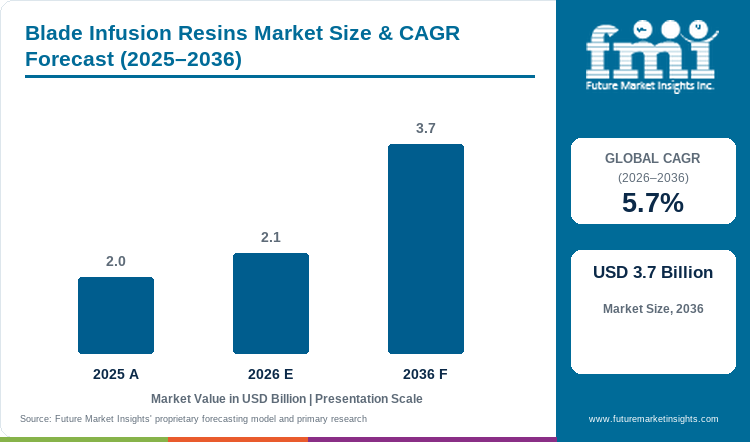
The blade infusion resins market is estimated at USD 2.1 Billion in 2026, up from USD 2 Billion in 2025.
Demand for blade infusion resins is projected to grow at a moderate pace during the forecast period at a CAGR of 5.7%. As per FMI’s analysis, sales of blade infusion resins are likely to grow to USD 3.7 Billion by 2036.
Primary drivers of the blade infusion resins market include increasing demand for lightweight materials in automative, aerospace, marine, and energy industries. Rising focus on renewable energy is also considered a key market driver, which is leading to an increase in installations of large-scale wind farms. Manufacturers are pushing the envelope of innovation through innovations in resin chemistries, especially in vinyl ester, epoxy, and polyester systems. FMI finds strong growth opportunities for the blade infusion resins market and wind blade bio-resin composites market across 30+ key countries, out of which some have been analyzed in the summary below.
As per FMI, revenue share across countries differs based on strategies key players follow and government policies. Key insights from Mexico suggest that players in the country are creating new routes for private renewable generation under measures announced by SENER in May 2026. Manufacturers in the South Korea market are combining offshore awards with stronger supply-chain and security criteria. Germany is already repowering a mature fleet while adding higher-capacity machines. Japan is redesigning offshore tender rules after three projects were withdrawn.
Analyst suggests that across these four markets among the other 30+ covered in the report, interest in the product converts to purchase only when a resin is qualified for the blade design and can be supplied on a production scale.
Key Takeaways
- As of 2026, key trends in blade infusion resins market point at a high sales potential of epoxy infusion at 57% share.
- Wind turbine blade innovations are happening at blade size of 50-80m. 33% of sales of blade infusion resins are for blade size of 50-80m, making it a high-demand category.
- A few of the notable companies profiled by FMI include Westlake Epoxy, Olin Epoxy, Huntsman, Sika, Gurit, Sicomin, Swancor, Aditya Birla Chemicals, and BASF, out of many players covered in the full report.
- Mexico (6.4%) and South Korea (6.1%) are all set to post the fastest CAGRs among profiled countries till 2036. Japan grows slowest, at 4.4%, because its offshore tender rules are being reset.
- Recyclable epoxy has reached commercial blades. As a result, recyclability claim can make or break manufacturers’ GTM strategy for buyers.
Analyst Perspective
“Revenue in blade infusion resins is won at qualification, not in the catalogue. If a resin fills a 100-meter mold without dry spots and cures on time as plant temperatures swing, it keeps its place on that platform for years. Recyclable and bio-based systems will gain share only by matching that factory performance. The suppliers best placed to prove it are the ones with technical-service people inside the blade plant.”
- Nikhil Kaitwade, Principal Consultant, Future Market Insights
How is the Blade Infusion Resins Market Segmented?
As per the analysis from FMI, the market is segmented by six categories. The split consists of Resin Type, Blade Size, Process, End Use, Sales Channel, and Region.
Resin type includes epoxy, polyester, vinyl ester and bio-based infusion resins, and toughened infusion systems. The blade size is studied across various categories, including below 50 m through 50-80 m and 80-100 m to above 100 m. The process is segmented into vacuum infusion, resin transfer molding, preform infusion and automated infusion lines. Based on the end use, the blade infusion resins market is segmented into onshore wind blades, offshore wind blades, blade repair/rebuild and prototype blades. Sales of blade infusion resins are handled through wind blade OEMs, composite material suppliers, direct resin supply and repair material distributors.
What makes Epoxy infusion resins central to the Resin Type category?
Fatigue resistance and high strength are key drivers to increasing sales of blade infusion resins manufactured with epoxy infusion. Polyester resins, despite being cost-efficient, settle for a lower market share, however, are increasingly witnessing high demand in non-critical automotive parts and marine industry. Demand for vinyl ester resins is anticipated to remain high and can be attributed to its corrosion resistance.
- Sales potential of epoxy infusion is projected to 57% of the market share in 2026 with adjustable hardener speed being its USP.
- Demand for formulated epoxy is growing and remains a key focal point for manufacturers. Gurit’s Wind Materials net sales rose 17.4% in continued operations at constant exchange rates in the first quarter of 2026.
Why do 50-80 m blades lead the Blade Size category?
As per FMI’s report, 50-80 m blades hold the largest share in 2026. Demand remains high and driven owing to their fit with the bulk of utility-scale onshore turbines. Factories build these blades in high numbers, which calls for industrial-scale infusion. France, an Engie executive said radar easements limit turbine heights to roughly 130-150 meters. In June 2026, repowering took 66% of the capacity awarded in France’s onshore tender. Most of those new turbines fall inside this size band. Smaller turbines will keep using blades below 50 m. FMI expects the 80-100 m and above-100 m classes to move mainly with offshore designs.
- Onshore turbine demand keeps 50-80 m blades in the lead, with 33.0% of blade size revenue in 2026.
- Repowering adds replacement demand. In June 2026, repowering projects won 535 MW of the 808 MW selected in France’s onshore tender.
How does Vacuum infusion anchor the Process category?
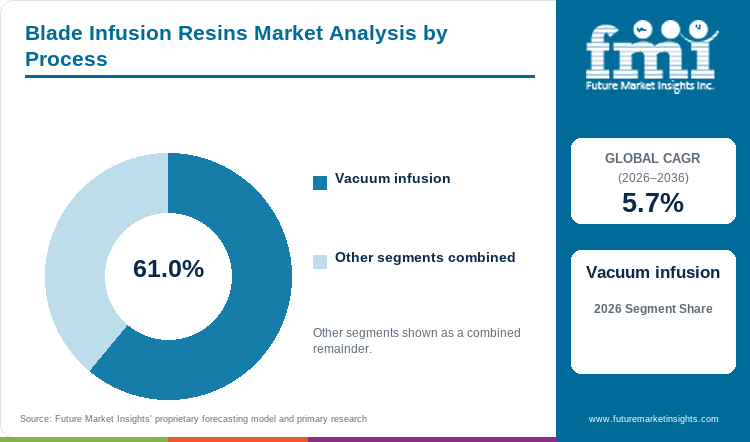
In terms of process, vacuum infusion remains the leading segment, as per FMI. The vacuum draws low-viscosity resin through the whole mold, which cuts dry spots and scrap on long shells. Resin transfer molding and preform infusion serve smaller or specialised parts. Automated infusion lines are gaining interest because plants want tighter control over how much resin goes where.
- Uniform fiber wet-out in large, closed molds keeps vacuum infusion in the lead, with 61.0% of process revenue in 2026.
- Suppliers are tuning resins to plant conditions. In July 2025, Sika issued a SikaBiresin CR80 data sheet that lists three hardeners with pot lives of 60, 190 and 330 minutes for vacuum infusion of wind and marine parts.
What supports Onshore wind blades in the End Use category?
In terms of end use, onshore wind blades hold the largest share. Demand is growing due to the sheer number of land-based wind farms and a steady run of repowering projects. The FMI report notes that offshore blades use more resin per blade because offshore blades are longer and face harsher weather. Offshore orders arrive in waves, so offshore volume swings more from year to year. Sales from repair/rebuild and prototype blades stay small and irregular.
- Large installation volumes and steady repowering keep onshore wind blades in the lead, with 49.0% of end use revenue in 2026.
- Onshore buildings are running at scale. GWEC counted 155.3 GW of new onshore wind worldwide in 2025, 42% more than the year before.
Why do Wind blade OEMs lead the Sales Channel category?
Based on sales channel, wind blade OEMs keep their lead in the current year. OEMs own the blade design and run the factory. An OEM decides which resin passes qualification. That decision gives the OEM control over purchase volumes.
- Control over material approval and serial buying keeps wind blade OEMs in the lead, with 44.0% of sales channel revenue in 2026.
- In August 2025, Swancor announced its work with Siemens Gamesa on the recyclable epoxy for the 108-meter blades at RWE’s Sofia offshore wind farm.
What are the drivers, restraints, and opportunities in the blade infusion resins market?
As per the analysis from FMI, bigger blades will keep pushing demand toward resins with tight process control. Qualification risk slows any change of material. Recyclable systems open a new revenue pool till 2036.
- Driver: Larger rotors and more wind installations raise both the volume of resin needed and the process demands placed on it.
- Restraint: One failed infusion can scrap a whole blade shell, so plants delay material changes until tests are complete.
- Opportunity: Recyclable and bio-based infusion systems can win approvals by matching standard epoxy on strength and factory cost.
Larger blades are the main demand driver
Demand is growing due to bigger turbines. A longer blade holds more resin and needs tighter control of flow and cure. A supplier that qualifies its resin on a new platform can sell into that platform for years. The build-out is large in absolute terms. GWEC reported 165 GW of wind capacity installed worldwide in 2025, of which 155.3 GW was onshore. Offshore projects push blade size furthest, with 15 MW turbines running in Germany and 108-meter blades going into the Sofia project. Blades of this size favor low-viscosity, fast-curing resins that fill quickly and free up mold time.
Qualification risk slows switching
Sales of new resin formulas move slowly because each one must pass factory trials. Resin behavior changes with reinforcement materials, release agents and plant temperature. In July 2025, Sika’s CR80 data sheet told users to test compatibility under real process conditions with the intended fibers and release agents. Those trials take months. As a result, buyers switch slowly, including in cases where a new resin costs less or has a lower carbon footprint. Suppliers who send application engineers to the plant shorten this cycle and tend to keep the account.
Which country CAGRs are profiled in the blade infusion resins market?
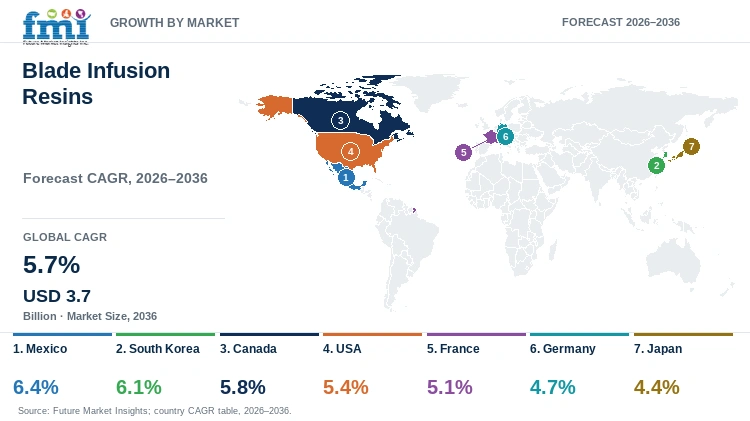
| Country | CAGR, 2026 to 2036 |
|---|---|
| Mexico | 6.4% |
| South Korea | 6.1% |
| Canada | 5.8% |
| USA | 5.4% |
| France | 5.1% |
| Germany | 4.7% |
| Japan | 4.4% |
How do country-level CAGRs compare?
As per the analysis from FMI, country CAGRs span 2.0 percentage points till 2036, from Mexico at 6.4% to Japan at 4.4%. Mexico and South Korea sit above 6.0%. Canada and the USA follow at 5.8% and 5.4%, with France at 5.1% and Germany at 4.7%. New project pipelines, repowering activity and the speed of resin qualification explain most of the gap.
- Mexico and South Korea grow fastest. Suppliers in both countries need local qualification and a credible supply chain before growth turns into repeat orders.
- In Canada and the USA, buyers reward local technical service and stock held near existing wind fleets.
- France and Germany favor productive processes, since mature composite supply chains already handle repowering and offshore work.
- Japan trails Mexico by 2.0 points as its offshore tender rules are being reset around project completion.
- Blade-factory presence, turbine mix and the timing of project awards all matter as much as the headline CAGR.
The full FMI report provides country-level CAGR analysis across North America, Latin America, Western Europe, Eastern Europe, East Asia, South Asia and Pacific, and the Middle East and Africa, covering 30+ countries.
Country Outlook
- The USA is forecasted to grow at a 5.4% CAGR from 2026 to 2036, primarily due to qualified blade programs in which engineering and purchasing teams sign off every material change together. GWEC ranked the USA as the second-largest wind market in 2025, with 6.9 GW installed. Requalification cost is the main hurdle. Any resin that changes flow or cure sends the blade back through testing.
- Germany’s sales of blade infusion resins are all set to grow at a 4.7% CAGR till 2036, primarily by repowering and larger turbines in a mature wind market. In January 2026, the Bundesnetzagentur reported that Germany added 4.6 GW of onshore wind in 2025, lifting the onshore fleet to 68.1 GW. Another 20.8 GW holds planning permission, which gives resin suppliers a visible pipeline.
- Offshore projects will primarily drive Japan’s demand, which is forecasted to grow at a 4.4% CAGR till 2036. Growth is slower because several projects stalled. In June 2026, METI and MLIT revised the offshore wind bidding guidelines after developers halted projects off Akita and Chiba. The new rules reward proof that a project can be finished and put less weight on speed.
- South Korea is all set to grow at a 6.1% CAGR over the forecast period, primarily due to offshore awards that favor local supply chains and pass strict security checks. In September 2025, the Ministry of Trade, Industry and Energy announced the selection of all four projects in the new public-led fixed-bottom category, totalling 689 MW.
- Canada’s demand is forecasted to grow at a 5.8% CAGR through 2036, primarily because wind is one of the country’s fastest-growing power sources, according to Natural Resources Canada’s Spring 2026 Energy Fact Book. Alberta leads the provinces with 5,533 MW of wind capacity. FMI’s analysis shows that cold weather and long distances push up stock and service costs. As a result, local support is crucial to consolidation in the market in Canada.
- Repowering remains a keyword for companies operating in France. Balde infusion resins market in France is forecasted to grow at a 5.1% CAGR over the next decade. Significant growth opportunities will arrive from onshore repowering, along with rising demand for very large offshore blades. In June 2026, the CRE reported the selection of 39 projects totalling 808 MW in the eleventh onshore wind tender, at an average of EUR 77.08/MWh. Repowering took 66% of that capacity. Height limits on some sites slow material decisions, which favors resins with long working life and suppliers who offer close application support.
- Mexico is all set to grow at a 6.4% CAGR during the forecast period owing to new openings for private renewable power rather than a large local blade industry. In May 2026, SENER, Mexico’s energy ministry, presented three investment instruments. Key players operating or eyeing to invest in Mexico needs to be vary of permissions and grid connections.
Who are the notable companies in the blade infusion resins market?
Westlake Epoxy, Olin Epoxy, Huntsman, Sika, Gurit, Sicomin, Swancor, Aditya Birla Chemicals, and BASF occupy the top spot in the blade infusion resins market, out of many players covered by FMI.
As per the analysis from FMI, consolidation in the market is proportional to its qualification in the process. The FMI report places the profiled suppliers in three strategy groups. Key companies include the ones operating across base resin, formulated systems and hardeners. Hexion is not profiled separately, because its former epoxy business, including its wind-blade systems, operates as Westlake Epoxy. On the buyer side, sales are heavily influenced by buyers comparing suppliers on process fit and technical support, along with supply security.
- Integrated Epoxy Producers with Wind Formulations: Westlake Epoxy, Olin Epoxy, and Huntsman make their own epoxy and sell low-viscosity infusion formulas. Westlake and Olin run wind-specific product lines.
- Formulated-System and Process-Support Specialists: Sika, Gurit, and Sicomin sell formulated resin systems together with process know-how. Product ranges include several hardener speeds, wind-focused epoxy products and bio-based options.
- Recyclable Chemistry and Curing-Agent Innovators: Swancor, Aditya Birla Chemicals, and BASF compete on chemistry. Swancor and Aditya Birla supply recyclable epoxy systems. BASF supplies amine curing agents to resin formulators.
Competitive Benchmarking
| Company | Dedicated Wind Infusion Systems | Large-Blade Process Support | Circular / Bio-based Pathway | Geographic Reach |
|---|---|---|---|---|
| Westlake Epoxy | High | High | High | North America, Europe, and Asia |
| Olin Epoxy | High | High | Low | North America, Europe, and Asia |
| Huntsman | Medium | Medium | Low | North America, Europe, and Asia-Pacific |
| Sika | High | High | Low | Europe, Americas, and Asia-Pacific |
| Gurit | High | High | Medium | Global, serving Western and Asian wind OEMs |
| Sicomin | Medium | Medium | High | Europe with international composites distribution |
| Swancor | High | High | High | East Asia with global wind OEM programs |
| Aditya Birla Chemicals | High | Medium | High | South and Southeast Asia with European wind customers |
| BASF | Medium | Medium | Low | Europe, North America, and Asia-Pacific |
Scoring basis: Dedicated Wind Infusion Systems measures whether public technical material documents resin-and-hardener systems specifically suited to wind blade infusion. Large-Blade Process Support measures documented control of viscosity and working time, along with application support for large composite parts. Circular / Bio-based Pathway measures documented recyclable or bio-based resin chemistry usable in infusion workflows. High indicates broad, clearly documented capability; Medium indicates credible but narrower documented capability; Low indicates limited public documentation for that criterion. Geographic Reach reflects evidenced sales, distribution or facility activity. In September 2026, FMI reviewed company public documentation to set these scores.
Key Developments
- In August 2025, Swancor announced that its recyclable epoxy, made in Taiwan, is used in 108-meter Siemens Gamesa RecyclableBlades.
- In April 2026, Leitwind adopted Aditya Birla Advanced Materials’ Recyclamine recyclable epoxy for the resin and bonding paste of its LS20.X_MK2 blade.
- In May 2026, Westlake Epoxy’s Deer Park, Texas site gained ISCC PLUS certification. As a result, its EpoVIVE mass-balance epoxy is entering new markets of Europe and the USA.
Key Players
Integrated Epoxy Producers with Wind Formulations
- Westlake Epoxy
- Olin Epoxy
- Huntsman
Formulated-System and Process-Support Specialists
- Sika
- Gurit
- Sicomin
Recyclable Chemistry and Curing-Agent Innovators
- Swancor
- Aditya Birla Chemicals
- BASF
Report Scope and Methodology
| Coverage field | Report scope |
|---|---|
| Market breakdown | 6 categories: Resin Type (Epoxy infusion resins, Polyester infusion resins, Vinyl ester infusion resins, Bio-based infusion resins, Toughened infusion systems), Blade Size (50-80 m blades, Below 50 m blades, 80-100 m blades, Above 100 m blades), Process (Vacuum infusion, Resin transfer molding, Preform infusion, Automated infusion lines), End Use (Onshore wind blades, Offshore wind blades, Blade repair/rebuild, Prototype blades), Sales Channel (Wind blade OEMs, Composite material suppliers, Direct resin supply, Repair material distributors), and Region |
| Quantitative units | USD Billion |
| Market definition | Revenue from resin-and-hardener systems sold for infusion of wind-turbine blade composite laminates within the stated segmentation. It excludes finished blades and turbines, fibers, cores, structural adhesives, coatings, gelcoats, tooling-only resins, prepregs, and adjacent substitute materials. |
| Regions covered | North America, Latin America, Western Europe, Eastern Europe, East Asia, South Asia and Pacific, Middle East and Africa |
| Countries covered | 30+ countries, including the USA, Germany, Japan, South Korea, Canada, France, and Mexico |
| Key companies profiled | A few of the notable companies out of many players covered by FMI: Westlake Epoxy, Olin Epoxy, Huntsman, Sika, Gurit, Sicomin, Swancor, Aditya Birla Chemicals, and BASF |
| Forecast period | 2026 to 2036 |
| Approach | FMI applies a hybrid bottom-up and top-down sizing framework that reconciles qualifying resin consumption, blade-production activity and supplier revenue signals with pricing and demand-side wind deployment indicators. |
Research Methodology
| Method | Approach |
|---|---|
| Primary research | FMI’s primary-research framework engages resin manufacturers, composite material suppliers, blade producers, distributors, procurement stakeholders and technical specialists to test qualification criteria, process windows, supply continuity, pricing behavior, cycle-time economics and repair demand. |
| Desk research | The analysis reviews government wind statistics, energy-regulator decisions, industry-body data, company filings, technical product documentation and public project announcements. FMI retains sources that define demand mechanisms, supplier roles, country conditions or material developments inside the market boundary. |
| Market sizing and forecasting | The sizing framework combines qualifying resin consumption per blade program with turbine and blade production trends, process mix, resin pricing, supplier participation, replacement demand and the timing of new wind projects. Forecasts consider platform scaling, qualification cycles, manufacturing capacity and resin-technology substitution. |
| Data validation | Supplier evidence is triangulated with demand-side wind indicators, and segment logic is checked against the revenue boundary. Downstream blade and turbine revenue, duplicate channel counting, tooling-only materials, structural adhesives, fibers, cores and coatings are excluded before final reconciliation. |
Blade Infusion Resins Market by Segments
Blade Infusion Resins Market Segmented by Resin Type
- Epoxy infusion resins
- Polyester infusion resins
- Vinyl ester infusion resins
- Bio-based infusion resins
- Toughened infusion systems
Blade Infusion Resins Market Segmented by Blade Size
- 50-80 m blades
- Below 50 m blades
- 80-100 m blades
- Above 100 m blades
Blade Infusion Resins Market Segmented by Process
- Vacuum infusion
- Resin transfer molding
- Preform infusion
- Automated infusion lines
Blade Infusion Resins Market Segmented by End Use
- Onshore wind blades
- Offshore wind blades
- Blade repair/rebuild
- Prototype blades
Blade Infusion Resins Market Segmented by Sales Channel
- Wind blade OEMs
- Composite material suppliers
- Direct resin supply
- Repair material distributors
Blade Infusion Resins Market Segmented by Region
- North America
- United States
- Canada
- Latin America
- Brazil
- Mexico
- Argentina
- Chile
- Western Europe
- Germany
- France
- United Kingdom
- Italy
- Spain
- Benelux
- Nordics
- Eastern Europe
- Poland
- Czech Republic
- Romania
- Hungary
- East Asia
- China
- Japan
- South Korea
- South Asia and Pacific
- India
- ASEAN
- Australia and New Zealand
- Middle East and Africa
- GCC Countries
- South Africa
- Türkiye
- Israel
Research Sources and Bibliography
- Global Wind Energy Council (2026, April 20). Global Wind Installations Rise Record 40% as Industry Charts Way Out of Energy Crisis.
- Bundesnetzagentur (2026, January 8). Growth in renewable energy in 2025.
- Ministry of Economy, Trade and Industry of Japan (2026, June 5). Revision of the Operating Guidelines for Competitive Bidding for Offshore Wind in General Sea Areas.
- Ministry of Trade, Industry and Energy of Korea (2025, September 1). Results of the First-Half 2025 Offshore Wind Competitive Bidding.
- Natural Resources Canada (2026, May). Energy Fact Book, Spring 2026 Edition.
- El Financiero (2026, May 11). SENER presenta instrumentos para detonar inversión en generación eléctrica por casi 740 mil mdp.
- Commission de régulation de l’énergie (2026, June 24). Délibération n°2026-129: onshore wind call for tenders, 11th period.
- Connaissance des Énergies / AFP (2026, July 8). Éolien terrestre compétitif: le renouvellement des parcs risque de vite trouver ses limites.
- Westlake Epoxy (2025, June 11). Westlake Epoxy Announces Strategic Collaboration With Alpha Recyclage Composites to Advance Composites Recycling.
- Westlake Corporation (2026, May 4). Westlake Epoxy’s Deer Park, Texas, Site Achieves ISCC PLUS Certification, Expanding EpoVIVE Mass Balance Offering Across Europe and the U.S..
- Olin Corporation (2026, January 29). Olin Announces Fourth Quarter 2025 Results.
- Sika (2025, July). SikaBiresin CR80 Product Data Sheet, Version 03.01.
- Gurit (2026, April 16). Gurit Reports Net Sales of CHF 75.9 Million in the First Quarter of 2026.
- Sicomin (2026, February 3). JEC World 2026: Sicomin showcases GreenPoxy and its CMR-free technology.
- BASF (2025, September 16). BASF Intermediates to produce amines at the Geismar site using 100 percent renewable electricity.
- Swancor (2025, August 29). Swancor Partners with Siemens Gamesa and RWE for Sofia Offshore Wind Farm.
- CompositesWorld (2026, April 24). Leitwind adopts Recyclamine for LS20.X wind turbine blade.
This bibliography is provided for reader reference and is not exhaustive. The full FMI report contains the complete reference list and detailed citations.
This Report Answers
- What is the Blade Infusion Resins Market size in 2026, and what value is FMI forecasting for 2036?
- Which wind-industry pressures and blade-manufacturing requirements will continue to support demand for blade infusion resins?
- Why are Epoxy infusion resins expected to hold the leading position within the Resin Type category in 2026?
- How will the 50-80 m blades category influence resin volume and process requirements?
- Why is Vacuum infusion expected to hold the leading position within the Process category?
- How do growth rates differ across the USA, Germany, Japan, South Korea, Canada, France, and Mexico till 2036?
- How should buyers assess the roles and capabilities of the profiled companies?
- How do qualification risk and infusion-process variability limit material switching?
- What should wind blade OEM procurement and engineering teams evaluate before selecting an infusion resin system?
Frequently Asked Questions
How big is the blade infusion resins market expected to be in 2026?
As per the analysis from FMI, the market is worth USD 2.1 billion in 2026 and will reach USD 3.7 billion by 2036. Demand is growing due to longer blades and a steady flow of new and repowered wind farms.
What is the CAGR of the blade infusion resins market from 2026 to 2036?
FMI forecasts a 5.7% CAGR from 2026 to 2036. The pace depends on how fast new blade platforms approve resin systems for serial production.
Which resin type holds the largest share?
Epoxy infusion resins stay formidable with 57.0% of resin type revenue in 2026. Popularity of epoxy infusion resins is high among blade makers owing to it resists fatigue and adjustable cure time in large laminates.
Which process leads the market?
Vacuum infusion is projected to hold 61.0% of process revenue in 2026. The vacuum pulls resin evenly through long closed molds and, in turn, remains a popular process.
Which country is expected to grow fastest?
Mexico is all set to grow at a 6.4% CAGR till 2036, ahead of South Korea at 6.1%. Japan is the slowest of the seven profiled countries at 4.4%, as its offshore tender rules are being reset.
What notable restraint affects the blade infusion resins market?
Qualification risk is the key restraint for growth in the market. Resin flow and cure shift with the fiber, the mold and plant temperature. A new material can pause production or create scrap. Hence, blade makers test it at length before buying in volume.
Which are the key companies in the blade infusion resins market?
Westlake Epoxy, Olin Epoxy, Huntsman, Sika, Gurit, Sicomin, Swancor, Aditya Birla Chemicals, and BASF are a few of the notable companies, out of many players covered by FMI.
Preview the report firsthand - request a free sample
Get SampleGet the brochure for pricing and purchase details.
Get PDFTable of Content
- Key Takeaways
- Market Size and CAGR
- Top Growth Driver
- Fastest Growing Segment
- Leading Region
- Key Companies
- Emerging Opportunities
- Executive Summary
- Global Market Outlook
- Demand-side Trends
- Supply-side Trends
- Technology Roadmap Analysis
- Analysis and Recommendations
- Analyst Perspective (What is happening? Why now? What should investors know?)
- Key Questions Answered
- How large is the market?
- What is the CAGR?
- What are key trends?
- Which region dominates?
- Who are the leaders?
- Market Overview
- Market Coverage / Taxonomy
- Market Definition / Scope / Limitations
- Research Methodology
- Chapter Orientation
- Analytical Lens and Working Hypotheses
- Market Structure, Signals, and Trend Drivers
- Benchmarking and Cross-market Comparability
- Market Sizing, Forecasting, and Opportunity Mapping
- Research Design and Evidence Framework
- Desk Research Programme (Secondary Evidence)
- Expert Input and Fieldwork (Primary Evidence)
- Tooling, Models, and Reference Databases
- Data Engineering and Model Build
- Quality Assurance and Audit Trail
- Market Background
- Market Dynamics (Drivers, Restraints, Opportunity, Trends)
- Scenario Forecast (Optimistic, Likely, Conservative)
- Impact Analysis
- AI Impact
- Sustainability Impact
- Regulatory Impact
- Technology Impact
- Consumer / Buyer Analysis
- Purchase Drivers
- Adoption Barriers
- Buyer Journey
- Opportunity Map Analysis
- Product Life Cycle Analysis
- Supply Chain Analysis
- Investment Feasibility Matrix
- Value Chain Analysis
- PESTLE and Porter's Analysis
- Regulatory Landscape
- Regional Parent Market Outlook
- Production and Consumption Statistics
- Import and Export Statistics
- Global Market Analysis and Forecast, 2021 to 2036
- Historical Market Size Value (USD Billion) Analysis, 2021 to 2025
- Current and Future Market Size Value (USD Billion) Projections, 2026 to 2036
- Y-o-Y Growth Trend Analysis
- Absolute $ Opportunity Analysis
- Global Market Pricing Analysis, 2021 to 2036
- Global Market Analysis and Forecast, By Resin Type, 2021 to 2036
- Introduction / Key Findings
- Historical Market Size Value (USD Billion) Analysis By Resin Type, 2021 to 2025
- Current and Future Market Size Value (USD Billion) Analysis and Forecast By Resin Type, 2026 to 2036
- Epoxy infusion resins
- Polyester infusion resins
- Vinyl ester infusion resins
- Bio-based infusion resins
- Toughened infusion systems
- Y-o-Y Growth Trend Analysis By Resin Type, 2021 to 2025
- Absolute $ Opportunity Analysis By Resin Type, 2026 to 2036
- Global Market Analysis and Forecast, By Blade Size, 2021 to 2036
- Introduction / Key Findings
- Historical Market Size Value (USD Billion) Analysis By Blade Size, 2021 to 2025
- Current and Future Market Size Value (USD Billion) Analysis and Forecast By Blade Size, 2026 to 2036
- 50-80 m blades
- Below 50 m blades
- 80-100 m blades
- Above 100 m blades
- Y-o-Y Growth Trend Analysis By Blade Size, 2021 to 2025
- Absolute $ Opportunity Analysis By Blade Size, 2026 to 2036
- Global Market Analysis and Forecast, By Process, 2021 to 2036
- Introduction / Key Findings
- Historical Market Size Value (USD Billion) Analysis By Process, 2021 to 2025
- Current and Future Market Size Value (USD Billion) Analysis and Forecast By Process, 2026 to 2036
- Vacuum infusion
- Resin transfer molding
- Preform infusion
- Automated infusion lines
- Y-o-Y Growth Trend Analysis By Process, 2021 to 2025
- Absolute $ Opportunity Analysis By Process, 2026 to 2036
- Global Market Analysis and Forecast, By End Use, 2021 to 2036
- Introduction / Key Findings
- Historical Market Size Value (USD Billion) Analysis By End Use, 2021 to 2025
- Current and Future Market Size Value (USD Billion) Analysis and Forecast By End Use, 2026 to 2036
- Onshore wind blades
- Offshore wind blades
- Blade repair/rebuild
- Prototype blades
- Y-o-Y Growth Trend Analysis By End Use, 2021 to 2025
- Absolute $ Opportunity Analysis By End Use, 2026 to 2036
- Global Market Analysis and Forecast, By Sales Channel, 2021 to 2036
- Introduction / Key Findings
- Historical Market Size Value (USD Billion) Analysis By Sales Channel, 2021 to 2025
- Current and Future Market Size Value (USD Billion) Analysis and Forecast By Sales Channel, 2026 to 2036
- Wind blade OEMs
- Composite material suppliers
- Direct resin supply
- Repair material distributors
- Y-o-Y Growth Trend Analysis By Sales Channel, 2021 to 2025
- Absolute $ Opportunity Analysis By Sales Channel, 2026 to 2036
- Global Market Analysis and Forecast, By Region, 2021 to 2036
- Introduction
- Historical Market Size Value (USD Billion) Analysis By Region, 2021 to 2025
- Current Market Size Value (USD Billion) Analysis and Forecast By Region, 2026 to 2036
- North America
- Latin America
- Western Europe
- Eastern Europe
- East Asia
- South Asia and Pacific
- Middle East and Africa
- Market Attractiveness Analysis By Region
- North America Market Analysis and Forecast, By Country, 2021 to 2036
- Historical Market Size Value (USD Billion) Trend Analysis By Market Taxonomy, 2021 to 2025
- Market Size Value (USD Billion) Forecast By Market Taxonomy, 2026 to 2036
- By Country
- United States
- Canada
- By Resin Type
- By Blade Size
- By Process
- By End Use
- By Sales Channel
- By Country
- Market Attractiveness Analysis
- By Country
- By Resin Type
- By Blade Size
- By Process
- By End Use
- By Sales Channel
- Key Takeaways
- Latin America Market Analysis and Forecast, By Country
- Historical Market Size Value (USD Billion) Trend Analysis By Market Taxonomy, 2021 to 2025
- Market Size Value (USD Billion) Forecast By Market Taxonomy, 2026 to 2036
- By Country
- Brazil
- Mexico
- Argentina
- Chile
- By Resin Type
- By Blade Size
- By Process
- By End Use
- By Sales Channel
- By Country
- Market Attractiveness Analysis
- By Country
- By Resin Type
- By Blade Size
- By Process
- By End Use
- By Sales Channel
- Key Takeaways
- Western Europe Market Analysis and Forecast, By Country
- Historical Market Size Value (USD Billion) Trend Analysis By Market Taxonomy, 2021 to 2025
- Market Size Value (USD Billion) Forecast By Market Taxonomy, 2026 to 2036
- By Country
- Germany
- France
- United Kingdom
- Italy
- Spain
- Benelux
- Nordics
- By Resin Type
- By Blade Size
- By Process
- By End Use
- By Sales Channel
- By Country
- Market Attractiveness Analysis
- By Country
- By Resin Type
- By Blade Size
- By Process
- By End Use
- By Sales Channel
- Key Takeaways
- Eastern Europe Market Analysis and Forecast, By Country
- Historical Market Size Value (USD Billion) Trend Analysis By Market Taxonomy, 2021 to 2025
- Market Size Value (USD Billion) Forecast By Market Taxonomy, 2026 to 2036
- By Country
- Poland
- Czech Republic
- Romania
- Hungary
- By Resin Type
- By Blade Size
- By Process
- By End Use
- By Sales Channel
- By Country
- Market Attractiveness Analysis
- By Country
- By Resin Type
- By Blade Size
- By Process
- By End Use
- By Sales Channel
- Key Takeaways
- East Asia Market Analysis and Forecast, By Country
- Historical Market Size Value (USD Billion) Trend Analysis By Market Taxonomy, 2021 to 2025
- Market Size Value (USD Billion) Forecast By Market Taxonomy, 2026 to 2036
- By Country
- China
- Japan
- South Korea
- By Resin Type
- By Blade Size
- By Process
- By End Use
- By Sales Channel
- By Country
- Market Attractiveness Analysis
- By Country
- By Resin Type
- By Blade Size
- By Process
- By End Use
- By Sales Channel
- Key Takeaways
- South Asia and Pacific Market Analysis and Forecast, By Country
- Historical Market Size Value (USD Billion) Trend Analysis By Market Taxonomy, 2021 to 2025
- Market Size Value (USD Billion) Forecast By Market Taxonomy, 2026 to 2036
- By Country
- India
- ASEAN
- Australia and New Zealand
- By Resin Type
- By Blade Size
- By Process
- By End Use
- By Sales Channel
- By Country
- Market Attractiveness Analysis
- By Country
- By Resin Type
- By Blade Size
- By Process
- By End Use
- By Sales Channel
- Key Takeaways
- Middle East and Africa Market Analysis and Forecast, By Country
- Historical Market Size Value (USD Billion) Trend Analysis By Market Taxonomy, 2021 to 2025
- Market Size Value (USD Billion) Forecast By Market Taxonomy, 2026 to 2036
- By Country
- GCC Countries
- South Africa
- Türkiye
- Israel
- By Resin Type
- By Blade Size
- By Process
- By End Use
- By Sales Channel
- By Country
- Market Attractiveness Analysis
- By Country
- By Resin Type
- By Blade Size
- By Process
- By End Use
- By Sales Channel
- Key Takeaways
- Key Countries Market Analysis
- United States
- Pricing Analysis
- Market Share Analysis, 2025
- By Resin Type
- By Blade Size
- By Process
- By End Use
- By Sales Channel
- Canada
- Pricing Analysis
- Market Share Analysis, 2025
- By Resin Type
- By Blade Size
- By Process
- By End Use
- By Sales Channel
- Mexico
- Pricing Analysis
- Market Share Analysis, 2025
- By Resin Type
- By Blade Size
- By Process
- By End Use
- By Sales Channel
- Brazil
- Pricing Analysis
- Market Share Analysis, 2025
- By Resin Type
- By Blade Size
- By Process
- By End Use
- By Sales Channel
- Chile
- Pricing Analysis
- Market Share Analysis, 2025
- By Resin Type
- By Blade Size
- By Process
- By End Use
- By Sales Channel
- Germany
- Pricing Analysis
- Market Share Analysis, 2025
- By Resin Type
- By Blade Size
- By Process
- By End Use
- By Sales Channel
- United Kingdom
- Pricing Analysis
- Market Share Analysis, 2025
- By Resin Type
- By Blade Size
- By Process
- By End Use
- By Sales Channel
- Italy
- Pricing Analysis
- Market Share Analysis, 2025
- By Resin Type
- By Blade Size
- By Process
- By End Use
- By Sales Channel
- Spain
- Pricing Analysis
- Market Share Analysis, 2025
- By Resin Type
- By Blade Size
- By Process
- By End Use
- By Sales Channel
- France
- Pricing Analysis
- Market Share Analysis, 2025
- By Resin Type
- By Blade Size
- By Process
- By End Use
- By Sales Channel
- India
- Pricing Analysis
- Market Share Analysis, 2025
- By Resin Type
- By Blade Size
- By Process
- By End Use
- By Sales Channel
- ASEAN
- Pricing Analysis
- Market Share Analysis, 2025
- By Resin Type
- By Blade Size
- By Process
- By End Use
- By Sales Channel
- Australia and New Zealand
- Pricing Analysis
- Market Share Analysis, 2025
- By Resin Type
- By Blade Size
- By Process
- By End Use
- By Sales Channel
- China
- Pricing Analysis
- Market Share Analysis, 2025
- By Resin Type
- By Blade Size
- By Process
- By End Use
- By Sales Channel
- Japan
- Pricing Analysis
- Market Share Analysis, 2025
- By Resin Type
- By Blade Size
- By Process
- By End Use
- By Sales Channel
- South Korea
- Pricing Analysis
- Market Share Analysis, 2025
- By Resin Type
- By Blade Size
- By Process
- By End Use
- By Sales Channel
- Poland
- Pricing Analysis
- Market Share Analysis, 2025
- By Resin Type
- By Blade Size
- By Process
- By End Use
- By Sales Channel
- Hungary
- Pricing Analysis
- Market Share Analysis, 2025
- By Resin Type
- By Blade Size
- By Process
- By End Use
- By Sales Channel
- Türkiye
- Pricing Analysis
- Market Share Analysis, 2025
- By Resin Type
- By Blade Size
- By Process
- By End Use
- By Sales Channel
- South Africa
- Pricing Analysis
- Market Share Analysis, 2025
- By Resin Type
- By Blade Size
- By Process
- By End Use
- By Sales Channel
- United States
- Market Structure Analysis
- Competition Dashboard
- Competition Benchmarking
- Market Share Analysis of Top Players
- By Regional
- By Resin Type
- By Blade Size
- By Process
- By End Use
- By Sales Channel
- Emerging Startups
- Innovation Benchmarking
- Competition Analysis
- Competition Deep Dive
- Westlake Epoxy
- Overview
- Product Portfolio
- Profitability by Market Segments
- Sales Footprint
- Strategy Overview
- Marketing Strategy
- Product Strategy
- Channel Strategy
- Olin Epoxy
- Huntsman
- Sika
- Gurit
- Sicomin
- Swancor
- Aditya Birla Chemicals
- BASF
- Westlake Epoxy
- Case Studies
- Success Stories
- Recent Developments
- Competition Deep Dive
- Assumptions & Acronyms Used


