

- Industry Size (2026)
- USD 3.5 Bn
- Forecast (2036)
- USD 7.0 Bn
- CAGR (2026 to 2036)
- 8.2%
Infusion Pumps Rental Market Forecast and Outlook 2026 to 2036
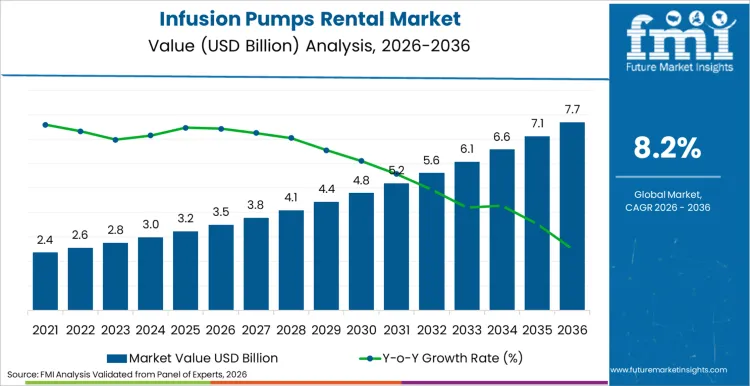
Infusion pumps rental market is anticipated to be worth USD 3.5 billion in 2026, driven by an urgent need to manage capital expenditure in healthcare facilities. Revenue generation is projected to expand at a steady CAGR of 8.2% through 2035, pushing total industry worth beyond USD 7.0 billion by the end of this period. Rising prevalence of chronic diseases requiring continuous medication delivery acts as a primary catalyst for this financial trajectory.
Hospitals are channeling significant operational budgets into leasing agreements, aiming to access advanced technology without heavy upfront investment. Administrators are shifting focus from purchasing assets to flexible on-demand models, redefining procurement habits in major healthcare economies. Such behavioral changes encourage medical device suppliers to introduce comprehensive rental packages that include maintenance and software updates.
Cost containment strategies in public and private health systems are significantly influencing industry expansion. Healthcare professionals emphasize operational efficiency, utilizing rental fleets to manage fluctuating patient volumes during seasonal peaks like flu outbreaks. Clinical trials investigating novel drug delivery mechanisms are creating temporary needs for specialized equipment, instilling confidence among rental providers regarding future demand spikes.
Growing awareness regarding the benefits of avoiding device obsolescence continues to fuel demand for leasing options, creating sustained opportunities for managed service providers. Government health initiatives targeting accessible care are facilitating wider adoption of rental models in community clinics. Companies are witnessing robust growth potential in developing nations, where optimizing limited budgets aligns perfectly with the pay-per-use philosophy.
Quick Stats for Infusion Pumps Rental Market
- Infusion Pumps Rental Industry Value (2026): USD 3.5 Billion
- Infusion Pumps Rental Industry Forecast Value (2035): USD 7.0 Billion
- Infusion Pumps Rental Industry Forecast CAGR: 8.2%
- Infusion Pumps Rental Industry Leading Form: Volumetric infusion pumps (32.0%)
- Infusion Pumps Rental Industry Leading End Use: Hospital inpatient care (38.0%)
- Infusion Pumps Rental Industry Leading Functionality: Fluid Delivery (Volumetric)
- Infusion Pumps Rental Industry Key Growth Regions: India, Brazil, China
- Infusion Pumps Rental Industry Key Players: Baxter, B. Braun, Fresenius Kabi, ICU Medical, Smiths Medical
Innovations in connectivity are transforming how leased devices integrate with hospital networks. Researchers are combining infusion pumps with wireless capabilities that allow remote programming and monitoring. Development of next generation infusion pump platforms is gaining traction, addressing safety concerns through smart dose-error reduction software. Focus is shifting toward comprehensive durable medical equipment rental contracts that cover entire fleet management. Advancements in home infusion therapy devices enable patients to receive complex treatments outside hospital walls, enhancing therapeutic outcomes while significantly reducing inpatient costs. These innovations are pivotal in shaping a future where equipment access is flexible and scalable.
Infusion Pumps Rental Market Key Takeaways
| Metric | Value |
|---|---|
| Industry Size (2026) | USD 3.5 Billion |
| Industry Value (2035) | USD 7.0 Billion |
| CAGR (2025-2035) | 8.2% |
Source: Future Market Insights’ proprietary forecasting model and primary research
What Factors Are Propelling Home Care Adoption?
Shift toward home-based treatment is serving as a significant catalyst for broader acceptance of rental medical devices. Recent breakthroughs in homecare medical devices have complemented treatment protocols by allowing safe administration of chemotherapy and antibiotics in domestic settings. This holistic approach appeals to payers and providers managing patients requiring long-term care. Clinical success of telemedicine equipment integration in remote monitoring has expanded prescribing precision. Education programs highlighting quality-of-life improvements associated with home infusion are driving patient proactivity. Pharmaceutical firms are capitalizing on these trends by introducing drugs compatible with ambulatory infusion pumps. Integrating patient controlled analgesia pumps into home palliative care is becoming standard practice, ensuring pain management does not require hospitalization.
How Is the Infusion Pumps Rental Market Structured Across Key Categories?
The infusion pumps rental market is structured across several key categories, primarily categorized based on the type of infusion pump, end-user segments, and geographical regions. Within the type category, infusion pumps are commonly divided into volumetric pumps, syringe pumps, patient-controlled analgesia (PCA) pumps, and disposable infusion pumps, each serving distinct medical applications in settings such as hospitals, home care, and specialty clinics. The end-users further segment the market into hospitals, ambulatory surgical centers, and home healthcare, with hospitals representing the largest share due to their high patient turnover and extensive use of infusion therapies.
Why Do Volumetric Infusion Pumps Maintain Dominance?
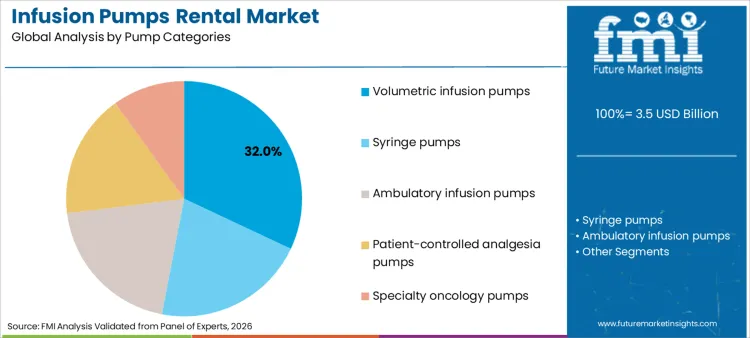
Volumetric infusion pumps account for 32% of share in 2026, driven by versatility in delivering fluids, blood, and medications. Leadership position is underpinned by clinical guidelines recommending precise large-volume delivery for critical care patients. Segment benefits from continuous software improvements, such as drug libraries that prevent medication errors. Research focused on interoperability is renewing interest among hospital IT directors. Critical role in multi-therapy infusion pumps further solidifies standing, as these devices can handle concurrent treatments. As healthcare systems prioritize cost-effective inventory management, demand for versatile volumetric units is expected to remain robust.
Why Is Hospital Inpatient Care the Preferred Setting?
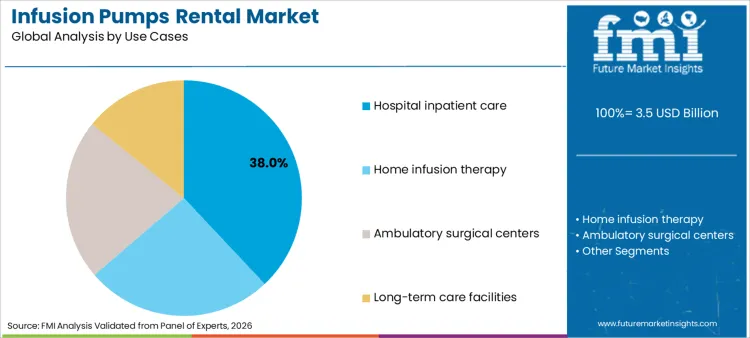
Hospital inpatient care commands 38% share of sector in 2026, reflecting global reliance on acute care facilities for complex treatments. Dominance is inextricably linked to need for immediate device availability during emergencies. Hospitals rely on specialized rapid infuser systems to manage trauma cases effectively. These settings are essential for monitoring unstable patients, driving priority status in equipment procurement budgets. Relentless pursuit of operational flexibility ensures products designed specifically for rental pools remain top priority. High patient turnover necessitates dynamic equipment supply, bolstering sustained revenue streams for rental providers.
How Will Smart Technology Impact Sales?
Smart pump adoption is set to reshape sales landscapes by enhancing medication safety and workflow efficiency. As advanced infusion systems evolve, hospitals access devices with bi-directional wireless communication, allowing real-time auto-programming. Shift toward connected health creates demand for rental fleets capable of EMR integration. Manufacturers failing to upgrade rental inventories with smart capabilities risk losing visibility among tech-forward institutions. Availability of mri compatible iv infusion pump systems for specialized departments drives complimentary consumption volume. Rise of data analytics stimulates innovation, with companies differentiating offerings by bundling hardware with usage utilization reports.
How Are Regulatory Frameworks Influencing Development?
Regulatory bodies are increasingly demanding rigorous maintenance records for rented medical devices, directly impacting operational costs. Shift forces rental providers to prove not just device functionality but also strict adherence to sterilization and calibration schedules. Opportunities for differentiation emerge as vendors demonstrating flawless compliance histories gain rapid endorsement. Strict cybersecurity standards impact deployment of connected pumps. Providers must ensure rigorous software patching to prevent data breaches. While regulations drive delivery of superior services, they impose higher compliance burdens. Companies proactively aligning with global guidelines regarding implantable infusion pump safety gain competitive edge, positioning brands as trusted partners.
How Will the Infusion Pumps Rental Industry Evolve in Major Nations?
Global landscape for infusion pump rental is characterized by diverse growth patterns, influenced by healthcare funding models and infrastructure maturity. Established markets prioritize fleet optimization and smart pump integration, whereas emerging economies rely on rentals to overcome capital constraints for basic equipment. Asia-Pacific is emerging as rapid growth hub due to expanding hospital networks and privatization of healthcare. Conversely, North American sectors pivot towards home care and specialty infusion services. Government initiatives in developing nations supporting critical care access ensure sustained demand for essential delivery systems across all geographies.
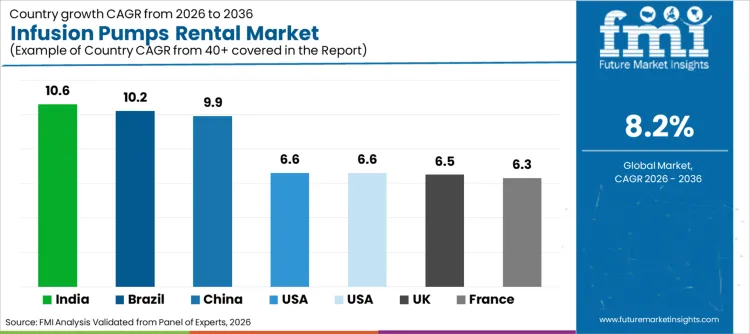
| Country | CAGR (2026 to 2036) |
|---|---|
| USA | 6.6% |
| Brazil | 10.2% |
| China | 9.9% |
| India | 10.6% |
| Germany | 6.6% |
| France | 6.3% |
| UK | 6.5% |
Source: Future Market Insights’ proprietary forecasting model and primary research
Why is the Infusion Pumps Rental Industry in the USA Growing?
Sales of infusion pump rentals in U.S. are set to grow at 6.6% CAGR through 2036. Expansion is underpinned by high prevalence of chronic conditions and robust united states durable medical equipment rental infrastructure. Growth is fueled by widespread shift towards outpatient and home-based care settings. Rapid adoption of advanced ambulatory pumps drives revenue generation per contract. Presence of major medical technology players headquartered within country streamlines supply chains. Emphasis on reducing hospital readmissions continues to be primary driver, maintaining U.S. position as critical revenue generator.
Why is the Infusion Pumps Rental Sector in China Expanding?
Demand for rental solutions in China is projected to rise at 9.9% CAGR during assessment period. Initiatives emphasizing hospital modernization foster favorable environment for domestic and international vendors. Increasing investment in tier-2 and tier-3 city hospitals creates massive supply channel for flexible equipment access. Rising patient volumes requiring intravenous therapy prompts local administrators to seek scalable solutions. Shift is supported by government policies encouraging private sector participation in healthcare, accelerating uptake of leasing models across country and fueling sector expansion.
Why is the Infusion Pumps Rental Industry in India Showing High Potential?
Infusion pumps rental industry in India is poised to expand at 10.6% CAGR, representing highest growth rate among analyzed nations. Surge is largely attributed to rapid expansion of corporate hospital chains and increasing penetration of health insurance. Government focus on improving critical care infrastructure encourages facilities to opt for rentals to minimize capex. Increasing partnerships between Indian distributors and global manufacturers necessitate availability of high-quality devices on lease. Cost advantages of rental models combined with rising middle-class demand for quality care attract significant investment. Limited capital budgets in public sector further drive adoption of opex-based procurement.
What is the Competitive Outlook for the Infusion Pumps Rental Market?
Market participants are increasingly focusing on service differentiation to capture value beyond hardware provision. Leading players like Baxter and B. Braun are directing investment toward digital platforms that track asset location and utilization rates. Significant trend involves developing therapeutic device management suites that offer predictive maintenance alerts. Companies actively engage in strategic collaborations with Group Purchasing Organizations (GPOs) to secure long-term contracts. Sustainability emerges as competitive frontier, with providers exploring circular economy models for device refurbishment. Consolidation activities remain high as large med-tech conglomerates acquire specialized rental firms to broaden their service portfolios against regional competitors.
Key Players in Infusion Pumps Rental Market
- Baxter
- B. Braun
- Fresenius Kabi
- ICU Medical
- Smiths Medical
Scope of Report
| Items | Values |
|---|---|
| Quantitative Units | USD Million, USD Billion |
| Pump Categories | Volumetric infusion pumps, Syringe pumps, Ambulatory infusion pumps, Patient-controlled analgesia pumps, Specialty oncology pumps |
| Use Cases | Hospital inpatient care, Home infusion therapy, Ambulatory surgical centers, Long-term care facilities |
| Rental Channels | Direct OEM rental, Third-party rental providers, Hospital-owned rental fleets, GPO-linked rental programs |
| Regions | North America, Europe, East Asia, South Asia, Latin America, MEA |
Infusion Pumps Rental Market by Segments
Pump Categories
- Volumetric infusion pumps
- Syringe pumps
- Ambulatory infusion pumps
- Patient-controlled analgesia pumps
- Specialty oncology pumps
Use Cases
- Hospital inpatient care
- Home infusion therapy
- Ambulatory surgical centers
- Long-term care facilities
Rental Channels
- Direct OEM rental
- Third-party rental providers
- Hospital-owned rental fleets
- GPO-linked rental programs
Regions
- North America
- Europe
- East Asia
- South Asia
- Latin America
- Middle East & Africa
Bibliography
- USA Food and Drug Administration. (2025, January 22). CDRHNew news and updates (including infusion pump safety updates and alerts). USA Food and Drug Administration, United States.
- World Health Organization. (2024, July 29). Medical device donations: Considerations for solicitation and provision (second edition). World Health Organization.
- Institute for Safe Medication Practices. (2024). Safe use of smart infusion pumps: Updated guidance on implementation, programming, and error prevention. Institute for Safe Medication Practices, United States.
- National Home Infusion Foundation. (2024, December 15). NHIF infusion industry trends report. National Home Infusion Foundation, United States.
- Infusion Nurses Society. (2024). Infusion therapy standards of practice: 2024 update overview. Infusion Nurses Society, United States.
Frequently Asked Questions
How large is the demand for Infusion Pumps Rental in the global market in 2026?
Demand for Infusion Pumps Rental in global market is estimated to be valued at USD 3.5 billion in 2026.
What will be the market size of Infusion Pumps Rental in the global market by 2035?
Market size for Infusion Pumps Rental is projected to reach USD 7.0 billion by 2035.
What is the expected demand growth for Infusion Pumps Rental in the global market between 2026 and 2035?
Demand for Infusion Pumps Rental in global market is expected to grow at CAGR of 8.2% between 2026 and 2035.
Which Pump Category is poised to lead global sales by 2026?
Volumetric infusion pumps are expected to be dominant category, capturing approximately 32% of global market share in 2026 due to versatile inpatient application.
How significant is the role of Hospital Inpatient Care in driving Infusion Pumps Rental adoption in 2026?
Hospital Inpatient Care represents critical use case, projected to hold substantial 38% share of total market in 2026 as facilities manage variable capacity needs.
Preview the report firsthand - request a free sample
Get SampleGet the brochure for pricing and purchase details.
Get PDFTable of Content
- Executive Summary
- Global Market Outlook
- Demand-side Trends
- Supply-side Trends
- Technology Roadmap Analysis
- Analysis and Recommendations
- Market Overview
- Market Coverage / Taxonomy
- Market Definition / Scope / Limitations
- Market Background
- Market Dynamics
- Drivers
- Restraints
- Opportunity
- Trends
- Scenario Forecast
- Demand in Optimistic Scenario
- Demand in Likely Scenario
- Demand in Conservative Scenario
- Opportunity Map Analysis
- Product Life Cycle Analysis
- Supply Chain Analysis
- Investment Feasibility Matrix
- Value Chain Analysis
- PESTLE and Porter’s Analysis
- Regulatory Landscape
- Regional Parent Market Outlook
- Production and Consumption Statistics
- Import and Export Statistics
- Market Dynamics
- Global Market Analysis 2021 to 2025 and Forecast, 2026 to 2036
- Historical Market Size Value (USD Million) Analysis, 2021 to 2025
- Current and Future Market Size Value (USD Million) Projections, 2026 to 2036
- Y-o-Y Growth Trend Analysis
- Absolute $ Opportunity Analysis
- Global Market Pricing Analysis 2021 to 2025 and Forecast 2026 to 2036
- Global Market Analysis 2021 to 2025 and Forecast 2026 to 2036, By Pump Categories
- Introduction / Key Findings
- Historical Market Size Value (USD Million) Analysis By Pump Categories , 2021 to 2025
- Current and Future Market Size Value (USD Million) Analysis and Forecast By Pump Categories , 2026 to 2036
- Volumetric infusion pumps
- Syringe pumps
- Ambulatory infusion pumps
- Patient-controlled analgesia pumps
- Specialty oncology pumps
- Volumetric infusion pumps
- Y-o-Y Growth Trend Analysis By Pump Categories , 2021 to 2025
- Absolute $ Opportunity Analysis By Pump Categories , 2026 to 2036
- Global Market Analysis 2021 to 2025 and Forecast 2026 to 2036, By Use Cases
- Introduction / Key Findings
- Historical Market Size Value (USD Million) Analysis By Use Cases, 2021 to 2025
- Current and Future Market Size Value (USD Million) Analysis and Forecast By Use Cases, 2026 to 2036
- Hospital inpatient care
- Home infusion therapy
- Ambulatory surgical centers
- Long-term care facilities
- Hospital inpatient care
- Y-o-Y Growth Trend Analysis By Use Cases, 2021 to 2025
- Absolute $ Opportunity Analysis By Use Cases, 2026 to 2036
- Global Market Analysis 2021 to 2025 and Forecast 2026 to 2036, By Rental Channels
- Introduction / Key Findings
- Historical Market Size Value (USD Million) Analysis By Rental Channels, 2021 to 2025
- Current and Future Market Size Value (USD Million) Analysis and Forecast By Rental Channels, 2026 to 2036
- Direct OEM rental
- Third-party rental providers
- Hospital-owned rental fleets
- GPO-linked rental programs
- Direct OEM rental
- Y-o-Y Growth Trend Analysis By Rental Channels, 2021 to 2025
- Absolute $ Opportunity Analysis By Rental Channels, 2026 to 2036
- Global Market Analysis 2021 to 2025 and Forecast 2026 to 2036, By Region
- Introduction
- Historical Market Size Value (USD Million) Analysis By Region, 2021 to 2025
- Current Market Size Value (USD Million) Analysis and Forecast By Region, 2026 to 2036
- North America
- Latin America
- Western Europe
- Eastern Europe
- East Asia
- South Asia and Pacific
- Middle East & Africa
- Market Attractiveness Analysis By Region
- North America Market Analysis 2021 to 2025 and Forecast 2026 to 2036, By Country
- Historical Market Size Value (USD Million) Trend Analysis By Market Taxonomy, 2021 to 2025
- Market Size Value (USD Million) Forecast By Market Taxonomy, 2026 to 2036
- By Country
- USA
- Canada
- Mexico
- By Pump Categories
- By Use Cases
- By Rental Channels
- By Country
- Market Attractiveness Analysis
- By Country
- By Pump Categories
- By Use Cases
- By Rental Channels
- Key Takeaways
- Latin America Market Analysis 2021 to 2025 and Forecast 2026 to 2036, By Country
- Historical Market Size Value (USD Million) Trend Analysis By Market Taxonomy, 2021 to 2025
- Market Size Value (USD Million) Forecast By Market Taxonomy, 2026 to 2036
- By Country
- Brazil
- Chile
- Rest of Latin America
- By Pump Categories
- By Use Cases
- By Rental Channels
- By Country
- Market Attractiveness Analysis
- By Country
- By Pump Categories
- By Use Cases
- By Rental Channels
- Key Takeaways
- Western Europe Market Analysis 2021 to 2025 and Forecast 2026 to 2036, By Country
- Historical Market Size Value (USD Million) Trend Analysis By Market Taxonomy, 2021 to 2025
- Market Size Value (USD Million) Forecast By Market Taxonomy, 2026 to 2036
- By Country
- Germany
- UK
- Italy
- Spain
- France
- Nordic
- BENELUX
- Rest of Western Europe
- By Pump Categories
- By Use Cases
- By Rental Channels
- By Country
- Market Attractiveness Analysis
- By Country
- By Pump Categories
- By Use Cases
- By Rental Channels
- Key Takeaways
- Eastern Europe Market Analysis 2021 to 2025 and Forecast 2026 to 2036, By Country
- Historical Market Size Value (USD Million) Trend Analysis By Market Taxonomy, 2021 to 2025
- Market Size Value (USD Million) Forecast By Market Taxonomy, 2026 to 2036
- By Country
- Russia
- Poland
- Hungary
- Balkan & Baltic
- Rest of Eastern Europe
- By Pump Categories
- By Use Cases
- By Rental Channels
- By Country
- Market Attractiveness Analysis
- By Country
- By Pump Categories
- By Use Cases
- By Rental Channels
- Key Takeaways
- East Asia Market Analysis 2021 to 2025 and Forecast 2026 to 2036, By Country
- Historical Market Size Value (USD Million) Trend Analysis By Market Taxonomy, 2021 to 2025
- Market Size Value (USD Million) Forecast By Market Taxonomy, 2026 to 2036
- By Country
- China
- Japan
- South Korea
- By Pump Categories
- By Use Cases
- By Rental Channels
- By Country
- Market Attractiveness Analysis
- By Country
- By Pump Categories
- By Use Cases
- By Rental Channels
- Key Takeaways
- South Asia and Pacific Market Analysis 2021 to 2025 and Forecast 2026 to 2036, By Country
- Historical Market Size Value (USD Million) Trend Analysis By Market Taxonomy, 2021 to 2025
- Market Size Value (USD Million) Forecast By Market Taxonomy, 2026 to 2036
- By Country
- India
- ASEAN
- Australia & New Zealand
- Rest of South Asia and Pacific
- By Pump Categories
- By Use Cases
- By Rental Channels
- By Country
- Market Attractiveness Analysis
- By Country
- By Pump Categories
- By Use Cases
- By Rental Channels
- Key Takeaways
- Middle East & Africa Market Analysis 2021 to 2025 and Forecast 2026 to 2036, By Country
- Historical Market Size Value (USD Million) Trend Analysis By Market Taxonomy, 2021 to 2025
- Market Size Value (USD Million) Forecast By Market Taxonomy, 2026 to 2036
- By Country
- Kingdom of Saudi Arabia
- Other GCC Countries
- Turkiye
- South Africa
- Other African Union
- Rest of Middle East & Africa
- By Pump Categories
- By Use Cases
- By Rental Channels
- By Country
- Market Attractiveness Analysis
- By Country
- By Pump Categories
- By Use Cases
- By Rental Channels
- Key Takeaways
- Key Countries Market Analysis
- USA
- Pricing Analysis
- Market Share Analysis, 2025
- By Pump Categories
- By Use Cases
- By Rental Channels
- Canada
- Pricing Analysis
- Market Share Analysis, 2025
- By Pump Categories
- By Use Cases
- By Rental Channels
- Mexico
- Pricing Analysis
- Market Share Analysis, 2025
- By Pump Categories
- By Use Cases
- By Rental Channels
- Brazil
- Pricing Analysis
- Market Share Analysis, 2025
- By Pump Categories
- By Use Cases
- By Rental Channels
- Chile
- Pricing Analysis
- Market Share Analysis, 2025
- By Pump Categories
- By Use Cases
- By Rental Channels
- Germany
- Pricing Analysis
- Market Share Analysis, 2025
- By Pump Categories
- By Use Cases
- By Rental Channels
- UK
- Pricing Analysis
- Market Share Analysis, 2025
- By Pump Categories
- By Use Cases
- By Rental Channels
- Italy
- Pricing Analysis
- Market Share Analysis, 2025
- By Pump Categories
- By Use Cases
- By Rental Channels
- Spain
- Pricing Analysis
- Market Share Analysis, 2025
- By Pump Categories
- By Use Cases
- By Rental Channels
- France
- Pricing Analysis
- Market Share Analysis, 2025
- By Pump Categories
- By Use Cases
- By Rental Channels
- India
- Pricing Analysis
- Market Share Analysis, 2025
- By Pump Categories
- By Use Cases
- By Rental Channels
- ASEAN
- Pricing Analysis
- Market Share Analysis, 2025
- By Pump Categories
- By Use Cases
- By Rental Channels
- Australia & New Zealand
- Pricing Analysis
- Market Share Analysis, 2025
- By Pump Categories
- By Use Cases
- By Rental Channels
- China
- Pricing Analysis
- Market Share Analysis, 2025
- By Pump Categories
- By Use Cases
- By Rental Channels
- Japan
- Pricing Analysis
- Market Share Analysis, 2025
- By Pump Categories
- By Use Cases
- By Rental Channels
- South Korea
- Pricing Analysis
- Market Share Analysis, 2025
- By Pump Categories
- By Use Cases
- By Rental Channels
- Russia
- Pricing Analysis
- Market Share Analysis, 2025
- By Pump Categories
- By Use Cases
- By Rental Channels
- Poland
- Pricing Analysis
- Market Share Analysis, 2025
- By Pump Categories
- By Use Cases
- By Rental Channels
- Hungary
- Pricing Analysis
- Market Share Analysis, 2025
- By Pump Categories
- By Use Cases
- By Rental Channels
- Kingdom of Saudi Arabia
- Pricing Analysis
- Market Share Analysis, 2025
- By Pump Categories
- By Use Cases
- By Rental Channels
- Turkiye
- Pricing Analysis
- Market Share Analysis, 2025
- By Pump Categories
- By Use Cases
- By Rental Channels
- South Africa
- Pricing Analysis
- Market Share Analysis, 2025
- By Pump Categories
- By Use Cases
- By Rental Channels
- USA
- Market Structure Analysis
- Competition Dashboard
- Competition Benchmarking
- Market Share Analysis of Top Players
- By Regional
- By Pump Categories
- By Use Cases
- By Rental Channels
- Competition Analysis
- Competition Deep Dive
- Baxter
- Overview
- Product Portfolio
- Profitability by Market Segments (Product/Age /Sales Channel/Region)
- Sales Footprint
- Strategy Overview
- Marketing Strategy
- Product Strategy
- Channel Strategy
- B. Braun
- Fresenius Kabi
- ICU Medical
- Smiths Medical
- Baxter
- Competition Deep Dive
- Assumptions & Acronyms Used
- Research Methodology


