

- Industry Size (2026)
- USD 1467.6 Mn
- Forecast (2036)
- USD 3139.3 Mn
- CAGR (2026 to 2036)
- 7.9%
Elastomeric Infusion Pumps Market Forecast and Outlook 2026 to 2036
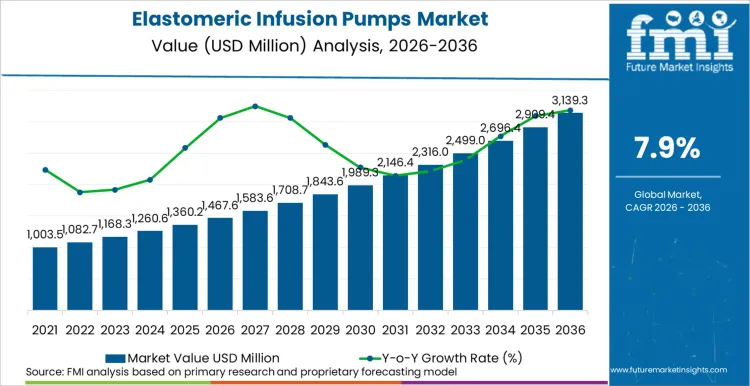
Future Market Insights anticipates the global elastomeric infusion pumps market to expand steadily over the 2026 to 2036 period, growing from USD 1,467.6 million in 2026 to USD 3,139.3 million by 2036, reflecting a CAGR of 7.9%. This growth trajectory is being driven by rising utilization of continuous-rate and variable-rate elastomeric pumps in pain management, chemotherapy, and anti-infective therapies, particularly in ambulatory surgical centers and home care settings. According to FMI’s analysis, healthcare systems are increasingly favoring elastomeric infusion devices as practical alternatives to electronic pumps, especially in outpatient environments where reliability, portability, and minimal training requirements are critical.
As per FMI, the trend of decentralization in the provision of care is one of the major trends in the market. The hospital market is slowly moving the infusion therapy process from an inpatient to an outpatient or home care setting, thus reducing the cost of care. This is also expected to further consolidate the market for single-use elastomeric infusion pumps that have a fixed flow rate, are easy to maintain, and are compatible with various types of drugs. The concern for patient safety and infection control is also influencing the market trends, particularly in North America, Europe, and the Asia-Pacific region.
These trends are also evident in the recent developments among the major players in the market. The major players are continuously enhancing their elastomeric pump offerings with improved accuracy of flow rate, increased infusion time, and improved material compatibility to meet the requirements of the oncology and long-term infusion therapy markets. Not surprisingly, the leadership of Baxter has emphasized the enabling effect of simplified infusion technology in expanding care beyond the hospital.
Michael Greiner, Avanos Medical's interim CEO, stated “The inclusion of ON-Q and ambIT pumps under the NOPAIN Act is a testament to the devices' effectiveness in reducing opioid use after surgery. We commend CMS for their commitment to improving patient access to non-opioid therapies, and we are dedicated to collaborating with healthcare professionals to advocate for proven non-opioid treatments."
The focus of manufacturers on aligning their product development efforts with the changing care environments, especially in hospitals, ambulatory surgical centers, and home care organizations, is helping them shift their focus from being mere commodity device suppliers to application-based infusion solution providers. This capability-based approach is expected to improve competitive differentiation and thus fuel the adoption of elastomeric infusion pumps in the global healthcare environment until the end of 2036.
Summary of Elastomeric Infusion Pumps Market
What Is Growth Outlook for Elastomeric Infusion Pumps Market as per Future Market Insights Projection?
Future Market Insights projects the elastomeric infusion pumps market to expand at a CAGR of 7.9% from 2026 to 2036, increasing from USD 1,467.6 million in 2026 to USD 3,139.3 million by 2036.
FMI Research Approach: Historical market size, product-type penetration, therapy-specific infusion demand, ambulatory care growth rates, and country-level adoption trends were assessed to model demand through 2036.
How Do FMI Analysts Perceive Elastomeric Infusion Pumps Market to Evolve?
Future Market Insights states that, the elastomeric infusion pump demand is increasingly driven by decentralization of care delivery, with expanded use in outpatient pain management, chemotherapy, and long-duration antibiotic therapy. The market is evolving toward broader clinical integration as healthcare providers seek low-maintenance infusion solutions that reduce training burden, minimize electronic failure risk, and support patient mobility.
FMI Research Approach: Assessment focused on shifts in site-of-care delivery, therapy expansion beyond acute pain management, device reliability expectations, and procurement preferences across hospitals and ambulatory settings.
Which Country Holds Largest Share in Global Elastomeric Infusion Pumps Market?
The United States holds the largest share in the global elastomeric infusion pumps market, supported by high surgical procedure volumes, strong adoption of ambulatory pain management protocols, and widespread utilization of home infusion services. Established reimbursement structures and early acceptance of disposable infusion technologies continue to support market leadership.
FMI Research Approach: Country-level analysis incorporated procedure volumes, ambulatory surgery penetration, home infusion adoption, reimbursement structures, and regulatory acceptance of disposable infusion devices.
How Large Will Elastomeric Infusion Pumps Market Be by 2036?
The global elastomeric infusion pumps market is projected to reach USD 3,139.3 million by 2036, supported by sustained utilization across hospital-based, ambulatory, and home-care infusion pathways.
FMI Research Approach: Market sizing was derived by modeling pump utilization by therapy area, replacement frequency, and weighted adoption across end-user segments.
How are Care Delivery Shifts Fueling Elastomeric Infusion Pump Adoption?
As per FMI, shifts toward outpatient treatment, reduced hospital length of stay, and home-based drug delivery are accelerating adoption of elastomeric infusion pumps. Their portability, ease of use, and independence from power sources align well with decentralized care models and infection control priorities.
FMI Research Approach: Trends including ambulatory surgery growth, home-care expansion, and therapy decentralization were integrated into forecasting models to refine demand estimates.
Elastomeric Infusion Pumps Market Key Takeaways
| Metric | Details |
|---|---|
| Industry Size (2026) | USD 1,467.6 million |
| Industry Value (2036) | USD 3,139.3 million |
| CAGR (2026-2036) | 7.9% |
Source: Future Market Insights (FMI) analysis, based on proprietary forecasting model and primary research
Why is the Demand for Elastomeric Infusion Pumps Growing?
The demand for elastomeric infusion pumps on the rise as the healthcare infrastructure begins to focus on the need for simplified, mobile, and patient-friendly infusion delivery. The shift towards ambulatory and home healthcare is lessening the dependence on electronic infusion pumps for low- to moderate-risk therapies, especially in pain management, chemotherapy, and long-term antimicrobial therapy. The elastomeric infusion pump is being preferred for its reliable flow rates, low complexity of use, and compatibility with infection control practices. The elastomeric infusion pump is being seen as a viable solution in the evolving infusion therapy landscape.
How is the Elastomeric Infusion Pumps Market Segmented?
The elastomeric infusion pumps market is segmented by product type, application, and end user. By product type, the market includes continuous rate elastomeric infusion pumps and variable rate elastomeric infusion pumps. Based on application, demand is categorized into pain management, chemotherapy, antibiotics and antiviral therapy, anesthesia, and other clinical uses. By end user, the market is segmented into hospitals, ambulatory surgical centers, home care settings, clinics, and other healthcare facilities. This segmentation reflects differences in infusion duration requirements, care setting intensity, and therapy administration protocols.
How Do Continuous Rate Elastomeric Pumps Secure Market Leadership?
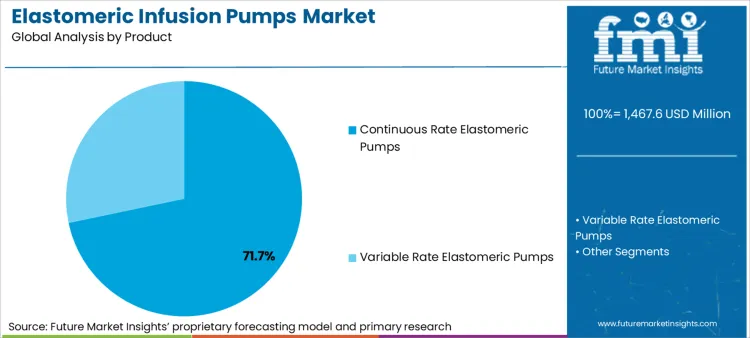
According to Future Market Insights, continuous rate elastomeric infusion pumps currently dominate the market for elastomeric infusion pumps globally because of their ability to provide a consistent flow of medication without the use of electronic control systems. These pumps currently have a projected market share of 71.7% of total product demand because of their widespread use in pain management, chemotherapy, and post-operative antibiotic therapy, where uninterrupted and predictable infusion of medication is medically imperative. The simplicity and portability of these pumps, which do not require any power source, make them highly ideal for use in outpatient and home care settings.
Continuous rate infusion pumps are preferred for their simplicity and lack of potential for programming errors, which make them ideal for use in settings where medication administration is less likely to be supervised by highly trained medical professionals. Their compatibility with disposable, single-use treatment models is also in line with infection control practices and requires less maintenance.
How Does Pain Management Lead Elastomeric Infusion Pump Demand?
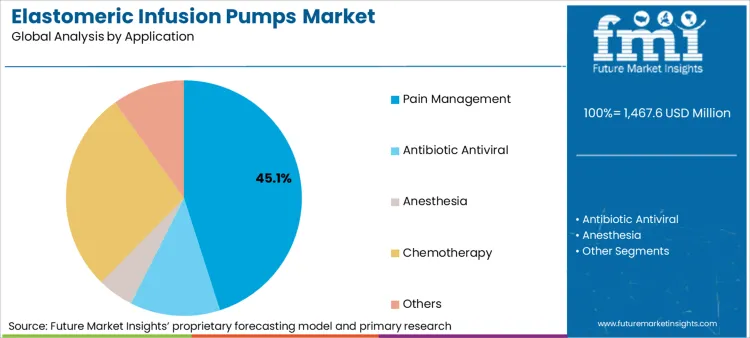
As per a research study carried out by Future Market Insights, pain management is the most important application of elastomeric infusion pumps, accounting for 45.1% of the overall use of elastomeric infusion pumps. Elastomeric infusion pumps are increasingly being used for post-operative pain management, orthopedic rehabilitation, and chronic pain management, where the continuous and controlled infusion of analgesics has been proven to be effective in improving patient comfort and reducing the need for intermittent infusion. Elastomeric infusion pumps assist in maintaining a constant plasma concentration of drugs, which is necessary for effective pain management.
The most important application of elastomeric infusion pumps is further supported by the rising trend of adopting enhanced recovery after surgery (ERAS) protocols, which emphasize early mobilization and opioid-free strategies. Elastomeric infusion pumps make the possibility of adopting ambulatory pain management strategies, which enable patients to manage their own treatment at home. With the rising number of surgeries and the rising trend of pain management strategies towards ambulatory and home-based management, this application area continues to be the most important driver of elastomeric infusion pump sales.
How Are Regulatory Frameworks Influencing Safer Infusion Device Selection?
The control of infusion therapy by regulation is becoming more focused on patient safety, accuracy of dosing, and reliable device function, thus affecting the purchase of elastomeric infusion pumps. The demand for better medication safety and the avoidance of electronic failure has resulted in the preference for mechanically driven systems that do not need batteries or software assistance. Infection control measures are also contributing to the use of single-use, disposable infusion devices that avoid cross-contamination.
Hospitals are incorporating device selection with risk management and regulatory requirements, particularly in outpatient and home infusion therapy. As a result, elastomeric infusion pumps that have been shown to have accurate flow rates and standardized manufacturing are now being prioritized, thus ensuring the safety and reliability of infusion therapy with elastomeric infusion pumps.
Why Is the Shift Toward Home-Based Care Reshaping Demand Patterns?
The increasing trend of home care and ambulatory care is one of the key drivers in the dynamics of elastomeric infusion pump demand. Such settings require infusion pumps that are portable, lightweight, and easy to operate without continuous monitoring. Elastomeric infusion pumps cater to this requirement by facilitating long-term infusion with the patient being mobile and comfortable.
The increasing use of elastomeric infusion pumps by healthcare providers to reduce hospitalization costs, particularly for pain management and antibiotic infusion, is expected to make elastomeric infusion pumps the pillars of decentralized healthcare delivery.
How Are Product Design Improvements Driving Market Innovation?
Innovation in elastomeric infusion pumps is being driven by advancements in the accuracy of flow rates, strength of materials, and design of the reservoir. The companies are trying to optimize the quality of elastomers to ensure that the infusion rate is constant despite the temperature variations. Innovation in designs that help in priming, have a low residual volume of drugs, and are patient-friendly is also becoming the need of the day.
Innovation in technology is ensuring that there is clinical acceptance and that the challenges posed by the variability in elastomeric infusion pumps are met. With the increasing use of infusion therapy in more outpatient centers, design innovation is an important differentiator.
How Will Elastomeric Infusion Pumps Market Expansion Unfold Across Key Global Regions?
Future Market Insights identifies the United States (CAGR ~7.5%), China (~10.8%), India (~10.2%), Germany (~8.6%), the United Kingdom (~8.9%), and Japan (~7.6%) as the six core demand drivers for elastomeric infusion pumps globally. The USA leads the market with widespread adoption of the device in ambulatory care, oncology infusion, and post-surgical pain management procedures. China and India drive the market with the development of hospital infrastructure, rising chemotherapy procedures, and a focus on cost-effective outpatient drug delivery. Germany maintains the market with organized infusion therapy procedures and strong adoption in home care settings. The UK market expands with value-based care strategies and NHS-driven transition to community-based infusion services. Japan’s market demand is driven by aging populations and the adoption of elastomeric pumps in long-term and chronic care procedures. FMI emphasizes that these countries have mature healthcare systems and a rising level of outpatient care intensity, ensuring the demand for elastomeric infusion pumps is robust until 2036.
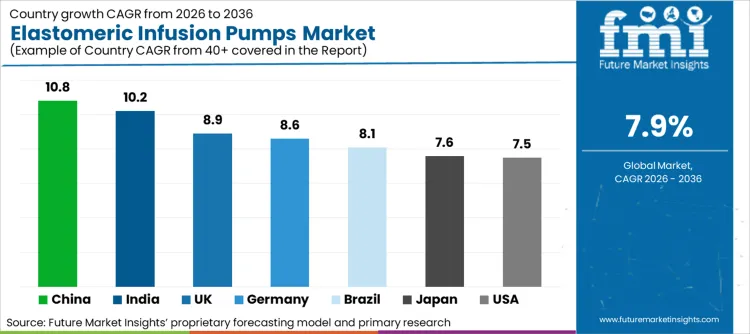
| Country | CAGR (2026-2036) |
|---|---|
| China | 10.8% |
| India | 10.2% |
| United Kingdom | 8.9% |
| Germany | 8.6% |
| Japan | 7.6% |
| United States | 7.5% |
Source: Future Market Insights (FMI) analysis, based on proprietary forecasting model and primary research
Is Ambulatory and Home-Based Infusion Redefining Elastomeric Pump Demand in the United States?
As per the analysis by Future Market Insights, the USA elastomeric infusion pumps market is expected to register a CAGR of 7.5%, largely driven by the ambulatory infusion therapy trend, outpatient oncology procedures, and post-operative pain management. Elastomeric infusion pumps are in high demand due to their portability, simplicity, and less reliance on electronic programming, making them suitable for home care and ambulatory surgical center procedures. As per FMI, hospital systems are increasingly adopting elastomeric infusion pumps to decrease inpatient length of stay and infusion-related operational burdens. Reimbursement standardization for outpatient drug delivery also supports the growth of the market.
How Is China’s Expanding Hospital and Oncology Infrastructure Accelerating Adoption?
As per Future Market Insights, the elastomeric infusion pumps market in China is expected to grow at a CAGR of 10.8%, driven by the rapid development of cancer care infrastructure and the adoption of continuous infusion therapy in tertiary care centers. The increasing incidence of cancer and the subsequent availability of chemotherapy are also fueling the demand for a dependable and disposable infusion solution that does not rely on electronic infusion pumps. Analysts at FMI note that the adoption of elastomeric infusion pumps is gaining momentum because of their application in high-volume infusion settings and low maintenance requirements.
Why Is India Emerging as a High-Growth Market for Elastomeric Infusion Pumps?
India as one of the fastest-growing markets, with an estimated CAGR of 10.2%, which is fueled by the growing availability of chemotherapy, the rise in the number of surgeries performed, and the adoption of ambulatory infusion practices. Indian hospitals and cancer treatment facilities are increasingly adopting elastomeric pumps to deal with the cost challenges while still being able to ensure infusion accuracy and patient mobility. FMI points out that the adoption of elastomeric pumps is further fueled by the rise in the number of private hospital chains and the growing penetration of home infusion practices in urban areas.
Does Germany’s Structured Infusion Therapy Framework Sustain Stable Demand?
According to FMI, the elastomeric infusion pumps market in Germany is expected to register a CAGR of 8.6%, driven by the established infusion therapy practices and adoption in home care and outpatient facilities. The German healthcare sector values standardized infusion practices that reduce complexity and ensure patient safety. FMI observes that elastomeric infusion pumps are increasingly being incorporated into chronic pain management, antibiotic treatment, and oncology practices. The regulatory focus on patient safety and continuity of treatment practices drives value-based demand rather than volume growth.
How Is the United Kingdom’s Shift Toward Community Care Influencing Market Growth?
The UK elastomeric infusion pumps market is projected to register an 8.9% CAGR, driven by initiatives from the NHS to provide community-based care and decrease hospital reliance. Elastomeric infusion pumps are increasingly being used for outpatient chemotherapy, antibiotic therapy, and pain management post-discharge. Analysts at FMI highlight that the ease of use and disposability of elastomeric infusion pumps are well-suited to the NHS’s efficiency goals. Fiscal responsibility and strategic procurement practices promote established and efficient infusion technologies, leading to steady growth.
Is Japan’s Aging Population Driving Long-Term Elastomeric Pump Utilization?
The elastomeric infusion pumps market in Japan is expected to grow at a CAGR of 7.6% during the forecast period, owing to the rapidly aging population of Japan and the growing number of cases of chronic diseases that require infusion. Japanese healthcare facilities demand pumps that are accurate, reliable, and comfortable for the patient. Elastomeric infusion pumps are the best option for long-term infusion in home and long-term care facilities. The use of elastomeric infusion pumps is driven by their growing use in oncology, palliative care, and post-surgical recovery.
What Strategic Moves Are Defining Competitive Landscape?
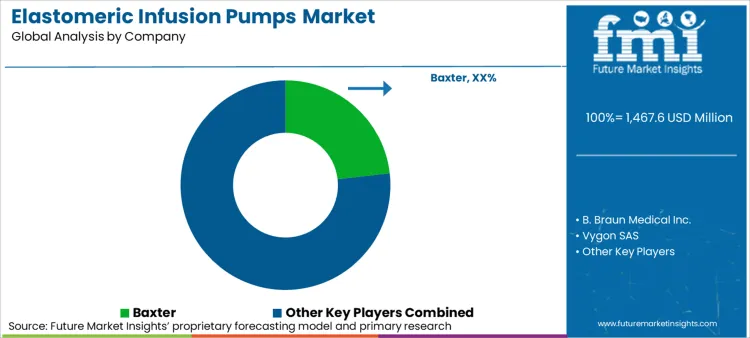
The competition in the elastomeric infusion pumps market is gradually moving from technology and digitalization to therapy-specific reliability, ambulatory care compatibility, and ease-of-use optimization. The major players in the market are attempting to improve the accuracy of flow rate, durability of elastomers, and portability of devices to make extended drug delivery in outpatient and home care settings easier, particularly for pain management, chemotherapy, and antibiotic/antiviral therapy.
Another important strategic area is the integration of elastomeric infusion pump products with ambulatory surgical centers and home care facilities, where non-electronic and disposable infusion products can reduce infrastructure complexities and requirements. The major players in the market, including Baxter and B. Braun Medical Inc., are attempting to position elastomeric infusion pumps as a reliable alternative to electronic infusion devices by emphasizing the simplicity of the device, reliability, and ease of use.
The rising trend of differentiation based on product segmentation by flow-rate configuration, where companies are optimizing Continuous Rate Elastomeric Pumps and Variable Rate Elastomeric Pumps according to certain clinical protocols and durations of drug delivery. The focus on regulatory requirements, biocompatibility, and expansion in the high-growth markets of China, India, and Brazil is also changing the scenario. All these factors are likely to shift the competition scenario to reliable and application-suited infusion solutions until 2036.
Recent Developments:
- On December, 2025, Spirit Medical wrapped up a successful few days at NAPS 2025, celebrating 60 years of the symposium while reconnecting with clinicians and partners. The event marked the debut of MedFuser®, our next-generation elastomeric pump, developed with UK pain specialists to advance safer, smarter pain management.
- On August 11, 2025, AleraCare, a leading provider of infusion and specialty pharmacy services across the USA, and PURE Healthcare, a leading national medical group that delivers healthcare services for individuals, announced that the businesses have entered into a definitive merger agreement.
- In November 2024, Avanos Medical stated that CMS issued the final 2025 Medicare OPPS and ASC payment rule, confirming that ON-Q elastomeric and ambIT disposable electronic infusion pump non-opioid pain management systems meet NOPAIN Act qualification requirements. This enables separate Medicare payment for the first time, with HOPDs and ASCs receiving additional reimbursement beyond the related APC payments starting January 1, 2025.
Key Players in Elastomeric Infusion Pumps Market
- Baxter
- B. Braun Medical Inc.
- Vygon SAS
- Ambu Inc.
- Nipro Europe Group Companies
- Leventon S.A.U. (Werfen company)
- Avanos Medical, Inc.
- Daiken Iki Corporation
- Ace Medical
- Heka s.r.l.
- Others
Market Definition
The Elastomeric Infusion Pumps Market is defined as the global market that is engaged in the production, distribution, and application of mechanical, non-electronic infusion pumps that are designed to dispense drugs at a controlled rate of flow through the use of elastomeric pressure systems. The elastomeric infusion pumps are used in pain management, chemotherapy, antibiotic/antiviral therapy, anesthesia, and other types of infusion therapies that require a long period of infusion and are typically practiced in ambulatory infusion therapy settings.
The market also comprises elastomeric infusion pumps that meet the relevant regulatory requirements for medical devices and are used in a regulated healthcare setting. The products covered in the market include Continuous Rate Elastomeric Pumps and Variable Rate Elastomeric Pumps, which come with reservoirs, flow restrictors, and tubing assemblies and are used in Hospitals, Ambulatory Surgical Centers, Home Care Settings, Clinics, and Other healthcare facilities.
The market excludes electronic infusion pumps, syringe infusion pumps, insulin infusion pumps, implantable infusion systems, and programmable infusion devices that use electrical or digital control mechanisms. Additionally, the market does not include standard IV administration sets, gravity-driven infusion devices, drug containers that do not have elastomeric flow control functionality, and infusion accessories that are not part of an elastomeric pump system. Furthermore, products for veterinary use, research, or non-medical applications are not within the scope of the market.
Scope of Report
| Items | Values |
|---|---|
| Quantitative Units (2026) | USD 1,467.6 Million |
| By Product | Continuous Rate Elastomeric Pumps; Variable Rate Elastomeric Pumps |
| By Application | Pain Management; Antibiotic/Antiviral; Anesthesia; Chemotherapy; Others |
| End Users | Hospitals; Ambulatory Surgical Centers; Home Care Settings; Clinics; Other |
| Regions Covered | North America, Europe, Asia Pacific, Latin America, Middle East & Africa |
| Countries Covered | USA, Germany, China, Japan, India, Brazil, and 40+ countries |
| Key Companies Profiled | Baxter; B. Braun Medical Inc.; Vygon SAS; Ambu Inc.; Nipro Europe Group Companies; Leventon S.A.U.; Avanos Medical, Inc.; Daiken Iki Corporation |
| Additional Attributes | Revenue analysis by product and application, assessment of ambulatory and home care adoption trends, competitive positioning based on reliability, therapy focus, and regulatory compliance |
Elastomeric Infusion Pumps Market by Segments
By Product:
- Continuous Rate Elastomeric Pumps
- Variable Rate Elastomeric Pumps
By Application:
- Pain Management
- Antibiotic/Antiviral
- Anesthesia
- Chemotherapy
- Others
End Users
- Hospitals
- Ambulatory Surgical Centers
- Home Care Settings
- Clinics
- Other
By Region:
- North America
- Europe
- East Asia
- South Asia
- Latin America
- Middle East & Africa
Bibliography
- USA Food and Drug Administration. (2024). Infusion Pumps Total Product Life Cycle: Guidance for Industry and FDA Staff. FDA.
- International Organization for Standardization. (2024). ISO 28620: Non-electrically Driven Portable Infusion Devices. ISO.
- European Medicines Agency. (2024). Medical Device Regulation (EU MDR) Clinical Evaluation Guidance for Drug Delivery Systems. EMA.
- World Health Organization. (2024). WHO Technical Specifications for Infusion Devices Used in Chemotherapy and Pain Management. WHO.
- Association for the Advancement of Medical Instrumentation. (2023). Performance and Safety Standards for Disposable and Elastomeric Infusion Pumps. AAMI.
- National Institute for Health and Care Excellence. (2023). Home-Based Infusion Therapy and Ambulatory Drug Delivery: Clinical Effectiveness Review. NICE.
Frequently Asked Questions
What is the current global market size for elastomeric infusion pumps?
The global elastomeric infusion pumps market is valued at USD 1,467.6 million in 2026, supported by expanding adoption of ambulatory drug delivery across pain management, oncology, and anti-infective therapies.
What is the projected CAGR for the market over the next 10 years?
The market is projected to grow at a 7.9% CAGR from 2026 to 2036, driven by decentralization of care delivery and increasing preference for disposable, non-electronic infusion systems.
Which regions are experiencing the fastest expansion?
India and China are witnessing the fastest expansion, with growth rates exceeding 10%, supported by rising chemotherapy volumes, outpatient infusion adoption, and expanding hospital-to-home care transition.
What are the primary market drivers?
Rising demand for continuous pain management, chemotherapy delivery outside inpatient settings, infection control advantages of single-use pumps, and cost containment pressures collectively drive market expansion.
Who are the leading suppliers in the industry?
Baxter, B. Braun Medical, and Avanos Medical remain leading suppliers, differentiating through broad elastomeric pump portfolios, clinical validation across therapeutic areas, and strong hospital and ambulatory care penetration.
Preview the report firsthand - request a free sample
Get SampleGet the brochure for pricing and purchase details.
Get PDFTable of Content
- Executive Summary
- Global Market Outlook
- Demand-side Trends
- Supply-side Trends
- Technology Roadmap Analysis
- Analysis and Recommendations
- Market Overview
- Market Coverage / Taxonomy
- Market Definition / Scope / Limitations
- Research Methodology
- Chapter Orientation
- Analytical Lens and Working Hypotheses
- Market Structure, Signals, and Trend Drivers
- Benchmarking and Cross-market Comparability
- Market Sizing, Forecasting, and Opportunity Mapping
- Research Design and Evidence Framework
- Desk Research Programme (Secondary Evidence)
- Company Annual and Sustainability Reports
- Peer-reviewed Journals and Academic Literature
- Corporate Websites, Product Literature, and Technical Notes
- Earnings Decks and Investor Briefings
- Statutory Filings and Regulatory Disclosures
- Technical White Papers and Standards Notes
- Trade Journals, Industry Magazines, and Analyst Briefs
- Conference Proceedings, Webinars, and Seminar Materials
- Government Statistics Portals and Public Data Releases
- Press Releases and Reputable Media Coverage
- Specialist Newsletters and Curated Briefings
- Sector Databases and Reference Repositories
- FMI Internal Proprietary Databases and Historical Market Datasets
- Subscription Datasets and Paid Sources
- Social Channels, Communities, and Digital Listening Inputs
- Additional Desk Sources
- Expert Input and Fieldwork (Primary Evidence)
- Primary Modes
- Qualitative Interviews and Expert Elicitation
- Quantitative Surveys and Structured Data Capture
- Blended Approach
- Why Primary Evidence is Used
- Field Techniques
- Interviews
- Surveys
- Focus Groups
- Observational and In-context Research
- Social and Community Interactions
- Stakeholder Universe Engaged
- C-suite Leaders
- Board Members
- Presidents and Vice Presidents
- R&D and Innovation Heads
- Technical Specialists
- Domain Subject-matter Experts
- Scientists
- Physicians and Other Healthcare Professionals
- Governance, Ethics, and Data Stewardship
- Research Ethics
- Data Integrity and Handling
- Primary Modes
- Tooling, Models, and Reference Databases
- Desk Research Programme (Secondary Evidence)
- Data Engineering and Model Build
- Data Acquisition and Ingestion
- Cleaning, Normalisation, and Verification
- Synthesis, Triangulation, and Analysis
- Quality Assurance and Audit Trail
- Market Background
- Market Dynamics
- Drivers
- Restraints
- Opportunity
- Trends
- Scenario Forecast
- Demand in Optimistic Scenario
- Demand in Likely Scenario
- Demand in Conservative Scenario
- Opportunity Map Analysis
- Product Life Cycle Analysis
- Supply Chain Analysis
- Investment Feasibility Matrix
- Value Chain Analysis
- PESTLE and Porter’s Analysis
- Regulatory Landscape
- Regional Parent Market Outlook
- Production and Consumption Statistics
- Import and Export Statistics
- Market Dynamics
- Global Market Analysis 2021 to 2025 and Forecast, 2026 to 2036
- Historical Market Size Value (USD Million) Analysis, 2021 to 2025
- Current and Future Market Size Value (USD Million) Projections, 2026 to 2036
- Y-o-Y Growth Trend Analysis
- Absolute $ Opportunity Analysis
- Global Market Pricing Analysis 2021 to 2025 and Forecast 2026 to 2036
- Global Market Analysis 2021 to 2025 and Forecast 2026 to 2036, By Product
- Introduction / Key Findings
- Historical Market Size Value (USD Million) Analysis By Product , 2021 to 2025
- Current and Future Market Size Value (USD Million) Analysis and Forecast By Product , 2026 to 2036
- Continuous Rate Elastomeric Pumps
- Variable Rate Elastomeric Pumps
- Continuous Rate Elastomeric Pumps
- Y-o-Y Growth Trend Analysis By Product , 2021 to 2025
- Absolute $ Opportunity Analysis By Product , 2026 to 2036
- Global Market Analysis 2021 to 2025 and Forecast 2026 to 2036, By Application
- Introduction / Key Findings
- Historical Market Size Value (USD Million) Analysis By Application, 2021 to 2025
- Current and Future Market Size Value (USD Million) Analysis and Forecast By Application, 2026 to 2036
- Pain Management
- Antibiotic Antiviral
- Anesthesia
- Chemotherapy
- Others
- Pain Management
- Y-o-Y Growth Trend Analysis By Application, 2021 to 2025
- Absolute $ Opportunity Analysis By Application, 2026 to 2036
- Global Market Analysis 2021 to 2025 and Forecast 2026 to 2036, By End Users
- Introduction / Key Findings
- Historical Market Size Value (USD Million) Analysis By End Users, 2021 to 2025
- Current and Future Market Size Value (USD Million) Analysis and Forecast By End Users, 2026 to 2036
- Hospitals
- Ambulatory Surgical Centers
- Home Care Settings
- Clinics
- Other
- Hospitals
- Y-o-Y Growth Trend Analysis By End Users, 2021 to 2025
- Absolute $ Opportunity Analysis By End Users, 2026 to 2036
- Global Market Analysis 2021 to 2025 and Forecast 2026 to 2036, By Region
- Introduction
- Historical Market Size Value (USD Million) Analysis By Region, 2021 to 2025
- Current Market Size Value (USD Million) Analysis and Forecast By Region, 2026 to 2036
- North America
- Latin America
- Western Europe
- Eastern Europe
- East Asia
- South Asia and Pacific
- Middle East & Africa
- Market Attractiveness Analysis By Region
- North America Market Analysis 2021 to 2025 and Forecast 2026 to 2036, By Country
- Historical Market Size Value (USD Million) Trend Analysis By Market Taxonomy, 2021 to 2025
- Market Size Value (USD Million) Forecast By Market Taxonomy, 2026 to 2036
- By Country
- USA
- Canada
- Mexico
- By Product
- By Application
- By End Users
- By Country
- Market Attractiveness Analysis
- By Country
- By Product
- By Application
- By End Users
- Key Takeaways
- Latin America Market Analysis 2021 to 2025 and Forecast 2026 to 2036, By Country
- Historical Market Size Value (USD Million) Trend Analysis By Market Taxonomy, 2021 to 2025
- Market Size Value (USD Million) Forecast By Market Taxonomy, 2026 to 2036
- By Country
- Brazil
- Chile
- Rest of Latin America
- By Product
- By Application
- By End Users
- By Country
- Market Attractiveness Analysis
- By Country
- By Product
- By Application
- By End Users
- Key Takeaways
- Western Europe Market Analysis 2021 to 2025 and Forecast 2026 to 2036, By Country
- Historical Market Size Value (USD Million) Trend Analysis By Market Taxonomy, 2021 to 2025
- Market Size Value (USD Million) Forecast By Market Taxonomy, 2026 to 2036
- By Country
- Germany
- UK
- Italy
- Spain
- France
- Nordic
- BENELUX
- Rest of Western Europe
- By Product
- By Application
- By End Users
- By Country
- Market Attractiveness Analysis
- By Country
- By Product
- By Application
- By End Users
- Key Takeaways
- Eastern Europe Market Analysis 2021 to 2025 and Forecast 2026 to 2036, By Country
- Historical Market Size Value (USD Million) Trend Analysis By Market Taxonomy, 2021 to 2025
- Market Size Value (USD Million) Forecast By Market Taxonomy, 2026 to 2036
- By Country
- Russia
- Poland
- Hungary
- Balkan & Baltic
- Rest of Eastern Europe
- By Product
- By Application
- By End Users
- By Country
- Market Attractiveness Analysis
- By Country
- By Product
- By Application
- By End Users
- Key Takeaways
- East Asia Market Analysis 2021 to 2025 and Forecast 2026 to 2036, By Country
- Historical Market Size Value (USD Million) Trend Analysis By Market Taxonomy, 2021 to 2025
- Market Size Value (USD Million) Forecast By Market Taxonomy, 2026 to 2036
- By Country
- China
- Japan
- South Korea
- By Product
- By Application
- By End Users
- By Country
- Market Attractiveness Analysis
- By Country
- By Product
- By Application
- By End Users
- Key Takeaways
- South Asia and Pacific Market Analysis 2021 to 2025 and Forecast 2026 to 2036, By Country
- Historical Market Size Value (USD Million) Trend Analysis By Market Taxonomy, 2021 to 2025
- Market Size Value (USD Million) Forecast By Market Taxonomy, 2026 to 2036
- By Country
- India
- ASEAN
- Australia & New Zealand
- Rest of South Asia and Pacific
- By Product
- By Application
- By End Users
- By Country
- Market Attractiveness Analysis
- By Country
- By Product
- By Application
- By End Users
- Key Takeaways
- Middle East & Africa Market Analysis 2021 to 2025 and Forecast 2026 to 2036, By Country
- Historical Market Size Value (USD Million) Trend Analysis By Market Taxonomy, 2021 to 2025
- Market Size Value (USD Million) Forecast By Market Taxonomy, 2026 to 2036
- By Country
- Kingdom of Saudi Arabia
- Other GCC Countries
- Turkiye
- South Africa
- Other African Union
- Rest of Middle East & Africa
- By Product
- By Application
- By End Users
- By Country
- Market Attractiveness Analysis
- By Country
- By Product
- By Application
- By End Users
- Key Takeaways
- Key Countries Market Analysis
- USA
- Pricing Analysis
- Market Share Analysis, 2025
- By Product
- By Application
- By End Users
- Canada
- Pricing Analysis
- Market Share Analysis, 2025
- By Product
- By Application
- By End Users
- Mexico
- Pricing Analysis
- Market Share Analysis, 2025
- By Product
- By Application
- By End Users
- Brazil
- Pricing Analysis
- Market Share Analysis, 2025
- By Product
- By Application
- By End Users
- Chile
- Pricing Analysis
- Market Share Analysis, 2025
- By Product
- By Application
- By End Users
- Germany
- Pricing Analysis
- Market Share Analysis, 2025
- By Product
- By Application
- By End Users
- UK
- Pricing Analysis
- Market Share Analysis, 2025
- By Product
- By Application
- By End Users
- Italy
- Pricing Analysis
- Market Share Analysis, 2025
- By Product
- By Application
- By End Users
- Spain
- Pricing Analysis
- Market Share Analysis, 2025
- By Product
- By Application
- By End Users
- France
- Pricing Analysis
- Market Share Analysis, 2025
- By Product
- By Application
- By End Users
- India
- Pricing Analysis
- Market Share Analysis, 2025
- By Product
- By Application
- By End Users
- ASEAN
- Pricing Analysis
- Market Share Analysis, 2025
- By Product
- By Application
- By End Users
- Australia & New Zealand
- Pricing Analysis
- Market Share Analysis, 2025
- By Product
- By Application
- By End Users
- China
- Pricing Analysis
- Market Share Analysis, 2025
- By Product
- By Application
- By End Users
- Japan
- Pricing Analysis
- Market Share Analysis, 2025
- By Product
- By Application
- By End Users
- South Korea
- Pricing Analysis
- Market Share Analysis, 2025
- By Product
- By Application
- By End Users
- Russia
- Pricing Analysis
- Market Share Analysis, 2025
- By Product
- By Application
- By End Users
- Poland
- Pricing Analysis
- Market Share Analysis, 2025
- By Product
- By Application
- By End Users
- Hungary
- Pricing Analysis
- Market Share Analysis, 2025
- By Product
- By Application
- By End Users
- Kingdom of Saudi Arabia
- Pricing Analysis
- Market Share Analysis, 2025
- By Product
- By Application
- By End Users
- Turkiye
- Pricing Analysis
- Market Share Analysis, 2025
- By Product
- By Application
- By End Users
- South Africa
- Pricing Analysis
- Market Share Analysis, 2025
- By Product
- By Application
- By End Users
- USA
- Market Structure Analysis
- Competition Dashboard
- Competition Benchmarking
- Market Share Analysis of Top Players
- By Regional
- By Product
- By Application
- By End Users
- Competition Analysis
- Competition Deep Dive
- Baxter
- Overview
- Product Portfolio
- Profitability by Market Segments (Product/Age /Sales Channel/Region)
- Sales Footprint
- Strategy Overview
- Marketing Strategy
- Product Strategy
- Channel Strategy
- B. Braun Medical Inc.
- Vygon SAS
- Ambu Inc.
- Nipro Europe Group Companies
- Leventon, S.A.U. (Werfen company)
- Avanos Medical, Inc.
- Daiken Iki Corporation
- Ace Medical.
- Heka s.r.l.
- Others
- Baxter
- Competition Deep Dive
- Assumptions & Acronyms Used


