

- Market Size (2026)
- USD 1.3 Bn
- Forecast (2036)
- USD 2.8 Bn
- CAGR (2026 to 2036)
- 8.0%
How big is Botanical Cleansing Oil Market size?
USD 1.3 billion in 2026 and USD 2.8 billion by 2036 at an 8.0% CAGR.
Demand for botanical cleansing oil is projected to expand at 8.0% CAGR between 2026 and 2036, increasing valuation from USD 1.3 billion in 2026 to USD 2.8 billion by 2036. Oil-soluble formula ingredients dissolve heavy makeup and sunscreen effectively during the initial cleansing step. The FANCL Report 2024 documented a 13.0% increase in sales for ATTENIR Cosmetics since shoppers eagerly purchased the Skin Clear Cleanse Oil. Daily face-washing routines generate continuous demand for gentle facial cleansers worldwide.
Detailed ingredient lists and clear fragrance disclosures remain top priorities for buyers across the United States and Germany. Affordability and locally sourced botanical oils strongly attract consumers throughout China and India. Korean Culture and Information Service confirmed a 20.4% surge in overseas online cosmetics sales throughout 2025. Rapid expansion across global e-commerce platforms actively connects international shoppers with new botanical cleansing routines.
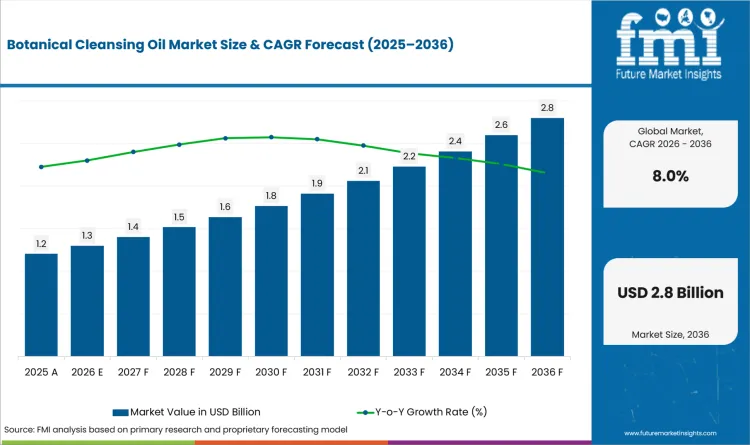
Key Takeaways for the Botanical Cleansing Oil Market
- Double-cleansing routines support demand for botanical cleansing oils as effective makeup and sunscreen removal combines with comfortable rinsing to encourage continued home use across regular evening skincare routines.
- Individual consumers are forecast to lead end user with 58.0% share in 2026, aided by recurring home-use routines and direct assessment of texture and rinsing comfort.
- Offline retail is likely to represent 42.0% share of distribution channel in 2026, driven by tester access and immediate comparison across competing cleansing textures.
- Comedogenicity concerns and oxidation exposure restrict repeat purchasing as unsupported natural claims reduce confidence in botanical cleansing oil quality.
- Competition focusses on Shiseido Co., Ltd., KOSÉ Corporation, DHC Corporation, The Face Shop, FANCL Corporation, Sulwhasoo, Tatcha LLC, The Body Shop, Clarins Group, and Caudalie, with providers differentiating based on cleansing performance and botanical formulation expertise.
Analyst Perspective
“Botanical cleansing oils earn repeat demand from reliable removal and comfortable rinsing. Ingredient narratives attract initial attention. Formula stability and skin tolerance decide continued use. Companies connecting plant-based positioning with proven cleansing performance are better placed for routine adoption.”
- Rahul Pandita, Principal Analyst for Food and Beverage at Future Market Insights
How is Botanical Cleansing Oil Market segmented?
The botanical cleansing oil industry is segmented by product type, application, end user, distribution channel, ingredient type, and region.
The botanical cleansing oil sector is segmented by product type, application, end user, distribution channel, ingredient type, and region. Product type separates pure and blended formulations. Organic options form a separate product group. Sensitive-skin and multifunctional oils complete product type coverage. Application covers facial cleansing and makeup removal. End user includes individual consumers and professional care settings. Distribution channel covers store-based and online routes. Ingredient type addresses plant oils and supporting botanical components. Regional coverage follows the source report breakdown.
What keeps pure botanical cleansing oils central to product type selection?
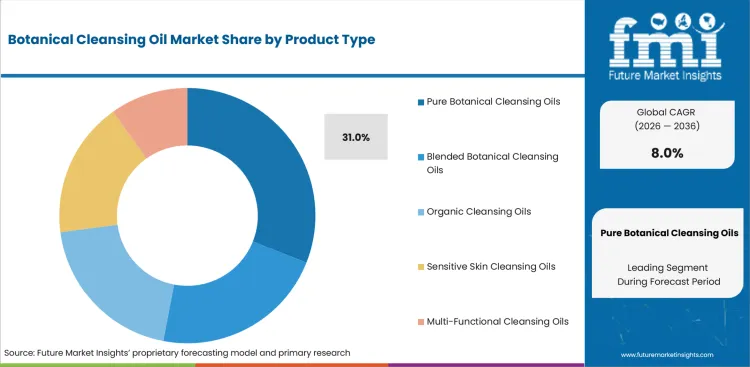
Pure botanical cleansing oils appeal to buyers seeking concise plant-derived formulas. Product acceptance rests on residue dissolution and clean emulsification. Australian Industrial Chemicals Introduction Scheme published 4 chemical assessment statements in January 2026, including cosmetic components intended for personal care and facial use. Published assessments strengthen safety review across botanical cleansing formulas.
- Pure botanical cleansing oils are predicted to represent 31.0% share of product type in 2026, driven by transparent ingredient narratives and consumer familiarity with facial oils. Continued leadership requires stable formulas delivering thorough makeup removal without persistent film or excessive fragrance exposure.
- Blended botanical cleansing oils balance spreading quality with controlled rinsing across varied skin preferences. Organic and sensitive-skin options compete using certification evidence and restrained fragrance profiles.
Why does facial cleansing lead application demand?
Facial cleansing converts botanical oil performance into a regular personal-care step. Daily use supports recurring purchasing if formulas rinse without heavy residue. South Korea's Ministry of Food and Drug Safety reported a 27.3% increase in body cleansing product exports during 2025, reflecting international interest in cleansing formats linked with Korean skincare routines. Texture quality shapes massage time and water activation.
- By application, facial cleansing is anticipated to account for 38.0% share in 2026 due to frequent use within evening cleansing routines. Repeat demand relies on consistent rinsing and acceptable skin feel across changing makeup intensity or sunscreen use.
- Makeup removal addresses waterproof and long-wear products using oil-compatible dissolution during initial cleansing. Sensitive skin care and spa treatments require restrained fragrance with comfortable rinsing.
What supports individual consumers across end user demand?
Individual consumers directly judge fragrance and spreading behavior during home use. Personal experience influences repurchase more than institutional protocols. USA Food and Drug Administration reported 16,398 active cosmetic facility registrations as of June 2026, raising the importance of clear benefits and dependable user guidance. Negative skin reactions encourage rapid product switching.
- Based on end user, individual consumers are likely to hold 58.0% share in 2026, driven by home-based cleansing and direct access from retail stores and online platforms. Suppliers need clear directions covering massage quantity and follow-up cleansing.
- Beauty salons and spas use cleansing oils during facial preparation across guided treatment sessions. Clinics and hospitality buyers assess package practicality with documented skin compatibility.
Why does offline retail retain the leading distribution channel position?
Offline retail allows customers to inspect fragrance and viscosity prior to purchase. Beauty advisors explain water activation and product quantity. Eurostat reported 20.0% of European Union residents purchased cosmetics or wellness products online during 2024, reinforcing the value of tester access and immediate advice inside physical stores. Product comparison separates cleansing oils from non-emulsifying treatment oils.
- In 2026, offline retail is estimated to capture 42.0% share since being aided by product testing and direct guidance across specialty beauty stores. Shelf presentation needs clear differentiation between treatment oils and non-emulsifying facial oil products.
- Online retail enables ingredient research and customer-review access across dispersed buyer locations. Pharmacies and department stores serve buyers seeking specialist advice or prestige presentation.
How do plant oils shape ingredient type demand?
Plant oils provide the primary dissolution medium across botanical cleansing formulas. Jojoba and argan oils influence glide and residue feel. Health Canada listed 24 fragrance allergens for required disclosure from April 2026, strengthening ingredient review for buyers seeking clear sensitivity information. Emulsifier compatibility decides water-assisted removal.
- Plant oils are projected to command 39.0% share in 2026, driven by their functional contribution to makeup and sebum dissolution. Supplier selection reflects fatty-acid profiles and resistance to oxidation during storage.
- Botanical extracts and herbal actives strengthen differentiated skincare claims within cleansing formulas. Essential oils and natural antioxidants require controlled dosage with protective package design.
What are drivers, restraints, and opportunities in botanical cleansing oil?
Double-cleansing routines support regular oil-based cleansing. Safety concerns are likely to interrupt repeat purchasing.
- Driver: Oil-based first cleansing reduces repeated rubbing during removal of sunscreen and long-wear makeup. Routine evening use supports regular product replacement across consumers following multi-step skincare practices.
- Restraint: Fragrance sensitivity and oxidation concerns weaken confidence in formulas lacking dependable stability records. Poor rinsing performance raises complaint risk and encourages buyers to return to familiar water-based cleansers.
- Opportunity: Sensitive-skin cleansing oils differentiate by pairing restrained fragrance with clear emulsification instructions for cautious buyers. Refill-ready packaging supports repeat purchasing if protective design limits oxidation during storage and repeated household use.
Sunscreen and makeup removal supports routine cleansing demand. Personal Care Products Council reported fewer than 14.0% of Americans used sunscreen daily in May 2026, leaving considerable need for education connecting sun protection with evening cleansing. Repeat purchasing requires comfortable use and clear instructions.
Safety scrutiny restricts formulas using weak ingredient records. European Commission reported cosmetics at 36.0% of Safety Gate alerts during 2025, increasing pressure for accurate composition records and dependable complaint procedures. Chemical risk formed the leading alert type across reported products.
Formula development creates opportunities across plant oils and controlled emulsifier systems. Shiseido reported in September 2024 that its cosmetic development platform combined more than 100 years of research with formulation artificial intelligence, supporting quicker comparison across cleansing concepts. Physical testing remains necessary during final product approval.
How are country CAGRs aligned in Botanical Cleansing Oil Market?
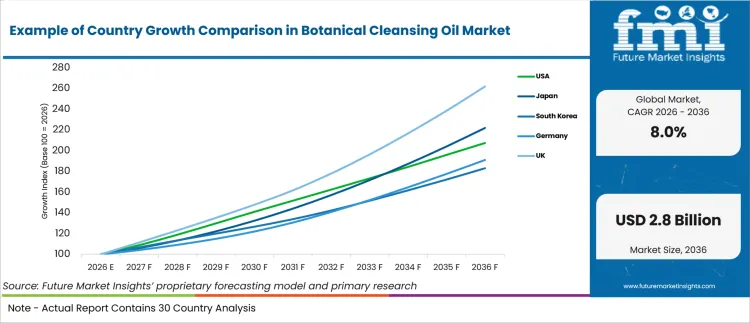
| Country or Market | CAGR |
|---|---|
| UK | 10.1% |
| Australia | 9.0% |
| Japan | 8.3% |
| USA | 7.6% |
| Germany | 6.7% |
| South Korea | 6.2% |
| Canada | 5.6% |
Source: Future Market Insights analysis, 2026.
How do country-level CAGRs compare in Botanical Cleansing Oil Markett?
Country comparison forms a gradual step-down across the seven profiled markets. The United Kingdom occupies the upper forecast position, followed by Australia and Japan. The United States forms the central rate band across the disclosed comparison. Germany and South Korea follow through more measured expansion paths. Canada completes the profiled range with an established regulatory and retail base. A 4.5 percentage-point spread separates United Kingdom from Canada.
- The United Kingdom is anticipated to lead the comparison as botanical routines gain support from established beauty retail and detailed cosmetic notification requirements.
- Australia is projected to follow United Kingdom depending on concentrated specialist retail and strong interest in plant-derived personal-care formulations.
- Japan is expected to occupy the next position based on longstanding cleansing-oil familiarity and established double-cleansing behavior.
- The United States is likely to form the middle band as sunscreen removal and cosmetic listing duties shape product review.
- Germany is estimated to follow United States led by drugstore access and sustained spending on beauty-care products.
- South Korea is forecast to retain a close position due to established cleansing rituals and international K-beauty exposure.
- Canada is anticipated to complete the comparison as fragrance disclosure and bilingual product communication influence launch preparation.
Similar forecast rates are likely to conceal different entry conditions across ingredient disclosure and skin-tolerance expectations. Commercial planning needs separate treatment for repeat-purchase behavior and retailer support within each country.
Country-wise Analysis
- The market in United Kingdom is projected to expand at 10.1% CAGR between 2026 and 2036, backed by established beauty channels and intensive product-notification oversight. Office for Product Safety and Standards reported 861,686 cosmetic notifications by May 2026, demonstrating extensive regulatory activity across products placed in Great Britain. Launch plans need precise ingredient records and responsible-person support matched with clear consumer instructions.
- Buyers in Australia frequently assess natural-origin claims through ingredient safety, ethical testing, and practical product performance. Adoption in Australia is expected to scale at 9.0% CAGR by 2036, reflected by plant-oil interest led by specialty beauty retail and online product education. Australian Industrial Chemicals Introduction Scheme recorded one assessed-category certificate involving new animal-test data during July-December 2025, reinforcing careful evidence review for cosmetic ingredients.
- Japan’s Ministry of Economy, Trade and Industry reported an 8.82% e-commerce ratio for cosmetics and pharmaceuticals during 2024. Online access complements department stores and specialty channels across established cleansing-oil routines. Sector in Japan is anticipated to rise at 8.3% CAGR from 2026 during the assessment period as sensory quality and dependable emulsification guide repurchase.
- The United States product launches require clear ingredient listings and reliable evidence supporting intended cleansing use. Industry in the United States is projected to progress at 7.6% CAGR between 2026 and 2036, influenced by sunscreen removal and expanding awareness of oil-compatible cleansing. USA Food and Drug Administration listed 1,298,361 active cosmetic products as of June 2026, illustrating an extensive competitive and compliance environment.
- German Cosmetic, Toiletry, Perfumery and Detergent Association reported drugstores represented 52.0% of beauty-care distribution during 2024. Sales in Germany are estimated to grow at 6.7% CAGR during the study period, led by accessible retail comparison and established facial-care purchasing. Companies need credible botanical claims and concise usage guidance suited to drugstore shelves and specialist channels.
- Demand in South Korea is forecast to increase at 6.2% CAGR by 2036, aided by familiar double-cleansing practices and continual beauty-product innovation. Local buyers assess pore-care positioning and comfortable rinsing across numerous competing textures. Korea’s official government portal reported cosmetics reached 202 export destinations during 2025, extending international exposure to Korean cleansing routines and product concepts.
- Demand in Canada reflects dispersed retail access and detailed ingredient notification duties. Health Canada requires fragrance-allergen disclosure above 0.01% in rinse-off cosmetics from April 2026, increasing formulation and notification precision. Sector in Canada is projected to record 5.6% CAGR through 2036 since compliant sensitive-skin products secure measured expansion.
Who are notable companies in Botanical Cleansing Oil Market?
Notable companies include Shiseido Co., Ltd., KOSÉ Corporation, DHC Corporation, FANCL Corporation, and Amorepacific Corporation (Sulwhasoo, AP Beauty, and Primera). Additional participants comprise Tatcha LLC, LG H&H Co., Ltd. (The Face Shop), The Body Shop, Clarins Group, and Caudalie.
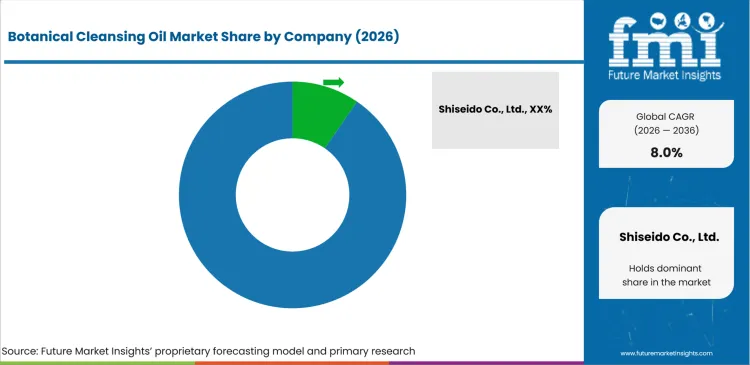
Competition centers on removal performance and emulsification quality. Japanese specialists bring long product histories and formulation experience. Korean brands connect cleansing oils with multi-step beauty routines. Botanical brands use store networks and online access across beauty and personal care products.
- Shiseido Co., Ltd. and DHC Corporation compete on cleansing performance. Product review covers waterproof makeup removal and post-rinse feel.
- FANCL Corporation and LG H&H Co., Ltd. (The Face Shop) address daily cleansing and pore-care use. Buyers compare ingredient restraint and refill options.
- Amorepacific Corporation (Sulwhasoo, AP Beauty, and Primera) and Tatcha LLC compete on ritual-led skincare positioning. Prestige presentation needs dependable removal performance.
- Clarins Group and The Body Shop emphasize botanical ingredients. Differentiation reflects formula clarity and channel accessibility.
Competitive Benchmarking: Botanical Cleansing Oil Market
| Company | Portfolio Depth | Botanical Match | Cleansing Oil Focus | Service Reach |
|---|---|---|---|---|
| Shiseido Co., Ltd. | High | High | High | Global |
| KOSÉ Corporation | High | High | Medium | Global |
| DHC Corporation | High | High | Medium | Multi-country |
| LG H&H Co., Ltd. (The Face Shop) | Medium | High | Medium | Multi-country |
| FANCL Corporation | High | Medium | High | Regional and selected overseas markets |
| Amorepacific Corporation (Sulwhasoo, AP Beauty, and Primera) | Medium | High | High | Global prestige channels |
| Tatcha LLC | Medium | High | High | International online and retail channels |
| The Body Shop | Medium | High | Medium | Global retail and online channels |
| Clarins Group | High | High | Medium | Global |
| Caudalie | Medium | High | Medium | Global specialist channels |
Source: Future Market Insights competitive analysis, 2026.
Key Developments in the Botanical Cleansing Oil Market
- In January 2025, Shiseido announced a complete renewal of Perfect Cover products and enhanced Cleansing Oil n for easier removal of specialized foundations. Improved cleansing properties strengthened product alignment with makeup-removal needs requiring thorough dissolution without complicated application.
- In February 2025, AP Beauty introduced its Ultimate Oil-to-Milk Cleanser with an antioxidant-rich A.O Oil Complex. The oil-to-milk format combined makeup and impurity removal with comfortable emulsification across a prestige facial-cleansing system.
- In October 2025, Amorepacific introduced Primera’s Mild and Perfect Cleansing Oil to Foam through Boots in the United Kingdom. The launch expanded access to a cleansing format combining oil-based makeup removal with one-step foaming.
Key Players in the Botanical Cleansing Oil Market
Japanese Cleansing Specialists
- Shiseido Co., Ltd.
- KOSÉ Corporation
- DHC Corporation
- FANCL Corporation
Korean and Ritual-Led Beauty Brands
- LG H&H Co., Ltd. (The Face Shop)
- Amorepacific Corporation (Sulwhasoo, AP Beauty, and Primera)
- Tatcha LLC
Botanical and Specialist Providers
- The Body Shop
- Clarins Group
- Caudalie
Botanical Cleansing Oil Market Report Scope
| Coverage field | Report scope |
|---|---|
| Market breakdown | Botanical cleansing oil market breakdown includes Product Type, Application, End User, Distribution Channel, Ingredient Type, and Region. |
| Market Definition | Facial and body cleansing oils use plant-derived oils with supporting esters and emulsifiers. Fragrances and active botanical ingredients complete defined coverage. Non-emulsifying treatment oils and conventional water-based facial cleansers are excluded. |
| Regions Covered | North America, Europe, East Asia, South Asia and Pacific, Latin America, Middle East and Africa. |
| Countries Covered | UK, Australia, Japan, USA, Germany, South Korea, Canada. |
| Key Companies Profiled | Shiseido Co., Ltd., KOSÉ Corporation, DHC Corporation, LG H&H Co., Ltd. (The Face Shop), FANCL Corporation, Amorepacific Corporation (Sulwhasoo, AP Beauty, and Primera), Tatcha LLC, The Body Shop, Clarins Group, Caudalie. |
| Forecast Period | 2026 to 2036 |
| Approach | Hybrid bottom-up and top-down analysis uses segment shares and country CAGRs. Company activity and buyer adoption support final reconciliation. |
Source: Future Market Insights analysis, 2026.
Botanical Cleansing Oil Market - Research Methodology
| Method | Approach |
|---|---|
| Primary Research | FMI analysts gathered input from manufacturers, service providers, technology developers, distributors, end users, procurement teams, and subject-matter experts. Interviews examined purchasing decisions, product or service evaluation, adoption barriers, approval requirements, pricing considerations, and expectations for technical or commercial support. Respondents were also asked what evidence is required before a trial, pilot, or initial order develops into regular purchasing. |
| Desk Research | Desk research covered government statistics, regulatory publications, trade data, industry associations, technical literature, standards, company filings, product information, and official corporate announcements. Sources were reviewed for relevance, publication date, geographic coverage, and consistency with the defined market scope. Claims relating to performance, applications, approvals, capacity, investment, and commercial activity were retained only when supported by credible public evidence. |
| Market Sizing and Forecasting | The market model combined the baseline value with historical performance, segment structure, pricing and volume indicators, adoption levels, company participation, and country-level demand conditions. Forecast assumptions considered economic activity, investment trends, regulatory developments, technology adoption, purchasing cycles, supply availability, and barriers to wider market use. Segment and regional estimates were reconciled before the final market total was calculated. |
| Data Validation | Estimates were checked against multiple independent indicators, including public data, company activity, trade patterns, industry developments, and findings from primary interviews. Validation also tested whether products, services, applications, and company revenues fell within the defined market boundaries. Adjacent categories, unsupported claims, overlapping revenues, and activities without direct market relevance were excluded to reduce double counting and maintain consistency across segments and countries. |
Source: Future Market Insights analysis, 2026.
Botanical Cleansing Oil Market by Segments
Botanical Cleansing Oil Market segmented by Product Type:
- Pure Botanical Cleansing Oils
- Blended Botanical Cleansing Oils
- Organic Cleansing Oils
- Sensitive Skin Cleansing Oils
- Multi-Functional Cleansing Oils
Botanical Cleansing Oil Market segmented by Application:
- Facial Cleansing
- Makeup Removal
- Sensitive Skin Care
- Anti-Pollution Skincare
- Professional Spa Treatments
Botanical Cleansing Oil Market segmented by End User:
- Individual Consumers
- Beauty Salons & Spas
- Dermatology Clinics
- Beauty Retailers
- Hospitality Industry
Botanical Cleansing Oil Market segmented by Distribution Channel:
- Offline Retail
- Online Retail
- Pharmacies & Drug Stores
- Department Stores
- Professional Sales
Botanical Cleansing Oil Market segmented by Ingredient Type:
- Plant Oils
- Botanical Extracts
- Essential Oils
- Natural Antioxidants
- Herbal Actives
Botanical Cleansing Oil Market segmented by Region:
- North America
- United States
- Canada
- Latin America
- Brazil
- Mexico
- Argentina
- Chile
- Western Europe
- Germany
- France
- United Kingdom
- Italy
- Spain
- Benelux
- Nordics
- Eastern Europe
- Poland
- Czech Republic
- Romania
- Hungary
- East Asia
- China
- Japan
- South Korea
- South Asia and Pacific
- India
- ASEAN
- Australia and New Zealand
- Middle East and Africa
- GCC Countries
- South Africa
- Türkiye
- Israel
Research Sources and Bibliography
- Amorepacific. (2025, February 1). AP Ultimate Oil-to-Milk Cleanser.
- Amorepacific. (2025, October 30). Mamonde, Primera, and ILLIYOON announce official debut at Boots in the United Kingdom.
- Australian Industrial Chemicals Introduction Scheme. (2025, September 8). Use of animal test data.
- Australian Industrial Chemicals Introduction Scheme. (2026, January 27). New chemical assessment statements published - 27 January 2026.
- European Commission. (2026). Safety Gate 2025.
- Eurostat. (2025, February 20). Online shopping in the EU keeps growing.
- FANCL Corporation. (2024). FANCL REPORT 2024.
- German Cosmetic, Toiletry, Perfumery and Detergent Association. (2025). Economy.
- Health Canada. (2025, March 17). Cosmetic advertising, labelling and ingredients.
- Health Canada. (2026, April 2). Notification of cosmetics: Guide for cosmetic notifications.
- Korea.net. (2026, January 13). Year of beauty: Cosmetics exports hit record USD 11.4B in 2025.
- Korea.net. (2026, February 19). International online purchases of domestic goods in 2025 break KRW 3T.
- Ministry of Economy, Trade and Industry. (2025, August 26). Results of FY2024 e-commerce market survey compiled.
- Office for Product Safety and Standards. (2026, July 17). New data on UK cosmetic product safety notifications.
- Personal Care Products Council. (2026, May 4). Skin cancer prevention starts with sunscreen: Why one ounce matters.
- Shiseido Company, Limited. (2024, September 26). Shiseido ushers in new era of innovative cosmetics development by blending century of research with advanced AI technology.
- Shiseido Company, Limited. (2025, January 31). Marking 30 years of innovation: Perfect Cover’s complete renewal for seamless and natural-looking coverage.
- USA Food and Drug Administration. (2026, June 30). Registration & Listing of Cosmetic Product Facilities and Products.
This bibliography is provided for reader reference and is not exhaustive. The full report contains the complete reference list and detailed citations.
This Report Answers
- How do product type and application choices influence cleansing performance?
- Why do individual consumers and offline retail lead the cited segments?
- What evidence supports repeat purchasing across makeup and sunscreen removal?
- Why do country CAGRs differ across UK, Australia, Japan, USA, Germany, South Korea, and Canada?
- How do ingredient safety duties affect product introduction?
- What companies compete on cleansing expertise and botanical formulation depth?
- How are forecasts validated using bottom-up and top-down assessment?
- What conditions restrict return across formulation and customer retention?
- How do companies build confidence using stable formulas and dependable rinsing?
Frequently Asked Questions
How big is the Botanical Cleansing Oil Market in 2026?
The botanical cleansing oil market is valued at USD 1.3 billion in 2026 and is forecast to reach USD 2.8 billion by 2036. Growth is supported by double-cleansing routines driving recurring demand for plant-derived oils that dissolve heavy makeup and sunscreen effectively during the initial cleansing step across daily evening skincare programs worldwide.
What is the CAGR of the Botanical Cleansing Oil Market from 2026 to 2036?
The botanical cleansing oil market grows at a CAGR of 8.0% between 2026 and 2036, supported by consumers adopting botanical cleansing oil formulas once those products demonstrate consistent makeup removal, comfortable water-activated rinsing, and stable formula performance across repeated home use throughout evening skincare routines.
Which product type leads the Botanical Cleansing Oil Market?
Pure botanical cleansing oils account for 31.0% of the botanical cleansing oil market by product type in 2026, driven by transparent ingredient narratives and consumer familiarity with facial oils that deliver thorough makeup removal without persistent film or excessive fragrance exposure across daily home cleansing routines.
How much will the Botanical Cleansing Oil Market add between 2026 and 2036?
The botanical cleansing oil market is set to add USD 1.5 billion between 2026 and 2036, growing from USD 1.3 billion to USD 2.8 billion as pure, blended, and sensitive-skin botanical cleansing formulas enter funded retail and online purchasing pathways across a widening base of facial cleansing and makeup removal programs worldwide.
Who are the leading companies in the Botanical Cleansing Oil Market?
Five companies lead the botanical cleansing oil market, including Shiseido, KOSÉ Corporation, DHC Corporation, FANCL Corporation, and Amorepacific Corporation, competing through long formulation histories, botanical ingredient expertise, waterproof makeup removal performance, and multi-channel retail presence across prestige and mass beauty cleansing programs worldwide.
Preview the report firsthand - request a free sample
Get SampleGet the brochure for pricing and purchase details.
Get PDFTable of Content
- Key Takeaways
- Market Size and CAGR
- Top Growth Driver
- Fastest Growing Segment
- Leading Region
- Key Companies
- Emerging Opportunities
- Executive Summary
- Global Market Outlook
- Demand-side Trends
- Supply-side Trends
- Technology Roadmap Analysis
- Analysis and Recommendations
- Analyst Perspective (What is happening? Why now? What should investors know?)
- Key Questions Answered
- How large is the market?
- What is the CAGR?
- What are key trends?
- Which region dominates?
- Who are the leaders?
- Market Overview
- Market Coverage / Taxonomy
- Market Definition / Scope / Limitations
- Research Methodology
- Chapter Orientation
- Analytical Lens and Working Hypotheses
- Market Structure, Signals, and Trend Drivers
- Benchmarking and Cross-market Comparability
- Market Sizing, Forecasting, and Opportunity Mapping
- Research Design and Evidence Framework
- Desk Research Programme (Secondary Evidence)
- Expert Input and Fieldwork (Primary Evidence)
- Tooling, Models, and Reference Databases
- Data Engineering and Model Build
- Quality Assurance and Audit Trail
- Market Background
- Market Dynamics (Drivers, Restraints, Opportunity, Trends)
- Scenario Forecast (Optimistic, Likely, Conservative)
- Impact Analysis
- AI Impact
- Sustainability Impact
- Regulatory Impact
- Technology Impact
- Consumer / Buyer Analysis
- Purchase Drivers
- Adoption Barriers
- Buyer Journey
- Opportunity Map Analysis
- Product Life Cycle Analysis
- Supply Chain Analysis
- Investment Feasibility Matrix
- Value Chain Analysis
- PESTLE and Porter's Analysis
- Regulatory Landscape
- Regional Parent Market Outlook
- Production and Consumption Statistics
- Import and Export Statistics
- Global Market Analysis and Forecast, 2021 to 2036
- Historical Market Size Value (USD Billion) Analysis, 2021 to 2025
- Current and Future Market Size Value (USD Billion) Projections, 2026 to 2036
- Y-o-Y Growth Trend Analysis
- Absolute $ Opportunity Analysis
- Global Market Pricing Analysis, 2021 to 2036
- Global Market Analysis and Forecast, By Product Type, 2021 to 2036
- Introduction / Key Findings
- Historical Market Size Value (USD Billion) Analysis By Product Type, 2021 to 2025
- Current and Future Market Size Value (USD Billion) Analysis and Forecast By Product Type, 2026 to 2036
- Pure Botanical Cleansing Oils
- Plant-Based Facial Oils
- Cold-Pressed Cleansing Oils
- Blended Botanical Cleansing Oils
- Herb-Infused Oils
- Essential Oil Blends
- Organic Cleansing Oils
- USDA Organic Formulations
- ECOCERT Certified Formulations
- Sensitive Skin Cleansing Oils
- Fragrance-Free Oils
- Hypoallergenic Oils
- Multi-Functional Cleansing Oils
- Makeup Removing Oils
- Deep Cleansing Oils
- Pure Botanical Cleansing Oils
- Y-o-Y Growth Trend Analysis By Product Type, 2021 to 2025
- Absolute $ Opportunity Analysis By Product Type, 2026 to 2036
- Global Market Analysis and Forecast, By Application, 2021 to 2036
- Introduction / Key Findings
- Historical Market Size Value (USD Billion) Analysis By Application, 2021 to 2025
- Current and Future Market Size Value (USD Billion) Analysis and Forecast By Application, 2026 to 2036
- Facial Cleansing
- Daily Cleansing
- Deep Cleansing
- Makeup Removal
- Waterproof Makeup Removal
- Long-Wear Makeup Removal
- Sensitive Skin Care
- Redness Relief
- Barrier Protection
- Anti-Pollution Skincare
- Urban Pollution Defense
- Pore Purification
- Professional Spa Treatments
- Facial Therapy
- Luxury Spa Treatments
- Facial Cleansing
- Y-o-Y Growth Trend Analysis By Application, 2021 to 2025
- Absolute $ Opportunity Analysis By Application, 2026 to 2036
- Global Market Analysis and Forecast, By End User, 2021 to 2036
- Introduction / Key Findings
- Historical Market Size Value (USD Billion) Analysis By End User, 2021 to 2025
- Current and Future Market Size Value (USD Billion) Analysis and Forecast By End User, 2026 to 2036
- Individual Consumers
- Women
- Men
- Beauty Salons & Spas
- Beauty Salons
- Wellness Spas
- Dermatology Clinics
- Medical Aesthetic Clinics
- Skin Care Clinics
- Beauty Retailers
- Cosmetic Stores
- Specialty Beauty Chains
- Hospitality Industry
- Luxury Hotels
- Resort Spas
- Individual Consumers
- Y-o-Y Growth Trend Analysis By End User, 2021 to 2025
- Absolute $ Opportunity Analysis By End User, 2026 to 2036
- Global Market Analysis and Forecast, By Distribution Channel, 2021 to 2036
- Introduction / Key Findings
- Historical Market Size Value (USD Billion) Analysis By Distribution Channel, 2021 to 2025
- Current and Future Market Size Value (USD Billion) Analysis and Forecast By Distribution Channel, 2026 to 2036
- Offline Retail
- Supermarkets & Hypermarkets
- Specialty Beauty Stores
- Online Retail
- Brand Websites
- E-Commerce Marketplaces
- Pharmacies & Drug Stores
- Chain Pharmacies
- Independent Pharmacies
- Department Stores
- Premium Department Stores
- Beauty Counters
- Professional Sales
- Spa Distributors
- Salon Suppliers
- Offline Retail
- Y-o-Y Growth Trend Analysis By Distribution Channel, 2021 to 2025
- Absolute $ Opportunity Analysis By Distribution Channel, 2026 to 2036
- Global Market Analysis and Forecast, By Ingredient Type, 2021 to 2036
- Introduction / Key Findings
- Historical Market Size Value (USD Billion) Analysis By Ingredient Type, 2021 to 2025
- Current and Future Market Size Value (USD Billion) Analysis and Forecast By Ingredient Type, 2026 to 2036
- Plant Oils
- Jojoba Oil
- Argan Oil
- Botanical Extracts
- Green Tea Extract
- Chamomile Extract
- Essential Oils
- Lavender Oil
- Rosemary Oil
- Natural Antioxidants
- Vitamin E
- Coenzyme Q10
- Herbal Actives
- Aloe Vera
- Centella Asiatica
- Plant Oils
- Y-o-Y Growth Trend Analysis By Ingredient Type, 2021 to 2025
- Absolute $ Opportunity Analysis By Ingredient Type, 2026 to 2036
- Global Market Analysis and Forecast, By Region, 2021 to 2036
- Introduction
- Historical Market Size Value (USD Billion) Analysis By Region, 2021 to 2025
- Current Market Size Value (USD Billion) Analysis and Forecast By Region, 2026 to 2036
- North America
- Latin America
- Western Europe
- Eastern Europe
- East Asia
- South Asia and Pacific
- Middle East & Africa
- Market Attractiveness Analysis By Region
- North America Market Analysis and Forecast, By Country, 2021 to 2036
- Historical Market Size Value (USD Billion) Trend Analysis By Market Taxonomy, 2021 to 2025
- Market Size Value (USD Billion) Forecast By Market Taxonomy, 2026 to 2036
- By Country
- USA
- Canada
- By Product Type
- By Application
- By End User
- By Distribution Channel
- By Ingredient Type
- By Country
- Market Attractiveness Analysis
- By Country
- By Product Type
- By Application
- By End User
- By Distribution Channel
- By Ingredient Type
- Key Takeaways
- Latin America Market Analysis and Forecast, By Country
- Historical Market Size Value (USD Billion) Trend Analysis By Market Taxonomy, 2021 to 2025
- Market Size Value (USD Billion) Forecast By Market Taxonomy, 2026 to 2036
- By Country
- Brazil
- Mexico
- Chile
- Rest of Latin America
- By Product Type
- By Application
- By End User
- By Distribution Channel
- By Ingredient Type
- By Country
- Market Attractiveness Analysis
- By Country
- By Product Type
- By Application
- By End User
- By Distribution Channel
- By Ingredient Type
- Key Takeaways
- Western Europe Market Analysis and Forecast, By Country
- Historical Market Size Value (USD Billion) Trend Analysis By Market Taxonomy, 2021 to 2025
- Market Size Value (USD Billion) Forecast By Market Taxonomy, 2026 to 2036
- By Country
- Germany
- UK
- Italy
- Spain
- France
- Nordic
- BENELUX
- Rest of Western Europe
- By Product Type
- By Application
- By End User
- By Distribution Channel
- By Ingredient Type
- By Country
- Market Attractiveness Analysis
- By Country
- By Product Type
- By Application
- By End User
- By Distribution Channel
- By Ingredient Type
- Key Takeaways
- Eastern Europe Market Analysis and Forecast, By Country
- Historical Market Size Value (USD Billion) Trend Analysis By Market Taxonomy, 2021 to 2025
- Market Size Value (USD Billion) Forecast By Market Taxonomy, 2026 to 2036
- By Country
- Russia
- Poland
- Hungary
- Balkan & Baltic
- Rest of Eastern Europe
- By Product Type
- By Application
- By End User
- By Distribution Channel
- By Ingredient Type
- By Country
- Market Attractiveness Analysis
- By Country
- By Product Type
- By Application
- By End User
- By Distribution Channel
- By Ingredient Type
- Key Takeaways
- East Asia Market Analysis and Forecast, By Country
- Historical Market Size Value (USD Billion) Trend Analysis By Market Taxonomy, 2021 to 2025
- Market Size Value (USD Billion) Forecast By Market Taxonomy, 2026 to 2036
- By Country
- China
- Japan
- South Korea
- By Product Type
- By Application
- By End User
- By Distribution Channel
- By Ingredient Type
- By Country
- Market Attractiveness Analysis
- By Country
- By Product Type
- By Application
- By End User
- By Distribution Channel
- By Ingredient Type
- Key Takeaways
- South Asia and Pacific Market Analysis and Forecast, By Country
- Historical Market Size Value (USD Billion) Trend Analysis By Market Taxonomy, 2021 to 2025
- Market Size Value (USD Billion) Forecast By Market Taxonomy, 2026 to 2036
- By Country
- India
- ASEAN
- Australia & New Zealand
- Rest of South Asia and Pacific
- By Product Type
- By Application
- By End User
- By Distribution Channel
- By Ingredient Type
- By Country
- Market Attractiveness Analysis
- By Country
- By Product Type
- By Application
- By End User
- By Distribution Channel
- By Ingredient Type
- Key Takeaways
- Middle East & Africa Market Analysis and Forecast, By Country
- Historical Market Size Value (USD Billion) Trend Analysis By Market Taxonomy, 2021 to 2025
- Market Size Value (USD Billion) Forecast By Market Taxonomy, 2026 to 2036
- By Country
- Kingdom of Saudi Arabia
- Other GCC Countries
- Türkiye
- South Africa
- Other African Union
- Rest of Middle East & Africa
- By Product Type
- By Application
- By End User
- By Distribution Channel
- By Ingredient Type
- By Country
- Market Attractiveness Analysis
- By Country
- By Product Type
- By Application
- By End User
- By Distribution Channel
- By Ingredient Type
- Key Takeaways
- Key Countries Market Analysis
- USA
- Pricing Analysis
- Market Share Analysis, 2025
- By Product Type
- By Application
- By End User
- By Distribution Channel
- By Ingredient Type
- Canada
- Pricing Analysis
- Market Share Analysis, 2025
- By Product Type
- By Application
- By End User
- By Distribution Channel
- By Ingredient Type
- Mexico
- Pricing Analysis
- Market Share Analysis, 2025
- By Product Type
- By Application
- By End User
- By Distribution Channel
- By Ingredient Type
- Brazil
- Pricing Analysis
- Market Share Analysis, 2025
- By Product Type
- By Application
- By End User
- By Distribution Channel
- By Ingredient Type
- Chile
- Pricing Analysis
- Market Share Analysis, 2025
- By Product Type
- By Application
- By End User
- By Distribution Channel
- By Ingredient Type
- Germany
- Pricing Analysis
- Market Share Analysis, 2025
- By Product Type
- By Application
- By End User
- By Distribution Channel
- By Ingredient Type
- UK
- Pricing Analysis
- Market Share Analysis, 2025
- By Product Type
- By Application
- By End User
- By Distribution Channel
- By Ingredient Type
- Italy
- Pricing Analysis
- Market Share Analysis, 2025
- By Product Type
- By Application
- By End User
- By Distribution Channel
- By Ingredient Type
- Spain
- Pricing Analysis
- Market Share Analysis, 2025
- By Product Type
- By Application
- By End User
- By Distribution Channel
- By Ingredient Type
- France
- Pricing Analysis
- Market Share Analysis, 2025
- By Product Type
- By Application
- By End User
- By Distribution Channel
- By Ingredient Type
- India
- Pricing Analysis
- Market Share Analysis, 2025
- By Product Type
- By Application
- By End User
- By Distribution Channel
- By Ingredient Type
- ASEAN
- Pricing Analysis
- Market Share Analysis, 2025
- By Product Type
- By Application
- By End User
- By Distribution Channel
- By Ingredient Type
- Australia & New Zealand
- Pricing Analysis
- Market Share Analysis, 2025
- By Product Type
- By Application
- By End User
- By Distribution Channel
- By Ingredient Type
- China
- Pricing Analysis
- Market Share Analysis, 2025
- By Product Type
- By Application
- By End User
- By Distribution Channel
- By Ingredient Type
- Japan
- Pricing Analysis
- Market Share Analysis, 2025
- By Product Type
- By Application
- By End User
- By Distribution Channel
- By Ingredient Type
- South Korea
- Pricing Analysis
- Market Share Analysis, 2025
- By Product Type
- By Application
- By End User
- By Distribution Channel
- By Ingredient Type
- Russia
- Pricing Analysis
- Market Share Analysis, 2025
- By Product Type
- By Application
- By End User
- By Distribution Channel
- By Ingredient Type
- Poland
- Pricing Analysis
- Market Share Analysis, 2025
- By Product Type
- By Application
- By End User
- By Distribution Channel
- By Ingredient Type
- Hungary
- Pricing Analysis
- Market Share Analysis, 2025
- By Product Type
- By Application
- By End User
- By Distribution Channel
- By Ingredient Type
- Kingdom of Saudi Arabia
- Pricing Analysis
- Market Share Analysis, 2025
- By Product Type
- By Application
- By End User
- By Distribution Channel
- By Ingredient Type
- Türkiye
- Pricing Analysis
- Market Share Analysis, 2025
- By Product Type
- By Application
- By End User
- By Distribution Channel
- By Ingredient Type
- South Africa
- Pricing Analysis
- Market Share Analysis, 2025
- By Product Type
- By Application
- By End User
- By Distribution Channel
- By Ingredient Type
- USA
- Market Structure Analysis
- Competition Dashboard
- Competition Benchmarking
- Market Share Analysis of Top Players
- By Regional
- By Product Type
- By Application
- By End User
- By Distribution Channel
- By Ingredient Type
- Emerging Startups
- Innovation Benchmarking
- Competition Analysis
- Competition Deep Dive
- Shiseido Co., Ltd.
- Overview
- Product Portfolio
- Profitability by Market Segments
- Sales Footprint
- Strategy Overview
- Marketing Strategy
- Product Strategy
- Channel Strategy
- KOSÉ Corporation
- DHC Corporation
- The Face Shop
- FANCL Corporation
- Sulwhasoo
- Tatcha LLC
- The Body Shop
- Clarins Group
- Caudalie
- Shiseido Co., Ltd.
- Case Studies
- Success Stories
- Recent Developments
- Competition Deep Dive
- Assumptions & Acronyms Used


