

- Market Size (2026)
- USD 75.5 Mn
- Forecast (2036)
- USD 115.0 Mn
- CAGR (2026 to 2036)
- 4.3%
How big is Bottle Capsule Spinning Machines Market in 2026?
The market is valued at USD 75.5 million in 2026.
The Bottle Capsule Spinning Machines Market is valued at USD 72.4 Million in 2025. Revenue is estimated at USD 75.5 Million in 2026 and is forecast to reach USD 115.0 Million by 2036 at a 4.3% CAGR. This represents an absolute dollar opportunity of USD 39.5 Million between 2026 and 2036. Demand for capsule spinning equipment is determined by where that wine is bottled and whether the finished bottle retains a mechanically spun capsule.
Bottled wine in containers below two litres represented 51.1% of global wine export volume in 2025, while bulk wine accounted for 34.0%. Bottled export volume declined 5.7% during the year [1]. The change was sharper in some producing countries. Australian bottled still-wine exports fell approximately 11.4% in 2025, compared with a 5.6% decline in total wine exports [2]. Aggregate wine trade therefore understated the contraction in the part of the export market most directly associated with bottle-finishing activity.
Portugal provides another indication of why bottling location matters. The country exported about 188.8 Million litres of bottled still wine in 2025 compared with 56.5 Million litres shipped in bulk. Bottled still wine averaged EUR 2.80 per litre (approximately USD 3.16 per litre), while bulk wine averaged EUR 0.79 per litre (approximately USD 0.89 per litre). The market therefore follows the geography of bottling more closely than the geography of wine production. Countries with large packaged-wine flows support a direct equipment base, while bulk-exporting countries can shift part of the addressable demand toward destination bottlers. Changes in capsule use add another layer, since a bottle contributes to spinning-machine workload only when a mechanically applied capsule remains part of the finished package.
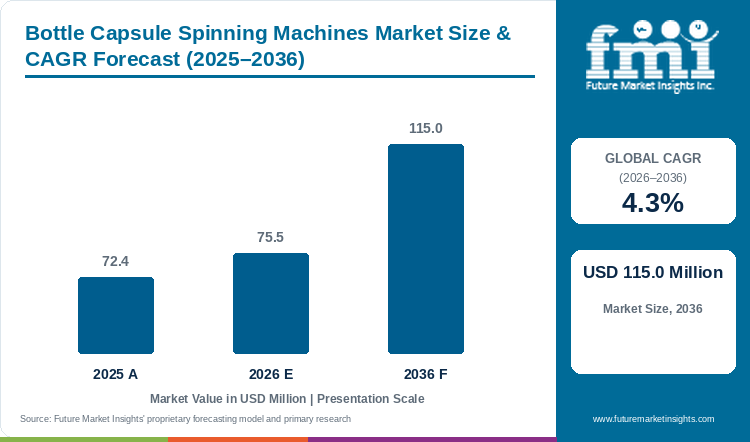
Bottle Capsule Spinning Machines Market Size & CAGR Forecast (2025-2036)
| Year | Basis | Market value (USD million) |
|---|---|---|
| 2025 | Actual | 72.4 |
| 2026 | Estimate | 75.5 |
| 2036 | Forecast | 115.0 |
| CAGR, 2026 to 2036 | 4.3% | |
Source: Future Market Insights proprietary forecasting model and primary research.
Key Takeaways
- In larger bottling operations, capsule dispensing and spinning can be synchronized with continuous bottle movement. Fully automatic machines account for 43.0% of Automation demand in 2026, reflecting their fit with lines where manual intervention would interrupt throughput.
- Capsule application typically occurs after the primary closure has been fitted and before the bottle reaches labelling. This position within the packaging sequence gives inline modules a 41.0% share of Configuration demand in 2026.
- Keeping capsule application in step with a faster bottling line requires more than a single spinning point. Multi-head systems distribute the workload across several bottles and represent 58.0% of Spinning Arrangement demand in 2026.
- The decision to retain a capsule is usually made where the finished bottle is assembled. Winery and estate bottlers consequently represent 59.0% of Buyer demand in 2026, placing equipment demand closer to the bottling site than to the location of wine production.
- Mature bottling infrastructure changes the nature of equipment spending. In established wine-producing countries, capital is increasingly directed toward replacing existing machinery rather than adding new capacity. Replacement accounts for 44.0% of Purchase demand in 2026.
- Total wine production can give a distorted view of the addressable market. Wine shipped in bulk may be bottled and finished elsewhere, shifting capsule-spinning activity to the destination market. Local bottling volume and continued use of mechanically spun capsules are therefore more useful indicators of equipment demand than production alone.
Analyst Perspective
“Capsule spinner demand follows the bottle, not the vineyard. A country can export more wine and still create limited spinning workload when much of that volume leaves in bulk. The stronger equipment signal is where bottles are filled and how many retain mechanically applied capsules.”
- Nandini Roy Choudhury, Principal Consultant at FMI
How is the Bottle Capsule Spinning Machines Market segmented?
- By Automation: Operator-loaded powered, Semi-automatic and Fully automatic.
- By Configuration: Benchtop standalone, Floor-standing standalone, Inline module and Integrated line module.
- By Spinning Arrangement: Single-head and Multi-head.
- By Compatible Capsule Material: Tin, Aluminium, Compatible polylaminate and Multi-material compatible.
- By Buyer: Winery/estate bottler, Contract/mobile bottler and Independent bottling facility.
- By Wine Application: Still red, Still white, Still rosé and Fortified wine.
- By Purchase: New installation, Replacement and Retrofit/upgrade.
- By Region: North America; Latin America; Western Europe; Eastern Europe; East Asia; South Asia and Pacific; Middle East and Africa.
Why do fully automatic machines lead Automation demand?
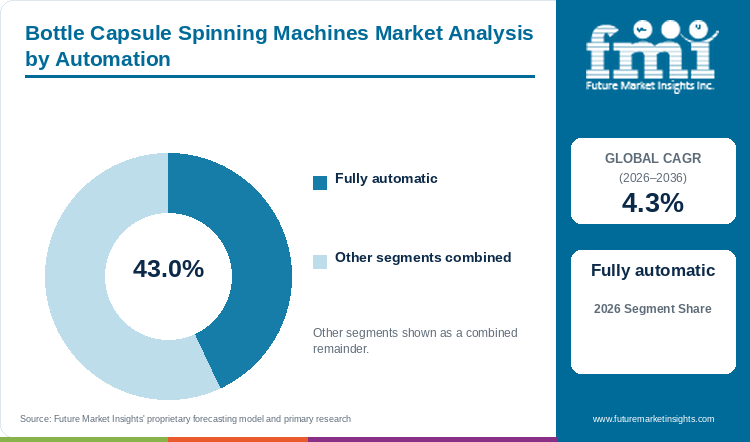
| Automation | Share (2026) |
|---|---|
| Fully automatic machines | 43.0% |
| Other segments combined | 57.0%* |
| Total | 100.0% |
| Metric | Value |
|---|---|
| Global CAGR (2026 to 2036) | 4.3% |
| Leading segment | Fully automatic machines |
Fully automatic capsule spinning becomes relevant when capsule application has to operate at the same pace as the rest of the bottling line. In these installations, capsule dispensing and spinning are incorporated into the bottle flow rather than performed as a separate hand-fed operation. University of Arkansas Extension guidance distinguishes this operating pattern from smaller wineries, which can use single motorized hand-fed spinners, and describes automatic capsule distribution as more appropriate once manual application becomes inefficient at higher production volumes. Automatic distribution systems can operate at substantially higher bottle rates because capsule placement occurs while bottles continue through the line.
Bottle and capsule compatibility remains important even in highly automated systems. University of Minnesota Extension notes that polylaminate capsules must be spun or burnished onto the bottle and that capsule selection depends on bottle-neck dimensions. This makes centering and repeatable handling important parts of automatic operation rather than spinning speed alone [3].
- Fully automatic machines are estimated to account for 43.0% of Automation demand in 2026.
- Their position is strongest in larger bottling facilities where capsule placement and spinning must remain synchronized with continuous bottle movement, while smaller wineries can continue to use hand-fed or semi-automatic equipment.
Why do inline modules lead Configuration demand?
Capsule spinning fits naturally inside the bottling sequence because the capsule is applied only after the bottle has received its primary closure. University of Minnesota Extension notes that polylaminate capsules are spun or burnished onto the bottle top and that capsule selection depends on bottle-neck dimensions. This makes the spinning stage part of final bottle finishing rather than part of wine filling itself [3].
Inline modules benefit from that position in the process. They can receive closed bottles directly from the upstream bottling equipment, complete capsule application, and pass the bottle onward for labelling or packing. This reduces the need for a separate finishing cell and is particularly useful where capsule application has to remain synchronized with the rest of the line. Standalone machines remain practical for smaller wineries or intermittent production, while integrated multifunction systems are more appropriate where capsuling is combined with other packaging operations.
- Inline modules are estimated to account for 41.0% of Configuration demand in 2026.
- Their position reflects the sequence of wine bottling itself: the capsule is applied after closure, which allows spinning equipment to be inserted into an existing bottle flow without requiring the filling or corking stages to be redesigned.
What are the drivers, restraints and opportunities in the Bottle Capsule Spinning Machines Market?
- Driver: Local bottling keeps capsule application within the same packaging operation and supports investment in automated spinning equipment.
- Restraint: Declining bottled-wine exports in several major producing countries reduce the need for machinery purchased purely to add bottling capacity.
- Opportunity: Bulk wine can shift bottle-finishing activity to destination markets, creating equipment demand among contract bottlers and independent packaging facilities.
Which country CAGRs are profiled in the Bottle Capsule Spinning Machines Market?
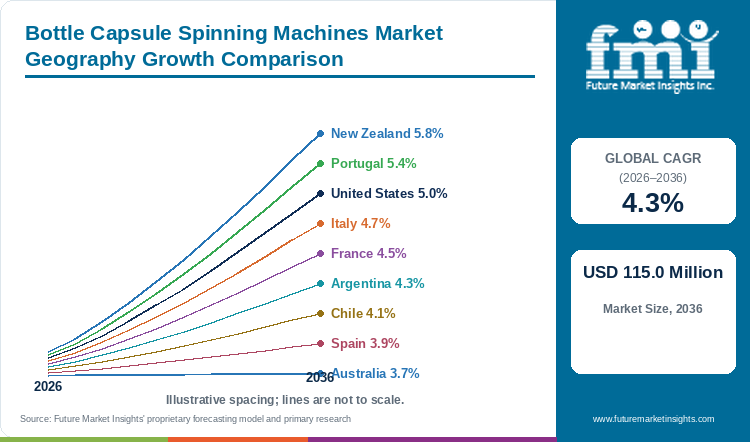
| Country | CAGR 2026-2036 |
|---|---|
| New Zealand | 5.8% |
| Portugal | 5.4% |
| United States | 5.0% |
| Italy | 4.7% |
| France | 4.5% |
| Argentina | 4.3% |
| Chile | 4.1% |
| Spain | 3.9% |
| Australia | 3.7% |
- New Zealand has a bullish outlook as bottled exports expanded in 2025 rather than contracting. OIV reported 3.1 Million hectolitres of wine exports, with bottled volume up 9.9% from 2024. Bulk volume rose faster at 25.4%, so the equipment opportunity is split between origin bottling and wine that may be finished elsewhere. The rise in bottled exports nevertheless provides a direct expansion in the pool of export wine that can pass through capsule application equipment before shipment.
- Portugal has a comparatively strong origin-bottling profile. IVV reported 188.8 Million litres of bottled still-wine exports in 2025 compared with 56.5 Million litres shipped in bulk. Bottled still wine generated EUR 529.2 Million (approximately USD 598.0 Million), while bulk still wine generated EUR 44.9 Million (approximately USD 50.7 Million). The average export value was EUR 2.8/L (approximately USD 3.2/L) for bottled wine and EUR 0.8/L (approximately USD 0.9/L) for bulk wine. The 3.5 times value difference does not measure capsule value, but it shows why packaging investment is concentrated more heavily around finished bottles.
- The United States has a large domestic bottling base even though recent wine flow has softened. TTB recorded 535.7 Million wine gallons of bottled taxable withdrawals in 2025, equal to about 2.0 Billion litres. The total was 6.2% below 2024. These withdrawals are not retail consumption, yet they show the scale of bottled wine moving through taxable channels. Equipment growth is therefore more likely to come from replacement and automation upgrades than from a broad increase in wine volume.
- Italy remains one of the largest addressable installed bases because it exported 21.0 Million hectolitres of wine in 2025. OIV reported that bottled wine represented 55.0% of export volume and 65.0% of export value. Bottled export volume still fell 5.6% from 2024. This combination supports replacement demand because a large bottling base remains in place while weak volume growth limits the case for adding capacity simply to process more wine.
- France retains a large premium bottling base but faces a weaker bottle-volume trend. Wine exports reached 12.5 Million hectolitres in 2025, while bottled export volume declined 6.7%. OIV also reported that France remained the world leader in wine export value. The equipment case therefore rests on maintaining presentation quality and modernizing existing lines rather than on a large increase in bottle count.
- Argentina exported 207.6 Million litres of wine in 2024. Packaged wine accounted for 155.6 Million litres and was predominantly bottled, while bulk wine reached 52.0 Million litres. The packaged share gives Argentina a meaningful origin-side finishing base. Growth should remain moderate because the available public figures do not identify how many bottles retain spun capsules, so machinery demand depends on packaging choices within the packaged-wine pool.
- Chile illustrates the importance of separating wine exports from bottling activity. The country exported 777.0 Million litres of wine in 2024, but 331.9 Million litres moved in bulk. The total export value was USD 1,599.8 Million FOB, while bulk wine represented USD 248.7 Million. A large bulk stream means part of the final bottle finishing can occur outside Chile. Origin-country wine exports can therefore overstate the local opportunity for capsule spinning equipment.
- Spain exported 19.6 Million hectolitres of wine in 2025. Bottled export volume fell 7.3% while bulk volume increased 1.2%. The divergence matters because a shift toward bulk reduces the amount of capsule-finishing work completed before export. Spain remains a major wine producer and bottler, but the near-term equipment case is more closely tied to replacement and line modernization than to new origin-side capacity.
- Australia has the weakest outlook among the profiled countries because its bottle-specific export pool contracted faster than total wine exports. Bottled still-wine exports were 178.9 Million litres in 2025, down 11.4% from 2024 [2]. Unpackaged still wine reached 416.1 Million litres, while total wine exports were 612.7 Million litres. The gap shows why aggregate export volume is a weak proxy for spinning-machine demand. Equipment purchases are more likely to center on replacement, flexible formats and destination bottling than on new capacity at origin.
Who are the notable companies in the Bottle Capsule Spinning Machines Market?
Publicly visible suppliers include Robino & Galandrino; GAI Macchine Imbottigliatrici; Enos Italia; CDA; and Criveller Group.
The supplier base includes specialist capsuling-machine manufacturers and broader bottling-equipment companies. Robino & Galandrino offers dedicated distribution and rolling monoblocks for tin and polylaminate capsules, with configurations extending from compact systems to high-throughput multi-head equipment. GAI integrates capsule rolling into its 4000, 7000, 8000 and 9000 packaging families. Enos Italia combines rolling heads with capsuling and labelling machines across several throughput levels. CDA integrates capsule crimping with wine labelling equipment, while Criveller supplies automatic capsule dispensing and spinning systems for winery bottling lines.
Competitive Benchmarking: Bottle Capsule Spinning Machines Market
High indicates broader visible capability for the named criterion. Medium indicates a narrower or more specialized offering. Low indicates limited visible capability. The ratings describe product breadth and do not represent product quality or market share.
| Company | Dedicated Spinning Equipment | Throughput Breadth | Multi-material Compatibility | Line Integration | Format Flexibility |
|---|---|---|---|---|---|
| Robino & Galandrino | High | High | High | High | High |
| GAI Macchine Imbottigliatrici | High | High | High | High | High |
| Enos Italia | Medium | Medium | High | High | High |
| CDA | Medium | Medium | High | High | High |
| Criveller Group | Medium | High | High | High | High |
Key Developments in the Bottle Capsule Spinning Machines Market
- In May 2026, OIV reported that bottled wine in containers below two litres represented 51.1% of global wine export volume in 2025 and declined 5.7% from 2024 [1]. The change reduces the bottle-specific export pool that can generate capsule-spinning work at origin.
- In August 2026, the EU Packaging and Packaging Waste Regulation entered its application phase. Article 10 requires packaging weight and volume to be reduced to the minimum necessary for functionality by 1 January 2030, subject to the regulation’s conditions and exceptions [4]. The rule creates a stronger design test for secondary packaging components without establishing a blanket ban on wine capsules.
- In January 2026, Wine Australia reported 612.7 Million litres of wine exports for 2025. Bottled still-wine exports were 178.9 Million litres and fell 11.4% from 2024, while total wine exports declined 5.6% [2]. The difference shows why bottle-specific trade is a more useful equipment indicator than aggregate wine exports.
Key Players in the Bottle Capsule Spinning Machines Market
- Robino & Galandrino
- GAI Macchine Imbottigliatrici
- Enos Italia
- CDA
- Criveller Group
Bottle Capsule Spinning Machines Market - Report Scope
| Coverage field | Report scope |
|---|---|
| Market breakdown | Automation; Configuration; Spinning Arrangement; Compatible Capsule Material; Buyer; Wine Application; Purchase |
| Quantitative Units | USD Million |
| Market Definition | Revenue includes equipment and modules that mechanically spin or roll compatible capsules onto bottle necks. Heat-shrink-only machines; screw-cap cappers; pharmaceutical capsule machinery; capsule material revenue and full bottling-line revenue are excluded. |
| Regions Covered | North America; Latin America; Western Europe; Eastern Europe; East Asia; South Asia and Pacific; Middle East and Africa |
| Countries Covered | United States; Italy; France; Spain; Portugal; Australia; New Zealand; Chile; Argentina and additional countries in the full report |
| Key Companies Profiled | Robino & Galandrino; GAI Macchine Imbottigliatrici; Enos Italia; CDA; Criveller Group |
| Forecast Period | 2026 to 2036 |
Bottle Capsule Spinning Machines Market - Research Methodology
| Method | Approach |
|---|---|
| Primary Research | The primary research framework covers winery and estate bottlers; contract or mobile bottlers; independent bottling facilities; packaging-equipment manufacturers and line integrators. The framework focuses on locally bottled volume; capsule-finished bottle counts; installed equipment; changeovers and purchase requirements. |
| Desk Research | FMI reviews official wine production and trade statistics, packaging regulation and first-party equipment information. The analysis separates bottled formats from bulk wine because total liquid volume does not identify where capsule finishing occurs. |
| Market Sizing and Forecasting | Market sizing combines the bottling base with capsule-retention patterns; equipment configuration; automation level; replacement cycles and country-level bottle flows. Forecasts also consider the shift between origin bottling and destination bottling. |
| Data Validation | Market values and country forecasts are cross-checked against bottle-specific trade indicators and visible equipment architecture. Heat-shrink equipment, screw-cap machinery, capsule materials and unrelated bottling-line revenue are excluded from the defined market. |
Bottle Capsule Spinning Machines Market by Segments
Bottle Capsule Spinning Machines Market segmented by Automation:
- Operator-loaded powered
- Semi-automatic
- Fully automatic
Bottle Capsule Spinning Machines Market segmented by Configuration:
- Benchtop standalone
- Floor-standing standalone
- Inline module
- Integrated line module
Bottle Capsule Spinning Machines Market segmented by Spinning Arrangement:
- Single-head
- Multi-head
Bottle Capsule Spinning Machines Market segmented by Compatible Capsule Material:
- Tin
- Aluminium
- Compatible polylaminate
- Multi-material compatible
Bottle Capsule Spinning Machines Market segmented by Buyer:
- Winery/estate bottler
- Contract/mobile bottler
- Independent bottling facility
Bottle Capsule Spinning Machines Market segmented by Wine Application:
- Still red
- Still white
- Still rosé
- Fortified wine
Bottle Capsule Spinning Machines Market segmented by Purchase:
- New installation
- Replacement
- Retrofit/upgrade
Bottle Capsule Spinning Machines Market by Region:
- North America
- United States
- Canada
- Latin America
- Brazil
- Mexico
- Argentina
- Chile
- Western Europe
- Germany
- France
- United Kingdom
- Italy
- Spain
- Portugal
- Eastern Europe
- Poland
- Romania
- East Asia
- China
- Japan
- South Korea
- South Asia and Pacific
- India
- Australia
- New Zealand
- Middle East and Africa
- GCC Countries
- South Africa
Bibliography
- [1] International Organisation of Vine and Wine (OIV). State of the World Wine Sector in 2025. Paris: OIV, 12 May 2026. https://www.oiv.int/sites/default/files/2026-05/OIV_State_of_the_World_Wine_Sector_in_2025_PPT.pdf
- [2] Wine Australia. Export Report December 2025: Australian wine exports not immune to global trends. Adelaide: Wine Australia, 28 January 2026. https://www.wineaustralia.com/news/media-releases/export-report-december-2025
- [3] University of Minnesota, Grape Breeding and Enology Program. Practical Preparation Techniques for Wine Bottling. St. Paul: University of Minnesota. https://enology.umn.edu/wine-winemaking/practical-preparation-techniques-wine-bottling
- [4] European Parliament and Council of the European Union. Regulation (EU) 2025/40 of 19 December 2024 on packaging and packaging waste. Official Journal of the European Union, 22 January 2025. https://eur-lex.europa.eu/eli/reg/2025/40/oj
This Report Answers
- How large is the Bottle Capsule Spinning Machines Market in 2025 and 2026?
- Why do fully automatic machines lead Automation demand?
- Why does local bottling matter more than total wine production for capsule-spinning workload?
- Which countries provide the strongest bottle-specific demand signals through 2036?
- How can bulk wine trade shift equipment demand from origin countries to destination bottlers?
Frequently Asked Questions
How big is the Bottle Capsule Spinning Machines Market in 2026?
The Bottle Capsule Spinning Machines Market is estimated at USD 75.5 Million in 2026 and is forecast to reach USD 115.0 Million by 2036.
What is the Bottle Capsule Spinning Machines Market CAGR from 2026 to 2036?
Revenue is forecast to increase at a 4.3% CAGR between 2026 and 2036.
Which Automation segment leads the Bottle Capsule Spinning Machines Market?
Fully automatic machines lead Automation demand with an estimated 43.0% share in 2026.
Which Configuration segment leads the market?
Inline modules lead Configuration demand with an estimated 41.0% share in 2026.
Which Spinning Arrangement leads the market?
Multi-head systems account for an estimated 58.0% of Spinning Arrangement demand in 2026.
Which country has the fastest growth outlook among the profiled markets?
New Zealand leads the profiled countries with a 5.8% CAGR through 2036, supported by growth in bottled wine exports.
What is the main demand indicator for capsule spinning equipment?
The strongest indicator is the number of bottles filled at a facility that retain a mechanically spun capsule. Total wine production can be misleading when a large share of wine is shipped in bulk.
Preview the report firsthand - request a free sample
Get SampleGet the brochure for pricing and purchase details.
Get PDFTable of Content
- How big is Bottle Capsule Spinning Machines Market in 2026?
- Key Takeaways
- Analyst Perspective
- How is the Bottle Capsule Spinning Machines Market segmented?
- Why do fully automatic machines lead Automation demand?
- Why do inline modules lead Configuration demand?
- What are the drivers, restraints and opportunities in the Bottle Capsule Spinning Machines Market?
- Which country CAGRs are profiled in the Bottle Capsule Spinning Machines Market?
- Who are the notable companies in the Bottle Capsule Spinning Machines Market?
- Competitive Benchmarking: Bottle Capsule Spinning Machines Market
- Key Developments in the Bottle Capsule Spinning Machines Market
- Key Players in the Bottle Capsule Spinning Machines Market
- Bottle Capsule Spinning Machines Market - Report Scope
- Bottle Capsule Spinning Machines Market - Research Methodology
- Bottle Capsule Spinning Machines Market by Segments
- Bottle Capsule Spinning Machines Market segmented by Automation:
- Bottle Capsule Spinning Machines Market segmented by Configuration:
- Bottle Capsule Spinning Machines Market segmented by Spinning Arrangement:
- Bottle Capsule Spinning Machines Market segmented by Compatible Capsule Material:
- Bottle Capsule Spinning Machines Market segmented by Buyer:
- Bottle Capsule Spinning Machines Market segmented by Wine Application:
- Bottle Capsule Spinning Machines Market segmented by Purchase:
- Bottle Capsule Spinning Machines Market by Region:
- This Report Answers
- Frequently Asked Questions
- Competitive Landscape


