

- Market Size (2026)
- USD 51.2 Mn
- Forecast (2036)
- USD 86.6 Mn
- CAGR (2026 to 2036)
- 5.4%
How big is Bottle Wax Sealing Machines Market in 2026?
The Bottle Wax Sealing Machines Market is estimated at USD 51.2 Million in 2026 and USD 86.6 Million by 2036, expanding at a 5.4% CAGR.
The market is valued at USD 48.6 Million in 2025. Revenue is estimated at USD 51.2 Million in 2026 and is forecast to reach USD 86.6 Million by 2036 at a 5.4% CAGR. This is likely to create an absolute dollar opportunity of USD 35.4 Million over the forecast period. The downstream base in this market is large, but it is not expanding uniformly. In modern spirits packaging, bottle wax sealing is used primarily as a decorative and product-differentiation feature rather than as an essential closure method. Standard closures used on distilled-spirit bottles generally provide the required protection without an additional wax layer. Wax sealing therefore serves mainly as a visual finishing technique associated with bottle presentation and brand identity. [1]
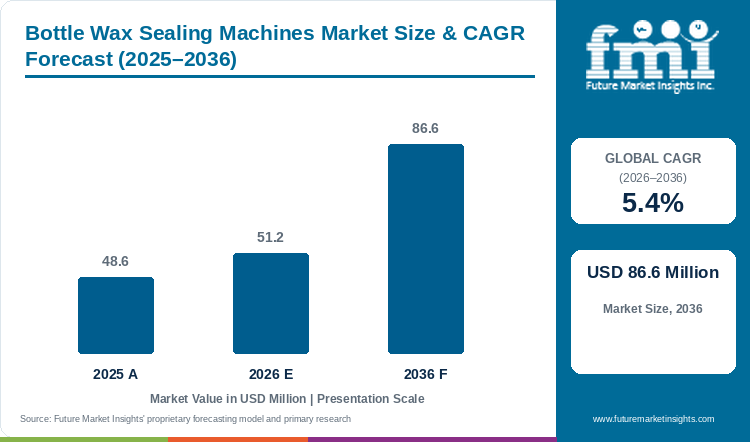
Bottle Wax Sealing Machines Market Size & CAGR Forecast (2025-2036)
| Year | Basis | Market value (USD million) |
|---|---|---|
| 2025 | Actual | 48.6 |
| 2026 | Estimate | 51.2 |
| 2036 | Forecast | 86.6 |
| CAGR, 2026 to 2036 | 5.4% | |
Source: Future Market Insights proprietary forecasting model and primary research.
Key Takeaways
- Semi-automatic machines lead Automation with a 49.0% share in 2026 as they reduce repetitive handling while retaining the flexibility needed for short or changing batches.
- Standalone floor-mounted systems hold 54.0% share by configuration in 2026 owing to the fact that many users add wax sealing after the main filling and closure line instead of redesigning the full packaging system.
- Bottle-neck dipping is set to hold 72.0% share in 2026.
- Spirits producers account for 44.0% of End Use demand in 2026.
Analyst Perspective
“Bottle wax sealing is evolving from a closure-related process into a specialized bottle-finishing step. For small production runs, machine economics depend heavily on changeover time. In an illustrative batch calculation, cutting changeover from 60 minutes to 10 minutes increases effective output by 187.5% for a 500-bottle batch at 30 bottles per minute, assuming batch time consists of changeover plus running time, while doubling running speed from 30 to 60 bottles per minute increases output by only 12.2%. This favors flexible semi-automatic systems and line-integrated modules for premium spirits, limited releases and other short-run applications.”
- Nandini Roy Choudhury, Principal Consultant at FMI
How is the Bottle Wax Sealing Machines Market segmented?
The market is segmented by Automation; Configuration; Application Method; Batch Handling; Wax Handling; End Use; Bottle Compatibility; Equipment Demand, and region.
- Automation covers manual bottle-handling dipping stations; semi-automatic machines and fully automatic machines.
- Configuration includes benchtop systems; standalone floor-mounted units and line-integrated modules.
- Application Method separates bottle-neck dipping from metered external wax application.
- Batch Handling covers single-bottle operation; multi-bottle fixtures and indexed or continuous feeding.
- Wax Handling distinguishes single-colour or single-bath equipment from multiple-colour or multiple-bath systems.
- End Use covers wine producers and spirits producers, plus specialty bottled food or beverage producers and contract bottlers.
- Bottle Compatibility is grouped into round bottles and non-round bottles, plus standard-volume and miniature or large-format containers. Equipment Demand includes new installations and replacements, plus dedicated retrofit modules.
Why do semi-automatic machines lead Automation demand?
Semi-automatic machines are estimated to account for 49.0% of Automation demand in 2026.
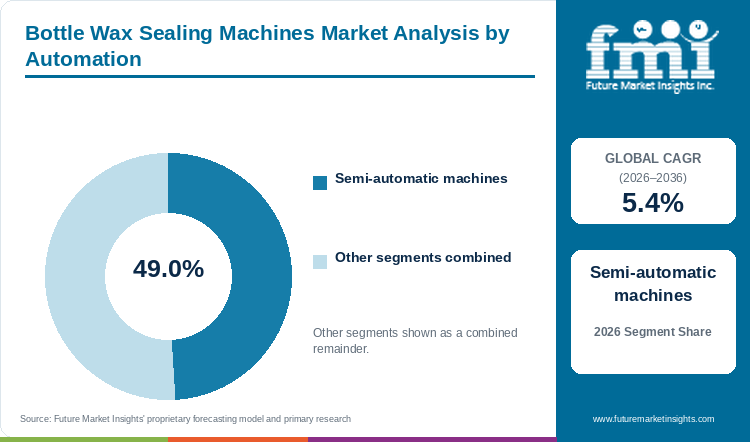
| Automation | Share (2026) |
|---|---|
| Semi-automatic machines | 49.0% |
| Other segments combined | 51.0%* |
| Total | 100.0% |
| Metric | Value |
|---|---|
| Global CAGR (2026-2036) | 5.4% |
| Leading segment | Semi-automatic machines |
Semi-automatic machines are suited to bottle wax sealing as the process is commonly used for short production runs and selected premium products. Manual systems require the operator to control much of the dipping process, while fully automatic lines are more appropriate when production volumes are sufficient to justify continuous handling. Semi-automatic equipment occupies the intermediate position by mechanizing functions such as bottle rotation and wax immersion while retaining manual loading or unloading. This allows manufacturers to use wax sealing as a separate finishing operation without making it a permanent part of the main bottling line.
- Semi-automatic machines are estimated to account for 49.0% of Automation demand in 2026.
- Their position reflects the operating pattern of bottle wax sealing, where producers often require controlled application for short batches without the cost or fixed throughput requirements of a fully automatic line.
Why do standalone floor-mounted systems lead Configuration demand?
Standalone floor-mounted systems are estimated to account for 54.0% of Configuration demand in 2026.
Standalone floor-mounted systems are well suited to bottle wax sealing because the process is commonly performed after the primary filling and closure stages. This allows the equipment to operate as a separate finishing station rather than as a fixed part of the main bottling line. Compared with benchtop units, floor-mounted systems can accommodate larger wax reservoirs and more substantial bottle-handling assemblies. They also require less line modification than fully integrated modules, which makes them easier to introduce into an existing packaging operation.
This configuration is particularly relevant where wax sealing is used only for selected products or limited production runs. A producer can schedule the machine around premium batches without affecting the operation of the primary filling line. That operating pattern also supports seasonal or intermittent use, since the equipment can remain independent of the main production sequence.
- Standalone floor-mounted systems are estimated to account for 54.0% of Configuration demand in 2026.
- Their leading position reflects the use of wax sealing as a separate bottle-finishing step, where producers benefit from greater working capacity than a benchtop unit without committing to a permanently integrated system.
Why does bottle-neck dipping remain the main Application Method?
Bottle-neck dipping is estimated to account for 72.0% of Application Method demand in 2026.
Bottle-neck dipping is the conventional method of producing a continuous wax covering around the closure and upper neck of a bottle. The closed bottle is inverted and lowered into molten wax to a predetermined depth. It is then withdrawn so that the coating can cool and harden around the closure. The depth of immersion determines how far the wax extends down the neck, while temperature and dwell time influence coating thickness. Metered application can provide greater control over the amount or position of wax, but it requires a more controlled delivery system. Dipping remains well suited to products where the desired result is the recognizable wax-covered bottle top rather than a narrowly applied decorative pattern.
- Bottle-neck dipping is estimated to account for 72.0% of Application Method demand in 2026.
- Its position reflects the physical form of the finished package. A single immersion can coat the closure and adjoining bottle neck without requiring wax to be deposited separately around the circumference.
Why do spirits producers account for the largest End Use share?
Spirits producers are estimated to account for 44.0% of End Use demand in 2026.
Wax sealing has greater economic relevance when the bottle itself contributes to product presentation. This favors distilled spirits because the technique can be applied selectively to premium expressions and limited releases without becoming part of every bottling run. The wax is normally applied over an existing closure rather than functioning as the primary seal. A U.S. federal court examining wax-sealed spirits bottles found that conventional closure mechanisms already provided the necessary protection and that the wax did not provide a material protective or preservative function in the case considered. Its role is therefore more closely associated with the finished appearance of the bottle. [1]
This use case is supported by the scale of premium spirits activity in major producing countries. UK whisky exports were valued at £5.4 billion in 2025 despite declining 6.6% in real terms from the previous year. The continued importance of whisky as a high-value export creates a large base of products for which packaging differentiation can remain commercially relevant. [2]
- Spirits producers are estimated to account for 44.0% of End Use demand in 2026.
- Demand is concentrated less in routine bottle closure and more in products where wax forms part of the final presentation. This makes premium spirits and limited releases a stronger application base than beverages packaged primarily for high-volume distribution.
Why do new installations lead Equipment Demand?
New installations are eDstimated to account for 57.0% of Equipment Demand in 2026.
New installations are associated with producers moving wax application from a manual activity to a repeatable mechanical process or adding wax finishing to products that previously used only their primary closure. Because wax sealing is normally performed after filling and closure, the equipment can be introduced as an additional production stage without replacing the principal filling or capping machinery. This lowers the operational barrier to adding a dedicated wax-finishing station.
The structure of the application also favors incremental adoption. A producer may begin with wax sealing on one premium product and extend the process to other limited releases if demand develops. A standalone or semi-automatic machine can therefore represent the first dedicated investment in wax finishing. Replacement demand becomes more important only after a larger installed base has developed, while retrofit demand is more relevant when wax application is incorporated into an existing conveyor or automated packaging sequence.
- New installations are estimated to account for 57.0% of Equipment Demand in 2026.
- Their leading position reflects the relatively specialized installed base of wax sealing equipment. New demand can arise when producers mechanize hand dipping or introduce wax finishing for the first time, while replacement demand depends on equipment already being established within the bottling operation.
What are the drivers, restraints and opportunities in the Bottle Wax Sealing Machines Market?
Wax sealing remains commercially relevant where bottle presentation contributes to product differentiation. Weak wine consumption limits the case for capacity-led investment in wax sealing equipment. Short-batch production creates an opportunity for equipment designed around faster changeovers rather than maximum running speed.
- Driver: Wax sealing remains commercially relevant where bottle presentation contributes to product differentiation. This is most apparent in premium spirits and selected wine ranges. UK whisky exports were valued at £5.4 billion (approximately USD 7.1 billion) in 2025, indicating a large base of high-value bottled products for which additional finishing processes can be economically justified. [2]
- Restraint: Weak wine consumption limits the case for capacity-led investment in wax sealing equipment. Global wine consumption fell 2.7% to 208.0 million hectolitres in 2025, continuing a decline that has reduced worldwide consumption by about 14% since 2018. Equipment purchases therefore depend increasingly on whether wax finishing supports a premium product or replaces labor-intensive manual application. [3]
- Opportunity: Short-batch production creates an opportunity for equipment designed around faster changeovers rather than maximum running speed. An illustrative batch calculation shows that reducing changeover from 60 minutes to 10 minutes increases effective output by 187.5% for a 500-bottle batch running at 30 bottles per minute. Doubling running speed from 30 to 60 bottles per minute increases effective output by only 12.2% under the same 60-minute changeover assumption. This favors interchangeable bottle fixtures and easier wax changeover for producers handling multiple premium SKUs. Effective output is calculated as batch size divided by the sum of changeover time and running time.
Which country CAGRs are profiled in the Bottle Wax Sealing Machines Market?
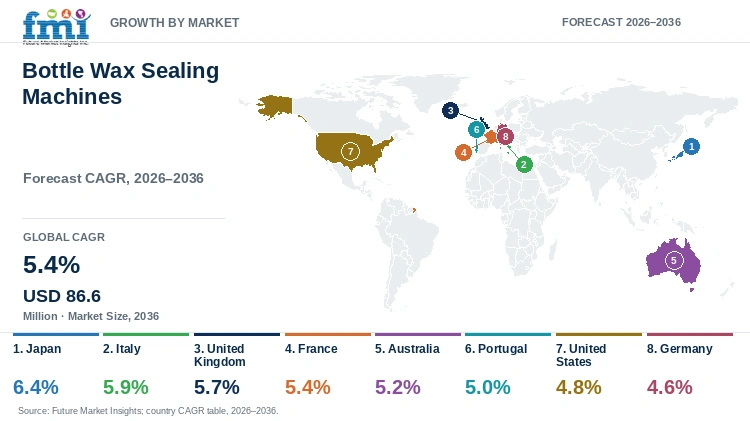
| Country | CAGR 2026-2036 |
|---|---|
| Japan | 6.4% |
| Italy | 5.9% |
| United Kingdom | 5.7% |
| France | 5.4% |
| Australia | 5.2% |
| Portugal | 5.0% |
| United States | 4.8% |
| Germany | 4.6% |
Country-wise Analysis
- Japan is likely to develop as a small but comparatively strong market for bottle wax sealing equipment. The country’s whisky and sake industries are increasingly export-oriented, and the National Tax Agency identifies sake, whisky and authentic shochu/awamori as priority categories for overseas market development. This favors packaging formats that can distinguish premium products outside the domestic market. Wax sealing is unlikely to become a standard closure method, but it can retain a role on premium releases and export-oriented bottles where presentation forms part of the product positioning. Equipment demand should therefore favor flexible systems capable of handling short production runs and different bottle formats. [4]
- Italy is likely to remain a stable market because of the scale and diversity of its wine industry. Wine production reached 47.8 Million hectolitres in 2025. This large bottling base does not translate directly into wax sealing demand because wax remains a specialized finish. Its use is more relevant among estate wines and limited releases where bottle appearance carries greater commercial importance. The fragmented nature of this application favors semi-automatic or standalone equipment that can be used across several products rather than dedicated high-speed wax sealing lines. [5]
- The United Kingdom has a comparatively favorable position because wax sealing has a natural application in premium spirits. Whisky remained the country's highest-value food and drink export in 2025 at £5.4 Billion (approximately USD 7.1 Billion), despite a decline from the previous year. The importance of whisky as a high-value export supports continued investment in distinctive bottle presentation even without strong growth in overall beverage volumes. Wax sealing equipment is therefore more likely to evolve around premium releases and short campaigns than mass-volume packaging. Machines that accommodate different bottle forms and frequent product changes should be better aligned with this structure. [2]
- France is likely to sustain bottle wax sealing as a specialized packaging activity rather than a capacity-driven equipment market. Wine production was 36.2 Million hectolitres in 2025 and is estimated at approximately 34.0 Million hectolitres in 2026. Lower production reduces the need for machinery purchased simply to increase bottling capacity. The stronger case for wax sealing remains within premium wine and spirits, where the finish can differentiate selected products. Equipment development should consequently place greater emphasis on repeatable finish quality and efficient short runs than on maximum machine speed. [6]
- Australia is likely to see selective rather than broad adoption. Wine production reached 1.13 Billion litres in 2024/25 while sales remained at approximately 1.08 Billion litres. Production therefore exceeded sales, contributing to a 5.0% increase in inventories. These conditions can discourage capacity-led investment. However, exports represented 59.0% of wine sales volume, which gives producers an incentive to differentiate selected products in overseas markets. Flexible wax finishing equipment should therefore have a stronger outlook than dedicated high-throughput systems. [7]
- Portugal is likely to support a persistent but selective market. Declared wine production totaled 6.9 Million hectolitres in the 2024/25 campaign, down 8.0% from the previous campaign. This limits the case for wax sealing equipment based on production expansion alone. Demand is more likely to remain concentrated among premium wine and fortified-wine producers where packaging contributes to product identity. Compact and semi-automatic systems fit this structure because they can serve intermittent production without requiring a dedicated high-volume line. [8]
- The United States is likely to remain one of the larger addressable markets because of its broad distilled-spirits and smaller-producer bottling base. The stronger opportunity lies in premium spirits and craft production rather than mainstream wine. Wax sealing can be introduced as a separate finishing operation after the primary closure has already been applied, allowing producers to use it selectively on higher-value products. This structure favors standalone and semi-automatic machinery.
Who are the notable companies in the Bottle Wax Sealing Machines Market?
ZONESUN, DAAP International, Q&L Packaging Machinery, Yantai Sailing Automation Technology and CRU Systems
The supplier base for bottle wax sealing equipment is fragmented. It includes specialist bottle-packaging machinery manufacturers and suppliers that offer wax dipping equipment within a broader bottling portfolio. Notable suppliers include ZONESUN, DAAP International, Q&L Packaging Machinery, Yantai Sailing Automation Technology and CRU Systems.
ZONESUN offers a six-station semi-automatic wax sealing machine with PLC control, adjustable bottle holders and separate wax and water tanks. Its published configuration is rated at approximately 360 bottles per hour and is designed for bottles below 1.5 litres, with provision for larger formats. [9]
DAAP International supplies six-station wax sealing equipment with adjustable bottle dimensions and sealing depth. Its published DMHA-LF60 configuration operates at up to approximately 350 bottles per hour without stamping and supports customized bottle dimensions. [10]
Q&L Packaging Machinery produces the FL-4H semi-automatic wax sealing machine. Bottles are loaded manually before being rotated and immersed in the wax pool for a predetermined period. Q&L also manufactures filling and capping equipment, placing wax sealing within a wider liquid-packaging portfolio. [11]
Yantai Sailing Automation Technology has one of the broader publicly visible wax-sealing ranges among the reviewed suppliers. Its portfolio includes semi-automatic equipment and rotary automatic configurations. Published systems support different bottle sizes through fixture changes, while higher-automation designs are intended for substantially greater throughput. [12]
CRU Systems focuses more heavily on equipment for small and medium bottling operations. Its wax equipment range includes single-bottle, three-bottle and six-bottle dipping systems. The six-bottle configuration is rated at approximately 600 bottles per hour, depending on operating conditions, while smaller systems provide lower-throughput alternatives for short production runs. [13]
Competitive Benchmarking: Bottle Wax Sealing Machines Market
Ratings describe published equipment capabilities. High indicates a broad offering for the criterion; Medium indicates a narrower offering. Not documented identifies a capability for which public technical information was not found.
| Company | Dedicated Wax Equipment | Bottle/Format Flexibility | Automation Breadth | Wax-Line Integration Evidence | Public Technical Detail |
|---|---|---|---|---|---|
| ZONESUN | Medium | High | Medium | Medium | High |
| DAAP International | High | High | High | Medium | High |
| Q&L Packaging Machinery | Medium | Medium | Medium | Medium | Medium |
| Yantai Sailing Automation Technology | High | High | High | Medium | High |
| CRU Systems | High | High | Medium | Not documented | High |
The competitive structure reflects the specialized nature of the market. CRU Systems provides several capacities within semi-automatic dipping equipment, while Yantai Sailing and DAAP show a broader progression toward automatic configurations. ZONESUN combines adjustable bottle handling with a relatively detailed semi-automatic design. Q&L participates through a wax sealing machine positioned within a broader filling and packaging equipment portfolio. Public evidence of wax sealing being fully integrated into complete bottling lines remains more limited than evidence for standalone machines.
Key Developments in the Bottle Wax Sealing Machines Market
- In May 2026, the OIV reported global wine production of 227.0 Million hectolitres in 2025, while consumption declined 2.7% to 208.0 Million hectolitres. The softer consumption environment reduces the case for bottle-finishing equipment purchased purely to support higher wine volumes and increases the importance of premium or differentiated packaging applications. [3]
- In 2026, Japan’s National Tax Agency reported that exports of Japan-made alcoholic beverages reached JPY 149.5 Billion (approximately USD 1.0 Billion) in 2025, up 11.8% from the previous year. Whisky exports increased 12.2% to JPY 49.0 Billion (approximately USD 328.0 Million), while sake exports rose 5.6% to JPY 45.9 Billion (approximately USD 307.2 Million). The growth of export-oriented whisky and sake supports demand for differentiated bottle presentation on selected premium products. [4]
- In September 2026, Defra reported that UK whisky exports were valued at GBP 5.4 Billion (approximately USD 7.1 Billion) in 2025 despite a 6.6% decline in real terms. Whisky remained the UK’s highest-value food and drink export. The scale of this premium spirits trade provides an established downstream base for specialized finishing processes such as wax sealing, particularly on limited releases and higher-value bottles. [2]
Key Players in the Bottle Wax Sealing Machines Market
- ZONESUN
- DAAP International
- Q&L Packaging Machinery
- Yantai Sailing Automation Technology
- CRU Systems
Bottle Wax Sealing Machines Market - Report Scope
| Coverage field | Report scope |
|---|---|
| Base year | 2025 |
| Estimated market size in 2025 | USD 48.6 Million |
| Current estimate | USD 51.2 Million in 2026 |
| Forecast value | USD 86.6 Million by 2036 |
| Forecast period | 2026-2036 |
| Forecast CAGR | 5.4% |
| Absolute dollar opportunity | USD 35.4 Million |
| Primary geography | Global |
| Leading Automation segment | Semi-automatic machines - 49.0% in 2026 |
| Leading Configuration segment | Standalone floor-mounted - 54.0% in 2026 |
| Leading Application Method | Bottle-neck dipping - 72.0% in 2026 |
| Leading End Use | Spirits producers - 44.0% in 2026 |
| Leading Equipment Demand | New installations - 57.0% in 2026 |
Bottle Wax Sealing Machines Market - Research Methodology
| Method | Approach |
|---|---|
| Equipment and Buyer Analysis | The analysis examines published equipment specifications and the operating requirements of wineries, spirits producers, contract bottlers and packaging-line operators. It compares equipment selection, batch sizes, automation requirements, changeover needs and the conditions under which manual wax application can be replaced by mechanized systems. |
| Desk Research | The analysis reviews government beverage statistics, export data, industry publications and publicly available equipment information. Evidence is used to assess the underlying wine and spirits production base, premium-packaging activity, machine configurations and country-level conditions relevant to bottle wax sealing equipment. |
| Market Sizing and Forecasting | The sizing framework combines the baseline market value with automation mix, equipment configuration, end-use structure, installation patterns and country-level demand indicators. Forecasts consider premium spirits activity, wine-sector conditions, export orientation, short-batch production requirements, automation adoption and replacement cycles. |
| Data Validation | Market estimates are checked against beverage production, export activity, observable equipment offerings and the operating economics of wax sealing. Downstream wine or spirits volumes are not treated as direct machine demand, and overlapping equipment revenues or activities outside the defined bottle wax sealing market are excluded before final reconciliation. |
Bottle Wax Sealing Machines Market by Segments
Bottle Wax Sealing Machines Market segmented by Automation:
- Manual bottle-handling dipping stations
- Semi-automatic machines
- Fully automatic machines
Bottle Wax Sealing Machines Market segmented by Configuration:
- Benchtop
- Standalone floor-mounted
- Line-integrated modules
Bottle Wax Sealing Machines Market segmented by Application Method:
- Bottle-neck dipping
- Metered external wax application
Bottle Wax Sealing Machines Market segmented by Batch Handling:
- Single-bottle
- Multi-bottle fixtures
- Indexed/continuous feeding
Bottle Wax Sealing Machines Market segmented by Wax Handling:
- Single-colour/single-bath
- Multiple-colour/multiple-bath
Bottle Wax Sealing Machines Market segmented by End Use:
- Wine producers
- Spirits producers
- Specialty bottled food/beverage producers
- Contract bottlers
Bottle Wax Sealing Machines Market segmented by Bottle Compatibility:
- Round bottles
- Non-round bottles
- Standard-volume bottles
- Miniature/large-format bottles
Bottle Wax Sealing Machines Market segmented by Equipment Demand:
- New installations
- Replacements
- Dedicated retrofit modules
Bottle Wax Sealing Machines Market by Region:
- North America
- United States
- Canada
- Latin America
- Brazil
- Mexico
- Chile
- Western Europe
- Germany
- France
- United Kingdom
- Italy
- Spain
- Portugal
- Eastern Europe
- Poland
- Russia
- Czech Republic
- East Asia
- China
- Japan
- South Korea
- South Asia & Pacific
- India
- Australia
- New Zealand
- Middle East & Africa
- United Arab Emirates
- Saudi Arabia
- South Africa
Research Sources and Bibliography
- [1] U.S. District Court for the Western District of Kentucky. Maker's Mark Distillery Inc. v. Diageo North America Inc., memorandum opinion, 2 April 2010, pp. 7-9.
- [2] Department for Environment, Food & Rural Affairs. Agriculture in the United Kingdom 2025, Chapter 13: Overseas trade. Updated 3 September 2026.
- [3] International Organisation of Vine and Wine. State of the World Wine Sector in 2025. May 2026, pp. 9 and 14.
- [4] National Tax Agency, Japan. Export support initiatives; 2025 alcoholic beverage export statistics; National Tax Agency Report 2025, Liquor Administration.
- [5] Istat. Produzioni agricole e zootecniche - Anno 2025. 4 September 2026.
- [6] Agreste. Viticulture: Production viticole 2025, estimations au 1er novembre 2025, November 2025; Une production viticole 2026 estimee a 34 millions d'hectolitres, 7 September 2026.
- [7] Wine Australia. Australian Wine Production, Sales and Inventory Report 2025. 1 December 2025.
- [8] Instituto da Vinha e do Vinho. Informacao de Mercado n.o 01/2025: Apuramento da Producao de Vinho na Campanha 2024/2025. 27 January 2025.
- [9] ZONESUN. ZS-WS6 Semi-Automatic 6 Heads Wine Bottles Dipping Wax Sealing Machine, product specifications; Bottle Wax Dipping Machine for Winery. Accessed 7 October 2026.
- [10] DAAP International. Wine Wax Sealing Machine DMHA-LF60, technical parameters. Accessed 7 October 2026.
- [11] Q&L Packaging Machinery. Wax sealing machine FL-4H, equipment structure and operating procedures. China Chamber of Commerce for Import and Export of Machinery and Electronic Products supplier listing. Accessed 7 October 2026.
- [12] Yantai Sailing Automation Technology. Company profile and wax sealing machine range. Manufacturer showroom, Made-in-China. Accessed 7 October 2026.
- [13] CRU Bottling Systems. Six Bottle Wax Dipping Machine with Basin and wax dipping equipment range. Accessed 7 October 2026.
This Report Answers
- How large is the Bottle Wax Sealing Machines Market in 2025 and 2026?
- What is the market forecast for 2036?
- Why do semi-automatic machines hold the leading Automation share?
- How does batch size change the value of higher machine speed?
- Which downstream beverage markets support equipment demand?
- Which countries are expected to grow fastest through 2036?
- Which publicly visible suppliers offer bottle wax sealing equipment?
- What should buyers examine beyond rated bottles per hour?
Frequently Asked Questions
How big is the Bottle Wax Sealing Machines Market in 2026, and what is forecast for 2036?
The Bottle Wax Sealing Machines Market is estimated at USD 51.2 Million in 2026 and is forecast to reach USD 86.6 Million by 2036.
What is the Bottle Wax Sealing Machines Market CAGR from 2026 to 2036?
The market is forecast to expand at a 5.4% CAGR from 2026 to 2036.
Which Automation segment leads the Bottle Wax Sealing Machines Market?
Semi-automatic machines lead Automation with an estimated 49.0% share in 2026.
Which Configuration segment leads the market?
Standalone floor-mounted systems lead Configuration with an estimated 54.0% share in 2026.
Which Application Method leads the market?
Bottle-neck dipping leads Application Method with an estimated 72.0% share in 2026.
Which country has the highest CAGR among the profiled markets?
Japan has the highest forecast CAGR in the profiled group at 6.4% through 2036.
How does changeover time affect output on small batches?
For small wax-sealing batches, reducing changeover time can improve effective output more than increasing running speed. The effect weakens as batch size rises.
Preview the report firsthand - request a free sample
Get SampleGet the brochure for pricing and purchase details.
Get PDFTable of Content
- How big is Bottle Wax Sealing Machines Market in 2026?
- Key Takeaways
- Analyst Perspective
- How is the Bottle Wax Sealing Machines Market segmented?
- Why do semi-automatic machines lead Automation demand?
- Why do standalone floor-mounted systems lead Configuration demand?
- Why does bottle-neck dipping remain the main Application Method?
- Why do spirits producers account for the largest End Use share?
- Why do new installations lead Equipment Demand?
- What are the drivers, restraints and opportunities in the Bottle Wax Sealing Machines Market?
- Which country CAGRs are profiled in the Bottle Wax Sealing Machines Market?
- Country-wise Analysis
- Who are the notable companies in the Bottle Wax Sealing Machines Market?
- Competitive Benchmarking: Bottle Wax Sealing Machines Market
- Key Developments in the Bottle Wax Sealing Machines Market
- Key Players in the Bottle Wax Sealing Machines Market
- Bottle Wax Sealing Machines Market - Report Scope
- Bottle Wax Sealing Machines Market - Research Methodology
- Bottle Wax Sealing Machines Market by Segments
- Bottle Wax Sealing Machines Market segmented by Automation:
- Bottle Wax Sealing Machines Market segmented by Configuration:
- Bottle Wax Sealing Machines Market segmented by Application Method:
- Bottle Wax Sealing Machines Market segmented by Batch Handling:
- Bottle Wax Sealing Machines Market segmented by Wax Handling:
- Bottle Wax Sealing Machines Market segmented by End Use:
- Bottle Wax Sealing Machines Market segmented by Bottle Compatibility:
- Bottle Wax Sealing Machines Market segmented by Equipment Demand:
- Bottle Wax Sealing Machines Market by Region:
- This Report Answers
- Frequently Asked Questions
- Competitive Landscape


