

- Market Size (2026)
- USD 890 Mn
- Forecast (2036)
- USD 1834.3 Mn
- CAGR (2026 to 2036)
- 7.5%
How big is Brachytherapy Treatment Planning Systems Market size?
USD 890 million in 2026 and USD 1,834.3 million by 2036 at a 7.5% CAGR.
Demand for brachytherapy treatment planning systems is projected to expand at 7.5% CAGR between 2026 and 2036, increasing valuation from USD 890 million in 2026 to USD 1,834.3 million by 2036. Medical teams rely on specialized planning software to import patient images and conduct vital quality assurance checks. Elekta published data in July 2026 showing that more than 2 million patients are treated each year through its solutions across 130 countries. Such an extensive global footprint raises clinical expectations for smooth system commissioning and reliable ongoing tech support without directly proving individual software system purchases.
Healthcare providers in the United Kingdom and Germany prefer well-documented imaging workflows and rigorous system testing records. Oncology operators throughout Japan and South Korea focus primarily on localized customer support and seamless data transfer between different cancer treatment platforms. RaySearch confirmed software sales to more than 1,200 clinical facilities across 51 countries during April 2026. Such widespread international software adoption naturally directs buyer attention toward robust regulatory compliance and sustainable long-term planning protocols.
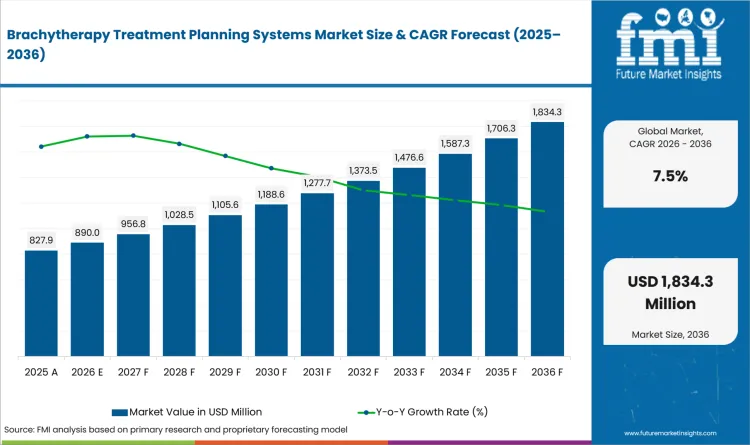
Key Takeaways for the Brachytherapy Treatment Planning Systems Market
- Demand for brachytherapy treatment planning systems reflects wider use of image-guided planning and replacement of legacy oncology interfaces.
- Direct sales are expected to represent 47.0% share of distribution channel in 2026, helped by commissioning duties and specialist support requirements.
- Hospitals are estimated to lead end user with 42.0% share in 2026, supported by concentrated imaging and quality-assurance resources.
- Limited specialist staffing and extensive validation duties represent principal barriers affecting implementation schedules and recurring software use.
- Competition focusses on Elekta AB, Varian, a Siemens Healthineers company, BEBIG Medical GmbH, RaySearch Laboratories AB, Prowess, Inc., and GE HealthCare through MIM Software, with providers differentiating based on planning accuracy and clinical workflow support.
Analyst Perspective
“Brachytherapy planning software earns clinical confidence depending on accurate reconstruction and traceable dose transfer. Oncology teams evaluate more than calculation speed during system review. Sustainable adoption reflects commissioning evidence and dependable integration across treatment delivery and patient records.”
- Anurag Sharma, Principal Analyst for Healthcare at Future Market Insights.
How is Brachytherapy Treatment Planning Systems Market segmented?
The brachytherapy treatment planning systems sector is segmented by product type, application, end user, distribution channel, technology, and region.
The brachytherapy treatment planning systems industry is segmented by product type, application, end user, distribution channel, technology, and region. Product type includes standalone, integrated oncology, 3D, cloud-based, and AI-enabled planning systems. Application coverage includes prostate, gynecological, breast, skin, head and neck, and ocular cancers. End-user assessment spans hospitals, cancer treatment centers, ambulatory surgical centers, research institutes, and radiotherapy clinics. Distribution analysis covers direct sales, authorized distributors, system integrators, value-added resellers, and online purchasing routes. Technology coverage includes 3D image guidance, inverse planning, artificial intelligence, adaptive planning, and cloud computing. Regional coverage includes North America, Latin America, Western Europe, Eastern Europe, East Asia, South Asia and Pacific, Middle East and Africa.
What supports standalone treatment planning systems across product type demand?
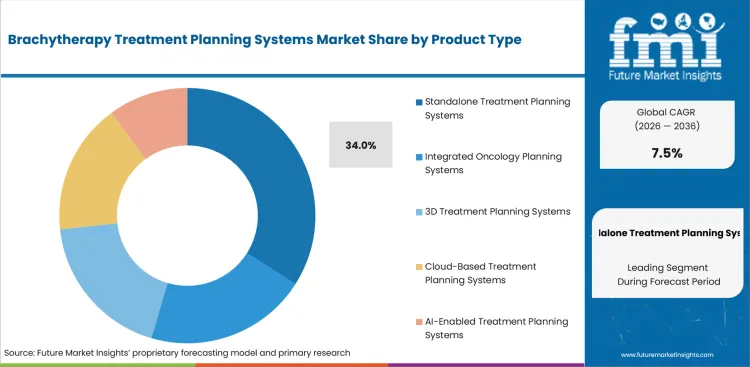
Standalone platforms preserve dedicated brachytherapy controls across applicator reconstruction and treatment export. Independent architecture helps centers retain modality-specific configuration without extending unrelated oncology functions into every planning task. In April 2025, the USA Food and Drug Administration recorded substantial-equivalence decisions covering 6 named RayStation and RayPlan configurations under one radiation therapy planning submission. Regulatory review across multiple software configurations reinforces buyer attention toward version control and controlled upgrades during standalone system selection.
- Standalone treatment planning systems are predicted to represent 34.0% share of product type in 2026, backed by focused brachytherapy workflows and direct control over modality-specific planning settings. Clinical teams test dose-engine behavior against applicator reconstruction and treatment export requirements prior to assigning the platform to routine patient planning.
- Integrated oncology planning systems and 3D treatment planning systems support institutions seeking unified records and volumetric review across oncology services. Cloud-based treatment planning systems and AI-enabled treatment planning systems add remote access or automated preparation under institution-specific validation controls.
Why does prostate cancer lead application demand?
Prostate planning requires seed or catheter reconstruction and treatment-quality review. LDR and HDR programs create distinct planning needs across intraoperative adjustment and cumulative dose evaluation. In May 2025,the American Cancer Society estimated 313,780 new prostate cancer cases in the United States during 2025. Incidence volume defines a substantial clinical treatment pool, though software revenue arises only from planning-system adoption or expanded brachytherapy capability.
- Based on application, prostate cancer is anticipated to account for 36.0% share in 2026 as it reflects established LDR and HDR planning requirements across seed placement and organ-at-risk assessment. Buyers compare workflow speed with dose reproducibility and complete treatment records during final approval across each established prostate program.
- Gynecological cancer and breast cancer require image-guided planning around applicators placed near sensitive anatomy during treatment. Skin cancer and other applications rely on site-specific templates supporting consistent dose calculations across specialized clinical pathways.
What supports hospitals across end user demand?
Hospitals combine radiation oncologists and oncology information systems within coordinated care settings. Concentrated resources support commissioning and ongoing quality checks across complex brachytherapy cases. A 2024 National Cancer Center Hospital workflow study validated a dose-management process across 46 consecutive patients, demonstrating institution-level effort required for multi-system planning and dose evaluation. Hospital demand therefore reflects coordinated clinical capacity rather than software access without trained operators.
- By end user, hospitals are likely to capture 42.0% share in 2026 since being driven by access to anesthetic support and multidisciplinary cancer services. System selection examines clinical coverage and commissioning resources before confirming dependable links with oncology records across routine treatment workflows.
- Cancer treatment centers and radiotherapy clinics support concentrated brachytherapy programs through specialist teams assigned to recurring patient cases. Ambulatory surgical centers and research institutes contribute through focused services or protocol development under defined clinical oversight.
How does direct sales shape distribution channel demand?
Direct engagement promotes applicator commissioning and service escalation. Brachytherapy planning purchases often involve hardware compatibility and institution-specific protocols requiring sustained vendor participation. RaySearch reported software sales to more than 1,200 clinical facilities across 51 countries as of the April 2026 annual report. Multi-country coverage illustrates service complexity and supports direct commercial relationships for planning configuration and technical resolution.
- In 2026, direct sales are projected to capture 47.0% share owing to complex implementation duties and direct accountability across clinical acceptance. Vendor-led implementation helps buyers document software performance and resolve configuration issues throughout local commissioning and routine clinical use.
- Authorized distributors and system integrators extend local access for institutions requiring regional technical assistance during implementation. Value-added resellers and online sourcing support contracting needs under service arrangements retaining qualified installation and clinical validation.
Why does 3D image-guided planning lead technology demand?
Three-dimensional planning combines CT or MRI anatomy with organ-at-risk structures and dose-volume analysis. Clinical value comes from anatomically informed optimization rather than point-based prescription without volumetric review. A study published in October 2025 tested integrated AI planning on 28 brachytherapy plans across 7 applicator types and reported an average runtime of 3.5 minutes. Workflow evidence supports automation inside image-guided planning, subject to contour review and clinician approval.
- 3D Image-guided planning is estimated to secure 38.0% share of technology in 2026, guided by CT and MRI guidance across applicator reconstruction and dose-volume assessment. Clinical teams use anatomical detail to refine applicator reconstruction and confirm organ exposure prior to final treatment approval.
- Inverse treatment planning and artificial intelligence support faster optimization or automated preparation across selected patient cases. Adaptive brachytherapy planning and cloud computing extend patient-specific review or remote collaboration under controlled clinical access.
What are drivers, restraints, and opportunities in Brachytherapy Treatment Planning Systems Market?
Image-guided planning supports adoption by improving treatment accuracy and strengthening dose review across brachytherapy programs. Specialist shortages and demanding validation work delay implementation across hospitals with limited medical physics capacity.
- Driver: Volumetric planning helps oncology teams shape dose around patient anatomy during complex brachytherapy procedures. Image-linked review provides physicists with a clearer basis for approving applicator placement and treatment parameters.
- Restraint: Specialist shortages slow commissioning across hospitals carrying limited brachytherapy experience. Each installation requires local dose checks and interface testing prior to approval for routine clinical use.
- Opportunity: Automated preparation shortens contouring and optimization work across suitable patient cases. Physicist-led review preserves clinical control as standardized software steps reduce repeated manual effort.
Image-guided brachytherapy changes software requirements through volumetric contouring and anatomy-specific optimization. An American Brachytherapy Society survey published in December 2024 found MRI use for first-fraction cervical planning reached 63.0% among analyzed responses. Higher imaging use increases demand for planning tools handling multimodality data and volumetric review, although every center retains separate purchasing and validation decisions.
Validation burden restrains implementation through workflow review and staff sign-off. A medical physics study published in May 2024 adopted a 5.0% threshold for secondary dose checks during initial validation of a model-based HDR brachytherapy algorithm. Such tolerances require local testing and documented acceptance, raising implementation effort for teams with limited specialist capacity.
Verified automation creates scope for shorter planning cycles and more consistent protocol application. Research published in September 2025 reduced average cervical brachytherapy planning time from 44.1 minutes to 9.4 minutes through BiCycle-based autoplanning. Commercial benefit depends on safe integration with clinical systems and retained physician review across target coverage and organ-at-risk protection.
How are country CAGRs aligned in Brachytherapy Treatment Planning Systems Market?
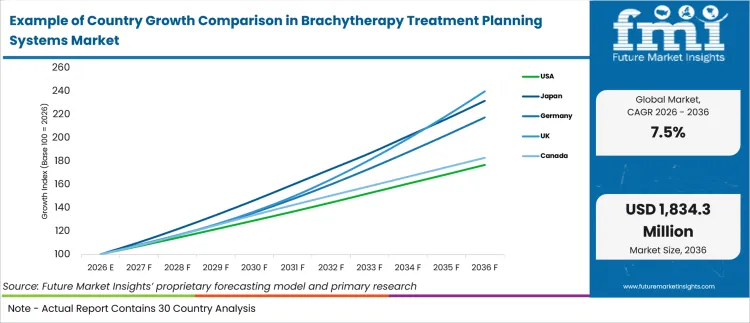
| Country or Market | CAGR |
|---|---|
| UK | 9.1% |
| Japan | 8.8% |
| Germany | 8.1% |
| South Korea | 7.2% |
| Canada | 6.2% |
| USA | 5.9% |
| Australia | 5.3% |
Source: Future Market Insights analysis, 2026.
How do country-level CAGRs compare in Brachytherapy Treatment Planning Systems Market?
The country comparison shows a gradual step-down in expansion across the markets covered. The United Kingdom and Japan occupy the upper end of the range, followed by Germany and South Korea in the second tier. Canada and United States form the next rate band. Australia completes the lower end of the comparison. A 3.8 percentage-point spread shows that profiled markets share a positive outlook, although individual positions reflect different levels of market momentum. National rates describe selected markets and do not represent a universal country ranking.
- The United Kingdom and Japan lead the comparison and establish Europe and East Asia as the principal expansion clusters among the markets shown.
- Germany and South Korea follow with a limited difference from the leading group.
- Canada and the United States form the next rate band and maintain a moderate gap from the middle tier.
- Australia records the lowest CAGR among the listed markets, although its forecast supports continued system replacement and clinical adoption.
- The pattern resembles a gradual downward slope instead of a sharp separation between higher-rate and lower-rate markets.
Markets carrying similar CAGRs are likely to present different entry conditions due to clinical infrastructure and brachytherapy readiness. The full report provides country-level analysis across North America, Latin America, Western Europe, Eastern Europe, East Asia, South Asia and Pacific, Middle East and Africa.
Country-wise Analysis
- Brachytherapy treatment planning systems market in the United Kingdom is predicted to scale at 9.1% CAGR between 2026 and 2036, driven by established radiotherapy services and formal review of image-guided planning evidence. Cancer Research UK reported around 24,300 curative prostate radiotherapy episodes in England during 2024, indicating substantial treatment activity requiring controlled planning and recording processes. Brachytherapy system purchases represent a subset of those episodes and require separate modality capability and staffing decisions.
- National Cancer Center Hospital recorded 479 high-dose-rate remote afterloading procedures during 2024, demonstrating active specialist brachytherapy workflows in Japan. Detailed treatment activity supports demand for reliable applicator reconstruction and record transfer across hospital systems. Demand in Japan is projected to rise at 8.8% CAGR by 2036, led by quality-focused clinical practice and localized technical assistance.
- Sector in Germany maintains a forecast of 8.1% CAGR from 2026 to 2036, reflecting structured oncology review and replacement of aging planning interfaces. A German clinical review published in 2025 reported approximately 75,000 prostate cancer diagnoses annually, defining a substantial patient pool across surveillance and brachytherapy pathways. Planning-system demand develops through hospitals selecting brachytherapy for eligible cases and funding software capability.
- Korea Central Cancer Registry researchers projected 308,876 new cancer cases in South Korea during 2026, with prostate cancer placed among six leading diagnosed cancers. National cancer burden supports continued investment in radiotherapy planning capacity without proving modality-specific spending. Industry in South Korea is expected to record 7.2% CAGR during the assessment period, aided by connected hospital infrastructure and rapid clinical technology evaluation.
- Sales in Canada are anticipated to register 6.2% CAGR between 2026 and 2036, shaped by specialist hospital networks and requirements for dependable regional support. Canadian Cancer Society estimated 29,300 prostate cancer diagnoses during 2026, creating a sizeable treatment population across several care pathways. Planning-system demand depends on local brachytherapy eligibility and software replacement schedules.
- National Cancer Institute data estimated 333,830 new prostate cancer cases in US during 2026, reinforcing extensive clinical need across active surveillance and treatment pathways. Eligible brachytherapy programs require validated planning tools for seed or catheter geometry, dose review, and treatment documentation. Demand in the United States is projected to increase at 5.9% CAGR during the study period, influenced by an established installed base and measured replacement activity.
- Concentrated specialist centers and long service distances influence system selection across Australia. The market in Australia is forecast to progress at 5.3% CAGR through 2036, backed by oncology software renewal and image-guided procedure development. Australian Institute of Health and Welfare estimated 29,000 prostate cancer diagnoses during 2025, defining a substantial clinical population without implying direct brachytherapy planning purchases.
Who are notable companies in Brachytherapy Treatment Planning Systems Market?
Elekta AB, Varian, a Siemens Healthineers company, BEBIG Medical GmbH, RaySearch Laboratories AB, Prowess, Inc., and GE HealthCare through MIM Software are prominent companies contributing to this market.
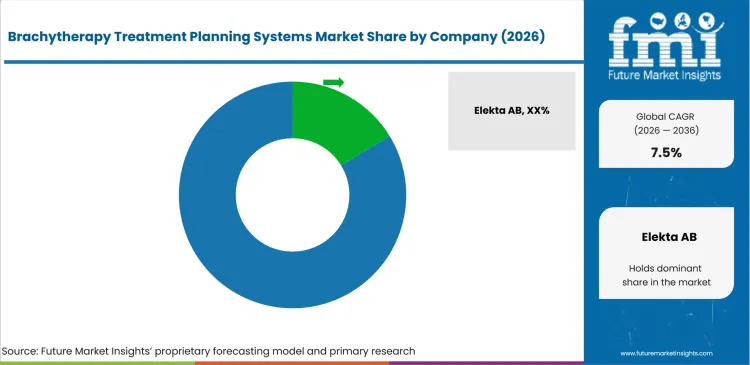
Competition centers on dedicated brachytherapy planning and cumulative dose assessment. Dedicated vendors connect applicator libraries with afterloaders and established clinical workflows. Integrated software providers combine brachytherapy with external beam planning or multimodality dose review. Buyers compare dose calculation and service coverage.
- Elekta AB and Varian compete based on established brachytherapy planning suites linked with treatment delivery and oncology information systems. Clinical teams assess applicator support and installed-service capability.
- BEBIG Medical GmbH and Prowess, Inc. compete based on focused HDR or LDR planning functions and specialist workflow support. Buyers examine real-time planning and implementation assistance.
- RaySearch Laboratories AB competes due to a multi-modality planning platform containing HDR brachytherapy capability and vendor-neutral workflows. Institutions assess unified dose review and compatibility with existing treatment infrastructure.
- GE HealthCare through MIM Software competes through cumulative dose evaluation and combined external-beam and HDR gynecologic planning support. Adoption reflects needs for cross-modality dose understanding and standardized preparation.
Competitive Benchmarking: Brachytherapy Treatment Planning Systems Market
| Company | Brachytherapy Workflow | Imaging and Dose Tools | Platform Integration | Service Reach |
|---|---|---|---|---|
| Elekta AB | High | High | High | Global |
| Varian, a Siemens Healthineers company | High | High | High | Global |
| BEBIG Medical GmbH | High | Medium | Medium | Multi-country |
| RaySearch Laboratories AB | Medium | High | High | Global |
| Prowess, Inc. | Medium | Medium | Medium | Selected markets |
| GE HealthCare through MIM Software | Medium | High | High | Global |
Source: Future Market Insights competitive analysis, 2026.
Key Developments in Brachytherapy Treatment Planning Systems Market
- In May 2025, RaySearch launched RayStation v2025 with automated planning improvements and extended brachytherapy workflow support. Release content expanded software capability for plan generation and clinical workflow standardization.
- In December 2025, the USA Food and Drug Administration recorded substantial equivalence for RayStation 2024A SP3 under radiation therapy treatment planning. Clearance supported regulated availability of an updated planning configuration in the United States.
- In May 2026, GE HealthCare introduced MIM ComboTherapy GYN HDR/EBRT for combined gynecologic dose evaluation. New capability connected external beam and HDR brachytherapy dose review through deformable registration and biological dose summation.
Key Players in Brachytherapy Treatment Planning Systems Market
Dedicated Brachytherapy Planning Providers
- Elekta AB
- Varian, a Siemens Healthineers company
- BEBIG Medical GmbH
Integrated Radiation Planning Providers
- RaySearch Laboratories AB
- GE HealthCare through MIM Software
Specialist Planning Provider
- Prowess, Inc.
Brachytherapy Treatment Planning Systems Market Report Scope
| Coverage field | Report scope |
|---|---|
| Market breakdown | Brachytherapy treatment planning systems market breakdown includes Product Type, Application, End User, Distribution Channel, Technology, and Region. |
| Quantitative Units | Revenue in USD Million, CAGR in %. |
| Market Definition | Brachytherapy treatment planning systems include software used to import images, reconstruct applicators or seeds, calculate dose, optimize plans, document treatment, and support quality assurance. Generic oncology software without brachytherapy planning capability is excluded. |
| Regions Covered | North America, Latin America, Western Europe, Eastern Europe, East Asia, South Asia and Pacific, Middle East and Africa. |
| Countries Covered | UK, Japan, Germany, South Korea, Canada, USA, Australia, and additional countries included across full regional coverage. |
| Key Companies Profiled | Elekta AB, Varian, a Siemens Healthineers company, BEBIG Medical GmbH, RaySearch Laboratories AB, Prowess, Inc., and GE HealthCare through MIM Software. |
| Forecast Period | 2026 to 2036. |
| Approach | Hybrid bottom-up and top-down methodology uses segment shares and country CAGRs. Company activity, clinical evidence, installed planning capability, and buyer adoption support final market reconciliation. |
Source: Future Market Insights analysis, 2026.
Brachytherapy Treatment Planning Systems Market - Research Methodology
| Method | Approach |
|---|---|
| Primary Research | FMI analysts gathered input from manufacturers, service providers, technology developers, distributors, end users, procurement teams, and subject-matter experts. Interviews examined purchasing decisions, product or service evaluation, adoption barriers, approval requirements, pricing considerations, and expectations for technical or commercial support. Respondents were also asked what evidence is required before a trial, pilot, or initial order develops into regular purchasing. |
| Desk Research | Desk research covered government statistics, regulatory publications, trade data, industry associations, technical literature, standards, company filings, product information, and official corporate announcements. Sources were reviewed for relevance, publication date, geographic coverage, and consistency with the defined market scope. Claims relating to performance, applications, approvals, capacity, investment, and commercial activity were retained only when supported by credible public evidence. |
| Market Sizing and Forecasting | The market model combined the baseline value with historical performance, segment structure, pricing and volume indicators, adoption levels, company participation, and country-level demand conditions. Forecast assumptions considered economic activity, investment trends, regulatory developments, technology adoption, purchasing cycles, supply availability, and barriers to wider market use. Segment and regional estimates were reconciled before the final market total was calculated. |
| Data Validation | Estimates were checked against multiple independent indicators, including public data, company activity, trade patterns, industry developments, and findings from primary interviews. Validation also tested whether products, services, applications, and company revenues fell within the defined market boundaries. Adjacent categories, unsupported claims, overlapping revenues, and activities without direct market relevance were excluded to reduce double counting and maintain consistency across segments and countries. |
Source: Future Market Insights analysis, 2026.
Brachytherapy Treatment Planning Systems Market by Segments
Brachytherapy Treatment Planning Systems Market segmented by Product Type:
- Standalone Treatment Planning Systems
- Integrated Oncology Planning Systems
- 3D Treatment Planning Systems
- Cloud-Based Treatment Planning Systems
- AI-Enabled Treatment Planning Systems
Brachytherapy Treatment Planning Systems Market segmented by Application:
- Prostate Cancer
- Gynecological Cancer
- Breast Cancer
- Skin Cancer
- Others
Brachytherapy Treatment Planning Systems Market segmented by End User:
- Hospitals
- Cancer Treatment Centers
- Ambulatory Surgical Centers
- Research Institutes
- Radiotherapy Clinics
Brachytherapy Treatment Planning Systems Market segmented by Distribution Channel:
- Direct Sales
- Authorized Distributors
- System Integrators
- Value-Added Resellers
- Online Procurement
Brachytherapy Treatment Planning Systems Market segmented by Technology:
- 3D Image-Guided Planning
- Inverse Treatment Planning
- Artificial Intelligence
- Adaptive Brachytherapy Planning
- Cloud Computing
Brachytherapy Treatment Planning Systems Market segmented by Region:
- North America
- United States
- Canada
- Latin America
- Brazil
- Mexico
- Argentina
- Chile
- Western Europe
- Germany
- France
- United Kingdom
- Italy
- Spain
- Benelux
- Nordics
- Eastern Europe
- Poland
- Czech Republic
- Romania
- Hungary
- East Asia
- China
- Japan
- South Korea
- South Asia and Pacific
- India
- ASEAN
- Australia and New Zealand
- Middle East and Africa
- GCC Countries
- South Africa
- Türkiye
- Israel
Research Sources and Bibliography
- Elekta AB. (2026, July 3). Elekta’s annual report for 2025/26 available.
- RaySearch Laboratories AB. (2026, April 15). RaySearch publishes annual report for 2025.
- USA Food and Drug Administration. (2025, April 4). 510(k) premarket notification K240398.
- National Cancer Institute. (2025, May 6). Common cancer types.
- Shikama, N., Murakami, N., Okonogi, N., et al. (2024, December). Optimizing the planning process in computed tomography-based image-guided adaptive brachytherapy for cervical cancer using a spreadsheet-based daily dose management system.
- RaySearch Laboratories AB. (2025, May 9). Interim report January 1-March 31, 2025.
- Truong, R., Moore, L. C., Mitra, A., Kallis, K., Kisling, K., Vasconcelos, N., & Meyers, S. M. (2025, October 22). Integration of single-click, AI-based brachytherapy auto-planning for cervical cancer within a treatment planning system.
- Kidd, E. A., Butler, S. S., Gardner, U., Jr., & Viswanathan, A. N. (2024, December 3). Image guided cervical brachytherapy practice patterns: 2023/2024 survey of the American Brachytherapy Society.
- Fagerstrom, J. M. (2024, May 14). Practical experience with initial quality assurance of a high dose rate brachytherapy grid-based Boltzmann solver algorithm.
- Rossi, L., Bijman, R., Westerveld, H., et al. (2025, September). Prospective evaluation of AI-based BiCycle autoplanning for advanced cervical cancer brachytherapy.
- Cancer Research UK. (2026, March). Prostate cancer statistics.
- National Cancer Center Japan. (2024). Annual report 2024: II. Radiological oncology.
- Albers, P., Franiel, T., Kötter, T., Kristiansen, G., Herrmann, K., & Wiegel, T. (2025). The early detection, diagnostic evaluation, and local treatment of prostate cancer: A paradigm shift.
- Jung, K.-W., Kang, M. J., Park, E.-H., Yun, E. H., Kim, H.-J., Kim, J.-E., Choi, K. S., & Yang, H.-K. (2026, March 23). Prediction of cancer incidence and mortality in Korea, 2026.
- Canadian Cancer Society. (2026, April). Prostate cancer statistics.
- National Cancer Institute, Surveillance, Epidemiology, and End Results Program. (2026). Cancer stat facts: Prostate cancer.
- Australian Institute of Health and Welfare. (2026, July 14). Cancer data in Australia.
- RaySearch Laboratories AB. (2025, May 2). RaySearch releases RayStation v2025.
- USA Food and Drug Administration. (2025, December 22). 510(k) premarket notification K252109.
- GE HealthCare. (2026, May 6). GE HealthCare introduces MIM ComboTherapy GYN HDR/EBRT to advance precision in gynecologic cancer care.
This bibliography is provided for reader reference and is not exhaustive. The full report contains complete primary-research documentation and detailed source records.
This Report Answers
- How do product type, application, end user, distribution channel, technology, and region influence demand?
- What criteria guide oncology teams evaluating brachytherapy treatment planning systems?
- Why do country CAGRs differ across selected national markets?
- What companies compete through dedicated and integrated planning capabilities?
- How are forecasts validated through bottom-up and top-down analysis?
- What evidence supports clinical acceptance prior to routine system use?
- Why do commissioning and specialist training influence implementation schedules?
- How do imaging compatibility and applicator reconstruction affect system selection?
- What operating risks reduce software adoption across hospitals and cancer centers?
- What company capabilities support long-term confidence and recurring use?
Frequently Asked Questions
How big is the Brachytherapy Treatment Planning Systems Market in 2026?
The brachytherapy treatment planning systems market is valued at USD 890.0 million in 2026 and is forecast to reach USD 1834.3 million by 2036. Growth is supported by oncology teams replacing legacy interfaces with image-guided planning platforms that combine applicator reconstruction, volumetric dose review, and traceable treatment documentation across hospital brachytherapy programs.
What is the CAGR of the Brachytherapy Treatment Planning Systems Market from 2026 to 2036?
The brachytherapy treatment planning systems market grows at a CAGR of 7.5% between 2026 and 2036, supported by hospitals adopting standalone and integrated planning systems once those platforms demonstrate accurate dose-engine behavior, dependable applicator reconstruction, and reliable links with oncology records across local commissioning programs.
Which product type leads the Brachytherapy Treatment Planning Systems Market?
Standalone treatment planning systems account for 34.0% of the brachytherapy treatment planning systems market by product type in 2026, driven by focused brachytherapy workflows and direct control over modality-specific planning settings that allow clinical teams to test dose-engine behavior against applicator reconstruction requirements before routine patient use.
How much will the Brachytherapy Treatment Planning Systems Market add between 2026 and 2036?
The brachytherapy treatment planning systems market is set to add USD 944.3 million between 2026 and 2036, growing from USD 890.0 million to USD 1834.3 million as image-guided planning platforms, AI-enabled automation, and cloud-based systems enter funded oncology purchasing pathways across a widening base of prostate, gynecological, and breast cancer brachytherapy programs.
Who are the leading companies in the Brachytherapy Treatment Planning Systems Market?
Five companies lead the brachytherapy treatment planning systems market, including Elekta AB, Varian a Siemens Healthineers company, BEBIG Medical GmbH, RaySearch Laboratories AB, and GE HealthCare through MIM Software, competing through dedicated brachytherapy planning suites, multi-modality dose review platforms, and integrated oncology workflow support across global hospital and cancer center programs.
Preview the report firsthand - request a free sample
Get SampleGet the brochure for pricing and purchase details.
Get PDFTable of Content
- Key Takeaways
- Market Size and CAGR
- Top Growth Driver
- Fastest Growing Segment
- Leading Region
- Key Companies
- Emerging Opportunities
- Executive Summary
- Global Market Outlook
- Demand-side Trends
- Supply-side Trends
- Technology Roadmap Analysis
- Analysis and Recommendations
- Analyst Perspective (What is happening? Why now? What should investors know?)
- Key Questions Answered
- How large is the market?
- What is the CAGR?
- What are key trends?
- Which region dominates?
- Who are the leaders?
- Market Overview
- Market Coverage / Taxonomy
- Market Definition / Scope / Limitations
- Research Methodology
- Chapter Orientation
- Analytical Lens and Working Hypotheses
- Market Structure, Signals, and Trend Drivers
- Benchmarking and Cross-market Comparability
- Market Sizing, Forecasting, and Opportunity Mapping
- Research Design and Evidence Framework
- Desk Research Programme (Secondary Evidence)
- Expert Input and Fieldwork (Primary Evidence)
- Tooling, Models, and Reference Databases
- Data Engineering and Model Build
- Quality Assurance and Audit Trail
- Market Background
- Market Dynamics (Drivers, Restraints, Opportunity, Trends)
- Scenario Forecast (Optimistic, Likely, Conservative)
- Impact Analysis
- AI Impact
- Sustainability Impact
- Regulatory Impact
- Technology Impact
- Consumer / Buyer Analysis
- Purchase Drivers
- Adoption Barriers
- Buyer Journey
- Opportunity Map Analysis
- Product Life Cycle Analysis
- Supply Chain Analysis
- Investment Feasibility Matrix
- Value Chain Analysis
- PESTLE and Porter's Analysis
- Regulatory Landscape
- Regional Parent Market Outlook
- Production and Consumption Statistics
- Import and Export Statistics
- Global Market Analysis and Forecast, 2021 to 2036
- Historical Market Size Value (USD Million) Analysis, 2021 to 2025
- Current and Future Market Size Value (USD Million) Projections, 2026 to 2036
- Y-o-Y Growth Trend Analysis
- Absolute $ Opportunity Analysis
- Global Market Pricing Analysis, 2021 to 2036
- Global Market Analysis and Forecast, By Product Type, 2021 to 2036
- Introduction / Key Findings
- Historical Market Size Value (USD Million) Analysis By Product Type, 2021 to 2025
- Current and Future Market Size Value (USD Million) Analysis and Forecast By Product Type, 2026 to 2036
- Standalone Treatment Planning Systems
- HDR Treatment Planning Systems
- LDR Treatment Planning Systems
- Integrated Oncology Planning Systems
- Multi-Modality Planning
- Hybrid Planning Platforms
- 3D Treatment Planning Systems
- CT-Based Planning Systems
- MRI-Based Planning Systems
- Cloud-Based Treatment Planning Systems
- Web-Based Planning Platforms
- Remote Planning Solutions
- AI-Enabled Treatment Planning Systems
- Automated Dose Optimization
- AI-Assisted Contouring
- Standalone Treatment Planning Systems
- Y-o-Y Growth Trend Analysis By Product Type, 2021 to 2025
- Absolute $ Opportunity Analysis By Product Type, 2026 to 2036
- Global Market Analysis and Forecast, By Application, 2021 to 2036
- Introduction / Key Findings
- Historical Market Size Value (USD Million) Analysis By Application, 2021 to 2025
- Current and Future Market Size Value (USD Million) Analysis and Forecast By Application, 2026 to 2036
- Prostate Cancer
- Low-Dose Rate Therapy
- High-Dose Rate Therapy
- Gynecological Cancer
- Cervical Cancer
- Endometrial Cancer
- Breast Cancer
- Accelerated Partial Breast Irradiation
- Boost Therapy
- Skin Cancer
- Basal Cell Carcinoma
- Squamous Cell Carcinoma
- Others
- Head & Neck Cancer
- Ocular Cancer
- Prostate Cancer
- Y-o-Y Growth Trend Analysis By Application, 2021 to 2025
- Absolute $ Opportunity Analysis By Application, 2026 to 2036
- Global Market Analysis and Forecast, By End User, 2021 to 2036
- Introduction / Key Findings
- Historical Market Size Value (USD Million) Analysis By End User, 2021 to 2025
- Current and Future Market Size Value (USD Million) Analysis and Forecast By End User, 2026 to 2036
- Hospitals
- Public Hospitals
- Private Hospitals
- Cancer Treatment Centers
- Comprehensive Cancer Centers
- Specialty Oncology Centers
- Ambulatory Surgical Centers
- Outpatient Oncology Centers
- Day Care Centers
- Research Institutes
- Academic Medical Centers
- Clinical Research Organizations
- Radiotherapy Clinics
- Private Radiotherapy Clinics
- Independent Cancer Clinics
- Hospitals
- Y-o-Y Growth Trend Analysis By End User, 2021 to 2025
- Absolute $ Opportunity Analysis By End User, 2026 to 2036
- Global Market Analysis and Forecast, By Distribution Channel, 2021 to 2036
- Introduction / Key Findings
- Historical Market Size Value (USD Million) Analysis By Distribution Channel, 2021 to 2025
- Current and Future Market Size Value (USD Million) Analysis and Forecast By Distribution Channel, 2026 to 2036
- Direct Sales
- OEM Contracts
- Enterprise Procurement
- Authorized Distributors
- National Distributors
- Regional Distributors
- System Integrators
- Oncology Solution Providers
- Healthcare IT Integrators
- Value-Added Resellers
- Medical Equipment VARs
- Software Solution Partners
- Online Procurement
- Digital Procurement Platforms
- E-Tender Portals
- Direct Sales
- Y-o-Y Growth Trend Analysis By Distribution Channel, 2021 to 2025
- Absolute $ Opportunity Analysis By Distribution Channel, 2026 to 2036
- Global Market Analysis and Forecast, By Technology, 2021 to 2036
- Introduction / Key Findings
- Historical Market Size Value (USD Million) Analysis By Technology, 2021 to 2025
- Current and Future Market Size Value (USD Million) Analysis and Forecast By Technology, 2026 to 2036
- 3D Image-Guided Planning
- CT Image Guidance
- MRI Image Guidance
- Inverse Treatment Planning
- Dose Optimization
- Source Position Optimization
- Artificial Intelligence
- Auto-Segmentation
- AI Dose Planning
- Adaptive Brachytherapy Planning
- Real-Time Planning
- Patient-Specific Adaptation
- Cloud Computing
- Remote Collaboration
- Centralized Data Management
- 3D Image-Guided Planning
- Y-o-Y Growth Trend Analysis By Technology, 2021 to 2025
- Absolute $ Opportunity Analysis By Technology, 2026 to 2036
- Global Market Analysis and Forecast, By Region, 2021 to 2036
- Introduction
- Historical Market Size Value (USD Million) Analysis By Region, 2021 to 2025
- Current Market Size Value (USD Million) Analysis and Forecast By Region, 2026 to 2036
- North America
- Latin America
- Western Europe
- Eastern Europe
- East Asia
- South Asia and Pacific
- Middle East & Africa
- Market Attractiveness Analysis By Region
- North America Market Analysis and Forecast, By Country, 2021 to 2036
- Historical Market Size Value (USD Million) Trend Analysis By Market Taxonomy, 2021 to 2025
- Market Size Value (USD Million) Forecast By Market Taxonomy, 2026 to 2036
- By Country
- USA
- Canada
- By Product Type
- By Application
- By End User
- By Distribution Channel
- By Technology
- By Country
- Market Attractiveness Analysis
- By Country
- By Product Type
- By Application
- By End User
- By Distribution Channel
- By Technology
- Key Takeaways
- Latin America Market Analysis and Forecast, By Country
- Historical Market Size Value (USD Million) Trend Analysis By Market Taxonomy, 2021 to 2025
- Market Size Value (USD Million) Forecast By Market Taxonomy, 2026 to 2036
- By Country
- Brazil
- Mexico
- Chile
- Rest of Latin America
- By Product Type
- By Application
- By End User
- By Distribution Channel
- By Technology
- By Country
- Market Attractiveness Analysis
- By Country
- By Product Type
- By Application
- By End User
- By Distribution Channel
- By Technology
- Key Takeaways
- Western Europe Market Analysis and Forecast, By Country
- Historical Market Size Value (USD Million) Trend Analysis By Market Taxonomy, 2021 to 2025
- Market Size Value (USD Million) Forecast By Market Taxonomy, 2026 to 2036
- By Country
- Germany
- UK
- Italy
- Spain
- France
- Nordic
- BENELUX
- Rest of Western Europe
- By Product Type
- By Application
- By End User
- By Distribution Channel
- By Technology
- By Country
- Market Attractiveness Analysis
- By Country
- By Product Type
- By Application
- By End User
- By Distribution Channel
- By Technology
- Key Takeaways
- Eastern Europe Market Analysis and Forecast, By Country
- Historical Market Size Value (USD Million) Trend Analysis By Market Taxonomy, 2021 to 2025
- Market Size Value (USD Million) Forecast By Market Taxonomy, 2026 to 2036
- By Country
- Russia
- Poland
- Hungary
- Balkan & Baltic
- Rest of Eastern Europe
- By Product Type
- By Application
- By End User
- By Distribution Channel
- By Technology
- By Country
- Market Attractiveness Analysis
- By Country
- By Product Type
- By Application
- By End User
- By Distribution Channel
- By Technology
- Key Takeaways
- East Asia Market Analysis and Forecast, By Country
- Historical Market Size Value (USD Million) Trend Analysis By Market Taxonomy, 2021 to 2025
- Market Size Value (USD Million) Forecast By Market Taxonomy, 2026 to 2036
- By Country
- China
- Japan
- South Korea
- By Product Type
- By Application
- By End User
- By Distribution Channel
- By Technology
- By Country
- Market Attractiveness Analysis
- By Country
- By Product Type
- By Application
- By End User
- By Distribution Channel
- By Technology
- Key Takeaways
- South Asia and Pacific Market Analysis and Forecast, By Country
- Historical Market Size Value (USD Million) Trend Analysis By Market Taxonomy, 2021 to 2025
- Market Size Value (USD Million) Forecast By Market Taxonomy, 2026 to 2036
- By Country
- India
- ASEAN
- Australia & New Zealand
- Rest of South Asia and Pacific
- By Product Type
- By Application
- By End User
- By Distribution Channel
- By Technology
- By Country
- Market Attractiveness Analysis
- By Country
- By Product Type
- By Application
- By End User
- By Distribution Channel
- By Technology
- Key Takeaways
- Middle East & Africa Market Analysis and Forecast, By Country
- Historical Market Size Value (USD Million) Trend Analysis By Market Taxonomy, 2021 to 2025
- Market Size Value (USD Million) Forecast By Market Taxonomy, 2026 to 2036
- By Country
- Kingdom of Saudi Arabia
- Other GCC Countries
- Türkiye
- South Africa
- Other African Union
- Rest of Middle East & Africa
- By Product Type
- By Application
- By End User
- By Distribution Channel
- By Technology
- By Country
- Market Attractiveness Analysis
- By Country
- By Product Type
- By Application
- By End User
- By Distribution Channel
- By Technology
- Key Takeaways
- Key Countries Market Analysis
- USA
- Pricing Analysis
- Market Share Analysis, 2025
- By Product Type
- By Application
- By End User
- By Distribution Channel
- By Technology
- Canada
- Pricing Analysis
- Market Share Analysis, 2025
- By Product Type
- By Application
- By End User
- By Distribution Channel
- By Technology
- Mexico
- Pricing Analysis
- Market Share Analysis, 2025
- By Product Type
- By Application
- By End User
- By Distribution Channel
- By Technology
- Brazil
- Pricing Analysis
- Market Share Analysis, 2025
- By Product Type
- By Application
- By End User
- By Distribution Channel
- By Technology
- Chile
- Pricing Analysis
- Market Share Analysis, 2025
- By Product Type
- By Application
- By End User
- By Distribution Channel
- By Technology
- Germany
- Pricing Analysis
- Market Share Analysis, 2025
- By Product Type
- By Application
- By End User
- By Distribution Channel
- By Technology
- UK
- Pricing Analysis
- Market Share Analysis, 2025
- By Product Type
- By Application
- By End User
- By Distribution Channel
- By Technology
- Italy
- Pricing Analysis
- Market Share Analysis, 2025
- By Product Type
- By Application
- By End User
- By Distribution Channel
- By Technology
- Spain
- Pricing Analysis
- Market Share Analysis, 2025
- By Product Type
- By Application
- By End User
- By Distribution Channel
- By Technology
- France
- Pricing Analysis
- Market Share Analysis, 2025
- By Product Type
- By Application
- By End User
- By Distribution Channel
- By Technology
- India
- Pricing Analysis
- Market Share Analysis, 2025
- By Product Type
- By Application
- By End User
- By Distribution Channel
- By Technology
- ASEAN
- Pricing Analysis
- Market Share Analysis, 2025
- By Product Type
- By Application
- By End User
- By Distribution Channel
- By Technology
- Australia & New Zealand
- Pricing Analysis
- Market Share Analysis, 2025
- By Product Type
- By Application
- By End User
- By Distribution Channel
- By Technology
- China
- Pricing Analysis
- Market Share Analysis, 2025
- By Product Type
- By Application
- By End User
- By Distribution Channel
- By Technology
- Japan
- Pricing Analysis
- Market Share Analysis, 2025
- By Product Type
- By Application
- By End User
- By Distribution Channel
- By Technology
- South Korea
- Pricing Analysis
- Market Share Analysis, 2025
- By Product Type
- By Application
- By End User
- By Distribution Channel
- By Technology
- Russia
- Pricing Analysis
- Market Share Analysis, 2025
- By Product Type
- By Application
- By End User
- By Distribution Channel
- By Technology
- Poland
- Pricing Analysis
- Market Share Analysis, 2025
- By Product Type
- By Application
- By End User
- By Distribution Channel
- By Technology
- Hungary
- Pricing Analysis
- Market Share Analysis, 2025
- By Product Type
- By Application
- By End User
- By Distribution Channel
- By Technology
- Kingdom of Saudi Arabia
- Pricing Analysis
- Market Share Analysis, 2025
- By Product Type
- By Application
- By End User
- By Distribution Channel
- By Technology
- Türkiye
- Pricing Analysis
- Market Share Analysis, 2025
- By Product Type
- By Application
- By End User
- By Distribution Channel
- By Technology
- South Africa
- Pricing Analysis
- Market Share Analysis, 2025
- By Product Type
- By Application
- By End User
- By Distribution Channel
- By Technology
- USA
- Market Structure Analysis
- Competition Dashboard
- Competition Benchmarking
- Market Share Analysis of Top Players
- By Regional
- By Product Type
- By Application
- By End User
- By Distribution Channel
- By Technology
- Emerging Startups
- Innovation Benchmarking
- Competition Analysis
- Competition Deep Dive
- Elekta AB
- Overview
- Product Portfolio
- Profitability by Market Segments
- Sales Footprint
- Strategy Overview
- Marketing Strategy
- Product Strategy
- Channel Strategy
- Varian Medical Systems (Siemens Healthineers)
- Eckert & Ziegler BEBIG
- Carl Zeiss Meditec AG
- Theragenics Corporation
- RaySearch Laboratories
- Panacea Medical Technologies
- IsoRay Medical
- Accuray Incorporated
- Standard Imaging Inc.
- Elekta AB
- Case Studies
- Success Stories
- Recent Developments
- Competition Deep Dive
- Assumptions & Acronyms Used


