

- Market Size (2026)
- USD 1.2 Bn
- Forecast (2036)
- USD 2.7 Bn
- CAGR (2026 to 2036)
- 8.4%
How big is Breath Training Devices Market size?
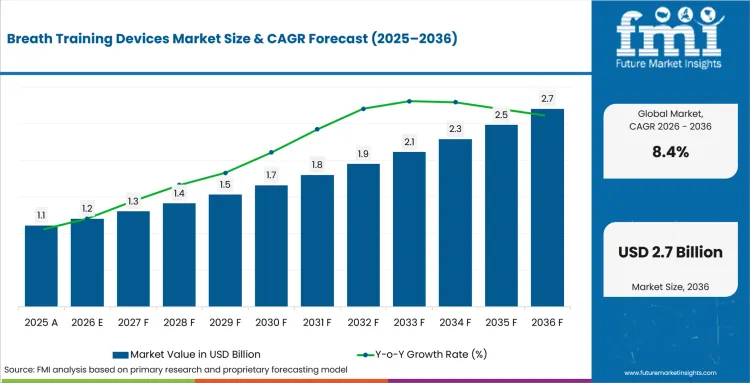
USD 1.2 billion in 2026 and USD 2.7 billion by 2036 at an 8.4% CAGR.
Demand for Breath Training Devices is projected to expand at 8.4% CAGR between 2026 and 2036, increasing valuation from USD 1.2 billion in 2026 to USD 2.7 billion by 2036. Patients actively deploy inspiratory and expiratory breathing trainers to speed up post-operative recovery and support guided home therapy programs. Andrawes and co-authors described 3 distinct commercial device mechanisms during May 2026 by categorizing them into threshold loading along with flow resistance, and isocapnic hyperpnea. These fundamental mechanical differences directly dictate the type of user feedback required and guide how medical researchers evaluate overall respiratory device performance.
Regional sourcing strategies also shift noticeably depending on local clinical training cultures and healthcare infrastructure. Healthcare buyers across the United States and Germany favor equipment providing calibrated loading records with formal clinician-led reviews. Purchasing groups in Japan and Australia actively prioritize compact portable systems adapting easily to both everyday rehabilitation and athletic performance programs. Brown and co-authors randomized 90 study participants between app-supported home rehabilitation and traditional center-based care during March 2026. Their clinical trial revealed equivalent exercise-capacity improvements across both patient groups and confirmed the viability of guided home breathing programs whenever users possess basic device skills and receive adequate clinician support.
Key Takeaways for Breath Training Devices Market
- Demand for breath training devices is driven by home rehabilitation and performance conditioning requiring measurable respiratory-muscle progress.
- Mechanical resistance technology is set to garner 41.0% share of technology in 2026, helped by simple loading control and familiar training routines.
- Medical device distributors are predicted to lead distribution channel with 38.0% share in 2026, backed by hospital access and local product support.
- Variable adherence and inconsistent outcome measurement represent principal barriers limiting repeat purchases and clinician confidence.
- Competition focuses on POWERbreathe International Ltd., Airofit A/S, PN Medical, Inc., Aspire Respiratory Products, Medline Inc., ICU Medical, Inc., AirPhysio Pty Ltd., and DOJO Health, Inc.
Analyst Perspective
“Breath training devices gain acceptance when clinicians can set suitable resistance and verify improvement across repeated sessions. Poor adherence weakens results and reduces confidence in continued use. Suppliers need dependable progress tracking and practical follow-up support to help users complete prescribed programs.”
- Anurag Sharma, Principal Analyst for Healthcare at Future Market Insights
How is Breath Training Devices Market segmented?
The breath training devices industry is segmented by product type, application, end user, distribution channel, technology, and region.
The breath training devices market is segmented by product type, application, end user, distribution channel, technology, and region. Product Type coverage includes Inspiratory Muscle Training (IMT) Devices, Expiratory Muscle Training (EMT) Devices, Combined IMT/EMT Devices, Breathing Exercisers, and Smart Breath Training Devices. Application coverage addresses Respiratory Rehabilitation, Sports & Fitness, Post-Operative Recovery, Pulmonary Disease Management, and Wellness & Preventive Care. End User coverage spans Hospitals, Homecare Settings, Sports & Fitness Centers, Rehabilitation Centers, and Specialty Clinics. Distribution Channel coverage includes Medical Device Distributors, Direct Sales, Online Retail, Pharmacies & Drug Stores, and Specialty Medical Stores. Technology coverage comprises Mechanical Resistance Technology, Electronic Feedback Technology, Pressure Threshold Technology, Smart Connected Technology, and Sensor-Based Monitoring. Regional coverage includes North America, Europe, East Asia, South Asia and Pacific, Latin America, Middle East and Africa.
Why do inspiratory muscle training (IMT) devices lead product type demand?
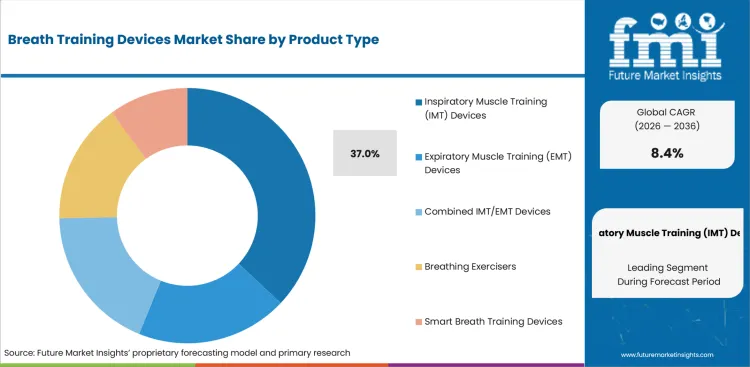
Inspiratory muscle training (IMT) devices apply controlled resistance during inhalation, helping users train respiratory muscles through repeatable sessions. Aktan and co-authors studied 30 participants across standard and warm-up groups in January 2025, documenting improved exercise capacity and inspiratory strength following an 8-week program. Findings support calibrated respiratory trainer use across supervised rehabilitation.
- Inspiratory muscle training (IMT) devices are predicted to represent 37.0% share of product type in 2026, driven by direct loading of weakened inspiratory muscles. Clinical teams review training frequency and completion records during device selection.
- Expiratory muscle training (EMT) devices and combined IMT/EMT devices influence swallowing assistance and balanced respiratory conditioning. Breathing exercisers and smart breath training devices address simpler recovery routines or feedback-led consumer programs.
How does respiratory rehabilitation shape application demand?
Respiratory rehabilitation combines exercise and structured breathing practice across chronic disease programs. NHS England reported 61.0% of enrolled pulmonary rehabilitation patients completed discharge assessment in February 2024, showing meaningful completion gaps despite established clinical pathways. Device selection favors manageable resistance and documented progress.
- Based on application, respiratory rehabilitation is anticipated to account for 34.0% share in 2026 due to routine use across COPD and asthma management programs. Clinician acceptance rises with measurable pressure gains and dependable patient follow-through.
- Sports & fitness and wellness & preventive care emphasize breathing control and convenient self-guided routines. Post-operative recovery and pulmonary disease management require closer supervision, especially for frail patients or complex respiratory conditions.
What supports hospitals across end user demand?
Hospitals connect diagnosis and outcome review within one care setting. American Hospital Association counted 6,100 hospitals across United States in February 2026, demonstrating extensive institutional coverage for respiratory assessment and recovery programs. Hospital use favors products carrying calibrated settings and dependable supply.
- By end user, hospitals are set to represent 36.0% share in 2026 owing to post-operative breathing exercises and pulmonary rehabilitation pathways. Clinical oversight helps match resistance levels with patient capacity and recovery goals.
- Homecare settings and rehabilitation centers extend repeated training beyond acute treatment. Sports & fitness centers and specialty clinics emphasize performance coaching or focused respiratory support, creating distinct service expectations.
Why do medical device distributors lead distribution channel demand?
Medical device distributors connect manufacturers with hospitals and rehabilitation providers requiring local inventory and product education. POWERbreathe reported availability across more than 50 countries during 2026, illustrating distribution depth supporting respiratory muscle training access. Local representation improves product comparison, replacement access, and training assistance.
- In 2026, medical device distributors are expected to secure 38.0% share as it is driven by established hospital relationships and multi-brand respiratory portfolios. Regional stock and technical assistance reduce purchasing delays across clinical accounts.
- Direct sales and online retail support specialist products requiring demonstration or consumer education. Pharmacies & drug stores and specialty medical stores serve convenient replacement demand.
What supports mechanical resistance technology within technology demand?
Mechanical resistance technology provides adjustable loading without complex electronics, supporting straightforward training routines and durable product design. Airofit reported in February 2026 that ELITE users applied breath-hold sessions and received posture alerts during training. Connected guidance illustrates how resistance-based devices increasingly combine physical loading with digital feedback across rehabilitation and performance programs.
- Mechanical resistance technology is likely to capture 41.0% share in 2026, backed by familiar operation and controlled resistance settings. Spring and valve systems support repeatable sessions without extensive setup requirements.
- Electronic feedback technology and smart connected technology add progress tracking and session records. Pressure threshold technology and sensor-based monitoring serve users requiring calibrated loading or quantified airflow assessment.
What are drivers, restraints, and opportunities in Breath Training Devices Market?
Chronic respiratory conditions support demand across clinical rehabilitation and guided home programs. Irregular practice reduces therapeutic value and weakens repeat purchasing.
- Driver: Home rehabilitation programs expand demand for calibrated breath trainers by extending guided respiratory-muscle practice beyond hospitals into supervised recovery routines. Clinicians favor devices combining adjustable resistance with simple progress records, since documented improvement supports continuation across chronic care and post-operative programs.
- Restraint: Irregular session completion weakens treatment consistency and reduces confidence in outcomes recorded across unsupervised home-based breathing programs. Providers face longer review cycles if prescriptions lack clear loading targets, leaving buyers uncertain about repeat use and measurable clinical benefit.
- Opportunity: Connected coaching creates an expansion route by pairing resistance exercises with reminders and progress summaries across rehabilitation and performance settings. Supplier platforms offering clinician review and user feedback may strengthen completion rates, improving repeat engagement without adding complex operating demands.
Chronic respiratory disease creates sustained need for breathing support and rehabilitation. National Center for Health Statistics reported COPD among 7.0% of United States adults aged 45 years and older during 2024 in its April 2026 release. Prevalence across older populations supports respiratory-muscle assessment, and structured training pathways.
Unsupervised practice creates a major execution barrier. Dosbaba and co-authors randomized 52 patients in August 2025, finding adherence declined during an unsupervised phase despite maintained benefits within one intervention group. Commercial programs need progress review and clear responsibility for follow-up.
Connected education and measured progress create a practical expansion route. PN Medical reported almost 2,000,000 people reached by its respiratory products as of January 2024, illustrating sizable demand for evidence-led training outside specialist facilities. Providers pairing breathing exercise devices with guided protocols may improve completion and repeat engagement.
How are country CAGRs aligned in Breath Training Devices Market?
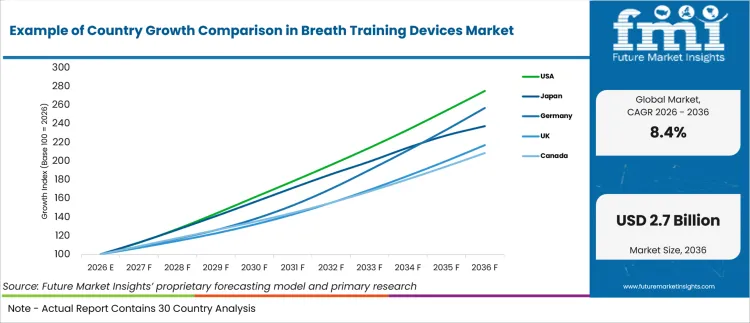
| Country or Market | CAGR |
|---|---|
| USA | 10.7% |
| Germany | 9.9% |
| Japan | 9.0% |
| UK | 8.1% |
| Canada | 7.6% |
| Australia | 7.3% |
| South Korea | 6.9% |
Source: Future Market Insights analysis, 2026.
How do country-level CAGRs compare in Breath Training Devices Market?
Country comparison shows a gradual step-down across profiled markets. The United States occupies upper forecast position, followed by Germany and Japan. The United Kingdom and Canada form middle-to-lower positions. Australia and South Korea complete disclosed comparison. A 3.8 percentage-point spread separates United States from South Korea. Profiled rates reflect different clinical pathways and home-program readiness.
- The United States is anticipated to lead disclosed comparison based on extensive hospital coverage and home rehabilitation interest.
- Germany is likely to follow under structured clinical review and established rehabilitation facilities.
- Japan is expected to occupy next position led by specialist oversight and compact home-training routines.
- The United Kingdom and Canada are projected to form a middle band shaped by rehabilitation access and service capacity.
- Australia and South Korea complete comparison through connected care models and distributed patient support.
Markets carrying similar CAGRs are likely to present different entry conditions through clinical referral and adherence management. Full report coverage includes North America, Europe, East Asia, South Asia and Pacific, Latin America, Middle East and Africa.
Country-wise Analysis
- Sales in the United States sales are projected to expand at 10.7% CAGR from 2026 to 2036, driven by extensive respiratory care capacity and rising home-program interest. National Center for Health Statistics recorded diagnosed COPD among 4.2% of all adults during 2024, with prevalence rising to 7.0% among adults aged 45 and older sustaining assessment and rehabilitation needs across care settings. Distributor education and program-completion records influence repeat purchasing across hospital and home channels.
- German Federal Statistical Office counted 1,874 hospitals as of September 2024, supporting institutional access for respiratory assessment and recovery pathways. Local documentation and calibrated loading records guide adoption across hospitals and rehabilitation facilities. Demand in Germany is anticipated to rise at 9.9% CAGR by 2036, influenced by clinical review and rehabilitation infrastructure.
- Specialist oversight and compact equipment help transfer structured practice into Japanese home routines. Adoption in Japan is estimated to grow at 9.0% CAGR between 2026 and 2036, led by measured respiratory-muscle assessment. Shiraishi and co-authors enrolled 38 participants in an inspiratory muscle training trial published during November 2024, reinforcing clinical interest in diaphragm function and exercise tolerance.
- Sector in the United Kingdom is likely to increase at 8.1% CAGR during the study period, guided by demand for scalable guided rehabilitation. Royal College of Physicians reported a 100-day average wait for stable COPD patients starting pulmonary rehabilitation in June 2026, exposing service-capacity pressure. Home programs need clinician review and simple adherence reporting across constrained pathways.
- Canadian Institute for Health Information reported 7.0 days average hospital stay for COPD and bronchitis during 2024- 2025, highlighting recovery burdens extending beyond acute treatment. Provincial coverage and dependable training guidance influence uptake across home and rehabilitation channels. Industry in Canada is forecast to scale at 7.6% CAGR during the assessment period, backed by chronic respiratory admissions and dispersed service delivery.
- Geographic distance and specialist hubs encourage connected instruction with remote progress review across Australia. The market in Australia is anticipated to rise at 7.3% CAGR by 2036, helped by distributed respiratory-care needs. Australian Institute of Health and Welfare recorded 61,500 emergency department presentations due to COPD during 2024 to 2025 in its February 2026 update, highlighting substantial acute-care activity.
- Sales in South Korea are projected to record 6.9% CAGR between 2026 and 2036, aided by connected rehabilitation and technology-oriented care delivery. Kim and co-authors conducted a pulmonary rehabilitation trial across 3 centers in April 2024, demonstrating institutional capacity for app-guided respiratory programs. Localized coaching and measurable progress influence product acceptance across clinician-led pathways.
Who are notable companies in Breath Training Devices Market?
POWERbreathe International Ltd., Airofit A/S, PN Medical, Inc., Aspire Respiratory Products, Medline Inc., ICU Medical, Inc., AirPhysio Pty Ltd., and DOJO Health, Inc. are notable companies active in breath training devices.
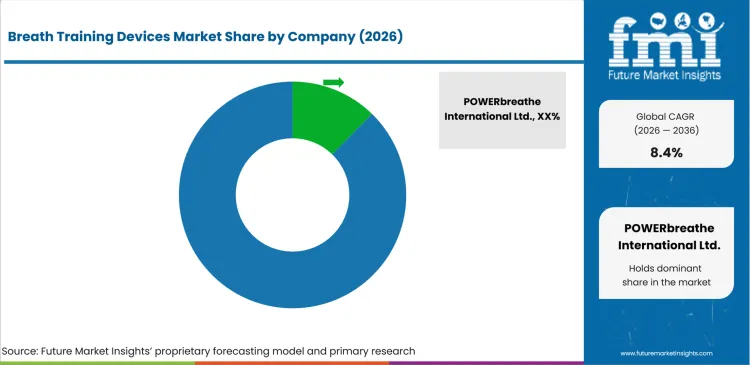
Competition in the market centers on loading precision and channel reach. Respiratory muscle training specialists emphasize adjustable resistance and progress measurement. Hospital suppliers compete based on disposable exercisers and familiar clinical workflows. Connected challengers add session records and real-time breath metrics. Buyer review covers replacement access and program-completion support.
- POWERbreathe International Ltd. and Airofit A/S compete driven by inspiratory training and guided performance feedback. Buyers compare coaching quality and compatibility with clinical or athletic programs.
- PN Medical, Inc. and Aspire Respiratory Products focus on combined or expiratory muscle training supported by established protocols. Clinicians assess patient suitability and evidence covering cough or endurance.
- Medline Inc. and ICU Medical, Inc. serve hospital respiratory workflows led by incentive exercisers and airway-care portfolios. Institutional buyers emphasize simple operation and staff familiarity.
- AirPhysio Pty Ltd. and DOJO Health, Inc. address different entry routes depending on expiratory lung expansion and connected breath tracking. Product evaluation reflects intended setting and user-support requirements.
Competitive Benchmarking: Breath Training Devices Market
| Company | Training Mechanism | Feedback Capability | Clinical Channel | Commercial Reach |
|---|---|---|---|---|
| POWERbreathe International Ltd. | High | High | High | Global |
| Airofit A/S | High | High | Medium | International |
| PN Medical, Inc. | High | Medium | High | International |
| Aspire Respiratory Products | High | Low | High | International distributors |
| Medline Inc. | Medium | Low | High | Global |
| ICU Medical, Inc. | Medium | High | High | Global |
| AirPhysio Pty Ltd. | Medium | Low | Medium | International |
| DOJO Health, Inc. | Medium | High | Emerging | Early commercial rollout |
Source: Future Market Insights competitive analysis, 2026.
Key Developments in Breath Training Devices Market
- In May 2025, ICU Medical and VisionHealth launched MyAcapella, adding guided therapy, reminders, education, and adherence tracking for respiratory patients. Coaching support strengthens completion oversight across prescribed airway-clearance routines.
- In January 2026, DOJO Health announced a Golden State Storm partnership for respiratory performance hardware and breath tracking. Athlete integration extends measured breath training into structured team-performance programs.
- In May 2026, DOJO Health launched DOJO Air through Kickstarter as a volumetric breath training and tracking platform. Real-time volume, airflow, and breath-hold feedback create a measurable consumer training pathway.
Key Players in Breath Training Devices Market
Respiratory Muscle Training Specialists
- POWERbreathe International Ltd.
- Airofit A/S
- PN Medical, Inc.
- Aspire Respiratory Products
Clinical Respiratory Device Providers
- Medline Inc.
- ICU Medical, Inc.
- AirPhysio Pty Ltd.
Connected Breath Training Challenger
- DOJO Health, Inc.
Breath Training Devices Market Report Scope
| Coverage field | Report scope |
|---|---|
| Market breakdown | Breath training devices market breakdown includes product type, application, end user, distribution channel, technology, and region. |
| Quantitative Units | Revenue in USD Million, CAGR in %. |
| Market Definition | Breath training devices include inspiratory and expiratory muscle trainers, combined resistance products, incentive exercisers, connected coaching tools, and related rehabilitation products. Generic wellness applications lacking a physical training device are excluded. |
| Regions Covered | North America, Europe, East Asia, South Asia and Pacific, Latin America, Middle East and Africa. |
| Countries Covered | USA, Germany, Japan, UK, Canada, Australia, South Korea, and additional countries covered across full regional analysis. |
| Key Companies Profiled | POWERbreathe International Ltd., Airofit A/S, PN Medical, Inc., Aspire Respiratory Products, Medline Inc., ICU Medical, Inc., AirPhysio Pty Ltd., and DOJO Health, Inc. |
| Forecast Period | 2026 to 2036 |
| Approach | Hybrid bottom-up and top-down methodology uses segment shares and country CAGRs. Company activity, clinical pathways, distributor reach, and user adherence support final reconciliation. |
Source: Future Market Insights analysis, 2026.
Breath Training Devices Market - Research Methodology
| Method | Approach |
|---|---|
| Primary Research | FMI analysts gathered input from manufacturers, service providers, technology developers, distributors, end users, procurement teams, and subject-matter experts. Interviews examined purchasing decisions, product or service evaluation, adoption barriers, approval requirements, pricing considerations, and expectations for technical or commercial support. Respondents were also asked what evidence is required before a trial, pilot, or initial order develops into regular purchasing. |
| Desk Research | Desk research covered government statistics, regulatory publications, trade data, industry associations, technical literature, standards, company filings, product information, and official corporate announcements. Sources were reviewed for relevance, publication date, geographic coverage, and consistency with the defined market scope. Claims relating to performance, applications, approvals, capacity, investment, and commercial activity were retained only when supported by credible public evidence. |
| Market Sizing and Forecasting | The market model combined the baseline value with historical performance, segment structure, pricing and volume indicators, adoption levels, company participation, and country-level demand conditions. Forecast assumptions considered economic activity, investment trends, regulatory developments, technology adoption, purchasing cycles, supply availability, and barriers to wider market use. Segment and regional estimates were reconciled before the final market total was calculated. |
| Data Validation | Estimates were checked against multiple independent indicators, including public data, company activity, trade patterns, industry developments, and findings from primary interviews. Validation also tested whether products, services, applications, and company revenues fell within the defined market boundaries. Adjacent categories, unsupported claims, overlapping revenues, and activities without direct market relevance were excluded to reduce double counting and maintain consistency across segments and countries. |
Source: Future Market Insights analysis, 2026.
Breath Training Devices Market by Segments
Breath Training Devices Market segmented by Product Type:
- Inspiratory Muscle Training (IMT) Devices
- Expiratory Muscle Training (EMT) Devices
- Combined IMT/EMT Devices
- Breathing Exercisers
- Smart Breath Training Devices
Breath Training Devices Market segmented by Application:
- Respiratory Rehabilitation
- Sports & Fitness
- Post-Operative Recovery
- Pulmonary Disease Management
- Wellness & Preventive Care
Breath Training Devices Market segmented by End User:
- Hospitals
- Homecare Settings
- Sports & Fitness Centers
- Rehabilitation Centers
- Specialty Clinics
Breath Training Devices Market segmented by Distribution Channel:
- Medical Device Distributors
- Direct Sales
- Online Retail
- Pharmacies & Drug Stores
- Specialty Medical Stores
Breath Training Devices Market segmented by Technology:
- Mechanical Resistance Technology
- Electronic Feedback Technology
- Pressure Threshold Technology
- Smart Connected Technology
- Sensor-Based Monitoring
Breath Training Devices Market segmented by Region:
- North America
- United States
- Canada
- Latin America
- Brazil
- Mexico
- Argentina
- Chile
- Western Europe
- Germany
- France
- United Kingdom
- Italy
- Spain
- Benelux
- Nordics
- Eastern Europe
- Poland
- Czech Republic
- Romania
- Hungary
- East Asia
- China
- Japan
- South Korea
- South Asia and Pacific
- India
- ASEAN
- Australia and New Zealand
- Middle East and Africa
- GCC Countries
- South Africa
- Türkiye
- Israel
Research Sources and Bibliography
- Airofit A/S. (2026, February 5). How breath training supports performance across three disciplines.
- Airofit A/S. (2026, April 30). Terms of sale and service.
- AirPhysio Pty Ltd. (2025, April 29). World Asthma Day: Let’s clear the air together.
- American Hospital Association. (2026, February). Fast facts on USA hospitals, 2026.
- Aspire Respiratory Products. (2026, January 24). 6 Hour Respiratory Muscle Strength Clinical Training Workshop.
- Andrawes, R., Wang, S., Sohrabipour, S., Goligher, E. C., Keshavjee, S., Reid, W. D., & Rozenberg, D. (2026, May 17). Inspiratory muscle training devices for chronic lung disease management: Current evidence and future directions. Expert Review of Medical Devices, 23(6), 633- 646.
- Aktan, R., Özalevli, S., Yakut, H., & Özgen Alpaydin, A. (2025, January). The effects of inspiratory muscle warm-up prior to inspiratory muscle training during pulmonary rehabilitation in subjects with chronic obstructive pulmonary disease: A randomized trial. Physiotherapy Theory and Practice, 41(1), 1- 11.
- Australian Institute of Health and Welfare. (2026, February 18). Chronic respiratory conditions: Chronic obstructive pulmonary disease.
- Brown, S. E., Wootton, S., Dale, M. T., Alison, J. A., Chan, A. S. L., Varnfield, M., Yang, I., Cunich, M., & McKeough, Z. J. (2026, March 13). Mobile health pulmonary rehabilitation (m-PR): A randomised controlled equivalence trial. Thorax, 81(4), 302- 310.
- Canadian Institute for Health Information. (2026, February 19). Hospital stays in Canada, 2024- 2025.
- DOJO Health, Inc. (2026, January 28). The Golden State Storm powers the future of athlete performance through flagship partnership with DOJO Air.
- DOJO Health, Inc. (2026, May 12). DOJO Air debuts on Kickstarter, introducing the world’s first breath training and tracking platform.
- DOJO Health, Inc. (2026, May 5). The DOJO Air breathwork revolution: Meet the device changing how we breathe and perform.
- Dosbaba, F., Hartman, M., Formiga, M. F., Vlazna, D., Mináriková, J., Plutinsky, M., Brat, K., Su, J. J., Cahalin, L. P., & Batalik, L. (2025, August 28). Long-term efficacy of novel and traditional home-based, remote inspiratory muscle training in COPD: A randomized controlled trial. Journal of Clinical Medicine, 14(17), 6099.
- German Federal Statistical Office. (2024, September 27). Medical facilities, hospital beds and movement of patient.
- ICU Medical, Inc. (2025, May 15). ICU Medical and VisionHealth launch MyAcapella digital OPEP coach to improve OPEP therapy and adherence for respiratory patients.
- ICU Medical, Inc. (2025, September 18). News.
- Medline Newsroom Staff. (2024, May 23). Medline introduces high-efficiency medication delivery system to respiratory portfolio.
- Medline Inc. (2026, February 25). Medline reports fourth-quarter and full-year 2025 results.
- Kim, C., Choi, H.-E., Rhee, C. K., Song, J. H., & Lee, J. H. (2024, April 3). Efficacy of digital therapeutics for pulmonary rehabilitation: A multi-center, randomized controlled trial. Life, 14(4), 469.
- National Center for Health Statistics. (2026). Chronic obstructive pulmonary disease: FastStats.
- NHS England. (2024, February 1). Annex: Operational performance update.
- PN Medical, Inc. (2024, January 10). About PN Medical.
- PN Medical, Inc. (2025, August 24). Reduce work-related stress with BREATHER FIT: Clinical evidence from front-line health workers.
- POWERbreathe International Ltd. (2025). Our history.
- POWERbreathe International Ltd. (2026). The story of POWERbreathe.
- Royal College of Physicians. (2026, June 11). Respiratory care improving in key areas, but progress remains uneven, new national clinical audit report shows.
- Shiraishi, M., Higashimoto, Y., Sugiya, R., Mizusawa, H., Takeda, Y., Noguchi, M., Nishiyama, O., Yamazaki, R., Kudo, S., Kimura, T., & Matsumoto, H. (2024, November 25). Enhanced diaphragm excursion and exercise tolerance in COPD patients through inspiratory muscle training after standardised pulmonary rehabilitation: Randomised controlled trial. ERJ Open Research, 10(6), 00035-2024.
- Wang, X., & Black, L. I. (2026, April). Prevalence of selected chronic conditions among adults age 45 and older, by age and urbanization level: United States, 2024. NCHS Data Brief, 557, 1- 12.
This bibliography is provided for reader reference and is not exhaustive. The full report contains the complete reference list and detailed citations.
This Report Answers
- How do product type and technology influence breath training device selection?
- What criteria guide hospitals evaluating respiratory muscle trainers for clinical use?
- Why do country CAGRs differ across profiled breath training device markets?
- What companies compete through resistance control and clinical reach?
- How are forecasts validated through segment shares and independent indicators?
- What evidence supports home rehabilitation adoption across respiratory programs?
- Why do adherence and outcome records influence repeat device purchasing?
- How does distributor coverage affect clinical access and product support?
- What company capabilities improve confidence across rehabilitation and performance programs?
- How do connected coaching tools change breath training program management?
Frequently Asked Questions
How big is the Breath Training Devices Market in 2026?
The breath training devices market is valued at USD 1.2 billion in 2026 and is forecast to reach USD 2.7 billion by 2036. Growth is supported by patients deploying inspiratory and expiratory breathing trainers to speed post-operative recovery and support guided home therapy programs across chronic respiratory disease and rehabilitation pathways worldwide.
What is the CAGR of the Breath Training Devices Market from 2026 to 2036?
The breath training devices market grows at a CAGR of 8.4% between 2026 and 2036, supported by clinicians adopting calibrated resistance devices once those systems combine adjustable loading with dependable progress records and practical follow-up support that help users complete prescribed respiratory rehabilitation programs across hospital and home settings.
Which technology leads the Breath Training Devices Market?
Mechanical resistance technology accounts for 41.0% of the breath training devices market by technology in 2026, driven by familiar spring and valve loading systems that support repeatable training sessions without extensive setup requirements across clinical rehabilitation, post-operative recovery, and home-based respiratory muscle conditioning programs.
How much will the Breath Training Devices Market add between 2026 and 2036?
The breath training devices market is set to add USD 1.5 billion between 2026 and 2036, growing from USD 1.2 billion to USD 2.7 billion as inspiratory muscle trainers, connected coaching platforms, and sensor-based monitoring devices enter funded rehabilitation pathways across a widening base of COPD, post-operative, and sports performance breathing programs.
Who are the leading companies in the Breath Training Devices Market?
Five companies lead the breath training devices market, including POWERbreathe International, Airofit, PN Medical, Medline, and ICU Medical, competing through adjustable inspiratory resistance systems, guided performance feedback, combined muscle training protocols, incentive exercisers, and connected adherence coaching across hospital and home respiratory rehabilitation programs worldwide.
Preview the report firsthand - request a free sample
Get SampleGet the brochure for pricing and purchase details.
Get PDFTable of Content
- Key Takeaways
- Market Size and CAGR
- Top Growth Driver
- Fastest Growing Segment
- Leading Region
- Key Companies
- Emerging Opportunities
- Executive Summary
- Global Market Outlook
- Demand-side Trends
- Supply-side Trends
- Technology Roadmap Analysis
- Analysis and Recommendations
- Analyst Perspective (What is happening? Why now? What should investors know?)
- Key Questions Answered
- How large is the market?
- What is the CAGR?
- What are key trends?
- Which region dominates?
- Who are the leaders?
- Market Overview
- Market Coverage / Taxonomy
- Market Definition / Scope / Limitations
- Research Methodology
- Chapter Orientation
- Analytical Lens and Working Hypotheses
- Market Structure, Signals, and Trend Drivers
- Benchmarking and Cross-market Comparability
- Market Sizing, Forecasting, and Opportunity Mapping
- Research Design and Evidence Framework
- Desk Research Programme (Secondary Evidence)
- Expert Input and Fieldwork (Primary Evidence)
- Tooling, Models, and Reference Databases
- Data Engineering and Model Build
- Quality Assurance and Audit Trail
- Market Background
- Market Dynamics (Drivers, Restraints, Opportunity, Trends)
- Scenario Forecast (Optimistic, Likely, Conservative)
- Impact Analysis
- AI Impact
- Sustainability Impact
- Regulatory Impact
- Technology Impact
- Consumer / Buyer Analysis
- Purchase Drivers
- Adoption Barriers
- Buyer Journey
- Opportunity Map Analysis
- Product Life Cycle Analysis
- Supply Chain Analysis
- Investment Feasibility Matrix
- Value Chain Analysis
- PESTLE and Porter's Analysis
- Regulatory Landscape
- Regional Parent Market Outlook
- Production and Consumption Statistics
- Import and Export Statistics
- Global Market Analysis and Forecast, 2021 to 2036
- Historical Market Size Value (USD Billion) Analysis, 2021 to 2025
- Current and Future Market Size Value (USD Billion) Projections, 2026 to 2036
- Y-o-Y Growth Trend Analysis
- Absolute $ Opportunity Analysis
- Global Market Pricing Analysis, 2021 to 2036
- Global Market Analysis and Forecast, By Product Type, 2021 to 2036
- Introduction / Key Findings
- Historical Market Size Value (USD Billion) Analysis By Product Type, 2021 to 2025
- Current and Future Market Size Value (USD Billion) Analysis and Forecast By Product Type, 2026 to 2036
- Inspiratory Muscle Training (IMT) Devices
- Threshold IMT Devices
- Electronic IMT Devices
- Expiratory Muscle Training (EMT) Devices
- Resistance EMT Devices
- Pressure-Based EMT Devices
- Combined IMT/EMT Devices
- Dual Resistance Devices
- Adjustable Resistance Devices
- Breathing Exercisers
- Ball-Type Exercisers
- Volume-Based Exercisers
- Smart Breath Training Devices
- Bluetooth Enabled Devices
- App-Connected Devices
- Inspiratory Muscle Training (IMT) Devices
- Y-o-Y Growth Trend Analysis By Product Type, 2021 to 2025
- Absolute $ Opportunity Analysis By Product Type, 2026 to 2036
- Global Market Analysis and Forecast, By Application, 2021 to 2036
- Introduction / Key Findings
- Historical Market Size Value (USD Billion) Analysis By Application, 2021 to 2025
- Current and Future Market Size Value (USD Billion) Analysis and Forecast By Application, 2026 to 2036
- Respiratory Rehabilitation
- COPD Rehabilitation
- Asthma Management
- Sports & Fitness
- Endurance Training
- Athletic Performance Enhancement
- Post-Operative Recovery
- Thoracic Surgery Recovery
- Cardiac Surgery Recovery
- Pulmonary Disease Management
- Restrictive Lung Diseases
- Chronic Respiratory Disorders
- Wellness & Preventive Care
- Breathing Exercises
- Stress Management
- Respiratory Rehabilitation
- Y-o-Y Growth Trend Analysis By Application, 2021 to 2025
- Absolute $ Opportunity Analysis By Application, 2026 to 2036
- Global Market Analysis and Forecast, By End User, 2021 to 2036
- Introduction / Key Findings
- Historical Market Size Value (USD Billion) Analysis By End User, 2021 to 2025
- Current and Future Market Size Value (USD Billion) Analysis and Forecast By End User, 2026 to 2036
- Hospitals
- Public Hospitals
- Private Hospitals
- Homecare Settings
- Home-Based Patients
- Elderly Care
- Sports & Fitness Centers
- Professional Training Centers
- Gyms & Fitness Clubs
- Rehabilitation Centers
- Pulmonary Rehabilitation Centers
- Physiotherapy Clinics
- Specialty Clinics
- Respiratory Clinics
- Sports Medicine Clinics
- Hospitals
- Y-o-Y Growth Trend Analysis By End User, 2021 to 2025
- Absolute $ Opportunity Analysis By End User, 2026 to 2036
- Global Market Analysis and Forecast, By Distribution Channel, 2021 to 2036
- Introduction / Key Findings
- Historical Market Size Value (USD Billion) Analysis By Distribution Channel, 2021 to 2025
- Current and Future Market Size Value (USD Billion) Analysis and Forecast By Distribution Channel, 2026 to 2036
- Medical Device Distributors
- National Distributors
- Regional Distributors
- Direct Sales
- Hospital Procurement
- Clinic Procurement
- Online Retail
- E-Commerce Platforms
- Company Websites
- Pharmacies & Drug Stores
- Retail Pharmacies
- Hospital Pharmacies
- Specialty Medical Stores
- Respiratory Equipment Stores
- Fitness Equipment Retailers
- Medical Device Distributors
- Y-o-Y Growth Trend Analysis By Distribution Channel, 2021 to 2025
- Absolute $ Opportunity Analysis By Distribution Channel, 2026 to 2036
- Global Market Analysis and Forecast, By Technology, 2021 to 2036
- Introduction / Key Findings
- Historical Market Size Value (USD Billion) Analysis By Technology, 2021 to 2025
- Current and Future Market Size Value (USD Billion) Analysis and Forecast By Technology, 2026 to 2036
- Mechanical Resistance Technology
- Spring Resistance
- Valve Resistance
- Electronic Feedback Technology
- Digital Monitoring
- Real-Time Performance Tracking
- Pressure Threshold Technology
- Adjustable Pressure Systems
- Fixed Pressure Systems
- Smart Connected Technology
- Mobile App Integration
- Bluetooth Connectivity
- Sensor-Based Monitoring
- Airflow Sensors
- Pressure Sensors
- Mechanical Resistance Technology
- Y-o-Y Growth Trend Analysis By Technology, 2021 to 2025
- Absolute $ Opportunity Analysis By Technology, 2026 to 2036
- Global Market Analysis and Forecast, By Region, 2021 to 2036
- Introduction
- Historical Market Size Value (USD Billion) Analysis By Region, 2021 to 2025
- Current Market Size Value (USD Billion) Analysis and Forecast By Region, 2026 to 2036
- North America
- Latin America
- Western Europe
- Eastern Europe
- East Asia
- South Asia and Pacific
- Middle East & Africa
- Market Attractiveness Analysis By Region
- North America Market Analysis and Forecast, By Country, 2021 to 2036
- Historical Market Size Value (USD Billion) Trend Analysis By Market Taxonomy, 2021 to 2025
- Market Size Value (USD Billion) Forecast By Market Taxonomy, 2026 to 2036
- By Country
- USA
- Canada
- By Product Type
- By Application
- By End User
- By Distribution Channel
- By Technology
- By Country
- Market Attractiveness Analysis
- By Country
- By Product Type
- By Application
- By End User
- By Distribution Channel
- By Technology
- Key Takeaways
- Latin America Market Analysis and Forecast, By Country
- Historical Market Size Value (USD Billion) Trend Analysis By Market Taxonomy, 2021 to 2025
- Market Size Value (USD Billion) Forecast By Market Taxonomy, 2026 to 2036
- By Country
- Brazil
- Mexico
- Chile
- Rest of Latin America
- By Product Type
- By Application
- By End User
- By Distribution Channel
- By Technology
- By Country
- Market Attractiveness Analysis
- By Country
- By Product Type
- By Application
- By End User
- By Distribution Channel
- By Technology
- Key Takeaways
- Western Europe Market Analysis and Forecast, By Country
- Historical Market Size Value (USD Billion) Trend Analysis By Market Taxonomy, 2021 to 2025
- Market Size Value (USD Billion) Forecast By Market Taxonomy, 2026 to 2036
- By Country
- Germany
- UK
- Italy
- Spain
- France
- Nordic
- BENELUX
- Rest of Western Europe
- By Product Type
- By Application
- By End User
- By Distribution Channel
- By Technology
- By Country
- Market Attractiveness Analysis
- By Country
- By Product Type
- By Application
- By End User
- By Distribution Channel
- By Technology
- Key Takeaways
- Eastern Europe Market Analysis and Forecast, By Country
- Historical Market Size Value (USD Billion) Trend Analysis By Market Taxonomy, 2021 to 2025
- Market Size Value (USD Billion) Forecast By Market Taxonomy, 2026 to 2036
- By Country
- Russia
- Poland
- Hungary
- Balkan & Baltic
- Rest of Eastern Europe
- By Product Type
- By Application
- By End User
- By Distribution Channel
- By Technology
- By Country
- Market Attractiveness Analysis
- By Country
- By Product Type
- By Application
- By End User
- By Distribution Channel
- By Technology
- Key Takeaways
- East Asia Market Analysis and Forecast, By Country
- Historical Market Size Value (USD Billion) Trend Analysis By Market Taxonomy, 2021 to 2025
- Market Size Value (USD Billion) Forecast By Market Taxonomy, 2026 to 2036
- By Country
- China
- Japan
- South Korea
- By Product Type
- By Application
- By End User
- By Distribution Channel
- By Technology
- By Country
- Market Attractiveness Analysis
- By Country
- By Product Type
- By Application
- By End User
- By Distribution Channel
- By Technology
- Key Takeaways
- South Asia and Pacific Market Analysis and Forecast, By Country
- Historical Market Size Value (USD Billion) Trend Analysis By Market Taxonomy, 2021 to 2025
- Market Size Value (USD Billion) Forecast By Market Taxonomy, 2026 to 2036
- By Country
- India
- ASEAN
- Australia & New Zealand
- Rest of South Asia and Pacific
- By Product Type
- By Application
- By End User
- By Distribution Channel
- By Technology
- By Country
- Market Attractiveness Analysis
- By Country
- By Product Type
- By Application
- By End User
- By Distribution Channel
- By Technology
- Key Takeaways
- Middle East & Africa Market Analysis and Forecast, By Country
- Historical Market Size Value (USD Billion) Trend Analysis By Market Taxonomy, 2021 to 2025
- Market Size Value (USD Billion) Forecast By Market Taxonomy, 2026 to 2036
- By Country
- Kingdom of Saudi Arabia
- Other GCC Countries
- Türkiye
- South Africa
- Other African Union
- Rest of Middle East & Africa
- By Product Type
- By Application
- By End User
- By Distribution Channel
- By Technology
- By Country
- Market Attractiveness Analysis
- By Country
- By Product Type
- By Application
- By End User
- By Distribution Channel
- By Technology
- Key Takeaways
- Key Countries Market Analysis
- USA
- Pricing Analysis
- Market Share Analysis, 2025
- By Product Type
- By Application
- By End User
- By Distribution Channel
- By Technology
- Canada
- Pricing Analysis
- Market Share Analysis, 2025
- By Product Type
- By Application
- By End User
- By Distribution Channel
- By Technology
- Mexico
- Pricing Analysis
- Market Share Analysis, 2025
- By Product Type
- By Application
- By End User
- By Distribution Channel
- By Technology
- Brazil
- Pricing Analysis
- Market Share Analysis, 2025
- By Product Type
- By Application
- By End User
- By Distribution Channel
- By Technology
- Chile
- Pricing Analysis
- Market Share Analysis, 2025
- By Product Type
- By Application
- By End User
- By Distribution Channel
- By Technology
- Germany
- Pricing Analysis
- Market Share Analysis, 2025
- By Product Type
- By Application
- By End User
- By Distribution Channel
- By Technology
- UK
- Pricing Analysis
- Market Share Analysis, 2025
- By Product Type
- By Application
- By End User
- By Distribution Channel
- By Technology
- Italy
- Pricing Analysis
- Market Share Analysis, 2025
- By Product Type
- By Application
- By End User
- By Distribution Channel
- By Technology
- Spain
- Pricing Analysis
- Market Share Analysis, 2025
- By Product Type
- By Application
- By End User
- By Distribution Channel
- By Technology
- France
- Pricing Analysis
- Market Share Analysis, 2025
- By Product Type
- By Application
- By End User
- By Distribution Channel
- By Technology
- India
- Pricing Analysis
- Market Share Analysis, 2025
- By Product Type
- By Application
- By End User
- By Distribution Channel
- By Technology
- ASEAN
- Pricing Analysis
- Market Share Analysis, 2025
- By Product Type
- By Application
- By End User
- By Distribution Channel
- By Technology
- Australia & New Zealand
- Pricing Analysis
- Market Share Analysis, 2025
- By Product Type
- By Application
- By End User
- By Distribution Channel
- By Technology
- China
- Pricing Analysis
- Market Share Analysis, 2025
- By Product Type
- By Application
- By End User
- By Distribution Channel
- By Technology
- Japan
- Pricing Analysis
- Market Share Analysis, 2025
- By Product Type
- By Application
- By End User
- By Distribution Channel
- By Technology
- South Korea
- Pricing Analysis
- Market Share Analysis, 2025
- By Product Type
- By Application
- By End User
- By Distribution Channel
- By Technology
- Russia
- Pricing Analysis
- Market Share Analysis, 2025
- By Product Type
- By Application
- By End User
- By Distribution Channel
- By Technology
- Poland
- Pricing Analysis
- Market Share Analysis, 2025
- By Product Type
- By Application
- By End User
- By Distribution Channel
- By Technology
- Hungary
- Pricing Analysis
- Market Share Analysis, 2025
- By Product Type
- By Application
- By End User
- By Distribution Channel
- By Technology
- Kingdom of Saudi Arabia
- Pricing Analysis
- Market Share Analysis, 2025
- By Product Type
- By Application
- By End User
- By Distribution Channel
- By Technology
- Türkiye
- Pricing Analysis
- Market Share Analysis, 2025
- By Product Type
- By Application
- By End User
- By Distribution Channel
- By Technology
- South Africa
- Pricing Analysis
- Market Share Analysis, 2025
- By Product Type
- By Application
- By End User
- By Distribution Channel
- By Technology
- USA
- Market Structure Analysis
- Competition Dashboard
- Competition Benchmarking
- Market Share Analysis of Top Players
- By Regional
- By Product Type
- By Application
- By End User
- By Distribution Channel
- By Technology
- Emerging Startups
- Innovation Benchmarking
- Competition Analysis
- Competition Deep Dive
- POWERbreathe International Ltd.
- Overview
- Product Portfolio
- Profitability by Market Segments
- Sales Footprint
- Strategy Overview
- Marketing Strategy
- Product Strategy
- Channel Strategy
- Philips Respironics
- Smiths Medical
- Trudell Medical International
- Ultrabreathe
- Airofit
- Expand-A-Lung
- Respironics Inc.
- Teleflex Incorporated
- Vyaire Medical
- POWERbreathe International Ltd.
- Case Studies
- Success Stories
- Recent Developments
- Competition Deep Dive
- Assumptions & Acronyms Used


