

- Market Size (2026)
- USD 800.0 Mn
- Forecast (2036)
- USD 1290.8 Mn
- CAGR (2026 to 2036)
- 4.9%
How big is Broadcast Video Frame Synchronizers Market in 2026?
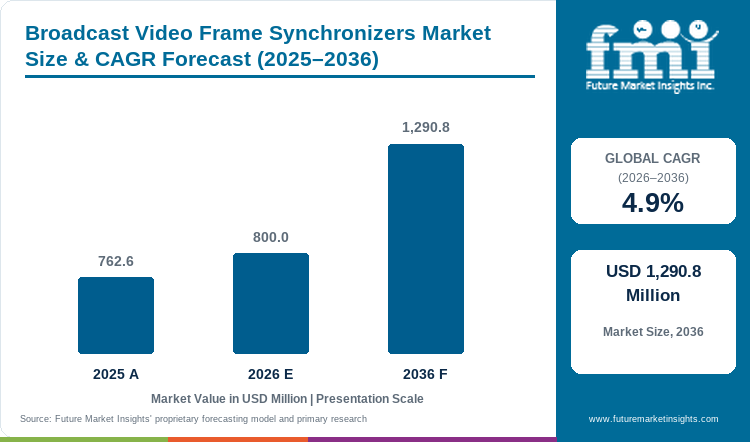
USD 800.0 million in 2026 and USD 1,290.8 million by 2036 at 4.9% CAGR.
Sales of broadcast video frame synchronizers are projected to expand at a 4.9% CAGR through 2036, with market value rising from USD 762.6 million in 2025 to USD 800.0 million in 2026 and reaching USD 1,290.8 million by 2036. As broadcasters are moving toward IP-based production environments, engineers are relying on frame synchronizers to align incoming feeds before seamless switching and distribution. SMPTE ST 2110 carries video, audio and metadata as separate streams referenced to a common timing source, yet many hybrid facilities continue to ingest feeds that do not fully match that clock structure. Frame synchronization systems help bridge these timing gaps while also supporting format conversion, allowing operators to modernize workflows without replacing entire broadcast infrastructures.
Canada and the United States present similar growth trajectories but face different purchasing priorities. Canada is projected to expand at a 5.3% CAGR through 2036, compared with 4.6% for the United States. The decline in Canadian linear television revenue has increased pressure on broadcasters to maximize equipment value, encouraging adoption of synchronizers that combine multiple signal-processing functions within a single unit. In the United States, broadcasters continue to balance ongoing ATSC transition requirements with the need to maintain uninterrupted operation of existing systems. This environment supports demand for multifunctional frame synchronizers that reduce rack-space requirements, simplify upgrades and lower the cost of integrating new broadcast technologies.
Key Takeaways
- Hybrid SDI and IP broadcast work raises demand for units that line up feeds before switching, recording or playout.
- By product type, modular card synchronizers are projected to account for 30.0% in 2026, supported by dense racks and easy field repair.
- In 2026, HD-SDI/3G-SDI is expected to lead signal format with 34.0% share, linked to the large installed 1080 broadcast base.
- Broadcast control rooms are likely to capture 31.0% of end-use demand in 2026, influenced by timing work at the main signal entry point.
- System tests can delay a buy when old clock systems and PTP-based IP networks must work together.
- Some of the key players in this market include Evertz, Grass Valley, Ross Video, AJA Video Systems, Blackmagic Design, Imagine Communications, Lawo, FOR-A, Cobalt Digital, and Decimator Design.
Analyst Perspective
"Engineering teams will pay for frame timing that blends into the wider signal chain instead of adding another single-use box. The buy decision rests on proven timing plus a clear path from installed SDI gear to newer IP systems."
- Sudip Saha, Principal Consultant, Future Market Insights
How is the broadcast video frame synchronizers market segmented?
The broadcast video frame synchronizers market is segmented by Product Type, Signal Format, End Use, Function, Sales Channel and Region.
The market uses five axes plus region. Product type covers modular, standalone, multi-channel, IP video and 4K/UHD synchronizers. Signal format covers HD-SDI/3G-SDI, SDI, 12G-SDI, IP/ST 2110 and HDMI/pro AV. End use shows the work setting. Function shows the signal task. Sales channel shows the buy route.
How do modular card synchronizers shape demand within the product type category?
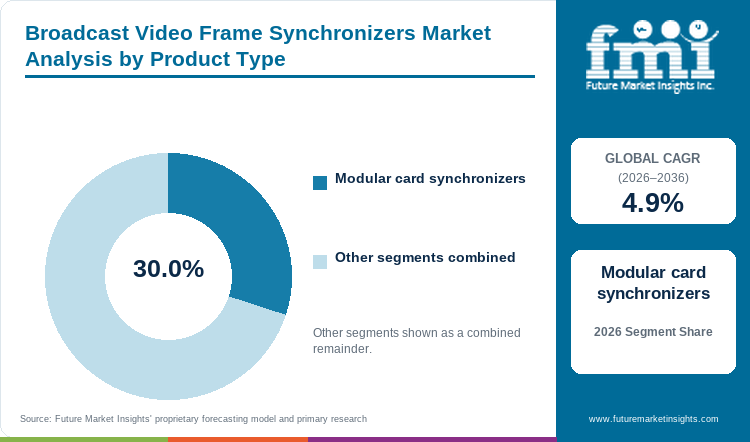
Modular cards let fixed sites add one channel at a time without a new chassis. Shared power and clock lines reduce extra rack gear. Engineers can replace one card without stopping other channels. Many broadcast equipment upgrades use this design because sites can add capacity in small steps.
- Based on product type, modular card synchronizers are projected to account for 30.0% in 2026, supported by dense racks and easy field repair.
- Current modular platforms pair frame sync with routing or format change. Site teams can add one signal path at a time.
What supports HD-SDI/3G-SDI within the signal format category?
HD-SDI/3G-SDI remains common in 1080 TV work because much installed gear still uses fixed baseband links. Frame sync units correct timing without forcing an IP move. New video processing platforms can still connect to installed 3G and HD paths during staged upgrades.
- By signal format, HD-SDI/3G-SDI is estimated to hold 34.0% in 2026, influenced by the large installed 1080 broadcast base.
- Sites keep this format while adding 12G or ST 2110 at points that need more bandwidth or remote routing.
How do broadcast control rooms influence selection within the end-use category?
Control rooms gather incoming feeds before switching or recording. Many feeds reach the room with different timing. Remote TV work adds more outside sources. Teams must line them up before the signals enter the main chain. Stable timing also helps video streaming start from a clean source.
- In 2026, broadcast control rooms are expected to lead end use with 31.0% share, attributable to timing work at main signal entry points.
- Central teams favor units with clear status tools because one timing fault can affect several feeds at once.
What role does timing correction play within the function category?
Timing correction lines up an incoming signal with the site clock before switching or routing. Format change and audio tools cannot replace frame alignment for an out-of-sync source. ST 2110 also uses a shared clock. Frame timing still matters beside media processing solutions in mixed SDI and IP sites.
- Timing correction is set to lead the function category with 38.0% share in 2026, driven by the need for stable frame alignment.
- Engineering teams add format change or audio tools once the unit holds a steady lock with the site clock.
What drives broadcast equipment dealers within the sales channel category?
Specialist dealers often supply frame sync units with optics and clock gear. They can match channel count to the installed router and find swap units fast. Dealer stock can also cut wait time during an urgent repair. Smaller sites use the same channel for video encoders and other gear on the signal chain.
- By sales channel, broadcast hardware dealers are forecast to represent 34.0% in 2026, supported by product access and help with routine upgrades.
- Large IP projects still favor system integrators. Direct OEM sales also remain important for major system work.
What are the drivers, restraints and opportunities in the Broadcast Video Frame Synchronizers Market?
Hybrid SDI/IP timing work raises demand, system testing can slow approval and multi-function units give vendors an expansion route.
- Driver: Mixed SDI, UHD and ST 2110 feeds create more timing points before switching or playout.
- Restraint: Old clock systems and PTP networks need joint tests before hardware approval.
- Opportunity: Dense units can pair frame sync with format change or gateway tools and replace several single-use boxes.
Hybrid systems add timing boundaries
Broadcast teams now use SDI and IP feeds in the same site. SMPTE ST 2110 gives each media stream a shared clock. Some incoming feeds still reach the site out of step with that clock. Engineers must line them up before clean switching or playout. More 4K technology paths can add high-rate feeds beside current HD gear. Frame sync units win budget when they fix timing without a full rebuild. Dense units can also cut rack space by handling timing and format change together. Sites can then keep working routes live while they upgrade other paths. A site can phase the work by rack or signal path. That keeps more of the old plant in use during each step.
System testing can delay approval
Hybrid sites must test clock behavior before a new unit goes live. A frame sync unit can pass a bench test but still fail on the real network. PTP timing or extra data can act in a different way once many systems connect. ARD and ZDF publish ST 2110 profiles that set clear use rules. Those rules make site tests more important before launch. The same test need appears in video conferencing systems that link several live signal paths. Engineering teams can delay a buy until failover and delay are proven on the actual network. Vendors can speed approval with clear mixed-mode test results and simple setup guides. Clear logs also help teams find clock faults during setup.
Combined processing raises value per rack unit
Sites can replace several single-use boxes with one unit that handles frame sync and format change. Cobalt Digital introduced the 9925-FSx in March 2026. Its license plan lets one signal path grow to four. Teams can buy the first level they need and add channels later. More 4K display resolution use can raise the signal load without changing every source at once. Software options can extend the same installed unit as needs grow. Sites then manage fewer boxes and power feeds. Vendors gain repeat sales from added licenses and support instead of relying on a large first order. That model also makes later growth easier to plan in the same rack. It can spread spend over time.
Which country CAGRs are profiled in the Broadcast Video Frame Synchronizers Market?
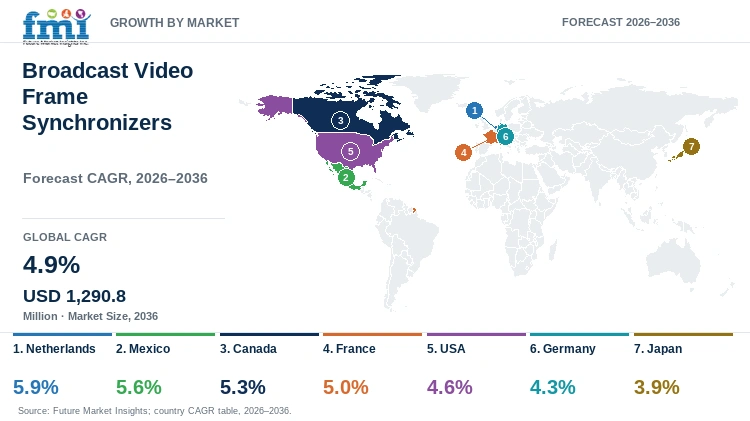
| Country | CAGR |
|---|---|
| Netherlands | 5.9% |
| Mexico | 5.6% |
| Canada | 5.3% |
| France | 5.0% |
| USA | 4.6% |
| Germany | 4.3% |
| Japan | 3.9% |
How do country-level CAGRs compare in the Broadcast Video Frame Synchronizers Market?
The seven country rates span 2.0 points from Netherlands at 5.9% to Japan at 3.9%. Faster growth often comes with new network work or remote TV use. Lower rates can still support steady swap sales in large installed bases. The CAGR shows forecast speed. It does not show which country has the most current revenue.
- Netherlands uses central media hubs and remote TV work that raise the need for dense timing control.
- Mexico is adding terrestrial TV capacity while regional stations still use a mix of old and new signal gear.
- Canada checks capital spending closely and favors units that can handle several signal jobs in one purchase.
- France links regional broadcast sites over ST 2110 and needs steady timing at each network handoff.
- USA broadcasters keep services live while station groups assess ATSC 3.0 and refresh older signal chains.
- Germany uses public-broadcast tech profiles that make system test proof a key part of hardware approval.
- Japan combines long hardware life with 4K and 8K work that needs proven low-delay timing control.
Similar CAGRs can still lead to different buying needs because installed gear and test rules vary by country. The full report gives country-level CAGR analysis across North America, Latin America, Western Europe, Eastern Europe, East Asia, South Asia and Pacific, and the Middle East and Africa.
Country-wise Analysis
- U.S. broadcast groups are upgrading in stages so current services can stay on air. The USA is projected to record 4.6% CAGR through 2036, influenced by the voluntary ATSC 3.0 shift. The FCC took action in September 2025 to speed that shift while keeping consumer safeguards. Many stations still use large SDI systems beside newer IP paths. Engineers test delay and clock behavior before they add a new frame sync unit. Some live sites also feed UHD panels from the same signal chain. Vendors can win repeat work by proving that new units work with old gear. Clear service plans also help teams manage planned cutovers.
- German public broadcasters use published tech profiles before new IP gear enters live service. Germany's broadcast video frame sync unit outlook is forecast at 4.3% CAGR through 2036, supported by formal ST 2110 use rules. ARD and ZDF kept those profiles current in 2025 and updated test material in 2026. The rules add more checks for timing gear. Engineers need clear PTP behavior and steady failover on the real plant. They also test SDI clock paths during each planned change. Good test records can make approval work faster. Vendors that show each test step can cut setup risk without weaker system checks. That can cut rework near launch.
- Japanese broadcasters keep gear for long periods and also run advanced 4K and 8K services. Japan is estimated to post 3.9% CAGR over the forecast period, shaped by continued high-resolution broadcast work. A-PAB reported a July 2025 ministerial award tied to 4K/8K satellite broadcast use. New timing units must meet current uptime needs. Engineers favor low delay and clear clock handling over extra features that add little value. They also test how new UHD paths work with older routers and monitors. Clear system proof can shorten review during swap projects. Stable support also helps teams plan cutovers with less risk. It also gives service teams a clearer swap plan.
- Canadian broadcasters are upgrading while linear TV revenue remains under pressure. Demand in Canada is forecast to expand at 5.3% CAGR through 2036, constrained by tighter checks on capital spending. The CRTC reported that linear TV revenue fell 7.3% in 2025. Stations still need to replace old timing gear. They prefer units that combine frame sync with format change or audio work. One purchase can remove several old boxes from a rack. Staged licenses can spread cost over more than one budget cycle. Local service also helps managers approve a swap when each new expense faces close review. Total running cost therefore matters more than a long feature list.
- France Télévisions is moving more regional feeds onto timed IP networks. France is projected to grow at 5.0% CAGR through 2036, tied to national ST 2110 upgrades. Imagine Communications reported in May 2026 that France Télévisions ordered 60 SNP-XS units for regional links to Paris-area data centers. The work puts timing and backup paths at the center of signal change. Regional sites still need steady service during each cutover. Stable source timing also supports OTT content delivery from the same feed chain. Vendors need dense units with simple control and strong backup support. Clear failover tests can cut risk as more local feeds move to IP. That can shorten final sign-off.
- Mexico has national networks and regional stations that use gear from different periods. Frame sync demand in Mexico is forecast to rise at 5.6% CAGR through 2036, enabled by new TV capacity. IFT approved a 2025 spectrum plan with 15 digital terrestrial TV channels. New channels add signal paths that must work with older station gear. Cost remains a key limit outside the largest networks. Vendors can meet that need with HD and 3G units that can later support 12G or IP. Dealer stock can shorten swap time for regional teams. Simple service plans can also reduce downtime during local upgrades.
- Dutch public media services use central tech teams for linear and online video. Netherlands is anticipated to record 5.9% CAGR through 2036, influenced by more remote media paths entering shared systems. NPO says its Media Technology group handles schedule work plus signal delivery for all NPO video content. Central control makes one timing fault visible on several services. Remote TV work also adds outside sources to the same sites. Suppliers need dense frame sync with clear status tools for central teams. Simple controls matter because one team supports many channels and platforms. Fast fault checks can cut service risk during live work.
Who are the notable companies in the Broadcast Video Frame Synchronizers Market?
Evertz, Grass Valley, Ross Video, AJA Video Systems, Blackmagic Design, Imagine Communications, Lawo, FOR-A, Cobalt Digital, Decimator Design.
Competition splits between modular systems and standalone units. Engineers compare channel count, format support and product life. IP upgrades also need a safe link between current SDI gear and ST 2110 paths.
- Evertz, Grass Valley, Ross Video, Imagine Communications and Cobalt Digital compete with modular or large-system signal platforms.
- AJA Video Systems and FOR-A focus on integrated units that pair timing with format change and audio work.
- Blackmagic Design, Lawo and Decimator Design serve smaller format change or IP-edge work with different levels of system depth.
Competitive Benchmarking: Broadcast Video Frame Synchronizers Market
| Company | Multi-Format Frame Sync Depth | UHD/12G Capability | IP/ST 2110 Integration | Geographic Reach |
|---|---|---|---|---|
| Evertz | High | High | High | Global |
| Grass Valley | High | High | High | Global |
| Ross Video | High | High | High | Global |
| AJA Video Systems | High | High | High | Global |
| Blackmagic Design | Medium | High | High | Global |
| Imagine Communications | High | High | High | Global |
| Lawo | Medium | High | High | Global |
| FOR-A | High | High | Medium | Global |
| Cobalt Digital | High | High | High | Global |
| Decimator Design | Medium | Medium | Low | International specialist channels |
Scoring basis: High frame-sync depth means multi-channel timing support. Medium means narrower timing use. High UHD/12G means current 12G or UHD support. High IP/ST 2110 means native support. Medium means a gateway path. Low means no verified native ST 2110 support.
Key Developments in the Broadcast Video Frame Synchronizers Market
- In September 2026, AJA Video Systems introduced FS8 with up to eight HD or four UltraHD frame-sync paths plus native ST 2110 links.
- In May 2026, Imagine Communications announced that France Télévisions ordered 60 SNP-XS units for its national ST 2110 regional network work.
- In March 2026, Cobalt Digital introduced the 9925-FSx openGear frame sync unit with license-based growth from one signal path to four.
Key Players in the Broadcast Video Frame Synchronizers Market
Modular broadcast infrastructure platforms
- Evertz
- Grass Valley
- Ross Video
- Imagine Communications
- Cobalt Digital
Integrated processing and IP edge systems
- AJA Video Systems
- Lawo
- FOR-A
Compact conversion and timing workflows
- Blackmagic Design
- Decimator Design
Broadcast Video Frame Synchronizers Market - Report Scope
| Coverage field | Report scope |
|---|---|
| Market breakdown | By product type, signal format, end use, function, sales channel and region. |
| Quantitative Units | USD million. |
| Market Definition | Commercial hardware and software-enabled processors that align asynchronous professional video sources to a common timing reference before switching, processing or playout. |
| Regions Covered | North America, Latin America, Western Europe, Eastern Europe, East Asia, South Asia and Pacific, and Middle East and Africa. |
| Countries Covered | Netherlands, Mexico, Canada, France, USA, Germany, Japan, and 20+ countries included in the full report. |
| Key Companies Profiled | Evertz, Grass Valley, Ross Video, AJA Video Systems, Blackmagic Design, Imagine Communications, Lawo, FOR-A, Cobalt Digital, Decimator Design. |
| Forecast Period | 2026 to 2036. |
| Approach | Primary and secondary research with market triangulation. |
Broadcast Video Frame Synchronizers Market - Research Methodology
| Method | Approach |
|---|---|
| Primary Research | FMI analysts gathered input from manufacturers, service providers, technology developers, distributors, end users, procurement teams, and subject-matter experts. Interviews examined purchasing decisions, product or service evaluation, adoption barriers, approval requirements, pricing considerations, and expectations for technical or commercial support. Respondents were also asked what evidence is required before a trial, pilot, or initial order develops into regular purchasing. |
| Desk Research | Desk research covered government statistics, regulatory publications, trade data, industry associations, technical literature, standards, company filings, product information, and official corporate announcements. Sources were reviewed for relevance, publication date, geographic coverage, and consistency with the defined market scope. Claims relating to performance, applications, approvals, capacity, investment, and commercial activity were retained only when supported by credible public evidence. |
| Market Sizing and Forecasting | The market model combined the baseline value with historical performance, segment structure, pricing and volume indicators, adoption levels, company participation, and country-level demand conditions. Forecast assumptions considered economic activity, investment trends, regulatory developments, technology adoption, purchasing cycles, supply availability, and barriers to wider market use. Segment and regional estimates were reconciled before the final market total was calculated. |
| Data Validation | Estimates were checked against multiple independent indicators, including public data, company activity, trade patterns, industry developments, and findings from primary interviews. Validation also tested whether products, services, applications, and company revenues fell within the defined market boundaries. Adjacent categories, unsupported claims, overlapping revenues, and activities without direct market relevance were excluded to reduce double counting and maintain consistency across segments and countries. |
Broadcast Video Frame Synchronizers Market by Segments
Broadcast Video Frame Synchronizers Market segmented by Product Type:
- Modular card synchronizers
- Standalone frame synchronizers
- Multi-channel synchronizers
- IP video synchronizers
- 4K/UHD synchronizers
Broadcast Video Frame Synchronizers Market segmented by Signal Format:
- HD-SDI/3G-SDI
- SDI
- 12G-SDI
- IP/ST 2110
- HDMI/pro AV
Broadcast Video Frame Synchronizers Market segmented by End Use:
- Broadcast control rooms
- Outside broadcast vans
- Production studios
- Playout centers
- Live event production
Broadcast Video Frame Synchronizers Market segmented by Function:
- Timing correction
- Format conversion
- Audio embedding/de-embedding
- Genlock/sync
Broadcast Video Frame Synchronizers Market segmented by Sales Channel:
- Broadcast equipment dealers
- System integrators
- Direct OEM sales
- Aftermarket/service
Broadcast Video Frame Synchronizers Market by Region:
- North America
- United States
- Canada
- Latin America
- Brazil
- Mexico
- Chile
- Rest of Latin America
- Western Europe
- Germany
- United Kingdom
- Italy
- Spain
- France
- Nordics
- Benelux
- Rest of Western Europe
- Eastern Europe
- Russia
- Poland
- Hungary
- Balkan and Baltic States
- Rest of Eastern Europe
- East Asia
- China
- Japan
- South Korea
- South Asia and Pacific
- India
- ASEAN
- Australia and New Zealand
- Rest of South Asia and Pacific
- Middle East and Africa
- Kingdom of Saudi Arabia
- Other GCC Countries
- Türkiye
- South Africa
- Other African Union Countries
- Rest of Middle East and Africa
Research Sources and Bibliography
- Federal Communications Commission. (2025, September 2). FCC Takes Action to Accelerate Transition to Next Gen TV.
- Society of Motion Picture and Television Engineers. (2025, August 15). SMPTE ST 2110 FAQ.
- ARD. (2025, August). Technische Profile SMPTE ST 2110.
- Association for Promotion of Advanced Broadcasting Services. (2025, July 18). 36th Radio Achievement Award: A-PAB receives Minister of Internal Affairs and Communications commendation.
- Canadian Radio-television and Telecommunications Commission. (2026, August 26). Annual highlights of the broadcasting sector 2024-2025.
- Imagine Communications. (2026, May 5). France Télévisions Adopts Imagine SNP-XS for ST 2110 Expansion.
- Instituto Federal de Telecomunicaciones. (2024, September 25). PABF 2025 includes 15 digital terrestrial television channels.
- Nederlandse Publieke Omroep. (n.d.). Werken bij NPO Tech.
- AJA Video Systems. (2026, September 1). AJA Introduces FS8, Next-Gen 12G-SDI/SMPTE ST 2110 Media Processor.
- Cobalt Digital. (2026, March 16). Cobalt Digital to Unveil Additions to End-to-End IPMX and ST 2110 Ecosystem at NAB, Including Fully Featured Standalone Signal Processors.
- Evertz Microsystems. (2026, April 17). Evertz Positions ENX as the New Media Core for Hybrid SDI and IP Facilities at NAB 2026.
- Grass Valley. (2026, April 15). Connect Everything, Everywhere, as One Infrastructure.
- Ross Video. (2026, September 9). Ross Video Launches Ultrix FR30, Bringing Enterprise-Scale Hyperconverged Media Infrastructure To IBC 2026.
- Ross Video. (2026, May 21). Ross Video Expands Ontario Innovation Operations to Advance Next Generation of Ultrix Platform.
- Ross Video. (2026, September 11). TV Skyline Becomes the World’s First Ultrix FR30 Customer.
- Blackmagic Design. (2026, April 13). Blackmagic Design Announces New Blackmagic SDI Expander 8x12G.
- Blackmagic Design. (2026, April 13). Blackmagic Design Announces New Blackmagic UpDownCross 100G.
- Imagine Communications. (2026, May 21). Torneos Modernizes Multichannel Playout with Versio.
- Lawo. (2026, July 14). Bayerischer Rundfunk Modernizes Radio OB Van with Lawo HOME Apps and mc² Technology.
- FOR-A. (2026, May 27). InfoComm 2026: Software-Defined Workflow for Pro AV Live Event Production with TAA-certified Alfalite LED Displays from the New FOR-A America.
- Cobalt Digital. (2026, April 18). Cobalt Digital Announces Launch of blueCORE at NAB Show 2026: Compact Powerhouse Signal Processors for SDI and ST 2110 Workflows.
- AJA Video Systems. (2026, April 9). AJA Launches openGear OG-GEN10 HD/SD Sync Generator.
- Grass Valley. (2026, April 18). Calrec and Grass Valley unlock exceptional choice and flexibility for broadcasters with ImPulseV and AMPP integration.
- Decimator Design. (n.d.). Decimator Design News: MD-HX Firmware V2.0.
- Syntex. (2026, April 8). Decimator MD-HX Software Update.
This bibliography is provided for reader reference and is not exhaustive. The full report contains the complete reference list and detailed citations.
This Report Answers
- What are the market values in 2026 and 2036?
- Which broadcast changes raise demand for frame timing?
- Why do modular cards hold 30.0% of product type in 2026?
- Why does HD-SDI/3G-SDI hold 34.0% of signal format?
- Why do control rooms hold 31.0% of end use in 2026?
- How do the seven country CAGRs differ?
- Which companies supply frame sync systems?
- How are vendors pairing timing with other signal tasks?
Frequently Asked Questions
How big is the broadcast video frame synchronizers market in 2026?
The broadcast video frame synchronizers market is valued at USD 800.0 million in 2026 and USD 1,290.8 million by 2036. Mixed SDI and IP signal paths still need frame timing at format handoffs.
What is the CAGR of the broadcast video frame synchronizers market from 2026 to 2036?
The broadcast video frame synchronizers market is projected to grow at 4.9% CAGR through 2036. Staged UHD and ST 2110 upgrades raise the need for dense units that can handle several signal tasks.
Which product type leads the broadcast video frame synchronizers market?
The modular card synchronizers segment is expected to hold 30.0% of product type in 2026, supported by dense racks and easy field repair. Shared chassis parts let sites add channels without replacing other cards.
Which signal format leads the broadcast video frame synchronizers market?
The HD-SDI/3G-SDI segment is projected to hold 34.0% of signal format demand in 2026, influenced by the large installed 1080 base. Sites keep these formats while adding 12G or IP at selected handoff points.
Which companies are active in the broadcast video frame synchronizers market?
Key companies operating in the market include Evertz, Grass Valley, Ross Video, AJA Video Systems, Blackmagic Design, Imagine Communications, Lawo, FOR-A, Cobalt Digital, and Decimator Design. They compete on channel count, format support and support for SDI-to-IP moves.
Preview the report firsthand - request a free sample
Get SampleGet the brochure for pricing and purchase details.
Get PDFTable of Content
- Key Takeaways
- Market Size and CAGR
- Top Growth Driver
- Fastest Growing Segment
- Leading Region
- Key Companies
- Emerging Opportunities
- Executive Summary
- Global Market Outlook
- Demand-side Trends
- Supply-side Trends
- Technology Roadmap Analysis
- Analysis and Recommendations
- Analyst Perspective (What is happening? Why now? What should investors know?)
- Key Questions Answered
- How large is the market?
- What is the CAGR?
- What are key trends?
- Which region dominates?
- Who are the leaders?
- Market Overview
- Market Coverage / Taxonomy
- Market Definition / Scope / Limitations
- Research Methodology
- Chapter Orientation
- Analytical Lens and Working Hypotheses
- Market Structure, Signals, and Trend Drivers
- Benchmarking and Cross-market Comparability
- Market Sizing, Forecasting, and Opportunity Mapping
- Research Design and Evidence Framework
- Desk Research Programme (Secondary Evidence)
- Expert Input and Fieldwork (Primary Evidence)
- Tooling, Models, and Reference Databases
- Data Engineering and Model Build
- Quality Assurance and Audit Trail
- Market Background
- Market Dynamics (Drivers, Restraints, Opportunity, Trends)
- Scenario Forecast (Optimistic, Likely, Conservative)
- Impact Analysis
- AI Impact
- Sustainability Impact
- Regulatory Impact
- Technology Impact
- Consumer / Buyer Analysis
- Purchase Drivers
- Adoption Barriers
- Buyer Journey
- Opportunity Map Analysis
- Product Life Cycle Analysis
- Supply Chain Analysis
- Investment Feasibility Matrix
- Value Chain Analysis
- PESTLE and Porter's Analysis
- Regulatory Landscape
- Regional Parent Market Outlook
- Production and Consumption Statistics
- Import and Export Statistics
- Global Market Analysis and Forecast, 2021 to 2036
- Historical Market Size Value (USD Million) Analysis, 2021 to 2025
- Current and Future Market Size Value (USD Million) Projections, 2026 to 2036
- Y-o-Y Growth Trend Analysis
- Absolute $ Opportunity Analysis
- Global Market Pricing Analysis, 2021 to 2036
- Global Market Analysis and Forecast, By Product Type, 2021 to 2036
- Introduction / Key Findings
- Historical Market Size Value (USD Million) Analysis By Product Type, 2021 to 2025
- Current and Future Market Size Value (USD Million) Analysis and Forecast By Product Type, 2026 to 2036
- Modular card synchronizers
- Standalone frame synchronizers
- Multi-channel synchronizers
- IP video synchronizers
- 4K/UHD synchronizers
- Y-o-Y Growth Trend Analysis By Product Type, 2021 to 2025
- Absolute $ Opportunity Analysis By Product Type, 2026 to 2036
- Global Market Analysis and Forecast, By Signal Format, 2021 to 2036
- Introduction / Key Findings
- Historical Market Size Value (USD Million) Analysis By Signal Format, 2021 to 2025
- Current and Future Market Size Value (USD Million) Analysis and Forecast By Signal Format, 2026 to 2036
- HD-SDI/3G-SDI
- SDI
- 12G-SDI
- IP/ST 2110
- HDMI/pro AV
- Y-o-Y Growth Trend Analysis By Signal Format, 2021 to 2025
- Absolute $ Opportunity Analysis By Signal Format, 2026 to 2036
- Global Market Analysis and Forecast, By End Use, 2021 to 2036
- Introduction / Key Findings
- Historical Market Size Value (USD Million) Analysis By End Use, 2021 to 2025
- Current and Future Market Size Value (USD Million) Analysis and Forecast By End Use, 2026 to 2036
- Broadcast control rooms
- Outside broadcast vans
- Production studios
- Playout centers
- Live event production
- Y-o-Y Growth Trend Analysis By End Use, 2021 to 2025
- Absolute $ Opportunity Analysis By End Use, 2026 to 2036
- Global Market Analysis and Forecast, By Function, 2021 to 2036
- Introduction / Key Findings
- Historical Market Size Value (USD Million) Analysis By Function, 2021 to 2025
- Current and Future Market Size Value (USD Million) Analysis and Forecast By Function, 2026 to 2036
- Timing correction
- Format conversion
- Audio embedding/de-embedding
- Genlock/sync
- Y-o-Y Growth Trend Analysis By Function, 2021 to 2025
- Absolute $ Opportunity Analysis By Function, 2026 to 2036
- Global Market Analysis and Forecast, By Sales Channel, 2021 to 2036
- Introduction / Key Findings
- Historical Market Size Value (USD Million) Analysis By Sales Channel, 2021 to 2025
- Current and Future Market Size Value (USD Million) Analysis and Forecast By Sales Channel, 2026 to 2036
- Broadcast equipment dealers
- System integrators
- Direct OEM sales
- Aftermarket/service
- Y-o-Y Growth Trend Analysis By Sales Channel, 2021 to 2025
- Absolute $ Opportunity Analysis By Sales Channel, 2026 to 2036
- Global Market Analysis and Forecast, By Region, 2021 to 2036
- Introduction
- Historical Market Size Value (USD Million) Analysis By Region, 2021 to 2025
- Current Market Size Value (USD Million) Analysis and Forecast By Region, 2026 to 2036
- North America
- Latin America
- Western Europe
- Eastern Europe
- East Asia
- South Asia and Pacific
- Middle East and Africa
- Market Attractiveness Analysis By Region
- North America Market Analysis and Forecast, By Country, 2021 to 2036
- Historical Market Size Value (USD Million) Trend Analysis By Market Taxonomy, 2021 to 2025
- Market Size Value (USD Million) Forecast By Market Taxonomy, 2026 to 2036
- By Country
- United States
- Canada
- By Product Type
- By Signal Format
- By End Use
- By Function
- By Sales Channel
- By Country
- Market Attractiveness Analysis
- By Country
- By Product Type
- By Signal Format
- By End Use
- By Function
- By Sales Channel
- Key Takeaways
- Latin America Market Analysis and Forecast, By Country
- Historical Market Size Value (USD Million) Trend Analysis By Market Taxonomy, 2021 to 2025
- Market Size Value (USD Million) Forecast By Market Taxonomy, 2026 to 2036
- By Country
- Brazil
- Mexico
- Chile
- Rest of Latin America
- By Product Type
- By Signal Format
- By End Use
- By Function
- By Sales Channel
- By Country
- Market Attractiveness Analysis
- By Country
- By Product Type
- By Signal Format
- By End Use
- By Function
- By Sales Channel
- Key Takeaways
- Western Europe Market Analysis and Forecast, By Country
- Historical Market Size Value (USD Million) Trend Analysis By Market Taxonomy, 2021 to 2025
- Market Size Value (USD Million) Forecast By Market Taxonomy, 2026 to 2036
- By Country
- Germany
- United Kingdom
- Italy
- Spain
- France
- Nordics
- Benelux
- Rest of Western Europe
- By Product Type
- By Signal Format
- By End Use
- By Function
- By Sales Channel
- By Country
- Market Attractiveness Analysis
- By Country
- By Product Type
- By Signal Format
- By End Use
- By Function
- By Sales Channel
- Key Takeaways
- Eastern Europe Market Analysis and Forecast, By Country
- Historical Market Size Value (USD Million) Trend Analysis By Market Taxonomy, 2021 to 2025
- Market Size Value (USD Million) Forecast By Market Taxonomy, 2026 to 2036
- By Country
- Russia
- Poland
- Hungary
- Balkan and Baltic States
- Rest of Eastern Europe
- By Product Type
- By Signal Format
- By End Use
- By Function
- By Sales Channel
- By Country
- Market Attractiveness Analysis
- By Country
- By Product Type
- By Signal Format
- By End Use
- By Function
- By Sales Channel
- Key Takeaways
- East Asia Market Analysis and Forecast, By Country
- Historical Market Size Value (USD Million) Trend Analysis By Market Taxonomy, 2021 to 2025
- Market Size Value (USD Million) Forecast By Market Taxonomy, 2026 to 2036
- By Country
- China
- Japan
- South Korea
- By Product Type
- By Signal Format
- By End Use
- By Function
- By Sales Channel
- By Country
- Market Attractiveness Analysis
- By Country
- By Product Type
- By Signal Format
- By End Use
- By Function
- By Sales Channel
- Key Takeaways
- South Asia and Pacific Market Analysis and Forecast, By Country
- Historical Market Size Value (USD Million) Trend Analysis By Market Taxonomy, 2021 to 2025
- Market Size Value (USD Million) Forecast By Market Taxonomy, 2026 to 2036
- By Country
- India
- ASEAN
- Australia and New Zealand
- Rest of South Asia and Pacific
- By Product Type
- By Signal Format
- By End Use
- By Function
- By Sales Channel
- By Country
- Market Attractiveness Analysis
- By Country
- By Product Type
- By Signal Format
- By End Use
- By Function
- By Sales Channel
- Key Takeaways
- Middle East and Africa Market Analysis and Forecast, By Country
- Historical Market Size Value (USD Million) Trend Analysis By Market Taxonomy, 2021 to 2025
- Market Size Value (USD Million) Forecast By Market Taxonomy, 2026 to 2036
- By Country
- Kingdom of Saudi Arabia
- Other GCC Countries
- Türkiye
- South Africa
- Other African Union Countries
- Rest of Middle East and Africa
- By Product Type
- By Signal Format
- By End Use
- By Function
- By Sales Channel
- By Country
- Market Attractiveness Analysis
- By Country
- By Product Type
- By Signal Format
- By End Use
- By Function
- By Sales Channel
- Key Takeaways
- Key Countries Market Analysis
- United States
- Pricing Analysis
- Market Share Analysis, 2025
- By Product Type
- By Signal Format
- By End Use
- By Function
- By Sales Channel
- Canada
- Pricing Analysis
- Market Share Analysis, 2025
- By Product Type
- By Signal Format
- By End Use
- By Function
- By Sales Channel
- Mexico
- Pricing Analysis
- Market Share Analysis, 2025
- By Product Type
- By Signal Format
- By End Use
- By Function
- By Sales Channel
- Brazil
- Pricing Analysis
- Market Share Analysis, 2025
- By Product Type
- By Signal Format
- By End Use
- By Function
- By Sales Channel
- Chile
- Pricing Analysis
- Market Share Analysis, 2025
- By Product Type
- By Signal Format
- By End Use
- By Function
- By Sales Channel
- Germany
- Pricing Analysis
- Market Share Analysis, 2025
- By Product Type
- By Signal Format
- By End Use
- By Function
- By Sales Channel
- United Kingdom
- Pricing Analysis
- Market Share Analysis, 2025
- By Product Type
- By Signal Format
- By End Use
- By Function
- By Sales Channel
- Italy
- Pricing Analysis
- Market Share Analysis, 2025
- By Product Type
- By Signal Format
- By End Use
- By Function
- By Sales Channel
- Spain
- Pricing Analysis
- Market Share Analysis, 2025
- By Product Type
- By Signal Format
- By End Use
- By Function
- By Sales Channel
- France
- Pricing Analysis
- Market Share Analysis, 2025
- By Product Type
- By Signal Format
- By End Use
- By Function
- By Sales Channel
- India
- Pricing Analysis
- Market Share Analysis, 2025
- By Product Type
- By Signal Format
- By End Use
- By Function
- By Sales Channel
- ASEAN
- Pricing Analysis
- Market Share Analysis, 2025
- By Product Type
- By Signal Format
- By End Use
- By Function
- By Sales Channel
- Australia and New Zealand
- Pricing Analysis
- Market Share Analysis, 2025
- By Product Type
- By Signal Format
- By End Use
- By Function
- By Sales Channel
- China
- Pricing Analysis
- Market Share Analysis, 2025
- By Product Type
- By Signal Format
- By End Use
- By Function
- By Sales Channel
- Japan
- Pricing Analysis
- Market Share Analysis, 2025
- By Product Type
- By Signal Format
- By End Use
- By Function
- By Sales Channel
- South Korea
- Pricing Analysis
- Market Share Analysis, 2025
- By Product Type
- By Signal Format
- By End Use
- By Function
- By Sales Channel
- Russia
- Pricing Analysis
- Market Share Analysis, 2025
- By Product Type
- By Signal Format
- By End Use
- By Function
- By Sales Channel
- Poland
- Pricing Analysis
- Market Share Analysis, 2025
- By Product Type
- By Signal Format
- By End Use
- By Function
- By Sales Channel
- Hungary
- Pricing Analysis
- Market Share Analysis, 2025
- By Product Type
- By Signal Format
- By End Use
- By Function
- By Sales Channel
- Kingdom of Saudi Arabia
- Pricing Analysis
- Market Share Analysis, 2025
- By Product Type
- By Signal Format
- By End Use
- By Function
- By Sales Channel
- Türkiye
- Pricing Analysis
- Market Share Analysis, 2025
- By Product Type
- By Signal Format
- By End Use
- By Function
- By Sales Channel
- South Africa
- Pricing Analysis
- Market Share Analysis, 2025
- By Product Type
- By Signal Format
- By End Use
- By Function
- By Sales Channel
- Netherlands
- Pricing Analysis
- Market Share Analysis, 2025
- By Product Type
- By Signal Format
- By End Use
- By Function
- By Sales Channel
- United States
- Market Structure Analysis
- Competition Dashboard
- Competition Benchmarking
- Market Share Analysis of Top Players
- By Regional
- By Product Type
- By Signal Format
- By End Use
- By Function
- By Sales Channel
- Emerging Startups
- Innovation Benchmarking
- Competition Analysis
- Competition Deep Dive
- Evertz
- Overview
- Product Portfolio
- Profitability by Market Segments
- Sales Footprint
- Strategy Overview
- Marketing Strategy
- Product Strategy
- Channel Strategy
- Grass Valley
- Ross Video
- AJA Video Systems
- Blackmagic Design
- Imagine Communications
- Lawo
- FOR-A
- Cobalt Digital
- Decimator Design
- Evertz
- Case Studies
- Success Stories
- Recent Developments
- Competition Deep Dive
- Assumptions & Acronyms Used


