

- Market Size (2026)
- USD 1860.7 Mn
- Forecast (2036)
- USD 4739.1 Mn
- CAGR (2026 to 2036)
- 9.8%
How big is the Robotic Broadcast Cameras Market in 2026?
USD 1,860.7 million in 2026 and USD 4,739.1 million by 2036 at a 9.8% CAGR.
Live production teams are shifting more camera positions into remote operation, driven by pressure to add viewing angles without expanding floor crews at the same pace. Sports venues and news studios use robotic systems to capture repeat shots from fixed positions and restricted areas. BLS projects 6,400 annual openings for film and video editors and camera operators from 2024 to 2034. That labor pressure supports systems that let one control room manage more repeatable angles across worship spaces and event rooms.
Broadcast teams, venue owners and integrators are primary end users of robotic camera systems due to various production jobs. Companies are focusing on fulfilling the demand gap with product launches that satisfied the need. For instance, Canon introduced the CR-N400 and CR-N350 in November 2025 for broadcast, corporate, education, and live-event production. The models offer 4K UHD at 60 fps and 40x Advanced Zoom in Full HD. Those features help buyers cover fixed shots and recurring room setups without adding more floor operators.
Robotic camera adoption is often influenced by whether the control setup fits the production environment before installation begins. Panasonic introduced the AW-RP200 remote camera controller in September 2025 with macro functionality for multi-camera operations. Buyers use that type of control layer to check shot recall and IP routing before committing capital to studio or venue refresh projects.
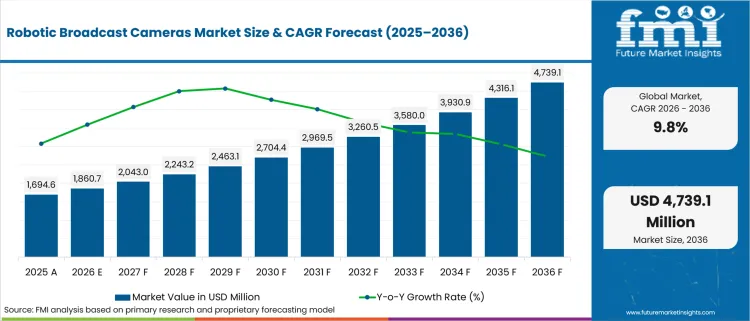
| Metric | Value |
|---|---|
| 2025 Market Size | USD 1,694.6 million |
| 2026 Market Size | USD 1,860.7 million |
| 2036 Market Size | USD 4,739.1 million |
| Forecast CAGR (2026-2036) | 9.8% |
| Camera Type Focus | PTZ Robotic Cameras |
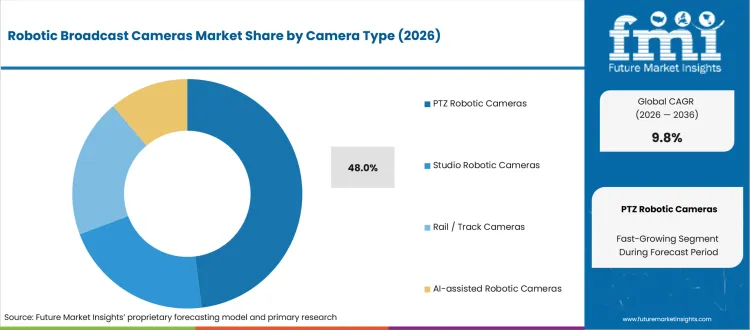
| PTZ Robotic Cameras Share (2026) | 48.0% |
| Application Focus | Live Sports |
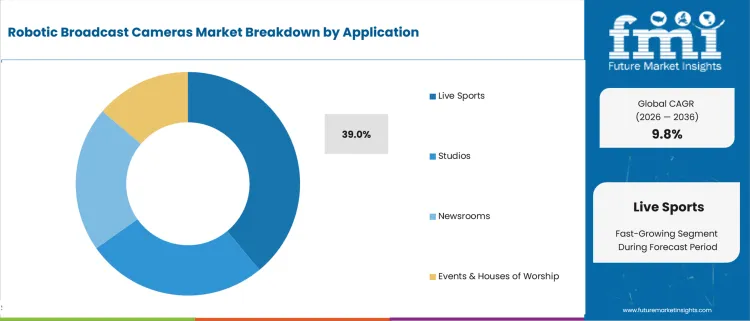
| Live Sports Share (2026) | 39.0% |
| Resolution Focus | 4K |
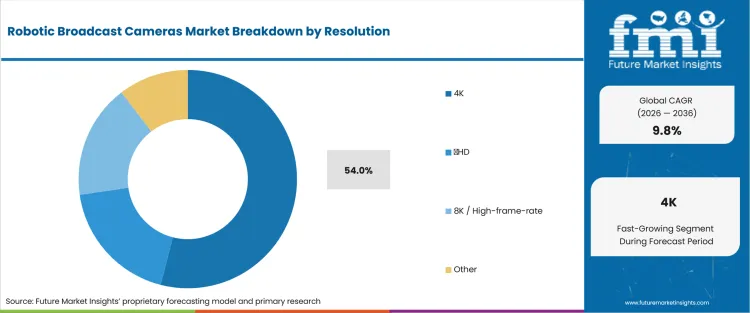
| 4K Share (2026) | 54.0% |
| Fastest-growing Country | India |
| India CAGR by 2036 | 11.1% |
Summary of the Robotic Broadcast Cameras Market
| Market Signal | Commercial Impact |
|---|---|
| Demand and Growth Drivers | Demand for robotic broadcast cameras is expected to expand steadily through 2036 as broadcasters, sports networks, and production studios adopt automated camera systems to improve production efficiency and support multi-platform content delivery.
|
| Product and Segment View | PTZ robotic cameras, live sports applications, and 4K resolution continue to lead their respective market segments.
|
| Geography and Growth Outlook | North America and Asia continue to lead market growth through expanding broadcast infrastructure, digital media production, and live event coverage.
|
| Competitive Landscape | Competition increasingly focuses on image quality, IP workflow integration, automation capabilities, and production ecosystem compatibility.
|
| Analyst Perspective | Robotic broadcast cameras are evolving from specialized studio equipment into essential production infrastructure that enables efficient, scalable, and highly automated broadcast operations.
- Sudip saha, Principal Analyst at Future Market Insights |
How is the robotic broadcast cameras market segmented?
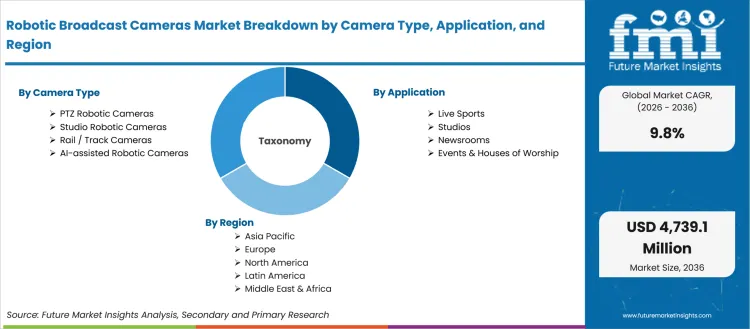
The robotic broadcast cameras industry is segmented by camera type, application, resolution, control type, sales channel, and region.
The robotic broadcast cameras market is segmented by camera type, application, resolution, control type, sales channel, and region. Camera type covers PTZ robotic cameras, studio robotic cameras, rail or track cameras, and AI-assisted robotic cameras. Application includes live sports, studios, newsrooms, and events or houses of worship. Resolution spans HD, 4K, 8K or high-frame-rate, and other formats. Control type includes remote operator control, automated tracking, and hybrid control. Sales channel covers direct OEM, broadcast integrators, and rental or service models. Regional coverage extends across North America, Latin America, Europe, East Asia, South Asia and Pacific, and the Middle East and Africa.
Why do PTZ robotic cameras matter within the camera type category?
Studio and event buyers need camera positions that can be mounted quickly and recalled without a floor operator. PTZ systems solve that problem by placing pan and tilt movement inside compact housings that fit ceilings and walls. The segment gains relevance due to smart camera functions moving into broadcast-grade PTZ products. This matters for buyers that need reliable framing in rooms without camera platforms.
- In 2026, PTZ Robotic Cameras are anticipated to hold 48.0% of camera type demand, driven by compact placement and repeat movement across smaller production rooms. Canon’s June 2024 firmware and application update added Auto Tracking Lite to supported indoor PTZ cameras. This supports software-led upgrade logic for buyers refreshing PTZ fleets.
- The operating value is repeatable movement that directors can recall during live output. Production teams using PTZ systems reduce reset time and floor-crew dependence owing to camera presets that cover podiums and stages. Anchor desks are also handled from fixed positions.
What makes live sports a notable application for robotic cameras?
Sports production needs cameras in places that are useful for replay but difficult for operators. Goal areas and benches can create safety constraints for manned positions. Tunnels and commentary zones can create space constraints during live production. Robotic cameras help producers add controlled shots from those areas and keep motion smooth enough for live editorial use. The application view therefore starts with camera placement before image style.
- Live Sports is predicted to represent around 39.0% share in 2026, supported by rights owners that need replay angles and alternate feeds. Arcom reported in May 2024 that sports-related audiovisual content was followed by 73% of the French population. This supports continued investment in richer sports capture.
- Sports buyers evaluate robotics by motion smoothness and control response. They also review the safety case for restricted positions. The buyer value is not only extra coverage. It is the ability to add repeatable venue views without building a larger camera-operator footprint.
How do buyers evaluate 4K within the resolution category?
Resolution decisions are tied to replay detail and network capacity. Archive reuse also shapes the buyer case. Buyers want sharper pictures for crops and highlights. They also need production rooms that can carry the signal without a costly shift to full 8K workflows. This keeps resolution selection tied to control-room readiness and content reuse. The 4K satellite broadcasting context also supports sports-led broadcast planning.
- 4K accounts for 54.0% of resolution demand in 2026, owing to its balance between image detail and production cost. Datavideo’s PTC-305 product information shows 4K 50/60p output and IP remote-control support. This aligns robotic camera selection with replay and live-switching needs.
- The buyer value is both operational and visual. Production teams can crop shots and create highlight clips. They can also reuse live footage for video on demand service workflows. This makes 4K useful beyond the first live transmission.
Why does remote operator control remain central to control type demand?
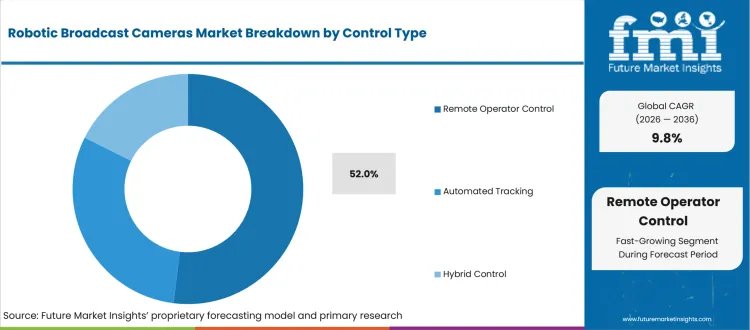
Remote control is central due to live production dependence on editorial judgment during fast changes. Automated tracking works well for predictable subjects. Newsrooms and sports crews still need operators to adjust framing at the right moment. The control layer also connects to video processing platforms that prepare camera feeds for distribution. This makes operator control a risk-management choice rather than only a staffing choice.
- Remote Operator Control is expected to account for 52.0% share in 2026, shaped by directors’ need to keep human judgment during live shots. Vinten’s VEGA Lite information describes PTZ control alongside Vinten robotic heads. This supports demand for control systems that sit above individual camera bodies.
- The executive case for remote control is production assurance. Buyers can keep framing decisions inside the control room and reduce movement risk on the studio floor. They can still add camera positions in rooms that cannot justify a full camera crew.
How are broadcast integrators positioned in the sales channel category?
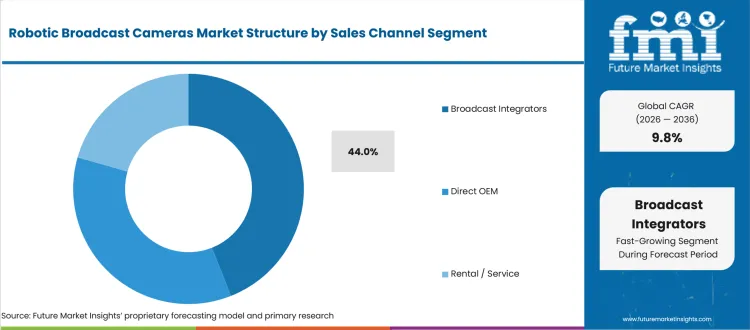
Robotic camera projects often fail on workflow fit instead of camera-body performance. Buyers need systems that work inside existing tally and shading plans. Routing and switcher plans must also align. Broadcast integrators are relevant due to the lower testing burden for buyers that cannot validate every device combination internally. This makes the channel question part of technical approval and service planning.
- Broadcast Integrators are projected to account for 44.0% share in 2026, led by buyer need for cameras that fit switchers and control systems. SMPTE ST 2110 standards support professional IP media transport. This makes integrator validation more important for networked production projects.
- The channel value is lower commissioning risk for broadcasters and venues. Integrators help buyers align robotic heads and PTZ cameras before a project moves from trial to daily live production. Controllers and routing gear must also fit the service plan.
What are the drivers, restraints, and opportunities in the robotic broadcast cameras market?
Near-term purchases are being shaped by multi-angle production pressure, control-room integration risk, and software-led PTZ upgrade routes outlined below.
- Driver: Multi-angle live production is driving spending, supported by the need to cover more viewpoints from one control room.
- Restraint: Integration risk restrains adoption, attributable to tally and shading mismatches inside live production rooms.
- Opportunity: PTZ software upgrades gain traction from auto framing and remote presets for smaller production teams.
Sports venues and studios are adding camera positions to create more controlled views for broadcast and online packages. The spending case is driven by pressure to capture more angles without expanding the same floor crew. FCC data listed 33,552 licensed broadcast stations in March 2026, giving suppliers a broad installed base for replacement and integration projects. Suppliers that prove low-noise motion and repeatable presets can convert production pressure into recurring equipment refresh cycles. Safe placement also helps buyers approve systems for restricted locations.
Integration remains the main purchasing barrier for buyers that operate mixed switchers and controllers. Network policies add another approval layer and raise commissioning effort before go-live. Panasonic’s 2025 PTZ Camera System Lineup lists separate software keys for SMPTE ST 2110 activation and auto framing licenses for one or three cameras. This shows how feature choices can create configuration work before commissioning. That complexity becomes a growth route for suppliers that bundle cameras and control software. Project testing can also become part of the sales offer.
Software-led PTZ upgrades create a practical entry route for suppliers that cannot win every full studio refresh. Smaller venues can start by adding framing tools and fixed PTZ units before larger robotic pedestals. Ross Video announced in April 2025 that 3Cat-TV3 acquired five Artimo free-roaming robotic camera systems for broadcast productions. That order shows how camera motion can move from premium studios into repeat production environments. Suppliers that offer training and support can convert trial use into broader camera-motion programs.
Which country CAGRs are profiled in the robotic broadcast cameras market?
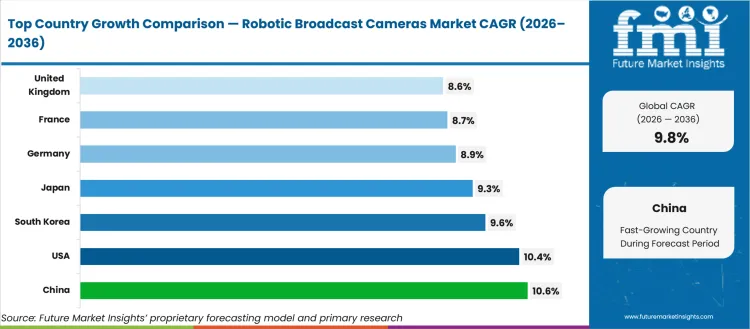
| Country | CAGR |
|---|---|
| United States | 10.4% |
| United Kingdom | 8.6% |
| Germany | 8.9% |
| France | 8.7% |
| Japan | 9.3% |
| China | 10.6% |
| South Korea | 9.6% |
| India | 11.1% |
How do country-level CAGRs compare in the robotic broadcast cameras market?
Country CAGR differences should be read against the production setting behind each purchase. In North America and Western Europe, the buying case is tied to studio renewal and labor discipline. Integrator-led project review also shapes purchase timing across broadcasters and sports venues. East Asian markets reflect broadcaster technology depth and strong local camera ecosystems. India carries a wider expansion angle due to channel depth and cost-sensitive live event production. These differences matter for purchasing plans due to buyers solving different production problems. Some buyers need replacement of aging camera positions and others need new rooms that support live output from smaller control teams. For suppliers, routes to market must match those project types before project bids reach final technical review.
- The United States is projected to record 10.4% CAGR by 2036, driven by a large replacement pool across broadcasters and venues. FCC data listed 398 Class A television stations in March 2026. This matters due to local and regional outlets needing compact robotic cameras that add control without full studio rebuilding.
- The United Kingdom is expected to grow at 8.6% CAGR during the forecast period, supported by broadcaster cost control and connected-TV monetization. Ofcom reported connected TV advertising revenue of GBP 1.5 billion in 2024. This gives UK producers a commercial reason to build repeatable camera workflows for online and linear output.
- Over the assessment period, Germany is forecast to advance at 8.9% CAGR due to tender-led studio refresh and disciplined engineering review. VAUNET projected Germany’s audio and audiovisual media revenue at EUR 16.0 billion in 2024. This supports a steady production base and a measured procurement profile.
- Through 2036, France is anticipated to post 8.7% CAGR due to sports interest and public-service production needs. Arcom reviewed 23 national free-to-air channels in its 2024 programming work. The country profile is steady due to broadcaster and regulator review paths before wider rollout.
- Japan is likely to expand at 9.3% CAGR by 2036, attributable to domestic camera OEM depth and careful studio renewal. The USA International Trade Administration reported Japan broadcasting industry sales of about USD 25.8 billion for 2022 in a 2024 note. This gives suppliers a trusted professional-video base.
- China is estimated to rise at 10.6% CAGR between 2026 and 2036, supported by state media projects and online video rooms. SCIO reported that China’s audiovisual industry revenue rose 7% in the first half of 2024. The growth profile differs due to project scale and local integration capacity shaping supplier access.
- Demand in South Korea is projected to grow at 9.6% CAGR by 2036, influenced by entertainment studios and esports venues. Korea.net reported 36.3 million broadcasting subscribers in 2024 on a terminal-count basis. This supports demand for compact robotic systems that can serve polished live stages and fast studio changes.
- India is expected to grow at 11.1% CAGR during the forecast period, propelled by channel depth and non-broadcast professional video use. The Ministry of Information and Broadcasting reported 400 news channels in the permitted channel base in December 2024. This makes India more dependent on affordable PTZ and training-led sales routes.
Who are the notable companies in the robotic broadcast cameras market?
Sony, Panasonic, Canon, Ross Video, Vinten, Mo-Sys, Mark Roberts Motion Control, EVS Telemetrics, Datavideo, Grass Valley, and Vizrt are the notable companies shaping this market.
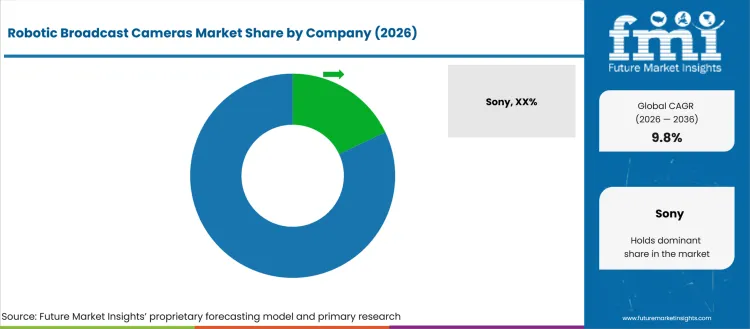
Supplier selection is shaped by the layer of the production environment that the buyer wants to solve. Camera OEMs are more relevant for standardized PTZ refresh projects that center on image quality and dealer support. Robotics specialists gain preference during projects that carry motion risk and need repeatable studio movement. Workflow platforms become important during projects requiring robotic cameras to connect to routing and replay. Switching and virtual production workflows may also use 3D motion capture environments.
- Camera OEMs including Sony and Panasonic are relevant for buyers that need reliable PTZ imaging and dealer support. Canon and Datavideo also serve standardized remote-camera projects. These suppliers fit standardized studios and classrooms. Worship venues and event rooms use them before moving into complex robotic pedestal systems.
- Robotics specialists including Ross Video and Vinten focus on motion behavior and preset reliability. Mo-Sys and Mark Roberts Motion Control also support repeatable studio movement. Their role matters in studios that need smooth pedestal movement and collision discipline. Repeat shots cannot depend only on camera-body features.
- EVS Telemetrics is relevant for projects that need robotic camera control beside replay and production routing. The supplier is better placed for studios and sports-production buyers that want robotics connected to broader live production systems rather than isolated camera positions.
- Workflow platforms including Grass Valley and Vizrt influence robotic camera projects tied to switching and graphics. Virtual production projects add another workflow fit requirement. Their relevance increases in facilities that need camera tracking and control-room data. Graphics workflows must also operate inside one production environment.
Competitive Benchmarking: Robotic Broadcast Cameras Market
| Company | PTZ imaging depth | Robotic motion control | IP workflow fit | Service reach |
|---|---|---|---|---|
| Sony | High | Medium | Strong | Global |
| Panasonic | High | Medium | Strong | Global |
| Canon | High | Medium | Strong | Global |
| Ross Video | Medium | High | Strong | Global |
| Vinten | Medium | High | Strong | Global |
| Mo-Sys | Medium | High | Medium | Global |
| Mark Roberts Motion Control | Medium | High | Medium | Global |
| EVS Telemetrics | Medium | High | Strong | North America and Europe |
| Datavideo | Medium | Medium | Medium | Global dealer network |
| Grass Valley | High | Low | High | Global |
| Vizrt | Low | Medium | High | Global |
Source: Future Market Insights competitive analysis, 2026. Ratings reflect relative portfolio relevance, workflow or project fit, service capability, and geographic reach.
Key Developments in the Robotic Broadcast Cameras Market
- In April 2024, Sony announced the BRC-AM7 4K 60p PTZ camera for broadcast and live-event production. The launch matters due to auto framing moving into professional PTZ systems. It points to more software-led value in controlled live production rooms.
- In April 2026, Canon and Ross Video announced a partnership to deliver broadcast-grade PTZ solutions inside Ross production workflows. The partnership matters due to buyer evaluation of camera control and switching together. It signals a shift toward bundled workflow proof before camera purchase.
- In August 2025, EVS announced the strategic acquisition of Telemetrics to expand into media production robotics. The move matters due to live production vendors combining replay and robotic camera motion which can reduce supplier handoffs for studios and sports-production buyers.
- In April 2024, Ross Video launched the free-roaming Artimo robotic camera system for studio production. The launch matters due to studios wanting more movement inside smaller rooms. It supports supplier opportunity around robotics that combine camera payloads and preset movement. Commissioning support remains part of the project value.
Key Players in the Robotic Broadcast Cameras Market
Camera OEMs
- Sony
- Panasonic
- Canon
- Datavideo
Robotics and Tracking Specialists
- Ross Video
- Vinten
- Mo-Sys
- Mark Roberts Motion Control
- EVS Telemetrics
Workflow and Integration Platforms
- Grass Valley
- Vizrt
Robotic Broadcast Cameras Market - Report Scope
| Coverage field | Report scope |
|---|---|
| Market breakdown | Robotic Broadcast Cameras Market Breakdown By Camera Type, Application, Resolution, Control Type, Sales Channel, and Region |
| Market Definition | Professional cameras and camera motion systems used for remote or automated image capture in broadcast-grade production. |
| Regions Covered | North America, Latin America, Europe, East Asia, South Asia and Pacific, Middle East and Africa |
| Countries Covered | United States, United Kingdom, Germany, France, Japan, China, South Korea, India and broader regional coverage |
| Key Companies Profiled | Sony, Panasonic, Canon, Ross Video, Vinten, Mo-Sys, Mark Roberts Motion Control, EVS Telemetrics, Datavideo, Grass Valley, Vizrt |
| Forecast Period | 2026 to 2036 |
| Approach | Hybrid bottom-up and macro-to-micro methodology using equipment pricing, camera type mix, integration channels, and country-level production demand |
Robotic Broadcast Cameras Market - Research Methodology
| Method | Approach |
|---|---|
| Primary Research | FMI analysts reviewed inputs from broadcasters, sports production firms, system integrators, rental companies, houses of worship, and studio operators. Discussions focused on camera placement, control-room fit, service access, and replacement timing across PTZ and studio robotic systems. |
| Desk Research | Desk research covered regulator station data, broadcasting reports, standards references, official company product information, and company release updates. Source use was limited to government, regulator, standards-body, official trade-body, and company sources. |
| Market Sizing and Forecasting | The model combined equipment value, average system pricing, application mix, control-type adoption, sales-channel behavior, and country production depth. Forecast assumptions were adjusted for live sports intensity, newsroom automation, and professional video use. |
| Data Validation | Forecasts were checked against public broadcasting indicators, PTZ product portfolios, standards evidence, and integrator channel behavior. Duplicate external statistics were removed before finalization, so each public evidence figure supports only one analytical section. |
Robotic Broadcast Cameras Market by Segments
Robotic Broadcast Cameras Market segmented by Camera Type:
- PTZ Robotic Cameras
- Studio Robotic Cameras
- Rail / Track Cameras
- AI-assisted Robotic Cameras
Robotic Broadcast Cameras Market segmented by Application:
- Live Sports
- Studios
- Newsrooms
- Events & Houses of Worship
Robotic Broadcast Cameras Market segmented by Resolution:
- HD
- 4K
- 8K / High-frame-rate
- Other
Robotic Broadcast Cameras Market segmented by Control Type:
- Remote Operator Control
- Automated Tracking
- Hybrid Control
Robotic Broadcast Cameras Market segmented by Sales Channel:
- Direct OEM
- Broadcast Integrators
- Rental / Service
Robotic Broadcast Cameras Market by Region:
- North America
- United States
- Canada
- Mexico
- Latin America
- Brazil
- Chile
- Rest of Latin America
- Western Europe
- Germany
- United Kingdom
- France
- Italy
- Spain
- Nordics
- BENELUX
- Rest of Western Europe
- Eastern Europe
- Russia
- Poland
- Hungary
- Balkan and Baltic
- Rest of Eastern Europe
- East Asia
- China
- Japan
- South Korea
- South Asia and Pacific
- India
- ASEAN
- Australia and New Zealand
- Rest of South Asia and Pacific
- Middle East and Africa
- Kingdom of Saudi Arabia
- Other GCC Countries
- Turkiye
- South Africa
- Other African Union
- Rest of Middle East and Africa
Research Sources and Bibliography
- Federal Communications Commission. (2026, April 10). Broadcast station totals as of March 31, 2026. https://www.fcc.gov/document/broadcast-station-totals-march-31-2026
- Ofcom. (2025, July 30). Media Nations 2025: UK report. https://www.ofcom.org.uk/siteassets/resources/documents/research-and-data/multi-sector/media-nations/2025/media-nations-2025-uk-report.pdf
- FIFA. (2025, June 6). Referee body cams and enhanced offside detection system tested at Club World Cup. https://www.fifa.com/technical/football-technology
- SMPTE. (2024). ST 2110 professional media over managed IP networks. https://www.smpte.org/standards/st-2110
- Panasonic Newsroom. (2024, October 3). Panasonic’s coming Auto framing application for PTZ cameras achieves high-quality video for broadcasting and video production. https://news.panasonic.com/global/press/en241003-3
- Canon Singapore. (2024, June 14). New firmware and applications for 4K remote PTZ camera systems including a Lite version for auto tracking. https://sg.canon/en/consumer/new-firmware-and-applications-for-4k-remote-ptz-camera-systems-including-a-lite-version-for-auto-tracking/news
- Datavideo. (2024). PTC-305 4K tracking PTZ camera. https://datavideo.com/global/product/PTC-305
- State Council Information Office of the People’s Republic of China. (2024, September 27). China’s audio-visual industry revenue up 7% in H1. https://english.scio.gov.cn/pressroom/2024-09/27/content_117455222.html
- Ministry of Information and Broadcasting, Government of India. (2026, January 7). Annual report 2024-25. https://mib.gov.in/sites/default/files/2026-01/annual-report-2024-25.pdf
- Arcom. (2024, May 21). Barometer of sports program consumption. https://www.arcom.fr/en/find-out-more/studies-and-data/studies-reviews-and-reports/barometer-sports-program-consumption
- Vinten. (2026). VEGA Lite. https://www.vinten.com/en/vega-lite/
- VAUNET. (2024, October 23). VAUNET expects revenue from audio and audiovisual media to reach €16 billion in Germany in 2024. https://vau.net/pressemeldungen/vaunet-expects-revenue-from-audio-and-audiovisual-media-to-reach-e16-billion-in-germany-in-2024/
- U.S. International Trade Administration. (2024, November 5). Japan broadcasting industry. https://www.trade.gov/market-intelligence/japan-broadcasting-industry
- Korea.net. (2025). Domestic production demand stagnates amid Netflix’s expansion. https://www.korea.net/Government/Briefing-Room/Press-Releases/view?articleId=2017164&insttCode=A260308&type=N
- Sony Europe. (2024, April 10). Sony announces a 4K 60p pan-tilt-zoom camera with AI-based auto framing. https://www.sony.co.uk/presscentre/sony-announces-a-4k-60p-pan-tilt-zoom-camera-with-ai-based-auto-framing
- Canon Inc. (2026, April 20). Canon and Ross Video announce partnership to deliver broadcast-grade PTZ solutions. https://global.canon/en/news/2026/20260420.html
- EVS. (2025, August 19). EVS announces strategic acquisition of Telemetrics Inc. https://news.evs.com/evs-acquires-telemetrics/
- Ross Video. (2024, April 13). Ross Video launches Artimo, a free-roaming robotics studio system. https://www.rossvideo.com/company/media/news-releases/ross-video-launches-artimo%2C-a-revolutionary-free-roaming-robotics-studio-system/
- Panasonic Connect. (2025, October). PTZ Camera System Lineup. https://eu.connect.panasonic.com/sites/default/files/media/document/2024-04/ptz_lineup_cat_en_16.pdf
- Ross Video. (2025, April 2). 3Cat-TV3 selects Ross Video's Artimo for broadcast productions. https://www.rossvideo.com/company/media/news-releases/3cat-tv3-selects-ross-videos-artimo-for-their-broadcast-productions/
This bibliography is provided for reader reference and uses primary government, standards-body, official trade body, and company sources.
This Report Answers
- What is the expected global value of the Robotic Broadcast Cameras Market in 2026 and 2036?
- What CAGR is forecast for robotic broadcast cameras during the 2026 to 2036 period?
- Which camera type is used to assess PTZ robotic camera demand in 2026?
- Why do sports producers and studios buy robotic broadcast cameras for production workflows?
- How do 4K output and remote operator control shape buyer evaluation?
- Which countries are compared in the robotic broadcast cameras forecast?
- Which companies compete across PTZ cameras and robotic motion control workflows?
- What products are included within the robotic broadcast cameras definition?
- How does FMI size and forecast robotic broadcast camera demand across segments and countries?
- What buyer factors should executives assess before selecting a robotic camera supplier?
Frequently Asked Questions
Why should executives track the Robotic Broadcast Cameras Market?
Executives should track this market because robotic cameras allow broadcasters and venues to expand viewing angles while controlling labor cost and production risk.
What business problem does the Robotic Broadcast Cameras Market address?
It enables consistent multi angle video capture from fixed or restricted positions without requiring additional on floor camera operators.
What should procurement leaders evaluate before selecting suppliers?
Procurement leaders should evaluate motion smoothness control room compatibility IP workflow support preset reliability and local service coverage.
What can limit return on investment for buyers?
Return on investment can be limited by integration complexity control system mismatch and insufficient training for daily live production use.
How can suppliers build executive confidence?
Suppliers build confidence by proving stable live performance seamless integration with switching systems dependable presets and responsive technical support.
Preview the report firsthand - request a free sample
Get SampleGet the brochure for pricing and purchase details.
Get PDFTable of Content
- Key Takeaways
- Market Size and CAGR
- Top Growth Driver
- Fastest Growing Segment
- Leading Region
- Key Companies
- Emerging Opportunities
- Executive Summary
- Global Market Outlook
- Demand-side Trends
- Supply-side Trends
- Technology Roadmap Analysis
- Analysis and Recommendations
- Analyst Perspective (What is happening? Why now? What should investors know?)
- Key Questions Answered
- How large is the market?
- What is the CAGR?
- What are key trends?
- Which region dominates?
- Who are the leaders?
- Market Overview
- Market Coverage / Taxonomy
- Market Definition / Scope / Limitations
- Research Methodology
- Chapter Orientation
- Analytical Lens and Working Hypotheses
- Market Structure, Signals, and Trend Drivers
- Benchmarking and Cross-market Comparability
- Market Sizing, Forecasting, and Opportunity Mapping
- Research Design and Evidence Framework
- Desk Research Programme (Secondary Evidence)
- Expert Input and Fieldwork (Primary Evidence)
- Tooling, Models, and Reference Databases
- Data Engineering and Model Build
- Quality Assurance and Audit Trail
- Market Background
- Market Dynamics (Drivers, Restraints, Opportunity, Trends)
- Scenario Forecast (Optimistic, Likely, Conservative)
- Impact Analysis
- AI Impact
- Sustainability Impact
- Regulatory Impact
- Technology Impact
- Consumer / Buyer Analysis
- Purchase Drivers
- Adoption Barriers
- Buyer Journey
- Opportunity Map Analysis
- Product Life Cycle Analysis
- Supply Chain Analysis
- Investment Feasibility Matrix
- Value Chain Analysis
- PESTLE and Porter's Analysis
- Regulatory Landscape
- Regional Parent Market Outlook
- Production and Consumption Statistics
- Import and Export Statistics
- Global Market Analysis and Forecast, 2021 to 2036
- Historical Market Size Value (USD Million) & Volume (Unit) Analysis, 2021 to 2025
- Current and Future Market Size Value (USD Million) & Volume (Unit) Projections, 2026 to 2036
- Y-o-Y Growth Trend Analysis
- Absolute $ Opportunity Analysis
- Global Market Pricing Analysis, 2021 to 2036
- Global Market Analysis and Forecast, By Camera Type, 2021 to 2036
- Introduction / Key Findings
- Historical Market Size Value (USD Million) & Volume (Unit) Analysis By Camera Type, 2021 to 2025
- Current and Future Market Size Value (USD Million) & Volume (Unit) Analysis and Forecast By Camera Type, 2026 to 2036
- PTZ Robotic Cameras
- Studio Robotic Cameras
- Rail / Track Cameras
- AI-assisted Robotic Cameras
- PTZ Robotic Cameras
- Y-o-Y Growth Trend Analysis By Camera Type, 2021 to 2025
- Absolute $ Opportunity Analysis By Camera Type, 2026 to 2036
- Global Market Analysis and Forecast, By Application, 2021 to 2036
- Introduction / Key Findings
- Historical Market Size Value (USD Million) & Volume (Unit) Analysis By Application, 2021 to 2025
- Current and Future Market Size Value (USD Million) & Volume (Unit) Analysis and Forecast By Application, 2026 to 2036
- Live Sports
- Studios
- Newsrooms
- Events & Houses of Worship
- Live Sports
- Y-o-Y Growth Trend Analysis By Application, 2021 to 2025
- Absolute $ Opportunity Analysis By Application, 2026 to 2036
- Global Market Analysis and Forecast, By Resolution, 2021 to 2036
- Introduction / Key Findings
- Historical Market Size Value (USD Million) & Volume (Unit) Analysis By Resolution, 2021 to 2025
- Current and Future Market Size Value (USD Million) & Volume (Unit) Analysis and Forecast By Resolution, 2026 to 2036
- 4K
- HD
- 8K / High-frame-rate
- Other
- 4K
- Y-o-Y Growth Trend Analysis By Resolution, 2021 to 2025
- Absolute $ Opportunity Analysis By Resolution, 2026 to 2036
- Global Market Analysis and Forecast, By Control Type, 2021 to 2036
- Introduction / Key Findings
- Historical Market Size Value (USD Million) & Volume (Unit) Analysis By Control Type, 2021 to 2025
- Current and Future Market Size Value (USD Million) & Volume (Unit) Analysis and Forecast By Control Type, 2026 to 2036
- Remote Operator Control
- Automated Tracking
- Hybrid Control
- Remote Operator Control
- Y-o-Y Growth Trend Analysis By Control Type, 2021 to 2025
- Absolute $ Opportunity Analysis By Control Type, 2026 to 2036
- Global Market Analysis and Forecast, By Sales Channel, 2021 to 2036
- Introduction / Key Findings
- Historical Market Size Value (USD Million) & Volume (Unit) Analysis By Sales Channel, 2021 to 2025
- Current and Future Market Size Value (USD Million) & Volume (Unit) Analysis and Forecast By Sales Channel, 2026 to 2036
- Broadcast Integrators
- Direct OEM
- Rental / Service
- Broadcast Integrators
- Y-o-Y Growth Trend Analysis By Sales Channel, 2021 to 2025
- Absolute $ Opportunity Analysis By Sales Channel, 2026 to 2036
- Global Market Analysis and Forecast, By Region, 2021 to 2036
- Introduction
- Historical Market Size Value (USD Million) & Volume (Unit) Analysis By Region, 2021 to 2025
- Current Market Size Value (USD Million) & Volume (Unit) Analysis and Forecast By Region, 2026 to 2036
- North America
- Latin America
- Western Europe
- Eastern Europe
- East Asia
- South Asia and Pacific
- Middle East & Africa
- Market Attractiveness Analysis By Region
- North America Market Analysis and Forecast, By Country, 2021 to 2036
- Historical Market Size Value (USD Million) & Volume (Unit) Trend Analysis By Market Taxonomy, 2021 to 2025
- Market Size Value (USD Million) & Volume (Unit) Forecast By Market Taxonomy, 2026 to 2036
- By Country
- USA
- Canada
- Mexico
- By Camera Type
- By Application
- By Resolution
- By Control Type
- By Sales Channel
- By Country
- Market Attractiveness Analysis
- By Country
- By Camera Type
- By Application
- By Resolution
- By Control Type
- By Sales Channel
- Key Takeaways
- Latin America Market Analysis and Forecast, By Country
- Historical Market Size Value (USD Million) & Volume (Unit) Trend Analysis By Market Taxonomy, 2021 to 2025
- Market Size Value (USD Million) & Volume (Unit) Forecast By Market Taxonomy, 2026 to 2036
- By Country
- Brazil
- Chile
- Rest of Latin America
- By Camera Type
- By Application
- By Resolution
- By Control Type
- By Sales Channel
- By Country
- Market Attractiveness Analysis
- By Country
- By Camera Type
- By Application
- By Resolution
- By Control Type
- By Sales Channel
- Key Takeaways
- Western Europe Market Analysis and Forecast, By Country
- Historical Market Size Value (USD Million) & Volume (Unit) Trend Analysis By Market Taxonomy, 2021 to 2025
- Market Size Value (USD Million) & Volume (Unit) Forecast By Market Taxonomy, 2026 to 2036
- By Country
- Germany
- UK
- Italy
- Spain
- France
- Nordic
- BENELUX
- Rest of Western Europe
- By Camera Type
- By Application
- By Resolution
- By Control Type
- By Sales Channel
- By Country
- Market Attractiveness Analysis
- By Country
- By Camera Type
- By Application
- By Resolution
- By Control Type
- By Sales Channel
- Key Takeaways
- Eastern Europe Market Analysis and Forecast, By Country
- Historical Market Size Value (USD Million) & Volume (Unit) Trend Analysis By Market Taxonomy, 2021 to 2025
- Market Size Value (USD Million) & Volume (Unit) Forecast By Market Taxonomy, 2026 to 2036
- By Country
- Russia
- Poland
- Hungary
- Balkan & Baltic
- Rest of Eastern Europe
- By Camera Type
- By Application
- By Resolution
- By Control Type
- By Sales Channel
- By Country
- Market Attractiveness Analysis
- By Country
- By Camera Type
- By Application
- By Resolution
- By Control Type
- By Sales Channel
- Key Takeaways
- East Asia Market Analysis and Forecast, By Country
- Historical Market Size Value (USD Million) & Volume (Unit) Trend Analysis By Market Taxonomy, 2021 to 2025
- Market Size Value (USD Million) & Volume (Unit) Forecast By Market Taxonomy, 2026 to 2036
- By Country
- China
- Japan
- South Korea
- By Camera Type
- By Application
- By Resolution
- By Control Type
- By Sales Channel
- By Country
- Market Attractiveness Analysis
- By Country
- By Camera Type
- By Application
- By Resolution
- By Control Type
- By Sales Channel
- Key Takeaways
- South Asia and Pacific Market Analysis and Forecast, By Country
- Historical Market Size Value (USD Million) & Volume (Unit) Trend Analysis By Market Taxonomy, 2021 to 2025
- Market Size Value (USD Million) & Volume (Unit) Forecast By Market Taxonomy, 2026 to 2036
- By Country
- India
- ASEAN
- Australia & New Zealand
- Rest of South Asia and Pacific
- By Camera Type
- By Application
- By Resolution
- By Control Type
- By Sales Channel
- By Country
- Market Attractiveness Analysis
- By Country
- By Camera Type
- By Application
- By Resolution
- By Control Type
- By Sales Channel
- Key Takeaways
- Middle East & Africa Market Analysis and Forecast, By Country
- Historical Market Size Value (USD Million) & Volume (Unit) Trend Analysis By Market Taxonomy, 2021 to 2025
- Market Size Value (USD Million) & Volume (Unit) Forecast By Market Taxonomy, 2026 to 2036
- By Country
- Kingdom of Saudi Arabia
- Other GCC Countries
- Türkiye
- South Africa
- Other African Union
- Rest of Middle East & Africa
- By Camera Type
- By Application
- By Resolution
- By Control Type
- By Sales Channel
- By Country
- Market Attractiveness Analysis
- By Country
- By Camera Type
- By Application
- By Resolution
- By Control Type
- By Sales Channel
- Key Takeaways
- Key Countries Market Analysis
- USA
- Pricing Analysis
- Market Share Analysis, 2025
- By Camera Type
- By Application
- By Resolution
- By Control Type
- By Sales Channel
- Canada
- Pricing Analysis
- Market Share Analysis, 2025
- By Camera Type
- By Application
- By Resolution
- By Control Type
- By Sales Channel
- Mexico
- Pricing Analysis
- Market Share Analysis, 2025
- By Camera Type
- By Application
- By Resolution
- By Control Type
- By Sales Channel
- Brazil
- Pricing Analysis
- Market Share Analysis, 2025
- By Camera Type
- By Application
- By Resolution
- By Control Type
- By Sales Channel
- Chile
- Pricing Analysis
- Market Share Analysis, 2025
- By Camera Type
- By Application
- By Resolution
- By Control Type
- By Sales Channel
- Germany
- Pricing Analysis
- Market Share Analysis, 2025
- By Camera Type
- By Application
- By Resolution
- By Control Type
- By Sales Channel
- UK
- Pricing Analysis
- Market Share Analysis, 2025
- By Camera Type
- By Application
- By Resolution
- By Control Type
- By Sales Channel
- Italy
- Pricing Analysis
- Market Share Analysis, 2025
- By Camera Type
- By Application
- By Resolution
- By Control Type
- By Sales Channel
- Spain
- Pricing Analysis
- Market Share Analysis, 2025
- By Camera Type
- By Application
- By Resolution
- By Control Type
- By Sales Channel
- France
- Pricing Analysis
- Market Share Analysis, 2025
- By Camera Type
- By Application
- By Resolution
- By Control Type
- By Sales Channel
- India
- Pricing Analysis
- Market Share Analysis, 2025
- By Camera Type
- By Application
- By Resolution
- By Control Type
- By Sales Channel
- ASEAN
- Pricing Analysis
- Market Share Analysis, 2025
- By Camera Type
- By Application
- By Resolution
- By Control Type
- By Sales Channel
- Australia & New Zealand
- Pricing Analysis
- Market Share Analysis, 2025
- By Camera Type
- By Application
- By Resolution
- By Control Type
- By Sales Channel
- China
- Pricing Analysis
- Market Share Analysis, 2025
- By Camera Type
- By Application
- By Resolution
- By Control Type
- By Sales Channel
- Japan
- Pricing Analysis
- Market Share Analysis, 2025
- By Camera Type
- By Application
- By Resolution
- By Control Type
- By Sales Channel
- South Korea
- Pricing Analysis
- Market Share Analysis, 2025
- By Camera Type
- By Application
- By Resolution
- By Control Type
- By Sales Channel
- Russia
- Pricing Analysis
- Market Share Analysis, 2025
- By Camera Type
- By Application
- By Resolution
- By Control Type
- By Sales Channel
- Poland
- Pricing Analysis
- Market Share Analysis, 2025
- By Camera Type
- By Application
- By Resolution
- By Control Type
- By Sales Channel
- Hungary
- Pricing Analysis
- Market Share Analysis, 2025
- By Camera Type
- By Application
- By Resolution
- By Control Type
- By Sales Channel
- Kingdom of Saudi Arabia
- Pricing Analysis
- Market Share Analysis, 2025
- By Camera Type
- By Application
- By Resolution
- By Control Type
- By Sales Channel
- Türkiye
- Pricing Analysis
- Market Share Analysis, 2025
- By Camera Type
- By Application
- By Resolution
- By Control Type
- By Sales Channel
- South Africa
- Pricing Analysis
- Market Share Analysis, 2025
- By Camera Type
- By Application
- By Resolution
- By Control Type
- By Sales Channel
- USA
- Market Structure Analysis
- Competition Dashboard
- Competition Benchmarking
- Market Share Analysis of Top Players
- By Regional
- By Camera Type
- By Application
- By Resolution
- By Control Type
- By Sales Channel
- Emerging Startups
- Innovation Benchmarking
- Competition Analysis
- Competition Deep Dive
- Sony
- Overview
- Product Portfolio
- Profitability by Market Segments (Product/Region/Sales Channel)
- Sales Footprint
- Strategy Overview
- Marketing Strategy
- Product Strategy
- Channel Strategy
- Panasonic
- Canon
- Datavideo
- Ross Video
- Vinten
- Sony
- Case Studies
- Success Stories
- Recent Developments
- Competition Deep Dive
- Assumptions & Acronyms Used


