
- Market Size (2026)
- USD 1.55 Bn
- Forecast (2036)
- USD 2.72 Bn
- CAGR (2026 to 2036)
- 5.8%
How Big Is the Building Vibration Isolation Systems Market in 2026?
The global building vibration isolation systems market is valued at USD 1.55 billion in 2026, up from USD 1.45 billion in 2025, and is projected by Future Market Insights (FMI) to reach USD 2.72 billion by 2036, expanding at a 5.8% CAGR from 2026 to 2036 and generating USD 1.17 billion in incremental revenue over the 10-year forecast period.
| Market Metric | Valuation / Share / Forecast Benchmark |
|---|---|
| 2025 Market Size (Historical) | USD 1.45 billion |
| 2026 Market Size (Estimated) | USD 1.55 billion |
| 2036 Market Size (Projected) | USD 2.72 billion |
| Compound Annual Growth Rate (2026 to 2036) | 5.8% CAGR |
| Incremental Dollar Opportunity (2026 to 2036) | USD 1.17 billion |
| Dominant Product Segment (2026 to 2036 Share) | Elastomeric Bearings and Pads (44.0% in 2026, easing to 42.5% by 2036) |
| Leading & Fastest-Growing Segments by Vibration Source | Rail and Metro (46.0% share in 2026, 6.3% CAGR, the fastest growth in this group) |
| Leading & Fastest-Growing Segments by Building Type | Residential and Mixed-Use Towers (37.0% share in 2026, 6.1% CAGR) │ Hospitals and Laboratories (7.1% CAGR) |
| Largest Country Markets (2026 Global Share) | China (22.0%), United States (17.0%), Japan (11.0%) |
| Fastest-Growing Country Markets (2026 to 2036) | India (12.0% CAGR), United States (7.0% CAGR), United Kingdom (7.0% CAGR) |
| Leading Tier-1 Companies | Getzner Werkstoffe GmbH, GERB Schwingungsisolierungen GmbH and Co. KG, Mason Industries Inc., Kinetics Noise Control Inc. |
Source: Future Market Insights analysis of the building vibration isolation systems market, 2026.
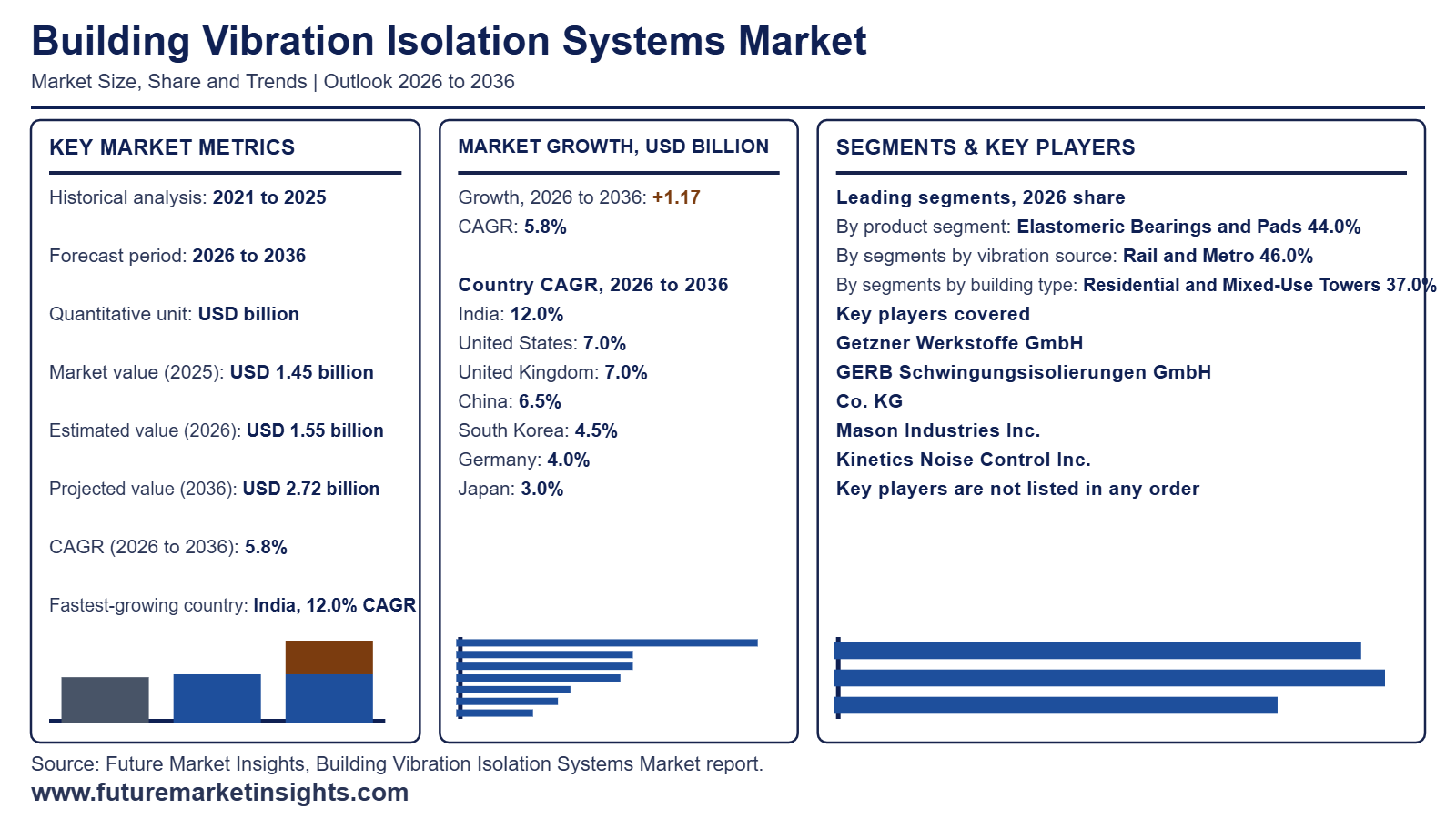
Executive Market Overview
Adoption of building vibration isolation systems is expected to be driven by construction of homes and offices beside rail lines along with tighter vibration limits in hospitals and laboratories. In FMI's assessment, developers of rail-side housing are the main buyers and China is the largest national market. Southwark Council (March 2025) approved one such scheme in London, with 44 social rent homes and 429 student rooms at Southwark Tube station. In China, Global Mass Transit (January 2026) reported 764.7 km of urban rail added in 2025 through 18 new lines.
Developers of station-side homes and hospitals buy elastomeric bearings and steel spring units, along with isolated floors, because ground-borne rail vibration would otherwise reach bedrooms and operating rooms. Makers are documenting products with third-party declarations and audits, and owners in North America are bringing isolation brands into larger groups. The Hospitals and Laboratories segment is projected to expand at a 7.1% CAGR, the Floating Floor and Room-in-Room Systems segment at 6.6% and India at 12.0%, all faster than the 5.8% overall market CAGR. Market sizing covers four product groups sold for buildings. The first two are Elastomeric Bearings and Pads and Steel Spring and Spring-Damper Units, and the other two are Floating Floor and Room-in-Room Systems and Isolation Hangers and Wall Ties. Stand-alone seismic base isolation for bridges and machine mounts sold to factories are excluded, as are acoustic wall panels and ceiling absorbers.
Analyst Perspective
"Revenue in building isolation moves with the engineering content of each project more than with the number of bearings shipped, because a tower beside a metro tunnel needs load-specific units and design hours that lift the price per square meter. A pause in rail-side development is the commercial risk to watch, since one delayed tower removes an entire isolation package from the sales year of a maker."
Nikhil Kaitwade , Principal Consultant, Future Market Insights (FMI)
Major Market Trends and Insights
Declarations and audits are becoming part of the product file: Getzner (January 2025) said the Institut Bauen und Umwelt awarded Environmental Product Declarations for the Sylomer and Sylodyn materials under ISO 14025 and EN 15804. Farrat (July 2026) reported that a BBA audit of the Farrat site in Germany on 24 July 2026 found no non-conformances. FMI expects specifiers of green-rated towers to ask every bearing maker for the same paperwork.
North American isolation brands are moving into larger groups: Pulse 2.0 (June 2026) reported that VMC Group, a portfolio company of Broadview Group, acquired Fabreeka Holdings for USD 92 million. Catalyst Acoustics Group (June 2026) promoted Jeremy Cantor to Group President over five brands that include Kinetics Noise Control. In FMI's assessment, grouped brands can sell floors and mounts to a contractor in one package. Machinery mounts sold by these brands to factories fall under the anti-vibration mounts market in FMI's coverage.
More housing is being planned above and beside rail lines: Trains (March 2026) reported that the mayor of New York proposed 12,000 housing units above Sunnyside Yard in Queens. The Herald Business (September 2026) reported that Korea Land and Housing Corporation offered a mixed-use plot of 25,904 square meters beside the GTX-A Unjeong Jungang Station in Paju. FMI expects schemes of this kind to specify full-building isolation at the design stage.
What Are the Main Drivers, Restraints, and Opportunities?
Rail-side building lifts demand for full-building isolation against a drag from uneven housing approvals, and partial isolation of floors and rooms opens a second line of sales.
Driver: Metro and urban rail expansion beside new buildings
Global Mass Transit (January 2026) reported that the urban rail network of China added 764.7 km in 2025, made up of 18 new lines and 32 new operating sections. News On AIR (November 2026) reported that the metro network of India covers 26 cities, up from five in 2014. In FMI's assessment, each new line creates plots beside tunnels and viaducts on which developers need isolation bearings to sell quiet homes.
Restraint: Uneven housing approvals and late discovery of vibration problems
Destatis (November 2026) reported that 20,800 dwellings were approved in Germany in September 2026, 14.8% fewer than a year earlier. GERB (August 2025) noted that vibration problems are often found only after construction, when a fix is costly. FMI's view is that developers under budget pressure defer the isolation package, and retrofits are harder to sell than bearings designed in from the start.
Opportunity: Isolated floors and rooms inside buildings
GERB (August 2025) presents floating floors and box-in-box rooms for gyms and recording studios, as well as concert halls. Construction UK Magazine (November 2025) previewed a Mason UK stand of jack-up floating floors and acoustic hangers for the London Build show of 19 and 20 November 2025. FMI expects partial isolation to outpace full-building work because a floor or a plant room can be isolated without a new foundation.
How Is the Building Vibration Isolation Systems Market Segmented?
The global building vibration isolation systems market is segmented by product and vibration source, along with building type and region.
| Segmentation Axis | Sub-Segments Covered | 2026 Leading Segment & Share | Main Growth Benchmark (2026 to 2036) |
|---|---|---|---|
| Product | Elastomeric Bearings and Pads, Steel Spring and Spring-Damper Units, Floating Floor and Room-in-Room Systems, Isolation Hangers and Wall Ties | Elastomeric Bearings and Pads (44.0% share) | Floating Floor and Room-in-Room Systems leads growth at 6.6% CAGR, against 5.4% for Elastomeric Bearings and Pads |
| Vibration Source | Rail and Metro, Building Services Plant, Road Traffic and Industrial, Seismic | Rail and Metro (46.0% share) | Rail and Metro share rises to 48.0% by 2036 |
| Building Type | Residential and Mixed-Use Towers, Offices and Hotels, Hospitals and Laboratories, Concert Halls, Studios and Cinemas, Others | Residential and Mixed-Use Towers (37.0% share) | Hospitals and Laboratories leads growth at 7.1% CAGR, against 6.1% for Residential and Mixed-Use Towers |
| Region | North America, Latin America, Western Europe, Eastern Europe, East Asia, South Asia and Pacific, Middle East and Africa | China (22.0% global share) | India leads national growth at 12.0% CAGR |
Source: Future Market Insights analysis of the building vibration isolation systems market, 2026.
Why Does the Elastomeric Bearings and Pads Segment Lead by Product?
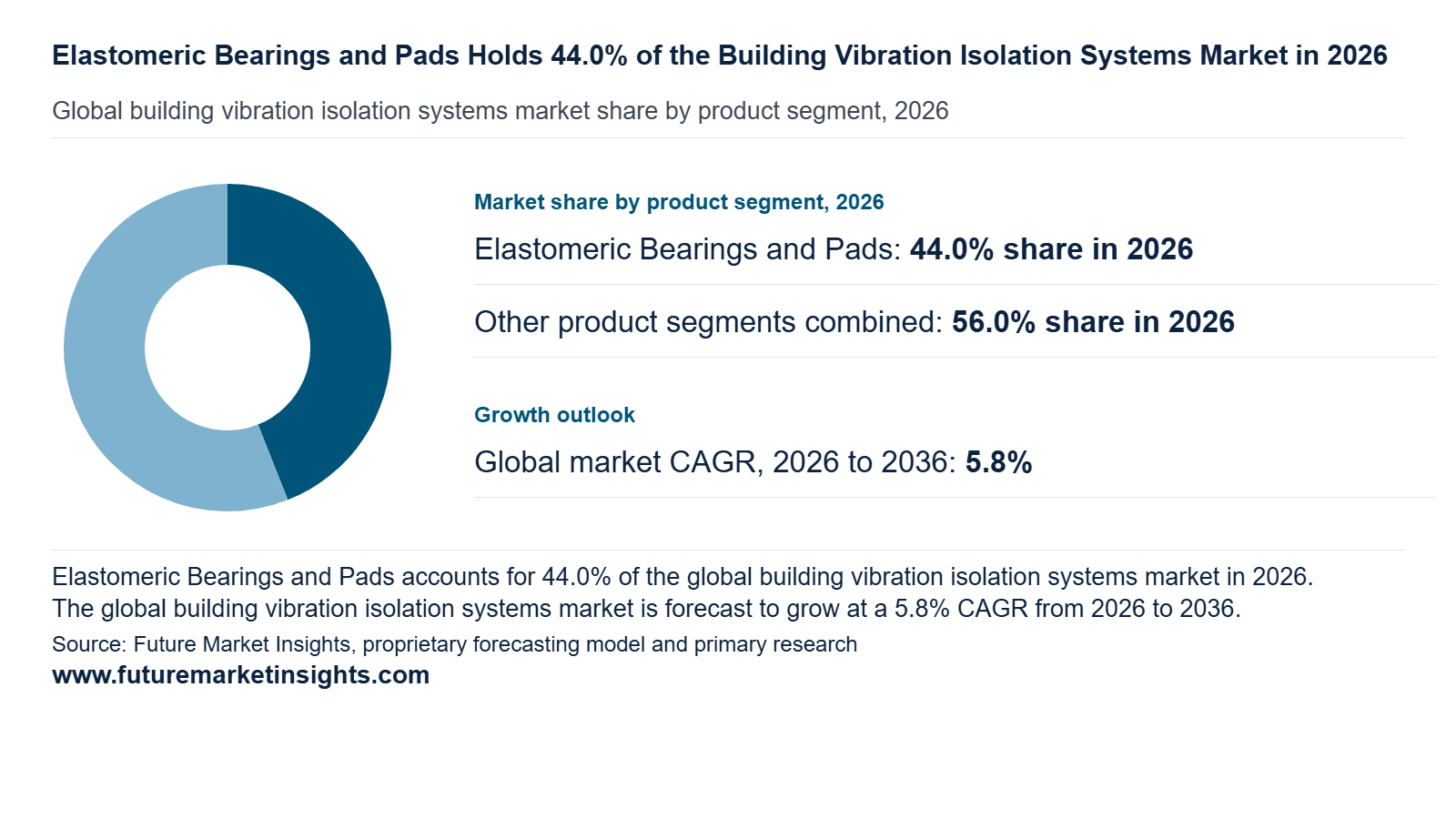
Elastomeric Bearings and Pads hold 44.0% of 2026 sales by product and are forecast at 42.5% in 2036. GERB (August 2025) describes polyurethane bearings as a cost-effective solution for support frequencies above 8 Hz, with steel springs used for 3 to 6 Hz. Getzner (January 2025) received Environmental Product Declarations for the Sylomer and Sylodyn materials. In FMI's assessment, declarations of this kind help elastomer makers on green-rated towers. FMI forecasts Floating Floor and Room-in-Room Systems at a CAGR of 6.6%, ahead of the market, on the view that more isolation is being fitted inside existing buildings.
Why Does the Rail and Metro Segment Lead by Vibration Source?
Rail and Metro vibration accounts for 46.0% of 2026 sales by vibration source and reaches 48.0% by 2036. GERB (August 2025) stated that steel spring elements can reduce railway vibrations by 80% or more in the 10 to 20 Hz range. In FMI's assessment, passing trains are the usual reason a developer isolates a full building instead of single rooms. Seismic protection of bridges is sized separately in the seismic protection device market.
Why Does the Residential and Mixed-Use Towers Segment Lead by Building Type?
Residential and Mixed-Use Towers make up 37.0% of 2026 sales by building type and are forecast at 38.0% in 2036. Southwark Council (March 2025) approved homes and student rooms as part of an over-station development beside Southwark Tube station. Trains (March 2026) described a New York proposal of 12,000 dwellings above a working rail yard. Hospitals and Laboratories grow at 7.1%, the highest rate on this axis in FMI's forecast. Wall and ceiling absorbers for the same buildings are sized in the acoustic insulation market.
Building Vibration Isolation Systems Market by Region and Country (2026 to 2036)
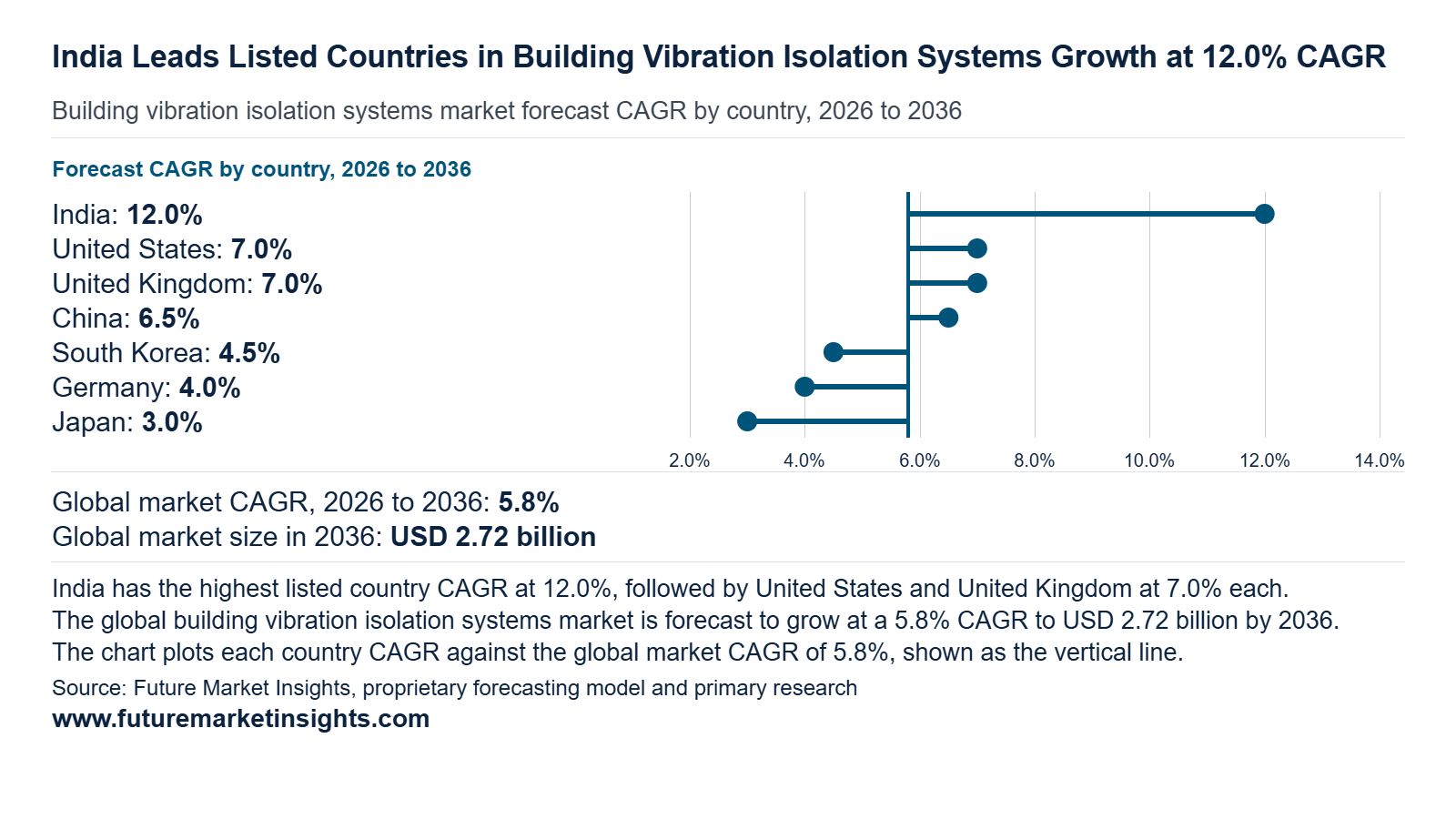
Asia Pacific is the largest buying region in 2026, and China alone accounts for 22.0% of global sales. India has the highest country growth rate at 12.0%, ahead of the United States and the United Kingdom at 7.0% each. Japan and Germany grow more slowly at 3.0% and 4.0%.
| Country | 2026 Revenue | 2036 Revenue | 10-Year Addition | 2026 to 2036 CAGR | Global Share (2026 → 2036) |
|---|---|---|---|---|---|
| India | USD 49.6 million | USD 154.1 million | +USD 104.5 million | 12.0% | 3.2% → 5.7% |
| United States | USD 263.5 million | USD 518.3 million | +USD 254.8 million | 7.0% | 17.0% → 19.0% |
| United Kingdom | USD 68.2 million | USD 134.2 million | +USD 66.0 million | 7.0% | 4.4% → 4.9% |
| China | USD 341.0 million | USD 640.1 million | +USD 299.1 million | 6.5% | 22.0% → 23.5% |
| South Korea | USD 54.3 million | USD 84.3 million | +USD 30.0 million | 4.5% | 3.5% → 3.1% |
| Germany | USD 86.8 million | USD 128.5 million | +USD 41.7 million | 4.0% | 5.6% → 4.7% |
| Japan | USD 170.5 million | USD 229.1 million | +USD 58.6 million | 3.0% | 11.0% → 8.4% |
Source: Future Market Insights analysis of the building vibration isolation systems market, 2026.
China
China buys more isolation than any other listed country, with USD 341.0 million in 2026 and USD 640.1 million projected for 2036 at a CAGR of 6.5%. Global Mass Transit (January 2026) reported 32 new operating sections of urban rail opened in 2025. FMI expects housing and offices built over metro depots and beside stations to keep China ahead of every other country in the forecast.
United States
The United States total of USD 263.5 million in 2026 is projected at USD 518.3 million in 2036, which equals a CAGR of 7.0%. Trains (March 2026) covered a mayoral plan for 12,000 homes above a rail yard in Queens. Pulse 2.0 (June 2026) reported the purchase of Fabreeka Holdings by VMC Group of New Jersey. FMI's assessment is that isolated floors in hospitals and laboratories add to rail-side demand in this country.
Japan
Japan has the lowest growth rate among the listed countries, moving from USD 170.5 million in 2026 to USD 229.1 million in 2036 at a CAGR of 3.0%. Yacmo (March 2026) announced a renovated showroom at the Tokyo head office that displays vibration control devices and seismic isolation devices for buildings. FMI's view is that long-standing seismic and rail isolation practice makes Japan a large but slow-growing market.
Germany
Germany accounts for USD 86.8 million in 2026 and is forecast at USD 128.5 million in 2036, a CAGR of 4.0%. Destatis (November 2026) reported 190,200 dwellings approved from January to September 2026, 8.4% more than a year earlier, although September alone fell 14.8%. Farrat (July 2026) reported a successful BBA audit of the Farrat site in Germany. FMI expects steady replacement and rail-side demand in German cities, with slower growth than the global market.
United Kingdom
The United Kingdom is sized at USD 68.2 million for 2026 and USD 134.2 million for 2036, a CAGR of 7.0%. Southwark Council (March 2025) granted permission on 5 March 2025 for an over-station development beside Southwark Tube station by Places for London and Helical. Construction UK Magazine (November 2025) reported that Mason UK planned to show floating floors and acoustic hangers at London Build. FMI's view is that London schemes above and beside Tube and rail stations account for most new isolation work in the country.
South Korea
South Korea is one of the smaller listed markets, at USD 54.3 million in 2026 and USD 84.3 million in 2036 with a CAGR of 4.5%. The Herald Business (September 2026) said Korea Land and Housing Corporation is offering a plot beside a GTX-A station in Paju with a floor area ratio of up to 500%. In FMI's assessment, dense plots of this kind beside express rail stations are the main source of isolation demand in the Seoul region.
India
India has the highest growth rate among the listed countries, moving from USD 49.6 million in 2026 to USD 154.1 million in 2036 at a CAGR of 12.0%. News On AIR (November 2026) carried a statement by the Prime Minister that the metro network is about 1,200 km long, up from 248 km in 2014. FMI expects towers and hospitals beside new metro corridors to bring full-building isolation into more Indian cities from a small base.
Competitive Environment and Notable Companies
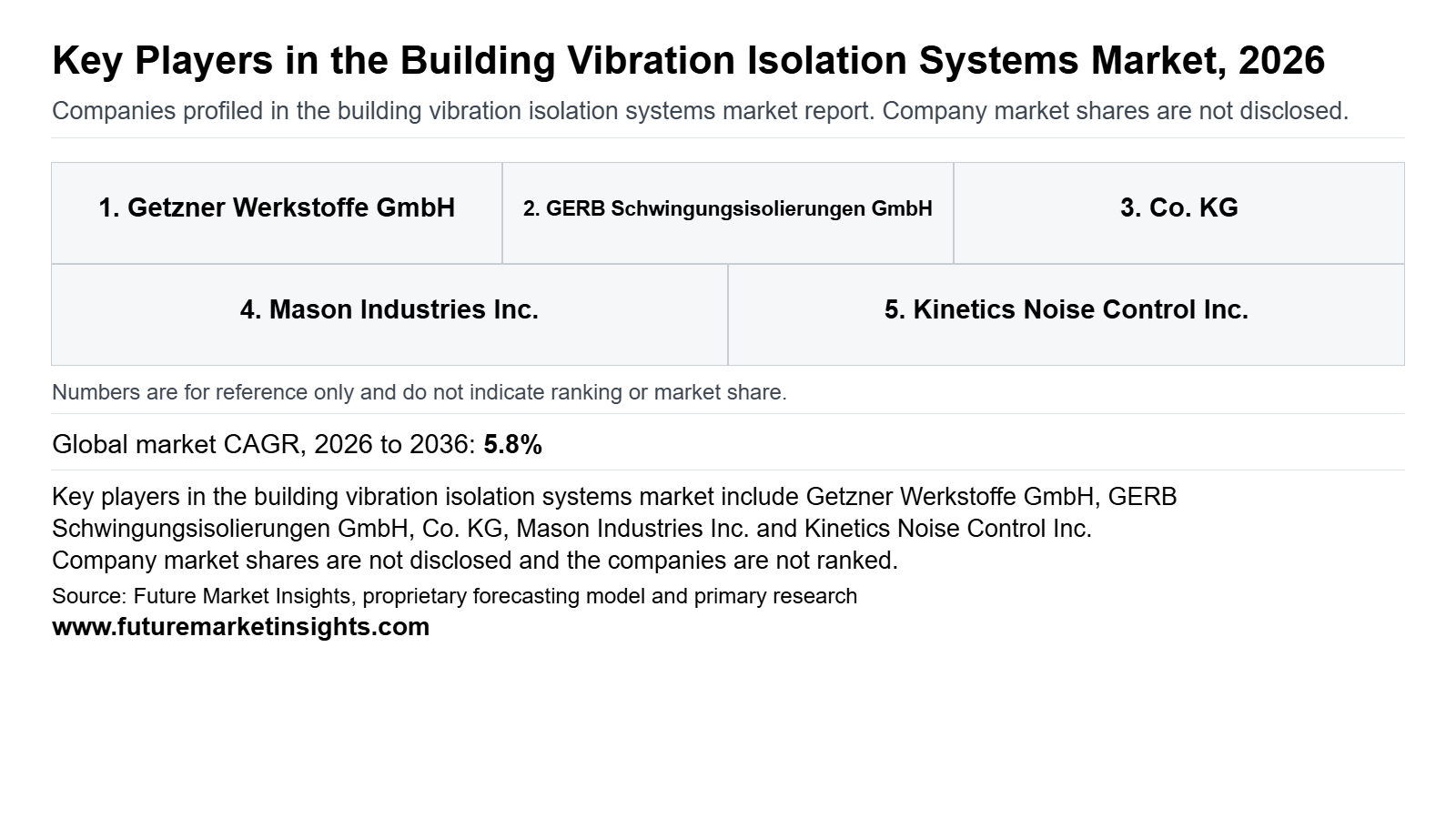
Getzner Werkstoffe GmbH and GERB Schwingungsisolierungen GmbH and Co. KG lead in full-building isolation, the first with polyurethane elastomers and the second with steel springs. Mason Industries Inc. and Kinetics Noise Control Inc. are the main North American names for floors and plant isolation. CDM Stravitec, Trelleborg AB, Farrat Isolevel Ltd. and AMC Mecanocaucho complete the list, and no single maker holds more than a tenth of sales in FMI's assessment.
How Are Companies Positioned in the Building Vibration Isolation Systems Market?
In FMI's assessment, European makers sell engineered bearings for entire buildings, and North American makers sell more floors and plant mounts. Kinetics Noise Control (August 2025) said the company was established in 1958 and is a brand of Catalyst Acoustics Group. CDM Stravitec (October 2026) said the company was founded in 1951 and that Laurence Carels took over from her father in 2020.
What Matters When a Buyer Selects a Building Vibration Isolation Systems Supplier?
FMI's view is that structural engineers and acoustic consultants choose a maker on tested material data and design support. GERB (August 2025) offers steel spring elements for system frequencies of 3 to 6 Hz. Trelleborg (2026) states a record of more than 50 years in bespoke vibration isolation for residential and commercial construction.
Which Capabilities Distinguish Product Offers?
FMI's assessment is that third-party declarations and audits separate offers with similar technical data. Getzner (January 2025) said the new product declarations are relevant to building certification schemes such as LEED and BREEAM. Farrat (July 2026) said the audit of the site in Germany was carried out to add that site to the existing BBA certification.
How Does Geographic Reach Affect Competition?
FMI's view is that most makers sell across borders through agents and local teams. CDM Stravitec (October 2026) said exports are more than 90% of business and that a North American team works from Toronto. AMC Mecanocaucho (August 2026) announced a stand at the NCAC 2026 expo in Quebec City, and Construction UK Magazine (November 2025) described Mason UK as the UK agent for Mason Industries.
| Verified Company Evidence (2026) | Commercial Effect | Buyer Action |
|---|---|---|
| 5 June 2026: Catalyst Acoustics Group promoted Jeremy Cantor, formerly Vice President of Sales for Kinetics, to Group President (Catalyst Acoustics Group, June 2026). | One executive now oversees Kinetics Noise Control and four sister brands. | Mechanical contractors can ask the group how floors and mounts from the five brands are sold together. |
| 30 June 2026: VMC Group, a portfolio company of Broadview Group, was reported to have acquired Fabreeka Holdings for USD 92 million (Pulse 2.0, June 2026). | Two makers of vibration isolation pads and mounts now have one owner. | Contractors that buy from either brand can check for changes to product lists and sales contacts. |
| 24 July 2026: A BBA audit of the Farrat site in Germany found no observations or non-conformances (Farrat, July 2026). | The audit result supports adding the site in Germany to the existing BBA certification. | Specifiers in Europe can ask Farrat whether the BBA certificate now names the site in Germany before comparing structural isolation bearings. |
Source: Verified corporate disclosures and Future Market Insights analysis, 2026.
| Company | Core Positioning | Verified Activity & Source Attribution |
|---|---|---|
| Getzner Werkstoffe GmbH | Austrian maker of polyurethane elastomer materials for building bearings and isolated floors | Received Environmental Product Declarations for the Sylomer and Sylodyn materials from the Institut Bauen und Umwelt, handed over at BAU 2025 in Munich (Getzner, January 2025). |
| GERB Schwingungsisolierungen GmbH and Co. KG | German maker of steel spring elements and polyurethane bearings for full and partial building isolation | Issued a building isolation brochure dated August 2025 that lists steel spring elements and NOVODAMP bearings, along with floating floor systems (GERB, August 2025). |
| Mason Industries Inc. | United States maker of floating floors and acoustic hangers, sold in Britain through Mason UK | Mason UK, the UK agent, announced a stand with jack-up floating floors for London Build on 19 and 20 November 2025 (Construction UK Magazine, November 2025). |
| Kinetics Noise Control Inc. | Ohio maker of vibration isolation and noise control products, a brand of Catalyst Acoustics Group | Parent group promoted Jeremy Cantor, who joined in 2025 as Vice President of Sales for Kinetics, to Group President (Catalyst Acoustics Group, June 2026). |
| CDM Stravitec | Belgian maker of building bearings and isolated floors, based in Overijse | Marked 75 years since the founding in 1951 with a podcast and said exports are more than 90% of business (CDM Stravitec, October 2026). |
| Trelleborg AB | Swedish polymer group selling structural and vibration isolation bearings through the marine and infrastructure operation | Product page lists standard structural bearings and bespoke structure supports, along with vibration isolation bearings (Trelleborg, 2026). |
| Farrat Isolevel Ltd. | British maker of structural isolation bearings and thermal breaks with a site in Germany | Germany site passed a BBA audit on 24 July 2026 with no non-conformances recorded (Farrat, July 2026). |
| AMC Mecanocaucho | Spanish maker of rubber-metal mounts and spring mounts for vibration isolation | Announced stand 5 at the NCAC 2026 expo in Quebec City from 21 to 23 August 2026 with rubber-metal mounts and spring mounts (AMC Mecanocaucho, August 2026). |
Source: Verified corporate disclosures and Future Market Insights analysis, 2026.
Building Vibration Isolation Systems Market Report Scope and Research Methodology
FMI sizes the market from the floor area of buildings constructed on isolation bearings or with isolated floors and the system price per square meter. FMI books each sale at the maker selling price in US dollars and assigns the sale to the country of the building site. Each sale is assigned once to a product, once to a vibration source and once to a building type, so the segments on every axis add up to the market total. Company releases and product documents, along with public construction statistics, are used to check the country and segment splits. Forecast growth reflects planned rail-side development and vibration requirements for hospitals and laboratories.
| Coverage Field | Report Scope |
|---|---|
| Market definition | Engineered products that separate a building, or a floor or room inside one, from ground-borne or plant vibration |
| Product | Elastomeric Bearings and Pads, Steel Spring and Spring-Damper Units, Floating Floor and Room-in-Room Systems, Isolation Hangers and Wall Ties |
| Vibration Source | Rail and Metro, Building Services Plant, Road Traffic and Industrial, Seismic |
| Building Type | Residential and Mixed-Use Towers, Offices and Hotels, Hospitals and Laboratories, Concert Halls, Studios and Cinemas, Others |
| End users | Property developers and building contractors, along with structural engineers and acoustic consultants |
| Inclusions | Elastomeric bearings and pads, steel spring and spring-damper units, floating floor and room-in-room systems, isolation hangers and wall ties |
| Exclusions | Stand-alone seismic base isolation for bridges and machine mounts sold to factories, along with acoustic wall panels and ceiling absorbers |
| Quantitative units | USD million for value. |
| Value basis | Maker selling prices in US dollars, booked to the country of the building site |
| Base year and history | 2025 base year, with history from 2021 to 2025. |
| Forecast period | 2026 to 2036. |
| Regions covered | North America, Latin America, Western Europe, Eastern Europe, East Asia, South Asia and Pacific, Middle East and Africa. |
| National coverage | China, United States, Japan, Germany, United Kingdom, South Korea, India. |
| Companies covered | Getzner Werkstoffe GmbH, GERB Schwingungsisolierungen GmbH and Co. KG, Mason Industries Inc., Kinetics Noise Control Inc., CDM Stravitec, Trelleborg AB, Farrat Isolevel Ltd., AMC Mecanocaucho. |
Source: Future Market Insights analysis of the building vibration isolation systems market, 2026.
Research Sources and Bibliography
- AMC Mecanocaucho. (2026, August 11). AMC MECANOCAUCHO is heading to Quebec City!.
- Catalyst Acoustics Group (press release on PR Newswire). (2026, June 5). Catalyst Acoustics Group Promotes Jeremy Cantor to Group President.
- CDM Stravitec. (2026, October 28). Podcast CDM Stravitec, Speaking With: Celebrating 75 Years of CDM Stravitec.
- Construction UK Magazine. (2025, November 18). Vibration isolation takes centre stage at London Build: Mason UK to showcase floating floors, acoustic hangers and pipe connectors.
- Farrat. (2026, July 31). Germany Site Achieves Successful BBA Audit with Outstanding Result.
- GERB. (2025, August). Vibration Isolation Solutions in Building Design (GERB Building Isolation brochure). https://it.gerb.com/gerb_building-isolation-2025-08
- Getzner Werkstoffe. (2025, January 16). Getzner receives EPD for Sylomer and Sylodyn. https://www.getzner.com/en/latest-news/news/epd
- Global Mass Transit. (2026, January 22). China's urban rail network adds 764.7 km in 2025. https://globalmasstransit.net/chinas-urban-rail-network-adds-764-7-km-in-2025/
- Kinetics Noise Control (press release on finanzen.net). (2025, August 19). Kinetics Noise Control Appoints Jeremy Cantor as Vice President of Sales to Accelerate Strategic Growth. https://finanzen.net/nachricht/aktien/kinetics-noise-control-appoints-jeremy-cantor-as-vice-president-of-sales-to-accelerate-strategic-growth-14742970
- News On AIR. (2026, November 5). Metro network now spans 26 cities, up from five in 2014: PM Modi. https://newsonair.gov.in/metro-network-now-spans-26-cities-up-from-five-in-2014-pm-modi/
- Pulse 2.0. (2026, June 30). VMC Group Acquires Fabreeka Holdings For $92 Million. https://pulse2.com/vmc-group-acquires-fabreeka-holdings-for-92-million/
- Southwark Council. (2025, March 7). Green light for 44 new council homes next to Southwark Tube station. https://www.southwark.gov.uk/news/2025/green-light-44-new-council-homes-next-southwark-tube-station
- Statistisches Bundesamt (Destatis). (2026, November 18). Baugenehmigungen für Wohnungen im September 2026: -14,8 % zum Vorjahresmonat. https://www.destatis.de/DE/Presse/Pressemitteilungen/2026/11/PD26_402_3111.html
- The Herald Business. (2026, September 30). LH to supply mixed-use commercial plot near GTX-A station in Paju. https://biz.heraldcorp.com/article/10888843
- Trains. (2026, March 2). New York mayor proposes housing project above Sunnyside Yard in Queens. https://www.trains.com/pro/passenger/new-york-mayor-proposes-housing-project-above-sunnyside-yard-in-queens/
- Trelleborg Marine and Infrastructure. (2026, accessed November 20, 2026). VI and Structural Supports | Trelleborg Marine and Infrastructure. https://www.trelleborg.com/en/marine-and-infrastructure/your-industry/building-and-construction/vi-and-structural-supports
- Yacmo (press release on PC Watch). (2026, March 19). 振動・音の「体感の拠点」に加えて、課題解決の「共創の拠点」へ ヤクモ、東京本社ショールームを4月20日にグランドオープン. https://pc.watch.impress.co.jp/docs/release/atpress/2094778.html
Table of Content
- Key Takeaways
- Market Size and CAGR
- Top Growth Driver
- Fastest Growing Segment
- Leading Region
- Key Companies
- Emerging Opportunities
- Executive Summary
- Global Market Outlook
- Demand-side Trends
- Supply-side Trends
- Technology Roadmap Analysis
- Analysis and Recommendations
- Analyst Perspective (What is happening? Why now? What should investors know?)
Read More...
- Key Questions Answered
- How large is the market?
- What is the CAGR?
- What are key trends?
- Which region dominates?
- Who are the leaders?
- Market Overview
- Market Coverage / Taxonomy
- Market Definition / Scope / Limitations
- Research Methodology
- Chapter Orientation
- Analytical Lens and Working Hypotheses
- Market Structure, Signals, and Trend Drivers
- Benchmarking and Cross-market Comparability
- Market Sizing, Forecasting, and Opportunity Mapping
- Research Design and Evidence Framework
- Desk Research Program (Secondary Evidence)
- Expert Input and Fieldwork (Primary Evidence)
- Tooling, Models, and Reference Databases
- Data Engineering and Model Build
- Quality Assurance and Audit Trail
- Market Background
- Market Dynamics (Drivers, Restraints, Opportunity, Trends)
- Scenario Forecast (Optimistic, Likely, Conservative)
- Impact Analysis
- AI Impact
- Sustainability Impact
- Regulatory Impact
- Technology Impact
- Consumer / Buyer Analysis
- Purchase Drivers
- Adoption Barriers
- Buyer Journey
- Opportunity Map Analysis
- Product Life Cycle Analysis
- Supply Chain Analysis
- Investment Feasibility Matrix
- Value Chain Analysis
- PESTLE and Porter's Analysis
- Regulatory Landscape
- Regional Parent Market Outlook
- Production and Consumption Statistics
- Import and Export Statistics
- Global Market Analysis and Forecast, 2021 to 2036
- Historical Market Size Value (USD Million) Analysis, 2021 to 2025
- Current and Future Market Size Value (USD Million) Projections, 2026 to 2036
- Y-o-Y Growth Trend Analysis
- Absolute $ Opportunity Analysis
- Global Market Pricing Analysis, 2021 to 2036
- Global Market Analysis and Forecast, By Product, 2021 to 2036
- Introduction / Key Findings
- Historical Market Size Value (USD Million) Analysis By Product, 2021 to 2025
- Current and Future Market Size Value (USD Million) Analysis and Forecast By Product, 2026 to 2036
- Elastomeric Bearings and Pads
- Steel Spring and Spring-Damper Units
- Floating Floor and Room-in-Room Systems
- Isolation Hangers and Wall Ties
- Y-o-Y Growth Trend Analysis By Product, 2021 to 2025
- Absolute $ Opportunity Analysis By Product, 2026 to 2036
- Global Market Analysis and Forecast, By Vibration Source, 2021 to 2036
- Introduction / Key Findings
- Historical Market Size Value (USD Million) Analysis By Vibration Source, 2021 to 2025
- Current and Future Market Size Value (USD Million) Analysis and Forecast By Vibration Source, 2026 to 2036
- Rail and Metro
- Building Services Plant
- Road Traffic and Industrial
- Seismic
- Y-o-Y Growth Trend Analysis By Vibration Source, 2021 to 2025
- Absolute $ Opportunity Analysis By Vibration Source, 2026 to 2036
- Global Market Analysis and Forecast, By Building Type, 2021 to 2036
- Introduction / Key Findings
- Historical Market Size Value (USD Million) Analysis By Building Type, 2021 to 2025
- Current and Future Market Size Value (USD Million) Analysis and Forecast By Building Type, 2026 to 2036
- Residential and Mixed-Use Towers
- Offices and Hotels
- Hospitals and Laboratories
- Concert Halls, Studios and Cinemas
- Others
- Y-o-Y Growth Trend Analysis By Building Type, 2021 to 2025
- Absolute $ Opportunity Analysis By Building Type, 2026 to 2036
- Global Market Analysis and Forecast, By Region, 2021 to 2036
- Introduction
- Historical Market Size Value (USD Million) Analysis By Region, 2021 to 2025
- Current Market Size Value (USD Million) Analysis and Forecast By Region, 2026 to 2036
- North America
- Western Europe
- East Asia
- South Asia and Pacific
- Market Attractiveness Analysis By Region
- North America Market Analysis and Forecast, By Country, 2021 to 2036
- Historical Market Size Value (USD Million) Trend Analysis By Market Taxonomy, 2021 to 2025
- Market Size Value (USD Million) Forecast By Market Taxonomy, 2026 to 2036
- By Country
- United States
- Rest of North America
- By Product
- By Vibration Source
- By Building Type
- By Country
- Market Attractiveness Analysis
- By Country
- By Product
- By Vibration Source
- By Building Type
- Key Takeaways
- Western Europe Market Analysis and Forecast, By Country, 2021 to 2036
- Historical Market Size Value (USD Million) Trend Analysis By Market Taxonomy, 2021 to 2025
- Market Size Value (USD Million) Forecast By Market Taxonomy, 2026 to 2036
- By Country
- Germany
- United Kingdom
- Rest of Western Europe
- By Product
- By Vibration Source
- By Building Type
- By Country
- Market Attractiveness Analysis
- By Country
- By Product
- By Vibration Source
- By Building Type
- Key Takeaways
- East Asia Market Analysis and Forecast, By Country, 2021 to 2036
- Historical Market Size Value (USD Million) Trend Analysis By Market Taxonomy, 2021 to 2025
- Market Size Value (USD Million) Forecast By Market Taxonomy, 2026 to 2036
- By Country
- China
- Japan
- South Korea
- Rest of East Asia
- By Product
- By Vibration Source
- By Building Type
- By Country
- Market Attractiveness Analysis
- By Country
- By Product
- By Vibration Source
- By Building Type
- Key Takeaways
- South Asia and Pacific Market Analysis and Forecast, By Country, 2021 to 2036
- Historical Market Size Value (USD Million) Trend Analysis By Market Taxonomy, 2021 to 2025
- Market Size Value (USD Million) Forecast By Market Taxonomy, 2026 to 2036
- By Country
- India
- Rest of South Asia and Pacific
- By Product
- By Vibration Source
- By Building Type
- By Country
- Market Attractiveness Analysis
- By Country
- By Product
- By Vibration Source
- By Building Type
- Key Takeaways
- Key Countries Market Analysis
- China
- Pricing Analysis
- Market Share Analysis, 2025
- By Product
- By Vibration Source
- By Building Type
- United States
- Pricing Analysis
- Market Share Analysis, 2025
- By Product
- By Vibration Source
- By Building Type
- Japan
- Pricing Analysis
- Market Share Analysis, 2025
- By Product
- By Vibration Source
- By Building Type
- Germany
- Pricing Analysis
- Market Share Analysis, 2025
- By Product
- By Vibration Source
- By Building Type
- United Kingdom
- Pricing Analysis
- Market Share Analysis, 2025
- By Product
- By Vibration Source
- By Building Type
- India
- Pricing Analysis
- Market Share Analysis, 2025
- By Product
- By Vibration Source
- By Building Type
- South Korea
- Pricing Analysis
- Market Share Analysis, 2025
- By Product
- By Vibration Source
- By Building Type
- China
- Market Structure Analysis
- Competition Dashboard
- Competition Benchmarking
- Market Share Analysis of Top Players
- By Regional
- By Product
- By Vibration Source
- By Building Type
- Emerging Startups
- Innovation Benchmarking
- Competition Analysis
- Competition Deep Dive
- Getzner Werkstoffe GmbH
- Overview
- Product Portfolio
- Profitability by Market Segments
- Sales Footprint
- Strategy Overview
- Marketing Strategy
- Product Strategy
- Channel Strategy
- GERB Schwingungsisolierungen GmbH and Co. KG
- Mason Industries Inc.
- Kinetics Noise Control Inc.
- CDM Stravitec
- Trelleborg AB
- Farrat Isolevel Ltd.
- AMC Mecanocaucho
- Getzner Werkstoffe GmbH
- Competition Deep Dive
- Case Studies
- Success Stories
- Recent Developments
- Assumptions & Acronyms Used
List of Tables
- Table 1: Global Market Value (USD Million) Forecast by Region, 2021 to 2036
- Table 2: Global Market Value (USD Million) Forecast by Product, 2021 to 2036
- Table 3: Global Market Value (USD Million) Forecast by Vibration Source, 2021 to 2036
- Table 4: Global Market Value (USD Million) Forecast by Building Type, 2021 to 2036
- Table 5: North America Market Value (USD Million) Forecast by Country, 2021 to 2036
- Table 6: North America Market Value (USD Million) Forecast by Product, 2021 to 2036
- Table 7: North America Market Value (USD Million) Forecast by Vibration Source, 2021 to 2036
- Table 8: North America Market Value (USD Million) Forecast by Building Type, 2021 to 2036
- Table 9: Western Europe Market Value (USD Million) Forecast by Country, 2021 to 2036
- Table 10: Western Europe Market Value (USD Million) Forecast by Product, 2021 to 2036
- Table 11: Western Europe Market Value (USD Million) Forecast by Vibration Source, 2021 to 2036
- Table 12: Western Europe Market Value (USD Million) Forecast by Building Type, 2021 to 2036
- Table 13: East Asia Market Value (USD Million) Forecast by Country, 2021 to 2036
- Table 14: East Asia Market Value (USD Million) Forecast by Product, 2021 to 2036
- Table 15: East Asia Market Value (USD Million) Forecast by Vibration Source, 2021 to 2036
- Table 16: East Asia Market Value (USD Million) Forecast by Building Type, 2021 to 2036
- Table 17: South Asia and Pacific Market Value (USD Million) Forecast by Country, 2021 to 2036
- Table 18: South Asia and Pacific Market Value (USD Million) Forecast by Product, 2021 to 2036
- Table 19: South Asia and Pacific Market Value (USD Million) Forecast by Vibration Source, 2021 to 2036
- Table 20: South Asia and Pacific Market Value (USD Million) Forecast by Building Type, 2021 to 2036
List of Figures
- Figure 1: Global Market Pricing Analysis
- Figure 2: Global Market Value (USD Million) Forecast 2021-2036
- Figure 3: Global Market Value Share and BPS Analysis by Product, 2026 and 2036
- Figure 4: Global Market Y-o-Y Growth Comparison by Product, 2026-2036
- Figure 5: Global Market Attractiveness Analysis by Product
- Figure 6: Global Market Value Share and BPS Analysis by Vibration Source, 2026 and 2036
- Figure 7: Global Market Y-o-Y Growth Comparison by Vibration Source, 2026-2036
- Figure 8: Global Market Attractiveness Analysis by Vibration Source
- Figure 9: Global Market Value Share and BPS Analysis by Building Type, 2026 and 2036
- Figure 10: Global Market Y-o-Y Growth Comparison by Building Type, 2026-2036
- Figure 11: Global Market Attractiveness Analysis by Building Type
- Figure 12: Global Market Value (USD Million) Share and BPS Analysis by Region, 2026 and 2036
- Figure 13: Global Market Y-o-Y Growth Comparison by Region, 2026-2036
- Figure 14: Global Market Attractiveness Analysis by Region
- Figure 15: North America Market Incremental Dollar Opportunity, 2026-2036
- Figure 16: Western Europe Market Incremental Dollar Opportunity, 2026-2036
- Figure 17: East Asia Market Incremental Dollar Opportunity, 2026-2036
- Figure 18: South Asia and Pacific Market Incremental Dollar Opportunity, 2026-2036
- Figure 19: North America Market Value Share and BPS Analysis by Country, 2026 and 2036
- Figure 20: North America Market Value Share and BPS Analysis by Product, 2026 and 2036
- Figure 21: North America Market Y-o-Y Growth Comparison by Product, 2026-2036
- Figure 22: North America Market Attractiveness Analysis by Product
- Figure 23: North America Market Value Share and BPS Analysis by Vibration Source, 2026 and 2036
- Figure 24: North America Market Y-o-Y Growth Comparison by Vibration Source, 2026-2036
- Figure 25: North America Market Attractiveness Analysis by Vibration Source
- Figure 26: North America Market Value Share and BPS Analysis by Building Type, 2026 and 2036
- Figure 27: North America Market Y-o-Y Growth Comparison by Building Type, 2026-2036
- Figure 28: North America Market Attractiveness Analysis by Building Type
- Figure 29: Western Europe Market Value Share and BPS Analysis by Country, 2026 and 2036
- Figure 30: Western Europe Market Value Share and BPS Analysis by Product, 2026 and 2036
- Figure 31: Western Europe Market Y-o-Y Growth Comparison by Product, 2026-2036
- Figure 32: Western Europe Market Attractiveness Analysis by Product
- Figure 33: Western Europe Market Value Share and BPS Analysis by Vibration Source, 2026 and 2036
- Figure 34: Western Europe Market Y-o-Y Growth Comparison by Vibration Source, 2026-2036
- Figure 35: Western Europe Market Attractiveness Analysis by Vibration Source
- Figure 36: Western Europe Market Value Share and BPS Analysis by Building Type, 2026 and 2036
- Figure 37: Western Europe Market Y-o-Y Growth Comparison by Building Type, 2026-2036
- Figure 38: Western Europe Market Attractiveness Analysis by Building Type
- Figure 39: East Asia Market Value Share and BPS Analysis by Country, 2026 and 2036
- Figure 40: East Asia Market Value Share and BPS Analysis by Product, 2026 and 2036
- Figure 41: East Asia Market Y-o-Y Growth Comparison by Product, 2026-2036
- Figure 42: East Asia Market Attractiveness Analysis by Product
- Figure 43: East Asia Market Value Share and BPS Analysis by Vibration Source, 2026 and 2036
- Figure 44: East Asia Market Y-o-Y Growth Comparison by Vibration Source, 2026-2036
- Figure 45: East Asia Market Attractiveness Analysis by Vibration Source
- Figure 46: East Asia Market Value Share and BPS Analysis by Building Type, 2026 and 2036
- Figure 47: East Asia Market Y-o-Y Growth Comparison by Building Type, 2026-2036
- Figure 48: East Asia Market Attractiveness Analysis by Building Type
- Figure 49: South Asia and Pacific Market Value Share and BPS Analysis by Country, 2026 and 2036
- Figure 50: South Asia and Pacific Market Value Share and BPS Analysis by Product, 2026 and 2036
- Figure 51: South Asia and Pacific Market Y-o-Y Growth Comparison by Product, 2026-2036
- Figure 52: South Asia and Pacific Market Attractiveness Analysis by Product
- Figure 53: South Asia and Pacific Market Value Share and BPS Analysis by Vibration Source, 2026 and 2036
- Figure 54: South Asia and Pacific Market Y-o-Y Growth Comparison by Vibration Source, 2026-2036
- Figure 55: South Asia and Pacific Market Attractiveness Analysis by Vibration Source
- Figure 56: South Asia and Pacific Market Value Share and BPS Analysis by Building Type, 2026 and 2036
- Figure 57: South Asia and Pacific Market Y-o-Y Growth Comparison by Building Type, 2026-2036
- Figure 58: South Asia and Pacific Market Attractiveness Analysis by Building Type
- Figure 59: Global Market - Tier Structure Analysis
- Figure 60: Global Market - Company Share Analysis
Frequently Asked Questions
How big is the building vibration isolation systems market in 2026?
Future Market Insights estimates the global building vibration isolation systems market at USD 1.55 billion in 2026, up from USD 1.45 billion in 2025.
How fast is the building vibration isolation systems market expected to grow through 2036?
FMI projects a 5.8% CAGR from 2026 to 2036, taking the global building vibration isolation systems market to USD 2.72 billion by 2036 and generating USD 1.17 billion in incremental revenue.
Which product leads the building vibration isolation systems market?
The Elastomeric Bearings and Pads segment leads the building vibration isolation systems market by product with 44.0% of 2026 revenue, and the Floating Floor and Room-in-Room Systems segment is projected to grow fastest at a 6.6% CAGR from 2026 to 2036.
Which vibration source leads the building vibration isolation systems market?
The Rail and Metro segment leads the building vibration isolation systems market by vibration source with 46.0% of 2026 revenue, and the segment share is projected to reach 48.0% by 2036.
Which building type leads the building vibration isolation systems market?
The Residential and Mixed-Use Towers segment leads the building vibration isolation systems market by building type with 37.0% of 2026 revenue, and the Hospitals and Laboratories segment is projected to grow fastest at a 7.1% CAGR from 2026 to 2036.
Which country is the largest building vibration isolation systems market?
Among the countries covered, China is the largest building vibration isolation systems market with 22.0% of global revenue in 2026 (USD 341.0 million), followed by the United States at 17.0% (USD 263.5 million) and Japan at 11.0% (USD 170.5 million).
Which countries are expected to grow fastest in the building vibration isolation systems market?
India is projected to grow fastest in the building vibration isolation systems market among the countries covered, at a 12.0% CAGR from 2026 to 2036, followed by the United States at 7.0% and the United Kingdom at 7.0%.
What drives demand for building vibration isolation systems?
Demand for building vibration isolation systems comes from homes and offices built beside rail lines. Hospital and laboratory owners add to demand because sensitive rooms need isolated floors.
Preview the report firsthand - request a free sample
Get SampleGet the brochure for pricing and purchase details.
Get PDF
