

- Market Size (2026)
- USD 150.8 Mn
- Forecast (2036)
- USD 366.9 Mn
- CAGR (2026 to 2036)
- 9.3%
How big is the caramelized white chocolate market in 2026?
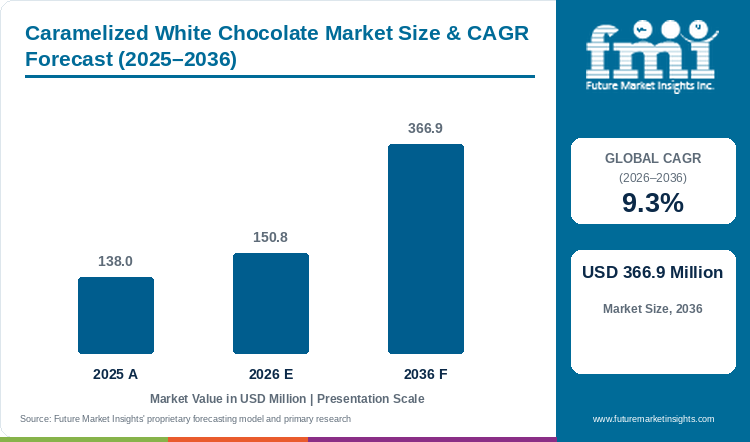
The market was valued at USD 138.0 million in 2025 and is expected to reach USD 150.8 million in 2026. It is projected to reach USD 366.9 million by 2036 at a CAGR of 9.3% from 2026 to 2036.
The caramelized white chocolate market was valued at USD 138.0 million in 2025 and is estimated at USD 150.8 million in 2026. Revenue is forecast to reach USD 366.9 million by 2036, reflecting a 9.3% CAGR. Powder and dry formats hold 45.0% of demand by form in 2026, while applications range from fillings and coatings to baked goods. The International Cocoa Organization estimated 2024/25 world cocoa production 8.3% higher and grindings 3.8% lower in its May 2026 bulletin.[2] For caramelized white chocolate, sustained growth therefore rests on the ingredient's value in finished recipes rather than on cocoa volume alone. Professional product offers show how an approved caramelized flavor can move from one filling or coating into additional compatible products, provided its composition and handling remain consistent.[3][4] The breadth of possible uses does not make every recipe equivalent: fillings need controlled viscosity, while coatings must set properly and retain their appearance after storage and handling.
Key Market Trends & Insights
- By product type: Dark represented 34.0% of 2026 product type demand. Dark leads Product Type, but a darker finish doesn't tell a buyer what's in the chocolate. Composition on the specification is what the bakery pays for, so every delivery has to match it.
- By form: Powder / Dry accounted for 45.0% of 2026 form demand. Powder leads because dry dosing fits the weighing routines a bakery already runs. It's only an advantage if it doesn't add preparation work or make the finished product inconsistent.
- By application: Bread & Rolls held 36.0% of 2026 application demand. This is the top application, and it covers fillings, swirls and finishes that use very different amounts of chocolate. Supplier volume follows the amount in each product as much as the number sold.
Regional Highlights
- The UAE's 10.6% projected CAGR is the highest among the caramelized white chocolate country profiles, with demand tied to whether an approved flavor extends beyond a small set of launches.
- Saudi Arabia follows at 10.2%, South Korea at 9.9% and the UK at 9.6%; Japan's 8.3% rate is the lowest of the profiled forecasts for 2026 to 2036.
Market Size & Forecast
Table 1: Caramelized White Chocolate Market Size and Forecast (USD million), 2025 to 2036
| Market size and forecast | Value |
|---|---|
| 2025 Value (actual) | USD 138.0 million |
| Estimated market size in 2026 | USD 150.8 million |
| Projected market size by 2036 | USD 366.9 million |
| CAGR (2026-2036) | 9.3% |
The practical opportunity depends on whether the ingredient stays in a recipe once the first pastry has sold. Callebaut Gold carries a three-drop fluidity rating and is positioned for fillings, mousses and decoration, while Felchlin describes Bionda 36.0% as caramel white-chocolate couverture for coating, fillings and creams.[3][4] Both give bakers a defined ingredient to test in several recipes, although a product page cannot show that customers will keep it on sale. White chocolate also carries cocoa-butter and dairy exposure, because the US standard requires at least 20.0% cocoa butter and 14.0% total milk solids.[1] Consequently, actual demand will depend on whether a caramelised recipe holds its texture, setting behaviour and portion cost in regular production.
Caramelized White Chocolate Market is segmented by Product Type, Form, Application, Claim, Sales Channel and Region. The forecast period runs from 2026 to 2036.
White chocolate retains a direct connection to cocoa purchasing. The US standard requires at least 20.0% cocoa butter and 14.0% total milk solids.[1] A caramelised product consequently carries cocoa-butter and dairy exposure alongside sugar and processing costs. ICCO’s May 2026 bulletin describes the upstream cocoa ingredient environment, where a stronger crop and lower grindings were occurring together.[2] The cost reaching a bakery also depends on composition, processing and contract terms. A speciality flavour therefore has to justify its portion cost within the finished pastry even when the wider bean balance improves. That purchasing decision is distinct from whether customers enjoy the flavour in a sample.
Callebaut Gold and Felchlin Bionda provide specific reference points for the commercial offer. Gold carries a three-drop fluidity rating and is positioned for fillings, mousses and decoration.[3] Felchlin describes Bionda 36.0% as caramel white-chocolate couverture for coating, fillings and creams.[4] Their application specifications help customers decide where a premium ingredient can enter an existing range. A thin finish and a substantial filling consume different amounts and impose different requirements on setting. The account grows when an accepted chocolate can be carried into additional compatible recipes. Each extension still has to preserve the finished texture and the intended amount of chocolate per portion.
Menu development offers a route into those accounts, although a limited launch and a permanent recipe create very different demand. The first may require only a small order and leave stock after the selling period ends. A retained filling or coating can support scheduled deliveries and larger packs. Multi-site use adds another opportunity when production teams can reproduce the same result on different equipment. This gives application support a direct commercial role: it helps an ingredient move beyond the first successful pastry. Persistent problems with setting or appearance can reverse that progress by making the recipe too difficult to retain in ordinary production.
Table 2: Supporting Industry Indicators for the Caramelized White Chocolate Market, 2025 to 2026 and current product specifications
| Indicator | Data point | Why it matters | Source |
|---|---|---|---|
| Upstream cocoa output | ICCO’s May 2026 estimate put 2024/25 production at 4,723,000 tonnes, up 8.3%. | The supply backdrop influences cocoa-ingredient purchasing conditions. | [2] |
| Upstream processing | The same bulletin estimated grindings at 4,628,000 tonnes, down 3.8%. | Higher crop supply and weaker processing can occur together. | [2] |
| White-chocolate composition | The US standard specifies minimum cocoa butter of 20.0% and milk solids of 14.0%. | Ingredient identity retains exposure to cocoa butter and dairy. | [1] |
| Callebaut application specification | Gold carries a three-drop fluidity rating. | Processing suitability affects which fillings and finishes can use it. | [3] |
| Felchlin product offer | Bionda 36.0% is sold as caramel white-chocolate couverture. | The product gives customers a defined coating and filling ingredient. | [4] |
| Commercial application range | Supplier uses include coating, creams, mousses and fillings. | Consumption follows individual recipes and portion sizes. | [3][4] |
Demand Intensity Analysis
The caramelized white chocolate market is forecast to generate an additional USD 216.1 million in annual revenue between 2026 and 2036. Part of this growth can come from wider use within a customer’s existing chocolate purchases, when a new flavour replaces part of an established range. Part can also follow additional sales of a successful pastry. Reported value will reflect both the amount of chocolate purchased and the prices paid, while physical demand follows the recipes that remain on sale. A seasonal item can open an account but offers a shorter replenishment cycle than a permanent line. Suppliers therefore need to turn an accepted launch into a recipe that stays in regular production.
The choice between buying a ready-made caramelised chocolate and preparing the profile in the bakery influences how much spending suppliers can capture. A purchased couverture such as Callebaut Gold or Felchlin Bionda moves that preparation to the supplier.[3][4] In-house caramelising keeps the profile under the bakery’s control at the cost of extra work in each batch. These distinctions matter when assessing the market’s projected 9.3% CAGR. ICCO’s May 2026 bulletin put 2024/25 grindings at 4,628,000 tonnes against production of 4,723,000 tonnes.[2] While the figures describe an upstream commodity, they suggest that the forecast requires gains beyond movements in cocoa supply. Greater use of purchased caramelised chocolate offers one possible route, particularly where bakers can show that the ingredient earns its portion cost.
Bread & rolls represent USD 54.3 million in 2026, while Powder / dry accounts for USD 67.9 million under the separate Form classification. Consumption follows the role of the ingredient in each application. A small finishing layer can reach many units with a relatively modest chocolate purchase. A larger filling consumes more per unit and gives input prices greater weight in the finished product’s cost. This difference helps explain why growth in pastry sales may not translate into the same percentage growth in ingredient volume. Changes in portion design can alter purchasing even where output is steady. The relevant measure is therefore the amount used in each item, rather than the size of the pack.
Direct supply to industrial bakeries represents USD 86.0 million in 2026. Large accounts can turn an accepted filling or coating into regular volume, particularly where the same product is manufactured across sites. That scale makes stable melting, depositing and cooling behaviour commercially significant. A small shift in the ingredient can affect the customer’s process or portion weight across a long run. Supply agreements therefore have value beyond the original taste approval: they preserve the conditions under which the recipe was costed and introduced. Long-term sales are ultimately determined by how many finished pastries the bakery makes with the chocolate, how often it runs each recipe and the amount used in each item.
Table 3: Demand Intensity Metrics for the Caramelized White Chocolate Market, 2026 to 2036 with relevant industry comparisons
| Demand intensity metric | Value | Basis |
|---|---|---|
| Caramelized white chocolate value CAGR | 9.3% | Global value forecast, 2026 to 2036. |
| Cocoa production change | +8.3% | ICCO May 2026 estimate for 2024/25; commodity context.[2] |
| Cocoa grindings change | −3.8% | ICCO May 2026 estimate for 2024/25; processing activity.[2] |
| Industrial direct-supply revenue, 2026 | USD 86.0 million | Direct to industrial bakeries within Sales Channel. |
| Powder / dry revenue, 2026 | USD 67.9 million | Form classification. |
| Bread & rolls revenue, 2026 | USD 54.3 million | Application classification. |
| Added revenue through 2036 | USD 216.1 million | Change in forecast market value between 2026 and 2036. |
Analyst Perspective
Caramelised white chocolate earns a lasting place when it adds a distinctive flavour without disrupting the bakery’s portion cost or setting. Suppliers that keep melting and setting steady can extend an accepted chocolate across recipes, while an unstable batch limits repeat use.
- Nandini Roy Choudhury, Principal Analyst at Future Market Insights
How is the caramelized white chocolate market segmented?
The caramelized white chocolate market is segmented by Product Type (Dark, Milk, White & blond, Sugar-free & specialty), Form (Powder / dry, Liquid, Paste / semi-solid, Granules / pieces), Application (Bread & rolls, Cakes & muffins, Biscuits & cookies, Viennoiserie & pastry, Other bakery & snacks), Claim (Conventional, Clean label, Organic, Non-GMO / identity preserved), and Sales Channel (Direct to industrial bakeries, Ingredient distributors, Foodservice & artisan supply, Online B2B). Regionally, the market is segmented into North America, Latin America, Western Europe, Eastern Europe, East Asia, South Asia and Pacific, and Middle East and Africa.
How do product specifications shape caramelised white chocolate purchasing?
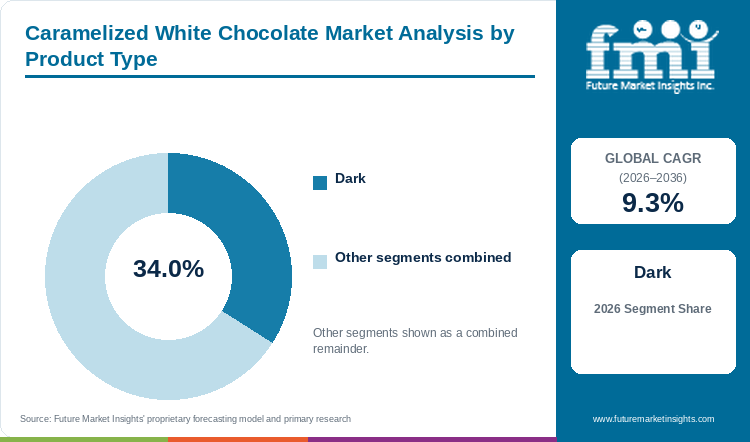
Dark leads with 34.0% of Product Type revenue in 2026.
White-chocolate composition gives purchasing a defined reference before flavour and handling are compared. The FDA standard specifies cocoa-butter and milk requirements.[1] Those ingredients influence cost and remain relevant when the chocolate enters a filling or coating. A darker finished colour alone cannot establish composition. The specification has to describe the product that the bakery will receive and use throughout the contract.
- Dark accounts for 34.0% of the Product Type breakdown in 2026.
- Later deliveries need to match the composition and processing specification agreed at purchase.
What supports the lead of Powder / dry in ingredient Form?
Powder / dry leads with 45.0% of Form revenue in 2026.
Different formats enter production at different points, so the commercial choice is tied to the receiving process. A confectionery coating brings requirements for flow and setting, while a measured inclusion has a separate portioning role. A convenient format loses its advantage if it adds preparation work or makes the finished product inconsistent.
- Powder / dry represents 45.0% of Form in 2026, with dry dosing suited to established ingredient-handling routines.
- The selected format needs to suit the mixing or finishing operation without adding preparation steps.
How do Bread & rolls anchor caramelised-white-chocolate Application?
Bread & rolls hold 36.0% of Application revenue in 2026.
Fillings, swirls and finishes create different ingredient quantities within this category. A filling used before baking has a different process exposure from a finish added after cooling. The supplier’s sales potential therefore follows both the output of the customer’s product and the amount used in its chosen application.
- Bread & rolls hold 36.0% of Application in 2026, covering fillings, swirls and finishes.
- The inclusion rate and application step need to be fixed for each recipe, because they set chocolate use per finished product.
Why do conventional formulations lead purchasing?
Conventional leads Claim with 48.0% of revenue in 2026.
Sourcing claims add conditions to a specification that must already establish composition and performance. A change in dairy ingredients or other formulation components can affect the finished-product declaration even when the caramel flavour remains familiar. Keeping that specification stable reduces the work attached to continuing supply.
- Conventional leads Claim at 48.0% of revenue in 2026.
- Sourcing records and the finished-product declaration must stay aligned with the chocolate’s composition.
What gives Direct to industrial bakeries the Sales Channel advantage?
Direct to industrial bakeries holds 57.0% of Sales Channel revenue in 2026.
Direct contact allows the chocolate supplier and bakery to agree the behaviour needed in melting, depositing and cooling. Once established, that specification can support long production runs or extension to additional sites. The commercial value of technical support rises when it resolves a process change without forcing the customer to abandon an existing recipe.
- Direct to industrial bakeries accounts for 57.0% of Sales Channel in 2026, bringing application work into the supply agreement.
- Melting and application behaviour need to stay within the range agreed with the bakery.
What are the drivers, restraints and opportunities in the caramelized white chocolate market?
A reproducible caramelised profile supports wider recipe use
Callebaut Gold and Felchlin Bionda offer ready-made caramelised profiles for professional applications.[3][4] Buying the ingredient transfers preparation of that profile to the supplier and gives a bakery a consistent starting point for several recipes. The opportunity extends beyond the first launch when a cream, coating or decoration remains in ordinary production. The portion cost still has to support the margin of each finished item.
Composition and handling requirements constrain substitution
Similar caramel notes can conceal different melting and setting behaviour. A replacement may require another handling temperature, a different dose or adjustments to the base recipe. White-chocolate composition is also subject to the FDA identity standard in the US.[1] These changes can absorb an apparent ingredient saving, giving an established product an advantage where a bakery already has a reliable process.
Controlled formats can make a speciality ingredient easier to scale
Application-specific support can extend one chocolate into additional prepared pastry fillings or finishes. Callebaut Gold and Felchlin Bionda demonstrate the range of professional uses available.[3][4] The supplier gains volume when a customer carries an accepted flavour into more products. Matching format and pack size to those uses can make that expansion economical without adding avoidable stock or preparation work.
Which country CAGRs are profiled in the caramelized white chocolate market?
Table 4: Country growth outlook for the caramelized white chocolate market
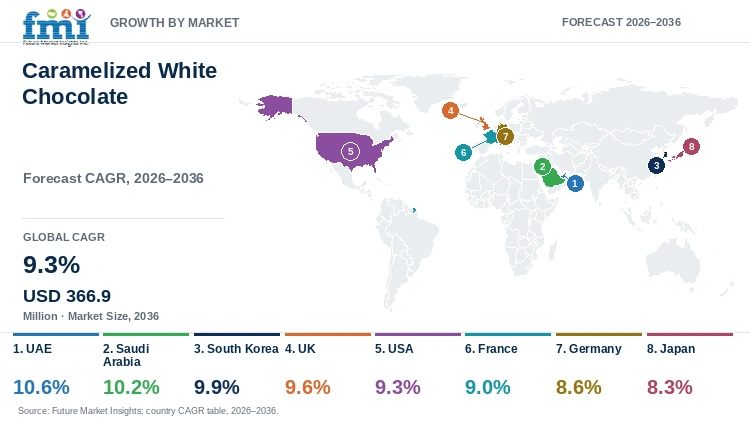
| Country | CAGR, 2026 to 2036 |
|---|---|
| UAE | 10.6% |
| Saudi Arabia | 10.2% |
| South Korea | 9.9% |
| UK | 9.6% |
| USA | 9.3% |
| France | 9.0% |
| Germany | 8.6% |
| Japan | 8.3% |
UAE
The UAE is forecast to record the highest growth among the profiled countries, at 10.6% CAGR between 2026 and 2036. Dubai’s Department of Economy and Tourism reported 19.59 million international overnight visitors in 2025, up from 18.72 million in 2024, widening the customer base for hotel pastry kitchens. Visitor numbers show the size of the hospitality market, not which desserts stay on a menu. A limited dessert launch offers an entry point for a speciality ingredient, while a permanent listing supports a larger stock commitment. However, a menu that changes with the season may retire the chocolate before the order repeats. Growth will depend on how many initial applications become recurring orders at a sustainable portion cost.
Saudi Arabia
Saudi Arabia is projected at 10.2% CAGR through 2036, above the global rate of 9.3%. The Ministry of Tourism reported about 122 million domestic and international visits in 2025, 5.0% above the previous year in preliminary estimates. A larger visitor base supports bakery chains and hotel kitchens, but the count says little about which recipes stay in production. The commercial decision includes whether to buy the caramelised profile or prepare it within the bakery. A purchased ingredient captures more of that value when one chocolate serves several recipes. The limitation is that a change in melting or setting behaviour can force a kitchen to repeat its recipe testing. Demand will depend on how many operators keep an approved recipe in regular production.
South Korea
South Korea is projected to expand at 9.9% CAGR, above the global forecast of 9.3%. The USDA Foreign Agricultural Service reported that South Korean imports of chocolate and cocoa products grew 18.0% between 2023 and 2024. Growth in imported chocolate points to rising use of the category, although it does not show that bakeries will pay a premium for a caramelised profile. The quantity of chocolate in each product determines the volume behind the outlook, because a small finish and a substantial filling create different ingredient orders. However, changes in portion design can offset growth in finished-product sales. Demand will depend on how many new pastry formats keep a chocolate component at a stable inclusion rate.
UK
The UK is forecast to grow at 9.6% CAGR, above the global rate of 9.3%. The Office for National Statistics reported that the sugar, jam, syrups, chocolate and confectionery class made the largest upward contribution to the change in annual food inflation in May 2025 and a downward contribution in November 2025. Price pressure in that class shifts from month to month, which weakens a purchasing case built on cost alone. Caramelised white chocolate competes for recipe space with other caramel preparations and conventional chocolate, so its premium has to be earned in the finished flavour and texture. However, added handling work can reduce the bakery’s margin. Demand will depend on how many recipes keep the ingredient once total recipe cost is tested.
USA
The USA forecast of 9.3% matches the global CAGR. The US Bureau of Labor Statistics reported that producer prices for US chocolate and confectionery products made from cacao rose 143.9% between December 2019 and November 2024, while import prices for cocoa and cocoa preparations rose 107.4%. Cost increases of that scale put the portion cost of a speciality chocolate under review without deciding whether a bakery keeps it. The FDA standard provides a compositional reference for products sold as white chocolate,[1] so ingredient identity and intended use enter the same purchasing discussion. However, a successful coating specification does not establish suitability for every baked application. Repeat orders will depend on whether the specification holds across the recipes where it is used.
France
France carries a 9.0% CAGR outlook, below the global rate of 9.3%. INSEE reported that consumer prices of cocoa-based products rose 22.0% between mid-2023 and May 2025. That increase raises the cost of cocoa-based ingredients but does not show whether bakeries will pay more for a caramelised profile. A couverture used across several compatible fillings and finishes can create more dependable volume than one tied to a single seasonal pastry. Supplier application support has a commercial role in those extensions. Yet a change in setting or storage can make a new recipe difficult to retain. Demand will depend on how many French recipes keep the same couverture beyond their first season and on whether suppliers hold the same specification.
Germany
Germany is projected at 8.6% CAGR through 2036, below the global rate of 9.3%. Destatis reported that German production of cocoa-containing chocolate products fell 5.8% in 2024 to just under 1.07 million tonnes. Lower output of chocolate products indicates that growth for a speciality ingredient cannot rely on rising volumes and has to come from recipe selection. An established melting and finishing process gives the current ingredient a switching advantage. A competing product has to offer enough improvement in cost or finished pastry to justify new trials. However, an ingredient that wins a trial can still be dropped if its specification drifts between deliveries. Demand will depend on how many bakeries retain the chocolate once the first trial ends.
Japan
Japan has the lowest profiled CAGR at 8.3%, below the global rate of 9.3%. The Statistics Bureau of Japan’s retail price survey recorded Tokyo chocolate prices 30.2% higher in January 2025 than a year earlier, and a further 24.2% higher in January 2026. Price rises on that scale put pressure on any premium ingredient, although they say little about whether Japanese bakeries will keep a caramelised recipe. The duration of a listing matters as much as the number of new flavour concepts introduced, because a product retained through successive production cycles gives the supplier recurring demand. The limitation is that a seasonal item can end its run before an order repeats. Demand will depend on how many listings last beyond the first selling period.
Who are the notable companies in the caramelized white chocolate market?
Barry Callebaut; Valrhona; Felchlin; Puratos; ICAM
Barry Callebaut, Valrhona and Felchlin offer professional products in caramelised or blond chocolate. Puratos supplies Belcolade Amber, and ICAM lists Vanini Aurum caramel white chocolate. These identifiable products compete through flavour, composition and handling properties within the customer’s intended application.
The broader account opportunity comes from carrying an accepted chocolate into compatible recipes. A supplier that supports that work can increase volume without relying on another flavour launch. Consistent product specifications preserve the methods already established by the bakery and reduce the disruption of later deliveries.
Competitive Benchmarking: Caramelized White Chocolate Market
Table 5: Company capabilities in the caramelized white chocolate market
| Company | Relevant offer | Commercial capability |
|---|---|---|
| Barry Callebaut | Callebaut Gold caramelised chocolate | Professional chocolate formats and applications |
| Valrhona | Dulcey blond chocolate | Speciality couverture and pastry support |
| Felchlin | Bionda caramelised white couverture | Professional couverture formats |
| Puratos | Belcolade Selection Amber | Chocolate within a wider bakery ingredient portfolio |
| ICAM | Vanini Aurum caramel white chocolate | Professional chocolate supply |
Key Developments in the Caramelized White Chocolate Market
- ICCO updated its assessment of the 2024/25 cocoa supply balance in May 2026. The cocoa environment remains relevant to white-chocolate purchasing because cocoa butter forms part of its required composition.[1][2]
- Callebaut Gold and Felchlin Bionda remain examples of established professional caramelised-chocolate formats. They give bakers products to compare for flavour, melting and application behaviour.[3][4]
Key Players in the Caramelized White Chocolate Market
- Barry Callebaut
- Valrhona
- Felchlin
- Puratos
- ICAM
Caramelized White Chocolate Market - Report Scope
Table 6: Report scope for the caramelized white chocolate market
| Coverage field | Report scope |
|---|---|
| Market breakdown | Product Type, Form, Application, Claim, Sales Channel |
| Quantitative Units | USD Million |
| Market Definition | Ingredient-level revenue from caramelised white chocolate and traceable dedicated preparations within the stated product and application categories. Excludes finished bread, confectionery and pastry sales, as well as conventional chocolate, caramel sauces and other substitutes without a caramelised-white-chocolate ingredient; bundled preparations are included only for their attributable eligible ingredient revenue. |
| Regions Covered | North America, Latin America, Western Europe, Eastern Europe, East Asia, South Asia and Pacific, Middle East and Africa |
| Countries Covered | UAE; Saudi Arabia; South Korea; UK; USA; France; Germany; Japan |
| Key Companies Profiled | Barry Callebaut; Valrhona; Felchlin; Puratos; ICAM |
| Forecast Period | 2026 to 2036 |
| Approach | Market assessment supported by official technical and regulatory publications, company product information and country operating conditions. |
Caramelized White Chocolate Market - Research Methodology
Table 7: Research approach for the caramelized white chocolate market
| Method | Approach |
|---|---|
| Market coverage | Coverage follows caramelised white-chocolate ingredients and dedicated preparations, excluding downstream bakery products and unrelated caramel substitutes. |
| Secondary evidence | Government and technical publications are considered alongside first-party product information and dated corporate announcements. |
| Commercial analysis | Purchasing requirements, operating constraints, service needs and country-specific routes to market inform the interpretation of demand. |
| Forecast presentation | Global values, leading segment shares and country growth rates are stated for the 2026 to 2036 forecast period. |
Caramelized White Chocolate Market by Segments
Product Type
- Dark
- Milk
- White & blond
- Sugar-free & specialty
Form
- Powder / dry
- Liquid
- Paste / semi-solid
- Granules / pieces
Application
- Bread & rolls
- Cakes & muffins
- Biscuits & cookies
- Viennoiserie & pastry
- Other bakery & snacks
Claim
- Conventional
- Clean label
- Organic
- Non-GMO / identity preserved
Sales Channel
- Direct to industrial bakeries
- Ingredient distributors
- Foodservice & artisan supply
- Online B2B
Caramelized White Chocolate Market by Region
- North America
- United States
- Canada
- Latin America
- Brazil
- Mexico
- Argentina
- Chile
- Western Europe
- Germany
- France
- United Kingdom
- Italy
- Spain
- Benelux
- Nordics
- Eastern Europe
- Poland
- Czech Republic
- Romania
- Hungary
- East Asia
- China
- Japan
- South Korea
- South Asia and Pacific
- India
- ASEAN
- Australia and New Zealand
- Middle East and Africa
- GCC Countries
- South Africa
- Türkiye
- Israel
Research Sources and Bibliography
- [1] U.S. Food and Drug Administration. (2008, July). Small entity compliance guide: Standard of identity for white chocolate.
- [2] International Cocoa Organization. (2026, May 29). May 2026 quarterly bulletin of cocoa statistics.
- [3] Callebaut. (n.d.). Callebaut Gold: The Belgian caramelized chocolate.
- [4] Felchlin. (n.d.). Bionda 36%.
This Report Answers
- What are the caramelized white chocolate market values in 2026 and 2036?
- Which bakery purchasing pressures support caramelised-white-chocolate demand?
- How do composition and product format shape ingredient selection?
- Why does Powder / dry lead ingredient Form?
- How do projected CAGRs differ across the eight profiled countries?
- Which profiled companies supply caramelised and blond chocolate for bakery applications?
Frequently Asked Questions
How big is the caramelized white chocolate market in 2026, and what is forecast for 2036?
The market is valued at USD 150.8 Million in 2026 and is forecast to reach USD 366.9 Million by 2036.
What is the caramelized white chocolate market CAGR from 2026 to 2036?
The projected CAGR is 9.3% from 2026 to 2036.
Which category leads the Product Type breakdown in 2026?
Dark accounts for 34.0% of the Product Type breakdown in 2026.
Which Form segment holds the largest share in 2026?
Powder / dry leads Form at 45.0% in 2026. Suitability depends on how the ingredient is incorporated into the intended application.
Which profiled countries have the highest growth rates?
The UAE has the highest CAGR at 10.6% and Saudi Arabia follows at 10.2% from 2026 to 2036.
Which companies participate in the caramelized white chocolate market?
Relevant participants include Barry Callebaut, Valrhona, Felchlin, Puratos and ICAM.
Preview the report firsthand - request a free sample
Get SampleGet the brochure for pricing and purchase details.
Get PDFTable of Content
- Key Takeaways
- Market Size and CAGR
- Top Growth Driver
- Fastest Growing Segment
- Leading Region
- Key Companies
- Emerging Opportunities
- Executive Summary
- Global Market Outlook
- Demand-side Trends
- Supply-side Trends
- Technology Roadmap Analysis
- Analysis and Recommendations
- Analyst Perspective (What is happening? Why now? What should investors know?)
- Key Questions Answered
- How large is the market?
- What is the CAGR?
- What are key trends?
- Which region dominates?
- Who are the leaders?
- Market Overview
- Market Coverage / Taxonomy
- Market Definition / Scope / Limitations
- Research Methodology
- Chapter Orientation
- Analytical Lens and Working Hypotheses
- Market Structure, Signals, and Trend Drivers
- Benchmarking and Cross-market Comparability
- Market Sizing, Forecasting, and Opportunity Mapping
- Research Design and Evidence Framework
- Desk Research Programme (Secondary Evidence)
- Expert Input and Fieldwork (Primary Evidence)
- Tooling, Models, and Reference Databases
- Data Engineering and Model Build
- Quality Assurance and Audit Trail
- Market Background
- Market Dynamics (Drivers, Restraints, Opportunity, Trends)
- Scenario Forecast (Optimistic, Likely, Conservative)
- Impact Analysis
- AI Impact
- Sustainability Impact
- Regulatory Impact
- Technology Impact
- Consumer / Buyer Analysis
- Purchase Drivers
- Adoption Barriers
- Buyer Journey
- Opportunity Map Analysis
- Product Life Cycle Analysis
- Supply Chain Analysis
- Investment Feasibility Matrix
- Value Chain Analysis
- PESTLE and Porter's Analysis
- Regulatory Landscape
- Regional Parent Market Outlook
- Production and Consumption Statistics
- Import and Export Statistics
- Global Market Analysis and Forecast, 2021 to 2036
- Historical Market Size Value (USD Million) Analysis, 2021 to 2025
- Current and Future Market Size Value (USD Million) Projections, 2026 to 2036
- Y-o-Y Growth Trend Analysis
- Absolute $ Opportunity Analysis
- Global Market Pricing Analysis, 2021 to 2036
- Global Market Analysis and Forecast, By Product Type, 2021 to 2036
- Introduction / Key Findings
- Historical Market Size Value (USD Million) Analysis By Product Type, 2021 to 2025
- Current and Future Market Size Value (USD Million) Analysis and Forecast By Product Type, 2026 to 2036
- Dark
- Milk
- White & blond
- Sugar-free & specialty
- Y-o-Y Growth Trend Analysis By Product Type, 2021 to 2025
- Absolute $ Opportunity Analysis By Product Type, 2026 to 2036
- Global Market Analysis and Forecast, By Form, 2021 to 2036
- Introduction / Key Findings
- Historical Market Size Value (USD Million) Analysis By Form, 2021 to 2025
- Current and Future Market Size Value (USD Million) Analysis and Forecast By Form, 2026 to 2036
- Powder / dry
- Liquid
- Paste / semi-solid
- Granules / pieces
- Y-o-Y Growth Trend Analysis By Form, 2021 to 2025
- Absolute $ Opportunity Analysis By Form, 2026 to 2036
- Global Market Analysis and Forecast, By Application, 2021 to 2036
- Introduction / Key Findings
- Historical Market Size Value (USD Million) Analysis By Application, 2021 to 2025
- Current and Future Market Size Value (USD Million) Analysis and Forecast By Application, 2026 to 2036
- Bread & rolls
- Cakes & muffins
- Biscuits & cookies
- Viennoiserie & pastry
- Other bakery & snacks
- Y-o-Y Growth Trend Analysis By Application, 2021 to 2025
- Absolute $ Opportunity Analysis By Application, 2026 to 2036
- Global Market Analysis and Forecast, By Claim, 2021 to 2036
- Introduction / Key Findings
- Historical Market Size Value (USD Million) Analysis By Claim, 2021 to 2025
- Current and Future Market Size Value (USD Million) Analysis and Forecast By Claim, 2026 to 2036
- Conventional
- Clean label
- Organic
- Non-GMO / identity preserved
- Y-o-Y Growth Trend Analysis By Claim, 2021 to 2025
- Absolute $ Opportunity Analysis By Claim, 2026 to 2036
- Global Market Analysis and Forecast, By Sales Channel, 2021 to 2036
- Introduction / Key Findings
- Historical Market Size Value (USD Million) Analysis By Sales Channel, 2021 to 2025
- Current and Future Market Size Value (USD Million) Analysis and Forecast By Sales Channel, 2026 to 2036
- Direct to industrial bakeries
- Ingredient distributors
- Foodservice & artisan supply
- Online B2B
- Y-o-Y Growth Trend Analysis By Sales Channel, 2021 to 2025
- Absolute $ Opportunity Analysis By Sales Channel, 2026 to 2036
- Global Market Analysis and Forecast, By Region, 2021 to 2036
- Introduction
- Historical Market Size Value (USD Million) Analysis By Region, 2021 to 2025
- Current Market Size Value (USD Million) Analysis and Forecast By Region, 2026 to 2036
- North America
- Latin America
- Western Europe
- Eastern Europe
- East Asia
- South Asia and Pacific
- Middle East and Africa
- Market Attractiveness Analysis By Region
- North America Market Analysis and Forecast, By Country, 2021 to 2036
- Historical Market Size Value (USD Million) Trend Analysis By Market Taxonomy, 2021 to 2025
- Market Size Value (USD Million) Forecast By Market Taxonomy, 2026 to 2036
- By Country
- United States
- Canada
- By Product Type
- By Form
- By Application
- By Claim
- By Sales Channel
- By Country
- Market Attractiveness Analysis
- By Country
- By Product Type
- By Form
- By Application
- By Claim
- By Sales Channel
- Key Takeaways
- Latin America Market Analysis and Forecast, By Country
- Historical Market Size Value (USD Million) Trend Analysis By Market Taxonomy, 2021 to 2025
- Market Size Value (USD Million) Forecast By Market Taxonomy, 2026 to 2036
- By Country
- Brazil
- Mexico
- Argentina
- Chile
- By Product Type
- By Form
- By Application
- By Claim
- By Sales Channel
- By Country
- Market Attractiveness Analysis
- By Country
- By Product Type
- By Form
- By Application
- By Claim
- By Sales Channel
- Key Takeaways
- Western Europe Market Analysis and Forecast, By Country
- Historical Market Size Value (USD Million) Trend Analysis By Market Taxonomy, 2021 to 2025
- Market Size Value (USD Million) Forecast By Market Taxonomy, 2026 to 2036
- By Country
- Germany
- France
- United Kingdom
- Italy
- Spain
- Benelux
- Nordics
- By Product Type
- By Form
- By Application
- By Claim
- By Sales Channel
- By Country
- Market Attractiveness Analysis
- By Country
- By Product Type
- By Form
- By Application
- By Claim
- By Sales Channel
- Key Takeaways
- Eastern Europe Market Analysis and Forecast, By Country
- Historical Market Size Value (USD Million) Trend Analysis By Market Taxonomy, 2021 to 2025
- Market Size Value (USD Million) Forecast By Market Taxonomy, 2026 to 2036
- By Country
- Poland
- Czech Republic
- Romania
- Hungary
- By Product Type
- By Form
- By Application
- By Claim
- By Sales Channel
- By Country
- Market Attractiveness Analysis
- By Country
- By Product Type
- By Form
- By Application
- By Claim
- By Sales Channel
- Key Takeaways
- East Asia Market Analysis and Forecast, By Country
- Historical Market Size Value (USD Million) Trend Analysis By Market Taxonomy, 2021 to 2025
- Market Size Value (USD Million) Forecast By Market Taxonomy, 2026 to 2036
- By Country
- China
- Japan
- South Korea
- By Product Type
- By Form
- By Application
- By Claim
- By Sales Channel
- By Country
- Market Attractiveness Analysis
- By Country
- By Product Type
- By Form
- By Application
- By Claim
- By Sales Channel
- Key Takeaways
- South Asia and Pacific Market Analysis and Forecast, By Country
- Historical Market Size Value (USD Million) Trend Analysis By Market Taxonomy, 2021 to 2025
- Market Size Value (USD Million) Forecast By Market Taxonomy, 2026 to 2036
- By Country
- India
- ASEAN
- Australia and New Zealand
- By Product Type
- By Form
- By Application
- By Claim
- By Sales Channel
- By Country
- Market Attractiveness Analysis
- By Country
- By Product Type
- By Form
- By Application
- By Claim
- By Sales Channel
- Key Takeaways
- Middle East and Africa Market Analysis and Forecast, By Country
- Historical Market Size Value (USD Million) Trend Analysis By Market Taxonomy, 2021 to 2025
- Market Size Value (USD Million) Forecast By Market Taxonomy, 2026 to 2036
- By Country
- GCC Countries
- South Africa
- Türkiye
- Israel
- By Product Type
- By Form
- By Application
- By Claim
- By Sales Channel
- By Country
- Market Attractiveness Analysis
- By Country
- By Product Type
- By Form
- By Application
- By Claim
- By Sales Channel
- Key Takeaways
- Key Countries Market Analysis
- United States
- Pricing Analysis
- Market Share Analysis, 2025
- By Product Type
- By Form
- By Application
- By Claim
- By Sales Channel
- Canada
- Pricing Analysis
- Market Share Analysis, 2025
- By Product Type
- By Form
- By Application
- By Claim
- By Sales Channel
- Mexico
- Pricing Analysis
- Market Share Analysis, 2025
- By Product Type
- By Form
- By Application
- By Claim
- By Sales Channel
- Brazil
- Pricing Analysis
- Market Share Analysis, 2025
- By Product Type
- By Form
- By Application
- By Claim
- By Sales Channel
- Chile
- Pricing Analysis
- Market Share Analysis, 2025
- By Product Type
- By Form
- By Application
- By Claim
- By Sales Channel
- Germany
- Pricing Analysis
- Market Share Analysis, 2025
- By Product Type
- By Form
- By Application
- By Claim
- By Sales Channel
- United Kingdom
- Pricing Analysis
- Market Share Analysis, 2025
- By Product Type
- By Form
- By Application
- By Claim
- By Sales Channel
- Italy
- Pricing Analysis
- Market Share Analysis, 2025
- By Product Type
- By Form
- By Application
- By Claim
- By Sales Channel
- Spain
- Pricing Analysis
- Market Share Analysis, 2025
- By Product Type
- By Form
- By Application
- By Claim
- By Sales Channel
- France
- Pricing Analysis
- Market Share Analysis, 2025
- By Product Type
- By Form
- By Application
- By Claim
- By Sales Channel
- India
- Pricing Analysis
- Market Share Analysis, 2025
- By Product Type
- By Form
- By Application
- By Claim
- By Sales Channel
- ASEAN
- Pricing Analysis
- Market Share Analysis, 2025
- By Product Type
- By Form
- By Application
- By Claim
- By Sales Channel
- Australia and New Zealand
- Pricing Analysis
- Market Share Analysis, 2025
- By Product Type
- By Form
- By Application
- By Claim
- By Sales Channel
- China
- Pricing Analysis
- Market Share Analysis, 2025
- By Product Type
- By Form
- By Application
- By Claim
- By Sales Channel
- Japan
- Pricing Analysis
- Market Share Analysis, 2025
- By Product Type
- By Form
- By Application
- By Claim
- By Sales Channel
- South Korea
- Pricing Analysis
- Market Share Analysis, 2025
- By Product Type
- By Form
- By Application
- By Claim
- By Sales Channel
- Poland
- Pricing Analysis
- Market Share Analysis, 2025
- By Product Type
- By Form
- By Application
- By Claim
- By Sales Channel
- Hungary
- Pricing Analysis
- Market Share Analysis, 2025
- By Product Type
- By Form
- By Application
- By Claim
- By Sales Channel
- Türkiye
- Pricing Analysis
- Market Share Analysis, 2025
- By Product Type
- By Form
- By Application
- By Claim
- By Sales Channel
- South Africa
- Pricing Analysis
- Market Share Analysis, 2025
- By Product Type
- By Form
- By Application
- By Claim
- By Sales Channel
- UAE
- Pricing Analysis
- Market Share Analysis, 2025
- By Product Type
- By Form
- By Application
- By Claim
- By Sales Channel
- Saudi Arabia
- Pricing Analysis
- Market Share Analysis, 2025
- By Product Type
- By Form
- By Application
- By Claim
- By Sales Channel
- United States
- Market Structure Analysis
- Competition Dashboard
- Competition Benchmarking
- Market Share Analysis of Top Players
- By Regional
- By Product Type
- By Form
- By Application
- By Claim
- By Sales Channel
- Emerging Startups
- Innovation Benchmarking
- Competition Analysis
- Competition Deep Dive
- Barry Callebaut
- Overview
- Product Portfolio
- Profitability by Market Segments
- Sales Footprint
- Strategy Overview
- Marketing Strategy
- Product Strategy
- Channel Strategy
- Valrhona
- Felchlin
- Puratos
- ICAM
- Barry Callebaut
- Case Studies
- Success Stories
- Recent Developments
- Competition Deep Dive
- Assumptions & Acronyms Used


