
- Market Size (2026)
- USD 56.3 Bn
- Forecast (2036)
- USD 90.0 Bn
- CAGR (2026 to 2036)
- 4.8%
How big is the Caustic Soda Market in 2026?
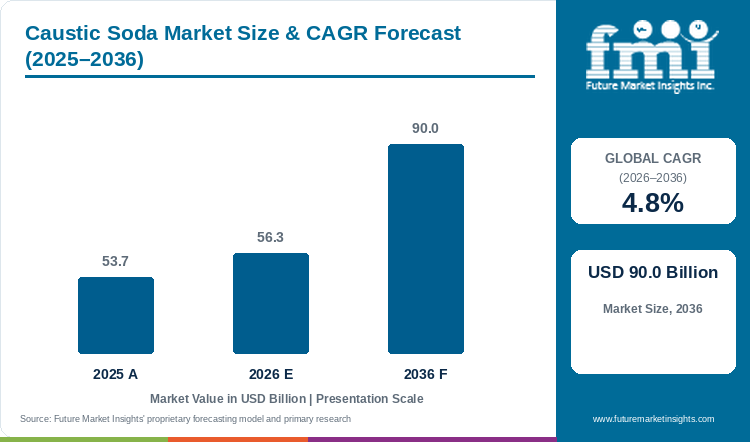
The market is projected to reach USD 90.0 billion by 2036, growing at a 4.8% CAGR from 2026 to 2036. The market is estimated at USD 56.3 billion in 2026. The market was valued at USD 53.7 billion in 2025. Demand starts with alumina refining, which dissolves bauxite in hot caustic soda [22]. World alumina output reached an estimated 150 million tonnes in 2025, up from 142 million tonnes in 2024 [9]. Alcoa reported on 15 October 2026 that third-quarter alumina production rose 11% sequentially to 2.5 million tonnes [3]. It reaffirmed its 2026 projection of 9.5 to 9.6 million tonnes [3].
Caustic soda is made with chlorine by electrolysing salt solution, so output follows chlorine and vinyl operating rates [10]. On 29 October 2026 Olin said higher pricing for caustic soda and ethylene dichloride partly offset lower chlor-alkali and vinyls earnings [1]. Domestic electrochemical unit values stayed stable despite challenging global demand [1]. Westlake said on 4 November 2026 that prices rose in the second quarter and moderated in the third [2]. European chlorine plants ran at 64.8% of capacity in July 2026, against 70.4% a year earlier [4].
Key Market Trends & Insights
- On 5 March 2026 Shin-Etsu announced a USD 3.4 billion expansion of Shintech's Plaquemine, Louisiana site. The expansion adds 310,000 tons a year of caustic soda capacity, with completion slated toward the end of 2030. Shin-Etsu also expects worldwide caustic soda demand to rise by an average of more than 1,300,000 tons a year over the next five years [7].
- European capacity is being withdrawn. Dow plans to close its Schkopau chlor-alkali and vinyl assets in Germany, with shutdown expected in the fourth quarter of 2027 [6]. Westlake said on 4 November 2026 that it is closing its Cologne PVC plant [2].
- Ownership is changing. Berkshire Hathaway completed its USD 9.7 billion purchase of OxyChem on 2 January 2026 [11]. INEOS Inovyn completed the purchase of the remaining half of Runcorn MCP Limited and the Runcorn ethylene dichloride assets on 30 October 2026 [18].
Regional Highlights
- North America had 15.8 million tonnes of capacity in 2025. About ten producers hold roughly 90% of output [10]. The United States produced about 11.4 million tonnes of caustic soda that year [10].
- Continental Europe: chlorine production across the EU-27, Norway, Switzerland and the UK was 7,787,394 tonnes in 2025. That was 3.1% less than in 2024, at 67.6% capacity utilisation [5]. Euro Chlor members operate 60 manufacturing locations with about 11 million tonnes of chlorine capacity [24].
- United Kingdom and Italy: both have a major chlor-alkali site changing hands in 2026, Runcorn under INEOS Inovyn [18] and Rosignano under an agreed sale to Esseco Industrial [19].
Caustic Soda Market Size and Forecast
Table 1: Caustic Soda Market Size and Forecast
| Market size and forecast | Value |
|---|---|
| Market size in 2025 | USD 53.7 billion |
| Estimated market size in 2026 | USD 56.3 billion |
| Projected market size by 2036 | USD 90.0 billion |
| CAGR from 2026 to 2036 | 4.8% |
Source: Future Market Insights analysis of the caustic soda market, 2026.
Analyst Perspective
“Alumina gives caustic soda its volume base, but chlorine decides how much caustic soda reaches the market. Buyers who read only the alumina cycle will misjudge price. Vinyls operating rates, European plant closures and new integrated capacity in Louisiana are better signals. Supply agreements with a clear index and a named back-up source hold up better than spot buying.”
- Nikhil Kaitwade, Principal Consultant, FMI
How is the Caustic Soda Market segmented?
- By application: Alumina, Inorganic Chemicals, Organic Chemicals, Food, Paper & Pulp, Soaps & Detergents and Textiles
- By region: North America and Europe
Why does Alumina lead by Application in the Caustic Soda Market in 2026?
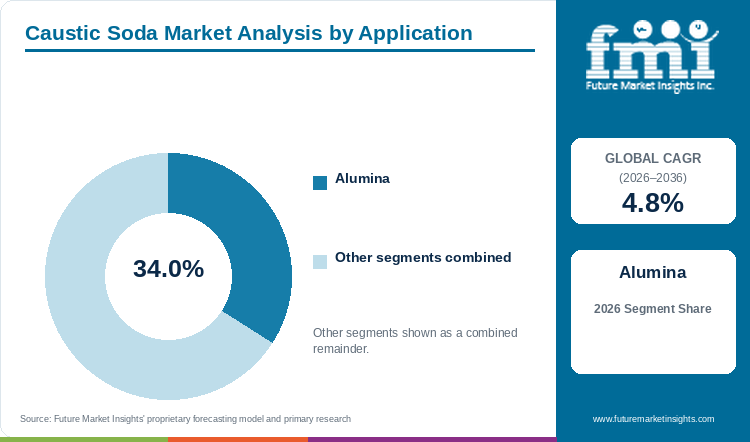
Alumina is estimated to account for 34.0% of the Caustic Soda Market by application in 2026. In the Bayer process, the main route from bauxite to alumina, aluminium-bearing minerals dissolve in hot caustic soda solution. Much of the remaining caustic soda is washed and recycled into digestion [22]. The International Aluminium Institute gives a global average of about 100 kilograms of caustic soda per tonne of alumina [23]. Scale explains the lead. World alumina output was an estimated 150 million tonnes in 2025, of which China produced 93 million tonnes, Australia 17.0 million and Brazil 11.0 million [9]. Indonesia's estimated output rose to 1.5 million tonnes in 2025 from 1.2 million [9]. A 1-million-tonne-a-year refinery in Mempawah shipped its first alumina in April 2025 [9]. Orbia lists alumina among its main demand sectors for caustic soda [10], and Formosa Plastics Corporation names aluminium among the industries it supplies [16]. Margins in refining are thin at present. Alcoa's average realised third-party alumina price was USD 353.0 per tonne in the third quarter of 2026. It was up from USD 334.0 per tonne in the second quarter but below USD 377.0 a year earlier. Its alumina segment posted an adjusted EBITDA loss of USD 1.0 million, against a loss of USD 96.0 million in the second quarter [3]. Thin margins leave refiners little room to absorb higher reagent costs, so alumina buyers are among the most exposed to caustic soda price moves.
Table 2: Application, 2026 Share
| Leading Share | 2026 market share |
|---|---|
| Alumina | 34.0% |
| All Other Segments Combined Share | 66.0% |
Source: Future Market Insights analysis of the caustic soda market, 2026.
What are the key drivers, restraints and opportunities?
Driver
Alumina expansion. New refining capacity pulls in caustic soda wherever a refinery starts up. The Mempawah refinery in Indonesia shipped its first alumina in April 2025 [9]. Mining began in June 2025 at a bauxite mine near Boddington, Australia, within expanded boundaries. The mine feeds a 4.7-million-tonne-a-year refinery near Collie [9]. Alcoa expects 2026 alumina production of 9.5 to 9.6 million tonnes and shipments of 11.5 to 11.6 million tonnes [3].
Wide industrial use. Chemtrade calls pulp and paper a major consumer of its caustic soda, which it uses for wood digestion and bleaching [12]. The company also lists municipal water treatment, oil and gas, on-site generation of sodium hypochlorite, and waste acid neutralisation, including electric vehicle battery recycling [12]. Orbia cites vinyls, alumina, inorganic and organic chemicals, and pulp and paper as demand sectors [10]. Demand spread across several industries steadies volumes more than any single end use does. Formosa Plastics Corporation also names chemical processing, soaps and detergents, water treatment, pulp and paper, and aluminium among the industries it supplies [16].
Restraint
Chlorine-linked output. Caustic soda supply moves with chlorine production, which has been uneven. Operating problems at Olin's Freeport, Texas vinyl chloride monomer plant cost the company USD 32.1 million of profit in the third quarter of 2026 [1]. Olin said it had restored the plant to normal operations during the quarter [1]. Euro Chlor reported 641,209 tonnes of European chlorine in July 2026, 6.8% below July 2025 [4]. Lower chlorine runs leave less caustic soda for buyers.
Export pressure and destocking. Olin guided fourth-quarter 2026 adjusted EBITDA to USD 80.0 million to USD 100.0 million [1]. Olin also cited elevated year-end customer destocking in chemicals and continued pressure from subsidised Asian exports [1]. Westlake said financial conditions for the European chemical industry deteriorated meaningfully in the third quarter of 2026 [2]. Merchant sellers therefore face thin margins. Westlake's performance and essential materials average sales price was up 9% on the year but down 8% from the second quarter. The company said prices had recently inflected higher off the lows of the quarter [2].
Opportunity
Lower-carbon and food grades. Dow sells 50% membrane grade caustic soda with a significantly reduced carbon footprint from renewable energy use [14]. Its TRACELIGHT grades for food and beverage carry chlorate under 5 ppm, and Dow positions the range on the lowest chlorate levels [14]. Covestro offers a renewable-energy grade made in ISCC Plus-certified plants and a food additive grade [15]. Producers that document grade and origin can hold price better than those selling on concentration alone.
Battery materials. Covestro lists lithium hydroxide and cathode active materials among caustic soda applications [15]. Chemtrade names electric vehicle battery recycling as a use for its product [12]. For a comparison with another alkali, see the soda ash market.
Caustic Soda Market by Country (2026 to 2036)
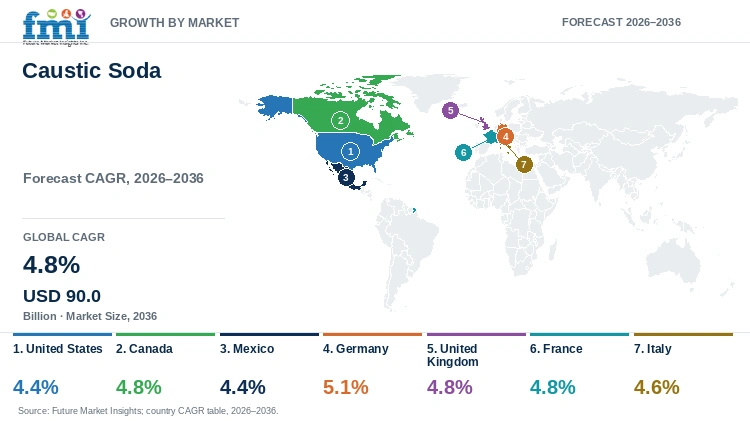
Table 3: Caustic Soda Market Country Growth Forecast
| Country | CAGR, 2026 to 2036 |
|---|---|
| United States | 4.4% |
| Canada | 4.8% |
| Mexico | 4.4% |
| Germany | 5.1% |
| United Kingdom | 4.8% |
| France | 4.8% |
| Italy | 4.6% |
Source: Future Market Insights analysis of the caustic soda market, 2026.
United States
Olin reported third-quarter 2026 results on 29 October 2026. Segment sales in chlor-alkali products and vinyls were USD 850.8 million, against USD 924.0 million a year earlier. Segment earnings fell to USD 71.3 million from USD 127.6 million [1]. Higher pricing, mainly for caustic soda and ethylene dichloride, offset part of the drop [1]. For the fourth quarter, Olin guided adjusted EBITDA to USD 80.0 million to USD 100.0 million [1].
Westlake reported on 4 November 2026 that essential materials net sales were USD 718.0 million, USD 19.0 million lower than a year earlier [2]. The decline came mainly from lower caustic soda sales volume, partly due to plant shutdowns [2]. One of its diaphragm chlor-alkali units at Lake Charles, Louisiana, stopped operating in December 2025. Westlake said selling prices had stabilised, with upward momentum entering the fourth quarter of 2026 [2]. The company said price volatility remains heightened [2].
New supply is coming at the end of the decade. Shintech's Plaquemine expansion adds 310,000 tons a year of caustic soda by the end of 2030 [7]. OxyChem, a top-three US chlor-alkali producer, changed hands on 2 January 2026 [11]. The US Geological Survey says one domestic refinery operated in 2025 [9]. That was a 1.2-million-tonne-a-year plant in Gramercy, Louisiana, while a 500,000-tonne-a-year refinery in Burnside stayed idle [9]. With only one operating refinery, alumina is a smaller domestic outlet than in producing countries such as Australia or China.
Canada
Chemtrade makes caustic soda by the chlor-alkali process at North Vancouver, British Columbia, and has supplied Western Canada and the US Pacific Northwest since the 1950s. It calls pulp and paper a major consumer [12].
On 20 July 2026 the District of North Vancouver gave final adoption to the rezoning bylaw for the facility. Liquid chlorine production may continue until the earlier of the expiry of Chemtrade's prospective lease or 2046 [13]. Chemtrade describes the facility as critical Canadian production of liquid chlorine, caustic soda and hydrochloric acid [13]. The 2046 limit is tied to liquid chlorine only. The release sets no end date for caustic soda, so western buyers have a planning horizon.
Alumina is the other anchor. Canada produced an estimated 1.5 million tonnes of alumina in 2025 [9]. In 2018 Rio Tinto committed C$250.0 million to extend operations at its Vaudreuil refinery in Quebec beyond 2022 [21]. Berkshire Hathaway notes that OxyChem also operates in Canada [11]. Canada supplied 5% of US alumina imports between 2021 and 2024 [9].
Mexico
Orbia's 2025 annual report puts Mexico's caustic soda capacity at about 0.62 million tonnes, with equivalent chlorine capacity [10]. Demand in 2025 was around 0.5 million tonnes of caustic soda. Orbia describes its position as favourable because local production is guaranteed [10].
Orbia operates diaphragm and membrane cells only. About 60% of its Mexican chlorine sales volume is under long-term contracts with prices indexed to North American markets [10]. Orbia says North American chlorine buyers are highly concentrated and often hold multi-year contracts with price ceilings or discounts [10]. Caustic soda is made together with chlorine, so these contracts help keep Mexican plants running and caustic soda available locally.
Orbia names soaps and detergents, cellulose and paper, and water treatment among its customer industries [10]. Capacity sits above demand, so local supply is ample. Because chlorine contracts are indexed to North American markets, US pricing is the reference point for Mexican buyers.
Germany
Covestro supplies 32% caustic soda from its Leverkusen, Dormagen and Uerdingen sites and 50% from Leverkusen, Dormagen and Tarragona [15]. The Tarragona 50% product uses membrane technology with an oxygen-depolarised cathode [15]. Covestro links that cathode design to lower electricity use [15].
On 7 July 2025 Dow announced that it will close its chlor-alkali and vinyl assets at Schkopau. Shutdown is expected in the fourth quarter of 2027, with implementation running from 2026 to 2029 [6]. In Germany, Westlake is closing its Cologne PVC plant [2]. It is also integrating its North American chlorovinyls assets with its Wilhelmshaven vinyls facility [2].
Orbia's vinyl chloride monomer facilities are in Germany. The company says nearly all its European chlorine is used internally for vinyl chloride monomer and derivatives, while caustic soda is sold to third parties [10]. Germany produced an estimated 460,000 tonnes of alumina in 2025, up from 450,000 tonnes in 2024 [9]. The closures reduce regional supply. Buyers served from Schkopau should qualify a second source well before the end of 2027.
United Kingdom
INEOS says its Runcorn operations focus mainly on chlorine, caustic soda and chlorinated derivatives [17]. It also says the site has one of the largest membrane electrolysis units in Europe [17].
On 30 October 2026 INEOS Inovyn completed the acquisition of Vynova Runcorn's remaining 50% of Runcorn MCP Limited. It also took the ethylene dichloride assets and employees at Runcorn [18]. Vynova Runcorn had entered administration in 2025 [18]. The company called the asset the last of its kind in the UK, and said securing it was important to prevent closure [18].
The company says Runcorn supplies around 98% of the chlorine used in drinking water treatment [18]. That gives the site a steady outlet, and caustic soda is made alongside the chlorine. Euro Chlor puts European caustic soda stocks, including the UK, at 198,552 tonnes in July 2026 [4]. That is level with a year earlier, so inventories are not building.
France
Kem One commissioned a new membrane electrolysis hall at Fos-sur-Mer on 24 March 2025. The Elyse project replaced the older diaphragm process. It followed an investment of EUR 200.0 million over three years [20].
The company expects the plan to cut electricity use by 16%, gas use by 36% and emissions by 50,000 tonnes a year [20]. The site makes vinyl chloride monomer, chlorine, caustic soda and low-carbon hydrogen, and about 15,000 tonnes of that hydrogen is made on site [20].
Orbia notes that in Europe caustic soda is largely produced and consumed locally, because transport and storage are costly [10]. Orbia also says integrated producers such as Inovyn, Dow, Covestro and Nobian compete in defined geographic areas [10]. Orbia reports European capacity of 11.9 million tonnes and production of 8 million tonnes in 2025 [10]. Euro Chlor reported European caustic soda stocks of 229,110 tonnes at the end of December 2025, 2,372 tonnes above a year earlier [5]. French plants rebuilt for efficiency are positioned to hold regional customers as higher-cost capacity leaves.
Italy
On 21 April 2026 INEOS Inovyn agreed to sell its shares in Inovyn Produzione Italia, which runs the Rosignano and Tavazzano sites, to Esseco Industrial. Rosignano is Italy's largest domestic chlor-alkali plant, producing caustic soda and chlorine, and Tavazzano makes sodium hypochlorite. Esseco Industrial is the industrial holding company of the Esseco Group [19].
The sale was expected to be completed during 2026, subject to customary regulatory approvals. Until closing, INEOS Inovyn continues to manage both sites with no change to customer or supplier arrangements. Its research activity at Rosignano is carved out of the sale [19].
Italian buyers of caustic soda from Rosignano should confirm how existing contracts transfer to the new owner. European chlorine plants ran at 64.8% of capacity in July 2026 [4]. That figure measures unused chlorine capacity, not caustic soda available to buyers. Negotiating room in those talks depends on the regional caustic balance.
Who are the notable companies in the Caustic Soda Market?
Notable companies in the Caustic Soda Market include Dow, Olin Corporation, Westlake Corporation, OxyChem, Formosa Plastics Corporation, Shin-Etsu Chemical and Grasim Industries.
What a producer does with its chlorine shapes how it competes. Olin, Westlake, Shintech and Orbia run chlor-alkali alongside vinyls, so their caustic soda output follows vinyl operating rates. Olin's Freeport vinyl chloride monomer problems cut third-quarter 2026 profit by USD 32.1 million [1]. Westlake attributed lower caustic soda volume partly to plant shutdowns [2]. Shintech plans a fourth chlor-alkali and vinyl chloride monomer plant at Plaquemine [7]. Westlake says its profitability plan remains on track to deliver USD 600.0 million of EBITDA uplift in 2026 [2]. Orbia combines its chlorine with ethylene to make vinyl chloride monomer, and it also sells by-products of chlorine and caustic soda production [10].
Location and power cost decide who can serve which customer. Orbia says European caustic soda is mostly produced and consumed locally because of transport and storage costs [10]. That explains the effort on European sites. Kem One rebuilt its Fos-sur-Mer electrolysis to cut electricity use [20]. Meanwhile, Dow and Westlake are closing German assets [6][2]. Outside Europe, Olin points to pressure from subsidised Asian exports [1]. Grasim reported a Southeast Asia spot price of USD 483.0 per tonne for the April to June 2026 quarter, up 3% on the year [8]. It also said weaker chlorine realisations moderated the gain in its electrochemical unit realisation of INR 37,955.0 per tonne [8].
Grades and documentation separate the merchant offers. Dow lists 45% and 50% membrane grades and food-grade TRACELIGHT [14]. Covestro sells 32% and 50% grades plus a renewable-energy grade [15]. Formosa Plastics Corporation issues declarations for 25% and 50% membrane grade product [16]. Chemtrade serves western Canada and the US Pacific Northwest from one plant [12]. Grasim reported sales of 284 thousand tonnes of caustic soda in the quarter ended 30 June 2026 [8].
Key Developments in the Caustic Soda Market
- Shin-Etsu announced on 5 March 2026 that Shintech will invest about USD 3.4 billion at Plaquemine, Louisiana [7]. The project adds 310,000 tons a year of caustic soda capacity alongside ethylene and vinyl chloride monomer. Completion is slated toward the end of 2030 [7].
- Berkshire Hathaway completed its USD 9.7 billion acquisition of OxyChem on 2 January 2026 [11]. OxyChem is a top-three US producer of chlor-alkali, and Wade Alleman continues as president and chief executive [11].
- On 29 October 2026, Olin reported third-quarter results. The all-stock Huntsman merger, agreed on 16 June 2026, has shareholder approval and an expired HSR waiting period [1]. Closing is expected in the first quarter of 2027, subject to remaining regulatory approvals [1].
- On 30 October 2026, INEOS Inovyn completed its acquisition of the remaining 50% of Runcorn MCP Limited. It also acquired the ethylene dichloride assets at Runcorn [18]. The deal brings the chlor-alkali and ethylene dichloride chain under one owner [18].
Key Players in the Caustic Soda Market
- Dow
- Olin Corporation
- Westlake Corporation
- OxyChem
- Formosa Plastics Corporation
- Shin-Etsu Chemical Co., Ltd.
- Grasim Industries Limited
- Covestro
- INEOS Inovyn
- Orbia
Caustic Soda Market Report Scope
Table 4: Caustic Soda Market Report Scope
| Coverage field | Report scope |
|---|---|
| Market definition | Caustic soda (sodium hydroxide) produced by chlor-alkali electrolysis, measured by value of sales to end-use applications |
| Application | Alumina, Inorganic Chemicals, Organic Chemicals, Food, Paper & Pulp, Soaps & Detergents and Textiles |
| Regions and profiled countries | North America and Europe (United States, Canada, Mexico, Germany, United Kingdom, France, Italy) |
| Companies covered | Dow, Olin Corporation, Westlake Corporation, OxyChem, Formosa Plastics Corporation, Shin-Etsu Chemical Co., Ltd., Grasim Industries Limited, Covestro, INEOS Inovyn and Orbia |
| Forecast period | 2026 to 2036, with 2025 as the historical base year |
| Quantitative Units | USD billion |
Source: Future Market Insights analysis of the caustic soda market, 2026.
Caustic Soda Market by Segments
Caustic Soda Market segmented by Application:
- Alumina
- Inorganic Chemicals
- Organic Chemicals
- Food, Paper & Pulp
- Soaps & Detergents
- Textiles
Caustic Soda Market by Region
- North America
- Europe
- United States
- Canada
- Mexico
- Germany
- United Kingdom
- France
- Italy
Research Sources and Bibliography
- [1] Olin Corporation. (2026, October 29). Olin Announces Third Quarter 2026 Results (Form 8-K, Exhibit 99.1). https://www.sec.gov/Archives/edgar/data/0000074303/000007430326000091/exhibit991q32026earningspr.htm
- [2] Westlake Corporation. (2026, November 4). Third quarter 2026 earnings release (Form 8-K, Exhibit 99.1). https://www.sec.gov/Archives/edgar/data/0001262823/000126282326000076/ex991_20260930earningsrele.htm
- [3] Alcoa Corporation. (2026, October 15). Third Quarter 2026 Results (Form 8-K, Exhibit 99.1). https://www.sec.gov/Archives/edgar/data/0001675149/000119312526422891/aa-ex99_1.htm
- [4] Euro Chlor. (2026, September 2). July 2026 Chlorine production. https://eurochlor.org/?p=6799
- [5] Euro Chlor. (2026, February 20). December 2025 Chlorine production. https://eurochlor.org/news/december-2025-chlorine-production/
- [6] Dow Inc. (2025, July 7). Dow will shut down three upstream European assets in response to structural challenges in the region. https://corporate.dow.com/en-us/news/press-releases/dow-will-shut-down-three-upstream-european-assets-in-response-to.html
- [7] Shin-Etsu Chemical Co., Ltd. (2026, March 5). Shintech Announces Capital Investment of $3.4 Billion to Bolster PVC and Caustic Soda Business. https://www.shinetsu.co.jp/en/news/news-release/shintech-announces-capital-investment-of-3-4-billion-to-bolster-pvc-and-caustic-soda-business/
- [8] Grasim Industries Limited. (2026, August 12). Grasim Q1 FY27 Financial Results. https://www.grasim.com/media/press-releases/grasim-results-q1fy-2026-27
- [9] U.S. Geological Survey. (2026, February). Bauxite and Alumina, Mineral Commodity Summaries 2026. https://pubs.usgs.gov/periodicals/mcs2026/mcs2026-bauxite-alumina.pdf
- [10] Orbia Advance Corporation, S.A.B. de C.V. (2026). Annual Report 2025, for the year ending 31 December 2025. https://www.orbia.com/498d7a/siteassets/5.-investor-relations/annual-reports/2025-annual-report/annual-report-2025.pdf
- [11] Dallas Innovates. (2026, January 5). Berkshire Hathaway Completes $9.7B Acquisition of North Texas-Based OxyChem. https://dallasinnovates.com/berkshire-hathaway-completes-9-7b-acquisition-of-dallas-based-oxychem/
- [12] Chemtrade Logistics Inc. (n.d.). Caustic Soda. https://www.chemtradelogistics.com/product/caustic-soda/
- [13] Chemtrade Logistics Inc. (2026, July 21). Chemtrade Logistics Announces Successful Final Adoption of Rezoning Application for the North Vancouver Chlor-Alkali Facility. https://www.chemtradelogistics.com/news/chemtrade-logistics-announces-successful-final-adoption-of-rezoning-application-for-the-north-vancouver-chlor-alkali-facility/
- [14] Dow. (n.d.). Premium Chlor-Alkali Additives and Caustic Solutions. https://www.dow.com/en-us/product-technology/pt-additives-modifiers/pg-additives-chlor-alkali.html
- [15] Covestro. (n.d.). Caustic soda. https://solutions.covestro.com/en/brands/caustic-soda
- [16] Formosa Plastics Corporation, U.S.A. (2023, January 26). Product General Declarations, Caustic Soda, Membrane Grade 25%, 50%. https://www.fpcusa.com/content/uploads/2023/01/CausticSodaGeneralDeclaration.pdf
- [17] INEOS. (n.d.). Runcorn site. https://www.ineos.com/sites/runcorn/
- [18] Hydrocarbon Processing. (2026, November 3). INEOS Inovyn completes acquisition of UK's only ethylene dichloride asset. https://hydrocarbonprocessing.com/news/2026/11/ineos-inovyn-completes-acquisition-of-uks-only-ethylene-dichloride-asset/
- [19] CHEManager. (2026, April 21). Ineos Inovyn to sell its Italian chlor-alkali business to Esseco Industrial. https://www.chemanager-online.com/en/news/ineos-inovyn-to-sell-its-italian-chlor-alkali-business-to-esseco-industrial
- [20] L'Usine Nouvelle. (2025, March 26). Kem One met en service sa nouvelle salle d'electrolyse a Fos-sur-Mer. https://www.usinenouvelle.com/article/kem-one-met-en-service-sa-nouvelle-salle-d-electrolyse-a-fos-sur-mer.N2229500
- [21] Rio Tinto. (2018, February 12). Vaudreuil refinery extension investment. https://www.riotinto.com/en/can/news/releases/vaudreuil-refinery-extension-investment
- [22] International Aluminium Institute. (n.d.). Refining: Refining Process. https://alustory.international-aluminium.org/?p=374
- [23] International Aluminium Institute. (n.d.). Material flows in aluminium refining. https://alustory.international-aluminium.org/?p=1919
- [24] Euro Chlor. (n.d.). Our industry. https://eurochlor.org/industry/
Table of Content
Table of Content
- Key Takeaways
- Market Size and CAGR
- Top Growth Driver
- Fastest Growing Segment
- Leading Region
- Key Companies
- Emerging Opportunities
- Executive Summary
- Global Market Outlook
- Demand-side Trends
- Supply-side Trends
- Technology Roadmap Analysis
- Analysis and Recommendations
- Analyst Perspective (What is happening? Why now? What should investors know?)
- Key Questions Answered
- How large is the market?
- What is the CAGR?
- What are key trends?
- Which region dominates?
- Who are the leaders?
Read More...
- Market Overview
- Market Coverage / Taxonomy
- Market Definition / Scope / Limitations
- Research Methodology
- Chapter Orientation
- Analytical Lens and Working Hypotheses
- Market Structure, Signals, and Trend Drivers
- Benchmarking and Cross-market Comparability
- Market Sizing, Forecasting, and Opportunity Mapping
- Research Design and Evidence Framework
- Desk Research Programme (Secondary Evidence)
- Expert Input and Fieldwork (Primary Evidence)
- Tooling, Models, and Reference Databases
- Data Engineering and Model Build
- Quality Assurance and Audit Trail
- Market Background
- Market Dynamics (Drivers, Restraints, Opportunity, Trends)
- Scenario Forecast (Optimistic, Likely, Conservative)
- Impact Analysis
- AI Impact
- Sustainability Impact
- Regulatory Impact
- Technology Impact
- Consumer / Buyer Analysis
- Purchase Drivers
- Adoption Barriers
- Buyer Journey
- Opportunity Map Analysis
- Product Life Cycle Analysis
- Supply Chain Analysis
- Investment Feasibility Matrix
- Value Chain Analysis
- PESTLE and Porter's Analysis
- Regulatory Landscape
- Regional Parent Market Outlook
- Production and Consumption Statistics
- Import and Export Statistics
- Global Market Analysis and Forecast, 2021 to 2036
- Historical Market Size Value (USD Billion) Analysis, 2021 to 2025
- Current and Future Market Size Value (USD Billion) Projections, 2026 to 2036
- Y-o-Y Growth Trend Analysis
- Absolute $ Opportunity Analysis
- Global Market Pricing Analysis, 2021 to 2036
- Global Market Analysis and Forecast, By Application, 2021 to 2036
- Introduction / Key Findings
- Historical Market Size Value (USD Billion) Analysis By Application, 2021 to 2025
- Current and Future Market Size Value (USD Billion) Analysis and Forecast By Application, 2026 to 2036
- Alumina
- Inorganic Chemicals
- Organic Chemicals
- Food, Paper & Pulp
- Soaps & Detergents
- Textiles
- Y-o-Y Growth Trend Analysis By Application, 2021 to 2025
- Absolute $ Opportunity Analysis By Application, 2026 to 2036
- Global Market Analysis and Forecast, By Region, 2021 to 2036
- Introduction
- Historical Market Size Value (USD Billion) Analysis By Region, 2021 to 2025
- Current Market Size Value (USD Billion) Analysis and Forecast By Region, 2026 to 2036
- North America
- Europe
- Market Attractiveness Analysis By Region
- North America Market Analysis and Forecast, By Country, 2021 to 2036
- Historical Market Size Value (USD Billion) Trend Analysis By Market Taxonomy, 2021 to 2025
- Market Size Value (USD Billion) Forecast By Market Taxonomy, 2026 to 2036
- By Country
- By Application
- Market Attractiveness Analysis
- By Country
- By Application
- Key Takeaways
- Europe Market Analysis and Forecast, By Country
- Historical Market Size Value (USD Billion) Trend Analysis By Market Taxonomy, 2021 to 2025
- Market Size Value (USD Billion) Forecast By Market Taxonomy, 2026 to 2036
- By Country
- United States
- Canada
- Mexico
- Germany
- United Kingdom
- France
- Italy
- By Application
- By Country
- Market Attractiveness Analysis
- By Country
- By Application
- Key Takeaways
- Key Countries Market Analysis
- United States
- Pricing Analysis
- Market Share Analysis, 2025
- By Application
- Canada
- Pricing Analysis
- Market Share Analysis, 2025
- By Application
- Mexico
- Pricing Analysis
- Market Share Analysis, 2025
- By Application
- Germany
- Pricing Analysis
- Market Share Analysis, 2025
- By Application
- United Kingdom
- Pricing Analysis
- Market Share Analysis, 2025
- By Application
- Italy
- Pricing Analysis
- Market Share Analysis, 2025
- By Application
- France
- Pricing Analysis
- Market Share Analysis, 2025
- By Application
- United States
- Market Structure Analysis
- Competition Dashboard
- Competition Benchmarking
- Market Share Analysis of Top Players
- By Regional
- By Application
- Emerging Startups
- Innovation Benchmarking
- Competition Analysis
- Competition Deep Dive
- Dow
- Overview
- Product Portfolio
- Profitability by Market Segments
- Sales Footprint
- Strategy Overview
- Marketing Strategy
- Product Strategy
- Channel Strategy
- Olin Corporation
- Westlake Corporation
- OxyChem
- Formosa Plastics Corporation
- Shin-Etsu Chemical Co., Ltd.
- Grasim Industries Limited
- Covestro
- INEOS Inovyn
- Orbia
- Dow
- Case Studies
- Success Stories
- Recent Developments
- Competition Deep Dive
- Assumptions & Acronyms Used
List of Tables
- Table 1: Global Market Value (USD Billion) Forecast by Region, 2021 to 2036
- Table 2: Global Market Value (USD Billion) Forecast by Application, 2021 to 2036
- Table 3: North America Market Value (USD Billion) Forecast by Country, 2021 to 2036
- Table 4: North America Market Value (USD Billion) Forecast by Application, 2021 to 2036
- Table 5: Europe Market Value (USD Billion) Forecast by Country, 2021 to 2036
- Table 6: Europe Market Value (USD Billion) Forecast by Application, 2021 to 2036
List of Figures
- Figure 1: Global Market Pricing Analysis
- Figure 2: Global Market Value (USD Billion) Forecast 2021-2036
- Figure 3: Global Market Value Share and BPS Analysis by Application, 2026 and 2036
- Figure 4: Global Market Y-o-Y Growth Comparison by Application, 2026-2036
- Figure 5: Global Market Attractiveness Analysis by Application
- Figure 6: Global Market Value (USD Billion) Share and BPS Analysis by Region, 2026 and 2036
- Figure 7: Global Market Y-o-Y Growth Comparison by Region, 2026-2036
- Figure 8: Global Market Attractiveness Analysis by Region
- Figure 9: North America Market Incremental Dollar Opportunity, 2026-2036
- Figure 10: Europe Market Incremental Dollar Opportunity, 2026-2036
- Figure 11: North America Market Value Share and BPS Analysis by Country, 2026 and 2036
- Figure 12: North America Market Value Share and BPS Analysis by Application, 2026 and 2036
- Figure 13: North America Market Y-o-Y Growth Comparison by Application, 2026-2036
- Figure 14: North America Market Attractiveness Analysis by Application
- Figure 15: Europe Market Value Share and BPS Analysis by Country, 2026 and 2036
- Figure 16: Europe Market Value Share and BPS Analysis by Application, 2026 and 2036
- Figure 17: Europe Market Y-o-Y Growth Comparison by Application, 2026-2036
- Figure 18: Europe Market Attractiveness Analysis by Application
- Figure 19: Global Market - Tier Structure Analysis
- Figure 20: Global Market - Company Share Analysis
Frequently Asked Questions
How big is the caustic soda market in 2026?
The Caustic Soda Market is estimated at USD 56.3 billion in 2026, up from USD 53.7 billion in 2025. It is projected to reach USD 90.0 billion by 2036, a 4.8% CAGR from 2026 to 2036.
Which application leads the caustic soda market?
Alumina leads with 34.0% of the market in 2026. Refiners use caustic soda to dissolve bauxite in the Bayer process [22]. The International Aluminium Institute gives a global average of about 100 kilograms per tonne of alumina [23]. World alumina output was an estimated 150 million tonnes in 2025, with China at 93 million tonnes [9].
Which other applications matter?
Inorganic Chemicals hold 20.0%, Organic Chemicals 15.0%, Food, Paper & Pulp 12.0%, Soaps & Detergents 10.0% and Textiles 9.0%. Orbia's demand sectors include vinyls, alumina, inorganic and organic chemicals, and pulp and paper [10].
Which profiled country is forecast to grow fastest?
Germany has the highest forecast CAGR of the seven profiled countries, at 5.1% from 2026 to 2036. Canada, the United Kingdom and France follow at 4.8% each. The fastest-growing market still faces a closure: Dow plans to shut its Schkopau assets in the fourth quarter of 2027 [6]. Covestro supplies 32% caustic soda from its Leverkusen, Dormagen and Uerdingen sites [15].
What permits and policy items are affecting supply?
In the United States, Olin booked a USD 5.0 million benefit from the Section 45V clean hydrogen production credit in the third quarter of 2026. The year-earlier figure was USD 32.0 million [1]. In Canada, the District of North Vancouver gave final adoption on 20 July 2026 to a rezoning bylaw for Chemtrade's chlor-alkali facility [13]. The bylaw allows liquid chlorine production until the earlier of the prospective lease expiry or 2046 [13].
What should a buyer check when choosing a grade?
Check concentration and impurity limits first. Dow lists 45% and 50% membrane technical grades with chlorate below 60 ppm [14]. Its food-grade TRACELIGHT carries chlorate under 5 ppm [14]. Covestro lists 32% (31 to 33% by weight) and 50% (49 to 51%) [15]. Formosa Plastics Corporation issues declarations for 25% and 50% membrane grade [16]. Then confirm the supply site, since several European plants are closing or changing owner [6][19].
Preview the report firsthand - request a free sample
Get SampleGet the brochure for pricing and purchase details.
Get PDF
