

- Market Size (2026)
- USD 1860.7 Mn
- Forecast (2036)
- USD 4445.5 Mn
- CAGR (2026 to 2036)
- 9.1%
How big is the Chassis Motion Control Units Market?
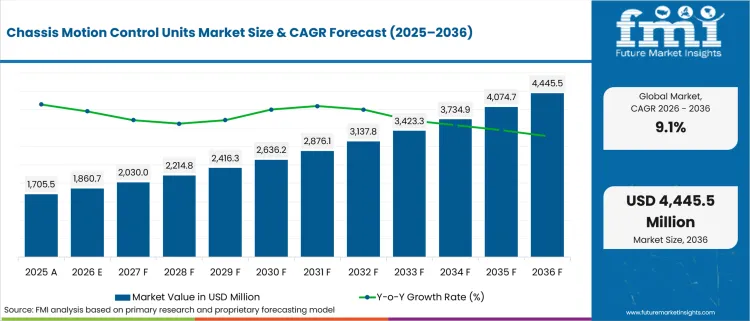
USD 1,860.7 million in 2026 and USD 4,445.5 million by 2036 at a 9.1% CAGR.
The chassis motion control units are shifting into the layer decidign how a vehicle feels on the road. A driver may press the brake pedal while the vehicle also manages wheel torque and body movement at the same moment. EV platforms make this work harder since instant motor response can disturb stability before a conventional chassis ECU reacts. Global electric car production reached nearly 22 million units in 2025, rising by more than 25% from the previous year, expanding the base of vehicles requiring coordinated brake and torque response.
Integrated controllers address the issue by linking brake control with steering decisions through one validated software path. Damping control helps keep the body settled during cornering and braking. Supplier selection now favors proven calibration teams. Actuator knowledge and software safety depth also influence launch decisions. NHTSA’s 2024 final rule requires automatic emergency braking on passenger cars and light trucks by September 2029, with systems required to avoid contact with a lead vehicle at speeds up to 62 mph and apply braking automatically at speeds up to 90 mph when a crash is imminent. The rule also requires pedestrian automatic emergency braking up to 45 mph and is projected to save at least 360 lives and prevent at least 24,000 injuries each year, making verified braking response more important for chassis control programs.
Bosch describes vehicle motion management as software that integrates braking, steering, powertrain, and suspension into one control approach. ZF cubiX software coordinates active and semi-active actuators through one control algorithm. The buyer case is no longer limited to one ECU. It is about proving one motion path can control ride feel and stability without adding launch risk. ACEA reported plug-in hybrid car registrations reached 1,015,887 units in the European Union during 2025, adding mixed-powertrain complexity to chassis control decisions.
| Metric | Value |
|---|---|
| 2025 Market Size | USD 1,705.5 million |
| 2026 Market Size | USD 1,860.7 million |
| 2036 Market Size | USD 4,445.5 million |
| Forecast CAGR (2026-2036) | 9.1% |
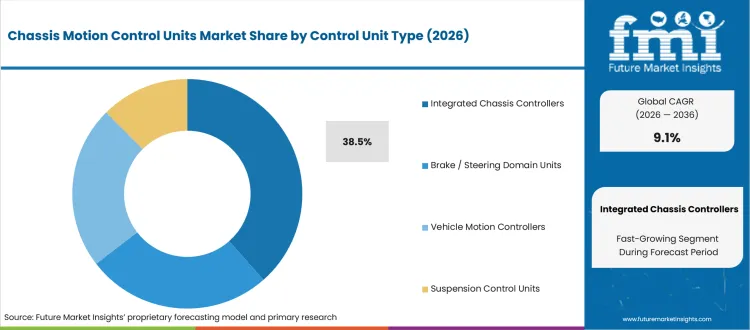
| Leading Control Unit Type | Integrated Chassis Controllers |
| Integrated Chassis Controllers Share (2026) | 38.5% |
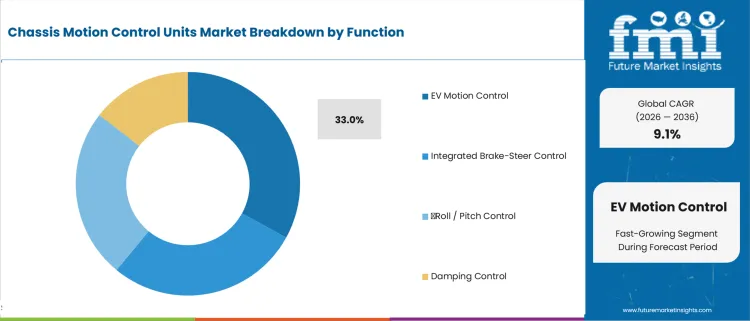
| Leading Function | EV Motion Control |
| EV Motion Control Share (2026) | 33.0% |
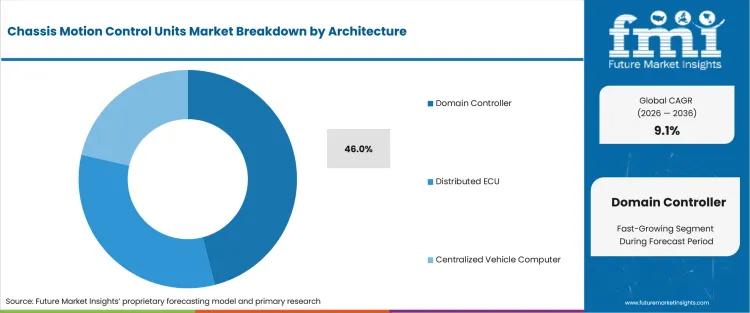
| Leading Architecture | Domain Controller |
| Domain Controller Share (2026) | 46.0% |
| Fastest-growing Country | China |
| China CAGR by 2036 | 11.2% |
Summary of the Chassis Motion Control Units Market
| Market Signal | Commercial Impact |
|---|---|
| Demand and Growth Drivers | Demand for chassis motion control units is increasing as electric vehicle platforms, domain-controller architectures, and advanced safety systems require integrated software to coordinate braking, steering, suspension, and torque management.
|
| Product and Segment View | EV motion control, integrated chassis controllers, and domain-controller architectures continue to represent the leading commercial opportunities across the market.
|
| Geography and Growth Outlook | Asia and Europe continue to lead market expansion as electric vehicle production, software-defined vehicles, and advanced chassis technologies gain momentum.
|
| Competitive Landscape | Competition increasingly focuses on integrated chassis software, actuator expertise, and long-term OEM development partnerships.
|
| Analyst Perspective | Chassis motion control units are evolving into the central intelligence layer that governs vehicle dynamics, safety, and driving characteristics across next-generation electric vehicles.
- Nikhil Kaitwade, Principal Consultant at Future Market Insights |
How is the Chassis Motion Control Units Market segmented?
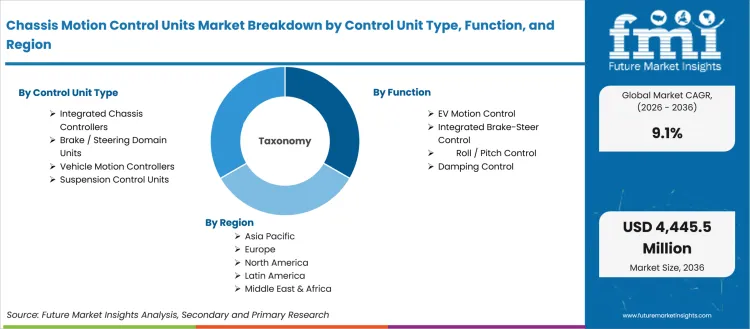
Chassis motion control units industry is segmented by control unit type, function, vehicle type, architecture, sales channel, and region.
The chassis motion control units market is segmented by control unit type, function, vehicle type, architecture, sales channel, and region. By control unit type, demand covers suspension control units, integrated chassis controllers, brake / steering domain units, and vehicle motion controllers. By function, applications include damping control, roll / pitch control, integrated brake-steer control, and EV motion control. By vehicle type, demand comes from premium passenger cars, EVs, SUVs / crossovers, and commercial vehicles. By architecture, demand is divided into distributed ECU, domain controller, and centralized vehicle computer. By sales channel, demand includes OEM and Tier-1 integrated supply, with regional coverage across North America, Latin America, Europe, East Asia, South Asia and Pacific, and Middle East Africa.
Why do Integrated Chassis Controllers lead the control unit type segment?
Automakers used to evaluate suspension, steering, and brake controllers through separate engineering teams. EV and software-defined vehicle programs make that separation harder to maintain. A tuning change in braking can affect body movement and steering response, so integrated control becomes a platform decision rather than a component choice. Bosch notes that current E/E architectures can include one hundred control units or more, which explains why OEMs are moving toward fewer control paths.
- Integrated Chassis Controllers are projected to account for 38.5% share in 2026 with OEMs seeking one controller that can align damping and braking commands with steering response before vehicle behavior feels inconsistent to the driver. NHTSA’s automatic emergency braking standard requires vehicles to stop and avoid contact with a lead vehicle at speeds up to 62 mph, which makes coordinated braking response harder to separate from chassis behavior.
- Executive value comes from fewer handoffs inside the chassis control stack. A single integrated controller can reduce calibration conflict, support shared safety cases, and help platform teams create consistent ride character across several vehicle trims. NXP’s S32N55 processor can deliver nearly 20K DMIPS in full lockstep ASIL D mode, showing why real-time safety compute is becoming central to integrated vehicle control.
Why does EV Motion Control matter within the function segment?
EV motion control demand is linked to the way electric motors deliver torque. Regenerative braking must work with stability control and friction brakes. Weak calibration can make the vehicle feel inconsistent during traffic stops, downhill braking, or quick acceleration. IEA reported that battery-electric cars represented 65% of total electric car sales in 2025, which raises demand for motion software that can manage electric torque without disturbing driver confidence.
- EV Motion Control is expected to represent 33.0% share in 2026 since electric axles create faster torque changes than combustion platforms and need closer coordination between stability control and brake blending. IEA reported more than 13 million electric cars were sold in China in 2025, accounting for six out of ten electric cars sold worldwide.
- Brake feel carries commercial weight in EV programs. Motion software must split deceleration between regenerative torque and friction brakes while maintaining predictable pedal response during city driving and highway braking. IEA estimated that electrified cars made up about 5% of global car stock in 2025, displacing 1.2 million barrels of oil per day and showing how regenerative braking is entering a larger vehicle base.
How do buyers evaluate Domain Controller architecture?
Domain controller buying starts with architecture. OEMs want fewer compute nodes, yet the remaining unit must handle more safety responsibility. A chassis domain unit has to process signals across actuators and document fallback behavior before launch approval. NXP’s S32N55 includes 48 MB of platform SRAM, which supports low-latency execution for multiple real-time vehicle functions.
- Domain Controller architecture is forecast to hold 46.0% share in 2026, supported by OEM plans that move chassis decisions into fewer compute nodes instead of maintaining several isolated ECUs. NXP describes the S32N55 as combining high-performance real-time processing with an integrated multiport TSN Ethernet switch, giving vehicle computers a stronger base for consolidated chassis communication.
- Validation becomes the main buying test. A domain controller must prove safe fallback behavior across steering and braking while also managing damping, sensors, networks, and software updates before production approval. NXP’s S32N55 uses 2 auxiliary pairs of lockstep Cortex-M7 cores for system and communication management, which shows why safety supervision is built into new controller designs.
What market factors influence demand from Premium Passenger Cars?
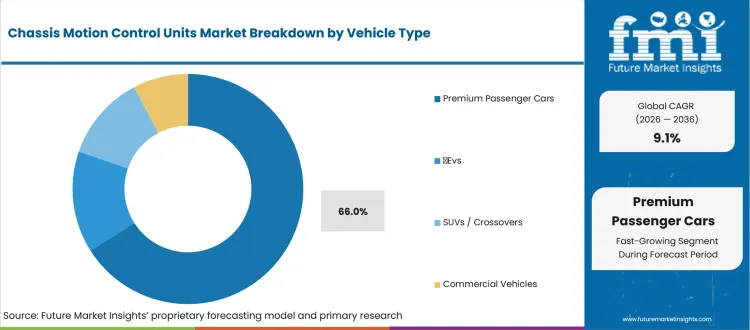
Premium passenger car demand is driven by ride quality expectations. Buyers in high-end trims notice body movement and braking smoothness more quickly. OEMs can turn motion-control tuning into a feature package once comfort and stability feel consistent. EPA reported that trucks accounted for 66% of all new vehicles under NHTSA regulatory classification in model year 2024, which keeps body-control and ride-management requirements high across larger passenger platforms.
- Premium Passenger Cars are set to command 66.0% of vehicle type demand in 2026, reflecting early use of active damping and motion software in high-end platforms that sell ride feel as a trim-level benefit. EPA reported that truck SUVs alone accounted for half of all new vehicle production in model year 2024, which strengthens the need for roll control and chassis tuning.
- High-end buyers make controller content easier to recover through vehicle pricing. OEMs can package comfort modes, body-control tuning, and stability features without treating the control unit as a standalone cost item. EPA reported that excluding BEVs and PHEVs would lower average model year 2024 vehicle power by 13 hp, weight by 72 pounds, and footprint by 0.1 square feet, showing how electrified high-content vehicles affect chassis calibration.
How is OEM positioned within the sales channel segment?
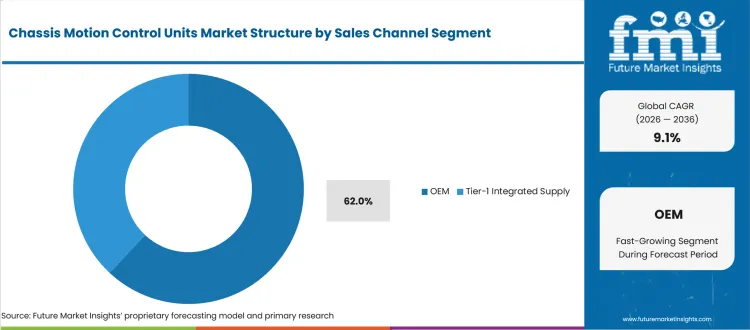
OEM sourcing dominates because motion control is not a late-stage accessory. Software behavior has to be tuned during platform development and then validated with actuator maps, safety cases, and road-test feedback. OICA reported that global vehicle production reached 96.4 million units in 2025, creating a large program base for OEM-level controller sourcing.
- OEM is estimated to account for 62.0% share in 2026, reflecting the need to tune motion control software inside vehicle-development cycles rather than after platform launch. Bosch Mobility generated 55.8 billion euros in sales during 2024, showing the scale of supplier programs that OEMs use for chassis and software sourcing.
- Tier-1 integrated supply remains commercially important for calibration and actuator maps. OEM teams often buy controller hardware with engineering support, safety documentation, and launch validation instead of sourcing isolated electronic modules. Bosch Mobility operates at more than 300 locations in around 66 countries, giving OEMs a global engineering and service base for complex controller programs.
What are the drivers, restraints, and opportunities in the Chassis Motion Control Units Market?
Near-term purchases are being shaped by the vehicle-platform requirement and software expansion route outlined below. OICA reported that China produced 34.53 million vehicles in 2025, while new-energy vehicle production reached 16.626 million units, creating a direct platform base for brake blending and torque-control integration.
- Driver: EV platform programs drive spending when OEMs need brake blending, torque allocation, and damping control to feel consistent across trims. IEA reported European electric car sales reached 4.2 million units in 2025, equal to 28% of new car sales, which expands the platform base needing coordinated motion software.
- Restraint: Validation complexity restrains adoption when one controller must prove safe fallback behavior across several actuators and networks. NHTSA’s AEB standard requires automatic braking at speeds up to 90 mph when a collision with a lead vehicle is imminent, which raises the safety proof burden for brake-linked control systems.
- Opportunity: Domain controller migration opens an opportunity for suppliers that can combine software and calibration support. NXP’s S32N55 integrates 16 split-lock Arm Cortex-R52 cores operating up to 1.2 GHz, giving suppliers a real-time compute base for consolidated vehicle functions.
Motion-control demand grows when OEMs treat vehicle behavior as a software-managed feature. EV platforms give controllers more work as torque response and regenerative braking affect ride feel in real time. IEA reported nearly 22 million electric cars were produced globally in 2025, up more than 25% from the prior year, which expands the number of platforms needing stable brake blending and body control.
Integrated control creates value, yet it raises documentation burden. A shared chassis controller must show how braking and sensor faults are handled before production release. NHTSA projects the automatic emergency braking standard will save at least 360 lives and prevent at least 24,000 injuries each year, which keeps safety evidence central to controller approval.
Software expansion creates room for post-launch feature improvement. Domain controllers can support updates that tune ride modes and stability behavior across vehicle trims. Bosch Mobility has more than 59,700 employees in research and development and 68 development sites, giving software-led suppliers the engineering base needed for lifecycle controller support.
Which country CAGRs are profiled in the Chassis Motion Control Units Market?
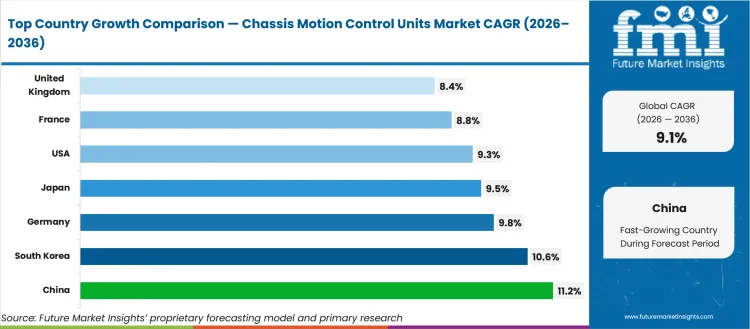
| Country | CAGR |
|---|---|
| China | 11.2% |
| South Korea | 10.6% |
| Germany | 9.8% |
| Japan | 9.5% |
| United States | 9.3% |
| France | 8.8% |
| United Kingdom | 8.4% |
| India | 8.1% |
Source: Future Market Insights analysis, 2026.
How do country-level CAGRs compare in the Chassis Motion Control Units Market?
Country growth in chassis motion control units should be read through the vehicle-platform pressure behind coordinated motion control. China and South Korea show stronger adoption paths since EV platforms and electronics depth support early controller integration. Germany and Japan remain important through supplier engineering and precision vehicle programs. The United States and Western Europe connect demand with heavier vehicles and electrified platforms. India has a different trigger as local vehicle scale and chassis electronics localization create gradual adoption room. OICA reported Asia-Pacific vehicle production reached around 59.2 million units in 2025, representing more than 61% of global output, which explains why chassis electronics sourcing is shifting toward Asia-led platform programs.
- China is forecast to record an estimated 11.2% CAGR from 2026 to 2036, supported by EV model volume and local controller software programs. IEA reported China accounted for nearly 55% electric car sales share in 2025, making brake blending and wheel-torque control a practical engineering requirement across more vehicle lines.
- South Korea is projected to post an estimated 10.6% CAGR by 2036, led by electronics capability and export-oriented vehicle platforms. Korea’s trade ministry reported automobile exports reached USD 6.4 billion in March 2026, with eco-friendly vehicle gains helping offset logistics pressure and keeping controller demand linked to higher-value electrified models.
- Germany is anticipated to register an estimated 9.8% CAGR during the forecast period, reflecting supplier depth across chassis systems and high-end OEM programs. ACEA reported Germany’s battery-electric car registrations rose 43.2% in 2025, giving controller suppliers a larger electrified platform base for brake-steer and damping coordination.
- Japan is expected to advance at an estimated 9.5% CAGR through 2036, supported by precision vehicle engineering and supplier focus on cross-domain control. JAMA reported auto-related employment totaled 5.59 million people in its 2025 motor industry review, showing why vehicle control and engineering knowledge remain tightly connected in Japan.
- United States is estimated to expand at 9.3% CAGR from 2026 to 2036, helped by EV trucks and heavier passenger vehicles that need better body and stability control. EPA reported average new vehicle weight in model year 2024 at 4,354 pounds, which keeps controller attention on damping and roll management.
- France is projected to record an estimated 8.8% CAGR by 2036, supported by selective electrified platform programs and European safety expectations. The European Alternative Fuels Observatory reported 363,130 battery-electric vehicles registered in France in 2025, giving chassis-control suppliers a measured opening for EV motion software and brake blending.
- United Kingdom is forecast to grow at an estimated 8.4% CAGR through 2036, shaped by premium vehicle engineering and pressure to improve EV adoption economics. SMMT reported the UK new car market rose 3.4% in January 2026 to 144,127 units, while its outlook expected EV share to reach 28.5% during 2026.
- India is set to record an estimated 8.1% CAGR by 2036, linked to EV crossovers and gradual localization of chassis electronics. SIAM reported passenger vehicle sales of 43,01,848 units during April 2024 to March 2025, giving suppliers a large addressable base for premium trims and EV programs.
Who are the notable companies in the Chassis Motion Control Units Market?
Bosch, ZF, AUMOVIO, Astemo, Denso, HL Mando, Schaeffler, Aptiv, Magna, and Hyundai Mobis are the notable companies shaping this market.
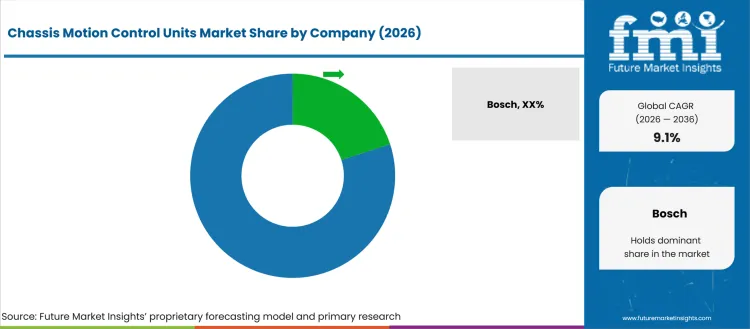
Competition in the chassis motion control units market is best understood by the control point OEMs want to own. Bosch, ZF, AUMOVIO, Astemo, and Denso are stronger when the question is safety-controlled vehicle motion. HL Mando, Hyundai Mobis, Magna, Schaeffler, and Aptiv are important when controller software is tied to braking systems and platform electronics.
- Bosch is well placed in programs that require brake and suspension coordination inside one motion-management layer. Its position is commercially useful for OEMs that want vehicle behavior software and safety validation support from one supplier group.
- ZF has a clear role in vehicle motion control through cubiX and its wider actuator portfolio. Buyers can use ZF capabilities to connect active and semi-active chassis functions without treating each actuator as a separate tuning problem.
- AUMOVIO, Astemo, and Denso compete through chassis electronics and SDV-linked vehicle control. Portfolio strength is clearest in programs that need motion control to connect with safety and platform software decisions.
- HL Mando, Schaeffler, Aptiv, Magna, and Hyundai Mobis support demand through software modules and OEM program relationships. Supplier wins are more likely in programs that bundle motion control with engineering support and validated actuator packages.
Competitive Benchmarking: Chassis Motion Control Units Market
| Company | Vehicle Motion Software Depth | Actuator System Coverage | Safety Validation Capability | Geographic Footprint |
|---|---|---|---|---|
| Bosch | High | High | High | Global |
| ZF | High | High | High | Global |
| AUMOVIO | High | Strong | High | Global |
| Astemo | Strong | High | Strong | Global |
| Denso | Medium | Strong | High | Global |
| HL Mando | Strong | Strong | Medium | Asia and Global |
| Schaeffler | Medium | Strong | Medium | Global |
| Aptiv | Medium | Medium | Strong | Global |
| Magna | Medium | Strong | Medium | Global |
| Hyundai Mobis | Strong | Strong | Medium | Asia and Global |
Source: Future Market Insights competitive analysis, 2026.
Key Developments in the Chassis Motion Control Units Market
- In June 2026, Schaeffler and Sonatus announced an Edge AI motion-control partnership for software-defined vehicles. Schaeffler control units will integrate Sonatus Collector AI and Sonatus AI Director, creating a direct link between motion-control hardware and embedded intelligence for OEM programs.
- In May 2025, Astemo announced Automotive Engineering Exposition 2025 exhibits covering IoV, AD/ADAS, e-powertrain, advanced chassis, and cross-domain control linking four domains. The announcement directly connects chassis control with SDV architecture and vehicle behavior management.
- In April 2026, Bosch Limited announced plans to acquire 100% of Bosch Chassis Systems India Private Limited through a cash transaction and equity issuance. The move strengthens Bosch Limited’s vehicle motion portfolio in India and improves local chassis-system capability for future vehicle platforms.
Key Players in the Chassis Motion Control Units Market
Vehicle Motion Software and Chassis System Suppliers
- Bosch
- ZF
- AUMOVIO
- Astemo
- Denso
- HL Mando
Automotive Electronics and Controller Suppliers
- Schaeffler
- Aptiv
- Hyundai Mobis
Integrated Vehicle System Suppliers
- Magna
Chassis Motion Control Units Market - Report Scope
| Coverage field | Report scope |
|---|---|
| Market breakdown | Chassis Motion Control Units Market Breakdown By Control Unit Type, Function, Vehicle Type, Architecture, Sales Channel, and Region |
| Market Definition | Electronic control units and software-enabled controllers that coordinate vehicle motion through braking, steering, suspension, and powertrain inputs |
| Regions Covered | North America, Latin America, Europe, East Asia, South Asia and Pacific, Middle East and Africa |
| Countries Covered | United States, United Kingdom, Germany, France, Japan, China, South Korea, India and 30+ countries |
| Key Companies Profiled | Bosch, ZF, AUMOVIO, Astemo, Denso, HL Mando, Schaeffler, Aptiv, Magna, Hyundai Mobis |
| Forecast Period | 2026 to 2036 |
| Approach | Hybrid bottom-up and top-down methodology using platform fitment, controller pricing, vehicle production, architecture mix, and supplier evidence |
Source: Future Market Insights analysis, 2026.
Chassis Motion Control Units Market - Research Methodology
| Method | Approach |
|---|---|
| Primary Research | FMI analysts reviewed inputs from automotive electronics suppliers, chassis system integrators, OEM platform teams, calibration specialists, and purchasing teams. Supplier interviews focused on controller specification, actuator coordination, validation cost, and launch timing. |
| Desk Research | Desk research covered vehicle production data, EV sales trends, chassis control product information, regulatory signals, supplier disclosures, and official vehicle technology publications. Product checks separated direct chassis motion control evidence from adjacent automotive electronics content. |
| Market Sizing and Forecasting | The model combined vehicle production, controller fitment, architecture mix, average selling price, EV platform intensity, and country-level supply signals. Forecast assumptions were adjusted for domain controller adoption and OEM software sourcing. |
| Data Validation | Forecasts were checked against EV model availability, supplier portfolios, chassis software disclosures, production data, and vehicle architecture evidence. Validation separated motion-control units from passive chassis parts and unrelated automotive electronics. |
Chassis Motion Control Units Market by Segments
Chassis Motion Control Units Market segmented by Control Unit Type:
- Suspension Control Units
- Integrated Chassis Controllers
- Brake / Steering Domain Units
- Vehicle Motion Controllers
Chassis Motion Control Units Market segmented by Function:
- Damping Control
- Roll / Pitch Control
- Integrated Brake-Steer Control
- EV Motion Control
Chassis Motion Control Units Market segmented by Vehicle Type:
- Premium Passenger Cars
- EVs
- SUVs / Crossovers
- Commercial Vehicles
Chassis Motion Control Units Market segmented by Architecture:
- Distributed ECU
- Domain Controller
- Centralized Vehicle Computer
Chassis Motion Control Units Market segmented by Sales Channel:
- OEM
- Tier-1 Integrated Supply
Chassis Motion Control Units Market by Region:
- North America
- United States
- Canada
- Mexico
- Latin America
- Brazil
- Chile
- Rest of Latin America
- Western Europe
- Germany
- UK
- Italy
- Spain
- France
- Nordic
- BENELUX
- Rest of Western Europe
- Eastern Europe
- Russia
- Poland
- Hungary
- Balkan & Baltic
- Rest of Eastern Europe
- East Asia
- China
- Japan
- South Korea
- South Asia and Pacific
- India
- ASEAN
- Australia & New Zealand
- Rest of South Asia and Pacific
- Middle East & Africa
- Kingdom of Saudi Arabia
- Other GCC Countries
- Turkiye
- South Africa
- Other African Union
- Rest of Middle East & Africa
Research Sources and Bibliography
- Bosch Limited. (2026, April 8). Bosch Limited enhances its portfolio in India; intends to acquire Bosch Chassis Systems India Private Limited. Bosch Limited.
- Bosch Mobility. (2026). About Bosch Mobility. Bosch Mobility.
- Bosch Mobility. (2026). The E/E architecture of the future. Bosch Mobility.
- Bosch Mobility. (2026). Vehicle Motion Management. Bosch Mobility.
- European Alternative Fuels Observatory. (2026, January 21). France’s EV market in 2025: Renewed momentum and a growing fleet. European Commission.
- European Automobile Manufacturers’ Association. (2026, January 27). New car registrations: +1.8% in 2025; battery-electric 17.4% market share. European Automobile Manufacturers’ Association.
- International Energy Agency. (2026). Global EV Outlook 2026: Executive summary. International Energy Agency.
- International Energy Agency. (2026). Global EV Outlook 2026: Manufacturing and trade. International Energy Agency.
- International Energy Agency. (2026). Global EV Outlook 2026: Trends in electric cars. International Energy Agency.
- International Organization of Motor Vehicle Manufacturers. (2026, April 23). Auto industry growth shifted east in 2025 amid global repositioning. International Organization of Motor Vehicle Manufacturers.
- Japan Automobile Manufacturers Association. (2025, September 26). The motor industry of Japan 2025. Japan Automobile Manufacturers Association.
- Ministry of Trade, Industry and Resources, Republic of Korea. (2026, March 19). February 2026 automobile exports reach USD 4.8 billion. Ministry of Trade, Industry and Resources.
- Ministry of Trade, Industry and Resources, Republic of Korea. (2026, April 1). March 2026 automobile exports reach USD 6.4 billion. Ministry of Trade, Industry and Resources.
- National Highway Traffic Safety Administration. (2024, April 29). NHTSA finalizes rule on automatic emergency braking. USA Department of Transportation.
- NXP Semiconductors. (2024, April 9). Introducing the S32N55 processor for real-time super-integration of vehicle functions. NXP Semiconductors.
- NXP Semiconductors. (2024, April 11). A walk around the S32N55 vehicle super-integration processor block diagram. NXP Semiconductors.
- Schaeffler AG. (2026, June 10). Schaeffler and Sonatus bring Edge AI to motion control for software-defined vehicles. Schaeffler AG.
- Society of Indian Automobile Manufacturers. (2025, April 15). Auto industry performance of March 2025 and FY 2024-25. Society of Indian Automobile Manufacturers.
- Society of Motor Manufacturers and Traders. (2026, February 5). New car market starts year with growth but EV share falls. Society of Motor Manufacturers and Traders.
- United States Environmental Protection Agency. (2026, February 19). Highlights of the Automotive Trends Report. United States Environmental Protection Agency.
- United States Environmental Protection Agency. (2026, February). The 2025 EPA Automotive Trends Report. United States Environmental Protection Agency.
- ZF Friedrichshafen AG. (2024, July 2). The new nerve center: ZF expands its cubiX vehicle motion control portfolio to commercial vehicles. ZF Friedrichshafen AG.
- ZF Friedrichshafen AG. (2026). cubiX - Vehicle Motion Control Coordinator. ZF Friedrichshafen AG.
- Astemo, Ltd. (2025, May 14). Astemo to showcase cross-domain control among SDV tech at Automotive Engineering Exposition 2025. Astemo, Ltd.
- AUMOVIO. (2026). Holistic Motion Control System. AUMOVIO.
This bibliography is provided for reader reference and is not exhaustive. The full report contains the complete reference list and detailed citations.
This Report Answers
- What is the expected global value of the chassis motion control units market in 2026 and 2036?
- What CAGR is forecast for chassis motion control units during the 2026 to 2036 period?
- Which control unit type category is used to assess integrated chassis controller demand in 2026?
- Why do automakers buy integrated chassis controllers for coordinated vehicle motion?
- How do EV platforms change controller requirements for braking and torque management?
- Which countries are compared in the chassis motion control units market forecast?
- Which companies compete across chassis software and vehicle control electronics?
- What capabilities are included within the chassis motion control units definition?
- How does FMI size and forecast chassis motion control unit demand across segments and countries?
- What implementation and supplier-selection factors should executives assess?
Frequently Asked Questions
What is driving growth in the Chassis Motion Control Units Market?
Growth is driven by EV platform development and torque control.
Why should executives track the Chassis Motion Control Units Market?
Executives should track this market since motion control affects ride feel and supplier pricing across future vehicle platforms.
What business problem does the Chassis Motion Control Units Market address?
It helps automakers coordinate brake pressure and wheel torque through validated control software before vehicle behavior becomes inconsistent.
What should procurement leaders evaluate before selecting suppliers?
Procurement leaders should compare actuator coverage and post-launch support commitments.
What can limit return on investment for buyers?
Return on investment can be delayed when validation work expands across several actuators and fallback scenarios. Buyers can reduce this risk by assigning early ownership and phasing controller integration by platform.
How can suppliers build executive confidence?
Suppliers build confidence through measured improvements in brake blending and accountable production-launch assistance.
Preview the report firsthand - request a free sample
Get SampleGet the brochure for pricing and purchase details.
Get PDFTable of Content
- Key Takeaways
- Market Size and CAGR
- Top Growth Driver
- Fastest Growing Segment
- Leading Region
- Key Companies
- Emerging Opportunities
- Executive Summary
- Global Market Outlook
- Demand-side Trends
- Supply-side Trends
- Technology Roadmap Analysis
- Analysis and Recommendations
- Analyst Perspective (What is happening? Why now? What should investors know?)
- Key Questions Answered
- How large is the market?
- What is the CAGR?
- What are key trends?
- Which region dominates?
- Who are the leaders?
- Market Overview
- Market Coverage / Taxonomy
- Market Definition / Scope / Limitations
- Research Methodology
- Chapter Orientation
- Analytical Lens and Working Hypotheses
- Market Structure, Signals, and Trend Drivers
- Benchmarking and Cross-market Comparability
- Market Sizing, Forecasting, and Opportunity Mapping
- Research Design and Evidence Framework
- Desk Research Programme (Secondary Evidence)
- Expert Input and Fieldwork (Primary Evidence)
- Tooling, Models, and Reference Databases
- Data Engineering and Model Build
- Quality Assurance and Audit Trail
- Market Background
- Market Dynamics (Drivers, Restraints, Opportunity, Trends)
- Scenario Forecast (Optimistic, Likely, Conservative)
- Impact Analysis
- AI Impact
- Sustainability Impact
- Regulatory Impact
- Technology Impact
- Consumer / Buyer Analysis
- Purchase Drivers
- Adoption Barriers
- Buyer Journey
- Opportunity Map Analysis
- Product Life Cycle Analysis
- Supply Chain Analysis
- Investment Feasibility Matrix
- Value Chain Analysis
- PESTLE and Porter's Analysis
- Regulatory Landscape
- Regional Parent Market Outlook
- Production and Consumption Statistics
- Import and Export Statistics
- Global Market Analysis and Forecast, 2021 to 2036
- Historical Market Size Value (USD Million) & Volume (Unit) Analysis, 2021 to 2025
- Current and Future Market Size Value (USD Million) & Volume (Unit) Projections, 2026 to 2036
- Y-o-Y Growth Trend Analysis
- Absolute $ Opportunity Analysis
- Global Market Pricing Analysis, 2021 to 2036
- Global Market Analysis and Forecast, By Control Value (USD Million) & Volume (Unit) Type, 2021 to 2036
- Introduction / Key Findings
- Historical Market Size Value (USD Million) & Volume (Unit) Analysis By Control Value (USD Million) & Volume (Unit) Type, 2021 to 2025
- Current and Future Market Size Value (USD Million) & Volume (Unit) Analysis and Forecast By Control Value (USD Million) & Volume (Unit) Type, 2026 to 2036
- Integrated Chassis Controllers
- Brake / Steering Domain Value (USD Million) & Volume (Unit)s
- Vehicle Motion Controllers
- Suspension Control Value (USD Million) & Volume (Unit)s
- Integrated Chassis Controllers
- Y-o-Y Growth Trend Analysis By Control Value (USD Million) & Volume (Unit) Type, 2021 to 2025
- Absolute $ Opportunity Analysis By Control Value (USD Million) & Volume (Unit) Type, 2026 to 2036
- Global Market Analysis and Forecast, By Function, 2021 to 2036
- Introduction / Key Findings
- Historical Market Size Value (USD Million) & Volume (Unit) Analysis By Function, 2021 to 2025
- Current and Future Market Size Value (USD Million) & Volume (Unit) Analysis and Forecast By Function, 2026 to 2036
- EV Motion Control
- Integrated Brake-Steer Control
- Roll / Pitch Control
- Damping Control
- EV Motion Control
- Y-o-Y Growth Trend Analysis By Function, 2021 to 2025
- Absolute $ Opportunity Analysis By Function, 2026 to 2036
- Global Market Analysis and Forecast, By Architecture, 2021 to 2036
- Introduction / Key Findings
- Historical Market Size Value (USD Million) & Volume (Unit) Analysis By Architecture, 2021 to 2025
- Current and Future Market Size Value (USD Million) & Volume (Unit) Analysis and Forecast By Architecture, 2026 to 2036
- Domain Controller
- Distributed ECU
- Centralized Vehicle Computer
- Domain Controller
- Y-o-Y Growth Trend Analysis By Architecture, 2021 to 2025
- Absolute $ Opportunity Analysis By Architecture, 2026 to 2036
- Global Market Analysis and Forecast, By Vehicle Type, 2021 to 2036
- Introduction / Key Findings
- Historical Market Size Value (USD Million) & Volume (Unit) Analysis By Vehicle Type, 2021 to 2025
- Current and Future Market Size Value (USD Million) & Volume (Unit) Analysis and Forecast By Vehicle Type, 2026 to 2036
- Premium Passenger Cars
- Evs
- SUVs / Crossovers
- Commercial Vehicles
- Premium Passenger Cars
- Y-o-Y Growth Trend Analysis By Vehicle Type, 2021 to 2025
- Absolute $ Opportunity Analysis By Vehicle Type, 2026 to 2036
- Global Market Analysis and Forecast, By Sales Channel, 2021 to 2036
- Introduction / Key Findings
- Historical Market Size Value (USD Million) & Volume (Unit) Analysis By Sales Channel, 2021 to 2025
- Current and Future Market Size Value (USD Million) & Volume (Unit) Analysis and Forecast By Sales Channel, 2026 to 2036
- OEM
- Tier-1 Integrated Supply
- OEM
- Y-o-Y Growth Trend Analysis By Sales Channel, 2021 to 2025
- Absolute $ Opportunity Analysis By Sales Channel, 2026 to 2036
- Global Market Analysis and Forecast, By Region, 2021 to 2036
- Introduction
- Historical Market Size Value (USD Million) & Volume (Unit) Analysis By Region, 2021 to 2025
- Current Market Size Value (USD Million) & Volume (Unit) Analysis and Forecast By Region, 2026 to 2036
- North America
- Latin America
- Western Europe
- Eastern Europe
- East Asia
- South Asia and Pacific
- Middle East & Africa
- Market Attractiveness Analysis By Region
- North America Market Analysis and Forecast, By Country, 2021 to 2036
- Historical Market Size Value (USD Million) & Volume (Unit) Trend Analysis By Market Taxonomy, 2021 to 2025
- Market Size Value (USD Million) & Volume (Unit) Forecast By Market Taxonomy, 2026 to 2036
- By Country
- USA
- Canada
- Mexico
- By Control Value (USD Million) & Volume (Unit) Type
- By Function
- By Architecture
- By Vehicle Type
- By Sales Channel
- By Country
- Market Attractiveness Analysis
- By Country
- By Control Value (USD Million) & Volume (Unit) Type
- By Function
- By Architecture
- By Vehicle Type
- By Sales Channel
- Key Takeaways
- Latin America Market Analysis and Forecast, By Country
- Historical Market Size Value (USD Million) & Volume (Unit) Trend Analysis By Market Taxonomy, 2021 to 2025
- Market Size Value (USD Million) & Volume (Unit) Forecast By Market Taxonomy, 2026 to 2036
- By Country
- Brazil
- Chile
- Rest of Latin America
- By Control Value (USD Million) & Volume (Unit) Type
- By Function
- By Architecture
- By Vehicle Type
- By Sales Channel
- By Country
- Market Attractiveness Analysis
- By Country
- By Control Value (USD Million) & Volume (Unit) Type
- By Function
- By Architecture
- By Vehicle Type
- By Sales Channel
- Key Takeaways
- Western Europe Market Analysis and Forecast, By Country
- Historical Market Size Value (USD Million) & Volume (Unit) Trend Analysis By Market Taxonomy, 2021 to 2025
- Market Size Value (USD Million) & Volume (Unit) Forecast By Market Taxonomy, 2026 to 2036
- By Country
- Germany
- UK
- Italy
- Spain
- France
- Nordic
- BENELUX
- Rest of Western Europe
- By Control Value (USD Million) & Volume (Unit) Type
- By Function
- By Architecture
- By Vehicle Type
- By Sales Channel
- By Country
- Market Attractiveness Analysis
- By Country
- By Control Value (USD Million) & Volume (Unit) Type
- By Function
- By Architecture
- By Vehicle Type
- By Sales Channel
- Key Takeaways
- Eastern Europe Market Analysis and Forecast, By Country
- Historical Market Size Value (USD Million) & Volume (Unit) Trend Analysis By Market Taxonomy, 2021 to 2025
- Market Size Value (USD Million) & Volume (Unit) Forecast By Market Taxonomy, 2026 to 2036
- By Country
- Russia
- Poland
- Hungary
- Balkan & Baltic
- Rest of Eastern Europe
- By Control Value (USD Million) & Volume (Unit) Type
- By Function
- By Architecture
- By Vehicle Type
- By Sales Channel
- By Country
- Market Attractiveness Analysis
- By Country
- By Control Value (USD Million) & Volume (Unit) Type
- By Function
- By Architecture
- By Vehicle Type
- By Sales Channel
- Key Takeaways
- East Asia Market Analysis and Forecast, By Country
- Historical Market Size Value (USD Million) & Volume (Unit) Trend Analysis By Market Taxonomy, 2021 to 2025
- Market Size Value (USD Million) & Volume (Unit) Forecast By Market Taxonomy, 2026 to 2036
- By Country
- China
- Japan
- South Korea
- By Control Value (USD Million) & Volume (Unit) Type
- By Function
- By Architecture
- By Vehicle Type
- By Sales Channel
- By Country
- Market Attractiveness Analysis
- By Country
- By Control Value (USD Million) & Volume (Unit) Type
- By Function
- By Architecture
- By Vehicle Type
- By Sales Channel
- Key Takeaways
- South Asia and Pacific Market Analysis and Forecast, By Country
- Historical Market Size Value (USD Million) & Volume (Unit) Trend Analysis By Market Taxonomy, 2021 to 2025
- Market Size Value (USD Million) & Volume (Unit) Forecast By Market Taxonomy, 2026 to 2036
- By Country
- India
- ASEAN
- Australia & New Zealand
- Rest of South Asia and Pacific
- By Control Value (USD Million) & Volume (Unit) Type
- By Function
- By Architecture
- By Vehicle Type
- By Sales Channel
- By Country
- Market Attractiveness Analysis
- By Country
- By Control Value (USD Million) & Volume (Unit) Type
- By Function
- By Architecture
- By Vehicle Type
- By Sales Channel
- Key Takeaways
- Middle East & Africa Market Analysis and Forecast, By Country
- Historical Market Size Value (USD Million) & Volume (Unit) Trend Analysis By Market Taxonomy, 2021 to 2025
- Market Size Value (USD Million) & Volume (Unit) Forecast By Market Taxonomy, 2026 to 2036
- By Country
- Kingdom of Saudi Arabia
- Other GCC Countries
- Türkiye
- South Africa
- Other African Union
- Rest of Middle East & Africa
- By Control Value (USD Million) & Volume (Unit) Type
- By Function
- By Architecture
- By Vehicle Type
- By Sales Channel
- By Country
- Market Attractiveness Analysis
- By Country
- By Control Value (USD Million) & Volume (Unit) Type
- By Function
- By Architecture
- By Vehicle Type
- By Sales Channel
- Key Takeaways
- Key Countries Market Analysis
- USA
- Pricing Analysis
- Market Share Analysis, 2025
- By Control Value (USD Million) & Volume (Unit) Type
- By Function
- By Architecture
- By Vehicle Type
- By Sales Channel
- Canada
- Pricing Analysis
- Market Share Analysis, 2025
- By Control Value (USD Million) & Volume (Unit) Type
- By Function
- By Architecture
- By Vehicle Type
- By Sales Channel
- Mexico
- Pricing Analysis
- Market Share Analysis, 2025
- By Control Value (USD Million) & Volume (Unit) Type
- By Function
- By Architecture
- By Vehicle Type
- By Sales Channel
- Brazil
- Pricing Analysis
- Market Share Analysis, 2025
- By Control Value (USD Million) & Volume (Unit) Type
- By Function
- By Architecture
- By Vehicle Type
- By Sales Channel
- Chile
- Pricing Analysis
- Market Share Analysis, 2025
- By Control Value (USD Million) & Volume (Unit) Type
- By Function
- By Architecture
- By Vehicle Type
- By Sales Channel
- Germany
- Pricing Analysis
- Market Share Analysis, 2025
- By Control Value (USD Million) & Volume (Unit) Type
- By Function
- By Architecture
- By Vehicle Type
- By Sales Channel
- UK
- Pricing Analysis
- Market Share Analysis, 2025
- By Control Value (USD Million) & Volume (Unit) Type
- By Function
- By Architecture
- By Vehicle Type
- By Sales Channel
- Italy
- Pricing Analysis
- Market Share Analysis, 2025
- By Control Value (USD Million) & Volume (Unit) Type
- By Function
- By Architecture
- By Vehicle Type
- By Sales Channel
- Spain
- Pricing Analysis
- Market Share Analysis, 2025
- By Control Value (USD Million) & Volume (Unit) Type
- By Function
- By Architecture
- By Vehicle Type
- By Sales Channel
- France
- Pricing Analysis
- Market Share Analysis, 2025
- By Control Value (USD Million) & Volume (Unit) Type
- By Function
- By Architecture
- By Vehicle Type
- By Sales Channel
- India
- Pricing Analysis
- Market Share Analysis, 2025
- By Control Value (USD Million) & Volume (Unit) Type
- By Function
- By Architecture
- By Vehicle Type
- By Sales Channel
- ASEAN
- Pricing Analysis
- Market Share Analysis, 2025
- By Control Value (USD Million) & Volume (Unit) Type
- By Function
- By Architecture
- By Vehicle Type
- By Sales Channel
- Australia & New Zealand
- Pricing Analysis
- Market Share Analysis, 2025
- By Control Value (USD Million) & Volume (Unit) Type
- By Function
- By Architecture
- By Vehicle Type
- By Sales Channel
- China
- Pricing Analysis
- Market Share Analysis, 2025
- By Control Value (USD Million) & Volume (Unit) Type
- By Function
- By Architecture
- By Vehicle Type
- By Sales Channel
- Japan
- Pricing Analysis
- Market Share Analysis, 2025
- By Control Value (USD Million) & Volume (Unit) Type
- By Function
- By Architecture
- By Vehicle Type
- By Sales Channel
- South Korea
- Pricing Analysis
- Market Share Analysis, 2025
- By Control Value (USD Million) & Volume (Unit) Type
- By Function
- By Architecture
- By Vehicle Type
- By Sales Channel
- Russia
- Pricing Analysis
- Market Share Analysis, 2025
- By Control Value (USD Million) & Volume (Unit) Type
- By Function
- By Architecture
- By Vehicle Type
- By Sales Channel
- Poland
- Pricing Analysis
- Market Share Analysis, 2025
- By Control Value (USD Million) & Volume (Unit) Type
- By Function
- By Architecture
- By Vehicle Type
- By Sales Channel
- Hungary
- Pricing Analysis
- Market Share Analysis, 2025
- By Control Value (USD Million) & Volume (Unit) Type
- By Function
- By Architecture
- By Vehicle Type
- By Sales Channel
- Kingdom of Saudi Arabia
- Pricing Analysis
- Market Share Analysis, 2025
- By Control Value (USD Million) & Volume (Unit) Type
- By Function
- By Architecture
- By Vehicle Type
- By Sales Channel
- Türkiye
- Pricing Analysis
- Market Share Analysis, 2025
- By Control Value (USD Million) & Volume (Unit) Type
- By Function
- By Architecture
- By Vehicle Type
- By Sales Channel
- South Africa
- Pricing Analysis
- Market Share Analysis, 2025
- By Control Value (USD Million) & Volume (Unit) Type
- By Function
- By Architecture
- By Vehicle Type
- By Sales Channel
- USA
- Market Structure Analysis
- Competition Dashboard
- Competition Benchmarking
- Market Share Analysis of Top Players
- By Regional
- By Control Value (USD Million) & Volume (Unit) Type
- By Function
- By Architecture
- By Vehicle Type
- By Sales Channel
- Emerging Startups
- Innovation Benchmarking
- Competition Analysis
- Competition Deep Dive
- Bosch
- Overview
- Product Portfolio
- Profitability by Market Segments (Product/Region/Sales Channel)
- Sales Footprint
- Strategy Overview
- Marketing Strategy
- Product Strategy
- Channel Strategy
- ZF
- AUMOVIO
- Astemo
- Denso
- HL Mando
- Bosch
- Case Studies
- Success Stories
- Recent Developments
- Competition Deep Dive
- Assumptions & Acronyms Used


