

- Market Size (2026)
- USD 420.6 Mn
- Forecast (2036)
- USD 711.7 Mn
- CAGR (2026 to 2036)
- 5.4%
How big is Chassis Extension Kits Market in 2026?
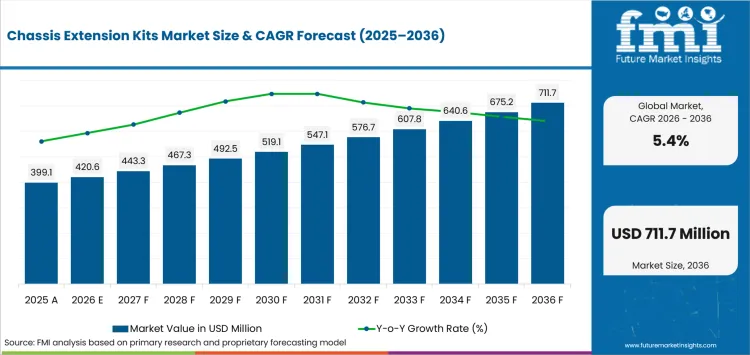
USD 420.6 million in 2026 and USD 711.7 million by 2036 at a 5.4% CAGR.
Demand for chassis extension kits is projected to expand at 5.4% CAGR between 2026 and 2036. Valuation is expected to rise from USD 420.6 million to USD 711.7 million as commercial truck platforms carry vocational bodies beyond the factory rear-frame envelope. NTEA documented in April 2026 that modern pickup frames are often boxed or hydroformed with variable geometry. Vehicle-specific rails and reinforcement details reduce fit uncertainty when final-stage builders repeat utility or service-body programs on the same chassis.
Country growth diverges as chassis activity and post-modification approval burdens do not increase at the same rate. The Federal Highway Administration projected in September 2025 that USA single-unit truck travel would rise 2.1% annually from 2023 to 2043. That operating base supports repeated vocational conversions while certification rules determine whether added frame length can shift from one-off fabrication into documented kit programs.
Key Takeaways
- Demand rises when vocational bodies or rear equipment exceed the usable factory rail length on otherwise suitable vehicle platforms.
- Based on kit type, rear chassis extension kits are projected to account for 34.0% in 2026 due to repeated rear-overhang and body-length changes on vocational vehicles.
- In 2026, pickup trucks are expected to lead vehicle type with 29.0% share because fleets often start from dealer-stock platforms for service-body conversions.
- High strength steel is set to lead the material category with 56.0% share in 2026 owing to familiar joining practices for load-carrying rail sections.
- Certification responsibility and nearby fuel or braking systems can turn a simple rail extension into a higher-risk final-stage vehicle modification.
- Key players in the chassis extension kits market include MORryde, AL-KO Vehicle Technology, Hendrickson, Knapheide, Reading Truck, Ranger Design, Fontaine Modification, and Monroe Truck Equipment.
Analyst Perspective
"A fleet program should treat a chassis extension as an engineered interface between the OEM rail and the selected body instead of fabricated steel alone. The strongest offers reduce repeat drawing work while giving final-stage builders clear limits for mounting loads and nearby vehicle systems."
- Nikhil Kaitwade, Principal Consultant, Future Market Insights
How is the chassis extension kits market segmented?
The chassis extension kits market is segmented by kit type, vehicle type, material, sales channel and application.
Kit type covers rear chassis extension kits, bolt-on frame extensions, weld-on frame extensions, front chassis extension kits and modular upfit extension kits. Vehicle type covers pickup trucks, LCVs, motorhomes, vocational trucks and specialty vehicles. Material covers high strength steel, galvanized steel, aluminum alloy and reinforced composite brackets. Sales channel covers upfitters, body builders, aftermarket distributors and fleet conversion shops. Application covers utility bodies, motorhome conversions, tow or recovery bodies, ambulance or rescue bodies and service vans.
Why do rear chassis extension kits lead the kit type category?
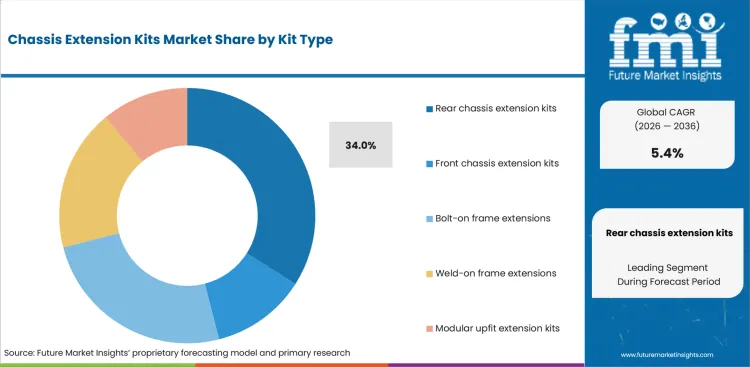
Rear extensions address frame areas lengthened for body overhang or towing equipment on vocational vehicles. AL-KO Vehicle Technology documented in October 2025 that SAWIKO towing systems match original chassis extensions with specified reinforcement components. Documented fit limits unrestricted rear fabrication in repeat motorhome and towing installations.
- By kit type, rear chassis extension kits are estimated to hold 34.0% in 2026 owing to repeated rear-overhang changes that leave steering and front crash structures untouched.
- Rear equipment also overlaps with automotive performance accessories that require predictable mounting points behind the body. Vehicle-specific extension drawings reduce rework by giving installers a known structural interface for rear hardware.
Why do pickup trucks lead the vehicle type category?
Pickup-based Class 2 platforms let fleets retain dealer availability and familiar cab configurations while adding utility bodies. The tradeoff is a frame designed around the factory box instead of an open body-builder interface that accepts secondary equipment more directly.
- In 2026, pickup trucks are expected to lead vehicle type with 29.0% share because service fleets repeatedly convert dealer-stock platforms into utility and field vehicles.
- NTEA reported in October 2025 that Ford, General Motors and Ram were the only manufacturers offering pickup box removal programs at publication. Those program limits make exact Class 3 truck platforms and OEM body-builder rules central to extension selection.
Why does high strength steel lead the material category?
Extension members need predictable bending resistance without forcing excessive section depth around body mounts and rear equipment. High strength steel also fits established automotive suspension systems that transfer road loads into nearby chassis rails.
- High strength steel is set to lead the material category with 56.0% share in 2026 due to predictable load transfer and familiar fabrication methods for modified rails.
- Hendrickson’s July 2025 STEERTEK NXT launch used fabricated 100 ksi steel plate in a box-shaped axle for fire and rescue chassis. The adjacent chassis example shows why air suspension systems and structural members increasingly balance section strength against installed mass.
Why do upfitters lead the sales channel category?
Upfitters control the installation step where the extension meets the body and routed vehicle systems on completed work trucks. Their technicians carefully reconcile automotive hardware with weight distribution before final-stage documentation and fleet acceptance.
- By sales channel, upfitters are forecast to represent 38.0% in 2026 driven by their control of body installation and final-stage documentation on completed work trucks.
- Fontaine Modification earned ISO 9001:2015 certification for its Charlotte operation in July 2025 covering post-production commercial-vehicle modifications. That certification demonstrates how formal process control becomes a commercial differentiator once structural work moves into serial upfit programs.
What are the drivers, restraints and opportunities in the chassis extension kits market?
Vocational body packaging supports demand while certification risk limits improvised conversion and modular vehicle-specific kits offer the clearest route to repeat orders.
- Driver: Utility and service bodies frequently require usable rear structure beyond the factory frame termination on otherwise suitable work-truck chassis.
- Restraint: Structural changes can transfer compliance responsibility to the final-stage manufacturer and expose nearby safety-critical vehicle systems to modification risk.
- Opportunity: Modular kit families can replace repeated one-off engineering when geometry and installation records are controlled for recurring chassis combinations.
Vocational Bodies Push Beyond Factory Rail Length
Body selection often establishes the extension requirement before a frame component enters the finished work-truck bill of materials. Reading Truck introduced RM-25 and RM-35 crane bodies in March 2025 for Class 4 chassis with different body lengths and equipment layouts. Those configurations can shift rear support beyond the original rail and make repeatable extension geometry useful for recurring chassis-body combinations.
Certification Responsibility Raises Conversion Risk
Frame modification transfers responsibility to the organization completing the vehicle since rail work can affect loading and regulated systems nearby. Transport Canada updated its manufacturing guidance in October 2025 and states that compliance duties apply to secondary manufacturers producing vocational trucks from new chassis. That obligation narrows the installer pool for poorly documented kits and raises the value of traceable specifications before final delivery.
Modular Kit Families Reduce Repeated Engineering
Repeat fleet orders become easier when an upfitter can reuse validated drawings for the same chassis and body configuration. Aebi Schmidt opened an Eagan upfit and service center in April 2025 to install Monroe commercial equipment on Ford and Ram vehicles plus other chassis. Centralized installation lets one team standardize extension interfaces and documentation beside related tipper body equipment for recurring fleet programs.
Which country CAGRs are profiled in the chassis extension kits market?
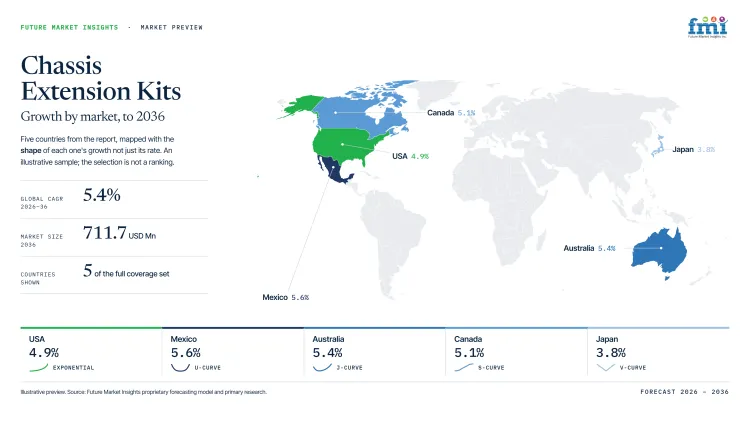
| Country | CAGR |
|---|---|
| Mexico | 6.2% |
| Australia | 5.9% |
| Canada | 5.5% |
| USA | 5.2% |
| UK | 4.9% |
How do country-level CAGRs compare in the chassis extension kits market?
The 1.3 percentage-point range places Mexico and Australia in the faster group while Canada and the USA form a close North American middle band. The UK follows at 4.9% under a more approval-intensive conversion route. The narrow spread means installation capacity and certification pathways matter more than headline CAGR differences alone.
- Mexico gains pace from heavy-truck assembly corridors serving export-oriented vocational body builders.
- Australia uses VSB6 codes that give licensed engineers defined chassis-modification approval routes.
- Canada pairs pickup-heavy fleets with federal certification duties for secondary vehicle manufacturers.
- USA upfit density supports repeat fleet programs under OEM-specific frame alteration rules.
- UK van utilization sustains service-body conversions under formal individual vehicle approval routes.
Approval effort and installer density determine how forecast growth converts into kit revenue. The full report provides country-level CAGR analysis across North America, Latin America, Europe, East Asia, South Asia, Oceania and the Middle East and Africa.
Country-wise Analysis
- Mexico’s chassis-extension opportunity is concentrated in heavy-vehicle production corridors where body builders work near North American chassis supply and export assembly plants serving regional fleets. Chassis extension kit sales in Mexico are forecast to expand at 6.2% CAGR through 2036 because repeated vocational platforms support standardized rear-frame interfaces for body programs. INEGI published its August 2026 heavy-vehicle release after recording 3,043 retail sales during July in the domestic market. Rear underride hardware and finished-vehicle labeling remain material frictions, so extension specialists gain an advantage when documented interfaces can be reused on common fleet chassis and body packages in repeat programs.
- Australian modifiers work under VSB6 engineering controls that treat wheelbase changes and chassis alterations as certifiable heavy-vehicle modifications instead of informal workshop fabrication on completed trucks. The National Heavy Vehicle Regulator documented 9,082 inspected vehicles and combinations in March 2025 through its 2024 National Roadworthiness Survey for the national fleet. Adoption of chassis extension kits in Australia is forecast to rise at 5.9% CAGR through 2036 owing to repeat vocational conversions and established certifier routes. Licensed engineering sign-off raises cost on low-volume builds, which favors kit families carrying calculation inputs that engineers can review without rebuilding the structural case for each vehicle.
- Canadian final-stage builders work from a large light-duty vehicle base and specialty-vehicle channels that repeatedly pair pickup or chassis-cab platforms with vocational bodies for local fleets. Demand for chassis extension kits in Canada is forecast to rise at 5.5% CAGR through 2036 supported by familiar platforms and repeat final-stage programs. Statistics Canada reported 26.8 million road motor vehicles for 2024 in October 2025, with light-duty vehicles representing 91.6% of registrations nationwide. Federal certification duties remain the main friction because completed vehicles need traceable specifications and compliant labels, leaving stronger positions for firms that document each chassis-body combination before delivery to fleet customers.
- American upfitters work close to OEM pickup programs and dense work-truck body networks that can repeat one chassis-body specification through large fleet orders and dealer channels. FHWA’s January 2026 Highway Statistics table recorded 189.8 million truck registrations for 2024, providing a broad installed base for vocational conversion activity nationwide. OEM-specific frame rules and final-stage certification duties still limit generic rail designs since nearby fuel or electrical systems differ by platform and model year. Chassis extension kit demand in the USA is forecast to expand at 5.2% CAGR through 2036 reflecting serial upfit volume and national dealer access to repeat configurations.
- UK conversion shops work heavily with light-commercial platforms where service bodies compete for rear packaging space under formal vehicle-approval routes used for completed vocational vehicles. Structural changes can trigger IVA evidence or registration work, which raises the commercial value of installation records tied to each chassis and body configuration. Chassis extension kit sales in the UK are forecast to expand at 4.9% CAGR through 2036 aided by sustained van utilization in service fleets. In June 2026, the Department for Transport reported 59.2 billion van miles for the year ending March 2026. Approval-ready documentation therefore carries more commercial weight than informal fabrication for repeat vocational conversions in this channel.
Who are the notable companies in the Chassis Extension Kits Market?
MORryde, AL-KO Vehicle Technology, Hendrickson, Knapheide, Reading Truck, Ranger Design, Fontaine Modification and Monroe Truck Equipment are the notable companies serving this market.
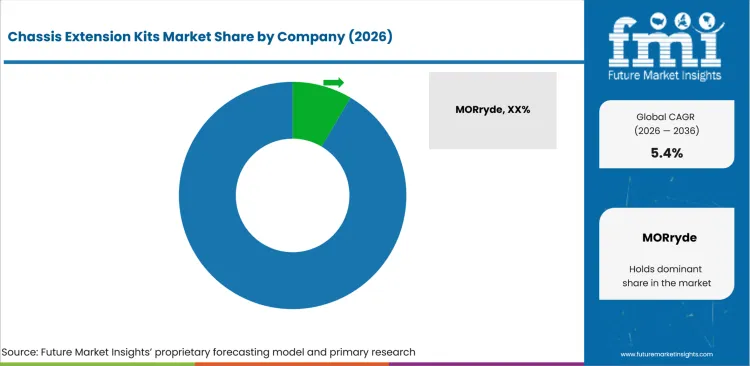
Competition splits between direct frame modifiers and companies that control the final body-installation step on vocational vehicles. MORryde and AL-KO Vehicle Technology document direct frame-extension work while Fontaine Modification handles wheelbase and frame changes on semi-truck chassis. Knapheide and Reading Truck influence extension selection through body integration for repeat work-truck programs serving utility and service fleets. Ranger Design and Monroe Truck Equipment provide regional upfit coverage while Hendrickson works at the chassis-load interface. Entry barriers center on validated geometry plus installer confidence in repeat structural modification procedures for each named chassis family.
- Direct chassis specialists include MORryde, AL-KO Vehicle Technology and Fontaine Modification with each company documenting structural alteration work.
- Body and upfit platforms include Knapheide, Reading Truck, Ranger Design and Monroe Truck Equipment at the body-to-chassis installation step.
- Hendrickson is adjacent to direct extension work as its suspension engineering determines chassis loads that modified rails must preserve.
Competitive Benchmarking: Chassis Extension Kits Market
| Company | Direct Chassis Modification | Final-Stage Upfit Integration | Vocational Platform Breadth | Geographic Reach |
|---|---|---|---|---|
| MORryde | High | High | High | United States |
| AL-KO Vehicle Technology | High | High | Medium | Europe |
| Hendrickson | Low | Low | High | Global commercial vehicle markets |
| Knapheide | Low | High | High | United States |
| Reading Truck | Low | High | High | United States and Canada |
| Ranger Design | Low | Medium | Medium | North America |
| Fontaine Modification | High | High | High | North America |
| Monroe Truck Equipment | Low | High | High | United States |
Scoring basis: High direct chassis modification requires documented frame or wheelbase alteration while Medium requires other structural chassis adaptation and Low identifies adjacent chassis work. High final-stage integration requires company-operated centers handling chassis and equipment installation while Medium reflects narrower integration and Low is component-only. High vocational breadth requires at least three documented applications while Medium requires two and Low identifies one verified application group. Geographic reach records only regions that current official company sources identify as active commercial coverage.
Key Developments in the Chassis Extension Kits Market
- In May 2026, AL-KO Vehicle Technology acquired Carsten Stäbler GmbH and expanded its European motorhome retrofit customer-center network to ten locations.
- In March 2026, Monroe Truck Equipment introduced the ServicePRO XP extreme-duty service body after on-vehicle and vibration testing for heavy-upfit conditions.
- In January 2025, Ranger Design joined Clarience Technologies after an acquisition that expanded Clarience’s commercial-vehicle upfit portfolio and Ranger Design’s access to a broader ownership platform.
Key Players in the Chassis Extension Kits Market
Frame and Chassis Engineering
- MORryde
- AL-KO Vehicle Technology
- Hendrickson
Work-Truck Body and Upfit Platforms
- Knapheide
- Reading Truck
- Ranger Design
Post-Production Modification and Equipment Integration
- Fontaine Modification
- Monroe Truck Equipment
Chassis Extension Kits Market - Report Scope
| Coverage field | Report scope |
|---|---|
| Market breakdown | By kit type, vehicle type, material, sales channel, application and region. |
| Quantitative Units | USD million. |
| Market Definition | Revenue from chassis extension kits and directly associated structures sold to add usable frame length on pickups, chassis cabs, motorhomes and specialty commercial vehicles. |
| Regions Covered | North America, Latin America, Europe, East Asia, South Asia and Pacific and Middle East and Africa. |
| Countries Covered | Mexico, Australia, Canada, USA, UK, and 20+ countries included in the full report. |
| Key Companies Profiled | MORryde, AL-KO Vehicle Technology, Hendrickson, Knapheide, Reading Truck, Ranger Design, Fontaine Modification, Monroe Truck Equipment. |
| Forecast Period | 2026 to 2036. |
| Approach | Primary and secondary research with market triangulation. |
Chassis Extension Kits Market - Research Methodology
| Method | Approach |
|---|---|
| Primary Research | FMI analysts gathered input from manufacturers, service providers, technology developers, distributors, end users, procurement teams, and subject-matter experts. Interviews examined purchasing decisions, product or service evaluation, adoption barriers, approval requirements, pricing considerations, and expectations for technical or commercial support. Respondents were also asked what evidence is required before a trial, pilot, or initial order develops into regular purchasing. |
| Desk Research | Desk research covered government statistics, regulatory publications, trade data, industry associations, technical literature, standards, company filings, product information, and official corporate announcements. Sources were reviewed for relevance, publication date, geographic coverage, and consistency with the defined market scope. Claims relating to performance, applications, approvals, capacity, investment, and commercial activity were retained only when supported by credible public evidence. |
| Market Sizing and Forecasting | The market model combined the baseline value with historical performance, segment structure, pricing and volume indicators, adoption levels, company participation, and country-level demand conditions. Forecast assumptions considered economic activity, investment trends, regulatory developments, technology adoption, purchasing cycles, supply availability, and barriers to wider market use. Segment and regional estimates were reconciled before the final market total was calculated. |
| Data Validation | Estimates were checked against multiple independent indicators, including public data, company activity, trade patterns, industry developments, and findings from primary interviews. Validation also tested whether products, services, applications, and company revenues fell within the defined market boundaries. Adjacent categories, unsupported claims, overlapping revenues, and activities without direct market relevance were excluded to reduce double counting and maintain consistency across segments and countries. |
Chassis Extension Kits Market by Segments
Chassis Extension Kits Market segmented by Kit Type:
- Rear chassis extension kits
- Bolt-on frame extensions
- Weld-on frame extensions
- Front chassis extension kits
- Modular upfit extension kits
Chassis Extension Kits Market segmented by Vehicle Type:
- Pickup trucks
- LCVs
- Motorhomes
- Vocational trucks
- Specialty vehicles
Chassis Extension Kits Market segmented by Material:
- High strength steel
- Galvanized steel
- Aluminum alloy
- Reinforced composite brackets
Chassis Extension Kits Market segmented by Sales Channel:
- Upfitters
- Body builders
- Aftermarket distributors
- Fleet conversion shops
Chassis Extension Kits Market segmented by Application:
- Utility bodies
- Motorhome conversions
- Tow / recovery bodies
- Ambulance / rescue bodies
- Service vans
Chassis Extension Kits Market by Region:
- North America
- United States
- Canada
- Latin America
- Brazil
- Mexico
- Chile
- Rest of Latin America
- Western Europe
- Germany
- United Kingdom
- Italy
- Spain
- France
- Nordics
- Benelux
- Rest of Western Europe
- Eastern Europe
- Russia
- Poland
- Hungary
- Balkan and Baltic States
- Rest of Eastern Europe
- East Asia
- China
- Japan
- South Korea
- South Asia and Pacific
- India
- ASEAN
- Australia and New Zealand
- Rest of South Asia and Pacific
- Middle East and Africa
- Kingdom of Saudi Arabia
- Other GCC Countries
- Türkiye
- South Africa
- Other African Union Countries
- Rest of Middle East and Africa
Research Sources and Bibliography
- NTEA - The Work Truck Association. (2026, April). Pickup box delete vs. pickup box removal.
- Federal Highway Administration. (2025, September). 2025 FHWA Forecasts of Vehicle Miles Traveled (VMT).
- AL-KO Vehicle Technology. (2025, October 10). Find the right tow bar for your motorhome or camper van in 3 steps.
- NTEA - The Work Truck Association. (2025, October 1). Pickup box removal information.
- Hendrickson. (2025, July 31). STEERTEK NXT Launched for Fire and Rescue.
- Fontaine Modification. (2025, July 8). Fontaine Modification Achieves Quality Milestone at Charlotte HQ.
- Reading Truck. (2025, March 4). Reading Truck Expands Crane Body Portfolio with RM-25 and RM-35 Models.
- Transport Canada. (2025, October 6). Vehicle Manufacturing in Canada - Compliance Requirements.
- Aebi Schmidt Group. (2025, April 17). Aebi Schmidt Group Expands Operations with New Upfit/Service Center in Minnesota.
- Instituto Nacional de Estadística y Geografía. (2026, August 11). Se vendieron en México 3 043 vehículos pesados al menudeo y 2 590 al mayoreo, en julio de 2026.
- National Heavy Vehicle Regulator. (2025, March 24). NHVR reveals findings of the largest-ever health check on Australia's heavy vehicle fleet.
- Statistics Canada. (2025, October 17). Vehicle registrations, 2024.
- Federal Highway Administration. (2026, January). Table MV-1 - Highway Statistics 2024.
- Department for Transport. (2026, June 25). Provisional road traffic estimates, Great Britain: April 2025 to March 2026.
- MORryde. (2026). Trademarks. Retrieved August 19, 2026.
- AL-KO Vehicle Technology. (2025, June 24). AL-KO opens new Customer and Training Centre in the UK.
- Knapheide. (2025, October 13). Knapheide Expands Cargo Van Product Line.
- Reading Truck. (2026, March 11). Reading Truck Unveils All-New Bodies at Work Truck Week ‘26.
- Clarience Technologies. (2025, January 27). Clarience Technologies Announces Addition of Ranger Design to Enhance Commercial Vehicle Upfit Solutions Capabilities.
- Fontaine Modification. (2025, December 1). Fontaine Modification Introduces Standard Sit-Down Dual Drive Conversion for Freightliner M2 106 Plus Trucks.
- Aebi Schmidt Group. (2026, March 11). Monroe ServicePRO XP Sets a New Standard.
- AL-KO Vehicle Technology. (2026, May 4). DexKo Global acquires Carsten Stäbler GmbH.
- Aebi Schmidt Group. (2025, July 1). Aebi Schmidt Group has successfully completed the merger with the Shyft Group and can start work as a global speciality vehicle manufacturer.
- J.B. Poindexter & Co. (2025, June 23). J.B. Poindexter & Co., Inc. Acquires Ambulance Manufacturing Leader Demers Braun Crestline Medix.
- Aebi Schmidt Group. (2026, July 9). Aebi Schmidt Supplies Hydraulic and Interchangeable Frame Systems for 123 German Federal Motorway Maintenance Vehicles.
- Hendrickson. (2025, July 22). STEERTEK NXT Advancements at International.
- Clarience Technologies. (2025, September 17). Clarience Technologies and Stoughton Trailers Collaborate to Introduce Leading Intelligent Chassis Design.
- J.B. Poindexter & Co. (2025, October 16). Morgan Olson Unveils the All-New Kestrel Work Truck.
- J.B. Poindexter & Co. (2026, March 11). JBPCO Showcases its Latest Vehicular Product Innovations and the Acquisition of Demers Braun Crestline Medix (DBCM) at NTEA Work Truck Week 2026.
- Aebi Schmidt Group. (2026, March 18). Aebi Schmidt Group Showcases Strength of Unified Brands at Work Truck Week 2026.
- Fontaine Modification. (2025, October 2). Fontaine Expands Dual-Drive Modification for Peterbilt Model 220 Trucks.
- Masterack. (2026, March 18). Masterack Showcases Next Generation of Fleet Upfit Solutions at Work Truck Week 2026.
This bibliography is provided for reader reference and is not exhaustive. The full report contains the complete reference list and detailed citations.
This Report Answers
- What are the 2026 and 2036 values for the chassis extension kits market?
- Which vehicle-body conditions create demand for chassis extension kits in commercial upfit programs?
- Why do rear chassis extension kits hold the leading position within the kit type category?
- Why do pickup trucks account for the largest vehicle type share in 2026?
- Why does high strength steel hold the largest material share in 2026?
- How do chassis extension kit growth rates compare across Mexico, Australia, Canada, USA and UK?
- Which companies compete through direct chassis modification or final-stage work-truck integration?
- How do certification duties and chassis-system interfaces limit adoption of extension kits?
Frequently Asked Questions
How big is the chassis extension kits market in 2026?
The chassis extension kits market is valued at USD 420.6 million in 2026 and is projected to reach USD 711.7 million by 2036. Growth is driven by vocational bodies that require additional rear frame length for mounted equipment and repeat fleet configurations.
What is the CAGR of the chassis extension kits market from 2026 to 2036?
The chassis extension kits market is projected to grow at a CAGR of 5.4% between 2026 and 2036. Expansion is supported by repeat work-truck upfits that need vehicle-specific structure and documented installation procedures for final-stage completion.
Which kit type leads the chassis extension kits market?
The rear chassis extension kits segment is expected to hold 34.0% of the chassis extension kits market in 2026, driven by repeated rear-overhang and body-length changes. Vehicle-specific rails also simplify repeated vocational installations without altering steering or front crash structures.
Which material leads the chassis extension kits market?
The high strength steel segment is expected to hold 56.0% of the chassis extension kits market in 2026, owing to predictable load transfer in modified rails. Familiar bolting and welding practices reduce retraining during repeat commercial upfit programs.
How much value will the chassis extension kits market add between 2026 and 2036?
The chassis extension kits market is expected to add USD 291.1 million in value between 2026 and 2036. Growth reflects repeated utility and service-body conversions where standardized frame-extension packages replace one-off fabrication engineering.
Which countries are projected to record the highest growth in the chassis extension kits market?
Mexico is projected to grow at 6.2% CAGR in the chassis extension kits market through 2036, followed by Australia at 5.9% and Canada at 5.5%. Growth is supported by active vocational conversion channels and repeat heavy-vehicle platforms in the three profiled countries.
Which companies are active in the chassis extension kits market?
Key companies operating in the chassis extension kits market include MORryde, AL-KO Vehicle Technology, Hendrickson, Knapheide, Reading Truck, Ranger Design, Fontaine Modification and Monroe Truck Equipment. These companies differentiate on chassis engineering plus body integration and regional final-stage upfit coverage for commercial vehicle programs.
Preview the report firsthand - request a free sample
Get SampleGet the brochure for pricing and purchase details.
Get PDFTable of Content
- Key Takeaways
- Market Size and CAGR
- Top Growth Driver
- Fastest Growing Segment
- Leading Region
- Key Companies
- Emerging Opportunities
- Executive Summary
- Global Market Outlook
- Demand-side Trends
- Supply-side Trends
- Technology Roadmap Analysis
- Analysis and Recommendations
- Analyst Perspective (What is happening? Why now? What should investors know?)
- Key Questions Answered
- How large is the market?
- What is the CAGR?
- What are key trends?
- Which region dominates?
- Who are the leaders?
- Market Overview
- Market Coverage / Taxonomy
- Market Definition / Scope / Limitations
- Research Methodology
- Chapter Orientation
- Analytical Lens and Working Hypotheses
- Market Structure, Signals, and Trend Drivers
- Benchmarking and Cross-market Comparability
- Market Sizing, Forecasting, and Opportunity Mapping
- Research Design and Evidence Framework
- Desk Research Programme (Secondary Evidence)
- Expert Input and Fieldwork (Primary Evidence)
- Tooling, Models, and Reference Databases
- Data Engineering and Model Build
- Quality Assurance and Audit Trail
- Market Background
- Market Dynamics (Drivers, Restraints, Opportunity, Trends)
- Scenario Forecast (Optimistic, Likely, Conservative)
- Impact Analysis
- AI Impact
- Sustainability Impact
- Regulatory Impact
- Technology Impact
- Consumer / Buyer Analysis
- Purchase Drivers
- Adoption Barriers
- Buyer Journey
- Opportunity Map Analysis
- Product Life Cycle Analysis
- Supply Chain Analysis
- Investment Feasibility Matrix
- Value Chain Analysis
- PESTLE and Porter's Analysis
- Regulatory Landscape
- Regional Parent Market Outlook
- Production and Consumption Statistics
- Import and Export Statistics
- Global Market Analysis and Forecast, 2021 to 2036
- Historical Market Size Value (USD Million) Analysis, 2021 to 2025
- Current and Future Market Size Value (USD Million) Projections, 2026 to 2036
- Y-o-Y Growth Trend Analysis
- Absolute $ Opportunity Analysis
- Global Market Pricing Analysis, 2021 to 2036
- Global Market Analysis and Forecast, By By Kit Type, 2021 to 2036
- Introduction / Key Findings
- Historical Market Size Value (USD Million) Analysis By By Kit Type, 2021 to 2025
- Current and Future Market Size Value (USD Million) Analysis and Forecast By By Kit Type, 2026 to 2036
- Rear chassis extension kits
- Front chassis extension kits
- Bolt-on frame extensions
- Weld-on frame extensions
- Modular upfit extension kits
- Rear chassis extension kits
- Y-o-Y Growth Trend Analysis By By Kit Type, 2021 to 2025
- Absolute $ Opportunity Analysis By By Kit Type, 2026 to 2036
- Global Market Analysis and Forecast, By By Vehicle Type, 2021 to 2036
- Introduction / Key Findings
- Historical Market Size Value (USD Million) Analysis By By Vehicle Type, 2021 to 2025
- Current and Future Market Size Value (USD Million) Analysis and Forecast By By Vehicle Type, 2026 to 2036
- Pickup trucks
- LCVs
- Motorhomes
- Vocational trucks
- Specialty vehicles
- Pickup trucks
- Y-o-Y Growth Trend Analysis By By Vehicle Type, 2021 to 2025
- Absolute $ Opportunity Analysis By By Vehicle Type, 2026 to 2036
- Global Market Analysis and Forecast, By By Material, 2021 to 2036
- Introduction / Key Findings
- Historical Market Size Value (USD Million) Analysis By By Material, 2021 to 2025
- Current and Future Market Size Value (USD Million) Analysis and Forecast By By Material, 2026 to 2036
- High strength steel
- Galvanized steel
- Aluminum alloy
- Reinforced composite brackets
- High strength steel
- Y-o-Y Growth Trend Analysis By By Material, 2021 to 2025
- Absolute $ Opportunity Analysis By By Material, 2026 to 2036
- Global Market Analysis and Forecast, By By Sales Channel, 2021 to 2036
- Introduction / Key Findings
- Historical Market Size Value (USD Million) Analysis By By Sales Channel, 2021 to 2025
- Current and Future Market Size Value (USD Million) Analysis and Forecast By By Sales Channel, 2026 to 2036
- Upfitters
- Body builders
- Aftermarket distributors
- Fleet conversion shops
- Upfitters
- Y-o-Y Growth Trend Analysis By By Sales Channel, 2021 to 2025
- Absolute $ Opportunity Analysis By By Sales Channel, 2026 to 2036
- Global Market Analysis and Forecast, By By Application, 2021 to 2036
- Introduction / Key Findings
- Historical Market Size Value (USD Million) Analysis By By Application, 2021 to 2025
- Current and Future Market Size Value (USD Million) Analysis and Forecast By By Application, 2026 to 2036
- Utility bodies
- Ambulance / rescue bodies
- Tow / recovery bodies
- Motorhome conversions
- Service vans
- Utility bodies
- Y-o-Y Growth Trend Analysis By By Application, 2021 to 2025
- Absolute $ Opportunity Analysis By By Application, 2026 to 2036
- Global Market Analysis and Forecast, By Region, 2021 to 2036
- Introduction
- Historical Market Size Value (USD Million) Analysis By Region, 2021 to 2025
- Current Market Size Value (USD Million) Analysis and Forecast By Region, 2026 to 2036
- North America
- Latin America
- Western Europe
- Eastern Europe
- East Asia
- South Asia and Pacific
- Middle East & Africa
- Market Attractiveness Analysis By Region
- North America Market Analysis and Forecast, By Country, 2021 to 2036
- Historical Market Size Value (USD Million) Trend Analysis By Market Taxonomy, 2021 to 2025
- Market Size Value (USD Million) Forecast By Market Taxonomy, 2026 to 2036
- By Country
- USA
- Canada
- By By Kit Type
- By By Vehicle Type
- By By Material
- By By Sales Channel
- By By Application
- By Country
- Market Attractiveness Analysis
- By Country
- By By Kit Type
- By By Vehicle Type
- By By Material
- By By Sales Channel
- By By Application
- Key Takeaways
- Latin America Market Analysis and Forecast, By Country
- Historical Market Size Value (USD Million) Trend Analysis By Market Taxonomy, 2021 to 2025
- Market Size Value (USD Million) Forecast By Market Taxonomy, 2026 to 2036
- By Country
- Brazil
- Mexico
- Chile
- Rest of Latin America
- By By Kit Type
- By By Vehicle Type
- By By Material
- By By Sales Channel
- By By Application
- By Country
- Market Attractiveness Analysis
- By Country
- By By Kit Type
- By By Vehicle Type
- By By Material
- By By Sales Channel
- By By Application
- Key Takeaways
- Western Europe Market Analysis and Forecast, By Country
- Historical Market Size Value (USD Million) Trend Analysis By Market Taxonomy, 2021 to 2025
- Market Size Value (USD Million) Forecast By Market Taxonomy, 2026 to 2036
- By Country
- Germany
- UK
- Italy
- Spain
- France
- Nordic
- BENELUX
- Rest of Western Europe
- By By Kit Type
- By By Vehicle Type
- By By Material
- By By Sales Channel
- By By Application
- By Country
- Market Attractiveness Analysis
- By Country
- By By Kit Type
- By By Vehicle Type
- By By Material
- By By Sales Channel
- By By Application
- Key Takeaways
- Eastern Europe Market Analysis and Forecast, By Country
- Historical Market Size Value (USD Million) Trend Analysis By Market Taxonomy, 2021 to 2025
- Market Size Value (USD Million) Forecast By Market Taxonomy, 2026 to 2036
- By Country
- Russia
- Poland
- Hungary
- Balkan & Baltic
- Rest of Eastern Europe
- By By Kit Type
- By By Vehicle Type
- By By Material
- By By Sales Channel
- By By Application
- By Country
- Market Attractiveness Analysis
- By Country
- By By Kit Type
- By By Vehicle Type
- By By Material
- By By Sales Channel
- By By Application
- Key Takeaways
- East Asia Market Analysis and Forecast, By Country
- Historical Market Size Value (USD Million) Trend Analysis By Market Taxonomy, 2021 to 2025
- Market Size Value (USD Million) Forecast By Market Taxonomy, 2026 to 2036
- By Country
- China
- Japan
- South Korea
- By By Kit Type
- By By Vehicle Type
- By By Material
- By By Sales Channel
- By By Application
- By Country
- Market Attractiveness Analysis
- By Country
- By By Kit Type
- By By Vehicle Type
- By By Material
- By By Sales Channel
- By By Application
- Key Takeaways
- South Asia and Pacific Market Analysis and Forecast, By Country
- Historical Market Size Value (USD Million) Trend Analysis By Market Taxonomy, 2021 to 2025
- Market Size Value (USD Million) Forecast By Market Taxonomy, 2026 to 2036
- By Country
- India
- ASEAN
- Australia & New Zealand
- Rest of South Asia and Pacific
- By By Kit Type
- By By Vehicle Type
- By By Material
- By By Sales Channel
- By By Application
- By Country
- Market Attractiveness Analysis
- By Country
- By By Kit Type
- By By Vehicle Type
- By By Material
- By By Sales Channel
- By By Application
- Key Takeaways
- Middle East & Africa Market Analysis and Forecast, By Country
- Historical Market Size Value (USD Million) Trend Analysis By Market Taxonomy, 2021 to 2025
- Market Size Value (USD Million) Forecast By Market Taxonomy, 2026 to 2036
- By Country
- Kingdom of Saudi Arabia
- Other GCC Countries
- Türkiye
- South Africa
- Other African Union
- Rest of Middle East & Africa
- By By Kit Type
- By By Vehicle Type
- By By Material
- By By Sales Channel
- By By Application
- By Country
- Market Attractiveness Analysis
- By Country
- By By Kit Type
- By By Vehicle Type
- By By Material
- By By Sales Channel
- By By Application
- Key Takeaways
- Key Countries Market Analysis
- USA
- Pricing Analysis
- Market Share Analysis, 2025
- By By Kit Type
- By By Vehicle Type
- By By Material
- By By Sales Channel
- By By Application
- Canada
- Pricing Analysis
- Market Share Analysis, 2025
- By By Kit Type
- By By Vehicle Type
- By By Material
- By By Sales Channel
- By By Application
- Mexico
- Pricing Analysis
- Market Share Analysis, 2025
- By By Kit Type
- By By Vehicle Type
- By By Material
- By By Sales Channel
- By By Application
- Brazil
- Pricing Analysis
- Market Share Analysis, 2025
- By By Kit Type
- By By Vehicle Type
- By By Material
- By By Sales Channel
- By By Application
- Chile
- Pricing Analysis
- Market Share Analysis, 2025
- By By Kit Type
- By By Vehicle Type
- By By Material
- By By Sales Channel
- By By Application
- Germany
- Pricing Analysis
- Market Share Analysis, 2025
- By By Kit Type
- By By Vehicle Type
- By By Material
- By By Sales Channel
- By By Application
- UK
- Pricing Analysis
- Market Share Analysis, 2025
- By By Kit Type
- By By Vehicle Type
- By By Material
- By By Sales Channel
- By By Application
- Italy
- Pricing Analysis
- Market Share Analysis, 2025
- By By Kit Type
- By By Vehicle Type
- By By Material
- By By Sales Channel
- By By Application
- Spain
- Pricing Analysis
- Market Share Analysis, 2025
- By By Kit Type
- By By Vehicle Type
- By By Material
- By By Sales Channel
- By By Application
- France
- Pricing Analysis
- Market Share Analysis, 2025
- By By Kit Type
- By By Vehicle Type
- By By Material
- By By Sales Channel
- By By Application
- India
- Pricing Analysis
- Market Share Analysis, 2025
- By By Kit Type
- By By Vehicle Type
- By By Material
- By By Sales Channel
- By By Application
- ASEAN
- Pricing Analysis
- Market Share Analysis, 2025
- By By Kit Type
- By By Vehicle Type
- By By Material
- By By Sales Channel
- By By Application
- Australia & New Zealand
- Pricing Analysis
- Market Share Analysis, 2025
- By By Kit Type
- By By Vehicle Type
- By By Material
- By By Sales Channel
- By By Application
- China
- Pricing Analysis
- Market Share Analysis, 2025
- By By Kit Type
- By By Vehicle Type
- By By Material
- By By Sales Channel
- By By Application
- Japan
- Pricing Analysis
- Market Share Analysis, 2025
- By By Kit Type
- By By Vehicle Type
- By By Material
- By By Sales Channel
- By By Application
- South Korea
- Pricing Analysis
- Market Share Analysis, 2025
- By By Kit Type
- By By Vehicle Type
- By By Material
- By By Sales Channel
- By By Application
- Russia
- Pricing Analysis
- Market Share Analysis, 2025
- By By Kit Type
- By By Vehicle Type
- By By Material
- By By Sales Channel
- By By Application
- Poland
- Pricing Analysis
- Market Share Analysis, 2025
- By By Kit Type
- By By Vehicle Type
- By By Material
- By By Sales Channel
- By By Application
- Hungary
- Pricing Analysis
- Market Share Analysis, 2025
- By By Kit Type
- By By Vehicle Type
- By By Material
- By By Sales Channel
- By By Application
- Kingdom of Saudi Arabia
- Pricing Analysis
- Market Share Analysis, 2025
- By By Kit Type
- By By Vehicle Type
- By By Material
- By By Sales Channel
- By By Application
- Türkiye
- Pricing Analysis
- Market Share Analysis, 2025
- By By Kit Type
- By By Vehicle Type
- By By Material
- By By Sales Channel
- By By Application
- South Africa
- Pricing Analysis
- Market Share Analysis, 2025
- By By Kit Type
- By By Vehicle Type
- By By Material
- By By Sales Channel
- By By Application
- USA
- Market Structure Analysis
- Competition Dashboard
- Competition Benchmarking
- Market Share Analysis of Top Players
- By Regional
- By By Kit Type
- By By Vehicle Type
- By By Material
- By By Sales Channel
- By By Application
- Emerging Startups
- Innovation Benchmarking
- Competition Analysis
- Competition Deep Dive
- MORryde
- Overview
- Product Portfolio
- Profitability by Market Segments
- Sales Footprint
- Strategy Overview
- Marketing Strategy
- Product Strategy
- Channel Strategy
- AL-KO Vehicle Technology
- Hendrickson
- MaxiTRANS
- NTEA upfit suppliers
- Knapheide
- Reading Truck
- Ranger Design
- Unaka Gear
- MORryde
- Case Studies
- Success Stories
- Recent Developments
- Competition Deep Dive
- Assumptions & Acronyms Used


