

- Market Size (2026)
- USD 685.7 Mn
- Forecast (2036)
- USD 1095.8 Mn
- CAGR (2026 to 2036)
- 4.8%
Chip Wringer Market Summary
Sales of chip wringers are projected to rise at a 4.8% CAGR between 2026 and 2036. From USD 654.3 million in 2025 and USD 685.7 million in 2026, sales will climb to USD 1,095.8 million by 2036 as more machining cells add chip drying.
FMI's review of the market finds that the market stands at USD 685.7 million in 2026 and will reach USD 1,095.8 million by 2036 at a 4.8% CAGR, as more chips are being produced on a growing base of new machine tools. U.S. orders for metalworking machinery climbed 22.5% to USD 5.74 billion in 2025, with contract machine shops raising orders by 19.1% [1], while Japanese builders booked JPY 1,604.32 billion of orders in 2025, up 8.0% [2]. Each new spindle adds to the chip stream, and PRAB states that its wringers can reclaim up to 98% of coolant and cutting oil and lift scrap value by up to 25% [3], due to which demand for wringers is expected to follow machine tool installations through the forecast period.
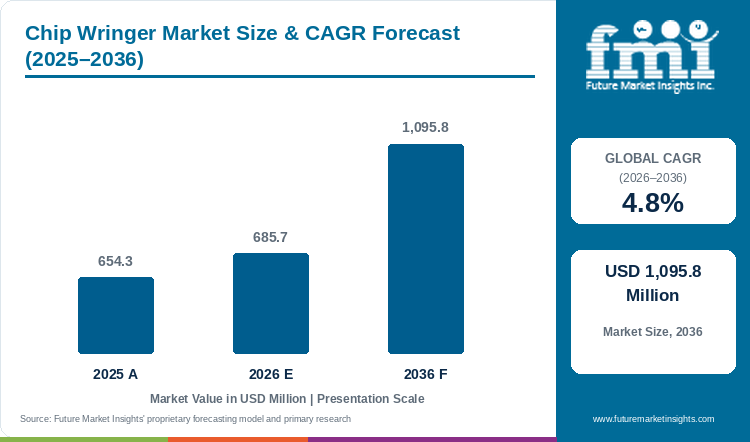
Table 1: Market Size and Forecast for the Chip Wringer Market (USD million), 2025-2036
| Market size and forecast | Value |
|---|---|
| 2025 market size | USD 654.3 million |
| Estimated market size in 2026 | USD 685.7 million |
| Projected market size by 2036 | USD 1,095.8 million |
| CAGR (2026-2036) | 4.8% |
| Added revenue, 2026 to 2036 | USD 410.1 million |
Key Market Trends & Insights
- Within wringer type, vertical chip wringers hold the largest share at 31.0% in 2026, as their compact footprint suits crowded shop floors.
- Steel chips make up 34.0% of chip material demand in 2026, the biggest slice of the category, due to the high tonnage of ferrous machining.
- Within end use, machine shops hold the largest share at 33.0% in 2026, as owners see the coolant saving on their own bills.
- The 100-500 kg/hr band is the most bought capacity range, taking 38.0% of the category in 2026 as it fits a cell of several machines.
- Among sales channels, machine tool accessory suppliers capture 35.0% in 2026, as buyers add a wringer to orders for conveyors and coolant units.
Regional Highlights
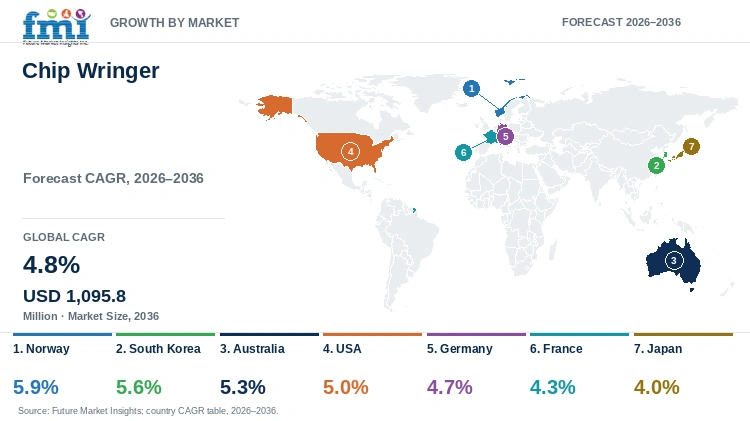
Norway sits at the top of the country ranking with a 5.9% CAGR from 2026 to 2036, while South Korea at 5.6% and Australia at 5.3% hold the next two places. At the other end, Japan will see the slowest rise at 4.0%, trailing France at 4.3% and Germany at 4.7%.
Market Evidence
Plants in the biggest machining markets are ordering more machine tools again, and each new spindle adds another wet chip stream that has to be drained. U.S. metalworking machinery orders reached a record USD 814.3 million in December 2025 and USD 5.74 billion for the full year [1], and orders for the first five months of 2026 were USD 2.77 billion, 31.9% above the same period of 2025 [4]. Japanese orders grew 8.0% in 2025, the first annual rise in three years, though domestic orders slipped 0.2% to JPY 440.86 billion [2]. As new machines are commissioned, sales of chip wringers are expected to follow with a lag of a few quarters, since chip handling is usually planned after the machining cell is in place.
Dry chips fetch a better price from recyclers than oily ones, which is giving buyers a second reason to invest, as clean scrap is easier to sell and ship. The U.S. Geological Survey estimates that domestic purchases of iron and steel scrap were worth USD 19.7 billion in 2025, while the average composite price of No. 1 heavy melting scrap rose to USD 319.00 per ton from USD 314.85 in 2024 [5]. Aluminum carries more value per kilogram, with the U.S. ingot spot price averaging 180 cents per pound in 2025 against 129.5 cents in 2024, and about 2.0 million tons of aluminum recovered from new manufacturing scrap [6]. This price gap means that aluminum and brass shops will judge a wringer mainly by the scrap premium, while steel shops will weigh coolant savings more heavily during the forecast period.
Regulators are tightening their view of oily scrap, which is pushing plants to keep coolant out of the scrap bin. Washington State's Department of Ecology names separating metalworking fluids from chips as the key pollution prevention step in chip recycling, as it cuts fluid purchases and lowers the risk of stormwater contamination when chips are stored outdoors [7]. In Europe, Regulation (EU) 2024/1157 on waste shipments was adopted in April 2024 [8], most of its provisions have applied since 21 May 2026, and stricter rules for exports to non-OECD countries will apply from 21 May 2027 [9]. As a result, European scrap buyers are expected to ask for cleaner, better-documented chip loads, which will favor plants that wring chips before they leave the site.
Buyers are now asking for a full chip and fluid cell rather than a single separator, and suppliers are reshaping their offers to match. PRAB explained in July 2026 that a wringer separates fluid by centrifugal force of well over 600 g but does not clean it, so fines, tramp oil and concentration drift still need filtering, skimming and coolant monitoring with refractometer checks [10]. Mayfran lists a vertical batch centrifuge and a continuous centrifuge with residual coolant below 2% next to its chip crushers [11], while Eriez showed its Sump Cleaner, coalescers and chip conveyors at IMTS 2026 in Chicago [12] [13]. Demand for bundled recovery systems is therefore expected to grow faster than demand for stand-alone wringers, as buyers want one supplier to answer for the fluid that comes back to the sump.
Local shipbuilding, export and factory cycles are setting the pace of wringer sales in each profiled country. Norway leads at 5.9% CAGR, as Statistics Norway reported that metal goods output rose 6.5% and ship and oil platform building rose 7.5% in 2025 [14], and South Korea follows at 5.6%, after 2025 exports hit a record USD 709.69 billion with ship exports up 24.9% [15]. Australia is next at 5.3%, where manufacturing value added rose 4.6% to AUD 141,973 million in 2024-25 [16]. However, Japan will trail at 4.0%, as its machine tool builders are relying on foreign orders while domestic orders stayed flat in 2025 [2].
Table 2: Supporting Industry Indicators for the Chip Wringer Market (mixed units), mixed years
| Indicator | Data point | Why it matters | Source |
|---|---|---|---|
| U.S. metalworking machinery orders (result) | USD 5.74 billion in 2025, up 22.5%; contract machine shops up 19.1% | Shows new chip-producing capacity in the largest machine-shop market | [1] |
| U.S. orders, January-May 2026 (result) | USD 2.77 billion, up 31.9% year on year | Points to further wringer demand as 2026 installations come online | [4] |
| Japan machine tool orders (result) | JPY 1,604.32 billion in 2025, up 8.0%; domestic down 0.2% | Builder orders lead chip handling purchases at plants | [2] |
| German machine tool orders (result) | Down 3% in 2025; domestic orders down 16%; production EUR 9.4 billion | Explains cautious capital spending among German buyers | [17] |
| China machine tool consumption (result) | EUR 25.2 billion in 2025, up 5%, about 32% of world consumption | Shows where machining volume and chip output are concentrated | [17] |
| U.S. iron and steel scrap purchases (result) | USD 19.7 billion in 2025; No. 1 heavy melting scrap USD 319.00 per ton | Sets the value of dry steel chips sold to recyclers | [5] |
| U.S. aluminum ingot price (result) | 180 cents per pound in 2025 vs 129.5 cents in 2024 | Raises the payback on drying aluminum chips | [6] |
| EU Waste Shipment Regulation (rule) | Most provisions apply from 21 May 2026; export rules from 21 May 2027 | Pushes for cleaner, traceable scrap shipments | [8] [9] |
| Washington State fluid guidance (rule) | Separating fluids from chips named the key prevention step | Links wringers to lower fluid buying and lower runoff risk | [7] |
| Wringer performance claim (supplier result) | Up to 98% coolant reclaimed; scrap value up to 25% higher | Gives buyers a basis for payback tests | [3] |
Machine Tool Demand Benchmark Analysis
Chip wringers are bought for chips that machine tools produce, so machine tool orders give the closest real-world check on the FMI forecast. Calculated from JMTBA data, foreign buyers took 72.5% of Japan's JPY 1,604.32 billion orders in 2025 [2], and calculated from VDW data, world machine tool consumption was about EUR 78.75 billion in 2025, as China's EUR 25.2 billion made up about 32% of the total [17]. U.S. orders for January to May 2026 already equal a calculated 48.3% of the full 2025 total [4] [1], which supports a steady pipeline of new chip streams in North America.
The FMI forecast adds a calculated USD 410.1 million of wringer sales between 2026 and 2036, a 1.60-times rise, which is modest next to the 22.5% U.S. order jump of 2025 and reflects the lag between buying a machine and adding chip handling. Equipment sizes also match the FMI capacity split, as PRAB's E9 handles up to 600 lb/hr, a calculated 272 kg/hr inside the leading 100-500 kg/hr band, while the E12 handles up to 2,500 lb/hr, a calculated 1,134 kg/hr in the 500-1,500 kg/hr band [3]. Demand will therefore stay strongest for mid-size units that match a cell of several machines rather than a single machine or a whole plant.
Table 3: Machine Tool Demand Benchmarks for the Chip Wringer Market (mixed currencies and units), 2024-2026, mixed years
| Indicator | Value | Source |
|---|---|---|
| Global chip wringer market, 2026 | USD 685.7 million | FMI |
| Added wringer sales, 2026-2036 | USD 410.1 million (1.60x) | Calculated |
| U.S. metalworking machinery orders, 2025 | USD 5.74 billion, +22.5% | [1] |
| U.S. orders Jan-May 2026 as share of full-year 2025 | 48.3% (USD 2.77 billion) | Calculated |
| Japan machine tool orders, 2025 | JPY 1,604.32 billion, +8.0% | [2] |
| Foreign share of Japan orders, 2025 | 72.5% | Calculated |
| Germany machine tool orders, 2025 | -3% (domestic -16%) | [17] |
| World machine tool consumption, 2025 | About EUR 78.75 billion | Calculated |
| PRAB E9 capacity | 600 lb/hr = 272 kg/hr (100-500 kg/hr band) | Calculated |
| PRAB E12 capacity | 2,500 lb/hr = 1,134 kg/hr (500-1,500 kg/hr band) | Calculated |
Analyst Perspective
“With steel chips at 34.0% of demand, the next round of wringer orders will go to suppliers who can prove the coolant they return is clean enough to reuse. Buyers are no longer paying for spin speed alone; they are paying for a recovery loop they can measure.”
- Nikhil Kaitwade, Principal Analyst at Future Market Insights
How is the Chip Wringer Market Segmented?
The chip wringer market is split into wringer type, chip material, end use, capacity, sales channel and region.
By wringer type, the market covers vertical chip wringers, horizontal chip wringers, centrifugal wringers, continuous chip wringers and batch chip dryers. By chip material, it includes steel chips, aluminum chips, brass/copper chips, cast iron chips and mixed metal chips, while end use spans machine shops, automotive component plants, aerospace machining, metal recycling and foundries. Capacity is split into below 100 kg/hr, 100-500 kg/hr, 500-1,500 kg/hr and above 1,500 kg/hr, and sales channels are machine tool accessory suppliers, direct equipment OEMs, recycling system integrators and aftermarket/service. Regional coverage spans North America, Latin America, Western Europe, Eastern Europe, East Asia, South Asia and Pacific, and Middle East and Africa.
Why Do Vertical Chip Wringers Lead the Chip Wringer Market by Wringer Type?
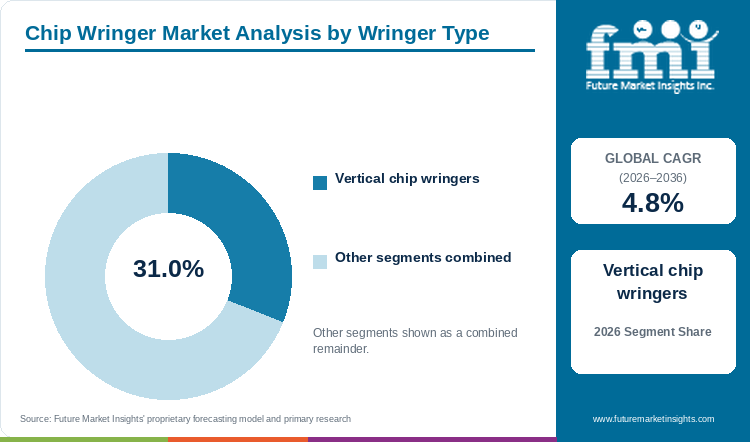
Vertical chip wringers are set to hold 31.0% of market share by wringer type in 2026.
Vertical chip wringers hold 31.0% of wringer type demand in 2026, as chips can drop in from a conveyor or hopper and leave without a long transfer path, which saves floor space next to the machines. Suppliers are building their lines around this layout, as Mayfran lists its LBC as a vertical centrifuge fed with chips in batches and pairs it with chip crushers [11]. Horizontal and centrifugal wringers will keep a place in larger lines, while continuous wringers and batch chip dryers are expected to gain where chip flow is steady and automated.
- Vertical chip wringers are expected to keep around 31.0% of wringer type demand as compact cells spread in space-short machine shops.
- Mayfran lists a vertical LBC centrifuge for batch feeding and a continuous VBU centrifuge, with residual coolant below 2% depending on material and fluid [11].
Why Do Steel Chips Lead the Chip Wringer Market by Chip Material?
Steel chips account for 34.0% of chip material demand in 2026.
Steel chips lead chip material demand with a 34.0% share in 2026, due to the large tonnage of ferrous machining and the coolant each ton carries off the floor. The value of that scrap, which feeds the recycled scrap metal trade, is holding up, as the U.S. Geological Survey put the 2025 composite price of No. 1 heavy melting scrap at USD 319.00 per ton and U.S. scrap purchases at USD 19.7 billion [5]. Aluminum, brass/copper, cast iron and mixed metal chips make up the rest, and aluminum is expected to gain share as higher metal prices reward drier, cleaner chips.
- Steel chips will stay the largest material stream at 34.0% in 2026, as ferrous machining keeps the highest chip tonnage.
- In 2025, the U.S. aluminum ingot spot price averaged 180 cents per pound, up from 129.5 cents in 2024, which raised the value of clean aluminum chips [6].
Why Do Machine Shops Lead the Chip Wringer Market by End Use?
Machine shops will account for 33.0% of end use demand in 2026.
Machine shops hold 33.0% of end use demand in 2026, as the shop owner pays directly for both the lost coolant and the haul-away of wet chips and can see the saving on one bill. This buyer group is investing, as U.S. contract machine shops raised their manufacturing technology orders by 19.1% in 2025 [1]. Automotive component plants, aerospace machining, metal recycling and foundries add steady demand, and aerospace machining is expected to gain as aircraft output rises.
- Machine shops are projected to keep the leading 33.0% end use share, as fragmented shops keep buying compact, simple units.
- In February 2026, AMT data showed that U.S. contract machine shops increased manufacturing technology orders by 19.1% in 2025 [1].
Why Does the 100-500 kg/hr Band Lead the Chip Wringer Market by Capacity?
The 100-500 kg/hr band is set to capture 38.0% of capacity demand in 2026.
The 100-500 kg/hr band holds 38.0% of capacity demand in 2026, as it is large enough for a cell of several machines yet small enough to fit on a skid near the conveyors. Supplier lines match this range, as PRAB's E9 handles up to 600 lb/hr, a calculated 272 kg/hr, while its E12 handles up to 2,500 lb/hr for larger lines [3]. Units below 100 kg/hr will serve single machines, while the 500-1,500 kg/hr and above 1,500 kg/hr bands are expected to grow with central chip systems in automotive and recycling plants.
- The 100-500 kg/hr band is expected to keep about 38.0% of capacity demand, as mid-size cells remain the common shop-floor setup.
- PRAB lists the E9 at up to 600 lb/hr and the E12 at up to 2,500 lb/hr of metal chips, a calculated 272 kg/hr and 1,134 kg/hr [3].
Why Do Machine Tool Accessory Suppliers Lead the Chip Wringer Market by Sales Channel?
Machine tool accessory suppliers represent 35.0% of sales channel demand in 2026.
Machine tool accessory suppliers hold 35.0% of sales channel demand in 2026, as they already sell the bar feeders, chip conveyors and coolant units around the machine and can add a wringer to the same order. LNS lists chip management and coolant management systems in its portfolio, and in November 2025 its UK unit teamed with HALTER CNC Automation to pair bar feeders with robot loading for UK and Irish shops [18]. Direct equipment OEMs, recycling system integrators and aftermarket/service channels share the rest, and service revenue is expected to rise as the installed base ages.
- Machine tool accessory suppliers will hold about 35.0% of channel sales, as buyers prefer one supplier for conveyors, coolant and chip drying.
- In November 2025, LNS Turbo UK and HALTER CNC Automation announced a collaboration combining LNS bar feeders with the HALTER LoadAssistant robot loader [18].
What are the Drivers, Restraints, and Opportunities in the Chip Wringer Market?
Coolant savings and scrap value are driving purchases, while uncertainty over the quality of recovered fluid is slowing approvals; bundled chip and fluid cells are opening a wider buyer base.
- Driver: Recovering cutting fluid and selling drier chips is cutting operating costs at machining plants that are adding new machine tools.
- Restraint: Payback weakens when chip shape, fluid condition or downstream cleaning needs are not tested before installation.
- Opportunity: Packaged cells that combine crushing, wringing and fluid cleaning can bring automated recovery to mid-volume shops.
The main driver is the money that leaves the plant on wet chips. Washington State's Department of Ecology states that separating fluids from chips reduces fluid purchases, since the fluid can be reused, and lowers contamination risk during storage and transport [7], while PRAB claims its wringers can reclaim up to 98% of coolant and produce chips that are 98% dry [3]. As machine tool orders rise, with U.S. orders up 31.9% in the first five months of 2026 [4], this saving will apply to a larger chip stream each year.
The main restraint is doubt about the fluid that comes back. PRAB noted in July 2026 that recovered coolant can carry fines and tramp oil and may be richer or leaner than the sump, so it must be filtered and checked before reuse [10], often on separate coolant filtration skids. This adds cost and engineering time, due to which some projects are being delayed until suppliers can show results on the buyer's own chips.
The clearest opportunity lies in bundled systems. Nederman bought Spanish foundry and metal recycling equipment supplier Euro-Equip for about EUR 15 million in March 2025 to strengthen its Process Technology division [19], and Jorgensen, which makes chip wringers, shredders and briquette presses, joined employee-owned Innovance in February 2024 [20]. Suppliers with conveyors, crushers, wringers and filters under one roof are expected to win a larger share of mid-size projects during the forecast period.
Which Country CAGRs are Profiled in the Chip Wringer Market?
Table 4: Country CAGRs for the Chip Wringer Market (%), 2026-2036
| Country | CAGR, 2026 to 2036 |
|---|---|
| Norway | 5.9% |
| South Korea | 5.6% |
| Australia | 5.3% |
| USA | 5.0% |
| Germany | 4.7% |
| France | 4.3% |
| Japan | 4.0% |
How do Country-level CAGRs Compare in the Chip Wringer Market?
Profiled country CAGRs span 1.9 percentage points, from 5.9% in Norway to 4.0% in Japan. Norway, South Korea and Australia form the faster band at 5.3% or above, as shipbuilding, offshore work and export manufacturing are adding chip volume, while the USA at 5.0% and Germany at 4.7% sit near the global 4.8% pace. France at 4.3% and Japan at 4.0% trail, as their large machining bases are buying more replacement units than new lines. These rates show pace rather than size, since a slower market such as Japan or Germany can still hold a larger installed base.
- Growing metal goods output and ship and platform building are adding new chip streams in Norway, which will lead at a 5.9% CAGR.
- South Korea will grow at 5.6% CAGR, as record exports of chips, ships and cars are keeping machining lines busy.
- Rising manufacturing output across scattered sites favors compact, low-service units in Australia, set for a 5.3% CAGR.
- With a broad machine-shop base and record machine tool orders, the USA is expected to post a 5.0% CAGR.
- Weak domestic machine tool orders are slowing new projects in Germany, which will grow at 4.7% CAGR as upgrades continue.
- Aerospace machining is supporting demand for controlled chip and fluid handling in France, projected at a 4.3% CAGR.
- A mature base with flat domestic orders is limiting new installations in Japan, the slowest listed country at 4.0% CAGR.
The full report extends chip wringer estimates to more than 30 countries across seven regions.
Country Outlook
- Statistics Norway reported in February 2026 that industrial output rose 3.9% in 2025, with metal goods up 6.5% and ship and oil platform building up 7.5% [14]; this growing fabrication base supports a 5.9% CAGR.
- In January 2026, South Korea's Ministry of Trade, Industry and Energy reported record 2025 exports of USD 709.69 billion, with semiconductors up 22.2% and ships up 24.9% [15]; busy export lines support a 5.6% CAGR.
- The Australian Bureau of Statistics reported in June 2026 that manufacturing employed 901,000 people and added AUD 141,973 million in value in 2024-25, up 4.6% [16]; this growth supports a 5.3% CAGR.
- U.S. metalworking machinery orders reached USD 5.74 billion in 2025, up 22.5% [1], and IMTS 2026 in Chicago listed more than 1,800 exhibiting manufacturers and suppliers for September 2026 [21]; this investment cycle supports a 5.0% CAGR.
- VDW reported in March 2026 that German machine tool orders fell 3% in 2025, with domestic orders down 16% [17]; cautious spending holds Germany at a 4.7% CAGR.
- GIFAS reported in May 2026 that French aerospace revenue rose 11.9% to EUR 85.6 billion in 2025, with order intake of EUR 88.6 billion [22]; aerospace machining supports a 4.3% CAGR.
- JMTBA reported in February 2026 that 2025 orders rose 8.0% to JPY 1,604.32 billion, but domestic orders fell 0.2% [2]; slow home demand keeps Japan at a 4.0% CAGR.
Who are the Leading Companies in the Chip Wringer Market?
PRAB, Mayfran International, Nederman, Jorgensen Conveyors, LNS Group and Eriez are among the leading suppliers across dedicated chip-drying specialists, machine-tool peripheral integrators and conveyance-led material handlers.
Competition is split between firms that build the wringer itself, firms that sell the conveyors and coolant systems around it, and conveyor makers that join at the project stage. Dedicated suppliers are publishing performance claims, as PRAB states up to 98% coolant recovery [3] and Mayfran states residual coolant below 2% [11]. Larger groups are buying scale, as Nederman reported 2025 net sales of SEK 5,783 million with higher orders and sales in its Process Technology division [23], due to which smaller specialists are expected to compete on application testing and service.
- PRAB, Mayfran International, Nederman and Jorgensen Conveyors form the dedicated chip-drying and integrated recovery group, building wringers or centrifuges and linking them with crushers, conveyors and filters.
- Among machine-tool peripheral and fluid-management integrators, LNS Group, Eriez and National Conveyors shape projects through chip conveyors, coolant cleaning and machine-side integration.
- Conveyance-led and broader material-handling suppliers such as KMC Global / Hapman, Kalamazoo Conveyor and Titan Conveyors take part where chip movement and plant interfaces drive the installation.
Competitive Benchmarking
Table 5: Competitive Benchmarking for the Chip Wringer Market (qualitative ratings), 2026
| Company | Dedicated Chip-Wringing Capability | Integrated Chip-and-Fluid Systems | Machine-Tool Integration and Service Access | Geographic Reach |
|---|---|---|---|---|
| PRAB | High | High | High | North America; broader project reach requires verification |
| Mayfran International | High | High | High | Europe, North America and Asia |
| LNS Group | Unscored | Medium | High | Worldwide machine-tool peripheral presence |
| Nederman | High | High | Medium | Global; wringer-specific geography varies by model |
| Jorgensen Conveyors | High | High | High | North America with machine-tool industry access |
| Eriez | Unscored | Medium | Medium | North America; international wringer relevance not scored |
| National Conveyors | Unscored | Medium | Medium | United States-focused public chip-processing evidence |
| KMC Global / Hapman | Unscored | Unscored | Unscored | Public wringer-specific reach not established |
| Kalamazoo Conveyor | Unscored | Unscored | Unscored | Public wringer-specific reach not established |
| Titan Conveyors | Unscored | Unscored | Unscored | Public wringer-specific reach not established |
Each company is rated High, Medium or Unscored on published wringer or centrifuge equipment for metal chips, on published ability to link chip drying with crushers, conveyors or coolant cleaning, and on closeness to machine-tool peripherals, field service or integration partners, where High means broad and directly published capability, Medium means narrower or adjacent capability and Unscored means public information is not enough to rate.
Key Developments
- In February 2024, Innovance, a 100% employee-owned holding company, acquired Jorgensen Conveyor and Filtration Solutions of Mequon, Wisconsin, a maker of conveyors, coolant filtration, chip wringers, shredders and briquette presses, and planned to keep all 65 employees [20].
- In March 2025, Nederman acquired Euro-Equip S.L. of Lezama, Spain, a supplier of foundry and metal recycling systems with about EUR 22 million in 2024 turnover, for about EUR 15 million [19].
- In November 2025, LNS Turbo UK and HALTER CNC Automation announced a collaboration to supply bar feeders and robot loading to manufacturers in the UK and Ireland [18].
- In July 2026, PRAB published guidance stating that wringers separate fluid mechanically and that recovered coolant still needs filtering, tramp-oil removal and concentration checks before reuse [10].
- In August 2026, Eriez announced that it would show its Sump Cleaner, coalescers and chip and parts conveyors at IMTS 2026 in Chicago on September 14-19 [12] [13].
Key Players
Dedicated Chip-Drying and Integrated Recovery Specialists
- PRAB, Inc.
- Mayfran International
- Nederman Holding AB
- Jorgensen Conveyor and Filtration Solutions
Machine-Tool Peripheral and Fluid-Management Integrators
- LNS Group
- National Conveyors
- Eriez Manufacturing Co.
Conveyance-Led and Broader Material-Handling Suppliers
- KMC Global / Hapman
- Kalamazoo Conveyor
- Titan Conveyors
Report Scope and Methodology
Table 6: Report Scope for the Chip Wringer Market (descriptive), 2025-2036
| Coverage field | Report scope |
|---|---|
| Market breakdown | Wringer Type, Chip Material, End Use, Capacity, Sales Channel and Region |
| Quantitative units | USD Million |
| Market definition | Revenue from chip wringer, chip centrifuge and chip-drying equipment that mechanically separates cutting fluid or oil from metal chips or swarf. Downstream finished-product revenue and adjacent substitute equipment are excluded unless wringer revenue is separately attributable. |
| Regions covered | North America, Latin America, Western Europe, Eastern Europe, East Asia, South Asia and Pacific, and Middle East and Africa |
| Countries covered | Norway, USA, Japan, Germany, South Korea, France, Australia and more than twenty-five additional countries |
| Key companies profiled | PRAB, Mayfran International, LNS Group, Nederman, Jorgensen Conveyors, Eriez, National Conveyors, KMC Global / Hapman, Kalamazoo Conveyor and Titan Conveyors |
| Forecast period | 2026 to 2036 |
| Approach | Hybrid bottom-up and top-down sizing that reconciles supplier equipment indicators with machining activity, installation patterns and application-level adoption within the defined wringer revenue boundary. |
Research Methodology
Table 7: Research Methodology for the Chip Wringer Market (descriptive), 2025-2036
| Method | Approach |
|---|---|
| Primary research | Interviews with chip-processing equipment makers, machine-tool accessory suppliers, system integrators, machine-shop operators, maintenance and procurement teams on sizing, chip mix, fluid recovery, service, pricing, replacement timing and capital approval. |
| Desk research | Official manufacturing statistics, machine tool order data, industry association releases, environmental guidance, supplier product literature and dated company announcements. |
| Market sizing and forecasting | Supplier and product indicators reconciled with end-user production, capacity bands, installed-use patterns and assumptions on machining activity and fluid-recovery investment. |
| Data validation | Cross-checks against independent and first-party sources; conveyors, crushers, briquetters, general coolant systems, general-purpose centrifuges and scrap resale excluded unless wringer revenue is separately identifiable. |
Chip Wringer Market by Segments
Chip Wringer Market Segmented by Wringer Type
- Vertical chip wringers
- Horizontal chip wringers
- Centrifugal wringers
- Continuous chip wringers
- Batch chip dryers
Chip Wringer Market Segmented by Chip Material
- Steel chips
- Aluminum chips
- Brass/copper chips
- Cast iron chips
- Mixed metal chips
Chip Wringer Market Segmented by End Use
- Machine shops
- Automotive component plants
- Aerospace machining
- Metal recycling
- Foundries
Chip Wringer Market Segmented by Capacity
- 100-500 kg/hr
- Below 100 kg/hr
- 500-1,500 kg/hr
- Above 1,500 kg/hr
Chip Wringer Market Segmented by Sales Channel
- Machine tool accessory suppliers
- Direct equipment OEMs
- Recycling system integrators
- Aftermarket/service
Chip Wringer Market Segmented by Region
- North America
- Latin America
- Western Europe
- Eastern Europe
- East Asia
- South Asia and Pacific
- Middle East and Africa
Research Sources and Bibliography
- [1] Automation.com (reporting AMT U.S. Manufacturing Technology Orders data) (2026, February 9). Manufacturing Technology Orders Set Record in December 2025.
- [2] Japan Machine Tool Builders' Association (2026, February 3). JMTBA Notes 2026-01: Machine Tool Orders for 2025 (News Release No. FY 25-9).
- [3] PRAB (n.d.; accessed 2026, October). Metal Chip Wringer/Centrifuge.
- [4] Industrial Machinery Digest (reporting AMT U.S. Manufacturing Technology Orders data) (2026, July). $583.4M in New Machinery Orders Highlight US Economic Strengths.
- [5] U.S. Geological Survey (2026, February). Mineral Commodity Summaries 2026: Iron and Steel Scrap.
- [6] U.S. Geological Survey (2026, February). Mineral Commodity Summaries 2026: Aluminum.
- [7] Washington State Department of Ecology (2021, November). Pollution Prevention Practices for Metalworking Fluids (Publication 21-04-006).
- [8] European Parliament and Council of the European Union (2024, April 11). Regulation (EU) 2024/1157 on shipments of waste.
- [9] European Commission, Directorate-General for Environment (n.d.; accessed 2026, October). Waste shipments.
- [10] PRAB (2026, July 2). How Do Chip Wringers Affect Coolant Concentration and Quality Upon Recovery?.
- [11] Mayfran International (n.d.; accessed 2026, October). Spänezentrifugen.
- [12] Eriez (n.d.; accessed 2026, October). Eriez IMTS 2026.
- [13] Modern Machine Shop (2026, August 27). Eriez Fluid Recycling, Material Handling Solutions Streamline Operations.
- [14] Statistics Norway (2026, February 6). Auke i industriproduksjonen i 2025.
- [15] The Kyunghyang Shinmun (reporting Ministry of Trade, Industry and Energy data) (2026, January 1). Korea's 2025 exports hit all-time high.
- [16] Australian Bureau of Statistics (2026, June 19). Australian Industry, 2024-25 financial year.
- [17] VDW (German Machine Tool Builders' Association) (2026, March 18). German machine tool industry leveling off - China further dominating production.
- [18] LNS Group (2025, November 11). LNS Turbo UK and HALTER CNC Automation Announce Strategic Collaboration to Boost CNC Productivity in the United Kingdom and Ireland.
- [19] Nederman Holding AB (2025, March 18). Nederman acquires Euro-Equip S.L.
- [20] Jorgensen Conveyor and Filtration Solutions (2024, February 28). Innovance Inc. Acquires Jorgensen Conveyor and Filtration Solutions.
- [21] IMTS (The Association for Manufacturing Technology) (n.d.; accessed 2026, October). About the Show: IMTS 2026.
- [22] GIFAS (2026, May 11). 2025 Results: The French Aerospace Industry Remains Strongly Positioned for the Future.
- [23] Nederman Holding AB (2026, February 12). Year-end report January - December 2025.
This bibliography is provided for reader reference and is not exhaustive. The full report contains the complete reference list and detailed citations.
This Report Answers
- What is the chip wringer market size in 2025, 2026 and 2036?
- Which machining, scrap and fluid-cost trends are supporting chip wringer demand?
- Why do vertical chip wringers lead the wringer type category?
- Why do steel chips and machine shops lead their categories?
- Which capacity band and sales channel capture the most demand?
- Which countries grow fastest between 2026 and 2036, and why?
- Which companies lead the market, and what recent moves have they made?
- Which coolant-quality and integration issues slow purchase approvals?
Frequently Asked Questions
How Big Is the Chip Wringer Market Expected to Be in 2026?
The chip wringer market is valued at USD 685.7 million in 2026, up from USD 654.3 million in 2025. It will reach USD 1,095.8 million by 2036.
What Is the Expected CAGR of the Chip Wringer Market?
The market is projected to expand at a 4.8% CAGR from 2026 to 2036. Growth is tied to rising machine tool installations and the value of recovered coolant and dry scrap.
Which Wringer Type Leads the Chip Wringer Market?
Vertical chip wringers lead with a 31.0% share of wringer type demand in 2026. Their compact, gravity-fed layout fits close to chip collection points.
Which Chip Material and End Use Lead the Market?
Steel chips hold 34.0% of chip material demand and machine shops hold 33.0% of end use demand in 2026. Large ferrous chip volumes and direct coolant costs make the saving easy to measure.
Which Country Grows Fastest in the Chip Wringer Market?
Norway posts the highest listed CAGR at 5.9% from 2026 to 2036, followed by South Korea at 5.6%. Growth in metal goods and ship and platform building supports Norwegian demand.
What Is the Key Restraint in the Chip Wringer Market?
Recovered coolant still carries fines, tramp oil and concentration changes, so it needs further cleaning before reuse. This extra step can delay approvals when results on real chips are not proven.
Who Are the Key Companies in the Chip Wringer Market?
Key companies include PRAB, Mayfran International, Nederman, Jorgensen Conveyors, LNS Group and Eriez. National Conveyors, KMC Global / Hapman, Kalamazoo Conveyor and Titan Conveyors are also profiled.
Preview the report firsthand - request a free sample
Get SampleGet the brochure for pricing and purchase details.
Get PDFTable of Content
- Key Takeaways
- Market Size and CAGR
- Top Growth Driver
- Fastest Growing Segment
- Leading Region
- Key Companies
- Emerging Opportunities
- Executive Summary
- Global Market Outlook
- Demand-side Trends
- Supply-side Trends
- Technology Roadmap Analysis
- Analysis and Recommendations
- Analyst Perspective (What is happening? Why now? What should investors know?)
- Key Questions Answered
- How large is the market?
- What is the CAGR?
- What are key trends?
- Which region dominates?
- Who are the leaders?
- Market Overview
- Market Coverage / Taxonomy
- Market Definition / Scope / Limitations
- Research Methodology
- Chapter Orientation
- Analytical Lens and Working Hypotheses
- Market Structure, Signals, and Trend Drivers
- Benchmarking and Cross-market Comparability
- Market Sizing, Forecasting, and Opportunity Mapping
- Research Design and Evidence Framework
- Desk Research Programme (Secondary Evidence)
- Expert Input and Fieldwork (Primary Evidence)
- Tooling, Models, and Reference Databases
- Data Engineering and Model Build
- Quality Assurance and Audit Trail
- Market Background
- Market Dynamics (Drivers, Restraints, Opportunity, Trends)
- Scenario Forecast (Optimistic, Likely, Conservative)
- Impact Analysis
- AI Impact
- Sustainability Impact
- Regulatory Impact
- Technology Impact
- Consumer / Buyer Analysis
- Purchase Drivers
- Adoption Barriers
- Buyer Journey
- Opportunity Map Analysis
- Product Life Cycle Analysis
- Supply Chain Analysis
- Investment Feasibility Matrix
- Value Chain Analysis
- PESTLE and Porter's Analysis
- Regulatory Landscape
- Regional Parent Market Outlook
- Production and Consumption Statistics
- Import and Export Statistics
- Global Market Analysis and Forecast, 2021 to 2036
- Historical Market Size Value (USD Million) Analysis, 2021 to 2025
- Current and Future Market Size Value (USD Million) Projections, 2026 to 2036
- Y-o-Y Growth Trend Analysis
- Absolute $ Opportunity Analysis
- Global Market Pricing Analysis, 2021 to 2036
- Global Market Analysis and Forecast, By Wringer Type, 2021 to 2036
- Introduction / Key Findings
- Historical Market Size Value (USD Million) Analysis By Wringer Type, 2021 to 2025
- Current and Future Market Size Value (USD Million) Analysis and Forecast By Wringer Type, 2026 to 2036
- Vertical chip wringers
- Horizontal chip wringers
- Centrifugal wringers
- Continuous chip wringers
- Batch chip dryers
- Y-o-Y Growth Trend Analysis By Wringer Type, 2021 to 2025
- Absolute $ Opportunity Analysis By Wringer Type, 2026 to 2036
- Global Market Analysis and Forecast, By Chip Material, 2021 to 2036
- Introduction / Key Findings
- Historical Market Size Value (USD Million) Analysis By Chip Material, 2021 to 2025
- Current and Future Market Size Value (USD Million) Analysis and Forecast By Chip Material, 2026 to 2036
- Steel chips
- Aluminum chips
- Brass/copper chips
- Cast iron chips
- Mixed metal chips
- Y-o-Y Growth Trend Analysis By Chip Material, 2021 to 2025
- Absolute $ Opportunity Analysis By Chip Material, 2026 to 2036
- Global Market Analysis and Forecast, By End Use, 2021 to 2036
- Introduction / Key Findings
- Historical Market Size Value (USD Million) Analysis By End Use, 2021 to 2025
- Current and Future Market Size Value (USD Million) Analysis and Forecast By End Use, 2026 to 2036
- Machine shops
- Automotive component plants
- Aerospace machining
- Metal recycling
- Foundries
- Y-o-Y Growth Trend Analysis By End Use, 2021 to 2025
- Absolute $ Opportunity Analysis By End Use, 2026 to 2036
- Global Market Analysis and Forecast, By Capacity, 2021 to 2036
- Introduction / Key Findings
- Historical Market Size Value (USD Million) Analysis By Capacity, 2021 to 2025
- Current and Future Market Size Value (USD Million) Analysis and Forecast By Capacity, 2026 to 2036
- 100-500 kg/hr
- Below 100 kg/hr
- 500-1,500 kg/hr
- Above 1,500 kg/hr
- Y-o-Y Growth Trend Analysis By Capacity, 2021 to 2025
- Absolute $ Opportunity Analysis By Capacity, 2026 to 2036
- Global Market Analysis and Forecast, By Sales Channel, 2021 to 2036
- Introduction / Key Findings
- Historical Market Size Value (USD Million) Analysis By Sales Channel, 2021 to 2025
- Current and Future Market Size Value (USD Million) Analysis and Forecast By Sales Channel, 2026 to 2036
- Machine tool accessory suppliers
- Direct equipment OEMs
- Recycling system integrators
- Aftermarket/service
- Y-o-Y Growth Trend Analysis By Sales Channel, 2021 to 2025
- Absolute $ Opportunity Analysis By Sales Channel, 2026 to 2036
- Global Market Analysis and Forecast, By Region, 2021 to 2036
- Introduction
- Historical Market Size Value (USD Million) Analysis By Region, 2021 to 2025
- Current Market Size Value (USD Million) Analysis and Forecast By Region, 2026 to 2036
- North America
- Latin America
- Western Europe
- Eastern Europe
- East Asia
- South Asia and Pacific
- Middle East and Africa
- Market Attractiveness Analysis By Region
- North America Market Analysis and Forecast, By Country, 2021 to 2036
- Historical Market Size Value (USD Million) Trend Analysis By Market Taxonomy, 2021 to 2025
- Market Size Value (USD Million) Forecast By Market Taxonomy, 2026 to 2036
- By Country
- By Wringer Type
- By Chip Material
- By End Use
- By Capacity
- By Sales Channel
- Market Attractiveness Analysis
- By Country
- By Wringer Type
- By Chip Material
- By End Use
- By Capacity
- By Sales Channel
- Key Takeaways
- Latin America Market Analysis and Forecast, By Country
- Historical Market Size Value (USD Million) Trend Analysis By Market Taxonomy, 2021 to 2025
- Market Size Value (USD Million) Forecast By Market Taxonomy, 2026 to 2036
- By Country
- By Wringer Type
- By Chip Material
- By End Use
- By Capacity
- By Sales Channel
- Market Attractiveness Analysis
- By Country
- By Wringer Type
- By Chip Material
- By End Use
- By Capacity
- By Sales Channel
- Key Takeaways
- Western Europe Market Analysis and Forecast, By Country
- Historical Market Size Value (USD Million) Trend Analysis By Market Taxonomy, 2021 to 2025
- Market Size Value (USD Million) Forecast By Market Taxonomy, 2026 to 2036
- By Country
- By Wringer Type
- By Chip Material
- By End Use
- By Capacity
- By Sales Channel
- Market Attractiveness Analysis
- By Country
- By Wringer Type
- By Chip Material
- By End Use
- By Capacity
- By Sales Channel
- Key Takeaways
- Eastern Europe Market Analysis and Forecast, By Country
- Historical Market Size Value (USD Million) Trend Analysis By Market Taxonomy, 2021 to 2025
- Market Size Value (USD Million) Forecast By Market Taxonomy, 2026 to 2036
- By Country
- By Wringer Type
- By Chip Material
- By End Use
- By Capacity
- By Sales Channel
- Market Attractiveness Analysis
- By Country
- By Wringer Type
- By Chip Material
- By End Use
- By Capacity
- By Sales Channel
- Key Takeaways
- East Asia Market Analysis and Forecast, By Country
- Historical Market Size Value (USD Million) Trend Analysis By Market Taxonomy, 2021 to 2025
- Market Size Value (USD Million) Forecast By Market Taxonomy, 2026 to 2036
- By Country
- By Wringer Type
- By Chip Material
- By End Use
- By Capacity
- By Sales Channel
- Market Attractiveness Analysis
- By Country
- By Wringer Type
- By Chip Material
- By End Use
- By Capacity
- By Sales Channel
- Key Takeaways
- South Asia and Pacific Market Analysis and Forecast, By Country
- Historical Market Size Value (USD Million) Trend Analysis By Market Taxonomy, 2021 to 2025
- Market Size Value (USD Million) Forecast By Market Taxonomy, 2026 to 2036
- By Country
- By Wringer Type
- By Chip Material
- By End Use
- By Capacity
- By Sales Channel
- Market Attractiveness Analysis
- By Country
- By Wringer Type
- By Chip Material
- By End Use
- By Capacity
- By Sales Channel
- Key Takeaways
- Middle East and Africa Market Analysis and Forecast, By Country
- Historical Market Size Value (USD Million) Trend Analysis By Market Taxonomy, 2021 to 2025
- Market Size Value (USD Million) Forecast By Market Taxonomy, 2026 to 2036
- By Country
- By Wringer Type
- By Chip Material
- By End Use
- By Capacity
- By Sales Channel
- Market Attractiveness Analysis
- By Country
- By Wringer Type
- By Chip Material
- By End Use
- By Capacity
- By Sales Channel
- Key Takeaways
- Key Countries Market Analysis
- Norway
- Pricing Analysis
- Market Share Analysis, 2025
- By Wringer Type
- By Chip Material
- By End Use
- By Capacity
- By Sales Channel
- South Korea
- Pricing Analysis
- Market Share Analysis, 2025
- By Wringer Type
- By Chip Material
- By End Use
- By Capacity
- By Sales Channel
- Australia
- Pricing Analysis
- Market Share Analysis, 2025
- By Wringer Type
- By Chip Material
- By End Use
- By Capacity
- By Sales Channel
- USA
- Pricing Analysis
- Market Share Analysis, 2025
- By Wringer Type
- By Chip Material
- By End Use
- By Capacity
- By Sales Channel
- Germany
- Pricing Analysis
- Market Share Analysis, 2025
- By Wringer Type
- By Chip Material
- By End Use
- By Capacity
- By Sales Channel
- France
- Pricing Analysis
- Market Share Analysis, 2025
- By Wringer Type
- By Chip Material
- By End Use
- By Capacity
- By Sales Channel
- Japan
- Pricing Analysis
- Market Share Analysis, 2025
- By Wringer Type
- By Chip Material
- By End Use
- By Capacity
- By Sales Channel
- Norway
- Market Structure Analysis
- Competition Dashboard
- Competition Benchmarking
- Market Share Analysis of Top Players
- By Regional
- By Wringer Type
- By Chip Material
- By End Use
- By Capacity
- By Sales Channel
- Emerging Startups
- Innovation Benchmarking
- Competition Analysis
- Competition Deep Dive
- PRAB
- Overview
- Product Portfolio
- Profitability by Market Segments
- Sales Footprint
- Strategy Overview
- Marketing Strategy
- Product Strategy
- Channel Strategy
- Mayfran International
- LNS Group
- Nederman
- Jorgensen Conveyors
- Eriez
- National Conveyors
- KMC Global / Hapman
- Kalamazoo Conveyor
- Titan Conveyors
- Nederman Holding AB
- Jorgensen Conveyor and Filtration Solutions
- Eriez Manufacturing Co.
- PRAB
- Case Studies
- Success Stories
- Recent Developments
- Competition Deep Dive
- Assumptions & Acronyms Used


