

- Market Size (2026)
- USD 278.7 Mn
- Forecast (2036)
- USD 553.3 Mn
- CAGR (2026 to 2036)
- 7.1%
How big is Cirrhosis-Specific Oral Nutrition Market in 2026?
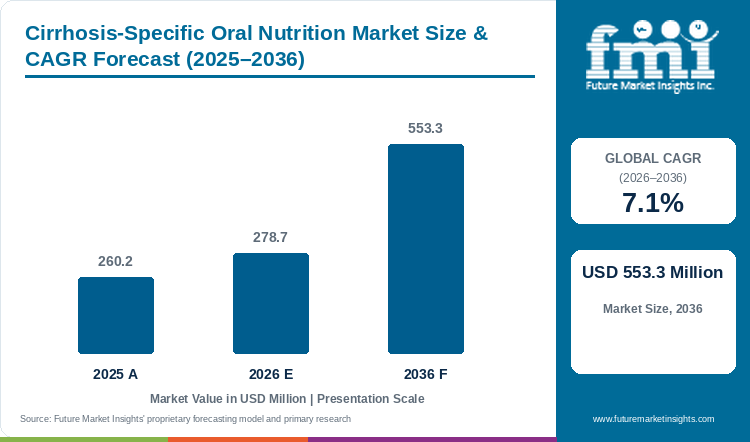
Cirrhosis-specific oral nutrition market is projected to grow at 7.1% CAGR through 2036. The market revenue increases from USD 260.2 million in 2025 to USD 278.7 million in 2026 and is anticipated to reach USD 553.3 million by 2036.
FMI analysis suggests that increasing requirement for meeting protein and energy intake among cirrhosis patients is driving adoption of measured oral nutrition products. The 2026 KASL guideline recommends 30 to 35 kcal/kg per day and 1.2 to 1.5 g/kg of protein, along with late-evening snacks. [4] This in turn is supporting cirrhosis-specific oral nutrition market, forecast to rise from USD 278.7 million in 2026 to USD 553.3 million by 2036. High-protein high-energy ONS, BCAA supplements and measured snack products are becoming important in daily nutrition plan. Increasing use from hospital support to homecare, long-term care and between-meal intake is expected to drive market growth.
Shift towards premium-grade oral nutrition through energy-dense composition, BCAA content, compact serving and preparation-free RTD format is a prominent trend. Buying requirement differs across regions, as the USA depends upon hospital initiation and retail purchase, the UK and Germany considers listed medical use, Japan follows planning, whereas South Korea uses disease-specific guidance. Product qualification remains the commercial filter, as nutrient content, stated medical purpose, serving schedule, product evidence, pharmacy listing and reimbursement documentation needs to meet buyer requirement. In August 2025, CMS confirmed that an orally administered high-protein nutrition shake did not qualify for Medicare DMEPOS benefit. [1] This indicates that suitable protein and calorie content alone does not decide community purchase.
Key Takeaways
- Defined protein targets and late-evening intake is increasing the use of scheduled oral nutrition when regular meals remain inadequate.
- High-protein high-energy ONS is estimated to hold 37.7% of product type revenue in 2026, owing to combined protein and calorie content in one serving.
- MASLD / metabolic is projected to account for 46.8% of etiology revenue in 2026, as cirrhosis protein requirement and metabolic calorie control needs to be managed together.
- RTD is expected to hold 49.8% of product form revenue in 2026 due to its measured serving and preparation-free use.
- South Korea is projected to grow at 7.4% CAGR, while the USA is estimated to grow at 6.8% CAGR during the forecast period.
- Some of the key players in cirrhosis-specific oral nutrition market are Abbott, Otsuka Pharmaceutical, Nestle Health Science, Danone Nutricia, Fresenius Kabi, Ajinomoto, Victus, and Medtrition.
Analyst Perspective
“Cirrhosis patients unable to meet the protein requirement through regular meals are increasingly receiving oral nutrition during discharge planning. Product tolerance and regular availability of prescribed formula in homecare will remain important for the market demand.”
- Nandini Roy Choudhury, Principal Consultant, Future Market Insights.
How is the cirrhosis-specific oral nutrition market segmented?
Cirrhosis-Specific Oral Nutrition Market is segmented by product type, etiology, product form, end user, sales channel, and region. High-protein high-energy ONS is estimated to hold 37.7% in 2026, while MASLD / metabolic and RTD are projected to account for 46.8% and 49.8%, respectively.
Cirrhosis-Specific Oral Nutrition Market is segmented on the basis of product type, etiology, product form, end user, sales channel, and region. High-protein high-energy ONS is estimated to hold 37.7% in 2026, while MASLD / metabolic and RTD are projected to account for 46.8% and 49.8%, respectively.
On the basis of product type, cirrhosis-specific oral nutrition market is segmented into high-protein high-energy ONS, BCAA supplements, late-evening snack products, micronutrient & zinc blends, and the report's Others category.
On the basis of etiology, cirrhosis-specific oral nutrition market is segmented into MASLD / metabolic, alcohol-related, viral, and the report's Others category.
On the basis of product form, cirrhosis-specific oral nutrition market is segmented into RTD, powders, puddings & semi-solids, and the report's Others category.
On the basis of end user, cirrhosis-specific oral nutrition market is segmented into homecare, hospitals, long-term care, and the report's Others category.
On the basis of sales channel, cirrhosis-specific oral nutrition market is segmented into hospital pharmacy, retail pharmacy, online, institutional tender, and the report's Others category.
Which Product Type is Expected to Hold the Highest Share in Cirrhosis-Specific Oral Nutrition?
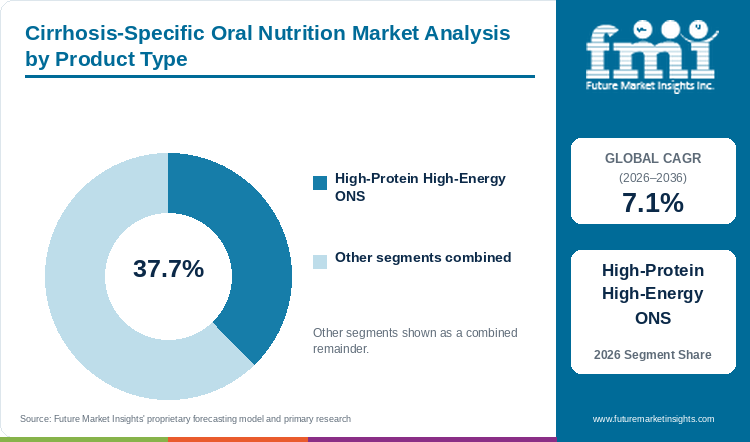
By product type, high-protein high-energy ONS is estimated to hold 37.7% share in 2026, owing to combined protein and calorie delivery.
High-protein high-energy ONS is a nutrition product which provides high amount of protein and calories in one serving. Cirrhosis patients having limited food intake are unable to meet the nutrition requirement through regular meals. Due to this, high-protein high-energy ONS is being used between meals and during daily nutrition schedule. Increasing application of medical nutrition among patients having limited appetite is expected to drive the segment growth.
- High-protein high-energy ONS provides protein and calories to cirrhosis patients whose regular meals are unable to meet the nutritional requirement. A measured serving provides the two nutrients together, due to which separate products are not required for protein and calorie deficit.
- High-protein high-energy ONS is estimated to account for 37.7% of product type revenue in 2026 owing to combined protein and calorie delivery.
Which Etiology is Expected to Account for the Largest Share of Cirrhosis-Specific Oral Nutrition Demand?
By etiology, MASLD / metabolic is projected to account for 46.8% share in 2026, attributed to increasing use of daily nutrition plans for metabolic disease.
MASLD / metabolic cirrhosis is associated with cirrhosis along with obesity, diabetes and other metabolic conditions. These patients requires adequate protein; however, high and uncontrolled calorie intake also needs to be avoided. Measured oral nutrition products provides a measured amount of protein and calories in every serving. Thus, increasing prevalence of metabolic disease among cirrhosis patients is expected to boost the demand for oral nutrition products.
- MASLD / metabolic cirrhosis patients requires adequate protein for cirrhosis along with controlled energy intake for obesity or diabetes. Measured oral nutrition servings helps in deciding the amount of protein and calories included in a daily nutrition plan. I
- MASLD / metabolic is projected to hold 46.8% of etiology revenue in 2026, attributed to the requirement of managing cirrhosis and metabolic disease together.
Which Product Form is Expected to Lead Cirrhosis-Specific Oral Nutrition Sales?
In 2026, RTD is expected to lead product form with 49.8% share, owing to preparation-free use and measured serving.
RTD oral nutrition products are ready for consumption and does not require mixing, measuring or preparation. These products are available in fixed serving bottles and can be consumed between meals or during late evening. RTD products also helps patients in following the same dose which was advised during hospital care. Due to easy consumption and preparation-free use, RTD products are anticipated to witness significant demand during the forecast period.
- RTD oral nutrition products are prepared in a measured bottle and are used for scheduled serving between meals or during late evening. These products does not require mixing or preparation at home.
- RTD is expected to account for 49.8% of product form revenue in 2026 owing to measured bottles and preparation-free dosing.
Which End User is Expected to Account for the Highest Cirrhosis-Specific Oral Nutrition Revenue?
Homecare is forecast to account for 43.7% of end user revenue in 2026, owing to daily oral nutrition use after specialist discharge.
Cirrhosis patients generally continues oral nutrition products at home after leaving hospital care. The products are consumed between meals and during late evening according to the advised nutrition schedule. Regular availability through home healthcare is required for continuing the same dose and serving time. Increasing adoption of oral nutrition products after hospital discharge is anticipated to support the homecare segment growth.
- Homecare is one of the important end user after a patient moves from hospital nutrition support to daily intake at home. Scheduled oral nutrition servings are generally consumed between specialist visits and requires regular product availability.
- Homecare is forecast to account for 43.7% of end user revenue in 2026, as most scheduled oral nutrition products are consumed in homecare.
Which Sales Channel is Expected to Hold the Largest Share of Cirrhosis-Specific Oral Nutrition Revenue?
Hospital pharmacy is projected to hold 36.3% of sales channel revenue in 2026, attributed to starting oral nutrition in hospital and first product supply.
Hospital pharmacy is one of the primary sales channel for cirrhosis-specific oral nutrition products. Patients are provided with ONS or amino acids according to prescribed protein and energy requirement before leaving specialist care. Hospital pharmacy also provides information related to starting dose and serving schedule. Increasing initiation of oral nutrition products in hospitals is expected to propel the hospital pharmacy segment growth.
- Hospital pharmacies provides the first oral nutrition product before cirrhosis patients leave specialist care. Pharmacy teams select ONS or amino acids according to prescribed protein and energy target and also informs patients about the starting dose.
- Hospital pharmacy is projected to hold 36.3% of sales channel revenue in 2026 owing to starting oral nutrition in hospital and first product supply in the same setting.
What are the drivers, restraints and opportunities in the Cirrhosis-Specific Oral Nutrition Market?
Defined clinical targets are driving the cirrhosis-specific oral nutrition market, poor tolerance may hamper the market growth and compact products are expected to create growth opportunities.
- Driver: Increasing requirement for meeting protein and energy targets is driving the prescription of oral nutrition products among cirrhosis patients.
- Restraint: Poor taste, low tolerance and large serving volume can reduce repeated use of oral nutrition products.
- Opportunity: Defined protein and energy targets are increasing oral nutrition prescription when meals does not meet cirrhosis requirement.
Defined protein and energy targets are one of the primary factor driving the cirrhosis-specific oral nutrition market. The 2026 KASL guideline recommends 30 to 35 kcal/kg per day and 1.2 to 1.5 g/kg of protein for adults with cirrhosis, along with late-evening snacks for reducing the fasting period. These figures helps clinicians in comparing the actual food intake with required protein and calorie intake. If the regular food is not sufficient, oral nutrition products are included for covering the nutrient gap. Increasing use of prescribed oral nutrition for meeting a defined protein and energy requirement is expected to propel the market growth.
Poor product tolerance is a major factor which can restrain the growth of cirrhosis-specific oral nutrition market. A December 2025 systematic mixed-studies review in Nutrition Research Reviews identified product tolerance and satisfaction as factors affecting ONS intake and also examined smaller serving volumes. Poor taste, large serving and uncomfortable daily use may lead to unfinished doses even when the nutrient content is suitable. As a result, actual protein and calorie intake may remain lower than the prescribed amount. These factors may hamper continued use of oral nutrition products during the forecast period.
Compact ready-to-use oral nutrition products are gaining higher demand due to ease of use and measured serving. A November 2025 clinical trial reported 90.9% compliance with one high-energy ONS and 82.7% with a plant-based comparator. The study was not cirrhosis-specific and supports use of the product format without establishing cirrhosis efficacy. Measured therapeutic food delivery provides a fixed serving without mixing and preparation, due to which late-evening and between-meal intake becomes easier. Increasing development of compact oral nutrition products is expected to create new avenues in cirrhosis-specific oral nutrition market.
Which country CAGRs are profiled in the cirrhosis-specific oral nutrition market?
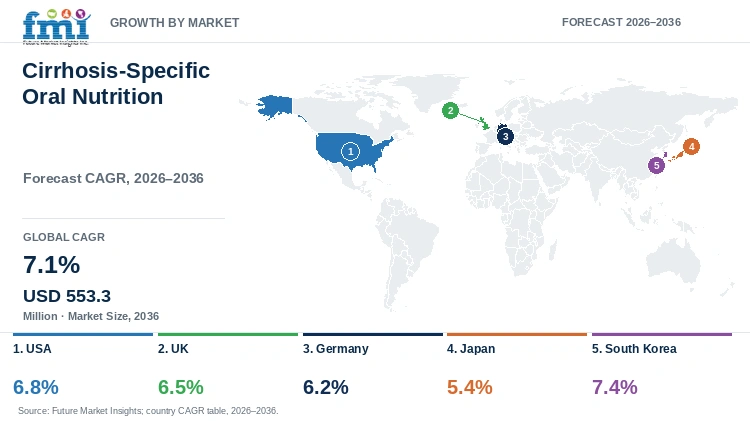
| Country | CAGR |
|---|---|
| USA | 6.8% |
| UK | 6.5% |
| Germany | 6.2% |
| Japan | 5.4% |
| South Korea | 7.4% |
How do country-level outlooks compare in the cirrhosis-specific oral nutrition market?
Cirrhosis-specific oral nutrition demand differs from one country to another owing to nutrition guidance, payment facility and availability of products after hospital discharge. Hospitals are increasingly starting oral nutrition products among patients having poor food intake. However, the same product is required to be available through pharmacy and homecare for regular consumption. Expansion of nutrition guidance and oral nutrition supply is expected to support the market growth across countries.
- USA hospital demand is supported by current cirrhosis guidance; however, lack of Medicare payment for oral products may limiting purchase after hospital discharge.
- United Kingdom prescribing is supported by nationally listed nutrition products, whereas local clinical and pharmacy decisions determine regular supply.
- Germany reviews balanced enteral diets through statutory processes, due to which stated medical purpose and product evidence remains important.
- Japan follows the 2025 dietary reference framework, while cirrhosis patients requires individual protein and energy planning.
- South Korea revised its cirrhosis guidance and included late-evening snacks and BCAA supplementation for disease management.
Apart from the above countries, the full report also covers CAGRs across North America, Latin America, Western Europe, Eastern Europe, East Asia, South Asia and Pacific, and Middle East and Africa.
Country-wise Analysis
- USA cirrhosis-specific oral nutrition demand is projected to grow at 6.8% CAGR from 2026 to 2036. In May 2025, the American College of Gastroenterology guideline recommended early oral or enteral nutrition for hospitalized patients having poor intake and also supported late-evening snacks. This is increasing the use of nutrition support during hospital care. However, in August 2025, CMS confirmed that an orally administered high-protein nutrition shake did not qualify for Medicare DMEPOS benefit. Dependence on retail availability and patient purchase after hospital discharge may hamper the growth of USA cirrhosis-specific oral nutrition market.
- UK cirrhosis-specific oral nutrition demand is forecast to grow at 6.5% CAGR from 2026 to 2036. The country has a national prescribing route for nutritional products having recognized medical use. In December 2025, the NHS Drug Tariff continued to list prescribed nutrition products in Part XV Borderline Substances for approved conditions. National listing supports the transfer of hospital nutrition plans into homecare. However, pharmacy availability and local clinical decision continues to affect the product supplied between specialist visits.
- Germany's cirrhosis-specific oral nutrition demand is projected to grow at 6.2% CAGR through 2036. Balanced medical nutrition is included under a government review process and requires stated medical purpose. In June 2025, the G-BA approved a national evaluation concept for balanced diets used in enteral nutrition. The review examines current supply and can support later reimbursement decisions. Products having suitable nutrient content and clear medical purpose are expected to witness steady demand in Germany market.
- Japan's cirrhosis-specific oral nutrition demand is projected to grow at 5.4% CAGR from 2026 to 2036. In February 2025, the Ministry of Health, Labour and Welfare released training material for the 2025 Dietary Reference Intakes, which supports nutrition assessment and management through 2029. Cirrhosis patients requires individual decision regarding protein and energy intake. Familiar oral formats and easy home use are anticipated to support the Japan cirrhosis-specific oral nutrition market growth.
- South Korea is projected to grow at 7.4% CAGR from 2026 to 2036, owing to presence of disease-specific nutrition guidance. In June 2026, the Korean Association for the Study of the Liver released revised cirrhosis guidance with daily energy and protein targets. The guidance also recommends late-evening snacks and food amino acids such as BCAA supplementation for patients with cirrhotic ascites. These instructions helps hospital teams in deciding the product, dose and nutrition schedule before discharge. Continued availability of familiar products at home is expected to drive the South Korea market growth.
Who are the notable companies in the cirrhosis-specific oral nutrition market?
Notable companies in the Cirrhosis-Specific Oral Nutrition Market include Abbott, Otsuka Pharmaceutical, Nestle Health Science, Danone Nutricia, Fresenius Kabi, Ajinomoto, Victus, and Medtrition.
Cirrhosis-specific oral nutrition market is fragmented with the presence of liver-specific formula suppliers and broader oral nutrition companies. Otsuka Pharmaceutical and Victus provides hepatic formulas, while Abbott, Nestle Health Science, Danone Nutricia, and Fresenius Kabi offers high-protein and high-energy ONS for different care settings. Ajinomoto provides Nualtra ONS and amino-acid capability, whereas Medtrition supplies concentrated protein for institutional use. Product portfolio, serving format, use in hospital care and distribution presence are some of the prominent factors influencing competition in cirrhosis-specific oral nutrition market.
- Liver-focused and amino-acid specialists include Otsuka Pharmaceutical, Victus, and Ajinomoto, which offers hepatic formulas or amino-acid based nutrition.
- Broad ONS companies include Abbott, Nestle Health Science, Danone Nutricia, and Fresenius Kabi, offering high-protein and high-energy oral products.
- Medtrition competes through low-volume concentrated protein products for acute, long-term, and community nutrition.
Competitive Benchmarking: Cirrhosis-Specific Oral Nutrition Market
| Company | Liver-Specific Formulation Depth |
High-Protein Oral Format Breadth |
Institutional/Homecare Usability |
Geographic Reach |
|---|---|---|---|---|
| Abbott | Low | High | High | High |
| Otsuka Pharmaceutical | High | Medium | Medium | Medium |
| Nestle Health Science | Low | High | High | High |
| Danone Nutricia | Low | High | High | High |
| Fresenius Kabi | Low | High | High | High |
| Ajinomoto | Medium | Medium | Medium | Medium |
| Victus | High | Medium | Medium | Medium |
| Medtrition | Low | Medium | High | Medium |
High rating represents broader available product range or presence across countries, Medium represents smaller product presence, and Low represents limited available information for the criterion. These ratings does not represent product quality or market share.
Key Developments in the Cirrhosis-Specific Oral Nutrition Market
- In September 2026, Danone inaugurated a French medical nutrition line with capacity for nearly 20 million liters of oral supplements each year. The development expands the company medical nutrition production capacity in Europe.
- In December 2025, Ajinomoto described Nualtra ONS work on taste, packaging, and ease of use in daily uses. The activity is focused towards improving repeated daily use of oral nutrition products.
- In October 2025, Nutricia launched savory Fortimel PlantBased Protein options for disease-related malnutrition and additional times of consumption. Expansion of flavor choice is expected to support product use among patients consuming repeated ONS servings.
- In March 2025, Medtrition launched ProSource Cup and ProSource Cup Plant, each providing 20 grams of complete protein per cup. The launch expands the company portfolio of low-volume concentrated protein products.
Key Players in the Cirrhosis-Specific Oral Nutrition Market
Liver-Specific and Amino-Acid Specialists
- Otsuka Pharmaceutical
- Ajinomoto
- Victus
Broad High-Protein ONS Platforms
- Abbott
- Nestle Health Science
- Danone Nutricia
- Fresenius Kabi
Concentrated Protein and Institutional Access
- Medtrition
What does the Cirrhosis-Specific Oral Nutrition Market report cover?
| Coverage field | Report scope |
|---|---|
| Market breakdown | Product Type, Etiology, Product Form, End User, Sales Channel, and Region. |
| Quantitative Units | USD million. |
| Market Definition | Market revenue includes oral nutrition products used for cirrhosis according to clinical nutrition requirement. Tube-only enteral feeds, parenteral nutrition, prescription liver drugs, normal food, general wellness supplements, care-service revenue and channel markups are excluded from the market. |
| Regions Covered | North America; Latin America; Western Europe; Eastern Europe; East Asia; South Asia and Pacific; Middle East and Africa. |
| Countries Covered | USA, UK, Germany, Japan, South Korea, and more than twenty-five additional countries in the full report. |
| Key Companies Profiled | Abbott, Otsuka Pharmaceutical, Nestle Health Science, Danone Nutricia, Fresenius Kabi, Ajinomoto, Victus, Medtrition. |
| Forecast Period | 2026 to 2036. |
| Approach | Primary and secondary research along with market triangulation. |
Cirrhosis-Specific Oral Nutrition Market - Research Methodology
| Method | Approach |
|---|---|
| Primary Research | Primary research includes interviews with manufacturers, service providers, distributors, end users, purchasing teams and industry experts. The interviews covers purchasing decision, product evaluation, price, adoption barriers, approval requirement and product support. |
| Desk Research | Desk research includes government statistics, regulatory publications, trade data, industry associations, technical literature, company filings, product information and official announcements. The sources are reviewed on the basis of publication date, geography and market coverage. |
| Market Sizing and Forecasting | Market size is calculated on the basis of historical value, segment performance, product pricing, volume, adoption and country demand. Forecast includes economic activity, regulation, product adoption, purchasing cycle and product availability. Segment and regional values are further compared for maintaining consistency. |
| Data Validation | Market estimates are validated using public data, company activities, trade information, industry developments and primary interviews. Products and revenues outside the market definition are excluded for reducing double counting across segments and countries. |
Cirrhosis-Specific Oral Nutrition Market by Segments
Cirrhosis-Specific Oral Nutrition Market segmented by Product Type:
- High-Protein High-Energy ONS
- BCAA Supplements
- Late-Evening Snack Products
- Micronutrient & Zinc Blends
- Others
Cirrhosis-Specific Oral Nutrition Market segmented by Etiology:
- MASLD / Metabolic
- Alcohol-Related
- Viral
- Others
Cirrhosis-Specific Oral Nutrition Market segmented by Product Form:
- RTD
- Powders
- Puddings & Semi-Solids
- Others
Cirrhosis-Specific Oral Nutrition Market segmented by End User:
- Homecare
- Hospitals
- Long-Term Care
- Others
Cirrhosis-Specific Oral Nutrition Market segmented by Sales Channel:
- Hospital Pharmacy
- Retail Pharmacy
- Online
- Institutional Tender
- Others
Cirrhosis-Specific Oral Nutrition Market by Region
- North America
- United States
- Canada
- Latin America
- Brazil
- Mexico
- Argentina
- Chile
- Western Europe
- Germany
- France
- United Kingdom
- Italy
- Spain
- Benelux
- Nordics
- Eastern Europe
- Poland
- Czech Republic
- Romania
- Hungary
- East Asia
- China
- Japan
- South Korea
- South Asia and Pacific
- India
- ASEAN
- Australia and New Zealand
- Middle East and Africa
- GCC Countries
- South Africa
- Türkiye
- Israel
Research Sources and Bibliography
- [1]. Centers for Medicare & Medicaid Services. (2025, August 19). Healthcare Common Procedure Coding System (HCPCS) Level II Final Coding, Benefit Category and Payme…
- [2]. Gemeinsamer Bundesausschuss. (2025, June 19). Bilanzierte Diäten zur enteralen Ernährung: Erstes Evaluationskonzept steht fest - Onlinebefragung …
- [3]. Korean Association for the Study of the Liver. (2026, June 12). The Liver Week 2026 [The Liver Week 2026 press conference release].
- [4]. Korean Association for the Study of the Liver. (2026). KASL clinical practice guidelines for liver cirrhosis: Ascites and related complications 2026. Clinical and Molecular Hepatology, 32(3), 961-1028.
- [5]. Singal, A. K., Wong, R. J., Dasarathy, S., Abdelmalek, M. F., Neuschwander-Tetri, B. A., Limketkai, B. N., Petrey, J., & McClain, C. J. (2025). ACG clinical guideline: Malnutrition and nutritional recommendations in liver disease. The American Journal of Gastroenterology, 120(5), 950-972.
- Liljeberg, E., Payne, L., Skinnars Josefsson, M., Söderström, L., & Einarsson, S. (2025). Understanding the complexity of barriers and facilitators to adherence to oral nutritional supplements among patients with malnutrition: A systematic mixed-studies review. Nutrition Research Reviews, 38(2), 407-427.
- Iglesias Hernández, N. C., Ramos Carrasco, A., De Luis Román, D. A., de Pablos-Velasco, P. L., Calañas Continente, A., Rodríguez Soto, M. J., López-Gómez, J. J., Comi-Díaz, C., García-Rey, S., Pérez-Rambla, C., & García-Luna, P. P. (2025). Effect of a new plant-based high-energy oral nutritional supplement in adult malnourished patients: An open-label, randomized clinical trial. Frontiers in Nutrition, 12, 1667954.
- NHS Business Services Authority. (2025, December). Drug Tariff, Part XV: Borderline substances and prescribed nutrition products.
- Ministry of Health, Labour and Welfare, Japan. (2025, February 5). [Slides for Dietary Reference Intakes for Japanese, 2025].
- Fresenius Kabi. (2025, December 23). 2025 Year in Review.
- Nutricia. (2025, October 1). Nutricia’s new savory plant-based medical nutrition proven to improve patient adherence.
- Medtrition, Inc. (2025, March 25). Medtrition, Inc. launches the ProSource Cup portfolio.
- Abbott Nutrition. (2026). Ensure Plus High Protein Therapeutic Nutrition Shake. Accessed September 2026.
- Otsuka Pharmaceutical Co., Ltd. (2025). Corporate brochure: Pharmaceuticals portfolio, including Aminoleban EN.
- Nestlé Health Science. (2026). Resource HP/HC. Accessed September 2026.
- Victus. (2026). Enterex Hepatic. Accessed September 2026.
- Danone. (2026, September 15). Danone positions Steenvoorde as a leading European medical nutrition site and inaugurates its largest production line in France.
- Ajinomoto Co., Inc. (2025, December 4). North America, Europe, and Other: Medical Food.
The bibliography is provided for the reader reference. Complete reference list and detailed citations are included in the full report.
This Report Answers
- What is the Cirrhosis-Specific Oral Nutrition Market size during 2026?
- What value is the Cirrhosis-Specific Oral Nutrition Market forecast by 2036?
- Which segment shares define the Cirrhosis-Specific Oral Nutrition Market in 2026?
- How do country outlooks differ in the Cirrhosis-Specific Oral Nutrition Market?
- Which companies participate in the Cirrhosis-Specific Oral Nutrition Market today?
- What scope does the Cirrhosis-Specific Oral Nutrition Market report cover?
Frequently Asked Questions
How big is the Cirrhosis-Specific Oral Nutrition Market in 2026?
Future Market Insights estimates that the Cirrhosis-Specific Oral Nutrition Market will be valued at USD 278.7 million in 2026. The market is expected to increase from USD 260.2 million in 2025 as demand for targeted nutritional support continues to rise.
What CAGR is projected for cirrhosis-specific oral nutrition through 2036?
As per FMI, the Cirrhosis-Specific Oral Nutrition Market is projected to grow at a 7.1% CAGR from 2026 to 2036. The market is anticipated to reach USD 553.3 million by 2036.
Which product type has a notable 2026 share in this market?
Future Market Insights projects that high-protein high-energy ONS will hold 37.7% share of the market in 2026. The segment benefits from its role in addressing protein-energy malnutrition among cirrhosis patients.
Which etiology segment has a notable 2026 share in this market?
The MASLD / metabolic segment is expected to account for 46.8% share of the market in 2026. Growth of the segment is supported by the increasing prevalence of metabolic disorders associated with liver disease.
Which country has a notable expansion outlook through the forecast period?
FMI finds that South Korea is projected to expand at a 7.4% CAGR through 2036. Growth is supported by rising clinical nutrition adoption and increasing focus on disease-specific nutritional management.
Which companies currently participate in the Cirrhosis-Specific Oral Nutrition Market?
Notable participants in the Cirrhosis-Specific Oral Nutrition Market include Abbott, Otsuka Pharmaceutical, Nestlé Health Science, Danone Nutricia, Fresenius Kabi, Ajinomoto, Victus, and Medtrition. These companies are focused on expanding specialized nutrition portfolios and strengthening their clinical nutrition offerings.
Preview the report firsthand - request a free sample
Get SampleGet the brochure for pricing and purchase details.
Get PDFTable of Content
- Key Takeaways
- Market Size and CAGR
- Top Growth Driver
- Fastest Growing Segment
- Leading Region
- Key Companies
- Emerging Opportunities
- Executive Summary
- Global Market Outlook
- Demand-side Trends
- Supply-side Trends
- Technology Roadmap Analysis
- Analysis and Recommendations
- Analyst Perspective (What is happening? Why now? What should investors know?)
- Key Questions Answered
- How large is the market?
- What is the CAGR?
- What are key trends?
- Which region dominates?
- Who are the leaders?
- Market Overview
- Market Coverage / Taxonomy
- Market Definition / Scope / Limitations
- Research Methodology
- Chapter Orientation
- Analytical Lens and Working Hypotheses
- Market Structure, Signals, and Trend Drivers
- Benchmarking and Cross-market Comparability
- Market Sizing, Forecasting, and Opportunity Mapping
- Research Design and Evidence Framework
- Desk Research Programme (Secondary Evidence)
- Expert Input and Fieldwork (Primary Evidence)
- Tooling, Models, and Reference Databases
- Data Engineering and Model Build
- Quality Assurance and Audit Trail
- Market Background
- Market Dynamics (Drivers, Restraints, Opportunity, Trends)
- Scenario Forecast (Optimistic, Likely, Conservative)
- Impact Analysis
- AI Impact
- Sustainability Impact
- Regulatory Impact
- Technology Impact
- Consumer / Buyer Analysis
- Purchase Drivers
- Adoption Barriers
- Buyer Journey
- Opportunity Map Analysis
- Product Life Cycle Analysis
- Supply Chain Analysis
- Investment Feasibility Matrix
- Value Chain Analysis
- PESTLE and Porter's Analysis
- Regulatory Landscape
- Regional Parent Market Outlook
- Production and Consumption Statistics
- Import and Export Statistics
- Global Market Analysis and Forecast, 2021 to 2036
- Historical Market Size Value (USD Million) Analysis, 2021 to 2025
- Current and Future Market Size Value (USD Million) Projections, 2026 to 2036
- Y-o-Y Growth Trend Analysis
- Absolute $ Opportunity Analysis
- Global Market Pricing Analysis, 2021 to 2036
- Global Market Analysis and Forecast, By Product Type, 2021 to 2036
- Introduction / Key Findings
- Historical Market Size Value (USD Million) Analysis By Product Type, 2021 to 2025
- Current and Future Market Size Value (USD Million) Analysis and Forecast By Product Type, 2026 to 2036
- High-Protein High-Energy ONS
- BCAA Supplements
- Late-Evening Snack Products
- Micronutrient & Zinc Blends
- Others
- Y-o-Y Growth Trend Analysis By Product Type, 2021 to 2025
- Absolute $ Opportunity Analysis By Product Type, 2026 to 2036
- Global Market Analysis and Forecast, By Etiology, 2021 to 2036
- Introduction / Key Findings
- Historical Market Size Value (USD Million) Analysis By Etiology, 2021 to 2025
- Current and Future Market Size Value (USD Million) Analysis and Forecast By Etiology, 2026 to 2036
- MASLD / Metabolic
- Alcohol-Related
- Viral
- Others
- Y-o-Y Growth Trend Analysis By Etiology, 2021 to 2025
- Absolute $ Opportunity Analysis By Etiology, 2026 to 2036
- Global Market Analysis and Forecast, By Product Form, 2021 to 2036
- Introduction / Key Findings
- Historical Market Size Value (USD Million) Analysis By Product Form, 2021 to 2025
- Current and Future Market Size Value (USD Million) Analysis and Forecast By Product Form, 2026 to 2036
- RTD
- Powders
- Puddings & Semi-Solids
- Others
- Y-o-Y Growth Trend Analysis By Product Form, 2021 to 2025
- Absolute $ Opportunity Analysis By Product Form, 2026 to 2036
- Global Market Analysis and Forecast, By End User, 2021 to 2036
- Introduction / Key Findings
- Historical Market Size Value (USD Million) Analysis By End User, 2021 to 2025
- Current and Future Market Size Value (USD Million) Analysis and Forecast By End User, 2026 to 2036
- Homecare
- Hospitals
- Long-Term Care
- Others
- Y-o-Y Growth Trend Analysis By End User, 2021 to 2025
- Absolute $ Opportunity Analysis By End User, 2026 to 2036
- Global Market Analysis and Forecast, By Sales Channel, 2021 to 2036
- Introduction / Key Findings
- Historical Market Size Value (USD Million) Analysis By Sales Channel, 2021 to 2025
- Current and Future Market Size Value (USD Million) Analysis and Forecast By Sales Channel, 2026 to 2036
- Hospital Pharmacy
- Retail Pharmacy
- Online
- Institutional Tender
- Others
- Y-o-Y Growth Trend Analysis By Sales Channel, 2021 to 2025
- Absolute $ Opportunity Analysis By Sales Channel, 2026 to 2036
- Global Market Analysis and Forecast, By Region, 2021 to 2036
- Introduction
- Historical Market Size Value (USD Million) Analysis By Region, 2021 to 2025
- Current Market Size Value (USD Million) Analysis and Forecast By Region, 2026 to 2036
- North America
- Latin America
- Western Europe
- Eastern Europe
- East Asia
- South Asia and Pacific
- Middle East and Africa
- Market Attractiveness Analysis By Region
- North America Market Analysis and Forecast, By Country, 2021 to 2036
- Historical Market Size Value (USD Million) Trend Analysis By Market Taxonomy, 2021 to 2025
- Market Size Value (USD Million) Forecast By Market Taxonomy, 2026 to 2036
- By Country
- United States
- Canada
- By Product Type
- By Etiology
- By Product Form
- By End User
- By Sales Channel
- By Country
- Market Attractiveness Analysis
- By Country
- By Product Type
- By Etiology
- By Product Form
- By End User
- By Sales Channel
- Key Takeaways
- Latin America Market Analysis and Forecast, By Country
- Historical Market Size Value (USD Million) Trend Analysis By Market Taxonomy, 2021 to 2025
- Market Size Value (USD Million) Forecast By Market Taxonomy, 2026 to 2036
- By Country
- Brazil
- Mexico
- Argentina
- Chile
- By Product Type
- By Etiology
- By Product Form
- By End User
- By Sales Channel
- By Country
- Market Attractiveness Analysis
- By Country
- By Product Type
- By Etiology
- By Product Form
- By End User
- By Sales Channel
- Key Takeaways
- Western Europe Market Analysis and Forecast, By Country
- Historical Market Size Value (USD Million) Trend Analysis By Market Taxonomy, 2021 to 2025
- Market Size Value (USD Million) Forecast By Market Taxonomy, 2026 to 2036
- By Country
- Germany
- France
- United Kingdom
- Italy
- Spain
- Benelux
- Nordics
- By Product Type
- By Etiology
- By Product Form
- By End User
- By Sales Channel
- By Country
- Market Attractiveness Analysis
- By Country
- By Product Type
- By Etiology
- By Product Form
- By End User
- By Sales Channel
- Key Takeaways
- Eastern Europe Market Analysis and Forecast, By Country
- Historical Market Size Value (USD Million) Trend Analysis By Market Taxonomy, 2021 to 2025
- Market Size Value (USD Million) Forecast By Market Taxonomy, 2026 to 2036
- By Country
- Poland
- Czech Republic
- Romania
- Hungary
- By Product Type
- By Etiology
- By Product Form
- By End User
- By Sales Channel
- By Country
- Market Attractiveness Analysis
- By Country
- By Product Type
- By Etiology
- By Product Form
- By End User
- By Sales Channel
- Key Takeaways
- East Asia Market Analysis and Forecast, By Country
- Historical Market Size Value (USD Million) Trend Analysis By Market Taxonomy, 2021 to 2025
- Market Size Value (USD Million) Forecast By Market Taxonomy, 2026 to 2036
- By Country
- China
- Japan
- South Korea
- By Product Type
- By Etiology
- By Product Form
- By End User
- By Sales Channel
- By Country
- Market Attractiveness Analysis
- By Country
- By Product Type
- By Etiology
- By Product Form
- By End User
- By Sales Channel
- Key Takeaways
- South Asia and Pacific Market Analysis and Forecast, By Country
- Historical Market Size Value (USD Million) Trend Analysis By Market Taxonomy, 2021 to 2025
- Market Size Value (USD Million) Forecast By Market Taxonomy, 2026 to 2036
- By Country
- India
- ASEAN
- Australia and New Zealand
- By Product Type
- By Etiology
- By Product Form
- By End User
- By Sales Channel
- By Country
- Market Attractiveness Analysis
- By Country
- By Product Type
- By Etiology
- By Product Form
- By End User
- By Sales Channel
- Key Takeaways
- Middle East and Africa Market Analysis and Forecast, By Country
- Historical Market Size Value (USD Million) Trend Analysis By Market Taxonomy, 2021 to 2025
- Market Size Value (USD Million) Forecast By Market Taxonomy, 2026 to 2036
- By Country
- GCC Countries
- South Africa
- Türkiye
- Israel
- By Product Type
- By Etiology
- By Product Form
- By End User
- By Sales Channel
- By Country
- Market Attractiveness Analysis
- By Country
- By Product Type
- By Etiology
- By Product Form
- By End User
- By Sales Channel
- Key Takeaways
- Key Countries Market Analysis
- United States
- Pricing Analysis
- Market Share Analysis, 2025
- By Product Type
- By Etiology
- By Product Form
- By End User
- By Sales Channel
- Canada
- Pricing Analysis
- Market Share Analysis, 2025
- By Product Type
- By Etiology
- By Product Form
- By End User
- By Sales Channel
- Mexico
- Pricing Analysis
- Market Share Analysis, 2025
- By Product Type
- By Etiology
- By Product Form
- By End User
- By Sales Channel
- Brazil
- Pricing Analysis
- Market Share Analysis, 2025
- By Product Type
- By Etiology
- By Product Form
- By End User
- By Sales Channel
- Chile
- Pricing Analysis
- Market Share Analysis, 2025
- By Product Type
- By Etiology
- By Product Form
- By End User
- By Sales Channel
- Germany
- Pricing Analysis
- Market Share Analysis, 2025
- By Product Type
- By Etiology
- By Product Form
- By End User
- By Sales Channel
- United Kingdom
- Pricing Analysis
- Market Share Analysis, 2025
- By Product Type
- By Etiology
- By Product Form
- By End User
- By Sales Channel
- Italy
- Pricing Analysis
- Market Share Analysis, 2025
- By Product Type
- By Etiology
- By Product Form
- By End User
- By Sales Channel
- Spain
- Pricing Analysis
- Market Share Analysis, 2025
- By Product Type
- By Etiology
- By Product Form
- By End User
- By Sales Channel
- France
- Pricing Analysis
- Market Share Analysis, 2025
- By Product Type
- By Etiology
- By Product Form
- By End User
- By Sales Channel
- India
- Pricing Analysis
- Market Share Analysis, 2025
- By Product Type
- By Etiology
- By Product Form
- By End User
- By Sales Channel
- ASEAN
- Pricing Analysis
- Market Share Analysis, 2025
- By Product Type
- By Etiology
- By Product Form
- By End User
- By Sales Channel
- Australia and New Zealand
- Pricing Analysis
- Market Share Analysis, 2025
- By Product Type
- By Etiology
- By Product Form
- By End User
- By Sales Channel
- China
- Pricing Analysis
- Market Share Analysis, 2025
- By Product Type
- By Etiology
- By Product Form
- By End User
- By Sales Channel
- Japan
- Pricing Analysis
- Market Share Analysis, 2025
- By Product Type
- By Etiology
- By Product Form
- By End User
- By Sales Channel
- South Korea
- Pricing Analysis
- Market Share Analysis, 2025
- By Product Type
- By Etiology
- By Product Form
- By End User
- By Sales Channel
- Poland
- Pricing Analysis
- Market Share Analysis, 2025
- By Product Type
- By Etiology
- By Product Form
- By End User
- By Sales Channel
- Hungary
- Pricing Analysis
- Market Share Analysis, 2025
- By Product Type
- By Etiology
- By Product Form
- By End User
- By Sales Channel
- Türkiye
- Pricing Analysis
- Market Share Analysis, 2025
- By Product Type
- By Etiology
- By Product Form
- By End User
- By Sales Channel
- South Africa
- Pricing Analysis
- Market Share Analysis, 2025
- By Product Type
- By Etiology
- By Product Form
- By End User
- By Sales Channel
- United States
- Market Structure Analysis
- Competition Dashboard
- Competition Benchmarking
- Market Share Analysis of Top Players
- By Regional
- By Product Type
- By Etiology
- By Product Form
- By End User
- By Sales Channel
- Emerging Startups
- Innovation Benchmarking
- Competition Analysis
- Competition Deep Dive
- Abbott
- Overview
- Product Portfolio
- Profitability by Market Segments
- Sales Footprint
- Strategy Overview
- Marketing Strategy
- Product Strategy
- Channel Strategy
- Otsuka Pharmaceutical
- Nestle Health Science
- Danone Nutricia
- Fresenius Kabi
- Ajinomoto
- Victus
- Medtrition
- Abbott
- Case Studies
- Success Stories
- Recent Developments
- Competition Deep Dive
- Assumptions & Acronyms Used


