

- Market Size (2026)
- USD 360.0 Mn
- Forecast (2036)
- USD 632.6 Mn
- CAGR (2026 to 2036)
- 5.8%
Coconut Milk Beverage Market Size, Market Forecast and Outlook By FMI
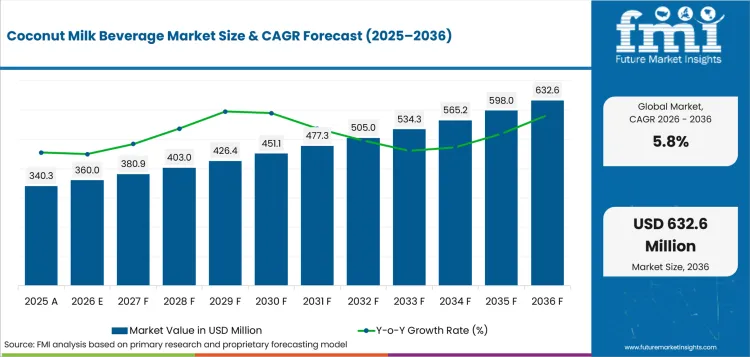
The coconut milk beverage market is likely to rise from USD 340.3 million in 2025 to USD 632.6 million by 2036, at a 5.8% CAGR, with growth supported by ready-to-drink dairy alternative use, clearerplant-based beverage labeling, while original coconut milk beverage holds 44.6% share and supermarkets lead sales with 51.7% share in 2024.
Key Takeaways, Market Size, and Forecast
- 2026 Market Size: USD 360.0 million
- 2036 Market Size: USD 632.6 million
- Forecast CAGR: 5.8% from 2026 to 2036
- Leading Product Type: Original Coconut Milk Beverage
- Original Coconut Milk Beverage Share in 2026: 44.6%
- Leading Packaging Format: Cartons
- Cartons Share in 2026: 48.2%
- Leading Sales Channel: Supermarkets
- Supermarkets Share in 2026: 51.7%
- Fastest-growing Country: South Korea
- South Korea CAGR: 7.2% by 2036
Summary of Coconut Milk Beverage Market
- Demand and Growth Drivers
- Coconut milk beverages are becoming a regular choice for shoppers who want dairy-free drinks.
- Ready-to-drink packs make coconut milk easier to use in breakfast and snacking routines.
- Clear front labels help shoppers separate beverages from cooking milk.
- Product and Segment View
- Original coconut milk beverages are expected to stay the main choice for daily use.
- Flavored coconut milk beverages can attract younger shoppers who want taste-led drinks.
- Fortified products help brands compete with other dairy alternatives on nutrition cues.
- Geography and Competitive Outlook
- North America has strong supermarket access for plant-based beverages.
- Europe and the United Kingdom need careful naming because dairy terms face closer review.
- Asian coconut processors are important because they have coconut sourcing and processing depth.
- Analyst Opinion
- Nandini Roy Choudhury, is Principal Consultant for Food and Beverage at Future Market Insights. She notes, “Coconut milk beverages are moving from trial purchases into regular plant-based drink use. Retailers are likely to compare label clarity and nutrition claims before expanding shelf space. Brands that separate beverage use from culinary coconut milk will have a cleaner growth route.”
- Coconut Milk Beverage Market Value Analysis
- Market value is forecast from eligible ready-to-drink coconut milk beverage products after cooking milk and coconut water are excluded.
- Supplier pricing reflects coconut input cost before flavor systems and packaging raise margin pressure.
- Revenue improves when brands move from plain coconut drinks toward fortified and flavored beverage lines.
- Retailer confidence improves when product labels explain drink use clearly.
Beverage brands are making coconut milk drink labels clearer as plant-based shelves become crowded. In January 2025, the United States Food and Drug Administration released draft guidance on naming and labeling plant-based alternatives to animal-derived foods. The guidance gives brands a clearer route to separate ready-to-drink coconut milk beverages from cooking coconut milk. Califia Farms launched Creamy Refreshers in March 2025 as dairy-free coconut and fruit beverages with nearly 60% less sugar than leading fruit juice beverages. This shows that coconut-based drinks are moving into refreshment use and not only dairy replacement use.
Coconut Milk Beverage Market Definition
Coconut milk beverage is a ready-to-drink plant-based drink made with coconut-derived ingredients and positioned for direct drinking. It is different from coconut cooking milk because the main use is beverage consumption and not recipe preparation. It is also different from coconut water because it has a creamier taste and is usually positioned as a dairy alternative. Shoppers use coconut milk beverages in breakfast and smoothies. Coffee and chilled drinking occasions add more use cases.
Coconut Milk Beverage Market Inclusions
Market scope covers ready-to-drink coconut milk beverages categorized by product type, including original coconut milk beverage, flavored coconut milk beverage, fortified coconut milk beverage, blended plant-based coconut beverage, and barista coconut milk beverage; flavor profile, including original, vanilla, chocolate, fruit blended, and coffee compatible; packaging format, including cartons, bottles, aseptic packs, multipacks, and single-serve packs; sales channel, including supermarkets, convenience stores, online grocery, club stores, and foodservice retail; and consumer group, including vegan consumers, lactose-sensitive consumers, flexitarian consumers, wellness-focused shoppers, and young adults. The scope also includes products sold within dairy alternative beverage shelves where drinking use, flavor clarity, nutrition cues, and pack convenience operate as the main purchase factors. Revenue scope covers 2026 to 2036. The key stakeholders include plant-based beverage brands, coconut processors, dairy alternative manufacturers, retailers, foodservice operators, packaging suppliers, ingredient suppliers, online grocery platforms, regulatory authorities, and distributors.
Coconut Milk Beverage Market Exclusions
Scope excludes coconut cooking milk and canned culinary coconut milk. Coconut water is outside the revenue count. Coconut cream and sweet cream of coconut are excluded unless sold as ready-to-drink beverages. Finished smoothies are excluded when coconut milk is only one ingredient. Powdered coconut milk is excluded unless it is sold as an instant beverage mix.
Coconut Milk Beverage Market Research Methodology
- Primary Research: Future Market Insights analysts reviewed ready-to-drink coconut milk beverage portfolios from Danone S.A. and Califia Farms, LLC. The review also covered The Vita Coco Company, Inc. and Vitasoy International Holdings Limited. Goya Foods, Inc. and GraceKennedy Limited were reviewed for coconut product visibility. The Hain Celestial Group, Inc. and PT Pulau Sambu were included. SunOpta Inc. completed the supplier review.
- Desk Research: Public data from the United States Food and Drug Administration and the United States Department of Agriculture Economic Research Service were reviewed. United States Department of Agriculture Foreign Agricultural Service and Court of Justice of the European Union sources were reviewed. Eurostat and Australian Bureau of Statistics data were checked. Statistics Bureau of Japan and Danone S.A. materials were included. Califia Farms, LLC materials were reviewed. Coupang, Inc. disclosures were reviewed. Official company product pages completed the desk review.
- Market Sizing and Forecasting: Estimated using a bottom-up product-boundary approach. Eligible product revenue and retail channel presence were used to construct the 2026 market estimate. Product positioning and flavor availability also supported the estimate. Country-level adoption completed the sizing inputs.
- Data Validation: Forecast checks compared ready-to-drink beverage claims and product range depth. Pack format and online retail access were reviewed. Dairy alternative shelf placement and country-level grocery activity completed validation.
Why is the Coconut Milk Beverage Market Growing?
- Packaged beverage brands are using coconut milk to serve dairy-free drinking needs.
- Retailers are giving more space to plant-based drinks that explain use clearly.
- Coconut milk beverages can serve breakfast and direct drinking occasions.
Coconut milk beverage demand is rising because shoppers want plant-based drinks that feel simple and familiar. Danone lists Alpro plant-based drinks across several bases, including coconut. Silk also lists coconut milk within its plant-based drink range. These portfolios show how coconut-based beverages sit inside wider plant-based drink shelves.
Large plant-based portfolios are making retail buyers more comfortable with coconut milk beverages. Danone stated that it was No. 1 worldwide in plant-based food and beverages in 2025. The company also reported €13.158 billion in total sales of essential dairy and plant-based products in 2025. This gives coconut milk beverages a stronger category setting because they can ride the wider plant-based drink shelf.
Coconut Milk Beverage Market Segmentation Analysis
- Original coconut milk beverage is expected to hold 44.6% share in 2026 because it fits daily dairy alternative use.
- Fortified coconut milk beverage is forecast to secure 22.4% share in 2026. Nutrition cues help it compete with other plant-based drinks.
- Cartons are expected to capture the main packaging position in 2026 at 48.2% share. Retailers prefer this format for chilled and shelf-stable beverage aisles.
- Supermarkets are forecast to lead sales with 51.7% share in 2026 because plant-based drinks need shelf visibility before repeat purchase begins.
- Lactose-sensitive consumers are expected to represent 34.3% share in 2026 as coconut milk beverages give this group a clear dairy-free option.
The market is divided into five primary segment groups based on product type and flavor profile. Packaging format, sales channel and consumer group complete the structure. Product type covers original coconut milk beverage and flavored coconut milk beverage. Fortified coconut milk beverage and barista coconut milk beverage complete the group. Flavor profile covers original and vanilla. Chocolate and fruit blended variants complete the flavor scope. Packaging format covers cartons and bottles. Aseptic packs and single-serve packs complete the packaging scope. Sales channel covers supermarkets and online grocery. Convenience stores and club stores complete the channel scope. Consumer group covers vegan consumers and lactose-sensitive consumers. Flexitarian consumers and wellness-focused shoppers complete the demand base.
Insights into Coconut Milk Beverage Market by Product Type
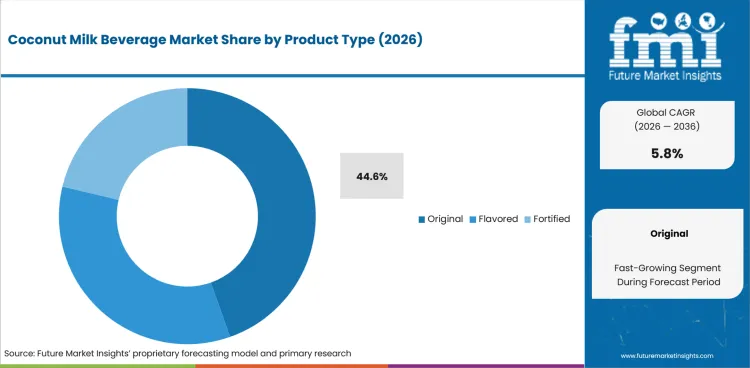
- Original coconut milk beverage is expected to hold 44.6% share in 2026 because it fits daily drinking and breakfast use.
- Fortified coconut milk beverage is forecast to secure 22.4% share in 2026. Nutrition claims help it compete with the plant-based milk alternatives.
Insights into Coconut Milk Beverage Market by Flavor Profile
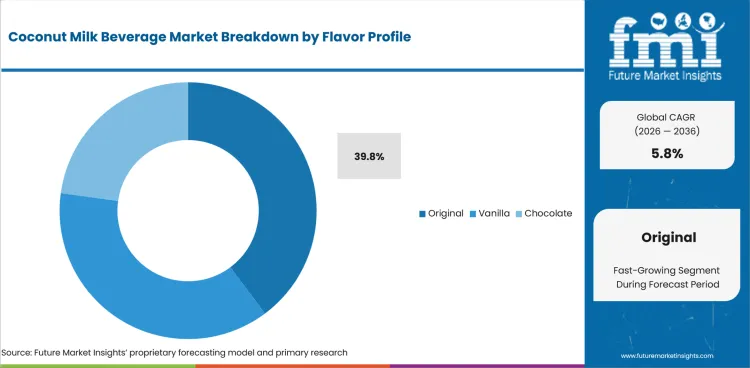
- Original flavor is anticipated to account for 39.8% share in 2026 because shoppers can use it in cereal and smoothies. Coffee use supports the same plain-flavor position.
- Chocolate coconut milk beverage is projected to hold 17.5% share in 2026. Taste-led packs can influence demand for plant-based beverages among younger shoppers.
Insights into Coconut Milk Beverage Market by Packaging Format
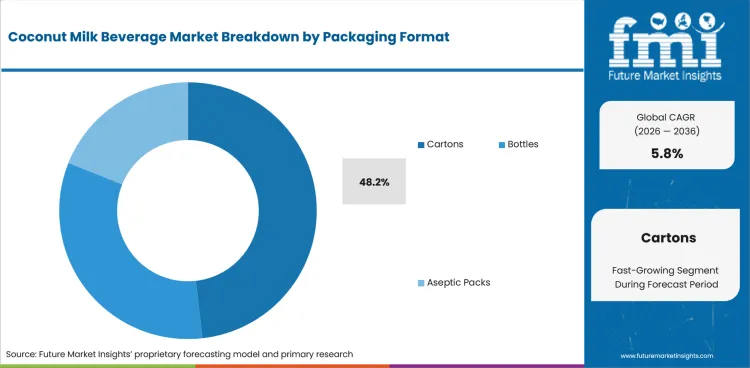
- Cartons are expected to capture 48.2% share in 2026 because they work well on chilled and shelf-stable beverage shelves.
- Single-serve packs are forecast to hold 16.9% share in 2026. They suit quick drinking occasions and help brands reach convenience stores.
Insights into Coconut Milk Beverage Market by Sales Channel
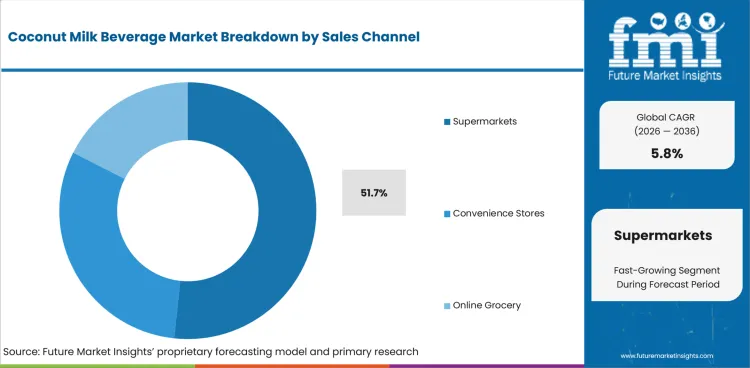
- Supermarkets are expected to lead with 51.7% share in 2026 because shoppers compare dairy-free drinks directly on shelves.
- Online grocery is projected to capture 14.6% share in 2026. Repeat orders can improve once shoppers find a trusted coconut milk beverage brand.
Insights into Coconut Milk Beverage Market by Consumer Group
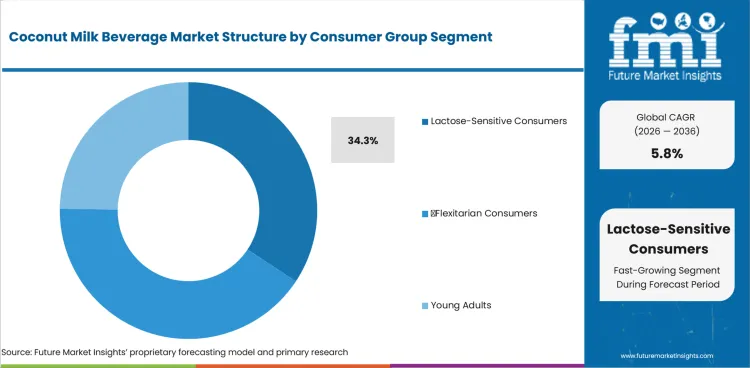
- Lactose-sensitive consumers are expected to represent 34.3% share in 2026 because coconut milk beverages give them a simple dairy-free option.
- Flexitarian consumers are forecast to hold 28.1% share in 2026. This group uses dairy alternatives for variety without fully removing dairy from the diet.
Coconut Milk Beverage Market Drivers, Restraints, and Opportunities
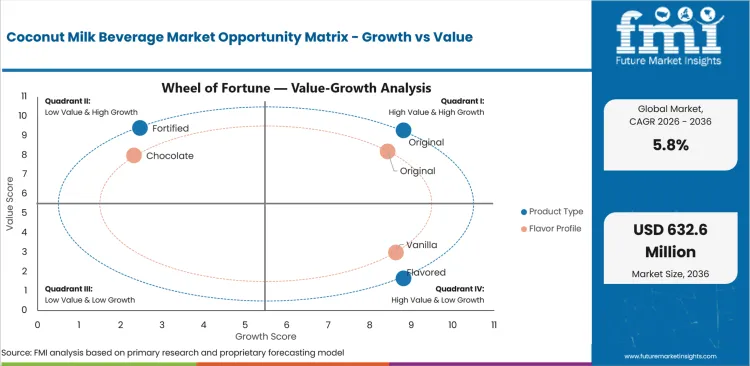
- Driver: Dairy-free beverage use is creating repeat demand for ready-to-drink coconut milk.
- Restraint: Sugar and additive concerns can slow flavored coconut milk beverage adoption.
- Opportunity: Fortified and low-sugar variants can give brands a clearer shelf position.
Demand is moving toward coconut milk beverages that feel lighter and easier to compare. Califia Farms launched Creamy Refreshers in March 2025 as dairy-free coconut and fruit beverages. The company stated that the line has nearly 60% less sugar than leading fruit juice beverages. This gives coconut-based drinks a stronger route into refreshment shelves and not only dairy alternative sections.
Nutrition positioning is also becoming more important because plant-based drinks compete with dairy milk. Califia Farms introduced Califia Farms Complete in February 2024 with 9 essential nutrients and 8 grams of protein. The launch also listed all 9 essential amino acids and 50% less sugar than dairy milk. This raises the standard for coconut milk beverage brands because shoppers now compare plant-based drinks on taste and nutrition together.
Raw Material Price and Formulation Cost Analysis
Coconut milk beverage pricing is sensitive to coconut ingredient cost and processing stability. Brands also need to manage flavor systems and fortification inputs. Beverage packaging adds another cost pressure. Cost pressure can increase when coconut supply tightens or freight costs rise. Formulation teams must balance taste with clean label expectations. Suppliers that use stable coconut input contracts and efficient packaging plans are better placed to protect margins.
Analysis of Coconut Milk Beverage Market by Key Countries and Regions
.webp "Top Country Growth Comparison Coconut Milk Beverage Market Cagr (2026 2036)")
| Country or Region | CAGR |
|---|---|
| South Korea | 7.2% |
| Saudi Arabia | 6.8% |
| Gulf Cooperation Council | 6.6% |
| Australia | 6.4% |
| Canada | 6.1% |
| United Kingdom | 5.9% |
| United States | 5.7% |
| European Union | 5.4% |
| Japan | 5.0% |
Source: Future Market Insights, 2026.
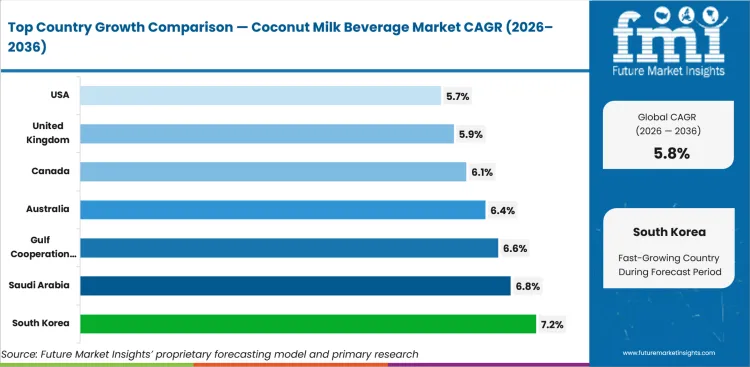
Coconut Milk Beverage Market CAGR Analysis by Country and Region
- South Korea is expected to record 7.2% CAGR by 2036. Online grocery use and compact beverage packs can support repeat purchase.
- Saudi Arabia is projected to expand at 6.8% CAGR through 2036 because imported dairy alternatives are gaining space in modern grocery stores.
- The Gulf Cooperation Council market is anticipated to rise at 6.6% CAGR by 2036. Premium grocery chains and expatriate demand guide plant-based beverage trials.
- Australia is forecast to move ahead at 6.4% CAGR over the forecast period. Supermarket access and dairy-free beverage awareness help demand.
- Canada is expected to advance at 6.1% CAGR by 2036. Multicultural retail shelves and health-focused beverage demand guide growth.
- The United Kingdom is projected to register 5.9% CAGR through 2036. Online grocery and plant-based drink habits help repeat orders.
- The United States is forecast to rise at 5.7% CAGR by 2036 as mainstream grocery shelves and dairy-free drinking occasions keep demand steady.
- The European Union is anticipated to expand at 5.4% CAGR over the forecast period. Label clarity and plant-based retail access will guide adoption.
- Japan is expected to record 5.0% CAGR by 2036. Compact packs and careful label review shape the market route.
Sales Outlook for Coconut Milk Beverage Market in the United States
Plant-based beverage shelves and breakfast use · 2026 to 2036
Country Market Snapshot Table
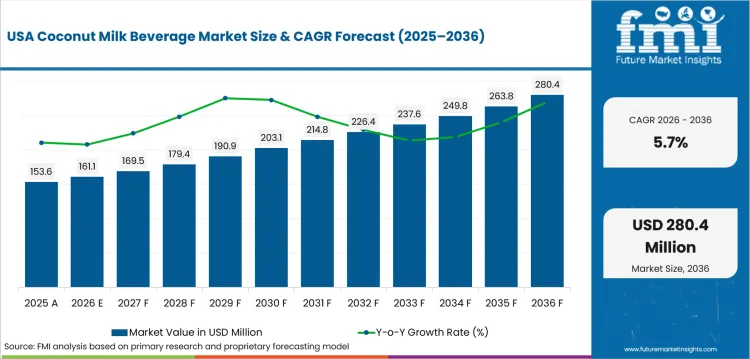
| Parameter | Value |
|---|---|
| Market Size in 2025 (Value) | USD 87.0 million |
| Market Size in 2026 (Value) | USD 92.0 million |
| Market Forecast in 2036 (Value) | USD 160.2 million |
| CAGR (2026 to 2036) | 5.7% |
| Years Considered | 2021 to 2036 |
| Base Year | 2025 |
| Forecast Period | 2026 to 2036 |
| Units Considered | Value (USD million) |
| Leading Sub-Region | Coastal supermarket and natural retail corridors |
United States Coconut Milk Beverage Market Outlook
United States coconut milk beverage demand is expected to expand at 5.7% CAGR through 2036. Mainstream grocery stores place coconut milk beverages near almond and oat drinks. Soy drinks add another comparison point. Clear label wording is important because shoppers compare plant-based beverages quickly.
Retail brands are expected to perform better when product names explain beverage use. Coconut milk beverages can serve breakfast and coffee occasions. Low-sugar and fortified products are likely to receive stronger shelf review.
Key Growth Drivers
- Grocery retailers need clear dairy-free beverages for repeat household trips. USDA Economic Research Service reported total United States food spending of USD 2.51 trillion in 2025. This gives coconut milk beverages a broad retail base.
- Foodservice and café use can help coconut milk beverages enter coffee and smoothie occasions. USDA Economic Research Service reported food-away-from-home spending of USD 1.41 trillion in 2025. This creates a route for beverage packs beyond household cartons.
- Plant-based brands are expected to use front-label wording to keep beverage products separate from cooking coconut milk.
- Fortified coconut milk beverages can compete better when shoppers compare dairy alternatives by nutrition.
Key Restraints
- Premium coconut milk beverages can face slower rotation if shoppers compare them with lower-priced almond and oat drinks.
- Beverage coconut milk can lose shelf clarity when placed near coconut water or cooking milk.
- Grocery shoppers can become more cautious during food-price pressure. USDA Economic Research Service reported that food-at-home prices increased 2.3% in 2025. This can slow faster movement for premium refrigerated packs.
What makes the United States unique
The United States has wide plant-based beverage visibility and strong natural retail access. Coconut milk beverages can reach shoppers through breakfast routines and café-style drinking.
Key Companies
- Danone S.A.
- Califia Farms, LLC
- The Vita Coco Company, Inc.
- Goya Foods, Inc.
- The Hain Celestial Group, Inc.
Sales & Marketing Channels
- Supermarkets
- Natural food stores
- Club stores
- Online grocery platforms
- Convenience stores
- Foodservice beverage accounts
Country Segment Breakdown Table
| Segment | Sub-Segments |
|---|---|
| By Product Type | Original Coconut Milk Beverage · Flavored Coconut Milk Beverage · Fortified Coconut Milk Beverage · Blended Plant-Based Coconut Beverage · Barista Coconut Milk Beverage |
| By Flavor Profile | Original · Vanilla · Chocolate · Fruit Blended · Coffee Compatible |
| By Packaging Format | Cartons · Bottles · Aseptic Packs · Multipacks · Single-Serve Packs |
| By Sales Channel | Supermarkets · Convenience Stores · Online Grocery · Club Stores · Foodservice Retail |
| By Consumer Group | Vegan Consumers · Lactose-Sensitive Consumers · Flexitarian Consumers · Wellness-Focused Shoppers · Young Adults |
| Key Sub-Regions Covered, Retail and Beverage Corridors | California · New York · Texas · Florida · Washington · Illinois · New Jersey |
Frequently Asked Questions
How fast is the United States coconut milk beverage market expanding?
The United States coconut milk beverage market is expected to expand at 5.7% CAGR by 2036. Mainstream plant-based beverage shelves guide demand.
Who leads the United States coconut milk beverage market?
Danone and Califia Farms are active in plant-based and coconut beverage routes. The Vita Coco Company and The Hain Celestial Group also support this route. Goya Foods adds coconut product access through multicultural retail.
What is driving coconut milk beverage adoption in the United States?
Clear dairy-free positioning and ready-to-drink use create demand across grocery shelves and online baskets.
Sales Outlook for Coconut Milk Beverage Market in Canada
Multicultural grocery access and dairy-free beverages · 2026 to 2036
Country Market Snapshot Table
| Parameter | Value |
|---|---|
| Market Size in 2025 (Value) | USD 21.7 million |
| Market Size in 2026 (Value) | USD 23.0 million |
| Market Forecast in 2036 (Value) | USD 41.6 million |
| CAGR (2026 to 2036) | 6.1% |
| Years Considered | 2021 to 2036 |
| Base Year | 2025 |
| Forecast Period | 2026 to 2036 |
| Units Considered | Value (USD million) |
| Leading Sub-Region | Ontario and British Columbia retail corridors |
Canada Coconut Milk Beverage Market Outlook
Canada is forecast to register 6.1% CAGR in coconut milk beverages from 2026 to 2036. Multicultural grocery shelves give coconut-based beverages a clear retail route. Health-focused shoppers can also help dairy-free beverage use.
Canadian retailers are expected to favor brands with simple front labels and bilingual packaging. Coconut milk beverage demand can improve when products sit near other dairy alternatives. Online grocery can help known brands receive repeat orders.
Key Growth Drivers
- Canada has a large grocery base for dairy alternative beverages. USDA Foreign Agricultural Service reported Canada food retail sales of USD 113.0 billion in 2024. This gives coconut milk beverages a strong supermarket setting.
- Food processors can use coconut beverages in chilled drinks and blended products. USDA Foreign Agricultural Service reported Canada food and beverage processing sales of USD 116.0 billion in 2024. This gives suppliers a route beyond retail cartons.
- Bilingual labels are expected to improve shelf review for imported coconut milk beverages.
- Online grocery can help shoppers reorder coconut milk beverages after trial.
Key Restraints
- Long import routes can raise landed cost for coconut-based beverages.
- Chilled products can face higher distribution cost than shelf-stable cartons.
- Retailer concentration can make national listings difficult for smaller beverage brands. USDA Foreign Agricultural Service reported that five leading retailers controlled over 65.0% of Canada’s grocery market in 2024.
What makes Canada unique
Canada combines multicultural grocery demand with strong interest in plant-based drinks. Brands need clear labels and steady supply before wider retail acceptance improves.
Key Companies
- Danone S.A.
- Vitasoy International Holdings Limited
- GraceKennedy Limited
- Goya Foods, Inc.
- SunOpta Inc.
Sales & Marketing Channels
- Supermarkets
- Natural food stores
- Online grocery platforms
- Ethnic grocery stores
- Club stores
- Import distributors
Country Segment Breakdown Table
| Segment | Sub-Segments |
|---|---|
| By Product Type | Original Coconut Milk Beverage · Flavored Coconut Milk Beverage · Fortified Coconut Milk Beverage · Blended Plant-Based Coconut Beverage · Barista Coconut Milk Beverage |
| By Flavor Profile | Original · Vanilla · Chocolate · Fruit Blended · Coffee Compatible |
| By Packaging Format | Cartons · Bottles · Aseptic Packs · Multipacks · Single-Serve Packs |
| By Sales Channel | Supermarkets · Convenience Stores · Online Grocery · Club Stores · Foodservice Retail |
| By Consumer Group | Vegan Consumers · Lactose-Sensitive Consumers · Flexitarian Consumers · Wellness-Focused Shoppers · Young Adults |
| Key Sub-Regions Covered, Provinces and Retail Areas | Ontario · British Columbia · Quebec · Alberta · Manitoba · Nova Scotia · Saskatchewan |
Frequently Asked Questions
How fast is Canada coconut milk beverage market expanding?
Canada coconut milk beverage demand is projected to expand at 6.1% CAGR from 2026 to 2036.
Who leads Canada coconut milk beverage market?
Danone and Vitasoy are relevant to plant-based beverage supply and retail access. GraceKennedy and SunOpta also support the market through beverage or processing routes. Goya Foods adds coconut product access.
What is driving adoption in Canada?
Multicultural retail shelves and dairy-free drinking demand guide coconut milk beverage purchases.
Demand Outlook for Coconut Milk Beverage Market in the European Union
Label clarity and plant-based beverage access · 2026 to 2036
Regional Market Snapshot Table
| Parameter | Value |
|---|---|
| Market Size in 2025 (Value) | USD 55.0 million |
| Market Size in 2026 (Value) | USD 58.0 million |
| Market Forecast in 2036 (Value) | USD 98.1 million |
| CAGR (2026 to 2036) | 5.4% |
| Years Considered | 2021 to 2036 |
| Base Year | 2025 |
| Forecast Period | 2026 to 2036 |
| Units Considered | Value (USD million) |
| Leading Sub-Region | Western Europe retail corridor |
European Union Coconut Milk Beverage Market Outlook
The European Union coconut milk beverage market is anticipated to expand at 5.4% CAGR during the forecast period. Plant-based beverage shelves are mature in Western Europe. Product naming needs careful review because dairy terms face close regulatory attention.
Brands are expected to use clear “drink” or “beverage” wording. Coconut milk beverage growth can improve through fortified and barista formats. Retailers may favor products with simple nutrition claims and recyclable packs.
Key Growth Drivers
- Online retail habits can help plant-based beverage reorders. Eurostat reported that 78% of European Union internet users bought goods or services online in 2025.
- Plant-based beverage labels need careful naming under European food law. The Court of Justice of the European Union delivered judgment in Case C-438/23 on October 4, 2024. This keeps label review important for plant-based brands.
- Barista coconut beverages can gain traction through café and home coffee use.
- Fortified coconut milk beverages can improve competitiveness against oat and soy drinks.
Key Restraints
- Dairy-term rules can make naming and marketing more complex for plant-based beverages.
- Coconut-based beverages can face cost pressure because coconut raw materials are imported into many European markets.
- Price differences across the European Union can affect premium beverage rotation. Eurostat reported that 2024 food and non-alcoholic beverage price levels were 24% above the European Union average in Luxembourg and 22% below the average in Romania.
What makes the European Union unique
The European Union rewards clear labels and nutrition consistency. Coconut milk beverage brands need careful naming and strong retail education.
Key Companies
- Danone S.A.
- Alpro
- Vitasoy International Holdings Limited
- The Hain Celestial Group, Inc.
- Califia Farms, LLC.
Sales & Marketing Channels
- Supermarkets
- Hypermarkets
- Online grocery platforms
- Organic food stores
- Café supply channels
- Specialty beverage retailers
Country Segment Breakdown Table
| Segment | Sub-Segments |
|---|---|
| By Product Type | Original Coconut Milk Beverage · Flavored Coconut Milk Beverage · Fortified Coconut Milk Beverage · Blended Plant-Based Coconut Beverage · Barista Coconut Milk Beverage |
| By Flavor Profile | Original · Vanilla · Chocolate · Fruit Blended · Coffee Compatible |
| By Packaging Format | Cartons · Bottles · Aseptic Packs · Multipacks · Single-Serve Packs |
| By Sales Channel | Supermarkets · Convenience Stores · Online Grocery · Club Stores · Foodservice Retail |
| By Consumer Group | Vegan Consumers · Lactose-Sensitive Consumers · Flexitarian Consumers · Wellness-Focused Shoppers · Young Adults |
| Key Sub-Regions Covered, Member States and Retail Areas | Germany · France · Italy · Spain · Netherlands · Belgium · Sweden · Poland |
Frequently Asked Questions
How fast is the European Union coconut milk beverage market expanding?
The European Union market is expected to expand at 5.4% CAGR through 2036.
Who leads coconut milk beverage supply in the European Union?
Danone and Alpro have strong plant-based beverage visibility. Vitasoy and Hain Celestial support wider dairy alternative supply. Califia Farms adds plant-based beverage depth.
What is driving adoption in the European Union?
Plant-based drink familiarity and barista beverage use guide coconut milk beverage demand.
Demand Outlook for Coconut Milk Beverage Market in the United Kingdom
Online grocery and plant-based drink habits · 2026 to 2036
Country Market Snapshot Table
| Parameter | Value |
|---|---|
| Market Size in 2025 (Value) | USD 20.8 million |
| Market Size in 2026 (Value) | USD 22.0 million |
| Market Forecast in 2036 (Value) | USD 39.0 million |
| CAGR (2026 to 2036) | 5.9% |
| Years Considered | 2021 to 2036 |
| Base Year | 2025 |
| Forecast Period | 2026 to 2036 |
| Units Considered | Value (USD million) |
| Leading Sub-Region | England grocery corridor |
United Kingdom Coconut Milk Beverage Market Outlook
The United Kingdom coconut milk beverage sector is expected to record 5.9% CAGR between 2026 and 2036. Plant-based drink use is familiar across major grocery chains. Online baskets can help known beverage brands receive repeat purchases.
Retailers are expected to favor products with clean labels and stable pricing. Coconut milk beverages need strong shelf identity because oat and almond drinks are widely available. Barista variants can help café-style home use.
Key Growth Drivers
- Online grocery can help repeat beverage orders. USDA Foreign Agricultural Service reported that online purchases accounted for 13.0% of United Kingdom grocery sales in 2025.
- Foodservice gives coconut milk beverages a café and cold-drink route. USDA Foreign Agricultural Service reported United Kingdom foodservice food and drink sales of USD 133.0 billion in 2024.
- Barista coconut beverages can serve coffee use at home and in cafés.
- Original and unsweetened variants can attract shoppers who want simpler daily drinks.
Key Restraints
- Price pressure can limit premium coconut milk beverage rotation.
- Oat drinks may compete strongly because shoppers often connect them with coffee use.
- Retail concentration can restrict new listings. USDA Foreign Agricultural Service reported that the top four United Kingdom retailers accounted for 66.0% of the market based on February 2026 figures.
What makes the United Kingdom unique
The United Kingdom has strong plant-based drink awareness and mature online grocery habits. Clear beverage wording and familiar pack formats are important for coconut milk brands.
Key Companies
- Danone S.A.
- Alpro
- Califia Farms, LLC.
- Grace Foods UK Limited
- The Hain Celestial Group, Inc.
Sales & Marketing Channels
- Supermarkets
- Online grocery platforms
- Convenience stores
- Natural food stores
- Café supply channels
- Club stores
Country Segment Breakdown Table
| Segment | Sub-Segments |
|---|---|
| By Product Type | Original Coconut Milk Beverage · Flavored Coconut Milk Beverage · Fortified Coconut Milk Beverage · Blended Plant-Based Coconut Beverage · Barista Coconut Milk Beverage |
| By Flavor Profile | Original · Vanilla · Chocolate · Fruit Blended · Coffee Compatible |
| By Packaging Format | Cartons · Bottles · Aseptic Packs · Multipacks · Single-Serve Packs |
| By Sales Channel | Supermarkets · Convenience Stores · Online Grocery · Club Stores · Foodservice Retail |
| By Consumer Group | Vegan Consumers · Lactose-Sensitive Consumers · Flexitarian Consumers · Wellness-Focused Shoppers · Young Adults |
| Key Sub-Regions Covered, Countries and Retail Areas | England · Scotland · Wales · Northern Ireland · London · Manchester · Birmingham |
Frequently Asked Questions
How fast is the United Kingdom coconut milk beverage market expanding?
The United Kingdom coconut milk beverage market is anticipated to expand at 5.9% CAGR during the forecast period.
Who leads the United Kingdom coconut milk beverage market?
Danone and Alpro support plant-based beverage supply. Califia Farms and Grace Foods UK add dairy-free product access. The Hain Celestial Group adds packaged natural food reach.
What is driving adoption in the United Kingdom?
Online grocery habits and plant-based drink familiarity create repeat demand.
Demand Outlook for Coconut Milk Beverage Market in the Gulf Cooperation Council
Premium grocery shelves and imported dairy alternatives · 2026 to 2036
Regional Market Snapshot Table
| Parameter | Value |
|---|---|
| Market Size in 2025 (Value) | USD 27.2 million |
| Market Size in 2026 (Value) | USD 29.0 million |
| Market Forecast in 2036 (Value) | USD 55.0 million |
| CAGR (2026 to 2036) | 6.6% |
| Years Considered | 2021 to 2036 |
| Base Year | 2025 |
| Forecast Period | 2026 to 2036 |
| Units Considered | Value (USD million) |
| Leading Sub-Region | United Arab Emirates and Saudi retail corridors |
Gulf Cooperation Council Coconut Milk Beverage Market Outlook
The Gulf Cooperation Council coconut milk beverage market is forecast to expand at 6.6% CAGR through 2036. Imported plant-based drinks reach consumers through premium supermarkets and online grocery platforms. Expatriate demand also helps dairy alternative beverage trials.
Retailers are expected to favor brands with Arabic label readiness and stable supply. Coconut milk beverages can improve as chilled and shelf-stable plant-based drinks become more familiar. Single-serve formats may help convenience retail.
Key Growth Drivers
- Premium supermarkets give imported dairy alternatives a strong modern retail route. USDA Foreign Agricultural Service reported United Arab Emirates grocery retail sales of USD 18.2 billion in 2024.
- Online ordering can help niche plant-based drinks move beyond premium store shelves. USDA Foreign Agricultural Service reported United Arab Emirates food e-commerce retail sales of USD 1.1 billion in 2024.
- Arabic label readiness can improve retail approval for imported coconut milk beverages.
- Single-serve packs can help convenience stores and workplace consumption.
Key Restraints
- Long import routes can raise shelf price for coconut milk beverages.
- Cold-chain cost can limit chilled coconut beverage distribution.
- Import exposure is a planning risk for beverage brands. USDA Foreign Agricultural Service reported that about 80% of United Arab Emirates agricultural products are imported.
What makes the Gulf Cooperation Council unique
The Gulf Cooperation Council market depends on import access and modern grocery execution. Brands that combine label readiness with reliable stock cover should perform better.
Key Companies
- Danone S.A.
- Califia Farms, LLC.
- The Vita Coco Company, Inc.
- GraceKennedy Limited
- PT Pulau Sambu
Sales & Marketing Channels
- Premium supermarkets
- Hypermarkets
- Online grocery platforms
- Convenience stores
- Hotel retail outlets
- Import distributors
Country Segment Breakdown Table
| Segment | Sub-Segments |
|---|---|
| By Product Type | Original Coconut Milk Beverage · Flavored Coconut Milk Beverage · Fortified Coconut Milk Beverage · Blended Plant-Based Coconut Beverage · Barista Coconut Milk Beverage |
| By Flavor Profile | Original · Vanilla · Chocolate · Fruit Blended · Coffee Compatible |
| By Packaging Format | Cartons · Bottles · Aseptic Packs · Multipacks · Single-Serve Packs |
| By Sales Channel | Supermarkets · Convenience Stores · Online Grocery · Club Stores · Foodservice Retail |
| By Consumer Group | Vegan Consumers · Lactose-Sensitive Consumers · Flexitarian Consumers · Wellness-Focused Shoppers · Young Adults |
| Key Sub-Regions Covered, Gulf Retail Areas | United Arab Emirates · Saudi Arabia · Qatar · Kuwait · Oman · Bahrain |
Frequently Asked Questions
How fast is the Gulf Cooperation Council coconut milk beverage market expanding?
The Gulf Cooperation Council market is expected to grow at 6.6% CAGR from 2026 to 2036.
Who leads coconut milk beverage supply in the Gulf Cooperation Council?
Danone and Califia Farms are relevant to imported plant-based beverage access. The Vita Coco Company and GraceKennedy also support coconut beverage routes. PT Pulau Sambu adds coconut processing depth.
What is driving demand in the Gulf Cooperation Council?
Premium grocery growth and dairy alternative trial help coconut milk beverage demand.
Demand Outlook for Coconut Milk Beverage Market in Saudi Arabia
Imported beverage shelves and modern retail · 2026 to 2036
Country Market Snapshot Table
| Parameter | Value |
|---|---|
| Market Size in 2025 (Value) | USD 11.2 million |
| Market Size in 2026 (Value) | USD 12.0 million |
| Market Forecast in 2036 (Value) | USD 23.2 million |
| CAGR (2026 to 2036) | 6.8% |
| Years Considered | 2021 to 2036 |
| Base Year | 2025 |
| Forecast Period | 2026 to 2036 |
| Units Considered | Value (USD million) |
| Leading Sub-Region | Riyadh and Jeddah retail corridor |
Saudi Arabia Coconut Milk Beverage Market Outlook
Saudi Arabia is projected to advance at 6.8% CAGR in coconut milk beverages from 2026 to 2036. Modern grocery chains help imported dairy alternatives reach households. Coconut milk beverages can serve shoppers who want dairy-free drinks and tropical flavors.
Foodservice retail can also help coconut milk beverages through cafés and hotel outlets. Brands are expected to benefit from Arabic labels and clear dairy-free claims. Single-serve packs may improve trial in convenience-led locations.
Key Growth Drivers
- Modern grocery stores give coconut milk beverages a retail base. USDA Foreign Agricultural Service reported Saudi food retail sales of more than USD 50.0 billion in 2024.
- Cafés and hotels can introduce coconut milk beverages through coffee and blended drinks. USDA Foreign Agricultural Service reported Saudi foodservice sales of USD 30.0 billion in 2024.
- Arabic label readiness can make imported plant-based beverages easier to approve.
- Premium supermarkets can support trial for chilled and shelf-stable coconut beverages.
Key Restraints
- Imported coconut beverages can face landed-cost pressure.
- Premium products may move slowly when shoppers focus on value.
- Import dependence can raise supply risk for coconut milk beverage brands. USDA Foreign Agricultural Service reported that Saudi Arabia relies on imports for 70.0% of food demand.
What makes Saudi Arabia unique
Saudi Arabia has a strong imported grocery route and a growing café culture. Coconut milk beverage suppliers need stable distribution and clear labels to expand.
Key Companies
- Danone S.A.
- Califia Farms, LLC.
- The Vita Coco Company, Inc.
- GraceKennedy Limited
- Goya Foods, Inc.
Sales & Marketing Channels
- Modern grocery chains
- Premium supermarkets
- Online grocery platforms
- Convenience stores
- Café outlets
- Import distributors
Country Segment Breakdown Table
| Segment | Sub-Segments |
|---|---|
| By Product Type | Original Coconut Milk Beverage · Flavored Coconut Milk Beverage · Fortified Coconut Milk Beverage · Blended Plant-Based Coconut Beverage · Barista Coconut Milk Beverage |
| By Flavor Profile | Original · Vanilla · Chocolate · Fruit Blended · Coffee Compatible |
| By Packaging Format | Cartons · Bottles · Aseptic Packs · Multipacks · Single-Serve Packs |
| By Sales Channel | Supermarkets · Convenience Stores · Online Grocery · Club Stores · Foodservice Retail |
| By Consumer Group | Vegan Consumers · Lactose-Sensitive Consumers · Flexitarian Consumers · Wellness-Focused Shoppers · Young Adults |
| Key Sub-Regions Covered, Cities and Retail Areas | Riyadh · Jeddah · Dammam · Mecca · Medina · Khobar · Al Ahsa |
Frequently Asked Questions
How fast is Saudi Arabia coconut milk beverage market expanding?
Saudi Arabia coconut milk beverage demand is expected to expand at 6.8% CAGR during the forecast period.
Who leads Saudi Arabia coconut milk beverage market?
Danone and Califia Farms support imported dairy alternative routes. The Vita Coco Company and GraceKennedy add coconut beverage visibility. Goya Foods adds multicultural coconut product reach.
What is driving adoption in Saudi Arabia?
Modern grocery access and dairy-free beverage trial help demand.
Sales Outlook for Coconut Milk Beverage Market in South Korea
Online retail and compact beverage packs · 2026 to 2036
Country Market Snapshot Table
| Parameter | Value |
|---|---|
| Market Size in 2025 (Value) | USD 22.4 million |
| Market Size in 2026 (Value) | USD 24.0 million |
| Market Forecast in 2036 (Value) | USD 48.1 million |
| CAGR (2026 to 2036) | 7.2% |
| Years Considered | 2021 to 2036 |
| Base Year | 2025 |
| Forecast Period | 2026 to 2036 |
| Units Considered | Value (USD million) |
| Leading Sub-Region | Seoul online and grocery corridor |
South Korea Coconut Milk Beverage Market Outlook
South Korea is expected to record 7.2% CAGR in coconut milk beverages by 2036. Smaller households and online grocery behavior make compact packs useful. Imported plant-based drinks can grow when product pages explain taste and nutrition clearly.
Retailers are expected to favor single-serve and smaller cartons. Coconut milk beverages can also receive trial through café-style use and flavored variants. Korean-language cues are important because shoppers need to understand that the product is a ready-to-drink beverage.
Key Growth Drivers
- Imported food channels create access for plant-based drinks. USDA Foreign Agricultural Service reported South Korea imported about USD 20.6 billion in consumer-oriented agricultural products in 2024.
- Online retail can help repeat purchase after shoppers choose a familiar drink. Coupang reported Product Commerce Active Customers of 22.8 million in the fourth quarter of 2024.
- Compact cartons can suit smaller homes and quick beverage use.
- Flavored coconut milk beverages can support trial among younger shoppers.
Key Restraints
- Imported beverage brands need Korean-language product pages and label clarity.
- Larger household packs can move slowly when shoppers prefer compact formats.
- Online competition can raise product-page expectations for imported drinks. Coupang reported Product Commerce gross profit margin of 32.7% in the fourth quarter of 2024. This shows how large platforms can set high standards for pricing and merchandising.
What makes South Korea unique
South Korea combines online grocery scale with compact household needs. Coconut milk beverage brands need clear digital content and practical pack sizes.
Key Companies
- Danone S.A.
- The Vita Coco Company, Inc.
- Vitasoy International Holdings Limited
- PT Pulau Sambu
- Goya Foods, Inc.
Sales & Marketing Channels
- Online grocery platforms
- Supermarkets
- Convenience stores
- Café retail
- Import grocery stores
- Club stores
Country Segment Breakdown Table
| Segment | Sub-Segments |
|---|---|
| By Product Type | Original Coconut Milk Beverage · Flavored Coconut Milk Beverage · Fortified Coconut Milk Beverage · Blended Plant-Based Coconut Beverage · Barista Coconut Milk Beverage |
| By Flavor Profile | Original · Vanilla · Chocolate · Fruit Blended · Coffee Compatible |
| By Packaging Format | Cartons · Bottles · Aseptic Packs · Multipacks · Single-Serve Packs |
| By Sales Channel | Supermarkets · Convenience Stores · Online Grocery · Club Stores · Foodservice Retail |
| By Consumer Group | Vegan Consumers · Lactose-Sensitive Consumers · Flexitarian Consumers · Wellness-Focused Shoppers · Young Adults |
| Key Sub-Regions Covered, Cities and Retail Areas | Seoul · Busan · Incheon · Daegu · Daejeon · Gwangju · Ulsan |
Frequently Asked Questions
How fast is South Korea coconut milk beverage market expanding?
South Korea coconut milk beverage demand is projected to expand at 7.2% CAGR during the forecast period.
Who leads South Korea coconut milk beverage market?
Danone and The Vita Coco Company are relevant to imported and plant-based beverage supply. Vitasoy and PT Pulau Sambu add regional beverage or processing depth. Goya Foods supports coconut product access.
What is driving adoption in South Korea?
Online ordering and compact beverage packs help coconut milk beverage demand.
Demand Analysis for Coconut Milk Beverage Market in Japan
Careful label review and compact retail packs · 2026 to 2036
Country Market Snapshot Table
| Parameter | Value |
|---|---|
| Market Size in 2025 (Value) | USD 24.8 million |
| Market Size in 2026 (Value) | USD 26.0 million |
| Market Forecast in 2036 (Value) | USD 42.4 million |
| CAGR (2026 to 2036) | 5.0% |
| Years Considered | 2021 to 2036 |
| Base Year | 2025 |
| Forecast Period | 2026 to 2036 |
| Units Considered | Value (USD million) |
| Leading Sub-Region | Tokyo and Osaka retail corridor |
Japan Coconut Milk Beverage Market Outlook
Japan is expected to record 5.0% CAGR in coconut milk beverages by 2036. Shoppers review labels carefully and retailers expect consistent quality. Compact cartons and single-serve packs can fit smaller households.
Coconut milk beverages may grow through breakfast and café-style use. Fortified products can receive attention when nutrition claims are simple. Brands need clean packaging and reliable distributor support.
Key Growth Drivers
- Japan has a strong food and beverage retail base. USDA Foreign Agricultural Service reported retail food and beverage sales of USD 193.0 billion in 2024.
- Food processors can use coconut beverages in health-oriented and shelf-stable formats. USDA Foreign Agricultural Service reported Japan’s food processing sector at USD 174.0 billion in 2025.
- Compact retail formats can help coconut milk beverages fit small household routines.
- Café-compatible products can support hot and iced drink use.
Key Restraints
- Product quality review can slow new imported beverage listings.
- Shoppers may prefer smaller packs if coconut milk beverage use is occasional.
- Food inflation can make premium beverages harder to rotate. Statistics Bureau of Japan reported that the food index rose 6.8% in 2025.
What makes Japan unique
Japan rewards clean packaging and predictable taste. Coconut milk beverage suppliers need careful label work and stable supply to build trust.
Key Companies
- Danone S.A.
- Vitasoy International Holdings Limited
- Kikkoman Corporation
- Goya Foods, Inc.
- PT Pulau Sambu
Sales & Marketing Channels
- Supermarkets
- Convenience stores
- Online grocery platforms
- Import grocery stores
- Café retail
- Specialty beverage retailers
Country Segment Breakdown Table
| Segment | Sub-Segments |
|---|---|
| By Product Type | Original Coconut Milk Beverage · Flavored Coconut Milk Beverage · Fortified Coconut Milk Beverage · Blended Plant-Based Coconut Beverage · Barista Coconut Milk Beverage |
| By Flavor Profile | Original · Vanilla · Chocolate · Fruit Blended · Coffee Compatible |
| By Packaging Format | Cartons · Bottles · Aseptic Packs · Multipacks · Single-Serve Packs |
| By Sales Channel | Supermarkets · Convenience Stores · Online Grocery · Club Stores · Foodservice Retail |
| By Consumer Group | Vegan Consumers · Lactose-Sensitive Consumers · Flexitarian Consumers · Wellness-Focused Shoppers · Young Adults |
| Key Sub-Regions Covered, Prefectures and Retail Areas | Tokyo · Osaka · Kanagawa · Aichi · Fukuoka · Hokkaido · Kyoto |
Frequently Asked Questions
How fast is Japan coconut milk beverage market expanding?
Japan coconut milk beverage demand is forecast to expand at 5.0% CAGR from 2026 to 2036.
Who leads Japan coconut milk beverage market?
Danone and Vitasoy support plant-based beverage access. Kikkoman and PT Pulau Sambu add beverage or coconut processing routes. Goya Foods supports coconut product access.
What is driving adoption in Japan?
Compact packs and careful label clarity guide coconut milk beverage demand.
Demand Outlook for Coconut Milk Beverage Market in Australia
Supermarket access and dairy-free drink use · 2026 to 2036
Country Market Snapshot Table
| Parameter | Value |
|---|---|
| Market Size in 2025 (Value) | USD 18.8 million |
| Market Size in 2026 (Value) | USD 20.0 million |
| Market Forecast in 2036 (Value) | USD 37.2 million |
| CAGR (2026 to 2036) | 6.4% |
| Years Considered | 2021 to 2036 |
| Base Year | 2025 |
| Forecast Period | 2026 to 2036 |
| Units Considered | Value (USD million) |
| Leading Sub-Region | Sydney and Melbourne grocery corridor |
Australia Coconut Milk Beverage Market Outlook
Australia’s coconut milk beverage market is projected to expand at 6.4% CAGR from 2026 to 2036. Plant-based drinks are familiar in supermarkets and cafés. Coconut milk beverages can serve dairy-free drinking and coffee occasions.
Retailers are expected to favor products with clear origin and ingredient claims. Barista-style coconut beverages can receive attention through café use. Online grocery and club stores can help repeat purchase.
Key Growth Drivers
- Australia has strong grocery access for beverage brands. USDA Foreign Agricultural Service reported food and liquor retailing at A$239.0 billion in 2024.
- Foodservice gives coconut beverages a café and smoothie route. USDA Foreign Agricultural Service reported that the Australian consumer foodservice industry was valued at A$65.0 billion in 2024.
- Barista coconut beverages can help café and home coffee use.
- Clear ingredient claims can improve shopper trust in imported coconut beverages.
Key Restraints
- Private label plant-based drinks can limit branded price premiums.
- Import lead times can affect shelf availability.
- Food-price pressure can make premium beverages harder to justify. The Australian Bureau of Statistics reported that food and non-alcoholic beverage prices rose 3.4% in the 12 months to December 2025.
What makes Australia unique
Australia combines supermarket access with café-led dairy alternative habits. Coconut milk beverage brands can grow when flavor and label clarity fit daily use.
Key Companies
- Vitasoy International Holdings Limited
- Danone S.A.
- Califia Farms, LLC.
- The Vita Coco Company, Inc.
- GraceKennedy Limited
Sales & Marketing Channels
- Supermarkets
- Café retail
- Online grocery platforms
- Club stores
- Natural food stores
- Convenience stores
Country Segment Breakdown Table
| Segment | Sub-Segments |
|---|---|
| By Product Type | Original Coconut Milk Beverage · Flavored Coconut Milk Beverage · Fortified Coconut Milk Beverage · Blended Plant-Based Coconut Beverage · Barista Coconut Milk Beverage |
| By Flavor Profile | Original · Vanilla · Chocolate · Fruit Blended · Coffee Compatible |
| By Packaging Format | Cartons · Bottles · Aseptic Packs · Multipacks · Single-Serve Packs |
| By Sales Channel | Supermarkets · Convenience Stores · Online Grocery · Club Stores · Foodservice Retail |
| By Consumer Group | Vegan Consumers · Lactose-Sensitive Consumers · Flexitarian Consumers · Wellness-Focused Shoppers · Young Adults |
| Key Sub-Regions Covered, States and Retail Areas | New South Wales · Victoria · Queensland · Western Australia · South Australia · Tasmania · Australian Capital Territory |
Frequently Asked Questions
How fast is Australia coconut milk beverage market expanding?
Australia coconut milk beverage demand is forecast to expand at 6.4% CAGR from 2026 to 2036.
Who leads Australia coconut milk beverage market?
Vitasoy and Danone support plant-based beverage access. Califia Farms and The Vita Coco Company add dairy-free beverage visibility. GraceKennedy supports coconut product access.
What is driving adoption in Australia?
Supermarket access and café-style dairy alternative use guide coconut milk beverage growth.
Competitive Landscape and Strategic Positioning
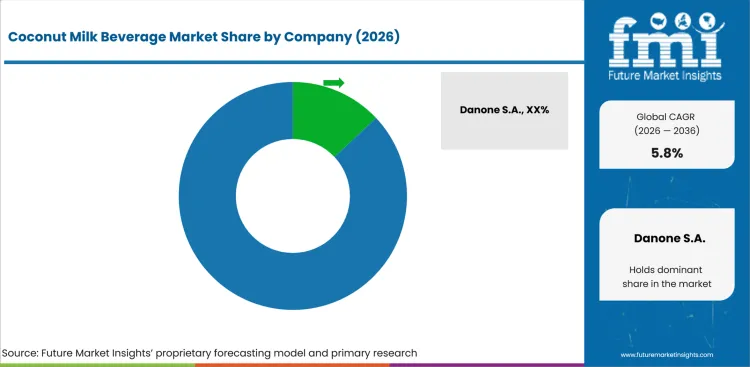
- Plant-based beverage brands lead shelf access through stronger retail relationships.
- Coconut processors help formulation quality through coconut sourcing depth.
- Retail brands build trust through clear drink labels and familiar pack formats.
- Beverage specialists can improve value through low-sugar and flavored variants.
Coconut milk beverage competition is influenced by brands that can explain product use quickly. Danone lists Silk and Alpro plant-based drink ranges that include coconut options. Califia Farms focuses on dairy-free beverage innovation and plant-based product design. The Vita Coco Company gives coconut-based beverages a wider lifestyle route through coconut water and coconut milk drink formats. Retail success will depend on taste clarity and pack convenience.
Scale is becoming important because large retailers prefer brands that can manage portfolio depth and steady supply. Danone reported FY 2025 sales of €27.283 billion, with like-for-like sales growth of 4.5%. This gives major plant-based beverage companies stronger leverage when retailers review dairy alternative shelf sets.
Packaging is also part of brand positioning. Califia Farms stated in February 2024 that it converted all North American bottles to 100% recycled plastic. The company said the shift would reduce greenhouse gas emissions by at least 19% and cut energy use in half. This gives plant-based beverage brands another way to defend shelf space with sustainability claims.
Key Companies in Coconut Milk Beverage Market
- Brand Owners: Danone S.A. and Califia Farms, LLC support mainstream plant-based beverage sales through retail and online channels.
- Coconut Beverage Specialists: The Vita Coco Company, Inc. supports coconut-based beverage positioning through ready-to-drink product formats.
- Grocery Pantry Brands: Goya Foods, Inc. and GraceKennedy Limited support coconut beverage visibility through multicultural retail channels.
- Plant-Based Beverage Suppliers: Vitasoy International Holdings Limited and The Hain Celestial Group, Inc. support dairy alternative drink access across selected markets.
- Processing and Supply Partners: PT Pulau Sambu and SunOpta Inc. support coconut ingredient and plant-based beverage supply routes.
Competitive Benchmarking: Coconut Milk Beverage Market
| Company | Plant-Based Beverage Reach | Coconut Product Depth | Retail Channel Reach |
|---|---|---|---|
| Danone S.A. | High | Medium | High |
| Califia Farms, LLC | High | Medium | High |
| The Vita Coco Company, Inc. | Medium | High | High |
| Vitasoy International Holdings Limited | High | Medium | Medium |
| Goya Foods, Inc. | Medium | Medium | High |
| GraceKennedy Limited | Medium | Medium | Medium |
| The Hain Celestial Group, Inc. | Medium | Medium | Medium |
| PT Pulau Sambu | Medium | High | Medium |
| SunOpta Inc. | Medium | Medium | Medium |
Source: Future Market Insights competitive analysis, 2026.
Key Developments in Coconut Milk Beverage Market
- In March 2025, Califia Farms launched Creamy Refreshers as dairy-free coconut and fruit beverages. The company stated that the line contains nearly 60% less sugar than leading fruit juice beverages.
- In January 2026, Califia Farms expanded its Simple and Organic portfolio. The launch included Simple and Organic Coconutmilk in a new 32 oz format made with coconut cream and coconut water.
Key Players in the Coconut Milk Beverage Market
- Danone S.A.
- Califia Farms, LLC
- The Vita Coco Company, Inc.
- Vitasoy International Holdings Limited
- Goya Foods, Inc.
- GraceKennedy Limited
- The Hain Celestial Group, Inc.
- PT Pulau Sambu
- SunOpta Inc.
- Alpro
Coconut Milk Beverage Market - Report Scope
| Parameter | Details |
|---|---|
| Market size by 2036 | USD 632.6 million |
| Growth rate | 5.8% CAGR from 2026 to 2036 |
| Forecast period | 2026 to 2036 |
| Base year value in 2025 | USD 340.3 million |
| By product type | Original coconut milk beverage, flavored coconut milk beverage, fortified coconut milk beverage, blended plant-based coconut beverage, barista coconut milk beverage |
| By flavor profile | Original, vanilla, chocolate, fruit blended, coffee compatible |
| By packaging format | Cartons, bottles, aseptic packs, multipacks, single-serve packs |
| By sales channel | Supermarkets, convenience stores, online grocery, club stores, foodservice retail |
| By consumer group | Vegan consumers, lactose-sensitive consumers, flexitarian consumers, wellness-focused shoppers, young adults |
| Regions covered | North America, Europe, East Asia, South Asia, ASEAN, Oceania, Middle East |
| Countries and regions covered | United States, Canada, European Union, United Kingdom, Gulf Cooperation Council, Saudi Arabia, South Korea, Japan, Australia |
| Key companies profiled | Danone S.A., Califia Farms, LLC, The Vita Coco Company, Inc., Vitasoy International Holdings Limited, Goya Foods, Inc., GraceKennedy Limited, The Hain Celestial Group, Inc., PT Pulau Sambu, SunOpta Inc., Alpro |
| Approach | Bottom-up product-boundary approach using eligible ready-to-drink product revenue, retail channel presence, product positioning, and country-level adoption |
Source: Future Market Insights, 2026.
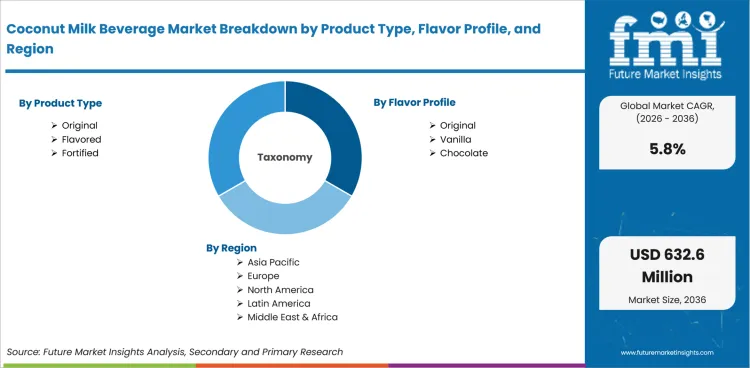
Coconut Milk Beverage Market Breakdown by Product Type and Flavor Profile. Packaging Format and Sales Channel are also covered. Consumer Group and Region complete the scope.
Coconut Milk Beverage Market Segmented by Product Type:
- Original Coconut Milk Beverage
- Flavored Coconut Milk Beverage
- Fortified Coconut Milk Beverage
- Blended Plant-Based Coconut Beverage
- Barista Coconut Milk Beverage
Coconut Milk Beverage Market Segmented by Flavor Profile:
- Original
- Vanilla
- Chocolate
- Fruit Blended
- Coffee Compatible
Coconut Milk Beverage Market Segmented by Packaging Format:
- Cartons
- Bottles
- Aseptic Packs
- Multipacks
- Single-Serve Packs
Coconut Milk Beverage Market Segmented by Sales Channel:
- Supermarkets
- Convenience Stores
- Online Grocery
- Club Stores
- Foodservice Retail
Coconut Milk Beverage Market Segmented by Consumer Group:
- Vegan Consumers
- Lactose-Sensitive Consumers
- Flexitarian Consumers
- Wellness-Focused Shoppers
- Young Adults
Coconut Milk Beverage Market by Region:
- North America
- Europe
- East Asia
- South Asia
- ASEAN
- Oceania
- Middle East
This Report Answers
- What is the expected size of Coconut Milk Beverage Market in 2026 and 2036?
- Which product type is expected to lead ready-to-drink coconut milk beverage sales?
- Which sales channel is forecast to lead coconut milk beverage purchases?
- Which countries and regions are expected to expand faster than the global pace by 2036?
- How do plant-based labeling rules affect coconut milk beverage shelf placement?
- Which companies sell active coconut milk beverage products across target markets?
- How do low-sugar and fortified variants affect retail acceptance?
- Which packaging formats and consumer groups carry stronger repeat-use potential?
Research Sources and Bibliography
- U.S. Food and Drug Administration. (2025, January 6). Draft guidance for industry: Labeling of plant-based alternatives to animal-derived foods. U.S. Food and Drug Administration.
- Court of Justice of the European Union. (2024, October 4). Judgment of the Court in Case C-438/23, Protéines France and Others. Court of Justice of the European Union.
- Eurostat. (2025, February 20). Online shopping in the EU keeps growing. European Commission.
- Eurostat. (2026, May 20). Comparative price levels for food, beverages and tobacco. European Commission.
- Danone S.A. (2026). Essential dairy and plant-based products. Danone S.A.
- Danone S.A. (2026, February 20). 2025: Another year of strong delivery. Danone S.A.
- Califia Farms, LLC. (2024, February 13). Califia Farms introduces “Califia Farms Complete,” plant-based milk nutritionally comparable to dairy. Califia Farms, LLC.
- Califia Farms, LLC. (2024, February 27). Califia Farms converts all North American bottles to 100% recycled plastic. Califia Farms, LLC.
- Califia Farms, LLC. (2025, March 26). A new era of juice is here: Introducing Creamy Refreshers from Califia Farms. Califia Farms, LLC.
- Califia Farms, LLC. (2026, January 22). Califia Farms expands Simple & Organic portfolio with its first-ever soymilk launch. Califia Farms, LLC.
- Coupang, Inc. (2025, February 25). Coupang announces results for fourth quarter 2024. Coupang, Inc.
- U.S. Department of Agriculture, Economic Research Service. (2026, May 22). Food price outlook: Summary findings. U.S. Department of Agriculture.
- U.S. Department of Agriculture, Economic Research Service. (2026, June 1). Total food spending reached $2.51 trillion in 2025. U.S. Department of Agriculture.
- U.S. Department of Agriculture, Foreign Agricultural Service. (2025, April 9). Food processing ingredients annual: Canada. U.S. Department of Agriculture.
- U.S. Department of Agriculture, Foreign Agricultural Service. (2025, May 5). Food processing ingredients annual: Korea, Republic of. U.S. Department of Agriculture.
- U.S. Department of Agriculture, Foreign Agricultural Service. (2025, September 24). Retail foods annual: Saudi Arabia. U.S. Department of Agriculture.
- U.S. Department of Agriculture, Foreign Agricultural Service. (2025, November 19). Retail foods annual: Australia. U.S. Department of Agriculture.
- U.S. Department of Agriculture, Foreign Agricultural Service. (2025, November 19). Retail foods annual: Japan. U.S. Department of Agriculture.
- U.S. Department of Agriculture, Foreign Agricultural Service. (2025, December 30). Food service—hotel restaurant institutional annual: Australia. U.S. Department of Agriculture.
- U.S. Department of Agriculture, Foreign Agricultural Service. (2025, December 30). Food service—hotel restaurant institutional annual: Saudi Arabia. U.S. Department of Agriculture.
- U.S. Department of Agriculture, Foreign Agricultural Service. (2026, March 24). Food processing ingredients annual: United Kingdom. U.S. Department of Agriculture.
- U.S. Department of Agriculture, Foreign Agricultural Service. (2026, April 1). Food processing ingredients annual: Japan. U.S. Department of Agriculture.
- Statistics Bureau of Japan. (2026, January 23). Consumer Price Index, Japan 2025. Statistics Bureau of Japan.
- Australian Bureau of Statistics. (2026, January 28). Consumer Price Index, Australia, December 2025. Australian Bureau of Statistics.
- Goya Foods, Inc. (2026). Milk and coconut products. Goya Foods, Inc.
- The Vita Coco Company, Inc. (2026). Treats. The Vita Coco Company, Inc.
This bibliography is provided for reader reference and is not exhaustive. The full report contains the complete reference list and detailed citations.
Frequently Asked Questions
How large is the Coconut Milk Beverage Market in 2026?
Coconut milk beverage sales are expected to reach USD 360.0 million in 2026, based on eligible ready-to-drink beverage revenue and channel presence.
What is the forecast value by 2036?
Coconut milk beverage sales are forecast to reach USD 632.6 million by 2036 at 5.8% CAGR from 2026 to 2036.
Which product type is expected to lead?
Original coconut milk beverage is expected to hold 44.6% share in 2026 because it fits daily dairy alternative use.
Which sales channel is expected to lead in 2026?
Supermarkets are expected to lead with 51.7% share in 2026 because plant-based drinks need shelf visibility.
Which country is expected to expand fastest?
South Korea is expected to expand at 7.2% CAGR by 2036 because online grocery behavior and compact beverage packs help demand.
Are coconut cooking milk products included?
Coconut cooking milk products are excluded. The market counts ready-to-drink coconut milk beverages only.
Are coconut water products included?
Coconut water is excluded because it is a separate beverage category. Products that combine coconut water and coconut milk are counted only when sold as coconut milk beverages.
Which packaging format is expected to lead?
Cartons are expected to capture 48.2% share in 2026 because they suit chilled and shelf-stable beverage aisles.
What is the main restraint?
Sugar concerns and competition from oat or almond drinks can slow faster adoption of coconut milk beverages.
How was the 2026 estimate prepared?
The 2026 estimate was prepared using a bottom-up product-boundary approach. Eligible ready-to-drink products and retail access were used to complete the estimate. Pricing and product positioning were also reviewed. Country adoption completed the estimate.
Preview the report firsthand - request a free sample
Get SampleGet the brochure for pricing and purchase details.
Get PDFTable of Content
- Executive Summary
- Global Market Outlook
- Demand to side Trends
- Supply to side Trends
- Technology Roadmap Analysis
- Analysis and Recommendations
- Market Overview
- Market Coverage / Taxonomy
- Market Definition / Scope / Limitations
- Research Methodology
- Chapter Orientation
- Analytical Lens and Working Hypotheses
- Market Structure, Signals, and Trend Drivers
- Benchmarking and Cross-market Comparability
- Market Sizing, Forecasting, and Opportunity Mapping
- Research Design and Evidence Framework
- Desk Research Programme (Secondary Evidence)
- Company Annual and Sustainability Reports
- Peer-reviewed Journals and Academic Literature
- Corporate Websites, Product Literature, and Technical Notes
- Earnings Decks and Investor Briefings
- Statutory Filings and Regulatory Disclosures
- Technical White Papers and Standards Notes
- Trade Journals, Industry Magazines, and Analyst Briefs
- Conference Proceedings, Webinars, and Seminar Materials
- Government Statistics Portals and Public Data Releases
- Press Releases and Reputable Media Coverage
- Specialist Newsletters and Curated Briefings
- Sector Databases and Reference Repositories
- FMI Internal Proprietary Databases and Historical Market Datasets
- Subscription Datasets and Paid Sources
- Social Channels, Communities, and Digital Listening Inputs
- Additional Desk Sources
- Expert Input and Fieldwork (Primary Evidence)
- Primary Modes
- Qualitative Interviews and Expert Elicitation
- Quantitative Surveys and Structured Data Capture
- Blended Approach
- Why Primary Evidence is Used
- Field Techniques
- Interviews
- Surveys
- Focus Groups
- Observational and In-context Research
- Social and Community Interactions
- Stakeholder Universe Engaged
- C-suite Leaders
- Board Members
- Presidents and Vice Presidents
- R&D and Innovation Heads
- Technical Specialists
- Domain Subject-matter Experts
- Scientists
- Physicians and Other Healthcare Professionals
- Governance, Ethics, and Data Stewardship
- Research Ethics
- Data Integrity and Handling
- Primary Modes
- Tooling, Models, and Reference Databases
- Desk Research Programme (Secondary Evidence)
- Data Engineering and Model Build
- Data Acquisition and Ingestion
- Cleaning, Normalisation, and Verification
- Synthesis, Triangulation, and Analysis
- Quality Assurance and Audit Trail
- Market Background
- Market Dynamics
- Drivers
- Restraints
- Opportunity
- Trends
- Scenario Forecast
- Demand in Optimistic Scenario
- Demand in Likely Scenario
- Demand in Conservative Scenario
- Opportunity Map Analysis
- Product Life Cycle Analysis
- Supply Chain Analysis
- Investment Feasibility Matrix
- Value Chain Analysis
- PESTLE and Porter’s Analysis
- Regulatory Landscape
- Regional Parent Market Outlook
- Production and Consumption Statistics
- Import and Export Statistics
- Market Dynamics
- Global Market Analysis 2021 to 2025 and Forecast, 2026 to 2036
- Historical Market Size Value (USD Million) Analysis, 2021 to 2025
- Current and Future Market Size Value (USD Million) Projections, 2026 to 2036
- Y to o to Y Growth Trend Analysis
- Absolute $ Opportunity Analysis
- Global Market Pricing Analysis 2021 to 2025 and Forecast 2026 to 2036
- Global Market Analysis 2021 to 2025 and Forecast 2026 to 2036, By Product Type
- Introduction / Key Findings
- Historical Market Size Value (USD Million) Analysis By Product Type , 2021 to 2025
- Current and Future Market Size Value (USD Million) Analysis and Forecast By Product Type , 2026 to 2036
- Original
- Flavored
- Fortified
- Original
- Y to o to Y Growth Trend Analysis By Product Type , 2021 to 2025
- Absolute $ Opportunity Analysis By Product Type , 2026 to 2036
- Global Market Analysis 2021 to 2025 and Forecast 2026 to 2036, By Flavor Profile
- Introduction / Key Findings
- Historical Market Size Value (USD Million) Analysis By Flavor Profile, 2021 to 2025
- Current and Future Market Size Value (USD Million) Analysis and Forecast By Flavor Profile, 2026 to 2036
- Original
- Vanilla
- Chocolate
- Original
- Y to o to Y Growth Trend Analysis By Flavor Profile, 2021 to 2025
- Absolute $ Opportunity Analysis By Flavor Profile, 2026 to 2036
- Global Market Analysis 2021 to 2025 and Forecast 2026 to 2036, By Packaging Format
- Introduction / Key Findings
- Historical Market Size Value (USD Million) Analysis By Packaging Format, 2021 to 2025
- Current and Future Market Size Value (USD Million) Analysis and Forecast By Packaging Format, 2026 to 2036
- Cartons
- Bottles
- Aseptic Packs
- Cartons
- Y to o to Y Growth Trend Analysis By Packaging Format, 2021 to 2025
- Absolute $ Opportunity Analysis By Packaging Format, 2026 to 2036
- Global Market Analysis 2021 to 2025 and Forecast 2026 to 2036, By Sales Channel
- Introduction / Key Findings
- Historical Market Size Value (USD Million) Analysis By Sales Channel, 2021 to 2025
- Current and Future Market Size Value (USD Million) Analysis and Forecast By Sales Channel, 2026 to 2036
- Supermarkets
- Convenience Stores
- Online Grocery
- Supermarkets
- Y to o to Y Growth Trend Analysis By Sales Channel, 2021 to 2025
- Absolute $ Opportunity Analysis By Sales Channel, 2026 to 2036
- Global Market Analysis 2021 to 2025 and Forecast 2026 to 2036, By Consumer Group
- Introduction / Key Findings
- Historical Market Size Value (USD Million) Analysis By Consumer Group, 2021 to 2025
- Current and Future Market Size Value (USD Million) Analysis and Forecast By Consumer Group, 2026 to 2036
- Lactose-Sensitive Consumers
- Flexitarian Consumers
- Young Adults
- Lactose-Sensitive Consumers
- Y to o to Y Growth Trend Analysis By Consumer Group, 2021 to 2025
- Absolute $ Opportunity Analysis By Consumer Group, 2026 to 2036
- Global Market Analysis 2021 to 2025 and Forecast 2026 to 2036, By Region
- Introduction
- Historical Market Size Value (USD Million) Analysis By Region, 2021 to 2025
- Current Market Size Value (USD Million) Analysis and Forecast By Region, 2026 to 2036
- North America
- Latin America
- Western Europe
- Eastern Europe
- East Asia
- South Asia and Pacific
- Middle East & Africa
- Market Attractiveness Analysis By Region
- North America Market Analysis 2021 to 2025 and Forecast 2026 to 2036, By Country
- Historical Market Size Value (USD Million) Trend Analysis By Market Taxonomy, 2021 to 2025
- Market Size Value (USD Million) Forecast By Market Taxonomy, 2026 to 2036
- By Country
- USA
- Canada
- Mexico
- By Product Type
- By Flavor Profile
- By Packaging Format
- By Sales Channel
- By Consumer Group
- By Country
- Market Attractiveness Analysis
- By Country
- By Product Type
- By Flavor Profile
- By Packaging Format
- By Sales Channel
- By Consumer Group
- Key Takeaways
- Latin America Market Analysis 2021 to 2025 and Forecast 2026 to 2036, By Country
- Historical Market Size Value (USD Million) Trend Analysis By Market Taxonomy, 2021 to 2025
- Market Size Value (USD Million) Forecast By Market Taxonomy, 2026 to 2036
- By Country
- Brazil
- Chile
- Rest of Latin America
- By Product Type
- By Flavor Profile
- By Packaging Format
- By Sales Channel
- By Consumer Group
- By Country
- Market Attractiveness Analysis
- By Country
- By Product Type
- By Flavor Profile
- By Packaging Format
- By Sales Channel
- By Consumer Group
- Key Takeaways
- Western Europe Market Analysis 2021 to 2025 and Forecast 2026 to 2036, By Country
- Historical Market Size Value (USD Million) Trend Analysis By Market Taxonomy, 2021 to 2025
- Market Size Value (USD Million) Forecast By Market Taxonomy, 2026 to 2036
- By Country
- Germany
- UK
- Italy
- Spain
- France
- Nordic
- BENELUX
- Rest of Western Europe
- By Product Type
- By Flavor Profile
- By Packaging Format
- By Sales Channel
- By Consumer Group
- By Country
- Market Attractiveness Analysis
- By Country
- By Product Type
- By Flavor Profile
- By Packaging Format
- By Sales Channel
- By Consumer Group
- Key Takeaways
- Eastern Europe Market Analysis 2021 to 2025 and Forecast 2026 to 2036, By Country
- Historical Market Size Value (USD Million) Trend Analysis By Market Taxonomy, 2021 to 2025
- Market Size Value (USD Million) Forecast By Market Taxonomy, 2026 to 2036
- By Country
- Russia
- Poland
- Hungary
- Balkan & Baltic
- Rest of Eastern Europe
- By Product Type
- By Flavor Profile
- By Packaging Format
- By Sales Channel
- By Consumer Group
- By Country
- Market Attractiveness Analysis
- By Country
- By Product Type
- By Flavor Profile
- By Packaging Format
- By Sales Channel
- By Consumer Group
- Key Takeaways
- East Asia Market Analysis 2021 to 2025 and Forecast 2026 to 2036, By Country
- Historical Market Size Value (USD Million) Trend Analysis By Market Taxonomy, 2021 to 2025
- Market Size Value (USD Million) Forecast By Market Taxonomy, 2026 to 2036
- By Country
- China
- Japan
- South Korea
- By Product Type
- By Flavor Profile
- By Packaging Format
- By Sales Channel
- By Consumer Group
- By Country
- Market Attractiveness Analysis
- By Country
- By Product Type
- By Flavor Profile
- By Packaging Format
- By Sales Channel
- By Consumer Group
- Key Takeaways
- South Asia and Pacific Market Analysis 2021 to 2025 and Forecast 2026 to 2036, By Country
- Historical Market Size Value (USD Million) Trend Analysis By Market Taxonomy, 2021 to 2025
- Market Size Value (USD Million) Forecast By Market Taxonomy, 2026 to 2036
- By Country
- India
- ASEAN
- Australia & New Zealand
- Rest of South Asia and Pacific
- By Product Type
- By Flavor Profile
- By Packaging Format
- By Sales Channel
- By Consumer Group
- By Country
- Market Attractiveness Analysis
- By Country
- By Product Type
- By Flavor Profile
- By Packaging Format
- By Sales Channel
- By Consumer Group
- Key Takeaways
- Middle East & Africa Market Analysis 2021 to 2025 and Forecast 2026 to 2036, By Country
- Historical Market Size Value (USD Million) Trend Analysis By Market Taxonomy, 2021 to 2025
- Market Size Value (USD Million) Forecast By Market Taxonomy, 2026 to 2036
- By Country
- Kingdom of Saudi Arabia
- Other GCC Countries
- Turkiye
- South Africa
- Other African Union
- Rest of Middle East & Africa
- By Product Type
- By Flavor Profile
- By Packaging Format
- By Sales Channel
- By Consumer Group
- By Country
- Market Attractiveness Analysis
- By Country
- By Product Type
- By Flavor Profile
- By Packaging Format
- By Sales Channel
- By Consumer Group
- Key Takeaways
- Key Countries Market Analysis
- USA
- Pricing Analysis
- Market Share Analysis, 2025
- By Product Type
- By Flavor Profile
- By Packaging Format
- By Sales Channel
- By Consumer Group
- Canada
- Pricing Analysis
- Market Share Analysis, 2025
- By Product Type
- By Flavor Profile
- By Packaging Format
- By Sales Channel
- By Consumer Group
- Mexico
- Pricing Analysis
- Market Share Analysis, 2025
- By Product Type
- By Flavor Profile
- By Packaging Format
- By Sales Channel
- By Consumer Group
- Brazil
- Pricing Analysis
- Market Share Analysis, 2025
- By Product Type
- By Flavor Profile
- By Packaging Format
- By Sales Channel
- By Consumer Group
- Chile
- Pricing Analysis
- Market Share Analysis, 2025
- By Product Type
- By Flavor Profile
- By Packaging Format
- By Sales Channel
- By Consumer Group
- Germany
- Pricing Analysis
- Market Share Analysis, 2025
- By Product Type
- By Flavor Profile
- By Packaging Format
- By Sales Channel
- By Consumer Group
- UK
- Pricing Analysis
- Market Share Analysis, 2025
- By Product Type
- By Flavor Profile
- By Packaging Format
- By Sales Channel
- By Consumer Group
- Italy
- Pricing Analysis
- Market Share Analysis, 2025
- By Product Type
- By Flavor Profile
- By Packaging Format
- By Sales Channel
- By Consumer Group
- Spain
- Pricing Analysis
- Market Share Analysis, 2025
- By Product Type
- By Flavor Profile
- By Packaging Format
- By Sales Channel
- By Consumer Group
- France
- Pricing Analysis
- Market Share Analysis, 2025
- By Product Type
- By Flavor Profile
- By Packaging Format
- By Sales Channel
- By Consumer Group
- India
- Pricing Analysis
- Market Share Analysis, 2025
- By Product Type
- By Flavor Profile
- By Packaging Format
- By Sales Channel
- By Consumer Group
- ASEAN
- Pricing Analysis
- Market Share Analysis, 2025
- By Product Type
- By Flavor Profile
- By Packaging Format
- By Sales Channel
- By Consumer Group
- Australia & New Zealand
- Pricing Analysis
- Market Share Analysis, 2025
- By Product Type
- By Flavor Profile
- By Packaging Format
- By Sales Channel
- By Consumer Group
- China
- Pricing Analysis
- Market Share Analysis, 2025
- By Product Type
- By Flavor Profile
- By Packaging Format
- By Sales Channel
- By Consumer Group
- Japan
- Pricing Analysis
- Market Share Analysis, 2025
- By Product Type
- By Flavor Profile
- By Packaging Format
- By Sales Channel
- By Consumer Group
- South Korea
- Pricing Analysis
- Market Share Analysis, 2025
- By Product Type
- By Flavor Profile
- By Packaging Format
- By Sales Channel
- By Consumer Group
- Russia
- Pricing Analysis
- Market Share Analysis, 2025
- By Product Type
- By Flavor Profile
- By Packaging Format
- By Sales Channel
- By Consumer Group
- Poland
- Pricing Analysis
- Market Share Analysis, 2025
- By Product Type
- By Flavor Profile
- By Packaging Format
- By Sales Channel
- By Consumer Group
- Hungary
- Pricing Analysis
- Market Share Analysis, 2025
- By Product Type
- By Flavor Profile
- By Packaging Format
- By Sales Channel
- By Consumer Group
- Kingdom of Saudi Arabia
- Pricing Analysis
- Market Share Analysis, 2025
- By Product Type
- By Flavor Profile
- By Packaging Format
- By Sales Channel
- By Consumer Group
- Turkiye
- Pricing Analysis
- Market Share Analysis, 2025
- By Product Type
- By Flavor Profile
- By Packaging Format
- By Sales Channel
- By Consumer Group
- South Africa
- Pricing Analysis
- Market Share Analysis, 2025
- By Product Type
- By Flavor Profile
- By Packaging Format
- By Sales Channel
- By Consumer Group
- USA
- Market Structure Analysis
- Competition Dashboard
- Competition Benchmarking
- Market Share Analysis of Top Players
- By Regional
- By Product Type
- By Flavor Profile
- By Packaging Format
- By Sales Channel
- By Consumer Group
- Competition Analysis
- Competition Deep Dive
- Danone S.A.
- Overview
- Product Portfolio
- Profitability by Market Segments (Product/Age /Sales Channel/Region)
- Sales Footprint
- Strategy Overview
- Marketing Strategy
- Product Strategy
- Channel Strategy
- Califia Farms, LLC
- The Vita Coco Company, Inc.
- Vitasoy International Holdings Limited
- Goya Foods, Inc.
- Danone S.A.
- Competition Deep Dive
- Assumptions & Acronyms Used


