

- Market Size (2026)
- USD 445.8 Mn
- Forecast (2036)
- USD 989.6 Mn
- CAGR (2026 to 2036)
- 8.3%
Coconut Milk Yogurt Base Market Size, Market Forecast and Outlook By FMI
USD 445.8 million in 2026 and USD 989.6 million by 2036 at an 8.3% CAGR.
The coconut milk yogurt base market was valued at USD 412.0 million in 2025. It is projected to reach USD 445.8 million in 2026 and USD 989.6 million by 2036 at an 8.3% CAGR. Fermentation-ready bases are projected to account for 44.0% of product format demand in 2026. Liquid bases are expected to hold 61.0% of form demand in 2026 as industrial yogurt makers prefer pumpable formats for batching and culture dosing.
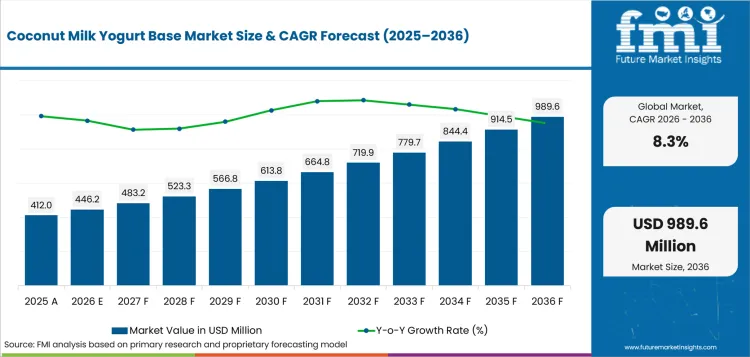
Coconut Milk Yogurt Base Market Overview: Size and Forecast
- 2026 Market Size: USD 445.8 million
- 2036 Market Size: USD 989.6 million
- Forecast CAGR: 8.3% from 2026 to 2036
- Leading Product Format: Fermentation-ready Bases
- Fermentation-ready Bases Share in 2026: 44.0%
- Leading Form: Liquid
- Liquid Bases Share in 2026: 61.0%
- Fastest-growing Country: India
- India CAGR: 9.0% by 2036
What are the key takeaways for the coconut milk yogurt base market?
Fermentation-ready bases lead at 44.0% with liquid bases at 61.0% and India fastest at 9.0%.
- Demand and Growth Drivers
- Demand for coconut milk yogurt bases is rising in tandem with double‑digit growth in plant-based yogurt sales, particularly in North America and Asia Pacific where lactose-free and vegan consumption is accelerating.
- Adoption is being driven by branded dairy-alternative manufacturers seeking faster go-to-market cycles, leading to increased reliance on pre-formulated bases that reduce product development timelines.
- Sales are shifting from bulk coconut ingredients toward value-added systems, as buyers prioritize suppliers that can demonstrate proven texture, stability, and shelf-life performance.
- Large food and beverage companies are expanding product portfolios in the dairy-free segment, resulting in higher volume contracts and repeat purchasing linked to successful product launches and sensory validation.
- Product and Segment View
- Fermentation-ready bases are projected to lead product format with 44.0% share in 2026 as buyers want culture-ready systems.
- Liquid bases are expected to lead form demand with 61.0% share in 2026 due to simpler plant handling.
- Spoonable yogurt is projected to account for 52.0% of function demand in 2026 with cup formats driving repeat orders.
- Direct B2B is expected to hold 58.0% of sales channel demand in 2026 as large food brands buy through technical teams.
- Geography and Competitive Outlook
- The United States is projected to record 7.2% CAGR with specialty retail and chilled yogurt innovation supporting steady use.
- Germany is expected to expand at 7.1% CAGR as EU label limits push brands toward careful product naming.
- AAK AB is estimated to hold the leading company position at 12.0% share in 2026 through plant-based fat systems.
- Ingredion, Cargill, Kerry Group, Tate & Lyle, dsm-firmenich and CP Kelco compete on texture systems and application support.
- Analyst Opinion
- Nandini Roy Choudhury, Principal Consultant at FMI says, “I see this market as an ingredient execution market more than a coconut demand story. Buyers are not only asking whether a supplier has coconut milk. They are asking whether the supplier can hold creaminess after fermentation and stop water separation during cold storage. The winning offer joins coconut solids with stabilizers, cultures and sensory masking in a format that a yogurt plant can run without extra trials.”
- What supports value in the coconut milk yogurt base market?
- Texture-stable coconut systems and supplier application support create value across regulated B2B dairy-free channels.
- Market value is supported by coconut yogurt brands moving from kitchen-scale recipes to industrial batches with controlled pH and viscosity.
- Fermentation-ready systems gain value since they combine coconut solids with hydrocolloids and culture compatibility in one supplier brief.
- Premium pricing depends on texture proof as coconut fat can separate after fermentation without a tailored stabilizer system.
- Supply risk remains visible as International Coconut Community data showed Indonesia coconut oil at USD 1,979 per metric ton on June 6, 2026.
- Larger ingredient firms gain an edge as they can test coconut bases across spoonable yogurt and dessert applications in pilot facilities.
As competition intensifies in the plant-based yogurt segment, ingredient suppliers are increasingly differentiating themselves through functionality and sensory performance. In October 2025, Ingredion said Simplistica™ YG 3206 was designed to deliver creamy texture and stability in coconut-based yogurt. Tate & Lyle launched Sensation™ in Asia Pacific in September 2025 starting with the yogurt category. These launches show suppliers are selling formulation speed and sensory control as much as raw coconut solids. dsm-firmenich opened a Delft food innovation center in October 2025 with facilities for plant-based alternatives to dairy. Together these signals show why branded buyers request samples first and then negotiate around texture proof.
Why is the Coconut Milk Yogurt Base Market Growing?
Coconut bases are used when brands need dairy-free creaminess with texture stability after fermentation.
- Coconut bases solve dairy-free creaminess gaps where oat and almond systems need extra fat or texture correction.
- Yogurt brands request fermentation-ready bases as pilot batches reduce launch risk and internal lab time.
- Co-packers prefer liquid bases when they need fast batching and fewer dry ingredient handling steps.
- Retail buyers push cleaner labels as fewer additives make coconut yogurt easier to explain to consumers.
Coconut yogurt demand is growing through the chilled spoonable route as brands try to match dairy texture without animal milk. The Good Food Institute reported in 2025 that global retail sales of plant-based meat, seafood, milk, yogurt, ice cream and cheese reached USD 28.9 billion in 2025. That figure gives suppliers a broad demand pool but not a guarantee of success for every format. Cost and formulation pressure shape the second growth route. GFI Europe reported in June 2026 that UK plant-based yoghurt sales reached GBP 102.3 million in 2025 and grew 10.0% in value. Coconut yogurt suppliers use cream concentrates and stabilizer blends to meet that expectation.
How is the coconut milk yogurt base market segmented?
The market is segmented by product format, form, function, nature and sales channel.
- Fermentation-ready bases are expected to lead product format with 44.0% share in 2026 as they reduce pilot batch uncertainty.
- Liquid bases are projected to account for 61.0% of form demand in 2026 with tank-based use fitting larger chilled plants.
- Spoonable yogurt is anticipated to hold 52.0% of function demand in 2026 as cup formats support repeat retail buying.
- Conventional bases are expected to represent 72.0% of nature demand in 2026 as standard inputs keep trial costs lower.
- Direct B2B is projected to capture 58.0% of sales channel value in 2026 where technical teams approve recipes before orders.
Why do fermentation-ready bases lead the coconut milk yogurt base market?
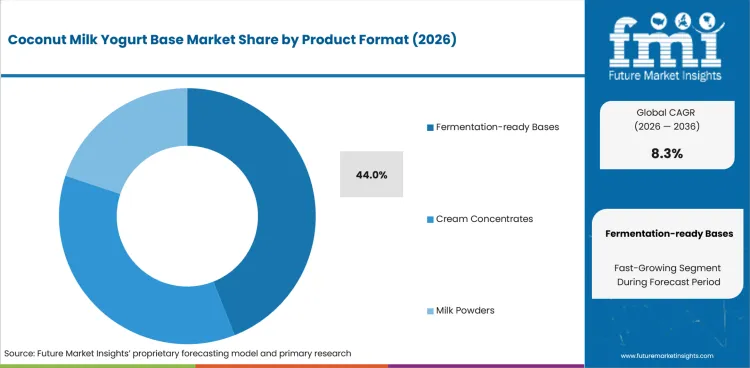
- Fermentation-ready bases are projected to account for 44.0% of product format demand in 2026 as they combine coconut solids, stabilizers and culture tolerance into a lower-risk launch input.
- Ingredion’s October 2025 coconut-based yogurt system shows how suppliers are selling sensory benchmarks and stability proof, not only raw coconut ingredients.
Which form leads the coconut milk yogurt base market?
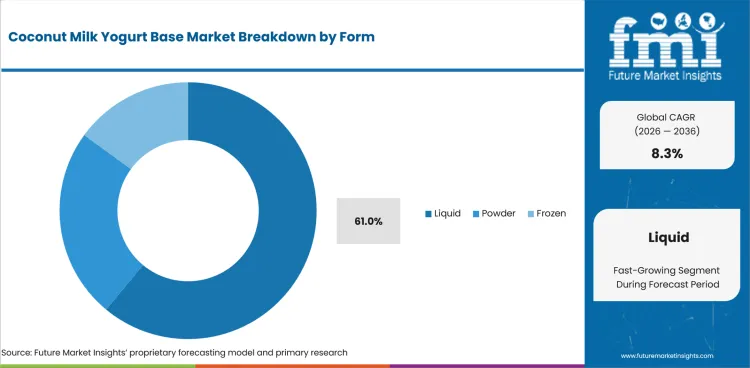
- Liquid bases are estimated to hold 61.0% of form demand in 2026 since larger yogurt plants prefer pumpable inputs with less reconstitution loss.
- Powder bases gain in export and distributor channels as dry handling reduces cold-chain exposure, but buyers must manage rehydration and fat dispersion carefully.
Which function leads the coconut milk yogurt base market?
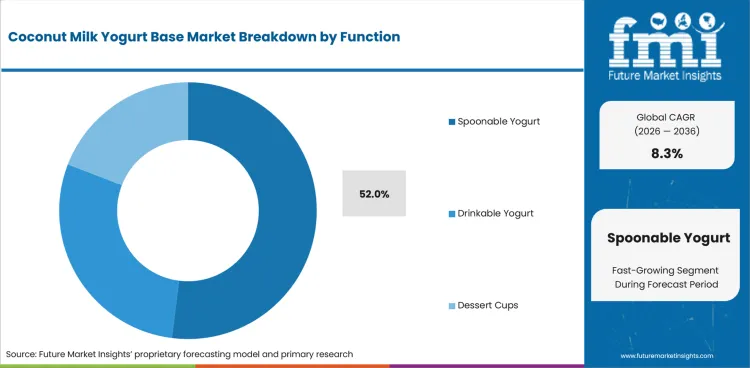
- Spoonable yogurt is anticipated to account for 52.0% of function demand in 2026 as single-serve cups remain the clearest retail use case.
- Drinkable formats need tighter viscosity control than spoonable cups since sediment and fat separation are more visible in bottles.
Which nature segment leads the coconut milk yogurt base market?
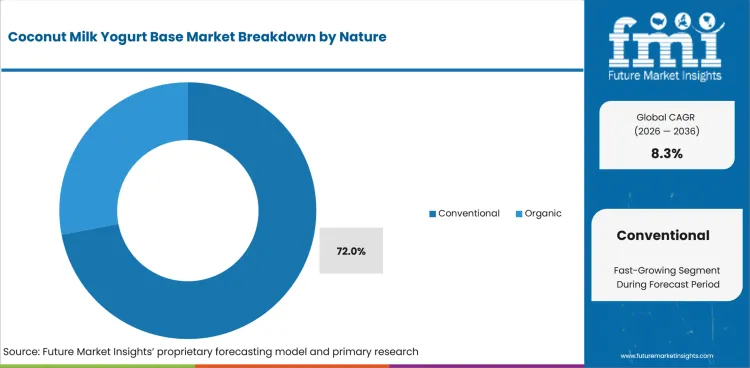
- Conventional bases are expected to represent 72.0% of nature demand in 2026 as price-sensitive brands scale with standard coconut cream and stabilizers.
- Organic bases sell best in premium grocery and specialty channels where buyers accept higher input costs for certified ingredient claims.
Which sales channel leads the coconut milk yogurt base market?
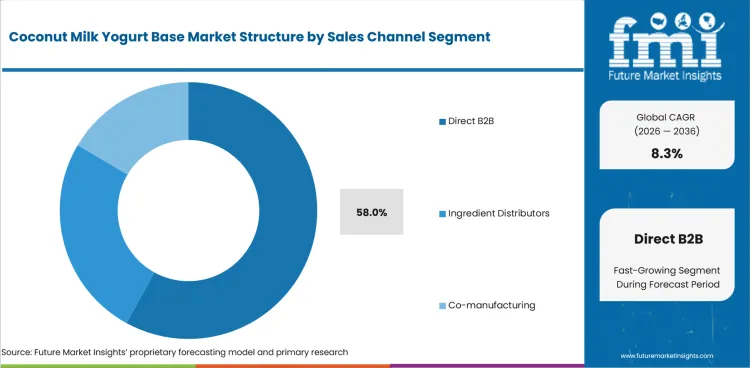
- Direct B2B is projected to capture 58.0% of sales channel demand in 2026 as application teams need supplier trials before factory qualification.
- Ingredient distributors matter most for regional brands that lack in-house formulation teams and need smaller sample lots before commercial orders.
What are the driver, restraints, and opportunities in the coconut milk yogurt base market?
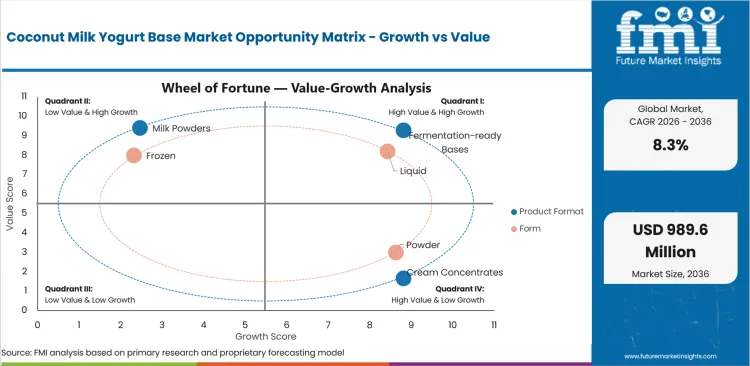
Texture rescue systems support demand while label rules and coconut input volatility limit faster conversion.
- Driver: Texture rescue systems can raise demand as coconut fat and protein need stabilizer support after fermentation.
- Opportunity: Retail private-label trials can create demand where buyers want lower-priced dairy-free cups without losing creaminess.
- Restraint: EU dairy terminology rules can restrict label wording because plant-based products must avoid protected dairy terms.
- Restraint: Coconut supply volatility can limit margin certainty as ingredient buyers face tropical crop and freight risk.
- Opportunity: Culture-compatible blends can help suppliers win when they prove pH control and clean taste.
Coconut texture stabilization is the main commercial battleground in coconut yogurt bases. Coconut milk brings fat and flavor but it does not behave like dairy protein during fermentation. Cargill states that pectin is used in dairy and plant-based yogurt alternatives for stability and creamy texture. Buyers pay more for bases that shorten this work and protect repeat purchase after the first trial.
Dairy-term label risk also shapes product design in Europe and other strict markets. GFI Europe notes that current EU law bars terms such as “milk” and “yoghurt” for plant-based dairy even with qualifiers. Suppliers that understand local label limits can help customers build products that are compliant and easier to sell.
Sample-to-scale conversion is the main opportunity for application-led suppliers. AAK’s AkoPlanet™ plant-based yogurt page describes support from drinking yoghurt to thick Greek-style formats. Suppliers with pilot capacity can win earlier in development and keep the account after launch.
Who are the leading companies in the coconut milk yogurt base market?
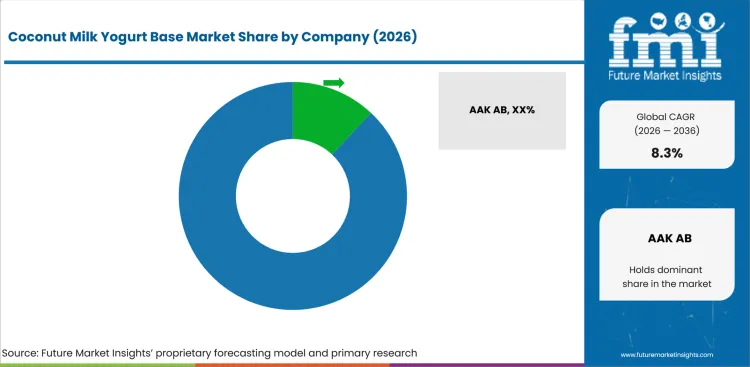
AAK AB, Ingredion, Cargill, Kerry Group, Tate & Lyle, dsm-firmenich and CP Kelco lead through texture systems and dairy-free application support.
- Global ingredient firms hold an advantage through application labs and stabilizer portfolios.
- Coconut-focused suppliers compete on cream quality and supply reliability.
- Distributors matter in smaller markets where brands need sample lots before commercial orders.
- Retailer-ready documentation supports buyer confidence across vegan and allergen review.
The market is moderately concentrated because global ingredient firms control texture systems and application lab access. Smaller suppliers compete with coconut sourcing and price but often lack culture-ready formulation support.
Established companies gain an edge through stabilizer portfolios and dairy alternative pilot plants. Buyers shortlist suppliers that can prove pH control, viscosity stability and clean taste before factory qualification.
Regional suppliers can win where local coconut sourcing lowers lead time. Scale alone is not enough if suppliers cannot document label compliance and repeat batch performance.
How do top coconut milk yogurt base companies compare?
AAK and Ingredion score strongest on texture support while Cargill and Kerry offer broad dairy-free formulation coverage.
| Company | Coconut Fat System Depth | Fermentation Texture Support | Dairy-Free Sensory Masking | Geographic Footprint |
|---|---|---|---|---|
| AAK AB | High | Strong | Medium | Global |
| Ingredion | Medium | High | Strong | Global |
| Cargill | Medium | Strong | Medium | Global |
| Kerry Group | Medium | Strong | Strong | Global |
| Tate & Lyle | Medium | Strong | Strong | Global |
| dsm-firmenich | Low to Medium | Medium | Strong | Global |
| CP Kelco | Low | Strong | Medium | Global |
| Symrise | Low | Medium | Strong | Global |
Who are the key players in the coconut milk yogurt base market?
AAK AB, Ingredion, Cargill and Kerry Group are listed with Tate & Lyle, dsm-firmenich and CP Kelco among other suppliers.
Key global companies leading the coconut milk yogurt base market include:
- AAK AB
- Ingredion
- Cargill
- Kerry Group
- Tate & Lyle
- dsm-firmenich
- CP Kelco
- Symrise
- Palsgaard
- SunOpta ingredient channels
Key Developments in Coconut Milk Yogurt Base Market
- In October 2025, Ingredion introduced Simplistica™ YG 3206 for coconut-based yogurt texture and stability. The system supports suppliers working on creamy plant-based spoonable products.
- In September 2025, Tate & Lyle launched Sensation™ in Asia Pacific starting with the yogurt category. The launch supports faster mouthfeel formulation for dairy and dairy-free products.
- In October 2025, dsm-firmenich opened a global food innovation center in Delft. The site includes facilities for plant-based alternatives to dairy and application-led product testing.
Key Players in the Coconut Milk Yogurt Base Market
Global Texture and Fat System Suppliers
- AAK AB
- Ingredion
- Cargill
- Kerry Group
- Tate & Lyle
- dsm-firmenich
- CP Kelco
Coconut Ingredient and Cream Suppliers
- SunOpta ingredient channels
- The Coconut Company
- Celebes Coconut Corporation
- Primex Group
- Franklin Baker ingredient channels
Hydrocolloid and Mouthfeel Specialists
- CP Kelco
- Palsgaard
- Tate & Lyle
- Ingredion
- Cargill
Which countries are growing fastest in the coconut milk yogurt base market?
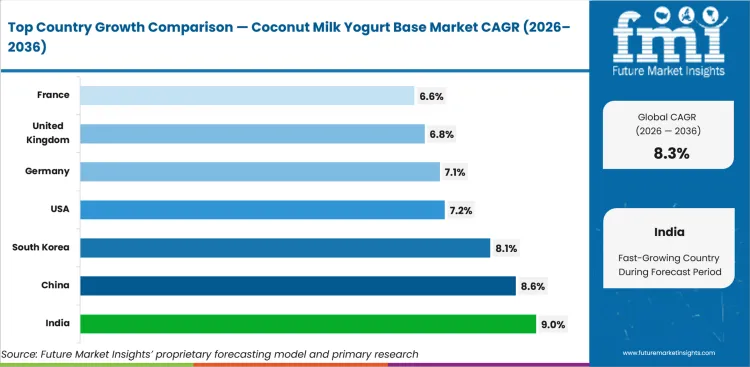
.webp "Top Country Growth Comparison Coconut Milk Yogurt Base Market Cagr (2026 2036)")
India reaches 9.0% CAGR followed by China at 8.6% through 2036.
| Country | CAGR |
|---|---|
| India | 9.0% |
| China | 8.6% |
| South Korea | 8.1% |
| United States | 7.2% |
| Germany | 7.1% |
| United Kingdom | 6.8% |
| France | 6.6% |
| Japan | 6.1% |
How do country-level CAGRs compare in the coconut milk yogurt base market?
India leads country growth while Japan records the most cautious expansion outlook among profiled markets.
- India is forecast to record 9.0% CAGR by 2036 as coconut availability and vegan logo guidance support early trials.
- China is projected to expand at 8.6% CAGR through 2036 with dessert chains and e-commerce brands testing coconut spoonable formats.
- South Korea is estimated to rise at 8.1% CAGR by 2036 with premium convenience formats and cafe-led dessert trials.
- The United States is expected to advance at 7.2% CAGR through 2036 as specialty retail and co-packers support dairy-free launches.
- Germany is forecast to post 7.1% CAGR by 2036 as plant-based retail scale meets stricter EU label discipline.
- The United Kingdom is projected to grow at 6.8% CAGR through 2036 with plant-based yoghurt retail proof and own-label testing.
- France is expected to expand at 6.6% CAGR by 2036 as supermarket chilled desserts and protein-diversification policy support testing.
- Japan is anticipated to register 6.1% CAGR through 2036 as convenience retail and import documentation shape controlled adoption.
What is the coconut milk yogurt base market outlook in the United States?
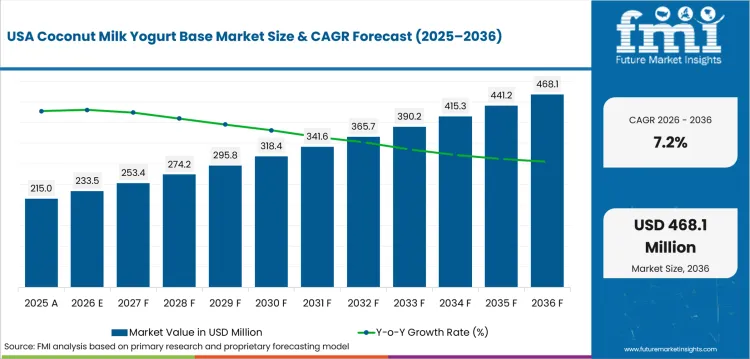
A 7.2% CAGR through 2036 reflects specialty retail scale and chilled dairy-free yogurt testing.
Country Market Snapshot Table
| Parameter | Value |
|---|---|
| Market Size in 2025 (Value) | USD 89.6 million |
| Market Size in 2026 (Value) | USD 96.0 million |
| Market Forecast in 2036 (Value) | USD 192.4 million |
| CAGR (2026 to 2036) | 7.2% |
| Years Considered | 2021 to 2036 |
| Base Year | 2025 |
| Forecast Period | 2026 to 2036 |
| Units Considered | Value (USD million) |
| Leading Sub-Region | California and Northeast chilled retail corridors |
United States Coconut Milk Yogurt Base Market Outlook
United States coconut milk yogurt base demand is shaped by specialty retail scale and a deep yogurt innovation base. Ingredient suppliers can reach brands through application labs, co-packers and natural channel distributors.
Retailers expect proof on texture and nutrition before giving broader shelf space. Coconut bases gain fastest when suppliers can correct separation and support clear label claims.
Key Growth Drivers
- Specialty yogurt claim activity supports formulation-led base selection. USDA ERS reported that 97.8% of USA yogurt UPCs carried at least one label claim in its 2025 packaging study.
- At-home chilled food pricing keeps shoppers comparing dairy-free cups with standard yogurt. BLS reported food-at-home prices rose 2.7% over the 12 months ending May 2026.
- FDA plant-based labeling guidance is expected to push brands toward suppliers that can document plant source and nutrient communication.
- Co-packer capacity in California and the Midwest is expected to help smaller dairy-free brands move from sample approval to regional production.
Key Restraints
- Dairy price competition can limit coconut yogurt premiums. BLS reported dairy and related product prices fell 1.0% over the year ending May 2026.
- Coconut bases often need added protein or stabilizers before they can compete with dairy and soy yogurt texture.
- Imported coconut inputs expose USA buyers to freight cycles and tropical crop risk before annual contracts are closed.
What makes United States unique
The United States is unique because specialty retail and co-packer depth make it the largest launch testbed for premium dairy-free yogurt bases.
Key Companies
- AAK USA Inc.
- Ingredion Incorporated
- Cargill Incorporated
- Kerry Inc.
- CP Kelco USA Inc.
- Tate & Lyle Solutions USA LLC
Sales & Marketing Channels
- Direct enterprise sales
- Co-packer qualification
- Natural channel distributors
- Foodservice ingredient supply
- Private-label retail tenders
Country Segment Breakdown Table
| Segment | Sub-Segments |
|---|---|
| By Product Format | Fermentation-ready Bases · Cream Concentrates · Milk Powders · Custom Blends |
| By Form | Liquid · Powder · Frozen |
| By Function | Spoonable Yogurt · Drinkable Yogurt · Dessert Cups · Frozen Desserts |
| By Nature | Conventional · Organic |
| By Sales Channel | Direct B2B · Ingredient Distributors · Co-manufacturing |
| Key Sub-Regions Covered, Chilled Retail Corridors | California · New York · Massachusetts · Illinois · Texas · Pacific Northwest |
Frequently Asked Questions
How fast is the United States coconut milk yogurt base market growing?
The United States is projected to expand at 7.2% CAGR from 2026 to 2036 through specialty retail and co-packer access.
Who leads the United States coconut milk yogurt base market?
AAK USA, Ingredion, Cargill, Kerry and CP Kelco are relevant through dairy-free ingredient and application support.
What is driving adoption in the United States?
Label-heavy yogurt shelves and dairy-free brand trials are moving buyers toward texture-stable coconut bases.
How is the coconut milk yogurt base market performing in the United Kingdom?
A 6.8% CAGR through 2036 is supported by plant-based yoghurt retail proof and supermarket own-label testing.
Country Market Snapshot Table
| Parameter | Value |
|---|---|
| Market Size in 2025 (Value) | USD 44.9 million |
| Market Size in 2026 (Value) | USD 48.0 million |
| Market Forecast in 2036 (Value) | USD 92.7 million |
| CAGR (2026 to 2036) | 6.8% |
| Years Considered | 2021 to 2036 |
| Base Year | 2025 |
| Forecast Period | 2026 to 2036 |
| Units Considered | Value (USD million) |
| Leading Sub-Region | London and Southeast supermarket chilled corridors |
United Kingdom Coconut Milk Yogurt Base Market Outlook
United Kingdom demand is shaped by supermarket own-label testing and established chilled dessert aisles. Coconut milk yogurt bases fit buyers that need dairy-free texture at controlled shelf prices.
Suppliers need allergen discipline and clean pack wording because vegan labels are not a safety guarantee. Application teams that can support retailer briefs should gain stronger repeat access.
Key Growth Drivers
- Retail channel breadth supports own-label dairy-free trials. ONS reported that annual retail sales volumes rose 1.3% over the year to 2025.
- Allergen scrutiny supports careful vegan product documentation. The Food Standards Agency reported that 54.0% of people reacting to animal-origin products used vegan labels when judging packaged food safety.
- Own-label product teams are expected to need cost-managed coconut formulations for chilled desserts and spoonable cups.
- Retailer-approved co-packers can convert base samples into supermarket-ready dairy-free chilled lines.
Key Restraints
- Food inflation keeps price checks active in chilled cabinets. ONS reported food and non-alcoholic beverage prices rose 3.0% in the 12 months to April 2026.
- Price gaps against dairy yogurt are expected to limit household frequency outside premium urban shoppers.
- Coconut flavor can narrow appeal in plain yogurt formats where shoppers expect a neutral dairy-style profile.
What makes United Kingdom unique
The United Kingdom is unique because own-label retailers can test plant-based yoghurt quickly across supermarket chilled cases.
Key Companies
- AAK UK Limited
- Kerry Ingredients UK Limited
- Cargill PLC
- Tate & Lyle PLC
- Ingredion UK Limited
- CP Kelco UK channel partners
Sales & Marketing Channels
- Retailer private-label tenders
- Co-manufacturer trials
- Ingredient distributor sampling
- Direct brand formulation support
- Foodservice dessert accounts
Country Segment Breakdown Table
| Segment | Sub-Segments |
|---|---|
| By Product Format | Fermentation-ready Bases · Cream Concentrates · Milk Powders · Custom Blends |
| By Form | Liquid · Powder · Frozen |
| By Function | Spoonable Yogurt · Drinkable Yogurt · Dessert Cups · Frozen Desserts |
| By Nature | Conventional · Organic |
| By Sales Channel | Direct B2B · Ingredient Distributors · Co-manufacturing |
| Key Sub-Regions Covered, Supermarket Chilled Areas | London · Southeast England · Midlands · Manchester · Leeds · Scotland |
Frequently Asked Questions
How fast is the United Kingdom coconut milk yogurt base market growing?
The United Kingdom is forecast to rise at 6.8% CAGR from 2026 to 2036 through own-label chilled testing.
Who leads the United Kingdom coconut milk yogurt base market?
AAK UK, Kerry, Cargill, Tate & Lyle and Ingredion compete through formulation support and retailer relationships.
What is driving adoption in the United Kingdom?
Plant-based yoghurt retail proof and supermarket own-label programs are moving buyers toward cost-managed coconut bases.
What is the coconut milk yogurt base market outlook in Germany?
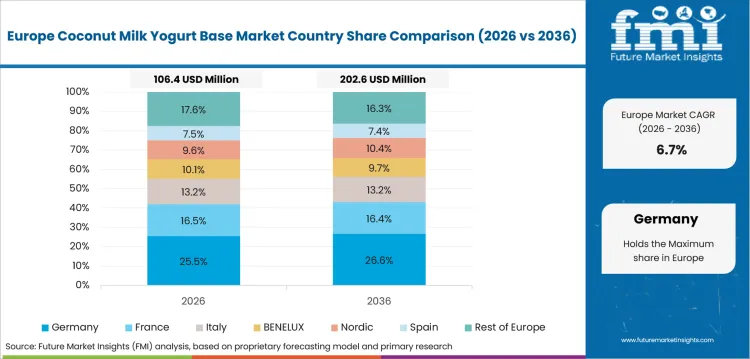
A 7.1% CAGR through 2036 reflects plant-based retail scale and strict EU dairy-term naming rules.
Country Market Snapshot Table
| Parameter | Value |
|---|---|
| Market Size in 2025 (Value) | USD 39.2 million |
| Market Size in 2026 (Value) | USD 42.0 million |
| Market Forecast in 2036 (Value) | USD 83.5 million |
| CAGR (2026 to 2036) | 7.1% |
| Years Considered | 2021 to 2036 |
| Base Year | 2025 |
| Forecast Period | 2026 to 2036 |
| Units Considered | Value (USD million) |
| Leading Sub-Region | Berlin and North Rhine-Westphalia retail corridors |
Germany Coconut Milk Yogurt Base Market Outlook
Germany demand is shaped by discount retail discipline and strict EU dairy-term rules. Coconut yogurt base suppliers must help customers build compliant names while keeping texture close to dairy yogurt.
Organic and vegetarian purchasing habits support trial, but price pressure remains high. Suppliers that offer both standard and premium bases can serve discounters and specialty brands.
Key Growth Drivers
- German plant-based familiarity supports dairy-free yogurt trials. BMEL reported that 53.0% of respondents had bought vegetarian or vegan alternatives to animal products at least once.
- Organic retail scale gives premium coconut bases a clearer entry point. Thuenen reported Germany’s organic food market volume at EUR 16.99 billion in 2024.
- Discounters are expected to use private-label coconut yogurt bases when suppliers can meet texture targets at controlled cost.
- EU dairy terminology limits are expected to increase demand for suppliers that can support compliant naming and nutrition communication.
Key Restraints
- Food price sensitivity remains a barrier for premium chilled cups. Destatis reported food prices were 0.4% higher year on year in May 2026.
- Protected dairy terms can slow product naming and shelf education for plant-based fermented desserts.
- Discount retail pressure can narrow supplier margins when coconut cream and stabilizer costs move upward.
What makes Germany unique
Germany is unique because discount retail scale combines with strict label rules and strong organic purchasing behavior.
Key Companies
- AAK Germany GmbH
- Ingredion Germany GmbH
- Cargill Deutschland GmbH
- Kerry Ingredients GmbH
- Tate & Lyle Germany GmbH
- CP Kelco Germany channel partners
Sales & Marketing Channels
- Discount retail tenders
- Organic store distributors
- Direct sales to food manufacturers
- Private-label co-packers
- Technical ingredient distributors
Country Segment Breakdown Table
| Segment | Sub-Segments |
|---|---|
| By Product Format | Fermentation-ready Bases · Cream Concentrates · Milk Powders · Custom Blends |
| By Form | Liquid · Powder · Frozen |
| By Function | Spoonable Yogurt · Drinkable Yogurt · Dessert Cups · Frozen Desserts |
| By Nature | Conventional · Organic |
| By Sales Channel | Direct B2B · Ingredient Distributors · Co-manufacturing |
| Key Sub-Regions Covered, Discount and Organic Retail Areas | Berlin · Hamburg · Munich · North Rhine-Westphalia · Baden-Württemberg · Bavaria |
Frequently Asked Questions
How fast is Germany coconut milk yogurt base market growing?
Germany is expected to expand at 7.1% CAGR from 2026 to 2036 through discount retail and organic channel testing.
Who leads Germany coconut milk yogurt base market?
AAK Germany, Ingredion, Cargill, Kerry and Tate & Lyle compete through dairy-free formulation support.
What is driving adoption in Germany?
Vegetarian product familiarity and organic retail scale are moving brands toward compliant coconut yogurt bases.
What is the coconut milk yogurt base market forecast for France?
A 6.6% CAGR through 2036 reflects supermarket chilled desserts and protein-diversification policy support.
Country Market Snapshot Table
| Parameter | Value |
|---|---|
| Market Size in 2025 (Value) | USD 32.8 million |
| Market Size in 2026 (Value) | USD 35.0 million |
| Market Forecast in 2036 (Value) | USD 66.4 million |
| CAGR (2026 to 2036) | 6.6% |
| Years Considered | 2021 to 2036 |
| Base Year | 2025 |
| Forecast Period | 2026 to 2036 |
| Units Considered | Value (USD million) |
| Leading Sub-Region | Paris and western supermarket chilled corridors |
France Coconut Milk Yogurt Base Market Outlook
France demand is expected to build through supermarket chilled desserts and dairy-free spoonable products. Coconut bases need refined texture because local shoppers compare them with dairy desserts and premium fromage blanc alternatives.
Protein-diversification policy gives plant-based suppliers a foodservice visibility route. Commercial conversion still depends on compliant naming and price control.
Key Growth Drivers
- Retail recovery can help chilled dessert testing. INSEE reported that sales volume in trade increased 0.9% month over month in March 2026.
- Foodservice protein-diversification rules support plant-based product exposure. French government guidance applies an action plan to catering sites averaging more than 200 table settings per day.
- Supermarket chilled desserts are expected to create coconut base demand when brands need spoon texture and clean flavor.
- Co-packers can support French dairy-free brands that need small-batch trials before national listings.
Key Restraints
- Food price pressure can restrict premium coconut dessert frequency. INSEE reported food prices rose 1.1% year on year in May 2026.
- Dairy dessert familiarity can make coconut flavor a barrier in plain and mild spoonable products.
- EU dairy terminology rules can slow pack wording and consumer explanation for fermented coconut desserts.
What makes France unique
France is unique because dairy dessert expectations and policy-backed protein diversification shape plant-based product testing together.
Key Companies
- AAK France SAS
- Ingredion France SAS
- Cargill France SAS
- Kerry Ingredients France SAS
- Tate & Lyle France channel partners
- dsm-firmenich France
Sales & Marketing Channels
- Supermarket chilled tenders
- Foodservice formulation briefs
- Ingredient distributor sampling
- Co-manufacturer trials
- Premium dessert brand programs
Country Segment Breakdown Table
| Segment | Sub-Segments |
|---|---|
| By Product Format | Fermentation-ready Bases · Cream Concentrates · Milk Powders · Custom Blends |
| By Form | Liquid · Powder · Frozen |
| By Function | Spoonable Yogurt · Drinkable Yogurt · Dessert Cups · Frozen Desserts |
| By Nature | Conventional · Organic |
| By Sales Channel | Direct B2B · Ingredient Distributors · Co-manufacturing |
| Key Sub-Regions Covered, Chilled Dessert Retail Areas | Paris · Lyon · Marseille · Nantes · Lille · Brittany |
Frequently Asked Questions
How fast is France coconut milk yogurt base market growing?
France is projected to grow at 6.6% CAGR from 2026 to 2036 through chilled dessert and foodservice testing.
Who leads France coconut milk yogurt base market?
AAK France, Ingredion, Cargill, Kerry and dsm-firmenich are relevant through application and ingredient support.
What is driving adoption in France?
Chilled dessert retail and protein-diversification policy are supporting controlled trials for coconut yogurt bases.
What is the coconut milk yogurt base market forecast for Japan?
A 6.1% CAGR through 2036 reflects convenience retail discipline and careful import documentation.
Country Market Snapshot Table
| Parameter | Value |
|---|---|
| Market Size in 2025 (Value) | USD 25.4 million |
| Market Size in 2026 (Value) | USD 27.0 million |
| Market Forecast in 2036 (Value) | USD 48.8 million |
| CAGR (2026 to 2036) | 6.1% |
| Years Considered | 2021 to 2036 |
| Base Year | 2025 |
| Forecast Period | 2026 to 2036 |
| Units Considered | Value (USD million) |
| Leading Sub-Region | Tokyo and Kansai premium convenience corridors |
Japan Coconut Milk Yogurt Base Market Outlook
Japan demand is expected to build through premium convenience retail and controlled dessert launches. Coconut yogurt bases must meet exact texture and documentation expectations before factories approve them.
Online and mobile shopping habits can support specialty dairy-free trials. Import controls and food price pressure make supplier paperwork and cost planning critical.
Key Growth Drivers
- Mobile commerce supports small-batch specialty testing. The USA International Trade Administration reported that 58.7% of Japan’s online goods sales were completed by smartphone in METI’s FY2023 e-commerce survey.
- Import documentation discipline supports suppliers that prepare complete files. Japan’s FY2024 imported foods monitoring plan covered 1,012,000 planned inspections.
- Convenience retailers are expected to support small chilled dessert cups when suppliers can deliver refined texture and mild flavor.
- Premium dessert makers can use coconut cream bases for smooth cups where dairy-free claims need a familiar sensory profile.
Key Restraints
- Food inflation can reduce trial of premium dairy-free cups. Japan’s Statistics Bureau reported food prices rose 6.8% in 2025.
- Low coconut familiarity in plain yogurt can slow mainstream conversion beyond dessert-positioned products.
- Import documentation adds approval time when suppliers cannot provide additive and traceability files quickly.
What makes Japan unique
Japan is unique because quality control and small-format convenience retail decide whether coconut yogurt bases pass buyer trials.
Key Companies
- AAK Japan K.K.
- Ingredion Japan K.K.
- Cargill Japan LLC
- Kerry Japan K.K.
- Tate & Lyle Japan channel partners
- dsm-firmenich Japan
Sales & Marketing Channels
- Importer-led ingredient supply
- Convenience store co-packers
- Direct sales to food manufacturers
- Technical distributors
- Premium dessert developers
Country Segment Breakdown Table
| Segment | Sub-Segments |
|---|---|
| By Product Format | Fermentation-ready Bases · Cream Concentrates · Milk Powders · Custom Blends |
| By Form | Liquid · Powder · Frozen |
| By Function | Spoonable Yogurt · Drinkable Yogurt · Dessert Cups · Frozen Desserts |
| By Nature | Conventional · Organic |
| By Sales Channel | Direct B2B · Ingredient Distributors · Co-manufacturing |
| Key Sub-Regions Covered, Premium Convenience Areas | Tokyo · Osaka · Yokohama · Nagoya · Fukuoka · Sapporo |
Frequently Asked Questions
How fast is Japan coconut milk yogurt base market growing?
Japan is anticipated to expand at 6.1% CAGR from 2026 to 2036 through premium convenience formats.
Who leads Japan coconut milk yogurt base market?
AAK Japan, Ingredion Japan, Cargill Japan and Kerry Japan are relevant through ingredient and distributor networks.
What is driving adoption in Japan?
Convenience retail discipline and mobile specialty shopping are supporting controlled coconut yogurt base trials.
What is the coconut milk yogurt base market outlook in China?
An 8.6% CAGR through 2036 reflects dessert-chain testing and wider coconut ingredient access.
Country Market Snapshot Table
| Parameter | Value |
|---|---|
| Market Size in 2025 (Value) | USD 58.9 million |
| Market Size in 2026 (Value) | USD 64.0 million |
| Market Forecast in 2036 (Value) | USD 145.9 million |
| CAGR (2026 to 2036) | 8.6% |
| Years Considered | 2021 to 2036 |
| Base Year | 2025 |
| Forecast Period | 2026 to 2036 |
| Units Considered | Value (USD million) |
| Leading Sub-Region | Shanghai and Guangdong dessert retail corridors |
China Coconut Milk Yogurt Base Market Outlook
China’s coconut yogurt base demand grows through rapid dessert and beverage testing. Brands need flexible bases that work in spoonable cups, pudding formats and drinkable dairy-free products.
E-commerce and catering scale support fast launch cycles. Price volatility and regional taste differences still require localized technical service.
Key Growth Drivers
- Online food sales support rapid trial. China’s statistics office reported that online food retail sales rose 14.5% in 2025.
- Catering channels create demand for dessert and beverage bases. China’s statistics office reported catering income reached CNY 5,571.8 billion in 2024 and grew 5.3%.
- Dessert drink chains are expected to create fast trials for coconut textures in spoonable and drinkable formats.
- Regional distributors can connect imported coconut ingredients with mid-sized processors that need flexible recipe support.
Key Restraints
- Dairy price deflation can pressure premium coconut bases. China’s statistics office reported milk and other dairy product prices fell 1.2% year on year in May 2026.
- Regional taste differences make one base recipe difficult to scale across northern and southern cities.
- Smaller brands face price swings when imported coconut inputs move faster than short buying cycles.
What makes China unique
China is unique because dessert chains and online brands can test coconut yogurt bases faster than most profiled markets.
Key Companies
- Ingredion China
- Kerry China
- Tate & Lyle China
- dsm-firmenich China
- Cargill China
- AAK China channel partners
Sales & Marketing Channels
- Regional ingredient distributors
- E-commerce brand supply
- Dessert chain partnerships
- Direct technical sales
- Co-manufacturing networks
Country Segment Breakdown Table
| Segment | Sub-Segments |
|---|---|
| By Product Format | Fermentation-ready Bases · Cream Concentrates · Milk Powders · Custom Blends |
| By Form | Liquid · Powder · Frozen |
| By Function | Spoonable Yogurt · Drinkable Yogurt · Dessert Cups · Frozen Desserts |
| By Nature | Conventional · Organic |
| By Sales Channel | Direct B2B · Ingredient Distributors · Co-manufacturing |
| Key Sub-Regions Covered, Dessert and E-commerce Areas | Shanghai · Guangdong · Beijing · Jiangsu · Zhejiang · Chengdu |
Frequently Asked Questions
How fast is China coconut milk yogurt base market growing?
China is projected to advance at 8.6% CAGR from 2026 to 2036 through dessert chains and online food brands.
Who leads China coconut milk yogurt base market?
Ingredion China, Kerry, Tate & Lyle, dsm-firmenich and Cargill compete through technical ingredient support.
What is driving adoption in China?
Online food sales and catering growth are moving coconut yogurt bases into dessert and beverage trials.
How is the coconut milk yogurt base market performing in South Korea?
An 8.1% CAGR through 2036 reflects premium convenience formats and cafe-led dessert trials.
Country Market Snapshot Table
| Parameter | Value |
|---|---|
| Market Size in 2025 (Value) | USD 23.1 million |
| Market Size in 2026 (Value) | USD 25.0 million |
| Market Forecast in 2036 (Value) | USD 54.5 million |
| CAGR (2026 to 2036) | 8.1% |
| Years Considered | 2021 to 2036 |
| Base Year | 2025 |
| Forecast Period | 2026 to 2036 |
| Units Considered | Value (USD million) |
| Leading Sub-Region | Seoul and Gyeonggi premium cafe corridors |
South Korea Coconut Milk Yogurt Base Market Outlook
South Korea’s coconut yogurt base demand is tied to cafe culture and premium convenience retail. Suppliers must deliver quick samples and mild flavor control for dessert-style applications.
Online food purchasing supports small-batch launches. Consumer price pressure and strong dairy competition make repeat purchase harder outside premium formats.
Key Growth Drivers
- Online food channels support quick test launches. KOSTAT reported online food and beverage transaction value grew 5.8% year on year in August 2025.
- Food-tech policy can support new ingredient systems. MAFRA planned to increase food-tech R&D support centers to 5 in 2025 from 3 in 2024.
- Cafe desserts are expected to create trials for coconut spoonable bases and mild cream concentrates.
- Local distributors can help imported ingredient systems reach mid-sized brands that need fast sample support.
Key Restraints
- Consumer price pressure can limit premium chilled trial. KOSTAT reported the CPI rose 3.1% year on year in May 2026.
- Shelf competition from soy and dairy yogurt limits trial frequency for coconut-first products.
- Coconut flavor can be too strong for plain product formats unless suppliers provide masking support.
What makes South Korea unique
South Korea is unique because cafe-led desserts and convenience formats give coconut bases a premium novelty route.
Key Companies
- Ingredion Korea
- Kerry Korea
- Cargill Korea
- dsm-firmenich Korea
- Tate & Lyle Korea channel partners
- AAK regional distributors
Sales & Marketing Channels
- Imported ingredient distributors
- Cafe chain innovation teams
- Convenience retail co-packers
- Direct B2B technical sales
- Online specialty food brands
Country Segment Breakdown Table
| Segment | Sub-Segments |
|---|---|
| By Product Format | Fermentation-ready Bases · Cream Concentrates · Milk Powders · Custom Blends |
| By Form | Liquid · Powder · Frozen |
| By Function | Spoonable Yogurt · Drinkable Yogurt · Dessert Cups · Frozen Desserts |
| By Nature | Conventional · Organic |
| By Sales Channel | Direct B2B · Ingredient Distributors · Co-manufacturing |
| Key Sub-Regions Covered, Cafe and Convenience Areas | Seoul · Gyeonggi · Busan · Incheon · Daegu · Daejeon |
Frequently Asked Questions
How fast is South Korea coconut milk yogurt base market growing?
South Korea is estimated to rise at 8.1% CAGR from 2026 to 2036 through cafe and convenience trials.
Who leads South Korea coconut milk yogurt base market?
Ingredion Korea, Kerry, Cargill and dsm-firmenich support the market through regional ingredient channels.
What is driving adoption in South Korea?
Online food growth and cafe dessert testing are moving brands toward mild coconut yogurt bases.
How fast is the coconut milk yogurt base market growing in India?
A 9.0% CAGR through 2036 reflects domestic coconut access and formal vegan logo guidance.
Country Market Snapshot Table
| Parameter | Value |
|---|---|
| Market Size in 2025 (Value) | USD 33.9 million |
| Market Size in 2026 (Value) | USD 37.0 million |
| Market Forecast in 2036 (Value) | USD 87.6 million |
| CAGR (2026 to 2036) | 9.0% |
| Years Considered | 2021 to 2036 |
| Base Year | 2025 |
| Forecast Period | 2026 to 2036 |
| Units Considered | Value (USD million) |
| Leading Sub-Region | Bengaluru and Mumbai premium retail corridors |
India Coconut Milk Yogurt Base Market Outlook
India records the strongest growth outlook as domestic coconut availability meets formal vegan label guidance. Metro brands can use coconut bases for dairy-free yogurt and dessert cups with recognizable local raw material.
Growth remains concentrated in premium retail and quick-commerce channels. Cold-chain gaps and price-sensitive dairy curd competition keep wider rollout controlled.
Key Growth Drivers
- Domestic coconut availability supports base production. PIB reported India produced about 13.97 million tonnes of coconut in 2024 to 2025 from 2.19 million hectares.
- Cold-chain project activity supports chilled dairy-free trials. The Ministry of Food Processing Industries listed 408 approved cold-chain projects as of March 31, 2026.
- FSSAI vegan logo guidance is expected to help brands communicate plant-based claims through a formal approval route.
- Metro quick-commerce platforms can help premium dairy-free cups reach trial users before wider supermarket expansion.
Key Restraints
- Cold-chain capacity remains a rollout constraint. A MoFPI assessment estimated India had 37.0 million tonnes of cold-chain warehousing against a food need of 140.0 million to 150.0 million tonnes.
- Price-sensitive consumers compare coconut yogurt with low-cost dairy curd before repeat purchase.
- Organic coconut bases are likely to remain limited to premium shelves because certified input costs are higher.
What makes India unique
India is unique because domestic coconut supply and vegan logo guidance combine with the fastest urban plant-based trial route.
Key Companies
- AAK India Pvt. Ltd.
- Kerry Ingredients India Pvt. Ltd.
- Ingredion India Pvt. Ltd.
- dsm-firmenich India
- Cargill India Pvt. Ltd.
- Tate & Lyle India channel partners
Sales & Marketing Channels
- Direct food manufacturer sales
- Quick-commerce brand partnerships
- Ingredient distributors
- Co-packer qualification
- Premium grocery channels
Country Segment Breakdown Table
| Segment | Sub-Segments |
|---|---|
| By Product Format | Fermentation-ready Bases · Cream Concentrates · Milk Powders · Custom Blends |
| By Form | Liquid · Powder · Frozen |
| By Function | Spoonable Yogurt · Drinkable Yogurt · Dessert Cups · Frozen Desserts |
| By Nature | Conventional · Organic |
| By Sales Channel | Direct B2B · Ingredient Distributors · Co-manufacturing |
| Key Sub-Regions Covered, Urban Chilled Retail Areas | Bengaluru · Mumbai · Delhi NCR · Chennai · Hyderabad · Kochi |
Frequently Asked Questions
How fast is India coconut milk yogurt base market growing?
India is forecast to record 9.0% CAGR from 2026 to 2036 due to coconut supply and urban dairy-free trials.
Who leads India coconut milk yogurt base market?
AAK India, Kerry, Ingredion, dsm-firmenich and Cargill compete through B2B ingredient support.
What is driving adoption in India?
Coconut availability and vegan logo guidance are supporting dairy-free yogurt base trials in metro retail channels.
Coconut Milk Yogurt Base Market - Report Scope
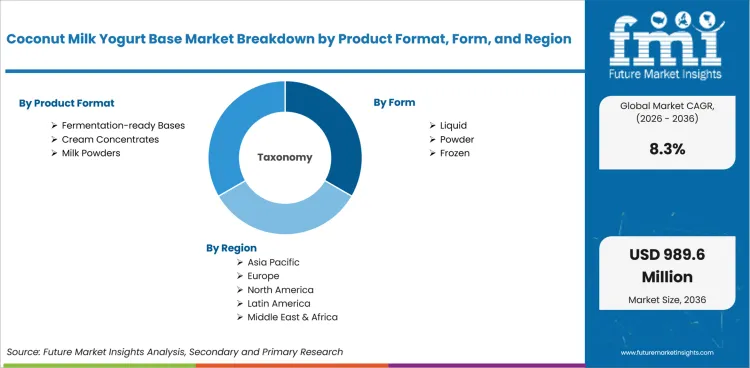
| Item | Value |
|---|---|
| Market size by 2036 | USD 989.6 million |
| Growth rate | 8.3% CAGR from 2026 to 2036 |
| Forecast period | 2026 to 2036 |
| Base year value (2025) | USD 412.0 million |
| By product format | Fermentation-ready bases, cream concentrates, milk powders, custom blends |
| By form | Liquid, powder, frozen |
| By function | Spoonable yogurt, drinkable yogurt, dessert cups, frozen desserts |
| By nature | Conventional, organic |
| By sales channel | Direct B2B, ingredient distributors, co-manufacturing |
| Regions covered | North America, Latin America, Europe, East Asia, South Asia and Pacific, Middle East and Africa |
| Countries covered | United States, United Kingdom, Germany, France, Japan, China, South Korea, India |
| Key companies profiled | AAK AB, Ingredion, Cargill, Kerry Group, Tate & Lyle, dsm-firmenich, CP Kelco, Symrise |
| Approach | Bottom-up product-boundary approach using B2B ingredient revenue, application fit, coconut input pricing and country-level adoption |
Coconut Milk Yogurt Base Market - Scope & Definition
| Attribute | Detail |
|---|---|
| Market Definition | B2B ingredient systems made from coconut milk, coconut cream, coconut milk powder and blended stabilizer systems for dairy-free yogurt production |
| Functions Covered | Texture stabilization, fermentation compatibility, fat dispersion, pH control, mouthfeel support and cold-storage stability |
| Applications Covered | Spoonable yogurt, drinkable yogurt, dessert cups and adjacent chilled fermented dairy-free products |
| End-Use Industries | Plant-based dairy alternatives, chilled desserts, foodservice preparation, co-manufacturing and private-label food production |
| Grades Covered | Conventional, organic, liquid, powder, frozen, fermentation-ready and custom blend formats |
| Inclusions | Commercially traded coconut yogurt bases across product formats, forms, functions, nature types and B2B sales channels |
| Exclusions | Finished retail yogurt cups, dairy yogurt, shelf-stable coconut beverages, culinary coconut milk, coconut water, coconut oil, coconut sugar and retail dessert products not sold as B2B bases |
Coconut Milk Yogurt Base Market - Research Methodology
| Method | Description |
|---|---|
| Primary Research | FMI analyst interviews with dairy-free yogurt manufacturers, ingredient distributors, co-packers and formulation teams across key markets |
| Desk Research | Review of food regulator guidance, coconut trade data, ingredient company technical pages, plant-based retail datasets and official country statistics |
| Market Sizing & Forecasting | Bottom-up product-boundary approach using plant-based yogurt output, coconut base inclusion rates, industrial ingredient pricing and country channel maturity |
| Data Validation | Cross-verification using coconut supply signals, plant-based dairy retail data, company portfolios and application support evidence |
Coconut Milk Yogurt Base Market Breakdown by Product Format, Form, Function, Nature, Sales Channel, and Region
Coconut Milk Yogurt Base Market Segmented by Product Format
- Fermentation-ready Bases
- Cream Concentrates
- Milk Powders
- Custom Blends
Coconut Milk Yogurt Base Market Segmented by Form
- Liquid
- Powder
- Frozen
Coconut Milk Yogurt Base Market Segmented by Function
- Spoonable Yogurt
- Drinkable Yogurt
- Dessert Cups
- Frozen Desserts
Coconut Milk Yogurt Base Market Segmented by Nature
- Conventional
- Organic
Coconut Milk Yogurt Base Market Segmented by Sales Channel
- Direct B2B
- Ingredient Distributors
- Co-manufacturing
Coconut Milk Yogurt Base Market by Region
- North America
- Latin America
- Europe
- East Asia
- South Asia and Pacific
- Middle East and Africa
Research Sources and Bibliography
- Good Food Institute. (2026, May). State of the industry: Plant-based meat, seafood, eggs, dairy, and ingredients.
- Good Food Institute Europe. (2026, June). European plant-based sales data.
- USA Food and Drug Administration. (2025, January 6). Plant-based milk and animal food alternatives.
- USA Bureau of Labor Statistics. (2026, June 10). Consumer Price Index Summary, May 2026.
- USA Department of Agriculture Economic Research Service. (2025). The prevalence of competing and complementary claims on USA food product packaging.
- Food Standards Agency. (2024, March 5). FSA launches campaign highlighting risk of food labelled as vegan to people with allergies.
- Office for National Statistics. (2026, May 20). Consumer price inflation, UK: April 2026.
- Federal Ministry of Food and Agriculture. (2024). Good food for Germany.
- Federal Statistical Office of Germany. (2026, June 12). Inflation rate at +2.6% in May 2026.
- Thünen Institute. (2025, August 18). Current trends in the German organic sector.
- INSEE. (2026, May 21). In March 2026, sales volume in trade increased.
- INSEE. (2026, June 12). In May 2026, consumer prices rose by 2.4% year on year.
- Ministry of Agriculture and Food Sovereignty of France. (2024). France’s EGAlim and Climate & Resilience legislation.
- Ministry of Health, Labour and Welfare. (2024, March 28). Implementation of Imported Foods Monitoring Plan for FY 2024.
- Statistics Bureau of Japan. (2026). Consumer Price Index Japan 2025.
- USA International Trade Administration. (2025, November 18). Japan - eCommerce.
- National Bureau of Statistics of China. (2026, January 20). Total retail sales of consumer goods in December 2025.
- National Bureau of Statistics of China. (2026, June 11). Consumer Price Index in May 2026.
- Statistics Korea. (2025, October 1). Online Shopping in August 2025.
- Ministry of Agriculture, Food and Rural Affairs. (2025, February 14). 2025 major work plan.
- Statistics Korea. (2026, June 2). Consumer Price Index in May 2026.
- Press Information Bureau of India. (2026, April 19). Accelerating India’s high value crop diversification.
- Ministry of Food Processing Industries. (2026, April 9). Consolidated list of approved cold-chain projects.
- Ministry of Food Processing Industries. (2025). Assessment of infrastructure and logistics requirements of India’s food processing sector.
- Food Safety and Standards Authority of India. (2024). Vegan food.
This bibliography is provided for reader reference and is not exhaustive. The full report contains the complete reference list and detailed citations.
This Report Answers
- What is the 2026 value and 2036 forecast for the coconut milk yogurt base market?
- What product format is projected to hold the leading share during the forecast period?
- What form is expected to account for the leading 2026 share?
- How do texture systems and label rules affect base supplier selection?
- What companies compete in coconut milk yogurt base formulation?
Frequently Asked Questions
What is the global market demand for Coconut Milk Yogurt Base Market in 2026?
In 2026, the global Coconut Milk Yogurt Base Market is expected to be worth USD 445.8 million as B2B dairy-free yogurt trials expand.
How big will the Coconut Milk Yogurt Base Market be by 2036?
By 2036, the Coconut Milk Yogurt Base Market is projected to reach USD 989.6 million as fermentation-ready systems gain wider manufacturing use.
What CAGR is projected for the Coconut Milk Yogurt Base Market from 2026 to 2036?
The Coconut Milk Yogurt Base Market is projected to expand at 8.3% CAGR during 2026 to 2036 with texture stability driving repeat orders.
What segment leads the Coconut Milk Yogurt Base Market?
Fermentation-ready bases are projected to lead with 44.0% share in 2026 as they reduce product development risk for yogurt makers.
What country grows fastest in the Coconut Milk Yogurt Base Market?
India is projected to record the fastest growth at 9.0% CAGR through 2036 due to vegan labeling support and urban chilled retail.
Preview the report firsthand - request a free sample
Get SampleGet the brochure for pricing and purchase details.
Get PDFTable of Content
- Key Takeaways
- Market Size and CAGR
- Top Growth Driver
- Fastest Growing Segment
- Leading Region
- Key Companies
- Emerging Opportunities
- Executive Summary
- Global Market Outlook
- Demand-side Trends
- Supply-side Trends
- Technology Roadmap Analysis
- Analysis and Recommendations
- Analyst Perspective (What is happening? Why now? What should investors know?)
- Key Questions Answered
- How large is the market?
- What is the CAGR?
- What are key trends?
- Which region dominates?
- Who are the leaders?
- Market Overview
- Market Coverage / Taxonomy
- Market Definition / Scope / Limitations
- Research Methodology
- Chapter Orientation
- Analytical Lens and Working Hypotheses
- Market Structure, Signals, and Trend Drivers
- Benchmarking and Cross-market Comparability
- Market Sizing, Forecasting, and Opportunity Mapping
- Research Design and Evidence Framework
- Desk Research Programme (Secondary Evidence)
- Expert Input and Fieldwork (Primary Evidence)
- Tooling, Models, and Reference Databases
- Data Engineering and Model Build
- Quality Assurance and Audit Trail
- Market Background
- Market Dynamics (Drivers, Restraints, Opportunity, Trends)
- Scenario Forecast (Optimistic, Likely, Conservative)
- Impact Analysis
- AI Impact
- Sustainability Impact
- Regulatory Impact
- Technology Impact
- Consumer / Buyer Analysis
- Purchase Drivers
- Adoption Barriers
- Buyer Journey
- Opportunity Map Analysis
- Product Life Cycle Analysis
- Supply Chain Analysis
- Investment Feasibility Matrix
- Value Chain Analysis
- PESTLE and Porter's Analysis
- Regulatory Landscape
- Regional Parent Market Outlook
- Production and Consumption Statistics
- Import and Export Statistics
- Global Market Analysis and Forecast, 2021 to 2036
- Historical Market Size Value (USD Million) & Volume (Unit) Analysis, 2021 to 2025
- Current and Future Market Size Value (USD Million) & Volume (Unit) Projections, 2026 to 2036
- Y-o-Y Growth Trend Analysis
- Absolute $ Opportunity Analysis
- Global Market Pricing Analysis, 2021 to 2036
- Global Market Analysis and Forecast, By Product Format, 2021 to 2036
- Introduction / Key Findings
- Historical Market Size Value (USD Million) & Volume (Unit) Analysis By Product Format, 2021 to 2025
- Current and Future Market Size Value (USD Million) & Volume (Unit) Analysis and Forecast By Product Format, 2026 to 2036
- Fermentation-ready Bases
- Cream Concentrates
- Milk Powders
- Custom Blends
- Fermentation-ready Bases
- Y-o-Y Growth Trend Analysis By Product Format, 2021 to 2025
- Absolute $ Opportunity Analysis By Product Format, 2026 to 2036
- Global Market Analysis and Forecast, By Form, 2021 to 2036
- Introduction / Key Findings
- Historical Market Size Value (USD Million) & Volume (Unit) Analysis By Form, 2021 to 2025
- Current and Future Market Size Value (USD Million) & Volume (Unit) Analysis and Forecast By Form, 2026 to 2036
- Liquid
- Powder
- Frozen
- Liquid
- Y-o-Y Growth Trend Analysis By Form, 2021 to 2025
- Absolute $ Opportunity Analysis By Form, 2026 to 2036
- Global Market Analysis and Forecast, By Function, 2021 to 2036
- Introduction / Key Findings
- Historical Market Size Value (USD Million) & Volume (Unit) Analysis By Function, 2021 to 2025
- Current and Future Market Size Value (USD Million) & Volume (Unit) Analysis and Forecast By Function, 2026 to 2036
- Spoonable Yogurt
- Drinkable Yogurt
- Dessert Cups
- Frozen Desserts
- Spoonable Yogurt
- Y-o-Y Growth Trend Analysis By Function, 2021 to 2025
- Absolute $ Opportunity Analysis By Function, 2026 to 2036
- Global Market Analysis and Forecast, By Nature, 2021 to 2036
- Introduction / Key Findings
- Historical Market Size Value (USD Million) & Volume (Unit) Analysis By Nature, 2021 to 2025
- Current and Future Market Size Value (USD Million) & Volume (Unit) Analysis and Forecast By Nature, 2026 to 2036
- Conventional
- Organic
- Conventional
- Y-o-Y Growth Trend Analysis By Nature, 2021 to 2025
- Absolute $ Opportunity Analysis By Nature, 2026 to 2036
- Global Market Analysis and Forecast, By Sales Channel, 2021 to 2036
- Introduction / Key Findings
- Historical Market Size Value (USD Million) & Volume (Unit) Analysis By Sales Channel, 2021 to 2025
- Current and Future Market Size Value (USD Million) & Volume (Unit) Analysis and Forecast By Sales Channel, 2026 to 2036
- Direct B2B
- Ingredient Distributors
- Co-manufacturing
- Direct B2B
- Y-o-Y Growth Trend Analysis By Sales Channel, 2021 to 2025
- Absolute $ Opportunity Analysis By Sales Channel, 2026 to 2036
- Global Market Analysis and Forecast, By Region, 2021 to 2036
- Introduction
- Historical Market Size Value (USD Million) & Volume (Unit) Analysis By Region, 2021 to 2025
- Current Market Size Value (USD Million) & Volume (Unit) Analysis and Forecast By Region, 2026 to 2036
- North America
- Latin America
- Western Europe
- Eastern Europe
- East Asia
- South Asia and Pacific
- Middle East & Africa
- Market Attractiveness Analysis By Region
- North America Market Analysis and Forecast, By Country, 2021 to 2036
- Historical Market Size Value (USD Million) & Volume (Unit) Trend Analysis By Market Taxonomy, 2021 to 2025
- Market Size Value (USD Million) & Volume (Unit) Forecast By Market Taxonomy, 2026 to 2036
- By Country
- USA
- Canada
- Mexico
- By Product Format
- By Form
- By Function
- By Nature
- By Sales Channel
- By Country
- Market Attractiveness Analysis
- By Country
- By Product Format
- By Form
- By Function
- By Nature
- By Sales Channel
- Key Takeaways
- Latin America Market Analysis and Forecast, By Country
- Historical Market Size Value (USD Million) & Volume (Unit) Trend Analysis By Market Taxonomy, 2021 to 2025
- Market Size Value (USD Million) & Volume (Unit) Forecast By Market Taxonomy, 2026 to 2036
- By Country
- Brazil
- Chile
- Rest of Latin America
- By Product Format
- By Form
- By Function
- By Nature
- By Sales Channel
- By Country
- Market Attractiveness Analysis
- By Country
- By Product Format
- By Form
- By Function
- By Nature
- By Sales Channel
- Key Takeaways
- Western Europe Market Analysis and Forecast, By Country
- Historical Market Size Value (USD Million) & Volume (Unit) Trend Analysis By Market Taxonomy, 2021 to 2025
- Market Size Value (USD Million) & Volume (Unit) Forecast By Market Taxonomy, 2026 to 2036
- By Country
- Germany
- UK
- Italy
- Spain
- France
- Nordic
- BENELUX
- Rest of Western Europe
- By Product Format
- By Form
- By Function
- By Nature
- By Sales Channel
- By Country
- Market Attractiveness Analysis
- By Country
- By Product Format
- By Form
- By Function
- By Nature
- By Sales Channel
- Key Takeaways
- Eastern Europe Market Analysis and Forecast, By Country
- Historical Market Size Value (USD Million) & Volume (Unit) Trend Analysis By Market Taxonomy, 2021 to 2025
- Market Size Value (USD Million) & Volume (Unit) Forecast By Market Taxonomy, 2026 to 2036
- By Country
- Russia
- Poland
- Hungary
- Balkan & Baltic
- Rest of Eastern Europe
- By Product Format
- By Form
- By Function
- By Nature
- By Sales Channel
- By Country
- Market Attractiveness Analysis
- By Country
- By Product Format
- By Form
- By Function
- By Nature
- By Sales Channel
- Key Takeaways
- East Asia Market Analysis and Forecast, By Country
- Historical Market Size Value (USD Million) & Volume (Unit) Trend Analysis By Market Taxonomy, 2021 to 2025
- Market Size Value (USD Million) & Volume (Unit) Forecast By Market Taxonomy, 2026 to 2036
- By Country
- China
- Japan
- South Korea
- By Product Format
- By Form
- By Function
- By Nature
- By Sales Channel
- By Country
- Market Attractiveness Analysis
- By Country
- By Product Format
- By Form
- By Function
- By Nature
- By Sales Channel
- Key Takeaways
- South Asia and Pacific Market Analysis and Forecast, By Country
- Historical Market Size Value (USD Million) & Volume (Unit) Trend Analysis By Market Taxonomy, 2021 to 2025
- Market Size Value (USD Million) & Volume (Unit) Forecast By Market Taxonomy, 2026 to 2036
- By Country
- India
- ASEAN
- Australia & New Zealand
- Rest of South Asia and Pacific
- By Product Format
- By Form
- By Function
- By Nature
- By Sales Channel
- By Country
- Market Attractiveness Analysis
- By Country
- By Product Format
- By Form
- By Function
- By Nature
- By Sales Channel
- Key Takeaways
- Middle East & Africa Market Analysis and Forecast, By Country
- Historical Market Size Value (USD Million) & Volume (Unit) Trend Analysis By Market Taxonomy, 2021 to 2025
- Market Size Value (USD Million) & Volume (Unit) Forecast By Market Taxonomy, 2026 to 2036
- By Country
- Kingdom of Saudi Arabia
- Other GCC Countries
- Türkiye
- South Africa
- Other African Union
- Rest of Middle East & Africa
- By Product Format
- By Form
- By Function
- By Nature
- By Sales Channel
- By Country
- Market Attractiveness Analysis
- By Country
- By Product Format
- By Form
- By Function
- By Nature
- By Sales Channel
- Key Takeaways
- Key Countries Market Analysis
- USA
- Pricing Analysis
- Market Share Analysis, 2025
- By Product Format
- By Form
- By Function
- By Nature
- By Sales Channel
- Canada
- Pricing Analysis
- Market Share Analysis, 2025
- By Product Format
- By Form
- By Function
- By Nature
- By Sales Channel
- Mexico
- Pricing Analysis
- Market Share Analysis, 2025
- By Product Format
- By Form
- By Function
- By Nature
- By Sales Channel
- Brazil
- Pricing Analysis
- Market Share Analysis, 2025
- By Product Format
- By Form
- By Function
- By Nature
- By Sales Channel
- Chile
- Pricing Analysis
- Market Share Analysis, 2025
- By Product Format
- By Form
- By Function
- By Nature
- By Sales Channel
- Germany
- Pricing Analysis
- Market Share Analysis, 2025
- By Product Format
- By Form
- By Function
- By Nature
- By Sales Channel
- UK
- Pricing Analysis
- Market Share Analysis, 2025
- By Product Format
- By Form
- By Function
- By Nature
- By Sales Channel
- Italy
- Pricing Analysis
- Market Share Analysis, 2025
- By Product Format
- By Form
- By Function
- By Nature
- By Sales Channel
- Spain
- Pricing Analysis
- Market Share Analysis, 2025
- By Product Format
- By Form
- By Function
- By Nature
- By Sales Channel
- France
- Pricing Analysis
- Market Share Analysis, 2025
- By Product Format
- By Form
- By Function
- By Nature
- By Sales Channel
- India
- Pricing Analysis
- Market Share Analysis, 2025
- By Product Format
- By Form
- By Function
- By Nature
- By Sales Channel
- ASEAN
- Pricing Analysis
- Market Share Analysis, 2025
- By Product Format
- By Form
- By Function
- By Nature
- By Sales Channel
- Australia & New Zealand
- Pricing Analysis
- Market Share Analysis, 2025
- By Product Format
- By Form
- By Function
- By Nature
- By Sales Channel
- China
- Pricing Analysis
- Market Share Analysis, 2025
- By Product Format
- By Form
- By Function
- By Nature
- By Sales Channel
- Japan
- Pricing Analysis
- Market Share Analysis, 2025
- By Product Format
- By Form
- By Function
- By Nature
- By Sales Channel
- South Korea
- Pricing Analysis
- Market Share Analysis, 2025
- By Product Format
- By Form
- By Function
- By Nature
- By Sales Channel
- Russia
- Pricing Analysis
- Market Share Analysis, 2025
- By Product Format
- By Form
- By Function
- By Nature
- By Sales Channel
- Poland
- Pricing Analysis
- Market Share Analysis, 2025
- By Product Format
- By Form
- By Function
- By Nature
- By Sales Channel
- Hungary
- Pricing Analysis
- Market Share Analysis, 2025
- By Product Format
- By Form
- By Function
- By Nature
- By Sales Channel
- Kingdom of Saudi Arabia
- Pricing Analysis
- Market Share Analysis, 2025
- By Product Format
- By Form
- By Function
- By Nature
- By Sales Channel
- Türkiye
- Pricing Analysis
- Market Share Analysis, 2025
- By Product Format
- By Form
- By Function
- By Nature
- By Sales Channel
- South Africa
- Pricing Analysis
- Market Share Analysis, 2025
- By Product Format
- By Form
- By Function
- By Nature
- By Sales Channel
- USA
- Market Structure Analysis
- Competition Dashboard
- Competition Benchmarking
- Market Share Analysis of Top Players
- By Regional
- By Product Format
- By Form
- By Function
- By Nature
- By Sales Channel
- Emerging Startups
- Innovation Benchmarking
- Competition Analysis
- Competition Deep Dive
- AAK AB
- Overview
- Product Portfolio
- Profitability by Market Segments (Product/Region/Sales Channel)
- Sales Footprint
- Strategy Overview
- Marketing Strategy
- Product Strategy
- Channel Strategy
- Ingredion
- Cargill
- Kerry Group
- Tate & Lyle
- dsm-firmenich
- CP Kelco
- Symrise
- Palsgaard
- SunOpta ingredient channels
- AAK AB
- Case Studies
- Success Stories
- Recent Developments
- Competition Deep Dive
- Assumptions & Acronyms Used


