

- Market Size (2026)
- USD 480.0 Mn
- Forecast (2036)
- USD 935.4 Mn
- CAGR (2026 to 2036)
- 6.9%
UHT Coconut Milk Market Size, Market Forecast and Outlook By FMI
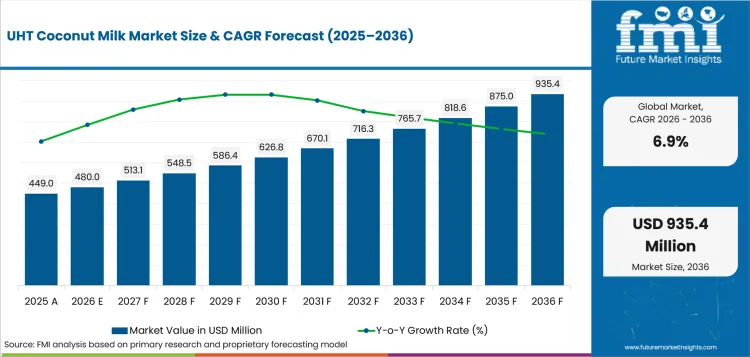
UHT coconut milk market is expected to rise from USD 449.0 million in 2025 to USD 935.4 million by 2036 at 6.9% CAGR. Growth is expected to come from shelf-stable retail packs and cooking formats that do not need chilled storage before opening. Plain UHT coconut milk is forecast to account for 48.9% share, while aseptic cartons are expected to hold 64.2% share because they fit pantry storage and export supply.
Key Takeaways, Market Size, and Forecast
- 2026 Market Size: USD 480.0 million
- 2036 Market Size: USD 935.4 million
- Forecast CAGR: 6.9% from 2026 to 2036
- Leading Product Type: Plain UHT coconut milk
- Plain UHT coconut milk share in 2026: 48.9%
- Leading Pack Format: Aseptic cartons
- Aseptic cartons share in 2026: 64.2%
- Fastest-growing Country: Saudi Arabia
- Saudi Arabia CAGR: 7.8% by 2036
Summary of UHT Coconut Milk Market
- Demand and Growth Drivers
- Households are choosing UHT coconut milk because it can be stored before opening without refrigeration.
- Retailers are adding shelf-stable coconut milk formats to cooking aisles and plant-based sections.
- Foodservice kitchens are using larger UHT packs to reduce cold storage pressure.
- Product and Segment View
- Plain UHT coconut milk is expected to lead because it is used in a wide range of cooking recipes.
- Aseptic cartons are expected to stay ahead because they protect liquid coconut milk during transport and storage.
- Family packs are expected to gain use among households that cook coconut-based dishes more often.
- Geography and Competitive Outlook
- The United States is expected to stay important because grocery retail and Asian food aisles are well developed.
- Saudi Arabia is expected to move fastest because imported shelf-stable foods fit modern retail and hotel kitchen needs.
- Competition is expected to split between coconut milk processors and aseptic beverage suppliers.
- Analyst Opinion
- FMI Principal Consultant for Food and Beverage Nandini Roy Choudhury, says “UHT coconut milk should be viewed as a shelf-stable cooking and beverage format rather than only as another coconut product. The product wins when it keeps taste consistent and reduces cold chain dependence. Brands that combine aseptic pack reliability with clear cooking use can protect repeat retail and foodservice orders.”
- UHT Coconut Milk Market Value Analysis
- The UHT coconut milk market is moving from a small shelf-stable option into a more structured retail and foodservice category.
- Demand is rising because consumers want coconut milk that can sit in pantry storage before use.
- Aseptic cartons are helping suppliers serve distant markets without depending on chilled logistics.
- Revenue is expected to improve as processors position UHT coconut milk for beverage blending and foodservice storage convenience.
Packaging compliance is a stronger pressure point for shelf-stable coconut milk suppliers. The European Union Packaging and Packaging Waste Regulation entered into force on 11 February 2025 and will generally apply from 12 August 2026. This gives UHT coconut milk brands a clear reason to review carton design and importer records before placing products in European retail channels. Aseptic packaging investment is moving in the same direction. In January 2026, Tetra Pak announced a EUR 60 million pilot plant investment in Lund to advance paper-based barrier technology for aseptic packaging. The move gives beverage and coconut milk processors a route to prepare shelf-stable packs for stricter packaging expectations without losing ambient storage benefits.
UHT Coconut Milk Market Definition
UHT coconut milk is coconut milk processed through ultra-high temperature treatment and packed in aseptic or shelf-stable formats. The process allows unopened products to be stored at ambient temperature for a longer period than chilled coconut milk. The market is centered on coconut milk products sold in cartons and other shelf-stable packs for cooking, beverage preparation and foodservice use. It differs from canned coconut milk because the value lies in aseptic processing, carton convenience and chilled-chain avoidance.
UHT Coconut Milk Market Inclusions
Market scope covers UHT coconut milk products categorized by product type and pack format. Product type includes plain UHT coconut milk and barista UHT coconut milk. Light UHT coconut milk and organic UHT coconut milk complete the product group. Pack format includes aseptic cartons and mini cartons. Family packs and foodservice packs complete pack coverage. Fat profile includes standard fat and light fat. Full fat and blended fat formats complete the fat profile scope. End use includes household retail and foodservice kitchens. Beverage manufacturing and private-label production complete end-use coverage. Sales channel includes supermarkets and hypermarkets. Online retail, specialty Asian stores and distributor sales complete the channel scope.
The scope also includes shelf-stable coconut milk products processed through UHT or aseptic systems where ambient storage before opening is a core product feature. Revenue scope covers 2026 to 2036. Key stakeholders include UHT coconut milk processors and aseptic beverage suppliers. Coconut ingredient companies and private-label manufacturers are also included. Grocery retailers, foodservice distributors and packaging suppliers complete the stakeholder base. Importers and exporters are included where they handle shelf-stable coconut milk flows.
UHT Coconut Milk Market Exclusions
Scope excludes canned coconut milk when the product is not positioned as UHT or aseptic. Chilled coconut milk is excluded because it depends on cold storage. Coconut water and ready-to-drink coconut beverages are excluded unless they are sold as UHT coconut milk products. Coconut cream is excluded because it serves a thicker cooking role. Finished curries, desserts and prepared drinks are excluded even if UHT coconut milk is used as an ingredient.
UHT Coconut Milk Market Research Methodology
- Primary Research: Future Market Insights analysts reviewed UHT product evidence, pack formats, shelf-stable claims and coconut milk portfolios from Kara, Thai Coconut Public Company Limited, Aroy-D, Thai Kitchen, SunOpta Inc. and Refresco Group.
- Desk Research: Public company sources, official product pages, packaging company releases, retail food data and country-level import indicators were reviewed to understand shelf-stable coconut milk demand.
- Market Sizing and Forecasting: The market size has been estimated using a bottom-up product-boundary approach. Eligible stock keeping unit revenue, UHT pack evidence, retail pricing, pack format and country-level adoption were used to construct the 2026 market estimate.
- Data Validation: Forecast checks compared UHT product availability, aseptic carton access, import routes, retail shelf placement and foodservice storage needs.
- Company Review: Company participation was checked through official names and active product evidence. Kara, Thai Coconut Public Company Limited, Aroy-D, Thai Kitchen and Refresco Group were reviewed for direct or relevant UHT coconut milk and aseptic beverage activity.
Why is the UHT Coconut Milk Market Rising?
- Households are using UHT coconut milk because unopened packs can be stored in the pantry.
- Retailers are placing UHT packs in cooking aisles where shoppers already look for coconut ingredients.
- UHT coconut milk fits inside coconut milk products demand because the base ingredient is already familiar.
UHT coconut milk demand is rising because it solves a storage problem for households and foodservice kitchens. The product can be kept before opening without the same cold chain pressure as chilled coconut milk. This makes it useful for retailers that want shelf-stable products and for consumers who cook coconut-based dishes occasionally. It also reduces waste risk for shoppers who do not use coconut milk every day.
Aseptic packaging gives the category a stronger route into long-distance distribution. Aseptic cartons also connect UHT coconut milk with paper packaging demand because many shelf-stable liquid packs use fiber-based carton structures. Tetra Pak states that aseptic cartons protect plant-based drinks during transport and storage without refrigeration or preservatives. The company also states that aseptic cartons can extend shelf life for up to twelve months. This matters for UHT coconut milk because many products move through imported food channels before reaching retail shelves.
Market Segmentation Analysis
- Plain UHT coconut milk is forecast to hold 48.9% share in 2026. It fits cooking and sauce preparation.
- Aseptic cartons should secure 64.2% pack share in 2026 because they offer shelf-stable handling and easier pouring.
- In 2026, standard-fat products are expected to account for 55.8% share as they keep texture close to regular coconut milk.
- Household retail use is anticipated to represent 58.4% end-use share in 2026 because most packs are bought for home cooking.
- Supermarkets and hypermarkets are forecast to capture 43.6% channel share in 2026 due to planned grocery buying.
The market is divided into five primary segment groups based on product type and pack format. Fat profile, end use and sales channel complete the structure. Product type covers plain UHT coconut milk and barista UHT coconut milk. Light and organic UHT formats complete the product group. Pack format covers aseptic cartons and mini cartons. Family packs and foodservice packs complete pack coverage. Fat profile covers standard fat and light fat. Full fat and blended fat formats complete the fat profile scope. End use covers household retail and foodservice kitchens. Beverage manufacturing and private-label production complete end-use coverage. Sales channel covers supermarkets and hypermarkets. Online retail, specialty Asian stores and distributor sales complete the channel scope.
Insights into UHT Coconut Milk Market by Product Type
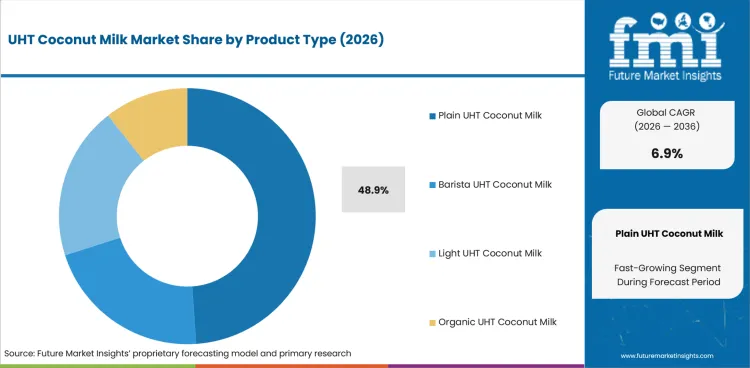
- Plain UHT coconut milk is forecast to account for 48.9% share in 2026 because it suits routine cooking use.
- Barista UHT coconut milk is expected to serve cafés and beverage users seeking shelf-stable plant-based milk formats.
Insights into UHT Coconut Milk Market by Pack Format
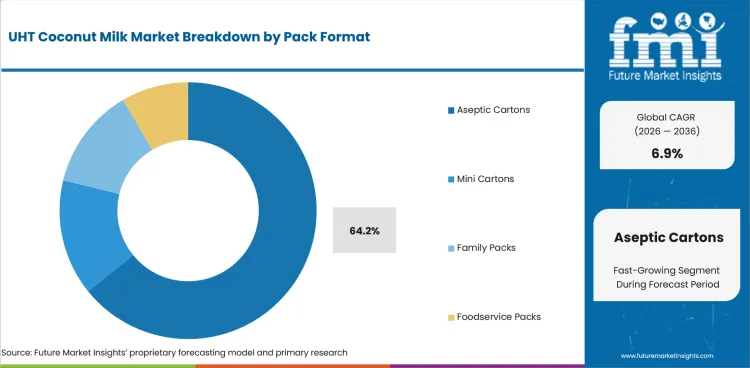
- Aseptic cartons are projected to secure 64.2% share in 2026. They help coconut milk move through ambient retail channels.
- Mini cartons are expected to appeal to smaller households that want portion control and less leftover product.
Insights into UHT Coconut Milk Market by Fat Profile
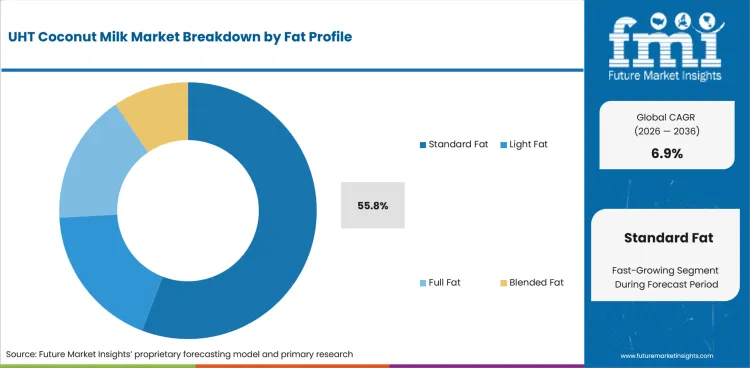
- Standard-fat UHT coconut milk is expected to hold 55.8% share in 2026 because it protects taste and recipe performance.
- Light-fat formats are expected to gain use among consumers comparing nutrition labels before repeat purchase.
Insights into UHT Coconut Milk Market by End Use
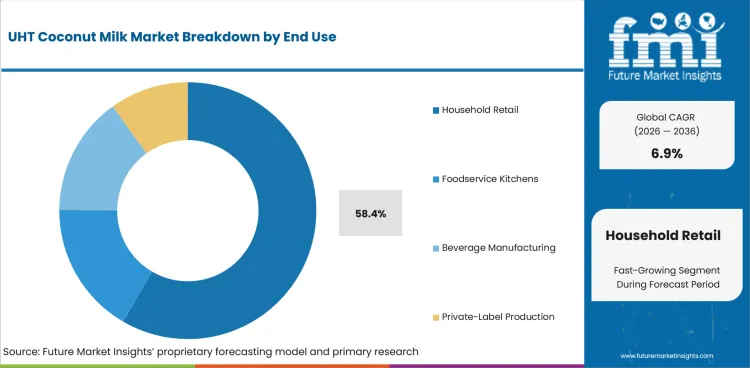
- Household retail use is expected to represent 58.4% share in 2026 as UHT packs fit pantry-led cooking.
- Foodservice kitchens are expected to use foodservice packs where storage space and recipe consistency matter.
Insights into UHT Coconut Milk Market by Sales Channel
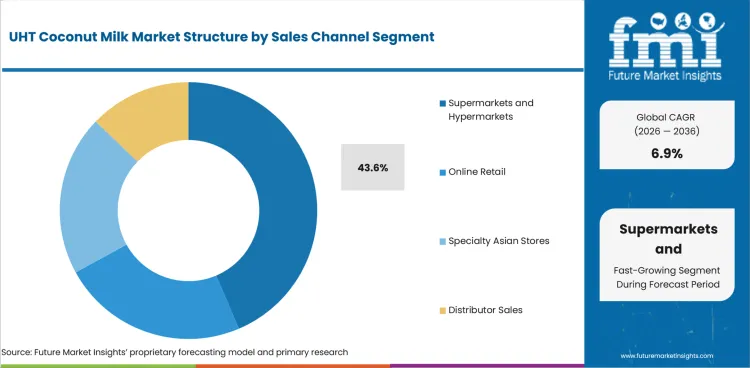
- UHT coconut milk is bought with regular pantry items. Supermarkets and hypermarkets are forecast to capture 43.6% share in 2026.
- Distributor sales are expected to serve hotels or restaurants and institutional kitchens using coconut milk in recipes.
UHT Coconut Milk Market Drivers, Restraints, and Opportunities
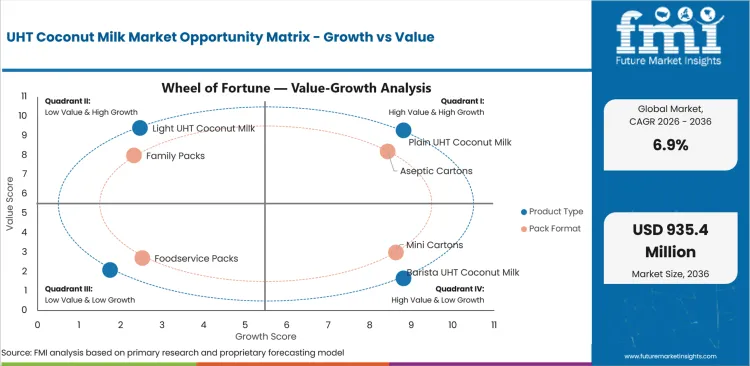
- Driver: UHT coconut milk helps retailers and kitchens reduce dependence on chilled space.
- Restraint: Aseptic cartons must meet stricter packaging expectations in regulated retail markets.
- Opportunity: Grocery retailers can place shelf-stable coconut milk beside canned coconut milk and plant drinks.
Supplier activity is moving toward aseptic formats because retailers and foodservice buyers want coconut milk that can be stored more easily before opening. Kara lists Classic UHT Coconut Milk as ultra-high-temperature processed and aseptically packed. The product is available in 200 ml, 400 ml and 1000 ml pack sizes. This range helps the same UHT format serve different buying needs. Smaller packs can support single-use and trial purchases, while larger packs can work better for households and foodservice kitchens using coconut milk in regular recipes.
Raw Material Price and Formulation Cost Analysis
Coconut extract quality affects cost because UHT processing must protect taste after heat treatment. Tetra Pak explains that UHT treatment heats milk to at least 135°C for a few seconds before rapid cooling. For UHT coconut milk, this raises pressure on formula balance because coconut solids and stabilizers must stay stable after heat treatment. Aseptic cartons also add packaging cost, but they can reduce cold-chain pressure before opening. Raw coconut supply also affects cost planning. USDA FAS stated in March 2026 that India’s copra crushing is expected to stay at 900 TMT in marketing year 2026/27. It also noted that premium coconut products including coconut milk are expected to reduce copra availability for crushing. This matters for UHT coconut milk because brand owners need reliable coconut inputs before they commit to aseptic production runs.
Consumer Segmentation and Purchase Behavior Analysis
Household shoppers buy UHT coconut milk when they want a pantry-ready cooking ingredient. Some shoppers compare UHT coconut milk with dairy alternatives when choosing non-dairy products for cooking and beverage use. Small households may prefer compact cartons because they reduce leftover product after one recipe. Tetra Pak states that Tetra Brik Aseptic packs range from 80 ml to 2000 ml. This gives brands room to serve portion-led and family-use occasions. Foodservice users compare pack size and recipe performance before repeat purchase. Purchase behavior is guided by trust in shelf stability. Tetra Pak states that aseptic cartons can store food for up to 12 months without refrigeration or preservatives. This shelf-stability signal helps explain why UHT coconut milk can appeal to shoppers who cook occasionally and do not want chilled storage pressure. This makes UHT coconut milk different from coconut water, which is usually bought as a drinking product.
Analysis of UHT Coconut Milk Market by Key Countries and Regions
.webp "Top Country Growth Comparison Uht Coconut Milk Market Cagr (2026 2036)")
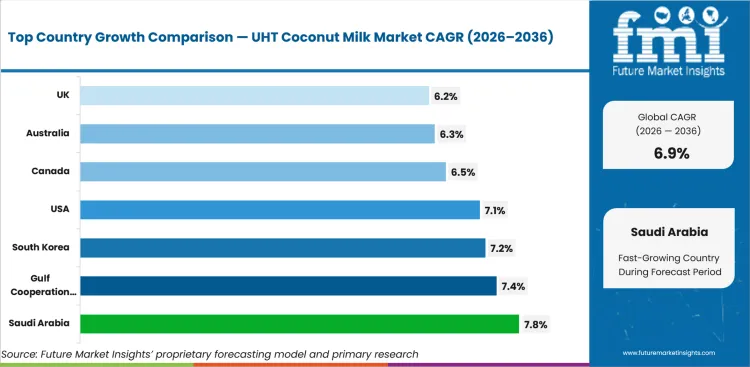
| Country or Region | CAGR 2026 to 2036 |
|---|---|
| Saudi Arabia | 7.8% |
| Gulf Cooperation Council excluding Saudi Arabia | 7.4% |
| South Korea | 7.2% |
| United States | 7.1% |
| Canada | 6.5% |
| Australia | 6.3% |
| United Kingdom | 6.2% |
| European Union | 6.0% |
| Japan | 5.7% |
Source: Future Market Insights, 2026.
UHT Coconut Milk Market CAGR Analysis by Country
- Saudi Arabia is expected to record 7.8% CAGR by 2036 due to modern retail growth and imported shelf-stable food demand.
- Gulf Cooperation Council excluding Saudi Arabia is projected to expand at 7.4% CAGR from 2026 to 2036 with premium grocery chains using more ambient imported food products.
- South Korea is forecast to rise at 7.2% CAGR through 2036 because food processors and online retail channels support shelf-stable ingredients.
- The United States is expected to advance at 7.1% CAGR over the forecast period as Asian food aisles and online grocery access widen product reach.
- Canada is anticipated to move ahead at 6.5% CAGR between 2026 and 2036 through grocery retail and imported pantry product demand.
- Australia is likely to post 6.3% CAGR by 2036 because Asian cooking familiarity helps UHT coconut milk gain repeat use.
- The United Kingdom is projected to register 6.2% CAGR from 2026 to 2036 with world food aisles and plant-based awareness helping trial.
- European Union demand is forecast at 6.0% CAGR by 2036 because packaging rules and retail scrutiny will favor better-documented shelf-stable packs.
- Japan is expected to reach 5.7% CAGR through 2036 as compact packs and careful retail testing guide uptake.
Demand Outlook for UHT Coconut Milk Market in the United States
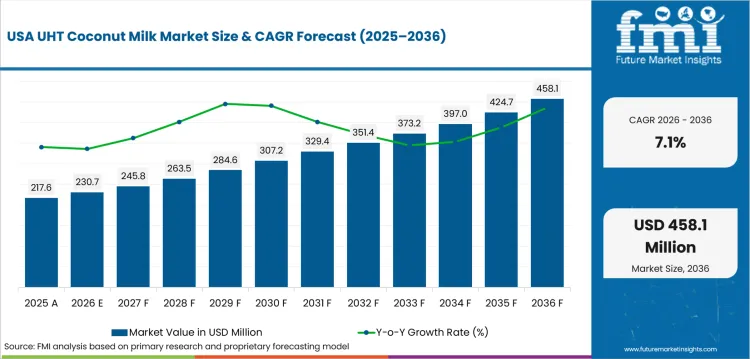
Large shelf-stable grocery route, 2026 to 2036
Country Market Snapshot Table
| Parameter | Value |
|---|---|
| Market Size in 2025 (Value) | USD 95.0 million |
| Market Size in 2026 (Value) | USD 101.7 million |
| Market Forecast in 2036 (Value) | USD 202.0 million |
| CAGR (2026 to 2036) | 7.1% |
| Years Considered | 2021 to 2036 |
| Base Year | 2025 |
| Forecast Period | 2026 to 2036 |
| Units Considered | Value (USD million) |
| Leading Sub-Region | West Coast grocery corridor |
United States UHT Coconut Milk Market Outlook
United States demand is expected to move through supermarkets, Asian food stores and online grocery platforms. The market is projected to expand at 7.1% CAGR from 2026 to 2036. UHT coconut milk is expected to gain from households that want shelf-stable cooking products. Brands with clear pack use and simple ingredient communication are expected to secure stronger repeat purchase.
Key Growth Drivers
- Retail spending gives shelf-stable coconut milk a broad route. USA Census Bureau reported retail and food services sales of USD 757.1 billion in April 2026.
- Grocery and online channels can help UHT cartons reach shoppers outside urban Asian food stores. USA Census Bureau reported retail trade sales up 5.2% from April 2025.
- Asian cooking aisles are expected to help UHT coconut milk gain regular pantry placement.
- Larger family packs are expected to work in households that cook coconut-based meals often.
Key Restraints
- UHT coconut milk may face comparison with lower-priced canned products.
- Some shoppers may prefer canned coconut milk for traditional recipes.
- Food and beverage store sales growth was limited in April 2026. U.S. Census Bureau reported food and beverage stores up 0.4% from April 2025.
What makes the United States unique
The United States has broad grocery access and strong online retail. UHT coconut milk can expand through pantry aisles and specialty food shelves.
Key Companies
- Thai Kitchen
- Goya Foods Inc.
- Edward & Sons Trading Co.
- Kara
- SunOpta Inc.
Sales & Marketing Channels
- Supermarkets
- Online grocery platforms
- Asian grocery stores
- Natural food retailers
- Foodservice distributors
Country Segment Breakdown Table
| Segment | Sub-Segments |
|---|---|
| By Product Type | Plain UHT Coconut Milk, Barista UHT Coconut Milk, Light UHT Coconut Milk, Organic UHT Coconut Milk |
| By Pack Format | Aseptic Cartons, Mini Cartons, Family Packs, Foodservice Packs |
| By Fat Profile | Standard Fat, Light Fat, Full Fat, Blended Fat |
| By End Use | Household Retail, Foodservice Kitchens, Beverage Manufacturing, Private-Label Production |
| By Sales Channel | Supermarkets and Hypermarkets, Online Retail, Specialty Asian Stores, Distributor Sales |
| Sub-Regions Covered | California, New York, Washington, Texas, Florida, Illinois, New Jersey |
Market Taxonomy and Sub-Regions Covered
Frequently Asked Questions
How fast is the United States UHT coconut milk market growing?
The United States UHT coconut milk market is forecast to expand at 7.1% CAGR from 2026 to 2036.
Who leads the United States UHT coconut milk market?
Thai Kitchen and Goya Foods Inc. are relevant through coconut milk access in mainstream grocery channels.
What is driving adoption of UHT coconut milk in the United States?
Shelf-stable cooking use and online grocery access are expected to support repeat demand.
Sales Outlook for UHT Coconut Milk Market in Canada
Retail grocery and imported pantry access, 2026 to 2036
Country Market Snapshot Table
| Parameter | Value |
|---|---|
| Market Size in 2025 (Value) | USD 30.0 million |
| Market Size in 2026 (Value) | USD 32.0 million |
| Market Forecast in 2036 (Value) | USD 60.0 million |
| CAGR (2026 to 2036) | 6.5% |
| Years Considered | 2021 to 2036 |
| Base Year | 2025 |
| Forecast Period | 2026 to 2036 |
| Units Considered | Value (USD million) |
| Leading Sub-Region | Ontario grocery corridor |
Canada UHT Coconut Milk Market Outlook
Canada’s UHT coconut milk market is expected to expand through urban grocery stores and online channels. The country is anticipated to record 6.5% CAGR from 2026 to 2036. UHT coconut milk is expected to serve households that want convenient cooking ingredients. Retailers can grow the category by placing cartons near regular coconut milk and Asian sauces.
Key Growth Drivers
- Retail momentum gives pantry products a stable channel. Statistics Canada reported retail sales increased 1.3% to CAD 70.4 billion in November 2025.
- Online grocery can help imported UHT coconut milk reach smaller markets. Statistics Canada reported retail e-commerce sales of CAD 4.3 billion in December 2025.
- Urban multicultural food demand is expected to support repeat purchase.
- Private-label cartons are expected to gain attention where retailers want shelf-stable pantry products.
Key Restraints
- Premium imported UHT cartons can face price pressure.
- Smaller grocery stores may stock regular coconut milk first.
- E-commerce still has limited retail share. Statistics Canada reported e-commerce accounted for 6.1% of total retail trade in December 2025.
What makes Canada unique
Canada has a smaller population than the United States but strong grocery access in major cities. UHT coconut milk can grow when retailers connect it to cooking convenience.
Key Companies
- Grace Foods Canada Inc.
- Aroy-D
- Thai Kitchen
- Blue Dragon Canada
- Cha’s Organics
Sales & Marketing Channels
- Grocery chains
- Online grocery platforms
- Asian food stores
- Natural food retailers
- Wholesale clubs
Country Segment Breakdown Table
| Segment | Sub-Segments |
|---|---|
| By Product Type | Plain UHT Coconut Milk, Barista UHT Coconut Milk, Light UHT Coconut Milk, Organic UHT Coconut Milk |
| By Pack Format | Aseptic Cartons, Mini Cartons, Family Packs, Foodservice Packs |
| By Fat Profile | Standard Fat, Light Fat, Full Fat, Blended Fat |
| By End Use | Household Retail, Foodservice Kitchens, Beverage Manufacturing, Private-Label Production |
| By Sales Channel | Supermarkets and Hypermarkets, Online Retail, Specialty Asian Stores, Distributor Sales |
| Sub-Regions Covered | Ontario, British Columbia, Quebec, Alberta, Manitoba, Nova Scotia |
Market Taxonomy and Sub-Regions Covered
Frequently Asked Questions
How fast is Canada UHT coconut milk market growing?
Canada UHT coconut milk demand is expected to rise at 6.5% CAGR from 2026 to 2036.
Who leads Canada UHT coconut milk market?
Aroy-D and Thai Kitchen are relevant through shelf-stable coconut milk access.
What is driving adoption of UHT coconut milk in Canada?
Grocery retail and online ordering are expected to support trial and repeat buying.
Demand Analysis of UHT Coconut Milk Market in the European Union
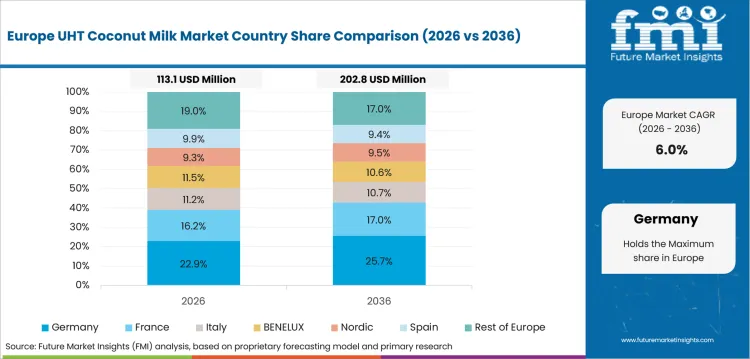
Packaging compliance and pantry use, 2026 to 2036
Regional Market Snapshot Table
| Parameter | Value |
|---|---|
| Market Size in 2025 (Value) | USD 86.0 million |
| Market Size in 2026 (Value) | USD 91.2 million |
| Market Forecast in 2036 (Value) | USD 163.3 million |
| CAGR (2026 to 2036) | 6.0% |
| Years Considered | 2021 to 2036 |
| Base Year | 2025 |
| Forecast Period | 2026 to 2036 |
| Units Considered | Value (USD million) |
| Leading Sub-Region | Western Europe retail corridor |
European Union UHT Coconut Milk Market Outlook
European Union demand is expected to move through supermarkets, organic retailers and Asian food importers. The market is forecast to register 6.0% CAGR from 2026 to 2036. UHT coconut milk is expected to gain from pantry cooking and shelf-stable packaging. Brands will need stronger documentation because carton packaging is coming under closer policy review.
Key Growth Drivers
- Food retail volume provides a route for shelf-stable products. Eurostat reported food, drinks and tobacco retail sales volume up 0.5% in September 2025 from September 2024.
- Demand improvement was spread across markets. Eurostat stated 15 of 25 European Union countries with available data recorded annual growth in food, drinks and tobacco sales volume in September 2025.
- Organic grocery stores are expected to support UHT coconut milk for health-focused cooking users.
- Importers are expected to place aseptic cartons near canned coconut products.
Key Restraints
- Packaging compliance can raise documentation work for importers.
- Retailers may add new shelf-stable variants slowly.
- Eurostat reported food, drinks and tobacco sales volume fell 0.2% month over month in the European Union in September 2025.
What makes the European Union unique
The European Union has strong packaging rules and established retail systems. UHT coconut milk can grow when brands prove pack compliance and keep shelf labels clear.
Key Companies
- Kara
- Aroy-D
- Thai Coconut Public Company Limited
- Clearspring Ltd.
- Ebro Foods S.A.
Sales & Marketing Channels
- Supermarkets
- Organic retailers
- Asian food importers
- Online grocery platforms
- Distributor sales
Regional Segment Breakdown Table
| Segment | Sub-Segments |
|---|---|
| By Product Type | Plain UHT Coconut Milk, Barista UHT Coconut Milk, Light UHT Coconut Milk, Organic UHT Coconut Milk |
| By Pack Format | Aseptic Cartons, Mini Cartons, Family Packs, Foodservice Packs |
| By Fat Profile | Standard Fat, Light Fat, Full Fat, Blended Fat |
| By End Use | Household Retail, Foodservice Kitchens, Beverage Manufacturing, Private-Label Production |
| By Sales Channel | Supermarkets and Hypermarkets, Online Retail, Specialty Asian Stores, Distributor Sales |
| Sub-Regions Covered | Germany, France, Italy, Spain, Netherlands, Sweden, Poland |
Market Taxonomy and Sub-Regions Covered
Frequently Asked Questions
How fast is the European Union UHT coconut milk market growing?
European Union UHT coconut milk demand is expected to expand at 6.0% CAGR from 2026 to 2036.
Who leads the European Union UHT coconut milk market?
Kara and Aroy-D hold relevance through UHT coconut milk access and imported Asian food channels.
What is driving adoption of UHT coconut milk in the European Union?
Shelf-stable pantry use and stronger packaging documentation are expected to guide demand.
Demand Outlook for UHT Coconut Milk Market in the United Kingdom
World food retail and shelf-stable cooking, 2026 to 2036
Country Market Snapshot Table
| Parameter | Value |
|---|---|
| Market Size in 2025 (Value) | USD 39.0 million |
| Market Size in 2026 (Value) | USD 41.4 million |
| Market Forecast in 2036 (Value) | USD 75.6 million |
| CAGR (2026 to 2036) | 6.2% |
| Years Considered | 2021 to 2036 |
| Base Year | 2025 |
| Forecast Period | 2026 to 2036 |
| Units Considered | Value (USD million) |
| Leading Sub-Region | London grocery corridor |
United Kingdom UHT Coconut Milk Market Outlook
United Kingdom demand is expected to come from world food aisles and home cooking. The market is forecast to record 6.2% CAGR by 2036. UHT coconut milk is expected to work well for shoppers who want a pantry-ready product. Retail placement can also benefit from milk alternatives visibility because shoppers already compare plant-based formats inside grocery aisles. Retailers can strengthen demand through smaller cartons and recipe-led shelf placement.
Key Growth Drivers
- The food system gives shelf-stable products a broad route. GOV.UK listed 4.1 million people employed in the agri-food sector in 2025.
- Food inflation can encourage home cooking with pantry ingredients. GOV.UK reported food and non-alcoholic beverage prices rose 4.5% in the 12 months to December 2025.
- World food aisles are expected to help UHT coconut milk reach mainstream shoppers.
- Carton formats are expected to appeal to users who prefer easy pouring over cans.
Key Restraints
- Regular canned coconut milk may keep stronger recipe trust.
- Smaller stores may stock fewer UHT variants.
- Shelf price pressure can limit premium UHT packs because shoppers compare them with canned coconut milk.
What makes the United Kingdom unique
The United Kingdom has strong world food retail access and high plant-based awareness. UHT coconut milk can gain when brands present it as a cooking product with storage convenience.
Key Companies
- Blue Dragon
- Clearspring Ltd.
- Thai Taste
- Tesco plc
- Sainsbury’s
Sales & Marketing Channels
- Supermarket chains
- Online grocery platforms
- Asian grocery stores
- Natural food retailers
- Foodservice wholesalers
Country Segment Breakdown Table
| Segment | Sub-Segments |
|---|---|
| By Product Type | Plain UHT Coconut Milk, Barista UHT Coconut Milk, Light UHT Coconut Milk, Organic UHT Coconut Milk |
| By Pack Format | Aseptic Cartons, Mini Cartons, Family Packs, Foodservice Packs |
| By Fat Profile | Standard Fat, Light Fat, Full Fat, Blended Fat |
| By End Use | Household Retail, Foodservice Kitchens, Beverage Manufacturing, Private-Label Production |
| By Sales Channel | Supermarkets and Hypermarkets, Online Retail, Specialty Asian Stores, Distributor Sales |
| Sub-Regions Covered | London, Manchester, Birmingham, Bristol, Glasgow, Leeds |
Market Taxonomy and Sub-Regions Covered
Frequently Asked Questions
How fast is the United Kingdom UHT coconut milk market growing?
The United Kingdom UHT coconut milk market is projected to expand at 6.2% CAGR from 2026 to 2036.
Who leads the United Kingdom UHT coconut milk market?
Blue Dragon and Clearspring Ltd. hold relevance through coconut milk access in retail channels.
What is driving adoption of UHT coconut milk in the United Kingdom?
World food aisles and pantry-led cooking are expected to support demand.
Opportunity Outlook for UHT Coconut Milk Market in Gulf Cooperation Council excluding Saudi Arabia
Imported shelf-stable food access, 2026 to 2036
Regional Market Snapshot Table
| Parameter | Value |
|---|---|
| Market Size in 2025 (Value) | USD 26.0 million |
| Market Size in 2026 (Value) | USD 27.9 million |
| Market Forecast in 2036 (Value) | USD 57.0 million |
| CAGR (2026 to 2036) | 7.4% |
| Years Considered | 2021 to 2036 |
| Base Year | 2025 |
| Forecast Period | 2026 to 2036 |
| Units Considered | Value (USD million) |
| Leading Sub-Region | United Arab Emirates premium retail corridor |
Gulf Cooperation Council UHT Coconut Milk Market Outlook
Gulf Cooperation Council demand is expected to move through imported grocery chains and hotel foodservice buyers. The market is projected to expand at 7.4% CAGR from 2026 to 2036. UHT coconut milk fits the region because ambient packs can move through longer import routes. Premium grocery chains are expected to test larger packs for cooking and smaller packs for household use.
Key Growth Drivers
- Imported food access gives UHT coconut milk a practical route. USDA FAS reported United Arab Emirates consumer-oriented food imports of USD 16.2 billion in 2024.
- Digital food retail can help specialty pantry products reach households. USDA FAS reported United Arab Emirates food e-commerce grew to USD 1.1 billion in 2024.
- Hotels are expected to use UHT coconut milk in sauces, desserts and breakfast recipes.
- Import distributors are expected to place coconut milk cartons beside Asian cooking ingredients.
Key Restraints
- Freight and storage costs can raise final shelf prices.
- Small retailers may prefer regular canned coconut milk over UHT cartons.
- Import exposure can affect price stability. USDA FAS reported consumer-oriented products made up 64% of United Arab Emirates agricultural imports in 2024.
What makes the Gulf Cooperation Council unique
The region has strong imported food access and premium grocery demand. UHT coconut milk can grow when distributors provide stable supply and clear Arabic-English labels.
Key Companies
- Kara
- Thai Coconut Public Company Limited
- Koita Foods
- Aroy-D
- Goya Foods Inc.
Sales & Marketing Channels
- Premium grocery chains
- Hotel foodservice buyers
- Imported food distributors
- Online specialty food stores
- Asian grocery stores
Regional Segment Breakdown Table
| Segment | Sub-Segments |
|---|---|
| By Product Type | Plain UHT Coconut Milk, Barista UHT Coconut Milk, Light UHT Coconut Milk, Organic UHT Coconut Milk |
| By Pack Format | Aseptic Cartons, Mini Cartons, Family Packs, Foodservice Packs |
| By Fat Profile | Standard Fat, Light Fat, Full Fat, Blended Fat |
| By End Use | Household Retail, Foodservice Kitchens, Beverage Manufacturing, Private-Label Production |
| By Sales Channel | Supermarkets and Hypermarkets, Online Retail, Specialty Asian Stores, Distributor Sales |
| Sub-Regions Covered | United Arab Emirates, Qatar, Kuwait, Bahrain, Oman |
Market Taxonomy and Sub-Regions Covered
Frequently Asked Questions
How fast is the Gulf Cooperation Council UHT coconut milk market growing?
Gulf Cooperation Council demand excluding Saudi Arabia is expected to rise at 7.4% CAGR from 2026 to 2036.
Who leads Gulf Cooperation Council UHT coconut milk market?
Kara and Thai Coconut Public Company Limited are relevant through imported coconut product access.
What is driving adoption of UHT coconut milk in the Gulf Cooperation Council?
Imported grocery access and ambient storage needs are expected to support demand.
Opportunity Outlook for UHT Coconut Milk Market in Saudi Arabia
Modern retail and hotel kitchen demand, 2026 to 2036
Country Market Snapshot Table
| Parameter | Value |
|---|---|
| Market Size in 2025 (Value) | USD 18.0 million |
| Market Size in 2026 (Value) | USD 19.4 million |
| Market Forecast in 2036 (Value) | USD 41.1 million |
| CAGR (2026 to 2036) | 7.8% |
| Years Considered | 2021 to 2036 |
| Base Year | 2025 |
| Forecast Period | 2026 to 2036 |
| Units Considered | Value (USD million) |
| Leading Sub-Region | Riyadh premium grocery corridor |
Saudi Arabia UHT Coconut Milk Market Outlook
Saudi Arabia is expected to be the fastest-moving market for UHT coconut milk in this study. The country is projected to expand at 7.8% CAGR by 2036. Modern retail and hotel kitchens are expected to support shelf-stable packs. UHT coconut milk fits local supply needs because imported products often move through longer storage and distribution cycles.
Key Growth Drivers
- Retail food sales provide a large route for UHT coconut milk. USDA FAS reported Saudi food retail sales of about USD 59.0 billion in 2024.
- Food retail growth can create more shelf space for imported pantry items. USDA FAS expected Saudi food retail sales to grow about 4.0% in 2025.
- Premium supermarkets are expected to test UHT coconut milk for lighter household cooking and recipes.
- Hotel kitchens are expected to prefer ambient cartons that simplify storage before opening.
Key Restraints
- Import costs can raise final shelf prices for UHT coconut milk.
- Coconut milk may still be used mainly in selected recipe groups.
- Foodservice competition can tighten distributor space. USDA FAS reported Saudi food service sales of USD 29.0 billion in 2024.
What makes Saudi Arabia unique
Saudi Arabia has modern retail growth and active hotel foodservice demand. UHT coconut milk can advance when brands combine shelf-stable packs with clear cooking use.
Key Companies
- Al Rabie Saudi Foods Co.
- Almarai Company
- Saudia Dairy and Foodstuff Company
- Kara
- Thai Coconut Public Company Limited
Sales & Marketing Channels
- Hypermarkets
- Premium supermarkets
- Imported food distributors
- Online grocery stores
- Hotel foodservice buyers
Country Segment Breakdown Table
| Segment | Sub-Segments |
|---|---|
| By Product Type | Plain UHT Coconut Milk, Barista UHT Coconut Milk, Light UHT Coconut Milk, Organic UHT Coconut Milk |
| By Pack Format | Aseptic Cartons, Mini Cartons, Family Packs, Foodservice Packs |
| By Fat Profile | Standard Fat, Light Fat, Full Fat, Blended Fat |
| By End Use | Household Retail, Foodservice Kitchens, Beverage Manufacturing, Private-Label Production |
| By Sales Channel | Supermarkets and Hypermarkets, Online Retail, Specialty Asian Stores, Distributor Sales |
| Sub-Regions Covered | Riyadh, Jeddah, Dammam, Khobar, Makkah, Madinah |
Market Taxonomy and Sub-Regions Covered
Frequently Asked Questions
How fast is Saudi Arabia UHT coconut milk market growing?
Saudi Arabia UHT coconut milk demand is anticipated to rise at 7.8% CAGR from 2026 to 2036.
Who leads Saudi Arabia UHT coconut milk market?
Kara and Thai Coconut Public Company Limited are relevant through imported coconut product supply.
What is driving adoption of UHT coconut milk in Saudi Arabia?
Modern retail growth and hotel kitchen demand are expected to create trial routes.
Growth Outlook for UHT Coconut Milk Market in South Korea
Food processing and online retail access, 2026 to 2036
Country Market Snapshot Table
| Parameter | Value |
|---|---|
| Market Size in 2025 (Value) | USD 25.0 million |
| Market Size in 2026 (Value) | USD 26.8 million |
| Market Forecast in 2036 (Value) | USD 53.7 million |
| CAGR (2026 to 2036) | 7.2% |
| Years Considered | 2021 to 2036 |
| Base Year | 2025 |
| Forecast Period | 2026 to 2036 |
| Units Considered | Value (USD million) |
| Leading Sub-Region | Seoul retail corridor |
South Korea UHT Coconut Milk Market Outlook
South Korea’s UHT coconut milk demand is expected to come from urban grocery channels and food processors. The market is forecast to rise at 7.2% CAGR during the forecast period. UHT coconut milk can serve sauces and beverage recipes. Suppliers are expected to need strong distributor access because retail testing cycles are fast.
Key Growth Drivers
- Food processing scale gives UHT coconut milk a recipe route. USDA FAS reported South Korea’s food processing industry generated KRW 111.9 trillion in sales in 2024.
- The same industry scale equaled about USD 82.1 billion in 2024, which shows a large base for imported ingredients.
- Online grocery platforms are expected to help specialty UHT cartons reach younger households.
- Convenience retail is expected to support mini cartons and smaller ambient packs.
Key Restraints
- Local shoppers may prefer familiar soy and dairy products for daily use.
- Imported cartons can face price pressure from local beverages.
- Fast retail cycles can shorten shelf time for new UHT coconut milk products.
What makes South Korea unique
South Korea has strong food processing capacity and quick retail testing. UHT coconut milk can grow when suppliers link cartons to clear recipe uses.
Key Companies
- CJ CheilJedang Corporation
- Maeil Dairies Co. Ltd.
- Lotte Chilsung Beverage Co. Ltd.
- Kara
- Thai Coconut Public Company Limited
Sales & Marketing Channels
- Online grocery platforms
- Convenience stores
- Hypermarkets
- Imported food distributors
- Specialty Asian stores
Country Segment Breakdown Table
| Segment | Sub-Segments |
|---|---|
| By Product Type | Plain UHT Coconut Milk, Barista UHT Coconut Milk, Light UHT Coconut Milk, Organic UHT Coconut Milk |
| By Pack Format | Aseptic Cartons, Mini Cartons, Family Packs, Foodservice Packs |
| By Fat Profile | Standard Fat, Light Fat, Full Fat, Blended Fat |
| By End Use | Household Retail, Foodservice Kitchens, Beverage Manufacturing, Private-Label Production |
| By Sales Channel | Supermarkets and Hypermarkets, Online Retail, Specialty Asian Stores, Distributor Sales |
| Sub-Regions Covered | Seoul, Busan, Incheon, Daegu, Daejeon, Gwangju |
Market Taxonomy and Sub-Regions Covered
Frequently Asked Questions
How fast is South Korea UHT coconut milk market growing?
South Korea UHT coconut milk demand is forecast to expand at 7.2% CAGR from 2026 to 2036.
Who leads South Korea UHT coconut milk market?
CJ CheilJedang Corporation and imported coconut processors are relevant through food ingredient and retail access.
What is driving adoption of UHT coconut milk in South Korea?
Food processing use and online grocery access are expected to support demand.
In-depth Analysis of UHT Coconut Milk Market in Japan
Compact packs and shelf-stable products, 2026 to 2036
Country Market Snapshot Table
| Parameter | Value |
|---|---|
| Market Size in 2025 (Value) | USD 34.0 million |
| Market Size in 2026 (Value) | USD 35.9 million |
| Market Forecast in 2036 (Value) | USD 62.6 million |
| CAGR (2026 to 2036) | 5.7% |
| Years Considered | 2021 to 2036 |
| Base Year | 2025 |
| Forecast Period | 2026 to 2036 |
| Units Considered | Value (USD million) |
| Leading Sub-Region | Tokyo premium grocery corridor |
Japan UHT Coconut Milk Market Outlook
Japan’s UHT coconut milk demand is expected to rise through careful retail testing and compact pack needs. The market is projected to expand at 5.7% CAGR from 2026 to 2036. UHT coconut milk can fit smaller households because unopened packs store easily. Retailers are expected to test products that offer mild flavor and clear cooking guidance.
Key Growth Drivers
- Shelf-stable products are gaining attention inside food processing. USDA FAS reported Japan’s food processing sector stood at USD 174.0 billion in 2025.
- The same report noted sector contraction of 3.0% in 2025. Growth was still noted in soft drinks and health foods. Frozen foods and shelf-stable products also supported opportunity.
- Premium grocery stores are expected to carry UHT coconut milk for health-focused shoppers.
- Compact packs are expected to suit smaller households and occasional cooking use.
Key Restraints
- Coconut taste may be too strong for some Japanese recipes.
- Retailers may test small volumes before wider listing.
- Shelf-stable coconut milk may need clear recipe education before repeat buying improves.
What makes Japan unique
Japan differs through careful product approval and smaller household needs. UHT coconut milk can grow when pack size and taste match local cooking habits.
Key Companies
- Kikkoman Corporation
- Kagome Co. Ltd.
- Aeon Co. Ltd.
- Kara
- Thai Coconut Public Company Limited
Sales & Marketing Channels
- Premium supermarkets
- Convenience stores
- Online grocery platforms
- Specialty imported food stores
- Foodservice distributors
Country Segment Breakdown Table
| Segment | Sub-Segments |
|---|---|
| By Product Type | Plain UHT Coconut Milk, Barista UHT Coconut Milk, Light UHT Coconut Milk, Organic UHT Coconut Milk |
| By Pack Format | Aseptic Cartons, Mini Cartons, Family Packs, Foodservice Packs |
| By Fat Profile | Standard Fat, Light Fat, Full Fat, Blended Fat |
| By End Use | Household Retail, Foodservice Kitchens, Beverage Manufacturing, Private-Label Production |
| By Sales Channel | Supermarkets and Hypermarkets, Online Retail, Specialty Asian Stores, Distributor Sales |
| Sub-Regions Covered | Tokyo, Osaka, Kanagawa, Aichi, Fukuoka, Hokkaido |
Market Taxonomy and Sub-Regions Covered
Frequently Asked Questions
How fast is Japan UHT coconut milk market growing?
Japan UHT coconut milk demand is anticipated to move ahead at 5.7% CAGR from 2026 to 2036.
Who leads Japan UHT coconut milk market?
Kara and Thai Coconut Public Company Limited are relevant through imported coconut product supply.
What is driving adoption of UHT coconut milk in Japan?
Compact packs and shelf-stable product interest are expected to support demand.
Sales Analysis of UHT Coconut Milk Market in Australia
Asian cooking and pantry storage, 2026 to 2036
Country Market Snapshot Table
| Parameter | Value |
|---|---|
| Market Size in 2025 (Value) | USD 24.0 million |
| Market Size in 2026 (Value) | USD 25.5 million |
| Market Forecast in 2036 (Value) | USD 47.0 million |
| CAGR (2026 to 2036) | 6.3% |
| Years Considered | 2021 to 2036 |
| Base Year | 2025 |
| Forecast Period | 2026 to 2036 |
| Units Considered | Value (USD million) |
| Leading Sub-Region | New South Wales grocery corridor |
Australia UHT Coconut Milk Market Outlook
Australia has strong access to Asian ingredients and pantry cooking products. UHT coconut milk demand is projected to expand at 6.3% CAGR from 2026 to 2036. Retailers are expected to carry UHT packs beside canned coconut milk and Asian sauces. The product is expected to appeal to households that want storage convenience before opening.
Key Growth Drivers
- Grocery shelves offer a useful route for UHT coconut milk. Australian Bureau of Statistics reported food retailing rose 0.9% in June 2025.
- Supermarket and grocery stores gave a stronger signal. Australian Bureau of Statistics reported this subgroup rose 1.2% in June 2025.
- Asian grocery access is expected to support repeat purchase.
- Shelf-stable cartons are expected to appeal to households that cook coconut dishes occasionally.
Key Restraints
- Regular canned coconut milk may keep stronger recipe trust.
- Smaller stores may not stock both canned and UHT coconut milk.
- Household spending pressure can slow pantry trials. Australian Bureau of Statistics reported food spending fell 1.3% month over month in April 2026.
What makes Australia unique
Australia has strong Asian cooking familiarity and broad supermarket access. UHT coconut milk needs to show clear storage benefits because canned coconut milk already has recipe trust.
Key Companies
- AYAM
- Kara
- PureHarvest
- Woolworths Group Limited
- Coles Group Limited
Sales & Marketing Channels
- Supermarkets
- Asian grocery stores
- Health food retailers
- Online grocery platforms
- Foodservice distributors
Country Segment Breakdown Table
| Segment | Sub-Segments |
|---|---|
| By Product Type | Plain UHT Coconut Milk, Barista UHT Coconut Milk, Light UHT Coconut Milk, Organic UHT Coconut Milk |
| By Pack Format | Aseptic Cartons, Mini Cartons, Family Packs, Foodservice Packs |
| By Fat Profile | Standard Fat, Light Fat, Full Fat, Blended Fat |
| By End Use | Household Retail, Foodservice Kitchens, Beverage Manufacturing, Private-Label Production |
| By Sales Channel | Supermarkets and Hypermarkets, Online Retail, Specialty Asian Stores, Distributor Sales |
| Sub-Regions Covered | New South Wales, Victoria, Queensland, Western Australia, South Australia, Australian Capital Territory |
Market Taxonomy and Sub-Regions Covered
Frequently Asked Questions
How fast is Australia UHT coconut milk market growing?
Australia UHT coconut milk demand is expected to record 6.3% CAGR from 2026 to 2036.
Who leads Australia UHT coconut milk market?
AYAM and Kara are relevant through coconut milk access in retail channels.
What is driving adoption of UHT coconut milk in Australia?
Asian cooking familiarity and pantry storage needs are expected to support demand.
Competitive Landscape and Strategic Positioning
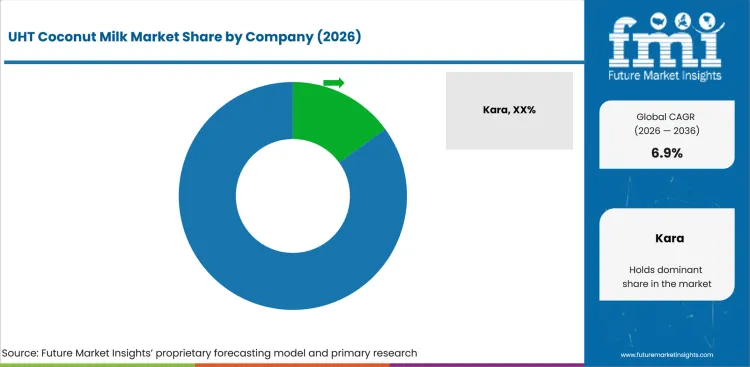
- Coconut milk processors compete through taste, pack reliability and shelf-stable product access.
- Aseptic beverage suppliers support brands that want ambient cartons without building filling capacity.
- Retailers are expected to use private-label UHT packs to widen pantry product choice.
UHT coconut milk competition is centered on shelf stability and pack convenience. Brands need cartons that protect taste during storage and still feel easy for shoppers to use at home. Aseptic beverage suppliers are becoming more important because they help coconut milk brands reduce chilled logistics before opening. Processors with reliable filling control can support retail cartons and foodservice packs without repeating product specifications already used in the article.
Aseptic packaging capacity is also shaping competition. In February 2025, SIG opened its first aseptic carton plant in India after a EUR 90 million investment completed in 20 months. The plant was designed with initial annual production capacity of up to 4 billion aseptic carton packs. This shows how packaging suppliers are preparing for more shelf-stable beverage and liquid food demand across fast-growing markets.
UHT coconut milk suppliers are expected to compete more on storage reliability than broad coconut claims. Retail brands will focus on easy pouring and clear recipe use. Processors are likely to focus on stable filling and export-ready cartons. This gives the market a clear split between consumer-facing coconut milk brands and aseptic manufacturing partners serving plant-based beverage programs.
Leading Companies Shaping the UHT Coconut Milk Market
- Coconut Milk Brand Owners: Kara and Thai Kitchen support consumer-facing UHT coconut milk awareness across retail channels.
- Asian Coconut Processors: Thai Coconut Public Company Limited and Aroy-D support export supply for UHT coconut milk formats.
- Aseptic Beverage Suppliers: Refresco Group and SunOpta Inc. support brands that need shelf-stable beverage filling capability.
- Private-Label Retailers: Tesco plc, Woolworths Group Limited and Coles Group Limited support store-brand coconut milk access.
- Regional Food Brands: Goya Foods Inc. and Blue Dragon support coconut milk visibility through world food aisles.
Company Benchmarking Table
| Company | UHT Product Evidence | Aseptic Format Strength | Retail Channel Reach |
|---|---|---|---|
| Kara | High | High | High |
| Thai Kitchen | Medium | Medium | High |
| Thai Coconut Public Company Limited | Medium | High | High |
| Aroy-D | High | High | High |
| Refresco Group | Medium | High | High |
| SunOpta Inc. | Medium | High | High |
| Goya Foods Inc. | Medium | Medium | High |
Recent Industry Developments
- In January 2026, Tetra Pak announced a EUR 60 million investment in a pilot plant in Lund to advance paper-based barrier technology for aseptic packaging.
- In May 2026, Refresco completed its acquisition of SunOpta. The transaction added North American supply chain capability across beverages, broths and better-for-you snacks.
Key Players in the UHT Coconut Milk Market
- Kara
- Thai Kitchen
- Thai Coconut Public Company Limited
- Aroy-D
- Refresco Group
- SunOpta Inc.
- Goya Foods Inc.
- Blue Dragon
- AYAM
- Clearspring Ltd.
UHT Coconut Milk Market - Report Scope
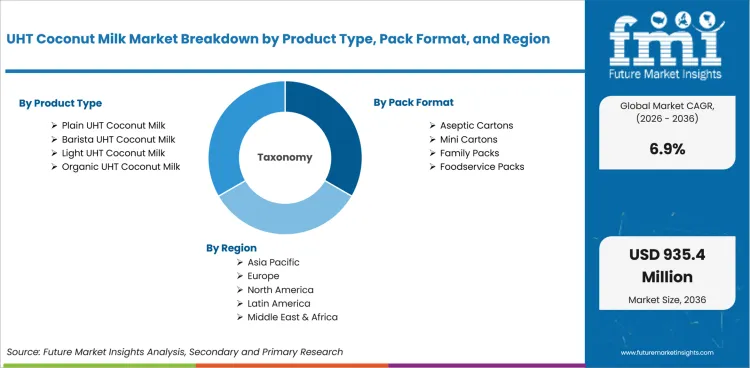
| Parameter | Details |
|---|---|
| Market size by 2036 | USD 935.4 million |
| Growth rate | 6.9% CAGR from 2026 to 2036 |
| Forecast period | 2026 to 2036 |
| Base year value (2025) | USD 449.0 million |
| Market size in 2026 | USD 480.0 million |
| By product type | Plain UHT coconut milk, Barista UHT coconut milk, Light UHT coconut milk, Organic UHT coconut milk |
| By pack format | Aseptic cartons, Mini cartons, Family packs, Foodservice packs |
| By fat profile | Standard fat, Light fat, Full fat, Blended fat |
| By end use | Household retail, Foodservice kitchens, Beverage manufacturing, Private-label production |
| By sales channel | Supermarkets and hypermarkets, Online retail, Specialty Asian stores, Distributor sales |
| Regions covered | North America, European Union, United Kingdom, Gulf Cooperation Council, East Asia, Oceania |
| Countries covered | United States, Canada, Saudi Arabia, South Korea, Japan, Australia |
| Key companies profiled | Kara, Thai Kitchen, Thai Coconut Public Company Limited, Aroy-D, Refresco Group, SunOpta Inc., Goya Foods Inc., Blue Dragon, AYAM, Clearspring Ltd. |
| Approach | Bottom-up product-boundary approach using eligible SKU revenue and UHT pack evidence. Retail pricing and country-level adoption were used for validation. |
UHT Coconut Milk Market Breakdown by Product Type, Pack Format, Fat Profile, End Use, Sales Channel, and Region
By Product Type
- Plain UHT Coconut Milk
- Barista UHT Coconut Milk
- Light UHT Coconut Milk
- Organic UHT Coconut Milk
By Pack Format
- Aseptic Cartons
- Mini Cartons
- Family Packs
- Foodservice Packs
By Fat Profile
- Standard Fat
- Light Fat
- Full Fat
- Blended Fat
By End Use
- Household Retail
- Foodservice Kitchens
- Beverage Manufacturing
- Private-Label Production
By Sales Channel
- Supermarkets and Hypermarkets
- Online Retail
- Specialty Asian Stores
- Distributor Sales
By Region
- North America
- European Union
- United Kingdom
- Gulf Cooperation Council
- East Asia
- Oceania
Research Sources and Bibliography
- Australian Bureau of Statistics. (2025, July 31). Retail trade, Australia, June 2025. Australian Bureau of Statistics.
- Australian Bureau of Statistics. (2026, May 28). Monthly household spending indicator, April 2026. Australian Bureau of Statistics.
- Department for Environment, Food & Rural Affairs. (2026, February 25). Food statistics in your pocket. GOV.UK.
- European Commission. (2025, February 11). Packaging waste. European Commission.
- Eurostat. (2025, November 10). Food, drinks and tobacco sales mildly up in September 2025. European Commission.
- Kara. (2026). Classic UHT coconut milk. Pulau Sambu Singapore Pte Ltd.
- Refresco Group B.V. (2026, May 1). Refresco completes acquisition of SunOpta, a North American supply chain solutions provider. Refresco Group B.V.
- SIG Group. (2025, February 13). SIG opens its first aseptic carton plant in India. SIG Group.
- Statistics Canada. (2026, January 23). Retail trade, November 2025. Statistics Canada.
- Statistics Canada. (2026, February 20). Retail trade, December 2025. Statistics Canada.
- Tetra Pak. (2026, January 26). Tetra Pak invests EUR 60 million in owned pilot plant to advance its paper-based barrier technology development. Tetra Pak.
- Tetra Pak. (2026). Aseptic carton packages. Tetra Pak.
- Tetra Pak. (2026). Tetra Brik aseptic. Tetra Pak.
- Tetra Pak. (2026). The UHT terminology guide. Tetra Pak.
- Thai Coconut Public Company Limited. (2026). ODM/OEM. Thai Coconut Public Company Limited.
- USA Census Bureau. (2026, May 14). Advance monthly sales for retail and food services, April 2026. USA Department of Commerce.
- USA Department of Agriculture, Foreign Agricultural Service. (2025, June 11). Exporter guide annual: Saudi Arabia. USA Department of Agriculture.
- USA Department of Agriculture, Foreign Agricultural Service. (2025, September 24). Retail foods annual: Saudi Arabia. USA Department of Agriculture.
- USA Department of Agriculture, Foreign Agricultural Service. (2025, December 30). Retail foods annual: United Arab Emirates. USA Department of Agriculture.
- USA Department of Agriculture, Foreign Agricultural Service. (2026, April 1). Food processing ingredients annual: Japan. USA Department of Agriculture.
- USA Department of Agriculture, Foreign Agricultural Service. (2026, May 27). Food processing ingredients annual: South Korea. USA Department of Agriculture.
This bibliography is provided for reader reference and is not exhaustive. The full report contains the complete reference list and detailed citations.
This Report Answers
- How large is the UHT coconut milk market in 2026?
- What value is expected for the UHT coconut milk market by 2036?
- Which product type is expected to lead in 2026?
- Which pack format is expected to hold the second leading parent-segment share in 2026?
- Which fat profile is expected to hold the third leading parent-segment share in 2026?
- Which countries are expected to grow faster than the global average?
- Which companies are most active across UHT coconut milk supply?
- Which product features shape retail buying decisions for UHT coconut milk?
- Which sales channels create repeat demand for UHT coconut milk cartons?
Frequently Asked Questions
How big is the UHT coconut milk market in 2026?
UHT coconut milk demand is expected to reach USD 480.0 million in 2026, based on eligible shelf-stable coconut milk products.
What is the expected value of the UHT coconut milk market by 2036?
UHT coconut milk revenue is forecast to reach USD 935.4 million by 2036 as aseptic carton use and shelf-stable cooking demand expand.
What CAGR is expected for UHT coconut milk demand from 2026 to 2036?
The market is forecast to rise at 6.9% CAGR from 2026 to 2036, driven by ambient storage needs and export-ready packaging.
Which product type is expected to lead in 2026?
Plain UHT coconut milk is expected to account for 48.9% share in 2026 because it fits routine cooking use.
Which pack format is expected to lead in 2026?
Aseptic cartons are forecast to secure 64.2% share in 2026 because they allow shelf-stable handling before opening.
Which country is expected to move fastest by 2036?
Saudi Arabia is expected to record 7.8% CAGR by 2036, helped by modern retail growth and imported shelf-stable food demand.
Who are the leading companies in UHT coconut milk?
Kara and Thai Kitchen are key suppliers across coconut milk channels. Thai Coconut Public Company Limited and Aroy-D add processor depth. Refresco Group is relevant through aseptic beverage channels.
What is excluded from UHT coconut milk revenue?
Canned coconut milk and chilled coconut milk are excluded. Coconut water and finished food products are also excluded unless the product clearly carries UHT or aseptic coconut milk positioning.
Preview the report firsthand - request a free sample
Get SampleGet the brochure for pricing and purchase details.
Get PDFTable of Content
- Executive Summary
- Global Market Outlook
- Demand to side Trends
- Supply to side Trends
- Technology Roadmap Analysis
- Analysis and Recommendations
- Market Overview
- Market Coverage / Taxonomy
- Market Definition / Scope / Limitations
- Research Methodology
- Chapter Orientation
- Analytical Lens and Working Hypotheses
- Market Structure, Signals, and Trend Drivers
- Benchmarking and Cross-market Comparability
- Market Sizing, Forecasting, and Opportunity Mapping
- Research Design and Evidence Framework
- Desk Research Programme (Secondary Evidence)
- Company Annual and Sustainability Reports
- Peer-reviewed Journals and Academic Literature
- Corporate Websites, Product Literature, and Technical Notes
- Earnings Decks and Investor Briefings
- Statutory Filings and Regulatory Disclosures
- Technical White Papers and Standards Notes
- Trade Journals, Industry Magazines, and Analyst Briefs
- Conference Proceedings, Webinars, and Seminar Materials
- Government Statistics Portals and Public Data Releases
- Press Releases and Reputable Media Coverage
- Specialist Newsletters and Curated Briefings
- Sector Databases and Reference Repositories
- FMI Internal Proprietary Databases and Historical Market Datasets
- Subscription Datasets and Paid Sources
- Social Channels, Communities, and Digital Listening Inputs
- Additional Desk Sources
- Expert Input and Fieldwork (Primary Evidence)
- Primary Modes
- Qualitative Interviews and Expert Elicitation
- Quantitative Surveys and Structured Data Capture
- Blended Approach
- Why Primary Evidence is Used
- Field Techniques
- Interviews
- Surveys
- Focus Groups
- Observational and In-context Research
- Social and Community Interactions
- Stakeholder Universe Engaged
- C-suite Leaders
- Board Members
- Presidents and Vice Presidents
- R&D and Innovation Heads
- Technical Specialists
- Domain Subject-matter Experts
- Scientists
- Physicians and Other Healthcare Professionals
- Governance, Ethics, and Data Stewardship
- Research Ethics
- Data Integrity and Handling
- Primary Modes
- Tooling, Models, and Reference Databases
- Desk Research Programme (Secondary Evidence)
- Data Engineering and Model Build
- Data Acquisition and Ingestion
- Cleaning, Normalisation, and Verification
- Synthesis, Triangulation, and Analysis
- Quality Assurance and Audit Trail
- Market Background
- Market Dynamics
- Drivers
- Supply Chain Analysis
- Investment Feasibility Matrix
- Value Chain Analysis
- PESTLE and Porter’s Analysis
- Regulatory Landscape
- Regional Parent Market Outlook
- Production and Consumption Statistics
- Import and Export Statistics
- Global Market Analysis 2021 to 2025 and Forecast, 2026 to 2036
- Historical Market Size Value (USD Million) Analysis, 2021 to 2025
- Current and Future Market Size Value (USD Million) Projections, 2026 to 2036
- Y to o to Y Growth Trend Analysis
- Absolute $ Opportunity Analysis
- Global Market Pricing Analysis 2021 to 2025 and Forecast 2026 to 2036
- Global Market Analysis 2021 to 2025 and Forecast 2026 to 2036, By Product Type
- Introduction / Key Findings
- Historical Market Size Value (USD Million) Analysis By Product Type , 2021 to 2025
- Current and Future Market Size Value (USD Million) Analysis and Forecast By Product Type , 2026 to 2036
- Plain UHT Coconut Milk
- Barista UHT Coconut Milk
- Light UHT Coconut Milk
- Organic UHT Coconut Milk
- Plain UHT Coconut Milk
- Y to o to Y Growth Trend Analysis By Product Type , 2021 to 2025
- Absolute $ Opportunity Analysis By Product Type , 2026 to 2036
- Global Market Analysis 2021 to 2025 and Forecast 2026 to 2036, By Pack Format
- Introduction / Key Findings
- Historical Market Size Value (USD Million) Analysis By Pack Format, 2021 to 2025
- Current and Future Market Size Value (USD Million) Analysis and Forecast By Pack Format, 2026 to 2036
- Aseptic Cartons
- Mini Cartons
- Family Packs
- Foodservice Packs
- Aseptic Cartons
- Y to o to Y Growth Trend Analysis By Pack Format, 2021 to 2025
- Absolute $ Opportunity Analysis By Pack Format, 2026 to 2036
- Global Market Analysis 2021 to 2025 and Forecast 2026 to 2036, By Fat Profile
- Introduction / Key Findings
- Historical Market Size Value (USD Million) Analysis By Fat Profile, 2021 to 2025
- Current and Future Market Size Value (USD Million) Analysis and Forecast By Fat Profile, 2026 to 2036
- Standard Fat
- Light Fat
- Full Fat
- Blended Fat
- Standard Fat
- Y to o to Y Growth Trend Analysis By Fat Profile, 2021 to 2025
- Absolute $ Opportunity Analysis By Fat Profile, 2026 to 2036
- Global Market Analysis 2021 to 2025 and Forecast 2026 to 2036, By End Use
- Introduction / Key Findings
- Historical Market Size Value (USD Million) Analysis By End Use, 2021 to 2025
- Current and Future Market Size Value (USD Million) Analysis and Forecast By End Use, 2026 to 2036
- Household Retail
- Foodservice Kitchens
- Beverage Manufacturing
- Private-Label Production
- Household Retail
- Y to o to Y Growth Trend Analysis By End Use, 2021 to 2025
- Absolute $ Opportunity Analysis By End Use, 2026 to 2036
- Global Market Analysis 2021 to 2025 and Forecast 2026 to 2036, By Sales Channel
- Introduction / Key Findings
- Historical Market Size Value (USD Million) Analysis By Sales Channel, 2021 to 2025
- Current and Future Market Size Value (USD Million) Analysis and Forecast By Sales Channel, 2026 to 2036
- Supermarkets and Hypermarkets
- Online Retail
- Specialty Asian Stores
- Distributor Sales
- Supermarkets and Hypermarkets
- Y to o to Y Growth Trend Analysis By Sales Channel, 2021 to 2025
- Absolute $ Opportunity Analysis By Sales Channel, 2026 to 2036
- Global Market Analysis 2021 to 2025 and Forecast 2026 to 2036, By Region
- Introduction
- Historical Market Size Value (USD Million) Analysis By Region, 2021 to 2025
- Current Market Size Value (USD Million) Analysis and Forecast By Region, 2026 to 2036
- North America
- Latin America
- Western Europe
- Eastern Europe
- East Asia
- South Asia and Pacific
- Middle East & Africa
- Market Attractiveness Analysis By Region
- North America Market Analysis 2021 to 2025 and Forecast 2026 to 2036, By Country
- Historical Market Size Value (USD Million) Trend Analysis By Market Taxonomy, 2021 to 2025
- Market Size Value (USD Million) Forecast By Market Taxonomy, 2026 to 2036
- By Country
- USA
- Canada
- Mexico
- By Product Type
- By Pack Format
- By Fat Profile
- By End Use
- By Sales Channel
- By Country
- Market Attractiveness Analysis
- By Country
- By Product Type
- By Pack Format
- By Fat Profile
- By End Use
- By Sales Channel
- Key Takeaways
- Latin America Market Analysis 2021 to 2025 and Forecast 2026 to 2036, By Country
- Historical Market Size Value (USD Million) Trend Analysis By Market Taxonomy, 2021 to 2025
- Market Size Value (USD Million) Forecast By Market Taxonomy, 2026 to 2036
- By Country
- Brazil
- Chile
- Rest of Latin America
- By Product Type
- By Pack Format
- By Fat Profile
- By End Use
- By Sales Channel
- By Country
- Market Attractiveness Analysis
- By Country
- By Product Type
- By Pack Format
- By Fat Profile
- By End Use
- By Sales Channel
- Key Takeaways
- Western Europe Market Analysis 2021 to 2025 and Forecast 2026 to 2036, By Country
- Historical Market Size Value (USD Million) Trend Analysis By Market Taxonomy, 2021 to 2025
- Market Size Value (USD Million) Forecast By Market Taxonomy, 2026 to 2036
- By Country
- Germany
- UK
- Italy
- Spain
- France
- Nordic
- BENELUX
- Rest of Western Europe
- By Product Type
- By Pack Format
- By Fat Profile
- By End Use
- By Sales Channel
- By Country
- Market Attractiveness Analysis
- By Country
- By Product Type
- By Pack Format
- By Fat Profile
- By End Use
- By Sales Channel
- Key Takeaways
- Eastern Europe Market Analysis 2021 to 2025 and Forecast 2026 to 2036, By Country
- Historical Market Size Value (USD Million) Trend Analysis By Market Taxonomy, 2021 to 2025
- Market Size Value (USD Million) Forecast By Market Taxonomy, 2026 to 2036
- By Country
- Russia
- Poland
- Hungary
- Balkan & Baltic
- Rest of Eastern Europe
- By Product Type
- By Pack Format
- By Fat Profile
- By End Use
- By Sales Channel
- By Country
- Market Attractiveness Analysis
- By Country
- By Product Type
- By Pack Format
- By Fat Profile
- By End Use
- By Sales Channel
- Key Takeaways
- East Asia Market Analysis 2021 to 2025 and Forecast 2026 to 2036, By Country
- Historical Market Size Value (USD Million) Trend Analysis By Market Taxonomy, 2021 to 2025
- Market Size Value (USD Million) Forecast By Market Taxonomy, 2026 to 2036
- By Country
- China
- Japan
- South Korea
- By Product Type
- By Pack Format
- By Fat Profile
- By End Use
- By Sales Channel
- By Country
- Market Attractiveness Analysis
- By Country
- By Product Type
- By Pack Format
- By Fat Profile
- By End Use
- By Sales Channel
- Key Takeaways
- South Asia and Pacific Market Analysis 2021 to 2025 and Forecast 2026 to 2036, By Country
- Historical Market Size Value (USD Million) Trend Analysis By Market Taxonomy, 2021 to 2025
- Market Size Value (USD Million) Forecast By Market Taxonomy, 2026 to 2036
- By Country
- India
- ASEAN
- Australia & New Zealand
- Rest of South Asia and Pacific
- By Product Type
- By Pack Format
- By Fat Profile
- By End Use
- By Sales Channel
- By Country
- Market Attractiveness Analysis
- By Country
- By Product Type
- By Pack Format
- By Fat Profile
- By End Use
- By Sales Channel
- Key Takeaways
- Middle East & Africa Market Analysis 2021 to 2025 and Forecast 2026 to 2036, By Country
- Historical Market Size Value (USD Million) Trend Analysis By Market Taxonomy, 2021 to 2025
- Market Size Value (USD Million) Forecast By Market Taxonomy, 2026 to 2036
- By Country
- Kingdom of Saudi Arabia
- Other GCC Countries
- Turkiye
- South Africa
- Other African Union
- Rest of Middle East & Africa
- By Product Type
- By Pack Format
- By Fat Profile
- By End Use
- By Sales Channel
- By Country
- Market Attractiveness Analysis
- By Country
- By Product Type
- By Pack Format
- By Fat Profile
- By End Use
- By Sales Channel
- Key Takeaways
- Key Countries Market Analysis
- USA
- Pricing Analysis
- Market Share Analysis, 2025
- By Product Type
- By Pack Format
- By Fat Profile
- By End Use
- By Sales Channel
- Canada
- Pricing Analysis
- Market Share Analysis, 2025
- By Product Type
- By Pack Format
- By Fat Profile
- By End Use
- By Sales Channel
- Mexico
- Pricing Analysis
- Market Share Analysis, 2025
- By Product Type
- By Pack Format
- By Fat Profile
- By End Use
- By Sales Channel
- Brazil
- Pricing Analysis
- Market Share Analysis, 2025
- By Product Type
- By Pack Format
- By Fat Profile
- By End Use
- By Sales Channel
- Chile
- Pricing Analysis
- Market Share Analysis, 2025
- By Product Type
- By Pack Format
- By Fat Profile
- By End Use
- By Sales Channel
- Germany
- Pricing Analysis
- Market Share Analysis, 2025
- By Product Type
- By Pack Format
- By Fat Profile
- By End Use
- By Sales Channel
- UK
- Pricing Analysis
- Market Share Analysis, 2025
- By Product Type
- By Pack Format
- By Fat Profile
- By End Use
- By Sales Channel
- Italy
- Pricing Analysis
- Market Share Analysis, 2025
- By Product Type
- By Pack Format
- By Fat Profile
- By End Use
- By Sales Channel
- Spain
- Pricing Analysis
- Market Share Analysis, 2025
- By Product Type
- By Pack Format
- By Fat Profile
- By End Use
- By Sales Channel
- France
- Pricing Analysis
- Market Share Analysis, 2025
- By Product Type
- By Pack Format
- By Fat Profile
- By End Use
- By Sales Channel
- India
- Pricing Analysis
- Market Share Analysis, 2025
- By Product Type
- By Pack Format
- By Fat Profile
- By End Use
- By Sales Channel
- ASEAN
- Pricing Analysis
- Market Share Analysis, 2025
- By Product Type
- By Pack Format
- By Fat Profile
- By End Use
- By Sales Channel
- Australia & New Zealand
- Pricing Analysis
- Market Share Analysis, 2025
- By Product Type
- By Pack Format
- By Fat Profile
- By End Use
- By Sales Channel
- China
- Pricing Analysis
- Market Share Analysis, 2025
- By Product Type
- By Pack Format
- By Fat Profile
- By End Use
- By Sales Channel
- Japan
- Pricing Analysis
- Market Share Analysis, 2025
- By Product Type
- By Pack Format
- By Fat Profile
- By End Use
- By Sales Channel
- South Korea
- Pricing Analysis
- Market Share Analysis, 2025
- By Product Type
- By Pack Format
- By Fat Profile
- By End Use
- By Sales Channel
- Russia
- Pricing Analysis
- Market Share Analysis, 2025
- By Product Type
- By Pack Format
- By Fat Profile
- By End Use
- By Sales Channel
- Poland
- Pricing Analysis
- Market Share Analysis, 2025
- By Product Type
- By Pack Format
- By Fat Profile
- By End Use
- By Sales Channel
- Hungary
- Pricing Analysis
- Market Share Analysis, 2025
- By Product Type
- By Pack Format
- By Fat Profile
- By End Use
- By Sales Channel
- Kingdom of Saudi Arabia
- Pricing Analysis
- Market Share Analysis, 2025
- By Product Type
- By Pack Format
- By Fat Profile
- By End Use
- By Sales Channel
- Turkiye
- Pricing Analysis
- Market Share Analysis, 2025
- By Product Type
- By Pack Format
- By Fat Profile
- By End Use
- By Sales Channel
- South Africa
- Pricing Analysis
- Market Share Analysis, 2025
- By Product Type
- By Pack Format
- By Fat Profile
- By End Use
- By Sales Channel
- USA
- Market Structure Analysis
- Competition Dashboard
- Competition Benchmarking
- Market Share Analysis of Top Players
- By Regional
- By Product Type
- By Pack Format
- By Fat Profile
- By End Use
- By Sales Channel
- Competition Analysis
- Competition Deep Dive
- Kara
- Overview
- Product Portfolio
- Profitability by Market Segments (Product/Age /Sales Channel/Region)
- Sales Footprint
- Strategy Overview
- Marketing Strategy
- Product Strategy
- Channel Strategy
- Thai Kitchen
- Thai Coconut Public Company Limited
- Aroy-D
- Refresco Group
- SunOpta Inc.
- Goya Foods Inc.
- Kara
- Competition Deep Dive
- Market Dynamics
- Assumptions & Acronyms Used


