

- Market Size (2026)
- USD 4.9 Bn
- Forecast (2036)
- USD 8.0 Bn
- CAGR (2026 to 2036)
- 5.1%
How big is Compression Fittings Market in 2026?
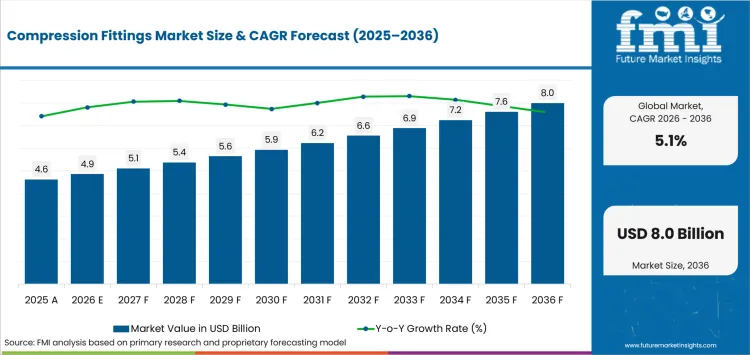
USD 4.9 billion in 2026 and USD 8.0 billion by 2036 at a 5.1% CAGR.
Demand for compression fittings is projected to expand at 5.1% CAGR between 2026 and 2036, increasing valuation from USD 4.9 billion in 2026 to USD 8.0 billion by 2036. Machine investment raises joint counts because pneumatic, hydraulic, cooling and instrumentation circuits each require serviceable tube connections. In September 2025, the International Federation of Robotics documented 542,000 industrial robot installations during 2024. New equipment therefore brings fittings into service during assembly and leaves an installed base that later requires replacement parts.
Country growth differs because production investment and replacement channels convert equipment demand into fitting orders at different speeds. Mexico illustrates the faster route, with export-oriented factories requiring OEM specification plus nearby maintenance stock. INEGI documented a 2.1% monthly rise in Mexican industrial activity during April 2026, including 1.2% growth in manufacturing. Mature automation markets such as Japan derive more purchases from installed-machine service, so similar technical relevance does not produce the same forecast pace.
Key Takeaways
- Industrial automation and plant modification raise connection counts because each machine can carry pneumatic, hydraulic, cooling, lubrication and instrumentation circuits.
- By fitting type, straight unions are estimated to hold 24.0% in 2026 owing to repeated use in aligned assembly, extension and repair work.
- In 2026, brass is expected to lead the material category with 34.0% share because common utility circuits need machinability and practical corrosion resistance.
- Below 6 mm is set to lead the tube size category with 18.0% share in 2026 due to compact instrument and control layouts.
- Qualification records, tube preparation, pressure ratings and media compatibility can slow brand switching after a connection family enters an approved equipment design.
- Some of the key players in this market include Parker Hannifin, Swagelok, Danfoss, DK-LOK Corporation, Hy-Lok Corporation, UCT Fluid Solutions (HAM-LET), Brennan Industries, STAUFF, IMI Norgren, and Beswick Engineering.
Analyst Perspective
"A compression fitting earns specification status after engineers validate tube preparation, ferrule behavior, pressure limits and media compatibility for the intended service. Commercial value comes later from keeping that approved configuration available during shutdowns without forcing another connection qualification."
- Nikhil Kaitwade, Principal Consultant, Future Market Insights
How is the compression fittings market segmented?
The compression fittings market is segmented by fitting type, material, tube size, end use, sales channel, and region.
Fitting type covers straight unions, elbows, tees, couplings, bulkhead fittings, and reducers or adapters. Material includes brass, stainless steel, carbon steel, copper, and plastic or polymer. Tube size covers below 6 mm, 6-12 mm, 12-25 mm, and above 25 mm. End uses include industrial machinery, oil and gas, instrumentation, HVAC or plumbing, and automotive. Sales channels include industrial distributors, direct OEM supply, MRO channels, and online or catalog sales.
Why do straight unions lead demand within the fitting type category?
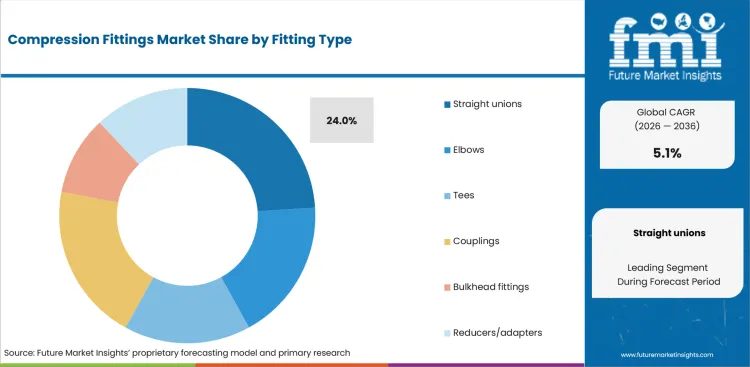
Straight unions reconnect an aligned tube run without changing direction, which suits machine assembly, instrumentation panels and maintenance work on established line routes. That simplicity reduces fitting variety in repeated skid and panel layouts, similar to the way instrumentation valve and fitting selections depend on repeatable connection standards without changing tube routing.
- By fitting type, straight unions are estimated to hold 24.0% in 2026 owing to repeated use for original assembly, line extension and component replacement.
- STAUFF received DNV approval for its Connect tube-fitting group in September 2025 for shipbuilding applications through September 2030. The approval demonstrates the qualification burden that mechanical tube connections must clear in higher-consequence service.
Why does brass lead demand within the material category?
Brass fits compressed-air, potable-water and general utility circuits that need clean machining and corrosion resistance without the installed cost of many stainless grades. Aggressive media, higher temperatures or contamination controls can shift the specification toward stainless steel or another alloy.
- In 2026, brass is expected to lead the material category with 34.0% share because high-volume utility connections reward practical material economics and replacement availability.
- NSF listings current in July 2026 include lead-free brass compression unions and sleeves certified to NSF/ANSI/CAN 372. Potable-water projects therefore keep lead-content documentation beside pressure and dimensional checks during material approval.
Why does below 6 mm lead demand within the tube size category?
Small-bore fittings serve analyzers, semiconductor tools and compact pneumatic controls that route several fluid or gas lines through limited equipment space. Assembly tolerances tighten as tube diameter falls, making ferrule position and tube preparation more important as ultrapure fittings move through contamination-sensitive service environments.
- Below 6 mm is set to lead the tube size category with 18.0% share in 2026 due to dense control layouts that need compact serviceable connections.
- SEMI published in June 2026 that semiconductor-equipment billings increased 14% year over year during the first quarter. Higher tool investment expands the installed base that uses compact gas and fluid connections.
Why does industrial machinery lead demand within the end use category?
Industrial machines place pneumatic actuation, hydraulic power, lubrication, cooling and instrumentation circuits inside one asset that maintenance teams service repeatedly. Each subsystem needs accessible joints that survive assembly, commissioning and later maintenance, while pneumatic actuator adoption reinforces the need for serviceable air-circuit connections without forcing major tube-route changes during service.
- Based on end use, industrial machinery is projected to account for 26.0% in 2026 due to the connection density built into multi-function equipment.
- The Federal Reserve stated in July 2026 that USA manufacturing output increased at a 4.7% annual rate during the second quarter. Higher factory utilization sustains retrofit and replacement work on machine fluid circuits.
Why do industrial distributors lead demand within the sales channel category?
Compression fittings create a stocking problem because tube size, thread, material, geometry and pressure class must match before a low-value part can return equipment to service. Local inventory shortens that delay by keeping replacement families close to operating plants, especially where industrial automation programs raise installed equipment density during maintenance.
- By sales channel, industrial distributors are forecast to represent 41.0% in 2026 driven by urgent MRO orders that place availability ahead of small unit-price differences.
- Statistics Canada found in August 2026 that machinery, equipment and supplies wholesale sales rose 4.8% during June. That activity demonstrates the commercial role of stocked industrial channels in equipment-related purchasing.
What are the drivers, restraints and opportunities in the Compression Fittings Market?
Machine investment increases fitting counts, qualification can delay substitution, and high-integrity energy projects reward documented connection performance.
- Driver: Automation and machinery investment increase the number of tube connections specified during equipment builds, upgrades and maintenance.
- Restraint: Qualification and assembly controls can delay brand switching even if two fittings appear dimensionally compatible.
- Opportunity: Hydrogen and carbon-capture projects can favor companies that document pressure integrity, materials, installation practice and application approvals.
Automation investment keeps fitting demand tied to equipment activity
Machine builders specify connection families before equipment reaches the plant, and maintenance groups reorder those same parts during service. The Association for Advancing Automation documented 36,766 North American robot orders in 2025, up 6.6% from 2024. More automated equipment therefore brings additional air and fluid circuits into operation. Fitting manufacturers retain repeat orders if distributors keep the original specification available during later modifications.
Qualification rules make apparently simple substitutions expensive
A fitting change can trigger review of material, pressure class, assembly practice and product markings even if the external dimensions match. Swagelok set 2025 non-renewal dates for selected carbon-steel and brass maritime fitting certifications under NK, Lloyd's Register and ABS. The change can alter an approved bill of materials without changing basic fitting geometry. Plants therefore control substitutions closely in systems that depend on documented marine approvals.
High-integrity energy projects raise the value of documented connections
Carbon-capture systems increase the cost of leakage, material mismatch and inconsistent assembly in instrumentation lines. The Global CCS Institute documented a 54% year-over-year increase in operational carbon-capture projects during October 2025. A larger operating base raises demand for qualified piping and instrumentation components. Compression-fitting companies can pursue those orders by pairing material evidence with assembly training and service records that complement process instrumentation qualification work.
Which country CAGRs are profiled in the Compression Fittings Market?
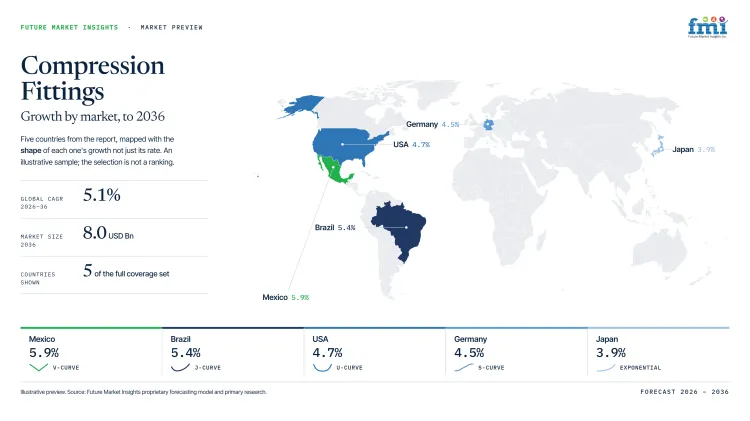
| Country | CAGR |
|---|---|
| Mexico | 5.9% |
| Brazil | 5.4% |
| Italy | 4.8% |
| USA | 4.7% |
| Canada | 4.6% |
| Germany | 4.5% |
| Japan | 3.9% |
How do country-level CAGRs compare in the Compression Fittings Market?
The seven-country range spans 2.0 percentage points, with Mexico and Brazil forming the growth band. Italy, the USA, Canada and Germany sit within 0.3 points, so channel economics outweigh small forecast differences. Japan occupies the lower end because its mature automation base generates more replacement demand than greenfield equipment expansion.
- Mexico concentrates high-volume OEM programs near export factories.
- Brazil gives corrosion-resistant instrumentation a larger role in remote projects.
- Italy relies heavily on specialist channels serving machinery clusters.
- USA replacement demand benefits from national MRO coverage.
- Canada makes service distance a material stocking cost.
- Germany locks connection standards into machinery designs early.
- Japan places more small-bore connections inside compact automation systems.
Similar CAGRs can produce different order sizes, stocking economics and qualification times.
The full report provides country-level CAGR analysis in North America, Latin America, Western Europe, Eastern Europe, East Asia, South Asia and Pacific, and the Middle East and Africa.
Country-wise Analysis
- Export-oriented manufacturing corridors shape Mexican compression-fitting demand, as automotive and industrial plants expect nearby replacement stock plus rapid application support for production equipment during continuous high-volume production schedules at each site. The Mexico compression fittings market is forecast to grow at 5.9% CAGR over the forecast period, tied to factory investment near major manufacturing centers. INEGI documented a 0.2% monthly increase in industrial activity during June 2026, confirming continued production activity behind local equipment use. Dispersed plants still expose smaller sites to cross-border lead times, so distributors gain repeat orders by staging metric and imperial fitting families close to operating factories serving factory automation and industrial controls programs.
- Remote mining, processing and energy sites define Brazil’s fitting requirement because downtime exposure rises when a replacement fitting is unavailable far from the main stocking centers. IBGE documented a 1.2% monthly rise in machinery and equipment production during May 2026, providing a direct indicator of equipment activity even as total national industrial output softened slightly overall. Brazil is forecast to post 5.4% CAGR during the assessment period, aided by machinery demand and industrial maintenance in remote operating regions. Long domestic transport routes raise the cost of national coverage, which favors fitting companies with corrosion-capable materials and field partners positioned near major oil and gas fittings project clusters.
- Italian compression-fitting purchases concentrate in machinery districts where specialist distributors serve equipment builders and industrial maintenance accounts with familiar fitting families. Standard brass and steel ranges face persistent price pressure because local plants can source common geometries from several channels during routine factory and process-equipment maintenance programs nationwide. Compression-fitting sales in Italy is forecast to advance at 4.8% CAGR through 2036, because plant and machinery investment sustains new builds plus scheduled service. Istat expected total investment to increase 2.7% in 2026 in its December 2025 outlook, giving stainless grades a clearer premium route where corrosion exposure or documentation changes the engineering requirement.
- A large installed equipment base keeps USA fitting purchases divided between OEM engineering programs, system integrators, industrial distributors and plant-level MRO networks. Demand for compression fittings in the USA is expected to register 4.7% CAGR during the forecast period, reflecting continued replacement and modification work. Varied process, transportation and facility standards can lengthen approval for substitute fitting families even with broad national stocking during project reviews and maintenance substitutions at plants. The USA Census Bureau reported a 0.3% decrease in manufactured-goods orders during June 2026, showing why service revenue can remain commercially important when new equipment orders soften.
- Distribution reach is central to Canadian fitting sales because manufacturing, resources and process customers operate over long service distances between major industrial centers. Statistics Canada documented a 2.8% increase in transportation-equipment manufacturing sales during June 2026, supporting active machinery-related purchasing while machinery distributors also supported maintenance demand in the same major industrial provinces. Remote sites remain exposed to freight timing and project swings, so cross-border replenishment works best when Canadian branches hold the approved replacement SKUs. The Canada compression fittings market is projected to progress at 4.6% CAGR over the assessment period, given machinery activity and installed-base service that reward coordinated local inventory.
- Engineering qualification gives Germany a distinct demand profile, as machinery and plant builders commonly approve tube connections against documented pressure classes, material rules and DIN or ISO assembly requirements before serial equipment production. Replacement fittings without the expected records can face longer approval even if their dimensions match the installed component during OEM redesign and plant maintenance work cycles. Destatis documented a 12.7% monthly increase in machinery and equipment orders during June 2026, reinforcing the link between OEM activity and connection specifications. Germany is projected to record 4.5% CAGR through 2036, propelled by machinery programs that favor certified fitting families with stable technical documentation and repeatable assembly procedures.
- Compact automation layouts shape Japanese equipment programs, where stable component quality and long design-in cycles discourage unplanned fitting substitutions after a machine enters production. METI established the Robotics and Regional Initiative Networking Group in June 2025 to accelerate robot adoption and address regional labor shortages through coordinated regional implementation networks serving manufacturers directly. Compression-fitting demand in Japan is expected to maintain 3.9% CAGR through 2036, attributable to automation programs and a mature machine base that requires service. Qualification time limits rapid switching, so local engineering support and consistent replenishment carry more commercial weight than frequent changes to an approved fitting family used in industrial robotics systems.
Who are the notable companies in the Compression Fittings Market?
Parker Hannifin, Swagelok, Danfoss, DK-LOK Corporation, Hy-Lok Corporation, UCT Fluid Solutions (HAM-LET), Brennan Industries, STAUFF, IMI Norgren, and Beswick Engineering are the notable companies profiled in this market.
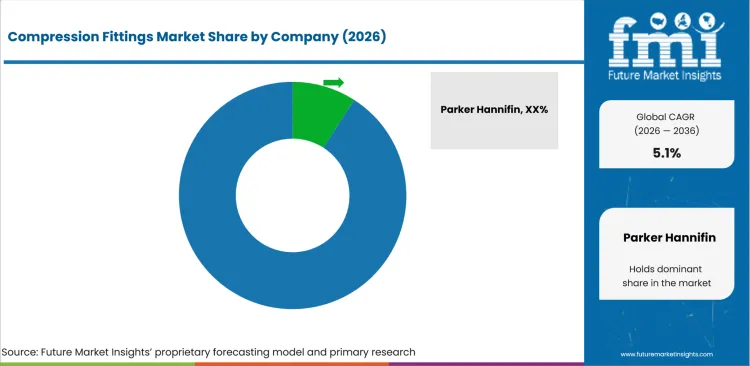
Instrumentation-grade competition is concentrated among Parker Hannifin, Swagelok, DK-LOK Corporation, Hy-Lok Corporation and UCT Fluid Solutions (HAM-LET). Danfoss and STAUFF carry deeper DIN and hydraulic tube-system scope, with Brennan Industries spanning hydraulic and instrumentation channels. IMI Norgren serves factory automation and Beswick Engineering focuses on miniature fluid connections. Entry therefore depends on proving connection integrity for the intended service and keeping the approved configuration available after equipment installation.
- Instrumentation and process connections: Parker Hannifin, Swagelok, DK-LOK Corporation, Hy-Lok Corporation, and UCT Fluid Solutions (HAM-LET).
- Hydraulic and DIN tube systems: Danfoss, Brennan Industries, and STAUFF.
- Automation and miniature fluid connections: IMI Norgren and Beswick Engineering.
Competitive Benchmarking: Compression Fittings Market
| Company | Instrumentation Tube-Fitting Breadth | DIN / Hydraulic Tube-System Coverage | Qualification / Specialty Depth | Geographic Reach |
|---|---|---|---|---|
| Parker Hannifin | High | Medium | High | Global |
| Swagelok | High | Low | High | Global |
| Danfoss | Medium | High | High | Global |
| DK-LOK Corporation | High | High | High | International |
| Hy-Lok Corporation | High | High | High | International |
| UCT Fluid Solutions (HAM-LET) | High | Medium | High | International |
| Brennan Industries | Medium | High | Medium | North America, Latin America, Australia and selected international markets |
| STAUFF | Medium | High | High | Global |
| IMI Norgren | Medium | Medium | Medium | Global |
| Beswick Engineering | Medium | Low | High | North America and international distribution |
Scoring basis: High instrumentation breadth requires several documented compression or ferrule fitting families; Medium indicates narrower verified participation and Low a different specialty. High DIN or hydraulic coverage requires documented DIN 2353, ISO 8434-1 or broad hydraulic tube-system scope. High qualification depth requires at least three approval or specialty routes, with Medium requiring one or two and Low indicating general-service scope. Geographic reach records verified operating or distribution presence and is not a score.
Key Developments in the Compression Fittings Market
- In February 2026, STAUFF received updated Lloyd's Register Type Approval for its Connect 24° tube fittings. The certificate covers LL, L and S series use in maritime, offshore and industrial applications through August 2030.
- In February 2026, DK-LOK Corporation received KR type approval for DK-LOK tube fittings under certificate CWN19339-PE001. The approval is recorded on its certification register through March 2031.
- In July 2025, Swagelok amended its Canadian registration scope for stainless steel tube fittings. The filing includes larger tube socket-weld and male pipe-weld end connections within the registered fitting family.
Key Players in the Compression Fittings Market
Instrumentation and high-integrity tube fittings
- Parker Hannifin
- Swagelok
- DK-LOK Corporation
- Hy-Lok Corporation
- UCT Fluid Solutions (HAM-LET)
Hydraulic and DIN tube-connection systems
- Danfoss
- Brennan Industries
- STAUFF
Automation and miniature fittings
- IMI Norgren
- Beswick Engineering
Compression Fittings Market - Report Scope
| Coverage field | Report scope |
|---|---|
| Market breakdown | By fitting type, material, tube size, end use, sales channel and region. |
| Quantitative Units | USD billion. |
| Market Definition | Commercial compression fittings that mechanically seal tubing through ferrules, cutting rings, sleeves, or related compression elements for industrial fluid and gas connections. |
| Regions Covered | North America, Latin America, Western Europe, Eastern Europe, East Asia, South Asia and Pacific, and Middle East and Africa. |
| Countries Covered | Mexico, Brazil, Italy, USA, Canada, Germany, Japan, and 20+ countries included in the full report. |
| Key Companies Profiled | Parker Hannifin, Swagelok, Danfoss, DK-LOK Corporation, Hy-Lok Corporation, UCT Fluid Solutions (HAM-LET), Brennan Industries, STAUFF, IMI Norgren, and Beswick Engineering. |
| Forecast Period | 2026 to 2036. |
| Approach | Primary and secondary research with market triangulation. |
Compression Fittings Market - Research Methodology
| Method | Approach |
|---|---|
| Primary Research | FMI analysts gathered input from manufacturers, service providers, technology developers, distributors, end users, procurement teams, and subject-matter experts. Interviews examined purchasing decisions, product or service evaluation, adoption barriers, approval requirements, pricing considerations, and expectations for technical or commercial support. Respondents were also asked what evidence is required before a trial, pilot, or initial order develops into regular purchasing. |
| Desk Research | Desk research covered government statistics, regulatory publications, trade data, industry associations, technical literature, standards, company filings, product information, and official corporate announcements. Sources were reviewed for relevance, publication date, geographic coverage, and consistency with the defined market scope. Claims relating to performance, applications, approvals, capacity, investment, and commercial activity were retained only when supported by credible public evidence. |
| Market Sizing and Forecasting | The market model combined the baseline value with historical performance, segment structure, pricing and volume indicators, adoption levels, company participation, and country-level demand conditions. Forecast assumptions considered economic activity, investment trends, regulatory developments, technology adoption, purchasing cycles, supply availability, and barriers to wider market use. Segment and regional estimates were reconciled before the final market total was calculated. |
| Data Validation | Estimates were checked against multiple independent indicators, including public data, company activity, trade patterns, industry developments, and findings from primary interviews. Validation also tested whether products, services, applications, and company revenues fell within the defined market boundaries. Adjacent categories, unsupported claims, overlapping revenues, and activities without direct market relevance were excluded to reduce double counting and maintain consistency across segments and countries. |
Compression Fittings Market by Segments
Compression Fittings Market segmented by Fitting Type:
- Straight unions
- Elbows
- Tees
- Couplings
- Bulkhead fittings
- Reducers/adapters
Compression Fittings Market segmented by Material:
- Brass
- Stainless steel
- Carbon steel
- Copper
- Plastic / polymer
Compression Fittings Market segmented by Tube Size:
- Below 6 mm
- 6-12 mm
- 12-25 mm
- Above 25 mm
Compression Fittings Market segmented by End Use:
- Industrial machinery
- Oil & gas
- Instrumentation
- HVAC/plumbing
- Automotive
Compression Fittings Market segmented by Sales Channel:
- Industrial distributors
- Direct OEM supply
- MRO channel
- Online/catalog sales
Compression Fittings Market by Region:
- North America
- United States
- Canada
- Latin America
- Brazil
- Mexico
- Argentina
- Chile
- Western Europe
- Germany
- France
- United Kingdom
- Italy
- Spain
- Benelux
- Nordics
- Eastern Europe
- Poland
- Czech Republic
- Romania
- Hungary
- East Asia
- China
- Japan
- South Korea
- South Asia and Pacific
- India
- ASEAN
- Australia and New Zealand
- Middle East and Africa
- GCC Countries
- South Africa
- Türkiye
- Israel
Research Sources and Bibliography
- International Federation of Robotics. (2025, September 25). Global robot demand in factories doubles over 10 years. Source: Global.
- Instituto Nacional de Estadística y Geografía (INEGI). (2026, June 11). Monthly Industrial Activity Indicator (IMAI). Base 2018. April, 2026. Source: Mexico.
- STAUFF. (2025, September 19). STAUFF Connect receives DNV certification for shipbuilding. Source: Global / Germany.
- NSF. (2026, July 26). NSF/ANSI/CAN 372 product and service listings. Source: Global / United States.
- SEMI. (2026, June 4). SEMI reports global semiconductor equipment billings increased 14% year-over-year in Q1 2026. Source: Global.
- Board of Governors of the Federal Reserve System. (2026, July 17). Industrial production and capacity utilization - G.17. Source: United States.
- Statistics Canada. (2026, August 14). Wholesale trade, June 2026. Source: Canada.
- Association for Advancing Automation. (2026, February 6). Robot orders grow 6.6% in 2025 as general industries drive broader automation adoption. Source: North America.
- Swagelok. (2025, January 27). Product changes. Source: Global / United States.
- Global CCS Institute. (2025, October 9). Carbon capture stays the course despite global headwinds, with 54% rise in operational projects. Source: Global.
- Instituto Nacional de Estadística y Geografía (INEGI). (2026, August 11). Monthly Industrial Activity Indicator (IMAI). Base 2018. June, 2026. Source: Mexico.
- Brazilian Institute of Geography and Statistics (IBGE). (2026, July 3). Industrial production changes -0.2% in May. Source: Brazil.
- Istat. (2025, December 5). Italy’s Economic outlook 2025-2026. Source: Italy.
- USA Census Bureau. (2026, August 4). Monthly Full Report on Manufacturers’ Shipments, Inventories, & Orders. Source: United States.
- Statistics Canada. (2026, August 14). Monthly Survey of Manufacturing, June 2026. Source: Canada.
- Federal Statistical Office of Germany (Destatis). (2026, August 6). New orders in manufacturing in June 2026: +3.1% on the previous month. Source: Germany.
- Ministry of Economy, Trade and Industry. (2025, June 30). Robotics & Regional Initiative Networking Group (RING Project) Established to Solve Regional Labor Shortages. Source: Japan.
- Parker Hannifin. (2025, November). Parker Instrumentation Products Division Certifications HUB. Source: Global.
- Swagelok. (2025, March 24). Lloyd’s Register Type Approval Certificate LR2537124TA. Source: Global.
- Nippon Kaiji Kyokai. (2025, July 3). Type Approval Certificate TA25499M. Source: Global / Japan.
- Swagelok. (2025, July 30). Canadian Registration Number Submittal #SS-TUBEFIT-2018 (2025 Amendment). Source: Canada.
- Danfoss Power Solutions. (2025, August 6). DNV Type Approval Certificate TAP00001CA, Revision 2. Source: Global / Germany.
- Danfoss. (2026, July 9). Danfoss to create a leading global player in fluid conveyance. Source: Global.
- DK-LOK USA. (2026, February 10). Fittings and Valves Certifications. Source: Global / United States.
- Hy-Lok Corporation. (2025, August 7). DNV Type Approval Certificate TAP00000A3, Revision 3. Source: Global / South Korea.
- UCT Fluid Solutions. (n.d.). Certifications. Source: Global.
- Brennan Industries. (2025, August 18). Brennan Industries expands into Australia with the acquisition of Aussie Adaptors & Hydraulics P/L. Source: Australia / Global.
- STAUFF. (2026, February 6). New Lloyd’s Register certificate for STAUFF Connect. Source: Global / Germany.
- STAUFF. (2026, February 6). STAUFF receives extended Bureau Veritas certifications for several product groups. Source: Global / Germany.
- STAUFF. (2025, June 12). Reliability confirmed: We are certified again. Source: Global / Germany.
- IMI plc. (2026, March 31). Annual Report 2025. Source: Global.
- Beswick Engineering. (2025, October 15). Beswick Engineering REACH Declaration. Source: Global / United States.
This bibliography is provided for reader reference and is not exhaustive. The full report contains the complete reference list and detailed citations
This Report Answers
- How large is the compression fittings market in 2026 and by 2036?
- Which equipment trends increase compression-fitting demand?
- Which fitting type, material and tube size lead in 2026?
- Why are industrial machinery and distributors important demand routes?
- Which qualification conditions slow fitting substitution?
- How do the seven profiled country CAGRs compare?
- Which local conditions affect country-level fitting sales?
- Which companies compete in the compression fittings market?
Frequently Asked Questions
How big is the compression fittings market in 2026?
The compression fittings market is valued at USD 4.9 billion in 2026 and is projected to reach USD 8.0 billion by 2036. Machinery investment and installed-equipment service increase the number of tube joints specified and replaced.
What is the CAGR of the compression fittings market from 2026 to 2036?
The compression fittings market is projected to grow at a CAGR of 5.1% between 2026 and 2036. Industrial automation, plant modification and installed-base replacement sustain fitting purchases for pneumatic, hydraulic, cooling and instrumentation circuits.
Which fitting type leads the compression fittings market?
The straight unions segment is expected to hold 24.0% of fitting type demand in the compression fittings market in 2026, attributable to repeated use on aligned tube runs. Its simple geometry serves assembly, extension and repair without changing line direction.
Which material leads the compression fittings market?
The brass segment is expected to hold 34.0% of material demand in the compression fittings market in 2026, supported by machinability and practical corrosion resistance. High-volume air, water and utility circuits also favor its installed-cost profile.
Which companies are active in the compression fittings market?
Key companies operating in the compression fittings market include Parker Hannifin, Swagelok, Danfoss, DK-LOK Corporation, Hy-Lok Corporation, UCT Fluid Solutions (HAM-LET), Brennan Industries, STAUFF, IMI Norgren, and Beswick Engineering. Competition centers on fitting architecture, qualification depth, application coverage and distribution reach.
Preview the report firsthand - request a free sample
Get SampleGet the brochure for pricing and purchase details.
Get PDFTable of Content
- Key Takeaways
- Market Size and CAGR
- Top Growth Driver
- Fastest Growing Segment
- Leading Region
- Key Companies
- Emerging Opportunities
- Executive Summary
- Global Market Outlook
- Demand-side Trends
- Supply-side Trends
- Technology Roadmap Analysis
- Analysis and Recommendations
- Analyst Perspective (What is happening? Why now? What should investors know?)
- Key Questions Answered
- How large is the market?
- What is the CAGR?
- What are key trends?
- Which region dominates?
- Who are the leaders?
- Market Overview
- Market Coverage / Taxonomy
- Market Definition / Scope / Limitations
- Research Methodology
- Chapter Orientation
- Analytical Lens and Working Hypotheses
- Market Structure, Signals, and Trend Drivers
- Benchmarking and Cross-market Comparability
- Market Sizing, Forecasting, and Opportunity Mapping
- Research Design and Evidence Framework
- Desk Research Programme (Secondary Evidence)
- Expert Input and Fieldwork (Primary Evidence)
- Tooling, Models, and Reference Databases
- Data Engineering and Model Build
- Quality Assurance and Audit Trail
- Market Background
- Market Dynamics (Drivers, Restraints, Opportunity, Trends)
- Scenario Forecast (Optimistic, Likely, Conservative)
- Impact Analysis
- AI Impact
- Sustainability Impact
- Regulatory Impact
- Technology Impact
- Consumer / Buyer Analysis
- Purchase Drivers
- Adoption Barriers
- Buyer Journey
- Opportunity Map Analysis
- Product Life Cycle Analysis
- Supply Chain Analysis
- Investment Feasibility Matrix
- Value Chain Analysis
- PESTLE and Porter's Analysis
- Regulatory Landscape
- Regional Parent Market Outlook
- Production and Consumption Statistics
- Import and Export Statistics
- Global Market Analysis and Forecast, 2021 to 2036
- Historical Market Size Value (USD Billion) Analysis, 2021 to 2025
- Current and Future Market Size Value (USD Billion) Projections, 2026 to 2036
- Y-o-Y Growth Trend Analysis
- Absolute $ Opportunity Analysis
- Global Market Pricing Analysis, 2021 to 2036
- Global Market Analysis and Forecast, By Fitting Type, 2021 to 2036
- Introduction / Key Findings
- Historical Market Size Value (USD Billion) Analysis By Fitting Type, 2021 to 2025
- Current and Future Market Size Value (USD Billion) Analysis and Forecast By Fitting Type, 2026 to 2036
- Straight unions
- Elbows
- Tees
- Couplings
- Bulkhead fittings
- Reducers/adapters
- Straight unions
- Y-o-Y Growth Trend Analysis By Fitting Type, 2021 to 2025
- Absolute $ Opportunity Analysis By Fitting Type, 2026 to 2036
- Global Market Analysis and Forecast, By Material, 2021 to 2036
- Introduction / Key Findings
- Historical Market Size Value (USD Billion) Analysis By Material, 2021 to 2025
- Current and Future Market Size Value (USD Billion) Analysis and Forecast By Material, 2026 to 2036
- Brass
- Stainless steel
- Carbon steel
- Copper
- Plastic / polymer
- Brass
- Y-o-Y Growth Trend Analysis By Material, 2021 to 2025
- Absolute $ Opportunity Analysis By Material, 2026 to 2036
- Global Market Analysis and Forecast, By Tube Size, 2021 to 2036
- Introduction / Key Findings
- Historical Market Size Value (USD Billion) Analysis By Tube Size, 2021 to 2025
- Current and Future Market Size Value (USD Billion) Analysis and Forecast By Tube Size, 2026 to 2036
- Below 6 mm
- 6-12 mm
- 12-25 mm
- Above 25 mm
- Below 6 mm
- Y-o-Y Growth Trend Analysis By Tube Size, 2021 to 2025
- Absolute $ Opportunity Analysis By Tube Size, 2026 to 2036
- Global Market Analysis and Forecast, By End Use, 2021 to 2036
- Introduction / Key Findings
- Historical Market Size Value (USD Billion) Analysis By End Use, 2021 to 2025
- Current and Future Market Size Value (USD Billion) Analysis and Forecast By End Use, 2026 to 2036
- Industrial machinery
- Oil & gas
- Instrumentation
- HVAC/plumbing
- Automotive
- Industrial machinery
- Y-o-Y Growth Trend Analysis By End Use, 2021 to 2025
- Absolute $ Opportunity Analysis By End Use, 2026 to 2036
- Global Market Analysis and Forecast, By Sales Channel, 2021 to 2036
- Introduction / Key Findings
- Historical Market Size Value (USD Billion) Analysis By Sales Channel, 2021 to 2025
- Current and Future Market Size Value (USD Billion) Analysis and Forecast By Sales Channel, 2026 to 2036
- Industrial distributors
- Direct OEM supply
- MRO channel
- Online/catalog sales
- Industrial distributors
- Y-o-Y Growth Trend Analysis By Sales Channel, 2021 to 2025
- Absolute $ Opportunity Analysis By Sales Channel, 2026 to 2036
- Global Market Analysis and Forecast, By Region, 2021 to 2036
- Introduction
- Historical Market Size Value (USD Billion) Analysis By Region, 2021 to 2025
- Current Market Size Value (USD Billion) Analysis and Forecast By Region, 2026 to 2036
- North America
- Latin America
- Western Europe
- Eastern Europe
- East Asia
- South Asia and Pacific
- Middle East & Africa
- Market Attractiveness Analysis By Region
- North America Market Analysis and Forecast, By Country, 2021 to 2036
- Historical Market Size Value (USD Billion) Trend Analysis By Market Taxonomy, 2021 to 2025
- Market Size Value (USD Billion) Forecast By Market Taxonomy, 2026 to 2036
- By Country
- USA
- Canada
- By Fitting Type
- By Material
- By Tube Size
- By End Use
- By Sales Channel
- By Country
- Market Attractiveness Analysis
- By Country
- By Fitting Type
- By Material
- By Tube Size
- By End Use
- By Sales Channel
- Key Takeaways
- Latin America Market Analysis and Forecast, By Country
- Historical Market Size Value (USD Billion) Trend Analysis By Market Taxonomy, 2021 to 2025
- Market Size Value (USD Billion) Forecast By Market Taxonomy, 2026 to 2036
- By Country
- Brazil
- Mexico
- Chile
- Rest of Latin America
- By Fitting Type
- By Material
- By Tube Size
- By End Use
- By Sales Channel
- By Country
- Market Attractiveness Analysis
- By Country
- By Fitting Type
- By Material
- By Tube Size
- By End Use
- By Sales Channel
- Key Takeaways
- Western Europe Market Analysis and Forecast, By Country
- Historical Market Size Value (USD Billion) Trend Analysis By Market Taxonomy, 2021 to 2025
- Market Size Value (USD Billion) Forecast By Market Taxonomy, 2026 to 2036
- By Country
- Germany
- UK
- Italy
- Spain
- France
- Nordic
- BENELUX
- Rest of Western Europe
- By Fitting Type
- By Material
- By Tube Size
- By End Use
- By Sales Channel
- By Country
- Market Attractiveness Analysis
- By Country
- By Fitting Type
- By Material
- By Tube Size
- By End Use
- By Sales Channel
- Key Takeaways
- Eastern Europe Market Analysis and Forecast, By Country
- Historical Market Size Value (USD Billion) Trend Analysis By Market Taxonomy, 2021 to 2025
- Market Size Value (USD Billion) Forecast By Market Taxonomy, 2026 to 2036
- By Country
- Russia
- Poland
- Hungary
- Balkan & Baltic
- Rest of Eastern Europe
- By Fitting Type
- By Material
- By Tube Size
- By End Use
- By Sales Channel
- By Country
- Market Attractiveness Analysis
- By Country
- By Fitting Type
- By Material
- By Tube Size
- By End Use
- By Sales Channel
- Key Takeaways
- East Asia Market Analysis and Forecast, By Country
- Historical Market Size Value (USD Billion) Trend Analysis By Market Taxonomy, 2021 to 2025
- Market Size Value (USD Billion) Forecast By Market Taxonomy, 2026 to 2036
- By Country
- China
- Japan
- South Korea
- By Fitting Type
- By Material
- By Tube Size
- By End Use
- By Sales Channel
- By Country
- Market Attractiveness Analysis
- By Country
- By Fitting Type
- By Material
- By Tube Size
- By End Use
- By Sales Channel
- Key Takeaways
- South Asia and Pacific Market Analysis and Forecast, By Country
- Historical Market Size Value (USD Billion) Trend Analysis By Market Taxonomy, 2021 to 2025
- Market Size Value (USD Billion) Forecast By Market Taxonomy, 2026 to 2036
- By Country
- India
- ASEAN
- Australia & New Zealand
- Rest of South Asia and Pacific
- By Fitting Type
- By Material
- By Tube Size
- By End Use
- By Sales Channel
- By Country
- Market Attractiveness Analysis
- By Country
- By Fitting Type
- By Material
- By Tube Size
- By End Use
- By Sales Channel
- Key Takeaways
- Middle East & Africa Market Analysis and Forecast, By Country
- Historical Market Size Value (USD Billion) Trend Analysis By Market Taxonomy, 2021 to 2025
- Market Size Value (USD Billion) Forecast By Market Taxonomy, 2026 to 2036
- By Country
- Kingdom of Saudi Arabia
- Other GCC Countries
- Türkiye
- South Africa
- Other African Union
- Rest of Middle East & Africa
- By Fitting Type
- By Material
- By Tube Size
- By End Use
- By Sales Channel
- By Country
- Market Attractiveness Analysis
- By Country
- By Fitting Type
- By Material
- By Tube Size
- By End Use
- By Sales Channel
- Key Takeaways
- Key Countries Market Analysis
- USA
- Pricing Analysis
- Market Share Analysis, 2025
- By Fitting Type
- By Material
- By Tube Size
- By End Use
- By Sales Channel
- Canada
- Pricing Analysis
- Market Share Analysis, 2025
- By Fitting Type
- By Material
- By Tube Size
- By End Use
- By Sales Channel
- Mexico
- Pricing Analysis
- Market Share Analysis, 2025
- By Fitting Type
- By Material
- By Tube Size
- By End Use
- By Sales Channel
- Brazil
- Pricing Analysis
- Market Share Analysis, 2025
- By Fitting Type
- By Material
- By Tube Size
- By End Use
- By Sales Channel
- Chile
- Pricing Analysis
- Market Share Analysis, 2025
- By Fitting Type
- By Material
- By Tube Size
- By End Use
- By Sales Channel
- Germany
- Pricing Analysis
- Market Share Analysis, 2025
- By Fitting Type
- By Material
- By Tube Size
- By End Use
- By Sales Channel
- UK
- Pricing Analysis
- Market Share Analysis, 2025
- By Fitting Type
- By Material
- By Tube Size
- By End Use
- By Sales Channel
- Italy
- Pricing Analysis
- Market Share Analysis, 2025
- By Fitting Type
- By Material
- By Tube Size
- By End Use
- By Sales Channel
- Spain
- Pricing Analysis
- Market Share Analysis, 2025
- By Fitting Type
- By Material
- By Tube Size
- By End Use
- By Sales Channel
- France
- Pricing Analysis
- Market Share Analysis, 2025
- By Fitting Type
- By Material
- By Tube Size
- By End Use
- By Sales Channel
- India
- Pricing Analysis
- Market Share Analysis, 2025
- By Fitting Type
- By Material
- By Tube Size
- By End Use
- By Sales Channel
- ASEAN
- Pricing Analysis
- Market Share Analysis, 2025
- By Fitting Type
- By Material
- By Tube Size
- By End Use
- By Sales Channel
- Australia & New Zealand
- Pricing Analysis
- Market Share Analysis, 2025
- By Fitting Type
- By Material
- By Tube Size
- By End Use
- By Sales Channel
- China
- Pricing Analysis
- Market Share Analysis, 2025
- By Fitting Type
- By Material
- By Tube Size
- By End Use
- By Sales Channel
- Japan
- Pricing Analysis
- Market Share Analysis, 2025
- By Fitting Type
- By Material
- By Tube Size
- By End Use
- By Sales Channel
- South Korea
- Pricing Analysis
- Market Share Analysis, 2025
- By Fitting Type
- By Material
- By Tube Size
- By End Use
- By Sales Channel
- Russia
- Pricing Analysis
- Market Share Analysis, 2025
- By Fitting Type
- By Material
- By Tube Size
- By End Use
- By Sales Channel
- Poland
- Pricing Analysis
- Market Share Analysis, 2025
- By Fitting Type
- By Material
- By Tube Size
- By End Use
- By Sales Channel
- Hungary
- Pricing Analysis
- Market Share Analysis, 2025
- By Fitting Type
- By Material
- By Tube Size
- By End Use
- By Sales Channel
- Kingdom of Saudi Arabia
- Pricing Analysis
- Market Share Analysis, 2025
- By Fitting Type
- By Material
- By Tube Size
- By End Use
- By Sales Channel
- Türkiye
- Pricing Analysis
- Market Share Analysis, 2025
- By Fitting Type
- By Material
- By Tube Size
- By End Use
- By Sales Channel
- South Africa
- Pricing Analysis
- Market Share Analysis, 2025
- By Fitting Type
- By Material
- By Tube Size
- By End Use
- By Sales Channel
- USA
- Market Structure Analysis
- Competition Dashboard
- Competition Benchmarking
- Market Share Analysis of Top Players
- By Regional
- By Fitting Type
- By Material
- By Tube Size
- By End Use
- By Sales Channel
- Emerging Startups
- Innovation Benchmarking
- Competition Analysis
- Competition Deep Dive
- Parker Hannifin
- Overview
- Product Portfolio
- Profitability by Market Segments
- Sales Footprint
- Strategy Overview
- Marketing Strategy
- Product Strategy
- Channel Strategy
- Swagelok
- Eaton
- DK-Lok
- Hy-Lok
- Ham-Let
- Brennan Industries
- Stauff
- Norgren / IMI
- Beswick Engineering
- Parker Hannifin
- Case Studies
- Success Stories
- Recent Developments
- Competition Deep Dive
- Assumptions & Acronyms Used


