

- Market Size (2026)
- USD 1.9 Bn
- Forecast (2036)
- USD 3.0 Bn
- CAGR (2026 to 2036)
- 4.8%
How big is Concealed Hinges Market in 2026?
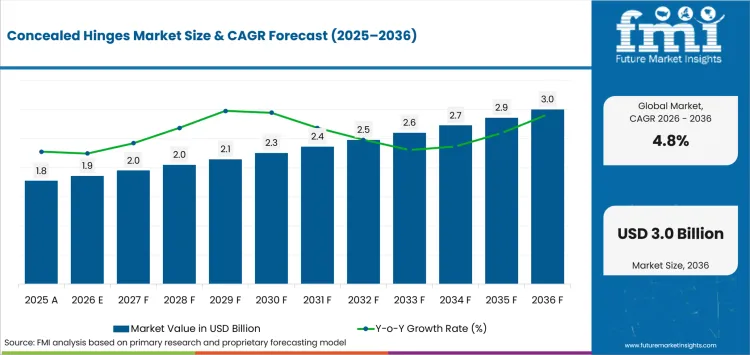
USD 1.9 billion in 2026 and USD 3.0 billion by 2036 at a 4.8% CAGR.
Demand for concealed hinges is projected to expand at 4.8% CAGR between 2026 and 2036, increasing valuation from USD 1.9 billion to USD 3.0 billion. Kitchen programs convert hardware demand into repeat orders because hinge geometry is fixed before cabinet assembly. Hettich's September 2025 ECF partnership placed Sensys hinge technology into assembled kitchen ranges and a nationwide distribution route serving more than 4,000 trade customers. That route shortens the distance between specification and replacement supply for modular furniture programs.
Country wise demand in the market will not move in a straight line because new construction and renovation contribute differently to hinge orders. The USA Census Bureau and HUD recorded July 2026 building permits at a 1.443 million annual rate while starts were 13.5% below July 2025. The gap keeps replacement cabinetry and interior upgrades relevant during weaker starts. For concealed-hinge manufacturers, residential interior doors and cabinet work therefore provide different order cycles instead of one construction signal.
Key Takeaways
- Cabinet production and replacement work sustain unit demand, while integrated damping and faster mounting raise hardware value per door.
- By hinge type, cup hinges are estimated to hold 29.0% in 2026 owing to standardized boring patterns used in cabinet production.
- Steel is expected to lead material with 43.0% share in 2026 because formed components balance stiffness and repeatability at volume cost.
- Kitchen cabinets are projected to hold 38.0% of end use in 2026, attributable to high door counts and frequent operating cycles.
- Drilling patterns and mounting-plate geometry slow supplier switching because a new hinge family can require line trials and field rework.
- Some of the key players in this market include Blum, Hettich, Häfele, GRASS, Salice, Sugatsune, Titus Group, FGV, SIMONSWERK GmbH, and DTC Hardware.
Analyst Perspective
"Concealed hinges earn premium value only when motion features fit the cabinet maker's existing drilling and plate system. The strongest programs reduce assembly work without turning every door size or opening angle into a separate hardware exception."
- Rahul Pandita, Principal Consultant, Future Market Insights
How is the concealed hinges market segmented?
The concealed hinges market is segmented by hinge type, opening angle, material, end use and sales channel.
Hinge type covers cup hinges, soft-close concealed hinges, clip-on hinges, inset concealed hinges and heavy-duty concealed hinges. Opening angle covers below 95°, 95-110°, 110-165° and above 165°. Material includes steel, stainless steel, zinc alloy, aluminum and composite/plastic. End use covers kitchen cabinets, furniture, appliances, architectural doors and industrial enclosures. Sales channels include furniture hardware distributors, direct OEM supply, retail/DIY and online/catalog.
How do kitchen cabinets shape the end use category?
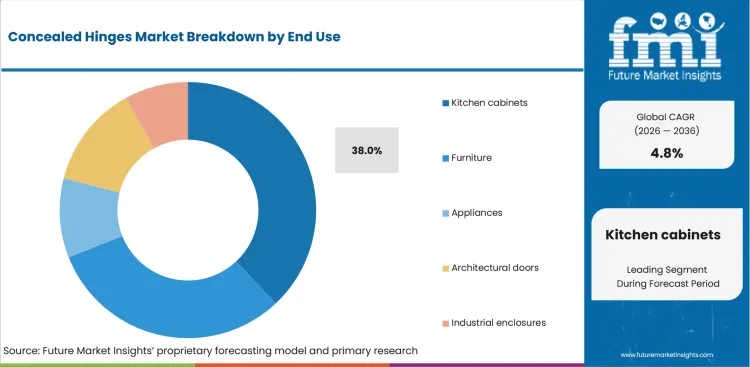
Kitchen cabinets concentrate many frequently operated doors inside one project, making adjustment and closing behavior visible after fitting. Hettich's May 2025 interzum release introduced Avosys for glass and mirror furniture fronts. The launch shows how hardware programs can cover specialized front materials without abandoning familiar assembly logic. Kitchen demand therefore rewards broad hinge families.
- By end use, kitchen cabinets are forecast to represent 38.0% in 2026 driven by high hinge counts and daily operating frequency.
- Kitchen manufacturers also benefit from nearby kitchen and dining furniture demand because cabinets, fronts and hardware are specified during the same fit-out cycle.
What makes cup hinges central to the hinge type category?
Cup hinges fit cabinet lines that already drill a repeatable cup and mounting-plate pattern. Manufacturers can vary overlay or inset geometry without rebuilding the full machining process. Blum's May 2025 launch of M BLUMOTION 105° and CLIP top BLUMOTION 105° retained three-dimensional adjustment and integrated soft close in two assembly routes. The release ties hinge choice directly to cabinetry tools and machining.
- Based on hinge type, cup hinges are projected to account for 29.0% in 2026 due to standardized boring and broad mounting-plate compatibility.
- Cabinet OEMs can retain one familiar machining logic while varying damping and mounting choices, which lowers changeover work during model updates.
How does below 95° influence selection within the opening angle category?
Restricted door travel is useful beside walls, appliances or neighboring fronts because clearance can matter more than maximum access. Wider angles remain necessary in deep cabinets and corner layouts. GRASS documented that split in June 2026 with the newly developed Tiomos 155 Plus wide-angle hinge. Its compact form and high stability show that opening angle follows application geometry.
- By opening angle, below 95° is estimated to hold 16.0% in 2026 owing to clearance-sensitive layouts that require controlled door travel.
- Designers choose wider alternatives only where interior access justifies additional swing, so narrow-angle hinges retain a defined role in compact cabinetry.
What supports steel within the material category?
Steel suits concealed-hinge arms and links that need repeatable formed geometry under repeated cycling. Material choice still has to survive the stated load and durability test route. ISO published ISO 25131:2025 in September 2025 for strength and durability testing of furniture hinges and components. The standard separates metal selection from verified hinge performance.
- In 2026, steel is expected to lead material with 43.0% share because forming economics and stiffness suit high-volume hinge components.
- Manufacturers qualify material through cycle and load performance instead of metal label alone, especially where door hardware must retain alignment through repeated use.
What drives furniture hardware distributors within the sales channel category?
Concealed hinges generate many order combinations because door thickness and overlay must align with plate height and opening angle. Distributors reduce the inventory burden for smaller cabinet shops. Sugatsune's June 2025 HES2S-150-A110 launch extended a surface-mount hidden hinge for 1-3/8-inch residential doors and reduced frame-side routing. That application matching gives stocked distribution a role beyond simple product availability.
- Furniture hardware distributors are set to lead sales channel with 36.0% share in 2026 due to mixed inventory and local application support.
- The channel is strongest where replacement jobs need compatible parts quickly, a pattern also visible in modular kitchen baskets and adjacent cabinet accessories.
What are the drivers, restraints and opportunities in the Concealed Hinges Market?
Cabinet replacement sustains demand, drilling compatibility slows changeovers and labor-saving assembly raises the value of qualified hinge families.
- Driver: Housing turnover and cabinet replacement sustain demand for concealed, adjustable and soft-close hinge systems.
- Restraint: Boring patterns and mounting-plate geometry make supplier changes expensive if line settings or field installation must change.
- Opportunity: Tool-free fixing and application-specific geometry can cut fitting time in OEM, renovation and architectural door work.
Replacement demand starts with homes staying in place long enough to justify cabinet renewal. NKBA's May 2025 North American briefing projected professional homeowner remodeling activity to rise 4.1% during 2025. That growth gives cabinet and interior fittings a repeat project route that does not depend on new construction. The same renewal cycle supports home decor and replacement hardware purchases.
Compatibility becomes expensive once a cabinet line has fixed its cup depth, hole pattern and mounting plate. TurkStat measured a 24.55% annual increase in Turkey's building construction cost index for December 2025. Higher project costs increase scrutiny of hardware changes that require extra drilling or installation labor. Qualification therefore centers on tested fit and stable assembly steps instead of feature count alone.
Assembly savings become more valuable where cabinet makers can remove a fitting step without changing the door design. Titus Group used interzum 2025 to present PressTo tool-free cup fixing and a 170° T-type hinge variant. Those options address labor and geometry as separate purchasing problems. The revenue route is strongest in bathroom cabinets and furniture programs that repeat the same installation task at volume.
Which country CAGRs are profiled in the Concealed Hinges Market?
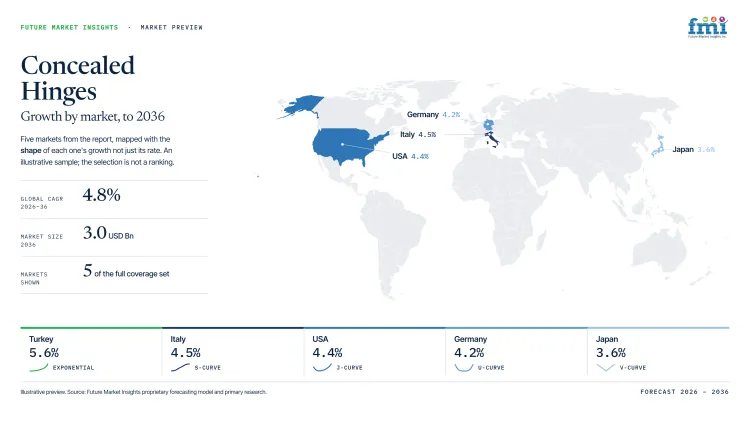
| Country | CAGR |
|---|---|
| Turkey | 5.6% |
| Brazil | 5.1% |
| Poland | 5.0% |
| Italy | 4.5% |
| USA | 4.4% |
| Germany | 4.2% |
| Japan | 3.6% |
How do country-level CAGRs compare in the Concealed Hinges Market?
Turkey leads the profiled group with Brazil and Poland close behind. Italy, USA and Germany form the middle band. Japan records the slowest approved CAGR as mature replacement cycles constrain acceleration.
- Turkey's pace raises channel needs under high construction costs.
- Brazil rewards faster installation as labor costs rise.
- Poland's furniture exports strengthen the OEM route.
- Italy's furniture base cushions variable residential permits.
- USA replacement work offsets uneven new construction.
- Germany rewards continuity in cabinet production routines.
- Japan depends more on compact renovation applications.
Similar CAGRs therefore require different inventory and qualification decisions.The full report provides country-level CAGR analysis across North America, Latin America, Western Europe, Eastern Europe, East Asia, South Asia and Pacific, and Middle East and Africa.
Country-wise Analysis
- Cabinet and furniture programs in Turkey enter 2026 with a large resale base that feeds refurbishment after home handovers because TurkStat recorded 1,688,910 home sales in 2025 and a 14.3% annual increase in January 2026. Turkey is projected to grow at 5.6% CAGR through 2036 because replacement work keeps fitted storage in active purchasing cycles and gives local distributors a steady route for stocked cup-and-plate combinations. High construction costs still make premium hardware difficult to justify on lower-budget projects, so broad distributor coverage and clear price tiers carry more commercial weight than a narrow premium-only offer in regional furniture clusters.
- Brazilian cabinet shops weigh labor-saving hardware against tight installed-cost targets in furniture production and residential improvement work because IBGE reported in January 2026 that the national civil-construction index rose 5.63% during 2025. Concealed-hinge sales in Brazil are forecast to expand at 5.1% CAGR by 2036 driven by faster fitting and replacement activity, with local stock shortening lead times for common hinge-and-plate configurations in regional dealer networks. A premium hinge still has to save enough installation effort to offset its higher unit price, which favors clear standard and soft-close tiers for mass furniture programs and upgraded kitchens instead of a premium-only route.
- Poland gives concealed-hinge makers a strong route through domestic housing and export-oriented furniture production because Statistics Poland recorded 208.8 thousand completed dwellings in 2025 and a 4.3% annual increase. Permits fell 8.8% and housing starts fell 9.2%, so the softer forward pipeline raises the value of repeat OEM programs and limits a new-build-only strategy for cabinet hardware producers serving domestic projects. Adoption of concealed hinges in Poland is estimated to expand at 5.0% CAGR through 2036 given cabinet output and distributor depth, with mounting consistency becoming especially valuable when retooling costs spread over large repeat furniture batches and export orders.
- Italian hinge demand is tied closely to furniture and kitchen manufacturing where design discretion has to coexist with repeatable production geometry because Istat recorded an 8.7% annual rise in dwellings within new buildings during Q4 2025. Italy's concealed hinges outlook is anticipated to advance at 4.5% CAGR over the assessment period attributable to furniture output and residential improvement, even though permit timing can change sharply between quarters and weaken short-term project visibility. Flexible inventory therefore carries more value than aggressive stock buildup, while manufacturers that preserve boring compatibility can introduce upgraded motion features without forcing cabinet plants to requalify an entire hinge platform.
- Large cabinet OEMs and architectural-hardware distributors give the USA a deep replacement route that is not tied to one new-build cycle because NKBA's 2026 outlook projects repair and remodeling kitchen-and-bath spending to grow 2.9%. Distributors gain an advantage from locally stocked plates and common hinge variants, while project volatility penalizes excessive SKU depth and raises the value of rapid technical selection during seasonal project swings. In the USA concealed-hinge demand is predicted to advance at 4.4% CAGR through 2036 helped by renovation and cabinet replacement, so service speed can matter more than carrying every uncommon angle in every branch and local warehouse.
- German furniture plants place a high cost on production disruption because drilling changes affect line settings and installer routines and Destatis recorded 206,586 completed dwellings in 2025 in its May 2026 construction release. The German concealed hinges sector is projected to record 4.2% CAGR during the assessment period tied to refurbishment and specification-led cabinet work, with documented dimensional fit helping new families enter controlled line trials. Existing drilling routines still slow switching if the hardware saving is small, but premium motion can earn a place where adjustment quality offsets qualification work in higher-specification cabinet programs and export furniture lines.
- Japan's compact residential layouts keep door travel and replacement fit important as the new housing pipeline contracts because MLIT recorded 740,667 housing starts in 2025 and a 6.5% decline from 2024 in January 2026. Japan is estimated to post 3.6% CAGR over the forecast period reflecting a larger role for renovation and installed-stock replacement, with compact geometries converting best where mounting dimensions match existing cabinetry. Lower starts limit volume from new projects and favor specialist ranges with controlled opening, so replacement-friendly geometry carries more commercial value than broad new-build distribution expansion for renovation contractors serving compact urban apartments and smaller homes.
Who are the notable companies in the Concealed Hinges Market?
Blum, Hettich, Häfele, GRASS, Salice, Sugatsune, Titus Group, FGV, SIMONSWERK GmbH, and DTC Hardware are the notable companies profiled in this market.
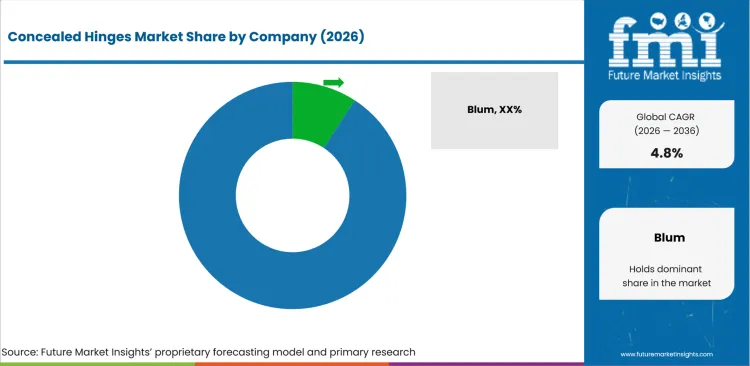
Competition divides between cabinet-hinge platforms, furniture-hardware networks and architectural specialists. Entry depends on repeatable geometry, documented durability and distributor stock. Luxury wood doors create a parallel need for concealed movement with controlled alignment.
- Blum and Hettich compete through broad cabinet-hinge families. GRASS and Salice also pair integrated motion with multiple application geometries.
- Häfele, FGV and DTC Hardware compete through broader furniture-hardware routes that also serve ergonomic furniture programs.
- Sugatsune and Titus Group hold stronger positions in specialized assembly. SIMONSWERK GmbH is stronger in architectural concealment and unusual door requirements.
Competitive Benchmarking: Concealed Hinges Market
| Company | Hinge Geometry & Application Breadth | Damping & Adjustment Integration | Assembly & Specification Support | Geographic Reach |
|---|---|---|---|---|
| Blum | High | High | High | Europe, North America, Asia-Pacific and other international markets |
| Hettich | High | High | High | Europe, Americas, Asia-Pacific and other international markets |
| Häfele | Medium | Medium | High | Global distribution and project network |
| GRASS | High | High | Medium | Europe, North America, Asia-Pacific and partner markets |
| Salice | High | High | Medium | Europe, North America, Asia-Pacific and distributor markets |
| Sugatsune | High | Medium | Medium | Japan, North America, Europe and Asia-Pacific |
| Titus Group | Medium | High | High | Europe, North America, Asia and other international markets |
| FGV | Medium | High | Medium | Europe, Americas and international distributor markets |
| SIMONSWERK GmbH | High | Medium | High | Europe, North America and international architectural markets |
| DTC Hardware | High | High | High | Manufacturing and distribution reach in 130+ countries |
Scoring basis: High geometry breadth documents at least three application or geometry classes. Medium documents two and Low one. High damping requires integrated motion plus multi-axis adjustment, while Medium confirms one. High assembly support combines installation simplification with technical selection or channel support. Medium confirms one route and Low a narrower documented offer.
Key Developments in the Concealed Hinges Market
- In June 2026 GRASS presented the newly developed Tiomos 155 Plus wide-angle hinge after HOLZ-HANDWERK 2026 with compact geometry and high stability for wider cabinet access.
- In June 2025 Sugatsune launched the HES2S-150-A110 surface-mount hidden door hinge for 1-3/8-inch residential doors and reduced frame-side routing for selected retrofit installations.
- In April 2025 Titus Group presented PressTo tool-free cup fixing and a 170° T-type hinge variant at interzum 2025 for faster assembly and specialized opening requirements.
Key Players in the Concealed Hinges Market
Integrated Cabinet-Hinge Platforms
- Blum
- Hettich
- GRASS
- Salice
Broad Hardware and Distribution Platforms
- Häfele
- FGV
- DTC Hardware
Specialized and Architectural Hinge Portfolios
- Sugatsune
- Titus Group
- SIMONSWERK GmbH
Concealed Hinges Market - Report Scope
| Coverage field | Report scope |
|---|---|
| Market breakdown | By hinge type, opening angle, material, end use, sales channel and region. |
| Quantitative Units | USD billion. |
| Market Definition | Revenue from concealed hinge assemblies and hinge-system components sold within the defined furniture, cabinet, appliance, architectural-door and industrial-enclosure scope. |
| Regions Covered | North America, Latin America, Western Europe, Eastern Europe, East Asia, South Asia and Pacific, and Middle East and Africa. |
| Countries Covered | Turkey, Brazil, Poland, Italy, USA, Germany, Japan, and 20+ countries included in the full report. |
| Key Companies Profiled | Blum, Hettich, Häfele, GRASS, Salice, Sugatsune, Titus Group, FGV, SIMONSWERK GmbH, DTC Hardware. |
| Forecast Period | 2026 to 2036. |
| Approach | Primary and secondary research with market triangulation. |
Concealed Hinges Market - Research Methodology
| Method | Approach |
|---|---|
| Primary Research | FMI analysts gathered input from manufacturers, service providers, technology developers, distributors, end users, procurement teams, and subject-matter experts. Interviews examined purchasing decisions, product or service evaluation, adoption barriers, approval requirements, pricing considerations, and expectations for technical or commercial support. Respondents were also asked what evidence is required before a trial, pilot, or initial order develops into regular purchasing. |
| Desk Research | Desk research covered government statistics, regulatory publications, trade data, industry associations, technical literature, standards, company filings, product information, and official corporate announcements. Sources were reviewed for relevance, publication date, geographic coverage, and consistency with the defined market scope. Claims relating to performance, applications, approvals, capacity, investment, and commercial activity were retained only when supported by credible public evidence. |
| Market Sizing and Forecasting | The market model combined the baseline value with historical performance, segment structure, pricing and volume indicators, adoption levels, company participation, and country-level demand conditions. Forecast assumptions considered economic activity, investment trends, regulatory developments, technology adoption, purchasing cycles, supply availability, and barriers to wider market use. Segment and regional estimates were reconciled before the final market total was calculated. |
| Data Validation | Estimates were checked against multiple independent indicators, including public data, company activity, trade patterns, industry developments, and findings from primary interviews. Validation also tested whether products, services, applications, and company revenues fell within the defined market boundaries. Adjacent categories, unsupported claims, overlapping revenues, and activities without direct market relevance were excluded to reduce double counting and maintain consistency across segments and countries. |
Concealed Hinges Market by Segments
Concealed Hinges Market segmented by Hinge Type:
- Cup hinges
- Soft-close concealed hinges
- Clip-on hinges
- Inset concealed hinges
- Heavy-duty concealed hinges
Concealed Hinges Market segmented by Opening Angle:
- Below 95°
- 95-110°
- 110-165°
- Above 165°
Concealed Hinges Market segmented by Material:
- Steel
- Stainless steel
- Zinc alloy
- Aluminum
- Composite/plastic
Concealed Hinges Market segmented by End Use:
- Kitchen cabinets
- Furniture
- Appliances
- Architectural doors
- Industrial enclosures
Concealed Hinges Market segmented by Sales Channel:
- Furniture hardware distributors
- Direct OEM supply
- Retail/DIY
- Online/catalog
Concealed Hinges Market by Region:
- North America
- United States
- Canada
- Latin America
- Brazil
- Mexico
- Argentina
- Chile
- Western Europe
- Germany
- France
- United Kingdom
- Italy
- Spain
- Benelux
- Nordics
- Eastern Europe
- Poland
- Czech Republic
- Romania
- Hungary
- East Asia
- China
- Japan
- South Korea
- South Asia and Pacific
- India
- ASEAN
- Australia and New Zealand
- Middle East and Africa
- GCC Countries
- South Africa
- Türkiye
- Israel
Research Sources and Bibliography
- Hettich. (2025, September 29). ECF & Hettich Announce Landmark Partnership.
- USA Census Bureau and USA Department of Housing and Urban Development. (2026, August 18). Monthly New Residential Construction, July 2026.
- Blum. (2025, May). Blum unveils new hinges as additions to its range.
- GRASS. (2026, June). News June 2026.
- International Organization for Standardization. (2025, September). ISO 25131:2025 Hardware for furniture - Strength and durability of hinges and their components - Stays and hinges pivoting on a horizontal axis.
- Hettich. (2025, May 20). Hettich's trade fair debuts at interzum 2025.
- Sugatsune America. (2025, June 23). The World’s First Surface Mount Hidden Door Hinge Just Got Better!.
- Titus Group. (2025, April 16). Titus at interzum 2025: Simply Titus - Engineering Made Effortless.
- Turkish Statistical Institute. (2026, January 20). House Sales Statistics - December 2025.
- Turkish Statistical Institute. (2026, February 10). Construction Cost Index - December 2025.
- Ministry of Land, Infrastructure, Transport and Tourism, Japan. (2026, January 30). Summary of New Housing Starts in 2025.
- German Federal Statistical Office (Destatis). (2026, May 22). Construction work completed in Germany, 2021 to 2025.
- Italian National Institute of Statistics (Istat). (2026, April 15). Building permits indicators - Q4 2025.
- Statistics Poland. (2026, January 22). Residential construction in the period of January-December 2025.
- Brazilian Institute of Geography and Statistics (IBGE). (2026, January 9). National Index of Civil Construction reaches 0.51% in December. closes 2025 with a rise of 5.63%.
- SIMONSWERK. (2025, January 23). Successful trade fair presence at the BAU 2025 in Munich.
- Salice. (2025, October 2). Salice acquires Villes 2000 S.r.l..
- National Kitchen & Bath Association. (2025, May 20). North American Market Outlook Spring 2025 Webinar Overview.
- National Kitchen & Bath Association. (2026). 2026 Kitchen & Bath Market Outlook.
- Hettich. (2025, September 8). IFA 2025: Midea showcases kitchens with Easy Access solutions from Hettich.
- Blum. (2025, September). Blum Unveils New Solution Centre in Worli, Mumbai: A New World of Modular Furniture Design for Quality Living..
- Hettich. (2025, November 10). Hettich to unleash new magic at Acetech 2025, showcasing its vision for the future of living and working spaces.
- GRASS. (2025, December). December 2025.
This bibliography is provided for reader reference and is not exhaustive. The full report contains the complete reference list and detailed citations.
This Report Answers
- What is the concealed hinges market size in 2026 and what value is forecast for 2036?
- Why do cup hinges hold the leading position within hinge type?
- How does opening angle change hinge selection in clearance-sensitive cabinetry?
- Why does steel hold the leading position within material?
- How do country growth rates differ among Turkey, Brazil, Poland, Italy, USA, Germany and Japan?
- How are Blum, Hettich, Häfele, GRASS, Salice, Sugatsune, Titus Group, FGV, SIMONSWERK GmbH and DTC Hardware positioned?
- How do drilling patterns and mounting-plate geometry slow supplier switching?
- What should cabinet OEMs and architectural-hardware distributors verify before approving a concealed-hinge family?
Frequently Asked Questions
How big is the concealed hinges market in 2026?
The concealed hinges market is valued at USD 1.9 billion in 2026 and is projected to reach USD 3.0 billion by 2036. Growth is tied to cabinet replacement, furniture production and higher specification of controlled closing.
What is the CAGR of the concealed hinges market from 2026 to 2036?
The concealed hinges market is projected to grow at a CAGR of 4.8% between 2026 and 2036. Expansion depends on replacement activity and hinge families that reduce assembly work without changing established drilling patterns.
Which hinge type leads the concealed hinges market?
The cup hinges segment is expected to hold 29.0% of the concealed hinges market in 2026, attributable to standardized boring and broad mounting-plate compatibility. Cabinet makers can vary damping and overlay choices within a familiar machining system.
Which material leads the concealed hinges market?
The steel segment is expected to hold 43.0% of the concealed hinges market in 2026, supported by stiffness and high-volume forming economics. Purchase approval still depends on cycle performance and dimensional stability in the intended hinge assembly.
Which countries are projected to record the highest growth in the concealed hinges market?
Turkey is projected to grow at 5.6% CAGR, followed by Brazil at 5.1% and Poland at 5.0% through 2036. Their growth routes differ because housing turnover, furniture production and construction costs affect orders differently.
Which companies are active in the concealed hinges market?
Key companies operating in the market include Blum, Hettich, Häfele, GRASS, Salice, Sugatsune, Titus Group, FGV, SIMONSWERK GmbH, and DTC Hardware. They compete through hinge geometry, motion integration, assembly support and distribution coverage.
Preview the report firsthand - request a free sample
Get SampleGet the brochure for pricing and purchase details.
Get PDFTable of Content
- Key Takeaways
- Market Size and CAGR
- Top Growth Driver
- Fastest Growing Segment
- Leading Region
- Key Companies
- Emerging Opportunities
- Executive Summary
- Global Market Outlook
- Demand-side Trends
- Supply-side Trends
- Technology Roadmap Analysis
- Analysis and Recommendations
- Analyst Perspective (What is happening? Why now? What should investors know?)
- Key Questions Answered
- How large is the market?
- What is the CAGR?
- What are key trends?
- Which region dominates?
- Who are the leaders?
- Market Overview
- Market Coverage / Taxonomy
- Market Definition / Scope / Limitations
- Research Methodology
- Chapter Orientation
- Analytical Lens and Working Hypotheses
- Market Structure, Signals, and Trend Drivers
- Benchmarking and Cross-market Comparability
- Market Sizing, Forecasting, and Opportunity Mapping
- Research Design and Evidence Framework
- Desk Research Programme (Secondary Evidence)
- Expert Input and Fieldwork (Primary Evidence)
- Tooling, Models, and Reference Databases
- Data Engineering and Model Build
- Quality Assurance and Audit Trail
- Market Background
- Market Dynamics (Drivers, Restraints, Opportunity, Trends)
- Scenario Forecast (Optimistic, Likely, Conservative)
- Impact Analysis
- AI Impact
- Sustainability Impact
- Regulatory Impact
- Technology Impact
- Consumer / Buyer Analysis
- Purchase Drivers
- Adoption Barriers
- Buyer Journey
- Opportunity Map Analysis
- Product Life Cycle Analysis
- Supply Chain Analysis
- Investment Feasibility Matrix
- Value Chain Analysis
- PESTLE and Porter's Analysis
- Regulatory Landscape
- Regional Parent Market Outlook
- Production and Consumption Statistics
- Import and Export Statistics
- Global Market Analysis and Forecast, 2021 to 2036
- Historical Market Size Value (USD Billion) Analysis, 2021 to 2025
- Current and Future Market Size Value (USD Billion) Projections, 2026 to 2036
- Y-o-Y Growth Trend Analysis
- Absolute $ Opportunity Analysis
- Global Market Pricing Analysis, 2021 to 2036
- Global Market Analysis and Forecast, By Hinge Type, 2021 to 2036
- Introduction / Key Findings
- Historical Market Size Value (USD Billion) Analysis By Hinge Type, 2021 to 2025
- Current and Future Market Size Value (USD Billion) Analysis and Forecast By Hinge Type, 2026 to 2036
- Cup hinges
- Soft-close concealed hinges
- Clip-on hinges
- Inset concealed hinges
- Heavy-duty concealed hinges
- Cup hinges
- Y-o-Y Growth Trend Analysis By Hinge Type, 2021 to 2025
- Absolute $ Opportunity Analysis By Hinge Type, 2026 to 2036
- Global Market Analysis and Forecast, By Opening Angle, 2021 to 2036
- Introduction / Key Findings
- Historical Market Size Value (USD Billion) Analysis By Opening Angle, 2021 to 2025
- Current and Future Market Size Value (USD Billion) Analysis and Forecast By Opening Angle, 2026 to 2036
- Below 95°
- 95–110°
- 110–165°
- Above 165°
- Below 95°
- Y-o-Y Growth Trend Analysis By Opening Angle, 2021 to 2025
- Absolute $ Opportunity Analysis By Opening Angle, 2026 to 2036
- Global Market Analysis and Forecast, By Material, 2021 to 2036
- Introduction / Key Findings
- Historical Market Size Value (USD Billion) Analysis By Material, 2021 to 2025
- Current and Future Market Size Value (USD Billion) Analysis and Forecast By Material, 2026 to 2036
- Steel
- Stainless steel
- Zinc alloy
- Aluminum
- Composite/plastic
- Steel
- Y-o-Y Growth Trend Analysis By Material, 2021 to 2025
- Absolute $ Opportunity Analysis By Material, 2026 to 2036
- Global Market Analysis and Forecast, By End Use, 2021 to 2036
- Introduction / Key Findings
- Historical Market Size Value (USD Billion) Analysis By End Use, 2021 to 2025
- Current and Future Market Size Value (USD Billion) Analysis and Forecast By End Use, 2026 to 2036
- Kitchen cabinets
- Furniture
- Appliances
- Architectural doors
- Industrial enclosures
- Kitchen cabinets
- Y-o-Y Growth Trend Analysis By End Use, 2021 to 2025
- Absolute $ Opportunity Analysis By End Use, 2026 to 2036
- Global Market Analysis and Forecast, By Sales Channel, 2021 to 2036
- Introduction / Key Findings
- Historical Market Size Value (USD Billion) Analysis By Sales Channel, 2021 to 2025
- Current and Future Market Size Value (USD Billion) Analysis and Forecast By Sales Channel, 2026 to 2036
- Furniture hardware distributors
- Direct OEM supply
- Retail/DIY
- Online/catalog
- Furniture hardware distributors
- Y-o-Y Growth Trend Analysis By Sales Channel, 2021 to 2025
- Absolute $ Opportunity Analysis By Sales Channel, 2026 to 2036
- Global Market Analysis and Forecast, By Region, 2021 to 2036
- Introduction
- Historical Market Size Value (USD Billion) Analysis By Region, 2021 to 2025
- Current Market Size Value (USD Billion) Analysis and Forecast By Region, 2026 to 2036
- North America
- Latin America
- Western Europe
- Eastern Europe
- East Asia
- South Asia and Pacific
- Middle East & Africa
- Market Attractiveness Analysis By Region
- North America Market Analysis and Forecast, By Country, 2021 to 2036
- Historical Market Size Value (USD Billion) Trend Analysis By Market Taxonomy, 2021 to 2025
- Market Size Value (USD Billion) Forecast By Market Taxonomy, 2026 to 2036
- By Country
- USA
- Canada
- By Hinge Type
- By Opening Angle
- By Material
- By End Use
- By Sales Channel
- By Country
- Market Attractiveness Analysis
- By Country
- By Hinge Type
- By Opening Angle
- By Material
- By End Use
- By Sales Channel
- Key Takeaways
- Latin America Market Analysis and Forecast, By Country
- Historical Market Size Value (USD Billion) Trend Analysis By Market Taxonomy, 2021 to 2025
- Market Size Value (USD Billion) Forecast By Market Taxonomy, 2026 to 2036
- By Country
- Brazil
- Mexico
- Chile
- Rest of Latin America
- By Hinge Type
- By Opening Angle
- By Material
- By End Use
- By Sales Channel
- By Country
- Market Attractiveness Analysis
- By Country
- By Hinge Type
- By Opening Angle
- By Material
- By End Use
- By Sales Channel
- Key Takeaways
- Western Europe Market Analysis and Forecast, By Country
- Historical Market Size Value (USD Billion) Trend Analysis By Market Taxonomy, 2021 to 2025
- Market Size Value (USD Billion) Forecast By Market Taxonomy, 2026 to 2036
- By Country
- Germany
- UK
- Italy
- Spain
- France
- Nordic
- BENELUX
- Rest of Western Europe
- By Hinge Type
- By Opening Angle
- By Material
- By End Use
- By Sales Channel
- By Country
- Market Attractiveness Analysis
- By Country
- By Hinge Type
- By Opening Angle
- By Material
- By End Use
- By Sales Channel
- Key Takeaways
- Eastern Europe Market Analysis and Forecast, By Country
- Historical Market Size Value (USD Billion) Trend Analysis By Market Taxonomy, 2021 to 2025
- Market Size Value (USD Billion) Forecast By Market Taxonomy, 2026 to 2036
- By Country
- Russia
- Poland
- Hungary
- Balkan & Baltic
- Rest of Eastern Europe
- By Hinge Type
- By Opening Angle
- By Material
- By End Use
- By Sales Channel
- By Country
- Market Attractiveness Analysis
- By Country
- By Hinge Type
- By Opening Angle
- By Material
- By End Use
- By Sales Channel
- Key Takeaways
- East Asia Market Analysis and Forecast, By Country
- Historical Market Size Value (USD Billion) Trend Analysis By Market Taxonomy, 2021 to 2025
- Market Size Value (USD Billion) Forecast By Market Taxonomy, 2026 to 2036
- By Country
- China
- Japan
- South Korea
- By Hinge Type
- By Opening Angle
- By Material
- By End Use
- By Sales Channel
- By Country
- Market Attractiveness Analysis
- By Country
- By Hinge Type
- By Opening Angle
- By Material
- By End Use
- By Sales Channel
- Key Takeaways
- South Asia and Pacific Market Analysis and Forecast, By Country
- Historical Market Size Value (USD Billion) Trend Analysis By Market Taxonomy, 2021 to 2025
- Market Size Value (USD Billion) Forecast By Market Taxonomy, 2026 to 2036
- By Country
- India
- ASEAN
- Australia & New Zealand
- Rest of South Asia and Pacific
- By Hinge Type
- By Opening Angle
- By Material
- By End Use
- By Sales Channel
- By Country
- Market Attractiveness Analysis
- By Country
- By Hinge Type
- By Opening Angle
- By Material
- By End Use
- By Sales Channel
- Key Takeaways
- Middle East & Africa Market Analysis and Forecast, By Country
- Historical Market Size Value (USD Billion) Trend Analysis By Market Taxonomy, 2021 to 2025
- Market Size Value (USD Billion) Forecast By Market Taxonomy, 2026 to 2036
- By Country
- Kingdom of Saudi Arabia
- Other GCC Countries
- Türkiye
- South Africa
- Other African Union
- Rest of Middle East & Africa
- By Hinge Type
- By Opening Angle
- By Material
- By End Use
- By Sales Channel
- By Country
- Market Attractiveness Analysis
- By Country
- By Hinge Type
- By Opening Angle
- By Material
- By End Use
- By Sales Channel
- Key Takeaways
- Key Countries Market Analysis
- USA
- Pricing Analysis
- Market Share Analysis, 2025
- By Hinge Type
- By Opening Angle
- By Material
- By End Use
- By Sales Channel
- Canada
- Pricing Analysis
- Market Share Analysis, 2025
- By Hinge Type
- By Opening Angle
- By Material
- By End Use
- By Sales Channel
- Mexico
- Pricing Analysis
- Market Share Analysis, 2025
- By Hinge Type
- By Opening Angle
- By Material
- By End Use
- By Sales Channel
- Brazil
- Pricing Analysis
- Market Share Analysis, 2025
- By Hinge Type
- By Opening Angle
- By Material
- By End Use
- By Sales Channel
- Chile
- Pricing Analysis
- Market Share Analysis, 2025
- By Hinge Type
- By Opening Angle
- By Material
- By End Use
- By Sales Channel
- Germany
- Pricing Analysis
- Market Share Analysis, 2025
- By Hinge Type
- By Opening Angle
- By Material
- By End Use
- By Sales Channel
- UK
- Pricing Analysis
- Market Share Analysis, 2025
- By Hinge Type
- By Opening Angle
- By Material
- By End Use
- By Sales Channel
- Italy
- Pricing Analysis
- Market Share Analysis, 2025
- By Hinge Type
- By Opening Angle
- By Material
- By End Use
- By Sales Channel
- Spain
- Pricing Analysis
- Market Share Analysis, 2025
- By Hinge Type
- By Opening Angle
- By Material
- By End Use
- By Sales Channel
- France
- Pricing Analysis
- Market Share Analysis, 2025
- By Hinge Type
- By Opening Angle
- By Material
- By End Use
- By Sales Channel
- India
- Pricing Analysis
- Market Share Analysis, 2025
- By Hinge Type
- By Opening Angle
- By Material
- By End Use
- By Sales Channel
- ASEAN
- Pricing Analysis
- Market Share Analysis, 2025
- By Hinge Type
- By Opening Angle
- By Material
- By End Use
- By Sales Channel
- Australia & New Zealand
- Pricing Analysis
- Market Share Analysis, 2025
- By Hinge Type
- By Opening Angle
- By Material
- By End Use
- By Sales Channel
- China
- Pricing Analysis
- Market Share Analysis, 2025
- By Hinge Type
- By Opening Angle
- By Material
- By End Use
- By Sales Channel
- Japan
- Pricing Analysis
- Market Share Analysis, 2025
- By Hinge Type
- By Opening Angle
- By Material
- By End Use
- By Sales Channel
- South Korea
- Pricing Analysis
- Market Share Analysis, 2025
- By Hinge Type
- By Opening Angle
- By Material
- By End Use
- By Sales Channel
- Russia
- Pricing Analysis
- Market Share Analysis, 2025
- By Hinge Type
- By Opening Angle
- By Material
- By End Use
- By Sales Channel
- Poland
- Pricing Analysis
- Market Share Analysis, 2025
- By Hinge Type
- By Opening Angle
- By Material
- By End Use
- By Sales Channel
- Hungary
- Pricing Analysis
- Market Share Analysis, 2025
- By Hinge Type
- By Opening Angle
- By Material
- By End Use
- By Sales Channel
- Kingdom of Saudi Arabia
- Pricing Analysis
- Market Share Analysis, 2025
- By Hinge Type
- By Opening Angle
- By Material
- By End Use
- By Sales Channel
- Türkiye
- Pricing Analysis
- Market Share Analysis, 2025
- By Hinge Type
- By Opening Angle
- By Material
- By End Use
- By Sales Channel
- South Africa
- Pricing Analysis
- Market Share Analysis, 2025
- By Hinge Type
- By Opening Angle
- By Material
- By End Use
- By Sales Channel
- USA
- Market Structure Analysis
- Competition Dashboard
- Competition Benchmarking
- Market Share Analysis of Top Players
- By Regional
- By Hinge Type
- By Opening Angle
- By Material
- By End Use
- By Sales Channel
- Emerging Startups
- Innovation Benchmarking
- Competition Analysis
- Competition Deep Dive
- Blum
- Overview
- Product Portfolio
- Profitability by Market Segments
- Sales Footprint
- Strategy Overview
- Marketing Strategy
- Product Strategy
- Channel Strategy
- Hettich
- Häfele
- Grass
- Salice
- Sugatsune
- Titus Group
- FGV
- Mepla / Hettich
- DTC Hardware
- Blum
- Case Studies
- Success Stories
- Recent Developments
- Competition Deep Dive
- Assumptions & Acronyms Used


