

- Industry Size (2026)
- USD 1.72 Bn
- Forecast (2036)
- USD 3.54 Bn
- CAGR (2026 to 2036)
- 7.5%
Conipack Pails Market Size, Market Forecast and Outlook By FMI
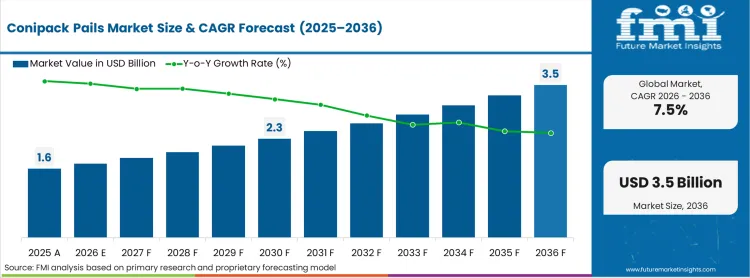
The conipack pails market was valued at USD 1.72 billion in 2025, rising to USD 1.72 billion in 2026 and projected to reach USD 3.54 billion by 2036 at a CAGR of 7.5%. Polyethylene holds 29.9% of the raw material type segment in 2026, reflecting entrenched procurement patterns and specification alignment across primary buyer categories. Based on FMI analysis, absolute market expansion of USD 1.82 billion over the 2026 to 2036 forecast period will be concentrated in technology-led sub-segments and geographies underpinned by regulatory mandates and active policy investment.
Summary of Conipack Pails Market
- Conipack Pails Market Definition
- The conipack pails market encompasses injection-molded and blow-molded plastic pails with conical taper profiles manufactured from polyethylene, polypropylene, and other thermoplastic resins, used for packaging lubricants, chemicals, paints, inks, edible oils, and pharmaceutical products across industrial, commercial, and consumer distribution channels globally.
- Demand Drivers in the Market
- Lubricants and Industrial Chemicals Packaging Standardization: Global lubricant manufacturers and specialty chemical producers are standardizing on conipack pail formats to reduce filling line changeover time and improve palletization efficiency, generating replacement procurement volumes across established supply relationships.
- Asia Pacific Industrial Output Expansion Driving Primary Packaging Demand: Manufacturing capacity expansion in China and India across automotive, construction chemicals, and agrochemical sectors is creating first-fill pail demand at a rate that outpaces mature market replacement cycles, anchoring global volume growth in the fastest-expanding geographies.
- Regulatory Transitions to Safer Resin Grades: Chemical safety regulations in Germany and the EU are driving reformulation of pail resin grades to comply with REACH and food-contact material standards, creating equipment and tooling refresh cycles at pail manufacturers serving European industrial markets.
- Key Segments Analyzed in the FMI Report
- Polyethylene: 29.9% share in 2026, driven by established procurement specifications that favour this configuration across primary buyer categories for its operational efficiency, performance consistency, and total cost of ownership advantages.
- Lubricants: the leading end-use category in 2026, anchored by institutional buyers operating under defined procurement cycles and volume commitments that generate predictable and recurring demand across the covered forecast period.
- China: 10.1% CAGR through 2036, the fastest-growing geography in the covered market, supported by active policy investment, expanding institutional procurement programs, and documented end-user industry capacity growth.
- Analyst Opinion at FMI
- Ismail Sutaria, Principal Consultant for Packaging observe that, FMI analysts note that the conipack pails market is bifurcating between commodity-oriented segments where regional manufacturers compete on price and specification-driven tiers where regulatory certification, integration credentials, and performance documentation create defensible margins for qualified vendors. Buyers consolidating supplier relationships are concentrating purchasing with organizations that can demonstrate both technical compliance and supply continuity, placing mid-tier providers without clear differentiation at structural disadvantage. The China and India growth trajectories are grounded in documented policy mandates and verifiable end-user industry expansion, making both geographies priority targets for capacity and go-to-market investment through the medium term.
- Strategic Implications / Executive Takeaways
- Prioritize capacity investment and distribution alignment with China and India, where CAGR outperformance relative to the global market average reflects durable structural demand anchored in verified policy commitments and expanding end-user industry activity.
- Develop certified and compliant product or service configurations that meet tightening specification requirements in Germany and adjacent geographies, where replacement-cycle buyers demonstrate willingness to pay premium pricing for documented performance credentials and regulatory compliance.
- Build multi-tier distribution and after-sale support infrastructure to serve both large institutional buyers with centralized procurement and mid-market buyers with decentralized purchasing decisions, capturing demand across both buyer segments throughout the forecast period.
Conipack Pails Market Key Takeaways
| Metric | Details |
|---|---|
| Industry Size (2026) | USD 1.72 billion |
| Industry Value (2036) | USD 3.54 billion |
| CAGR (2026-2036) | 7.5% |
| Source | Future Market Insights, 2026 |
FMI analysts observe that structural demand for the conipack pails market is shaped by regulatory compliance timelines, technology adoption curves, and procurement policy frameworks that function independently of short-term economic fluctuations. Lubricants and Industrial Chemicals Packaging Standardization establishes the volume baseline across the forecast period, while asia pacific industrial output expansion driving primary packaging demand is generating incremental demand from buyer categories that were previously underserved or constrained by cost barriers. FMI is of the opinion that producers and vendors who align investment with these converging forces will capture above-market revenue growth while those relying on legacy procurement relationships face progressive margin erosion as specification requirements tighten.
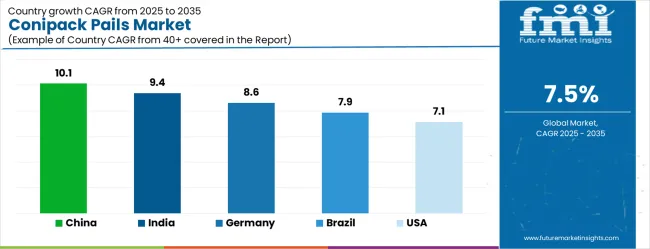
Regional performance diverges materially across the conipack pails market forecast horizon. China at 10.1% CAGR and India at 9.4% CAGR lead the global expansion trajectory, driven by policy-backed demand creation and expanding institutional procurement volumes. Germany at 8.6% and Brazil at 7.9% represent mid-growth markets where established regulatory and investment frameworks support steady adoption. USA at 7.1%, UK at 6.4%, Japan at 5.6% reflect trajectories shaped by replacement demand, compliance cycles, and pricing dynamics rather than net new volume creation.
Conipack Pails Market Definition
The conipack pails market covers injection-molded and blow-molded plastic pails with conical taper profiles manufactured from polyethylene, polypropylene, and other thermoplastic resins, used for packaging lubricants, chemicals, paints, inks, edible oils, and pharmaceutical products across industrial, commercial, and consumer distribution channels globally. Products and solutions within scope are differentiated by technical configuration, deployment model, and end-use performance requirements that govern procurement decisions across institutional, commercial, and enterprise buyer segments. As per FMI, market boundaries are defined by functional end-use characteristics and certified performance parameters rather than by manufacturing process or delivery mechanism designation alone.
Conipack Pails Market Inclusions
Market scope includes conical-profile plastic pails in capacities from below 500ml to 20 litres and above, HDPE, LDPE, polypropylene, PET, PVC, polyamide, and polystyrene pail constructions, tamper-evident lid and closure systems sold with pails, and reusable industrial conipack pail programs. All products, platforms, and services within scope are evaluated across the full segmentation taxonomy and geographic coverage framework applied in the FMI analysis.
Conipack Pails Market Exclusions
The scope excludes steel and tinplate pails and drums, rectangular and square plastic containers without conical taper profiles, intermediate bulk containers above 20 litres, flexible pouches and bag-in-box packaging systems, and pail cleaning and reconditioning services. Products and services that do not satisfy the functional, technical, or certification criteria defined by the market taxonomy are omitted from all revenue and volume calculations.
Conipack Pails Market Research Methodology
- Primary Research: Structured interviews were conducted with procurement managers, technical directors, and commercial executives across supplier, integrator, and end-user organizations in all covered geographies to map decision criteria, specification requirements, pricing dynamics, and adoption barriers.
- Desk Research: Secondary data collection aggregated national trade statistics, regulatory filings, company annual reports, investor presentations, standards body publications, and peer-reviewed technical research relevant to the covered market.
- Market-Sizing and Forecasting: A bottom-up revenue model was constructed from verified unit shipment and contract value benchmarks with average selling price data, validated against top-down total addressable market estimates anchored to observable industry benchmarks from allowed primary sources.
- Data Validation and Update Cycle: All forecast outputs are cross-referenced against publicly reported company revenue guidance and validated through a secondary round of primary outreach. Data is refreshed on a rolling basis as new regulatory filings and corporate disclosures become available.
Why is the Conipack Pails Market Growing?
The Conipack Pails market is experiencing robust growth, driven by increasing demand for durable, lightweight, and versatile packaging solutions across industrial and commercial sectors. Rising consumption of chemicals, lubricants, paints, and adhesives is fueling the adoption of pails that provide reliable containment, ease of handling, and transportation efficiency. Advances in manufacturing processes, including improved molding techniques and high-quality polymer usage, are enhancing product performance while maintaining cost efficiency.
The market is further supported by growing emphasis on sustainable and recyclable packaging materials, which aligns with global environmental regulations and corporate responsibility initiatives. Innovations in design, such as airtight sealing, stackable structures, and ergonomic handles, are improving operational efficiency and reducing spillage risk.
As industrial production and lubricant consumption continue to expand, demand for standardized, high-performance pails is expected to grow Investment in advanced raw materials, improved capacity ranges, and multi-purpose applications positions the market for sustained expansion, with opportunities emerging from evolving industrial requirements, regulatory compliance, and the need for safe and efficient storage solutions.
Segmental Analysis
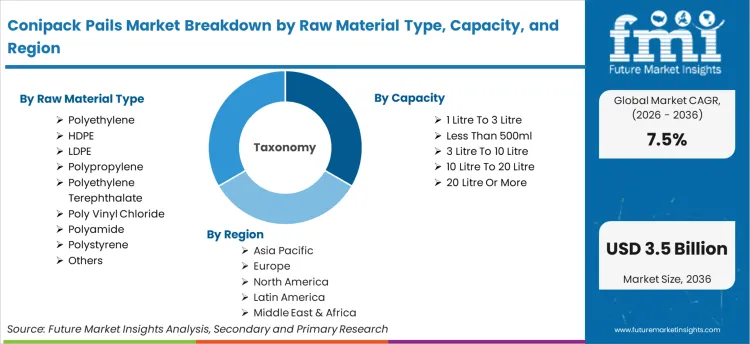
The conipack pails market is segmented by raw material type, capacity, applications, and geographic regions. By raw material type, conipack pails market is divided into Polyethylene (PE), HDPE, LDPE, Polypropylene (PP), Polyethylene Terephthalate (PET), Poly Vinyl Chloride (PVC), Polyamide (PA), Polystyrene (PS), and Others. In terms of capacity, conipack pails market is classified into 1 Litre To 3 Litre, Less Than 500ml, 3 Litre To 10 Litre, 10 Litre To 20 Litre, and 20 Litre Or More. Based on applications, conipack pails market is segmented into Lubricants, Chemicals, Paints, Inks & Resins, Edible Oil, Pharmaceutical Products, and Others. Regionally, the conipack pails industry is classified into North America, Latin America, Western Europe, Eastern Europe, Balkan & Baltic Countries, Russia & Belarus, Central Asia, East Asia, South Asia & Pacific, and the Middle East & Africa.
Insights into the Polyethylene (PE) Raw Material Type Segment
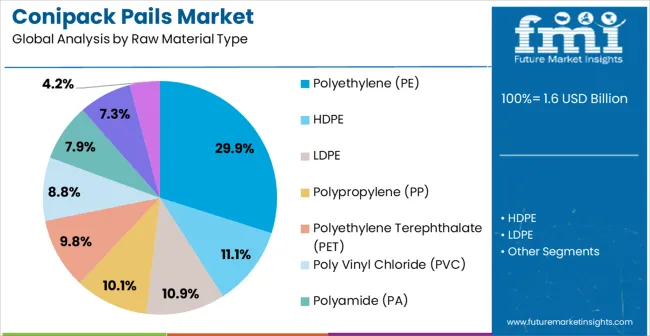
The polyethylene (PE) raw material segment is projected to hold 29.9% of the market revenue in 2026, establishing it as the leading raw material type. Growth in this segment is driven by PE’s superior chemical resistance, lightweight nature, and cost-effectiveness, which make it ideal for manufacturing durable pails suitable for industrial use. Polyethylene pails offer excellent barrier properties, reducing leakage and contamination risk, while supporting safe storage and transport of liquids, powders, and viscous materials.
The material’s flexibility allows for easy molding into various shapes and sizes, accommodating specific industrial needs. Its recyclability and compatibility with modern manufacturing techniques further reinforce adoption.
Increasing demand for efficient and environmentally responsible packaging solutions has strengthened PE’s position as the preferred material As industries continue to prioritize operational efficiency, regulatory compliance, and sustainability, polyethylene pails are expected to maintain their leading market share, supported by ongoing innovations in polymer formulations and production processes that enhance performance and durability.
Insights into the 1 Litre To 3 Litre Capacity Segment
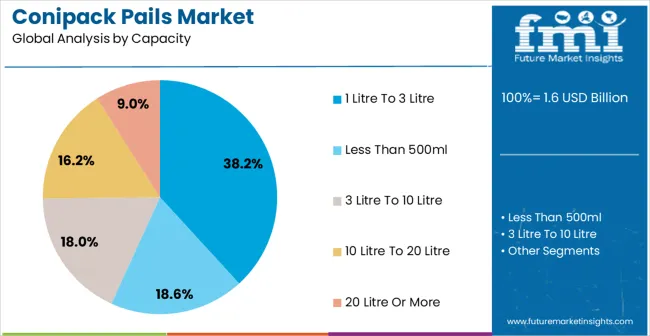
The 1 litre to 3 litre capacity segment is expected to account for 38.2% of the market revenue in 2026, making it the leading capacity category. Its dominance is driven by its versatility in storing and transporting a wide range of liquid and semi-solid industrial products, including lubricants, adhesives, and chemicals. This size range is preferred for operational efficiency, as it balances manageable handling with adequate storage volume for industrial applications.
The ability to standardize this capacity range for different raw materials and applications improves manufacturing efficiency and reduces logistical complexity. Ergonomic design features, such as easy-grip handles and stackable structures, enhance usability in industrial and commercial environments.
Growing demand for compact, easy-to-use containers that minimize spillage risk and improve storage density further supports this segment’s adoption As industries focus on operational safety, convenience, and cost-effectiveness, the 1 litre to 3 litre capacity segment is expected to remain the most sought-after, reinforcing its market leadership and supporting overall market growth.
Insights into the Lubricants Application Segment
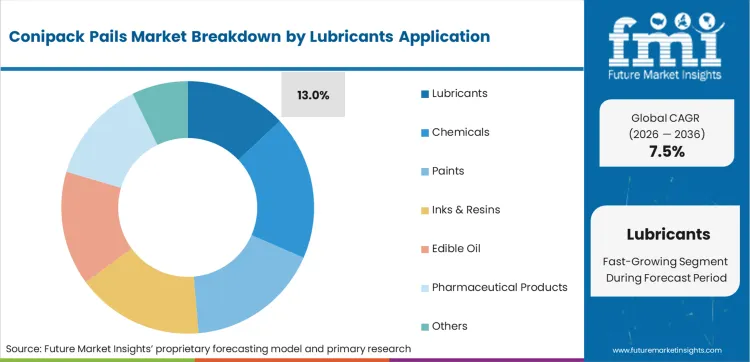
The lubricants application segment is projected to hold 13.0% of the market revenue in 2026, establishing it as the leading application area. Growth is being driven by the increasing global consumption of industrial, automotive, and specialty lubricants, which require reliable, safe, and efficient packaging solutions. Conipack pails provide chemical resistance, airtight sealing, and durability, ensuring product integrity and reducing leakage during storage and transport.
The ability to handle high-viscosity fluids without compromising container stability enhances their suitability for lubricant applications. Industrial adoption is also influenced by operational efficiency, as standardized pail sizes facilitate easier handling, stacking, and transportation within production and distribution chains.
Regulatory compliance related to chemical storage and transportation further reinforces demand for high-quality pails As lubricant consumption continues to rise globally, and manufacturers seek durable, versatile, and compliant packaging solutions, the lubricants application segment is expected to maintain its market leadership, supported by ongoing innovations in material quality, design, and production processes.
Market Overview
Conipack Pails Market Overview
In recent few years, there has been a trend for the use of strong and sturdy packaging solutions for better logistics and transportation of the product. Such type of packaging product is conipack pails which are plastic pails specially made for carrying industrial products which are especially liquids. Conipack pails are covered with air tight lid which gives leak proof protection to liquid products.
Conipack pails with lids are also provided with tamper evident feature which restricts the product from getting misplaced or stolen. Conipack pails made from plastic are rust/corrosion free which are the key factors replacing the usage of metal pails. Even the light weight of conipack pails are creating growth as compared to the usage of traditional metal pails.
Conipack pails are good for storing chemicals, lubricants, paints, grease, etc. Conipack pails are made from plastic, so the inner surface does not react with the liquid stored in it. Conipack pails are mainly manufactured from materials such as HDPE and LDPE.
Analysis of Conipack Pails Market By Key Countries
.webp "Top Country Growth Comparison Conipack Pails Market Cagr (2026 2036)")
| Country | CAGR |
|---|---|
| China | 10.1% |
| India | 9.4% |
| Germany | 8.6% |
| Brazil | 7.9% |
| USA | 7.1% |
| UK | 6.4% |
| Japan | 5.6% |
Country-wise Analysis
The Conipack Pails Market is expected to register a CAGR of 7.5% during the forecast period, exhibiting varied country level momentum. China leads with the highest CAGR of 10.1%, followed by India at 9.4%. Developed markets such as Germany, France, and the UK continue to expand steadily, while the USA is likely to grow at consistent rates. Japan posts the lowest CAGR at 5.6%, yet still underscores a broadly positive trajectory for the global Conipack Pails Market. In 2024, Germany held a dominant revenue in the Western Europe market and is expected to grow with a CAGR of 8.6%.
Key Players in the Conipack Pails Market

- RPC
- BWAY
- IPL Plastics plc
- Industrial Container Services
- Jokey Group
- Paragon Manufacturing
- Century Container
- Pro-western
- M M Industries
- CL Smith
- Illing Company
- Leaktite
Scope of the Report
| Metric | Value |
|---|---|
| Quantitative Units | USD 1.72 billion to USD 3.54 billion, at a CAGR of 7.5% |
| Market Definition | Conipack Pails Market encompasses injection-molded and blow-molded plastic pails with conical taper profiles manufactured from polyethylene, polypropylene, and other thermoplastic resins, used for packaging lubricants, chemicals, paints, inks, edible oils, and pharmaceutical products across industrial, commercial, and consumer distribution channels globally. |
| Segmentation | Raw Material Type (Polyethylene, HDPE, LDPE, Polypropylene, Polyethylene Terephthalate, Poly Vinyl Chloride, Polyamide, Polystyrene, Others); Capacity (1 Litre To 3 Litre, Less Than 500ml, 3 Litre To 10 Litre, 10 Litre To 20 Litre, 20 Litre Or More); Application (Lubricants, Chemicals, Paints, Inks and Resins, Edible Oil, Pharmaceutical Products, Others) |
| Regions Covered | North America, Latin America, Europe, East Asia, South Asia, Oceania, Middle East and Africa |
| Countries Covered | China, India, Germany, Brazil, USA, UK, Japan, and 40 plus countries |
| Key Companies Profiled | RPC, BWAY, Industrial Container Services, Jokey Group, Paragon Manufacturing, Century Container, Pro-western, M M Industries, CL Smith, Illing Company, Leaktite, IPL Plastics plc |
| Forecast Period | 2026 to 2036 |
| Approach | Bottom-up revenue modeling anchored to verified shipment and contract value benchmarks, with scenario adjustments for regulatory, policy, and macroeconomic inputs |
Conipack Pails Market by Segments
Raw Material Type:
- Polyethylene (PE)
- HDPE
- LDPE
- Polypropylene (PP)
- Polyethylene Terephthalate (PET)
- Poly Vinyl Chloride (PVC)
- Polyamide (PA)
- Polystyrene (PS)
- Others
Capacity:
- 1 Litre To 3 Litre
- Less Than 500ml
- 3 Litre To 10 Litre
- 10 Litre To 20 Litre
- 20 Litre Or More
Applications:
- Lubricants
- Chemicals
- Paints
- Inks & Resins
- Edible Oil
- Pharmaceutical Products
- Others
Region:
- North America
- USA
- Canada
- Mexico
- Latin America
- Brazil
- Chile
- Rest of Latin America
- Western Europe
- Germany
- UK
- Italy
- Spain
- France
- Nordic
- BENELUX
- Rest of Western Europe
- Eastern Europe
- Russia
- Poland
- Hungary
- Balkan & Baltic
- Rest of Eastern Europe
- East Asia
- China
- Japan
- South Korea
- South Asia and Pacific
- India
- ASEAN
- Australia & New Zealand
- Rest of South Asia and Pacific
- Middle East & Africa
- Kingdom of Saudi Arabia
- Other GCC Countries
- Turkiye
- South Africa
- Other African Union
- Rest of Middle East & Africa
Bibliography
- 1. European Chemicals Agency. (2024, March). REACH regulation: Plastics additives restriction update and compliance timeline for industrial packaging. ECHA.
- 2. Ministry of Commerce, People's Republic of China. (2024, February). Packaging industry development report: Plastic container production and export statistics FY2023. MofCOM.
- 3. Ministry of Chemicals and Fertilizers, Government of India. (2024, April). Chemical industry annual report 2023 to 2024: Packaging consumption and domestic production data. MoCF.
- 4. German Federal Institute for Risk Assessment. (2024, January). BfR recommendations: Plastics for food contact applications including HDPE and PP containers. BfR.
- 5. Organisation for Economic Co-operation and Development. (2024, June). Plastic pollution and packaging waste policy toolkit: Industrial packaging sector. OECD.
- 6. USA Environmental Protection Agency. (2024, September). Resource conservation and recovery act: Industrial container reuse and reconditioning compliance guidance. U.S. EPA.
This bibliography is provided for reader reference. The full FMI report contains the complete reference list with primary research documentation.
Frequently Asked Questions
How large is the Conipack Pails Market in 2026?
The conipack pails market is estimated at USD 1.72 billion in 2026, based on FMI proprietary bottom-up revenue modeling and primary research validation.
What will the Conipack Pails Market size be by 2036?
FMI projects the conipack pails market to reach USD 3.54 billion by 2036, supported by sustained demand across primary end-use segments and covered geographies.
What is the CAGR for the Conipack Pails Market between 2026 and 2036?
The conipack pails market is projected to grow at a CAGR of 7.5% between 2026 and 2036.
Which raw material type category leads in 2026?
Polyethylene holds 29.9% of the raw material type segment in 2026, reflecting established procurement preference and performance advantages relative to alternative configurations.
Which geography shows the fastest growth in the Conipack Pails Market?
China registers the highest CAGR at 10.1% through 2036, driven by policy-backed demand creation and expanding institutional procurement volumes.
What is the leading end-use category in the Conipack Pails Market?
Lubricants is the leading end-use category in 2026, anchored by institutional procurement cycles and volume commitments that generate predictable and recurring demand patterns.
What is included in the scope of this report?
The scope includes conical-profile plastic pails in capacities from below 500ml to 20 litres and above, HDPE, LDPE, polypropylene, PET, PVC, polyamide, and polystyrene pail constructions, tamper-evident lid and closure systems sold with pails, and reusable industrial conipack pail programs. All products and services are analyzed across the full segmentation taxonomy and geographic coverage framework defined in the FMI market analysis.
How does FMI validate the Conipack Pails Market forecast?
FMI applies a bottom-up methodology anchored to verified shipment and contract value benchmarks, cross-referenced against top-down market estimates and validated through primary interviews with suppliers, integrators, and end users across covered geographies.
Preview the report firsthand - request a free sample
Get SampleGet the brochure for pricing and purchase details.
Get PDFTable of Content
- Executive Summary
- Global Market Outlook
- Demand-side Trends
- Supply-side Trends
- Technology Roadmap Analysis
- Analysis and Recommendations
- Market Overview
- Market Coverage / Taxonomy
- Market Definition / Scope / Limitations
- Research Methodology
- Chapter Orientation
- Analytical Lens and Working Hypotheses
- Market Structure, Signals, and Trend Drivers
- Benchmarking and Cross-market Comparability
- Market Sizing, Forecasting, and Opportunity Mapping
- Research Design and Evidence Framework
- Desk Research Programme (Secondary Evidence)
- Company Annual and Sustainability Reports
- Peer-reviewed Journals and Academic Literature
- Corporate Websites, Product Literature, and Technical Notes
- Earnings Decks and Investor Briefings
- Statutory Filings and Regulatory Disclosures
- Technical White Papers and Standards Notes
- Trade Journals, Industry Magazines, and Analyst Briefs
- Conference Proceedings, Webinars, and Seminar Materials
- Government Statistics Portals and Public Data Releases
- Press Releases and Reputable Media Coverage
- Specialist Newsletters and Curated Briefings
- Sector Databases and Reference Repositories
- FMI Internal Proprietary Databases and Historical Market Datasets
- Subscription Datasets and Paid Sources
- Social Channels, Communities, and Digital Listening Inputs
- Additional Desk Sources
- Expert Input and Fieldwork (Primary Evidence)
- Primary Modes
- Qualitative Interviews and Expert Elicitation
- Quantitative Surveys and Structured Data Capture
- Blended Approach
- Why Primary Evidence is Used
- Field Techniques
- Interviews
- Surveys
- Focus Groups
- Observational and In-context Research
- Social and Community Interactions
- Stakeholder Universe Engaged
- C-suite Leaders
- Board Members
- Presidents and Vice Presidents
- R&D and Innovation Heads
- Technical Specialists
- Domain Subject-matter Experts
- Scientists
- Physicians and Other Healthcare Professionals
- Governance, Ethics, and Data Stewardship
- Research Ethics
- Data Integrity and Handling
- Primary Modes
- Tooling, Models, and Reference Databases
- Desk Research Programme (Secondary Evidence)
- Data Engineering and Model Build
- Data Acquisition and Ingestion
- Cleaning, Normalisation, and Verification
- Synthesis, Triangulation, and Analysis
- Quality Assurance and Audit Trail
- Market Background
- Market Dynamics
- Drivers
- Restraints
- Opportunity
- Trends
- Scenario Forecast
- Demand in Optimistic Scenario
- Demand in Likely Scenario
- Demand in Conservative Scenario
- Opportunity Map Analysis
- Product Life Cycle Analysis
- Supply Chain Analysis
- Investment Feasibility Matrix
- Value Chain Analysis
- PESTLE and Porter’s Analysis
- Regulatory Landscape
- Regional Parent Market Outlook
- Production and Consumption Statistics
- Import and Export Statistics
- Market Dynamics
- Global Market Analysis 2021 to 2025 and Forecast, 2026 to 2036
- Historical Market Size Value (USD Million) Analysis, 2021 to 2025
- Current and Future Market Size Value (USD Million) Projections, 2026 to 2036
- Y-o-Y Growth Trend Analysis
- Absolute $ Opportunity Analysis
- Global Market Pricing Analysis 2021 to 2025 and Forecast 2026 to 2036
- Global Market Analysis 2021 to 2025 and Forecast 2026 to 2036, By Raw Material Type
- Introduction / Key Findings
- Historical Market Size Value (USD Million) Analysis By Raw Material Type , 2021 to 2025
- Current and Future Market Size Value (USD Million) Analysis and Forecast By Raw Material Type , 2026 to 2036
- Polyethylene
- HDPE
- LDPE
- Polypropylene
- Polyethylene Terephthalate
- Poly Vinyl Chloride
- Polyamide
- Polystyrene
- Others
- Polyethylene
- Y-o-Y Growth Trend Analysis By Raw Material Type , 2021 to 2025
- Absolute $ Opportunity Analysis By Raw Material Type , 2026 to 2036
- Global Market Analysis 2021 to 2025 and Forecast 2026 to 2036, By Capacity
- Introduction / Key Findings
- Historical Market Size Value (USD Million) Analysis By Capacity, 2021 to 2025
- Current and Future Market Size Value (USD Million) Analysis and Forecast By Capacity, 2026 to 2036
- 1 Litre To 3 Litre
- Less Than 500ml
- 3 Litre To 10 Litre
- 10 Litre To 20 Litre
- 20 Litre Or More
- 1 Litre To 3 Litre
- Y-o-Y Growth Trend Analysis By Capacity, 2021 to 2025
- Absolute $ Opportunity Analysis By Capacity, 2026 to 2036
- Global Market Analysis 2021 to 2025 and Forecast 2026 to 2036, By Lubricants Application
- Introduction / Key Findings
- Historical Market Size Value (USD Million) Analysis By Lubricants Application, 2021 to 2025
- Current and Future Market Size Value (USD Million) Analysis and Forecast By Lubricants Application, 2026 to 2036
- Lubricants
- Chemicals
- Paints
- Inks & Resins
- Edible Oil
- Pharmaceutical Products
- Others
- Lubricants
- Y-o-Y Growth Trend Analysis By Lubricants Application, 2021 to 2025
- Absolute $ Opportunity Analysis By Lubricants Application, 2026 to 2036
- Global Market Analysis 2021 to 2025 and Forecast 2026 to 2036, By Region
- Introduction
- Historical Market Size Value (USD Million) Analysis By Region, 2021 to 2025
- Current Market Size Value (USD Million) Analysis and Forecast By Region, 2026 to 2036
- North America
- Latin America
- Western Europe
- Eastern Europe
- East Asia
- South Asia and Pacific
- Middle East & Africa
- Market Attractiveness Analysis By Region
- North America Market Analysis 2021 to 2025 and Forecast 2026 to 2036, By Country
- Historical Market Size Value (USD Million) Trend Analysis By Market Taxonomy, 2021 to 2025
- Market Size Value (USD Million) Forecast By Market Taxonomy, 2026 to 2036
- By Country
- USA
- Canada
- Mexico
- By Raw Material Type
- By Capacity
- By Lubricants Application
- By Country
- Market Attractiveness Analysis
- By Country
- By Raw Material Type
- By Capacity
- By Lubricants Application
- Key Takeaways
- Latin America Market Analysis 2021 to 2025 and Forecast 2026 to 2036, By Country
- Historical Market Size Value (USD Million) Trend Analysis By Market Taxonomy, 2021 to 2025
- Market Size Value (USD Million) Forecast By Market Taxonomy, 2026 to 2036
- By Country
- Brazil
- Chile
- Rest of Latin America
- By Raw Material Type
- By Capacity
- By Lubricants Application
- By Country
- Market Attractiveness Analysis
- By Country
- By Raw Material Type
- By Capacity
- By Lubricants Application
- Key Takeaways
- Western Europe Market Analysis 2021 to 2025 and Forecast 2026 to 2036, By Country
- Historical Market Size Value (USD Million) Trend Analysis By Market Taxonomy, 2021 to 2025
- Market Size Value (USD Million) Forecast By Market Taxonomy, 2026 to 2036
- By Country
- Germany
- UK
- Italy
- Spain
- France
- Nordic
- BENELUX
- Rest of Western Europe
- By Raw Material Type
- By Capacity
- By Lubricants Application
- By Country
- Market Attractiveness Analysis
- By Country
- By Raw Material Type
- By Capacity
- By Lubricants Application
- Key Takeaways
- Eastern Europe Market Analysis 2021 to 2025 and Forecast 2026 to 2036, By Country
- Historical Market Size Value (USD Million) Trend Analysis By Market Taxonomy, 2021 to 2025
- Market Size Value (USD Million) Forecast By Market Taxonomy, 2026 to 2036
- By Country
- Russia
- Poland
- Hungary
- Balkan & Baltic
- Rest of Eastern Europe
- By Raw Material Type
- By Capacity
- By Lubricants Application
- By Country
- Market Attractiveness Analysis
- By Country
- By Raw Material Type
- By Capacity
- By Lubricants Application
- Key Takeaways
- East Asia Market Analysis 2021 to 2025 and Forecast 2026 to 2036, By Country
- Historical Market Size Value (USD Million) Trend Analysis By Market Taxonomy, 2021 to 2025
- Market Size Value (USD Million) Forecast By Market Taxonomy, 2026 to 2036
- By Country
- China
- Japan
- South Korea
- By Raw Material Type
- By Capacity
- By Lubricants Application
- By Country
- Market Attractiveness Analysis
- By Country
- By Raw Material Type
- By Capacity
- By Lubricants Application
- Key Takeaways
- South Asia and Pacific Market Analysis 2021 to 2025 and Forecast 2026 to 2036, By Country
- Historical Market Size Value (USD Million) Trend Analysis By Market Taxonomy, 2021 to 2025
- Market Size Value (USD Million) Forecast By Market Taxonomy, 2026 to 2036
- By Country
- India
- ASEAN
- Australia & New Zealand
- Rest of South Asia and Pacific
- By Raw Material Type
- By Capacity
- By Lubricants Application
- By Country
- Market Attractiveness Analysis
- By Country
- By Raw Material Type
- By Capacity
- By Lubricants Application
- Key Takeaways
- Middle East & Africa Market Analysis 2021 to 2025 and Forecast 2026 to 2036, By Country
- Historical Market Size Value (USD Million) Trend Analysis By Market Taxonomy, 2021 to 2025
- Market Size Value (USD Million) Forecast By Market Taxonomy, 2026 to 2036
- By Country
- Kingdom of Saudi Arabia
- Other GCC Countries
- Turkiye
- South Africa
- Other African Union
- Rest of Middle East & Africa
- By Raw Material Type
- By Capacity
- By Lubricants Application
- By Country
- Market Attractiveness Analysis
- By Country
- By Raw Material Type
- By Capacity
- By Lubricants Application
- Key Takeaways
- Key Countries Market Analysis
- USA
- Pricing Analysis
- Market Share Analysis, 2025
- By Raw Material Type
- By Capacity
- By Lubricants Application
- Canada
- Pricing Analysis
- Market Share Analysis, 2025
- By Raw Material Type
- By Capacity
- By Lubricants Application
- Mexico
- Pricing Analysis
- Market Share Analysis, 2025
- By Raw Material Type
- By Capacity
- By Lubricants Application
- Brazil
- Pricing Analysis
- Market Share Analysis, 2025
- By Raw Material Type
- By Capacity
- By Lubricants Application
- Chile
- Pricing Analysis
- Market Share Analysis, 2025
- By Raw Material Type
- By Capacity
- By Lubricants Application
- Germany
- Pricing Analysis
- Market Share Analysis, 2025
- By Raw Material Type
- By Capacity
- By Lubricants Application
- UK
- Pricing Analysis
- Market Share Analysis, 2025
- By Raw Material Type
- By Capacity
- By Lubricants Application
- Italy
- Pricing Analysis
- Market Share Analysis, 2025
- By Raw Material Type
- By Capacity
- By Lubricants Application
- Spain
- Pricing Analysis
- Market Share Analysis, 2025
- By Raw Material Type
- By Capacity
- By Lubricants Application
- France
- Pricing Analysis
- Market Share Analysis, 2025
- By Raw Material Type
- By Capacity
- By Lubricants Application
- India
- Pricing Analysis
- Market Share Analysis, 2025
- By Raw Material Type
- By Capacity
- By Lubricants Application
- ASEAN
- Pricing Analysis
- Market Share Analysis, 2025
- By Raw Material Type
- By Capacity
- By Lubricants Application
- Australia & New Zealand
- Pricing Analysis
- Market Share Analysis, 2025
- By Raw Material Type
- By Capacity
- By Lubricants Application
- China
- Pricing Analysis
- Market Share Analysis, 2025
- By Raw Material Type
- By Capacity
- By Lubricants Application
- Japan
- Pricing Analysis
- Market Share Analysis, 2025
- By Raw Material Type
- By Capacity
- By Lubricants Application
- South Korea
- Pricing Analysis
- Market Share Analysis, 2025
- By Raw Material Type
- By Capacity
- By Lubricants Application
- Russia
- Pricing Analysis
- Market Share Analysis, 2025
- By Raw Material Type
- By Capacity
- By Lubricants Application
- Poland
- Pricing Analysis
- Market Share Analysis, 2025
- By Raw Material Type
- By Capacity
- By Lubricants Application
- Hungary
- Pricing Analysis
- Market Share Analysis, 2025
- By Raw Material Type
- By Capacity
- By Lubricants Application
- Kingdom of Saudi Arabia
- Pricing Analysis
- Market Share Analysis, 2025
- By Raw Material Type
- By Capacity
- By Lubricants Application
- Turkiye
- Pricing Analysis
- Market Share Analysis, 2025
- By Raw Material Type
- By Capacity
- By Lubricants Application
- South Africa
- Pricing Analysis
- Market Share Analysis, 2025
- By Raw Material Type
- By Capacity
- By Lubricants Application
- USA
- Market Structure Analysis
- Competition Dashboard
- Competition Benchmarking
- Market Share Analysis of Top Players
- By Regional
- By Raw Material Type
- By Capacity
- By Lubricants Application
- Competition Analysis
- Competition Deep Dive
- RPC
- Overview
- Product Portfolio
- Profitability by Market Segments (Product/Age /Sales Channel/Region)
- Sales Footprint
- Strategy Overview
- Marketing Strategy
- Product Strategy
- Channel Strategy
- BWAY
- Industrial Container Services
- Jokey Group
- Paragon Manufacturing
- Century Container
- Pro-western
- M M Industries
- CL Smith
- Illing Company
- Leaktite
- IPL Plastics plc
- RPC
- Competition Deep Dive
- Assumptions & Acronyms Used


