

- Market Size (2026)
- USD 1.2 Bn
- Forecast (2036)
- USD 2.5 Bn
- CAGR (2026 to 2036)
- 7.6%
How big is Continuous Bladder Irrigation Devices Market in 2026?
USD 1.2 billion in 2026 and USD 2.5 billion by 2036 at a 7.6% CAGR.
Sales of continuous bladder irrigation devices are estimated to rise at 7.6% CAGR through 2036, increasing valuation from USD 1.2 billion in 2026 to USD 2.5 billion by 2036. Postoperative bleeding creates recurring use across prostate and bladder procedures by increasing clot-obstruction risk during early recovery. A prospective study published in April 2025 included 324 patients with non-muscle-invasive bladder cancer following transurethral resection. The study assessed continuous saline bladder irrigation as a postoperative strategy and validated a defined clinical workflow without establishing commercial adoption. Hospitals therefore assess Foley catheter systems based on lumen patency and secure connections across varying clot loads. Repeat orders depend on stable drainage and reliable access to compatible replacement components throughout each hospital contract.
Hospital teams must preserve closed drainage while maintaining irrigation access throughout each clinically supervised episode. The CDC reported in July 2026 that catheter-associated urinary tract infections fell 10% across acute care hospitals between 2023 and 2024. The reduction does not directly drive device demand but raises the performance standard for urinary collection devices used during monitored catheter care. Three-way catheters need dependable inflow and outflow without frequent disconnection or unnecessarily prolonged dwell time during monitored recovery. Australia applies new device-identification duties and Great Britain requires stronger post-market surveillance for products already sold. Both requirements favor companies that trace lots and replace affected stock quickly across hospital urology departments.
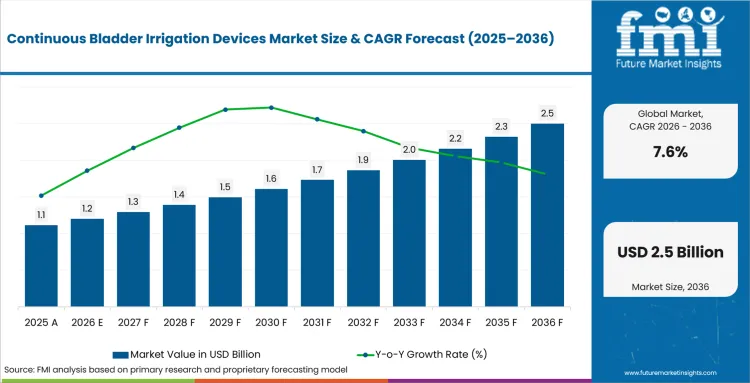
Key Takeaways of Continuous Bladder Irrigation Devices Market
- Postoperative urology protocols create recurring demand for continuous inflow and drainage during active bleeding or clot formation. Hospital care pathways define catheter configuration and monitoring responsibility before every clinically supervised irrigation episode begins.
- By product, three-way Foley catheters are forecast to represent 46.0% share in 2026 through their dedicated inflow and drainage lumens. The configuration reduces repeated catheter manipulation during clot management across monitored postoperative urology recovery pathways.
- Postoperative urological care is estimated to hold 42.0% share in 2026 within the application category. Standardized recovery protocols convert prostate and bladder procedures into repeat demand for controlled irrigation and visible drainage monitoring.
- In 2026, hospitals are expected to lead end user with 51.0% share through continuous nursing observation and rapid intervention capability. Smaller settings often lack the staffing and escalation resources required during high-risk irrigation episodes across extended recovery periods.
- Catheter-associated infection exposure and inconsistent monitoring remain material restraints across hospital irrigation pathways and recurring supply contracts. Product standardization creates price pressure unless a system reduces blockage events or simplifies controlled setup.
- Competition includes BD, B. Braun, Teleflex, Coloplast, Baxter, Medline, Well Lead, and Amsino across verified catheter and hospital supply roles. Their positions differ through catheter range and irrigation components alongside regional support for hospital accounts.
Analyst Perspective
"Continuous bladder irrigation depends on a simple fluid circuit, yet small failures can stop drainage during clot-heavy recovery. Hospital teams need catheters that remain patent and provide visible warning before obstruction threatens care. Companies secure repeat contracts through reliable stock and prompt recall action rather than broad catalog claims. Infection control and flow continuity therefore define the commercial standard across every hospital irrigation pathway."
- Anurag Sharma, Principal Analyst, Future Market Insights
How is the Continuous Bladder Irrigation Devices Market segmented?
The Continuous Bladder Irrigation Devices market is segmented by Product, Application, End User, Distribution Channel, Material, and Region.
The framework separates the purchased device from its clinical role and route to hospital availability. Product analysis covers three-way Foley catheters, irrigation sets, solution bags, drainage systems, and accessories used during controlled care. Application analysis distinguishes postoperative care, hematuria management, bladder cancer treatment, trauma management, and other procedures requiring different observation routes. End-user categories compare hospitals with surgical centers, urology clinics, long-term care facilities, and home healthcare settings offering different monitoring capacity. Distribution channels separate direct agreements from distributors, online platforms, retail suppliers, and third-party purchasing services serving facilities with different order volumes. Material analysis covers silicone, latex, polyvinyl chloride, polyurethane, and hybrid constructions with different handling and packaging requirements. Regional analysis compares operating conditions across major catheter technologies without including products that lack a dedicated irrigation function.
How do three-way foley catheters shape demand within the product category?
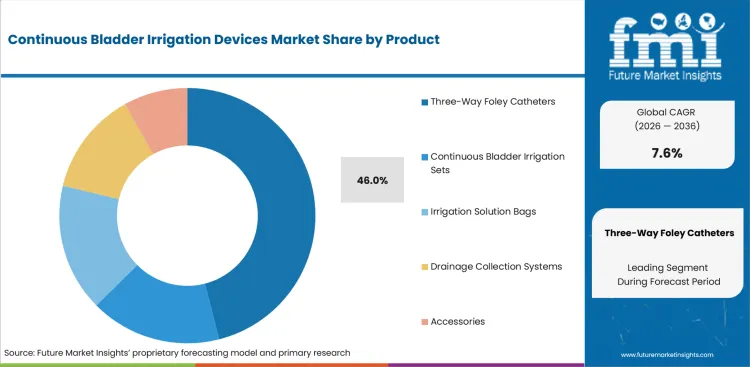
Three-way Foley catheters combine inflation and irrigation channels with the drainage lumen inside one catheter. The design lets nursing teams adjust inflow without catheter removal during active clot management and supervised recovery. An FDA report received in January 2025 described a Medline three-way Foley catheter whose irrigation port would not accept fluid. The catheter required replacement and the record concerned one event rather than a measured failure rate. Hospitals test lumen patency across approved sizes while comparable urethral balloon catheters remain outside continuous irrigation without a dedicated inflow channel.
- By product, three-way Foley catheters are forecast to represent 46.0% in 2026, driven by their dedicated irrigation and drainage pathway. Their position reflects direct use during clot evacuation rather than ordinary urinary drainage without a dedicated inflow channel. Urology departments compare lumen patency and catheter sizes against each approved postoperative protocol during product standardization across recovery units.
- Adoption depends on stable outflow as urine color and clot burden change throughout supervised recovery. Nursing teams need secure connections that tolerate patient transfer and routine repositioning without interrupting drainage during monitored recovery. Repeat use therefore rests on complete pathway performance instead of isolated claims about coating or material across routine hospital care.
Why does postoperative urological care retain the largest application position?
Postoperative urology creates a defined bleeding-risk period that requires close drainage observation and rapid clinical escalation. The FDA posted an X-Flow prostatectomy catheter recall in January 2025 following a potential sterility issue affecting distributed units. The record concerns a catheter used during prostatectomy recovery and shows how release controls can interrupt scheduled care. The recall confirms availability risk rather than purchasing growth or the approved application share across the forecast. Hospitals therefore assess sterility assurance and replacement access beside flow performance during scheduled postoperative recovery.
- The postoperative urological care segment is likely to capture 42.0% share in 2026, attributable to predictable bleeding and clot-retention risks following defined procedures. Standard recovery pathways provide a clearer purchasing basis than irregular emergency irrigation across unrelated departments. Hospitals can align catheter stock and nursing observation with expected postoperative case flow across established urology departments.
- Urology departments adopt irrigation devices that fit recovery observation and documented escalation rules across every defined postoperative pathway. Nursing teams need visible urine assessment plus immediate access to replacement components throughout every episode. The application expands through repeatable postoperative protocols rather than broad catheter use across unrelated hospital wards and clinical pathways.
Which operating requirements support Hospitals within the end user category?
Hospitals concentrate continuous irrigation within surgical recovery and urology units that can observe output throughout each episode. Amsino announced upgraded AMSure Foley kits in July 2025 with dual antiseptic preparation and a new securement device. The launch addressed insertion standardization and catheter movement within a defined hospital workflow involving nursing preparation and securement. Continuous bladder irrigation requires additional irrigation components but follows the same need for traceable preparation and secure catheter positioning. Hospital adoption therefore depends on coordinated training and traceable hospital consumables across operating and recovery departments.
- By end user, hospitals are estimated to hold 51.0% in 2026, owing to continuous nursing coverage and immediate escalation capability. Their position reflects the operating capacity required during high-risk postoperative irrigation and clinically significant obstruction events across recovery units. Hospital systems can standardize clinical pathways across several departments and preserve specialist oversight during complications that require immediate escalation.
- Hospital adoption rises through insertion and irrigation procedures that assign responsibility for every flow check. Infection-prevention teams examine disconnection frequency and catheter dwell time during routine quality monitoring across participating clinical departments. Expansion requires evidence that easier setup does not weaken closed drainage across multi-department clinical use and patient transfers.
What supports the position of direct Sales within the distribution channel category?
Direct contracting gives large hospital systems a clear route for item standardization and complaint escalation across several facilities. An FDA recall posted in April 2025 covered Medline convenience kits that included Foley catheter configurations. The action required hospital inventory checks and demonstrates why direct accounts value immediate product identification during quality events. System-wide agreements coordinate item codes and response contacts across recurring medical supplies used throughout several hospital facilities. Smaller facilities may prefer distributors that combine catheter products with local delivery schedules and broader procedure inventory.
- Based on distribution channel, direct sales are projected to account for 48.0% in 2026, due to system-wide item standardization and direct complaint handling. Large hospital groups can coordinate recurring catheter orders through common product codes across several facilities. Immediate manufacturer contact improves recall response and urgent substitution planning for scheduled urology procedures across hospital systems.
- Hospital groups favor direct channels that provide stable inventory and product training across several clinical sites. The model becomes less effective across remote facilities without dependable regional service coverage and replacement inventory during urgent disruptions. Distributors remain relevant through consolidated delivery and on-site support for lower-volume accounts outside major hospital purchasing networks.
Why does silicone maintain the largest material allocation?
Silicone supports catheter configurations for longer postoperative drainage and for patients who require latex avoidance. The FDA posted a Folysil silicone catheter recall in January 2025 following a potential sterility issue linked with packaging. The action shows that material choice cannot be separated from package integrity and distribution controls. Hospitals compare stiffness and lumen dimensions across expected dwell periods and procedure requirements within established urology care pathways. Silicone catheters therefore need consistent manufacturing evidence before entering standardized medical device trays and urology protocols.
- Silicone is set to lead the material category with 44.0% share in 2026, due to established use across indwelling catheter configurations. Hospitals compare material consistency with lumen dimensions and procedure-specific sizing during monitored postoperative care across several clinical pathways. The segment retains its position through complete device performance rather than material claims separated from design and packaging quality.
- Silicone adoption depends on consistent extrusion and intact packaging from manufacturing through hospital storage conditions. Urology teams assess tip design and lumen patency during clot-heavy recovery episodes that require continuous observation and rapid escalation. A higher material price requires measurable workflow or patient-management value within every hospital contract covering standardized catheter supply.
What are the drivers, restraints, and opportunities in the Continuous Bladder Irrigation Devices Market?
Postoperative urology protocols support recurring demand, while infection exposure and product quality events require strict traceability across hospital catheter pathways.
- Driver: Postoperative bleeding management creates recurring demand for controlled irrigation and dependable drainage during monitored urology recovery.
- Restraint: Infection exposure and product quality events can delay standardization across hospital catheter pathways and purchasing contracts.
- Opportunity: Integrated catheter and irrigation kits can reduce setup variation while preserving clear component traceability during clinical use.
Postoperative protocols create device use across prostate and bladder procedures that require active clot management and continuous drainage observation. A Canadian pilot published in June 2025 monitored irrigation across three patients following transurethral prostate resection. The system recorded four interruptions linked with empty saline bags or unclamped tubing during monitored postoperative episodes. The findings establish an operating need for visible flow control without proving commercial adoption across wider hospital purchasing programs. Urology departments therefore need compatible hospital supplies that assign clear responsibility for fluid replacement and drainage checks.
Product quality events can interrupt purchasing despite stable procedure volumes across urology departments using recurring catheter contracts. The FDA posted a Bardex LubriSil I.C. 400-series Foley catheter recall in August 2025 following lumen obstruction that could prevent bladder drainage. The record connects process control with immediate clinical performance and replacement access across affected hospital catheter inventories. Disconnection and prolonged dwell time can extend the clinical burden into catheter infection treatment pathways. Manufacturers must support rapid lot identification and replacement access without disrupting scheduled urology procedures across affected facilities.
Sensor-based monitoring creates an opportunity for manufacturers that reduce subjective flow assessment during postoperative care. A prospective study published in November 2025 monitored 20 patients through the VisIMon digital system following transurethral surgery. The platform measured inflow and outflow volumes while detecting drainage interruptions during supervised observation across all enrolled patients. The study establishes clinical feasibility without proving broad commercial use or routine purchasing across multi-site hospital networks. Developers need regulatory validation and practical alert integration before hospitals adopt automated monitoring across routine irrigation pathways.
Which country CAGRs are profiled in the Continuous Bladder Irrigation Devices Market?
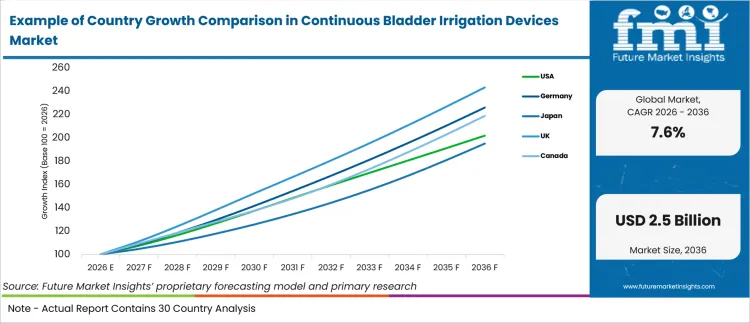
| Country | CAGR |
|---|---|
| Australia | 9.7% |
| UK | 9.3% |
| Germany | 8.5% |
| Canada | 8.1% |
| Brazil | 7.6% |
| USA | 7.3% |
| Japan | 6.9% |
How do country-level CAGRs compare in the Continuous Bladder Irrigation Devices Market?
The country forecasts show a gradual progression across the continuous bladder irrigation devices market, with no abrupt breaks between adjacent countries. Australia and the UK form an upper group where growth is supported by established urology care pathways and increasing use of post-operative urinary management devices. Germany and Canada create a middle band with relatively limited separation, reflecting steady demand from hospital and specialty care settings. Brazil, the USA and Japan follow in a measured sequence, indicating that market expansion is occurring across diverse healthcare systems despite differences in care delivery models. The pattern suggests that growth is being influenced by procedural volumes, aging patient populations and the management of conditions requiring continuous bladder irrigation. Variations between countries are tied to hospital adoption practices, reimbursement structures and the modernization of urology services.
- Australia benefits from a well-developed healthcare system and continued demand for urological care solutions used in post-surgical recovery and the management of urinary tract complications.
- The UK remains closely aligned with Australia as hospital-based urology services continue to support the use of continuous bladder irrigation devices for patient monitoring and complication management.
- Germany reflects steady market development through established clinical protocols and consistent utilization of urology devices across acute care and specialty treatment settings.
- Canada's outlook is supported by growing demand for efficient patient management solutions within hospitals and expanding focus on improving outcomes in urological procedures.
- Brazil continues to advance through increasing access to specialized healthcare services and rising adoption of modern urology treatment equipment across healthcare facilities.
- The USA maintains stable momentum as healthcare providers continue to utilize continuous bladder irrigation systems for surgical recovery and the management of bladder-related conditions, although growth is moderated by the maturity of the market.
- Japan's position reflects a mature healthcare environment where demand is supported by an aging population and ongoing need for effective urinary care management solutions.
Similar CAGRs do not necessarily translate into identical market opportunities. Differences in hospital procurement processes, reimbursement frameworks, urology procedure volumes and patient management practices can significantly influence device adoption patterns. As a result, manufacturers may encounter distinct commercialization and market access conditions despite broadly comparable growth forecasts. The full report provides country-level CAGR analysis across North America, Latin America, Europe, East Asia, South Asia, Oceania and the Middle East and Africa.
Country-wise Analysis
- Australian sponsors must identify regulated devices accurately across hospital inventory and distribution records serving distant clinical facilities. Geographic distance increases replacement lead times outside major cities and raises the value of dependable local stock. Continuous bladder irrigation device sales in Australia are forecast to expand at 9.7% CAGR by 2036, supported by mandatory device identification across regulated supply channels. The Therapeutic Goods Administration confirmed in July 2026 that new UDI duties had commenced for selected devices. Traceable catheter and drainage components help hospitals isolate affected lots during quality actions without replacing unrelated inventory. Sponsors need Australian registrations and local service capacity before pursuing broad hospital contracts across distant facilities.
- Great Britain requires defined post-market surveillance for medical devices already placed through regulated commercial channels. The United Kingdom's continuous bladder irrigation device outlook is anticipated to advance at 9.3% CAGR over the assessment period, underpinned by strengthened post-market duties. The MHRA published its guidance in January 2025 and the requirements entered force during June 2025. National hospital purchasing can standardize catheter configurations across shared clinical specifications used throughout several provider organizations. Detailed evidence reviews and tender schedules remain material frictions for companies without established regulatory support. Manufacturers should connect complaint handling with rapid lot investigation and clear field communication throughout every hospital supply contract.
- German hospitals use detailed specifications and formal supply controls across inpatient urology purchasing routes serving several regional networks. Local-language documentation gives established European portfolios a practical route into hospital review and contracting across specification-led systems. By 2036, Germany's continuous bladder irrigation device market is projected to grow at 8.5% CAGR, supported by formal purchasing and supply visibility. BfArM introduced a reporting route in January 2025 for medical-device supply interruptions and discontinuations affecting German availability. The reporting route improves visibility but does not remove price pressure across standardized consumable contracts used by hospital groups. Manufacturers need dependable distributor inventory and early shortage communication across regional hospital networks serving scheduled urology procedures.
- Canadian medical-device licensing applies risk-based evidence requirements across Class II through Class IV products entering commercial distribution. Canada's continuous bladder irrigation device market is estimated to post 8.1% CAGR over the forecast period, supported by a defined licensing route and provincial hospital purchasing. Health Canada updated its clinical evidence guidance in April 2026 for license applications and later lifecycle reviews. Provincial formularies provide an enabler for repeat use across approved hospital pathways and recurring catheter arrangements. Geographic spread creates inventory and service friction across smaller facilities outside established distribution and clinical support centers. Companies should align product claims with Canadian licenses and maintain regional replacement stock for urgent catheter substitutions.
- Brazilian device imports increasingly pass through a unified digital process that requires structured product and importer records. Local registration provides a direct route into public and private hospitals using recurring urology supplies. Currency exposure and channel complexity remain material frictions for imported catheter products requiring stable replenishment. In Brazil, continuous bladder irrigation device demand is predicted to advance at 7.6% CAGR through 2036, shaped by digital import integration and local registration requirements. Anvisa confirmed in October 2025 that medical devices would enter the new import process during November 2025. Manufacturers need capable local partners that maintain regulatory records and dependable replenishment across public and private hospital accounts.
- United States hospitals combine large purchasing networks with strict quality-system and recall obligations covering distributed catheter products. Adoption of continuous bladder irrigation devices in the USA is estimated to expand at 7.3% CAGR through 2036, underpinned by established hospital contracting routes. The FDA stated that its Quality Management System Regulation became effective in February 2026 for regulated medical-device manufacturers. Group purchasing arrangements support wide access for validated catheter and irrigation portfolios across multi-site hospital systems and urology departments. Consolidated contracting intensifies price pressure and recall execution adds further operational cost across every affected distribution network. Commercial plans should pair account coverage with rapid complaint investigation and replacement coordination across every affected hospital facility.
- Japanese hospitals emphasize product identification and consistent local support across controlled urology supply routes serving formal clinical accounts. Local distributors provide an enabler through language-specific service and replacement coordination across accounts using imported catheter products. The Japanese continuous bladder irrigation device market is projected to record 6.9% CAGR during the assessment period, supported by structured product identification and local service expectations. The Ministry of Health published medical-device digitization survey results in March 2026 covering barcode display progress. Rigorous acceptance reviews remain a material friction for international manufacturers seeking conversion across established hospital accounts. Companies should use focused product ranges and dependable distributor training during hospital conversion across several urology departments.
Who are the notable companies in the Continuous Bladder Irrigation Devices Market?
Becton, Dickinson and Company, B. Braun SE, Teleflex Incorporated, Coloplast A/S, Baxter International Inc., Medline Industries, LP, Well Lead Medical Co., Ltd., and Amsino International, Inc. are the notable companies shaping this market.
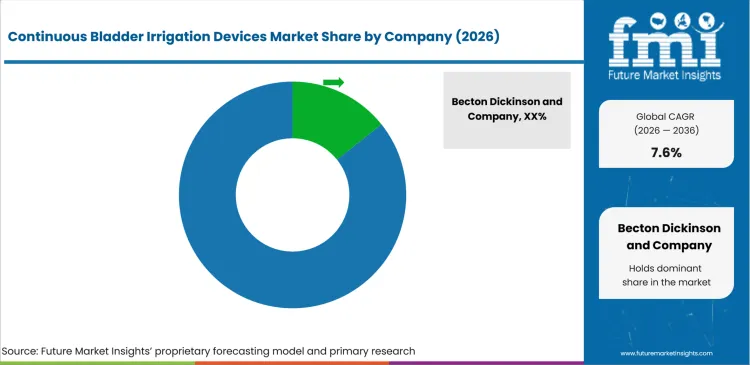
The competitive outlook combines catheter specialists with broader hospital supply companies serving recurring urology and fluid-management requirements. BD and Teleflex compete through Foley configurations across several materials and sizes used within hospital pathways. B. Braun SE and Baxter support irrigation through dedicated sets or sterile solutions used during scheduled procedures. Coloplast supplies silicone catheter options while Medline and Amsino combine urology products with procedure supplies. Well Lead maintains international catheter production and several regional commercial channels serving hospital and distributor accounts across multiple countries. Competition across these medical device portfolios centers on configuration breadth and service response rather than unsupported market-share claims.
- BD and Teleflex focus on broad Foley catheter families for postoperative drainage and hematuria management across hospital urology accounts. Coloplast maintains an all-silicone Folysil line for defined indwelling pathways across established hospital and urology channels. Selection depends on configuration breadth and dependable replacement access during planned postoperative care and urgent hematuria management.
- B. Braun SE and Medline connect irrigation or catheter components with established hospital distribution across several care settings and recurring contracts. Baxter supplies sterile irrigation solutions for controlled fluid-delivery workflows used throughout scheduled hospital procedures and recovery pathways. Their commercial position depends on coordinated catheter and irrigation inventory across recurring hospital supply contracts.
- Well Lead lists three-way Foley configurations across an international urology portfolio and growing manufacturing network. Amsino supplies catheter families alongside irrigation trays and kits through several regional channels serving hospital and distributor accounts. Both companies need local registration and responsive field support to secure repeat orders from hospital urology accounts.
Competitive Benchmarking: Continuous Bladder Irrigation Devices Market
| Company | Three-Way Catheter Breadth | Irrigation and Drainage Breadth | Hospital Supply Support | Geographic Reach |
|---|---|---|---|---|
| Becton, Dickinson and Company | High | Medium | High | Global |
| B. Braun SE | Low | High | High | Global |
| Teleflex Incorporated | High | High | High | Global |
| Coloplast A/S | Medium | Low | Medium | Multi-country |
| Baxter International Inc. | Low | Medium | High | Global |
| Medline Industries, LP | Medium | High | High | North America |
| Well Lead Medical Co., Ltd. | High | Medium | Medium | Global |
| Amsino International, Inc. | Medium | High | Medium | Global |
Key Developments in the Continuous Bladder Irrigation Devices Market
- In March 2026, Teleflex confirmed that its planned sale of the Acute Care and Interventional Urology businesses remained on track for completion during the second half of 2026. The update matters because Rüsch catheter ownership and account support could transfer during existing hospital agreements. Hospital groups should confirm the contracting entity and service contacts during negotiations for long-term catheter supply.
- In November 2025, Amsino opened its Asia Pacific headquarters in Shanghai for sales and regulatory work alongside regional supply-chain operations. The location places commercial teams closer to hospital customers and distribution partners across several major Asian markets. Regulatory and supply-chain staff coordinate product support and regional operations from the same base. Country-specific approvals continue to control market access for every urological product and destination country served.
- In April 2026, Well Lead began operations at its first overseas manufacturing base in Indonesia. The site expands production capacity within Southeast Asia and strengthens the company's regional service network. The new production base shortens selected regional supply routes, but local registrations and validated quality systems continue to control commercial use across hospital and distributor accounts.
- In May 2026, Becton, Dickinson and Company notified customers about stains found on affected Silastic Foley catheters through an FDA Class II recall. The company instructed facilities to stop use and quarantine affected inventory across every location holding the listed catheter lots. The action reinforces the need for lot-level traceability and clear replacement instructions across hospital catheter contracts.
Key Players in the Continuous Bladder Irrigation Devices Market
Catheter and Urology Product Providers
- Becton, Dickinson and Company
- Teleflex Incorporated
- Coloplast A/S
Irrigation and Hospital Supply Providers
- B. Braun SE
- Baxter International Inc.
- Medline Industries, LP
International Urology Challengers
- Well Lead Medical Co., Ltd.
- Amsino International, Inc.
Continuous Bladder Irrigation Devices Market - Report Scope
| Coverage field | Report scope |
|---|---|
| Market breakdown | Product, application, end user, distribution channel, material, and region. |
| Quantitative Units | Revenue in USD Million, CAGR in %. |
| Market Definition | Three-way urinary catheters, irrigation sets, solution bags, drainage systems, and accessories used for continuous bladder irrigation during monitored urological care. |
| Regions Covered | North America, Latin America, Europe, East Asia, South Asia, Oceania, and Middle East and Africa. |
| Countries Covered | Australia, UK, Germany, Canada, Brazil, USA, and Japan. |
| Key Companies Profiled | Becton, Dickinson and Company, B. Braun SE, Teleflex Incorporated, Coloplast A/S, Baxter International Inc., Medline Industries, LP, Well Lead Medical Co., Ltd., and Amsino International, Inc. |
| Forecast Period | 2026 to 2036. |
| Approach | Hybrid bottom-up and top-down market sizing supported by primary interviews and official desk research. |
Continuous Bladder Irrigation Devices Market - Research Methodology
| Method | Approach |
|---|---|
| Primary Research | FMI analysts gathered input from manufacturers, service providers, technology developers, distributors, end users, procurement teams, and subject-matter experts. Interviews examined purchasing decisions, product or service evaluation, adoption barriers, approval requirements, pricing considerations, and expectations for technical or commercial support. Respondents were also asked what evidence is required before a trial, pilot, or initial order develops into regular purchasing. |
| Desk Research | Desk research covered government statistics, regulatory publications, trade data, industry associations, technical literature, standards, company filings, product information, and official corporate announcements. Sources were reviewed for relevance, publication date, geographic coverage, and consistency with the defined market scope. Claims relating to performance, applications, approvals, capacity, investment, and commercial activity were retained only when supported by credible public evidence. |
| Market Sizing and Forecasting | The market model combined the baseline value with historical performance, segment structure, pricing and volume indicators, adoption levels, company participation, and country-level demand conditions. Forecast assumptions considered economic activity, investment trends, regulatory developments, technology adoption, purchasing cycles, supply availability, and barriers to wider market use. Segment and regional estimates were reconciled before the final market total was calculated. |
| Data Validation | Estimates were checked against multiple independent indicators, including public data, company activity, trade patterns, industry developments, and findings from primary interviews. Validation also tested whether products, services, applications, and company revenues fell within the defined market boundaries. Adjacent categories, unsupported claims, overlapping revenues, and activities without direct market relevance were excluded to reduce double counting and maintain consistency across segments and countries. |
Continuous Bladder Irrigation Devices Market by Segments
Continuous Bladder Irrigation Devices Market segmented by Product:
- Three-Way Foley Catheters
- Continuous Bladder Irrigation Sets
- Irrigation Solution Bags
- Drainage Collection Systems
- Accessories
Continuous Bladder Irrigation Devices Market segmented by Application:
- Postoperative Urological Care
- Hematuria Management
- Bladder Cancer Treatment
- Trauma Management
- Other Urological Procedures
Continuous Bladder Irrigation Devices Market segmented by End User:
- Hospitals
- Ambulatory Surgical Centers
- Urology Clinics
- Long-Term Care Facilities
- Home Healthcare
Continuous Bladder Irrigation Devices Market segmented by Distribution Channel:
- Direct Sales
- Medical Device Distributors
- Online Medical Supply Platforms
- Retail Medical Suppliers
- Third-Party Procurement Services
Continuous Bladder Irrigation Devices Market segmented by Material:
- Silicone
- Latex
- Polyvinyl Chloride
- Polyurethane
- Hybrid Materials
Continuous Bladder Irrigation Devices Market by Region:
- North America
- United States
- Canada
- Latin America
- Brazil
- Mexico
- Argentina
- Chile
- Western Europe
- Germany
- France
- United Kingdom
- Italy
- Spain
- Benelux
- Nordics
- Eastern Europe
- Poland
- Czech Republic
- Romania
- Hungary
- East Asia
- China
- Japan
- South Korea
- South Asia and Pacific
- India
- ASEAN
- Australia and New Zealand
- Middle East and Africa
- GCC Countries
- South Africa
- Türkiye
- Israel
Research Sources and Bibliography
- Zhang, Q., Du, Y., Wang, D., Du, G., Cao, C., Yu, X., Zhang, X., Xie, P., Wan, D., Wen, L., Shi, H., Guan, Y., Lu, L., Bi, X., Cheng, S., Zhang, K., Zhang, W., & Shou, J. (2025, April 29). Postoperative continuous saline bladder irrigation reduces active urinary cancer cells: a prospective study in NMIBC. Cellular Oncology, 48, 991-1003.
- Centers for Disease Control and Prevention. (2026, July 15). Current HAI Progress Report.
- USA Food and Drug Administration. (2025, January 27). MAUDE Adverse Event Report: MEDLINE INDUSTRIES LP; CATHETER,FOLEY,3-WAY,16FR 30ML,100PERCES.
- USA Food and Drug Administration. (2025, January 10). Class 2 Device Recall X-Flow Prostatectomy Catheter [Recall No. Z-0845-2025].
- Amsino International, Inc. (2025, July 31). Introducing Upgraded AMSure® Foley Kits with FlexGRIP® Technology - Raising the Bar in Urological Care.
- USA Food and Drug Administration. (2025, April 17). Class 2 Device Recall Medline Convenience kits.
- USA Food and Drug Administration. (2025, January 10). Class 2 Device Recall Folysil Silicone Foley Catheters [Recall No. Z-0844-2025].
- Shaikh, S., Hamzeh, A., Lee, J., Saleem, F., White, K., Fok, K.-H., Habib, K., Carrillo, B., & Farcas, M. (2025, June). MP 10.9. From interruption to innovation: Pilot study of an automated continuous bladder irrigation monitoring system. Canadian Urological Association Journal, 19(6 Suppl 1), S99.
- USA Food and Drug Administration. (2025, August 28). Class 2 Device Recall Bardex LubriSil I.C. 400series Temperature Sensing Silver/Hydrogel Coated AllSilicone Foley Cathe.
- Glienke, M., Krumnau, A., Reichelt, A. C., Reis, G., Steiner, C., Pohlmann, P. F., Dressler, F. F., Gratzke, C., Miernik, A., & Schöb, D. S. (2025, November 25). Real-time digital monitoring of continuous bladder irrigation: clinical evaluation of a sensor-based system for hematuria and catheter-associated events. Frontiers in Digital Health, 7, 1634537.
- Therapeutic Goods Administration. (2026, July 1). New UDI requirements for medical devices commence 1 July 2026.
- Medicines and Healthcare products Regulatory Agency. (2025, January 15). Medical devices: post-market surveillance requirements.
- Federal Institute for Drugs and Medical Devices. (2025, January 21). Notification of interruptions or discontinuations of the supply of a medical device.
- Health Canada. (2026, April 1). Guidance on clinical evidence requirements for medical devices: Overview.
- Agência Nacional de Vigilância Sanitária. (2025, October 2). Anvisa divulga cronograma de integração ao Novo Processo de Importação.
- USA Food and Drug Administration. (2026, February 2). Quality Management System Regulation (QMSR).
- Ministry of Health, Labour and Welfare. (2026, March 25).
- Teleflex Incorporated. (2026, March 27). Teleflex Reiterates Commitment to Value Maximizing Strategies and Strong Execution.
- Amsino International, Inc. (2025, November 10). Amsino Opens New Asia Pacific Headquarters in Shanghai.
- Well Lead Medical Co., Ltd. (2026, April 26). Grand Opening of Well Lead's First Overseas Manufacturing Base in Indonesia.
- USA Food and Drug Administration. (2026, May 21). Class 2 Device Recall Silastic Brand Foley Catheter.
This bibliography is provided for reader reference and is not exhaustive. The full report contains the complete reference list and detailed citations.
This Report Answers
- How large is the continuous bladder irrigation devices market in 2026 and 2036?
- Which clinical conditions support continuous bladder irrigation device purchasing?
- Why do Three-Way Foley Catheters account for the largest Product share?
- How does Postoperative Urological Care influence recurring device demand?
- Why do Hospitals capture the largest End User allocation in 2026?
- How do country growth rates differ across Australia, Europe, the Americas, and Japan?
- Which companies provide catheters, irrigation sets, or hospital procedure supplies?
- What quality and infection risks can delay hospital standardization?
- How can integrated irrigation kits reduce setup variation across urology units?
Frequently Asked Questions
How big is the Continuous Bladder Irrigation Devices Market in 2026?
The continuous bladder irrigation devices market is valued at USD 1.2 billion in 2026 and is forecast to reach USD 2.5 billion by 2036. Growth is supported by postoperative bleeding management creating recurring demand for controlled inflow and dependable drainage across prostate and bladder procedures within monitored hospital urology recovery pathways.
What is the CAGR of the Continuous Bladder Irrigation Devices Market from 2026 to 2036?
The continuous bladder irrigation devices market grows at a CAGR of 7.6% between 2026 and 2036, supported by hospital urology departments adopting three-way catheter and irrigation systems once those systems demonstrate stable drainage, reliable lot traceability, and rapid replacement access across standardized postoperative care contracts.
Which product leads the Continuous Bladder Irrigation Devices Market?
Three-way Foley catheters account for 46.0% of the continuous bladder irrigation devices market by product in 2026, driven by their dedicated inflow and drainage lumens that allow nursing teams to adjust irrigation without catheter removal during active clot management across monitored postoperative urology recovery pathways.
How much will the Continuous Bladder Irrigation Devices Market add between 2026 and 2036?
The continuous bladder irrigation devices market is set to add USD 1.3 billion between 2026 and 2036, growing from USD 1.2 billion to USD 2.5 billion as three-way catheter systems, integrated irrigation kits, and sensor-based monitoring platforms enter funded hospital urology purchasing pathways across a widening base of postoperative and hematuria management programs.
Who are the leading companies in the Continuous Bladder Irrigation Devices Market?
Five companies lead the continuous bladder irrigation devices market, including Becton Dickinson, B. Braun SE, Teleflex, Coloplast, and Baxter International, competing through broad Foley catheter families, dedicated irrigation and drainage systems, sterile solution supply, and multi-country hospital distribution support across urology and postoperative care programs worldwide.
Preview the report firsthand - request a free sample
Get SampleGet the brochure for pricing and purchase details.
Get PDFTable of Content
- Key Takeaways
- Market Size and CAGR
- Top Growth Driver
- Fastest Growing Segment
- Leading Region
- Key Companies
- Emerging Opportunities
- Executive Summary
- Global Market Outlook
- Demand-side Trends
- Supply-side Trends
- Technology Roadmap Analysis
- Analysis and Recommendations
- Analyst Perspective (What is happening? Why now? What should investors know?)
- Key Questions Answered
- How large is the market?
- What is the CAGR?
- What are key trends?
- Which region dominates?
- Who are the leaders?
- Market Overview
- Market Coverage / Taxonomy
- Market Definition / Scope / Limitations
- Research Methodology
- Chapter Orientation
- Analytical Lens and Working Hypotheses
- Market Structure, Signals, and Trend Drivers
- Benchmarking and Cross-market Comparability
- Market Sizing, Forecasting, and Opportunity Mapping
- Research Design and Evidence Framework
- Desk Research Programme (Secondary Evidence)
- Expert Input and Fieldwork (Primary Evidence)
- Tooling, Models, and Reference Databases
- Data Engineering and Model Build
- Quality Assurance and Audit Trail
- Market Background
- Market Dynamics (Drivers, Restraints, Opportunity, Trends)
- Scenario Forecast (Optimistic, Likely, Conservative)
- Impact Analysis
- AI Impact
- Sustainability Impact
- Regulatory Impact
- Technology Impact
- Consumer / Buyer Analysis
- Purchase Drivers
- Adoption Barriers
- Buyer Journey
- Opportunity Map Analysis
- Product Life Cycle Analysis
- Supply Chain Analysis
- Investment Feasibility Matrix
- Value Chain Analysis
- PESTLE and Porter's Analysis
- Regulatory Landscape
- Regional Parent Market Outlook
- Production and Consumption Statistics
- Import and Export Statistics
- Global Market Analysis and Forecast, 2021 to 2036
- Historical Market Size Value (USD Billion) Analysis, 2021 to 2025
- Current and Future Market Size Value (USD Billion) Projections, 2026 to 2036
- Y-o-Y Growth Trend Analysis
- Absolute $ Opportunity Analysis
- Global Market Pricing Analysis, 2021 to 2036
- Global Market Analysis and Forecast, By Product, 2021 to 2036
- Introduction / Key Findings
- Historical Market Size Value (USD Billion) Analysis By Product, 2021 to 2025
- Current and Future Market Size Value (USD Billion) Analysis and Forecast By Product, 2026 to 2036
- Three-Way Foley Catheters
- Silicone Three-Way Catheters
- Latex Three-Way Catheters
- Continuous Bladder Irrigation Sets
- Gravity Irrigation Sets
- High Flow Irrigation Sets
- Irrigation Solution Bags
- Normal Saline Bags
- Sterile Irrigation Fluid Bags
- Drainage Collection Systems
- Anti-Reflux Drainage Bags
- High Capacity Drainage Bags
- Accessories
- Catheter Securement Devices
- Irrigation Tubing Sets
- Three-Way Foley Catheters
- Y-o-Y Growth Trend Analysis By Product, 2021 to 2025
- Absolute $ Opportunity Analysis By Product, 2026 to 2036
- Global Market Analysis and Forecast, By Application, 2021 to 2036
- Introduction / Key Findings
- Historical Market Size Value (USD Billion) Analysis By Application, 2021 to 2025
- Current and Future Market Size Value (USD Billion) Analysis and Forecast By Application, 2026 to 2036
- Postoperative Urological Care
- Transurethral Resection of Prostate
- Bladder Surgery Recovery
- Hematuria Management
- Gross Hematuria
- Clot Retention Prevention
- Bladder Cancer Treatment
- Post Tumor Resection Care
- Bladder Washout Procedures
- Trauma Management
- Urinary Tract Trauma
- Pelvic Injury Management
- Other Urological Procedures
- Prostate Surgery
- Urethral Reconstruction
- Postoperative Urological Care
- Y-o-Y Growth Trend Analysis By Application, 2021 to 2025
- Absolute $ Opportunity Analysis By Application, 2026 to 2036
- Global Market Analysis and Forecast, By End User, 2021 to 2036
- Introduction / Key Findings
- Historical Market Size Value (USD Billion) Analysis By End User, 2021 to 2025
- Current and Future Market Size Value (USD Billion) Analysis and Forecast By End User, 2026 to 2036
- Hospitals
- Public Hospitals
- Private Hospitals
- Ambulatory Surgical Centers
- Day Surgery Centers
- Specialty Surgical Centers
- Urology Clinics
- Specialty Urology Clinics
- Outpatient Urology Centers
- Long-Term Care Facilities
- Rehabilitation Centers
- Skilled Nursing Facilities
- Home Healthcare
- Home Nursing Services
- Remote Patient Care
- Hospitals
- Y-o-Y Growth Trend Analysis By End User, 2021 to 2025
- Absolute $ Opportunity Analysis By End User, 2026 to 2036
- Global Market Analysis and Forecast, By Distribution Channel, 2021 to 2036
- Introduction / Key Findings
- Historical Market Size Value (USD Billion) Analysis By Distribution Channel, 2021 to 2025
- Current and Future Market Size Value (USD Billion) Analysis and Forecast By Distribution Channel, 2026 to 2036
- Direct Sales
- Hospital Procurement
- Group Purchasing Organizations
- Medical Device Distributors
- National Distributors
- Regional Distributors
- Online Medical Supply Platforms
- Manufacturer E-Commerce
- B2B Healthcare Platforms
- Retail Medical Suppliers
- Specialty Medical Stores
- Hospital Supply Dealers
- Third-Party Procurement Services
- Healthcare Procurement Firms
- Contract Supply Providers
- Direct Sales
- Y-o-Y Growth Trend Analysis By Distribution Channel, 2021 to 2025
- Absolute $ Opportunity Analysis By Distribution Channel, 2026 to 2036
- Global Market Analysis and Forecast, By Material, 2021 to 2036
- Introduction / Key Findings
- Historical Market Size Value (USD Billion) Analysis By Material, 2021 to 2025
- Current and Future Market Size Value (USD Billion) Analysis and Forecast By Material, 2026 to 2036
- Silicone
- 100 Percent Silicone
- Silicone Elastomer
- Latex
- Natural Latex
- Silicone Coated Latex
- Polyvinyl Chloride
- Medical Grade PVC
- Soft PVC
- Polyurethane
- Thermoplastic Polyurethane
- High Flexibility Polyurethane
- Hybrid Materials
- Antimicrobial Coated Materials
- Hydrogel Coated Materials
- Silicone
- Y-o-Y Growth Trend Analysis By Material, 2021 to 2025
- Absolute $ Opportunity Analysis By Material, 2026 to 2036
- Global Market Analysis and Forecast, By Region, 2021 to 2036
- Introduction
- Historical Market Size Value (USD Billion) Analysis By Region, 2021 to 2025
- Current Market Size Value (USD Billion) Analysis and Forecast By Region, 2026 to 2036
- North America
- Latin America
- Western Europe
- Eastern Europe
- East Asia
- South Asia and Pacific
- Middle East & Africa
- Market Attractiveness Analysis By Region
- North America Market Analysis and Forecast, By Country, 2021 to 2036
- Historical Market Size Value (USD Billion) Trend Analysis By Market Taxonomy, 2021 to 2025
- Market Size Value (USD Billion) Forecast By Market Taxonomy, 2026 to 2036
- By Country
- USA
- Canada
- By Product
- By Application
- By End User
- By Distribution Channel
- By Material
- By Country
- Market Attractiveness Analysis
- By Country
- By Product
- By Application
- By End User
- By Distribution Channel
- By Material
- Key Takeaways
- Latin America Market Analysis and Forecast, By Country
- Historical Market Size Value (USD Billion) Trend Analysis By Market Taxonomy, 2021 to 2025
- Market Size Value (USD Billion) Forecast By Market Taxonomy, 2026 to 2036
- By Country
- Brazil
- Mexico
- Chile
- Rest of Latin America
- By Product
- By Application
- By End User
- By Distribution Channel
- By Material
- By Country
- Market Attractiveness Analysis
- By Country
- By Product
- By Application
- By End User
- By Distribution Channel
- By Material
- Key Takeaways
- Western Europe Market Analysis and Forecast, By Country
- Historical Market Size Value (USD Billion) Trend Analysis By Market Taxonomy, 2021 to 2025
- Market Size Value (USD Billion) Forecast By Market Taxonomy, 2026 to 2036
- By Country
- Germany
- UK
- Italy
- Spain
- France
- Nordic
- BENELUX
- Rest of Western Europe
- By Product
- By Application
- By End User
- By Distribution Channel
- By Material
- By Country
- Market Attractiveness Analysis
- By Country
- By Product
- By Application
- By End User
- By Distribution Channel
- By Material
- Key Takeaways
- Eastern Europe Market Analysis and Forecast, By Country
- Historical Market Size Value (USD Billion) Trend Analysis By Market Taxonomy, 2021 to 2025
- Market Size Value (USD Billion) Forecast By Market Taxonomy, 2026 to 2036
- By Country
- Russia
- Poland
- Hungary
- Balkan & Baltic
- Rest of Eastern Europe
- By Product
- By Application
- By End User
- By Distribution Channel
- By Material
- By Country
- Market Attractiveness Analysis
- By Country
- By Product
- By Application
- By End User
- By Distribution Channel
- By Material
- Key Takeaways
- East Asia Market Analysis and Forecast, By Country
- Historical Market Size Value (USD Billion) Trend Analysis By Market Taxonomy, 2021 to 2025
- Market Size Value (USD Billion) Forecast By Market Taxonomy, 2026 to 2036
- By Country
- China
- Japan
- South Korea
- By Product
- By Application
- By End User
- By Distribution Channel
- By Material
- By Country
- Market Attractiveness Analysis
- By Country
- By Product
- By Application
- By End User
- By Distribution Channel
- By Material
- Key Takeaways
- South Asia and Pacific Market Analysis and Forecast, By Country
- Historical Market Size Value (USD Billion) Trend Analysis By Market Taxonomy, 2021 to 2025
- Market Size Value (USD Billion) Forecast By Market Taxonomy, 2026 to 2036
- By Country
- India
- ASEAN
- Australia & New Zealand
- Rest of South Asia and Pacific
- By Product
- By Application
- By End User
- By Distribution Channel
- By Material
- By Country
- Market Attractiveness Analysis
- By Country
- By Product
- By Application
- By End User
- By Distribution Channel
- By Material
- Key Takeaways
- Middle East & Africa Market Analysis and Forecast, By Country
- Historical Market Size Value (USD Billion) Trend Analysis By Market Taxonomy, 2021 to 2025
- Market Size Value (USD Billion) Forecast By Market Taxonomy, 2026 to 2036
- By Country
- Kingdom of Saudi Arabia
- Other GCC Countries
- Türkiye
- South Africa
- Other African Union
- Rest of Middle East & Africa
- By Product
- By Application
- By End User
- By Distribution Channel
- By Material
- By Country
- Market Attractiveness Analysis
- By Country
- By Product
- By Application
- By End User
- By Distribution Channel
- By Material
- Key Takeaways
- Key Countries Market Analysis
- USA
- Pricing Analysis
- Market Share Analysis, 2025
- By Product
- By Application
- By End User
- By Distribution Channel
- By Material
- Canada
- Pricing Analysis
- Market Share Analysis, 2025
- By Product
- By Application
- By End User
- By Distribution Channel
- By Material
- Mexico
- Pricing Analysis
- Market Share Analysis, 2025
- By Product
- By Application
- By End User
- By Distribution Channel
- By Material
- Brazil
- Pricing Analysis
- Market Share Analysis, 2025
- By Product
- By Application
- By End User
- By Distribution Channel
- By Material
- Chile
- Pricing Analysis
- Market Share Analysis, 2025
- By Product
- By Application
- By End User
- By Distribution Channel
- By Material
- Germany
- Pricing Analysis
- Market Share Analysis, 2025
- By Product
- By Application
- By End User
- By Distribution Channel
- By Material
- UK
- Pricing Analysis
- Market Share Analysis, 2025
- By Product
- By Application
- By End User
- By Distribution Channel
- By Material
- Italy
- Pricing Analysis
- Market Share Analysis, 2025
- By Product
- By Application
- By End User
- By Distribution Channel
- By Material
- Spain
- Pricing Analysis
- Market Share Analysis, 2025
- By Product
- By Application
- By End User
- By Distribution Channel
- By Material
- France
- Pricing Analysis
- Market Share Analysis, 2025
- By Product
- By Application
- By End User
- By Distribution Channel
- By Material
- India
- Pricing Analysis
- Market Share Analysis, 2025
- By Product
- By Application
- By End User
- By Distribution Channel
- By Material
- ASEAN
- Pricing Analysis
- Market Share Analysis, 2025
- By Product
- By Application
- By End User
- By Distribution Channel
- By Material
- Australia & New Zealand
- Pricing Analysis
- Market Share Analysis, 2025
- By Product
- By Application
- By End User
- By Distribution Channel
- By Material
- China
- Pricing Analysis
- Market Share Analysis, 2025
- By Product
- By Application
- By End User
- By Distribution Channel
- By Material
- Japan
- Pricing Analysis
- Market Share Analysis, 2025
- By Product
- By Application
- By End User
- By Distribution Channel
- By Material
- South Korea
- Pricing Analysis
- Market Share Analysis, 2025
- By Product
- By Application
- By End User
- By Distribution Channel
- By Material
- Russia
- Pricing Analysis
- Market Share Analysis, 2025
- By Product
- By Application
- By End User
- By Distribution Channel
- By Material
- Poland
- Pricing Analysis
- Market Share Analysis, 2025
- By Product
- By Application
- By End User
- By Distribution Channel
- By Material
- Hungary
- Pricing Analysis
- Market Share Analysis, 2025
- By Product
- By Application
- By End User
- By Distribution Channel
- By Material
- Kingdom of Saudi Arabia
- Pricing Analysis
- Market Share Analysis, 2025
- By Product
- By Application
- By End User
- By Distribution Channel
- By Material
- Türkiye
- Pricing Analysis
- Market Share Analysis, 2025
- By Product
- By Application
- By End User
- By Distribution Channel
- By Material
- South Africa
- Pricing Analysis
- Market Share Analysis, 2025
- By Product
- By Application
- By End User
- By Distribution Channel
- By Material
- USA
- Market Structure Analysis
- Competition Dashboard
- Competition Benchmarking
- Market Share Analysis of Top Players
- By Regional
- By Product
- By Application
- By End User
- By Distribution Channel
- By Material
- Emerging Startups
- Innovation Benchmarking
- Competition Analysis
- Competition Deep Dive
- Becton Dickinson and Company
- Overview
- Product Portfolio
- Profitability by Market Segments
- Sales Footprint
- Strategy Overview
- Marketing Strategy
- Product Strategy
- Channel Strategy
- B. Braun SE
- Baxter International
- Coloplast
- Teleflex Incorporated
- Cardinal Health
- ConvaTec Group
- Medline Industries
- Cook Medical
- Well Lead Medical
- Becton Dickinson and Company
- Case Studies
- Success Stories
- Recent Developments
- Competition Deep Dive
- Assumptions & Acronyms Used


