

- Market Size (2026)
- USD 1.6 Bn
- Forecast (2036)
- USD 3.5 Bn
- CAGR (2026 to 2036)
- 8.1%
How big is the Continuous Renal Replacement Therapy Market in 2026?
USD 1.6 billion in 2026, reaching USD 3.5 billion by 2036 at an 8.1% CAGR
The continuous renal replacement therapy market is estimated at USD 1.6 billion in 2026 and is forecast to reach USD 3.5 billion by 2036 at an 8.1% CAGR. Demand is shaped by rising acute kidney injury caseloads in intensive care units, where clinicians need slow, continuous fluid removal for hemodynamically unstable patients. Consumables account for 53.0% of product demand in 2026, while Renal therapy holds 70.0% share.
The market was valued at USD 1.4 billion in 2025. Growth reflects expanding critical-care capacity across hospital ICUs and a widening installed base of standalone CRRT systems that pull recurring filter, tubing, and replacement-fluid revenue. Adoption is increasing due to protocols favoring continuous therapy over intermittent dialysis for septic and post-surgical patients who cannot tolerate rapid volume shifts.
Continuous renal replacement therapy is shifting from selective ICU use to a standing modality for unstable acute kidney injury patients. Buyers judge systems through consumable cost per treatment day and filter life.
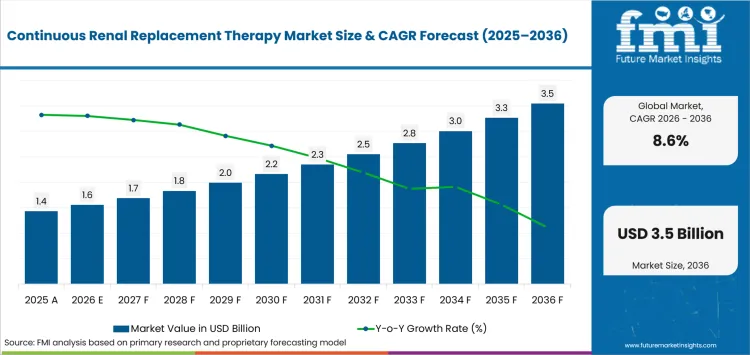
| Metric | Value |
|---|---|
| 2025 Market Size | USD 1.4 billion |
| 2026 Market Size | USD 1.6 billion |
| 2036 Market Size | USD 3.5 billion |
| Forecast CAGR (2026-2036) | 8.1% |
| Product Type Focus | Consumables |
| Consumables Share (2026) | 53.0% |
| Therapy Focus | Renal |
| Renal Share (2026) | 70.0% |
| Key Countries | USA, Germany, France, UK |
Summary of the Continuous Renal Replacement Therapy Market
| Market Signal | Commercial Impact |
|---|---|
| Demand and Growth Drivers | Demand follows hospital critical-care activity, where ICUs treating acute kidney injury generate recurring, per-treatment consumption of filters, tubing, and replacement fluids.
|
| Product and Segment View | Consumables and renal therapy dominate the mix, with continuous venovenous hemofiltration the leading modality.
|
| Geography and Competitive Outlook | Growth is fastest in markets expanding ICU capacity such as China, while established device makers compete on integrated systems and consumable ecosystems.
|
| Analyst Opinion | Competitive advantage will rest on the economics of continuous therapy rather than on system placement alone.
|
Why is the Continuous Renal Replacement Therapy Market growing?
Rising Consumables and Renal therapy demand in hospital intensive care units
- Sustained procurement of hemofilters and replacement fluids is shaped by hospitals treating acute kidney injury in critically ill patients across ICU settings.
- China is leading the way with growth of 8.1%, driven by government hospital expansion, rising ICU bed capacity, and domestic manufacturing of CRRT consumables.
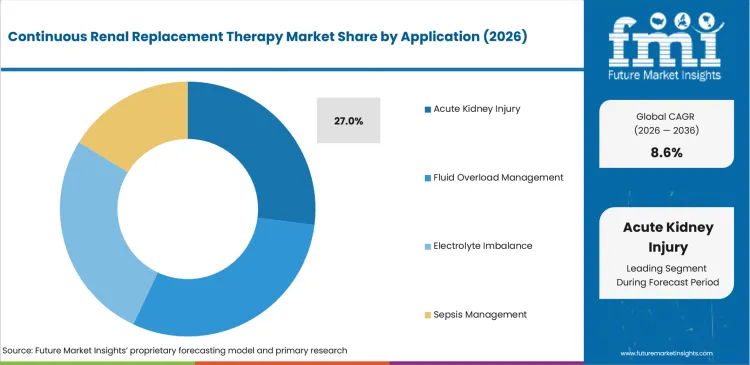
- The therapy segment is led by Renal at 70.0% share, supported by kidney-indication caseloads in acute kidney injury, sepsis management, and fluid overload management.
Demand is rising because intensive care units need continuous, gentle fluid and solute removal for patients who cannot tolerate intermittent hemodialysis. Adoption is increasing due to the consumable-intensive nature of therapy, where each treatment day consumes hemofilters, tubing sets, and bicarbonate-based or lactate-based replacement fluids, tying market value directly to ICU caseload and therapy duration.
How is the Continuous Renal Replacement Therapy Market segmented?
By Product Type, Therapy, Modality, End User, Patient Type and Application
- Consumables are projected to lead Product Type demand with 53.0% share in 2026 because each treatment day consumes filters, tubing, and fluids.
- Renal therapy is expected to lead with 70.0% share in 2026 as kidney-indication caseloads outweigh non-renal uses.
- Hospitals are forecast to lead End User with 80.0% share in 2026 as critical-care delivery concentrates in inpatient settings.
Why do Consumables lead the Continuous Renal Replacement Therapy Market?
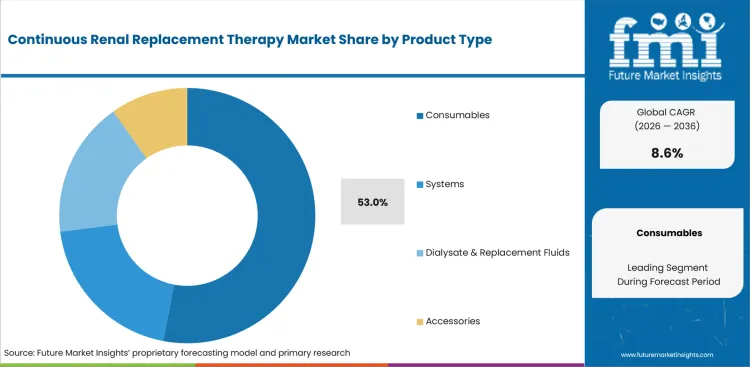
- Consumables are expected to hold 53.0% share in 2026 because hemofilters, tubing sets, and replacement fluids are consumed per treatment day rather than purchased once.
- High-flux and low-flux filters and bicarbonate-based fluids generate recurring revenue tied to therapy duration and ICU caseload.
Renal therapy holds 70.0% share, led by acute kidney injury indications
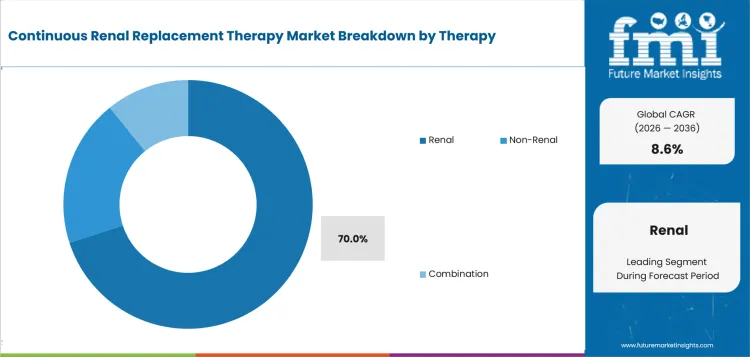
- Renal therapy forms the leading block at 70.0% share, anchored by acute kidney injury and fluid overload management indications.
- Non-renal and combination therapy uses such as sepsis management remain secondary but expand the clinical addressable base.
Which Modality leads the market?
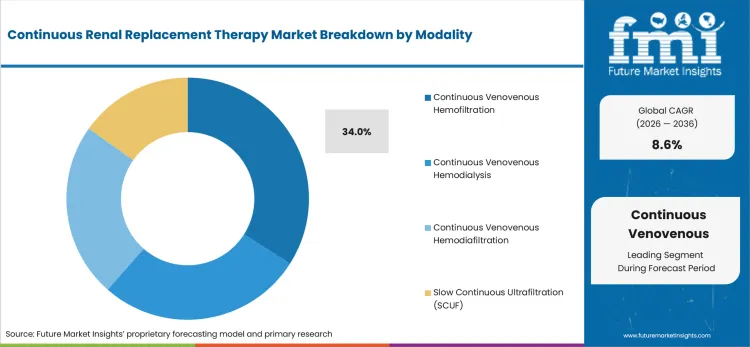
- Continuous Venovenous Hemofiltration is estimated to represent 34.0% Modality share in 2026 due to its convective solute clearance.
- Continuous venovenous hemodialysis and hemodiafiltration follow where diffusion or combined clearance suits the patient profile.
Which End User leads sourcing?
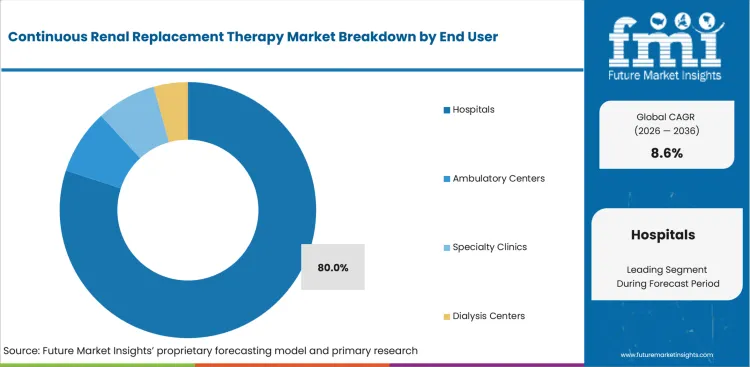
- Hospitals are forecast to hold 80.0% End User share in 2026, with public, teaching, and multi-specialty hospitals running most CRRT caseloads.
- Ambulatory centers and specialty clinics follow as continuous therapy extends into transplant and cardiac surgery units.
Which Patient Type leads the market?
- Adult patients lead demand as acute kidney injury and critical illness concentrate in adult ICU populations.
- Pediatric and geriatric patient segments follow, with neonatal and age-related kidney failure cases requiring tailored circuit configurations.
What drives and restrains the Continuous Renal Replacement Therapy Market?
Driven by ICU acute kidney injury caseloads and consumable recurrence; restrained by procedure cost and specialist staffing
Critical-care caseloads and per-treatment consumable use support adoption, while high procedure cost and the need for trained ICU nephrology staff limit access in lower-resource settings.
- Driver: Hospital ICUs treating acute kidney injury in septic and post-surgical patients generate recurring demand for hemofilters, tubing sets, and replacement fluids tied to each therapy day.
- Restraint: Public hospitals delay CRRT scale-up when high consumable cost per treatment day and the need for trained critical-care nurses strain critical-care budgets.
- Opportunity: Portable and integrated CRRT systems can widen adoption by extending continuous therapy into cardiac surgery centers and transplant units beyond general ICUs.
Critical-care expansion is lifting demand for CRRT as hospitals manage more hemodynamically unstable acute kidney injury patients. Standalone and integrated CRRT systems anchor the installed base while hemofilters, tubing, and bicarbonate-based fluids generate recurring revenue per treatment day.
The market is led by structural demand from hospital intensive care units. Renal indications remain the leading therapy block, while non-renal uses such as sepsis management broaden the clinical base. Constraints include procedure cost, reimbursement variability, and the supply of trained critical-care staff.
Which factors support expansion in the Continuous Renal Replacement Therapy Market?
System placement and recurring consumable contracts support market value across hospital critical-care channels
- Market value is supported by standalone and integrated system placement before consumable contracts add recurring per-treatment revenue.
- Supplier pricing reflects filter clearance efficiency and fluid quality before service coverage affects renewal demand.
- Hospitals compare consumable cost per treatment day and filter life before standardizing on a CRRT platform.
Which countries are growing fastest in the Continuous Renal Replacement Therapy Market?
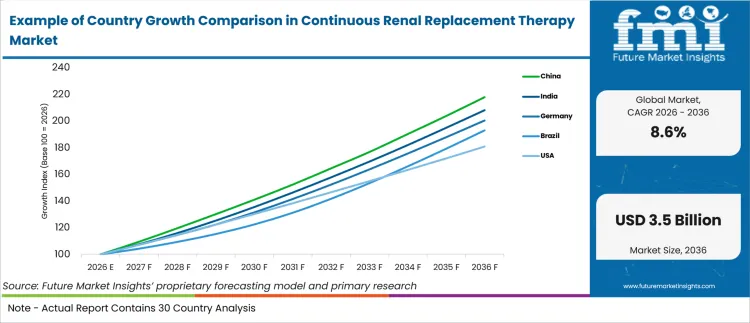
| Country | CAGR |
|---|---|
| China | 8.1% |
| India | 7.6% |
| Germany | 7.2% |
| Brazil | 6.8% |
| USA | 6.1% |
Source: Future Market Insights analysis, 2026.
How do country-level CAGRs compare in the Continuous Renal Replacement Therapy Market?
Country growth in continuous renal replacement therapy should be read through the pace of critical-care capacity building. In the United States and Germany, demand reflects a mature ICU base where replacement is driven by consumables and regulated device standards. In China, India, and Brazil, the same category tracks fast ICU expansion and widening public access to critical care. For senior buyers, the question is where CRRT consumable reliability creates the most value in caseload growth and supplier qualification.
- China is estimated to record 8.1% CAGR through 2036 as government hospital expansion and ICU bed growth lift continuous venovenous hemofiltration caseloads. China's National Health Commission set a target of 15 intensive-care beds per 100,000 people by the end of 2025, up from about 5.31 per 100,000 in 2022, enlarging the installed base that drives CRRT consumable demand.
- India is expected to expand at 7.6% CAGR through 2036 as private critical-care investment and Ayushman Bharat coverage widen access to intensive care. Under the PM Ayushman Bharat Health Infrastructure Mission, critical-care hospital blocks are being funded across 602 districts, and 32,574 hospitals were empanelled under AB PM-JAY as of December 2025, broadening the base of ICUs that use replacement fluids and hemofilters.
- Germany is estimated to grow at 7.2% CAGR through 2036 as EU device standards and tertiary critical-care capacity shape procurement. Germany runs the largest hospital sector in the EU at about 7.9 beds per 1,000 people, with the DIVI intensive-care register tracking capacity across roughly 1,300 hospitals, sustaining steady demand for CRRT consumables.
- Brazil is projected to rise at 6.8% CAGR through 2036 as SUS public hospital networks expand critical-care services. The SUS 'Health in Our Hands' program cut ICU infections by 26% between September 2024 and October 2025, and the Ministry of Health is rolling out a national smart-hospital network with 14 smart ICUs from 2026, both reinforcing continued CRRT uptake.
- The United States is forecast to post 6.1% CAGR through 2036 as a mature ICU installed base shifts toward consumable-driven replacement. High-income health systems such as the United States report ICU bed densities of roughly 12 to 30 per 100,000 people, so growth is anchored in recurring hemofilter and replacement-fluid purchasing rather than new system placement.
Who are the leading companies in the Continuous Renal Replacement Therapy Market?
Fresenius Medical Care, Vantive, B. Braun Melsungen, Nikkiso, and Asahi Kasei
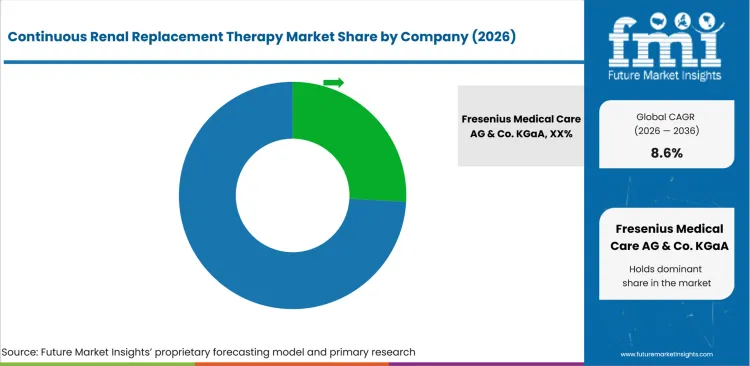
Fresenius Medical Care and Vantive compete through combined systems and consumable ecosystems. Filter performance is a further point of differentiation. B. Braun Melsungen and Nikkiso compete on hemofilter clearance and circuit design, while Asahi Kasei and Toray Medical hold positions in membrane technology. These overlap with broader dialysis and blood-purification buying paths.
Buyers compare suppliers on consumable cost per treatment day, filter life, and service coverage. Hospitals standardize on platforms that lower per-treatment cost and reduce circuit changes. Larger academic centers favor systems with validated clearance across continuous venovenous modalities and reliable replacement-fluid supply.
Who are the key players in the Continuous Renal Replacement Therapy Market?
Key global companies include:
- Fresenius Medical Care, Vantive, and B. Braun Melsuingen maintain leading positions through systems, consumable portfolios, and direct hospital relationships across global markets.
- Membrane and circuit specialists such as Nikkiso, Asahi Kasei, Toray Medical, and Nipro compete through filter clearance efficiency and consumable supply.
- Specialist and emerging providers such as Cytosorbents and Medica target blood-purification and adsorption niches to establish clinical positions and scale.
How do top Continuous Renal Replacement Therapy Market companies compare?
Fresenius and Baxter lead on scale; B. Braun also has a global footprint, while Nikkiso and Asahi Kasei are more membrane-concentrated.
| Company | Product Breadth | Consumable Depth | Deployment Scale | Geographic Footprint |
|---|---|---|---|---|
| Fresenius Medical Care | High | High | Strong | Global |
| Vantive | High | High | Strong | Global |
| B. Braun Melsungen | High | Moderate | Strong | Europe-led |
| Nikkiso | Moderate | High | Moderate | Asia-led |
| Asahi Kasei | Moderate | High | Moderate | Asia-led |
| Cytosorbents | Moderate | Moderate | Moderate | Americas-led |
Source: Future Market Insights competitive analysis, 2026.
Key Developments in the Continuous Renal Replacement Therapy Market
-
In August 2024, Baxter International signed a definitive agreement to divest its Kidney Care segment, renamed Vantive, to Carlyle for USD 3.8 billion, with the transaction completing in January 2025. Separation of the PrisMax and Prismaflex CRRT franchise into a standalone, capital-backed entity reshapes ownership of a leading acute platform and supports hospital buyers assessing long-term supply continuity for CRRT devices and consumables.
-
In June 2025, Vantive announced a plan to invest more than USD 1 billion over five years across research and development and production capacity, alongside digitally enabled CRRT management through the PrisMax System with embedded TrueVue Connect. Committed manufacturing and digital investment supports ICU purchasers needing assurance of consumables supply reliability and connectivity readiness before platform standardisation decisions.
-
In December 2025, SeaStar Medical received FDA approval for a reduction in mandatory enrolment for the SAVE Surveillance Registry, the post-approval study supporting QUELIMMUNE, an immunomodulatory device integrated in-line with existing CRRT circuits for pediatric acute kidney injury due to sepsis. Lower registry participation requirements reduce the institutional onboarding burden and support pediatric intensive care units evaluating CRRT-integrated adjunct therapy before adoption.
Key Players in the Continuous Renal Replacement Therapy Market
Global Device Leaders
- Fresenius Medical Care AG.
- Vantive
- B. Braun Melsungen AG
Membrane and Consumable Specialists
- Nikkiso Co., Ltd.
- Toray Medical Co., Ltd.
- Asahi Kasei Corporation
- Nipro Corporation
Emerging and Niche Players
- Cytosorbents Corporation
- Medica S.p.A.
- Infomed SA
Continuous Renal Replacement Therapy Market - Scope & Definition
| Attribute | Detail |
|---|---|
| Market Definition | Continuous extracorporeal blood-purification therapy and associated systems, consumables, and fluids used to manage acute kidney injury and fluid overload in critically ill patients |
| Functions Covered | Continuous fluid removal, solute clearance, electrolyte balance, and blood purification across continuous venovenous modalities |
| Applications Covered | Acute kidney injury, fluid overload management, sepsis management, electrolyte imbalance, and ICU-related kidney failure |
| End-Use Industries | Hospitals, ambulatory centers, specialty clinics, and dialysis centers |
| Inclusions | CRRT systems, hemofilters, tubing sets, dialysate and replacement fluids, catheters, and collection systems |
| Exclusions | Chronic intermittent hemodialysis equipment, standalone peritoneal dialysis, and consumables outside continuous therapy circuits |
Continuous Renal Replacement Therapy Market - Research Methodology
| Method | Description |
|---|---|
| Primary Research | FMI analysts gathered input from manufacturers, service providers, technology developers, distributors, end users, sourcing teams, and subject-matter experts. Interviews examined purchasing decisions, product or service evaluation, adoption barriers, approval requirements, pricing considerations, and expectations for technical or commercial support. Respondents were also asked what evidence is required before a trial, pilot, or initial order develops into regular purchasing. |
| Desk Research | Desk research covered government statistics, regulatory publications, trade data, industry associations, technical literature, standards, company filings, product information, and official corporate announcements. Sources were reviewed for relevance, publication date, geographic coverage, and consistency with the defined market scope. Claims relating to performance, applications, approvals, capacity, investment, and commercial activity were retained only when supported by credible public evidence. |
| Market Sizing & Forecasting | The market model combined the baseline value with historical performance, segment structure, pricing and volume indicators, adoption levels, company participation, and country-level demand conditions. Forecast assumptions considered economic activity, investment trends, regulatory developments, technology adoption, purchasing cycles, supply availability, and barriers to wider market use. Segment and regional estimates were reconciled before the final market total was calculated. |
| Data Validation | Estimates were checked against multiple independent indicators, including public data, company activity, trade patterns, industry developments, and findings from primary interviews. Validation also tested whether products, services, applications, and company revenues fell within the defined market boundaries. Adjacent categories, unsupported claims, overlapping revenues, and activities without direct market relevance were excluded to reduce double counting and maintain consistency across segments and countries. |
What does the Continuous Renal Replacement Therapy Market report cover?
2021 to 2025 history and 2026 to 2036 forecasts across all segments and 30+ countries
| Parameter | Details |
|---|---|
| Forecast period | 2026 to 2036 |
| Historical period | 2021 to 2025 |
| Quantitative unit | Value in USD billion |
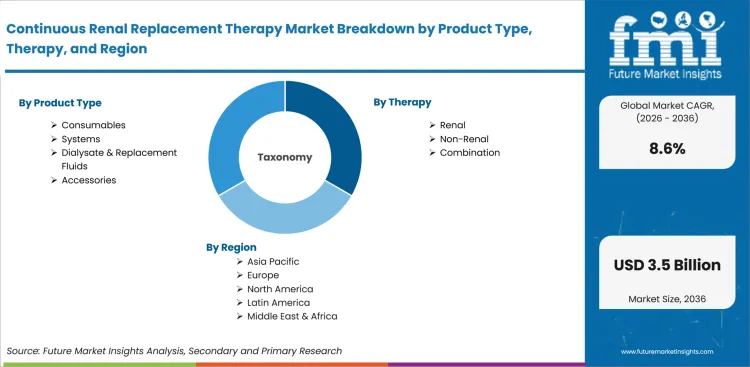
| By Product type | Consumables, Systems, Dialysate and Replacement Fluids, Accessories |
| By Therapy | Renal, Non-Renal, Combination |
| By Modality | Continuous Venovenous Hemofiltration, Continuous Venovenous Hemodialysis, Continuous Venovenous Hemodiafiltration, Slow Continuous Ultrafiltration |
| By End user | Hospitals, Ambulatory Centers, Specialty Clinics, Dialysis Centers |
| By Patient type | Adult Patients, Pediatric Patients, Geriatric Patients |
| By Application | Acute Kidney Injury, Fluid Overload Management, Sepsis Management, Electrolyte Imbalance |
| Regions Covered | North America, Latin America, Western Europe, Eastern Europe, East Asia, South Asia and Pacific, Middle East and Africa |
| Countries Covered | USA, China, India, Germany, Brazil, and other major markets |
| Key companies profiled | Fresenius Medical Care, Vantive, B. Braun Melsungen, Nikkiso, Toray Medical, Asahi Kasei, Nipro, Cytosorbents |
| Approach | Bottom-up clinical-use approach using system placement, consumable use per treatment, ICU caseload, and supplier disclosures |
Market Segmentation Analysis
Continuous Renal Replacement Therapy Market Segmented by Product Type:
- Consumables
- Hemofilters
- High Flux Filters
- Low Flux Filters
- Tubing Sets
- Standard Tubing Kits
- Customized Tubing Sets
- Dialysate and Replacement Fluids
- Bicarbonate Based Fluids
- Lactate Based Fluids
- Hemofilters
- Systems
- Standalone CRRT Systems
- Bedside CRRT Machines
- Portable CRRT Systems
- Integrated CRRT Systems
- Multi Therapy Platforms
- ICU Integrated Systems
- Standalone CRRT Systems
- Dialysate & Replacement Fluids
- Accessories
- Catheters
- Double Lumen Catheters
- Temporary Catheters
- Collection Systems
- Waste Collection Bags
- Fluid Management Systems
- Catheters
Continuous Renal Replacement Therapy Market Segmented by Therapy:
- Renal
- Non-Renal
- Combination
Continuous Renal Replacement Therapy Market Segmented by Modality:
- Continuous Venovenous Hemofiltration
- Pre Dilution Method
- Fluid Replacement Before Filter
- Improved Filter Life
- Post Dilution Method
- Higher Clearance Efficiency
- Enhanced Solute Removal
- Pre Dilution Method
- Continuous Venovenous Hemodialysis
- Diffusion Based Therapy
- Small Molecule Clearance
- Stable Electrolyte Balance
- Low Flow Dialysis
- Gentle Fluid Removal
- Hemodynamic Stability
- Diffusion Based Therapy
- Continuous Venovenous Hemodiafiltration
- Combination Therapy
- Diffusion and Convection
- High Clearance Efficiency
- High Volume Therapy
- Intensive Care Applications
- Severe Kidney Failure
- Combination Therapy
- Slow Continuous Ultrafiltration (SCUF)
Continuous Renal Replacement Therapy Market Segmented by End User:
- Hospitals
- Public Hospitals
- Government ICUs
- Teaching Hospitals
- Private Hospitals
- Multi Specialty Hospitals
- Advanced Critical Care Units
- Public Hospitals
- Ambulatory Centers
- Outpatient Care Centers
- Day Care Units
- Short Stay Centers
- Specialty Surgical Units
- Cardiac Surgery Centers
- Transplant Centers
- Outpatient Care Centers
- Specialty Clinics
- Dialysis Centers
- Independent Dialysis Centers
- Standalone Units
- Chain Dialysis Networks
- Hospital Based Dialysis Units
- Inpatient Dialysis
- Outpatient Dialysis
- Independent Dialysis Centers
Continuous Renal Replacement Therapy Market Segmented by Patient Type:
- Adult Patients
- Critical Care Patients
- ICU Patients
- Emergency Cases
- Chronic Kidney Patients
- Acute on Chronic Kidney Disease
- Dialysis Dependent Patients
- Critical Care Patients
- Pediatric Patients
- Neonatal Patients
- NICU Care
- Low Weight Infants
- Children
- Pediatric ICU Patients
- Congenital Disorders
- Neonatal Patients
- Geriatric Patients
- Elderly Patients
- Age Related Kidney Failure
- Comorbid Conditions
- Long Term Care Patients
- Chronic Illness Management
- Post Operative Care
- Elderly Patients
Continuous Renal Replacement Therapy Market Segmented by Application:
- Acute Kidney Injury
- ICU Related Kidney Failure
- Trauma Related AKI
- Fluid Overload Management
- Cardiac Patients
- Critical Care Patients
- Electrolyte Imbalance
- Hyperkalemia Treatment
- Acid Base Disorders
- Sepsis Management
- Septic Shock Treatment
- Toxin Removal
Continuous Renal Replacement Therapy Market by Region:
- North America
- USA
- Canada
- Mexico
- Latin America
- Brazil
- Chile
- Rest of Latin America
- Western Europe
- Germany
- UK
- Italy
- Spain
- France
- Nordic
- BENELUX
- Rest of Western Europe
- Eastern Europe
- Russia
- Poland
- Hungary
- Balkan & Baltic
- Rest of Eastern Europe
- East Asia
- China
- Japan
- South Korea
- South Asia and Pacific
- India
- ASEAN
- Australia & New Zealand
- Rest of South Asia and Pacific
- Middle East & Africa
- Kingdom of Saudi Arabia
- Other GCC Countries
- Türkiye
- South Africa
- Other African Union
- Rest of Middle East & Africa
Research Sources and Bibliography
- World Health Organization. (2025, October). Global report on kidney health and critical-care capacity.
- Organisation for Economic Co-operation and Development. (2025, November). Health at a Glance: intensive-care resources across member states.
- USA Food and Drug Administration. (2026, February 10). Device classification and clearances for continuous renal replacement systems.
- European Commission. (2025, December 9). Medical Device Regulation guidance for blood-purification devices.
- National Health Commission of China. (2025, September). Tertiary hospital critical-care capacity bulletin.
- Indian Council of Medical Research. (2026, January). Critical-care and acute kidney injury management guidance.
- Fresenius Medical Care AG. (2026, February 24). 2025 annual report and renal-care segment overview.
- Vantive 2025 results and acute therapies portfolio update.
This bibliography is provided for reader reference and is not exhaustive.
This Report Answers
- Market size estimates for 2026 and forecasts through 2036 for the Continuous Renal Replacement Therapy Market.
- Analysis of product demand across consumables and systems with dialysate and replacement fluids.
- Country-level growth analysis covering China and India with Germany, Brazil and USA outlooks.
- Evaluation of company positioning across Fresenius Medical Care and Baxter with B. Braun, Nikkiso and Asahi Kasei.
- Assessment of drivers and restraints with procurement patterns across hospital critical-care channels.
Frequently Asked Questions
What is the growth prospect for the Continuous Renal Replacement Therapy Market?
Demand is projected to increase as hospital intensive care units manage a growing number of acute kidney injury patients requiring continuous therapy.
Which companies are expected to shape the Continuous Renal Replacement Therapy Market?
Fresenius Medical Care and Baxter are positioned to lead the competitive landscape, alongside B. Braun, Nikkiso, and Asahi Kasei.
Why are Consumables important in this market?
Consumables account for the largest share of Product Type demand, as filters, tubing, and fluids are consumed daily per treatment, generating recurring revenue.
How do regulation and reimbursement influence CRRT demand?
Device regulation and hospital reimbursement frameworks influence consumable selection and the duration of continuous therapy in intensive care.
Which modality is gaining attention?
Continuous venovenous hemofiltration leads in convective clearance, while hemodiafiltration is gaining prominence for combined solute removal.
Preview the report firsthand - request a free sample
Get SampleGet the brochure for pricing and purchase details.
Get PDFTable of Content
- Key Takeaways
- Market Size and CAGR
- Top Growth Driver
- Fastest Growing Segment
- Leading Region
- Key Companies
- Emerging Opportunities
- Executive Summary
- Global Market Outlook
- Demand-side Trends
- Supply-side Trends
- Technology Roadmap Analysis
- Analysis and Recommendations
- Analyst Perspective (What is happening? Why now? What should investors know?)
- Key Questions Answered
- How large is the market?
- What is the CAGR?
- What are key trends?
- Which region dominates?
- Who are the leaders?
- Market Overview
- Market Coverage / Taxonomy
- Market Definition / Scope / Limitations
- Research Methodology
- Chapter Orientation
- Analytical Lens and Working Hypotheses
- Market Structure, Signals, and Trend Drivers
- Benchmarking and Cross-market Comparability
- Market Sizing, Forecasting, and Opportunity Mapping
- Research Design and Evidence Framework
- Desk Research Programme (Secondary Evidence)
- Expert Input and Fieldwork (Primary Evidence)
- Tooling, Models, and Reference Databases
- Data Engineering and Model Build
- Quality Assurance and Audit Trail
- Market Background
- Market Dynamics (Drivers, Restraints, Opportunity, Trends)
- Scenario Forecast (Optimistic, Likely, Conservative)
- Impact Analysis
- AI Impact
- Sustainability Impact
- Regulatory Impact
- Technology Impact
- Consumer / Buyer Analysis
- Purchase Drivers
- Adoption Barriers
- Buyer Journey
- Opportunity Map Analysis
- Product Life Cycle Analysis
- Supply Chain Analysis
- Investment Feasibility Matrix
- Value Chain Analysis
- PESTLE and Porter's Analysis
- Regulatory Landscape
- Regional Parent Market Outlook
- Production and Consumption Statistics
- Import and Export Statistics
- Global Market Analysis and Forecast, 2021 to 2036
- Historical Market Size Value (USD Million) Analysis, 2021 to 2025
- Current and Future Market Size Value (USD Million) Projections, 2026 to 2036
- Y-o-Y Growth Trend Analysis
- Absolute $ Opportunity Analysis
- Global Market Pricing Analysis, 2021 to 2036
- Global Market Analysis and Forecast, By Product Type, 2021 to 2036
- Introduction / Key Findings
- Historical Market Size Value (USD Million) Analysis By Product Type, 2021 to 2025
- Current and Future Market Size Value (USD Million) Analysis and Forecast By Product Type, 2026 to 2036
- Consumables
- Hemofilters
- High Flux Filters
- Low Flux Filters
- Tubing Sets
- Standard Tubing Kits
- Customized Tubing Sets
- Dialysate and Replacement Fluids
- Bicarbonate Based Fluids
- Lactate Based Fluids
- Hemofilters
- Systems
- Standalone CRRT Systems
- Bedside CRRT Machines
- Portable CRRT Systems
- Integrated CRRT Systems
- Multi Therapy Platforms
- ICU Integrated Systems
- Standalone CRRT Systems
- Dialysate & Replacement Fluids
- Accessories
- Catheters
- Double Lumen Catheters
- Temporary Catheters
- Collection Systems
- Waste Collection Bags
- Fluid Management Systems
- Catheters
- Consumables
- Y-o-Y Growth Trend Analysis By Product Type, 2021 to 2025
- Absolute $ Opportunity Analysis By Product Type, 2026 to 2036
- Global Market Analysis and Forecast, By Therapy, 2021 to 2036
- Introduction / Key Findings
- Historical Market Size Value (USD Million) Analysis By Therapy, 2021 to 2025
- Current and Future Market Size Value (USD Million) Analysis and Forecast By Therapy, 2026 to 2036
- Renal
- Non-Renal
- Combination
- Renal
- Y-o-Y Growth Trend Analysis By Therapy, 2021 to 2025
- Absolute $ Opportunity Analysis By Therapy, 2026 to 2036
- Global Market Analysis and Forecast, By Modality, 2021 to 2036
- Introduction / Key Findings
- Historical Market Size Value (USD Million) Analysis By Modality, 2021 to 2025
- Current and Future Market Size Value (USD Million) Analysis and Forecast By Modality, 2026 to 2036
- Continuous Venovenous Hemofiltration
- Pre Dilution Method
- Fluid Replacement Before Filter
- Improved Filter Life
- Post Dilution Method
- Higher Clearance Efficiency
- Enhanced Solute Removal
- Pre Dilution Method
- Continuous Venovenous Hemodialysis
- Diffusion Based Therapy
- Small Molecule Clearance
- Stable Electrolyte Balance
- Low Flow Dialysis
- Gentle Fluid Removal
- Hemodynamic Stability
- Diffusion Based Therapy
- Continuous Venovenous Hemodiafiltration
- Combination Therapy
- Diffusion and Convection
- High Clearance Efficiency
- High Volume Therapy
- Intensive Care Applications
- Severe Kidney Failure
- Combination Therapy
- Slow Continuous Ultrafiltration (SCUF)
- Continuous Venovenous Hemofiltration
- Y-o-Y Growth Trend Analysis By Modality, 2021 to 2025
- Absolute $ Opportunity Analysis By Modality, 2026 to 2036
- Global Market Analysis and Forecast, By End User, 2021 to 2036
- Introduction / Key Findings
- Historical Market Size Value (USD Million) Analysis By End User, 2021 to 2025
- Current and Future Market Size Value (USD Million) Analysis and Forecast By End User, 2026 to 2036
- Hospitals
- Public Hospitals
- Government ICUs
- Teaching Hospitals
- Private Hospitals
- Multi Specialty Hospitals
- Advanced Critical Care Units
- Public Hospitals
- Ambulatory Centers
- Outpatient Care Centers
- Day Care Units
- Short Stay Centers
- Specialty Surgical Units
- Cardiac Surgery Centers
- Transplant Centers
- Outpatient Care Centers
- Specialty Clinics
- Dialysis Centers
- Independent Dialysis Centers
- Standalone Units
- Chain Dialysis Networks
- Hospital Based Dialysis Units
- Inpatient Dialysis
- Outpatient Dialysis
- Independent Dialysis Centers
- Hospitals
- Y-o-Y Growth Trend Analysis By End User, 2021 to 2025
- Absolute $ Opportunity Analysis By End User, 2026 to 2036
- Global Market Analysis and Forecast, By Patient Type, 2021 to 2036
- Introduction / Key Findings
- Historical Market Size Value (USD Million) Analysis By Patient Type, 2021 to 2025
- Current and Future Market Size Value (USD Million) Analysis and Forecast By Patient Type, 2026 to 2036
- Adult Patients
- Critical Care Patients
- ICU Patients
- Emergency Cases
- Chronic Kidney Patients
- Acute on Chronic Kidney Disease
- Dialysis Dependent Patients
- Critical Care Patients
- Pediatric Patients
- Neonatal Patients
- NICU Care
- Low Weight Infants
- Children
- Pediatric ICU Patients
- Congenital Disorders
- Neonatal Patients
- Geriatric Patients
- Elderly Patients
- Age Related Kidney Failure
- Comorbid Conditions
- Long Term Care Patients
- Chronic Illness Management
- Post Operative Care
- Elderly Patients
- Adult Patients
- Y-o-Y Growth Trend Analysis By Patient Type, 2021 to 2025
- Absolute $ Opportunity Analysis By Patient Type, 2026 to 2036
- Global Market Analysis and Forecast, By Application
- Introduction / Key Findings
- Historical Market Size Value (USD Million) Analysis By Application, 2021 to 2025
- Current and Future Market Size Value (USD Million) Analysis and Forecast By Application, 2026 to 2036
- Acute Kidney Injury
- ICU Related Kidney Failure
- Trauma Related AKI
- Fluid Overload Management
- Cardiac Patients
- Critical Care Patients
- Electrolyte Imbalance
- Hyperkalemia Treatment
- Acid Base Disorders
- Sepsis Management
- Septic Shock Treatment
- Toxin Removal
- Acute Kidney Injury
- Y-o-Y Growth Trend Analysis By Application, 2021 to 2025
- Absolute $ Opportunity Analysis By Application, 2026 to 2036
- Global Market Analysis and Forecast, By Region, 2021 to 2036
- Introduction
- Historical Market Size Value (USD Million) Analysis By Region, 2021 to 2025
- Current Market Size Value (USD Million) Analysis and Forecast By Region, 2026 to 2036
- North America
- Latin America
- Western Europe
- Eastern Europe
- East Asia
- South Asia and Pacific
- Middle East & Africa
- Market Attractiveness Analysis By Region
- North America Market Analysis and Forecast, By Country, 2021 to 2036
- Historical Market Size Value (USD Million) Trend Analysis By Market Taxonomy, 2021 to 2025
- Market Size Value (USD Million) Forecast By Market Taxonomy, 2026 to 2036
- By Country
- USA
- Canada
- Mexico
- By Product Type
- By Therapy
- By Modality
- By End User
- By Patient Type
- By Application
- By Country
- Market Attractiveness Analysis
- By Country
- By Product Type
- By Therapy
- By Modality
- By End User
- By Patient Type
- By Application
- Key Takeaways
- Latin America Market Analysis and Forecast, By Country
- Historical Market Size Value (USD Million) Trend Analysis By Market Taxonomy, 2021 to 2025
- Market Size Value (USD Million) Forecast By Market Taxonomy, 2026 to 2036
- By Country
- Brazil
- Chile
- Rest of Latin America
- By Product Type
- By Therapy
- By Modality
- By End User
- By Patient Type
- By Application
- By Country
- Market Attractiveness Analysis
- By Country
- By Product Type
- By Therapy
- By Modality
- By End User
- By Patient Type
- By Application
- Key Takeaways
- Western Europe Market Analysis and Forecast, By Country
- Historical Market Size Value (USD Million) Trend Analysis By Market Taxonomy, 2021 to 2025
- Market Size Value (USD Million) Forecast By Market Taxonomy, 2026 to 2036
- By Country
- Germany
- UK
- Italy
- Spain
- France
- Nordic
- BENELUX
- Rest of Western Europe
- By Product Type
- By Therapy
- By Modality
- By End User
- By Patient Type
- By Application
- By Country
- Market Attractiveness Analysis
- By Country
- By Product Type
- By Therapy
- By Modality
- By End User
- By Patient Type
- By Application
- Key Takeaways
- Eastern Europe Market Analysis and Forecast, By Country
- Historical Market Size Value (USD Million) Trend Analysis By Market Taxonomy, 2021 to 2025
- Market Size Value (USD Million) Forecast By Market Taxonomy, 2026 to 2036
- By Country
- Russia
- Poland
- Hungary
- Balkan & Baltic
- Rest of Eastern Europe
- By Product Type
- By Therapy
- By Modality
- By End User
- By Patient Type
- By Application
- By Country
- Market Attractiveness Analysis
- By Country
- By Product Type
- By Therapy
- By Modality
- By End User
- By Patient Type
- By Application
- Key Takeaways
- East Asia Market Analysis and Forecast, By Country
- Historical Market Size Value (USD Million) Trend Analysis By Market Taxonomy, 2021 to 2025
- Market Size Value (USD Million) Forecast By Market Taxonomy, 2026 to 2036
- By Country
- China
- Japan
- South Korea
- By Product Type
- By Therapy
- By Modality
- By End User
- By Patient Type
- By Application
- By Country
- Market Attractiveness Analysis
- By Country
- By Product Type
- By Therapy
- By Modality
- By End User
- By Patient Type
- By Application
- Key Takeaways
- South Asia and Pacific Market Analysis and Forecast, By Country
- Historical Market Size Value (USD Million) Trend Analysis By Market Taxonomy, 2021 to 2025
- Market Size Value (USD Million) Forecast By Market Taxonomy, 2026 to 2036
- By Country
- India
- ASEAN
- Australia & New Zealand
- Rest of South Asia and Pacific
- By Product Type
- By Therapy
- By Modality
- By End User
- By Patient Type
- By Application
- By Country
- Market Attractiveness Analysis
- By Country
- By Product Type
- By Therapy
- By Modality
- By End User
- By Patient Type
- By Application
- Key Takeaways
- Middle East & Africa Market Analysis and Forecast, By Country
- Historical Market Size Value (USD Million) Trend Analysis By Market Taxonomy, 2021 to 2025
- Market Size Value (USD Million) Forecast By Market Taxonomy, 2026 to 2036
- By Country
- Kingdom of Saudi Arabia
- Other GCC Countries
- Türkiye
- South Africa
- Other African Union
- Rest of Middle East & Africa
- By Product Type
- By Therapy
- By Modality
- By End User
- By Patient Type
- By Application
- By Country
- Market Attractiveness Analysis
- By Country
- By Product Type
- By Therapy
- By Modality
- By End User
- By Patient Type
- By Application
- Key Takeaways
- Key Countries Market Analysis
- USA
- Pricing Analysis
- Market Share Analysis, 2025
- By Product Type
- By Therapy
- By Modality
- By End User
- By Patient Type
- By Application
- Canada
- Pricing Analysis
- Market Share Analysis, 2025
- By Product Type
- By Therapy
- By Modality
- By End User
- By Patient Type
- By Application
- Mexico
- Pricing Analysis
- Market Share Analysis, 2025
- By Product Type
- By Therapy
- By Modality
- By End User
- By Patient Type
- By Application
- Brazil
- Pricing Analysis
- Market Share Analysis, 2025
- By Product Type
- By Therapy
- By Modality
- By End User
- By Patient Type
- By Application
- Chile
- Pricing Analysis
- Market Share Analysis, 2025
- By Product Type
- By Therapy
- By Modality
- By End User
- By Patient Type
- By Application
- Germany
- Pricing Analysis
- Market Share Analysis, 2025
- By Product Type
- By Therapy
- By Modality
- By End User
- By Patient Type
- By Application
- UK
- Pricing Analysis
- Market Share Analysis, 2025
- By Product Type
- By Therapy
- By Modality
- By End User
- By Patient Type
- By Application
- Italy
- Pricing Analysis
- Market Share Analysis, 2025
- By Product Type
- By Therapy
- By Modality
- By End User
- By Patient Type
- By Application
- Spain
- Pricing Analysis
- Market Share Analysis, 2025
- By Product Type
- By Therapy
- By Modality
- By End User
- By Patient Type
- By Application
- France
- Pricing Analysis
- Market Share Analysis, 2025
- By Product Type
- By Therapy
- By Modality
- By End User
- By Patient Type
- By Application
- India
- Pricing Analysis
- Market Share Analysis, 2025
- By Product Type
- By Therapy
- By Modality
- By End User
- By Patient Type
- By Application
- ASEAN
- Pricing Analysis
- Market Share Analysis, 2025
- By Product Type
- By Therapy
- By Modality
- By End User
- By Patient Type
- By Application
- Australia & New Zealand
- Pricing Analysis
- Market Share Analysis, 2025
- By Product Type
- By Therapy
- By Modality
- By End User
- By Patient Type
- By Application
- China
- Pricing Analysis
- Market Share Analysis, 2025
- By Product Type
- By Therapy
- By Modality
- By End User
- By Patient Type
- By Application
- Japan
- Pricing Analysis
- Market Share Analysis, 2025
- By Product Type
- By Therapy
- By Modality
- By End User
- By Patient Type
- By Application
- South Korea
- Pricing Analysis
- Market Share Analysis, 2025
- By Product Type
- By Therapy
- By Modality
- By End User
- By Patient Type
- By Application
- Russia
- Pricing Analysis
- Market Share Analysis, 2025
- By Product Type
- By Therapy
- By Modality
- By End User
- By Patient Type
- By Application
- Poland
- Pricing Analysis
- Market Share Analysis, 2025
- By Product Type
- By Therapy
- By Modality
- By End User
- By Patient Type
- By Application
- Hungary
- Pricing Analysis
- Market Share Analysis, 2025
- By Product Type
- By Therapy
- By Modality
- By End User
- By Patient Type
- By Application
- Kingdom of Saudi Arabia
- Pricing Analysis
- Market Share Analysis, 2025
- By Product Type
- By Therapy
- By Modality
- By End User
- By Patient Type
- By Application
- Türkiye
- Pricing Analysis
- Market Share Analysis, 2025
- By Product Type
- By Therapy
- By Modality
- By End User
- By Patient Type
- By Application
- South Africa
- Pricing Analysis
- Market Share Analysis, 2025
- By Product Type
- By Therapy
- By Modality
- By End User
- By Patient Type
- By Application
- USA
- Market Structure Analysis
- Competition Dashboard
- Competition Benchmarking
- Market Share Analysis of Top Players
- By Regional
- By Product Type
- By Therapy
- By Modality
- By End User
- By Patient Type
- By Application
- Emerging Startups
- Innovation Benchmarking
- Competition Analysis
- Competition Deep Dive
- Fresenius Medical Care AG
- Overview
- Product Portfolio
- Profitability by Market Segments (Product/Region/Sales Channel)
- Sales Footprint
- Strategy Overview
- Marketing Strategy
- Product Strategy
- Channel Strategy
- Baxter International Inc.
- B. Braun Melsungen AG
- Medica SpA
- Nikkiso Co.,Ltd.
- Toray Medical Co., Ltd.
- Asahi Kasei Corporation
- Nipro Corporation
- Medica S.p.A.
- Cytosorbents Corporation
- Fresenius Medical Care AG
- Case Studies
- Success Stories
- Recent Developments
- Competition Deep Dive
- Assumptions & Acronyms Used


