

- Industry Size (2025)
- USD 2.5 Bn
- Forecast (2035)
- USD 4.1 Bn
- CAGR: 5.0%
- (2025 to 2035)
Crank Case Ventilation Valve Market size, market forecast and outlook by FMI
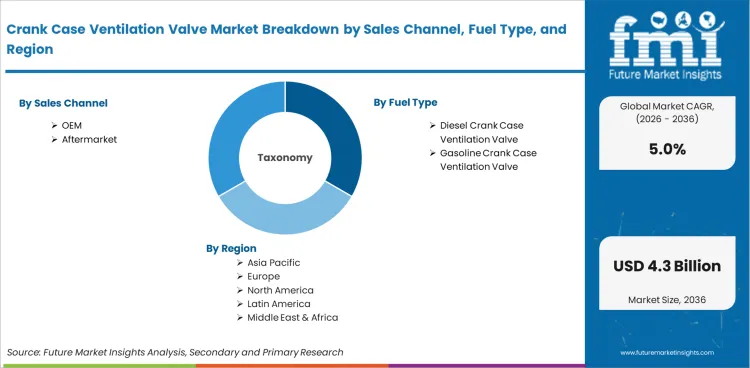
The crank case ventilation valve market was valued at USD 2.50 billion in 2025, projected to reach USD 2.63 billion in 2026, and is forecast to expand to USD 4.28 billion by 2036 at a 5.0% CAGR. Tightening emissions regulations mandating closed crankcase ventilation across internal combustion engine applications in automotive, construction, marine, and military sectors are sustaining demand for engineered CCV valve systems. The transition from fixed to variable crankcase ventilation valves reflects OEM requirements for precise blow-by gas management that adapts to varying engine load and speed conditions to maintain emissions compliance.
Summary of Crank Case Ventilation Valve Market
- The market is on track to reach USD 4.28 billion by 2036.
- Growth is pegged at a 5.0% CAGR over the 2026 to 2036 forecast window.
- As of 2025, the market was valued at USD 2.50 billion.
- Cumulative incremental value across the forecast stands at USD 1.65 billion.
- OEM channel leads with 60.0% share in 2026 as engine manufacturers integrate CCV valves into factory-assembled powertrains for emissions compliance.
- Diesel CCV valves hold 55.0% share in 2026 because diesel engines generate higher blow-by gas volumes requiring more complex valve designs with integrated oil separation.
- Fixed CCV valves hold 50.0% share in 2026, while variable electronically controlled valves are the fastest-growing subcategory.
- Demand is sustained by tightening emissions regulations including Euro 7, EPA Tier 4, and Bharat Stage standards that mandate closed crankcase ventilation across internal combustion engine applications.
- Among key countries, India leads at 6.3% CAGR, followed by Germany at 5.8%, Brazil at 5.3%, the USA at 4.8%, the UK at 4.3%, and Japan at 3.8%.
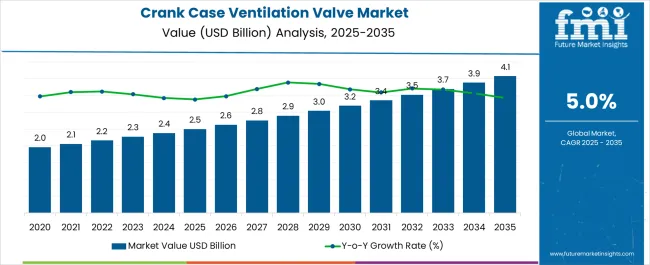
As per FMI, the crank case ventilation valve market is sustained by the dual forces of tightening emissions regulations on internal combustion engines and the expanding global vehicle fleet requiring replacement components. OEM channels hold 60.0% share as engine manufacturers integrate CCV valves into factory-assembled powertrains to meet Euro 7, EPA Tier 4, and equivalent emissions standards. Diesel variants command 55.0% share because diesel engines generate higher blow-by gas volumes and particulate loads, requiring more complex CCV valve designs with integrated oil separation. FMI analysts observe that variable CCV valves are gaining share as OEM specifications shift toward electronically controlled ventilation that adjusts flow rates in real time based on engine operating parameters, improving both emissions performance and engine oil consumption efficiency.
All major markets reflect accelerated deployment parameters. India sets a 6.3% CAGR, Germany sets a 5.8% CAGR, Brazil sets a 5.3% CAGR, USA sets a 4.8% CAGR, UK sets a 4.3% CAGR, and Japan sets a 3.8% CAGR. India leads at 6.3% CAGR as its expanding commercial vehicle fleet and tightening Bharat Stage emission standards drive CCV valve adoption. Germany at 5.8% reflects OEM demand from its automotive and heavy equipment manufacturing base. Brazil at 5.3% benefits from growing fleet size and emission regulation harmonization. The USA at 4.8% sustains aftermarket replacement demand across its large installed vehicle base. The UK at 4.3% and Japan at 3.8% maintain steady OEM and aftermarket demand through established automotive manufacturing operations.
Crank Case Ventilation Valve Market key takeaways
| Metric | Details |
|---|---|
| Industry Size (2026) | USD 2.63 billion |
| Industry Value (2036) | USD 4.28 billion |
| CAGR (2026-2036) | 5.0% |
Source: Future Market Insights, 2026
Crank Case Ventilation Valve Market definition
Crank case ventilation valves are engineered components that regulate the flow of blow-by gases from the crankcase of internal combustion engines, routing them back to the intake manifold or through a dedicated filtration system to prevent atmospheric release. Product categories include fixed-flow PCV valves and variable electronically controlled CCV valves. Applications span light-duty and heavy-duty automotive engines, construction equipment, marine engines, military vehicles, and aerospace auxiliary power units.
Crank Case Ventilation Valve Market inclusions
Market scope includes all CCV valve types sold through OEM and aftermarket channels for internal combustion engine applications. Regional and country-level market sizes, forecast period 2026 to 2036, and segment breakdowns by sales channel, fuel type, valve type, vehicle type, and end use are fully incorporated.
Crank Case Ventilation Valve Market exclusions
The scope excludes exhaust aftertreatment systems, catalytic converters, turbocharger components, engine management control units, and air intake filtration systems not specific to crankcase ventilation.
Crank Case Ventilation Valve Market research methodology
Primary Research
Analysts conducted interviews with automotive OEM powertrain engineers, CCV valve manufacturers, aftermarket parts distributors, and emissions regulation compliance officers to map OEM specification cycles and aftermarket replacement patterns.
Desk Research
Data collection aggregated emissions regulation databases, vehicle production and fleet statistics, aftermarket parts catalogue data, and automotive component manufacturer annual reports.
Market-Sizing and Forecasting
Baseline values derive from a bottom-up aggregation of OEM vehicle production volumes and aftermarket fleet replacement rates by region, applying valve-type-specific pricing and emissions regulation compliance timelines.
Data Validation and Update Cycle
Projections are tested against publicly reported automotive component revenue from CCV valve manufacturers and cross-referenced with vehicle production and fleet registration data.
Why is the Crank Case Ventilation Valve Market Growing?
The Crank Case Ventilation Valve market is experiencing robust growth driven by the increasing demand for efficient emission control systems and stringent regulatory norms for vehicular exhaust. The market expansion is being influenced by the rising adoption of advanced internal combustion engine technologies and the growing emphasis on reducing particulate matter and hydrocarbon emissions. Investments in vehicle modernization and upgrades in both commercial and passenger vehicle segments are further supporting the demand for high-performance crank case ventilation valves.
With OEMs prioritizing integration of durable and efficient components, the market is witnessing enhanced product penetration. Additionally, technological advancements in valve design, including better materials and optimized airflow mechanisms, have improved engine performance and reliability, which is accelerating adoption.
The future outlook remains positive as automotive manufacturers continue to invest in emission control solutions, focusing on sustainability and regulatory compliance Continuous development in fuel-efficient engines, combined with increasing replacement demand for high-wear components, is expected to sustain market growth in both established and emerging automotive markets worldwide.
Segmental Analysis
The crank case ventilation valve market is segmented by sales channel, fuel type, type, engine, end use, and geographic regions. By sales channel, crank case ventilation valve market is divided into OEM and Aftermarket. In terms of fuel type, crank case ventilation valve market is classified into Diesel Crank Case Ventilation Valve and Gasoline Crank Case Ventilation Valve. Based on type, crank case ventilation valve market is segmented into Fixed Crank Case Ventilation Valve and Variable Crank Case Ventilation Valve. By engine, crank case ventilation valve market is segmented into Light Duty Crank Case Ventilation Valve and Heavy Duty Crank Case Ventilation Valve. By end use, crank case ventilation valve market is segmented into Automotive, Construction, Marine, Military, and Aerospace. Regionally, the crank case ventilation valve industry is classified into North America, Latin America, Western Europe, Eastern Europe, Balkan & Baltic Countries, Russia & Belarus, Central Asia, East Asia, South Asia & Pacific, and the Middle East & Africa.
Insights into the Sales Channel Segment
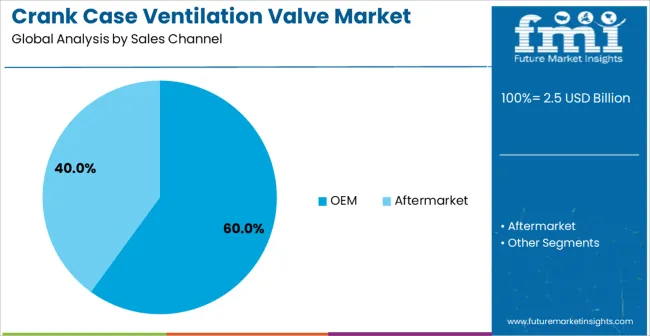
The OEM sales channel is projected to account for 60.00% of the Crank Case Ventilation Valve market revenue in 2026, making it the leading channel. This dominance is being driven by the preference for factory-fitted components that ensure reliability, adherence to manufacturer specifications, and long-term engine performance. OEM valves are favored due to their high quality, integration with engine management systems, and compliance with emission standards, which reduces maintenance costs and increases durability.
The growth of the OEM channel has been reinforced by automotive manufacturers focusing on providing complete and warranty-backed solutions to end customers. Moreover, the global expansion of vehicle production and the trend of offering pre-installed emission control components in new vehicles have strengthened the market share of OEM channels.
The adoption of OEM valves is further supported by increasing consumer awareness regarding engine efficiency and longevity, which encourages the use of original equipment With automotive production expected to rise, the OEM channel is anticipated to maintain leadership in the market due to consistent demand for reliable, factory-installed crank case ventilation solutions.
Insights into the Fuel Type Segment
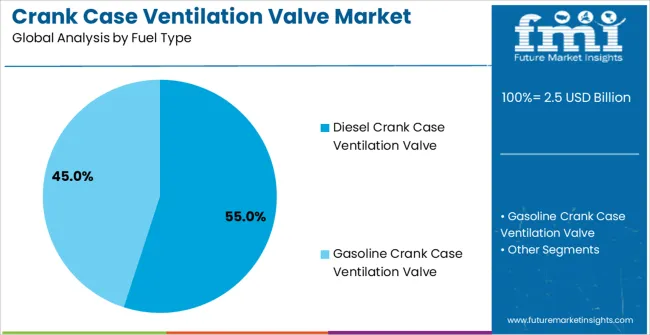
The Diesel Crank Case Ventilation Valve is expected to capture 55.00% of the market revenue in 2026, making it the leading fuel type segment. This prevalence is being attributed to the widespread use of diesel engines in commercial vehicles, heavy-duty trucks, and industrial applications where high torque and efficiency are required. Diesel engines produce higher levels of blow-by gases, necessitating advanced crank case ventilation solutions to prevent engine damage and reduce emissions.
The growth of this segment has been reinforced by stringent emission regulations that mandate precise control over particulate and hydrocarbon outputs. Additionally, diesel engine manufacturers are increasingly adopting valves designed to optimize airflow and improve engine longevity, which has accelerated demand.
The segment benefits from a stable installed base of diesel-powered vehicles in key markets and growing investment in emission-compliant diesel technologies As governments continue to enforce stricter diesel emission standards and operators focus on fleet efficiency, the diesel crank case ventilation valve segment is expected to sustain its leading position in the market.
Insights into the Type Segment
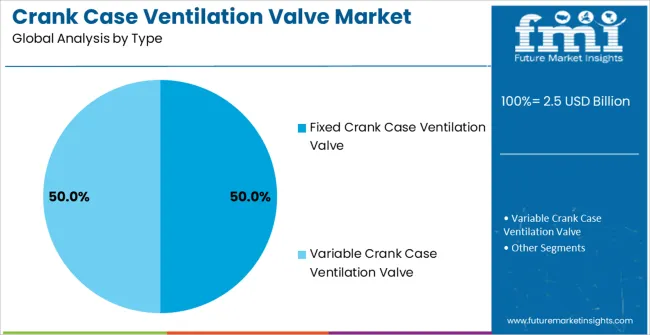
The Fixed Crank Case Ventilation Valve is projected to hold 50.00% of the market revenue in 2026, positioning it as the dominant type. This leadership is being driven by the simplicity, reliability, and cost-effectiveness of fixed valves, which require minimal maintenance while providing consistent performance under varying engine conditions. Fixed valves are widely used across passenger and commercial vehicles due to their durability and ability to withstand high-temperature and high-pressure environments.
The segment’s growth has been supported by increasing production of engines that rely on standardized, proven components for emission control and engine protection. Moreover, fixed valves offer compatibility with a wide range of engine designs, reducing the need for customization and simplifying integration in OEM assembly lines.
The long-term stability and predictability of fixed valves have made them a preferred choice for manufacturers seeking dependable solutions without frequent replacements As engine efficiency and emission compliance continue to be key priorities, the fixed crank case ventilation valve segment is expected to maintain its market leadership.
Market Overview
Crank Case Ventilation Valve Market: Market Outlook
Crank case ventilation is a system that helps to eliminate harmful vapors from engine and helps to prevent vapors from being ejected into the atmosphere. The crank case ventilation valve is operational as both a pollution control device and as well as crank case ventilation system.
Since 1960s, crank case ventilation valve have been standard equipment on all new cars. However, not every petrol engines have these valves. Sometimes, dragsters use scavenger system (device) and venturi tube in the exhaust to take out combust gases and sustain a small quantity of vacuum in the crank case to avoid oil leaks on the track.
Owing to the growing importance to safeguard the global environment, efficient crank case ventilation valves are increasingly critical to diesel engine OEMs (Original Equipment Manufacturers). In future, globally diesel engine emission guidelines will require manufacturers to continue to reduce total particulate emissions.
Recent emission regulations in some countries and market sectors cover total engine emissions that include both crank case and tailpipe. Since crank case emissions contributes up to twenty five percent of total emissions, control of this air contamination source is critical to safeguard the earth’s environment.
Analysis of Crank Case Ventilation Valve Market By Key Countries
.webp "Top Country Growth Comparison Crank Case Ventilation Valve Market Cagr (2026 2036)")
| Country | CAGR |
|---|---|
| China | 6.8% |
| India | 6.3% |
| Germany | 5.8% |
| Brazil | 5.3% |
| USA | 4.8% |
| U.K. | 4.3% |
| Japan | 3.8% |
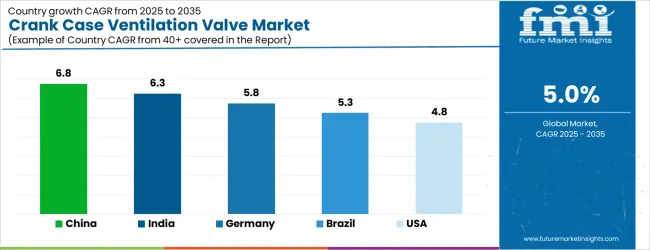
Country-wise Analysis
The Crank Case Ventilation Valve Market is expected to register a CAGR of 5.0% during the forecast period, exhibiting varied country level momentum. China leads with the highest CAGR of 6.8%, followed by India at 6.3%. Developed markets such as Germany, France, and the UK continue to expand steadily, while the USA is likely to grow at consistent rates. Japan posts the lowest CAGR at 3.8%, yet still underscores a broadly positive trajectory for the global Crank Case Ventilation Valve Market. In 2024, Germany held a dominant revenue in the Western Europe market and is expected to grow with a CAGR of 5.8%. The USA Crank Case Ventilation Valve Market is estimated to be valued at USD 943.0 million in 2026 and is anticipated to reach a valuation of USD 943.0 million by 2036. Sales are projected to rise at a CAGR of 0.0% over the forecast period between 2026 and 2036. While Japan and South Korea markets are estimated to be valued at USD 131.1 million and USD 79.8 million respectively in 2026.
Key Players in the Crank Case Ventilation Valve Market
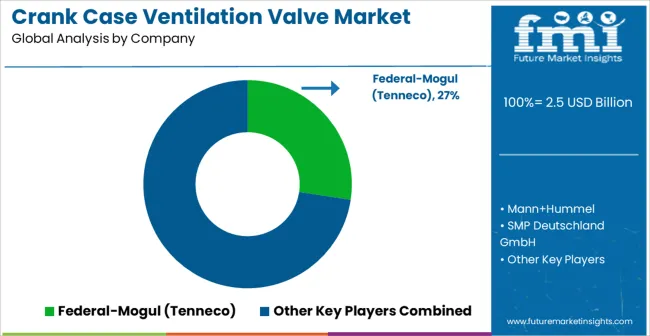
- Federal-Mogul (Tenneco)
- Mann+Hummel
- SMP Deutschland GmbH
- Chongqing Changan Chiyeung Automotive Electrics
- ACDelco
- APA Industries
- DENSO
- Mahle GmbH
Scope of the Report
| Metric | Value |
|---|---|
| Quantitative Units | USD 2.63 billion to USD 4.28 billion, at a CAGR of 5.0% |
| Market Definition | Crank case ventilation valves encompass engineered components regulating blow-by gas flow in internal combustion engines across automotive, construction, marine, military, and aerospace applications. |
| Sales Channel Segmentation | OEM, Aftermarket |
| Fuel Type Segmentation | Diesel Crank Case Ventilation Valve, Gasoline Crank Case Ventilation Valve |
| Valve Type Segmentation | Fixed Crank Case Ventilation Valve, Variable Crank Case Ventilation Valve |
| Vehicle Type Segmentation | Light Duty Crank Case Ventilation Valve, Heavy Duty Crank Case Ventilation Valve |
| End Use Segmentation | Automotive, Construction, Marine, Military, Aerospace |
| Regions Covered | North America, Latin America, Europe, East Asia, South Asia, Oceania, Middle East & Africa |
| Countries Covered | India, Germany, Brazil, USA, UK, Japan, and 40 plus countries |
| Key Companies Profiled | Federal-Mogul (Tenneco), Mann+Hummel, SMP Deutschland GmbH, Chongqing Changan Chiyeung Automotive Electrics, ACDelco, APA Industries, DENSO, Mahle GmbH |
| Forecast Period | 2026 to 2036 |
| Approach | Forecasting models apply a bottom-up methodology starting with OEM vehicle production volumes and aftermarket fleet replacement rates, cross-validated against component manufacturer revenue and emissions regulation compliance timelines. |
Crank Case Ventilation Valve Market by Segments
Sales Channel:
- OEM
- Aftermarket
Fuel Type:
- Diesel Crank Case Ventilation Valve
- Gasoline Crank Case Ventilation Valve
Type:
- Fixed Crank Case Ventilation Valve
- Variable Crank Case Ventilation Valve
Engine:
- Light Duty Crank Case Ventilation Valve
- Heavy Duty Crank Case Ventilation Valve
End Use:
- Automotive
- Construction
- Marine
- Military
- Aerospace
Region:
- North America
- U.S.
- Canada
- Mexico
- Latin America
- Brazil
- Chile
- Rest of Latin America
- Western Europe
- Germany
- U.K.
- Italy
- Spain
- France
- Nordic
- BENELUX
- Rest of Western Europe
- Eastern Europe
- Russia
- Poland
- Hungary
- Balkan & Baltic
- Rest of Eastern Europe
- East Asia
- China
- Japan
- South Korea
- South Asia and Pacific
- India
- ASEAN
- Australia & New Zealand
- Rest of South Asia and Pacific
- Middle East & Africa
- Kingdom of Saudi Arabia
- Other GCC Countries
- Turkiye
- South Africa
- Other African Union
- Rest of Middle East & Africa
Bibliography
- 1. European Commission. (2024). Euro 7 regulation: Emission standards for light-duty and heavy-duty vehicles including crankcase emission requirements. EUR-Lex.
- 2. U.S. Environmental Protection Agency. (2024). EPA Tier 4 emission standards for nonroad diesel engines: Crankcase ventilation compliance guidance. EPA.
- 3. Ministry of Road Transport and Highways, Government of India. (2024). Bharat Stage VI emission standards: Crankcase ventilation system requirements. MoRTH India.
- 4. International Organization for Standardization. (2024). ISO 6299: Crankcase emission measurement methods for reciprocating internal combustion engines. ISO.
- 5. Organisation Internationale des Constructeurs d'Automobiles. (2024). Global vehicle production statistics 2024. OICA.
- 6. Automotive Aftermarket Suppliers Association. (2024). Aftermarket parts demand forecast: Engine management and emission control components. AASA.
This bibliography is provided for reader reference. The full Future Market Insights report contains the complete reference list with primary research documentation.
Frequently Asked Questions
How large is the demand for crank case ventilation valves in the global market in 2026?
Demand for crank case ventilation valves in the global market is estimated to be valued at USD 2.63 billion in 2026.
What will be the market size of crank case ventilation valves by 2036?
Market size for crank case ventilation valves is projected to reach USD 4.28 billion by 2036.
What is the expected demand growth between 2026 and 2036?
Demand for crank case ventilation valves is expected to grow at a CAGR of 5.0% between 2026 and 2036.
Which sales channel is poised to lead by 2026?
OEM channel accounts for 60.0% share in 2026 as engine manufacturers integrate CCV valves into factory-assembled powertrains for emissions regulatory compliance.
Which fuel type leads the market?
Diesel CCV valves hold 55.0% share in 2026 because diesel engines generate higher blow-by gas volumes and particulate loads requiring more complex valve designs with integrated oil separation.
What is driving demand in India?
Expanding commercial vehicle fleet and tightening Bharat Stage emission standards are driving CCV valve adoption in India at 6.3% CAGR through 2036.
What is included in the scope of this report?
The market covers all CCV valve types for internal combustion engines across OEM and aftermarket channels, with breakdowns by sales channel, fuel type, valve type, vehicle type, and end use.
Preview the report firsthand - request a free sample
Get SampleGet the brochure for pricing and purchase details.
Get PDFTable of Content
- Executive Summary
- Global Market Outlook
- Demand-side Trends
- Supply-side Trends
- Technology Roadmap Analysis
- Analysis and Recommendations
- Market Overview
- Market Coverage / Taxonomy
- Market Definition / Scope / Limitations
- Research Methodology
- Chapter Orientation
- Analytical Lens and Working Hypotheses
- Market Structure, Signals, and Trend Drivers
- Benchmarking and Cross-market Comparability
- Market Sizing, Forecasting, and Opportunity Mapping
- Research Design and Evidence Framework
- Desk Research Programme (Secondary Evidence)
- Company Annual and Sustainability Reports
- Peer-reviewed Journals and Academic Literature
- Corporate Websites, Product Literature, and Technical Notes
- Earnings Decks and Investor Briefings
- Statutory Filings and Regulatory Disclosures
- Technical White Papers and Standards Notes
- Trade Journals, Industry Magazines, and Analyst Briefs
- Conference Proceedings, Webinars, and Seminar Materials
- Government Statistics Portals and Public Data Releases
- Press Releases and Reputable Media Coverage
- Specialist Newsletters and Curated Briefings
- Sector Databases and Reference Repositories
- FMI Internal Proprietary Databases and Historical Market Datasets
- Subscription Datasets and Paid Sources
- Social Channels, Communities, and Digital Listening Inputs
- Additional Desk Sources
- Expert Input and Fieldwork (Primary Evidence)
- Primary Modes
- Qualitative Interviews and Expert Elicitation
- Quantitative Surveys and Structured Data Capture
- Blended Approach
- Why Primary Evidence is Used
- Field Techniques
- Interviews
- Surveys
- Focus Groups
- Observational and In-context Research
- Social and Community Interactions
- Stakeholder Universe Engaged
- C-suite Leaders
- Board Members
- Presidents and Vice Presidents
- R&D and Innovation Heads
- Technical Specialists
- Domain Subject-matter Experts
- Scientists
- Physicians and Other Healthcare Professionals
- Governance, Ethics, and Data Stewardship
- Research Ethics
- Data Integrity and Handling
- Primary Modes
- Tooling, Models, and Reference Databases
- Desk Research Programme (Secondary Evidence)
- Data Engineering and Model Build
- Data Acquisition and Ingestion
- Cleaning, Normalisation, and Verification
- Synthesis, Triangulation, and Analysis
- Quality Assurance and Audit Trail
- Market Background
- Market Dynamics
- Drivers
- Restraints
- Opportunity
- Trends
- Scenario Forecast
- Demand in Optimistic Scenario
- Demand in Likely Scenario
- Demand in Conservative Scenario
- Opportunity Map Analysis
- Product Life Cycle Analysis
- Supply Chain Analysis
- Investment Feasibility Matrix
- Value Chain Analysis
- PESTLE and Porter’s Analysis
- Regulatory Landscape
- Regional Parent Market Outlook
- Production and Consumption Statistics
- Import and Export Statistics
- Market Dynamics
- Global Market Analysis 2021 to 2025 and Forecast, 2026 to 2036
- Historical Market Size Value (USD Million) Analysis, 2021 to 2025
- Current and Future Market Size Value (USD Million) Projections, 2026 to 2036
- Y-o-Y Growth Trend Analysis
- Absolute $ Opportunity Analysis
- Global Market Pricing Analysis 2021 to 2025 and Forecast 2026 to 2036
- Global Market Analysis 2021 to 2025 and Forecast 2026 to 2036, By Sales Channel
- Introduction / Key Findings
- Historical Market Size Value (USD Million) Analysis By Sales Channel , 2021 to 2025
- Current and Future Market Size Value (USD Million) Analysis and Forecast By Sales Channel , 2026 to 2036
- OEM
- Aftermarket
- OEM
- Y-o-Y Growth Trend Analysis By Sales Channel , 2021 to 2025
- Absolute $ Opportunity Analysis By Sales Channel , 2026 to 2036
- Global Market Analysis 2021 to 2025 and Forecast 2026 to 2036, By Fuel Type
- Introduction / Key Findings
- Historical Market Size Value (USD Million) Analysis By Fuel Type, 2021 to 2025
- Current and Future Market Size Value (USD Million) Analysis and Forecast By Fuel Type, 2026 to 2036
- Diesel Crank Case Ventilation Valve
- Gasoline Crank Case Ventilation Valve
- Diesel Crank Case Ventilation Valve
- Y-o-Y Growth Trend Analysis By Fuel Type, 2021 to 2025
- Absolute $ Opportunity Analysis By Fuel Type, 2026 to 2036
- Global Market Analysis 2021 to 2025 and Forecast 2026 to 2036, By Type
- Introduction / Key Findings
- Historical Market Size Value (USD Million) Analysis By Type, 2021 to 2025
- Current and Future Market Size Value (USD Million) Analysis and Forecast By Type, 2026 to 2036
- Fixed Crank Case Ventilation Valve
- Variable Crank Case Ventilation Valve
- Fixed Crank Case Ventilation Valve
- Y-o-Y Growth Trend Analysis By Type, 2021 to 2025
- Absolute $ Opportunity Analysis By Type, 2026 to 2036
- Global Market Analysis 2021 to 2025 and Forecast 2026 to 2036, By Engine
- Introduction / Key Findings
- Historical Market Size Value (USD Million) Analysis By Engine, 2021 to 2025
- Current and Future Market Size Value (USD Million) Analysis and Forecast By Engine, 2026 to 2036
- Light Duty Crank Case Ventilation Valve
- Heavy Duty Crank Case Ventilation Valve
- Light Duty Crank Case Ventilation Valve
- Y-o-Y Growth Trend Analysis By Engine, 2021 to 2025
- Absolute $ Opportunity Analysis By Engine, 2026 to 2036
- Global Market Analysis 2021 to 2025 and Forecast 2026 to 2036, By End Use
- Introduction / Key Findings
- Historical Market Size Value (USD Million) Analysis By End Use, 2021 to 2025
- Current and Future Market Size Value (USD Million) Analysis and Forecast By End Use, 2026 to 2036
- Automotive
- Construction
- Marine
- Military
- Aerospace
- Automotive
- Y-o-Y Growth Trend Analysis By End Use, 2021 to 2025
- Absolute $ Opportunity Analysis By End Use, 2026 to 2036
- Global Market Analysis 2021 to 2025 and Forecast 2026 to 2036, By Region
- Introduction
- Historical Market Size Value (USD Million) Analysis By Region, 2021 to 2025
- Current Market Size Value (USD Million) Analysis and Forecast By Region, 2026 to 2036
- North America
- Latin America
- Western Europe
- Eastern Europe
- East Asia
- South Asia and Pacific
- Middle East & Africa
- Market Attractiveness Analysis By Region
- North America Market Analysis 2021 to 2025 and Forecast 2026 to 2036, By Country
- Historical Market Size Value (USD Million) Trend Analysis By Market Taxonomy, 2021 to 2025
- Market Size Value (USD Million) Forecast By Market Taxonomy, 2026 to 2036
- By Country
- USA
- Canada
- Mexico
- By Sales Channel
- By Fuel Type
- By Type
- By Engine
- By End Use
- By Country
- Market Attractiveness Analysis
- By Country
- By Sales Channel
- By Fuel Type
- By Type
- By Engine
- By End Use
- Key Takeaways
- Latin America Market Analysis 2021 to 2025 and Forecast 2026 to 2036, By Country
- Historical Market Size Value (USD Million) Trend Analysis By Market Taxonomy, 2021 to 2025
- Market Size Value (USD Million) Forecast By Market Taxonomy, 2026 to 2036
- By Country
- Brazil
- Chile
- Rest of Latin America
- By Sales Channel
- By Fuel Type
- By Type
- By Engine
- By End Use
- By Country
- Market Attractiveness Analysis
- By Country
- By Sales Channel
- By Fuel Type
- By Type
- By Engine
- By End Use
- Key Takeaways
- Western Europe Market Analysis 2021 to 2025 and Forecast 2026 to 2036, By Country
- Historical Market Size Value (USD Million) Trend Analysis By Market Taxonomy, 2021 to 2025
- Market Size Value (USD Million) Forecast By Market Taxonomy, 2026 to 2036
- By Country
- Germany
- UK
- Italy
- Spain
- France
- Nordic
- BENELUX
- Rest of Western Europe
- By Sales Channel
- By Fuel Type
- By Type
- By Engine
- By End Use
- By Country
- Market Attractiveness Analysis
- By Country
- By Sales Channel
- By Fuel Type
- By Type
- By Engine
- By End Use
- Key Takeaways
- Eastern Europe Market Analysis 2021 to 2025 and Forecast 2026 to 2036, By Country
- Historical Market Size Value (USD Million) Trend Analysis By Market Taxonomy, 2021 to 2025
- Market Size Value (USD Million) Forecast By Market Taxonomy, 2026 to 2036
- By Country
- Russia
- Poland
- Hungary
- Balkan & Baltic
- Rest of Eastern Europe
- By Sales Channel
- By Fuel Type
- By Type
- By Engine
- By End Use
- By Country
- Market Attractiveness Analysis
- By Country
- By Sales Channel
- By Fuel Type
- By Type
- By Engine
- By End Use
- Key Takeaways
- East Asia Market Analysis 2021 to 2025 and Forecast 2026 to 2036, By Country
- Historical Market Size Value (USD Million) Trend Analysis By Market Taxonomy, 2021 to 2025
- Market Size Value (USD Million) Forecast By Market Taxonomy, 2026 to 2036
- By Country
- China
- Japan
- South Korea
- By Sales Channel
- By Fuel Type
- By Type
- By Engine
- By End Use
- By Country
- Market Attractiveness Analysis
- By Country
- By Sales Channel
- By Fuel Type
- By Type
- By Engine
- By End Use
- Key Takeaways
- South Asia and Pacific Market Analysis 2021 to 2025 and Forecast 2026 to 2036, By Country
- Historical Market Size Value (USD Million) Trend Analysis By Market Taxonomy, 2021 to 2025
- Market Size Value (USD Million) Forecast By Market Taxonomy, 2026 to 2036
- By Country
- India
- ASEAN
- Australia & New Zealand
- Rest of South Asia and Pacific
- By Sales Channel
- By Fuel Type
- By Type
- By Engine
- By End Use
- By Country
- Market Attractiveness Analysis
- By Country
- By Sales Channel
- By Fuel Type
- By Type
- By Engine
- By End Use
- Key Takeaways
- Middle East & Africa Market Analysis 2021 to 2025 and Forecast 2026 to 2036, By Country
- Historical Market Size Value (USD Million) Trend Analysis By Market Taxonomy, 2021 to 2025
- Market Size Value (USD Million) Forecast By Market Taxonomy, 2026 to 2036
- By Country
- Kingdom of Saudi Arabia
- Other GCC Countries
- Turkiye
- South Africa
- Other African Union
- Rest of Middle East & Africa
- By Sales Channel
- By Fuel Type
- By Type
- By Engine
- By End Use
- By Country
- Market Attractiveness Analysis
- By Country
- By Sales Channel
- By Fuel Type
- By Type
- By Engine
- By End Use
- Key Takeaways
- Key Countries Market Analysis
- USA
- Pricing Analysis
- Market Share Analysis, 2025
- By Sales Channel
- By Fuel Type
- By Type
- By Engine
- By End Use
- Canada
- Pricing Analysis
- Market Share Analysis, 2025
- By Sales Channel
- By Fuel Type
- By Type
- By Engine
- By End Use
- Mexico
- Pricing Analysis
- Market Share Analysis, 2025
- By Sales Channel
- By Fuel Type
- By Type
- By Engine
- By End Use
- Brazil
- Pricing Analysis
- Market Share Analysis, 2025
- By Sales Channel
- By Fuel Type
- By Type
- By Engine
- By End Use
- Chile
- Pricing Analysis
- Market Share Analysis, 2025
- By Sales Channel
- By Fuel Type
- By Type
- By Engine
- By End Use
- Germany
- Pricing Analysis
- Market Share Analysis, 2025
- By Sales Channel
- By Fuel Type
- By Type
- By Engine
- By End Use
- UK
- Pricing Analysis
- Market Share Analysis, 2025
- By Sales Channel
- By Fuel Type
- By Type
- By Engine
- By End Use
- Italy
- Pricing Analysis
- Market Share Analysis, 2025
- By Sales Channel
- By Fuel Type
- By Type
- By Engine
- By End Use
- Spain
- Pricing Analysis
- Market Share Analysis, 2025
- By Sales Channel
- By Fuel Type
- By Type
- By Engine
- By End Use
- France
- Pricing Analysis
- Market Share Analysis, 2025
- By Sales Channel
- By Fuel Type
- By Type
- By Engine
- By End Use
- India
- Pricing Analysis
- Market Share Analysis, 2025
- By Sales Channel
- By Fuel Type
- By Type
- By Engine
- By End Use
- ASEAN
- Pricing Analysis
- Market Share Analysis, 2025
- By Sales Channel
- By Fuel Type
- By Type
- By Engine
- By End Use
- Australia & New Zealand
- Pricing Analysis
- Market Share Analysis, 2025
- By Sales Channel
- By Fuel Type
- By Type
- By Engine
- By End Use
- China
- Pricing Analysis
- Market Share Analysis, 2025
- By Sales Channel
- By Fuel Type
- By Type
- By Engine
- By End Use
- Japan
- Pricing Analysis
- Market Share Analysis, 2025
- By Sales Channel
- By Fuel Type
- By Type
- By Engine
- By End Use
- South Korea
- Pricing Analysis
- Market Share Analysis, 2025
- By Sales Channel
- By Fuel Type
- By Type
- By Engine
- By End Use
- Russia
- Pricing Analysis
- Market Share Analysis, 2025
- By Sales Channel
- By Fuel Type
- By Type
- By Engine
- By End Use
- Poland
- Pricing Analysis
- Market Share Analysis, 2025
- By Sales Channel
- By Fuel Type
- By Type
- By Engine
- By End Use
- Hungary
- Pricing Analysis
- Market Share Analysis, 2025
- By Sales Channel
- By Fuel Type
- By Type
- By Engine
- By End Use
- Kingdom of Saudi Arabia
- Pricing Analysis
- Market Share Analysis, 2025
- By Sales Channel
- By Fuel Type
- By Type
- By Engine
- By End Use
- Turkiye
- Pricing Analysis
- Market Share Analysis, 2025
- By Sales Channel
- By Fuel Type
- By Type
- By Engine
- By End Use
- South Africa
- Pricing Analysis
- Market Share Analysis, 2025
- By Sales Channel
- By Fuel Type
- By Type
- By Engine
- By End Use
- USA
- Market Structure Analysis
- Competition Dashboard
- Competition Benchmarking
- Market Share Analysis of Top Players
- By Regional
- By Sales Channel
- By Fuel Type
- By Type
- By Engine
- By End Use
- Competition Analysis
- Competition Deep Dive
- Federal-Mogul (Tenneco)
- Overview
- Product Portfolio
- Profitability by Market Segments (Product/Age /Sales Channel/Region)
- Sales Footprint
- Strategy Overview
- Marketing Strategy
- Product Strategy
- Channel Strategy
- Mann+Hummel
- SMP Deutschland GmbH
- Chongqing Changan Chiyeung Automotive Electrics
- ACDelco
- APA Industries
- DENSO
- Mahle GmbH
- Federal-Mogul (Tenneco)
- Competition Deep Dive
- Assumptions & Acronyms Used


