
- Market Size (2026)
- USD 234.3 Mn
- Forecast (2036)
- USD 439.8 Mn
- CAGR (2026 to 2036)
- 6.5%
How big is the Cryosauna and Cryochamber Market in 2026?
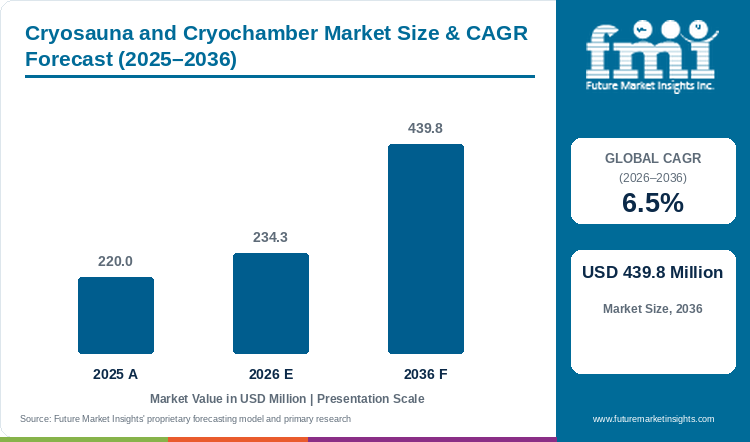
The global cryosauna and cryochamber market is on course to reach USD 439.8 million by 2036, a 6.5% CAGR from 2026 to 2036. The market was valued at USD 220.0 million in 2025 and is estimated at USD 234.3 million in 2026.
Cryosauna and Cryochamber Market Size and Forecast
Table 1: Cryosauna and Cryochamber Market Size and Forecast
| Market size and forecast | Value |
|---|---|
| Market size in 2025 | USD 220.0 million |
| Estimated market size in 2026 | USD 234.3 million |
| Projected market size by 2036 | USD 439.8 million |
| CAGR from 2026 to 2036 | 6.5% |
Source: Future Market Insights analysis of the cryosauna and cryochamber market, 2026.
Equipment buyers are purchasing a repeatable service capability, while the claims used to sell that service remain a material constraint. The FDA's current consumer guidance separates whole-body cryotherapy from circulating-water devices and describes its healing benefits as unconfirmed. Within FMI's outlook, Electric Cryochambers and Cryosaunas share product leadership at 42.0% each.
Engineering competition is more concrete. In September 2025, the Chinese Academy of Sciences reported mechanical whole-body chambers and nitrogen cryosaunas developed through its refrigeration programme. Quantum Cryotherapy announced its British-designed CryoQube in August 2025, including installation, training and maintenance support. Such offers address the facility's ability to commission and keep equipment available. FMI expects that practical distinction to influence supplier selection throughout the forecast period. A site earns no session revenue while equipment awaits technical approval or repair. This assessment therefore isolates chamber and cabin equipment within the broader cryotherapy market and excludes surgical-device demand and procedure revenue.
Key Market Trends & Insights
- Temperature claims require like-for-like comparison. CRYO Science distinguishes the actual air temperature of its e-Arctic from a lower perceived windchill figure. Quoting one as the other changes the apparent specification offered to a buyer.
- Nitrogen equipment remains an active design category. JUKA's current cryosauna description includes separate gas evaporation, extraction ventilation and automated drying. Its investment proposition covers the complete installation and the cabinet.
- Clinical screening is becoming more explicit in the professional evidence base. An April 2025 consensus study used two Delphi rounds completed by 28 European experts to identify contraindications.
Regional Highlights
- China and the United States are gaining share of global revenue. Projected 2036 shares are China 9.1% (from 7.0%) and the United States 30.9% (from 30.0%).
- Share slips for Germany, Russia and Poland as revenue grows. FMI projects Germany at 8.9% against 10.0% in 2026, Russia at 3.3% against 4.0% in 2026 and Poland at 6.5% against 7.0% in 2026 by 2036.
Analyst Perspective
“FMI expects operating readiness to be a stronger basis for supplier differentiation than an isolated minimum-temperature claim. The buyer needs an installation that fits the premises, a clear service responsibility and a defensible description of the sessions it intends to sell. Electric rooms and nitrogen cabins will retain different purchasing cases. Their commercial prospects depend on the facility's actual constraints and repeat customer demand.”
- Anurag Sharma, Principal Consultant, FMI
How is the Cryosauna and Cryochamber Market segmented?
- By product: Electric Cryochambers, Nitrogen Cryochambers, and Cryosaunas.
- By end user: Wellness and Spa Centers, Sports and Fitness Facilities, Physiotherapy and Rehabilitation Clinics, and Dermatology and Aesthetic Clinics.
- By capacity: Single-Person Units and Multi-Person Chambers.
- By region: North America, Western Europe, Eastern Europe, East Asia, and Rest of world.
Why does the Electric Cryochambers segment lead by Product in the Cryosauna and Cryochamber Market in 2026?
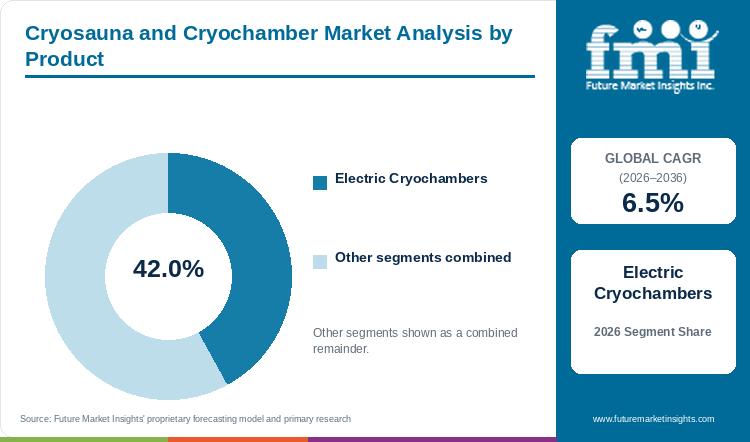
The Electric Cryochambers segment holds 42.0% of the Cryosauna and Cryochamber Market by product in 2026.
Electric equipment addresses sites that prefer refrigeration to a recurring cryogenic-gas supply. Zimmer's icelab range includes compact single-room and larger multi-room systems powered exclusively by electricity. That creates a purchasing distinction at the premises stage. An operator must compare available space and the installed service arrangement before it can compare the equipment's earning potential.
The equal share held by Cryosaunas prevents a simple replacement narrative. Nitrogen cabins remain a substantial commercial choice, and FMI forecasts their revenue at USD 201.3 million in 2036. Their 7.4% CAGR exceeds the 5.9% outlook for Electric Cryochambers. Electric revenue nevertheless rises to USD 174.9 million. A falling share to 39.8% therefore accompanies growth in absolute sales.
For a supplier, the resulting priority is the quality of its addressable projects. Selling a larger refrigeration system into an unsuitable building can create a commissioning problem even when the purchase order is attractive. FMI's view is that room configuration, measured performance and a workable local service agreement deserve more attention than a claim that one cooling method will replace every other option.
Nitrogen Cryochambers and Cryosaunas together hold the remaining 58.0% by product.
Table 2: Product, 2026 Share
| Leading Share | 2026 market share |
|---|---|
| Electric Cryochambers | 42.0% |
| All Other Segments Combined Share | 58.0% |
Source: Future Market Insights analysis of the cryosauna and cryochamber market, 2026.
Why does the Wellness and Spa Centers segment lead by End User in the Cryosauna and Cryochamber Market in 2026?
The Wellness and Spa Centers segment holds 38.0% of the Cryosauna and Cryochamber Market by end user in 2026.
Wellness buyers evaluate whether the chamber strengthens an existing paid experience. The purchasing case is different from a hospital acquiring a device for a defined clinical pathway. MECOTEC's August 2026 account placed a cryo:one+ within the Blu Zone at Fairmont Mumbai during The Longevity Summit India.
The end-user outlook leaves considerable business outside spas. Sports and Fitness Facilities represent 30.0% in 2026, while Physiotherapy and Rehabilitation Clinics hold 24.0%. Dermatology and Aesthetic Clinics account for 8.0%. Those shares require suppliers to distinguish between a chamber installation and localized cold devices sold into the same premises. The latter belong to a wider physiotherapy equipment purchasing budget but are excluded from chamber revenue here.
FMI projects Wellness and Spa Centers at USD 171.8 million in 2036, with a 6.8% CAGR. Retaining that opportunity depends on repeat use and continued operation. Equipment downtime removes the revenue a premium reception area is meant to support. Manufacturers serving this category therefore need an offer whose installation and after-sales responsibilities are understandable to a business that may operate several different wellness technologies.
Sports and Fitness Facilities, Physiotherapy and Rehabilitation Clinics and Dermatology and Aesthetic Clinics together hold the remaining 62.0% by end user.
Table 3: End User, 2026 Share
| Leading Share | 2026 market share |
|---|---|
| Wellness and Spa Centers | 38.0% |
| All Other Segments Combined Share | 62.0% |
Source: Future Market Insights analysis of the cryosauna and cryochamber market, 2026.
Why does the Single-Person Units segment lead by Capacity in the Cryosauna and Cryochamber Market in 2026?
The Single-Person Units segment holds 76.0% of the Cryosauna and Cryochamber Market by capacity in 2026.
Single-person units lead because a whole-body session normally treats one client at a time, and a cabin of that size fits a studio, clinic or sports-club room without major building work. One European supplier offers nitrogen cabins and multiperson chambers, which shows that both formats are built, but the multiperson room needs more space and a larger refrigeration or gas installation.
Multi-person chambers address operators with team or group demand, such as sports facilities. The choice between sizes also interacts with the electric or nitrogen decision.
FMI's 2026 assessment values Single-Person Units at USD 178.1 million. A sports club or rehabilitation centre that wants simultaneous use would move towards multiperson rooms, but that purchase carries higher installation cost and fewer buyers. Suppliers should quote building work and recurring inputs separately from the unit price.
Multi-Person Chambers together hold the remaining 24.0% by capacity.
Table 4: Capacity, 2026 Share
| Leading Share | 2026 market share |
|---|---|
| Single-Person Units | 76.0% |
| All Other Segments Combined Share | 24.0% |
Source: Future Market Insights analysis of the cryosauna and cryochamber market, 2026.
What are the key drivers restraints and opportunities?
Growth depends on facilities adding repeatable cold-exposure services. Site engineering and uncertain therapeutic claims constrain adoption. Suppliers can win through a clear installation offer and support that remains available after commissioning.
Driver
Existing recovery and wellness venues are incorporating chamber access into a larger service mix. The equipment sale depends on the venue's commissioning decision. The service side of those venues is covered in FMI's fitness recovery services market.
Restraint
The facility must fund installation and continued operation while avoiding unsupported promises. The FDA's distinction between whole-body exposure and other cold therapies makes claim discipline commercially significant.
Opportunity
Suppliers that define service access, actual chamber conditions and installation responsibilities can make bids easier to compare. This is especially relevant when the buyer is choosing between gas-dependent and electric designs.
How do purchasing rules and qualification affect cryosauna and cryochamber market demand?
The most visible demand is a completed project with an operating service. For equipment manufacturers, such projects create a sales opportunity when the operator has settled its location and operating concept. Forecast growth should therefore be assessed against commissioning progress and replacement demand.
Repeat purchases also depend on what happens after the first room opens. FMI sees a commercial distinction between a buyer expanding an established format and one testing its first location. The established operator has its own usage and maintenance history. That evidence can shape its next specification and reduce uncertainty about a second purchase. Manufacturers able to preserve service continuity have a better opportunity to participate in that later order.
What limits reliable cryosauna and cryochamber market supply and quality?
The term cryotherapy covers very different products. Cryonic Medical's Cryoscreen is a localized CO2 system, while Kriomedpol's current catalogue emphasizes local cryotherapy and cryosurgery. Buyers face a similar distinction when comparing capital equipment with lower-cost hot and cold therapy options. Clinical evidence and operating requirements differ between those categories.
There is also a channel risk after installation. CRIOTEC's official website states that the business ceased activity permanently on 30 September 2026. The closure shows why a purchaser needs to know who carries continuing service obligations, which sit outside the product specification.
Where can suppliers win additional business in the cryosauna and cryochamber market?
A credible bid can separate equipment price from building work, recurring inputs and after-sales support. Quantum Cryotherapy's 2025 launch description explicitly included a premises survey, training and ongoing maintenance. Such a proposition makes the delivery responsibility visible. Actual payback still depends on the venue's costs and paid usage.
FMI expects this approach to matter most where facilities are comparing unlike designs. A buyer can then decide which costs it is willing to carry directly and which it wants the supplier to manage. The opportunity is commercially specific: turn an uncertain installation into a clearly scoped project, then retain the account through dependable service. The same discipline should govern expansion into medical premises, where intended use and the support required by clinical staff may differ from a spa installation.
Cryosauna and Cryochamber Market by Country (2026 to 2036)
Table 5: Cryosauna and Cryochamber Market Country Growth Forecast
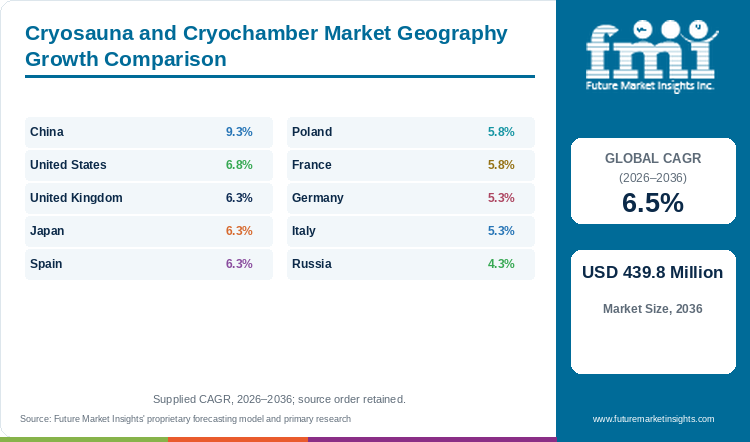
| Country | CAGR, 2026 to 2036 |
|---|---|
| China | 9.3% |
| United States | 6.8% |
| United Kingdom | 6.3% |
| Japan | 6.3% |
| Spain | 6.3% |
| Poland | 5.8% |
| France | 5.8% |
| Germany | 5.3% |
| Italy | 5.3% |
| Russia | 4.3% |
Source: Future Market Insights analysis of the cryosauna and cryochamber market, 2026.
China
Domestic refrigeration development gives China a distinct route into this market. The Chinese Academy of Sciences reported in September 2025 that its team had developed mechanical whole-body chambers, nitrogen saunas and localized equipment. The programme addressed cooling efficiency, temperature distribution and other engineering limitations.
The same report documented use of a nitrogen sauna by the national women's hockey team during training and competition. FMI reads this as evidence of an identifiable professional-sport application. For commercial suppliers, the important link is the progression from a refrigeration research programme into equipment used in a real sporting setting.
China records the fastest national forecast in this report at a CAGR of 9.3% from 2026 to 2036. Revenue rises from USD 16.4 million to USD 39.9 million. FMI expects the opportunity to involve competition between locally developed equipment and imported systems. Buyers will still need to compare the exact configuration they are being offered. Manufacturers seeking repeat orders must show how laboratory engineering translates into equipment that can be commissioned and supported at the customer site. That transition is more commercially meaningful than treating all cold-therapy technology as one undifferentiated category. China records a USD 23.5 million increase, second of the ten. Global revenue share for China increases from 7.0% to 9.1%. From 2026 to 2036, revenue in China rises 2.4 times and global revenue 1.9 times.
United States
The American opportunity is led by equipment sold into a wellness service business, where the operator's promise to its customer matters as much as the machine's specification. The US icelab brochure explicitly says the device is not intended to diagnose, treat, cure or prevent disease or chronic illness. This is a concrete limitation on how that particular offer should be positioned.
FMI forecasts a 6.8% CAGR in the United States from 2026 to 2036. National revenue rises from USD 70.3 million to USD 135.7 million in that outlook. The forecast requires an equipment-sales pathway through opening locations, replacement rooms and additional sites. Global revenue share for the United States increases from 30.0% to 30.9%. The United States records a USD 65.4 million increase, first of the ten. The United States' 2026 revenue ranks first of ten. A 6.8% CAGR leaves the United States 0.3 points above the 6.5% global pace. The gain of USD 65.4 million equals 31.8% of the global increase of USD 205.5 million.
The FDA's current description of whole-body cryotherapy benefits as unconfirmed also limits the strength of a medical sales argument. FMI consequently places more weight on how a venue intends to operate and support the equipment. An equipment maker can state its actual intended use and performance directly. The stronger commercial account is one with a viable venue and clearly assigned support responsibilities.
United Kingdom
The UK market includes both locally engineered equipment and specialist businesses selling paid sessions. Quantum Cryotherapy's August 2025 CryoQube launch described indirect nitrogen cooling, with the cryogenic gas kept separate from the user air. It also offered premises assessment, installation and continuing support. The company's claim to be the first entirely British-designed system remains its own claim. The commercially relevant fact is the introduction of a domestic supplier with a defined project-delivery offer.
At the retail end, Finchley operator EK Cryo identifies an electric Lifecube system and lists a GBP 45.0 single session alongside a GBP 99.0 four-session package. Package selling means the venue's advertised single-session price is an incomplete guide to its receipts. An equipment bid therefore needs to fit the operator's actual selling model, with payback based on realised receipts and not the headline session fee.
FMI expects UK equipment sales to increase at a 6.3% CAGR from 2026 to 2036. Revenue reaches USD 25.9 million by 2036 from USD 14.1 million in 2026. The national opportunity is therefore substantial enough to attract different supply models, but it remains smaller than the American market. FMI sees room for domestic installation expertise where buyers want direct responsibility for the entire project. Imported equipment remains a credible alternative when local service is demonstrably available. UK growth of 6.3% trails the 6.5% global rate by 0.2 percentage points.
Japan
Japan has a documented sports-science basis for comparing equipment formats. A 2019 Japan Institute of Sports Sciences study compared tank-type and chamber-type systems in five adult men. The small sample and the biological measures used limit the conclusion.
Its commercial relevance is the distinction between the exposure environments. The paper discussed constraints associated with nitrogen availability and single-person use, alongside the different characteristics of a chamber. Those are purchasing considerations for a sports facility even when the broader efficacy question remains unsettled. FMI expects buyers with established sports-science teams to examine measured operating conditions and the equipment's fit with their facility, and not rely on a manufacturer's lowest advertised temperature.
The Japanese market is projected to rise from USD 11.7 million in 2026 to USD 21.6 million in 2036. This implies a 6.3% CAGR over 2026 to 2036. The outlook is compatible with a specialist equipment business. The strongest supplier case is a clearly specified room or cabin supported by appropriate local technical capability. FMI also distinguishes research use from recurring commercial replacement demand. A published study may influence specifications, but another equipment sale occurs only when an institution or operator commits to an acquisition. In the cryosauna and cryochamber market, Japan grows 6.3% a year, 0.2 points below the global rate. Japan's 2026 revenue ranks seventh of ten.
Spain
Spain offers a visible distributor route into professional cold-exposure equipment. Valencia-based Sunmarket lists CRYO Science whole-body products alongside localized devices and describes installation, training and maintenance within its commercial offer. The mixed catalogue makes scope checking important.
The demand side includes sports-care providers. KLINIK PM in Alicante identifies whole-body and localized cryotherapy within its Recovery Studio. This supports a concrete example of a service setting. For an equipment seller, the useful fact is that a chamber can sit alongside several other technologies competing for the same facility budget.
FMI projects Spanish equipment revenue to grow at a 6.3% CAGR from 2026 to 2036. The market rises from USD 7.0 million to USD 12.9 million. Manufacturers seeking this demand need to account for the distributor's role in commissioning and after-sales work. A locally understandable support offer can be particularly relevant when the buyer is comparing several equipment modalities at once. FMI expects suppliers to benefit from explaining the chamber's complete installation requirements and separating them from unrelated localized products. This creates a more credible route to a purchase decision than presenting every recovery technology as interchangeable. Revenue in Spain climbs by USD 5.9 million, ninth among the ten. Spain represents 3.0% of the global total in 2026, then 2.9% in 2036. At 6.3% CAGR, Spain grows 0.2 percentage points slower than the 6.5% global rate.
Poland
Poland's role extends beyond domestic consumer demand because local manufacturing supplies distinct nitrogen equipment formats. One manufacturer describes both a single-person cryosauna and a multiperson nitrogen cryochamber. Its current product pages state medical-device certification, which is a manufacturer-specific assertion. The availability of both formats gives purchasing teams separate choices for individual service and a larger room installation.
FMI's Polish equipment outlook expands from USD 16.4 million in 2026 to USD 28.8 million by 2036. The corresponding CAGR is 5.8% over 2026 to 2036. National demand should be kept separate from the export activity of Polish manufacturers. A cabinet made in Poland and sold abroad supports the supplier's business, but its destination determines where equipment demand is recorded in this assessment. Poland's weight in the world total is 7.0% in 2026 and 6.5% in 2036.
There is also a useful boundary within the domestic supplier base. Kriomedpol's current public offer centres on local cryotherapy equipment, cryosurgery and liquid-nitrogen accessories. Those capabilities are relevant to a physiotherapy buyer's wider expenditure. FMI sees Poland's commercial position as a combination of specialist cabin supply and a broader cold-therapy industry. The actionable distinction for buyers is the exact product being acquired, its intended use and the support attached to it. A shared cryogenic label is insufficient to make two offers equivalent.
France
French purchasing involves a particularly visible distinction between medical use and a wellness proposition. In its January 2023 parliamentary response, the government described limits on medical use by non-health professionals and distinguished aesthetic applications that do not destroy skin tissue. The response's date and scope matter. It provides evidence of the intended-use boundary.
The distribution channel has also changed. CRIOTEC's current official website states that it ceased activity permanently on 30 September 2026. A buyer relying on an older distributor listing would therefore have an incomplete picture of the service arrangement. It creates a specific need to confirm which business is responsible for an affected equipment account.
Against those conditions, FMI forecasts French market revenue at USD 16.4 million in 2026 and USD 28.8 million in 2036. The 5.8% CAGR from 2026 to 2036 depends on continuing purchases within properly defined operating settings. FMI sees service continuity as an important differentiator for suppliers addressing replacement or expansion projects. A clear equipment warranty needs a functioning route for technical assistance. The purchaser should be able to identify that route independently of promotional material describing the physiological effects of cold exposure. This gives current manufacturers and distributors a concrete account-retention challenge. France's 5.8% CAGR sits 0.7 points below the global 6.5%. France adds USD 12.4 million over the decade. Global revenue share for France decreases from 7.0% to 6.5%.
Germany
Germany is both a customer market and an engineering base for electric chambers. The current icelab offer spans compact single-room systems and larger multi-room configurations developed and built in Germany. This range is commercially important because floor space and project scale are decided before a facility can compare the economics of a completed installation. Each building and operating plan needs its own configuration.
The national outlook advances at a 5.3% CAGR between 2026 and 2036, taking equipment revenue from USD 23.4 million to USD 39.3 million. FMI expects an established domestic supply base to shape competition around configuration and continued technical support. A manufacturer with several room options can address different projects. Project suitability remains a separate question from the supplier's catalogue breadth. Germany adds USD 15.9 million over the decade. Global revenue share for Germany decreases from 10.0% to 8.9%.
For German buyers considering electric systems, the comparison with nitrogen equipment should include the complete premises requirement. Eliminating gas replenishment changes one operating obligation, while the refrigeration installation still needs to be properly specified. FMI sees an opportunity in replacement and refurbishment projects where the owner already understands its customer flow. Those operators can judge the value of additional space or a different room layout against their own experience. The domestic manufacturer's task is to translate that experience into a suitable specification for a properly commissioned room.
Italy
Private rehabilitation access gives Italy a different commercial structure from a purely recreational spa market. Auxologico's cryotherapy page, updated in July 2026, identifies private access at its Meda rehabilitation site. It lists EUR 35.0 for a single session and EUR 160.0 for five sessions. This is evidence of a functioning provider offer. It makes repeat private attendance relevant to the provider's operating case.
The institution also reported its participation in research on contraindications and rehabilitation in March 2026. The combination of service provision and research creates a particular procurement setting. A rehabilitation operator can require a different clinical workflow from a wellness venue, while both still need the equipment to remain available. FMI sees that distinction as relevant to technical training and supplier support.
Italy's forecast equipment revenue grows from USD 9.4 million in 2026 to USD 15.7 million in 2036. The 5.3% CAGR from 2026 to 2036 reflects a more measured expansion than the Chinese outlook. Within that opportunity, manufacturers need to understand whether the customer is buying for private rehabilitation access, professional sport or general wellness. Each route carries a different operating concept. A clear specification and intended-use description make the transaction easier to assess. FMI expects the quality of the installation and the continuity of the supplier relationship to matter more than an unsupported promise of short payback. Italy adds USD 6.3 million, ranking eighth for increase.
Russia
An established institutional physiotherapy setting is visible in Russia's primary provider material. The National Medical Research Center for Rehabilitation and Balneology identifies general cryotherapy in a three-stage air cryosauna. The terminology is broader than the product labels used by some Western manufacturers. Equipment should therefore be classified by its actual configuration and not by the word sauna.
FMI forecasts a 4.3% CAGR in Russia between 2026 and 2036. Equipment revenue increases from USD 9.4 million to USD 14.3 million. This is the slowest rate among the ten national profiles. The forecast should be read as an equipment outlook within a defined market boundary. Global revenue share for Russia decreases from 4.0% to 3.3%. The USD 4.9 million rise over the decade ranks Russia last for increase. Measured by 2026 revenue, Russia sits joint eighth of ten.
For suppliers, the institutional context places weight on maintaining an existing service capability. A centre already combining several physiotherapy modalities has a different purchasing decision from a new stand-alone wellness studio. FMI sees replacement suitability and technical continuity as relevant commercial considerations. A new system must fit the department's working arrangements and the provider's service responsibilities. Equipment orders remain dependent on specific replacement or expansion decisions. This makes verified customer projects more useful to a supplier than a broad claim about the popularity of cold exposure.
Who are the notable companies in the Cryosauna and Cryochamber Market?
Notable companies in the Cryosauna and Cryochamber Market include Zimmer MedizinSysteme, MECOTEC, JUKA, Cryo Science and Cryonic Medical.
The competitive structure follows the equipment being sold. Zimmer MedizinSysteme offers electric icelab rooms. MECOTEC also competes in electric chambers, while JUKA's public range covers nitrogen cryosaunas and multiperson chambers. Cryo Science offers electric and nitrogen-related whole-body systems alongside localized products. These differences create distinct project requirements.
Cryonic Medical's Cryoscreen is a localized CO2 device. Kriomedpol's current catalogue features local cryotherapy, cryosurgery and accessories. They can compete for a rehabilitation or aesthetic facility's broader budget, but their documented local products are excluded from the chamber revenue assessed here.
FMI's view is that manufacturers compete through the responsibility they can accept for an operating installation. A refrigeration-room specialist, a nitrogen-cabin maker and a local cold-therapy supplier each need their own capability description. Buyers also need to identify the legal service provider behind the sale. The CRIOTEC closure provides a dated example of why historical distribution coverage is not sufficient evidence of current support.
Electric-room suppliers: Zimmer MedizinSysteme and MECOTEC.
Whole-body suppliers with different cooling formats: JUKA and Cryo Science.
Adjacent local cold-therapy specialists: Cryonic Medical and Kriomedpol.
Key Developments in the Cryosauna and Cryochamber Market
- August 2026: MECOTEC placed its cryo:one+ within the Blu Zone at Fairmont Mumbai during The Longevity Summit India on 15 to 16 August. The placement was a summit demonstration.
- September 2026: CRIOTEC permanently ceased activity on 30 September, according to its current official website. The event affects the interpretation of older French distributor listings and the need to confirm ongoing service responsibility.
Key Players in the Cryosauna and Cryochamber Market
- Zimmer MedizinSysteme
- MECOTEC
- JUKA
- Cryo Science
- Cryonic Medical
- Kriomedpol
Cryosauna and Cryochamber Market Report Scope
Table 6: Cryosauna and Cryochamber Market Report Scope
| Coverage field | Report scope |
|---|---|
| Market definition | Commercial equipment revenue from cryosaunas and whole-body cryochambers sold to professional facilities. |
| Product boundaries | Electric Cryochambers, Nitrogen Cryochambers and Cryosaunas, including head-out cabins within the commercial scope. |
| Exclusions | Session-service revenue, localized cold devices, surgical cryoablation, cold-water baths and standalone cryogenic gas sales. |
| Quantitative Units | USD million |
| End users | Wellness and Spa Centers. Sports and Fitness Facilities. Physiotherapy and Rehabilitation Clinics. Dermatology and Aesthetic Clinics. |
| National coverage | United States, Germany, Poland, France, China, United Kingdom, Japan, Italy, Russia and Spain. Rest of world as an aggregate. |
| Capacity coverage | Single-Person Units, Multi-Person Chambers. |
| Company coverage | Zimmer MedizinSysteme, Cryonic Medical, MECOTEC, Kriomedpol, JUKA and Cryo Science, with direct and adjacent roles distinguished. |
Source: Future Market Insights analysis of the cryosauna and cryochamber market, 2026.
Cryosauna and Cryochamber Market Research Methodology
The assessment combines FMI's equipment outlook with secondary review of original institutional research, regulator guidance and current manufacturer and provider material. Checks distinguish equipment units from sessions, direct chamber offers from adjacent cold devices and documented activity from promotional efficacy claims. Country interpretations retain the scope and date of each cited example. Competitive positions describe verified product roles without assigning unsupported company shares.
Cryosauna and Cryochamber Market by Segments
Cryosauna and Cryochamber Market segmented by Product:
- Electric Cryochambers
- Nitrogen Cryochambers
- Cryosaunas
Cryosauna and Cryochamber Market segmented by End User:
- Wellness and Spa Centers
- Sports and Fitness Facilities
- Physiotherapy and Rehabilitation Clinics
- Dermatology and Aesthetic Clinics
Cryosauna and Cryochamber Market segmented by Capacity:
- Single-Person Units
- Multi-Person Chambers
Cryosauna and Cryochamber Market by Region
- North America
- United States
- Western Europe
- Germany
- France
- United Kingdom
- Italy
- Spain
- Eastern Europe
- Poland
- Russia
- East Asia
- China
- Japan
- Rest of world
Research Sources and Bibliography
- Capodaglio, P., et al. (15 April 2025). Contraindications to Whole-Body Cryostimulation: A Position Paper from the WBC Working Group of the International Institute of Refrigeration and the Multidisciplinary Expert Panel. Frontiers in Rehabilitation Sciences, 6, 1567402. https://doi.org/10.3389/fresc.2025.1567402
- CRIO TEC. (30 September 2026 cessation date; accessed 9 November 2026). Notice of Permanent Cessation of Activity [French]. https://criotec.fr/index.html
- CRYO. (Accessed 9 November 2026). CRYO e-Arctic Electric Cryotherapy Chamber. https://cryo.com/cryo-e-arctic/
- CRYO Science. (Accessed 9 November 2026). Cryotherapy Products and Company Locations. https://www.cryosc.com/ and https://www.cryosc.com/about-us/
- Cryonic Medical. (Accessed 9 November 2026). Cryoscreen: Device. https://cryonic-medical.com/en/device/
- Dohi, M., et al. (2019). Comparison of Biological Responses by Whole Body Cryotherapy Between Tank-Type and Chamber-Type Machines. Journal of High Performance Sport, 4, 141-144. https://www.jpnsport.go.jp/hpsc/Portals/0/resources/jiss/info/doc/JHPS/JHPS_18-13.pdf
- EK Cryo. (Accessed 9 November 2026). Whole Body Cryotherapy in Finchley, London. https://ekcryo.co.uk/cryotherapy/
- French National Assembly. (17 January 2023). Response to Written Question 1412: Cryotherapy Reserved for Doctors and Physiotherapists [French]. https://www.assemblee-nationale.fr/dyn/16/questions/QANR5L16QE1412
- Istituto Auxologico Italiano. (4 March 2026). Whole Body Cryostimulation: Auxologico Research for Rehabilitation [Italian]. https://www.auxologico.it/news/crioterapia-total-body-riabilitazione
- Istituto Auxologico Italiano. (Updated 3 July 2026). Cryotherapy: Private Access and Equipment [Italian]. https://www.auxologico.it/crioterapia
- JUKA. (Accessed 9 November 2026). Cryochamber: Multiperson Nitrogen Cryogenic Chamber. https://juka.com.pl/en/cryogenic/medical-devices/cryochamber
- JUKA. (Accessed 9 November 2026). Cryosauna: Single-Person Nitrogen Cryogenic Chamber. https://juka.com.pl/en/cryogenic/medical-devices/cryosauna
- JUKA. (Accessed 9 November 2026). New Generation Cryosauna: Combining Technology and Safety. https://juka.com.pl/en/news/531-new-generation-cryosauna-combining-technology-and-safety
- KLINIK PM. (Accessed 9 November 2026). Football Medicine Alicante: Recovery Studio. https://www.klinikpm.es/en/medicina-futbol-alicante/
- Kriomedpol. (Accessed 9 November 2026). Product Offer: Cryotherapy, Cryosurgery and Accessories [Polish]. https://kriomedpol.pl/pl/
- MECOTEC. (16 August 2026). MECOTEC Draws Strong Interest at The Longevity Summit India 2026. Corporate press releases. https://mecotec.net/en/events-news/press-releases
- National Medical Research Center for Rehabilitation and Balneology, Russian Ministry of Health. (Accessed 9 November 2026). Equipment-Based Physiotherapy: General Cryotherapy [Russian]. https://nmicrk.ru/pacientam/metody-lecheniya1/fizioterapiya-apparatnaya
- Quantum Cryotherapy. (28 August 2025). World's First Entirely British Designed, Manufactured and Installed Indirect Whole Body Cryotherapy Chamber. https://www.quantumcryotherapy.com/worlds-first-entirely-british-designed-manufactured-and-installed-indirect-whole-body-cryotherapy-chamber/
- Sunmarket Wellness. (Accessed 9 November 2026). Professional Cryotherapy Cryosauna Equipment. https://www.sunmarket.es/en/cryotherapy-cabins-cryosauna/
- Technical Institute of Physics and Chemistry, Chinese Academy of Sciences. (17 September 2025). Progress in the Development of Low-Temperature Cryotherapy Equipment [Chinese]. https://www.ipc.ac.cn/xwzx/kyjz/202509/t20250917_7969499.html
- US Food and Drug Administration. (Accessed 9 November 2026). Cold Facts to Help Avoid Injury from Water-Circulating Hot/Cold Therapy Devices. https://www.fda.gov/consumers/consumer-updates/cold-facts-help-avoid-injury-water-circulating-hotcold-therapy-devices
- Zimmer MedizinSysteme. (Accessed 9 November 2026). Whole Body Cold Application: icelab. https://www.zimmer.de/en/products/whole-body-cold-application/
- Zimmer MedizinSystems USA. (Accessed 9 November 2026). icelab Brochure and Intended-Use Statement. https://zimmerusa.com/products/cryo-therapy/icelab/icelab-brochure/
This bibliography is provided for reader reference and is not exhaustive. The full report contains the complete reference list and detailed citations.
Table of Content
- Key Takeaways
- Market Size and CAGR
- Top Growth Driver
- Fastest Growing Segment
- Leading Region
- Key Companies
- Emerging Opportunities
- Executive Summary
- Global Market Outlook
- Demand-side Trends
- Supply-side Trends
- Technology Roadmap Analysis
- Analysis and Recommendations
- Analyst Perspective (What is happening? Why now? What should investors know?)
- Key Questions Answered
- How large is the market?
- What is the CAGR?
- What are key trends?
- Which region dominates?
- Who are the leaders?
Read More...
- Market Overview
- Market Coverage / Taxonomy
- Market Definition / Scope / Limitations
- Research Methodology
- Chapter Orientation
- Analytical Lens and Working Hypotheses
- Market Structure, Signals, and Trend Drivers
- Benchmarking and Cross-market Comparability
- Market Sizing, Forecasting, and Opportunity Mapping
- Research Design and Evidence Framework
- Desk Research Programme (Secondary Evidence)
- Expert Input and Fieldwork (Primary Evidence)
- Tooling, Models, and Reference Databases
- Data Engineering and Model Build
- Quality Assurance and Audit Trail
- Market Background
- Market Dynamics (Drivers, Restraints, Opportunity, Trends)
- Scenario Forecast (Optimistic, Likely, Conservative)
- Impact Analysis
- AI Impact
- Sustainability Impact
- Regulatory Impact
- Technology Impact
- Consumer / Buyer Analysis
- Purchase Drivers
- Adoption Barriers
- Buyer Journey
- Opportunity Map Analysis
- Product Life Cycle Analysis
- Supply Chain Analysis
- Investment Feasibility Matrix
- Value Chain Analysis
- PESTLE and Porter's Analysis
- Regulatory Landscape
- Regional Parent Market Outlook
- Production and Consumption Statistics
- Import and Export Statistics
- Global Market Analysis and Forecast, 2021 to 2036
- Historical Market Size Value (USD Million) Analysis, 2021 to 2025
- Current and Future Market Size Value (USD Million) Projections, 2026 to 2036
- Y-o-Y Growth Trend Analysis
- Absolute $ Opportunity Analysis
- Global Market Pricing Analysis, 2021 to 2036
- Global Market Analysis and Forecast, By Product, 2021 to 2036
- Introduction / Key Findings
- Historical Market Size Value (USD Million) Analysis By Product, 2021 to 2025
- Current and Future Market Size Value (USD Million) Analysis and Forecast By Product, 2026 to 2036
- Electric Cryochambers
- Nitrogen Cryochambers
- Cryosaunas
- Y-o-Y Growth Trend Analysis By Product, 2021 to 2025
- Absolute $ Opportunity Analysis By Product, 2026 to 2036
- Global Market Analysis and Forecast, By End User, 2021 to 2036
- Introduction / Key Findings
- Historical Market Size Value (USD Million) Analysis By End User, 2021 to 2025
- Current and Future Market Size Value (USD Million) Analysis and Forecast By End User, 2026 to 2036
- Wellness and Spa Centers
- Sports and Fitness Facilities
- Physiotherapy and Rehabilitation Clinics
- Dermatology and Aesthetic Clinics
- Y-o-Y Growth Trend Analysis By End User, 2021 to 2025
- Absolute $ Opportunity Analysis By End User, 2026 to 2036
- Global Market Analysis and Forecast, By Capacity, 2021 to 2036
- Introduction / Key Findings
- Historical Market Size Value (USD Million) Analysis By Capacity, 2021 to 2025
- Current and Future Market Size Value (USD Million) Analysis and Forecast By Capacity, 2026 to 2036
- Single-Person Units
- Multi-Person Chambers
- Y-o-Y Growth Trend Analysis By Capacity, 2021 to 2025
- Absolute $ Opportunity Analysis By Capacity, 2026 to 2036
- Global Market Analysis and Forecast, By Region, 2021 to 2036
- Introduction
- Historical Market Size Value (USD Million) Analysis By Region, 2021 to 2025
- Current Market Size Value (USD Million) Analysis and Forecast By Region, 2026 to 2036
- North America
- Western Europe
- Eastern Europe
- East Asia
- Market Attractiveness Analysis By Region
- North America Market Analysis and Forecast, By Country, 2021 to 2036
- Historical Market Size Value (USD Million) Trend Analysis By Market Taxonomy, 2021 to 2025
- Market Size Value (USD Million) Forecast By Market Taxonomy, 2026 to 2036
- By Country
- United States
- By Product
- By End User
- By Capacity
- By Country
- Market Attractiveness Analysis
- By Country
- By Product
- By End User
- By Capacity
- Key Takeaways
- Western Europe Market Analysis and Forecast, By Country
- Historical Market Size Value (USD Million) Trend Analysis By Market Taxonomy, 2021 to 2025
- Market Size Value (USD Million) Forecast By Market Taxonomy, 2026 to 2036
- By Country
- Germany
- France
- United Kingdom
- Italy
- Spain
- By Product
- By End User
- By Capacity
- By Country
- Market Attractiveness Analysis
- By Country
- By Product
- By End User
- By Capacity
- Key Takeaways
- Eastern Europe Market Analysis and Forecast, By Country
- Historical Market Size Value (USD Million) Trend Analysis By Market Taxonomy, 2021 to 2025
- Market Size Value (USD Million) Forecast By Market Taxonomy, 2026 to 2036
- By Country
- Poland
- Russia
- By Product
- By End User
- By Capacity
- By Country
- Market Attractiveness Analysis
- By Country
- By Product
- By End User
- By Capacity
- Key Takeaways
- East Asia Market Analysis and Forecast, By Country
- Historical Market Size Value (USD Million) Trend Analysis By Market Taxonomy, 2021 to 2025
- Market Size Value (USD Million) Forecast By Market Taxonomy, 2026 to 2036
- By Country
- China
- Japan
- Rest of world
- By Product
- By End User
- By Capacity
- By Country
- Market Attractiveness Analysis
- By Country
- By Product
- By End User
- By Capacity
- Key Takeaways
- Key Countries Market Analysis
- United States
- Pricing Analysis
- Market Share Analysis, 2025
- By Product
- By End User
- By Capacity
- Germany
- Pricing Analysis
- Market Share Analysis, 2025
- By Product
- By End User
- By Capacity
- United Kingdom
- Pricing Analysis
- Market Share Analysis, 2025
- By Product
- By End User
- By Capacity
- Italy
- Pricing Analysis
- Market Share Analysis, 2025
- By Product
- By End User
- By Capacity
- Spain
- Pricing Analysis
- Market Share Analysis, 2025
- By Product
- By End User
- By Capacity
- France
- Pricing Analysis
- Market Share Analysis, 2025
- By Product
- By End User
- By Capacity
- China
- Pricing Analysis
- Market Share Analysis, 2025
- By Product
- By End User
- By Capacity
- Japan
- Pricing Analysis
- Market Share Analysis, 2025
- By Product
- By End User
- By Capacity
- Russia
- Pricing Analysis
- Market Share Analysis, 2025
- By Product
- By End User
- By Capacity
- Poland
- Pricing Analysis
- Market Share Analysis, 2025
- By Product
- By End User
- By Capacity
- United States
- Market Structure Analysis
- Competition Dashboard
- Competition Benchmarking
- Market Share Analysis of Top Players
- By Regional
- By Product
- By End User
- By Capacity
- Emerging Startups
- Innovation Benchmarking
- Competition Analysis
- Competition Deep Dive
- Zimmer MedizinSysteme
- Overview
- Product Portfolio
- Profitability by Market Segments
- Sales Footprint
- Strategy Overview
- Marketing Strategy
- Product Strategy
- Channel Strategy
- MECOTEC
- JUKA
- Cryo Science
- Cryonic Medical
- Kriomedpol
- Zimmer MedizinSysteme
- Case Studies
- Success Stories
- Recent Developments
- Competition Deep Dive
- Assumptions & Acronyms Used
List of Tables
- Table 1: Global Market Value (USD Million) Forecast by Region, 2021 to 2036
- Table 2: Global Market Value (USD Million) Forecast by Product, 2021 to 2036
- Table 3: Global Market Value (USD Million) Forecast by End User, 2021 to 2036
- Table 4: Global Market Value (USD Million) Forecast by Capacity, 2021 to 2036
- Table 5: North America Market Value (USD Million) Forecast by Country, 2021 to 2036
- Table 6: North America Market Value (USD Million) Forecast by Product, 2021 to 2036
- Table 7: North America Market Value (USD Million) Forecast by End User, 2021 to 2036
- Table 8: North America Market Value (USD Million) Forecast by Capacity, 2021 to 2036
- Table 9: Western Europe Market Value (USD Million) Forecast by Country, 2021 to 2036
- Table 10: Western Europe Market Value (USD Million) Forecast by Product, 2021 to 2036
- Table 11: Western Europe Market Value (USD Million) Forecast by End User, 2021 to 2036
- Table 12: Western Europe Market Value (USD Million) Forecast by Capacity, 2021 to 2036
- Table 13: Eastern Europe Market Value (USD Million) Forecast by Country, 2021 to 2036
- Table 14: Eastern Europe Market Value (USD Million) Forecast by Product, 2021 to 2036
- Table 15: Eastern Europe Market Value (USD Million) Forecast by End User, 2021 to 2036
- Table 16: Eastern Europe Market Value (USD Million) Forecast by Capacity, 2021 to 2036
- Table 17: East Asia Market Value (USD Million) Forecast by Country, 2021 to 2036
- Table 18: East Asia Market Value (USD Million) Forecast by Product, 2021 to 2036
- Table 19: East Asia Market Value (USD Million) Forecast by End User, 2021 to 2036
- Table 20: East Asia Market Value (USD Million) Forecast by Capacity, 2021 to 2036
List of Figures
- Figure 1: Global Market Pricing Analysis
- Figure 2: Global Market Value (USD Million) Forecast 2021-2036
- Figure 3: Global Market Value Share and BPS Analysis by Product, 2026 and 2036
- Figure 4: Global Market Y-o-Y Growth Comparison by Product, 2026-2036
- Figure 5: Global Market Attractiveness Analysis by Product
- Figure 6: Global Market Value Share and BPS Analysis by End User, 2026 and 2036
- Figure 7: Global Market Y-o-Y Growth Comparison by End User, 2026-2036
- Figure 8: Global Market Attractiveness Analysis by End User
- Figure 9: Global Market Value Share and BPS Analysis by Capacity, 2026 and 2036
- Figure 10: Global Market Y-o-Y Growth Comparison by Capacity, 2026-2036
- Figure 11: Global Market Attractiveness Analysis by Capacity
- Figure 12: Global Market Value (USD Million) Share and BPS Analysis by Region, 2026 and 2036
- Figure 13: Global Market Y-o-Y Growth Comparison by Region, 2026-2036
- Figure 14: Global Market Attractiveness Analysis by Region
- Figure 15: North America Market Incremental Dollar Opportunity, 2026-2036
- Figure 16: Western Europe Market Incremental Dollar Opportunity, 2026-2036
- Figure 17: Eastern Europe Market Incremental Dollar Opportunity, 2026-2036
- Figure 18: East Asia Market Incremental Dollar Opportunity, 2026-2036
- Figure 19: North America Market Value Share and BPS Analysis by Country, 2026 and 2036
- Figure 20: North America Market Value Share and BPS Analysis by Product, 2026 and 2036
- Figure 21: North America Market Y-o-Y Growth Comparison by Product, 2026-2036
- Figure 22: North America Market Attractiveness Analysis by Product
- Figure 23: North America Market Value Share and BPS Analysis by End User, 2026 and 2036
- Figure 24: North America Market Y-o-Y Growth Comparison by End User, 2026-2036
- Figure 25: North America Market Attractiveness Analysis by End User
- Figure 26: North America Market Value Share and BPS Analysis by Capacity, 2026 and 2036
- Figure 27: North America Market Y-o-Y Growth Comparison by Capacity, 2026-2036
- Figure 28: North America Market Attractiveness Analysis by Capacity
- Figure 29: Western Europe Market Value Share and BPS Analysis by Country, 2026 and 2036
- Figure 30: Western Europe Market Value Share and BPS Analysis by Product, 2026 and 2036
- Figure 31: Western Europe Market Y-o-Y Growth Comparison by Product, 2026-2036
- Figure 32: Western Europe Market Attractiveness Analysis by Product
- Figure 33: Western Europe Market Value Share and BPS Analysis by End User, 2026 and 2036
- Figure 34: Western Europe Market Y-o-Y Growth Comparison by End User, 2026-2036
- Figure 35: Western Europe Market Attractiveness Analysis by End User
- Figure 36: Western Europe Market Value Share and BPS Analysis by Capacity, 2026 and 2036
- Figure 37: Western Europe Market Y-o-Y Growth Comparison by Capacity, 2026-2036
- Figure 38: Western Europe Market Attractiveness Analysis by Capacity
- Figure 39: Eastern Europe Market Value Share and BPS Analysis by Country, 2026 and 2036
- Figure 40: Eastern Europe Market Value Share and BPS Analysis by Product, 2026 and 2036
- Figure 41: Eastern Europe Market Y-o-Y Growth Comparison by Product, 2026-2036
- Figure 42: Eastern Europe Market Attractiveness Analysis by Product
- Figure 43: Eastern Europe Market Value Share and BPS Analysis by End User, 2026 and 2036
- Figure 44: Eastern Europe Market Y-o-Y Growth Comparison by End User, 2026-2036
- Figure 45: Eastern Europe Market Attractiveness Analysis by End User
- Figure 46: Eastern Europe Market Value Share and BPS Analysis by Capacity, 2026 and 2036
- Figure 47: Eastern Europe Market Y-o-Y Growth Comparison by Capacity, 2026-2036
- Figure 48: Eastern Europe Market Attractiveness Analysis by Capacity
- Figure 49: East Asia Market Value Share and BPS Analysis by Country, 2026 and 2036
- Figure 50: East Asia Market Value Share and BPS Analysis by Product, 2026 and 2036
- Figure 51: East Asia Market Y-o-Y Growth Comparison by Product, 2026-2036
- Figure 52: East Asia Market Attractiveness Analysis by Product
- Figure 53: East Asia Market Value Share and BPS Analysis by End User, 2026 and 2036
- Figure 54: East Asia Market Y-o-Y Growth Comparison by End User, 2026-2036
- Figure 55: East Asia Market Attractiveness Analysis by End User
- Figure 56: East Asia Market Value Share and BPS Analysis by Capacity, 2026 and 2036
- Figure 57: East Asia Market Y-o-Y Growth Comparison by Capacity, 2026-2036
- Figure 58: East Asia Market Attractiveness Analysis by Capacity
- Figure 59: Global Market - Tier Structure Analysis
- Figure 60: Global Market - Company Share Analysis
Frequently Asked Questions
How big is the cryosauna and cryochamber market in 2026?
FMI estimates the market at USD 234.3 million in 2026, up from USD 220.0 million in 2025. It is forecast to reach USD 439.8 million by 2036 at a 6.5% CAGR.
Which product leads the cryosauna and cryochamber market in 2026?
Electric Cryochambers leads by product with 42.0% in 2026. All other segments together hold 58.0%.
Which end user and capacity lead in 2026?
Wellness and Spa Centers holds 38.0% by end user and Single-Person Units holds 76.0% by capacity in FMI's 2026 assessment.
Which market is forecast to grow fastest through 2036?
China has the highest forecast CAGR at 9.3% during 2026 to 2036, followed by United States at 6.8%.
Does the forecast establish that whole-body cryotherapy treats disease?
No. Equipment sales and clinical efficacy are separate questions. The FDA describes the healing benefits of whole-body cryotherapy as unconfirmed, and the intended-use statement for Zimmer's US icelab offer excludes disease-treatment claims.[1][11]
Preview the report firsthand - request a free sample
Get SampleGet the brochure for pricing and purchase details.
Get PDF
