

- Market Size (2026)
- USD 407.16 Mn
- Forecast (2036)
- USD 953.48 Mn
- CAGR (2026 to 2036)
- 8.9%
How big is the Daprodustat market in 2026?
USD 407.16 million in 2026 and USD 953.48 million by 2036 at an 8.9% CAGR.
The daprodustat market was valued at USD 371.80 million in 2025. It is expected to grow from USD 407.16 million in 2026 to USD 953.48 million in 2036 at a CAGR of 8.9% as renal anemia access expands through oral HIF-PHI supply programs. Direct Supply is expected to hold 69.0% share in 2026, reflected by audit access and source-control requirements. Powder is projected to secure 62.4% share in 2026, backed by oral solid dosage manufacturing needs.
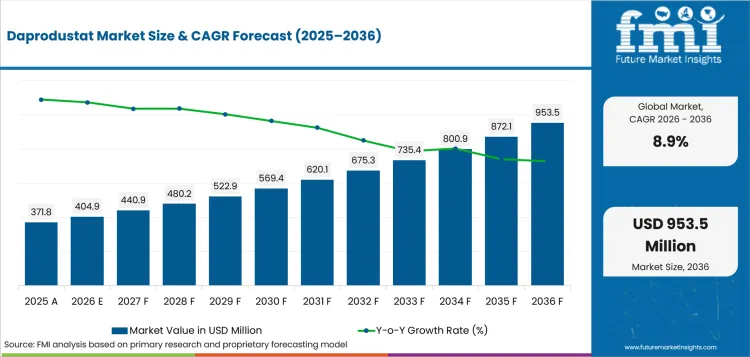
| Metric | Value |
|---|---|
| 2026 Market Size | USD 407.16 million |
| 2036 Market Size | USD 953.48 million |
| Forecast CAGR (2026-2036) | 8.9% |
| Leading Sales Channel | Direct Supply |
| Direct Supply Share (2026) | 69.0% |
| Leading Form | Powder |
| Powder Share (2026) | 62.4% |
| Fastest-growing Country | China |
| China CAGR by 2036 | 10.6% |
Summary of the Daprodustat Market
| Market Signal | Commercial Impact |
|---|---|
| Demand and Growth Drivers | Demand for daprodustat is projected to expand through 2036 as oral renal anemia therapies gain wider acceptance and regulated pharmaceutical markets require traceable API supply with comprehensive regulatory documentation.
|
| Product and Segment View | Direct supply, powder formulations, and ≥99.5% purity grades continue to lead their respective market segments.
|
| Geography and Growth Outlook | Asia continues to lead market expansion through increasing HIF-PHI adoption and growing chronic kidney disease treatment demand.
|
| Competitive Landscape | Competition increasingly focuses on regulatory compliance, manufacturing quality, and dependable API supply for renal anemia therapies.
|
| Analyst Perspective | Daprodustat is emerging as a strategically important API market where regulatory readiness, manufacturing consistency, and supply transparency increasingly influence supplier selection.
- Anurag Sharma, Principal Consultant for Healthcare at Future Market Insights |
Kidney disease burden and regulator-defined access shape market value. World Health Organization reporting in 2026 estimated 674 million people living with chronic kidney disease worldwide, creating a large renal anemia treatment base. U.S. health reporting in 2026 estimated 37 million adults with chronic kidney disease, equal to 14% of adults, supporting a defined dialysis-linked prescribing pool. China’s medicines regulator approved desidustat for renal anemia in 2026, and company reporting connected approval to more than 120 million chronic kidney disease patients in China. Daprodustat API suppliers gain value as formulation buyers need controlled impurity files and stable oral tablet supply.
Which factors support expansion in the Daprodustat market?
Finished dosage access and traceable API programs support market value across regulated renal anemia supply chains.
- Market value rises as oral HIF-PHI therapy expands product options available to approved renal anemia channels.
- Dialysis-linked prescribing supports early API demand as U.S. label scope creates a defined treatment population.
- High-purity API gains value as formulation buyers seek cleaner impurity profiles and fewer filing questions.
- East Asian renal anemia experience supports supplier confidence as Japan and China add commercial class familiarity.
- Direct supply contracts expand as buyers request audit access and change-control records.
Why is the Daprodustat market growing?
Approved renal anemia pathways create practical API demand through dialysis-linked treatment and controlled oral tablet production.
Commercial interest in daprodustat API is supported by regulator-defined dosing options. U.S. federal reporting in 2024 determined JESDUVROQ tablets in 1 mg, 2 mg, 4 mg, 6 mg, and 8 mg strengths were not withdrawn from sale for safety or effectiveness, preserving a pathway for future abbreviated applications meeting regulatory requirements. Supplier value improves as formulation buyers evaluate source continuity and documentation before commercial planning. Oral solid dosage compatibility supports powder demand, while regulatory caution keeps supplier selection focused on analytical files and reliable batch release.
How is the Daprodustat Market segmented?
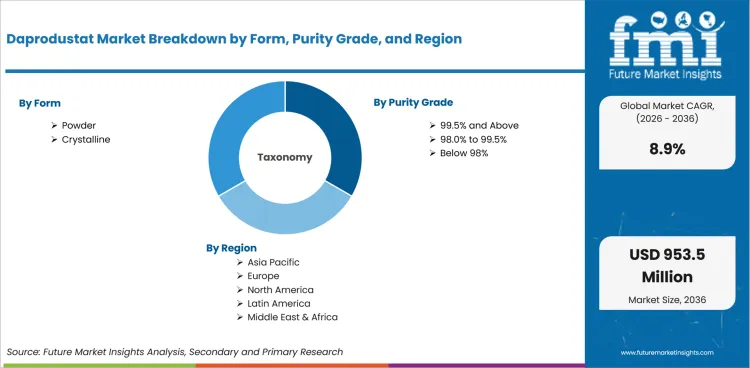
Daprodustat Market is segmented by form, purity grade, application, sales channel, and buyer type.
- Powder is projected to account for 62.4% share in 2026, influenced by oral tablet manufacturing needs and blend uniformity requirements.
- 99.5% and above purity grade is expected to hold 59.2% share in 2026, shaped by impurity control and regulated buyer documentation.
- Anemia in chronic kidney disease - dialysis is anticipated to account for 56.5% share in 2026, led by approved-use boundaries and dialysis-center treatment flow.
- Direct supply is projected to hold 69.0% share in 2026, guided by buyer preference for quality agreements and traceable batch records.
- Branded-route buyers are expected to represent 54.8% share in 2026, supported by product access control and filing-linked API qualification.
Why does powder dominate the Daprodustat market by form?
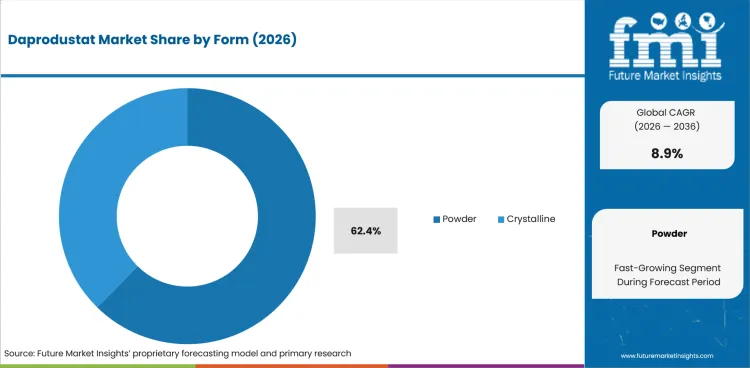
- Powder is projected to account for 62.4% share in 2026, driven by oral tablet production needs favoring controlled blending and commercial batch handling.
- Crystalline material remains active for buyers prioritizing solid-state stability and development-stage characterization before formulation lock.
Which purity grade leads the Daprodustat market?
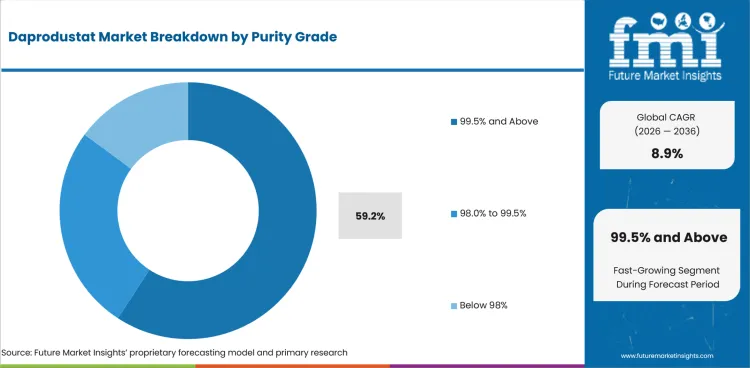
- 99.5% and above purity grade is expected to hold 59.2% share in 2026, shaped by regulated buyer preference for cleaner impurity records and repeatable release files.
- 98.0% to 99.5% material supports method development and early qualification work. Commercial buyers usually prefer higher-purity supply before filing.
Which application leads the Daprodustat Market?
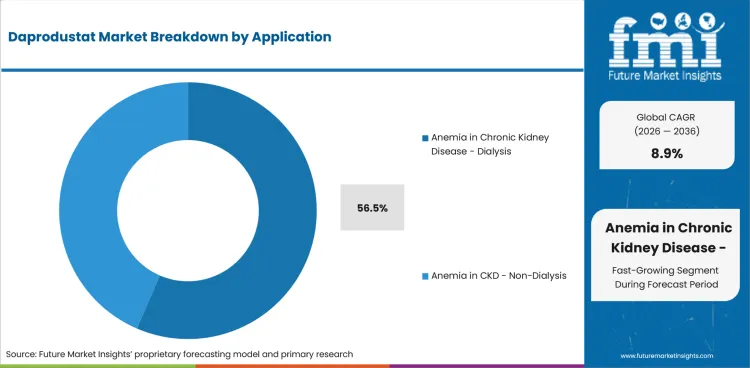
- Anemia in chronic kidney disease - dialysis is anticipated to account for 56.5% share in 2026, led by approved-use boundaries supporting a defined prescribing channel.
- Anemia in CKD - non-dialysis remains a watch area as safety views and country-level label differences shape future access.
Which sales channel leads the Daprodustat Market?
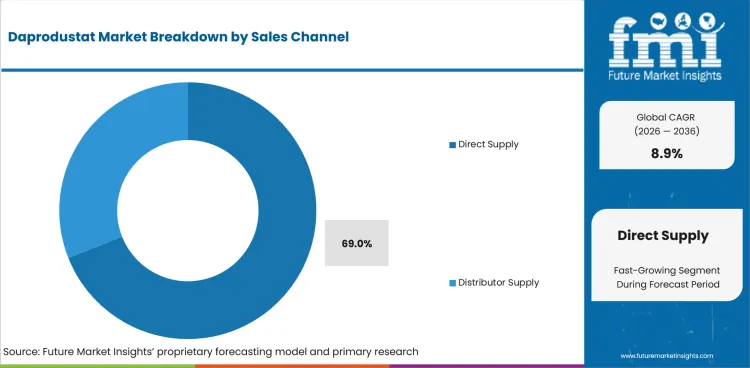
- Direct supply is projected to hold 69.0% share in 2026, guided by quality agreements and change-control communication.
- Distributor supply remains useful for development buyers needing samples and early screening before a direct API relationship is approved.
Which buyer type leads the Daprodustat Market?
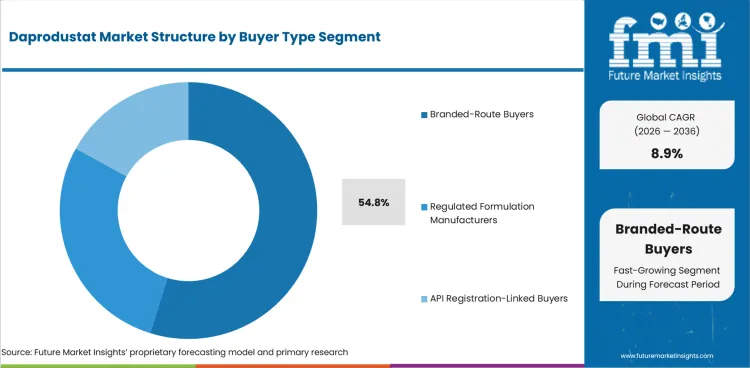
- Branded-route buyers are expected to represent 54.8% share in 2026, supported by label-controlled commercialization and tighter source documentation.
- API registration-linked buyers gain demand as filing plans require validated methods and supplier records that can withstand regulator review.
What are the drivers, restraints, and opportunities in the Daprodustat Market?
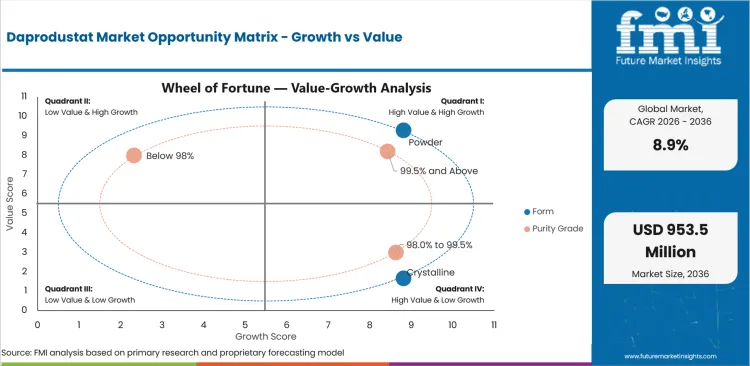
Renal anemia access and API documentation requirements shape Daprodustat buying decisions.
- Driver: Oral renal anemia therapy supports API demand as approved dialysis-linked pathways create practical commercial use.
- Restraint: Label caution limits addressable volume in markets lacking wider non-dialysis access.
- Opportunity: Supplier documentation and high-purity production can support stronger buyer qualification across regulated formulation programs.
Dialysis-Linked Label Scope Supports Early API Demand
Renal anemia treatment demand is supported by high disease burden in diabetes-linked kidney disease. U.S. health reporting in 2026 estimated that 38% of adults with diabetes had chronic kidney disease, creating a population requiring close renal monitoring and anemia assessment. Daprodustat API demand benefits from a defined dialysis pathway as oral tablet supply can be planned around approved treatment settings. Suppliers with reliable assay control and batch records can support formulation buyers seeking documented supply continuity.
Safety Review and Monitoring Burden Narrow Wider Planning
Non-dialysis planning faces limits as anemia agents require close hemoglobin monitoring and safety controls. KDIGO’s 2025 anemia draft advised hemoglobin monitoring every 2 to 4 weeks after ESA initiation or dose change and dose reduction of 25% to 50% if hemoglobin rises by more than 1.0 g/dL within 2 to 4 weeks. Commercial teams therefore need evidence packages addressing monitoring burden and patient-selection discipline. API suppliers should avoid capacity plans based only on total chronic kidney disease prevalence.
HIF-PHI Activity Creates API Qualification Openings
Class-level renal anemia activity supports supplier qualification across Asian markets. India’s hematology committee in 2025 recorded desidustat 25 mg, 50 mg, and 100 mg strengths as approved for adult chronic kidney disease anemia and reviewed a 120 mg protocol for another indication. HIF-PHI familiarity can help formulation buyers evaluate oral renal anemia supply chains. Daprodustat suppliers with validated impurity tracking and stable powder performance can benefit as buyers compare related class experience.
Which countries are growing in the Daprodustat market?
China 10.6% CAGR, Japan 9.7% CAGR, India 9.4% CAGR, United States 8.5% CAGR, South Korea 8.2% CAGR, Germany 6.4% CAGR, France 6.2% CAGR, and United Kingdom 6.1% CAGR through 2036.
.webp "Top Country Growth Comparison Daprodustat Market Cagr (2026 2036)")
| Country | CAGR |
|---|---|
| China | 10.6% |
| Japan | 9.7% |
| India | 9.4% |
| United States | 8.5% |
| South Korea | 8.2% |
| Germany | 6.4% |
| France | 6.2% |
| United Kingdom | 6.1% |
Source: Future Market Insights, 2026.
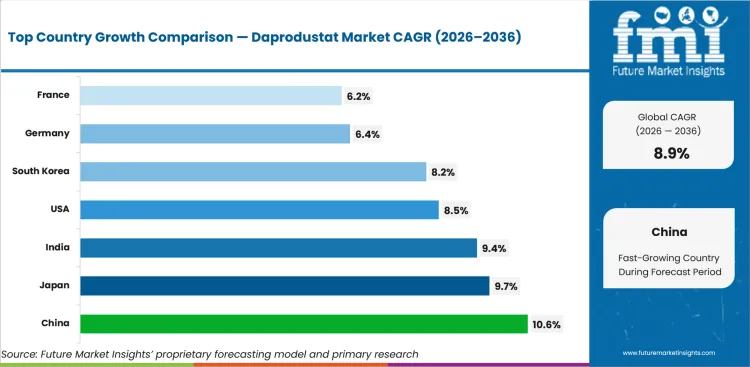
How do country-level CAGRs compare in the Daprodustat Market?
China leads country expansion while United Kingdom records the most cautious pace among profiled markets.
- China is forecast to record 10.6% CAGR by 2036 due to renal anemia demand and HIF-PHI class approval activity.
- Japan is expected to expand at 9.7% CAGR from 2026 to 2036, led by established renal anemia treatment experience.
- India is projected to grow at 9.4% CAGR through 2036 as domestic API capability and dialysis access programs support demand.
- United States is estimated to rise at 8.5% CAGR by 2036, reflected by label-defined dialysis treatment access.
- South Korea is expected to advance at 8.2% CAGR over the forecast period as renal care capacity and specialty API demand improve.
- Germany is forecast to grow at 6.4% CAGR by 2036, backed by regulated formulation scrutiny and renal therapy infrastructure.
- France is projected to post 6.2% CAGR by 2036, guided by renal replacement therapy monitoring and hospital-centered treatment pathways.
- United Kingdom is expected to record 6.1% CAGR by 2036, driven by cautious access planning and API registration control.
How fast is the Daprodustat market growing in China?
A 10.6% CAGR through 2036 reflects renal anemia demand and HIF-PHI class approval activity.
Country Market Snapshot Table
| Parameter | Value |
|---|---|
| Market Size in 2025 (Value) | USD 57.9 million |
| Market Size in 2026 (Value) | USD 64.0 million |
| Market Forecast in 2036 (Value) | USD 174.9 million |
| CAGR (2026 to 2036) | 10.6% |
| Years Considered | 2021 to 2036 |
| Base Year | 2025 |
| Forecast Period | 2026 to 2036 |
| Units Considered | Value (USD million) |
| Leading Sub-Region | Yangtze River Delta and Beijing-Tianjin-Hebei renal care corridors |
China Daprodustat Market Outlook
China Daprodustat market advances through renal anemia treatment need and oral HIF-PHI class familiarity. Domestic formulation buyers need API partners with stable impurity records and documentation suitable for national registration files.
Commercial demand is expected to favor suppliers offering audited manufacturing and batch-release consistency. Local selling networks will be important as hospital access and registered product pathways shape order conversion.
Key Growth Drivers
- Renal anemia demand is supported by chronic kidney disease burden, strengthened by China CDC research in 2024 estimating 5.58 million hypertension-related chronic kidney disease cases in 2019.
- Treated kidney failure prevalence creates a defined renal care base, indicated through international kidney-health profiling that listed China at 526 treated kidney failure cases per 1 million population.
- Domestic HIF-PHI experience supports oral renal anemia product evaluation among formulation buyers and nephrology-linked channels.
- API manufacturers gain scope as regulated buyers look for impurity discipline and documentation aligned to registration files.
Key Restraints
- Safety caution can slow wider non-dialysis commercialization as renal anemia access remains tied to class-level regulator review.
- Hospital tendering can compress product economics and limit tolerance for high-cost API qualification packages.
- Clinical burden remains high before payer acceptance strengthens, reflected by China CDC research in 2024 linking hypertension-related chronic kidney disease to 70,260 deaths in 2019.
What makes China unique
China combines large renal anemia demand and a strong API manufacturing base.
Key Companies
- Asymchem Laboratories
- WuXi STA
- Zhejiang Huahai Pharmaceutical
- Zhejiang Jiuzhou Pharmaceutical
- Shandong Xinhua Pharmaceutical
- Sichuan Kelun Pharmaceutical
- CSPC Pharmaceutical Group
Sales & Marketing Channels
- Direct technical sales to formulation manufacturers
- Tender-linked supply through hospital product sponsors
- API registration support for domestic dossier submissions
- Contract manufacturing partnerships with renal anemia product owners
- Distributor access for early-stage samples and qualification lots
- Quality-audit programs linked to long-term purchase agreements
Country Segment Breakdown Table
| Segment | Sub-Segments |
|---|---|
| By Form | Powder · Crystalline |
| By Purity Grade | 99.5% and Above · 98.0% to 99.5% · Below 98% |
| By Application | Anemia in Chronic Kidney Disease - Dialysis · Anemia in CKD - Non-Dialysis |
| By Sales Channel | Direct Supply · Distributor Supply |
| By Buyer Type | Branded-Route Buyers · Regulated Formulation Manufacturers · API Registration-Linked Buyers |
| Key Sub-Regions Covered, Pharmaceutical Corridors | Yangtze River Delta · Beijing-Tianjin-Hebei · Shandong · Guangdong · Jiangsu · Zhejiang |
Frequently Asked Questions
How fast is China Daprodustat market growing?
Industry in China is projected to rise at 10.6% CAGR from 2026 to 2036, supported by renal anemia demand and HIF-PHI class approvals.
Who leads China Daprodustat market?
WuXi STA, Asymchem Laboratories, Zhejiang Huahai Pharmaceutical, and Zhejiang Jiuzhou Pharmaceutical compete through API process capability and domestic registration support.
What is driving adoption in China Daprodustat market?
HIF-PHI class approval activity and hospital-linked renal anemia treatment needs are moving buyers toward qualified oral anemia API supply.
How fast is the Daprodustat market growing in Japan?
A 9.7% CAGR through 2036 reflects established renal anemia treatment experience and local HIF-PHI familiarity.
Country Market Snapshot Table
| Parameter | Value |
|---|---|
| Market Size in 2025 (Value) | USD 55.6 million |
| Market Size in 2026 (Value) | USD 61.0 million |
| Market Forecast in 2036 (Value) | USD 153.8 million |
| CAGR (2026 to 2036) | 9.7% |
| Years Considered | 2021 to 2036 |
| Base Year | 2025 |
| Forecast Period | 2026 to 2036 |
| Units Considered | Value (USD million) |
| Leading Sub-Region | Kanto and Kansai renal care corridors |
Japan Daprodustat Market Outlook
Japan Daprodustat market benefits from renal anemia treatment experience and HIF-PHI commercialization. Local buyers need stable API quality and strong documentation to support finished-dose supply.
Demand is expected to remain tied to established nephrology channels and hospital formularies. Supplier selection will favor companies with validated manufacturing control and Japanese regulatory support experience.
Key Growth Drivers
- Dialysis-linked demand is supported by national renal care scale, shown by Japanese dialysis reporting that listed 337,414 dialysis patients at year-end 2024.
- Treated kidney failure intensity supports renal anemia demand, measured through international kidney-health profiling that listed Japan at 2,696 treated kidney failure cases per 1 million population.
- Local HIF-PHI product experience improves physician and buyer familiarity with oral renal anemia therapy.
- Quality-driven buying favors API suppliers able to document particle profile consistency and release stability.
Key Restraints
- Price controls can limit premium API pass-through and increase pressure on finished-dose product economics.
- Buyer qualification can require longer quality review cycles due to strict local expectations for documentation and change control.
- Development evidence remains closely reviewed, illustrated by Japanese hemodialysis study records in 2024 listing a 52-week trial design for daprodustat evaluation.
What makes Japan unique
Japan stands apart for early oral renal anemia product experience and a quality-sensitive pharmaceutical buying culture.
Key Companies
- Kyowa Kirin
- Mitsubishi Tanabe Pharma
- Nippon Shinyaku
- Shionogi
- Sawai Pharmaceutical
- Towa Pharmaceutical
- Nichi-Iko Pharmaceutical
Sales & Marketing Channels
- Direct supply to local formulation partners
- Hospital-centered renal anemia product channels
- Quality-audit pathways with Japanese technical documentation
- Specialist distributor support for development lots
- Regulatory-support selling through filing-linked API packages
- Long-term buyer relationships through renal therapy franchises
Country Segment Breakdown Table
| Segment | Sub-Segments |
|---|---|
| By Form | Powder · Crystalline |
| By Purity Grade | 99.5% and Above · 98.0% to 99.5% · Below 98% |
| By Application | Anemia in Chronic Kidney Disease - Dialysis · Anemia in CKD - Non-Dialysis |
| By Sales Channel | Direct Supply · Distributor Supply |
| By Buyer Type | Branded-Route Buyers · Regulated Formulation Manufacturers · API Registration-Linked Buyers |
| Key Sub-Regions Covered, Pharmaceutical Corridors | Kanto · Kansai · Chubu · Kyushu · Tohoku · Shikoku |
Frequently Asked Questions
How fast is Japan Daprodustat market growing?
Industry in Japan is projected to rise at 9.7% CAGR from 2026 to 2036, supported by renal anemia commercialization and specialist nephrology channels.
Who leads Japan Daprodustat market?
Kyowa Kirin leads through Duvroq commercialization and established relationships across local nephrology channels.
What is driving adoption in Japan Daprodustat market?
Established HIF-PHI use and specialist renal anemia treatment pathways are supporting steady demand for documented API supply.
How fast is the Daprodustat market growing in India?
A 9.4% CAGR through 2036 reflects domestic API capability and dialysis access expansion.
Country Market Snapshot Table
| Parameter | Value |
|---|---|
| Market Size in 2025 (Value) | USD 29.3 million |
| Market Size in 2026 (Value) | USD 32.0 million |
| Market Forecast in 2036 (Value) | USD 78.4 million |
| CAGR (2026 to 2036) | 9.4% |
| Years Considered | 2021 to 2036 |
| Base Year | 2025 |
| Forecast Period | 2026 to 2036 |
| Units Considered | Value (USD million) |
| Leading Sub-Region | Hyderabad, Ahmedabad, and Mumbai pharmaceutical corridors |
India Daprodustat Market Outlook
India Daprodustat market draws support from API manufacturing depth and renal care expansion. Domestic buyers need cost-effective supply and regulatory documentation for oral renal anemia products.
Supplier competition is expected to remain active across established API clusters. Commercial demand will favor manufacturers able to provide stable powder supply and development-to-commercial batch continuity.
Key Growth Drivers
- Dialysis access programs support renal anemia treatment demand, reinforced by national health material estimating about 2.2 lakh new end-stage renal disease patients and 3.4 crore dialysis sessions needed each year.
- HIF-PHI class familiarity improves formulation interest, as national hematology review in 2025 recorded desidustat 25 mg, 50 mg, and 100 mg strengths for adult chronic kidney disease anemia.
- Domestic API makers can support regulated buyers through process-development capability and cost-competitive manufacturing.
- Contract supply opportunities improve as buyers seek alternate qualified sources for specialty renal anemia APIs.
Key Restraints
- Price-sensitive tendering can narrow margins for specialty API suppliers serving domestic formulation channels.
- Wider adoption may require stronger nephrology awareness and careful safety communication across oral anemia therapies.
- Monitoring expectations can increase treatment complexity, shown by Indian nephrology guidance in 2025 recommending iron status assessment every 6 months for chronic kidney disease care.
What makes India unique
India differs through strong API manufacturing clusters and local HIF-PHI class experience.
Key Companies
- MSN Laboratories
- Hetero Drugs
- MetroChem API
- Laurus Labs
- Aurobindo Pharma
- Dr. Reddy’s Laboratories
- Granules India
Sales & Marketing Channels
- Direct API supply to domestic formulation companies
- Export-linked buyer qualification through regulated-market documentation
- Contract development and manufacturing partnerships
- Distributor-led sample supply for early-stage formulation work
- Technical sales through Hyderabad and Ahmedabad API clusters
- Quality-agreement channels with long-term formulation buyers
Country Segment Breakdown Table
| Segment | Sub-Segments |
|---|---|
| By Form | Powder · Crystalline |
| By Purity Grade | 99.5% and Above · 98.0% to 99.5% · Below 98% |
| By Application | Anemia in Chronic Kidney Disease - Dialysis · Anemia in CKD - Non-Dialysis |
| By Sales Channel | Direct Supply · Distributor Supply |
| By Buyer Type | Branded-Route Buyers · Regulated Formulation Manufacturers · API Registration-Linked Buyers |
| Key Sub-Regions Covered, Pharmaceutical Corridors | Hyderabad · Ahmedabad · Mumbai · Visakhapatnam · Bengaluru · Baddi |
Frequently Asked Questions
How fast is India Daprodustat market growing?
Industry in India is projected to rise at 9.4% CAGR from 2026 to 2036, helped by API manufacturing depth and dialysis access programs.
Who leads India Daprodustat market?
MSN Laboratories, Hetero Drugs, MetroChem API, and Laurus Labs compete based on specialty API synthesis and local formulation relationships.
What is driving adoption in India Daprodustat market?
Domestic HIF-PHI class familiarity and contract API capacity are moving formulation buyers toward qualified renal anemia API programs.
How fast is the Daprodustat market growing in the United States?
An 8.5% CAGR through 2036 reflects dialysis-linked label scope and regulated API supply needs.
Country Market Snapshot Table
| Parameter | Value |
|---|---|
| Market Size in 2025 (Value) | USD 50.7 million |
| Market Size in 2026 (Value) | USD 55.0 million |
| Market Forecast in 2036 (Value) | USD 124.5 million |
| CAGR (2026 to 2036) | 8.5% |
| Years Considered | 2021 to 2036 |
| Base Year | 2025 |
| Forecast Period | 2026 to 2036 |
| Units Considered | Value (USD million) |
| Leading Sub-Region | Northeast and Midwest dialysis treatment corridors |
United States Daprodustat Market Outlook
United States Daprodustat market works around label-defined dialysis use and strict safety review. Buyers need API sources capable of supporting regulated finished-dose manufacturing and post-approval supply discipline.
Demand is expected to remain concentrated in controlled renal anemia channels. Supplier qualification will favor audit access and data packages aligned with finished-dose regulatory expectations.
Key Growth Drivers
- Label-defined use supports a clear treatment pool, as federal drug information records use for adults receiving dialysis for at least 4 months.
- Chronic kidney disease underdiagnosis creates long-term renal care pressure, shown by U.S. health reporting in 2026 estimating 87% of adults with chronic kidney disease were unaware of their condition.
- Oral tablet supply supports formulation planning as renal anemia products seek alternatives to injectable-only treatment options.
- Direct API relationships gain value as buyers require batch histories and impurity tracking.
Key Restraints
- Non-dialysis access remains limited, which narrows addressable demand compared with total chronic kidney disease prevalence.
- Payer scrutiny can slow uptake if safety communication and treatment value are not clearly documented.
- Product-status complexity can create commercial caution, indicated by federal reporting in 2024 covering 5 discontinued JESDUVROQ tablet strengths despite a safety-effectiveness determination.
What makes United States unique
United States stands apart through a label-defined dialysis pathway and high documentation expectations for API supply.
Key Companies
- GSK US
- Catalent
- Thermo Fisher Scientific
- Cambrex
- Siegfried USA
- Curia Global
- Alkermes Contract Pharma Services
Sales & Marketing Channels
- Direct supply to regulated formulation sponsors
- Quality-audit selling through validated API records
- Dialysis-channel support through finished-dose product owners
- Contract manufacturing discussions with U.S. registered sites
- Distributor access for early development samples
- Regulatory documentation packages for abbreviated application planning
Country Segment Breakdown Table
| Segment | Sub-Segments |
|---|---|
| By Form | Powder · Crystalline |
| By Purity Grade | 99.5% and Above · 98.0% to 99.5% · Below 98% |
| By Application | Anemia in Chronic Kidney Disease - Dialysis · Anemia in CKD - Non-Dialysis |
| By Sales Channel | Direct Supply · Distributor Supply |
| By Buyer Type | Branded-Route Buyers · Regulated Formulation Manufacturers · API Registration-Linked Buyers |
| Key Sub-Regions Covered, Pharmaceutical Corridors | Northeast · Midwest · North Carolina · New Jersey · Pennsylvania · California |
Frequently Asked Questions
How fast is United States Daprodustat market growing?
Industry in the United States is projected to rise at 8.5% CAGR from 2026 to 2036, driven by approved dialysis use and strict API documentation needs.
Who leads United States Daprodustat market?
GSK US leads depending on dialysis-channel positioning and established regulatory documentation for daprodustat tablets.
What is driving adoption in United States Daprodustat market?
Label-defined dialysis use and oral HIF-PHI treatment access are supporting qualified API demand across regulated supply programs.
How fast is the Daprodustat market growing in South Korea?
An 8.2% CAGR through 2036 reflects renal care intensity and specialty pharmaceutical supply demand.
Country Market Snapshot Table
| Parameter | Value |
|---|---|
| Market Size in 2025 (Value) | USD 18.5 million |
| Market Size in 2026 (Value) | USD 20.0 million |
| Market Forecast in 2036 (Value) | USD 44.1 million |
| CAGR (2026 to 2036) | 8.2% |
| Years Considered | 2021 to 2036 |
| Base Year | 2025 |
| Forecast Period | 2026 to 2036 |
| Units Considered | Value (USD million) |
| Leading Sub-Region | Seoul Capital Area and Daegu-Busan healthcare corridors |
South Korea Daprodustat Market Outlook
South Korea Daprodustat market receives support from advanced renal care infrastructure and specialty pharmaceutical manufacturing. Buyers need qualified API sources with strong documentation and stable supply.
Demand is expected to favor high-purity material and direct supplier relationships. Hospital access and reimbursement review will shape adoption across renal anemia channels.
Key Growth Drivers
- Renal care intensity supports anemia therapy demand, documented through international kidney-health profiling that listed South Korea at 2,100 treated kidney failure cases per 1 million population.
- Dialysis initiation pressure supports treatment need, backed by national nephrology reporting in 2024 identifying 15,539 new hemodialysis patients.
- Domestic pharmaceutical manufacturers can support specialty product development through established quality systems and regional distribution.
- API suppliers gain openings as buyers seek traceable sources for regulated oral renal anemia products.
Key Restraints
- Reimbursement review can slow product adoption if oral renal anemia therapy does not show clear treatment and cost advantages.
- Hospital formulary decisions may concentrate demand among fewer product sponsors, reducing supply opportunities for unqualified API vendors.
- Clinical development caution remains, reflected by trial registry material in 2024 listing a daprodustat non-dialysis study termination linked to recruitment feasibility under identifier NCT03446612.
What makes South Korea unique
South Korea is distinct through high treated kidney failure intensity and a quality-focused specialty pharmaceutical sector.
Key Companies
- Celltrion Pharm
- Hanmi Pharmaceutical
- Chong Kun Dang
- Daewoong Pharmaceutical
- Yuhan Corporation
- Dong-A ST
- SK Biopharmaceuticals
Sales & Marketing Channels
- Direct API sales to local formulation manufacturers
- Hospital-channel coordination through finished-dose sponsors
- Regulatory documentation support for Korean filings
- Development-lot supply through specialty distributors
- Contract manufacturing partnerships with local pharmaceutical groups
- Quality-audit programs tied to repeat commercial supply
Country Segment Breakdown Table
| Segment | Sub-Segments |
|---|---|
| By Form | Powder · Crystalline |
| By Purity Grade | 99.5% and Above · 98.0% to 99.5% · Below 98% |
| By Application | Anemia in Chronic Kidney Disease - Dialysis · Anemia in CKD - Non-Dialysis |
| By Sales Channel | Direct Supply · Distributor Supply |
| By Buyer Type | Branded-Route Buyers · Regulated Formulation Manufacturers · API Registration-Linked Buyers |
| Key Sub-Regions Covered, Pharmaceutical Corridors | Seoul Capital Area · Daegu · Busan · Daejeon · Incheon · Gyeonggi |
Frequently Asked Questions
How fast is South Korea Daprodustat market growing?
Industry in South Korea is projected to rise at 8.2% CAGR from 2026 to 2036, aided by renal care intensity and local specialty pharmaceutical manufacturing.
Who leads South Korea Daprodustat market?
Hanmi Pharmaceutical, Celltrion Pharm, Chong Kun Dang, and Daewoong Pharmaceutical compete due to formulation capability and regulated local supply networks.
What is driving adoption in South Korea Daprodustat market?
Renal care intensity and specialty pharmaceutical capacity are moving buyers toward controlled oral anemia API qualification.
How fast is the Daprodustat market growing in Germany?
A 6.4% CAGR through 2036 reflects controlled renal therapy demand and strict API quality expectations.
Country Market Snapshot Table
| Parameter | Value |
|---|---|
| Market Size in 2025 (Value) | USD 16.0 million |
| Market Size in 2026 (Value) | USD 17.0 million |
| Market Forecast in 2036 (Value) | USD 31.6 million |
| CAGR (2026 to 2036) | 6.4% |
| Years Considered | 2021 to 2036 |
| Base Year | 2025 |
| Forecast Period | 2026 to 2036 |
| Units Considered | Value (USD million) |
| Leading Sub-Region | North Rhine-Westphalia and Hesse pharmaceutical corridors |
Germany Daprodustat Market Outlook
Germany Daprodustat demand comes from regulated pharmaceutical manufacturing and payer caution. Buyers need API records that support strict audit review and finished-dose quality expectations.
Demand is expected to develop through selected formulation partners and renal anemia access decisions. Local suppliers with documentation depth and process reliability will hold stronger qualification prospects.
Key Growth Drivers
- European renal therapy scale supports anemia treatment demand, evidenced by registry reporting in 2025 listing 1,101 people per 1 million population receiving kidney replacement therapy across Europe.
- German chronic kidney disease research infrastructure supports renal data generation, demonstrated by national cohort material covering more than 5,000 patients across 11 academic centers.
- Pharmaceutical manufacturing strength supports API qualification and specialty oral solid dosage development.
- Quality-focused buyers favor high-purity daprodustat material with consistent analytical records and low change-control risk.
Key Restraints
- Reimbursement caution can slow uptake as payers evaluate safety and clinical positioning.
- Strict supplier qualification can delay new API sources without strong European documentation and inspection records.
- Eligible-patient estimates can remain difficult across early-stage kidney disease, as a 2025 German population analysis found chronic kidney disease prevalence at 11.2% under creatinine/uACR criteria and 19.5% under cystatin-C criteria.
What makes Germany unique
Germany stands out through regulated pharmaceutical manufacturing and renal research infrastructure.
Key Companies
- Merck KGaA
- Evotec
- Wacker Chemie
- CordenPharma
- Axplora Germany
- Haupt Pharma
- Vetter Pharma
Sales & Marketing Channels
- Direct sales to regulated formulation manufacturers
- Quality-agreement selling through European audit records
- CDMO partnerships for oral solid dosage products
- Distributor access for research and development lots
- Tender-linked product access through finished-dose sponsors
- Pharmacovigilance support through renal therapy product owners
Country Segment Breakdown Table
| Segment | Sub-Segments |
|---|---|
| By Form | Powder · Crystalline |
| By Purity Grade | 99.5% and Above · 98.0% to 99.5% · Below 98% |
| By Application | Anemia in Chronic Kidney Disease - Dialysis · Anemia in CKD - Non-Dialysis |
| By Sales Channel | Direct Supply · Distributor Supply |
| By Buyer Type | Branded-Route Buyers · Regulated Formulation Manufacturers · API Registration-Linked Buyers |
| Key Sub-Regions Covered, Pharmaceutical Corridors | North Rhine-Westphalia · Hesse · Bavaria · Baden-Württemberg · Hamburg · Berlin-Brandenburg |
Frequently Asked Questions
How fast is Germany Daprodustat market growing?
Industry in Germany is projected to rise at 6.4% CAGR from 2026 to 2036, supported by regulated formulation demand and renal therapy infrastructure.
Who leads Germany Daprodustat market?
Merck KGaA, CordenPharma, Evotec, and Axplora Germany compete led by regulated manufacturing systems and specialty pharmaceutical service depth.
What is driving adoption in Germany Daprodustat market?
Quality-controlled renal therapy supply and strict documentation expectations are moving buyers toward high-purity API qualification.
How fast is the Daprodustat market growing in France?
A 6.2% CAGR through 2036 reflects hospital-centered renal care and cautious specialty drug access.
Country Market Snapshot Table
| Parameter | Value |
|---|---|
| Market Size in 2025 (Value) | USD 14.1 million |
| Market Size in 2026 (Value) | USD 15.0 million |
| Market Forecast in 2036 (Value) | USD 27.4 million |
| CAGR (2026 to 2036) | 6.2% |
| Years Considered | 2021 to 2036 |
| Base Year | 2025 |
| Forecast Period | 2026 to 2036 |
| Units Considered | Value (USD million) |
| Leading Sub-Region | Île-de-France and Auvergne-Rhône-Alpes healthcare corridors |
France Daprodustat Market Outlook
France Daprodustat market reflects hospital renal care and controlled specialty medicine evaluation. Buyers need API suppliers able to support quality records and patient-safety review.
Demand is expected to remain measured until product access decisions and renal anemia pathways support wider use. Local pharmaceutical suppliers may benefit through formulation and documentation support.
Key Growth Drivers
- Renal replacement therapy tracking supports treatment planning, with national registry reporting published in 2026 covering 2024 activity across all French regions.
- European kidney replacement therapy scale supports renal anemia demand, shown by registry reporting in 2025 estimating 1 person in every 910 inhabitants receiving kidney replacement therapy across participating countries.
- Hospital-centered nephrology care supports controlled introduction of oral renal anemia products through specialist channels.
- Local pharmaceutical groups can support formulation partnerships and national access documentation.
Key Restraints
- Health technology assessment scrutiny may delay wider access if safety and value evidence remain limited.
- Hospital formulary caution can slow ordering until renal anemia specialists define suitable patient groups.
- Renal service planning remains complex, as 2026 REIN reporting noted that entries into dialysis or transplant have decreased by about 2% per year since 2017 and now stabilize around 11,000 new patients per year.
What makes France unique
France differs through national renal replacement therapy tracking and hospital-centered specialty medicine access.
Key Companies
- Servier
- Sanofi
- Seqens
- Delpharm
- Pierre Fabre
- Ipsen
- Fareva
Sales & Marketing Channels
- Direct supply to formulation and specialty medicine sponsors
- Hospital access through finished-dose product owners
- API documentation support for national quality review
- CDMO partnerships with French manufacturing sites
- Distributor support for development and validation lots
- Specialist selling through nephrology-linked product teams
Country Segment Breakdown Table
| Segment | Sub-Segments |
|---|---|
| By Form | Powder · Crystalline |
| By Purity Grade | 99.5% and Above · 98.0% to 99.5% · Below 98% |
| By Application | Anemia in Chronic Kidney Disease - Dialysis · Anemia in CKD - Non-Dialysis |
| By Sales Channel | Direct Supply · Distributor Supply |
| By Buyer Type | Branded-Route Buyers · Regulated Formulation Manufacturers · API Registration-Linked Buyers |
| Key Sub-Regions Covered, Pharmaceutical Corridors | Île-de-France · Auvergne-Rhône-Alpes · Normandy · Hauts-de-France · Grand Est · Occitanie |
Frequently Asked Questions
How fast is France Daprodustat market growing?
Industry in France is projected to rise at 6.2% CAGR from 2026 to 2036, supported by hospital nephrology pathways and renal registry-led planning.
Who leads France Daprodustat market?
Servier, Seqens, Delpharm, and Sanofi compete led by pharmaceutical manufacturing access and hospital-channel experience.
What is driving adoption in France Daprodustat market?
Renal registry monitoring and hospital-centered specialty medicine pathways are moving buyers toward carefully qualified oral anemia API supply.
How fast is the Daprodustat market growing in the United Kingdom?
A 6.1% CAGR through 2036 reflects cautious access planning and API registration control.
Country Market Snapshot Table
| Parameter | Value |
|---|---|
| Market Size in 2025 (Value) | USD 12.3 million |
| Market Size in 2026 (Value) | USD 13.0 million |
| Market Forecast in 2036 (Value) | USD 23.5 million |
| CAGR (2026 to 2036) | 6.1% |
| Years Considered | 2021 to 2036 |
| Base Year | 2025 |
| Forecast Period | 2026 to 2036 |
| Units Considered | Value (USD million) |
| Leading Sub-Region | England renal care and pharmaceutical distribution corridors |
United Kingdom Daprodustat Market Outlook
United Kingdom Daprodustat market develops through cautious renal anemia access and API registration oversight. Buyers need qualified sources with documentation suitable for local importation and quality control.
Demand is expected to remain selective as health technology assessment and product licensing decisions shape commercial options. Supplier value will depend on registration status and reliable quality records.
Key Growth Drivers
- Renal replacement therapy creates a defined treatment base, with registry reporting in 2024 indicating about 70,000 kidney patients receiving kidney replacement therapy across the United Kingdom.
- API registration supports supply visibility, with medicine regulator records dated 17 June 2026 listing UK API registration 42657 for daprodustat importation and distribution.
- Local distribution and quality systems support controlled API access for regulated formulation and supply programs.
- Specialist renal care networks can support measured adoption after product licensing and access decisions are clarified.
Key Restraints
- Health technology appraisal suspension can delay wider product planning and reduce near-term commercial confidence.
- Local market access can remain cautious if product sponsors do not pursue a complete licensing route.
- Registry coordination can complicate launch planning, shown by 2024 reporting covering 67 adult renal centers and 13 pediatric centers.
What makes the United Kingdom unique
United Kingdom has API registration visibility and cautious product access pathways.
Key Companies
- GSK
- Sterling Pharma Solutions
- Quotient Sciences
- Almac Pharma Services
- Piramal Pharma Solutions UK
- Recipharm UK
- Aesica Pharmaceuticals
Sales & Marketing Channels
- Direct supply through registered API importers and distributors
- Quality-audit selling to regulated formulation sponsors
- Specialist distribution for development and validation lots
- CDMO partnerships for oral solid dosage programs
- Renal therapy access through finished-dose product owners
- Regulatory documentation support for local supply arrangements
Country Segment Breakdown Table
| Segment | Sub-Segments |
|---|---|
| By Form | Powder · Crystalline |
| By Purity Grade | 99.5% and Above · 98.0% to 99.5% · Below 98% |
| By Application | Anemia in Chronic Kidney Disease - Dialysis · Anemia in CKD - Non-Dialysis |
| By Sales Channel | Direct Supply · Distributor Supply |
| By Buyer Type | Branded-Route Buyers · Regulated Formulation Manufacturers · API Registration-Linked Buyers |
| Key Sub-Regions Covered, Pharmaceutical Corridors | England · Scotland · Wales · Northern Ireland · North West England · South East England |
Frequently Asked Questions
How fast is United Kingdom Daprodustat market growing?
Industry in the United Kingdom is projected to rise at 6.1% CAGR from 2026 to 2036, aided by API registration oversight and renal registry-led planning.
Who leads United Kingdom Daprodustat market?
GSK leads through local product history and direct connection to daprodustat regulatory documentation.
What is driving adoption in United Kingdom Daprodustat market?
Registered API importation and controlled renal anemia access are moving buyers toward traceable high-purity daprodustat supply.
Who are the leading companies in the Daprodustat Market?
GSK, Kyowa Kirin, MSN Laboratories, Hetero Drugs, and MetroChem API.
- Product-linked companies hold an advantage through regulatory records and renal anemia channel knowledge.
- API suppliers gain stronger acceptance by connecting impurity control with validated oral solid dosage manufacturing support.
- Regional pharmaceutical companies win in country markets by offering faster technical response and local quality documentation.
- Service-ready API suppliers improve renewal chances led by batch consistency and change-control communication.
Daprodustat companies compete through regulatory access, API documentation, and impurity-control performance. GSK has a strong position through product history and regulatory records. Kyowa Kirin competes based on Japan renal anemia commercialization and nephrology franchise support. Indian API suppliers compete through specialty synthesis and buyer qualification support.
Manufacturing and documentation depth have become stronger competitive separators as daprodustat moves beyond development-stage interest. MSN Laboratories, Hetero Drugs, MetroChem API, Laurus Labs, and Aurobindo Pharma compete based on commercial batch readiness and customer file support. Buyers compare supplier performance through assay consistency and batch-release reliability.
Smaller and regional suppliers can win through local regulatory knowledge and faster development-lot support. China, India, and South Korea create opportunities for suppliers with process chemistry teams and local formulation relationships. United States and Europe create stronger demand for compliance documentation and technical validation. Companies that prove API quality under regulated buyer review should gain more durable supply contracts.
How do top Daprodustat companies compare?
GSK and Kyowa Kirin score strongest on product access while Indian API suppliers lead through process chemistry and regulated supply depth.
| Company | Relevance to Market Title | API Portfolio Depth | Regulatory Support Strength | Oral Solid Dosage Support | Channel Reach | Geographic Footprint |
|---|---|---|---|---|---|---|
| GSK | Very High | Moderate | Very Strong | Strong | Very Strong | Global |
| Kyowa Kirin | Very High | Moderate | Strong | Strong | Strong | Japan and Asia |
| MSN Laboratories | High | Very Strong | Strong | Strong | Strong | India and International |
| Hetero Drugs | High | Very Strong | Strong | Strong | Strong | India and Global |
| MetroChem API | High | Strong | Strong | Moderate | Moderate | India and International |
| Laurus Labs | High | Strong | Strong | Strong | Strong | India and Global |
| Aurobindo Pharma | High | Strong | Strong | Very Strong | Strong | Global |
| WuXi STA | Moderate to High | Very Strong | Strong | Strong | Strong | China and Global |
| CordenPharma | Moderate to High | Strong | Strong | Strong | Moderate | Europe and United States |
| Seqens | Moderate to High | Strong | Strong | Moderate | Moderate | Europe and International |
Source: Future Market Insights competitive analysis, 2026.
Who are the key players in the Daprodustat Market?
GSK, Kyowa Kirin and MSN Laboratories are listed with Hetero Drugs and MetroChem API among other suppliers.
Key global companies leading the Daprodustat Market include:
- GSK plc
- GlaxoSmithKline Trading Services Limited
- Glaxo Wellcome Manufacturing Pte Limited
- Kyowa Kirin
- MSN Laboratories
- Hetero Drugs
- MetroChem API
- Laurus Labs
- Aurobindo Pharma
- WuXi STA
Key Developments in Daprodustat Market
- In June 2026, United Kingdom medicine regulator records listed UK API registration 42657 for GlaxoSmithKline Trading Services Limited, covering daprodustat importation and distribution.
- In March 2026, Zydus reported China approval for desidustat as a renal anemia therapy, strengthening HIF-PHI class visibility in a large chronic kidney disease market.
- In February 2025, Kyowa Kirin reported that Duvroq revenue increased during 2024, supporting continued oral renal anemia commercialization in Japan.
Key Players in the Daprodustat Market
Product and Brand-Linked Companies
- GSK plc
- GlaxoSmithKline Trading Services Limited
- Glaxo Wellcome Manufacturing Pte Limited
- Kyowa Kirin
India API and Formulation Suppliers
- MSN Laboratories
- Hetero Drugs
- MetroChem API
- Laurus Labs
- Aurobindo Pharma
- Dr. Reddy’s Laboratories
China and East Asia Suppliers
- WuXi STA
- Zhejiang Huahai Pharmaceutical
- Asymchem Laboratories
- CSPC Pharmaceutical Group
Europe and North America CDMO Suppliers
- CordenPharma
- Seqens
- Cambrex
- Curia Global
- Sterling Pharma Solutions
Daprodustat Market - Report Scope
| Parameter | Details |
|---|---|
| Forecast period | 2026 to 2036 |
| Historical period | 2021 to 2025 |
| Quantitative unit | Revenue in USD million |
| By form | Powder, crystalline |
| By purity grade | 99.5% and Above, 98.0% to 99.5%, below 98% |
| By application | Anemia in Chronic Kidney Disease - Dialysis, Anemia in CKD - Non-Dialysis |
| By sales channel | Direct supply, distributor supply |
| By buyer type | Branded-route buyers, regulated formulation manufacturers, API registration-linked buyers |
| Regions covered | North America, Latin America, Europe, East Asia, South Asia and Pacific, Middle East and Africa |
| Countries covered | China, Japan, India, United States, South Korea, Germany, France, United Kingdom |
| Key companies profiled | GSK, Kyowa Kirin, MSN Laboratories, Hetero Drugs, MetroChem API, Laurus Labs, Aurobindo Pharma, WuXi STA, CordenPharma, Seqens |
| Approach | Bottom-up API demand approach using approved-use access, dose strength requirements, buyer qualification, country renal anemia pathways, and regulated supply evidence |
Source: Future Market Insights competitive analysis, 2026.
Daprodustat Market - Scope & Definition
| Attribute | Detail |
|---|---|
| Market Definition | Commercial demand for daprodustat active pharmaceutical ingredient used in regulated renal anemia finished dosage products. |
| Functions Covered | API supply, impurity control, batch-release support, documentation support, and regulatory filing support for oral HIF-PHI products. |
| Applications Covered | Dialysis-linked chronic kidney disease anemia treatment and selected non-dialysis chronic kidney disease anemia evaluation. |
| End-Use Industries | Pharmaceutical formulation, renal therapy, specialty medicine supply, and contract manufacturing. |
| Grades Covered | 99.5% and Above, 98.0% to 99.5%, and below 98% purity grades. |
| Inclusions | Powder API, crystalline API, commercial-grade material, development-grade material, direct supply, distributor supply, API registration-linked demand, and country-level renal anemia API use. |
| Exclusions | Finished daprodustat tablets, patient-level treatment services, dialysis equipment, injectable erythropoiesis-stimulating agents, iron therapies, roxadustat, vadadustat, desidustat, molidustat, and unrelated pharmaceutical intermediates. |
Daprodustat Market - Research Methodology
| Method | Description |
|---|---|
| Primary Research | FMI analyst interviews with API suppliers, formulation manufacturers, renal therapy specialists, regulatory affairs teams, distributors, and contract development teams active in specialty pharmaceutical ingredients. |
| Desk Research | Review of regulator labels, medicine registration records, clinical trial records, company disclosures, renal registry material, kidney-disease statistics, and official anemia guidance. |
| Market Sizing & Forecasting | Bottom-up API demand approach using oral dosage demand, dose strength range, country access, buyer qualification, API purity requirements, and regional HIF-PHI experience. |
| Data Validation | Cross-verification using approved indication differences, dialysis-channel demand, supplier records, company developments, country renal anemia treatment context, and regulated buyer documentation requirements. |
Daprodustat Market Breakdown by Form, Purity Grade, Application, Sales Channel, Buyer Type, and Region
Daprodustat Market Segmented by Form:
- Powder
- Crystalline
Daprodustat Market Segmented by Purity Grade:
- 99.5% and Above
- 98.0% to 99.5%
- Below 98%
Daprodustat Market Segmented by Application:
- Anemia in Chronic Kidney Disease - Dialysis
- Anemia in CKD - Non-Dialysis
Daprodustat Market Segmented by Sales Channel:
- Direct Supply
- Distributor Supply
Daprodustat Market Segmented by Buyer Type:
- Branded-Route Buyers
- Regulated Formulation Manufacturers
- API Registration-Linked Buyers
Daprodustat Market by Region:
- North America
- Latin America
- East Asia
- South Asia and Pacific
- Europe
- Middle East and Africa
Research Sources and Bibliography
- U.S. Food and Drug Administration. (2024, February 22). Drug Trials Snapshots: JESDUVROQ.
- Federal Register. (2024, November 19). Determination that JESDUVROQ tablets were not withdrawn from sale for reasons of safety or effectiveness.
- U.S. Food and Drug Administration. (2023). JESDUVROQ prescribing information.
- Centers for Disease Control and Prevention. (2026, March 31). Chronic kidney disease in the United States.
- World Health Organization. (2026, April 20). Kidney disease.
- Medicines and Healthcare products Regulatory Agency. (2026, June 17). UK API registration record 42657.
- Central Drugs Standard Control Organisation. (2025, April 8). Subject Expert Committee recommendations: Haematology.
- Zydus Lifesciences Limited. (2026, March 14). Desidustat receives approval from China’s National Medical Products Administration.
- Kyowa Kirin Co., Ltd. (2025, February 6). Results presentation fiscal 2024.
- Kidney Disease: Improving Global Outcomes. (2024, November 4). KDIGO 2025 clinical practice guideline for anemia in chronic kidney disease: Public review draft.
- Institute for Quality and Efficiency in Health Care. (2024, September 2). Vadadustat for symptomatic anaemia associated with chronic kidney disease.
- Japanese Society for Dialysis Therapy. (2026). Annual dialysis data report 2024.
- International Society of Nephrology. (2025). Global Kidney Health Atlas country profiles.
- Pradhan Mantri National Dialysis Programme. (2025). Programme guidance and dialysis burden material.
- United Kingdom Kidney Association. (2024, July 7). UK Renal Registry 26th annual report.
- Agence de la biomédecine. (2026, May 21). REIN annual report 2024.
- France Rein. (2026, March 16). New REIN 2024 kidney disease registry data.
- European Renal Association Registry. (2025, November). Annual Report 2023.
- Schmidt-Lauber, C., et al. (2025). Prevalence and characteristics of chronic kidney disease in the Gutenberg Health Study.
- GSK. (2024, July 17). ASCEND-D daprodustat study register record.
This bibliography is provided for reader reference and is not exhaustive. The full report contains the complete reference list and detailed citations.
This Report Answers
- Market size estimates for 2026 and forecasts through 2036 for the Daprodustat Market.
- Insights across regional and country-level renal anemia API markets.
- Analysis of demand drivers and purchasing behavior.
- Evaluation of form, purity grade, application, sales channel, and buyer type.
- Assessment of approved-use boundaries and high-purity API requirements.
- Identification of opportunities across powder API and direct supply contracts.
- Evaluation of API documentation models and technical sales channels.
- Country-level analysis covering China, Japan, India, United States, South Korea, Germany, France, and United Kingdom.
- Assessment of competition, including leading product-linked companies and API manufacturers.
- Analysis of buyer qualification drivers and renewal criteria.
- Regional outlooks across North America, Europe, East Asia, South Asia and Pacific, Latin America, and Middle East and Africa.
- Delivery of market data, forecasts, and supporting analysis in report-ready format.
Frequently Asked Questions
What is the growth prospect for Daprodustat?
Demand for daprodustat is expected to rise at a measured pace as renal anemia treatment access expands through approved oral HIF-PHI pathways.
Which companies are expected to shape the Daprodustat market?
GSK, Kyowa Kirin, MSN Laboratories, Hetero Drugs, MetroChem API, Laurus Labs, and Aurobindo Pharma are expected to shape competition through product access and API supply strength.
Why are pharmaceutical companies investing in Daprodustat API?
Pharmaceutical companies are investing in daprodustat API to support regulated renal anemia product supply and strengthen oral solid dosage portfolios.
Why are direct supply channels important in the Daprodustat market?
Direct supply channels support audit acces and change-control communication across regulated formulation programs.
Which API formats are gaining attention in Daprodustat?
Powder API is gaining attention as oral tablet manufacturers prioritize blend uniformit and reliable batch release.
How do regulations influence Daprodustat demand?
Regulations influence demand through safety monitoring and documentation expectations.
Why is high purity important for Daprodustat API?
High purity is important since regulated buyers need cleaner impurity records and fewer filing questions.
What role does direct supply play in Daprodustat adoption?
Direct supply supports adoption by combining API availability with audit access, technical documentation, and source-control visibility.
Preview the report firsthand - request a free sample
Get SampleGet the brochure for pricing and purchase details.
Get PDFTable of Content
- Key Takeaways
- Market Size and CAGR
- Top Growth Driver
- Fastest Growing Segment
- Leading Region
- Key Companies
- Emerging Opportunities
- Executive Summary
- Global Market Outlook
- Demand-side Trends
- Supply-side Trends
- Technology Roadmap Analysis
- Analysis and Recommendations
- Analyst Perspective (What is happening? Why now? What should investors know?)
- Key Questions Answered
- How large is the market?
- What is the CAGR?
- What are key trends?
- Which region dominates?
- Who are the leaders?
- Market Overview
- Market Coverage / Taxonomy
- Market Definition / Scope / Limitations
- Research Methodology
- Chapter Orientation
- Analytical Lens and Working Hypotheses
- Market Structure, Signals, and Trend Drivers
- Benchmarking and Cross-market Comparability
- Market Sizing, Forecasting, and Opportunity Mapping
- Research Design and Evidence Framework
- Desk Research Programme (Secondary Evidence)
- Expert Input and Fieldwork (Primary Evidence)
- Tooling, Models, and Reference Databases
- Data Engineering and Model Build
- Quality Assurance and Audit Trail
- Market Background
- Market Dynamics (Drivers, Restraints, Opportunity, Trends)
- Scenario Forecast (Optimistic, Likely, Conservative)
- Impact Analysis
- AI Impact
- Sustainability Impact
- Regulatory Impact
- Technology Impact
- Consumer / Buyer Analysis
- Purchase Drivers
- Adoption Barriers
- Buyer Journey
- Opportunity Map Analysis
- Product Life Cycle Analysis
- Supply Chain Analysis
- Investment Feasibility Matrix
- Value Chain Analysis
- PESTLE and Porter's Analysis
- Regulatory Landscape
- Regional Parent Market Outlook
- Production and Consumption Statistics
- Import and Export Statistics
- Global Market Analysis and Forecast, 2021 to 2036
- Historical Market Size Value (USD Million) Analysis, 2021 to 2025
- Current and Future Market Size Value (USD Million) Projections, 2026 to 2036
- Y-o-Y Growth Trend Analysis
- Absolute $ Opportunity Analysis
- Global Market Pricing Analysis, 2021 to 2036
- Global Market Analysis and Forecast, By Form, 2021 to 2036
- Introduction / Key Findings
- Historical Market Size Value (USD Million) Analysis By Form, 2021 to 2025
- Current and Future Market Size Value (USD Million) Analysis and Forecast By Form, 2026 to 2036
- Powder
- Crystalline
- Powder
- Y-o-Y Growth Trend Analysis By Form, 2021 to 2025
- Absolute $ Opportunity Analysis By Form, 2026 to 2036
- Global Market Analysis and Forecast, By Purity Grade, 2021 to 2036
- Introduction / Key Findings
- Historical Market Size Value (USD Million) Analysis By Purity Grade, 2021 to 2025
- Current and Future Market Size Value (USD Million) Analysis and Forecast By Purity Grade, 2026 to 2036
- 99.5% and Above
- 98.0% to 99.5%
- Below 98%
- 99.5% and Above
- Y-o-Y Growth Trend Analysis By Purity Grade, 2021 to 2025
- Absolute $ Opportunity Analysis By Purity Grade, 2026 to 2036
- Global Market Analysis and Forecast, By Application, 2021 to 2036
- Introduction / Key Findings
- Historical Market Size Value (USD Million) Analysis By Application, 2021 to 2025
- Current and Future Market Size Value (USD Million) Analysis and Forecast By Application, 2026 to 2036
- Anemia in Chronic Kidney Disease - Dialysis
- Anemia in CKD - Non-Dialysis
- Anemia in Chronic Kidney Disease - Dialysis
- Y-o-Y Growth Trend Analysis By Application, 2021 to 2025
- Absolute $ Opportunity Analysis By Application, 2026 to 2036
- Global Market Analysis and Forecast, By Sales Channel, 2021 to 2036
- Introduction / Key Findings
- Historical Market Size Value (USD Million) Analysis By Sales Channel, 2021 to 2025
- Current and Future Market Size Value (USD Million) Analysis and Forecast By Sales Channel, 2026 to 2036
- Direct Supply
- Distributor Supply
- Direct Supply
- Y-o-Y Growth Trend Analysis By Sales Channel, 2021 to 2025
- Absolute $ Opportunity Analysis By Sales Channel, 2026 to 2036
- Global Market Analysis and Forecast, By Buyer Type, 2021 to 2036
- Introduction / Key Findings
- Historical Market Size Value (USD Million) Analysis By Buyer Type, 2021 to 2025
- Current and Future Market Size Value (USD Million) Analysis and Forecast By Buyer Type, 2026 to 2036
- Branded-Route Buyers
- Regulated Formulation Manufacturers
- API Registration-Linked Buyers
- Branded-Route Buyers
- Y-o-Y Growth Trend Analysis By Buyer Type, 2021 to 2025
- Absolute $ Opportunity Analysis By Buyer Type, 2026 to 2036
- Global Market Analysis and Forecast, By Region, 2021 to 2036
- Introduction
- Historical Market Size Value (USD Million) Analysis By Region, 2021 to 2025
- Current Market Size Value (USD Million) Analysis and Forecast By Region, 2026 to 2036
- North America
- Latin America
- Western Europe
- Eastern Europe
- East Asia
- South Asia and Pacific
- Middle East & Africa
- Market Attractiveness Analysis By Region
- North America Market Analysis and Forecast, By Country, 2021 to 2036
- Historical Market Size Value (USD Million) Trend Analysis By Market Taxonomy, 2021 to 2025
- Market Size Value (USD Million) Forecast By Market Taxonomy, 2026 to 2036
- By Country
- USA
- Canada
- Mexico
- By Form
- By Purity Grade
- By Application
- By Sales Channel
- By Buyer Type
- By Country
- Market Attractiveness Analysis
- By Country
- By Form
- By Purity Grade
- By Application
- By Sales Channel
- By Buyer Type
- Key Takeaways
- Latin America Market Analysis and Forecast, By Country
- Historical Market Size Value (USD Million) Trend Analysis By Market Taxonomy, 2021 to 2025
- Market Size Value (USD Million) Forecast By Market Taxonomy, 2026 to 2036
- By Country
- Brazil
- Chile
- Rest of Latin America
- By Form
- By Purity Grade
- By Application
- By Sales Channel
- By Buyer Type
- By Country
- Market Attractiveness Analysis
- By Country
- By Form
- By Purity Grade
- By Application
- By Sales Channel
- By Buyer Type
- Key Takeaways
- Western Europe Market Analysis and Forecast, By Country
- Historical Market Size Value (USD Million) Trend Analysis By Market Taxonomy, 2021 to 2025
- Market Size Value (USD Million) Forecast By Market Taxonomy, 2026 to 2036
- By Country
- Germany
- UK
- Italy
- Spain
- France
- Nordic
- BENELUX
- Rest of Western Europe
- By Form
- By Purity Grade
- By Application
- By Sales Channel
- By Buyer Type
- By Country
- Market Attractiveness Analysis
- By Country
- By Form
- By Purity Grade
- By Application
- By Sales Channel
- By Buyer Type
- Key Takeaways
- Eastern Europe Market Analysis and Forecast, By Country
- Historical Market Size Value (USD Million) Trend Analysis By Market Taxonomy, 2021 to 2025
- Market Size Value (USD Million) Forecast By Market Taxonomy, 2026 to 2036
- By Country
- Russia
- Poland
- Hungary
- Balkan & Baltic
- Rest of Eastern Europe
- By Form
- By Purity Grade
- By Application
- By Sales Channel
- By Buyer Type
- By Country
- Market Attractiveness Analysis
- By Country
- By Form
- By Purity Grade
- By Application
- By Sales Channel
- By Buyer Type
- Key Takeaways
- East Asia Market Analysis and Forecast, By Country
- Historical Market Size Value (USD Million) Trend Analysis By Market Taxonomy, 2021 to 2025
- Market Size Value (USD Million) Forecast By Market Taxonomy, 2026 to 2036
- By Country
- China
- Japan
- South Korea
- By Form
- By Purity Grade
- By Application
- By Sales Channel
- By Buyer Type
- By Country
- Market Attractiveness Analysis
- By Country
- By Form
- By Purity Grade
- By Application
- By Sales Channel
- By Buyer Type
- Key Takeaways
- South Asia and Pacific Market Analysis and Forecast, By Country
- Historical Market Size Value (USD Million) Trend Analysis By Market Taxonomy, 2021 to 2025
- Market Size Value (USD Million) Forecast By Market Taxonomy, 2026 to 2036
- By Country
- India
- ASEAN
- Australia & New Zealand
- Rest of South Asia and Pacific
- By Form
- By Purity Grade
- By Application
- By Sales Channel
- By Buyer Type
- By Country
- Market Attractiveness Analysis
- By Country
- By Form
- By Purity Grade
- By Application
- By Sales Channel
- By Buyer Type
- Key Takeaways
- Middle East & Africa Market Analysis and Forecast, By Country
- Historical Market Size Value (USD Million) Trend Analysis By Market Taxonomy, 2021 to 2025
- Market Size Value (USD Million) Forecast By Market Taxonomy, 2026 to 2036
- By Country
- Kingdom of Saudi Arabia
- Other GCC Countries
- Türkiye
- South Africa
- Other African Union
- Rest of Middle East & Africa
- By Form
- By Purity Grade
- By Application
- By Sales Channel
- By Buyer Type
- By Country
- Market Attractiveness Analysis
- By Country
- By Form
- By Purity Grade
- By Application
- By Sales Channel
- By Buyer Type
- Key Takeaways
- Key Countries Market Analysis
- USA
- Pricing Analysis
- Market Share Analysis, 2025
- By Form
- By Purity Grade
- By Application
- By Sales Channel
- By Buyer Type
- Canada
- Pricing Analysis
- Market Share Analysis, 2025
- By Form
- By Purity Grade
- By Application
- By Sales Channel
- By Buyer Type
- Mexico
- Pricing Analysis
- Market Share Analysis, 2025
- By Form
- By Purity Grade
- By Application
- By Sales Channel
- By Buyer Type
- Brazil
- Pricing Analysis
- Market Share Analysis, 2025
- By Form
- By Purity Grade
- By Application
- By Sales Channel
- By Buyer Type
- Chile
- Pricing Analysis
- Market Share Analysis, 2025
- By Form
- By Purity Grade
- By Application
- By Sales Channel
- By Buyer Type
- Germany
- Pricing Analysis
- Market Share Analysis, 2025
- By Form
- By Purity Grade
- By Application
- By Sales Channel
- By Buyer Type
- UK
- Pricing Analysis
- Market Share Analysis, 2025
- By Form
- By Purity Grade
- By Application
- By Sales Channel
- By Buyer Type
- Italy
- Pricing Analysis
- Market Share Analysis, 2025
- By Form
- By Purity Grade
- By Application
- By Sales Channel
- By Buyer Type
- Spain
- Pricing Analysis
- Market Share Analysis, 2025
- By Form
- By Purity Grade
- By Application
- By Sales Channel
- By Buyer Type
- France
- Pricing Analysis
- Market Share Analysis, 2025
- By Form
- By Purity Grade
- By Application
- By Sales Channel
- By Buyer Type
- India
- Pricing Analysis
- Market Share Analysis, 2025
- By Form
- By Purity Grade
- By Application
- By Sales Channel
- By Buyer Type
- ASEAN
- Pricing Analysis
- Market Share Analysis, 2025
- By Form
- By Purity Grade
- By Application
- By Sales Channel
- By Buyer Type
- Australia & New Zealand
- Pricing Analysis
- Market Share Analysis, 2025
- By Form
- By Purity Grade
- By Application
- By Sales Channel
- By Buyer Type
- China
- Pricing Analysis
- Market Share Analysis, 2025
- By Form
- By Purity Grade
- By Application
- By Sales Channel
- By Buyer Type
- Japan
- Pricing Analysis
- Market Share Analysis, 2025
- By Form
- By Purity Grade
- By Application
- By Sales Channel
- By Buyer Type
- South Korea
- Pricing Analysis
- Market Share Analysis, 2025
- By Form
- By Purity Grade
- By Application
- By Sales Channel
- By Buyer Type
- Russia
- Pricing Analysis
- Market Share Analysis, 2025
- By Form
- By Purity Grade
- By Application
- By Sales Channel
- By Buyer Type
- Poland
- Pricing Analysis
- Market Share Analysis, 2025
- By Form
- By Purity Grade
- By Application
- By Sales Channel
- By Buyer Type
- Hungary
- Pricing Analysis
- Market Share Analysis, 2025
- By Form
- By Purity Grade
- By Application
- By Sales Channel
- By Buyer Type
- Kingdom of Saudi Arabia
- Pricing Analysis
- Market Share Analysis, 2025
- By Form
- By Purity Grade
- By Application
- By Sales Channel
- By Buyer Type
- Türkiye
- Pricing Analysis
- Market Share Analysis, 2025
- By Form
- By Purity Grade
- By Application
- By Sales Channel
- By Buyer Type
- South Africa
- Pricing Analysis
- Market Share Analysis, 2025
- By Form
- By Purity Grade
- By Application
- By Sales Channel
- By Buyer Type
- USA
- Market Structure Analysis
- Competition Dashboard
- Competition Benchmarking
- Market Share Analysis of Top Players
- By Regional
- By Form
- By Purity Grade
- By Application
- By Sales Channel
- By Buyer Type
- Emerging Startups
- Innovation Benchmarking
- Competition Analysis
- Competition Deep Dive
- GSK plc
- Overview
- Product Portfolio
- Profitability by Market Segments (Product/Region/Sales Channel)
- Sales Footprint
- Strategy Overview
- Marketing Strategy
- Product Strategy
- Channel Strategy
- GlaxoSmithKline Trading Services Limited
- Glaxo Wellcome Manufacturing Pte Limited
- Kyowa Kirin
- MSN Laboratories
- Hetero Drugs
- MetroChem API
- Laurus Labs
- GSK plc
- Case Studies
- Success Stories
- Recent Developments
- Competition Deep Dive
- Assumptions & Acronyms Used


