

- Industry Size (2026)
- USD 554.1 Mn
- Forecast (2036)
- USD 836.1 Mn
- CAGR (2026 to 2036)
- 4.2%
Diethyl Ketone Market Size, Market Forecast and Outlook By FMI
Diethyl ketone market reached USD 531.8 million in 2025. FMI estimates indicate that market value will reach USD 554.1 million in 2026 and USD 836.1 million by 2036 at a CAGR of 4.2%.
Summary of the Diethyl Ketone Market
- Demand and Growth Drivers
- Demand is rising in regulated chemical processing as manufacturers favor solvents with balanced evaporation and consistent solvency across repeat production cycles.
- Pharmaceutical synthesis is reinforcing consumption as impurity control and stable reaction behavior gain greater weight in solvent selection decisions.
- Import reliance across India and parts of ASEAN is strengthening the value placed on supply continuity and shipment reliability.
- Process discipline in coatings is supporting usage as balanced drying helps film uniformity and application consistency.
- Product and Segment View
- <99% purity is the leading purity band and is projected to account for 67.0% share in 2026.
- Solvent is the leading application and is projected to capture 50.0% share in 2026.
- Pharmaceuticals lead end use with an estimated 33.2% share in 2026 due to controlled synthesis demand.
- Product scope includes bulk industrial grades and higher purity material sold into solvents use, intermediate synthesis, and reagent applications.
- Geography and Competitive Outlook
- India is projected to record the fastest pace at 6.2% CAGR through 2036 due to expanding pharmaceutical and specialty chemical output.
- China follows at 5.9% CAGR with support from integrated chemical production and export oriented downstream demand.
- USA, Germany, UK, and Japan reflect steadier expansion patterns shaped by mature compliance structures and process optimization.
- Competition is concentrated among large chemical manufacturers with feedstock access, grade control capability, and dependable distribution reach.
- Analyst Opinion
- Nikhil Kaitwade, Principal Analyst in the Chemicals and Materials domain at FMI, says “Demand for diethyl ketone is moving toward tightly controlled and application-led uses. Regulated synthesis, stricter formulation standards, and closer supply scrutiny favor companies with consistent grades, broad solvent portfolios, and dependable technical support across pharmaceuticals and coatings.”
- Diethyl Ketone Market Value Analysis
- Diethyl ketone is evolving from a small volume solvent input into a more defined specialty chemical purchase line.
- Value expansion is being reinforced by applications requiring controlled drying behavior and predictable reaction performance.
- Import reliance in several demand centers is lifting the commercial weight of dependable supply contracts.
- High specification usage in regulated synthesis is improving product mix quality across selected end uses.
- Portfolio comparison against methyl ethyl ketone and acetone now places greater emphasis on performance than on price alone.
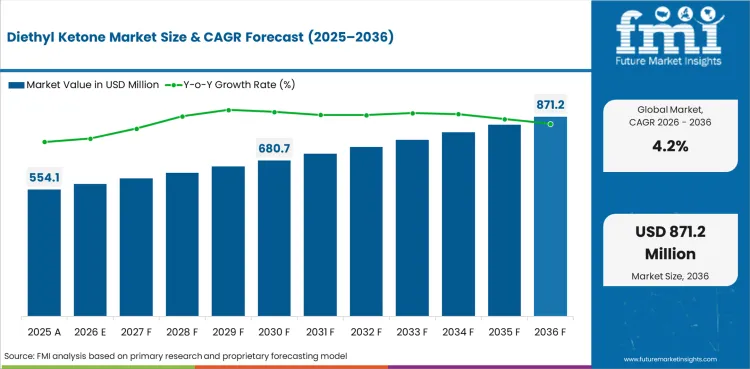
Key Takeaways, Market Size, and Forecast
| Metric | Value |
|---|---|
| Market Size (2025) | USD 531.8 Million |
| Market Size (2026) | USD 554.1 Million |
| Incremental Opportunity (2026–2036) | USD 282.0 Million |
| Leading Specification (2026) | The <99% Purity Segment (99%) |
| Leading Product Type (2026) | Solvent Use |
| Solvent Use Share (2026) | 50.0% |
| Leading Distribution Channel (2026) | Pharmaceuticals |
| Pharmaceuticals Share (2026) | 33.2% |
| Fastest-Growing Country | China |
| China CAGR | 5.9% |
| 2nd Fastest-Growing Country | ASEAN |
| ASEAN CAGR | 5.2% |
Demand is influenced by controlled evaporation requirements in coatings and by tighter purity discipline in regulated synthesis. Solvent selection in this category now overlaps with procurement patterns seen in pharmaceutical solvents and industrial solvents. Trade concentration in large petrochemical hubs reinforces supply discipline across import-reliant demand centers.
Diethyl Ketone Market Definition
Diethyl ketone is an organic solvent and intermediate used in industrial processing and controlled chemical synthesis. Market scope covers the sale of material into formulations and process systems. These systems require solvency strength, balanced evaporation and stable performance under operating conditions. Demand is generated by manufacturers using the material in coatings, pharmaceutical processing, agrochemicals, flavors, fragrances, and selected imaging chemistry applications.
Diethyl Ketone Market Inclusions
Market scope includes diethyl ketone sold in below 99% purity grades and 99% and above purity grades. Counted applications include solvent use, chemical intermediate use, and reagent use in industrial or controlled laboratory settings. Counted end uses include pharmaceuticals, paints and coatings, agrochemicals, flavors and fragrances, and photography and lithography across direct manufacturer sales and chemical distribution channels.
Diethyl Ketone Market Exclusions
Scope excludes substitute ketones such as acetone or methyl ethyl ketone unless diethyl ketone is the actual material sold. Downstream finished goods are excluded once diethyl ketone is no longer a traded input. Contract processing services, consulting activities, reclaimed solvent streams, and experimental usage outside commercial supply chains are excluded from valuation.
Diethyl Ketone Market Research Methodology
- Primary Research: FMI assessment incorporates discussions with chemical producers, distributors, pharmaceutical formulators, coatings manufacturers, and specialty chemical processors across major producing and importing regions.
- Desk Research: Secondary work draws from technical literature, chemical safety databases, trade flow records, regulatory documentation, and company product information tied to solvent grade positioning.
- Market Sizing and Forecasting: Bottom up country modeling aligns demand with pharmaceutical production intensity, coatings activity, and specialty chemical processing volume across target applications.
- Data Validation: Estimates are triangulated through producer input, trade patterns, downstream consumption signals, and recurring review of capacity and compliance changes.
Why is the Diethyl Ketone Market Expanding?
- Controlled evaporation is improving material preference in coatings and formulation work requiring even drying profiles.
- Higher purity demand in regulated synthesis is strengthening usage in selected pharmaceutical processes.
- Import dependent regions are placing more value on reliable supply and consistent delivered quality.
- Specialty chemical production is widening application depth for solvents with stable reaction behavior.
Balanced performance remains a major commercial reason behind rising diethyl ketone consumption. Formulators using resins and specialty compounds value solvent systems that deliver even dissolution and manageable drying without abrupt volatility shifts. Demand patterns in coatings now align more closely with application themes visible in coating resins and specialty coatings. Manufacturers are focusing more closely on material behavior across repeated production runs. Consistent operating behavior and clean processing outcomes now carry greater weight in selection decisions, and headline solvent strength plays a less decisive role. Such buying discipline helps diethyl ketone retain a defined role in process settings requiring repeatable performance.
Supply side conditions are shaping expansion in a different way. Production is stronger in integrated chemical regions with feedstock depth and established handling infrastructure. Import reliant destinations across India and ASEAN are responding by favoring suppliers offering continuity and standard specification control. Downstream use in pharmaceutical intermediates and fine chemicals is reinforcing this shift toward application grade selling. Distribution strength, transport discipline, and documentation quality now exert a more direct influence on purchase decisions compared with earlier market phases. Such conditions are gradually moving the market toward more structured supply relationships.
Market Segmentation Analysis
Segmental demand in diethyl ketone reflects three clear commercial filters. Purity governs fitness for use in sensitive synthesis and general processing. Application determines solvent value inside formulation or chemical conversion work. End use identifies the operating environment driving purchase discipline and repeat consumption. Additional insight across selected subsegments shows how demand varies between broad volume usage and narrower high control processing needs. Competitive substitution from other ketones is present, but diethyl ketone retains a defined place in settings needing balanced solvency and measured evaporation.
Insights into the <99% Purity Segment
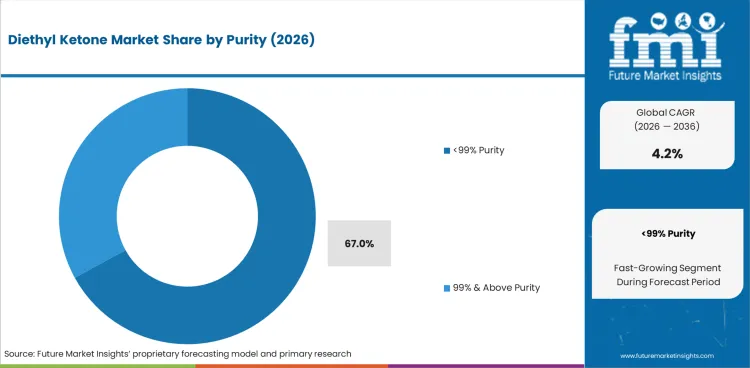
- In 2026, the <99% purity segment is estimated to account for 67.0% share as industrial users focus on workable solvency and lower input cost across routine processing programs.
- Coatings and general chemical processing support this lead since most high volume applications do not require tighter refinement or premium grade pricing seen in high purity solvents.
- Steady repeat use across resin systems and intermediates supports segment strength. Broad solvent applications favor cost discipline as ultra‑high specification control plays a more limited role.
Insights into the Solvent Segment
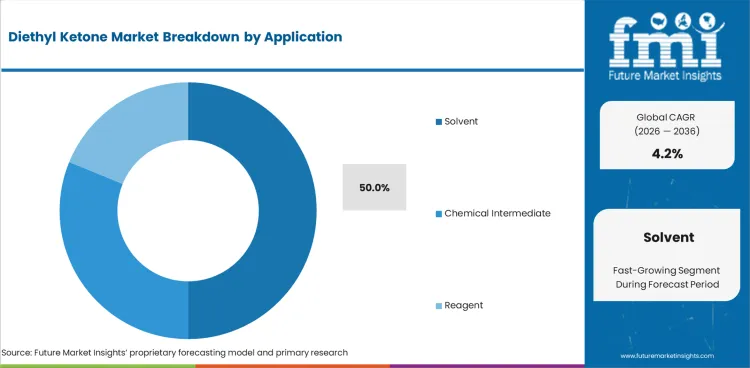
- In 2026, the solvent segment is projected to capture 50.0% share as diethyl ketone supports balanced evaporation and dependable dissolution across industrial formulations and processing systems.
- Coating systems and specialty blends favor this application since even drying improves film quality and supports more uniform output across coating resins and specialty coatings.
- Large repeat volumes keep solvent use in first place across the application mix and preserve its scale advantage over narrower reaction-driven uses.
Insights into the Pharmaceuticals Segment
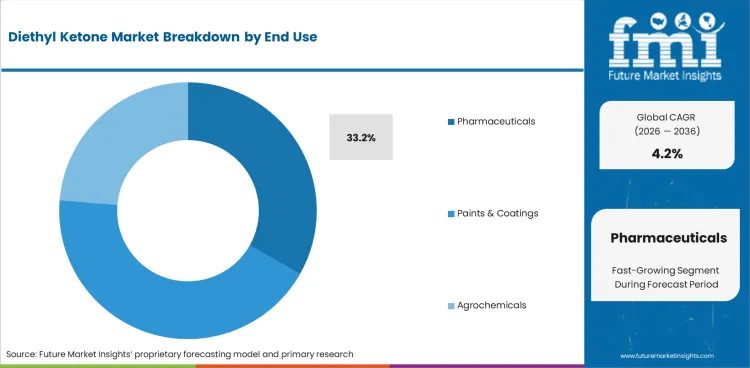
- In 2026, pharmaceuticals are estimated to account for 33.2% share. Regulated synthesis places greater weight on stable solvent behavior, impurity discipline, and repeat batch performance.
- Intermediate preparation and controlled process steps favor suppliers delivering dependable quality and stronger documentation across manufacturing programs aligned with pharmaceutical solvents.
- End‑use leadership in pharmaceuticals reflects tighter operating requirements and firmer value realization, while broad industrial outlets face wider substitution pressure.
Insights into the Chemical Intermediate Segment
- Chemical intermediate use is commercially important as multistep synthesis programs require solvents supporting stable reaction conditions and practical downstream compatibility.
- Fine chemical and regulated intermediate production create demand for material performing with low variability across controlled operating cycles linked with pharmaceutical intermediates and fine chemicals.
- Value per ton in this segment often runs firmer due to stronger process sensitivity and narrower qualification tolerance compared with broad solvent applications.
Insights into the Reagent Segment
- Reagent use forms a smaller share base but continues to hold strategic importance in analytical and preparative work that requires repeat reaction input and documented material consistency.
- Controlled grades are preferred in laboratory and industrial settings due to the importance of reproducibility in this narrower application space.
- Premium positioning here is supported by lower lot volumes and a stronger focus on packaging integrity. Specification control and batch consistency across qualified use environments are also important.
Insights into the Paints & Coatings Segment
- Paints and coatings remain a major end use block as diethyl ketone supports resin compatibility and controlled drying across formulation programs requiring stable application behavior.
- Industrial coating lines and specialty formulations favor solvents delivering even film formation without abrupt volatility shifts across systems comparable with coating resins and ink additives.
- Demand from this segment broadens the market base beyond regulated synthesis and supports steady repeat use across industrial production cycles.
Insights into the Flavors & Fragrances Segment
- Flavors and fragrances represent a smaller outlet. Purchase standards are exacting due to strict residue discipline controlled handling practices and compatibility with delicate compound systems.
- Suppliers active in this segment need dependable lot quality and tighter documentation across specialty chemical channels aligned with flavors and fragrances.
- Lower volume demand does not reduce commercial value since qualification standards and performance consistency carry heavy weight in approved formulations.
Diethyl Ketone Market Drivers, Restraints, and Opportunities
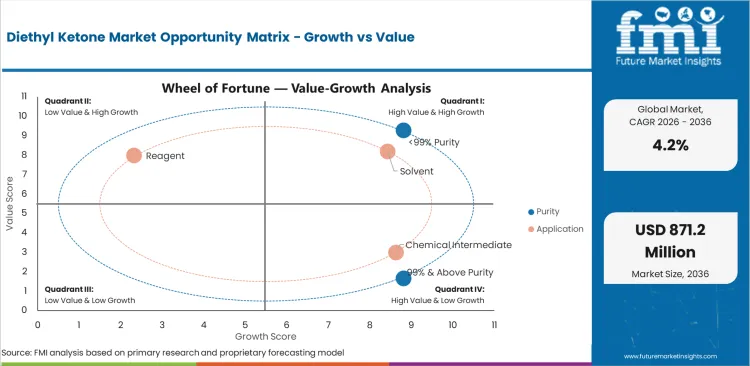
Commercial direction in diethyl ketone is shaped by a narrow set of operating forces. Demand gains originate from applications requiring controlled evaporation and stable reaction behavior. Restraints emerge from feedstock reliance and flammability handling requirements. Substitution pressure from broader solvent portfolios also limits market expansion. Opportunity is strongest in higher‑control processing programs where application‑led grade selection guides purchasing decisions. Market participants able to combine a stable supply with technical grade discipline are better placed to protect share across the decade.
Unit-Value Proxy Shows Wide Price Dispersion
In the diethyl ketone market, a cleaner way to discuss pricing is through a unit-value proxy instead of an index. USA Census Bureau FT895 tables from March 2025 show that the tariff line for acyclic ketones without other oxygen function moved at very different implied values across 2024 flows. Shipments from the United States to Puerto Rico totaled 1,537 kg at US$9 thousand, which equals about US$5.85 per kg. Shipments from the United States to the Virgin Islands totaled 217,575 kg at US$122 thousand, which equals about US$0.56 per kg. For diethyl ketone, this spread signals how transaction economics are shaped.
Aerosol-Coatings Rule Improves Formulation Access
In the diethyl ketone market, a commercially relevant non-price statistic comes from regulatory usability in aerosol coatings. In January 2025, EPA finalized amendments to the national aerosol coatings rule, added 17 new compounds to Table 2A, and reset the default reactivity factor for unlisted VOCs to 18.50 g O3/g VOC. Within the same rule, 3-Pentanone (diethyl ketone, CAS 96-22-0) is listed at 1.24 g O3/g VOC, while all regulated entities had to comply with the revised provisions by July 17, 2025. For diethyl ketone suppliers, this holds importance as a listed reactivity factor well below the default improves formulation certainty. It also keeps the molecule commercially usable in compliance‑sensitive aerosol applications.
Regional Analysis
Diethyl ketone demand extends across major industrial regions. Commercial intensity varies sharply due to differences in local chemical integration import exposure and downstream manufacturing depth. East Asia and South Asia carry stronger pace due to chemical production expansion and import linked formulation demand. North America and Western Europe reflect steadier trajectories shaped by mature compliance systems and product qualification discipline. Seven benchmark countries and regions below capture the main commercial contrast across the global market.
.webp "Top Country Growth Comparison Diethyl Ketone Market Cagr (2026 2036)")
| Country / Region | CAGR (2026 to 2036) |
|---|---|
| USA | 4.0% |
| ASEAN | 5.2% |
| Japan | 3.4% |
| Germany | 3.9% |
| UK | 3.7% |
| China | 5.9% |
| India | 6.2% |
Source: Future Market Insights, 2026.
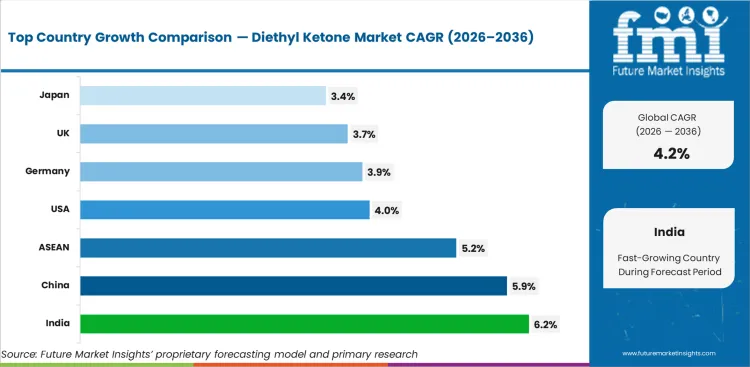
India and China stand above the global average due to stronger manufacturing expansion and larger demand pull from downstream chemical processing. ASEAN follows closely as coatings and agrochemical demand deepen across export-oriented industrial clusters. The USA, Germany, the UK, and Japan remain important volume centers, and each operates from a mature base with tighter process optimization and slower incremental expansion.
Demand Outlook for Diethyl Ketone Market in the United States
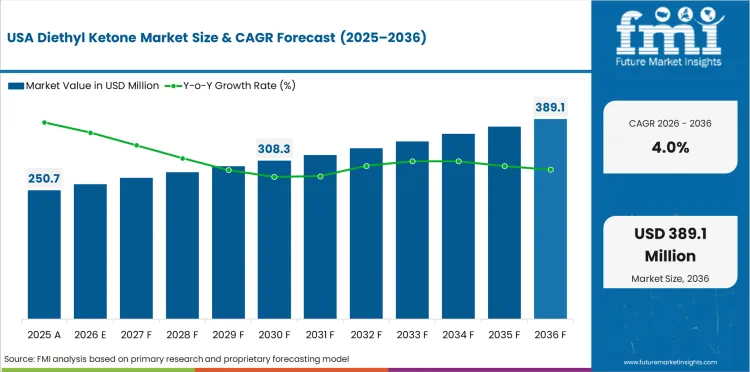
United States demand is projected to expand at a 4.0% CAGR through 2036. Pharmaceutical manufacturing and specialty chemical processing keep solvent demand stable in operating environments requiring repeat reaction behavior and controlled handling.
- Pharmaceutical and specialty chemical production sustain stable solvent demand across regulated operating environments.
- Compliance documentation and handling discipline influence supplier selection more directly in this market.
- A mature industrial structure supports steady expansion with limited acceleration.
Future Outlook for Diethyl Ketone Market in ASEAN
ASEAN is expected to record a 5.2% CAGR over the forecast years. Regional pace is lifted by industrial diversification and by a rising base of downstream production serving external markets.
- Coatings and agrochemical processing are enhancing regional need for dependable solvent supply.
- Import reliance places strong emphasis on continuity, shipment timing, and delivered specification quality.
- Export manufacturing activity supports broader use in specialty chemical processing programs.
In-depth Analysis of Diethyl Ketone Market in Japan
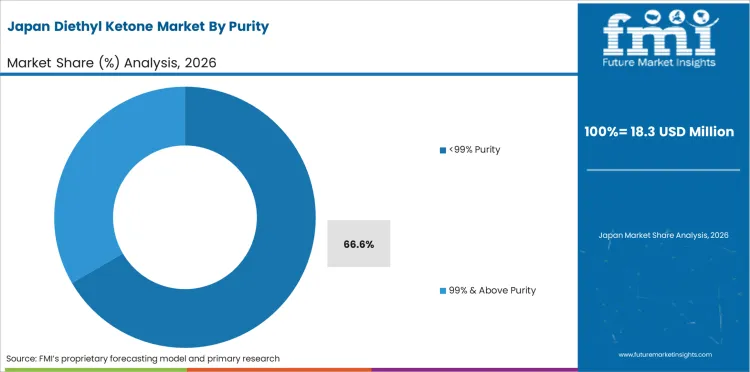
Japan is projected to expand at a 3.4% CAGR from 2026 to 2036. Fine chemical production and high‑control manufacturing environments keep demand present.
- High control manufacturing keeps demand focused on consistency and impurity discipline.
- Mature operating conditions limit value acceleration relative to faster industrializing markets.
- Technical credibility is central for suppliers serving precision led processing programs.
Opportunity Analysis of Diethyl Ketone Market in Germany
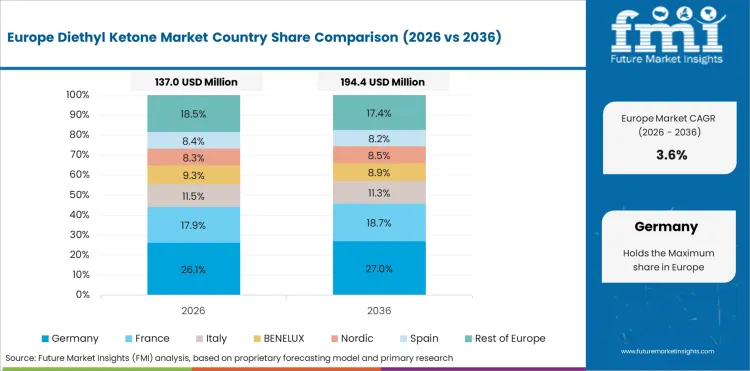
Germany is expected to register a 3.9% CAGR during the assessment period. Commercial success in this country favors suppliers with dependable grade consistency and strong industrial channel reach.
- Specialty coatings and engineered chemicals preserve a solid demand base for disciplined solvent systems.
- Traceability and batch repeatability carry strong weight under mature chemical compliance structures.
- Export linked manufacturing supports continued use in higher value processing programs.
Sales Outlook for Diethyl Ketone Market in the United Kingdom
United Kingdom demand is expected to rise at a 3.7% CAGR by 2036. UK REACH and related compliance practices strengthen focus on handling discipline and supplier documentation.
- Regulated manufacturing supports steady demand for documented solvent grades in controlled processing work.
- Compliance obligations keep supplier documentation and handling standards commercially important.
- Life sciences strength preserves demand quality even with moderate pace.
Sales Analysis of Diethyl Ketone Market in China
China is projected to record a 5.9% CAGR through 2036. The country remains one of the most important commercial bases for diethyl ketone across the forecast period.
- Integrated chemical production supports strong availability and cost efficiency in domestic supply.
- Export linked downstream demand preserves large scale use across several industrial applications.
- Environmental oversight is raising the value of compliant production and documented grade quality.
Demand Outlook for Diethyl Ketone Market in India
India is projected to post the fastest pace at a 6.2% CAGR during the forecast period. Manufacturers in India favor materials offering cost discipline together with dependable performance in varied processing settings.
- Pharmaceutical and specialty chemical expansion are widening solvent use across regulated and industrial programs.
- Import dependence raises the commercial value of reliable shipments and consistent delivered quality.
- Coatings and agrochemical demand deepen market breadth beyond core synthesis applications.
Competitive Landscape and Strategic Positioning
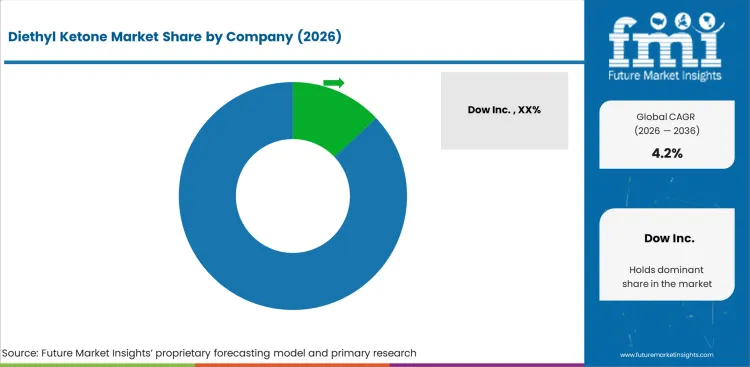
- Moderate concentration defines competition as integrated producers control feedstock chains, wider solvent portfolios, and established industrial supply coverage.
- Dow Inc., BASF SE, Eastman Chemical Company, and Celanese Corporation hold stronger standing through broader solvent capability and tighter grade discipline.
- Regional suppliers compete through faster delivery, closer technical contact, and stronger alignment with pharmaceutical, coatings, and specialty chemical demand.
- Entry barriers remain meaningful as hazardous solvent production requires compliant infrastructure, trusted logistics, and long qualification cycles across industrial accounts.
Competition in the diethyl ketone market remains moderately concentrated as integrated chemical producers control upstream inputs and wider solvent portfolios. Established industrial distribution networks strengthen their position across major producing regions and regulated downstream applications. Market structure favors suppliers able to combine dependable grade control with steady service for qualified industrial accounts.
Dow Inc. and BASF SE hold strong positions within this group through broader solvent capability and tighter specification discipline. Eastman Chemical Company and Celanese Corporation support similar advantages through wider account coverage and reliable industrial supply programs.In regulated settings, supplier preference is shaped by repeat batch quality and documentation strength rather than short‑term price signals.
Portfolio breadth helps support contract retention across coatings, synthesis, and formulation work. Customers benefit from sourcing several related solvents within a single purchase cycle. Global manufacturing capacity and storage reach help these suppliers serve larger import sensitive regions with fewer supply gaps. Broader infrastructure improves customer confidence during qualification and during repeat production under controlled operating conditions.
Regional participants compete through faster local delivery and closer technical contact with downstream chemical manufacturers. Mitsui Chemicals Inc. and LG Chem Ltd. hold stronger standing in Asian networks shaped by local production and formulation demand. Arkema S.A. serves programs requiring solvent handling experience and dependable industrial support across selected accounts. Sasol Limited and Shell Chemicals compete in selected accounts through feedstock strength and established industrial customer links.
Entry barriers remain meaningful as hazardous solvent production requires compliant infrastructure and trusted storage and logistics execution. Qualified buyers rarely change suppliers after approval for repeat production in sensitive industrial operating environments. Feedstock integration and steady product quality raise the threshold for any newcomer seeking meaningful participation. Competitive success rests on manufacturing discipline and documentation quality and dependable continuity during trade or logistics disruption.
Key Companies in the Diethyl Ketone Market
- Global Leaders: Dow Inc., BASF SE, Eastman Chemical Company, and Celanese Corporation hold the strongest global footing due to broad solvent portfolios, integrated production capability, and established industrial distribution.
- Regional Players: Mitsui Chemicals, LG Chem, and Arkema hold strong regional positions through local manufacturing and customer ties, supported by proximity to chemical clusters, efficient regional delivery, shorter lead times, and dependable technical support.
- Selective Suppliers: Sasol Limited, Shell Chemicals, and ExxonMobil remain selective participants, leveraging upstream strength and solvent expertise to serve accounts prioritizing supply reliability, hazardous material handling, and integrated petrochemical sourcing.
Recent Developments
- In June 2025, Alkyl Amines Chemicals confirmed completion and commissioning of its diethyl ketone capacity expansion at the Kurkumbh site, strengthening available supply for downstream industrial use.
- In November 2025, Alkyl Amines said diethyl ketone volumes were improving as agrochemical-linked demand normalized and plant operations stabilized after a weaker phase.
- Sisco Research Laboratories’ 2026 catalogue showed higher listed prices for lab‑grade diethyl ketone, signaling firmer pricing in the specialty supply channel
Key Players in the Diethyl Ketone Market
Major Global Players
- Dow Inc.
- BASF SE
- Eastman Chemical Company
- Celanese Corporation
- ExxonMobil Corporation
Regional Players
- Arkema S.A.
- Mitsui Chemicals Inc.
- LG Chem Ltd.
Selective / Feedstock-Backed Participants
- Sasol Limited
- Shell Chemicals
Competitive Benchmarking for Diethyl Ketone Market
| Company | Solvent Portfolio Breadth | Purity Control Capability | Manufacturing & Distribution Reach | Commercial Position |
|---|---|---|---|---|
| Dow Inc. | High | Strong | Global | Leading integrated supplier |
| BASF SE | High | Strong | Global | Leading integrated supplier |
| Eastman Chemical Company | High | Strong | Global | Strong specialty chemicals presence |
| Celanese Corporation | High | Strong | Global | Strong industrial solvent position |
| Sasol Limited | Medium | Moderate | Global | Selective industrial supplier |
| Shell Chemicals | Medium | Moderate | Global | Feedstock-backed participant |
| ExxonMobil Corporation | Medium | Moderate | Global | Large petrochemical participant |
| Arkema S.A. | Medium | Strong | Europe, Global | Application-focused supplier |
| Mitsui Chemicals Inc. | Medium | Strong | Asia | Strong regional supplier |
| LG Chem Ltd. | Medium | Moderate | Asia | Strong regional supplier |
Source: Future Market Insights, 2026.
Scope of the Report
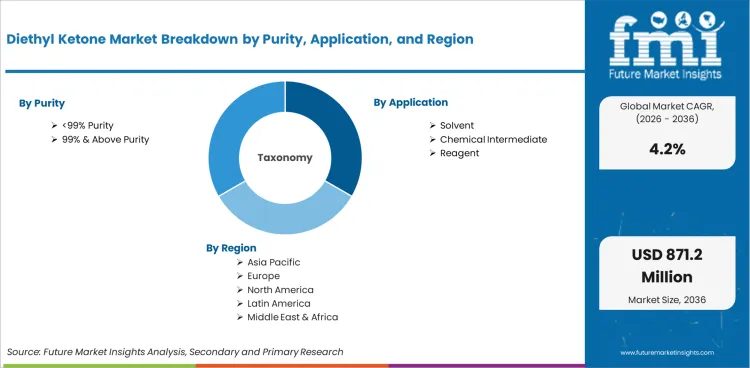
| Metric | Value |
|---|---|
| Quantitative Units | USD 554.1 Million to USD 836.1 Million, at a CAGR of 4.2% |
| Market Definition | The Diethyl Ketone Market covers the production and use of diethyl ketone, an organic solvent valued for its fast evaporation and effective solvency. It includes applications in paints and coatings, adhesives, and chemical processing for efficient formulation and industrial use. |
| Regions Covered | North America, Latin America, Europe, East Asia, South Asia, Oceania, Middle East & Africa |
| Countries Covered | China, India, Germany, Brazil, USA, UK, Japan, and 40+ countries |
| Key Companies Profiled | Dow Inc., Sasol Limited, ExxonMobil Corporation, Shell Chemicals, BASF SE, Celanese Corporation, Eastman Chemical Company, Arkema S.A., Mitsui Chemicals Inc., LG Chem Ltd. |
| Forecast Period | 2026 to 2036 |
| Approach | Baseline estimates are derived from production and consumption data across key end-use industries. The approach aligns application-specific usage patterns of diethyl ketone with regional industrial trends, regulatory frameworks, and solvent substitution patterns to project demand through 2036. |
Diethyl Ketone Market by Segments
Diethyl Ketone Market Segmented by Purity:
- <99% Purity
- 99% & Above Purity
Diethyl Ketone Market Segmented by Application:
- Solvent
- Chemical Intermediate
- Reagent
Diethyl Ketone Market Segmented by End Use:
- Pharmaceuticals
- Paints & Coatings
- Agrochemicals
- Flavors & Fragrances
- Photography & Lithography
Diethyl Ketone Market by Region:
- North America
- USA
- Canada
- Mexico
- Latin America
- Brazil
- Chile
- Rest of Latin America
- Western Europe
- Germany
- UK
- Italy
- Spain
- France
- Nordic
- BENELUX
- Rest of Western Europe
- Eastern Europe
- Russia
- Poland
- Hungary
- Balkan & Baltic
- Rest of Eastern Europe
- East Asia
- China
- Japan
- South Korea
- South Asia and Pacific
- India
- ASEAN
- Australia & New Zealand
- Rest of South Asia and Pacific
- Middle East & Africa
- Kingdom of Saudi Arabia
- Other GCC Countries
- Turkiye
- South Africa
- Other African Union
- Rest of Middle East & Africa
Research Sources and Bibliography
- USA Census Bureau. (2025, March 4). USA Trade with Puerto Rico and USA Possessions, 2024.
- Environmental Protection Agency. (2025, January 17). National Volatile Organic Compound Emission Standards for Aerosol Coatings Amendments. Federal Register.
- Alkyl Amines Chemicals Limited. (2025, June 6). Notice of 45th annual general meeting.
- Alkyl Amines Chemicals Limited. (2025, November 6). 2QFY’26 earnings conference call transcript. Conference-Call-Transcript.pdf
- Sisco Research Laboratories Pvt. Ltd. (2025, April 9). SRL e-catalogue 2025-26 (Excel version).
- Sisco Research Laboratories Pvt. Ltd. (2026, April 6). Catalogue 2026-2027.
- Elsevier B.V. (2024, December). The chemical organic reactions of β-diketones to prepare different β-diketone derivatives, their properties and its applications: A review. ScienceDirect.
- Asahi Kasei Corporation. (2026, January 27). Asahi Kasei, Mitsui Chemicals, and Mitsubishi Chemical enter basic agreement to promote decarbonization of ethylene production in western Japan.
This bibliography is provided for reader reference and is not exhaustive. The full report contains the complete reference list and detailed citations.
This Report Answers
- Diethyl ketone market sizing for 2026 and 2036 with CAGR for 2026 to 2036 in USD Mn.
- Competitive landscape assessment highlighting integrated chemical producers and regional suppliers across key manufacturing hubs.
- Segment-level analysis by purity, application, and end use, including leading segment shares and usage rationale.
- Country-level growth outlook and CAGR comparison for USA, ASEAN, Japan, Germany, UK, China, and India.
- Assessment of solvent performance characteristics including evaporation behavior, solvency strength, and process compatibility.
- Evaluation of supply chain dynamics, feedstock dependency, and trade flow positioning influencing availability.
- Demand analysis across pharmaceuticals, coatings, agrochemicals, and specialty chemicals shaping market expansion.
Frequently Asked Questions
What is the global market demand for Diethyl Ketone Market in 2026?
In 2026, global demand for diethyl ketone is projected to reach USD 554.1 million.
How large is the Diethyl Ketone Market expected to be by 2036?
By 2036, global market value is projected to reach USD 836.1 million on a steady expansion path.
What is the expected CAGR for Diethyl Ketone Market from 2026 to 2036?
Demand for diethyl ketone is projected to expand at a 4.2% CAGR between 2026 and 2036.
Which purity segment is expected to lead in 2026?
The <99% purity segment is estimated to lead in 2026 with 67.0% share.
Which application segment is expected to lead in 2026?
The solvent segment is projected to lead in 2026 and is expected to account for 50.0% share.
Which end use industry is expected to lead in 2026?
Pharmaceuticals are estimated to remain the leading end use industry with 33.2% share in 2026.
What is driving demand in India?
India leads country level expansion at 6.2% CAGR due to pharmaceutical output, specialty chemical investment, and rising coatings and agrochemical processing demand.
What does this market cover?
Market scope covers commercial sale and use of diethyl ketone as an organic solvent and intermediate across formulation and synthesis applications.
Preview the report firsthand - request a free sample
Get SampleGet the brochure for pricing and purchase details.
Get PDFTable of Content
- Executive Summary
- Global Market Outlook
- Demand-side Trends
- Supply-side Trends
- Technology Roadmap Analysis
- Analysis and Recommendations
- Market Overview
- Market Coverage / Taxonomy
- Market Definition / Scope / Limitations
- Research Methodology
- Chapter Orientation
- Analytical Lens and Working Hypotheses
- Market Structure, Signals, and Trend Drivers
- Benchmarking and Cross-market Comparability
- Market Sizing, Forecasting, and Opportunity Mapping
- Research Design and Evidence Framework
- Desk Research Programme (Secondary Evidence)
- Company Annual and Sustainability Reports
- Peer-reviewed Journals and Academic Literature
- Corporate Websites, Product Literature, and Technical Notes
- Earnings Decks and Investor Briefings
- Statutory Filings and Regulatory Disclosures
- Technical White Papers and Standards Notes
- Trade Journals, Industry Magazines, and Analyst Briefs
- Conference Proceedings, Webinars, and Seminar Materials
- Government Statistics Portals and Public Data Releases
- Press Releases and Reputable Media Coverage
- Specialist Newsletters and Curated Briefings
- Sector Databases and Reference Repositories
- FMI Internal Proprietary Databases and Historical Market Datasets
- Subscription Datasets and Paid Sources
- Social Channels, Communities, and Digital Listening Inputs
- Additional Desk Sources
- Expert Input and Fieldwork (Primary Evidence)
- Primary Modes
- Qualitative Interviews and Expert Elicitation
- Quantitative Surveys and Structured Data Capture
- Blended Approach
- Why Primary Evidence is Used
- Field Techniques
- Interviews
- Surveys
- Focus Groups
- Observational and In-context Research
- Social and Community Interactions
- Stakeholder Universe Engaged
- C-suite Leaders
- Board Members
- Presidents and Vice Presidents
- R&D and Innovation Heads
- Technical Specialists
- Domain Subject-matter Experts
- Scientists
- Physicians and Other Healthcare Professionals
- Governance, Ethics, and Data Stewardship
- Research Ethics
- Data Integrity and Handling
- Primary Modes
- Tooling, Models, and Reference Databases
- Desk Research Programme (Secondary Evidence)
- Data Engineering and Model Build
- Data Acquisition and Ingestion
- Cleaning, Normalisation, and Verification
- Synthesis, Triangulation, and Analysis
- Quality Assurance and Audit Trail
- Market Background
- Market Dynamics
- Drivers
- Restraints
- Opportunity
- Trends
- Scenario Forecast
- Demand in Optimistic Scenario
- Demand in Likely Scenario
- Demand in Conservative Scenario
- Opportunity Map Analysis
- Product Life Cycle Analysis
- Supply Chain Analysis
- Investment Feasibility Matrix
- Value Chain Analysis
- PESTLE and Porter’s Analysis
- Regulatory Landscape
- Regional Parent Market Outlook
- Production and Consumption Statistics
- Import and Export Statistics
- Market Dynamics
- Global Market Analysis 2021 to 2025 and Forecast, 2026 to 2036
- Historical Market Size Value (USD Million) Analysis, 2021 to 2025
- Current and Future Market Size Value (USD Million) Projections, 2026 to 2036
- Y-o-Y Growth Trend Analysis
- Absolute $ Opportunity Analysis
- Global Market Pricing Analysis 2021 to 2025 and Forecast 2026 to 2036
- Global Market Analysis 2021 to 2025 and Forecast 2026 to 2036, By Material Type
- Introduction / Key Findings
- Historical Market Size Value (USD Million) Analysis By Material Type , 2021 to 2025
- Current and Future Market Size Value (USD Million) Analysis and Forecast By Material Type , 2026 to 2036
- Polymers
- Surfactants
- Suspension
- Polymers
- Y-o-Y Growth Trend Analysis By Material Type , 2021 to 2025
- Absolute $ Opportunity Analysis By Material Type , 2026 to 2036
- Global Market Analysis 2021 to 2025 and Forecast 2026 to 2036, By Application
- Introduction / Key Findings
- Historical Market Size Value (USD Million) Analysis By Application, 2021 to 2025
- Current and Future Market Size Value (USD Million) Analysis and Forecast By Application, 2026 to 2036
- Crude Oil
- Multiphase Liquid
- Refined Products
- Crude Oil
- Y-o-Y Growth Trend Analysis By Application, 2021 to 2025
- Absolute $ Opportunity Analysis By Application, 2026 to 2036
- Global Market Analysis 2021 to 2025 and Forecast 2026 to 2036, By End-Use
- Introduction / Key Findings
- Historical Market Size Value (USD Million) Analysis By End-Use, 2021 to 2025
- Current and Future Market Size Value (USD Million) Analysis and Forecast By End-Use, 2026 to 2036
- Oil & Gas
- Chemicals & Petrochemicals
- Energy
- Oil & Gas
- Y-o-Y Growth Trend Analysis By End-Use, 2021 to 2025
- Absolute $ Opportunity Analysis By End-Use, 2026 to 2036
- Global Market Analysis 2021 to 2025 and Forecast 2026 to 2036, By Region
- Introduction
- Historical Market Size Value (USD Million) Analysis By Region, 2021 to 2025
- Current Market Size Value (USD Million) Analysis and Forecast By Region, 2026 to 2036
- North America
- Latin America
- Western Europe
- Eastern Europe
- East Asia
- South Asia and Pacific
- Middle East & Africa
- Market Attractiveness Analysis By Region
- North America Market Analysis 2021 to 2025 and Forecast 2026 to 2036, By Country
- Historical Market Size Value (USD Million) Trend Analysis By Market Taxonomy, 2021 to 2025
- Market Size Value (USD Million) Forecast By Market Taxonomy, 2026 to 2036
- By Country
- USA
- Canada
- Mexico
- By Material Type
- By Application
- By End-Use
- By Country
- Market Attractiveness Analysis
- By Country
- By Material Type
- By Application
- By End-Use
- Key Takeaways
- Latin America Market Analysis 2021 to 2025 and Forecast 2026 to 2036, By Country
- Historical Market Size Value (USD Million) Trend Analysis By Market Taxonomy, 2021 to 2025
- Market Size Value (USD Million) Forecast By Market Taxonomy, 2026 to 2036
- By Country
- Brazil
- Chile
- Rest of Latin America
- By Material Type
- By Application
- By End-Use
- By Country
- Market Attractiveness Analysis
- By Country
- By Material Type
- By Application
- By End-Use
- Key Takeaways
- Western Europe Market Analysis 2021 to 2025 and Forecast 2026 to 2036, By Country
- Historical Market Size Value (USD Million) Trend Analysis By Market Taxonomy, 2021 to 2025
- Market Size Value (USD Million) Forecast By Market Taxonomy, 2026 to 2036
- By Country
- Germany
- UK
- Italy
- Spain
- France
- Nordic
- BENELUX
- Rest of Western Europe
- By Material Type
- By Application
- By End-Use
- By Country
- Market Attractiveness Analysis
- By Country
- By Material Type
- By Application
- By End-Use
- Key Takeaways
- Eastern Europe Market Analysis 2021 to 2025 and Forecast 2026 to 2036, By Country
- Historical Market Size Value (USD Million) Trend Analysis By Market Taxonomy, 2021 to 2025
- Market Size Value (USD Million) Forecast By Market Taxonomy, 2026 to 2036
- By Country
- Russia
- Poland
- Hungary
- Balkan & Baltic
- Rest of Eastern Europe
- By Material Type
- By Application
- By End-Use
- By Country
- Market Attractiveness Analysis
- By Country
- By Material Type
- By Application
- By End-Use
- Key Takeaways
- East Asia Market Analysis 2021 to 2025 and Forecast 2026 to 2036, By Country
- Historical Market Size Value (USD Million) Trend Analysis By Market Taxonomy, 2021 to 2025
- Market Size Value (USD Million) Forecast By Market Taxonomy, 2026 to 2036
- By Country
- China
- Japan
- South Korea
- By Material Type
- By Application
- By End-Use
- By Country
- Market Attractiveness Analysis
- By Country
- By Material Type
- By Application
- By End-Use
- Key Takeaways
- South Asia and Pacific Market Analysis 2021 to 2025 and Forecast 2026 to 2036, By Country
- Historical Market Size Value (USD Million) Trend Analysis By Market Taxonomy, 2021 to 2025
- Market Size Value (USD Million) Forecast By Market Taxonomy, 2026 to 2036
- By Country
- India
- ASEAN
- Australia & New Zealand
- Rest of South Asia and Pacific
- By Material Type
- By Application
- By End-Use
- By Country
- Market Attractiveness Analysis
- By Country
- By Material Type
- By Application
- By End-Use
- Key Takeaways
- Middle East & Africa Market Analysis 2021 to 2025 and Forecast 2026 to 2036, By Country
- Historical Market Size Value (USD Million) Trend Analysis By Market Taxonomy, 2021 to 2025
- Market Size Value (USD Million) Forecast By Market Taxonomy, 2026 to 2036
- By Country
- Kingdom of Saudi Arabia
- Other GCC Countries
- Turkiye
- South Africa
- Other African Union
- Rest of Middle East & Africa
- By Material Type
- By Application
- By End-Use
- By Country
- Market Attractiveness Analysis
- By Country
- By Material Type
- By Application
- By End-Use
- Key Takeaways
- Key Countries Market Analysis
- USA
- Pricing Analysis
- Market Share Analysis, 2025
- By Material Type
- By Application
- By End-Use
- Canada
- Pricing Analysis
- Market Share Analysis, 2025
- By Material Type
- By Application
- By End-Use
- Mexico
- Pricing Analysis
- Market Share Analysis, 2025
- By Material Type
- By Application
- By End-Use
- Brazil
- Pricing Analysis
- Market Share Analysis, 2025
- By Material Type
- By Application
- By End-Use
- Chile
- Pricing Analysis
- Market Share Analysis, 2025
- By Material Type
- By Application
- By End-Use
- Germany
- Pricing Analysis
- Market Share Analysis, 2025
- By Material Type
- By Application
- By End-Use
- UK
- Pricing Analysis
- Market Share Analysis, 2025
- By Material Type
- By Application
- By End-Use
- Italy
- Pricing Analysis
- Market Share Analysis, 2025
- By Material Type
- By Application
- By End-Use
- Spain
- Pricing Analysis
- Market Share Analysis, 2025
- By Material Type
- By Application
- By End-Use
- France
- Pricing Analysis
- Market Share Analysis, 2025
- By Material Type
- By Application
- By End-Use
- India
- Pricing Analysis
- Market Share Analysis, 2025
- By Material Type
- By Application
- By End-Use
- ASEAN
- Pricing Analysis
- Market Share Analysis, 2025
- By Material Type
- By Application
- By End-Use
- Australia & New Zealand
- Pricing Analysis
- Market Share Analysis, 2025
- By Material Type
- By Application
- By End-Use
- China
- Pricing Analysis
- Market Share Analysis, 2025
- By Material Type
- By Application
- By End-Use
- Japan
- Pricing Analysis
- Market Share Analysis, 2025
- By Material Type
- By Application
- By End-Use
- South Korea
- Pricing Analysis
- Market Share Analysis, 2025
- By Material Type
- By Application
- By End-Use
- Russia
- Pricing Analysis
- Market Share Analysis, 2025
- By Material Type
- By Application
- By End-Use
- Poland
- Pricing Analysis
- Market Share Analysis, 2025
- By Material Type
- By Application
- By End-Use
- Hungary
- Pricing Analysis
- Market Share Analysis, 2025
- By Material Type
- By Application
- By End-Use
- Kingdom of Saudi Arabia
- Pricing Analysis
- Market Share Analysis, 2025
- By Material Type
- By Application
- By End-Use
- Turkiye
- Pricing Analysis
- Market Share Analysis, 2025
- By Material Type
- By Application
- By End-Use
- South Africa
- Pricing Analysis
- Market Share Analysis, 2025
- By Material Type
- By Application
- By End-Use
- USA
- Market Structure Analysis
- Competition Dashboard
- Competition Benchmarking
- Market Share Analysis of Top Players
- By Regional
- By Material Type
- By Application
- By End-Use
- Competition Analysis
- Competition Deep Dive
- Baker Hughes
- Overview
- Product Portfolio
- Profitability by Market Segments (Product/Age /Sales Channel/Region)
- Sales Footprint
- Strategy Overview
- Marketing Strategy
- Product Strategy
- Channel Strategy
- Innospec
- Flowchem
- Lubrizol Specialty Products Inc.
- Oil Flux Americas
- NuGenTec
- Sino Oil King Shine Chemical
- Baker Hughes
- Competition Deep Dive
- Assumptions & Acronyms Used


