

- Market Size (2026)
- USD 403.8 Mn
- Forecast (2036)
- USD 1000.7 Mn
- CAGR (2026 to 2036)
- 9.5%
How Big is the Donut Mix & Concentrates Market in 2026?
The donut mix & concentrates market is estimated at USD 403.8 million in 2026.
The global donut mix & concentrates market was valued at USD 368.8 million in 2025 and is estimated to reach USD 403.8 million in 2026. The market is projected to reach USD 1,000.7 million by 2036, expanding at a compound annual growth rate (CAGR) of 9.5% between 2026 and 2036. Glazed rings accounted for the largest share of the Product Type breakdown, contributing 34.0% of total revenue in 2026. Demand is supported by bakeries that use complete mixes and concentrates to obtain consistent dough handling, shape and crumb through mixing, proofing and frying. Raw material costs have risen sharply. According to the Food and Agriculture Organization of the United Nations (FAO), its Cereal Price Index stood 17.2% above its year-earlier level in September 2026, with world wheat prices reaching their highest level since August 2023, while the Vegetable Oil Price Index was 18.3% higher[5]. Such increases affect both the flour in a donut mix and the oil used for frying. Suppliers continue to launch new products. For instance, Dawn Foods announced its Churro Donut Mix in May 2025, with US availability from July 2025[1].
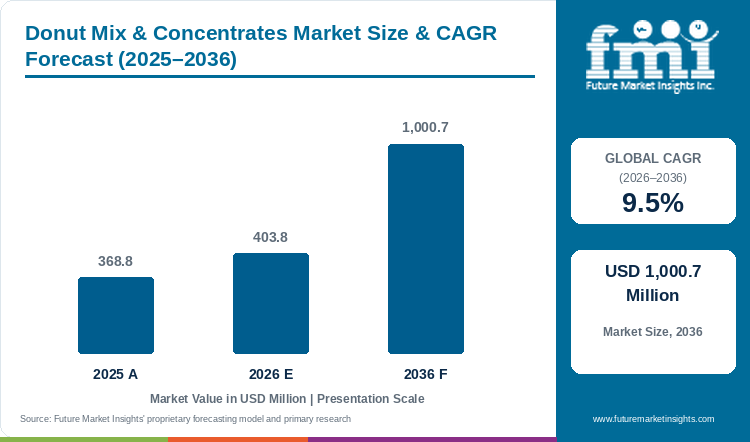
Table 1: Donut Mix & Concentrates Market Size and Forecast (USD million), 2025 to 2036
| Market size and forecast | Value |
|---|---|
| 2025 market size | USD 368.8 million |
| Estimated market size in 2026 | USD 403.8 million |
| Projected market size by 2036 | USD 1,000.7 million |
| CAGR (2026-2036) | 9.5% |
| Added revenue, 2026 to 2036 | USD 596.9 million |
Key Market Trends & Insights
- By Product Type: The Glazed rings segment accounted for the largest share of the Product Type breakdown in 2026, representing 34.0% of total market revenue.
- By Form: Powder / dry products held the leading market position with a share of 48.0% in 2026, fitting dry storage, weighing and batch preparation systems.
- By Application: Bread & rolls remained the largest application segment, accounting for 34.0% of the market in 2026.
Regional Highlights
- Fastest-growing country: The UAE is expected to record the highest growth rate among the eight profiled countries, with a projected CAGR of 10.9% between 2026 and 2036.
- Growth across other countries: Saudi Arabia is projected to expand at a CAGR of 10.5%, followed by South Korea at 10.2% and the USA at 9.9%. Japan is expected to register comparatively slower growth, with a CAGR of 8.6% during the forecast period.
Flour is the largest component of a complete donut mix, and wheat prices remain an important factor influencing mix costs. The FAO reported that world wheat prices rose by 6.3% in September 2026, as logistical constraints in the Black Sea region pushed importers towards alternative origins[5]. In a complete mix, the supplier bears this cost and passes it on through the mix price. In a concentrate, the bakery buys its own flour, which keeps the price exposure with the customer. Zeelandia's Donut Concentrate recipe, for instance, combines the supplied preparation with flour, water, eggs and yeast[4]. Within bakery mixes and concentrates, rising wheat prices can therefore shift the cost comparison between the two formats.
Other ingredient costs are moving in different directions. International palm oil prices rose for a fourth consecutive month in September 2026, and the FAO Vegetable Oil Price Index stood 18.3% above its year-earlier level[5], which increases frying costs for every donut. In contrast, the United States Department of Agriculture (USDA) forecasts that egg prices will fall by 29.4% in 2026, after rising by 21.9% in 2025[7]. Lower egg prices reduce the cost of concentrates that require eggs to be added at the bakery. Demand conditions in donut retail are also changing. Krispy Kreme reported 2025 systemwide sales of USD 2.0 billion, up 0.7% in constant currency, while reducing its global points of access by 13.5% to 15,194[6].
Suppliers are investing in application support to help bakeries adapt mixes to local conditions. CSM Ingredients opened a GBP 3.0 million customer development centre in Cheshire, UK, in November 2025 for formulation and practical bakery work[2]. Development support links the supplied blend with flour selection, water addition and the customer's operating conditions, which influence oil uptake, crumb and finishing. Ingredient information must also remain aligned with the recipe. Food Standards Agency guidance addresses labelling of food prepacked for direct sale in the UK[3], so changes to flour or formulation can affect both production behaviour and the records attached to the finished donut.
Table 2: Supporting Industry Indicators for the Donut Mix & Concentrates Market, 2021 to 2026
| Indicator | Data point | Why it matters | Source |
|---|---|---|---|
| Cereal prices | The FAO Cereal Price Index stood 17.2% above its year-earlier level in September 2026. | Flour is the main component of complete donut mixes. | [5] |
| Wheat prices | World wheat prices rose by 6.3% in September 2026 to their highest level since August 2023. | Higher wheat prices raise mix costs and shift the comparison with concentrates. | [5] |
| Vegetable oil prices | The FAO Vegetable Oil Price Index stood 18.3% above its year-earlier level in September 2026. | Frying oil is a major cost in donut production. | [5] |
| Egg prices | US egg prices rose by 21.9% in 2025 and are forecast to fall by 29.4% in 2026. | Eggs are added at the bakery when using concentrates. | [7] |
| Donut retail | Krispy Kreme systemwide sales reached USD 2.0 billion in 2025, while points of access fell by 13.5%. | Donut volumes are concentrating in fewer, higher-volume outlets. | [6] |
| Product launch | Dawn announced Churro Donut Mix in May 2025, with US availability from July 2025. | New mixes add flavour and texture options within existing production. | [1] |
| Development centre | CSM Ingredients opened a GBP 3.0 million customer development centre in Cheshire in November 2025. | Local formulation resources help adapt mixes to bakery conditions. | [2] |
| Concentrate preparation | Zeelandia lists flour, water, eggs and yeast as additions to its Donut Concentrate. | Local ingredients remain part of the formulation and its cost. | [4] |
| Labelling guidance | Food Standards Agency guidance from June 2021 addresses prepacked-for-direct-sale labelling. | UK recipes must remain aligned with the finished-product declaration. | [3] |
Demand Intensity Analysis
A comparison of FMI's market estimate with donut chain sales provides a measure of the scale of mix use. Krispy Kreme reported systemwide sales of USD 2.0 billion in 2025[6]. FMI estimated the donut mix & concentrates market at USD 368.8 million in 2025, which is equivalent to approximately 18.8% of the systemwide sales of this single chain. Since mixes are only one input into a donut, and many bakeries make donuts from basic ingredients, the comparison indicates that FMI's estimate covers a broad base of in-store bakeries, foodservice operators and industrial producers.
Raw material costs provide another reference point. The FAO Cereal Price Index rose by 17.2% and the Vegetable Oil Price Index by 18.3% in the year to September 2026[5], while FMI expects the market to grow at a CAGR of 9.5% between 2026 and 2036. If cereal prices remain at current levels, part of the market's value growth in the near term will reflect higher flour costs passed through in mix prices rather than higher volumes.
A similar comparison can be made between complete mixes and concentrates. When wheat prices rise, the cost of a complete mix increases in proportion to its flour content, while the cost of a concentrate changes less because the bakery buys flour separately[4][5]. At the same time, the 29.4% forecast fall in US egg prices for 2026[7] reduces the cost of the ingredients bakeries add to concentrates. These movements may favour concentrates among cost-conscious industrial users in 2026.
Segment values show where demand is concentrated. Powder / dry accounted for USD 193.8 million of Form revenue in 2026, while Glazed rings represented USD 137.3 million on the Product Type axis. Direct to industrial bakeries represented USD 201.9 million of Sales Channel revenue. The market is projected to add USD 596.9 million between 2026 and 2036 and reach 2.5 times its 2026 value.
Table 3: Demand Intensity Metrics for the Donut Mix & Concentrates Market, 2025 and 2026 Industry Data Against Market Values
| Demand intensity metric | Value | Basis |
|---|---|---|
| FMI market value, 2025 | USD 368.8 million | FMI estimate of donut mix and concentrate revenue. |
| Krispy Kreme systemwide sales, 2025 | USD 2.0 billion | Krispy Kreme full-year 2025 results. |
| FMI value as a share of Krispy Kreme systemwide sales | 18.8% | USD 368.8 million divided by USD 2.0 billion. |
| FAO Cereal Price Index, year-on-year change | +17.2% | September 2026 against September 2025. |
| FAO Vegetable Oil Price Index, year-on-year change | +18.3% | September 2026 against September 2025. |
| US egg price forecast, 2026 | -29.4% | USDA ERS, September 2026. |
| FMI value CAGR, 2026 to 2036 | 9.5% | FMI market forecast. |
| Powder / dry revenue, 2026 | USD 193.8 million | 48.0% of the market. |
| Glazed rings revenue, 2026 | USD 137.3 million | 34.0% of the market. |
| Direct industrial bakery revenue, 2026 | USD 201.9 million | 50.0% of the market. |
| Market expansion multiple | 2.5 times | Projected 2036 market value relative to 2026. |
Analyst Perspective
"With wheat and frying oil both up by more than 17.0% in a year, bakeries are looking hard at whether a complete mix or a concentrate gives them the lower cost per donut without losing shape and crumb."
- Nandini Roy Choudhury, Principal Analyst at Future Market Insights
How is the donut mix & concentrates market segmented?
The donut mix & concentrates market is segmented by product type, form, application, claim and sales channel. Product Type comprises Glazed rings, Filled donuts, Cake donuts and Premium & specialty. Form comprises Powder / dry, Liquid, Paste / semi-solid and Granules / pieces. Application comprises Bread & rolls, Cakes & muffins, Biscuits & cookies, Viennoiserie & pastry and Other bakery & snacks. Claim comprises Conventional, Clean label, Organic and Non-GMO / identity preserved. Sales Channel comprises Direct to industrial bakeries, Ingredient distributors, Foodservice & artisan supply and Online B2B.
Why do Glazed rings anchor Product Type demand?
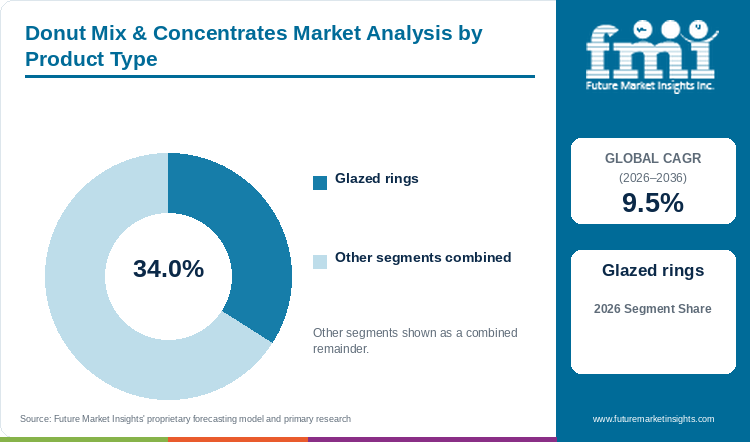
Glazed rings account for 34.0% of Product Type revenue in 2026.
In a ring donut, any variation in mixing, proofing or frying becomes visible during glazing and packing, which is why consistent dough development matters most for this format. Glazed rings generated approximately USD 137.3 million of mix revenue in 2026. A ring formulation can be assessed repeatedly for yield and appearance across normal production runs. Filled donuts add another handling operation, while cake donuts involve different batter and frying behaviour. Reliable shape and crumb give an established ring preparation recurring value by keeping the accepted appearance consistent between batches and shifts.
- Glazed rings account for 34.0% of Product Type revenue in 2026.
- Ring uniformity, crumb and glazing behaviour form a connected production specification.
What makes Powder / dry the preferred mix format?
Powder / dry holds 48.0% of Form revenue in 2026.
Dry products held 48.0% of Form revenue, or approximately USD 193.8 million, in 2026. The key distinction between a complete dry mix and a concentrate is the amount of formulation work left at the bakery. Both can be weighed into a batch, but a concentrate requires more locally added ingredients, such as the flour, water, eggs and yeast listed in Zeelandia's recipe[4]. This can suit an operator with established flour purchasing and mixing controls, particularly when wheat prices are rising[5]. A complete mix reduces the number of ingredients to manage. Cost comparisons need to include these additions and the preparation they require.
- Powder / dry holds 48.0% of Form revenue in 2026.
- The bakery's additional ingredients and weighing work belong in the comparison.
Why do Bread & rolls represent the largest Application category?
Bread & rolls contribute 34.0% of Application revenue in 2026.
Bread & rolls accounted for 34.0% of Application revenue in 2026, as some sweet-dough requirements overlap across donuts, breads and rolls, including mixing, proofing and a soft crumb. Zeelandia identifies both donuts and bread as applications for its concentrate[4], which can offer a bakery a common ingredient platform. The two processes still need separate assessment, as frying and oven baking expose dough to different conditions. Inventory becomes simpler only when the shared preparation performs well in each finished product.
- Bread & rolls contribute 34.0% of Application revenue in 2026.
- Fried and oven-baked products need separate trials even when they share a dough preparation.
How does Conventional retain leadership within Claim?
Conventional accounts for 45.0% of Claim revenue in 2026.
Conventional formulations held 45.0% of Claim revenue in 2026, as they give manufacturers a broad choice of ingredients for maintaining dough tolerance through ordinary batch sizes and holding periods. Organic, clean label and identity-preserved alternatives introduce different composition and sourcing conditions, which can affect preparation and the finished-product declaration. Their operating performance remains relevant to qualification, including frying stability and the condition of the donut after storage.
- Conventional accounts for 45.0% of Claim revenue in 2026.
- A claim-led change must retain the dough tolerance needed on an ordinary production shift.
Why do direct industrial bakery contracts lead Sales Channel?
Direct to industrial bakeries represents 50.0% of Sales Channel revenue in 2026.
Half of Sales Channel revenue, or approximately USD 201.9 million in 2026, came from direct supply to industrial bakeries, which connects the mix manufacturer with the bakery's concentration, flour and processing requirements. Technical work during qualification establishes the conditions under which the preparation produces the accepted donut, and the same relationship supports later changes in batch size. Distributors serve smaller volumes and mixed-brand orders. For an industrial account, flour variation and changes in equipment can reopen the acceptance trial after approval.
- Direct to industrial bakeries represents 50.0% of Sales Channel revenue in 2026.
- Flour and batch-scale changes can require renewed production assessment.
What are the drivers, restraints and opportunities in the donut mix & concentrates market?
Repeatable dough reduces work across the donut process, but rising wheat and oil costs restrain margins, so flavour extensions work best when they preserve the production routine.
Repeatable dough reduces work across the donut process
Consistent dough development limits variation before it reaches shaping, proofing and frying. A complete mix reduces small-ingredient weighing, while a concentrate retains the bakery's choice of flour and other inputs[4]. Once the formulation is established, clear batch instructions support repetition across shifts. Compatibility with dough handling systems is part of that performance, as the blend must tolerate the actual mixing and forming sequence. With donut chains concentrating production in fewer, higher-volume outlets[6], a mix that maintains shape and crumb through these stages becomes more valuable, as it reduces correction during glazing and packing.
Rising wheat and oil costs restrain margins
The cost of the two largest inputs in donut production has risen sharply. The FAO Cereal Price Index was 17.2% higher and the Vegetable Oil Price Index 18.3% higher in September 2026 than a year earlier[5]. Mix suppliers must pass on higher flour costs, while bakeries face higher frying costs at the same time. Flour and operating conditions can also expose weaknesses that an attractive sample conceals. Water addition, batch size and holding time all influence how the dough behaves before frying, and differences may appear in oil uptake or shape. Replacing an established mix to save cost means checking that the alternative can accommodate these conditions, which can slow a purchasing change.
Flavour extensions work best when they preserve the production routine
Flavour extensions can create additional mix demand within an established donut-making process. Dawn's 2025 Churro Donut Mix provides a specific example of a blend developed to add a different flavour and texture[1]. The relevant production question is how much preparation change is needed to retain the intended result at normal scale. Development also includes compatibility with the selected donut fillings and finish, as the dough is only one component of the complete product. Application centres, such as CSM Ingredients' GBP 3.0 million facility in Cheshire[2], help bakeries resolve these questions before a recipe enters the regular range.
Which country CAGRs are profiled in the donut mix & concentrates market?
Table 4: Country growth outlook for the donut mix & concentrates market
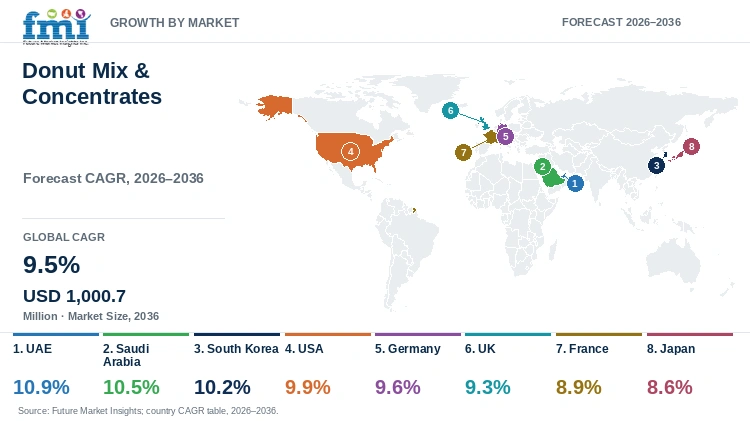
| Country | CAGR |
|---|---|
| UAE | 10.9% |
| Saudi Arabia | 10.5% |
| South Korea | 10.2% |
| USA | 9.9% |
| Germany | 9.6% |
| UK | 9.3% |
| France | 8.9% |
| Japan | 8.6% |
UAE
- The UAE is the fastest-growing market among the profiled countries, with a forecast CAGR of 10.9% from 2026 to 2036. The use of a common donut recipe across UAE central kitchens and outlets depends on the preparation work assigned to each location. Complete mixes and concentrates divide that work differently, particularly through flour selection and local ingredient additions. Batch instructions preserve the additions and conditions established during qualification, and supply schedules connect the accepted blend with the timing of production.
Saudi Arabia
- Saudi operators serving several outlets need dough tolerance, as proofing, shape and crumb determine the consistency of the finished donut at each location. The market is forecast to grow at a CAGR of 10.5% from 2026 to 2036. Flour selection and available equipment distinguish the requirements of complete mixes from those of concentrates. Qualification at the intended batch size establishes both the product specification and the staff procedure used to obtain it, and application support helps preserve the approved texture as a recipe moves into a different kitchen.
South Korea
- With a forecast CAGR of 10.2% from 2026 to 2036, South Korea ranks third among the profiled countries. A consistent dough base supports the development of different centres and toppings in South Korean donut production. Concentrates retain flexibility through added flour and other ingredients, while complete preparations reduce some of the assembly required. Batch yield and preparation effort distinguish their roles, and maintaining the accepted blend allows a successful product to enter regular sales without repeated changes to the dough.
USA
- The United States has the largest donut chains, with Krispy Kreme alone reporting systemwide sales of USD 2.0 billion in 2025[6]. The USA market is forecast to grow at a CAGR of 9.9% from 2026 to 2036. Dawn's May 2025 Churro Donut Mix shows how US professional bakers can add a new product through a mix[1]. An operator still needs to confirm that the new preparation holds its shape and texture at normal batch size. Falling US egg prices, forecast at -29.4% for 2026[7], may also improve the economics of concentrates that require eggs to be added.
Germany
- German bakeries with established flour purchasing and mixing controls may favour concentrates, while others choose complete blends to reduce weighing steps. Germany is projected to grow at a CAGR of 9.6% from 2026 to 2036. Comparison at finished-batch level includes the additional materials and the preparation they require, as well as the yield obtained after frying. With wheat prices at their highest since August 2023[5], the choice of format also determines who bears the flour price risk.
UK
- UK buyers have gained a new local resource for application work, as CSM Ingredients opened its GBP 3.0 million development centre in Cheshire in November 2025[2]. The UK is forecast to grow at a CAGR of 9.3% from 2026 to 2036. Ingredient records also matter where products are prepacked for direct sale, as addressed in Food Standards Agency labelling guidance[3]. Changes to a recipe or its finish need to be reflected accurately in those records. With a dependable base, a bakery can assess new donut styles without introducing uncertainty into ordinary production.
France
- France is forecast to grow at a CAGR of 8.9% for 2026 to 2036. In French bakeries, donut production adds a frying and finishing sequence to the wider sweet-bakery schedule, and the chosen preparation affects the additional stock and handling required. Complete blends can reduce ingredient assembly, while concentrates preserve a role for the flour and purchasing arrangements already used in larger plants. Dough compatibility with the selected cream or fruit centre also influences the finished result.
Japan
- Japan is expected to register the slowest growth among the profiled countries, with a forecast CAGR of 8.6% from 2026 to 2036. Local additions and frying conditions influence the performance of imported specialty donut blends in Japan, where softness and portion appearance need to remain consistent after cooling and finishing. Pack sizes and shipment quantities affect the stock required for a launch, and as output increases, consistency of the supplied blend preserves the basis of the accepted recipe.
Who are the notable companies in the donut mix & concentrates market?
Dawn Foods; Puratos; Zeelandia; Bakels; IRCA Group
Dawn Foods, Puratos, Zeelandia, Bakels and IRCA Group offer complete mixes, concentrates and sweet-dough preparations, which allocate formulation work differently between supplier and bakery. Dawn launched its Churro Donut Mix in 2025[1], while Zeelandia's Donut Concentrate leaves flour, eggs and yeast with the customer[4]. The supplier landscape is also consolidating, as Puratos agreed in March 2026 to acquire Dawn Foods[8].
The relevance of each offer is best assessed against the customer's flour and frying conditions, followed by the way the donut will be filled or finished. Supply continuity matters once that combination has been approved, particularly during periods of rising wheat prices[5].
Competitive Benchmarking: Donut Mix & Concentrates Market
Table 5: Company capabilities in the donut mix & concentrates market
| Company | Relevant offering | Purchasing consideration |
|---|---|---|
| Dawn Foods | Donut mixes, including Churro Donut Mix | Select blend for the intended donut format |
| Puratos | Tegral donut mixes | Match dough performance to preparation method |
| Zeelandia | Donut Concentrate and complete doughnut mixes | Compare local additions with complete-mix convenience |
| Bakels | Donut mixes and concentrates | Assess yield and dough handling |
| IRCA Group | FRIBOL and PANDORA mixes | Select the mix for the required fried or baked product |
Key Developments in the Donut Mix & Concentrates Market
- In May 2025, Dawn Foods announced its Churro Donut Mix for US availability from July 2025, adding a new flavour and texture option for professional bakers[1].
- In November 2025, CSM Ingredients opened a GBP 3.0 million customer-focused development centre in Cheshire, UK, for bakery formulation and application work[2].
- In February 2026, Krispy Kreme reported 2025 systemwide sales of USD 2.0 billion and a 13.5% reduction in global points of access[6].
- In March 2026, Puratos agreed to acquire Dawn Foods, subject to regulatory approvals[8].
- In October 2026, the FAO reported that its Cereal Price Index was 17.2% higher than a year earlier, with wheat prices at their highest since August 2023[5].
Key Players in the Donut Mix & Concentrates Market
- Dawn Foods
- Puratos
- Zeelandia
- Bakels
- IRCA Group
Donut Mix & Concentrates Market - Report Scope
Table 6: Report scope for the donut mix & concentrates market
| Coverage field | Report scope |
|---|---|
| Market breakdown | Product Type; Form; Application; Claim; Sales Channel; Region. |
| Quantitative Units | USD Million |
| Market Definition | Revenue from commercial donut dough mixes, premixes, concentrates and directly associated formulation fillings or finishing preparations within the stated segments. Excludes sales of finished donuts, unrelated bread-only mixes, general-purpose chocolate or fruit products without a qualifying donut use, and downstream bakery services. Bundled ingredient offers count only their qualifying formulation revenue; finished products are not double counted. |
| Regions Covered | North America, Latin America, Western Europe, Eastern Europe, East Asia, South Asia and Pacific, Middle East and Africa |
| Countries Covered | UAE; Saudi Arabia; South Korea; USA; Germany; UK; France; Japan |
| Key Companies Profiled | Dawn Foods; Puratos; Zeelandia; Bakels; IRCA Group |
| Forecast Period | 2026 to 2036 |
| Approach | Market assessment supported by official technical and regulatory publications, company product information and country operating conditions. |
Donut Mix & Concentrates Market - Research Methodology
Table 7: Research approach for the donut mix & concentrates market
| Method | Approach |
|---|---|
| Market definition | The assessment separates qualifying ingredient revenue from finished bakery products and unrelated formulation inputs. |
| Secondary evidence | Government publications, regulatory material, technical literature and first-party product documentation establish the operating context. |
| Commercial assessment | Product performance, supply continuity and customer qualification requirements are considered within each segment and country profile. |
| Comparability | Market values, segment shares and country forecasts use the stated revenue boundary, units and forecast period. |
Donut Mix & Concentrates Market by Segments
Product Type
- Glazed rings
- Filled donuts
- Cake donuts
- Premium & specialty
Form
- Powder / dry
- Liquid
- Paste / semi-solid
- Granules / pieces
Application
- Bread & rolls
- Cakes & muffins
- Biscuits & cookies
- Viennoiserie & pastry
- Other bakery & snacks
Claim
- Conventional
- Clean label
- Organic
- Non-GMO / identity preserved
Sales Channel
- Direct to industrial bakeries
- Ingredient distributors
- Foodservice & artisan supply
- Online B2B
Donut Mix & Concentrates Market by Region
- North America
- United States
- Canada
- Latin America
- Brazil
- Mexico
- Argentina
- Chile
- Western Europe
- Germany
- France
- United Kingdom
- Italy
- Spain
- Benelux
- Nordics
- Eastern Europe
- Poland
- Czech Republic
- Romania
- Hungary
- East Asia
- China
- Japan
- South Korea
- South Asia and Pacific
- India
- ASEAN
- Australia and New Zealand
- Middle East and Africa
- GCC Countries
- South Africa
- Türkiye
- Israel
Research Sources and Bibliography
- [1] Dawn Foods. (2025, May 15). Beloved dessert takes on new form with new Dawn Exceptional Churro Donut Mix and Dawn Ready-to-Finish Churro Donuts.
- [2] CSM Ingredients. (2025, November 18). CSM Ingredients opens new £3m customer-focused product development centre in the UK.
- [3] Food Standards Agency. (2021, June 17). Labelling guidance for prepacked for direct sale (PPDS) food products.
- [4] Zeelandia. (n.d.). Zeelandia Donut Concentrate.
- [5] Food and Agriculture Organization of the United Nations. (2026, October 2). FAO Food Price Index.
- [6] Krispy Kreme, Inc. (2026, February 26). Krispy Kreme reports fourth quarter and full year 2025 financial results demonstrating meaningful progress on turnaround.
- [7] USDA Economic Research Service. (2026, September 25). Food price outlook: Summary findings.
- [8] Food Ingredients First. (2026, March 12). Puratos strikes deal to acquire Dawn Foods in bakery industry shakeup.
Future Market Insights. (2026). Donut Mix & Concentrates Market: Global Industry Analysis and Opportunity Assessment 2036.
This Report Answers
- What is the Donut Mix & Concentrates Market value in 2026 and its forecast for 2036?
- Which production and foodservice pressures support demand for donut mixes and concentrates?
- Why do Glazed rings lead the Product Type category?
- What allows Powder / dry to retain the largest share by Form?
- How do CAGR expectations vary across the eight profiled countries?
- Which profiled companies supply donut dough systems or qualifying bakery preparations?
Frequently Asked Questions
How big is the Donut Mix & Concentrates Market in 2026, and what is forecast for 2036?
The market is valued at USD 403.8 million in 2026 and is forecast to reach USD 1,000.7 million by 2036. The scope covers ingredient and formulation sales rather than finished donuts.
What CAGR is forecast for the donut mix & concentrates market from 2026 to 2036?
The market is forecast to grow at a CAGR of 9.5% from 2026 to 2036.
Which Product Type segment leads the donut mix & concentrates market?
Glazed rings lead with 34.0% in 2026, as standardised ring geometry supports repeatable frying and finishing.
Which Form segment holds the largest share in 2026?
Powder / dry leads with 48.0% in 2026, as storage and controlled batch dosing suit multi-site bakery operations.
Which profiled countries record the fastest forecast growth?
The UAE leads at 10.9%, followed by Saudi Arabia at 10.5% and South Korea at 10.2% for 2026 to 2036.
Which companies are active in the Donut Mix & Concentrates Market?
The report profiles Dawn Foods, Puratos, Zeelandia, Bakels and IRCA Group.
Preview the report firsthand - request a free sample
Get SampleGet the brochure for pricing and purchase details.
Get PDFTable of Content
- Key Takeaways
- Market Size and CAGR
- Top Growth Driver
- Fastest Growing Segment
- Leading Region
- Key Companies
- Emerging Opportunities
- Executive Summary
- Global Market Outlook
- Demand-side Trends
- Supply-side Trends
- Technology Roadmap Analysis
- Analysis and Recommendations
- Analyst Perspective (What is happening? Why now? What should investors know?)
- Key Questions Answered
- How large is the market?
- What is the CAGR?
- What are key trends?
- Which region dominates?
- Who are the leaders?
- Market Overview
- Market Coverage / Taxonomy
- Market Definition / Scope / Limitations
- Research Methodology
- Chapter Orientation
- Analytical Lens and Working Hypotheses
- Market Structure, Signals, and Trend Drivers
- Benchmarking and Cross-market Comparability
- Market Sizing, Forecasting, and Opportunity Mapping
- Research Design and Evidence Framework
- Desk Research Programme (Secondary Evidence)
- Expert Input and Fieldwork (Primary Evidence)
- Tooling, Models, and Reference Databases
- Data Engineering and Model Build
- Quality Assurance and Audit Trail
- Market Background
- Market Dynamics (Drivers, Restraints, Opportunity, Trends)
- Scenario Forecast (Optimistic, Likely, Conservative)
- Impact Analysis
- AI Impact
- Sustainability Impact
- Regulatory Impact
- Technology Impact
- Consumer / Buyer Analysis
- Purchase Drivers
- Adoption Barriers
- Buyer Journey
- Opportunity Map Analysis
- Product Life Cycle Analysis
- Supply Chain Analysis
- Investment Feasibility Matrix
- Value Chain Analysis
- PESTLE and Porter's Analysis
- Regulatory Landscape
- Regional Parent Market Outlook
- Production and Consumption Statistics
- Import and Export Statistics
- Global Market Analysis and Forecast, 2021 to 2036
- Historical Market Size Value (USD Million) Analysis, 2021 to 2025
- Current and Future Market Size Value (USD Million) Projections, 2026 to 2036
- Y-o-Y Growth Trend Analysis
- Absolute $ Opportunity Analysis
- Global Market Pricing Analysis, 2021 to 2036
- Global Market Analysis and Forecast, By Product Type, 2021 to 2036
- Introduction / Key Findings
- Historical Market Size Value (USD Million) Analysis By Product Type, 2021 to 2025
- Current and Future Market Size Value (USD Million) Analysis and Forecast By Product Type, 2026 to 2036
- Glazed rings
- Filled donuts
- Cake donuts
- Premium & specialty
- Y-o-Y Growth Trend Analysis By Product Type, 2021 to 2025
- Absolute $ Opportunity Analysis By Product Type, 2026 to 2036
- Global Market Analysis and Forecast, By Form, 2021 to 2036
- Introduction / Key Findings
- Historical Market Size Value (USD Million) Analysis By Form, 2021 to 2025
- Current and Future Market Size Value (USD Million) Analysis and Forecast By Form, 2026 to 2036
- Powder / dry
- Liquid
- Paste / semi-solid
- Granules / pieces
- Y-o-Y Growth Trend Analysis By Form, 2021 to 2025
- Absolute $ Opportunity Analysis By Form, 2026 to 2036
- Global Market Analysis and Forecast, By Application, 2021 to 2036
- Introduction / Key Findings
- Historical Market Size Value (USD Million) Analysis By Application, 2021 to 2025
- Current and Future Market Size Value (USD Million) Analysis and Forecast By Application, 2026 to 2036
- Bread & rolls
- Cakes & muffins
- Biscuits & cookies
- Viennoiserie & pastry
- Other bakery & snacks
- Y-o-Y Growth Trend Analysis By Application, 2021 to 2025
- Absolute $ Opportunity Analysis By Application, 2026 to 2036
- Global Market Analysis and Forecast, By Claim, 2021 to 2036
- Introduction / Key Findings
- Historical Market Size Value (USD Million) Analysis By Claim, 2021 to 2025
- Current and Future Market Size Value (USD Million) Analysis and Forecast By Claim, 2026 to 2036
- Conventional
- Clean label
- Organic
- Non-GMO / identity preserved
- Y-o-Y Growth Trend Analysis By Claim, 2021 to 2025
- Absolute $ Opportunity Analysis By Claim, 2026 to 2036
- Global Market Analysis and Forecast, By Sales Channel, 2021 to 2036
- Introduction / Key Findings
- Historical Market Size Value (USD Million) Analysis By Sales Channel, 2021 to 2025
- Current and Future Market Size Value (USD Million) Analysis and Forecast By Sales Channel, 2026 to 2036
- Direct to industrial bakeries
- Ingredient distributors
- Foodservice & artisan supply
- Online B2B
- Y-o-Y Growth Trend Analysis By Sales Channel, 2021 to 2025
- Absolute $ Opportunity Analysis By Sales Channel, 2026 to 2036
- Global Market Analysis and Forecast, By Region, 2021 to 2036
- Introduction
- Historical Market Size Value (USD Million) Analysis By Region, 2021 to 2025
- Current Market Size Value (USD Million) Analysis and Forecast By Region, 2026 to 2036
- North America
- Latin America
- Western Europe
- Eastern Europe
- East Asia
- South Asia and Pacific
- Middle East and Africa
- Market Attractiveness Analysis By Region
- North America Market Analysis and Forecast, By Country, 2021 to 2036
- Historical Market Size Value (USD Million) Trend Analysis By Market Taxonomy, 2021 to 2025
- Market Size Value (USD Million) Forecast By Market Taxonomy, 2026 to 2036
- By Country
- United States
- Canada
- By Product Type
- By Form
- By Application
- By Claim
- By Sales Channel
- By Country
- Market Attractiveness Analysis
- By Country
- By Product Type
- By Form
- By Application
- By Claim
- By Sales Channel
- Key Takeaways
- Latin America Market Analysis and Forecast, By Country
- Historical Market Size Value (USD Million) Trend Analysis By Market Taxonomy, 2021 to 2025
- Market Size Value (USD Million) Forecast By Market Taxonomy, 2026 to 2036
- By Country
- Brazil
- Mexico
- Argentina
- Chile
- By Product Type
- By Form
- By Application
- By Claim
- By Sales Channel
- By Country
- Market Attractiveness Analysis
- By Country
- By Product Type
- By Form
- By Application
- By Claim
- By Sales Channel
- Key Takeaways
- Western Europe Market Analysis and Forecast, By Country
- Historical Market Size Value (USD Million) Trend Analysis By Market Taxonomy, 2021 to 2025
- Market Size Value (USD Million) Forecast By Market Taxonomy, 2026 to 2036
- By Country
- Germany
- France
- United Kingdom
- Italy
- Spain
- Benelux
- Nordics
- By Product Type
- By Form
- By Application
- By Claim
- By Sales Channel
- By Country
- Market Attractiveness Analysis
- By Country
- By Product Type
- By Form
- By Application
- By Claim
- By Sales Channel
- Key Takeaways
- Eastern Europe Market Analysis and Forecast, By Country
- Historical Market Size Value (USD Million) Trend Analysis By Market Taxonomy, 2021 to 2025
- Market Size Value (USD Million) Forecast By Market Taxonomy, 2026 to 2036
- By Country
- Poland
- Czech Republic
- Romania
- Hungary
- By Product Type
- By Form
- By Application
- By Claim
- By Sales Channel
- By Country
- Market Attractiveness Analysis
- By Country
- By Product Type
- By Form
- By Application
- By Claim
- By Sales Channel
- Key Takeaways
- East Asia Market Analysis and Forecast, By Country
- Historical Market Size Value (USD Million) Trend Analysis By Market Taxonomy, 2021 to 2025
- Market Size Value (USD Million) Forecast By Market Taxonomy, 2026 to 2036
- By Country
- China
- Japan
- South Korea
- By Product Type
- By Form
- By Application
- By Claim
- By Sales Channel
- By Country
- Market Attractiveness Analysis
- By Country
- By Product Type
- By Form
- By Application
- By Claim
- By Sales Channel
- Key Takeaways
- South Asia and Pacific Market Analysis and Forecast, By Country
- Historical Market Size Value (USD Million) Trend Analysis By Market Taxonomy, 2021 to 2025
- Market Size Value (USD Million) Forecast By Market Taxonomy, 2026 to 2036
- By Country
- India
- ASEAN
- Australia and New Zealand
- By Product Type
- By Form
- By Application
- By Claim
- By Sales Channel
- By Country
- Market Attractiveness Analysis
- By Country
- By Product Type
- By Form
- By Application
- By Claim
- By Sales Channel
- Key Takeaways
- Middle East and Africa Market Analysis and Forecast, By Country
- Historical Market Size Value (USD Million) Trend Analysis By Market Taxonomy, 2021 to 2025
- Market Size Value (USD Million) Forecast By Market Taxonomy, 2026 to 2036
- By Country
- GCC Countries
- South Africa
- Türkiye
- Israel
- By Product Type
- By Form
- By Application
- By Claim
- By Sales Channel
- By Country
- Market Attractiveness Analysis
- By Country
- By Product Type
- By Form
- By Application
- By Claim
- By Sales Channel
- Key Takeaways
- Key Countries Market Analysis
- United States
- Pricing Analysis
- Market Share Analysis, 2025
- By Product Type
- By Form
- By Application
- By Claim
- By Sales Channel
- Canada
- Pricing Analysis
- Market Share Analysis, 2025
- By Product Type
- By Form
- By Application
- By Claim
- By Sales Channel
- Mexico
- Pricing Analysis
- Market Share Analysis, 2025
- By Product Type
- By Form
- By Application
- By Claim
- By Sales Channel
- Brazil
- Pricing Analysis
- Market Share Analysis, 2025
- By Product Type
- By Form
- By Application
- By Claim
- By Sales Channel
- Chile
- Pricing Analysis
- Market Share Analysis, 2025
- By Product Type
- By Form
- By Application
- By Claim
- By Sales Channel
- Germany
- Pricing Analysis
- Market Share Analysis, 2025
- By Product Type
- By Form
- By Application
- By Claim
- By Sales Channel
- United Kingdom
- Pricing Analysis
- Market Share Analysis, 2025
- By Product Type
- By Form
- By Application
- By Claim
- By Sales Channel
- Italy
- Pricing Analysis
- Market Share Analysis, 2025
- By Product Type
- By Form
- By Application
- By Claim
- By Sales Channel
- Spain
- Pricing Analysis
- Market Share Analysis, 2025
- By Product Type
- By Form
- By Application
- By Claim
- By Sales Channel
- France
- Pricing Analysis
- Market Share Analysis, 2025
- By Product Type
- By Form
- By Application
- By Claim
- By Sales Channel
- India
- Pricing Analysis
- Market Share Analysis, 2025
- By Product Type
- By Form
- By Application
- By Claim
- By Sales Channel
- ASEAN
- Pricing Analysis
- Market Share Analysis, 2025
- By Product Type
- By Form
- By Application
- By Claim
- By Sales Channel
- Australia and New Zealand
- Pricing Analysis
- Market Share Analysis, 2025
- By Product Type
- By Form
- By Application
- By Claim
- By Sales Channel
- China
- Pricing Analysis
- Market Share Analysis, 2025
- By Product Type
- By Form
- By Application
- By Claim
- By Sales Channel
- Japan
- Pricing Analysis
- Market Share Analysis, 2025
- By Product Type
- By Form
- By Application
- By Claim
- By Sales Channel
- South Korea
- Pricing Analysis
- Market Share Analysis, 2025
- By Product Type
- By Form
- By Application
- By Claim
- By Sales Channel
- Poland
- Pricing Analysis
- Market Share Analysis, 2025
- By Product Type
- By Form
- By Application
- By Claim
- By Sales Channel
- Hungary
- Pricing Analysis
- Market Share Analysis, 2025
- By Product Type
- By Form
- By Application
- By Claim
- By Sales Channel
- Türkiye
- Pricing Analysis
- Market Share Analysis, 2025
- By Product Type
- By Form
- By Application
- By Claim
- By Sales Channel
- South Africa
- Pricing Analysis
- Market Share Analysis, 2025
- By Product Type
- By Form
- By Application
- By Claim
- By Sales Channel
- UAE
- Pricing Analysis
- Market Share Analysis, 2025
- By Product Type
- By Form
- By Application
- By Claim
- By Sales Channel
- Saudi Arabia
- Pricing Analysis
- Market Share Analysis, 2025
- By Product Type
- By Form
- By Application
- By Claim
- By Sales Channel
- United States
- Market Structure Analysis
- Competition Dashboard
- Competition Benchmarking
- Market Share Analysis of Top Players
- By Regional
- By Product Type
- By Form
- By Application
- By Claim
- By Sales Channel
- Emerging Startups
- Innovation Benchmarking
- Competition Analysis
- Competition Deep Dive
- Dawn Foods
- Overview
- Product Portfolio
- Profitability by Market Segments
- Sales Footprint
- Strategy Overview
- Marketing Strategy
- Product Strategy
- Channel Strategy
- Puratos
- Zeelandia
- Bakels
- IRCA Group
- Dawn Foods
- Case Studies
- Success Stories
- Recent Developments
- Competition Deep Dive
- Assumptions & Acronyms Used


