

- Market Size (2026)
- USD 97.9 Mn
- Forecast (2036)
- USD 227.6 Mn
- CAGR (2026 to 2036)
- 8.8%
How big is Dumping Syndrome Nutrition Market in 2026?
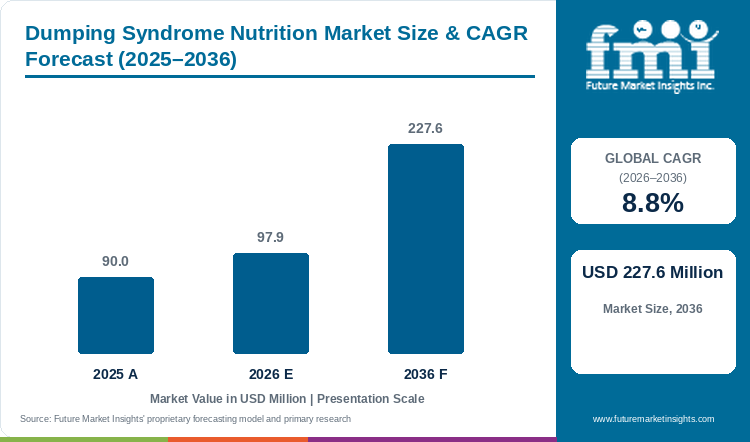
Demand in the dumping syndrome nutrition market is anticipated to expand at 8.8% CAGR through 2036. Industry valuation grows from USD 90.0 million in 2025 to USD 97.9 million in 2026 and is anticipated to reach USD 227.6 million by 2036.
Dietary management after gastric surgery requires smaller meals, adequate protein and lower rapid-sugar intake. Due to this, compact protein and controlled-carbohydrate products are increasingly used within broader clinical nutrition routines. A September 2025 clinical review placed meal distribution and lower-glycemic selection at the first stage of care.[1] FMI estimates that market value will increase from USD 90.0 million in 2025 to USD 97.9 million in 2026 and reach USD 227.6 million by 2036, expanding at 8.8% CAGR during 2026 to 2036. This increase is expected as suitable products support continued intake after discharge, although serving volume, sweetness and tolerance will remain important for repeat purchase.
Adoption conditions are different across South Korea and the USA. South Korea is anticipated to expand at 9.3% CAGR during 2026 to 2036, whereas the USA is forecast to grow at 8.6%. The Korean Society for the Study of Obesity reported adult obesity near 38% for three consecutive years in its 2025 fact sheet.[2] Nutrition follow-up is likely to improve product use in South Korea. The USA, apart from that, has wider bariatric channels and home delivery. FMI expects smaller lower-sugar formats to create growth avenues in both countries, but products which fit local serving guidance and remain available at home can receive preference.
Key Takeaways
- Dietary management is increasing repeated use of nutrition products that fit smaller meals, lower rapid-carbohydrate exposure and adequate protein intake.
- Based on product type, slow-release carbohydrate products are projected to account for 41.9% in 2026, owing to their fit with lower-glycemic meal planning.
- By syndrome type, early dumping is estimated to hold 49.3% in 2026, as symptoms appear close to eating and prompt early diet changes.
- In 2026, post-bariatric surgery is expected to lead underlying cause with 52.1% share because structured follow-up continues after discharge.
- South Korea is projected at 9.3% CAGR through 2036, while the USA is forecast at 8.6%, with separate clinical and channel conditions.
- Notable companies include Danone Nutricia, Nestle Health Science, Abbott, Fresenius Kabi, Celebrate Vitamins, Bariatric Advantage, Medtrition, and Victus.
Analyst Perspective
“I see stronger adoption for compact nutrition that controls carbohydrate exposure and still gives adequate protein in smaller servings. Products which remain tolerable and easily available at home will continue after hospital advice and gain wider demand.”
- Nandini Roy Choudhury, Principal Consultant, Future Market Insights.
How is the dumping syndrome nutrition market segmented?
Dumping syndrome nutrition is segmented by five primary commercial axes and region: product type, syndrome type, underlying cause, end user, sales channel, and region. In 2026, slow-release carbohydrate products are projected at 41.9%, early dumping at 49.3%, post-bariatric surgery at 52.1%, homecare at 50.6%, and hospital pharmacy at 40.4%.
Dumping syndrome nutrition market is segmented by product type, syndrome type, underlying cause, end user, sales channel, and region.
By product type: slow-release carbohydrate products; small-volume high-protein oral nutritional supplements; uncooked cornstarch-based products; others.
By syndrome type: early dumping; late dumping or reactive hypoglycemia; mixed presentations.
By underlying cause: post-bariatric surgery; post-gastrectomy; others.
By end user: homecare; hospitals and clinics; others.
By sales channel: hospital pharmacy; retail pharmacy; online; institutional tender; others.
By region: North America; Latin America; Western Europe; Eastern Europe; East Asia; South Asia and Pacific; Middle East and Africa.
Why do slow-release carbohydrates hold product type demand?
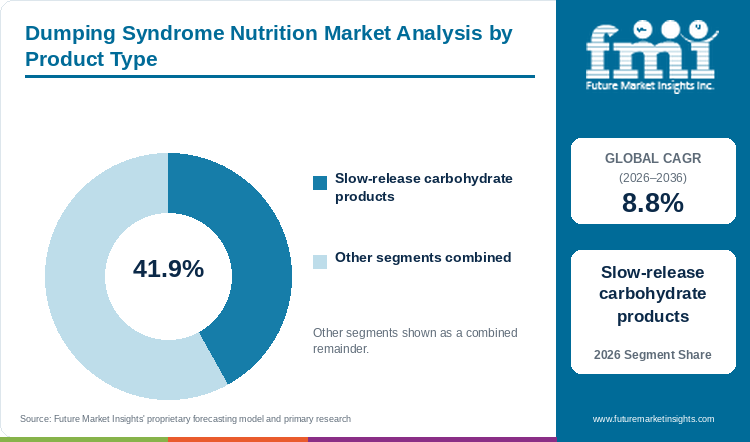
Based on product type, slow-release carbohydrate products are projected to account for 41.9% in 2026, supported by controlled glucose delivery.
Lower-glycemic carbohydrate selection fits the first dietary response to dumping symptoms. In November 2025, Abbott introduced an advanced Ensure Diabetes Care formula with a low-glycemic carbohydrate blend designed for steady glucose delivery.[3] The format can be divided across smaller meals, but product suitability still depends on total sugar, fiber, and tolerance. FMI data suggests that the segment also connects with specialized oral clinical nutritional cream and pudding used across repeated clinical nutrition routines.
- Slow-release carbohydrate products are projected to hold 41.9% of product type revenue in 2026, supported by controlled glucose delivery across repeated meals.
- Product suitability still depends on total sugar load, dietary fiber content, and individual patient tolerance.
What supports early dumping within the syndrome type category?
In 2026, early dumping is expected to lead syndrome type with 49.3% share, owing to immediate post-meal symptoms.
Early dumping symptoms appear soon after eating and therefore food composition, portion size and fluid timing are changed at the beginning of care. In December 2025, a clinical study on post-bariatric cohorts reported that 76.8% of symptomatic patients experienced early dumping manifestations within the first hour post-meal.[4] Formulations meeting specific guidelines function similarly to a prescribed medical food, where controlled macronutrient release limits rapid fluid shifts. As changes start close to symptom recognition, early dumping is expected to hold 49.3% share and support higher use of suitable nutrition products.
- Early dumping contributes 49.3% of syndrome type revenue in 2026, reflecting immediate symptom onset following meal ingestion.
- Clinical management prioritizes rapid fluid restriction and portion control before pharmacological intervention is escalated.
Why does post-bariatric surgery lead underlying cause demand?
Post-bariatric surgery is set to lead underlying cause with 52.1% share in 2026, driven by structured nutrition follow-up.
Changes in stomach capacity and food transit continue after the patient leaves the hospital, which creates a need for smaller meals, adequate protein and regular symptom review. The American Society for Metabolic and Bariatric Surgery reported 270,089 USA procedures for 2023 in its April 2025 update.[5] The large follow-up base across clinical obesity management programs creates a repeated nutrition requirement, which is expected to support the 52.1% share of post-bariatric surgery during 2026.
- Post-bariatric surgery represents 52.1% of underlying cause revenue in 2026, driven by structured post-operative dietary follow-up.
- Sustained nutritional recovery requires lifelong protein supplementation and routine metabolic monitoring after surgical discharge.
How does homecare shape end-user purchasing after discharge?
Within end user, homecare is anticipated to maintain the leading position with 50.6% share in 2026, enabled by daily use.
Majority of nutrition intake takes place at home once the initial plan is provided by a hospital or dietitian. In July 2025, Danone completed the acquisition of Kate Farms and expanded specialized nutrition access across hospitals, homes, online channels and stores.[6] Wider home access, smaller pack formats and regular replenishment support transitions from acute care to enteral nutrition and oral feeding maintenance at home, which is projected to hold 50.6% share in 2026.
- Homecare holds 50.6% of end-user revenue in 2026, enabled by daily symptom management across regular home eating occasions.
- Patient adherence improves when compact formulas are readily available through outpatient pharmacy and direct home replenishment.
Which conditions keep hospital pharmacy relevant in sales channels?
Hospital pharmacy is expected to command 40.4% of sales channel revenue in 2026, reinforced by clinical product initiation.
Hospital pharmacies are used when dietary advice is converted into a suitable product recommendation after surgery. In March 2025, Medtrition introduced two ProSource Cup products with 20 g protein and national-account availability from April 2025.[7] Hospital pharmacies often coordinate clinical initiation alongside inpatient parenteral formula or enteral regimens before discharging patients onto oral meal plans, supporting the 40.4% sales channel revenue share in 2026.
- Hospital pharmacy contributes 40.4% of sales channel revenue in 2026, reinforced by inpatient clinical initiation and dietitian referrals.
- Initial hospital dispensing establishes product familiarity that patients continue through retail and home-delivery channels.
What are the drivers, restraints, and opportunities in the dumping syndrome nutrition market?
In the dumping syndrome nutrition market, the key driver is first-line dietary care, the key restraint is formulation mismatch, and the key opportunity is compact symptom-aligned nutrition.
- Driver: Post-surgical care begins with diet changes, creating repeated decisions about carbohydrate delivery, protein, and meal size.
- Restraint: High-sugar or high-volume formulas can conflict with symptom management and narrow the clinically suitable product set.
- Opportunity: Compact products can combine lower-glycemic carbohydrate delivery with adequate protein and practical home use.
Dietary Care Creates Repeat Use
Dietary modification begins before drug escalation for many patients. In January 2026, the National Institutes of Health StatPearls clinical review confirmed dietary modification as first-line therapy, emphasizing the elimination of rapidly absorbable sugars and regular protein-rich intake.[8] That clinical protocol gives dietitians an early role in product selection alongside broader specialized nutrition standards. The effect reaches beyond discharge because meal planning repeats each day. As per the analysis from FMI, repeat revenue depends on continued tolerance rather than a single hospital order.
Formulation Mismatch Narrows Choice
A nutrition formula can provide calories and protein, however, too much sugar or a larger serving volume may not suit a symptomatic patient. Nutricia states that Fortimel Compact Protein provides 18 g protein and 300 kcal in 125 ml.[9] Higher nutrient density can reduce the serving volume, whereas sugar content and symptom timing still affects product selection. Unlike standard parenteral nutrition solutions that bypass digestion, oral intake triggers gastrointestinal symptoms if osmolality is unmanaged, which restricts the adoption of general nutrition products in dumping syndrome care.
Compact Formats Open New Routes
Smaller eating occasions are creating opportunities for products which combine protein density with controlled carbohydrate delivery. In October 2025, Nutricia launched savory Fortimel PlantBased Protein and reported that one in five patients stop prescriptions early because of flavor fatigue.[10] Savory choice and mealtime variety can support continued product intake, opening crossover demand with cirrhosis-specific oral nutrition and oncology recovery lines. Compact formats with hospital access and regular home supply are therefore expected to create new growth opportunities.
Which country CAGRs are profiled in the dumping syndrome nutrition market?
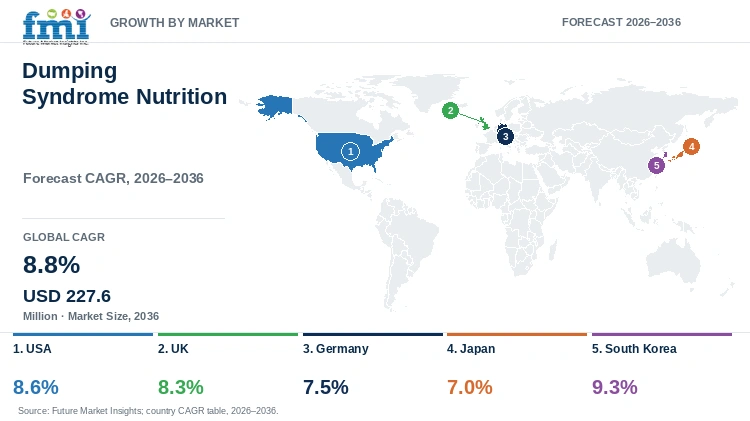
| Country | CAGR, 2026-2036 |
|---|---|
| USA | 8.6% |
| UK | 8.3% |
| Germany | 7.5% |
| Japan | 7.0% |
| South Korea | 9.3% |
How do country-level CAGRs compare in the dumping syndrome nutrition market?
As noted by FMI, country growth rates differ through 2036 because bariatric follow-up, gastric surgery care and the availability of nutrition products for daily home use are not uniform across markets. South Korea and the USA are expected to witness higher growth, while Germany and Japan continue through specialist centers and structured care pathways.
- Dumping syndrome nutrition demand in the USA is forecast to expand at 8.6% CAGR through 2036, supported by bariatric follow-up and established clinical nutrition channels.
- The UK market is projected to record 8.3% CAGR through 2036, influenced by NHS-funded bariatric care and dietitian-led meal-pattern management.
- Germany is anticipated to advance at 7.5% CAGR through 2036, supported by certified obesity centers and structured post-surgical follow-up.
- Japan is forecast to expand at 7.0% CAGR through 2036, linked to specialist post-gastrectomy care and localized nutrition guidance.
- South Korea is estimated to post 9.3% CAGR through 2036, backed by obesity management and continuing gastric cancer care pathways.
Full report country CAGRs cover: North America; Latin America; Western Europe; Eastern Europe; East Asia; South Asia and Pacific; Middle East and Africa.
Country-wise Analysis
- Dumping syndrome nutrition demand in the USA is projected to grow at 8.6% CAGR through 2036, owing to established bariatric follow-up and clinical nutrition channels. In May 2026, the American Society for Metabolic and Bariatric Surgery reported an analysis covering more than 430,000 patients undergoing comprehensive weight loss and obesity management interventions.[11] This large treated population is widening the requirement for dietitian referral, smaller meals and continued nutrition support after discharge. Availability through hospitals, retail and home delivery is expected to support regular product use in the USA.
- Dumping syndrome nutrition demand in the UK is forecast to rise at 8.3% CAGR through 2036, owing to NHS-funded bariatric care and dietitian-led management. NHS England published the National Obesity Audit in April 2026 with activity data through December 2025.[12] The national audit is increasing visibility of treated patients and service pathways, which in turn supports structured nutrition follow-up. Compact and lower-sugar products that remain available after discharge are expected to witness increasing demand in the UK.
- Dumping syndrome nutrition market in Germany is anticipated to advance at 7.5% CAGR through 2036, supported by structured center-level follow-up. The German Society for General and Visceral Surgery announced revised certification requirements for obesity and metabolic-surgery centers in January 2026.[13] Certified centers place higher importance on documented composition, serving guidance and continued follow-up. These factors are expected to support product adoption through specialist and local distribution channels in Germany.
- Sales of dumping syndrome nutrition products in Japan are forecast to expand at 7.0% CAGR through 2036, attributed to post-gastrectomy care and bariatric follow-up. The Japanese Gastric Cancer Association revised its physician treatment guideline in March 2025.[14] An FMI analyst notes that localized serving instructions and sweetness profiles directly influence clinical adoption across Japanese hospitals. Specialist gastric care creates a patient group requiring smaller eating occasions and continued nutrition guidance after surgery, supporting localized product demand in Japan.
- South Korea is estimated to post 9.3% CAGR through 2036, backed by obesity management and continued gastric cancer care. In January 2026, the Korean Society for Metabolic and Bariatric Surgery outlined updated accreditation standards prioritizing multidisciplinary post-surgical nutrition follow-up.[15] Owing to a larger obesity treatment base, nutrition follow-up after bariatric procedures is expanding rapidly. Hospital guidance and availability of compact nutrition formats will further support the South Korea market growth.
Who are the notable companies in the dumping syndrome nutrition market?
Danone Nutricia, Nestle Health Science, Abbott, Fresenius Kabi, Celebrate Vitamins, Bariatric Advantage, Medtrition, and Victus are notable companies profiled in this market.
Competition in the dumping syndrome nutrition market includes global medical nutrition companies, bariatric nutrition specialists and concentrated protein suppliers. Large companies are expanding hospital access and oral nutrition portfolios, while specialist brands are focusing on bariatric routines and smaller serving formats. In the FMI report, competitive position is connected with carbohydrate control and ease of adding compact protein into post-surgical routines. Product composition, lower sugar exposure, protein density and availability after discharge are major factors affecting supplier selection. Companies with clinical channels along with retail and online supply are expected to gain higher market opportunities.
- Global medical nutrition platforms: Danone Nutricia, Nestle Health Science, Abbott and Fresenius Kabi are focusing on hospital access and wider oral nutrition portfolios.
- Bariatric-specific nutrition: Celebrate Vitamins and Bariatric Advantage are offering procedure-oriented ranges through specialist and direct replenishment channels.
- Modular and specialized nutrition: Medtrition and Victus are providing concentrated protein and condition-oriented formats for selected post-surgical requirements.
Competitive Benchmarking: Dumping Syndrome Nutrition Market
| Company | Carbohydrate control | Compact protein | Clinical channel | Geographic reach |
|---|---|---|---|---|
| Danone Nutricia | High | High | High | High |
| Nestle Health Science | High | Medium | High | High |
| Abbott | High | Medium | High | High |
| Fresenius Kabi | Medium | High | High | High |
| Celebrate Vitamins | Medium | Medium | Medium | Low |
| Bariatric Advantage | High | Medium | Medium | Low |
| Medtrition | Medium | High | High | Medium |
| Victus | High | Medium | Medium | Medium |
High indicates broad capability across the stated area, Medium indicates selective capability, and Low indicates a narrower operating presence.
Key Developments in the Dumping Syndrome Nutrition Market
- In September 2026, Danone completed its acquisition of Huel, extending its portfolio in functional and specialized nutrition.[17]
- In October 2025, Nutricia launched Fortimel PlantBased Protein in savory and other flavors, improving dietary adherence in medical nutrition routines.[10]
- In July 2025, Vivici presented a 100 ml compact protein concept delivering up to 25 g of protein through fermentation-derived beta-lactoglobulin.[16]
- In March 2025, Medtrition launched the ProSource Cup portfolio with 20 g of protein per cup and national-account availability from April 2025.[7]
Key Players in the Dumping Syndrome Nutrition Market
Global medical nutrition platforms
- Danone Nutricia
- Nestle Health Science
- Abbott
- Fresenius Kabi
Bariatric-specific direct nutrition
- Celebrate Vitamins
- Bariatric Advantage
Modular and specialized clinical nutrition
- Medtrition
- Victus
Dumping Syndrome Nutrition Market - Report Scope
| Coverage field | Report scope |
|---|---|
| Market breakdown | Product type, syndrome type, underlying cause, end user, sales channel, and region. |
| Quantitative units | USD million. |
| Market definition | Supplier revenue from nutrition products used for dietary management within the defined axes. Pharmaceuticals, procedures, generic foods, and clinical-service revenue are excluded. |
| Regions covered | North America; Latin America; Western Europe; Eastern Europe; East Asia; South Asia and Pacific; Middle East and Africa. |
| Countries covered | USA, UK, Germany, Japan, South Korea, and additional countries in the full report. |
| Key companies profiled | Danone Nutricia, Nestle Health Science, Abbott, Fresenius Kabi, Celebrate Vitamins, Bariatric Advantage, Medtrition, Victus. |
| Forecast period | 2026 to 2036. |
| Approach | As per FMI, the report covers supplier activity, segment structure, care pathways, and country adoption conditions within the stated market boundary. |
Dumping Syndrome Nutrition Market - Research Methodology
| Method | Approach |
|---|---|
| Primary Research | Analysts gathered input from manufacturers, service providers, technology developers, distributors, end users, procurement teams, and subject-matter experts. Interviews examined purchasing decisions, product evaluation, adoption barriers, approval requirements, pricing, and technical support. |
| Desk Research | Desk research covered government statistics, regulatory publications, trade data, industry associations, technical literature, standards, company filings, product information, and official corporate announcements. Sources were checked for date, geography, and direct market relevance. |
| Market Sizing and Forecasting | The model combined the baseline value with historical performance, segment structure, pricing and volume indicators, adoption levels, company participation, and country demand conditions. Forecast assumptions included surgical follow-up, clinical nutrition use, purchasing cycles, and supply availability. |
| Data Validation | Estimates were checked against public data, company activity, trade patterns, and primary-research findings. Adjacent categories, unsupported claims, overlapping revenue, and activities outside the defined market were excluded. |
Segment shares and forecast estimates are FMI estimates. Values reflect the market outlook for 2026 to 2036.
Dumping Syndrome Nutrition Market by Segments
Dumping Syndrome Nutrition Market segmented by Product Type:
- Slow-release carbohydrate products
- Small-volume high-protein oral nutritional supplements
- Uncooked cornstarch-based products
- Others
Dumping Syndrome Nutrition Market segmented by Syndrome Type:
- Early dumping
- Late dumping or reactive hypoglycemia
- Mixed
Dumping Syndrome Nutrition Market segmented by Underlying Cause:
- Post-bariatric surgery
- Post-gastrectomy
- Others
Dumping Syndrome Nutrition Market segmented by End User:
- Homecare
- Hospitals and clinics
- Others
Dumping Syndrome Nutrition Market segmented by Sales Channel:
- Hospital pharmacy
- Retail pharmacy
- Online
- Institutional tender
- Others
Dumping Syndrome Nutrition Market by Region
- North America
- United States
- Canada
- Latin America
- Brazil
- Mexico
- Argentina
- Chile
- Western Europe
- Germany
- France
- United Kingdom
- Italy
- Spain
- Benelux
- Nordics
- Eastern Europe
- Poland
- Czech Republic
- Romania
- Hungary
- East Asia
- China
- Japan
- South Korea
- South Asia and Pacific
- India
- ASEAN
- Australia and New Zealand
- Middle East and Africa
- GCC Countries
- South Africa
- Türkiye
- Israel
Research Sources and Bibliography
- [1] Cano, R., et al. (2025, September 30). Dumping syndrome after bariatric surgery: Advanced nutritional perspectives and integrated pharmacological management. Nutrients, 17(19), 3123.
- [2] Korean Society for the Study of Obesity. (2025, September 4). 2025 Obesity Fact Sheet.
- [3] Abbott. (2025, November 13). Abbott launches new and advanced Ensure Diabetes Care with a low-glycemic carbohydrate blend.
- [4] Alqahtani, A., et al. (2025, December 30). Prevalence and correlates of dumping syndrome after bariatric surgery in adults: The role of social determinants and nutrition knowledge. Diabetes, Metabolic Syndrome and Obesity, 18, 451-462.
- [5] American Society for Metabolic and Bariatric Surgery. (2025, April). Estimate of bariatric surgery numbers, 2011-2023.
- [6] Danone. (2025, July 1). Danone completes the acquisition of Kate Farms, enhancing its U.S. specialized nutrition offerings.
- [7] Medtrition, Inc. (2025, March 25). Medtrition launches the ProSource Cup portfolio.
- [8] National Institutes of Health / StatPearls. Hui, C., & Bauza, G. (2026, January 31). Dumping Syndrome. StatPearls Publishing.
- [9] Nutricia. (2026). Fortimel Compact Protein.
- [10] Nutricia. (2025, October 1). Nutricia's new savory plant-based medical nutrition proven to improve patient adherence.
- [11] American Society for Metabolic and Bariatric Surgery. (2026, May 6). Bariatric surgery significantly more effective than GLP-1 drugs for weight loss and disease remission, large real-world study finds.
- [12] NHS England. (2026, April 9). National Obesity Audit, October 2025 to December 2025.
- [13] German Society for General and Visceral Surgery. (2026, January 21). New certification requirements for obesity therapy and metabolic surgery centers from January 1, 2026.
- [14] Japanese Gastric Cancer Association. (2025, March). Gastric Cancer Treatment Guidelines, 7th edition.
- [15] Korean Society for Metabolic and Bariatric Surgery. (2026, January 13). Accreditation standards and clinical management guidelines for metabolic and bariatric surgery.
- [16] Vivici. (2025, August 11). Vivici launches new standard in compact protein with Vivitein BLG shots at Newtopia Now 2025.
- [17] Danone. (2026, September 4). Danone completes its acquisition of Huel, extending its portfolio in functional nutrition.
- [18] Nestlé S.A. (2026, March 23). 2025 operating segments and information by products restated following the integration of Nestlé Health Science into Nutrition from January 1, 2026.
This bibliography is provided for reader reference. The full report contains the complete reference list and detailed citations.
This Report Answers
- What is Dumping Syndrome Nutrition Market worth during 2026?
- What value is Dumping Syndrome Nutrition Market projected by 2036?
- Which product type holds notable dumping syndrome nutrition share?
- Which underlying cause holds notable dumping syndrome nutrition share?
- Which countries show notable dumping syndrome nutrition growth outlooks?
- Which companies are notable in Dumping Syndrome Nutrition Market today?
Frequently Asked Questions
How large is the Dumping Syndrome Nutrition Market expected to be in 2026?
Future Market Insights estimates that the dumping syndrome nutrition market will reach USD 97.9 million in 2026. The market is projected to expand further and reach USD 227.6 million by 2036.
What CAGR is forecast for the Dumping Syndrome Nutrition Market through 2036?
As per FMI, the dumping syndrome nutrition market is projected to grow at an 8.8% CAGR from 2026 to 2036. Growth is supported by repeated dietary management and nutrition follow-up after bariatric and gastric surgery.
Which product type holds a notable dumping syndrome nutrition demand share in 2026?
Future Market Insights projects slow-release carbohydrate products to hold 41.9% of product type demand in 2026. Lower-glycemic meal planning and controlled carbohydrate delivery across smaller meals supports the segment demand.
Which underlying cause holds a notable dumping syndrome nutrition share in 2026?
FMI finds that post-bariatric surgery will hold 52.1% of underlying cause demand in 2026. Demand is supported by the need for continuous nutrition follow-up and portion management after discharge.
Which country has a notable dumping syndrome nutrition expansion outlook during the forecast period?
Future Market Insights predicts South Korea to expand at a 9.3% CAGR during the 2026 to 2036 assessment period. Growth is supported by active obesity management programs and continuing gastric cancer care pathways.
Which companies are active in the Dumping Syndrome Nutrition Market during 2026?
As per FMI analysis, notable companies include Danone Nutricia, Nestle Health Science, Abbott, Fresenius Kabi, Celebrate Vitamins, Bariatric Advantage, Medtrition, and Victus. These companies are focusing on clinical nutrition ranges, bariatric products, compact protein formats and wider replenishment channels.
Preview the report firsthand - request a free sample
Get SampleGet the brochure for pricing and purchase details.
Get PDFTable of Content
- Key Takeaways
- Market Size and CAGR
- Top Growth Driver
- Fastest Growing Segment
- Leading Region
- Key Companies
- Emerging Opportunities
- Executive Summary
- Global Market Outlook
- Demand-side Trends
- Supply-side Trends
- Technology Roadmap Analysis
- Analysis and Recommendations
- Analyst Perspective (What is happening? Why now? What should investors know?)
- Key Questions Answered
- How large is the market?
- What is the CAGR?
- What are key trends?
- Which region dominates?
- Who are the leaders?
- Market Overview
- Market Coverage / Taxonomy
- Market Definition / Scope / Limitations
- Research Methodology
- Chapter Orientation
- Analytical Lens and Working Hypotheses
- Market Structure, Signals, and Trend Drivers
- Benchmarking and Cross-market Comparability
- Market Sizing, Forecasting, and Opportunity Mapping
- Research Design and Evidence Framework
- Desk Research Programme (Secondary Evidence)
- Expert Input and Fieldwork (Primary Evidence)
- Tooling, Models, and Reference Databases
- Data Engineering and Model Build
- Quality Assurance and Audit Trail
- Market Background
- Market Dynamics (Drivers, Restraints, Opportunity, Trends)
- Scenario Forecast (Optimistic, Likely, Conservative)
- Impact Analysis
- AI Impact
- Sustainability Impact
- Regulatory Impact
- Technology Impact
- Consumer / Buyer Analysis
- Purchase Drivers
- Adoption Barriers
- Buyer Journey
- Opportunity Map Analysis
- Product Life Cycle Analysis
- Supply Chain Analysis
- Investment Feasibility Matrix
- Value Chain Analysis
- PESTLE and Porter's Analysis
- Regulatory Landscape
- Regional Parent Market Outlook
- Production and Consumption Statistics
- Import and Export Statistics
- Global Market Analysis and Forecast, 2021 to 2036
- Historical Market Size Value (USD Million) Analysis, 2021 to 2025
- Current and Future Market Size Value (USD Million) Projections, 2026 to 2036
- Y-o-Y Growth Trend Analysis
- Absolute $ Opportunity Analysis
- Global Market Pricing Analysis, 2021 to 2036
- Global Market Analysis and Forecast, By Product Type, 2021 to 2036
- Introduction / Key Findings
- Historical Market Size Value (USD Million) Analysis By Product Type, 2021 to 2025
- Current and Future Market Size Value (USD Million) Analysis and Forecast By Product Type, 2026 to 2036
- Slow-release carbohydrate products
- Small-volume high-protein oral nutritional supplements
- Uncooked cornstarch-based products
- Others
- Y-o-Y Growth Trend Analysis By Product Type, 2021 to 2025
- Absolute $ Opportunity Analysis By Product Type, 2026 to 2036
- Global Market Analysis and Forecast, By Syndrome Type, 2021 to 2036
- Introduction / Key Findings
- Historical Market Size Value (USD Million) Analysis By Syndrome Type, 2021 to 2025
- Current and Future Market Size Value (USD Million) Analysis and Forecast By Syndrome Type, 2026 to 2036
- Early dumping
- Late dumping or reactive hypoglycemia
- Mixed
- Y-o-Y Growth Trend Analysis By Syndrome Type, 2021 to 2025
- Absolute $ Opportunity Analysis By Syndrome Type, 2026 to 2036
- Global Market Analysis and Forecast, By Underlying Cause, 2021 to 2036
- Introduction / Key Findings
- Historical Market Size Value (USD Million) Analysis By Underlying Cause, 2021 to 2025
- Current and Future Market Size Value (USD Million) Analysis and Forecast By Underlying Cause, 2026 to 2036
- Post-bariatric surgery
- Post-gastrectomy
- Others
- Y-o-Y Growth Trend Analysis By Underlying Cause, 2021 to 2025
- Absolute $ Opportunity Analysis By Underlying Cause, 2026 to 2036
- Global Market Analysis and Forecast, By End User, 2021 to 2036
- Introduction / Key Findings
- Historical Market Size Value (USD Million) Analysis By End User, 2021 to 2025
- Current and Future Market Size Value (USD Million) Analysis and Forecast By End User, 2026 to 2036
- Homecare
- Hospitals and clinics
- Others
- Y-o-Y Growth Trend Analysis By End User, 2021 to 2025
- Absolute $ Opportunity Analysis By End User, 2026 to 2036
- Global Market Analysis and Forecast, By Sales Channel, 2021 to 2036
- Introduction / Key Findings
- Historical Market Size Value (USD Million) Analysis By Sales Channel, 2021 to 2025
- Current and Future Market Size Value (USD Million) Analysis and Forecast By Sales Channel, 2026 to 2036
- Hospital pharmacy
- Retail pharmacy
- Online
- Institutional tender
- Others
- Y-o-Y Growth Trend Analysis By Sales Channel, 2021 to 2025
- Absolute $ Opportunity Analysis By Sales Channel, 2026 to 2036
- Global Market Analysis and Forecast, By Region, 2021 to 2036
- Introduction
- Historical Market Size Value (USD Million) Analysis By Region, 2021 to 2025
- Current Market Size Value (USD Million) Analysis and Forecast By Region, 2026 to 2036
- North America
- Latin America
- Western Europe
- Eastern Europe
- East Asia
- South Asia and Pacific
- Middle East and Africa
- Market Attractiveness Analysis By Region
- North America Market Analysis and Forecast, By Country, 2021 to 2036
- Historical Market Size Value (USD Million) Trend Analysis By Market Taxonomy, 2021 to 2025
- Market Size Value (USD Million) Forecast By Market Taxonomy, 2026 to 2036
- By Country
- United States
- Canada
- By Product Type
- By Syndrome Type
- By Underlying Cause
- By End User
- By Sales Channel
- By Country
- Market Attractiveness Analysis
- By Country
- By Product Type
- By Syndrome Type
- By Underlying Cause
- By End User
- By Sales Channel
- Key Takeaways
- Latin America Market Analysis and Forecast, By Country
- Historical Market Size Value (USD Million) Trend Analysis By Market Taxonomy, 2021 to 2025
- Market Size Value (USD Million) Forecast By Market Taxonomy, 2026 to 2036
- By Country
- Brazil
- Mexico
- Argentina
- Chile
- By Product Type
- By Syndrome Type
- By Underlying Cause
- By End User
- By Sales Channel
- By Country
- Market Attractiveness Analysis
- By Country
- By Product Type
- By Syndrome Type
- By Underlying Cause
- By End User
- By Sales Channel
- Key Takeaways
- Western Europe Market Analysis and Forecast, By Country
- Historical Market Size Value (USD Million) Trend Analysis By Market Taxonomy, 2021 to 2025
- Market Size Value (USD Million) Forecast By Market Taxonomy, 2026 to 2036
- By Country
- Germany
- France
- United Kingdom
- Italy
- Spain
- Benelux
- Nordics
- By Product Type
- By Syndrome Type
- By Underlying Cause
- By End User
- By Sales Channel
- By Country
- Market Attractiveness Analysis
- By Country
- By Product Type
- By Syndrome Type
- By Underlying Cause
- By End User
- By Sales Channel
- Key Takeaways
- Eastern Europe Market Analysis and Forecast, By Country
- Historical Market Size Value (USD Million) Trend Analysis By Market Taxonomy, 2021 to 2025
- Market Size Value (USD Million) Forecast By Market Taxonomy, 2026 to 2036
- By Country
- Poland
- Czech Republic
- Romania
- Hungary
- By Product Type
- By Syndrome Type
- By Underlying Cause
- By End User
- By Sales Channel
- By Country
- Market Attractiveness Analysis
- By Country
- By Product Type
- By Syndrome Type
- By Underlying Cause
- By End User
- By Sales Channel
- Key Takeaways
- East Asia Market Analysis and Forecast, By Country
- Historical Market Size Value (USD Million) Trend Analysis By Market Taxonomy, 2021 to 2025
- Market Size Value (USD Million) Forecast By Market Taxonomy, 2026 to 2036
- By Country
- China
- Japan
- South Korea
- By Product Type
- By Syndrome Type
- By Underlying Cause
- By End User
- By Sales Channel
- By Country
- Market Attractiveness Analysis
- By Country
- By Product Type
- By Syndrome Type
- By Underlying Cause
- By End User
- By Sales Channel
- Key Takeaways
- South Asia and Pacific Market Analysis and Forecast, By Country
- Historical Market Size Value (USD Million) Trend Analysis By Market Taxonomy, 2021 to 2025
- Market Size Value (USD Million) Forecast By Market Taxonomy, 2026 to 2036
- By Country
- India
- ASEAN
- Australia and New Zealand
- By Product Type
- By Syndrome Type
- By Underlying Cause
- By End User
- By Sales Channel
- By Country
- Market Attractiveness Analysis
- By Country
- By Product Type
- By Syndrome Type
- By Underlying Cause
- By End User
- By Sales Channel
- Key Takeaways
- Middle East and Africa Market Analysis and Forecast, By Country
- Historical Market Size Value (USD Million) Trend Analysis By Market Taxonomy, 2021 to 2025
- Market Size Value (USD Million) Forecast By Market Taxonomy, 2026 to 2036
- By Country
- GCC Countries
- South Africa
- Türkiye
- Israel
- By Product Type
- By Syndrome Type
- By Underlying Cause
- By End User
- By Sales Channel
- By Country
- Market Attractiveness Analysis
- By Country
- By Product Type
- By Syndrome Type
- By Underlying Cause
- By End User
- By Sales Channel
- Key Takeaways
- Key Countries Market Analysis
- United States
- Pricing Analysis
- Market Share Analysis, 2025
- By Product Type
- By Syndrome Type
- By Underlying Cause
- By End User
- By Sales Channel
- Canada
- Pricing Analysis
- Market Share Analysis, 2025
- By Product Type
- By Syndrome Type
- By Underlying Cause
- By End User
- By Sales Channel
- Mexico
- Pricing Analysis
- Market Share Analysis, 2025
- By Product Type
- By Syndrome Type
- By Underlying Cause
- By End User
- By Sales Channel
- Brazil
- Pricing Analysis
- Market Share Analysis, 2025
- By Product Type
- By Syndrome Type
- By Underlying Cause
- By End User
- By Sales Channel
- Chile
- Pricing Analysis
- Market Share Analysis, 2025
- By Product Type
- By Syndrome Type
- By Underlying Cause
- By End User
- By Sales Channel
- Germany
- Pricing Analysis
- Market Share Analysis, 2025
- By Product Type
- By Syndrome Type
- By Underlying Cause
- By End User
- By Sales Channel
- United Kingdom
- Pricing Analysis
- Market Share Analysis, 2025
- By Product Type
- By Syndrome Type
- By Underlying Cause
- By End User
- By Sales Channel
- Italy
- Pricing Analysis
- Market Share Analysis, 2025
- By Product Type
- By Syndrome Type
- By Underlying Cause
- By End User
- By Sales Channel
- Spain
- Pricing Analysis
- Market Share Analysis, 2025
- By Product Type
- By Syndrome Type
- By Underlying Cause
- By End User
- By Sales Channel
- France
- Pricing Analysis
- Market Share Analysis, 2025
- By Product Type
- By Syndrome Type
- By Underlying Cause
- By End User
- By Sales Channel
- India
- Pricing Analysis
- Market Share Analysis, 2025
- By Product Type
- By Syndrome Type
- By Underlying Cause
- By End User
- By Sales Channel
- ASEAN
- Pricing Analysis
- Market Share Analysis, 2025
- By Product Type
- By Syndrome Type
- By Underlying Cause
- By End User
- By Sales Channel
- Australia and New Zealand
- Pricing Analysis
- Market Share Analysis, 2025
- By Product Type
- By Syndrome Type
- By Underlying Cause
- By End User
- By Sales Channel
- China
- Pricing Analysis
- Market Share Analysis, 2025
- By Product Type
- By Syndrome Type
- By Underlying Cause
- By End User
- By Sales Channel
- Japan
- Pricing Analysis
- Market Share Analysis, 2025
- By Product Type
- By Syndrome Type
- By Underlying Cause
- By End User
- By Sales Channel
- South Korea
- Pricing Analysis
- Market Share Analysis, 2025
- By Product Type
- By Syndrome Type
- By Underlying Cause
- By End User
- By Sales Channel
- Poland
- Pricing Analysis
- Market Share Analysis, 2025
- By Product Type
- By Syndrome Type
- By Underlying Cause
- By End User
- By Sales Channel
- Hungary
- Pricing Analysis
- Market Share Analysis, 2025
- By Product Type
- By Syndrome Type
- By Underlying Cause
- By End User
- By Sales Channel
- Türkiye
- Pricing Analysis
- Market Share Analysis, 2025
- By Product Type
- By Syndrome Type
- By Underlying Cause
- By End User
- By Sales Channel
- South Africa
- Pricing Analysis
- Market Share Analysis, 2025
- By Product Type
- By Syndrome Type
- By Underlying Cause
- By End User
- By Sales Channel
- United States
- Market Structure Analysis
- Competition Dashboard
- Competition Benchmarking
- Market Share Analysis of Top Players
- By Regional
- By Product Type
- By Syndrome Type
- By Underlying Cause
- By End User
- By Sales Channel
- Emerging Startups
- Innovation Benchmarking
- Competition Analysis
- Competition Deep Dive
- Danone Nutricia
- Overview
- Product Portfolio
- Profitability by Market Segments
- Sales Footprint
- Strategy Overview
- Marketing Strategy
- Product Strategy
- Channel Strategy
- Nestle Health Science
- Abbott
- Fresenius Kabi
- Celebrate Vitamins
- Bariatric Advantage
- Medtrition
- Victus
- Danone Nutricia
- Case Studies
- Success Stories
- Recent Developments
- Competition Deep Dive
- Assumptions & Acronyms Used


