

- Market Size (2026)
- USD 1.7 Bn
- Forecast (2036)
- USD 5.2 Bn
- CAGR (2026 to 2036)
- 12.1%
How Big is the Eggless Cakes Market?
The Eggless Cakes Market is estimated at USD 1.7 Billion in 2026 and will reach USD 5.2 Billion by 2036. Sales will grow at a 12.1% CAGR from 2026 to 2036, according to FMI.
Eggless cakes market size is estimated at USD 1.7 Billion in 2026 and will reach USD 5.2 Billion by 2036 at a 12.1% CAGR, as per FMI. Sales will rise as bakers supply cakes for consumers avoiding egg and buyers add suitable desserts to regular assortments. Replacing egg takes more than changing the ingredient list because it affects the structure of the batter and the finished sponge. In January 2024, University College Cork researchers compared ten commercial replacements in pound cake. None reproduced the complete quality profile of the egg controls [13]. Manufacturers need to test each recipe before committing it to regular production. Applying the forecast CAGR to the prior year gives an estimated 2025 market value of USD 1.52 Billion.
Supply disruption gives bakers another reason to develop an alternative recipe. USDA’s April 2026 analysis recorded average U.S. retail egg prices 21.9% higher in 2025 than in 2024 following avian-influenza disruption [1]. Industrial buyers will assess the cost of their own contracted ingredients and the quantity of saleable cake each batch produces. A replacement that is cheaper to buy can still require more preparation or yield fewer acceptable portions. Buyers serving consumers with allergies also need factory controls: the FSA’s March 2024 vegan labelling campaign warned of cross-contact risks in vegan products [3].
Hotels can use a suitable eggless cake to serve guests with different dietary preferences. Dubai recorded 19.59 million international overnight visitors in 2025, according to DET’s tourism report [8]. Kitchens need desserts that fit available storage, staff and service periods. Frozen products can move preparation to the manufacturing site, while portion packs can help outlets prepare stock closer to demand. For either route, the cake needs to retain acceptable texture and moisture until it reaches the customer. Eggless products may contain dairy; vegan and allergy-related claims require their own recipe and production assessment.
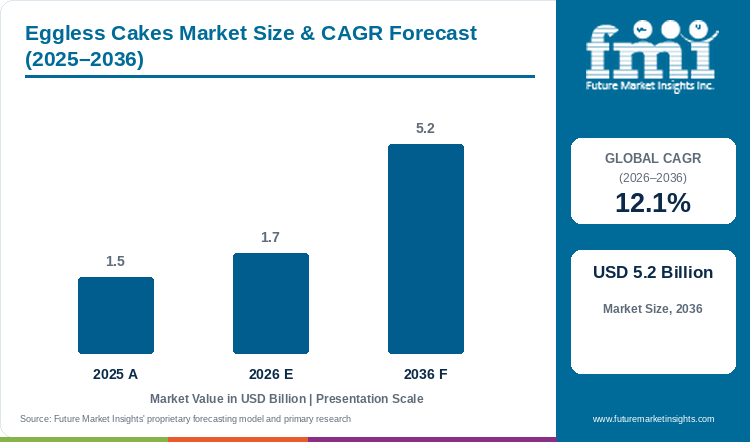
Key Takeaways
- Demand will grow as bakers serve consumers avoiding egg and qualify alternative recipes during egg-supply disruption. Cost savings depend on the replacement ingredients and saleable batch output.
- Liquid formats will hold 39.0% of Type revenue in 2026. Ready-to-dose systems can reduce preparation where the recipe otherwise requires a separate hydration step.
- Conventional will account for 57.0% of Claim / Nature revenue in 2026. Manufacturers retain flexibility over other ingredients while meeting the eggless requirement.
- Frozen will represent 30.0% of Format revenue in 2026. Central baking and controlled thawing can reduce the work required in individual kitchens.
- Cake texture, storage performance and cross-contact controls can slow recipe approval. Eggless and vegan claims address different requirements from allergy suitability.
- Companies profiled include Rich Products, Sara Lee Frozen Bakery, Dessert Holdings, Mademoiselle Desserts, Finsbury Food Group, Dr. Oetker, Premier Foods, McKee Foods, Hostess Brands and Bauli.
Analyst Perspective
“An eggless cake needs to work in the buyer’s kitchen as well as in the manufacturer’s test batch. Suppliers that maintain texture after storage and give buyers clear preparation instructions can reduce the work required to introduce a new product. Allergy suitability must be supported separately through the recipe and production controls.”
- Nandini Roy Choudhury, Principal Analyst at Future Market Insights
How is the Eggless Cakes Market Segmented?
According to FMI, the market is segmented by Type, Claim / Nature, Format, Packaging Format, Sales Channel and Region.
Type covers Liquid formats, Powdered formats, Frozen and Specialty functional. Claim / Nature comprises Conventional, Clean label, Organic, Gluten-free and High-protein / fortified. Format includes Frozen, Fresh, Ambient packaged, Chilled and Par-baked / thaw-and-serve. Packaging Format covers Multipack, Single-serve, Family / loaf pack and Bulk foodservice. Sales Channel comprises Supermarkets & hypermarkets, Artisan & specialty bakeries, Convenience & forecourt, Online & DTC and Foodservice distributors. Regional coverage spans North America, Latin America, Western Europe, Eastern Europe, East Asia, South Asia and Pacific, and Middle East and Africa.
Why Do Liquid Formats Lead Type Revenue?
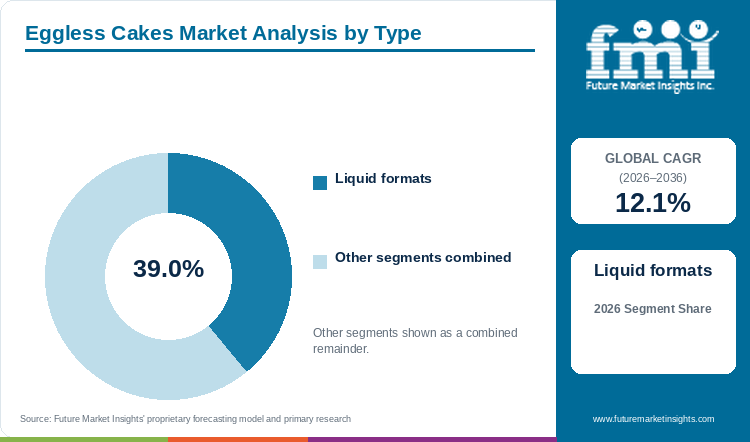
Liquid formats will account for 39.0% of Type revenue in 2026.
A baker choosing a liquid replacement can avoid a separate hydration step and integrate dosing into an existing mixing routine. That can save preparation work when the system behaves consistently in the chosen batter. The leading Type share will be 39.0% in 2026, according to FMI. Suppliers still need to show how the formulation performs during baking and storage. Cake volume, crumb and moisture depend on the ingredient blend and the process, so buyers will assess a system in the recipe they intend to sell. Application support can help a manufacturer repeat an acceptable trial result across production batches.
- The March 2026 plant protein comparison examined fourteen legume and oat ingredients in pound cake [14]. Processing and ingredient composition affected performance, making recipe trials necessary when buyers compare egg replacement ingredients.
- Liquid formats will hold 39.0% of Type revenue in 2026. Controlled dosing and fewer preparation steps support their use in qualified recipes.
- In the January 2024 study, differences between the commercial replacements and egg controls extended across appearance, physical and textural properties, and nutrition [13].
Why Does Conventional Lead by Claim / Nature?
Conventional will hold 57.0% of Claim / Nature revenue in 2026.
Removing egg already changes the work of formulating a cake. Conventional products let manufacturers concentrate on that change while retaining broad choices for the remaining ingredients. Organic sourcing or a gluten-free recipe adds separate constraints, while fortification can alter taste and texture. Suppliers need to weigh those extra requirements against the intended selling price. FMI forecasts a 57.0% share for Conventional within Claim / Nature in 2026. The category gives bakers room to preserve familiar recipes and serve mainstream customers without adding claims that the product does not need.
Dairy can remain in an eggless cake, whereas vegan pastry excludes other animal-derived ingredients too. The recipe needs to match the buyer’s dietary requirement; manufacturing and handling controls determine whether an allergy-related claim can also be supported [3].
- Conventional will account for 57.0% of Claim / Nature revenue in 2026. Flexibility over other ingredients helps manufacturers balance texture with the target price.
- Germany’s 2024 nutrition report found that 39% of respondents often bought vegetarian or vegan alternatives to animal products, compared with 29% in 2020 [5]. The survey describes wider purchasing habits.
What Supports Frozen as the Leading Format?
Frozen will account for 30.0% of Format revenue in 2026.
A frozen cake lets a central bakery control formulation and baking while the outlet handles storage and final service. Kitchens can thaw portions closer to expected demand and avoid maintaining a separate eggless baking process at every site. This arrangement will support Frozen’s 30.0% Format share in 2026. The cake must retain acceptable crumb and moisture after thawing, and its holding period needs to fit the buyer’s service routine. A hotel or retailer will compare the labor saved with freezer space, distribution cost and any losses after preparation. Clear instructions help staff reproduce the intended result.
- Within frozen baked goods, the useful life after thawing affects how much prepared stock an outlet can sell. Buyers need cake-specific storage and holding instructions alongside the recipe specification.
- Frozen will hold 30.0% of Format revenue in 2026. Central production allows buyers to prepare stock nearer to the time it is needed.
- The May 2026 Sara Lee announcement describes foodservice and supermarket bakery customers [22]. Its transaction concerned the Van’s Foods frozen breakfast business, providing wider channel context for frozen cake supply.
Why Does Multipack Lead Packaging Format Revenue?
Multipack will account for 30.0% of Packaging Format revenue in 2026.
Several portions in one pack can suit households that want cake for more than one occasion without buying a full celebration product. Suppliers need to choose a portion size and price that make that purchase useful. FMI forecasts a 30.0% share for Multipack within Packaging Format in 2026. Freshness after opening also matters: a pack loses value if later portions dry out before they are eaten. Portion protection and a usable storage period can support repeat purchases. The packaging decision therefore brings together the amount a household wants to buy and the time over which it is likely to eat it.
- FDA’s January 2025 allergen labelling guidance addresses individual units within a multiunit package [2]. Certain inner units need an allergen statement even when exempt from other labelling, while an unprinted protective sleeve has a specific exemption. Manufacturers need to assess their actual pack arrangement.
- Multipack will hold 30.0% of Packaging Format revenue in 2026. Smaller portions can spread household consumption across several occasions.
- Premier Foods’ September 2023 Plantastic brownie launch offered on-the-go single slices and at-home multipacks [26]. These adjacent plant-based sweet-bakery formats show how one recipe can serve different purchasing occasions.
Why Do Supermarkets and Hypermarkets Lead Sales Channel Revenue?
Supermarkets & hypermarkets will hold 31.0% of Sales Channel revenue in 2026.
Grocery stores give an eggless cake access to shoppers making regular food purchases. Manufacturers can choose an ambient pack, a chilled display or a product prepared for an in-store bakery, depending on the recipe and storage life. Supermarkets & hypermarkets will account for 31.0% of Sales Channel revenue in 2026, as per FMI. Each listing still needs sufficient turnover at the intended price. Retailers also need clear information when a cake arrives frozen and is later displayed for sale. A specification that fits delivery schedules and store handling can make replenishment easier and reduce unsold stock.
- Supermarkets & hypermarkets will account for 31.0% of Sales Channel revenue in 2026. Routine shopper access supports household and occasion-led purchases.
- In January 2026, Finsbury Food Group launched Little Big Cake through a 12-week Tesco exclusive [20]. This bento-format launch describes a supermarket route for new cakes; its announcement did not position the product as eggless.
What are the Drivers, Restraints and Opportunities in the Eggless Cakes Market?
As per FMI, egg avoidance and supply disruption will support demand, recipe performance and cross-contact control can restrain adoption, and products that fit retail and kitchen routines will create opportunities through 2036.
- Driver: Consumers avoiding egg need suitable desserts, while bakers can qualify another recipe option when egg supply becomes uncertain.
- Restraint: Replacing egg can change cake quality, and allergy-related claims require controls for ingredients and cross-contact.
- Opportunity: Frozen cakes and portion packs can reach more outlets when storage and preparation preserve the intended eating quality.
Consumers avoiding egg give bakers a defined reason to develop a new cake. FDA’s January 2025 guidance explains U.S. labelling requirements for major food allergens, including egg [2]. The product needs an accurate ingredient declaration and production controls appropriate to any allergy-related claim. A retailer or kitchen can then assess it for the customers and occasions it intends to serve.
Egg-price disruption also encourages manufacturers to test alternatives. USDA recorded the 21.9% rise in average retail egg prices in 2025 after avian-influenza disruption [1]. A bakery that has already qualified an alternative recipe can compare its delivered ingredient cost and usable batch output when procurement conditions change. The retail series gives supply-risk context; savings need to be calculated from the bakery’s own costs.
Recipe development takes time because egg contributes structure, aeration and emulsification. The ten commercial replacements tested in the 2024 pound-cake study produced different quality profiles from the controls [13]. Manufacturers need to decide which properties matter to their own cake and test whether the replacement preserves them through production and storage.
The March 2026 legume and oat study likewise found differences in functionality across the tested ingredients [14]. Buyers need to evaluate ingredient selection and processing together. The same blend may require different preparation in a small fresh cake and a product intended for frozen distribution.
Factory and outlet handling add another approval requirement. The FSA campaign explains that a vegan label does not guarantee protection from unintended animal-derived allergens [3]. A supplier serving consumers with egg allergy needs information and controls that remain consistent from manufacturing to sale.
Finished products can reduce the work needed in the buyer’s kitchen. A frozen cake lets staff prepare stock near demand, while a multipack offers smaller household portions. Suppliers will gain repeat orders when the chosen format remains acceptable through the declared storage and serving period. Reliable replenishment matters as much as the result of the first recipe trial.
Mademoiselle Desserts documents a plant-based dessert range that includes cakes, while Dr. Oetker has described egg-replacement development in baking mixes [17] [15]. The two approaches suit different buyers: one supplies a finished dessert, and the other needs the consumer or kitchen to prepare the mix.
Eggless products containing dairy and suitable vegan desserts can serve different customers. Defining the recipe and preparation process clearly helps a buyer select the product it can use consistently.
Country-wise Analysis
FMI Country CAGR Forecasts from 2026 to 2036
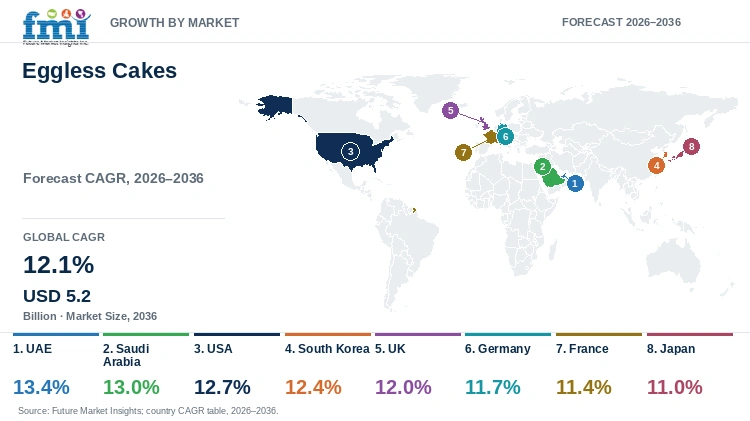
| Country | CAGR |
|---|---|
| UAE | 13.4% |
| Saudi Arabia | 13.0% |
| USA | 12.7% |
| South Korea | 12.4% |
| UK | 12.0% |
| Germany | 11.7% |
| France | 11.4% |
| Japan | 11.0% |
How Do Country Growth Rates Compare in the Eggless Cakes Market?
The UAE will grow at 13.4%, while Japan will reach 11.0%, giving a spread of 2.4 percentage points. Saudi Arabia will grow at 13.0%. The USA and South Korea, at 12.7% and 12.4%, will also exceed the global 12.1% rate. The UK will grow at 12.0%, followed by Germany at 11.7% and France at 11.4%. These forecasts apply to different starting revenue values. Local distribution, cake preferences and product-information requirements will affect how suppliers develop sales in each country.
- UAE: Hotels serving varied dietary preferences need a consistent dessert and the registration and allergen information required for local sale [8] [9].
- Saudi Arabia: Food facilities and online ordering need consistent allergen disclosures for the recipe offered [7].
- USA: Bakers will assess alternatives against their own ingredient costs and cake output as well as packaged-food allergen requirements [1] [2].
- South Korea: Separate allergen statements and shared-process warnings make the actual recipe and production arrangement important to pack design [12].
- UK: Retailers need product descriptions that distinguish vegan positioning from allergy suitability [3].
- Germany: Wider familiarity with animal-product alternatives creates a retail context; cake taste and price determine acceptance [5].
- France: Allergen information is required at bakery counters as well as on packaged products [6].
- Japan: Supermarket and convenience-store channels offer access for suitable portions with Japanese product information [10] [11].
Country Outlook
- UAE: Hotels give UAE suppliers a customer base for desserts suited to different dietary preferences. DET’s January 2026 tourism report recorded 19.59 million international overnight visitors in Dubai during 2025, up 5% from 2024 [8]. FMI forecasts a 13.4% CAGR for the UAE from 2026 to 2036. Suppliers need a cake that hotel staff can store and prepare consistently through the intended service period. Dubai’s 2025 public health law requires food-related establishments to register packaged food and provide warnings for ingredients that may cause allergic reactions [9]. This emirate-level requirement affects local entry alongside the buyer’s product trials and delivery needs.
- Saudi Arabia: Allergen information follows the customer through menus and online ordering in Saudi Arabia. SFDA’s March 2022 initiative addressed those routes and identified egg among ingredients requiring disclosure [7]. The authority also cited a national study with Taibah University indicating food allergy among 21% of the population, covering multiple allergens. The country’s eggless cakes market will grow at a 13.0% CAGR from 2026 to 2036, according to FMI. A supplier needs Arabic-ready recipe information that remains consistent on packs and menus. Distribution and final handling must also preserve the texture promised at purchase.
- USA: FMI expects U.S. sales to grow at a 12.7% CAGR from 2026 to 2036. Manufacturers can develop alternative recipes for dietary needs while managing disruption to egg inputs. USDA’s April 2026 analysis linked the average 21.9% retail egg-price increase in 2025 to avian-influenza disruption [1]. Bakery buyers need to compare their contracted input costs and usable cake output before switching. FDA’s January 2025 guidance separately addresses allergen labelling for packaged food [2]. A viable cake combines acceptable texture and selling price with production information that supports the claim made on its pack.
- South Korea: South Korean pack requirements make recipe and factory information part of supplier qualification. MFDS’s food labelling system includes poultry eggs, requires a separate allergen statement near the ingredient list and addresses warnings for products sharing a manufacturing process [12]. The country’s market will grow at a 12.4% CAGR from 2026 to 2036, as per FMI. Bread products fall within mandatory processed-food nutrition labelling, and additional rules cover qualifying chains selling children’s foods. Suppliers need to assess the requirements for the particular cake and sales arrangement. Convenient portions still need acceptable taste and moisture throughout their declared shelf life.
- UK: UK retailers need to describe vegan and allergy-related claims accurately. In March 2024, the FSA reported that 62% of surveyed people who reacted to animal-based products, or bought for someone who did, were confident that vegan-labelled food was safe for them [3]. The agency warned that this belief could expose them to allergens. FMI forecasts a 12.0% CAGR for UK eggless cakes from 2026 to 2036. Suppliers need labels consistent with factory controls and precautionary information where appropriate. Bakery and foodservice handling also needs to preserve that information when a product is sold by the slice.
- Germany: Germany’s 2024 nutrition report found that 39% of respondents often bought vegetarian or vegan alternatives to animal products, compared with 29% in 2020 [5]. Familiarity with alternatives gives bakers a reason to offer recognizable cakes without egg. Sales in the defined market will grow at an 11.7% CAGR from 2026 to 2036, according to FMI. Shoppers will still compare taste, portions and price with other cakes. EU rules require allergen information for packaged and non-prepacked food [4], so recipes retaining dairy or other allergens need suitable declarations. A specialty ingredient needs to earn its cost through the cake offered.
- France: A French bakery may sell the same cake in a sealed pack or by the slice, and each presentation needs suitable consumer information. DGCCRF’s July 2026 guidance requires clear French labelling on prepacked foods and nearby allergen information for non-prepacked pastries [6]. FMI expects an 11.4% CAGR for France from 2026 to 2036. Suppliers need a recipe that retains acceptable sponge quality through the chosen display or holding period. An accurately described eggless offer can then give shoppers another choice at the counter. Preparation and replenishment need to fit the outlet’s actual rate of sale.
- Japan: Japanese supermarket and convenience-store channels can accommodate compact, packaged cakes. METI’s April 2026 retail analysis recorded 2025 supermarket sales growth of 4.7% and convenience-store sales growth of 3.4% [11]. These figures cover wider retail activity. The eggless cakes market will grow at an 11.0% CAGR from 2026 to 2036, as per FMI. Suppliers need portions, storage life and price suited to the selected outlet. The Consumer Affairs Agency requires Japanese food labels, with egg included in mandatory allergen declarations [10]. Localized pack information and dependable deliveries help a suitable recipe reach regular customers.
Who are the Notable Companies in the Eggless Cakes Market?
Companies profiled include Rich Products, Sara Lee Frozen Bakery, Dessert Holdings, Mademoiselle Desserts, Finsbury Food Group, Dr. Oetker, Premier Foods, McKee Foods, Hostess Brands and Bauli.
Mademoiselle Desserts and Finsbury Food Group document finished plant-based cakes, while Dr. Oetker describes replacement development in baking mixes [17] [19] [15]. Rich Products adds a wider bakery operation with products for in-store preparation [23]. A finished cake supplier can give a buyer a defined storage and service process. A mix supplier needs to show what the recipe produces under its preparation instructions. This difference affects the equipment, staff and trials required before the buyer starts ordering.
Sara Lee Frozen Bakery and Dessert Holdings provide scaled dessert manufacturing for retail and foodservice [21] [24]. Premier Foods supplies plant-based sweet bakery alongside its broader cake brands [26]. McKee Foods, Hostess Brands and Bauli add packaged-bakery routes [28] [29] [31]. Buyers need the specification for the particular cake they intend to sell, including its ingredients, storage conditions and allergen information.
- Plant-based formulation and inclusive bakery specialists: Mademoiselle Desserts and Finsbury Food Group supply finished-cake examples; Dr. Oetker contributes baking-mix development and Rich Products wider bakery capability.
- Frozen and foodservice dessert platforms: Sara Lee Frozen Bakery and Dessert Holdings supply desserts through established professional and retail channels.
- Branded ambient and packaged-cake networks: Premier Foods, McKee Foods, Hostess Brands and Bauli provide pack-format and distribution experience.
Competitive Benchmarking
| Company | Plant-Based / Egg-Replacement Cake Capability | Ready-to-Serve / Frozen Cake Platform | Retail and Foodservice Route Breadth | Geographic Reach |
|---|---|---|---|---|
| Rich Products | Medium | High | High | North America and Europe with reach into Asia and Latin America. The network also covers the Middle East and Africa as well as Australia. |
| Sara Lee Frozen Bakery | Low | High | High | United States retail and foodservice including in-store bakery. |
| Dessert Holdings | Low | Medium | High | North America with retail and foodservice customers. |
| Mademoiselle Desserts | High | High | High | United Kingdom and France with a wider European customer base. |
| Finsbury Food Group | High | Medium | High | United Kingdom retail and foodservice. |
| Premier Foods | Medium | Low | High | United Kingdom grocery. |
| McKee Foods | Low | Low | Medium | United States retail and vending alongside foodservice. |
| Hostess Brands | Low | Low | Medium | North American packaged sweet-baked-goods channels. |
| Bauli | Low | Low | High | Italy-based network with products sold in more than 70 countries. |
| Dr. Oetker | High | Medium | High | Consumer and professional food presence across Europe and other regions. |
Scoring basis: Plant-Based / Egg-Replacement Cake Capability assesses documented products and formulation work. High indicates direct and repeated evidence, while Medium covers narrower or adjacent activity.
Ready-to-Serve / Frozen Cake Platform assesses formats that reduce outlet preparation. High reflects a broad platform and Medium a narrower documented offer.
Retail and Foodservice Route Breadth assesses access to consumer retail and professional buyers. Geographic Reach describes the company footprint.
Low indicates limited documented capability or insufficient product-specific evidence for a higher rating in this comparison. Ratings describe capabilities supported by the cited information; they are not supplier shares of eggless cake revenue.
Key Developments in the Eggless Cakes Market
- In October 2022, Dr. Oetker described vegan baking-mix development for muffins and brownies [15]. Apple pulp supported the muffin recipe, while pea protein partly replaced egg function in brownies. The team assessed texture and taste before finalizing each mix. These choices show how the required properties of a baked product influence replacement selection. Buyers need trials for their own cake and preparation process.
- In March 2021, Finsbury Food Group expanded its BOSH! partnership with a vegan traybake for Costa Coffee [19]. The announcement also described an existing vegan cake range in Tesco and Asda. Grocery cakes and coffee-shop portions need different packs and handling instructions. Suppliers can serve both routes when they qualify each product for its selling and service conditions.
- In May 2026, Mademoiselle Desserts reported free-from product recognition for its Vegan Jaffa Orange Cake and a gluten-free vegan cheesecake [18]. Judges commented on sponge texture, flavor and presentation. Its plant-based dessert range also includes cakes [17]. These finished products provide concrete recipe examples for buyers assessing a vegan dessert; any allergy-related requirement needs to be checked against the individual specification.
Key Players in the Eggless Cakes Market
Plant-Based Formulation and Inclusive Bakery Specialists
- Mademoiselle Desserts
- Finsbury Food Group
- Dr. Oetker
- Rich Products
Frozen and Foodservice Dessert Platforms
- Sara Lee Frozen Bakery
- Dessert Holdings
Branded Ambient and Packaged-Cake Networks
- Premier Foods
- McKee Foods
- Hostess Brands
- Bauli
Report Scope and Methodology
| Coverage field | Report scope |
|---|---|
| Market breakdown | Type; Claim / Nature; Format; Packaging Format; Sales Channel |
| Quantitative Units | USD Billion |
| Market Definition | Revenue includes commercial eggless cake offerings and eggless cake production formats represented by the listed Type, Claim / Nature, Format, Packaging Format and Sales Channel categories. Revenue is counted at the point the in-scope product or production format is sold. Downstream prepared-service revenue, conventional egg-containing cakes, general-purpose egg replacers not intended for cake applications and adjacent desserts outside the eggless-cake definition are excluded. |
| Regions Covered | North America; Latin America; Western Europe; Eastern Europe; East Asia; South Asia and Pacific; Middle East and Africa |
| Countries Covered | USA; Germany; France; UK; Saudi Arabia; UAE; Japan; South Korea |
| Key Companies Profiled | Rich Products; Sara Lee Frozen Bakery; Dessert Holdings; Mademoiselle Desserts; Finsbury Food Group; Premier Foods; McKee Foods; Hostess Brands; Bauli; Dr. Oetker |
| Forecast Period | 2026 to 2036 |
| Approach | Primary and secondary research with market triangulation. |
Research Methodology
| Method | Approach |
|---|---|
| Primary Research | FMI analysts gathered input from manufacturers, ingredient and cake suppliers, distributors, retail and foodservice buyers, procurement teams and subject-matter experts. Discussions examined recipe approval, production trials, allergen controls, storage, preparation, price and the conditions supporting regular orders. |
| Desk Research | Government statistics, food-labelling publications, technical studies, company products, filings and announcements informed the assessment. Sources were reviewed for date, geography and relevance to commercial eggless cakes and cake-production formats. Broader egg-price and channel figures provided context within their stated coverage. |
| Market Sizing and Forecasting | The model combined the baseline value with segment structure, prices, volume indicators, company participation and country demand conditions. Recipe performance, input costs, claim requirements, storage and distribution informed the forecast. Segment and regional estimates were reconciled with the market total. |
| Data Validation | Estimates were checked against public evidence, company activity and primary research inputs. In-scope cake products and production formats were separated from conventional egg-containing cakes, general-purpose replacements outside cake applications, adjacent desserts and prepared-service revenue. Connected operations and overlapping revenues were reconciled. |
Market Segmentation
By Type
- Liquid formats
- Powdered formats
- Frozen
- Specialty functional
By Claim / Nature
- Conventional
- Clean label
- Organic
- Gluten-free
- High-protein / fortified
By Format
- Frozen
- Fresh
- Ambient packaged
- Chilled
- Par-baked / thaw-and-serve
By Packaging Format
- Multipack
- Single-serve
- Family / loaf pack
- Bulk foodservice
By Sales Channel
- Supermarkets & hypermarkets
- Artisan & specialty bakeries
- Convenience & forecourt
- Online & DTC
- Foodservice distributors
By Region
- North America
- United States
- Canada
- Latin America
- Brazil
- Mexico
- Argentina
- Chile
- Western Europe
- Germany
- France
- United Kingdom
- Italy
- Spain
- Benelux
- Nordics
- Eastern Europe
- Poland
- Czech Republic
- Romania
- Hungary
- East Asia
- China
- Japan
- South Korea
- South Asia and Pacific
- India
- ASEAN
- Australia and New Zealand
- Middle East and Africa
- GCC Countries
- South Africa
- Türkiye
- Israel
Research Sources and Bibliography
- [1] USDA Economic Research Service (2026, April 30). U.S. food-at-home prices increased 2.3 percent in 2025, compared with 2024. Food price analysis.
- [2] US Food and Drug Administration (2025, January). Guidance for Industry: Questions and Answers Regarding Food Allergen Labeling (Edition 5). Food allergen guidance.
- [3] Food Standards Agency (2024, March 5). FSA launches campaign highlighting risk of food labelled as vegan to people with allergies. Vegan labelling campaign.
- [4] European Commission (2026, February 23). Allergies - Food Safety. EU allergen information.
- [5] Federal Ministry of Food and Agriculture, Germany (2024). Deutschland, wie es isst - der BMEL-Ernährungsreport 2024. German nutrition report.
- [6] DGCCRF, France (2026, July 23). Étiquetage des denrées alimentaires : les règles à connaître. French labelling guidance.
- [7] Saudi Food and Drug Authority (2022, March 18). SFDA: Food allergy treatment is to avoid ingredients that cause it. SFDA allergy guidance.
- [8] Dubai Department of Economy and Tourism (2026, January 7). Tourism Performance Report January - December 2025. Dubai tourism report.
- [9] Dubai Legislation Portal (2025). Law No. (5) of 2025 Concerning Public Health in the Emirate of Dubai. Public health law.
- [10] Consumer Affairs Agency, Japan (n.d.). Japanese allergen information.
- [11] Ministry of Economy, Trade and Industry, Japan (14 April 2026). 2025 Japan retail analysis.
- [12] Ministry of Food and Drug Safety, South Korea (n.d.). Food Labeling System. Korean labelling system.
- [13] Halm et al. (2024, January 17). Commercial Egg Replacers in Pound Cake Systems: A Comprehensive Analysis of Market Trends and Application. Commercial replacer study.
- [14] Halm et al. (2026, March 11). Plant-based proteins as functional egg replacers in pound cake: A comparative study of legume and oat ingredients. Plant protein study.
- [15] Dr. Oetker (27 October 2022). Juicy, simple, vegan! - The development of plant-based baking mixes. Vegan baking development.
- Dr. Oetker (2025, December 18). Bringing Everybody to the Table - Veganuary 2026 at Dr. Oetker. Veganuary product activity.
- [17] Mademoiselle Desserts (2026, May 15). Indulge Without Compromise. Plant-based dessert range.
- [18] Mademoiselle Desserts (2026, May 15). Our Free From Food Awards Success. Free-from product recognition.
- [19] Finsbury Food Group (2021, March). Finsbury Food Group announces partnership with Costa Coffee to expand BOSH! range. Costa Coffee partnership.
- [20] Finsbury Food Group (2026, January 19). Introducing Little Big Cake. Little Big Cake.
- [21] Sara Lee Frozen Bakery (n.d.). Our Story. Frozen bakery platform.
- [22] Cal-Maine Foods and Sara Lee Frozen Bakery (2026, May 12). Cal-Maine Foods and Sara Lee Frozen Bakery Announce Cal-Maine Foods’ Acquisition of Van’s Foods Brand. Van’s Foods announcement.
- [23] Rich Products (2025, April 10). Rich Products, Funfetti extend partnership. Funfetti cake launch.
- [24] Dessert Holdings (2025, July 14). Dessert Holdings Acquires Willamette Valley Pie Co. Willamette acquisition announcement.
- Dessert Holdings (n.d.). Innovating Extraordinary Moments. Dessert product portfolio.
- [26] Premier Foods (2023, September 30). Premier Foods delivers on taste with trio of cake launches. Plantastic brownie launch.
- [27] McKee Foods (2025, April 25). Little Debbie Snacks Launches Big Pack Nutty Buddy Cakes - A Fresh Take on a Classic Favorite! Nutty Buddy launch.
- [28] McKee Foods (n.d.). Little Debbie Foodservice. Little Debbie foodservice.
- [29] The J.M. Smucker Co. (2025, June 26). The J.M. Smucker Co. Announces Commitment to Remove FD&C Colors from Consumer Food Products. Colour reformulation announcement.
- [30] Bauli Group (2024, August 22). After 100 years the Bauli Group is reinventing itself and aims for a billion by 2030. Bauli investment announcement.
- [31] Bauli Group (n.d.). About us: our heritage and vision. Bauli geographic reach.
This bibliography is provided for reader reference and is not exhaustive. The full report contains the complete reference list and detailed citations.
This Report Answers
- How large is the Eggless Cakes Market in 2026 and what value is forecast for 2036?
- Which industry pressures are supporting demand for eggless cake products and production formats?
- Why do Liquid formats lead the Type category?
- Why does Conventional lead the Claim / Nature category?
- How do growth rates differ across the eight profiled countries?
- Which profiled companies supply relevant bakery, cake, frozen-dessert or plant-based capabilities?
- What technical, allergen-control and channel frictions can limit adoption or supplier switching?
- What should buyers evaluate before purchasing or qualifying an eggless cake offering?
Frequently Asked Questions
How big is the Eggless Cakes Market in 2026, and what is forecast for 2036?
FMI estimates the market at USD 1.7 Billion in 2026 and forecasts USD 5.2 Billion by 2036. Revenue covers commercial eggless cakes and the cake-production formats defined in the report scope.
What is the CAGR of the Eggless Cakes Market from 2026 to 2036?
Sales will grow at a 12.1% CAGR from 2026 to 2036, according to FMI. Recipe performance, cost and the buyer’s storage and preparation requirements will affect adoption.
Which segment leads Type in the Eggless Cakes Market?
Liquid formats will hold 39.0% of Type revenue in 2026. Controlled dosing and fewer preparation steps support systems qualified for the intended cake recipe.
Which segment leads Claim / Nature in the Eggless Cakes Market?
Conventional will account for 57.0% of Claim / Nature revenue in 2026. Manufacturers retain flexibility over other ingredients while meeting the specified eggless requirement.
Which profiled countries have the highest growth rates in the Eggless Cakes Market?
The UAE will grow at 13.4%, followed by Saudi Arabia at 13.0% and the USA at 12.7% from 2026 to 2036. The forecasts apply to different starting market values.
Which companies are active in the Eggless Cakes Market?
The study profiles Rich Products, Sara Lee Frozen Bakery, Dessert Holdings, Mademoiselle Desserts, Finsbury Food Group, Dr. Oetker, Premier Foods, McKee Foods, Hostess Brands and Bauli. Their roles span finished plant-based cakes, baking mixes, wider dessert production and packaged-bakery distribution.
Preview the report firsthand - request a free sample
Get SampleGet the brochure for pricing and purchase details.
Get PDFTable of Content
- Key Takeaways
- Market Size and CAGR
- Top Growth Driver
- Fastest Growing Segment
- Leading Region
- Key Companies
- Emerging Opportunities
- Executive Summary
- Global Market Outlook
- Demand-side Trends
- Supply-side Trends
- Technology Roadmap Analysis
- Analysis and Recommendations
- Analyst Perspective (What is happening? Why now? What should investors know?)
- Key Questions Answered
- How large is the market?
- What is the CAGR?
- What are key trends?
- Which region dominates?
- Who are the leaders?
- Market Overview
- Market Coverage / Taxonomy
- Market Definition / Scope / Limitations
- Research Methodology
- Chapter Orientation
- Analytical Lens and Working Hypotheses
- Market Structure, Signals, and Trend Drivers
- Benchmarking and Cross-market Comparability
- Market Sizing, Forecasting, and Opportunity Mapping
- Research Design and Evidence Framework
- Desk Research Programme (Secondary Evidence)
- Expert Input and Fieldwork (Primary Evidence)
- Tooling, Models, and Reference Databases
- Data Engineering and Model Build
- Quality Assurance and Audit Trail
- Market Background
- Market Dynamics (Drivers, Restraints, Opportunity, Trends)
- Scenario Forecast (Optimistic, Likely, Conservative)
- Impact Analysis
- AI Impact
- Sustainability Impact
- Regulatory Impact
- Technology Impact
- Consumer / Buyer Analysis
- Purchase Drivers
- Adoption Barriers
- Buyer Journey
- Opportunity Map Analysis
- Product Life Cycle Analysis
- Supply Chain Analysis
- Investment Feasibility Matrix
- Value Chain Analysis
- PESTLE and Porter's Analysis
- Regulatory Landscape
- Regional Parent Market Outlook
- Production and Consumption Statistics
- Import and Export Statistics
- Global Market Analysis and Forecast, 2021 to 2036
- Historical Market Size Value (USD Billion) Analysis, 2021 to 2025
- Current and Future Market Size Value (USD Billion) Projections, 2026 to 2036
- Y-o-Y Growth Trend Analysis
- Absolute $ Opportunity Analysis
- Global Market Pricing Analysis, 2021 to 2036
- Global Market Analysis and Forecast, By Type, 2021 to 2036
- Introduction / Key Findings
- Historical Market Size Value (USD Billion) Analysis By Type, 2021 to 2025
- Current and Future Market Size Value (USD Billion) Analysis and Forecast By Type, 2026 to 2036
- Liquid formats
- Powdered formats
- Frozen
- Specialty functional
- Y-o-Y Growth Trend Analysis By Type, 2021 to 2025
- Absolute $ Opportunity Analysis By Type, 2026 to 2036
- Global Market Analysis and Forecast, By Claim / Nature, 2021 to 2036
- Introduction / Key Findings
- Historical Market Size Value (USD Billion) Analysis By Claim / Nature, 2021 to 2025
- Current and Future Market Size Value (USD Billion) Analysis and Forecast By Claim / Nature, 2026 to 2036
- Conventional
- Clean label
- Organic
- Gluten-free
- High-protein / fortified
- Y-o-Y Growth Trend Analysis By Claim / Nature, 2021 to 2025
- Absolute $ Opportunity Analysis By Claim / Nature, 2026 to 2036
- Global Market Analysis and Forecast, By Format, 2021 to 2036
- Introduction / Key Findings
- Historical Market Size Value (USD Billion) Analysis By Format, 2021 to 2025
- Current and Future Market Size Value (USD Billion) Analysis and Forecast By Format, 2026 to 2036
- Frozen
- Fresh
- Ambient packaged
- Chilled
- Par-baked / thaw-and-serve
- Y-o-Y Growth Trend Analysis By Format, 2021 to 2025
- Absolute $ Opportunity Analysis By Format, 2026 to 2036
- Global Market Analysis and Forecast, By Packaging Format, 2021 to 2036
- Introduction / Key Findings
- Historical Market Size Value (USD Billion) Analysis By Packaging Format, 2021 to 2025
- Current and Future Market Size Value (USD Billion) Analysis and Forecast By Packaging Format, 2026 to 2036
- Multipack
- Single-serve
- Family / loaf pack
- Bulk foodservice
- Y-o-Y Growth Trend Analysis By Packaging Format, 2021 to 2025
- Absolute $ Opportunity Analysis By Packaging Format, 2026 to 2036
- Global Market Analysis and Forecast, By Sales Channel, 2021 to 2036
- Introduction / Key Findings
- Historical Market Size Value (USD Billion) Analysis By Sales Channel, 2021 to 2025
- Current and Future Market Size Value (USD Billion) Analysis and Forecast By Sales Channel, 2026 to 2036
- Supermarkets & hypermarkets
- Artisan & specialty bakeries
- Convenience & forecourt
- Online & DTC
- Foodservice distributors
- Y-o-Y Growth Trend Analysis By Sales Channel, 2021 to 2025
- Absolute $ Opportunity Analysis By Sales Channel, 2026 to 2036
- Global Market Analysis and Forecast, By Region, 2021 to 2036
- Introduction
- Historical Market Size Value (USD Billion) Analysis By Region, 2021 to 2025
- Current Market Size Value (USD Billion) Analysis and Forecast By Region, 2026 to 2036
- North America
- Latin America
- Western Europe
- Eastern Europe
- East Asia
- South Asia and Pacific
- Middle East and Africa
- Market Attractiveness Analysis By Region
- North America Market Analysis and Forecast, By Country, 2021 to 2036
- Historical Market Size Value (USD Billion) Trend Analysis By Market Taxonomy, 2021 to 2025
- Market Size Value (USD Billion) Forecast By Market Taxonomy, 2026 to 2036
- By Country
- United States
- Canada
- By Type
- By Claim / Nature
- By Format
- By Packaging Format
- By Sales Channel
- By Country
- Market Attractiveness Analysis
- By Country
- By Type
- By Claim / Nature
- By Format
- By Packaging Format
- By Sales Channel
- Key Takeaways
- Latin America Market Analysis and Forecast, By Country
- Historical Market Size Value (USD Billion) Trend Analysis By Market Taxonomy, 2021 to 2025
- Market Size Value (USD Billion) Forecast By Market Taxonomy, 2026 to 2036
- By Country
- Brazil
- Mexico
- Argentina
- Chile
- By Type
- By Claim / Nature
- By Format
- By Packaging Format
- By Sales Channel
- By Country
- Market Attractiveness Analysis
- By Country
- By Type
- By Claim / Nature
- By Format
- By Packaging Format
- By Sales Channel
- Key Takeaways
- Western Europe Market Analysis and Forecast, By Country
- Historical Market Size Value (USD Billion) Trend Analysis By Market Taxonomy, 2021 to 2025
- Market Size Value (USD Billion) Forecast By Market Taxonomy, 2026 to 2036
- By Country
- Germany
- France
- United Kingdom
- Italy
- Spain
- Benelux
- Nordics
- By Type
- By Claim / Nature
- By Format
- By Packaging Format
- By Sales Channel
- By Country
- Market Attractiveness Analysis
- By Country
- By Type
- By Claim / Nature
- By Format
- By Packaging Format
- By Sales Channel
- Key Takeaways
- Eastern Europe Market Analysis and Forecast, By Country
- Historical Market Size Value (USD Billion) Trend Analysis By Market Taxonomy, 2021 to 2025
- Market Size Value (USD Billion) Forecast By Market Taxonomy, 2026 to 2036
- By Country
- Poland
- Czech Republic
- Romania
- Hungary
- By Type
- By Claim / Nature
- By Format
- By Packaging Format
- By Sales Channel
- By Country
- Market Attractiveness Analysis
- By Country
- By Type
- By Claim / Nature
- By Format
- By Packaging Format
- By Sales Channel
- Key Takeaways
- East Asia Market Analysis and Forecast, By Country
- Historical Market Size Value (USD Billion) Trend Analysis By Market Taxonomy, 2021 to 2025
- Market Size Value (USD Billion) Forecast By Market Taxonomy, 2026 to 2036
- By Country
- China
- Japan
- South Korea
- By Type
- By Claim / Nature
- By Format
- By Packaging Format
- By Sales Channel
- By Country
- Market Attractiveness Analysis
- By Country
- By Type
- By Claim / Nature
- By Format
- By Packaging Format
- By Sales Channel
- Key Takeaways
- South Asia and Pacific Market Analysis and Forecast, By Country
- Historical Market Size Value (USD Billion) Trend Analysis By Market Taxonomy, 2021 to 2025
- Market Size Value (USD Billion) Forecast By Market Taxonomy, 2026 to 2036
- By Country
- India
- ASEAN
- Australia and New Zealand
- By Type
- By Claim / Nature
- By Format
- By Packaging Format
- By Sales Channel
- By Country
- Market Attractiveness Analysis
- By Country
- By Type
- By Claim / Nature
- By Format
- By Packaging Format
- By Sales Channel
- Key Takeaways
- Middle East and Africa Market Analysis and Forecast, By Country
- Historical Market Size Value (USD Billion) Trend Analysis By Market Taxonomy, 2021 to 2025
- Market Size Value (USD Billion) Forecast By Market Taxonomy, 2026 to 2036
- By Country
- GCC Countries
- South Africa
- Türkiye
- Israel
- By Type
- By Claim / Nature
- By Format
- By Packaging Format
- By Sales Channel
- By Country
- Market Attractiveness Analysis
- By Country
- By Type
- By Claim / Nature
- By Format
- By Packaging Format
- By Sales Channel
- Key Takeaways
- Key Countries Market Analysis
- United States
- Pricing Analysis
- Market Share Analysis, 2025
- By Type
- By Claim / Nature
- By Format
- By Packaging Format
- By Sales Channel
- Canada
- Pricing Analysis
- Market Share Analysis, 2025
- By Type
- By Claim / Nature
- By Format
- By Packaging Format
- By Sales Channel
- Mexico
- Pricing Analysis
- Market Share Analysis, 2025
- By Type
- By Claim / Nature
- By Format
- By Packaging Format
- By Sales Channel
- Brazil
- Pricing Analysis
- Market Share Analysis, 2025
- By Type
- By Claim / Nature
- By Format
- By Packaging Format
- By Sales Channel
- Chile
- Pricing Analysis
- Market Share Analysis, 2025
- By Type
- By Claim / Nature
- By Format
- By Packaging Format
- By Sales Channel
- Germany
- Pricing Analysis
- Market Share Analysis, 2025
- By Type
- By Claim / Nature
- By Format
- By Packaging Format
- By Sales Channel
- United Kingdom
- Pricing Analysis
- Market Share Analysis, 2025
- By Type
- By Claim / Nature
- By Format
- By Packaging Format
- By Sales Channel
- Italy
- Pricing Analysis
- Market Share Analysis, 2025
- By Type
- By Claim / Nature
- By Format
- By Packaging Format
- By Sales Channel
- Spain
- Pricing Analysis
- Market Share Analysis, 2025
- By Type
- By Claim / Nature
- By Format
- By Packaging Format
- By Sales Channel
- France
- Pricing Analysis
- Market Share Analysis, 2025
- By Type
- By Claim / Nature
- By Format
- By Packaging Format
- By Sales Channel
- India
- Pricing Analysis
- Market Share Analysis, 2025
- By Type
- By Claim / Nature
- By Format
- By Packaging Format
- By Sales Channel
- ASEAN
- Pricing Analysis
- Market Share Analysis, 2025
- By Type
- By Claim / Nature
- By Format
- By Packaging Format
- By Sales Channel
- Australia and New Zealand
- Pricing Analysis
- Market Share Analysis, 2025
- By Type
- By Claim / Nature
- By Format
- By Packaging Format
- By Sales Channel
- China
- Pricing Analysis
- Market Share Analysis, 2025
- By Type
- By Claim / Nature
- By Format
- By Packaging Format
- By Sales Channel
- Japan
- Pricing Analysis
- Market Share Analysis, 2025
- By Type
- By Claim / Nature
- By Format
- By Packaging Format
- By Sales Channel
- South Korea
- Pricing Analysis
- Market Share Analysis, 2025
- By Type
- By Claim / Nature
- By Format
- By Packaging Format
- By Sales Channel
- Poland
- Pricing Analysis
- Market Share Analysis, 2025
- By Type
- By Claim / Nature
- By Format
- By Packaging Format
- By Sales Channel
- Hungary
- Pricing Analysis
- Market Share Analysis, 2025
- By Type
- By Claim / Nature
- By Format
- By Packaging Format
- By Sales Channel
- Türkiye
- Pricing Analysis
- Market Share Analysis, 2025
- By Type
- By Claim / Nature
- By Format
- By Packaging Format
- By Sales Channel
- South Africa
- Pricing Analysis
- Market Share Analysis, 2025
- By Type
- By Claim / Nature
- By Format
- By Packaging Format
- By Sales Channel
- UAE
- Pricing Analysis
- Market Share Analysis, 2025
- By Type
- By Claim / Nature
- By Format
- By Packaging Format
- By Sales Channel
- Saudi Arabia
- Pricing Analysis
- Market Share Analysis, 2025
- By Type
- By Claim / Nature
- By Format
- By Packaging Format
- By Sales Channel
- United States
- Market Structure Analysis
- Competition Dashboard
- Competition Benchmarking
- Market Share Analysis of Top Players
- By Regional
- By Type
- By Claim / Nature
- By Format
- By Packaging Format
- By Sales Channel
- Emerging Startups
- Innovation Benchmarking
- Competition Analysis
- Competition Deep Dive
- Rich Products
- Overview
- Product Portfolio
- Profitability by Market Segments
- Sales Footprint
- Strategy Overview
- Marketing Strategy
- Product Strategy
- Channel Strategy
- Sara Lee Frozen Bakery
- Dessert Holdings
- Mademoiselle Desserts
- Finsbury Food Group
- Premier Foods
- McKee Foods
- Hostess Brands
- Bauli
- Dr. Oetker
- Rich Products
- Case Studies
- Success Stories
- Recent Developments
- Competition Deep Dive
- Assumptions & Acronyms Used


