

- Market Size (2026)
- USD 287.8 Mn
- Forecast (2036)
- USD 788.2 Mn
- CAGR (2026 to 2036)
- 10.6%
How big is Mille Crepe Cakes Market in 2026?
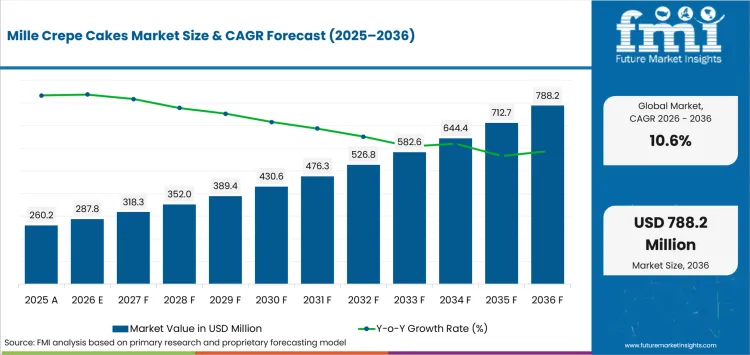
USD 287.8 million in 2026 and USD 788.2 million by 2036 at a 10.6% CAGR.
Demand for mille crepe cakes is projected to expand at 10.6% CAGR between 2026 and 2036, increasing valuation from USD 287.8 million in 2026 to USD 788.2 million by 2036. Distribution broadens when finished cakes reach retail and foodservice outlets without rebuilding thin layers on site. Lady M's January 2026 Year of the Horse program launched Orange Mille Crêpes through boutiques and nationwide shipping, showing how a specialist can combine local retail with distributed fulfillment. Comparable frozen bakery programs use similar cold-chain economics, though mille crepe cakes allow less tolerance for compression or cream movement.
Emmi's 2026 half-year report said premium desserts contributed to growth and commercial synergies from its integrated dessert platform were already being realized. For mille crepe suppliers, wider listings depend on repeatable manufacturing plus reliable portion yield and channel service. Retailers can carry premium layered cakes more confidently once those variables are controlled before products reach bakery counters or foodservice outlets.
Key Takeaways
- Cold-chain execution expands distribution because finished mille crepe cakes can reach major channels without recreating every crepe layer on site.
- By product type, classic - original is estimated to hold 37.0% in 2026 because its visible layers provide a familiar reference for buyers.
- Conventional is set to account for 54.0% of claim - nature demand in 2026 because standard formulations require fewer recipe changes during scale-up.
- In 2026, fresh is projected to represent 34.0% of format demand because shorter handling routes better protect soft crepe texture and cream presentation.
- Layer compression and cream instability weaken margins when distribution outpaces packaging controls, and labeling errors add a separate compliance cost.
- Key players include Lady M Cake Boutique and Rich Products Corporation alongside Emmi Desserts. Finsbury Food Group and Premier Foods are also profiled alongside McKee Foods and Dr. Oetker.
Analyst Perspective
"Mille crepe suppliers create durable value when scaled production preserves the thin-layer texture that supports premium pricing. Frozen distribution widens channel reach only when packaging and thaw instructions protect the eating experience, with formulation controls supporting consistency after transport."
- Nandini Roy Choudhury, Principal Consultant, Future Market Insights
How is the mille crepe cakes market segmented?
The mille crepe cakes market is segmented by product type, claim - nature, format, packaging format, sales channel, and region.
Product type defines cake construction and claim - nature defines formulation, while format defines handling. Packaging format connects portion design with retail and foodservice routes, while sales channel separates specialty bakery from online distribution.
What makes Classic - original central to the Product Type category?
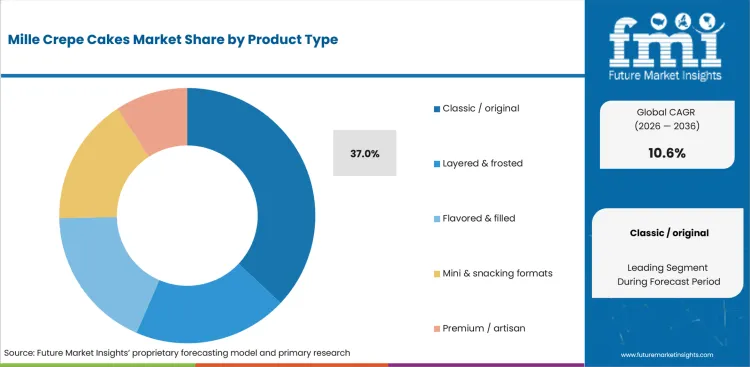
Classic - original gives buyers a stable visual benchmark for layer definition and slice quality, while cream balance remains a final sensory test. Lady M's February 2026 Valentine's program brought Strawberry Matcha Mille Crêpes back as a seasonal exact-market launch. The move shows how flavor rotation can sit on a recognizable layered base. Familiar architecture also matters in bundt cakes, where shape gives shoppers an immediate cue before flavor differentiation begins.
- Classic - original represents 37.0% of 2026 product type demand because its layered structure is immediately recognizable.
- Producers qualify layer definition and clean slicing before extending flavors, with cream stability remaining central to every variant.
Why does Conventional lead the Claim - Nature category?
Conventional formulations reduce the number of variables manufacturers must requalify when they scale production across channels. An August 2026 FDA recall of cake donuts distributed nationwide and through Amazon involved undeclared milk. The action shows how familiar bakery recipes can lose market access when label controls fail. Reformulation pressure also affects low sugar bakery products, where ingredient changes create value only when texture and allergen declarations stay aligned with production controls.
- Conventional accounts for 54.0% of 2026 claim - nature demand because standard recipes require fewer formulation changes.
- Color and allergen controls can force recipe or label changes before specialized variants reach regular distribution.
How does Fresh support the Format category?
Fresh formats protect soft crepe texture and cream finish close to the production point, but that advantage narrows the selling radius and raises waste risk. frozen baked goods extend selling reach through controlled storage and carefully managed thawing across wider territories. Mille crepe suppliers therefore need to decide where fresh presentation earns enough premium to offset a shorter selling window and where frozen distribution produces more dependable economics.
- Fresh represents 34.0% of 2026 format demand because immediate consumption reduces texture damage.
- Fresh requires short selling windows, while frozen programs need validated thaw routines before display.
What supports Multipack in the Packaging Format category?
Multipacks reduce the commitment of a full celebration cake while giving retailers more ways to sell sharing and sampling occasions. Finsbury Food Group's January 2026 Little Big Cake launch put a cake-bento format into Tesco, pairing one larger cake with smaller portions in a single retail proposition. Occasion-led pack design is also central to personalized bakery products, while mille crepe packs need stronger protection because exposed cut edges and thin layers show compression quickly.
- Multipack holds 28.0% of 2026 packaging-format demand because structured portions lower purchase commitment.
- Pack design must separate cut edges and limit horizontal pressure during chilled transport.
What drives Supermarkets & hypermarkets in the Sales Channel category?
Supermarkets combine shopper traffic with cold storage and established bakery merchandising across large store networks. In June 2026, Finsbury Food Group launched a licensed celebration cake across Tesco stores nationwide, showing that standardized cake programs can scale through grocery. bakery products gain the same retail advantage from predictable replenishment, and mille crepe listings become easier to defend when thaw performance and slice yield reduce execution risk.
- Supermarkets & hypermarkets account for 34.0% of 2026 sales-channel demand because shopper traffic combines with cold storage.
- Simple thaw instructions and predictable slice yield reduce store labor and listing risk.
What are the drivers, restraints, and opportunities in the mille crepe cakes market?
Finished-cake distribution widens the selling base, layer stability and compliance constrain scale, and portion-led formats create additional revenue routes.
- Driver: Centralized finished-cake production lets more retail and foodservice outlets sell layered cakes without reproducing the full assembly process.
- Restraint: Thin crepe layers and cream fillings require controlled handling, while allergen and color rules add a separate formulation gate.
- Opportunity: Smaller packs and localized flavors can extend the layered format into gifting and snacking, opening individual dessert occasions without changing the core cake.
Centralized manufacturing widens the selling base because outlets can buy a finished cake instead of reproducing dozens of layers in-store. That model is strongest when thawing and portioning are standardized across multiple sites. frozen desserts show why broader reach creates value only when temperature control and portion yield remain predictable throughout distribution.
Layered construction creates a visible failure mode because compression or temperature drift can damage the presentation that supports premium pricing. Inaccurate allergen labeling can also turn a sellable cake into a compliance problem before purchase. Suppliers therefore need handling and formulation controls to stay synchronized, with pack information updated for each channel.
Smaller packs and localized flavors give suppliers a way to add occasions without rebuilding the core format. bakery mixes can move flavor cycles quickly across familiar bakery platforms. Mille crepe programs face an extra qualification step because each change must preserve layer definition, cream stability and post-thaw yield. The strongest opportunities pair flavor novelty with a pack size retailers can merchandise repeatedly.
Which country CAGRs are profiled in the mille crepe cakes market?
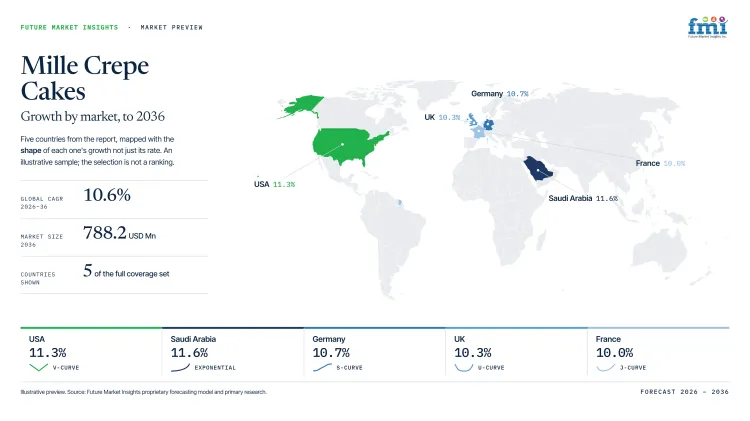
| Country | CAGR |
|---|---|
| USA | 11.3% |
| Germany | 10.7% |
| France | 10.0% |
| UK | 10.3% |
| Saudi Arabia | 11.6% |
| UAE | 11.9% |
| Japan | 9.7% |
| South Korea | 10.9% |
How do country-level CAGRs compare in the mille crepe cakes market?
The CAGR range spans 2.2 percentage points, from UAE at 11.9% to Japan at 9.7%. The narrow spread means channel readiness matters more than headline ranking when suppliers decide where to invest.
- The UAE is expected to witness stable growth, supported by premium dessert consumption, strong café culture and efficient cold-chain distribution for fresh and frozen cakes.
- Saudi Arabia follows closely, benefiting from expanding foodservice channels, growing demand for premium bakery products, and rising interest in international dessert concepts.
- The USA combines a large consumer base with diverse retail and foodservice channels, creating broad opportunities for premium layered desserts.
- South Korea's trend-driven dessert market favors visually distinctive and premium bakery products, supporting adoption of mille crepe cakes.
- Germany benefits from a well-developed premium bakery segment where quality consistency and refrigeration capabilities are important differentiators.
- The UK continues to see demand through café chains, specialty bakeries, and consumers seeking premium dessert experiences.
- France offers opportunities through its sophisticated pastry culture, where innovation and presentation can help products stand out in a highly competitive environment.
- Japan, despite recording the most moderate growth among the profiled countries, remains an important market due to its established appreciation for layered cakes, premium confectionery, and high-quality dessert formats.
Similar CAGRs can mask different cold-chain costs and retailer requirements, especially where labeling rules change channel execution. The full report covers additional countries across the fixed regional taxonomy for broader comparison.
Country-wise Analysis
- USA import controls make formulation compliance a market-entry issue for filled cakes. Demand in the USA is forecast to expand at 11.3% CAGR through 2036. FDA Import Alert 45-02 lists a July 2026 matcha sandwich cake with custard or cream filling for a non-permitted color additive. Mille crepe suppliers using imported color systems need compliant formulations before wider retail or foodservice distribution can begin.
- Germany combines a mature bakery base with continued pressure on independent operators. The market is projected to record 10.7% CAGR through 2036. On June 9, 2026, the German Bakers' Confederation reported 8,659 craft bakery businesses in 2025, down 2.8% year over year, while sector revenue reached EUR 18.14 billion. Centralized premium cakes can reduce repetitive assembly, but thaw quality still has to meet established bakery-counter expectations.
- France's dense bakery-patisserie network creates a demanding presentation benchmark for centralized cakes. Demand is predicted to advance at 10.0% CAGR through 2036. Insee counted 50,122 bakery-patisserie establishments across France in 2025 in data published in August 2026. That channel depth gives premium cakes many points of comparison, so suppliers need clean slices and consistent finish after thawing. Central production earns a place only when it removes assembly work without making the cake look standardized.
- UK supermarket and café channels give chilled cakes broad visibility, but label execution remains a practical gate. Adoption is forecast at 10.3% CAGR through 2036. Food Standards Agency guidance updated in July 2026 explicitly includes cakes among prepacked-for-direct-sale foods subject to ingredient and allergen labeling rules. Suppliers can scale centralized production more safely when recipe changes match pack information, with thaw instructions standardized across national retail programs.
- Saudi Arabia combines premium dessert occasions with a standards-led food market. Demand is forecast at 11.6% CAGR through 2036. In July 2026, the Saudi Food and Drug Authority announced Codex adoption of a Saudi-led Maamoul standard with unified technical requirements for a traditional filled baked product. For premium bakery suppliers, the decision confirms that product specifications can become a market-access condition. Mille crepe programs need equally disciplined ingredient, handling and chilled-distribution controls.
- UAE hospitality procurement is becoming more structured as major operators formalize supply programs. The market is estimated to post 11.9% CAGR through 2036. In January 2026, the Ministry of Climate Change and Environment launched the Sustainable Product initiative, targeting 25% local agricultural and livestock use across UAE restaurants and hotels and supporting the program with six strategic MoUs. For mille crepe suppliers, the commercial implication is a more formal procurement environment where chilled service, sourcing documentation and supplier consistency matter alongside product appeal.
- Japan places unusual weight on precise ingredient communication alongside presentation. Demand is positioned to record 9.7% CAGR through 2036. The Consumer Affairs Agency added cashew nuts to the mandatory allergen list on April 1, 2026 and updated its processed-food allergen requirements. Mille crepe suppliers using nut or dairy formulations must treat label updates as part of launch planning, especially when wheat remains part of the base recipe. Compact portions can widen café and takeout occasions only when ingredient control matches the visual standard.
- South Korea gives visually distinctive desserts a fast route from online discovery to delivery, but label failures can interrupt that conversion. Demand is forecast at 10.9% CAGR through 2036. In January 2026, the Ministry of Food and Drug Safety ordered a bread recall over an undeclared allergen. The action reinforces the importance of accurate bakery labeling before products enter routine distribution. Mille crepe suppliers need packaging that protects thin layers during last-mile delivery and formulation records that stay synchronized with physical labels.
Who are the notable companies in the mille crepe cakes market?
Lady M Cake Boutique, Rich Products Corporation, Emmi Desserts, Finsbury Food Group, Premier Foods, McKee Foods, and Dr. Oetker are the notable companies profiled in this market.
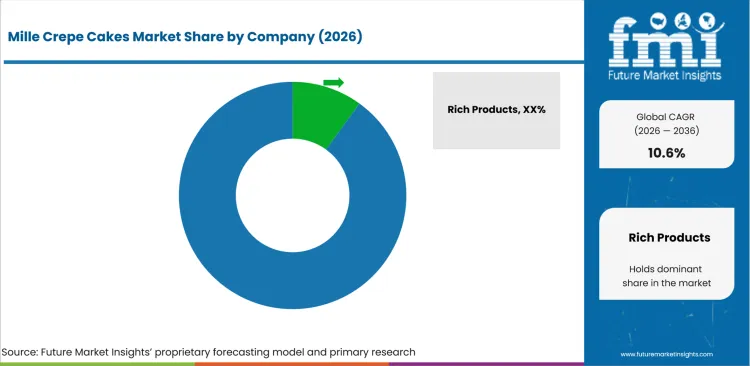
Competitive relevance depends on pairing a credible cake platform with a route to retail, foodservice or direct shipping. Lady M Cake Boutique launches mille crepe cakes directly, while Rich Products Corporation and Emmi Desserts bring scaled dessert operations. Finsbury Food Group and Premier Foods compete through retail cake programs, with McKee Foods and Dr. Oetker extending the field through broader sweet-bakery platforms. The same upstream-labor logic shapes ready-to-finish bakery products, where listings depend on transferring repeatable production work away from the selling point without adding handling complexity.
- Exact mille crepe specialist: Lady M Cake Boutique.
- Scaled premium-dessert platforms: Rich Products Corporation and Emmi Desserts.
- Retail cake and sweet-bakery platforms: Finsbury Food Group and Premier Foods alongside McKee Foods and Dr. Oetker.
Competitive Benchmarking: Mille Crepe Cakes Market
| Company | Premium Cake & Dessert Manufacturing | Cold-Chain / Thaw-and-Serve Capability | Retail / Foodservice Channel Breadth | Geographic Reach |
|---|---|---|---|---|
| Lady M Cake Boutique | High | Medium | High | United States boutiques and direct shipping |
| Rich Products Corporation | High | High | High | North America with international operations |
| Emmi Desserts | High | High | High | Europe, United States, and international customers |
| Finsbury Food Group | High | Medium | High | United Kingdom and Europe with international distribution |
| Premier Foods | High | Low | Medium | United Kingdom with selected international markets |
| McKee Foods | Medium | Low | Medium | North America |
| Dr. Oetker | High | High | High | Broad international operations |
Scoring basis: High premium-cake breadth requires multiple documented cake or dessert programs, while Medium reflects a narrower verified family. High cold-chain capability requires documented frozen or refrigerated operations. Medium reflects one verified temperature-controlled route, and Low indicates limited qualifying evidence. High channel breadth requires more than one established commercial route, while Medium reflects a primary route with narrower secondary access.
Key Developments in the Mille Crepe Cakes Market
- In September 2026, Finsbury Food Group expanded Little Big Cake through a strawberry matcha launch in Tesco nationwide. The move extended a retail cake platform introduced earlier in the year.
- In May 2026, Premier Foods announced five Mr Kipling launches across three ranges. The program included Birthday Cake Slices and targeted younger shoppers with additional sweet-treat occasions.
- In February 2026, Dr. Oetker announced an expansion of its ready-made small-cake range for March, strengthening its portion-led finished-cake offer in Germany.
Key Players in the Mille Crepe Cakes Market
Exact and Scaled Dessert Platforms
- Lady M Cake Boutique
- Rich Products Corporation
- Emmi Desserts
Retail Cake Manufacturers
- Finsbury Food Group
- Premier Foods
Broader Cake and Dessert Producers
- McKee Foods
- Dr. Oetker
Mille Crepe Cakes Market - Report Scope
| Coverage field | Report scope |
|---|---|
| Market breakdown | By product type, claim - nature, format, packaging format, sales channel, and region. |
| Quantitative Units | USD million. |
| Market Definition | Commercial sales of layered mille crepe cakes sold as whole cakes, slices, minis, multipacks, frozen or chilled finished desserts, and related packaged formats. Plain crepes, pancakes, unrelated cake categories, and foodservice markups are excluded. |
| Regions Covered | North America, Latin America, Western Europe, Eastern Europe, East Asia, South Asia and Pacific, and Middle East and Africa. |
| Countries Covered | USA, Germany, France, UK, Saudi Arabia, UAE, Japan, South Korea, and 20+ countries included in the full report. |
| Key Companies Profiled | Lady M Cake Boutique, Rich Products Corporation, Emmi Desserts, Finsbury Food Group, Premier Foods, McKee Foods, and Dr. Oetker. |
| Forecast Period | 2026 to 2036. |
| Approach | Primary and secondary research with market triangulation. |
Mille Crepe Cakes Market - Research Methodology
| Method | Approach |
|---|---|
| Primary Research | FMI analysts gathered input from manufacturers, service providers, technology developers, distributors, end users, procurement teams, and subject-matter experts. Interviews examined purchasing decisions, product or service evaluation, adoption barriers, approval requirements, pricing considerations, and expectations for technical or commercial support. Respondents were also asked what evidence is required before a trial, pilot, or initial order develops into regular purchasing. |
| Desk Research | Desk research covered government statistics, regulatory publications, trade data, industry associations, technical literature, standards, company filings, product information, and official corporate announcements. Sources were reviewed for relevance, publication date, geographic coverage, and consistency with the defined market scope. Claims relating to performance, applications, approvals, capacity, investment, and commercial activity were retained only when supported by credible public evidence. |
| Market Sizing and Forecasting | The market model combined the baseline value with historical performance, segment structure, pricing and volume indicators, adoption levels, company participation, and country-level demand conditions. Forecast assumptions considered economic activity, investment trends, regulatory developments, technology adoption, purchasing cycles, supply availability, and barriers to wider market use. Segment and regional estimates were reconciled before the final market total was calculated. |
| Data Validation | Estimates were checked against multiple independent indicators, including public data, company activity, trade patterns, industry developments, and findings from primary interviews. Validation also tested whether products, services, applications, and company revenues fell within the defined market boundaries. Adjacent categories, unsupported claims, overlapping revenues, and activities without direct market relevance were excluded to reduce double counting and maintain consistency across segments and countries. |
Mille Crepe Cakes Market by Segments
Mille Crepe Cakes Market segmented by Product Type:
- Classic - original
- Layered & frosted
- Flavored & filled
- Mini & snacking formats
- Premium - artisan
Mille Crepe Cakes Market segmented by Claim - Nature:
- Conventional
- Clean label
- Organic
- Gluten-free
- High-protein - fortified
Mille Crepe Cakes Market segmented by Format:
- Fresh
- Frozen
- Ambient packaged
- Chilled
- Par-baked - thaw-and-serve
Mille Crepe Cakes Market segmented by Packaging Format:
- Multipack
- Single-serve
- Family - loaf pack
- Bulk foodservice
Mille Crepe Cakes Market segmented by Sales Channel:
- Supermarkets & hypermarkets
- Artisan & specialty bakeries
- Convenience & forecourt
- Online & DTC
- Foodservice distributors
Mille Crepe Cakes Market by Region:
- North America
- United States
- Canada
- Latin America
- Brazil
- Mexico
- Argentina
- Chile
- Western Europe
- Germany
- France
- United Kingdom
- Italy
- Spain
- Benelux
- Nordics
- Eastern Europe
- Poland
- Czech Republic
- Romania
- Hungary
- East Asia
- China
- Japan
- South Korea
- South Asia and Pacific
- India
- ASEAN
- Australia and New Zealand
- Middle East and Africa
- GCC Countries
- South Africa
- Türkiye
- Israel
Research Sources and Bibliography
- Lady M. (2026, January 11). Celebrating the Year of the Horse at Lady M.
- Emmi Group. (2026). Half-year report 2026: Shareholder letter.
- Lady M. (2026, February 11). Love, Layered Beautifully: A Valentine's Day Gift Guide.
- USA Food and Drug Administration. (2026, August 24). The Better Bakehouse Snack Company is recalling certain lots of Donutful Chocolate Dipped Vanilla Cake Donuts to undeclared milk allergen.
- Finsbury Food Group. (2026, January 19). Introducing Little Big Cake.
- Finsbury Food Group. (2026, June 26). First-ever Hello Kitty Celebration Cake hits Tesco shelves.
- USA Food and Drug Administration. (2026, September 8). Import Alert 45-02: Detention Without Physical Examination and Guidance of Foods Containing Illegal and/or Undeclared Colors.
- Zentralverband des Deutschen Bäckerhandwerks. (2026, June 9). Bäckerhandwerk zeigt Stabilität, doch Betriebe zunehmend unter Druck.
- Insee. (2026, August 6). Dossier complet - France entière.
- Food Standards Agency. (2026, July 17). Prepacked for direct sale (PPDS) allergen labelling changes for restaurants, cafés and pubs.
- Saudi Food and Drug Authority. (2026, July 7). Saudi Arabia's New International Achievement for Traditional Foods: Codex Alimentarius Commission Adopts Maamoul Standard.
- Ministry of Climate Change and Environment, United Arab Emirates. (2026, January 28). HE Dr Al Dahak launches Sustainable Product initiative to increase local produce use in the UAE's hospitality sector to 25%.
- Consumer Affairs Agency, Japan. (2026, April 1). Food allergy labelling information.
- Ministry of Food and Drug Safety, Republic of Korea. (2026, January 20). [보도참고] 알레르기 유발물질 미표시 '빵류' 회수 조치.
- Finsbury Food Group. (2026, September 1). Finsbury adds strawberry matcha flavour to Little Big Cake range.
- Premier Foods. (2026, May 29). Mr Kipling unveils exceedingly good innovation.
- Dr. Oetker. (2026, February 26). Großer Geschmack kommt klein raus!
- Finsbury Food Group. (2026, April 30). Finsbury Food Group Acquires Flower & White To Boost DTC And Healthy Snacking Growth.
- McKee Foods Corporation. (2026, January 29). Introducing the Fieldstone Bakery® Chocolate Chip Creme Pies!
- Finsbury Food Group. (2026, September 8). Finsbury conjures up new Harry Potter-Inspired Celebration Cake in celebration of 25 Years of Magic.
- Premier Foods. (2026, July 16). Quarter 1 Trading Update for Premier Foods for the 13 weeks ending 27 June 2026.
- Lady M. (2026, May 13). Oishii Mille Crêpes is Back for a Limited Time.
- Rich Products Corporation. (2026, July 6). Rich Products Introduces Mini Cakes.
- Emmi Group. (2026, March 26). Emmi Group launches “Emmi Desserts” as the unified name for its global dessert business.
- Finsbury Food Group. (2026, May 7). Finsbury Food Group renews Disney licensing collaboration.
- Premier Foods. (2026, May 14). Full Year Results for the 52 weeks ending 28 March 2026.
- McKee Foods Corporation. (2026, January 14). Little Debbie Ice Cream Sandwiches.
- Dr. Oetker. (2026, April 16). Business Year 2025: Dr. Oetker and Coppenrath & Wiese.
This bibliography is provided for reader reference and is not exhaustive. The full report contains the complete reference list and detailed citations
This Report Answers
- How large is the mille crepe cakes market in 2026 and 2036?
- Which 2026 segment shares lead the profiled dimensions?
- How does centralized production reduce store assembly?
- Which handling and compliance constraints limit scale?
- How do the country CAGRs compare in mille crepe cakes market?
- Which national rules affect labeling and formulation?
- Which companies are active in cake and dessert formats relevant to this market?
- What should buyers assess beyond unit price?
Frequently Asked Questions
How big is the mille crepe cakes market in 2026?
The mille crepe cakes market is valued at USD 287.8 million in 2026 and projected to reach USD 788.2 million by 2036. Finished-cake production can broaden distribution because retailers avoid repeated layer assembly at each selling location.
What is the CAGR of the mille crepe cakes market from 2026 to 2036?
The mille crepe cakes market is projected to grow at a CAGR of 10.6% between 2026 and 2036. Growth depends on cold-chain and packaging controls that preserve layer quality through transport and display.
Which product type leads the mille crepe cakes market?
The classic - original segment is expected to hold 37.0% of the mille crepe cakes market by product type in 2026. Visible thin layers provide a familiar appearance benchmark for shoppers and retail buyers.
Which claim - nature segment leads the mille crepe cakes market?
The conventional segment is projected to account for 54.0% of the mille crepe cakes market by claim - nature in 2026. Established recipes reduce reformulation work and lower texture-validation risk during scaled production.
Which countries are projected to record the highest growth in the mille crepe cakes market?
UAE is projected at 11.9% CAGR, followed by Saudi Arabia at 11.6% and USA at 11.3% through 2036. Similar growth rates place greater weight on channel execution, cold-chain cost and compliance discipline during market entry.
Which companies are active in the mille crepe cakes market?
Key companies includes Lady M Cake Boutique and Rich Products Corporation alongside Emmi Desserts. Finsbury Food Group and Premier Foods are also profiled with McKee Foods and Dr. Oetker. Their official 2026 evidence covers mille crepe launches and premium dessert programs, supported by retail cake and foodservice bakery activity.
Preview the report firsthand - request a free sample
Get SampleGet the brochure for pricing and purchase details.
Get PDFTable of Content
- Key Takeaways
- Market Size and CAGR
- Top Growth Driver
- Fastest Growing Segment
- Leading Region
- Key Companies
- Emerging Opportunities
- Executive Summary
- Global Market Outlook
- Demand-side Trends
- Supply-side Trends
- Technology Roadmap Analysis
- Analysis and Recommendations
- Analyst Perspective (What is happening? Why now? What should investors know?)
- Key Questions Answered
- How large is the market?
- What is the CAGR?
- What are key trends?
- Which region dominates?
- Who are the leaders?
- Market Overview
- Market Coverage / Taxonomy
- Market Definition / Scope / Limitations
- Research Methodology
- Chapter Orientation
- Analytical Lens and Working Hypotheses
- Market Structure, Signals, and Trend Drivers
- Benchmarking and Cross-market Comparability
- Market Sizing, Forecasting, and Opportunity Mapping
- Research Design and Evidence Framework
- Desk Research Programme (Secondary Evidence)
- Expert Input and Fieldwork (Primary Evidence)
- Tooling, Models, and Reference Databases
- Data Engineering and Model Build
- Quality Assurance and Audit Trail
- Market Background
- Market Dynamics (Drivers, Restraints, Opportunity, Trends)
- Scenario Forecast (Optimistic, Likely, Conservative)
- Impact Analysis
- AI Impact
- Sustainability Impact
- Regulatory Impact
- Technology Impact
- Consumer / Buyer Analysis
- Purchase Drivers
- Adoption Barriers
- Buyer Journey
- Opportunity Map Analysis
- Product Life Cycle Analysis
- Supply Chain Analysis
- Investment Feasibility Matrix
- Value Chain Analysis
- PESTLE and Porter's Analysis
- Regulatory Landscape
- Regional Parent Market Outlook
- Production and Consumption Statistics
- Import and Export Statistics
- Global Market Analysis and Forecast, 2021 to 2036
- Historical Market Size Value (USD Million) Analysis, 2021 to 2025
- Current and Future Market Size Value (USD Million) Projections, 2026 to 2036
- Y-o-Y Growth Trend Analysis
- Absolute $ Opportunity Analysis
- Global Market Pricing Analysis, 2021 to 2036
- Global Market Analysis and Forecast, By Product Type, 2021 to 2036
- Introduction / Key Findings
- Historical Market Size Value (USD Million) Analysis By Product Type, 2021 to 2025
- Current and Future Market Size Value (USD Million) Analysis and Forecast By Product Type, 2026 to 2036
- Classic / original
- Layered & frosted
- Flavored & filled
- Mini & snacking formats
- Premium / artisan
- Classic / original
- Y-o-Y Growth Trend Analysis By Product Type, 2021 to 2025
- Absolute $ Opportunity Analysis By Product Type, 2026 to 2036
- Global Market Analysis and Forecast, By Claim / Nature, 2021 to 2036
- Introduction / Key Findings
- Historical Market Size Value (USD Million) Analysis By Claim / Nature, 2021 to 2025
- Current and Future Market Size Value (USD Million) Analysis and Forecast By Claim / Nature, 2026 to 2036
- Conventional
- Clean label
- Organic
- Gluten-free
- High-protein / fortified
- Conventional
- Y-o-Y Growth Trend Analysis By Claim / Nature, 2021 to 2025
- Absolute $ Opportunity Analysis By Claim / Nature, 2026 to 2036
- Global Market Analysis and Forecast, By Format, 2021 to 2036
- Introduction / Key Findings
- Historical Market Size Value (USD Million) Analysis By Format, 2021 to 2025
- Current and Future Market Size Value (USD Million) Analysis and Forecast By Format, 2026 to 2036
- Fresh
- Frozen
- Ambient packaged
- Chilled
- Par-baked / thaw-and-serve
- Fresh
- Y-o-Y Growth Trend Analysis By Format, 2021 to 2025
- Absolute $ Opportunity Analysis By Format, 2026 to 2036
- Global Market Analysis and Forecast, By Packaging Format, 2021 to 2036
- Introduction / Key Findings
- Historical Market Size Value (USD Million) Analysis By Packaging Format, 2021 to 2025
- Current and Future Market Size Value (USD Million) Analysis and Forecast By Packaging Format, 2026 to 2036
- Multipack
- Single-serve
- Family / loaf pack
- Bulk foodservice
- Multipack
- Y-o-Y Growth Trend Analysis By Packaging Format, 2021 to 2025
- Absolute $ Opportunity Analysis By Packaging Format, 2026 to 2036
- Global Market Analysis and Forecast, By Sales Channel, 2021 to 2036
- Introduction / Key Findings
- Historical Market Size Value (USD Million) Analysis By Sales Channel, 2021 to 2025
- Current and Future Market Size Value (USD Million) Analysis and Forecast By Sales Channel, 2026 to 2036
- Supermarkets & hypermarkets
- Artisan & specialty bakeries
- Convenience & forecourt
- Online & DTC
- Foodservice distributors
- Supermarkets & hypermarkets
- Y-o-Y Growth Trend Analysis By Sales Channel, 2021 to 2025
- Absolute $ Opportunity Analysis By Sales Channel, 2026 to 2036
- Global Market Analysis and Forecast, By Region, 2021 to 2036
- Introduction
- Historical Market Size Value (USD Million) Analysis By Region, 2021 to 2025
- Current Market Size Value (USD Million) Analysis and Forecast By Region, 2026 to 2036
- North America
- Latin America
- Western Europe
- Eastern Europe
- East Asia
- South Asia and Pacific
- Middle East & Africa
- Market Attractiveness Analysis By Region
- North America Market Analysis and Forecast, By Country, 2021 to 2036
- Historical Market Size Value (USD Million) Trend Analysis By Market Taxonomy, 2021 to 2025
- Market Size Value (USD Million) Forecast By Market Taxonomy, 2026 to 2036
- By Country
- USA
- Canada
- By Product Type
- By Claim / Nature
- By Format
- By Packaging Format
- By Sales Channel
- By Country
- Market Attractiveness Analysis
- By Country
- By Product Type
- By Claim / Nature
- By Format
- By Packaging Format
- By Sales Channel
- Key Takeaways
- Latin America Market Analysis and Forecast, By Country
- Historical Market Size Value (USD Million) Trend Analysis By Market Taxonomy, 2021 to 2025
- Market Size Value (USD Million) Forecast By Market Taxonomy, 2026 to 2036
- By Country
- Brazil
- Mexico
- Chile
- Rest of Latin America
- By Product Type
- By Claim / Nature
- By Format
- By Packaging Format
- By Sales Channel
- By Country
- Market Attractiveness Analysis
- By Country
- By Product Type
- By Claim / Nature
- By Format
- By Packaging Format
- By Sales Channel
- Key Takeaways
- Western Europe Market Analysis and Forecast, By Country
- Historical Market Size Value (USD Million) Trend Analysis By Market Taxonomy, 2021 to 2025
- Market Size Value (USD Million) Forecast By Market Taxonomy, 2026 to 2036
- By Country
- Germany
- UK
- Italy
- Spain
- France
- Nordic
- BENELUX
- Rest of Western Europe
- By Product Type
- By Claim / Nature
- By Format
- By Packaging Format
- By Sales Channel
- By Country
- Market Attractiveness Analysis
- By Country
- By Product Type
- By Claim / Nature
- By Format
- By Packaging Format
- By Sales Channel
- Key Takeaways
- Eastern Europe Market Analysis and Forecast, By Country
- Historical Market Size Value (USD Million) Trend Analysis By Market Taxonomy, 2021 to 2025
- Market Size Value (USD Million) Forecast By Market Taxonomy, 2026 to 2036
- By Country
- Russia
- Poland
- Hungary
- Balkan & Baltic
- Rest of Eastern Europe
- By Product Type
- By Claim / Nature
- By Format
- By Packaging Format
- By Sales Channel
- By Country
- Market Attractiveness Analysis
- By Country
- By Product Type
- By Claim / Nature
- By Format
- By Packaging Format
- By Sales Channel
- Key Takeaways
- East Asia Market Analysis and Forecast, By Country
- Historical Market Size Value (USD Million) Trend Analysis By Market Taxonomy, 2021 to 2025
- Market Size Value (USD Million) Forecast By Market Taxonomy, 2026 to 2036
- By Country
- China
- Japan
- South Korea
- By Product Type
- By Claim / Nature
- By Format
- By Packaging Format
- By Sales Channel
- By Country
- Market Attractiveness Analysis
- By Country
- By Product Type
- By Claim / Nature
- By Format
- By Packaging Format
- By Sales Channel
- Key Takeaways
- South Asia and Pacific Market Analysis and Forecast, By Country
- Historical Market Size Value (USD Million) Trend Analysis By Market Taxonomy, 2021 to 2025
- Market Size Value (USD Million) Forecast By Market Taxonomy, 2026 to 2036
- By Country
- India
- ASEAN
- Australia & New Zealand
- Rest of South Asia and Pacific
- By Product Type
- By Claim / Nature
- By Format
- By Packaging Format
- By Sales Channel
- By Country
- Market Attractiveness Analysis
- By Country
- By Product Type
- By Claim / Nature
- By Format
- By Packaging Format
- By Sales Channel
- Key Takeaways
- Middle East & Africa Market Analysis and Forecast, By Country
- Historical Market Size Value (USD Million) Trend Analysis By Market Taxonomy, 2021 to 2025
- Market Size Value (USD Million) Forecast By Market Taxonomy, 2026 to 2036
- By Country
- Kingdom of Saudi Arabia
- Other GCC Countries
- Türkiye
- South Africa
- Other African Union
- Rest of Middle East & Africa
- By Product Type
- By Claim / Nature
- By Format
- By Packaging Format
- By Sales Channel
- By Country
- Market Attractiveness Analysis
- By Country
- By Product Type
- By Claim / Nature
- By Format
- By Packaging Format
- By Sales Channel
- Key Takeaways
- Key Countries Market Analysis
- USA
- Pricing Analysis
- Market Share Analysis, 2025
- By Product Type
- By Claim / Nature
- By Format
- By Packaging Format
- By Sales Channel
- Canada
- Pricing Analysis
- Market Share Analysis, 2025
- By Product Type
- By Claim / Nature
- By Format
- By Packaging Format
- By Sales Channel
- Mexico
- Pricing Analysis
- Market Share Analysis, 2025
- By Product Type
- By Claim / Nature
- By Format
- By Packaging Format
- By Sales Channel
- Brazil
- Pricing Analysis
- Market Share Analysis, 2025
- By Product Type
- By Claim / Nature
- By Format
- By Packaging Format
- By Sales Channel
- Chile
- Pricing Analysis
- Market Share Analysis, 2025
- By Product Type
- By Claim / Nature
- By Format
- By Packaging Format
- By Sales Channel
- Germany
- Pricing Analysis
- Market Share Analysis, 2025
- By Product Type
- By Claim / Nature
- By Format
- By Packaging Format
- By Sales Channel
- UK
- Pricing Analysis
- Market Share Analysis, 2025
- By Product Type
- By Claim / Nature
- By Format
- By Packaging Format
- By Sales Channel
- Italy
- Pricing Analysis
- Market Share Analysis, 2025
- By Product Type
- By Claim / Nature
- By Format
- By Packaging Format
- By Sales Channel
- Spain
- Pricing Analysis
- Market Share Analysis, 2025
- By Product Type
- By Claim / Nature
- By Format
- By Packaging Format
- By Sales Channel
- France
- Pricing Analysis
- Market Share Analysis, 2025
- By Product Type
- By Claim / Nature
- By Format
- By Packaging Format
- By Sales Channel
- India
- Pricing Analysis
- Market Share Analysis, 2025
- By Product Type
- By Claim / Nature
- By Format
- By Packaging Format
- By Sales Channel
- ASEAN
- Pricing Analysis
- Market Share Analysis, 2025
- By Product Type
- By Claim / Nature
- By Format
- By Packaging Format
- By Sales Channel
- Australia & New Zealand
- Pricing Analysis
- Market Share Analysis, 2025
- By Product Type
- By Claim / Nature
- By Format
- By Packaging Format
- By Sales Channel
- China
- Pricing Analysis
- Market Share Analysis, 2025
- By Product Type
- By Claim / Nature
- By Format
- By Packaging Format
- By Sales Channel
- Japan
- Pricing Analysis
- Market Share Analysis, 2025
- By Product Type
- By Claim / Nature
- By Format
- By Packaging Format
- By Sales Channel
- South Korea
- Pricing Analysis
- Market Share Analysis, 2025
- By Product Type
- By Claim / Nature
- By Format
- By Packaging Format
- By Sales Channel
- Russia
- Pricing Analysis
- Market Share Analysis, 2025
- By Product Type
- By Claim / Nature
- By Format
- By Packaging Format
- By Sales Channel
- Poland
- Pricing Analysis
- Market Share Analysis, 2025
- By Product Type
- By Claim / Nature
- By Format
- By Packaging Format
- By Sales Channel
- Hungary
- Pricing Analysis
- Market Share Analysis, 2025
- By Product Type
- By Claim / Nature
- By Format
- By Packaging Format
- By Sales Channel
- Kingdom of Saudi Arabia
- Pricing Analysis
- Market Share Analysis, 2025
- By Product Type
- By Claim / Nature
- By Format
- By Packaging Format
- By Sales Channel
- Türkiye
- Pricing Analysis
- Market Share Analysis, 2025
- By Product Type
- By Claim / Nature
- By Format
- By Packaging Format
- By Sales Channel
- South Africa
- Pricing Analysis
- Market Share Analysis, 2025
- By Product Type
- By Claim / Nature
- By Format
- By Packaging Format
- By Sales Channel
- USA
- Market Structure Analysis
- Competition Dashboard
- Competition Benchmarking
- Market Share Analysis of Top Players
- By Regional
- By Product Type
- By Claim / Nature
- By Format
- By Packaging Format
- By Sales Channel
- Emerging Startups
- Innovation Benchmarking
- Competition Analysis
- Competition Deep Dive
- Rich Products
- Overview
- Product Portfolio
- Profitability by Market Segments
- Sales Footprint
- Strategy Overview
- Marketing Strategy
- Product Strategy
- Channel Strategy
- Sara Lee Frozen Bakery
- Dessert Holdings
- Mademoiselle Desserts
- Finsbury Food Group
- Premier Foods
- McKee Foods
- Hostess Brands
- Bauli
- Dr. Oetker
- Rich Products
- Case Studies
- Success Stories
- Recent Developments
- Competition Deep Dive
- Assumptions & Acronyms Used


