

- Market Size (2026)
- USD 1264.8 Mn
- Forecast (2036)
- USD 4218.1 Mn
- CAGR (2026 to 2036)
- 12.8%
How big is Gluten-Free Cakes Market in 2026?
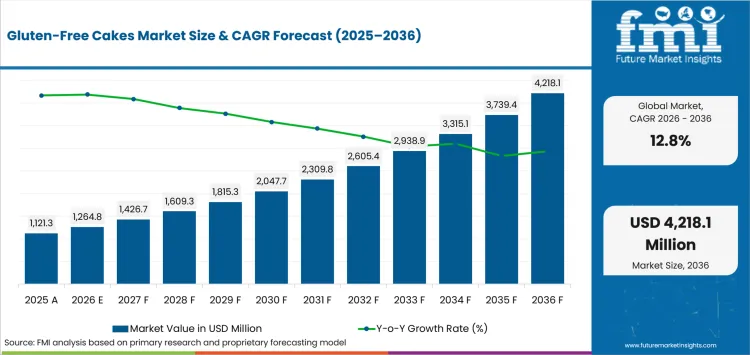
USD 1,264.8 million in 2026 and USD 4,218.1 million by 2036 at a 12.8% CAGR.
Demand for gluten-free cakes is projected to expand at a 12.8% CAGR between 2026 and 2036 as retailers move the category into routine free-from assortments. Industry is expected to achieve a valuation of USD 1,264.8 million in 2026 to USD 4,218.1 million by 2036. In May 2025 Dr. Schär reported that its cakes and muffins were 6.8% below an internal nutritional limit and retained taste targets. Repeat purchase therefore depends on sensory performance alongside claim control.
Country conditions change how the forecast converts into orders. Saudi Arabia is projected above Japan as importer-led supply can widen faster from a smaller base. In January 2026 the Saudi Food and Drug Authority recorded 1,578 inspection visits covering 310 factories and 1,017 warehouses. Frequent inspection gives importers a reason to prefer complete documentation at distribution approval.
Key Takeaways
- Retail and foodservice accounts expand gluten-free cake listings once claim control and sensory performance meet the service standard expected from mainstream cake.
- Standard vital gluten is estimated to represent 43.0% of grade in 2026, attributable to its position as the broadest standard-grade classification in the market taxonomy.
- Conventional accounts for 51.0% of claim - nature in 2026, driven by mainstream price points and wider formulation flexibility than specialist organic or fortified propositions.
- Fresh is projected to hold 34.0% of format in 2026, supported by bakery-style texture and close-to-market replenishment for celebration and impulse occasions.
- Segregation and validation costs restrain adoption in shared bakeries because a defensible gluten-free claim depends on controlled ingredients and production.
- Key players in the gluten-free cakes market include Dessert Holdings, Mademoiselle Desserts, Finsbury Food Group, Bauli Group, Sweet Street Desserts, Antonina's Gluten-Free Bakery, Dr. Schär, Park Cakes, Marks & Spencer, and Honeybuns.
Analyst Perspective
"Gluten-free cake keeps repeat space when claim integrity survives normal retail or foodservice handling. Texture retention and pack waste often influence repeat purchasing more than the lowest unit price."
- Nandini Roy Choudhury, Principal Consultant, Future Market Insights
How is the gluten-free cakes market segmented?
The gluten-free cakes market is segmented by grade, claim - nature, format, packaging format, sales channel and region.
Grade covers standard vital gluten, high water-absorption grade, organic and devitalized classifications. Claim - nature includes conventional, clean label, organic, gluten-free and high-protein - fortified offers. Format covers fresh, frozen, ambient packaged, chilled and par-baked - thaw-and-serve products. Packaging format includes multipack, single-serve, family - loaf pack and bulk foodservice. Sales channels comprise supermarkets & hypermarkets, artisan & specialty bakeries, convenience & forecourt, online & DTC and foodservice distributors.
What makes standard vital gluten central to the grade category?
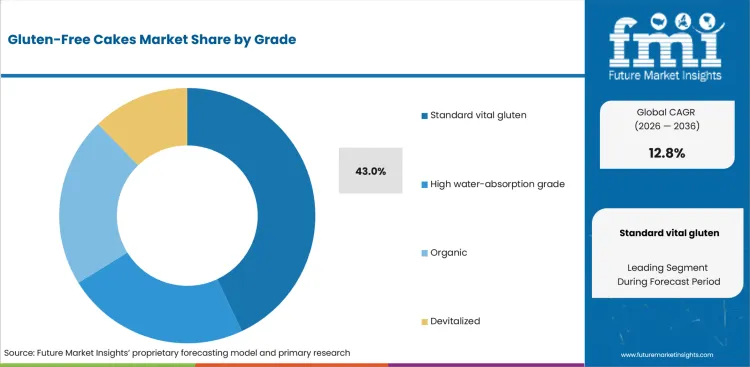
Standard vital gluten occupies the broadest standard-grade category in the grade taxonomy. Finished gluten-free cakes still require compliant recipes, so manufacturers qualify the final product instead of relying on the grade label. Gluten-free flour systems replace wheat functionality inside those recipes. Mademoiselle Desserts reported in May 2026 that its gluten-free carrot cake bar won a gold Free From Food Award.
- By grade, standard vital gluten is estimated to hold 43.0% in 2026 owing to the breadth of the standard-grade classification.
- Bakeries qualify finished texture and gluten-control records as the grade label enters a commercial specification.
Why does conventional lead the claim - nature category?
Conventional products give manufacturers more room to balance softness and shelf life at mainstream price points. Organic or fortified recipes narrow ingredient choices until retailers see proven incremental demand. Clean-label ingredients remain relevant for premium lines. Bauli Group reported that free-from products reached 4.2% of fiscal 2024/2025 revenue versus 3.4% a year earlier.
- Conventional is expected to account for 51.0% of claim - nature in 2026, driven by price flexibility within compliant recipes.
- Mainstream retailers can promote conventional gluten-free cakes without waiting for specialist claims to prove a separate willingness to pay.
How does fresh retain leadership in the format category?
Fresh cake fits outlets where crumb quality and bakery presentation outweigh long storage. Short shelf life raises waste risk if replenishment is inaccurate. Slower outlets often compare fresh stock with frozen bakery formats. In June 2026 Finsbury Food Group documented specialist free-from sites serving retail and foodservice customers. Dedicated production gives short-life programs a clearer control point.
- Fresh is predicted to lead with 34.0% share based on format in 2026, attributable to texture and bakery presentation in high-turnover occasions.
- Fresh programs work best where segregated baking and short replenishment loops control claim risk and waste.
What supports multipack leadership in packaging format?
Multipacks cover several eating occasions without exposing every portion during later servings. They also give manufacturers room for claim information and a clear price per serving. Bakery product portfolios use similar pack logic in planned grocery purchases. In January 2026 the FDA opened an information request on gluten disclosure and packaged-food cross-contact. Clear unit packaging reduces ambiguity at selection.
- By packaging format, multipack is anticipated to represent 34.0% share in 2026, supported by protected portions and household value.
- Pack count must match consumption pace because larger units can turn savings into waste for occasional purchasers.
What drives supermarkets & hypermarkets leadership in sales channel?
Large grocers compare gluten-free cake sales at store level and support several pack sizes within one category plan. Allergen-free food ranges share the same weekly shopping trip. France's DGCCRF stated in June 2025 that food labels help consumers compare ingredients and product claims. National retailers therefore prefer repeatable documentation and pack information.
- Supermarkets & hypermarkets is predicted to account for 40.0% of sales channel in 2026, driven by routine grocery traffic and broad assortment control.
- Specialty bakeries retain craft cues but supermarkets support repeat purchase through store coverage and scheduled replenishment.
What are the drivers, restraints and opportunities in the Gluten-Free Cakes Market?
Inclusive dessert demand raises listing activity, claim-control work slows qualification and scalable prepared formats give foodservice buyers a lower-risk route to assortment expansion.
- Driver: Retail and foodservice accounts need a cake that serves gluten-avoiding customers without lowering expected taste or service performance.
- Restraint: Shared production raises segregation and label-control costs during qualification for regular gluten-free cake purchasing.
- Opportunity: Frozen or portion-controlled cakes can extend compliant supply into outlets that cannot run a dedicated gluten-free bakery process.
Inclusive Dessert Listings Depend on Verifiable Allergen Control
Retailers can plan a gluten-free cake line once staff can apply the claim consistently. The Food Standards Agency published a March 2025 checklist requiring allergen information and cross-contamination controls. Food allergen testing becomes part of qualification for manufacturers serving several settings. Taste then determines whether the qualified listing repeats.
Shared Bakery Production Raises the Cost of Qualification
Shared production carries the main qualification burden. FDA's 2026 inspection manual directs investigators to review allergen-label controls and voluntary gluten-free claims. Manufacturers therefore need documented changeovers and label checks so customers can treat the claim as repeatable. Those controls extend approval time and can make low-volume SKUs uneconomic.
Prepared Formats Extend Access Beyond Dedicated Bakeries
Foodservice operators can use sealed portions and thaw-and-serve formats to limit in-kitchen handling. Dubai Municipality inspected about 1.95 million food products during 2025 as it expanded digital food-safety services. The inspection volume makes portable documentation more useful for imported products. Manufacturers pairing stable specialty food ingredients with simple thawing instructions can serve hotels and cafes without on-site gluten-free baking.
Which country CAGRs are profiled in the Gluten-Free Cakes Market?
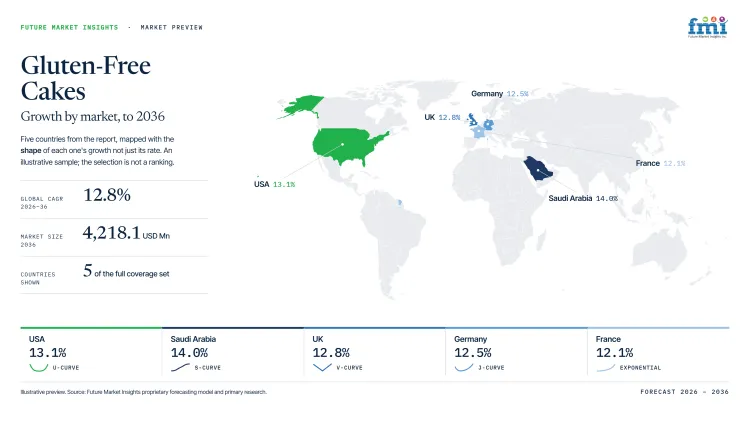
| Country | CAGR |
|---|---|
| Saudi Arabia | 14.0% |
| UAE | 13.7% |
| South Korea | 13.4% |
| USA | 13.1% |
| UK | 12.8% |
| Germany | 12.5% |
| France | 12.1% |
| Japan | 11.8% |
How do country-level CAGRs compare in the Gluten-Free Cakes Market?
The profiled rates span 2.2 percentage points from Saudi Arabia at 14.0% to Japan at 11.8%. Gulf markets form the upper band because smaller bases leave more room for new assortment. Germany and France form a narrower lower group with Japan at the bottom.
- Saudi Arabia retains more room for specialized gluten-free dessert assortment expansion.
- UAE menus refresh premium dessert choices quickly as hospitality concepts compete.
- South Korea has more room for category expansion than mature Japan.
- USA maturity shifts gluten-free cake expansion toward new product formats.
- UK growth depends more on format renewal than basic gluten-free availability.
- Germany's mature specialty base slows rapid expansion of gluten-free cake ranges.
- France has less room for a rapid reset in free-from cakes.
- Japan has the smallest opening for broad gluten-free cake assortment expansion.
The narrow spread hides different qualification costs. The full report provides country-level CAGR analysis across North America, Latin America, Western Europe, Eastern Europe, East Asia, South Asia and Pacific, and Middle East and Africa.
Country-wise Analysis
- Saudi Arabia relies on importers and retail accounts that screen product files at the distribution gate. Gluten-free cake sales in Saudi Arabia are forecast to expand at 14.0% CAGR by 2036, driven by faster assortment building in organized retail and hospitality. The Saudi Food and Drug Authority recorded 17,096 inspection visits in the second quarter of 2026. Inspectors also identified 1,016 non-compliant products across the reviewed food-safety campaign. Frequent enforcement makes complete product specifications especially important during importer approval reviews. Long shipping distances test pack stability before products reach stores. Finished texture must survive storage without weakening the gluten-free claim.
- UAE foodservice demand centers on hotels and premium retailers that buy imported products in smaller runs. Dubai Municipality deployed about 150 inspectors in June 2025 ahead of Eid Al-Adha to check storage and handling practices. The UAE gluten-free cakes sector is projected to record 13.7% CAGR during the assessment period, attributable to imported assortment breadth and strong foodservice turnover. Sealed portions reduce handling steps and cross-contact opportunities inside mixed commercial kitchens. Distributor training improves product handling and execution for hotel and cafe service teams. Rapid menu changes also shorten the time available for product testing during rollout planning.
- South Korean consumers discover premium desserts through cafes and digital commerce ahead of broad grocery distribution. Adoption of gluten-free cakes in South Korea is estimated to expand at 13.4% CAGR through 2036, supported by bakery discovery and local label adaptation. The Ministry of Food and Drug Safety reissued the Food Labeling Standards as Notification No. 2026-37 in May 2026. Importers must keep Korean label review inside the launch timetable. Bakery mixes can shorten formulation work but cannot replace finished-product substantiation. Premium pricing limits wider trial outside specialist audiences in mass retail.
- US grocery and foodservice accounts use national specifications that require the same claim at each plant and through distribution routes. FDA's Gluten-Free Labeling of Foods page was updated in 2026 and states that manufacturers using the voluntary claim must meet the regulation. Gluten-free cake demand in the USA is forecast to rise at 13.1% CAGR over the forecast period, driven by scale in mainstream retail and prepared-food channels. The rule gives gluten-free food categories a common compliance floor. A failed changeover or label error can affect far more units than in a local bakery program.
- UK supermarkets offer established free-from assortments and hospitality operators rely on written allergen procedures. Gluten-free cake demand in the UK is forecast to rise at 12.8% CAGR over the forecast period, attributable to routine assortment use rather than first-time category creation. The Food Standards Agency updated its allergen icon and poster resources in March 2025 and requires businesses to communicate regulated allergens. Frozen portions fit mixed kitchens because staff can separate service more easily, and dedicated supply gives the outlet one clearer control point. Shared preparation space is the main friction for cafes that want bakery-style presentation.
- German retailers use formal ingredient information and structured quality systems to qualify packaged bakery products. The Federal Ministry of Food and Agriculture stated in April 2025 that gluten-containing cereals must be declared and allergen information is compulsory for loose foods. German gluten-free cake demand is predicted to advance at 12.5% CAGR through 2036, driven by mature specialty retail and exacting product documentation. The rule raises the value of bakery ingredient systems with stable specifications during retailer range reviews. Development cycles lengthen if texture work requires several reformulations during claim documentation.
- French demand passes through supermarkets plus bakery and restaurant channels where handling discipline varies by operator. Gluten-free cake demand in France is forecast to rise at 12.1% CAGR over the forecast period, supported by broader free-from availability in everyday food retail. In July 2026 DGCCRF stated that allergens must be highlighted in prepacked ingredient lists and disclosed for non-prepacked foods. The rule gives sealed products a clearer information route in mixed retail formats. Small bakery operators still face training and process costs that can make a dedicated gluten-free line difficult to justify.
- Japanese buyers place high weight on label precision and texture suited to local expectations for soft cakes and compact presentation. The Consumer Affairs Agency revised its processed-food allergen labeling handbook in April 2026. Gluten-free cake sales in Japan are forecast to expand at 11.8% CAGR by 2036, attributable to premium positioning and careful allergen screening in a mature food market. Packaged products must enter launch review with current Japanese labeling information. Rice-based formulation knowledge can shorten recipe adjustment for gluten-free cake manufacturers. The slower rate versus Gulf markets reflects a higher qualification burden and less room for rapid assortment expansion.
Who are the notable companies in the Gluten-Free Cakes Market?
Dessert Holdings, Mademoiselle Desserts, Finsbury Food Group, Bauli Group, Sweet Street Desserts, Antonina's Gluten-Free Bakery, Dr. Schär, Park Cakes, Marks & Spencer, and Honeybuns are notable companies serving this market.
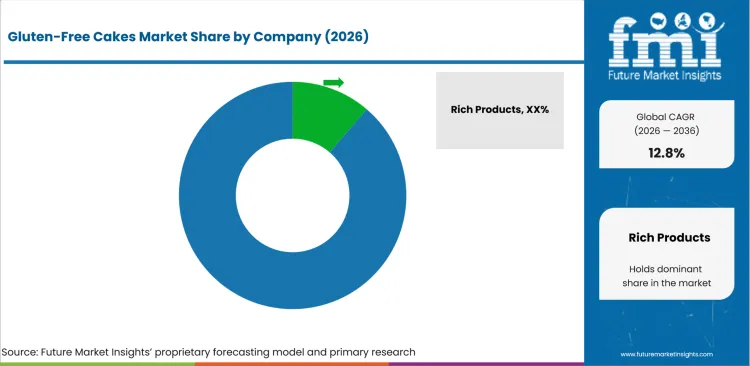
Competition spans dedicated gluten-free bakeries, scaled dessert manufacturers and retailer-backed programs. Entry depends on defensible gluten control plus a format that survives its route to sale. Foodservice specialists rely on thaw-and-serve handling. Retail programs depend on pack consistency and store coverage. Dedicated bakeries carry stronger contamination records but usually serve fewer geographies.
- Dessert Holdings and Mademoiselle Desserts focus on prepared dessert platforms. Sweet Street Desserts serves foodservice.
- Antonina's Gluten-Free Bakery and Honeybuns use dedicated gluten-free production as their qualification base.
- Finsbury Food Group and Bauli Group use wider bakery networks. Dr. Schär brings specialist gluten-free manufacturing.
- Park Cakes and Marks & Spencer use a dedicated line for mainstream retail distribution.
Competitive Benchmarking: Gluten-Free Cakes Market
| Company | Documented Gluten-Free Cake Scope | Format and Route Breadth | Claim-Control Evidence | Geographic Reach |
|---|---|---|---|---|
| Dessert Holdings | Medium | High | Medium | North America |
| Mademoiselle Desserts | High | High | High | Europe and selected international markets |
| Finsbury Food Group | Medium | High | High | UK and continental Europe |
| Bauli Group | High | Medium | High | Europe, United States and Asia |
| Sweet Street Desserts | Medium | High | Medium | United States |
| Antonina's Gluten-Free Bakery | High | Medium | High | United States |
| Dr. Schär | Medium | High | High | Europe and international markets |
| Park Cakes | High | Medium | High | United Kingdom |
| Marks & Spencer | High | Medium | Medium | United Kingdom |
| Honeybuns | High | Medium | High | United Kingdom |
Scoring basis: High cake scope requires a current gluten-free cake family or dedicated cake line. Medium marks a narrower offer. High format and route breadth requires multiple formats plus more than one commercial route. High claim-control evidence requires a dedicated process or formal external control. Medium indicates narrower documented evidence.
Key Developments in the Gluten-Free Cakes Market
- In May 2025 Dessert Holdings returned to IDDBA with an expanded premium dessert portfolio for retail and foodservice. The event reinforced thaw-and-serve capacity for prepared-dessert listings.
- In February 2025 Dr. Schär reported a new Alagón production line for sweet and savoury bakery products sold in Europe. The expansion increased industrial capacity for gluten-free bakery programs.
- In January 2025 Sweet Street Desserts launched Scoopables for foodservice with a gluten-free no-bake cheesecake. The format gives operators portion control without on-site cake preparation.
Key Players in the Gluten-Free Cakes Market
Scaled Dessert and Bakery Platforms
- Dessert Holdings
- Mademoiselle Desserts
- Finsbury Food Group
- Bauli Group
- Dr. Schär
Dedicated Gluten-Free Bakery Specialists
- Antonina's Gluten-Free Bakery
- Honeybuns
- Sweet Street Desserts
Retailer-Manufacturer Gluten-Free Cake Programs
- Park Cakes
- Marks & Spencer
Gluten-Free Cakes Market - Report Scope
| Coverage field | Report scope |
|---|---|
| Market breakdown | By grade, claim - nature, format, packaging format, sales channel and region. |
| Quantitative Units | USD million. |
| Market Definition | Revenue includes finished gluten-free cakes sold through the defined formats, packaging types and channels. Ingredient revenue, ordinary cakes, adjacent bakery products and downstream plated-dessert revenue are excluded. |
| Regions Covered | North America, Latin America, Western Europe, Eastern Europe, East Asia, South Asia and Pacific, and Middle East and Africa. |
| Countries Covered | Saudi Arabia, UAE, South Korea, USA, UK, Germany, France, Japan, and more than twenty-five additional countries in the full report. |
| Key Companies Profiled | Dessert Holdings, Mademoiselle Desserts, Finsbury Food Group, Bauli Group, Sweet Street Desserts, Antonina's Gluten-Free Bakery, Dr. Schär, Park Cakes, Marks & Spencer, and Honeybuns. |
| Forecast Period | 2026 to 2036. |
| Approach | Primary and secondary research with market triangulation. |
Gluten-Free Cakes Market - Research Methodology
| Method | Approach |
|---|---|
| Primary Research | FMI analysts gathered input from manufacturers, service providers, technology developers, distributors, end users, procurement teams, and subject-matter experts. Interviews examined purchasing decisions, product or service evaluation, adoption barriers, approval requirements, pricing considerations, and expectations for technical or commercial support. Respondents were also asked what evidence is required before a trial, pilot, or initial order develops into regular purchasing. |
| Desk Research | Desk research covered government statistics, regulatory publications, trade data, industry associations, technical literature, standards, company filings, product information, and official corporate announcements. Sources were reviewed for relevance, publication date, geographic coverage, and consistency with the defined market scope. Claims relating to performance, applications, approvals, capacity, investment, and commercial activity were retained only when supported by credible public evidence. |
| Market Sizing and Forecasting | The market model combined the baseline value with historical performance, segment structure, pricing and volume indicators, adoption levels, company participation, and country-level demand conditions. Forecast assumptions considered economic activity, investment trends, regulatory developments, technology adoption, purchasing cycles, supply availability, and barriers to wider market use. Segment and regional estimates were reconciled before the final market total was calculated. |
| Data Validation | Estimates were checked against multiple independent indicators, including public data, company activity, trade patterns, industry developments, and findings from primary interviews. Validation also tested whether products, services, applications, and company revenues fell within the defined market boundaries. Adjacent categories, unsupported claims, overlapping revenues, and activities without direct market relevance were excluded to reduce double counting and maintain consistency across segments and countries. |
Gluten-Free Cakes Market by Segments
Gluten-Free Cakes Market segmented by Grade:
- Standard vital gluten
- High water-absorption grade
- Organic
- Devitalized
Gluten-Free Cakes Market segmented by Claim - Nature:
- Conventional
- Clean label
- Organic
- Gluten-free
- High-protein - fortified
Gluten-Free Cakes Market segmented by Format:
- Fresh
- Frozen
- Ambient packaged
- Chilled
- Par-baked - thaw-and-serve
Gluten-Free Cakes Market segmented by Packaging Format:
- Multipack
- Single-serve
- Family - loaf pack
- Bulk foodservice
Gluten-Free Cakes Market segmented by Sales Channel:
- Supermarkets & hypermarkets
- Artisan & specialty bakeries
- Convenience & forecourt
- Online & DTC
- Foodservice distributors
Gluten-Free Cakes Market by Region:
- North America
- United States
- Canada
- Latin America
- Brazil
- Mexico
- Argentina
- Chile
- Western Europe
- Germany
- France
- United Kingdom
- Italy
- Spain
- Benelux
- Nordics
- Eastern Europe
- Poland
- Czech Republic
- Romania
- Hungary
- East Asia
- China
- Japan
- South Korea
- South Asia and Pacific
- India
- ASEAN
- Australia and New Zealand
- Middle East and Africa
- GCC Countries
- South Africa
- Türkiye
- Israel
Research Sources and Bibliography
- Dr. Schär. (2025, May 8). Always Tastier, Always More Balanced.
- Saudi Food and Drug Authority. (2026, January 19). SFDA Intensifies Inspection Campaigns Nationwide to Ensure the Safety of Commonly Consumed Products.
- Mademoiselle Desserts. (2026, May 15). Our Free From Food Awards Success.
- Bauli Group. (2026, January). Sustainability Report as of June 30th, 2025.
- Finsbury Food Group. (2026, June 3). The Evolution of Free-From Industry Trends: Data, Taste, and Diets.
- USA Food and Drug Administration. (2026, January 21). FDA Takes Steps to Improve Gluten Ingredient Disclosure in Foods.
- Direction générale de la concurrence, de la consommation et de la répression des fraudes. (2025, June 30). Produits alimentaires : que nous apprennent les étiquettes ?
- Food Standards Agency. (2025, March 13). Allergen checklist for food businesses.
- USA Food and Drug Administration. (2026, August). 2026 Investigations Operations Manual: Chapter 5 - Inspections.
- Dubai Municipality. (2026, January 26). Innovative digital food safety services at Gulfood 2026.
- Saudi Food and Drug Authority. (2026, July 23). SFDA Intercepts Over 301 Tons of Non-Compliant Food Products in Q2 2026.
- Dubai Municipality. (2025, June 2). Food safety inspections intensified ahead of Eid Al-Adha.
- Ministry of Food and Drug Safety, Republic of Korea. (2026, May 12). Food Labeling Standards, Notification No. 2026-37.
- USA Food and Drug Administration. (2026, April). Gluten-Free Labeling of Foods.
- Food Standards Agency. (2025, March 5). Download your allergen icons and posters.
- Federal Ministry of Food and Agriculture, Germany. (2025, April 7). Allergenkennzeichnung ist Pflicht.
- Direction générale de la concurrence, de la consommation et de la répression des fraudes. (2026, July 23). Étiquetage des denrées alimentaires : les règles à connaître.
- Consumer Affairs Agency, Japan. (2026, April). Food allergen labeling information.
- Dessert Holdings. (2025, May 30). Dessert Holdings Returns to IDDBA Ahead of 10-Year Anniversary.
- Dr. Schär. (2025, February 19). A record-breaking 2024 for Dr. Schär.
- Sweet Street Desserts. (2025, January 29). Sweet Street Introduces Scoopables - A New Era of Gourmet Desserts.
- Mademoiselle Desserts. (2025, April). Sustainability Report 2024.
- Antonina's Gluten-Free Bakery. (n.d.). About Antonina's Gluten-Free Bakery. Retrieved September 7, 2026.
- Honeybuns. (n.d.). Our Story. Retrieved September 7, 2026.
- Marks & Spencer. (2026, February 4). Inside M&S' 80-Year Partnership With "Fortress" Factory Behind Latest Product Launch.
- Dr. Schär. (2026, July 22). In Trieste (Italy), a new plant to shape the future of nutrition.
- Mademoiselle Desserts. (2026, May 15). Baking a Better Future, Together.
- Dr. Schär. (2025, August 29). 10 Years of Innovation, Quality and Proximity in Austria and France.
- Finsbury Food Group. (2026, August 7). Finsbury's Place in the Global Bakery Market, From the UK to Europe.
- Finsbury Food Group. (2026, April 30). Finsbury Food Group Acquires Flower & White To Boost DTC And Healthy Snacking Growth.
This bibliography is provided for reader reference and is not exhaustive. The full report contains the complete reference list and detailed citations
This Report Answers
- What is the gluten-free cakes market size from 2026 to 2036?
- Which controls shape repeat purchasing for gluten-free cakes?
- Why does standard vital gluten lead the grade category?
- Why do conventional and fresh formats lead their categories?
- How do multipacks and supermarkets influence routine purchase?
- Why do country growth rates differ among the profiled markets?
- Which companies compete in gluten-free cake production?
- What costs slow qualification in shared bakery facilities?
Frequently Asked Questions
How big is the gluten-free cakes market in 2026?
The gluten-free cakes market is valued at USD 1,264.8 million in 2026 and is projected to reach USD 4,218.1 million by 2036. Growth is driven by wider retail and foodservice listings that preserve claim integrity and familiar texture.
What is the CAGR of the gluten-free cakes market from 2026 to 2036?
The gluten-free cakes market is projected to grow at a CAGR of 12.8% between 2026 and 2036. Expansion is supported by mainstream free-from assortments and prepared formats that let more outlets serve gluten-avoiding customers with controlled handling.
Which grade segment leads the gluten-free cakes market?
The standard vital gluten segment is expected to hold 43.0% of the gluten-free cakes market by grade in 2026, attributable to its broad position in the grade taxonomy. Finished products still require full gluten-free claim control.
Which sales channel leads the gluten-free cakes market?
Supermarkets & hypermarkets are expected to hold 40.0% of the gluten-free cakes market by sales channel in 2026, driven by routine grocery traffic and broad assortment control. Their scale raises the value of consistent labeling and replenishment.
Which companies are active in the gluten-free cakes market?
Dessert Holdings, Mademoiselle Desserts, Finsbury Food Group, Bauli Group, Sweet Street Desserts, Antonina's Gluten-Free Bakery, Dr. Schär, Park Cakes, Marks & Spencer, and Honeybuns are active in the market. Their positions differ through dedicated production and prepared-dessert capacity alongside retail access and specialist free-from bakery expertise.
Preview the report firsthand - request a free sample
Get SampleGet the brochure for pricing and purchase details.
Get PDFTable of Content
- Key Takeaways
- Market Size and CAGR
- Top Growth Driver
- Fastest Growing Segment
- Leading Region
- Key Companies
- Emerging Opportunities
- Executive Summary
- Global Market Outlook
- Demand-side Trends
- Supply-side Trends
- Technology Roadmap Analysis
- Analysis and Recommendations
- Analyst Perspective (What is happening? Why now? What should investors know?)
- Key Questions Answered
- How large is the market?
- What is the CAGR?
- What are key trends?
- Which region dominates?
- Who are the leaders?
- Market Overview
- Market Coverage / Taxonomy
- Market Definition / Scope / Limitations
- Research Methodology
- Chapter Orientation
- Analytical Lens and Working Hypotheses
- Market Structure, Signals, and Trend Drivers
- Benchmarking and Cross-market Comparability
- Market Sizing, Forecasting, and Opportunity Mapping
- Research Design and Evidence Framework
- Desk Research Programme (Secondary Evidence)
- Expert Input and Fieldwork (Primary Evidence)
- Tooling, Models, and Reference Databases
- Data Engineering and Model Build
- Quality Assurance and Audit Trail
- Market Background
- Market Dynamics (Drivers, Restraints, Opportunity, Trends)
- Scenario Forecast (Optimistic, Likely, Conservative)
- Impact Analysis
- AI Impact
- Sustainability Impact
- Regulatory Impact
- Technology Impact
- Consumer / Buyer Analysis
- Purchase Drivers
- Adoption Barriers
- Buyer Journey
- Opportunity Map Analysis
- Product Life Cycle Analysis
- Supply Chain Analysis
- Investment Feasibility Matrix
- Value Chain Analysis
- PESTLE and Porter's Analysis
- Regulatory Landscape
- Regional Parent Market Outlook
- Production and Consumption Statistics
- Import and Export Statistics
- Global Market Analysis and Forecast, 2021 to 2036
- Historical Market Size Value (USD Million) Analysis, 2021 to 2025
- Current and Future Market Size Value (USD Million) Projections, 2026 to 2036
- Y-o-Y Growth Trend Analysis
- Absolute $ Opportunity Analysis
- Global Market Pricing Analysis, 2021 to 2036
- Global Market Analysis and Forecast, By Grade, 2021 to 2036
- Introduction / Key Findings
- Historical Market Size Value (USD Million) Analysis By Grade, 2021 to 2025
- Current and Future Market Size Value (USD Million) Analysis and Forecast By Grade, 2026 to 2036
- Standard vital gluten
- High water-absorption grade
- Organic
- Devitalized
- Standard vital gluten
- Y-o-Y Growth Trend Analysis By Grade, 2021 to 2025
- Absolute $ Opportunity Analysis By Grade, 2026 to 2036
- Global Market Analysis and Forecast, By Claim / Nature, 2021 to 2036
- Introduction / Key Findings
- Historical Market Size Value (USD Million) Analysis By Claim / Nature, 2021 to 2025
- Current and Future Market Size Value (USD Million) Analysis and Forecast By Claim / Nature, 2026 to 2036
- Conventional
- Clean label
- Organic
- Gluten-free
- High-protein / fortified
- Conventional
- Y-o-Y Growth Trend Analysis By Claim / Nature, 2021 to 2025
- Absolute $ Opportunity Analysis By Claim / Nature, 2026 to 2036
- Global Market Analysis and Forecast, By Format, 2021 to 2036
- Introduction / Key Findings
- Historical Market Size Value (USD Million) Analysis By Format, 2021 to 2025
- Current and Future Market Size Value (USD Million) Analysis and Forecast By Format, 2026 to 2036
- Fresh
- Frozen
- Ambient packaged
- Chilled
- Par-baked / thaw-and-serve
- Fresh
- Y-o-Y Growth Trend Analysis By Format, 2021 to 2025
- Absolute $ Opportunity Analysis By Format, 2026 to 2036
- Global Market Analysis and Forecast, By Packaging Format, 2021 to 2036
- Introduction / Key Findings
- Historical Market Size Value (USD Million) Analysis By Packaging Format, 2021 to 2025
- Current and Future Market Size Value (USD Million) Analysis and Forecast By Packaging Format, 2026 to 2036
- Multipack
- Single-serve
- Family / loaf pack
- Bulk foodservice
- Multipack
- Y-o-Y Growth Trend Analysis By Packaging Format, 2021 to 2025
- Absolute $ Opportunity Analysis By Packaging Format, 2026 to 2036
- Global Market Analysis and Forecast, By Sales Channel, 2021 to 2036
- Introduction / Key Findings
- Historical Market Size Value (USD Million) Analysis By Sales Channel, 2021 to 2025
- Current and Future Market Size Value (USD Million) Analysis and Forecast By Sales Channel, 2026 to 2036
- Supermarkets & hypermarkets
- Artisan & specialty bakeries
- Convenience & forecourt
- Online & DTC
- Foodservice distributors
- Supermarkets & hypermarkets
- Y-o-Y Growth Trend Analysis By Sales Channel, 2021 to 2025
- Absolute $ Opportunity Analysis By Sales Channel, 2026 to 2036
- Global Market Analysis and Forecast, By Region, 2021 to 2036
- Introduction
- Historical Market Size Value (USD Million) Analysis By Region, 2021 to 2025
- Current Market Size Value (USD Million) Analysis and Forecast By Region, 2026 to 2036
- North America
- Latin America
- Western Europe
- Eastern Europe
- East Asia
- South Asia and Pacific
- Middle East & Africa
- Market Attractiveness Analysis By Region
- North America Market Analysis and Forecast, By Country, 2021 to 2036
- Historical Market Size Value (USD Million) Trend Analysis By Market Taxonomy, 2021 to 2025
- Market Size Value (USD Million) Forecast By Market Taxonomy, 2026 to 2036
- By Country
- USA
- Canada
- By Grade
- By Claim / Nature
- By Format
- By Packaging Format
- By Sales Channel
- By Country
- Market Attractiveness Analysis
- By Country
- By Grade
- By Claim / Nature
- By Format
- By Packaging Format
- By Sales Channel
- Key Takeaways
- Latin America Market Analysis and Forecast, By Country
- Historical Market Size Value (USD Million) Trend Analysis By Market Taxonomy, 2021 to 2025
- Market Size Value (USD Million) Forecast By Market Taxonomy, 2026 to 2036
- By Country
- Brazil
- Mexico
- Chile
- Rest of Latin America
- By Grade
- By Claim / Nature
- By Format
- By Packaging Format
- By Sales Channel
- By Country
- Market Attractiveness Analysis
- By Country
- By Grade
- By Claim / Nature
- By Format
- By Packaging Format
- By Sales Channel
- Key Takeaways
- Western Europe Market Analysis and Forecast, By Country
- Historical Market Size Value (USD Million) Trend Analysis By Market Taxonomy, 2021 to 2025
- Market Size Value (USD Million) Forecast By Market Taxonomy, 2026 to 2036
- By Country
- Germany
- UK
- Italy
- Spain
- France
- Nordic
- BENELUX
- Rest of Western Europe
- By Grade
- By Claim / Nature
- By Format
- By Packaging Format
- By Sales Channel
- By Country
- Market Attractiveness Analysis
- By Country
- By Grade
- By Claim / Nature
- By Format
- By Packaging Format
- By Sales Channel
- Key Takeaways
- Eastern Europe Market Analysis and Forecast, By Country
- Historical Market Size Value (USD Million) Trend Analysis By Market Taxonomy, 2021 to 2025
- Market Size Value (USD Million) Forecast By Market Taxonomy, 2026 to 2036
- By Country
- Russia
- Poland
- Hungary
- Balkan & Baltic
- Rest of Eastern Europe
- By Grade
- By Claim / Nature
- By Format
- By Packaging Format
- By Sales Channel
- By Country
- Market Attractiveness Analysis
- By Country
- By Grade
- By Claim / Nature
- By Format
- By Packaging Format
- By Sales Channel
- Key Takeaways
- East Asia Market Analysis and Forecast, By Country
- Historical Market Size Value (USD Million) Trend Analysis By Market Taxonomy, 2021 to 2025
- Market Size Value (USD Million) Forecast By Market Taxonomy, 2026 to 2036
- By Country
- China
- Japan
- South Korea
- By Grade
- By Claim / Nature
- By Format
- By Packaging Format
- By Sales Channel
- By Country
- Market Attractiveness Analysis
- By Country
- By Grade
- By Claim / Nature
- By Format
- By Packaging Format
- By Sales Channel
- Key Takeaways
- South Asia and Pacific Market Analysis and Forecast, By Country
- Historical Market Size Value (USD Million) Trend Analysis By Market Taxonomy, 2021 to 2025
- Market Size Value (USD Million) Forecast By Market Taxonomy, 2026 to 2036
- By Country
- India
- ASEAN
- Australia & New Zealand
- Rest of South Asia and Pacific
- By Grade
- By Claim / Nature
- By Format
- By Packaging Format
- By Sales Channel
- By Country
- Market Attractiveness Analysis
- By Country
- By Grade
- By Claim / Nature
- By Format
- By Packaging Format
- By Sales Channel
- Key Takeaways
- Middle East & Africa Market Analysis and Forecast, By Country
- Historical Market Size Value (USD Million) Trend Analysis By Market Taxonomy, 2021 to 2025
- Market Size Value (USD Million) Forecast By Market Taxonomy, 2026 to 2036
- By Country
- Kingdom of Saudi Arabia
- Other GCC Countries
- Türkiye
- South Africa
- Other African Union
- Rest of Middle East & Africa
- By Grade
- By Claim / Nature
- By Format
- By Packaging Format
- By Sales Channel
- By Country
- Market Attractiveness Analysis
- By Country
- By Grade
- By Claim / Nature
- By Format
- By Packaging Format
- By Sales Channel
- Key Takeaways
- Key Countries Market Analysis
- USA
- Pricing Analysis
- Market Share Analysis, 2025
- By Grade
- By Claim / Nature
- By Format
- By Packaging Format
- By Sales Channel
- Canada
- Pricing Analysis
- Market Share Analysis, 2025
- By Grade
- By Claim / Nature
- By Format
- By Packaging Format
- By Sales Channel
- Mexico
- Pricing Analysis
- Market Share Analysis, 2025
- By Grade
- By Claim / Nature
- By Format
- By Packaging Format
- By Sales Channel
- Brazil
- Pricing Analysis
- Market Share Analysis, 2025
- By Grade
- By Claim / Nature
- By Format
- By Packaging Format
- By Sales Channel
- Chile
- Pricing Analysis
- Market Share Analysis, 2025
- By Grade
- By Claim / Nature
- By Format
- By Packaging Format
- By Sales Channel
- Germany
- Pricing Analysis
- Market Share Analysis, 2025
- By Grade
- By Claim / Nature
- By Format
- By Packaging Format
- By Sales Channel
- UK
- Pricing Analysis
- Market Share Analysis, 2025
- By Grade
- By Claim / Nature
- By Format
- By Packaging Format
- By Sales Channel
- Italy
- Pricing Analysis
- Market Share Analysis, 2025
- By Grade
- By Claim / Nature
- By Format
- By Packaging Format
- By Sales Channel
- Spain
- Pricing Analysis
- Market Share Analysis, 2025
- By Grade
- By Claim / Nature
- By Format
- By Packaging Format
- By Sales Channel
- France
- Pricing Analysis
- Market Share Analysis, 2025
- By Grade
- By Claim / Nature
- By Format
- By Packaging Format
- By Sales Channel
- India
- Pricing Analysis
- Market Share Analysis, 2025
- By Grade
- By Claim / Nature
- By Format
- By Packaging Format
- By Sales Channel
- ASEAN
- Pricing Analysis
- Market Share Analysis, 2025
- By Grade
- By Claim / Nature
- By Format
- By Packaging Format
- By Sales Channel
- Australia & New Zealand
- Pricing Analysis
- Market Share Analysis, 2025
- By Grade
- By Claim / Nature
- By Format
- By Packaging Format
- By Sales Channel
- China
- Pricing Analysis
- Market Share Analysis, 2025
- By Grade
- By Claim / Nature
- By Format
- By Packaging Format
- By Sales Channel
- Japan
- Pricing Analysis
- Market Share Analysis, 2025
- By Grade
- By Claim / Nature
- By Format
- By Packaging Format
- By Sales Channel
- South Korea
- Pricing Analysis
- Market Share Analysis, 2025
- By Grade
- By Claim / Nature
- By Format
- By Packaging Format
- By Sales Channel
- Russia
- Pricing Analysis
- Market Share Analysis, 2025
- By Grade
- By Claim / Nature
- By Format
- By Packaging Format
- By Sales Channel
- Poland
- Pricing Analysis
- Market Share Analysis, 2025
- By Grade
- By Claim / Nature
- By Format
- By Packaging Format
- By Sales Channel
- Hungary
- Pricing Analysis
- Market Share Analysis, 2025
- By Grade
- By Claim / Nature
- By Format
- By Packaging Format
- By Sales Channel
- Kingdom of Saudi Arabia
- Pricing Analysis
- Market Share Analysis, 2025
- By Grade
- By Claim / Nature
- By Format
- By Packaging Format
- By Sales Channel
- Türkiye
- Pricing Analysis
- Market Share Analysis, 2025
- By Grade
- By Claim / Nature
- By Format
- By Packaging Format
- By Sales Channel
- South Africa
- Pricing Analysis
- Market Share Analysis, 2025
- By Grade
- By Claim / Nature
- By Format
- By Packaging Format
- By Sales Channel
- USA
- Market Structure Analysis
- Competition Dashboard
- Competition Benchmarking
- Market Share Analysis of Top Players
- By Regional
- By Grade
- By Claim / Nature
- By Format
- By Packaging Format
- By Sales Channel
- Emerging Startups
- Innovation Benchmarking
- Competition Analysis
- Competition Deep Dive
- Rich Products
- Overview
- Product Portfolio
- Profitability by Market Segments
- Sales Footprint
- Strategy Overview
- Marketing Strategy
- Product Strategy
- Channel Strategy
- Sara Lee Frozen Bakery
- Dessert Holdings
- Mademoiselle Desserts
- Finsbury Food Group
- Premier Foods
- McKee Foods
- Hostess Brands
- Bauli
- Dr. Oetker
- Rich Products
- Case Studies
- Success Stories
- Recent Developments
- Competition Deep Dive
- Assumptions & Acronyms Used


