

- Market Size (2026)
- USD 307.6 Mn
- Forecast (2036)
- USD 873.4 Mn
- CAGR (2026 to 2036)
- 11.0%
How big is Gluten-Free Bagels Market in 2026?
USD 307.6 Million in 2026 and USD 873.4 Million by 2036 at an 11.0% CAGR.
The gluten-free bagels market is projected to expand from USD 307.6 million in 2026 to USD 873.4 million by 2036 at an 11.0% CAGR. Within the wider gluten-free food category, bagels serve recurring breakfast and sandwich occasions as routine dietary substitutes. The Celiac Disease Foundation reported in February 2026 that a strict gluten-free diet remains the only treatment for celiac disease. That requirement supports recurring purchases when producers maintain dependable gluten control and familiar bagel eating quality.
Country conversion depends on how household affordability and verified access fit local buying routines across major markets. France provides a clear example of institutional support while food allergen testing shapes the proof burden elsewhere. Assurance Maladie stated in January 2026 that eligible gluten-free foods receive 60% reimbursement for people with biopsy-confirmed celiac disease, subject to monthly caps. Other markets rely more heavily on mainstream retail availability and household budgets despite the same continuous dietary need.
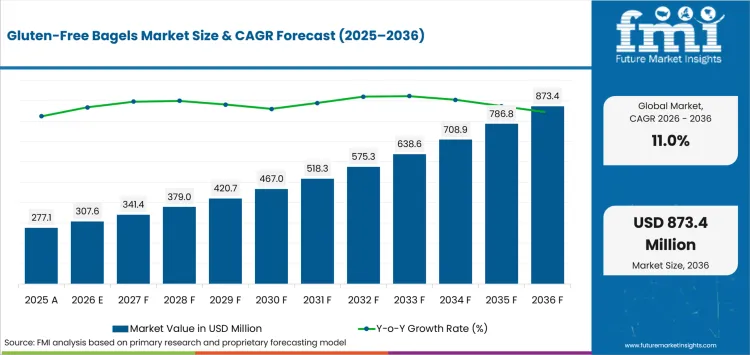
Key Takeaways of Gluten-Free Bagels Market
- Recurring dietary need supports demand because gluten-free consumers seek bagels that fit normal breakfast and sandwich routines without repeated preparation work.
- By product type, plain is estimated to hold 25.0% in 2026 owing to its neutral flavor across breakfast and sandwich uses.
- Based on claim - nature, conventional is projected to account for 52.0% in 2026 due to core gluten control and texture remaining the first purchase tests.
- In 2026, fresh is expected to lead format with 37.0% share because shoppers continue to judge bagels on chew and immediate eating quality.
- Texture rebuilding and cross-contact controls raise formulation and production costs, which can widen price gaps against conventional bagels and limit purchase frequency.
- Some of the key players in this market include Flowers Foods, Conagra Brands, Modern Bread & Bagel, The Greater Knead, O'Doughs, Carbonaut, Outside The Breadbox, and Kettlemans Bagel.
Analyst Perspective
"Gluten-free bagels should be evaluated on verified gluten control and repeatable texture before unit price. Commercial value depends on shelf-life performance and channel economics that preserve the chew expected from a mainstream bagel."
- Nandini Roy Choudhury, Principal Consultant, Future Market Insights
How is the Gluten-Free Bagels Market segmented?
The market is analyzed by product type, claim - nature, format, packaging format and sales channel.
Product types include plain, everything, seeded & multigrain, sweet variants and mini & bagel thins. Claims cover conventional, clean label, organic, gluten-free and high-protein / fortified. Formats cover fresh, frozen, ambient packaged, chilled and par-baked / thaw-and-serve. Packaging includes multipack, single-serve, family / loaf pack and bulk foodservice. Sales channels include supermarkets & hypermarkets, specialty bakeries, convenience & forecourt, online & DTC and foodservice distributors.
What drives supermarkets & hypermarkets within the sales channel category?
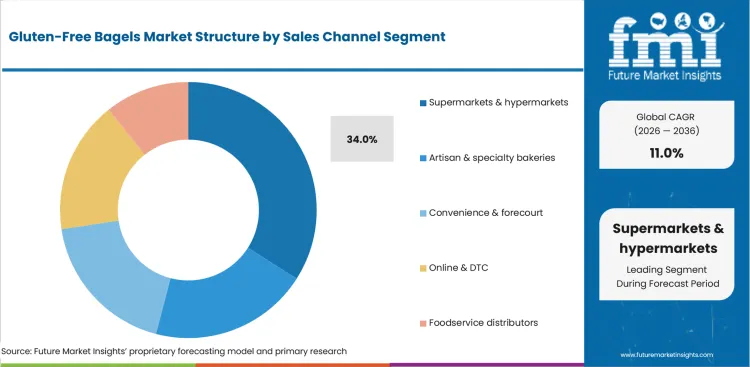
Supermarkets and hypermarkets place gluten-free products beside household staples, exposing bagel price and pack size against conventional alternatives. Coeliac UK reported in February 2025 that a weekly gluten-free food shop can cost up to 35% more, making affordability a recurring replenishment test.
- By sales channel, supermarkets & hypermarkets are forecast to represent 34.0% in 2026 driven by regular grocery trips that support repeat replenishment and assortment comparison.
- Retailers can use frozen placement and multipacks to balance shelf life with household value across wider distribution. The channel becomes more productive when promotions reduce trial risk without weakening established allergen-control expectations.
What makes plain central to the product type category?
Plain bagels reduce assortment risk because one SKU supports breakfast sandwiches and sweet spreads across everyday bakery products offerings. The format also exposes texture weaknesses that flavored inclusions can otherwise mask during routine retailer evaluation.
- By product type, plain is estimated to hold 25.0% in 2026 owing to its neutral flavor across the widest range of serving occasions.
- Institutional menus make plain-bagel versatility useful because one neutral format can support several meal builds safely. The Celiac Disease Foundation reported in April 2025 that more than 70% of college students with celiac disease found gluten-free dining options inadequate, reinforcing the value of flexible safe-menu items.
Why does conventional lead the claim - nature category?
Within allergen-free food ranges, conventional positioning leaves manufacturers more formulation freedom once the gluten-free requirement is satisfied. The Celiac Disease Foundation reported in February 2026 that 74% of 675 surveyed adults rated celiac associations as highly useful, showing why dependable claim information matters during purchase evaluation.
- Based on claim - nature, conventional is projected to account for 52.0% in 2026 due to core safety and eating quality remaining decisive for mainstream shoppers.
- Manufacturers can use gums and starches to rebuild chew without committing every recipe to organic or fortified positioning. Clean-label bakery enzymes remain an optional formulation route after safety and texture expectations are satisfied.
How does fresh shape the format category?
Fresh bagels face a narrow quality window because shoppers judge crust resilience and chew soon after purchase. Bakery ingredients and dough handling must preserve those sensory cues while controlling staling across retail display periods.
- In 2026, fresh is expected to lead format with 37.0% share because immediate eating quality remains a primary benchmark for bagel acceptance.
- Safety remains part of the sensory purchase test because good texture cannot offset accidental gluten exposure. In June 2026, the Celiac Disease Foundation reported that about 85% of patients had gluten symptoms during the prior three months despite adherence, increasing the need for handling controls across retail programs.
What are the drivers, restraints and opportunities in the Gluten-Free Bagels Market?
Recurring medical need supports repeat demand, while texture and cross-contact controls raise production costs and verified certification expands access to mainstream retail and foodservice channels.
- Driver: Lifelong gluten avoidance supports recurring demand for trusted bagels that fit routine breakfast and sandwich occasions.
- Restraint: Rebuilding chew while preventing cross-contact increases ingredient qualification, process validation and line-control costs for commercial bakeries.
- Opportunity: Certified frozen and packaged programs can extend gluten-free bagel availability across mainstream retail and foodservice channels.
Daily Dietary Need Supports Repeat Purchase
Gluten-free bagels address a repeated eating need across routine breakfast and sandwich occasions for people managing celiac disease. The Celiac Disease Foundation reported in May 2026 that a national survey covered more than 2,000 USA adults with biopsy-confirmed celiac disease following recent symptomatic gluten exposure. Reliable packaged substitutes therefore remain relevant across gluten-free prepared food occasions because households need familiar formats that reduce exposure risk without sacrificing convenience.
Cross-Contact Control Raises the Cost Base
Production control limits the number of bakeries that can compete on more than price because gluten-free dough and shared equipment create separate texture and safety challenges. GFCO reported on January 5 2026 that Sprouts recalled Gluten-Free Four Cheese Lasagna after certification testing detected gluten. Bagel manufacturers therefore incur recurring costs for segregation, sanitation and testing while bread improvers and process controls protect repeat retail placement.
Certification Can Expand Channel Access
Third-party certification can widen channel access after a bakery stabilizes bagel quality and contamination controls across repeated production runs. GFCO's 2025.1 certification process requires product and ingredient review plus registered manufacturing plants and facility audits before certified products carry the mark. Manufacturers can then qualify protected frozen or packaged programs while validated baking enzymes and other formulation changes protect texture across wider distribution routes.
Which country CAGRs are profiled in the Gluten-Free Bagels Market?
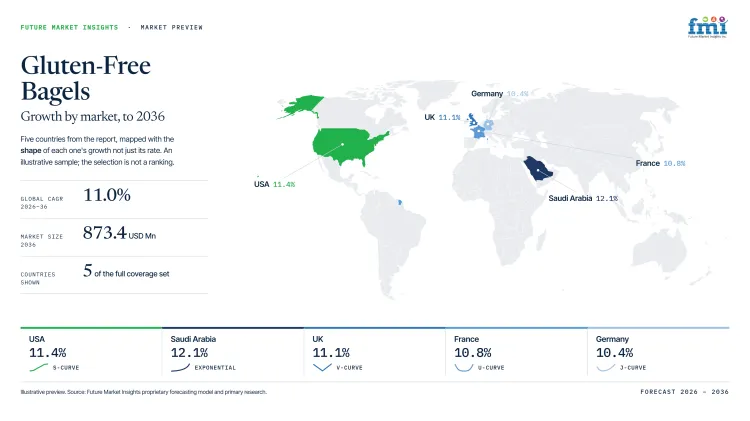
| Country | CAGR |
|---|---|
| South Korea | 11.8% |
| USA | 11.4% |
| UK | 11.1% |
| Germany | 10.4% |
| Japan | 10.1% |
How do country-level CAGRs compare in the Gluten-Free Bagels Market?
The five profiles span 1.7 points from South Korea at 11.8% to Japan at 10.1%. South Korea and the USA form the upper pair, with the UK close behind. Germany and Japan form the lower band, so channel economics and compliance work explain more than the forecast spread.
- South Korea’s dense e-commerce channels shorten delivery cycles for imported bakery products.
- USA frozen distribution broadens reach, but household price resistance keeps pack economics central.
- UK free-from maturity raises service expectations for texture consistency across supermarket ranges.
- Germany’s 20 mg/kg threshold makes testing and claim documentation clear entry requirements.
- Japan’s allergen-label updates increase localization work while compact packs fit shopping routines.
Comparable CAGRs produce different entry conditions because channel economics and compliance work vary. The full report provides country-level CAGR analysis across North America, Latin America, Europe, East Asia, South Asia, Oceania and the Middle East and Africa.
Country-wise Analysis
- South Korean packaged bakery reaches shoppers through large retailers and dense e-commerce networks that shorten national delivery times for imported specialty foods. MFDS published its 2026 nutrition-label changes on February 28 2025, giving importers a clear timetable for revising packaged-food information before implementation. Gluten-free bagel demand in South Korea is forecast to rise at 11.8% CAGR through 2036, driven by digital discovery and fast urban delivery. Korean-language label review and shared-line controls still raise launch costs, especially for smaller brands entering through imported frozen products. Local regulatory support and dependable distribution therefore determine how quickly online discovery converts into repeat grocery orders.
- USA grocery chains now place branded gluten-free bagels in conventional frozen aisles across major banners, giving packaged-bakery companies a national route for routine household replenishment and broader flavor extensions. USA demand is projected to expand at 11.4% CAGR through 2036, supported by national frozen distribution and broad supermarket access across established free-from sections. FDA updated Compliance Program 7321.005 on May 9 2025 and incorporated gluten-free labeling guidance into domestic and import inspection work for regulated packaged foods. Premium pricing and cross-contact risks remain material frictions for household frequency, so national programs reward documented claim controls and dependable fill rates.
- UK free-from grocery is mature enough that basic availability no longer secures productive shelf space across competitive supermarket ranges. Food Standards Agency guidance published in February 2025 requires accurate allergen information for non-prepacked foods, increasing training and information-control work for cafés and sandwich counters. Specialist-food premiums still pressure repeat household purchasing despite established free-from sections and strong online grocery access. Gluten-free bagel sales in the UK are forecast to expand at 11.1% CAGR by 2036, owing to mature retail access but constrained by differentiated quality and service costs. Brands entering national grocers therefore need credible allergen controls plus texture that remains consistent after frozen distribution.
- German retail has a mature gluten-free verification culture that makes claim accuracy visible beside established certified free-from ranges and specialist bakery alternatives. Germany is estimated to post 10.4% CAGR over the forecast period, influenced by established grocery access and specialist demand for documented products with dependable eating quality. The Federal Institute for Risk Assessment reiterated in July 2026 that gluten-free foods may contain no more than 20 milligrams of gluten per kilogram under European claim rules. Testing and segregation therefore raise operating costs for new entrants, favoring producers that can document controls while maintaining bagel texture and competitive pack economics.
- Japanese packaged-food shoppers expect precise ingredient presentation and compact formats that fit established shopping routines across urban retail channels. The Consumer Affairs Agency added cashew as a mandatory specified allergen on April 1 2026, increasing current Japanese-language label review across imported packaged foods. Long import routes can also weaken bagel eating quality before sale, making shelf-life validation a material entry condition. Adoption of gluten-free bagels in Japan is estimated to expand at 10.1% CAGR through 2036, supported by specialty e-commerce but constrained by local expectations for portion size and chew. Importers therefore need label expertise and pack formats that protect texture without pushing trial prices beyond local tolerance.
Who are the notable companies in the Gluten-Free Bagels Market?
Flowers Foods, Conagra Brands, Modern Bread & Bagel, The Greater Knead, O'Doughs, Carbonaut, Outside The Breadbox, and Kettlemans Bagel are the notable companies profiled in this market.
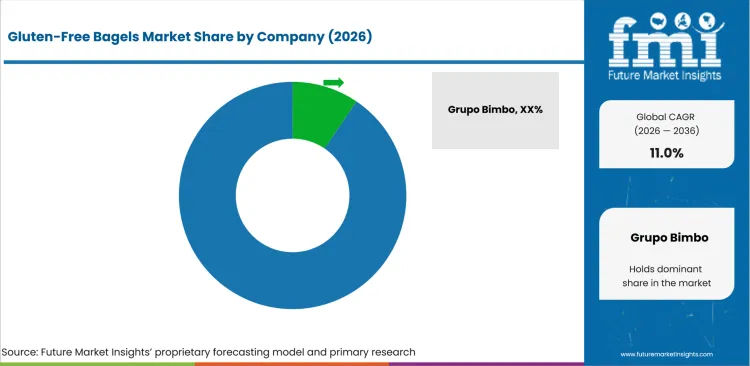
The competitive field separates national packaged-bakery platforms from specialist gluten-free bagel makers. Flowers Foods has direct nationwide frozen-bagel evidence through Canyon Bakehouse while Conagra Brands documents industrial gluten-free bagel capacity under Udi's. Modern Bread & Bagel and The Greater Knead concentrate on dedicated gluten-free production. O'Doughs, Carbonaut, Outside The Breadbox and Kettlemans Bagel broaden the field through retail or direct distribution. Entry barriers sit in gluten-control proof, bagel texture and dependable route-to-market execution.
- National packaged-bakery platforms: Flowers Foods and Conagra Brands pair production scale with documented gluten-free bakery capability and broad USA distribution.
- Dedicated gluten-free specialists: Modern Bread & Bagel, The Greater Knead and O'Doughs compete with direct bagel ranges plus controlled production.
- Retail and regional challengers: Carbonaut, Outside The Breadbox and Kettlemans Bagel use multi-flavor ranges or regional distribution to widen gluten-free bagel access.
Competitive Benchmarking: Gluten-Free Bagels Market
| Company | Gluten-Control Depth | Bagel Format Depth | Route-to-Market Coverage | Geographic Reach |
|---|---|---|---|---|
| Flowers Foods | High | Medium | High | United States nationwide |
| Conagra Brands | Medium | Low | Medium | United States |
| Modern Bread & Bagel | High | Low | Medium | USA metro stores plus nationwide shipping |
| The Greater Knead | High | Low | High | United States nationwide |
| O'Doughs | High | Low | Medium | Canada and selected USA retail |
| Carbonaut | Low | High | Medium | North America |
| Outside The Breadbox | High | Low | High | United States nationwide |
| Kettlemans Bagel | High | Low | Medium | Canada regional chain plus digital delivery |
Key Developments in the Gluten-Free Bagels Market
- In May 2026, Flowers Foods launched Canyon Bakehouse Cinnamon Raisin and Blueberry gluten-free bagels nationwide in the USA frozen aisle.
- In August 2025, The Greater Knead received MenuTrinfo's Certified Free From seal for bagels and pretzels covering the top nine allergens plus gluten.
- In January 2025, Kettlemans Bagel launched a gluten-free Everything bagel made in a separate dedicated facility and sold in four-packs across its locations and digital channels.
Key Players in the Gluten-Free Bagels Market
National Packaged-Bakery Platforms
- Flowers Foods
- Conagra Brands
Dedicated Gluten-Free Bagel Specialists
- Modern Bread & Bagel
- The Greater Knead
- O'Doughs
Retail and Regional Gluten-Free Brands
- Carbonaut
- Outside The Breadbox
- Kettlemans Bagel
Gluten-Free Bagels Market - Report Scope
| Coverage field | Report scope |
|---|---|
| Market breakdown | By product type, claim - nature, format, packaging format, sales channel and region. |
| Quantitative Units | Revenue in USD million and CAGR in %. |
| Market Definition | Commercial gluten-free bagels sold for household and foodservice use across fresh, frozen, chilled, ambient packaged and par-baked formats. |
| Regions Covered | North America, Latin America, Europe, East Asia, South Asia and Pacific, and Middle East and Africa. |
| Countries Covered | South Korea, USA, UK, Germany, Japan, and 20+ countries included in the full report. |
| Key Companies Profiled | Flowers Foods, Conagra Brands, Modern Bread & Bagel, The Greater Knead, O'Doughs, Carbonaut, Outside The Breadbox, Kettlemans Bagel. |
| Forecast Period | 2026 to 2036. |
| Approach | Primary and secondary research with market triangulation. |
Gluten-Free Bagels Market - Research Methodology
| Method | Approach |
|---|---|
| Primary Research | FMI analysts gathered input from manufacturers, service providers, technology developers, distributors, end users, procurement teams, and subject-matter experts. Interviews examined purchasing decisions, product or service evaluation, adoption barriers, approval requirements, pricing considerations, and expectations for technical or commercial support. Respondents were also asked what evidence is required before a trial, pilot, or initial order develops into regular purchasing. |
| Desk Research | Desk research covered government statistics, regulatory publications, trade data, industry associations, technical literature, standards, company filings, product information, and official corporate announcements. Sources were reviewed for relevance, publication date, geographic coverage, and consistency with the defined market scope. Claims relating to performance, applications, approvals, capacity, investment, and commercial activity were retained only when supported by credible public evidence. |
| Market Sizing and Forecasting | The market model combined the baseline value with historical performance, segment structure, pricing and volume indicators, adoption levels, company participation, and country-level demand conditions. Forecast assumptions considered economic activity, investment trends, regulatory developments, technology adoption, purchasing cycles, supply availability, and barriers to wider market use. Segment and regional estimates were reconciled before the final market total was calculated. |
| Data Validation | Estimates were checked against multiple independent indicators, including public data, company activity, trade patterns, industry developments, and findings from primary interviews. Validation also tested whether products, services, applications, and company revenues fell within the defined market boundaries. Adjacent categories, unsupported claims, overlapping revenues, and activities without direct market relevance were excluded to reduce double counting and maintain consistency across segments and countries. |
Gluten-Free Bagels Market by Segments
Gluten-Free Bagels Market segmented by Product Type:
- Plain
- Everything
- Seeded & multigrain
- Sweet (cinnamon raisin, blueberry)
- Mini & bagel thins
Gluten-Free Bagels Market segmented by Claim - nature:
- Conventional
- Clean label
- Organic
- Gluten-free
- High-protein / fortified
Gluten-Free Bagels Market segmented by Format:
- Fresh
- Frozen
- Ambient packaged
- Chilled
- Par-baked / thaw-and-serve
Gluten-Free Bagels Market segmented by Packaging Format:
- Multipack
- Single-serve
- Family / loaf pack
- Bulk foodservice
Gluten-Free Bagels Market segmented by Sales Channel:
- Supermarkets & hypermarkets
- Artisan & specialty bakeries
- Convenience & forecourt
- Online & DTC
- Foodservice distributors
Gluten-Free Bagels Market by Region:
- North America
- United States
- Canada
- Latin America
- Brazil
- Mexico
- Chile
- Rest of Latin America
- Western Europe
- Germany
- United Kingdom
- Italy
- Spain
- France
- Nordics
- Benelux
- Rest of Western Europe
- Eastern Europe
- Russia
- Poland
- Hungary
- Balkan and Baltic States
- Rest of Eastern Europe
- East Asia
- China
- Japan
- South Korea
- South Asia and Pacific
- India
- ASEAN
- Australia and New Zealand
- Rest of South Asia and Pacific
- Middle East and Africa
- Kingdom of Saudi Arabia
- Other GCC Countries
- Türkiye
- South Africa
- Other African Union Countries
- Rest of Middle East and Africa
Research Sources and Bibliography
- Celiac Disease Foundation. (2026, February 19). New research highlights the hidden burden of celiac disease.
- Assurance Maladie. (2026, January 20). Remboursement des aliments sans gluten avec l’application du compte ameli : mode d’emploi.
- Celiac Disease Foundation. (2025, April 16). Foundation Leads Development of Evidence-Based College Recommendations.
- Celiac Disease Foundation. (2026, February 12). Who do adults with celiac disease trust? A new study has answers…
- Celiac Disease Foundation. (2026, June 18). Getting drugs for celiac disease to patients…It will take more than science.
- Coeliac UK. (2025, February). New Coeliac UK report sheds light on cost, access & availability of GF food.
- Celiac Disease Foundation. (2026, May 22). How the Celiac Disease Foundation and Biopharma Partners Are Turning Patient Voice Into Scientific Evidence.
- Gluten-Free Certification Organization. (2026, January 5). Safety alerts.
- Gluten-Free Certification Organization. (2025). Certification. Retrieved August 17, 2026.
- USA Food and Drug Administration. (2025, May 9). FDA updates General Food Labeling Requirements Compliance Program.
- Food Standards Agency. (2025, February 24). Allergen Information for Non-Prepacked Foods Best Practice.
- Bundesinstitut für Risikobewertung. (2026, July 10). Gluten und glutenhaltige Getreide: Vorkommen und gesundheitliche Relevanz.
- Consumer Affairs Agency. (2026, April 1). 食物アレルギー表示に関する情報.
- Ministry of Food and Drug Safety. (2025, February 28). 2026년 영양표시제도 주요 변경사항 알림.
- Flowers Foods. (2026, May 4). Flowers Foods’ innovations deliver fresh variety to breakfast, snacking categories.
- MenuTrinfo. (2025, August 12). The Greater Knead serves peace of mind with Certified Free From allergen seal.
- Kettlemans Bagel. (2025, January). Introducing Kettlemans’ new gluten-free bagel: Safe, delicious, and perfect for every occasion!
- Conagra Brands. (2026). Welcome to Conagra Denver. Retrieved August 17, 2026.
- Conagra Brands. (2026). Food Quality & Safety. Retrieved August 17, 2026.
- Halal Monitoring Authority. (2026, March 16). Other baked goods: Carbonaut gluten-free bagels.
- Warburtons. (2026, January). Section 172 statement for financial period 2024/25.
- Lantmännen Unibake. (2025, June 3). Lantmännen makes strategic and long-term investment in new production facility for bread.
- Dr. Schär. (2025, February 19). A record-breaking 2024 for Dr. Schär.
- Grupo Bimbo. (2025, July 29). We are committed to removing artificial colorants from all our products by the end of 2026.
- ARYZTA. (2026, January 22). Full year 2025 targets achieved; Revenue growth & improved performance expected in 2026; New €40m bun bakery in Portugal.
- Rise Baking Company. (2026, March 12). Rise Baking Company Optimizes Manufacturing Footprint to Expand Production Capacity.
- Conagra Brands. (2025, June 11). Conagra Brands introduces more than 50 new frozen foods, elevating convenience and flavor for consumers.
This bibliography is provided for reader reference and is not exhaustive. The full report contains the complete reference list and detailed citations.
This Report Answers
- How large is the gluten-free bagels market in 2026 and what value is forecast for 2036?
- Which operating conditions support recurring demand for gluten-free bagels?
- Why does plain hold the leading product type share in 2026?
- How does conventional positioning shape the claim - nature category?
- Why does fresh remain important within the format category?
- How do growth rates compare across the five profiled countries?
- Which companies bring direct gluten-free bagel or packaged-bakery capabilities?
- What limits wider adoption across formulation, cross-contact control and household affordability?
Frequently Asked Questions
How big is the Gluten-Free Bagels Market in 2026?
The gluten-free bagels market is valued at USD 307.6 million in 2026 and is projected to reach USD 873.4 million by 2036. Growth is driven by recurring demand from consumers requiring gluten-free alternatives for breakfast and sandwich occasions.
What is the CAGR of the Gluten-Free Bagels Market from 2026 to 2036?
The gluten-free bagels market is projected to grow at a CAGR of 11.0% between 2026 and 2036. Expansion is supported by rising awareness of gluten-related disorders and increasing availability of gluten-free bakery products across retail channels.
Which product type leads the Gluten-Free Bagels Market?
Plain bagels are projected to account for 25.0% of the market in 2026. Their leading share is supported by broad versatility across breakfast, snacking, and sandwich applications.
Which claim nature dominates the Gluten-Free Bagels Market?
Conventional products are projected to account for 52.0% of the market in 2026. Their dominance is driven by consumer focus on gluten control and texture rather than additional premium positioning claims.
Which format leads the Gluten-Free Bagels Market?
Fresh bagels are projected to account for 37.0% of the market in 2026. Their leading share reflects strong preference for immediate eating quality, chew, and bakery-style freshness.
Which sales channel leads the Gluten-Free Bagels Market?
Supermarkets and hypermarkets are projected to account for 34.0% of the market in 2026. Their dominance is supported by regular grocery purchasing, broad assortment availability, and convenient product comparison.
Which companies are active in the Gluten-Free Bagels Market?
Key companies operating in the market include Flowers Foods, Conagra Brands, Modern Bread & Bagel, The Greater Knead, O'Doughs, Carbonaut, Outside The Breadbox, and Kettlemans Bagel. These companies compete through gluten-control expertise, product innovation, distribution reach, and specialized gluten-free bakery offerings.
Preview the report firsthand - request a free sample
Get SampleGet the brochure for pricing and purchase details.
Get PDFTable of Content
- Key Takeaways
- Market Size and CAGR
- Top Growth Driver
- Fastest Growing Segment
- Leading Region
- Key Companies
- Emerging Opportunities
- Executive Summary
- Global Market Outlook
- Demand-side Trends
- Supply-side Trends
- Technology Roadmap Analysis
- Analysis and Recommendations
- Analyst Perspective (What is happening? Why now? What should investors know?)
- Key Questions Answered
- How large is the market?
- What is the CAGR?
- What are key trends?
- Which region dominates?
- Who are the leaders?
- Market Overview
- Market Coverage / Taxonomy
- Market Definition / Scope / Limitations
- Research Methodology
- Chapter Orientation
- Analytical Lens and Working Hypotheses
- Market Structure, Signals, and Trend Drivers
- Benchmarking and Cross-market Comparability
- Market Sizing, Forecasting, and Opportunity Mapping
- Research Design and Evidence Framework
- Desk Research Programme (Secondary Evidence)
- Expert Input and Fieldwork (Primary Evidence)
- Tooling, Models, and Reference Databases
- Data Engineering and Model Build
- Quality Assurance and Audit Trail
- Market Background
- Market Dynamics (Drivers, Restraints, Opportunity, Trends)
- Scenario Forecast (Optimistic, Likely, Conservative)
- Impact Analysis
- AI Impact
- Sustainability Impact
- Regulatory Impact
- Technology Impact
- Consumer / Buyer Analysis
- Purchase Drivers
- Adoption Barriers
- Buyer Journey
- Opportunity Map Analysis
- Product Life Cycle Analysis
- Supply Chain Analysis
- Investment Feasibility Matrix
- Value Chain Analysis
- PESTLE and Porter's Analysis
- Regulatory Landscape
- Regional Parent Market Outlook
- Production and Consumption Statistics
- Import and Export Statistics
- Global Market Analysis and Forecast, 2021 to 2036
- Historical Market Size Value (USD Million) Analysis, 2021 to 2025
- Current and Future Market Size Value (USD Million) Projections, 2026 to 2036
- Y-o-Y Growth Trend Analysis
- Absolute $ Opportunity Analysis
- Global Market Pricing Analysis, 2021 to 2036
- Global Market Analysis and Forecast, By Product Type, 2021 to 2036
- Introduction / Key Findings
- Historical Market Size Value (USD Million) Analysis By Product Type, 2021 to 2025
- Current and Future Market Size Value (USD Million) Analysis and Forecast By Product Type, 2026 to 2036
- Plain
- Everything
- Seeded & multigrain
- Sweet (cinnamon raisin, blueberry)
- Mini & bagel thins
- Plain
- Y-o-Y Growth Trend Analysis By Product Type, 2021 to 2025
- Absolute $ Opportunity Analysis By Product Type, 2026 to 2036
- Global Market Analysis and Forecast, By Claim / Nature, 2021 to 2036
- Introduction / Key Findings
- Historical Market Size Value (USD Million) Analysis By Claim / Nature, 2021 to 2025
- Current and Future Market Size Value (USD Million) Analysis and Forecast By Claim / Nature, 2026 to 2036
- Conventional
- Clean label
- Organic
- Gluten-free
- High-protein / fortified
- Conventional
- Y-o-Y Growth Trend Analysis By Claim / Nature, 2021 to 2025
- Absolute $ Opportunity Analysis By Claim / Nature, 2026 to 2036
- Global Market Analysis and Forecast, By Format, 2021 to 2036
- Introduction / Key Findings
- Historical Market Size Value (USD Million) Analysis By Format, 2021 to 2025
- Current and Future Market Size Value (USD Million) Analysis and Forecast By Format, 2026 to 2036
- Fresh
- Frozen
- Ambient packaged
- Chilled
- Par-baked / thaw-and-serve
- Fresh
- Y-o-Y Growth Trend Analysis By Format, 2021 to 2025
- Absolute $ Opportunity Analysis By Format, 2026 to 2036
- Global Market Analysis and Forecast, By Packaging Format, 2021 to 2036
- Introduction / Key Findings
- Historical Market Size Value (USD Million) Analysis By Packaging Format, 2021 to 2025
- Current and Future Market Size Value (USD Million) Analysis and Forecast By Packaging Format, 2026 to 2036
- Multipack
- Single-serve
- Family / loaf pack
- Bulk foodservice
- Multipack
- Y-o-Y Growth Trend Analysis By Packaging Format, 2021 to 2025
- Absolute $ Opportunity Analysis By Packaging Format, 2026 to 2036
- Global Market Analysis and Forecast, By Sales Channel, 2021 to 2036
- Introduction / Key Findings
- Historical Market Size Value (USD Million) Analysis By Sales Channel, 2021 to 2025
- Current and Future Market Size Value (USD Million) Analysis and Forecast By Sales Channel, 2026 to 2036
- Supermarkets & hypermarkets
- Artisan & specialty bakeries
- Convenience & forecourt
- Online & DTC
- Foodservice distributors
- Supermarkets & hypermarkets
- Y-o-Y Growth Trend Analysis By Sales Channel, 2021 to 2025
- Absolute $ Opportunity Analysis By Sales Channel, 2026 to 2036
- Global Market Analysis and Forecast, By Region, 2021 to 2036
- Introduction
- Historical Market Size Value (USD Million) Analysis By Region, 2021 to 2025
- Current Market Size Value (USD Million) Analysis and Forecast By Region, 2026 to 2036
- North America
- Latin America
- Western Europe
- Eastern Europe
- East Asia
- South Asia and Pacific
- Middle East & Africa
- Market Attractiveness Analysis By Region
- North America Market Analysis and Forecast, By Country, 2021 to 2036
- Historical Market Size Value (USD Million) Trend Analysis By Market Taxonomy, 2021 to 2025
- Market Size Value (USD Million) Forecast By Market Taxonomy, 2026 to 2036
- By Country
- USA
- Canada
- By Product Type
- By Claim / Nature
- By Format
- By Packaging Format
- By Sales Channel
- By Country
- Market Attractiveness Analysis
- By Country
- By Product Type
- By Claim / Nature
- By Format
- By Packaging Format
- By Sales Channel
- Key Takeaways
- Latin America Market Analysis and Forecast, By Country
- Historical Market Size Value (USD Million) Trend Analysis By Market Taxonomy, 2021 to 2025
- Market Size Value (USD Million) Forecast By Market Taxonomy, 2026 to 2036
- By Country
- Brazil
- Mexico
- Chile
- Rest of Latin America
- By Product Type
- By Claim / Nature
- By Format
- By Packaging Format
- By Sales Channel
- By Country
- Market Attractiveness Analysis
- By Country
- By Product Type
- By Claim / Nature
- By Format
- By Packaging Format
- By Sales Channel
- Key Takeaways
- Western Europe Market Analysis and Forecast, By Country
- Historical Market Size Value (USD Million) Trend Analysis By Market Taxonomy, 2021 to 2025
- Market Size Value (USD Million) Forecast By Market Taxonomy, 2026 to 2036
- By Country
- Germany
- UK
- Italy
- Spain
- France
- Nordic
- BENELUX
- Rest of Western Europe
- By Product Type
- By Claim / Nature
- By Format
- By Packaging Format
- By Sales Channel
- By Country
- Market Attractiveness Analysis
- By Country
- By Product Type
- By Claim / Nature
- By Format
- By Packaging Format
- By Sales Channel
- Key Takeaways
- Eastern Europe Market Analysis and Forecast, By Country
- Historical Market Size Value (USD Million) Trend Analysis By Market Taxonomy, 2021 to 2025
- Market Size Value (USD Million) Forecast By Market Taxonomy, 2026 to 2036
- By Country
- Russia
- Poland
- Hungary
- Balkan & Baltic
- Rest of Eastern Europe
- By Product Type
- By Claim / Nature
- By Format
- By Packaging Format
- By Sales Channel
- By Country
- Market Attractiveness Analysis
- By Country
- By Product Type
- By Claim / Nature
- By Format
- By Packaging Format
- By Sales Channel
- Key Takeaways
- East Asia Market Analysis and Forecast, By Country
- Historical Market Size Value (USD Million) Trend Analysis By Market Taxonomy, 2021 to 2025
- Market Size Value (USD Million) Forecast By Market Taxonomy, 2026 to 2036
- By Country
- China
- Japan
- South Korea
- By Product Type
- By Claim / Nature
- By Format
- By Packaging Format
- By Sales Channel
- By Country
- Market Attractiveness Analysis
- By Country
- By Product Type
- By Claim / Nature
- By Format
- By Packaging Format
- By Sales Channel
- Key Takeaways
- South Asia and Pacific Market Analysis and Forecast, By Country
- Historical Market Size Value (USD Million) Trend Analysis By Market Taxonomy, 2021 to 2025
- Market Size Value (USD Million) Forecast By Market Taxonomy, 2026 to 2036
- By Country
- India
- ASEAN
- Australia & New Zealand
- Rest of South Asia and Pacific
- By Product Type
- By Claim / Nature
- By Format
- By Packaging Format
- By Sales Channel
- By Country
- Market Attractiveness Analysis
- By Country
- By Product Type
- By Claim / Nature
- By Format
- By Packaging Format
- By Sales Channel
- Key Takeaways
- Middle East & Africa Market Analysis and Forecast, By Country
- Historical Market Size Value (USD Million) Trend Analysis By Market Taxonomy, 2021 to 2025
- Market Size Value (USD Million) Forecast By Market Taxonomy, 2026 to 2036
- By Country
- Kingdom of Saudi Arabia
- Other GCC Countries
- Türkiye
- South Africa
- Other African Union
- Rest of Middle East & Africa
- By Product Type
- By Claim / Nature
- By Format
- By Packaging Format
- By Sales Channel
- By Country
- Market Attractiveness Analysis
- By Country
- By Product Type
- By Claim / Nature
- By Format
- By Packaging Format
- By Sales Channel
- Key Takeaways
- Key Countries Market Analysis
- USA
- Pricing Analysis
- Market Share Analysis, 2025
- By Product Type
- By Claim / Nature
- By Format
- By Packaging Format
- By Sales Channel
- Canada
- Pricing Analysis
- Market Share Analysis, 2025
- By Product Type
- By Claim / Nature
- By Format
- By Packaging Format
- By Sales Channel
- Mexico
- Pricing Analysis
- Market Share Analysis, 2025
- By Product Type
- By Claim / Nature
- By Format
- By Packaging Format
- By Sales Channel
- Brazil
- Pricing Analysis
- Market Share Analysis, 2025
- By Product Type
- By Claim / Nature
- By Format
- By Packaging Format
- By Sales Channel
- Chile
- Pricing Analysis
- Market Share Analysis, 2025
- By Product Type
- By Claim / Nature
- By Format
- By Packaging Format
- By Sales Channel
- Germany
- Pricing Analysis
- Market Share Analysis, 2025
- By Product Type
- By Claim / Nature
- By Format
- By Packaging Format
- By Sales Channel
- UK
- Pricing Analysis
- Market Share Analysis, 2025
- By Product Type
- By Claim / Nature
- By Format
- By Packaging Format
- By Sales Channel
- Italy
- Pricing Analysis
- Market Share Analysis, 2025
- By Product Type
- By Claim / Nature
- By Format
- By Packaging Format
- By Sales Channel
- Spain
- Pricing Analysis
- Market Share Analysis, 2025
- By Product Type
- By Claim / Nature
- By Format
- By Packaging Format
- By Sales Channel
- France
- Pricing Analysis
- Market Share Analysis, 2025
- By Product Type
- By Claim / Nature
- By Format
- By Packaging Format
- By Sales Channel
- India
- Pricing Analysis
- Market Share Analysis, 2025
- By Product Type
- By Claim / Nature
- By Format
- By Packaging Format
- By Sales Channel
- ASEAN
- Pricing Analysis
- Market Share Analysis, 2025
- By Product Type
- By Claim / Nature
- By Format
- By Packaging Format
- By Sales Channel
- Australia & New Zealand
- Pricing Analysis
- Market Share Analysis, 2025
- By Product Type
- By Claim / Nature
- By Format
- By Packaging Format
- By Sales Channel
- China
- Pricing Analysis
- Market Share Analysis, 2025
- By Product Type
- By Claim / Nature
- By Format
- By Packaging Format
- By Sales Channel
- Japan
- Pricing Analysis
- Market Share Analysis, 2025
- By Product Type
- By Claim / Nature
- By Format
- By Packaging Format
- By Sales Channel
- South Korea
- Pricing Analysis
- Market Share Analysis, 2025
- By Product Type
- By Claim / Nature
- By Format
- By Packaging Format
- By Sales Channel
- Russia
- Pricing Analysis
- Market Share Analysis, 2025
- By Product Type
- By Claim / Nature
- By Format
- By Packaging Format
- By Sales Channel
- Poland
- Pricing Analysis
- Market Share Analysis, 2025
- By Product Type
- By Claim / Nature
- By Format
- By Packaging Format
- By Sales Channel
- Hungary
- Pricing Analysis
- Market Share Analysis, 2025
- By Product Type
- By Claim / Nature
- By Format
- By Packaging Format
- By Sales Channel
- Kingdom of Saudi Arabia
- Pricing Analysis
- Market Share Analysis, 2025
- By Product Type
- By Claim / Nature
- By Format
- By Packaging Format
- By Sales Channel
- Türkiye
- Pricing Analysis
- Market Share Analysis, 2025
- By Product Type
- By Claim / Nature
- By Format
- By Packaging Format
- By Sales Channel
- South Africa
- Pricing Analysis
- Market Share Analysis, 2025
- By Product Type
- By Claim / Nature
- By Format
- By Packaging Format
- By Sales Channel
- USA
- Market Structure Analysis
- Competition Dashboard
- Competition Benchmarking
- Market Share Analysis of Top Players
- By Regional
- By Product Type
- By Claim / Nature
- By Format
- By Packaging Format
- By Sales Channel
- Emerging Startups
- Innovation Benchmarking
- Competition Analysis
- Competition Deep Dive
- Grupo Bimbo
- Overview
- Product Portfolio
- Profitability by Market Segments
- Sales Footprint
- Strategy Overview
- Marketing Strategy
- Product Strategy
- Channel Strategy
- Flowers Foods
- Aryzta
- Lantmannen Unibake
- Vandemoortele
- Yamazaki Baking
- Warburtons
- King's Hawaiian
- Europastry
- St Pierre Groupe
- Grupo Bimbo
- Case Studies
- Success Stories
- Recent Developments
- Competition Deep Dive
- Assumptions & Acronyms Used


