

- Market Size (2026)
- USD 1.10 Bn
- Forecast (2036)
- USD 2.12 Bn
- CAGR (2026 to 2036)
- 6.8%
Low Sugar Bakery Products Market Size, Market Forecast and Outlook By FMI
The low sugar bakery products market was valued at USD 1.03 billion in 2025 and is estimated at USD 1.10 billion in 2026. It is projected to reach USD 2.12 billion by 2036 at 6.8% CAGR. Low-sugar cookies are projected to account for 39.2% share in 2026 as brands reformulate familiar snacks first.
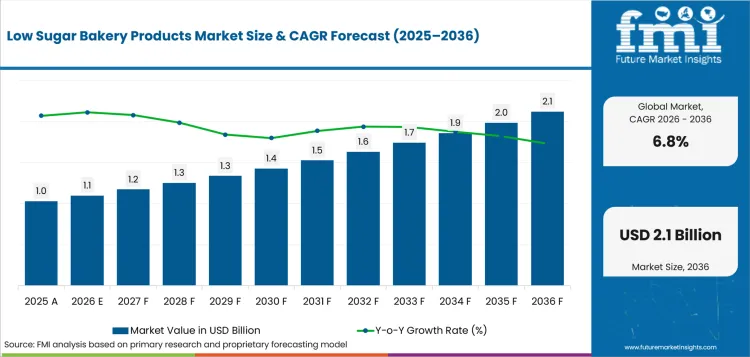
Key Takeaways, Market Size, and Forecast
- 2026 Market Size: USD 1.10 billion
- 2036 Market Size: USD 2.12 billion
- Forecast CAGR: 6.8% from 2026 to 2036
- Leading Product Type: Low-sugar cookies
- Low-sugar Cookies Share in 2026: 39.2%
- Leading Sweetening System: Polyol blends
- Polyol Blends Share in 2026: 34.6%
- Fastest-growing Country: Saudi Arabia
- Saudi Arabia CAGR: 7.6% through 2036
Summary of the Low Sugar Bakery Products Market
- Demand and Growth Drivers
- Added sugar label checks are expected to push sweet bakery brands toward lighter sugar recipes.
- Retailers are likely to expand low sugar shelf space where shoppers compare cakes and cookies by nutrition panels.
- Foodservice buyers are expected to use portion control and lower sugar claims to keep sweet bakery on menus.
- Sweetener suppliers are projected to gain new bakery briefs where sugar removal affects texture and browning.
- Product and Segment View
- Low-sugar cookies are projected to lead product type with 39.2% share in 2026 due to simpler recipe conversion.
- Polyol blends are anticipated to lead sweetening system with 34.6% share in 2026 owing to bulk replacement needs.
- Reduced sugar products are expected to hold 47.8% share in 2026 as mainstream buyers avoid taste trade-offs.
- Supermarkets are forecast to account for 42.6% share in 2026 where nutrition labels are checked before repeat buying.
- Geography and Competitive Outlook
- Saudi Arabia is projected to record 7.6% CAGR by 2036 with health policy and premium retail supporting low sugar choices.
- The United Kingdom is expected to expand at 7.2% CAGR by 2036 as media rules push reformulation planning.
- Mondelez International and Grupo Bimbo compete through branded sweet bakery scale and broad retail access.
- Tate & Lyle and Ingredion focus on sweetener systems that help bakeries rebuild texture after sugar reduction.
- Analyst Opinion
- Nandini Roy Choudhury, Principal Analyst at FMI says, "I see low sugar bakery as a reformulation problem before it is a consumer claim. Cakes and cookies lose body when sugar is removed. That means brands need sweetener blends that protect bite and shelf life. Retailers also want packs that make added sugar easy to compare. Clients should watch how quickly bakery teams move from small zero sugar tests into mainstream reduced sugar ranges."
- Low Sugar Bakery Products Market Value Analysis
- Value per unit is expected to rise as sweetener blends add cost while protecting texture in cookies and cakes.
- Retail buyer pools are likely to widen as mainstream shoppers look for lower sugar treats without diet-only branding.
- Adoption is becoming more practical where ingredient houses supply bakery-ready blends that reduce trial batch losses.
- Price gaps are expected to constrain faster uptake since polyols and fibers cost more than commodity sugar.
- Channel value is projected to shift toward resealable and portion packs where families manage serving size more directly
Regulation is making added sugar easier to screen at shelf level and during campaign approval. In December 2024, the United States Food and Drug Administration finalized the updated healthy nutrient content claim with limits on added sugars plus saturated fat and sodium. The Department of Health and Social Care stated in June 2025 that UK restrictions on less healthy food and drink advertising would come into force on January 5 2026. The UK guidance includes cakes and cookies when products meet the less healthy food definition. These rules are expected to raise buyer checks on added sugar levels, nutrition panels and campaign eligibility before cakes and cookies are approved for shelf claims or advertising plans.
Low Sugar Bakery Products Market Definition
The low sugar bakery products market covers finished sweet bakery items that carry reduced sugar, no added sugar, zero sugar, or keto-style positioning. The scope includes packaged cookies, cakes, muffins, pastries, and brownies sold through retail and foodservice channels. Products are counted when sugar reduction is part of the product claim, front-pack message, ingredient strategy, or buyer specification. Revenue includes branded products and private label products that are sold as finished bakery items. Foodservice-ready formats are counted when distributors sell them with a defined lower sugar or sugar reduction position. Ingredient systems are analyzed only when they are used inside finished low sugar bakery products.
Low Sugar Bakery Products Market Inclusions
The market includes low-sugar cookies, low-sugar cakes, low-sugar muffins, low-sugar pastries, and low-sugar brownies sold in packaged or foodservice-ready formats. It covers products sweetened with polyol blends, stevia blends, allulose blends, fiber bulkers, and fruit bases when these systems support a lower sugar claim. Reduced sugar, no added sugar, zero sugar, and keto-style bakery products are included when they remain positioned as sweet bakery. Sales through supermarkets, online grocery, specialty stores, club stores, and foodservice distributors are counted. Buyer coverage includes retail brands, industrial bakeries, private label programs, and artisan bakery suppliers that sell products with clear sugar reduction positioning.
Low Sugar Bakery Products Market Exclusions
The scope excludes standard sweet bakery products that do not carry a sugar reduction claim or lower sugar positioning. Bread, rolls, buns, savory bakery, and ordinary breakfast bakery are excluded unless they are sold as sweet bakery with a defined sugar reduction claim. Candy, chocolate confectionery, frozen desserts, snack bars, and breakfast cereals are outside the market boundary. Standalone sweetener ingredients are excluded unless their value is captured inside a finished low sugar bakery product. Dietary supplements, meal replacements, and medical nutrition products are also excluded because they are not sold as bakery products.
Low Sugar Bakery Products Market Research Methodology
- Primary Research: FMI analysts reviewed branded bakery portfolios and retailer shelf checks across major grocery markets. Interviews covered bakery brands, ingredient suppliers and distributors serving sweet bakery categories.
- Desk Research: Public data from the United States Food and Drug Administration and the Centers for Disease Control and Prevention were checked. Health Canada and the Government of the United Kingdom were also reviewed against the low sugar bakery scope.
- Market Sizing and Forecasting: The market size has been estimated using a bottom-up product-boundary approach. Each category has been defined by eligible SKUs and retail revenue pools. Foodservice revenue pools and country-level adoption patterns were then checked separately. Standard sugar-rich bakery products were excluded unless they clearly matched low sugar, no added sugar or zero sugar bakery positioning.
- Data Validation: Forecast checks compared added sugar rules and diabetes prevalence. Sweetener functionality and active supplier portfolios were reviewed separately. Estimates were reconciled against bakery product revenue pools and reformulation intensity in target countries.
Why is the Low Sugar Bakery Products Market Growing?
- Regulatory pressure is expected to move brands toward added sugar reduction in sweet bakery packs.
- Retail category teams are likely to favor reformulated cookies where nutrition panels still support repeat taste expectations.
- Ingredient suppliers are expanding sugar replacement systems that address texture loss after sugar removal.
Low sugar bakery is moving beyond specialist diet shelves as label rules make sugar content easier to compare. The United States Food and Drug Administration proposed a front-of-package nutrition label in January 2025 for most packaged foods. That proposal matters to bakery brands because cakes and cookies are often compared quickly in supermarkets. Reformulated products with clearer sugar levels are expected to gain easier listing discussions when buyers reset better-for-you shelves.
Ingredient choice is also changing the economics of reformulation. Manufacturers working near the low-calorie sweeteners category need sweetness and bulk without creating a dry bite. That is why polyol blends and fiber bulkers are expected to gain share in sweet bakery. Suppliers that test dough spread and shelf texture can reduce the cost of failed reformulation.
Market Segmentation Analysis
- Low-sugar cookies are projected to secure 39.2% share in 2026, led by familiar taste and faster retail rotation.
- Polyol blends are anticipated to hold 34.6% share in 2026 since they replace both sweetness and bulk.
- Reduced sugar positioning is expected to account for 47.8% share in 2026 where mainstream buyers still expect indulgent taste.
- Supermarkets are forecast to represent 42.6% share in 2026 owing to shelf visibility and pack comparison.
- Retail brands are projected to account for 45.3% share in 2026 as national brands reformulate core sweet snacks first.
Insights into Low Sugar Bakery Products Market by Product Type
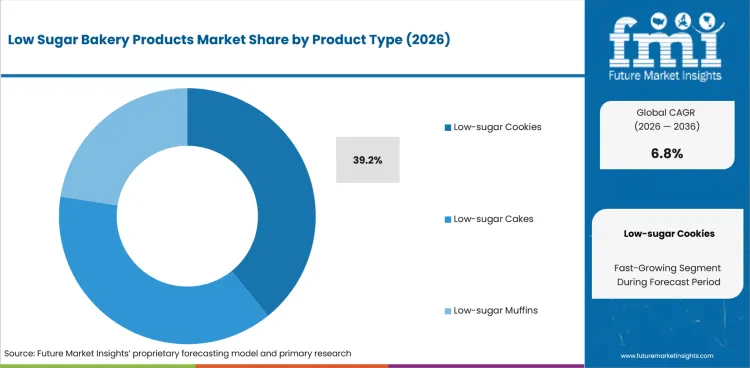
- Low-sugar cookies are estimated to hold 39.2% share in 2026 as familiar snacks are easier to reformulate before cakes and pastries.
- Low-sugar cakes are expected to gain share where birthday packs and snack cakes can carry reduced sugar claims without losing texture. Product testing is closest to sugar-free cookies where texture and sweetness must match familiar snack habits.
Insights into Low Sugar Bakery Products Market by Sweetening System
- Polyol blends are forecast to hold 34.6% share in 2026 as these systems replace sweetness and bulk in one recipe step.
- Stevia blends are expected to gain share where brands want high sweetness with less recipe bulk. Bakery teams also use sugar substitutes when sugar removal changes browning and mouthfeel.
Insights into Low Sugar Bakery Products Market by Reduction Level
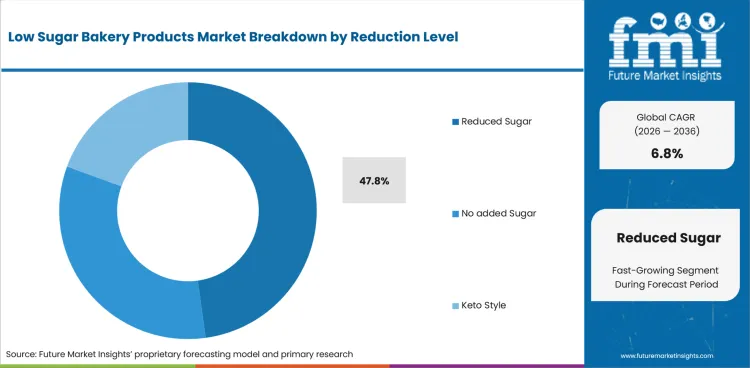
- Reduced sugar products are expected to represent 47.8% share in 2026 since mainstream buyers still accept some sugar for taste and browning.
- No added sugar products are expected to gain share where brands want a clearer front-pack claim without moving fully into zero sugar.
Insights into Low Sugar Bakery Products Market by Sales Channel
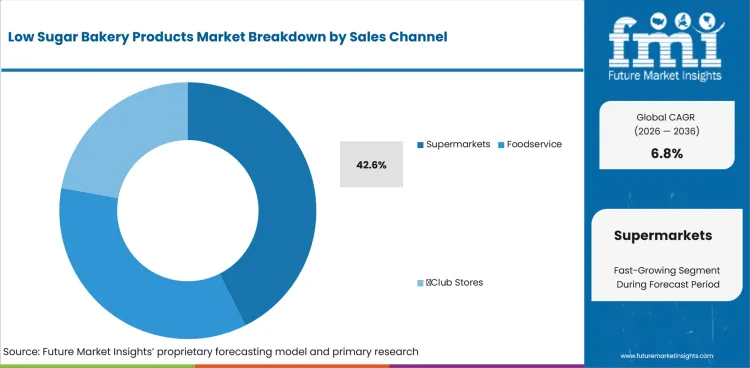
- Supermarkets are forecast to represent 42.6% share in 2026 as grocery shelves make nutrition panels easy to compare before repeat buying.
- Online retail channels are expected to gain share where specialist low sugar brands need trial outside main grocery aisles.
Insights into Low Sugar Bakery Products Market by Buyer Type
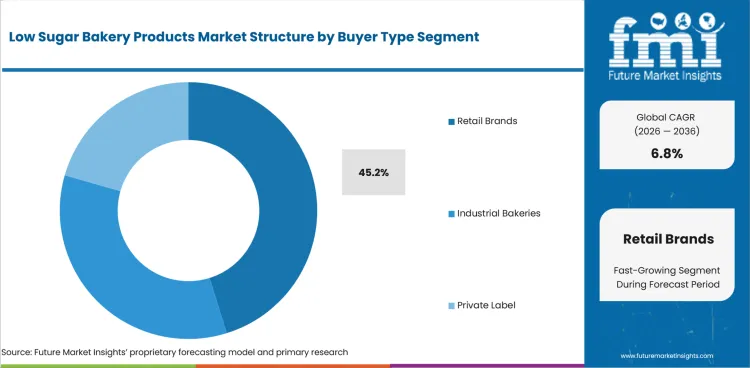
- Retail brands are estimated to hold 45.3% share in 2026 as national labels usually reformulate core sweet snacks before smaller bakery lines.
- Industrial bakeries are expected to gain share where foodservice customers need consistent lower sugar bases for repeat menus.
Insights into Low Sugar Bakery Products Market by Packaging Format
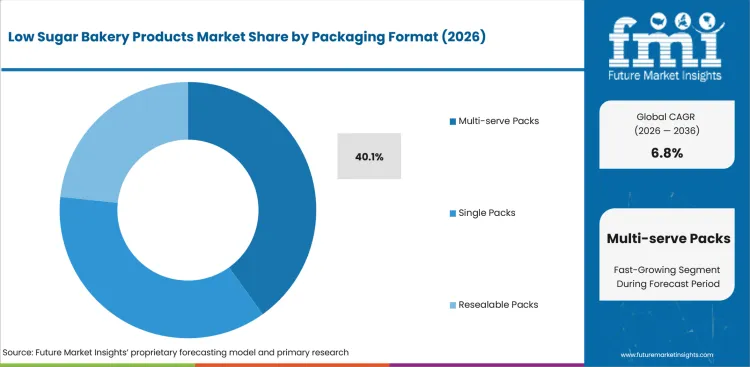
- Multi-serve packs are forecast to hold 40.1% share in 2026 because family packs keep price per serving lower than single packs.
- Single packs are expected to gain share where portion control matters more than pantry stocking.
Low Sugar Bakery Products Market Drivers, Restraints, and Opportunities
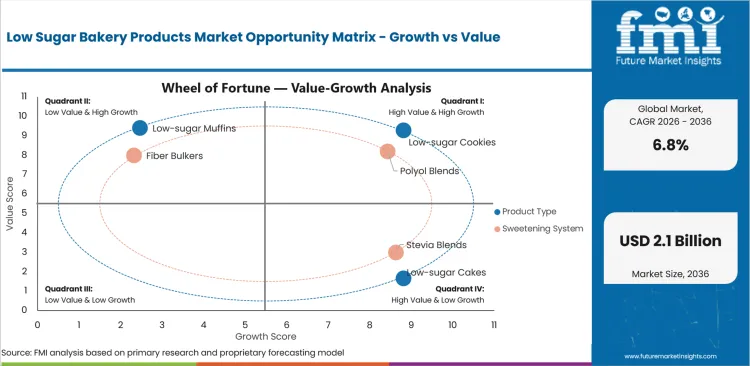
- Driver: Added sugar labeling is expected to raise reformulation activity in cakes and cookies.
- Restraint: Higher sweetener costs are likely to keep standard sugar products cheaper in mass channels.
- Opportunity: Bakery-ready sweetener systems are projected to help brands shorten reformulation cycles.
Demand planning is becoming more practical as the health reason and technical route are now visible together. The Centers for Disease Control and Prevention reported in April 2026 that Americans eat and drink too much added sugar. The same public message supports retailer interest in lower sugar snacks. Bakery brands that keep taste stable are expected to hold better repeat purchase than products framed only around restriction.
Consumer Segmentation and Purchase Behavior Analysis
Consumers are expected to split between sugar reducers and claim-driven buyers. Sugar reducers still want familiar cookies and cakes. Claim-driven buyers look for zero sugar or no added sugar on the pack. The Centers for Disease Control and Prevention links excess added sugar to weight gain, type 2 diabetes and heart disease in its April 2026 consumer guidance. That makes low sugar bakery more relevant to family snack planning and adult treat routines.
Voice of Customer and Decision-driver Analysis
Purchase decisions are expected to depend on taste trust before the sugar claim. Shoppers compare sweetness and price when polyols are used. Digestive comfort is then checked through repeat purchase feedback. Ingredion stated in November 2025 that sugar substitutes affect baking beyond sweetness and can change texture and moisture. This means suppliers need bakery-specific guidance other than a sweetener-only sales pitch. Low sugar bakery also connects with better for you snacks as shoppers want treats that fit everyday snacking and not for medical diet use.
Analysis of Low Sugar Bakery Products Market by Key Countries
.webp "Top Country Growth Comparison Low Sugar Bakery Products Market Cagr (2026 2036)")
| Country | CAGR |
|---|---|
| Saudi Arabia | 7.6% |
| United Kingdom | 7.2% |
| United States | 6.9% |
| Canada | 6.4% |
| Australia | 6.2% |
| Germany | 6.1% |
| Japan | 5.8% |
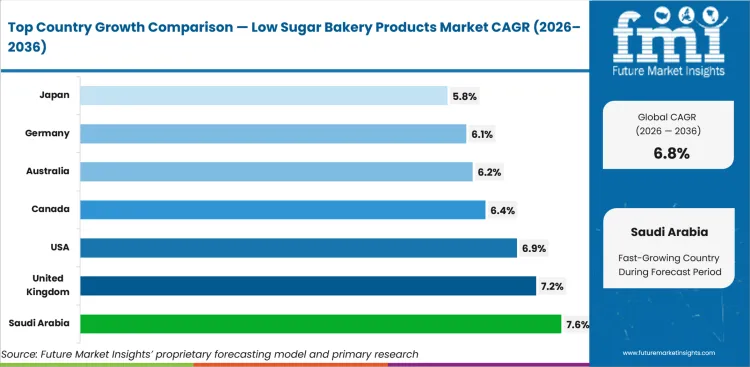
Source: Future Market Insights, 2026.
Low Sugar Bakery Products Market CAGR Analysis by Country
- Saudi Arabia is projected to record a 7.6% CAGR through 2036, supported by health-led retail screening.
- United Kingdom is expected to expand at 7.2% CAGR through 2036, attributable to advertising rules and reformulation checks.
- United States is forecast to grow at 6.9% CAGR through 2036, driven by national grocery scale and label visibility.
- Canada is expected to advance at 6.4% CAGR through 2036, supported by front-of-package symbol readiness.
- Australia is projected to rise at 6.2% CAGR through 2036, led by health rating use and supermarket private label tests.
- Germany is forecast at 6.1% CAGR through 2036, reflecting Nutri-Score pressure and bakery input inflation.
- Japan is expected to post 5.8% CAGR through 2036, owing to convenience retail and portion-control formats.
Sales Outlook for Low Sugar Bakery Products Market in Saudi Arabia
Riyadh and Jeddah premium retail corridors center · 2026 to 2036
Country Market Snapshot Table
| Parameter | Value |
|---|---|
| Market Size in 2025 (Value) | USD 40 million |
| Market Size in 2026 (Value) | USD 43 million |
| Market Forecast in 2036 (Value) | USD 89 million |
| CAGR (2026 to 2036) | 7.6% |
| Incremental Opportunity | USD 46 million |
| Years Considered | 2021 to 2036 |
| Base Year | 2025 |
| Forecast Period | 2026 to 2036 |
| Units Considered | Value (USD million) |
| Leading Sub-Region | Riyadh and Jeddah premium retail corridors |
Saudi Arabia Low Sugar Bakery Products Market Outlook
Saudi Arabia low sugar bakery demand is shaped by health screening in premium grocery corridors. Retailers are expected to use lower sugar claims to keep sweet bakery relevant as nutrition checks become more visible. International Diabetes Federation reported 5.3 million adults aged 20 to 79 living with diabetes in Saudi Arabia in 2024. That health base supports reformulated cakes and cookies only when brands keep familiar taste.
Suppliers in Saudi Arabia are expected to compete on recipe proof and pack clarity. Retail buyers need products that fit current shelf rules and avoid a large price gap. The channel implication is a stronger role for cookies and snack cakes that can be sold in small packs.
Key Growth Drivers
- Label visibility is expected to support lower sugar bakery trials in Saudi Arabia as shoppers compare sweet snacks more closely.
- Retail resets are likely to favor cookies and cakes that keep familiar taste while reducing added sugar load.
- Portion packs are projected to help families manage sweet bakery use without removing treats from weekly baskets.
- Ingredient guidance is expected to reduce reformulation risk where suppliers test sweetness and texture together.
Key Restraints
- Imported ingredient costs can limit price parity where premium low sugar products depend on foreign sweetener systems.
- Taste risk is likely to slow repeat buying when polyols leave an aftertaste or change the bite.
- Shelf-life checks can delay launches as sugar reduction changes moisture and browning in cakes.
What makes Saudi Arabia unique
Saudi Arabia is unique because health reform and premium imported bakery sales meet in the same urban retail corridors.
Key Companies
- Modern Bakery
- Dawn Foods
- Tate & Lyle
- Cargill
- Puratos
- Bakels
- Mondelez International
Sales & Marketing Channels
- Supermarkets
- Convenience stores
- Online grocery
- Club stores
- Foodservice distributors
- Specialty bakery shops
Country Segment Breakdown Table
| Segment | Sub-Segments |
|---|---|
| By Product Type | Low-sugar cookies · Low-sugar cakes · Low-sugar muffins · Low-sugar pastries · Low-sugar brownies |
| By Sweetening System | Polyol blends · Stevia blends · Allulose blends · Fiber bulkers · Fruit bases |
| By Reduction Level | Reduced sugar · No added sugar · Zero sugar · Keto style |
| By Sales Channel | Supermarkets · Online retail · Foodservice · Specialty stores · Club stores |
| By Buyer Type | Retail brands · Industrial bakeries · Private label · Artisan bakeries |
| By Packaging Format | Multi-serve packs · Single packs · Resealable packs · Foodservice cases |
| Key Sub-Regions Covered, Provinces / Municipalities | Riyadh · Jeddah · Dammam · Khobar · Makkah · Madinah · Qassim · Abha |
Frequently Asked Questions
How fast is Saudi Arabia low sugar bakery products market growing?
The Saudi Arabia market is projected to expand at 7.6% CAGR from 2026 to 2036. Growth is linked to reformulated sweet bakery and clearer sugar cues.
Who leads the Saudi Arabia low sugar bakery products market?
Local bakery brands and global ingredient suppliers lead supply in Saudi Arabia. Companies compete on taste, texture and reliable retail availability.
What is driving demand in Saudi Arabia?
Demand is driven by health-linked buying and retailer checks on added sugar. Products that keep familiar taste are expected to gain better repeat listings.
Country planning also connects with low calorie desserts where lower calorie or better-for-you product cues overlap with sweet bakery choices in Saudi Arabia.
Demand Outlook for Low Sugar Bakery Products Market in United Kingdom
London and South East retail corridors center · 2026 to 2036
Country Market Snapshot Table
| Parameter | Value |
|---|---|
| Market Size in 2025 (Value) | USD 90 million |
| Market Size in 2026 (Value) | USD 96 million |
| Market Forecast in 2036 (Value) | USD 192 million |
| CAGR (2026 to 2036) | 7.2% |
| Incremental Opportunity | USD 96 million |
| Years Considered | 2021 to 2036 |
| Base Year | 2025 |
| Forecast Period | 2026 to 2036 |
| Units Considered | Value (USD million) |
| Leading Sub-Region | London and South East retail corridors |
United Kingdom Low Sugar Bakery Products Market Outlook
Low sugar bakery planning in the United Kingdom is being pulled forward by advertising rules. Brands are expected to use lower sugar positioning before media approvals and retail promotions are reviewed. The Department of Health and Social Care stated in June 2025 that less healthy food advertising restrictions start on January 5, 2026. That timing supports reformulated cakes and cookies where brands can keep familiar taste.
Suppliers in the United Kingdom are expected to compete on recipe proof and pack clarity. Retail buyers need products that fit current shelf rules and avoid a large price gap. The channel implication is a stronger role for cookies and snack cakes that can be sold in small packs.
Key Growth Drivers
- Advertising rules are expected to push lower sugar recipes as less healthy food promotion limits begin in January 2026.
- Retail resets are likely to favor cookies and cakes that keep familiar taste while reducing added sugar load.
- Portion packs are projected to help families manage sweet bakery use without removing treats from weekly baskets.
- Ingredient guidance is expected to reduce reformulation risk where suppliers test sweetness and texture together.
Key Restraints
- Price gaps are expected to limit fast conversion in the United Kingdom where standard sugar bakery stays cheaper.
- Taste risk is likely to slow repeat buying when polyols leave an aftertaste or change the bite.
- Shelf-life checks can delay launches as sugar reduction changes moisture and browning in cakes.
What makes United Kingdom unique
The United Kingdom is unique because high fat, sugar and salt rules push reformulation before media and retail promotion decisions.
Key Companies
- Warburtons
- Premier Foods
- Dawn Foods
- Tate & Lyle
- Ingredion
- Cargill
- Mondelez International
Sales & Marketing Channels
- Supermarkets
- Convenience stores
- Online grocery
- Club stores
- Foodservice distributors
- Specialty bakery shops
Country Segment Breakdown Table
| Segment | Sub-Segments |
|---|---|
| By Product Type | Low-sugar cookies · Low-sugar cakes · Low-sugar muffins · Low-sugar pastries · Low-sugar brownies |
| By Sweetening System | Polyol blends · Stevia blends · Allulose blends · Fiber bulkers · Fruit bases |
| By Reduction Level | Reduced sugar · No added sugar · Zero sugar · Keto style |
| By Sales Channel | Supermarkets · Online retail · Foodservice · Specialty stores · Club stores |
| By Buyer Type | Retail brands · Industrial bakeries · Private label · Artisan bakeries |
| By Packaging Format | Multi-serve packs · Single packs · Resealable packs · Foodservice cases |
| Key Sub-Regions Covered, Provinces / Municipalities | London · South East England · North West England · West Midlands · Scotland · Wales · Yorkshire · Northern Ireland |
Market Taxonomy and Sub-Regions Covered
Frequently Asked Questions
How fast is United Kingdom low sugar bakery products market growing?
The United Kingdom market is projected to expand at 7.2% CAGR from 2026 to 2036. Growth is linked to reformulated sweet bakery and clearer sugar cues.
Who leads the United Kingdom low sugar bakery products market?
Local bakery brands and global ingredient suppliers lead supply in the United Kingdom. Companies compete on taste, texture and reliable retail availability.
What is driving demand in the United Kingdom?
Demand is driven by health-linked buying and retailer checks on added sugar. Products that keep familiar taste are expected to gain better repeat listings.
Opportunity Analysis for Low Sugar Bakery Products Market in United States
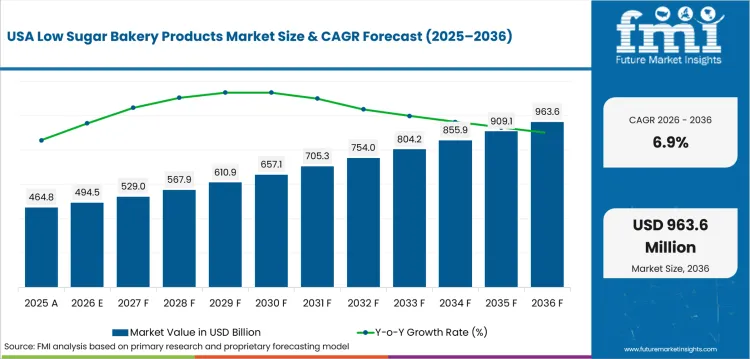
National grocery and club store networks center · 2026 to 2036
Country Market Snapshot Table
| Parameter | Value |
|---|---|
| Market Size in 2025 (Value) | USD 299 million |
| Market Size in 2026 (Value) | USD 320 million |
| Market Forecast in 2036 (Value) | USD 624 million |
| CAGR (2026 to 2036) | 6.9% |
| Incremental Opportunity | USD 304 million |
| Years Considered | 2021 to 2036 |
| Base Year | 2025 |
| Forecast Period | 2026 to 2036 |
| Units Considered | Value (USD million) |
| Leading Sub-Region | National grocery and club store networks |
United States Low Sugar Bakery Products Market Outlook
United States low sugar bakery demand is shaped by national grocery scale and label visibility. Retail brands are expected to test reduced sugar cookies first because the channel can scale familiar snacks quickly. The Centers for Disease Control and Prevention reported 40.1 million people with diabetes in the United States for 2023. This health context supports reformulated cakes and cookies where brands can keep familiar taste.
Key Growth Drivers
- Label visibility is expected to support lower sugar bakery trials in United States as shoppers compare sweet snacks more closely.
- Retail resets are likely to favor cookies and cakes that keep familiar taste while reducing added sugar load.
- Portion packs are projected to help families manage sweet bakery use without removing treats from weekly baskets.
- Ingredient guidance is expected to reduce reformulation risk where suppliers test sweetness and texture together.
Key Restraints
- Price gaps are expected to limit fast conversion in United States where standard sugar bakery stays cheaper.
- Taste risk is likely to slow repeat buying when polyols leave an aftertaste or change the bite.
- Shelf-life checks can delay launches as sugar reduction changes moisture and browning in cakes.
What makes United States unique
The United States is unique because national retail scale and added sugar labeling pressure meet in one large packaged bakery pool.
Key Companies
- Mondelez International
- Flowers Foods
- Dawn Foods
- Ingredion
- Cargill
- Tate & Lyle
- Grupo Bimbo
Sales & Marketing Channels
- Supermarkets
- Convenience stores
- Online grocery
- Club stores
- Foodservice distributors
- Specialty bakery shops
Country Segment Breakdown Table
| Segment | Sub-Segments |
|---|---|
| By Product Type | Low-sugar cookies · Low-sugar cakes · Low-sugar muffins · Low-sugar pastries · Low-sugar brownies |
| By Sweetening System | Polyol blends · Stevia blends · Allulose blends · Fiber bulkers · Fruit bases |
| By Reduction Level | Reduced sugar · No added sugar · Zero sugar · Keto style |
| By Sales Channel | Supermarkets · Online retail · Foodservice · Specialty stores · Club stores |
| By Buyer Type | Retail brands · Industrial bakeries · Private label · Artisan bakeries |
| By Packaging Format | Multi-serve packs · Single packs · Resealable packs · Foodservice cases |
| Key Sub-Regions Covered, Provinces / Municipalities | California · Texas · Florida · New York · Illinois · Pennsylvania · Georgia · Washington |
Market Taxonomy and Sub-Regions Covered
Frequently Asked Questions
How fast is United States low sugar bakery products market growing?
The United States market is projected to expand at 6.9% CAGR from 2026 to 2036. Growth is linked to reformulated sweet bakery and clearer sugar cues.
Who leads the United States low sugar bakery products market?
Local bakery brands and global ingredient suppliers lead supply in United States. Companies compete on taste, texture and reliable retail availability.
What is driving demand in United States?
Demand is driven by health-linked buying and retailer checks on added sugar. Products that keep familiar taste are expected to gain better repeat listings.
Country planning also connects with stevia products where lower calorie or better-for-you product cues overlap with sweet bakery choices in United States.
Growth Outlook for Low Sugar Bakery Products Market in Canada
Ontario and Quebec grocery corridors center · 2026 to 2036
Country Market Snapshot Table
| Parameter | Value |
|---|---|
| Market Size in 2025 (Value) | USD 77 million |
| Market Size in 2026 (Value) | USD 82 million |
| Market Forecast in 2036 (Value) | USD 152 million |
| CAGR (2026 to 2036) | 6.4% |
| Incremental Opportunity | USD 70 million |
| Years Considered | 2021 to 2036 |
| Base Year | 2025 |
| Forecast Period | 2026 to 2036 |
| Units Considered | Value (USD million) |
| Leading Sub-Region | Ontario and Quebec grocery corridors |
Canada Low Sugar Bakery Products Market Outlook
Canada low sugar bakery demand is shaped by front-of-package nutrition symbol readiness. Brands are expected to treat sugar thresholds as pack design criteria before wider retail rollout. The Public Health Agency of Canada reported 9.40% age-standardized diabetes prevalence in 2023 to 2024. That prevalence base supports reformulated cakes and cookies where brands can keep familiar taste.
Key Growth Drivers
- Front-of-package symbols are expected to push cleaner sugar positioning when the January 2026 compliance date affects packaged foods.
- Retail resets are likely to favor cookies and cakes that keep familiar taste while reducing added sugar load.
- Portion packs are projected to help families manage sweet bakery use without removing treats from weekly baskets.
- Ingredient guidance is expected to reduce reformulation risk where suppliers test sweetness and texture together.
Key Restraints
- Price gaps are expected to limit fast conversion in Canada where standard sugar bakery stays cheaper.
- Taste risk is likely to slow repeat buying when polyols leave an aftertaste or change the bite.
- Shelf-life checks can delay launches as sugar reduction changes moisture and browning in cakes.
What makes Canada unique
Canada is unique because front-of-package symbols make sugar levels visible before shoppers compare bakery prices.
Key Companies
- Canada Bread
- Voortman Bakery
- Mondelez International
- Dawn Foods
- Ingredion
- Cargill
- Tate & Lyle
Sales & Marketing Channels
- Supermarkets
- Convenience stores
- Online grocery
- Club stores
- Foodservice distributors
- Specialty bakery shops
Country Segment Breakdown Table
| Segment | Sub-Segments |
|---|---|
| By Product Type | Low-sugar cookies · Low-sugar cakes · Low-sugar muffins · Low-sugar pastries · Low-sugar brownies |
| By Sweetening System | Polyol blends · Stevia blends · Allulose blends · Fiber bulkers · Fruit bases |
| By Reduction Level | Reduced sugar · No added sugar · Zero sugar · Keto style |
| By Sales Channel | Supermarkets · Online retail · Foodservice · Specialty stores · Club stores |
| By Buyer Type | Retail brands · Industrial bakeries · Private label · Artisan bakeries |
| By Packaging Format | Multi-serve packs · Single packs · Resealable packs · Foodservice cases |
| Key Sub-Regions Covered, Provinces / Municipalities | Ontario · Quebec · British Columbia · Alberta · Manitoba · Saskatchewan · Nova Scotia · New Brunswick |
Market Taxonomy and Sub-Regions Covered
Frequently Asked Questions
How fast is Canada low sugar bakery products market growing?
The Canada market is projected to expand at 6.4% CAGR from 2026 to 2036. Growth is linked to reformulated sweet bakery and clearer sugar cues.
Who leads the Canada low sugar bakery products market?
Local bakery brands and global ingredient suppliers lead supply in Canada. Companies compete on taste, texture and reliable retail availability.
What is driving demand in Canada?
Demand is driven by health-linked buying and retailer checks on added sugar. Products that keep familiar taste are expected to gain better repeat listings.
Industry Outlook for Low Sugar Bakery Products Market in Australia
New South Wales and Victoria supermarket corridors center · 2026 to 2036
Country Market Snapshot Table
| Parameter | Value |
|---|---|
| Market Size in 2025 (Value) | USD 47 million |
| Market Size in 2026 (Value) | USD 50 million |
| Market Forecast in 2036 (Value) | USD 91 million |
| CAGR (2026 to 2036) | 6.2% |
| Incremental Opportunity | USD 41 million |
| Years Considered | 2021 to 2036 |
| Base Year | 2025 |
| Forecast Period | 2026 to 2036 |
| Units Considered | Value (USD million) |
| Leading Sub-Region | New South Wales and Victoria supermarket corridors |
Australia Low Sugar Bakery Products Market Outlook
Australia low sugar bakery demand is shaped by supermarket private label tests and health rating use. Brands are expected to use portion control and lower sugar claims where sweet bakery remains part of weekly shopping. The Australian Institute of Health and Welfare reported about 1.3 million Australians were living with diabetes in 2022 to 2024. That disease burden keeps lower sugar bakery relevant when products remain familiar and affordable.
Key Growth Drivers
- Label visibility is expected to support lower sugar bakery trials in Australia as shoppers compare sweet snacks more closely.
- Retail resets are likely to favor cookies and cakes that keep familiar taste while reducing added sugar load.
- Portion packs are projected to help families manage sweet bakery use without removing treats from weekly baskets.
- Ingredient guidance is expected to reduce reformulation risk where suppliers test sweetness and texture together.
Key Restraints
- Price gaps are expected to limit fast conversion in Australia where standard sugar bakery stays cheaper.
- Taste risk is likely to slow repeat buying when polyols leave an aftertaste or change the bite.
- Shelf-life checks can delay launches as sugar reduction changes moisture and browning in cakes.
What makes Australia unique
Australia is unique because grocery buyers already use health ratings and reformulation cues to sort packaged sweet bakery ranges.
Key Companies
- Goodman Fielder
- George Weston Foods
- Mondelez International
- Dawn Foods
- Ingredion
- Cargill
- Bakels
Sales & Marketing Channels
- Supermarkets
- Convenience stores
- Online grocery
- Club stores
- Foodservice distributors
- Specialty bakery shops
Country Segment Breakdown Table
| Segment | Sub-Segments |
|---|---|
| By Product Type | Low-sugar cookies · Low-sugar cakes · Low-sugar muffins · Low-sugar pastries · Low-sugar brownies |
| By Sweetening System | Polyol blends · Stevia blends · Allulose blends · Fiber bulkers · Fruit bases |
| By Reduction Level | Reduced sugar · No added sugar · Zero sugar · Keto style |
| By Sales Channel | Supermarkets · Online retail · Foodservice · Specialty stores · Club stores |
| By Buyer Type | Retail brands · Industrial bakeries · Private label · Artisan bakeries |
| By Packaging Format | Multi-serve packs · Single packs · Resealable packs · Foodservice cases |
| Key Sub-Regions Covered, Provinces / Municipalities | New South Wales · Victoria · Queensland · Western Australia · South Australia · Tasmania · Australian Capital Territory · Northern Territory |
Market Taxonomy and Sub-Regions Covered
Frequently Asked Questions
How fast is Australia low sugar bakery products market growing?
The Australia market is projected to expand at 6.2% CAGR from 2026 to 2036. Growth is linked to reformulated sweet bakery and clearer sugar cues.
Who leads the Australia low sugar bakery products market?
Local bakery brands and global ingredient suppliers lead supply in Australia. Companies compete on taste, texture and reliable retail availability.
What is driving demand in Australia?
Demand is driven by health-linked buying and retailer checks on added sugar. Products that keep familiar taste are expected to gain better repeat listings.
Revenue Outlook for Low Sugar Bakery Products Market in Germany
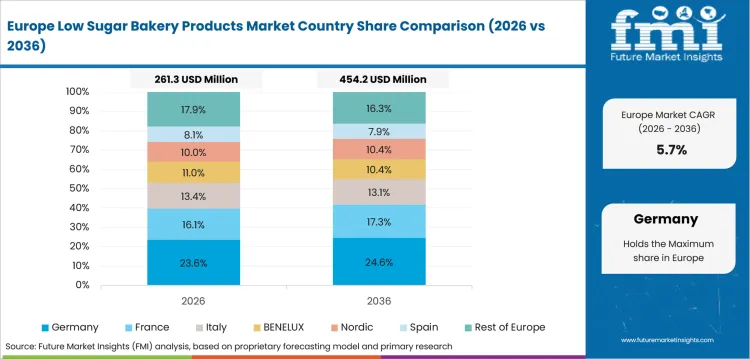
North Rhine-Westphalia and Bavaria bakery retail corridors center · 2026 to 2036
Country Market Snapshot Table
| Parameter | Value |
|---|---|
| Market Size in 2025 (Value) | USD 87 million |
| Market Size in 2026 (Value) | USD 92 million |
| Market Forecast in 2036 (Value) | USD 166 million |
| CAGR (2026 to 2036) | 6.1% |
| Incremental Opportunity | USD 74 million |
| Years Considered | 2021 to 2036 |
| Base Year | 2025 |
| Forecast Period | 2026 to 2036 |
| Units Considered | Value (USD million) |
| Leading Sub-Region | North Rhine-Westphalia and Bavaria bakery retail corridors |
Germany Low Sugar Bakery Products Market Outlook
Germany low sugar bakery demand is shaped by Nutri-Score pressure and bakery input inflation. Retailers are expected to review lower sugar bakery more closely where price inflation makes formulation choices harder. The Federal Statistical Office of Germany reported sugar, confectionery and bakery wholesale prices rose 14.7% in 2025 compared with 2024. That cost pressure makes recipe cost control as important as the sugar claim.
Key Growth Drivers
- Nutri-Score changes are expected to influence sweet bakery reformulation as stricter sugar ratings affect pack comparison.
- Retail resets are likely to favor cookies and cakes that keep familiar taste while reducing added sugar load.
- Portion packs are projected to help families manage sweet bakery use without removing treats from weekly baskets.
- Ingredient guidance is expected to reduce reformulation risk where suppliers test sweetness and texture together.
Key Restraints
- Wholesale price pressure can restrict promotion budgets as bakery and sugar-related prices rose sharply in 2025.
- Taste risk is likely to slow repeat buying when polyols leave an aftertaste or change the bite.
- Shelf-life checks can delay launches as sugar reduction changes moisture and browning in cakes.
What makes Germany unique
Germany is unique because Nutri-Score pressure and wholesale bakery input inflation push reformulation from both label and cost sides.
Key Companies
- Bahlsen
- Harry-Brot
- Mondelez International
- Cargill
- Tate & Lyle
- Roquette
- Puratos
Sales & Marketing Channels
- Supermarkets
- Convenience stores
- Online grocery
- Club stores
- Foodservice distributors
- Specialty bakery shops
Country Segment Breakdown Table
| Segment | Sub-Segments |
|---|---|
| By Product Type | Low-sugar cookies · Low-sugar cakes · Low-sugar muffins · Low-sugar pastries · Low-sugar brownies |
| By Sweetening System | Polyol blends · Stevia blends · Allulose blends · Fiber bulkers · Fruit bases |
| By Reduction Level | Reduced sugar · No added sugar · Zero sugar · Keto style |
| By Sales Channel | Supermarkets · Online retail · Foodservice · Specialty stores · Club stores |
| By Buyer Type | Retail brands · Industrial bakeries · Private label · Artisan bakeries |
| By Packaging Format | Multi-serve packs · Single packs · Resealable packs · Foodservice cases |
| Key Sub-Regions Covered, Provinces / Municipalities | North Rhine-Westphalia · Bavaria · Baden-Wuerttemberg · Hesse · Lower Saxony · Berlin · Saxony · Hamburg |
Market Taxonomy and Sub-Regions Covered
Frequently Asked Questions
How fast is Germany low sugar bakery products market growing?
The Germany market is projected to expand at 6.1% CAGR from 2026 to 2036. Growth is linked to reformulated sweet bakery and clearer sugar cues.
Who leads the Germany low sugar bakery products market?
Local bakery brands and global ingredient suppliers lead supply in Germany. Companies compete on taste, texture and reliable retail availability.
What is driving demand in Germany?
Demand is driven by health-linked buying and retailer checks on added sugar. Products that keep familiar taste are expected to gain better repeat listings.
Commercial Outlook for Low Sugar Bakery Products Market in Japan
Tokyo and Kansai convenience retail networks center · 2026 to 2036
Country Market Snapshot Table
| Parameter | Value |
|---|---|
| Market Size in 2025 (Value) | USD 68 million |
| Market Size in 2026 (Value) | USD 72 million |
| Market Forecast in 2036 (Value) | USD 127 million |
| CAGR (2026 to 2036) | 5.8% |
| Incremental Opportunity | USD 55 million |
| Years Considered | 2021 to 2036 |
| Base Year | 2025 |
| Forecast Period | 2026 to 2036 |
| Units Considered | Value (USD million) |
| Leading Sub-Region | Tokyo and Kansai convenience retail networks |
Japan Low Sugar Bakery Products Market Outlook
Japan low sugar bakery demand is shaped by convenience retail and portion-control formats. Brands are expected to use small packs to keep sweet bakery relevant as nutrition checks become more visible. The World Bank recorded Japan diabetes prevalence at 8.1% of people aged 20 to 79 in 2024. That health context supports reformulated cakes and cookies where brands can keep familiar taste.
Key Growth Drivers
- Label visibility is expected to support lower sugar bakery trials in Japan as shoppers compare sweet snacks more closely.
- Retail resets are likely to favor cookies and cakes that keep familiar taste while reducing added sugar load.
- Portion packs are projected to help families manage sweet bakery use without removing treats from weekly baskets.
- Ingredient guidance is expected to reduce reformulation risk where suppliers test sweetness and texture together.
Key Restraints
- Price gaps are expected to limit fast conversion in Japan where standard sugar bakery stays cheaper.
- Taste risk is likely to slow repeat buying when polyols leave an aftertaste or change the bite.
- Shelf-life checks can delay launches as sugar reduction changes moisture and browning in cakes.
What makes Japan unique
Japan is unique because portion-controlled sweet bakery and convenience retail make sugar reduction more format-led than claim-led.
Key Companies
- Yamazaki Baking
- Pasco Shikishima
- Fuji Baking
- Mondelez International
- Cargill
- Roquette
- Ingredion
Sales & Marketing Channels
- Supermarkets
- Convenience stores
- Online grocery
- Club stores
- Foodservice distributors
- Specialty bakery shops
Country Segment Breakdown Table
| Segment | Sub-Segments |
|---|---|
| By Product Type | Low-sugar cookies · Low-sugar cakes · Low-sugar muffins · Low-sugar pastries · Low-sugar brownies |
| By Sweetening System | Polyol blends · Stevia blends · Allulose blends · Fiber bulkers · Fruit bases |
| By Reduction Level | Reduced sugar · No added sugar · Zero sugar · Keto style |
| By Sales Channel | Supermarkets · Online retail · Foodservice · Specialty stores · Club stores |
| By Buyer Type | Retail brands · Industrial bakeries · Private label · Artisan bakeries |
| By Packaging Format | Multi-serve packs · Single packs · Resealable packs · Foodservice cases |
| Key Sub-Regions Covered, Provinces / Municipalities | Tokyo · Osaka · Kanagawa · Aichi · Saitama · Chiba · Hyogo · Fukuoka |
Market Taxonomy and Sub-Regions Covered
Frequently Asked Questions
How fast is Japan low sugar bakery products market growing?
The Japan market is projected to expand at 5.8% CAGR from 2026 to 2036. Growth is linked to reformulated sweet bakery and clearer sugar cues.
Who leads the Japan low sugar bakery products market?
Local bakery brands and global ingredient suppliers lead supply in Japan. Companies compete on taste, texture and reliable retail availability.
What is driving demand in Japan?
Demand is driven by health-linked buying and retailer checks on added sugar. Products that keep familiar taste are expected to gain better repeat listings.
Competitive Landscape and Strategic Positioning
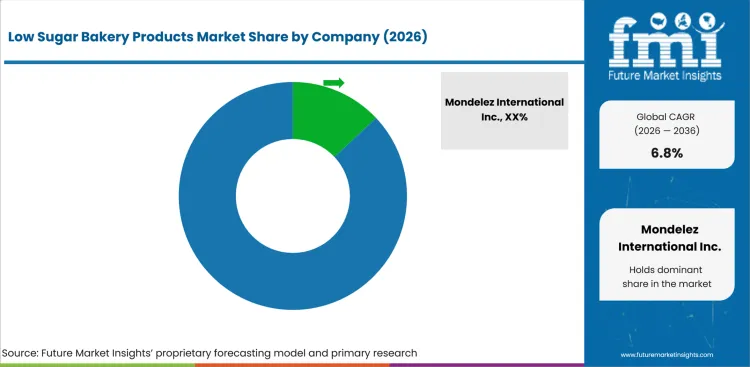
- Market structure is mixed as large bakery brands own shelf access while ingredient suppliers control reformulation know-how.
- Established companies gain from retailer trust and national distribution where low sugar products need frequent replenishment.
- Specialist brands compete through zero sugar claims and keto-style packs that reach shoppers outside mainstream bakery aisles.
- Entry barriers are tied to taste testing and digestive tolerance checks. Higher sweetener input costs add a separate pricing constraint.
Large bakery brands are focusing on shelf access and consumer trust. Mondelez shows this pattern through Oreo Zero Sugar which offers pre-portioned two-cookie packs on its official product page. That format matters because sugar reduction works better when portion control and taste familiarity move together. Grupo Bimbo and Flowers Foods are expected to rely on route-to-store strength in packaged bakery. Ingredient suppliers then shape how quickly these brands can reformulate without hurting repeat purchase.
Capability is shifting toward sweetener system design instead of single-ingredient selling. Tate & Lyle expanded its BioHarvest collaboration in May 2026 to accelerate next-generation sweetener work. This is relevant to naturally derived sweeteners because stevia taste and aftertaste still affect cookie and cake acceptance. Ingredion also published baking guidance in November 2025 explaining how sugar substitutes change texture and moisture. Suppliers that explain baking behavior are expected to win more reformulation briefs.
Buyer criteria are plain and difficult to meet at the same time. Retailers want lower added sugar and stable taste. Price points also need to stay close enough for mainstream shoppers. Cargill presented EverSweet stevia and bakery sugar reduction solutions at Food Ingredients Europe in November 2024. Roquette opened a starch and polyol pilot center in Lianyungang in April 2026. These moves show why application testing and polyol supply are expected to matter more than claim wording.
Barriers stay high for small entrants when texture, labeling and supply reliability are evaluated together. Low sugar bakery draws from baking ingredients but needs more product-level proof than standard bakery inputs. Dawn Foods expanded access to Royal Steensma products in June 2024. This supports bakery customers needing ready decorations and inclusions for reformulated sweet goods. Smaller brands can still win through zero sugar cookies where online trial reduces listing costs.
Key Companies in the Low Sugar Bakery Products Market
Competition combines branded bakery scale with ingredient system expertise and regional bakery distribution.
- Global Leaders: Mondelez International sells Oreo and other baked snacks across major grocery markets. Grupo Bimbo supplies packaged bakery through wide retail and route networks. Cargill and Tate & Lyle support reformulation through sweetener systems used by food manufacturers that need lower sugar recipes with stable taste and texture.
- Regional Players: Dawn Foods serves bakery customers through mixes and fillings across North America and Europe. Roquette supplies polyols and fibers for bakery and snack applications. Bakels and Puratos compete where bakery customers need application support close to production sites.
- Specialist and Challenger Brands: Voortman Bakery, HighKey and Quest-style snack brands compete by placing sugar reduction at the front of the pack. These companies are expected to pressure mainstream brands through keto-style cookies and portion formats. Their challenge is wider distribution and price parity.
Competitive Benchmarking: Low Sugar Bakery Products Market
| Company | Bakery Reformulation Proof | Sweetener System Depth | Retail or Foodservice Reach | Geographic Footprint |
|---|---|---|---|---|
| Mondelez International Inc. | High | Medium | High | Global |
| Grupo Bimbo S.A.B. de C.V. | High | Medium | High | Global |
| Dawn Food Products Inc. | High | Medium | Strong | North America and Europe |
| Tate & Lyle PLC | Medium | High | Strong | Global |
| Ingredion Incorporated | Medium | High | Strong | Global |
| Cargill Incorporated | Medium | High | Strong | Global |
| Roquette Freres | Medium | High | Moderate | Europe and Asia |
| Puratos Group | High | Medium | Strong | Global |
| Flowers Foods Inc. | High | Low | High | United States |
| Bakels Group | Medium | Medium | Moderate | Europe and Asia Pacific |
Source: Future Market Insights competitive analysis 2026. Ratings reflect relative positioning based on bakery reformulation proof, sweetener system depth and retail or foodservice reach.
Key Developments in Low Sugar Bakery Products Market
- In May 2026, Tate & Lyle expanded its BioHarvest collaboration to accelerate next-generation sweetener work. The move supports sweetening systems that can serve low sugar bakery reformulation.
- In November 2025, Ingredion published baking guidance on sugar substitutes and texture. The guidance supports bakery brands managing moisture and shelf life after sugar reduction.
- In April 2026, Roquette opened a starch and polyol pilot center in Lianyungang. The center supports application testing for polyol and starch systems used in bakery texture design.
Key Players in the Low Sugar Bakery Products Market
Global Leaders
- Mondelez International Inc.
- Grupo Bimbo S.A.B. de C.V.
- Cargill Incorporated
- Tate & Lyle PLC
- Ingredion Incorporated
Regional Players
- Dawn Food Products Inc.
- Roquette Freres
- Puratos Group
- Bakels Group
Specialist and Challenger Brands
- Voortman Bakery Ltd.
- HighKey Snacks
- Quest Nutrition LLC
Low Sugar Bakery Products Market - Report Scope and Coverage
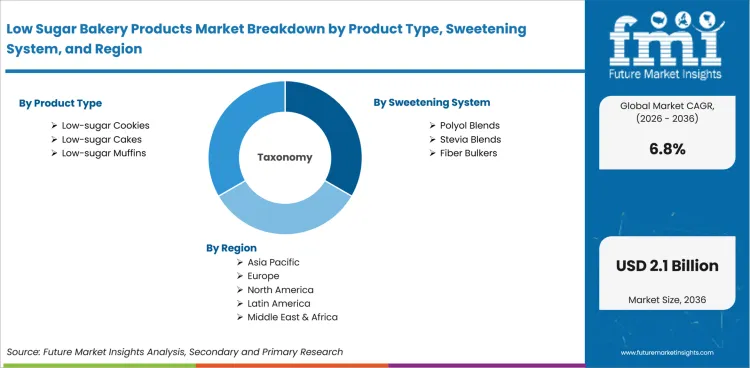
| Parameter | Details |
|---|---|
| Forecast Period | 2026 to 2036 |
| Base Year | 2025 |
| Historical Years | 2021 to 2025 |
| Quantitative Units | USD billion |
| 2025 Market Size | USD 1.03 billion |
| 2026 Market Size | USD 1.10 billion |
| 2036 Market Size | USD 2.12 billion |
| Forecast CAGR | 6.8% from 2026 to 2036 |
| Product Type | Low‑sugar cookies, low‑sugar cakes, low‑sugar muffins, low‑sugar pastries, low‑sugar brownies |
| Sweetening System | Polyol blends, stevia blends, allulose blends, fiber bulkers, fruit bases |
| Reduction Level | Reduced sugar, no added sugar, zero sugar, keto‑style |
| Sales Channel | Supermarkets, online retail, foodservice, specialty stores, club stores |
| Buyer Type | Retail brands, industrial bakeries, private label, artisan bakeries |
| Packaging Format | Multi‑serve packs, single packs, resealable packs, foodservice cases |
| Regions Covered | North America, Latin America, Europe, East Asia, South Asia & Pacific, Middle East and Africa |
| Countries Covered | Saudi Arabia, United Kingdom, United States, Canada, Australia, Germany, Japan, and other key markets |
| Market Definition | Finished sweet bakery products positioned with reduced sugar, no added sugar, or zero sugar claims across retail and foodservice channels |
| Methodology | Bottom‑up product‑boundary approach based on eligible SKUs, retailer listings, formulation positioning, added‑sugar thresholds, channel mix, and country‑level adoption patterns |
Low Sugar Bakery Products Market by Segments
Low Sugar Bakery Products Market Segmented by Product Type:
- Low-sugar cookies
- Low-sugar cakes
- Low-sugar muffins
- Low-sugar pastries
- Low-sugar brownies
Low Sugar Bakery Products Market Segmented by Sweetening System:
- Polyol blends
- Stevia blends
- Allulose blends
- Fiber bulkers
- Fruit bases
Low Sugar Bakery Products Market Segmented by Reduction Level:
- Reduced sugar
- No added sugar
- Zero sugar
- Keto style
Low Sugar Bakery Products Market Segmented by Sales Channel:
- Supermarkets
- Online retail
- Foodservice
- Specialty stores
- Club stores
Low Sugar Bakery Products Market Segmented by Buyer Type:
- Retail brands
- Industrial bakeries
- Private label
- Artisan bakeries
Low Sugar Bakery Products Market Segmented by Packaging Format:
- Multi-serve packs
- Single packs
- Resealable packs
- Foodservice cases
Low Sugar Bakery Products Market by Region:
- North America
- United States
- Canada
- Mexico
- Latin America
- Brazil
- Chile
- Rest of Latin America
- Western Europe
- Germany
- UK
- Italy
- Spain
- France
- Nordic
- BENELUX
- Rest of Western Europe
- Eastern Europe
- Russia
- Poland
- Hungary
- Balkan and Baltic
- Rest of Eastern Europe
- East Asia
- China
- Japan
- South Korea
- South Asia and Pacific
- India
- ASEAN
- Australia and New Zealand
- Rest of South Asia and Pacific
- Middle East and Africa
- Kingdom of Saudi Arabia
- Other GCC Countries
- Turkiye
- South Africa
- Other African Union
- Rest of Middle East and Africa
Research Sources and Bibliography
- Centers for Disease Control and Prevention. (2026, April 29). Get the facts: Added sugars. Centers for Disease Control and Prevention.
- Centers for Disease Control and Prevention. (2026, January 21). National diabetes statistics report. Centers for Disease Control and Prevention.
- United States Food and Drug Administration. (2024, December 19). FDA updates healthy claim providing refreshed tool for consumers. United States Food and Drug Administration.
- United States Food and Drug Administration. (2025, January 14). FDA issues proposed rule on front-of-package nutrition labeling. United States Food and Drug Administration.
- Health Canada. (2026, January 5). Nutrition labelling: Front-of-package nutrition symbol. Government of Canada.
- Public Health Agency of Canada. (2025, November 20). Diabetes in Canada: An interactive report on key statistics. Government of Canada.
- Department of Health and Social Care. (2025, June 4). Restricting advertising of less healthy food or drink on TV and online. Government of the United Kingdom.
- Department of Health and Social Care. (2025, October 1). Restricting promotions of products high in fat, sugar or salt by location and by volume price. Government of the United Kingdom.
- Federal Statistical Office of Germany. (2026, January 15). Wholesale prices in December 2025: +1.2% on December 2024. Destatis.
- Max Rubner-Institut. (2024, February 14). Nature Food publication on the revision of the Nutri-Score algorithm. Max Rubner-Institut.
- International Diabetes Federation. (2026, May). Saudi Arabia diabetes trends and insights. International Diabetes Federation Diabetes Atlas.
- Australian Institute of Health and Welfare. (2026, May 27). Australian facts: All diabetes. Australian Institute of Health and Welfare.
- World Bank. (2026, May). Diabetes prevalence of population ages 20 to 79. World Development Indicators.
- World Health Organization. (2024, November 14). Diabetes. World Health Organization.
- Mondelez Global LLC. (2026). Zero Sugar Chocolate Sandwich Cookies. OREO.
- Tate & Lyle PLC. (2026, May 18). Tate & Lyle expands collaboration with BioHarvest to accelerate next-generation sweetener innovation. Tate & Lyle PLC.
- Ingredion Incorporated. (2025, November 10). What you should know before using a sugar substitute for baking. Ingredion Incorporated.
- Cargill Incorporated. (2024, November). Cargill food solutions at Food Ingredients Europe 2024. Cargill Incorporated.
- Roquette Freres. (2026, April 6). Roquette opens starch and polyol pilot center in Lianyungang. Roquette Freres.
- Dawn Food Products Inc. (2024, June 1). First selection of Royal Steensma products now available through Dawn Foods. Dawn Foods.
This Report Answers
- What is the estimated value of low sugar bakery products in 2026 and how is the figure calculated?
- How fast is the low sugar bakery products market expected to expand from 2026 to 2036?
- Which product type is projected to account for the leading share in low sugar sweet bakery?
- Which sweetening system is expected to hold the larger share in bakery sugar reduction?
- How do added sugar labeling rules affect cakes, cookies and sweet bakery reformulation?
- Which countries are expected to show the stronger pace for low sugar bakery sales?
- Which companies compete through branded bakery and which compete through ingredient systems?
- What products are excluded from the low sugar bakery products market boundary?
- How does FMI validate product-boundary sizing for low sugar bakery categories?
Frequently Asked Questions
What is the global market demand for Low Sugar Bakery Products Market in 2026?
In 2026, the global Low Sugar Bakery Products Market is expected to be worth USD 1.10 billion with cookies leading product use.
What is the forecast value of Low Sugar Bakery Products Market by 2036?
The market is projected to reach USD 2.12 billion by 2036 as reformulated sweet bakery gains more grocery listings.
What CAGR is expected for Low Sugar Bakery Products Market?
The market is forecast to expand at 6.8% CAGR from 2026 to 2036 across finished low sugar sweet bakery.
Which product type leads the Low Sugar Bakery Products Market?
Low-sugar cookies are projected to lead with 39.2% share in 2026 due to familiar formats and faster shelf rotation.
Which sales channel leads low sugar bakery products?
Supermarkets are expected to lead with 42.6% share in 2026 where shoppers compare nutrition panels at shelf level.
Which country grows fastest in low sugar bakery products?
Saudi Arabia is forecast at 7.6% CAGR by 2036 as health screening and premium retail support reformulated bakery.
What products are included in the Low Sugar Bakery Products Market?
The scope includes reduced sugar and no added sugar cookies. Zero sugar cakes and muffins are included when pack claims are clear.
Preview the report firsthand - request a free sample
Get SampleGet the brochure for pricing and purchase details.
Get PDFTable of Content
- Executive Summary
- Global Market Outlook
- Demand to side Trends
- Supply to side Trends
- Technology Roadmap Analysis
- Analysis and Recommendations
- Market Overview
- Market Coverage / Taxonomy
- Market Definition / Scope / Limitations
- Research Methodology
- Chapter Orientation
- Analytical Lens and Working Hypotheses
- Market Structure, Signals, and Trend Drivers
- Benchmarking and Cross-market Comparability
- Market Sizing, Forecasting, and Opportunity Mapping
- Research Design and Evidence Framework
- Desk Research Programme (Secondary Evidence)
- Company Annual and Sustainability Reports
- Peer-reviewed Journals and Academic Literature
- Corporate Websites, Product Literature, and Technical Notes
- Earnings Decks and Investor Briefings
- Statutory Filings and Regulatory Disclosures
- Technical White Papers and Standards Notes
- Trade Journals, Industry Magazines, and Analyst Briefs
- Conference Proceedings, Webinars, and Seminar Materials
- Government Statistics Portals and Public Data Releases
- Press Releases and Reputable Media Coverage
- Specialist Newsletters and Curated Briefings
- Sector Databases and Reference Repositories
- FMI Internal Proprietary Databases and Historical Market Datasets
- Subscription Datasets and Paid Sources
- Social Channels, Communities, and Digital Listening Inputs
- Additional Desk Sources
- Expert Input and Fieldwork (Primary Evidence)
- Primary Modes
- Qualitative Interviews and Expert Elicitation
- Quantitative Surveys and Structured Data Capture
- Blended Approach
- Why Primary Evidence is Used
- Field Techniques
- Interviews
- Surveys
- Focus Groups
- Observational and In-context Research
- Social and Community Interactions
- Stakeholder Universe Engaged
- C-suite Leaders
- Board Members
- Presidents and Vice Presidents
- R&D and Innovation Heads
- Technical Specialists
- Domain Subject-matter Experts
- Scientists
- Physicians and Other Healthcare Professionals
- Governance, Ethics, and Data Stewardship
- Research Ethics
- Data Integrity and Handling
- Primary Modes
- Tooling, Models, and Reference Databases
- Desk Research Programme (Secondary Evidence)
- Data Engineering and Model Build
- Data Acquisition and Ingestion
- Cleaning, Normalisation, and Verification
- Synthesis, Triangulation, and Analysis
- Quality Assurance and Audit Trail
- Market Background
- Market Dynamics
- Drivers
- Restraints
- Opportunity
- Trends
- Scenario Forecast
- Demand in Optimistic Scenario
- Demand in Likely Scenario
- Demand in Conservative Scenario
- Opportunity Map Analysis
- Product Life Cycle Analysis
- Supply Chain Analysis
- Investment Feasibility Matrix
- Value Chain Analysis
- PESTLE and Porter’s Analysis
- Regulatory Landscape
- Regional Parent Market Outlook
- Production and Consumption Statistics
- Import and Export Statistics
- Market Dynamics
- Global Market Analysis 2021 to 2025 and Forecast, 2026 to 2036
- Historical Market Size Value (USD Million) Analysis, 2021 to 2025
- Current and Future Market Size Value (USD Million) Projections, 2026 to 2036
- Y to o to Y Growth Trend Analysis
- Absolute $ Opportunity Analysis
- Global Market Pricing Analysis 2021 to 2025 and Forecast 2026 to 2036
- Global Market Analysis 2021 to 2025 and Forecast 2026 to 2036, By Product Type
- Introduction / Key Findings
- Historical Market Size Value (USD Million) Analysis By Product Type , 2021 to 2025
- Current and Future Market Size Value (USD Million) Analysis and Forecast By Product Type , 2026 to 2036
- Low-sugar Cookies
- Low-sugar Cakes
- Low-sugar Muffins
- Low-sugar Cookies
- Y to o to Y Growth Trend Analysis By Product Type , 2021 to 2025
- Absolute $ Opportunity Analysis By Product Type , 2026 to 2036
- Global Market Analysis 2021 to 2025 and Forecast 2026 to 2036, By Sweetening System
- Introduction / Key Findings
- Historical Market Size Value (USD Million) Analysis By Sweetening System, 2021 to 2025
- Current and Future Market Size Value (USD Million) Analysis and Forecast By Sweetening System, 2026 to 2036
- Polyol Blends
- Stevia Blends
- Fiber Bulkers
- Polyol Blends
- Y to o to Y Growth Trend Analysis By Sweetening System, 2021 to 2025
- Absolute $ Opportunity Analysis By Sweetening System, 2026 to 2036
- Global Market Analysis 2021 to 2025 and Forecast 2026 to 2036, By Reduction Level
- Introduction / Key Findings
- Historical Market Size Value (USD Million) Analysis By Reduction Level, 2021 to 2025
- Current and Future Market Size Value (USD Million) Analysis and Forecast By Reduction Level, 2026 to 2036
- Reduced Sugar
- No added Sugar
- Keto Style
- Reduced Sugar
- Y to o to Y Growth Trend Analysis By Reduction Level, 2021 to 2025
- Absolute $ Opportunity Analysis By Reduction Level, 2026 to 2036
- Global Market Analysis 2021 to 2025 and Forecast 2026 to 2036, By Sales Channel
- Introduction / Key Findings
- Historical Market Size Value (USD Million) Analysis By Sales Channel, 2021 to 2025
- Current and Future Market Size Value (USD Million) Analysis and Forecast By Sales Channel, 2026 to 2036
- Supermarkets
- Foodservice
- Club Stores
- Supermarkets
- Y to o to Y Growth Trend Analysis By Sales Channel, 2021 to 2025
- Absolute $ Opportunity Analysis By Sales Channel, 2026 to 2036
- Global Market Analysis 2021 to 2025 and Forecast 2026 to 2036, By Buyer Type
- Introduction / Key Findings
- Historical Market Size Value (USD Million) Analysis By Buyer Type, 2021 to 2025
- Current and Future Market Size Value (USD Million) Analysis and Forecast By Buyer Type, 2026 to 2036
- Retail Brands
- Industrial Bakeries
- Private Label
- Retail Brands
- Y to o to Y Growth Trend Analysis By Buyer Type, 2021 to 2025
- Absolute $ Opportunity Analysis By Buyer Type, 2026 to 2036
- Global Market Analysis 2021 to 2025 and Forecast 2026 to 2036, By Packaging Format
- Introduction / Key Findings
- Historical Market Size Value (USD Million) Analysis By Packaging Format, 2021 to 2025
- Current and Future Market Size Value (USD Million) Analysis and Forecast By Packaging Format, 2026 to 2036
- Multi-serve Packs
- Single Packs
- Resealable Packs
- Multi-serve Packs
- Y to o to Y Growth Trend Analysis By Packaging Format, 2021 to 2025
- Absolute $ Opportunity Analysis By Packaging Format, 2026 to 2036
- Global Market Analysis 2021 to 2025 and Forecast 2026 to 2036, By Region
- Introduction
- Historical Market Size Value (USD Million) Analysis By Region, 2021 to 2025
- Current Market Size Value (USD Million) Analysis and Forecast By Region, 2026 to 2036
- North America
- Latin America
- Western Europe
- Eastern Europe
- East Asia
- South Asia and Pacific
- Middle East & Africa
- Market Attractiveness Analysis By Region
- North America Market Analysis 2021 to 2025 and Forecast 2026 to 2036, By Country
- Historical Market Size Value (USD Million) Trend Analysis By Market Taxonomy, 2021 to 2025
- Market Size Value (USD Million) Forecast By Market Taxonomy, 2026 to 2036
- By Country
- USA
- Canada
- Mexico
- By Product Type
- By Sweetening System
- By Reduction Level
- By Sales Channel
- By Buyer Type
- By Packaging Format
- By Country
- Market Attractiveness Analysis
- By Country
- By Product Type
- By Sweetening System
- By Reduction Level
- By Sales Channel
- By Buyer Type
- By Packaging Format
- Key Takeaways
- Latin America Market Analysis 2021 to 2025 and Forecast 2026 to 2036, By Country
- Historical Market Size Value (USD Million) Trend Analysis By Market Taxonomy, 2021 to 2025
- Market Size Value (USD Million) Forecast By Market Taxonomy, 2026 to 2036
- By Country
- Brazil
- Chile
- Rest of Latin America
- By Product Type
- By Sweetening System
- By Reduction Level
- By Sales Channel
- By Buyer Type
- By Packaging Format
- By Country
- Market Attractiveness Analysis
- By Country
- By Product Type
- By Sweetening System
- By Reduction Level
- By Sales Channel
- By Buyer Type
- By Packaging Format
- Key Takeaways
- Western Europe Market Analysis 2021 to 2025 and Forecast 2026 to 2036, By Country
- Historical Market Size Value (USD Million) Trend Analysis By Market Taxonomy, 2021 to 2025
- Market Size Value (USD Million) Forecast By Market Taxonomy, 2026 to 2036
- By Country
- Germany
- UK
- Italy
- Spain
- France
- Nordic
- BENELUX
- Rest of Western Europe
- By Product Type
- By Sweetening System
- By Reduction Level
- By Sales Channel
- By Buyer Type
- By Packaging Format
- By Country
- Market Attractiveness Analysis
- By Country
- By Product Type
- By Sweetening System
- By Reduction Level
- By Sales Channel
- By Buyer Type
- By Packaging Format
- Key Takeaways
- Eastern Europe Market Analysis 2021 to 2025 and Forecast 2026 to 2036, By Country
- Historical Market Size Value (USD Million) Trend Analysis By Market Taxonomy, 2021 to 2025
- Market Size Value (USD Million) Forecast By Market Taxonomy, 2026 to 2036
- By Country
- Russia
- Poland
- Hungary
- Balkan & Baltic
- Rest of Eastern Europe
- By Product Type
- By Sweetening System
- By Reduction Level
- By Sales Channel
- By Buyer Type
- By Packaging Format
- By Country
- Market Attractiveness Analysis
- By Country
- By Product Type
- By Sweetening System
- By Reduction Level
- By Sales Channel
- By Buyer Type
- By Packaging Format
- Key Takeaways
- East Asia Market Analysis 2021 to 2025 and Forecast 2026 to 2036, By Country
- Historical Market Size Value (USD Million) Trend Analysis By Market Taxonomy, 2021 to 2025
- Market Size Value (USD Million) Forecast By Market Taxonomy, 2026 to 2036
- By Country
- China
- Japan
- South Korea
- By Product Type
- By Sweetening System
- By Reduction Level
- By Sales Channel
- By Buyer Type
- By Packaging Format
- By Country
- Market Attractiveness Analysis
- By Country
- By Product Type
- By Sweetening System
- By Reduction Level
- By Sales Channel
- By Buyer Type
- By Packaging Format
- Key Takeaways
- South Asia and Pacific Market Analysis 2021 to 2025 and Forecast 2026 to 2036, By Country
- Historical Market Size Value (USD Million) Trend Analysis By Market Taxonomy, 2021 to 2025
- Market Size Value (USD Million) Forecast By Market Taxonomy, 2026 to 2036
- By Country
- India
- ASEAN
- Australia & New Zealand
- Rest of South Asia and Pacific
- By Product Type
- By Sweetening System
- By Reduction Level
- By Sales Channel
- By Buyer Type
- By Packaging Format
- By Country
- Market Attractiveness Analysis
- By Country
- By Product Type
- By Sweetening System
- By Reduction Level
- By Sales Channel
- By Buyer Type
- By Packaging Format
- Key Takeaways
- Middle East & Africa Market Analysis 2021 to 2025 and Forecast 2026 to 2036, By Country
- Historical Market Size Value (USD Million) Trend Analysis By Market Taxonomy, 2021 to 2025
- Market Size Value (USD Million) Forecast By Market Taxonomy, 2026 to 2036
- By Country
- Kingdom of Saudi Arabia
- Other GCC Countries
- Turkiye
- South Africa
- Other African Union
- Rest of Middle East & Africa
- By Product Type
- By Sweetening System
- By Reduction Level
- By Sales Channel
- By Buyer Type
- By Packaging Format
- By Country
- Market Attractiveness Analysis
- By Country
- By Product Type
- By Sweetening System
- By Reduction Level
- By Sales Channel
- By Buyer Type
- By Packaging Format
- Key Takeaways
- Key Countries Market Analysis
- USA
- Pricing Analysis
- Market Share Analysis, 2025
- By Product Type
- By Sweetening System
- By Reduction Level
- By Sales Channel
- By Buyer Type
- By Packaging Format
- Canada
- Pricing Analysis
- Market Share Analysis, 2025
- By Product Type
- By Sweetening System
- By Reduction Level
- By Sales Channel
- By Buyer Type
- By Packaging Format
- Mexico
- Pricing Analysis
- Market Share Analysis, 2025
- By Product Type
- By Sweetening System
- By Reduction Level
- By Sales Channel
- By Buyer Type
- By Packaging Format
- Brazil
- Pricing Analysis
- Market Share Analysis, 2025
- By Product Type
- By Sweetening System
- By Reduction Level
- By Sales Channel
- By Buyer Type
- By Packaging Format
- Chile
- Pricing Analysis
- Market Share Analysis, 2025
- By Product Type
- By Sweetening System
- By Reduction Level
- By Sales Channel
- By Buyer Type
- By Packaging Format
- Germany
- Pricing Analysis
- Market Share Analysis, 2025
- By Product Type
- By Sweetening System
- By Reduction Level
- By Sales Channel
- By Buyer Type
- By Packaging Format
- UK
- Pricing Analysis
- Market Share Analysis, 2025
- By Product Type
- By Sweetening System
- By Reduction Level
- By Sales Channel
- By Buyer Type
- By Packaging Format
- Italy
- Pricing Analysis
- Market Share Analysis, 2025
- By Product Type
- By Sweetening System
- By Reduction Level
- By Sales Channel
- By Buyer Type
- By Packaging Format
- Spain
- Pricing Analysis
- Market Share Analysis, 2025
- By Product Type
- By Sweetening System
- By Reduction Level
- By Sales Channel
- By Buyer Type
- By Packaging Format
- France
- Pricing Analysis
- Market Share Analysis, 2025
- By Product Type
- By Sweetening System
- By Reduction Level
- By Sales Channel
- By Buyer Type
- By Packaging Format
- India
- Pricing Analysis
- Market Share Analysis, 2025
- By Product Type
- By Sweetening System
- By Reduction Level
- By Sales Channel
- By Buyer Type
- By Packaging Format
- ASEAN
- Pricing Analysis
- Market Share Analysis, 2025
- By Product Type
- By Sweetening System
- By Reduction Level
- By Sales Channel
- By Buyer Type
- By Packaging Format
- Australia & New Zealand
- Pricing Analysis
- Market Share Analysis, 2025
- By Product Type
- By Sweetening System
- By Reduction Level
- By Sales Channel
- By Buyer Type
- By Packaging Format
- China
- Pricing Analysis
- Market Share Analysis, 2025
- By Product Type
- By Sweetening System
- By Reduction Level
- By Sales Channel
- By Buyer Type
- By Packaging Format
- Japan
- Pricing Analysis
- Market Share Analysis, 2025
- By Product Type
- By Sweetening System
- By Reduction Level
- By Sales Channel
- By Buyer Type
- By Packaging Format
- South Korea
- Pricing Analysis
- Market Share Analysis, 2025
- By Product Type
- By Sweetening System
- By Reduction Level
- By Sales Channel
- By Buyer Type
- By Packaging Format
- Russia
- Pricing Analysis
- Market Share Analysis, 2025
- By Product Type
- By Sweetening System
- By Reduction Level
- By Sales Channel
- By Buyer Type
- By Packaging Format
- Poland
- Pricing Analysis
- Market Share Analysis, 2025
- By Product Type
- By Sweetening System
- By Reduction Level
- By Sales Channel
- By Buyer Type
- By Packaging Format
- Hungary
- Pricing Analysis
- Market Share Analysis, 2025
- By Product Type
- By Sweetening System
- By Reduction Level
- By Sales Channel
- By Buyer Type
- By Packaging Format
- Kingdom of Saudi Arabia
- Pricing Analysis
- Market Share Analysis, 2025
- By Product Type
- By Sweetening System
- By Reduction Level
- By Sales Channel
- By Buyer Type
- By Packaging Format
- Turkiye
- Pricing Analysis
- Market Share Analysis, 2025
- By Product Type
- By Sweetening System
- By Reduction Level
- By Sales Channel
- By Buyer Type
- By Packaging Format
- South Africa
- Pricing Analysis
- Market Share Analysis, 2025
- By Product Type
- By Sweetening System
- By Reduction Level
- By Sales Channel
- By Buyer Type
- By Packaging Format
- USA
- Market Structure Analysis
- Competition Dashboard
- Competition Benchmarking
- Market Share Analysis of Top Players
- By Regional
- By Product Type
- By Sweetening System
- By Reduction Level
- By Sales Channel
- By Buyer Type
- By Packaging Format
- Competition Analysis
- Competition Deep Dive
- Mondelez International Inc.
- Overview
- Product Portfolio
- Profitability by Market Segments (Product/Age /Sales Channel/Region)
- Sales Footprint
- Strategy Overview
- Marketing Strategy
- Product Strategy
- Channel Strategy
- Grupo Bimbo S.A.B. de C.V.
- Cargill Incorporated
- Tate & Lyle PLC
- Ingredion Incorporated
- Mondelez International Inc.
- Competition Deep Dive
- Assumptions & Acronyms Used


