

- Industry Size (2022)
- USD 6945.4 Mn
- Forecast (2032)
- USD 45932.8 Mn
- CAGR (2022 to 2032)
- 20.8%
Enterprise File Sharing and Synchronization (EFSS) Market Outlook (2022-2032)
[420 Pages Report] The global enterprise file sharing and synchronization (EFSS) market revenue totaled ~US$ 6,945.4 Mn in 2022. The enterprise file sharing and synchronization (EFSS) market is expected to reach ~US$ 45,932.8 Mn by 2032, growing at a CAGR of 20.8% for 2022 – 2032.
|
Enterprise File Sharing and Synchronization (EFSS) Market Value (2022) |
US$ 6,945.4 Mn |
|
Projected Year (2032) Market Value |
US$ 45,932.8 Mn |
|
CAGR% (2022-2032) |
20.8% |
|
Top 5 Vendor Market Share |
Around 45% |
The enterprise file sharing and synchronization (EFSS) market currently represents about 14% of the overall global enterprise collaboration market. EFSS solutions offers a service to maintain data such as documents, videos, and photos in the on-premises or cloud storage. Furthermore, it helps users in sharing files, reviewing, editing, and storing, EFSS solutions also allows document version tracking, remarking, and workflow process management.
2017-2021 Enterprise File Sharing and Synchronization (EFSS) Demand Outlook Compared to 2022-2032 Forecast
The enterprise file sharing and synchronization (EFSS) demand is estimated to grow at 20.8% CAGR during the forecast period (2022-2032). Enterprise file sharing and synchronization solutions allow businesses to securely share and synchronize such as files, documents, videos, and images.
Key factors improving the growth in the market is on the back of rising adoption of these technologies to help employees avoid utilizing consumer-based data-sharing software and applications to manage, access, and store data. As per Future Market Insights (FMI), the demand in the EFSS market is expected to increase at US$ 6,945.4 Mn by the end of 2022..
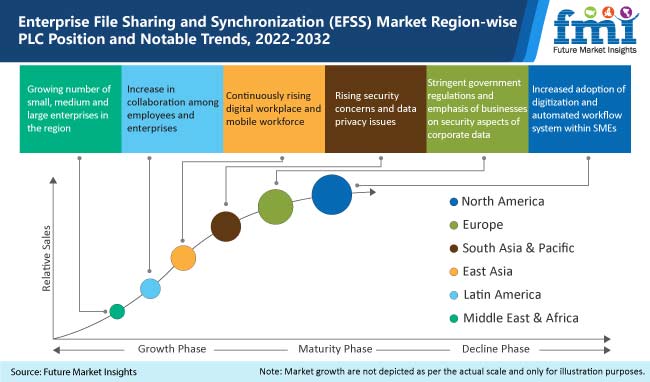
What are the Key Trends Boosting the Enterprise File Sharing and Synchronization (EFSS) Market?
Growth in the market is primarily attributed to growing adoption of these solutions in organizations to implement security solutions and protect employees from using consumer-based data sharing applications.
These applications are also used to manage, store and access the company’s data that not in IT department’s visibility and control. To fulfil the required data security, adoption of enterprise file sharing and synchronization solutions is expected to surge in the organizations.
EFSS solutions offer security capabilities such as data encryption, maintaining, authentication, and tracking features to prevent the firm’s data. These advantages are aiding the adoption of EFSS solutions and services in small & medium as well as large organizations.
Further, the implementation of BYOD programs in firms, rise in mobile workforce, increasing penetration of smartphones across businesses, and stringent government policies for data security are driving the growth of the EFSS market.
Which is the Leading Region in Enterprise File Sharing and Synchronization Market?
The EFSS market in South Asia and Pacific is expected to grow at the fastest rate, as per Future Market Insights (FMI). During the forecast period, sales in South Asia & Pacific are expected to grow by 27.5% CAGR.
However, in 2022, North America is expected to account for the largest market share of 32.1% in the EFSS market. Early adoption of EFSS solutions and \presence of major EFSS solution vendors will drive the growth in the region.
Besides this, organizations in the U.S. and Canada are increasingly implementing EFSS solutions to secularly sharing files, reviewing, editing, and storing the data. This is boosting the demand for EFSS in North America
Country-wise Insights
Why is Adoption of EFSS Solutions Increasing in India?
Increasing Data Theft Cases to Create Opportunities for EFSS Solution Providers
According to FMI, India is expected to lead the South Asia EFSS solutions market over the assessment period. India enterprise file sharing and synchronization (EFSS) solutions is estimated to account for about 47.1% of the South Asia & Pacific market share.
In 2021, India was considered to be the largest and fastest-growing economy in the world and the trend is likely to continue over the upcoming decade. As per the Department of Commerce, Google, Microsoft, IBM, Dropbox, and Citrix Systems are the key providers with a considerable presence in the country.
According to the National Crime Records Bureau (NCRB), India reported more than 50,000 cybercrimes in 2020, most of the cyber-criminal attacks on organizations for data stealing. Due to these factors, private and public organizations are increasing the adoption of EFSS solutions to prevent company’s sensitive data.
What will be the U.S. Enterprise File Sharing and Synchronization (EFSS) Market Demand Outlook?
Adoption of Latest Technologies such as IoT and Cloud Computing in the U.S. to Boost EFSS Solution Demand
In 2022, the U.S. enterprise file sharing and synchronization (EFSS) market is expected to account for the market share of 82.0% in North America. This is due to the increased adoption of EFSS systems by small and large enterprises over the past years.
Furthermore, the adoption of the latest technological developments in enterprises, such as the Internet of Things (IoT), cloud computing, and mobile devices is another factor driving the demand in the market. The development of SaaS flexibility, mobile platforms, and mobile workforces are key growth drivers for the U.S.
How will the Sales Prospects for EFSS Solution Unfold in China?
Surging Demand for EFSS Solutions Among Local IT Companies to Improve the Sales in China
In the East Asia, China is expected to account for the highest market share of 44.2% in 2022. Furthermore, the sales revenue in China are estimated to grow at an impressive rate of around 23.0% CAGR between 2022 and 2032.
China is considered to be one of the largest manufacturer of electronics and consumer electronics across the globe. As per the NBS (National Bureau of Statistics of China), in February 2020, the country's income from consumer electronics was US$ 12.03 Billion.
Furthermore, in China, significant international IT firms have a smaller user base or are restricted by china’s government-run firewalls. For example, Dropbox an American company is blocked in China and unable to use the country's internet. However, local IT companies such as Nihao and Nutstore Cloud are selling their EFSS solution in the country.
Category-wise Insights
Why Cloud-based Deployment is the Most Efficient Platform for Enterprise File Sharing and Synchronization (EFSS) Software?
Features such as Flexibility, Scalability, and Accessibility to Drive Cloud-Based Enterprise File Sharing and Synchronization Software Demand
Growing adoption of cloud computing, network infrastructure, and data centers across the globe is the key factor pushing the adoption of cloud-based deployment. The cloud-based EFSS solution is supporting modern document workflow automation and business process enablement.
Adoption of the cloud-based solution offers flexibility, scalability, simplicity of access, accessibility from anywhere, multi-device support, and also, as compared to on-premises deployment it is available at low costs due to minimum investment in hardware, it has negligible costs of maintenance and minimum infrastructure costs.
As result, large-scale and small, and mid-sized enterprises are rapidly deploying cloud-based enterprise file sharing and synchronization (EFSS) solutions. Due to such factors, organizations will continue to adopt cloud-based EFSS solutions during the forecast period.
Why is Adoption in Small and Mid-Sized Enterprises (SMEs) for EFSS Solution Surging?
Growing Need to Manage the Workflow in SMEs to Fuel EFSS Solution Adoption
Based on enterprise size, the SMEs segment is expected to grow by 7.4X during the forecast period. Due to the increased adoption of digital technologies across the globe, the segment is expected to showcase strong growth through 2032.
With rising awareness about technology and data security, SMEs are increasingly investing in digital technology to manage their entire workflow and to reduce paperwork. With the use of the digital solution, SMEs create huge data on daily basis, which need to be managed, share, and sync with security. Hence, SMEs are increasing the adoption of EFSS solutions.
Why is Demand for EFSS Solutions Burgeoning in Healthcare Industry?
Rising Incidence of Data Theft in Healthcare Sector will Create Conducive Environment for EFSS Solution Providers
The healthcare industry is increasingly adopting digital technologies such as software and IoT devices such as drug tracking systems, wearable devices, and others. Also, IoT applications in healthcare sector help users stay connected to doctors, nurses, or other staff.
However, adoption of digital technology has paved the way for increased data theft, creating a challenge for service delivery in the healthcare industry. To avoid these types of instance, professionals in healthcare industry are adopting secure platform for data transfer.
On the back of these aforementioned factors, the demand for enterprise file sharing and synchronization (EFSS) solutions is expected to propel in the healthcare industry.
Competitive Landscape
Enterprise file sharing and synchronization (EFSS) market players are focusing on various strategies such as research and development (R&D) to upgrade their file sharing solutions. Also, several organizations are acquiring and entering into a partnership with other tech leaders to develop their own EFSS solutions to fulfill the customer demand.
- In January 2021, Citrix Systems acquired Wrike, the acquisition helps Citrix to develop its EFSS solutions to remove the complexity of distributed and hybrid work environments that helps organizations and employees perform at their best.
- In July 2021, sOpenText launched OpenText Core Share for SAP. Core Share for SAP is a cloud-based solution that offers the capabilities to securely collaborate, share, and synchronize data outside the firewall.
Scope of Report
|
Attribute |
Details |
|
Market value in 2022 |
US$ 6,945.5 Mn |
|
Market CAGR 2022 to 2032 |
20.8% |
|
Share of top 5 players |
Around 45% |
|
Forecast Period |
2022-2032 |
|
Historical Data Available for |
2017-2021 |
|
Market Analysis |
USD Million for Value |
|
Key Regions Covered |
North America, Latin America, Europe, East Asia, South Asia & Pacific, and the Middle East & Africa |
|
Key Countries Covered |
US, Canada, Germany, U.K., France, Italy, Spain, Russia, China, Japan, South Korea, India, Malaysia, Indonesia, Singapore, Australia & New Zealand, GCC Countries, Turkey, North Africa and South Africa |
|
Key Segments Covered |
Solution, Enterprise Size, Application, Industry and Region |
|
Key Companies Profiled |
|
|
Report Coverage |
Market Forecast, Company Share Analysis, Competition Intelligence, DROT Analysis, Market Dynamics and Challenges, and Strategic Growth Initiatives |
Global EFSS Market Outlook by Category
By Solution:
- Integrated EFSS Platform
- Cloud-based
- On-Premises
- Services
- Professional Services
- Implementation Services
- Consulting Services
- Support & Maintenance
- Managed Services
- Professional Services
By Application:
- Enterprise Content Management Systems
- Enterprise Storage and Backup
- Enterprise Document Collaboration
- Enterprise Mobility
- Other
By Enterprise Size:
- Small and Mid-Sized Enterprises (SMEs)
- Large Enterprises
By Industry:
- BFSI
- IT & Telecom
- Healthcare
- Media & Entertainment
- Retail & ecommerce
- Education
- Government
- Others
By Region:
- North America
- Latin America
- Europe
- East Asia
- South Asia & Pacific
- Middle East and Africa (MEA)
Frequently Asked Questions
Which region is expected to showcase high growth in EFSS demand?
South Asia & Pacific is projected to register strong growth in the market, exhibiting a CAGR of nearly 27.5% during the forecast period with a market share of around 15.5% in 2022.
How much is the global EFSS market worth?
The EFSS market was valued at ~US$ 5,823.7 Mn in 2021, and is estimated to grow at an exceptional pace at a CAGR of 20.8%.
What will be the demand outlook for the EFSS market?
The sales of EFSS solution are expected to total ~US$ 6,945.4 Mn by the end of 2022 and are likely to reach ~US$ 45,932.7 Mn by 2032.
What was the last 5-year EFSS market CAGR?
The market in the last 5 years (2017 – 2021) grew by a CAGR of 17.6%.
What are the top 5 countries driving demand?
Top 5 countries driving demand for EFSS market include U.S., Mexico, U.K, Japan, and India.
What is the East Asia enterprise file sharing and synchronization market outlook?
East Asia is predicted to remain one of the most attractive markets during the forecast period, according to Future Market Insights. According to the study, Japan is expected to account for a market share of nearly 44.2% in the East Asia enterprise file sharing and synchronization market through 2032.
What are the South Korean and Japan EFSS market outlooks?
The EFSS solution demand in Japan and South Korea was valued at ~US$ 218.3 Mn and ~US$ 112.8 Mn in 2021, respectively and is projected to register a CAGR of around 27.4% and 25.1% respectively between 2022 and 2032. Q8. Who are some of the leading companies offering EFSS solutions? Some of the leading companies in this landscape are Box Inc., Citrix Systems, Inc., Dropbox Inc., Microsoft Corporation, Google, Inc. (Alphabet Inc.), IBM Corporation, and among others. As per Future Market Insight
Preview the report firsthand - request a free sample
Get SampleGet the brochure for pricing and purchase details.
Get PDFTable of Content
1. Executive Summary
1.1. Global Market Outlook
1.2. Demand Side Trends
1.3. Supply Side Trends
1.4. Analysis and Recommendations
2. Market Overview
2.1. Market Coverage / Taxonomy
2.2. Market Definition / Scope / Limitations
3. Key Market Trends
3.1. Key Trends Impacting the Market
3.2. Software Innovation / Development Trends
4. Pricing Analysis
4.1. Types of Pricing Model
4.2. Global Average Pricing Analysis Benchmark
4.3. Regional Pricing Analysis
5. Global Enterprise File Sharing and Synchronization (EFSS) Market Demand (in Value or Size in US$ Mn) Analysis 2017-2021 and Forecast, 2022-2032
5.1. Historical Market Value (US$ Mn) Analysis, 2017-2021
5.2. Current and Future Market Value (US$ Mn) Projections, 2022-2032
5.2.1. Y-o-Y Growth Trend Analysis
5.2.2. Absolute $ Opportunity Analysis
6. Market Background
6.1. Macro-Economic Factors
6.2. Forecast Factors - Relevance & Impact
6.3. Value Chain
6.4. COVID-19 Crisis – Impact Assessment
6.4.1. Current Statistics
6.4.2. Short-Mid-Long Term Outlook
6.4.3. Likely Rebound
6.5. Market Dynamics
6.5.1. Drivers
6.5.2. Restraints
6.5.3. Opportunity Analysis
7. Global Enterprise File Sharing and Synchronization (EFSS) Market Analysis 2017-2021 and Forecast 2022-2032, by Solution
7.1. Introduction / Key Findings
7.2. Historical Market Size (US$ Mn) Analysis By Solution, 2017-2021
7.3. Current and Future Market Size (US$ Mn) Analysis and Forecast By Solution, 2022-2032
7.3.1. Integrated EFSS Platform
7.3.1.1. Cloud-based
7.3.1.2. On-Premises
7.3.2. Services
7.3.2.1. Professional Services
7.3.2.1.1. Implementation Services
7.3.2.1.2. Consulting Services
7.3.2.1.3. Support & Maintenance
7.3.2.2. Managed Services
7.4. Market Attractiveness Analysis By Solution
8. Global Enterprise File Sharing and Synchronization (EFSS) Market Analysis 2017-2021 and Forecast 2022-2032, by Enterprise Size
8.1. Introduction / Key Findings
8.2. Historical Market Size (US$ Mn) Analysis By Enterprise Size, 2017-2021
8.3. Current and Future Market Size (US$ Mn) Analysis and Forecast By Enterprise Size, 2022-2032
8.3.1. Small & Mid-Sized Enterprises (SMEs)
8.3.2. Large Enterprises
8.4. Market Attractiveness Analysis By Enterprise Size
9. Global Enterprise File Sharing and Synchronization (EFSS) Market Analysis 2017-2021 and Forecast 2022-2032, by Application
9.1. Introduction / Key Findings
9.2. Historical Market Size (US$ Mn) Analysis By Application, 2017-2021
9.3. Current and Future Market Size (US$ Mn) Analysis and Forecast By Application, 2022-2032
9.3.1. Enterprise Content Management Systems
9.3.2. Enterprise Storage and Backup
9.3.3. Enterprise Document Collaboration
9.3.4. Enterprise Mobility
9.3.5. Others
9.4. Market Attractiveness Analysis By Application
10. Global Enterprise File Sharing and Synchronization (EFSS) Market Analysis 2017-2021 and Forecast 2022-2032, by Industry
10.1. Introduction / Key Findings
10.2. Historical Market Size (US$ Mn) Analysis By Industry, 2017-2021
10.3. Current and Future Market Size (US$ Mn) Analysis and Forecast By Industry, 2022-2032
10.3.1. BFSI
10.3.2. IT & Telecom
10.3.3. Healthcare
10.3.4. Media & Entertainment
10.3.5. Retail & ecommerce
10.3.6. Education
10.3.7. Government
10.3.8. Others
10.4. Market Attractiveness Analysis By Industry
11. Global Enterprise File Sharing and Synchronization (EFSS) Market Analysis 2017-2021 and Forecast 2022-2032, by Region
11.1. Introduction
11.2. Historical Market Size (US$ Mn) Analysis By Region, 2017-2021
11.3. Current and Future Market Size (US$ Mn) Analysis and Forecast By Region, 2022-2032
11.3.1. North America
11.3.2. Latin America
11.3.3. Europe
11.3.4. East Asia
11.3.5. South Asia and Pacific
11.3.6. Middle East and Africa (MEA)
11.4. Market Attractiveness Analysis By Region
12. North America Enterprise File Sharing and Synchronization (EFSS) Market Analysis 2017-2021 and Forecast 2022-2032
12.1. Introduction
12.2. Historical Market Size (US$ Mn) and Trend Analysis By Market Taxonomy, 2017-2021
12.3. Current and Future Market Size (US$ Mn) and Forecast By Market Taxonomy, 2022-2032
12.3.1. By Country
12.3.1.1. U.S.
12.3.1.2. Canada
12.3.2. By Solution
12.3.3. By Enterprise Size
12.3.4. By Application
12.3.5. By Industry
12.4. Market Attractiveness Analysis
12.4.1. By Country
12.4.2. By Solution
12.4.3. By Enterprise Size
12.4.4. By Application
12.4.5. By Industry
13. Latin America Enterprise File Sharing and Synchronization (EFSS) Market Analysis 2017-2021 and Forecast 2022-2032
13.1. Introduction
13.2. Historical Market Size (US$ Mn) and Trend Analysis By Market Taxonomy, 2017-2021
13.3. Current and Future Market Size (US$ Mn) and Forecast By Market Taxonomy, 2022-2032
13.3.1. By Country
13.3.1.1. Brazil
13.3.1.2. Mexico
13.3.1.3. Rest of Latin America
13.3.2. By Solution
13.3.3. By Enterprise Size
13.3.4. By Application
13.3.5. By Industry
13.4. Market Attractiveness Analysis
13.4.1. By Country
13.4.2. By Solution
13.4.3. By Enterprise Size
13.4.4. By Application
13.4.5. By Industry
14. Europe Enterprise File Sharing and Synchronization (EFSS) Market Analysis 2017-2021 and Forecast 2022-2032
14.1. Introduction
14.2. Historical Market Size (US$ Mn) and Trend Analysis By Market Taxonomy, 2017-2021
14.3. Current and Future Market Size (US$ Mn) and Forecast By Market Taxonomy, 2022-2032
14.3.1. By Country
14.3.1.1. Germany
14.3.1.2. Italy
14.3.1.3. France
14.3.1.4. U.K.
14.3.1.5. Spain
14.3.1.6. BENELUX
14.3.1.7. Russia
14.3.1.8. Rest of Europe
14.3.2. By Solution
14.3.3. By Enterprise Size
14.3.4. By Application
14.3.5. By Industry
14.4. Market Attractiveness Analysis
14.4.1. By Country
14.4.2. By Solution
14.4.3. By Enterprise Size
14.4.4. By Application
14.4.5. By Industry
15. East Asia Enterprise File Sharing and Synchronization (EFSS) Market Analysis 2017-2021 and Forecast 2022-2032
15.1. Introduction
15.2. Historical Market Size (US$ Mn) and Trend Analysis By Market Taxonomy, 2017-2021
15.3. Current and Future Market Size (US$ Mn) and Forecast By Market Taxonomy, 2022-2032
15.3.1. By Country
15.3.1.1. China
15.3.1.2. Japan
15.3.1.3. South Korea
15.3.2. By Solution
15.3.3. By Enterprise Size
15.3.4. By Application
15.3.5. By Industry
15.4. Market Attractiveness Analysis
15.4.1. By Country
15.4.2. By Solution
15.4.3. By Enterprise Size
15.4.4. By Application
15.4.5. By Industry
16. South Asia and Pacific Enterprise File Sharing and Synchronization (EFSS) Market Analysis 2017-2021 and Forecast 2022-2032
16.1. Introduction
16.2. Historical Market Size (US$ Mn) and Trend Analysis By Market Taxonomy, 2017-2021
16.3. Current and Future Market Size (US$ Mn) and Forecast By Market Taxonomy, 2022-2032
16.3.1. By Country
16.3.1.1. India
16.3.1.2. Malaysia
16.3.1.3. Indonesia
16.3.1.4. Singapore
16.3.1.5. Australia & New Zealand
16.3.1.6. Rest of South Asia & Pacific
16.3.2. By Solution
16.3.3. By Enterprise Size
16.3.4. By Application
16.3.5. By Industry
16.4. Market Attractiveness Analysis
16.4.1. By Country
16.4.2. By Solution
16.4.3. By Enterprise Size
16.4.4. By Application
16.4.5. By Industry
17. Middle East and Africa Enterprise File Sharing and Synchronization (EFSS) Market Analysis 2017-2021 and Forecast 2022-2032
17.1. Introduction
17.2. Historical Market Size (US$ Mn) and Trend Analysis By Market Taxonomy, 2017-2021
17.3. Current and Future Market Size (US$ Mn) and Forecast By Market Taxonomy, 2022-2032
17.3.1. By Country
17.3.1.1. GCC Countries
17.3.1.2. Turkey
17.3.1.3. South Africa
17.3.1.4. Rest of Middle East and Africa
17.3.2. By Solution
17.3.3. By Enterprise Size
17.3.4. By Application
17.3.5. By Industry
17.4. Market Attractiveness Analysis
17.4.1. By Country
17.4.2. By Solution
17.4.3. By Enterprise Size
17.4.4. By Application
17.4.5. By Industry
18. Emerging Countries Enterprise File Sharing and Synchronization (EFSS) Market Analysis
18.1. U.S. Enterprise File Sharing and Synchronization (EFSS) Market Analysis
18.1.1. By Solution
18.1.2. By Enterprise Size
18.1.3. By Application
18.1.4. By Industry
18.2. Canada Enterprise File Sharing and Synchronization (EFSS) Market Analysis
18.2.1. By Solution
18.2.2. By Enterprise Size
18.2.3. By Application
18.2.4. By Industry
18.3. Mexico Enterprise File Sharing and Synchronization (EFSS) Market Analysis
18.3.1. By Solution
18.3.2. By Enterprise Size
18.3.3. By Application
18.3.4. By Industry
18.4. Brazil Enterprise File Sharing and Synchronization (EFSS) Market Analysis
18.4.1. By Solution
18.4.2. By Enterprise Size
18.4.3. By Application
18.4.4. By Industry
18.5. Germany Enterprise File Sharing and Synchronization (EFSS) Market Analysis
18.5.1. By Solution
18.5.2. By Enterprise Size
18.5.3. By Application
18.5.4. By Industry
18.6. Italy Enterprise File Sharing and Synchronization (EFSS) Market Analysis
18.6.1. By Solution
18.6.2. By Enterprise Size
18.6.3. By Application
18.6.4. By Industry
18.7. France Enterprise File Sharing and Synchronization (EFSS) Market Analysis
18.7.1. By Solution
18.7.2. By Enterprise Size
18.7.3. By Application
18.7.4. By Industry
18.8. U.K. Enterprise File Sharing and Synchronization (EFSS) Market Analysis
18.8.1. By Solution
18.8.2. By Enterprise Size
18.8.3. By Application
18.8.4. By Industry
18.9. Spain Enterprise File Sharing and Synchronization (EFSS) Market Analysis
18.9.1. By Solution
18.9.2. By Enterprise Size
18.9.3. By Application
18.9.4. By Industry
18.10. BENELUX Enterprise File Sharing and Synchronization (EFSS) Market Analysis
18.10.1. By Solution
18.10.2. By Enterprise Size
18.10.3. By Application
18.10.4. By Industry
18.11. Russia Enterprise File Sharing and Synchronization (EFSS) Market Analysis
18.11.1. By Solution
18.11.2. By Enterprise Size
18.11.3. By Application
18.11.4. By Industry
18.12. China Enterprise File Sharing and Synchronization (EFSS) Market Analysis
18.12.1. By Solution
18.12.2. By Enterprise Size
18.12.3. By Application
18.12.4. By Industry
18.13. Japan Enterprise File Sharing and Synchronization (EFSS) Market Analysis
18.13.1. By Solution
18.13.2. By Enterprise Size
18.13.3. By Application
18.13.4. By Industry
18.14. South Korea Enterprise File Sharing and Synchronization (EFSS) Market Analysis
18.14.1. By Solution
18.14.2. By Enterprise Size
18.14.3. By Application
18.14.4. By Industry
18.15. India Enterprise File Sharing and Synchronization (EFSS) Market Analysis
18.15.1. By Solution
18.15.2. By Enterprise Size
18.15.3. By Application
18.15.4. By Industry
18.16. Thailand Enterprise File Sharing and Synchronization (EFSS) Market Analysis
18.16.1. By Solution
18.16.2. By Enterprise Size
18.16.3. By Application
18.16.4. By Industry
18.17. Indonesia Enterprise File Sharing and Synchronization (EFSS) Market Analysis
18.17.1. By Solution
18.17.2. By Enterprise Size
18.17.3. By Application
18.17.4. By Industry
18.18. Malaysia Enterprise File Sharing and Synchronization (EFSS) Market Analysis
18.18.1. By Solution
18.18.2. By Enterprise Size
18.18.3. By Application
18.18.4. By Industry
18.19. Australia and New Zealand Enterprise File Sharing and Synchronization (EFSS) Market Analysis
18.19.1. By Solution
18.19.2. By Enterprise Size
18.19.3. By Application
18.19.4. By Industry
18.20. GCC Countries Enterprise File Sharing and Synchronization (EFSS) Market Analysis
18.20.1. By Solution
18.20.2. By Enterprise Size
18.20.3. By Application
18.20.4. By Industry
18.21. Turkey Enterprise File Sharing and Synchronization (EFSS) Market Analysis
18.21.1. By Solution
18.21.2. By Enterprise Size
18.21.3. By Application
18.21.4. By Industry
18.22. Northern Africa Enterprise File Sharing and Synchronization (EFSS) Market Analysis
18.22.1. By Solution
18.22.2. By Enterprise Size
18.22.3. By Application
18.22.4. By Industry
18.23. South Africa Enterprise File Sharing and Synchronization (EFSS) Market Analysis
18.23.1. By Solution
18.23.2. By Enterprise Size
18.23.3. By Application
18.23.4. By Industry
19. Market Structure Analysis
19.1. Market Analysis by Tier of Companies
19.2. Market Share Analysis of Top Players
19.3. Market Presence Analysis
20. Competition Analysis
20.1. Competition Dashboard
20.2. Competition Benchmarking
20.3. Competition Deep Dive
20.3.1. Box Inc.
20.3.1.1. Business Overview
20.3.1.2. Product Portfolio
20.3.1.3. Profitability by Market Segments (Business Segments/Region)
20.3.1.4. SWOT Analysis
20.3.1.5. Key Strategy & Developments
20.3.2. Citrix Systems, Inc.
20.3.2.1. Business Overview
20.3.2.2. Product Portfolio
20.3.2.3. Profitability by Market Segments (Business Segments/Region)
20.3.2.4. SWOT Analysis
20.3.2.5. Key Strategy & Developments
20.3.3. Dropbox Inc.
20.3.3.1. Business Overview
20.3.3.2. Product Portfolio
20.3.3.3. Profitability by Market Segments (Business Segments/Region)
20.3.3.4. SWOT Analysis
20.3.3.5. Key Strategy & Developments
20.3.4. Microsoft Corporation
20.3.4.1. Business Overview
20.3.4.2. Product Portfolio
20.3.4.3. Profitability by Market Segments (Business Segments/Region)
20.3.4.4. SWOT Analysis
20.3.4.5. Key Strategy & Developments
20.3.5. Google, Inc. (Alphabet Inc.)
20.3.5.1. Business Overview
20.3.5.2. Product Portfolio
20.3.5.3. Profitability by Market Segments (Business Segments/Region)
20.3.5.4. SWOT Analysis
20.3.5.5. Key Strategy & Developments
20.3.6. IBM Corporation
20.3.6.1. Business Overview
20.3.6.2. Product Portfolio
20.3.6.3. Profitability by Market Segments (Business Segments/Region)
20.3.6.4. SWOT Analysis
20.3.6.5. Key Strategy & Developments
20.3.7. Watchdox Inc. (BlackBerry Limited)
20.3.7.1. Business Overview
20.3.7.2. Product Portfolio
20.3.7.3. Profitability by Market Segments (Business Segments/Region)
20.3.7.4. SWOT Analysis
20.3.7.5. Key Strategy & Developments
20.3.8. VMware
20.3.8.1. Business Overview
20.3.8.2. Product Portfolio
20.3.8.3. Profitability by Market Segments (Business Segments/Region)
20.3.8.4. SWOT Analysis
20.3.8.5. Key Strategy & Developments
20.3.9. Thru Inc.
20.3.9.1. Business Overview
20.3.9.2. Product Portfolio
20.3.9.3. Profitability by Market Segments (Business Segments/Region)
20.3.9.4. SWOT Analysis
20.3.9.5. Key Strategy & Developments
20.3.10. SugarSync Inc.
20.3.10.1. Business Overview
20.3.10.2. Product Portfolio
20.3.10.3. Profitability by Market Segments (Business Segments/Region)
20.3.10.4. SWOT Analysis
20.3.10.5. Key Strategy & Developments
20.3.11. Thomson Reuters
20.3.11.1. Business Overview
20.3.11.2. Product Portfolio
20.3.11.3. Profitability by Market Segments (Business Segments/Region)
20.3.11.4. SWOT Analysis
20.3.11.5. Key Strategy & Developments
20.3.12. Kiteworks
20.3.12.1. Business Overview
20.3.12.2. Product Portfolio
20.3.12.3. Profitability by Market Segments (Business Segments/Region)
20.3.12.4. SWOT Analysis
20.3.12.5. Key Strategy & Developments
20.3.13. Qnext Corp.
20.3.13.1. Business Overview
20.3.13.2. Product Portfolio
20.3.13.3. Profitability by Market Segments (Business Segments/Region)
20.3.13.4. SWOT Analysis
20.3.13.5. Key Strategy & Developments
20.3.14. Acronis Inc.
20.3.14.1. Business Overview
20.3.14.2. Product Portfolio
20.3.14.3. Profitability by Market Segments (Business Segments/Region)
20.3.14.4. SWOT Analysis
20.3.14.5. Key Strategy & Developments
20.3.15. CTERA Networks Inc.
20.3.15.1. Business Overview
20.3.15.2. Product Portfolio
20.3.15.3. Profitability by Market Segments (Business Segments/Region)
20.3.15.4. SWOT Analysis
20.3.15.5. Key Strategy & Developments
21. Assumptions and Acronyms Used
22. Research Methodology


