

- Industry Size (2026)
- USD 1.4 Bn
- Forecast (2036)
- USD 1.9 Bn
- CAGR (2026 to 2036)
- 3.3%
Demand for High-Density Racks (100Kw) in South Korea Forecast and Outlook 2026 to 2036
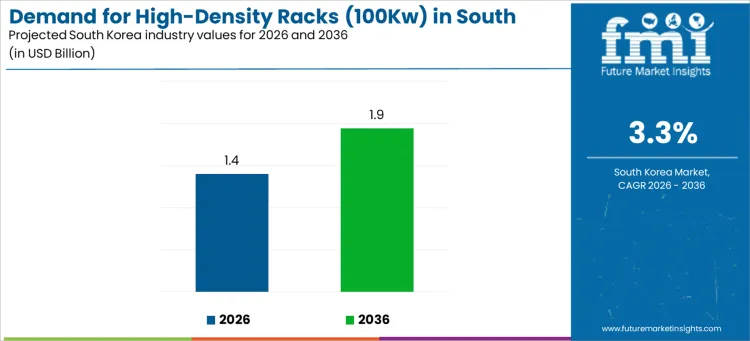
Demand for high-density racks (>100Kw) in South Korea is anticipated to reach USD 1.4 billion in 2026. Financial volume associated with the sector is likely to garner around USD 1.9 billion by 2036, expanding at a compound annual growth rate of 3.3%. South Korea stands at the forefront of digital innovation, with pervasive 5G adoption and burgeoning artificial intelligence initiatives driving the need for robust computational power. Data centers are densifying their server footprints to accommodate high-performance computing workloads within limited real estate. This densification necessitates advanced racking systems capable of supporting heavy IT equipment and managing extreme thermal loads.
Government policies promoting digital transformation and energy efficiency are actively shaping industry dynamics. Ministry of Science and ICT initiatives to establish South Korea as a global AI hub are channeling investment into next-generation infrastructure. Regulations mandating lower Power Usage Effectiveness (PUE) ratios compel facility managers to adopt aisle containment and precision airflow management strategies integrated with high-density racks.
Quick Stats for Demand for High-Density Racks (>100Kw) in South Korea
- Demand for High-Density Racks (>100Kw) in South Korea Value (2026): USD 1.4 billion
- Demand for High-Density Racks (>100Kw) in South Korea Forecast Value (2036): USD 1.9 billion
- Demand for High-Density Racks (>100Kw) in South Korea Forecast CAGR: 3.3%
- Leading Type Segment for High-Density Racks (>100Kw) Industry in South Korea: Drive-in Rack (44.0%)
- Leading End Use Segment for High-Density Racks (>100Kw) Industry in South Korea: Data Center (39.4%)
- Key Growth Regions for High-Density Racks (>100Kw) Industry in South Korea: Jeju, South Gyeongsang, South Jeolla, North Jeolla
- High-Density Racks (>100Kw) Industry in South Korea Key Players: Vertiv Group Corp., Schneider Electric SE, Rittal GmbH & Co. KG, Eaton Corporation, Hewlett Packard Enterprise (HPE)
Subsidies for green data center projects encourage the deployment of energy-efficient housing for servers. Public sector demand for secure cloud services further bolsters the installation of high-specification racks in government-operated facilities. Compliance with stringent seismic safety standards also influences procurement, favoring racking systems engineered to withstand significant structural stress during potential earthquakes.
Technological evolution is rapidly pivoting towards liquid cooling compatibility to handle soaring heat output. Modern racks are being designed to integrate seamlessly with ai datacenter liquid cooling manifolds and rear-door heat exchangers. Adoption of immersion cooling tanks necessitates specialized rack configurations different from traditional air-cooled setups. Facility operators are implementing intelligent power distribution unit (PDU) systems within these racks to monitor energy consumption at a granular level.
Integration of DCIM software allows for real-time thermal mapping and capacity planning. Such innovations address the critical challenge of heat dissipation in ultra-high-density environments. Emerging trends also include the use of blanking panels to optimize airflow efficiency, ensuring that cooling resources are directed precisely where needed to maintain hardware reliability.
Demand for High-Density Racks (100Kw) in South Korea Key Takeaways
South Korea's data infrastructure domain is characterized by a relentless drive towards higher density and greater energy efficiency. Drive-in racks command the largest portion of sales, favored for their space-saving attributes in high-volume storage environments. Data centers represent the primary consumption vertical, driven by the expansion of cloud services and AI model training. Regional growth is emerging in southern provinces as the government promotes decentralization of data facilities. Competitive dynamics are led by global engineering firms offering integrated rack and cooling solutions. Ultimately, the sector serves as the physical backbone for the nation's ambitious digital economy goals, requiring constant innovation in thermal and structural engineering.
| Metric | Value |
|---|---|
| Industry Size (2026) | USD 1.4 billion |
| Industry Value (2036) | USD 1.9 billion |
| CAGR (2026 to 2036) | 3.3% |
What Specific Technological Advancements Are Driving High-Density Rack Adoption?
Explosion of artificial intelligence and machine learning workloads acts as a primary catalyst for infrastructure upgrades. Training complex AI models requires powerful GPUs that generate immense heat, necessitating high density racks equipped with advanced cooling interfaces. Proliferation of white box server deployments by hyperscalers drives demand for open-standard racks that offer flexibility and scalability. Shift towards edge computing is also influencing design, creating a need for compact yet high-density solutions that can operate in remote locations. Furthermore, ongoing data center construction projects are increasingly specifying racks capable of supporting loads greater than 100Kw to future-proof facilities against next-generation hardware requirements.
How is the Sector Structured Across Key Segments?
Structure of this domain is categorized by rack type, cooling methodology, and end-user facility. Type segmentation distinguishes between drive-in, drive-through, and other structural configurations. Cooling segmentation highlights the transition from air-based systems to liquid and refrigerant-based solutions. End-user classification reveals the dominance of dedicated data centers over general warehouses or retail outlets. Understanding this segmentation helps manufacturers tailor their engineering efforts; for instance, designing reinforced frames for heavy data center storage arrays versus modular units for distribution centers. This division underscores the specialized nature of high-density infrastructure, where one size does not fit all operational needs.
Why Do Drive-in Racks Maintain Dominance?
Drive-in Racks command a 44.0% share of the industry. Storage density is the paramount concern for facilities operating in South Korea's high-cost real estate capability markets. Drive-in configurations allow forklifts to enter the rack structure, eliminating the need for aisles and maximizing the use of vertical space. This design is particularly effective for storing large quantities of homogeneous goods or equipment, which aligns with the needs of massive distribution hubs and certain data center logistics. Structural integrity of these racks supports heavy loads, making them suitable for housing dense data center power backup units. Cost-effectiveness per pallet position further solidifies their leading status in space-constrained environments.
How is the Data Center Segment Contributing to Sector Growth?
Data Centers account for 39.4% of the usage share. South Korea is a major hub for cloud service providers and telecommunications giants, all of whom operate extensive server farms. Continuous upgrade cycles for IT equipment require modern racks that can handle increasing power densities. dc powered servers and high-performance computing clusters are predominantly housed in these facilities. Strict uptime requirements drive investment in premium racking systems that offer superior cable management and airflow control. Government incentives to build new facilities outside of Seoul are spreading this demand geographically. Consequently, the data center vertical remains the engine of innovation and volume sales for high-specification racks.
Will the Shift to Liquid Cooling Redefine Future Sales?
Usage of liquid cooling technologies is becoming essential as rack densities climb past 100Kw. Air cooling alone is often insufficient for modern AI clusters, prompting a move towards direct-to-chip or immersion cooling. Racks must be re-engineered to support heavy liquid manifolds and containment basins. Adoption of green data center principles accelerates this trend, as liquid cooling offers superior energy efficiency. Manufacturers are developing hybrid racks that can accommodate both air and liquid-cooled gear to ease the transition. This technological pivot presents a significant opportunity for vendors who can offer integrated rack-and-cooling solutions that simplify deployment for facility operators.
How Do Energy Efficiency Regulations Impact Design?
Stringent regulations regarding carbon emissions and energy consumption are influencing infrastructure choices. South Korea's commitment to carbon neutrality puts pressure on operators to reduce auxiliary power consumption. High-density racks that improve airflow dynamics contribute to lower cooling costs. Integration of data center energy storage solutions within the rack footprint is gaining traction to manage peak loads. Designs that utilize blanking panels and containment systems to prevent hot air recirculation are becoming standard. Regulatory compliance is thus driving the adoption of premium, engineered racking solutions that contribute to a lower overall facility PUE, moving the industry away from commodity cabinets.
Is the Trend Towards Edge Computing Affecting Demand?
Rise of 5G and IoT applications is pushing compute power closer to the user, known as edge computing. This requires deploying high-density racks in non-traditional environments like telecommunications towers or manufacturing floors. These racks must be rugged, secure, and self-contained with integrated cooling and power. Demand for micro data centers housed in a single rack is growing. Data center operators are deploying these distributed nodes to reduce latency for autonomous vehicles and smart city applications. Consequently, manufacturers are expanding their portfolios to include versatile, ruggedized high-density racks suitable for edge deployment.
How is the Infrastructure Landscape Evolving Across South Korea's Regions?
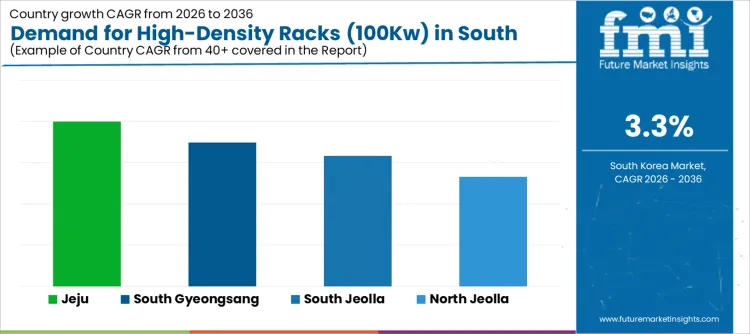
Regional consumption patterns regarding high-density infrastructure are witnessing a strategic shift driven by government decentralization policies and the unique industrial profiles of different provinces. While the capital area has traditionally hosted the bulk of data facilities, incentives such as lower electricity rates and tax breaks are encouraging operators to establish hyperscale centers in southern regions. This migration creates new pockets of demand for robust racking systems capable of supporting heavy computational loads. Localized industrial digitization in manufacturing hubs further stimulates the need for on-premise high-density server rooms, ensuring a more balanced geographical distribution of advanced IT infrastructure across the peninsula.
| Region | CAGR (2026 to 2036) |
|---|---|
| Jeju | 4.0% |
| South Gyeongsang | 3.5% |
| South Jeolla | 3.2% |
| North Jeolla | 2.7% |
Why is the Smart Island Initiative in Jeju Driving Rapid Growth?
Adoption of high-density racks in Jeju is projected to expand at a CAGR of 4.0%. Jeju Island's "Carbon Free Island 2030" project involves massive data processing for smart grid management and renewable energy balancing. Data centers located here leverage the cool climate and abundant renewable energy, requiring specialized racks for green computing. Research institutes on the island are deploying high-performance computing clusters for climate modeling and oceanography. Tourism analytics also generate significant data loads. This focus on sustainable, high-tech development creates a niche but rapidly growing demand for eco-friendly, high-density infrastructure solutions.
How is Industrial Digitalization in South Gyeongsang Influencing Sales?
Sales of infrastructure equipment in South Gyeongsang are likely to reach a CAGR of 3.5%. As a manufacturing powerhouse, this region is undergoing a "Smart Factory" revolution. Heavy industries like shipbuilding and aerospace are implementing digital twins and AI-driven quality control, which require on-site high-density computing. Factories are retrofitting server rooms with robust racks to handle industrial IoT data streams. Regional universities are also upgrading their research computing facilities. Convergence of manufacturing and IT in this belt ensures a steady demand for durable racking systems capable of operating in industrial environments.
What Specific Factors Drive Demand in South Jeolla?
Expansion in South Jeolla is anticipated to rise at a CAGR of 3.2%. South Jeolla is emerging as an energy hub with the massive Bitgaram Energy Valley project. KEPCO and other energy companies headquartered here operate large data centers for grid management. Investment in renewable energy monitoring requires substantial data storage and processing capacity. New industrial complexes focusing on new materials and energy storage are establishing their own data rooms. Focus on energy sector digitization drives the procurement of secure, high-density racking solutions to support critical infrastructure operations.
Why is North Jeolla Modernizing its Data Infrastructure?
Deployment of IT infrastructure in North Jeolla is expected to increase at a CAGR of 2.7%. The Saemangeum development area is attracting investments in data centers and renewable energy. Agricultural technology (Agri-Tech) initiatives in the province utilize big data for smart farming, requiring local processing power. Local government efforts to digitize administrative services are leading to server room upgrades. While growing from a smaller base, the region's focus on integrating technology with traditional sectors like agriculture creates a sustainable long-term demand for modern data center equipment.
What Strategic Initiatives Define Market Leadership?
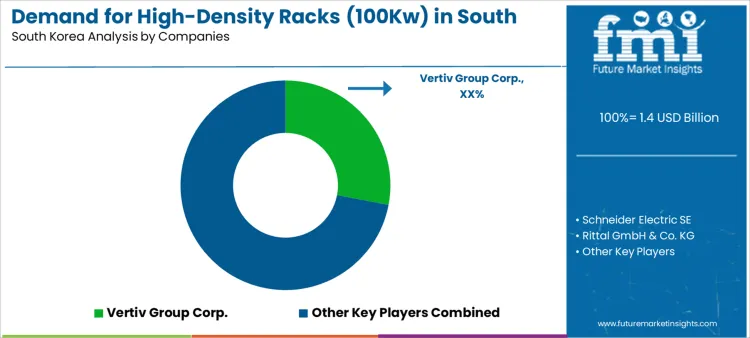
Vertiv Group Corp. commands a dominant position with a 28.0% share, leveraging its comprehensive portfolio of thermal management and power solutions that integrate with their racks. Strategy revolves around offering holistic "critical continuity" solutions rather than just standalone cabinets. Vertiv invests in local support teams to assist hyperscalers with complex deployment planning. Competitors like Schneider Electric and Rittal emphasize modularity and energy efficiency. Strategic partnerships with major system integrators and construction firms allow these leaders to secure large-scale greenfield projects.
How Are Global Players Adapting to Local Needs?
International firms are customizing their rack dimensions and load ratings to meet specific Korean building codes and seismic requirements. Providing localized DCIM software interfaces and Korean-language technical support is becoming standard. Companies are also establishing logistics hubs within the country to ensure rapid delivery for time-critical data center build-outs. Collaborating with local cloud providers like Naver and Kakao helps global brands align their product roadmaps with the specific needs of the Korean digital ecosystem.
Scope of Report
| Items | Values |
|---|---|
| Quantitative Units | USD Billion |
| Type | Drive-in Rack, Drive-through Rack |
| Cooling | Refrigerant, Water, Direct Expansion, Air Flow |
| End Use | Data Center, Distribution Centers, Warehouses, Big-box Retail Outlets, Food Processing Plants |
| Regions Covered | Jeju, South Gyeongsang, South Jeolla, North Jeolla |
| Key Companies Profiled | Vertiv, Schneider Electric, Rittal, Eaton, HPE |
Key Companies
- Vertiv Group Corp.
- Schneider Electric SE
- Rittal GmbH & Co. KG
- Eaton Corporation
- Hewlett Packard Enterprise (HPE)
Demand for High-Density Racks (100Kw) in South Korea by Segments
By Type
- Drive-in Rack
- Drive-through Rack
- Vacuums
By Cooling
- Refrigerant
- Water
- Direct Expansion
- Air Flow
By End Use
- Data Center
- Distribution Centers
- Warehouses
- Big-box Retail Outlets
- Food Processing Plants
Bibliography
- Ministry of Science and ICT. (2024, July 31). MSIT unveils first master plan for developing critical and emerging digital technologies. Ministry of Science and ICT, Republic of Korea.
- Korea Data Center Council. (2024, July 3). 2024 Korea data center market report: Industry statistics and market outlook. Korea Data Center Council, Republic of Korea.
- Statistics Korea. (2024, October 17). KOSTAT Notice No. 2024-671: ICT workforce survey methodology change notice. Statistics Korea, Republic of Korea.
- Statistics Korea. (2024). KOSTAT Notice No. 2024-738: Digital industry survey framework and sample design notice. Statistics Korea, Republic of Korea.
- National Information Society Agency. (2025). 2025 cloud trends. National Information Society Agency, Republic of Korea.
Frequently Asked Questions
How big is the demand for High-Density Racks (100Kw) in South Korea in 2026?
The demand for High-Density Racks (100Kw) in South Korea is estimated to be valued at USD 1.4 billion in 2026.
What will be the size of High-Density Racks (100Kw) in South Korea in 2036?
The industry size for the High-Density Racks (100Kw) in South Korea is projected to reach USD 1.9 billion by 2036.
How much will be the demand for High-Density Racks (100Kw) in South Korea growth between 2026 and 2036?
The demand for High-Density Racks (100Kw) in South Korea is expected to grow at a 3.3% CAGR between 2026 and 2036.
What are the key product types in the High-Density Racks (100Kw) in South Korea?
The key product types in High-Density Racks (100Kw) in South Korea are Drive-in Rack and Drive-through Rack.
Which end user segment is expected to contribute significant share in the High-Density Racks (100Kw) in South Korea in 2026?
By end user, Data Center segment is expected to command 39.4% share in the High-Density Racks (100Kw) in South Korea in 2026.
Preview the report firsthand - request a free sample
Get SampleGet the brochure for pricing and purchase details.
Get PDFTable of Content
- Executive Summary
- South Korea Market Outlook
- Demand-side Trends
- Supply-side Trends
- Technology Roadmap Analysis
- Analysis and Recommendations
- Market Overview
- Market Coverage / Taxonomy
- Market Definition / Scope / Limitations
- Market Background
- Market Dynamics
- Drivers
- Restraints
- Opportunity
- Trends
- Scenario Forecast
- Demand in Optimistic Scenario
- Demand in Likely Scenario
- Demand in Conservative Scenario
- Opportunity Map Analysis
- Product Life Cycle Analysis
- Supply Chain Analysis
- Investment Feasibility Matrix
- Value Chain Analysis
- PESTLE and Porter’s Analysis
- Regulatory Landscape
- Regional Parent Market Outlook
- Production and Consumption Statistics
- Import and Export Statistics
- Market Dynamics
- South Korea Market Analysis 2021 to 2025 and Forecast, 2026 to 2036
- Historical Market Size Value (USD Million) Analysis, 2021 to 2025
- Current and Future Market Size Value (USD Million) Projections, 2026 to 2036
- Y-o-Y Growth Trend Analysis
- Absolute $ Opportunity Analysis
- South Korea Market Pricing Analysis 2021 to 2025 and Forecast 2026 to 2036
- South Korea Market Analysis 2021 to 2025 and Forecast 2026 to 2036, By Type
- Introduction / Key Findings
- Historical Market Size Value (USD Million) Analysis By Type , 2021 to 2025
- Current and Future Market Size Value (USD Million) Analysis and Forecast By Type , 2026 to 2036
- Drive-in Rack
- Drive-through Rack
- Vacuums
- Drive-in Rack
- Y-o-Y Growth Trend Analysis By Type , 2021 to 2025
- Absolute $ Opportunity Analysis By Type , 2026 to 2036
- South Korea Market Analysis 2021 to 2025 and Forecast 2026 to 2036, By Cooling
- Introduction / Key Findings
- Historical Market Size Value (USD Million) Analysis By Cooling, 2021 to 2025
- Current and Future Market Size Value (USD Million) Analysis and Forecast By Cooling, 2026 to 2036
- Refrigerant
- Water
- Direct Expansion
- Air Flow
- Refrigerant
- Y-o-Y Growth Trend Analysis By Cooling, 2021 to 2025
- Absolute $ Opportunity Analysis By Cooling, 2026 to 2036
- South Korea Market Analysis 2021 to 2025 and Forecast 2026 to 2036, By End Use
- Introduction / Key Findings
- Historical Market Size Value (USD Million) Analysis By End Use, 2021 to 2025
- Current and Future Market Size Value (USD Million) Analysis and Forecast By End Use, 2026 to 2036
- Data Center
- Distribution Centers
- Warehouses
- Big-box Retail Outlets
- Food Processing Plants
- Data Center
- Y-o-Y Growth Trend Analysis By End Use, 2021 to 2025
- Absolute $ Opportunity Analysis By End Use, 2026 to 2036
- Market Structure Analysis
- Competition Dashboard
- Competition Benchmarking
- Market Share Analysis of Top Players
- By Regional
- By Type
- By Cooling
- By End Use
- Competition Analysis
- Competition Deep Dive
- Vertiv Group Corp.
- Overview
- Product Portfolio
- Profitability by Market Segments (Product/Age /Sales Channel/Region)
- Sales Footprint
- Strategy Overview
- Marketing Strategy
- Product Strategy
- Channel Strategy
- Schneider Electric SE
- Rittal GmbH & Co. KG
- Eaton Corporation
- Hewlett Packard Enterprise (HPE)
- Vertiv Group Corp.
- Competition Deep Dive
- Assumptions & Acronyms Used
- Research Methodology


