

- Industry Size (2026)
- USD 4.7 Bn
- Forecast (2036)
- USD 6.7 Bn
- CAGR (2026 to 2036)
- 3.7%
High-Density Racks (>100 kW) Forecast in the UK 2026 to 2036
Demand for high-density racks above 100 kW in the UK is projected at USD 4.7 billion in 2026 and is expected to reach USD 6.7 billion by 2036, expanding at a 3.7% CAGR. This demand pattern reflects the shift toward higher compute density in data center halls, rising power draw per rack, and the operational need to manage heat removal, airflow integrity, and service access without expanding building footprint at the same pace as workload growth.
High-density racks above 100 kW sit at the intersection of space optimisation and thermal control. Operators and facility leaders treat them as engineered infrastructure blocks rather than simple enclosures. Each rack configuration affects cable routing, containment efficiency, hot aisle integrity, liquid cooling readiness, and power distribution planning. Procurement decisions are guided by load stability, structural strength, access ergonomics, safety compliance, and long-term serviceability across repeated hardware refresh cycles.
For CEOs and commercial leaders, this category links directly to capacity planning and capital efficiency. A rack strategy that supports higher power density can unlock more compute per square meter, better utilisation of a fixed facility footprint, and faster time-to-capacity in premium colocation sites. For solution providers, value sits in delivering rack platforms that are compatible with evolving cooling architectures and standardised operational workflows.
Quick Stats for High-Density Racks (>100 kW) Demand in the UK
- High-Density Racks (>100 kW) Valuation in the UK (2026): USD 4.7 billion
- High-Density Racks (>100 kW) Forecast Valuation in the UK (2036): USD 6.7 billion
- Forecast CAGR 2026 to 2036: 3.7%
- Leading Regional Growth: England (4.1%)
- Leading Type: Drive-in Rack (42.0% share)
- Leading Cooling: Refrigerant (34.5% share)
- Leading End Use: Data Center (37.5% share)
- Key Companies Profiled: Vertiv Group Corp.; Schneider Electric SE; Rittal GmbH & Co. KG; Eaton Corporation; Hewlett Packard Enterprise (HPE)
High-Density Racks (>100 kW) in the UK Key Takeaways
| Metric | Value |
|---|---|
| Industry Value (2026) | USD 4.7 billion |
| Industry Forecast Value (2036) | USD 6.7 billion |
| Forecast CAGR (2026 to 2036) | 3.7% |
Why is the UK Scaling Demand for High-Density Racks Above 100 kW?
UK demand is shaped by how fast compute is being deployed and how costly new space has become in key hubs. Workloads tied to AI training, inference, high-performance computing, and high-throughput storage push operators toward denser installations. The rack becomes a control point for three operational outcomes: more compute per floor tile, better thermal containment, and faster maintenance access during hardware swaps.
Data centers in the UK have also been recognised as critical national infrastructure, increasing focus on resilience, planning, and sustainability expectations around this infrastructure layer. A UK Parliament briefing notes that in September 2024 the UK Government designated data centres as part of the country’s critical national infrastructure. As resilience expectations rise, operators pay closer attention to standardised infrastructure design and validated operating conditions, both of which influence rack strategy and cooling choices.
Energy and sustainability pressure adds another demand driver. Denser racks can deliver more compute in fewer square meters, yet they also increase heat flux, creating a stronger need for efficient cooling design. The EU Code of Conduct best practice guidelines for data centres highlight that power consumption should be considered at expected utilisation, not only peak performance figures, reinforcing how infrastructure decisions are evaluated through real operating conditions.
Supply chain realities also matter. Operators prefer rack platforms that can be built, installed, and commissioned quickly using repeatable designs. Facility teams want fewer custom parts, consistent clearance requirements, and predictable cable pathways. These factors support demand for rack and aisle systems designed as integrated infrastructure kits rather than one-off builds.
Product planners and infrastructure integrators often keep reference points aligned with related category coverage such as high-density racks above 100 kW and thermal architecture categories such as data center liquid cooling systems when shaping design rules for high-power deployments.
How is High-Density Rack Demand Structured by Type, Cooling, and End Use?
This segmentation reflects how operators store and service high-density equipment, how heat is removed at rack-level, and which facility types carry the largest deployment loads.
Why do drive-in racks lead installation decisions for dense compute zones?
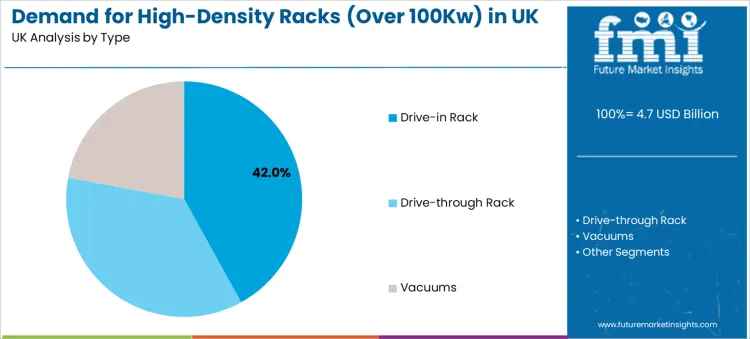
Drive-in rack holds a 42.0% share, making it the leading type. This reflects a practical operator preference for designs that support space efficiency and structured access during installation and service. In high-density environments, rack selection is tied to aisle layout strategy, service clearance, and repeatability across multiple halls. Drive-in configurations can align with controlled deployment lanes and standardised workflow planning for large rollouts.
Buyers evaluate drive-in designs through strength under heavy equipment load, stable mounting tolerance, and cable routing options that reduce congestion and airflow disruption. The goal is to keep operational work predictable even when rack power levels and cooling complexity rise.
Why is refrigerant-based cooling the most selected approach for high-density rack environments?
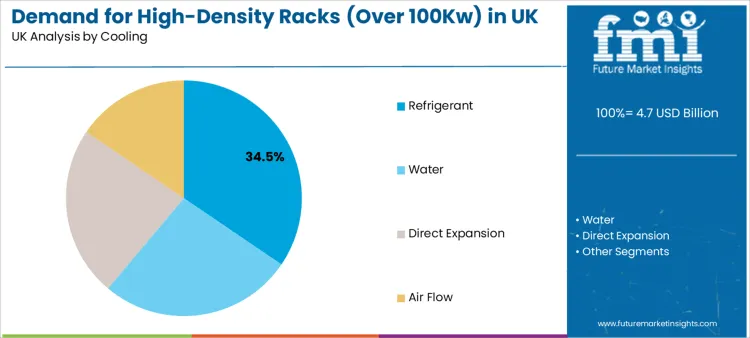
Refrigerant leads with a 34.5% share, indicating strong usage where cooling intensity needs to scale while maintaining controllability. Refrigerant-supported cooling approaches are often evaluated for performance stability, heat removal capability, and suitability for high-load racks where traditional air-only designs can hit practical limits.
Cooling selection also reflects a risk management mindset. Operators aim to control hotspots, reduce thermal runaway risk, and stabilise inlet conditions for high-value compute equipment. ASHRAE references for data center thermal environment guidance highlight recommended temperature ranges and provide a structured basis for thinking about IT equipment operating conditions.
Teams looking to reduce footprint pressure while raising thermal headroom often align engineering decisions with adjacent infrastructure themes such as direct-to-chip liquid cooling systems and data center chillers used for high-load sites, especially when build programs are planned around higher rack power bands.
Why do data centers represent the largest end-use base for racks above 100 kW?
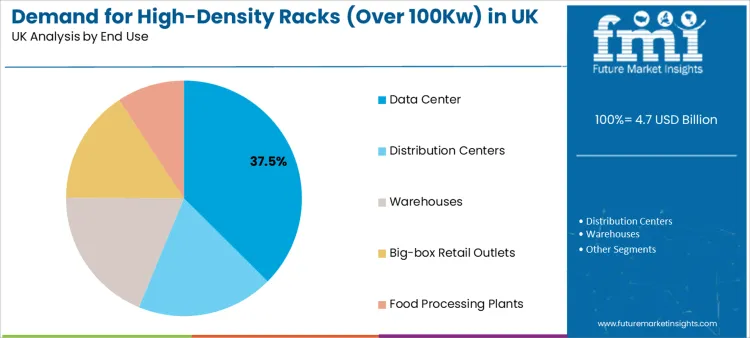
Data center holds a 37.5% share, positioning it as the largest end-use segment. This is expected because these racks are primarily built for dense compute and storage environments where power delivery and thermal design are core facility functions. Data centers deploy racks above 100 kW to consolidate more compute within a fixed footprint and to support high-throughput workloads with stable service access.
Distribution centers and warehouses also use rack systems, though the performance priorities differ. In those environments, space efficiency, workflow access, and inventory movement often dominate over thermal intensity. Big-box retail outlets use rack systems in back-of-house technology spaces and hybrid logistics settings. Food processing plants can require robust, corrosion-aware infrastructure planning where humidity and sanitation context influence material selection.
What are the Dynamics, Restraints, Opportunities, and Threats Shaping this Space?
What dynamics are strengthening demand fundamentals?
The biggest driver is compute density. Higher power servers and accelerator-heavy deployments push rack designs toward stronger structural tolerance, better cable management, and tighter integration with cooling. Data center build activity and resilience planning also support demand for scalable rack infrastructure. The UK Parliament briefing notes the national infrastructure status given to data centres in 2024, which reinforces the role of dependable design and operational stability.
Standardisation initiatives also shape how facility infrastructure is planned. ISO/IEC 22237 provides a structured approach to data centre facilities and infrastructure planning, supporting modularity and scalability principles. EN 50600 is referenced as a comprehensive European standard covering planning, construction, and operation of data centres, including power supply and air conditioning infrastructure.
What restraints can slow adoption or increase deployment friction?
Capital intensity is a key restraint. Racks above 100 kW typically require supporting infrastructure investment, including cooling upgrades, power distribution changes, and containment or monitoring improvements. Integration complexity also slows decision cycles. Operators often need cross-functional sign-off from IT, facilities, safety, compliance, and finance teams before committing to a deployment standard.
Operational risk management adds friction. High-density deployments raise the cost of failure, so buyers demand proven field performance, validated installation practices, and reliable service coverage.
Where do practical opportunities sit for suppliers and service partners?
Opportunity concentrates in rack plus cooling readiness platforms. Suppliers that provide rack systems designed for liquid cooling, improved containment, and fast service access can embed deeper into new build programs and retrofit initiatives. Monitoring integration is another growth area.
Operators value visibility into temperature, power draw, and airflow integrity, supporting better capacity planning and incident prevention. Teams mapping infrastructure strategy across multiple layers often align rack decisions with related coverage such as data center power infrastructure and operational tooling such as data center infrastructure management to keep rollout execution consistent.
What threats can disrupt demand expectations?
Supply constraints for specialised rack components, cooling elements, or service parts can delay deployment schedules. Policy and planning changes may also reshape site development timelines, impacting near-term procurement cycles. Energy availability constraints and grid capacity issues can slow expansion planning for dense compute sites, raising the importance of efficiency and demand management.
How is High-Density Rack Adoption Progressing across Key Regions in the UK?
| Region | CAGR 2026 to 2036 |
|---|---|
| England | 4.1% |
| Scotland | 3.6% |
| Wales | 3.4% |
| Northern Ireland | 2.9% |
Why is England leading growth through stronger data center clustering and capacity expansion programs?
England grows at 4.1%, supported by a larger base of data center infrastructure, colocation activity, and enterprise deployment needs. Expansion programs in major hubs encourage procurement of denser rack platforms to maximise floor utilisation and accelerate capacity delivery. Operators in England also show strong interest in cooling strategies that support higher power per rack without compromising service access or stability.
How is Scotland sustaining adoption as high-power deployments expand within targeted infrastructure builds?
Scotland advances at 3.6%, shaped by focused site development and demand for resilient infrastructure that can support high-load computing zones. Rack deployments above 100 kW in this region often depend on project readiness in cooling and power integration, since high-density rollouts require careful commissioning discipline.
What is driving Wales as operators improve space efficiency for high-density technology zones?
Wales grows at 3.4%, supported by measured expansion and retrofit work where operators seek improved space efficiency inside existing footprints. Rack selection is shaped by practical factors such as installation flexibility, service workflow fit, and compatibility with evolving cooling plans.
Why is Northern Ireland progressing steadily as deployment remains selective and infrastructure-led?
Northern Ireland increases at 2.9%, reflecting selective adoption patterns tied to project pipeline size and facility readiness. High-density rack deployments tend to appear where operators have defined high-load use cases and can justify the supporting cooling and power investment. The pace remains steady, supported by infrastructure planning discipline and procurement caution.
What Defines the Competitive Landscape for High-Density Racks in the UK?
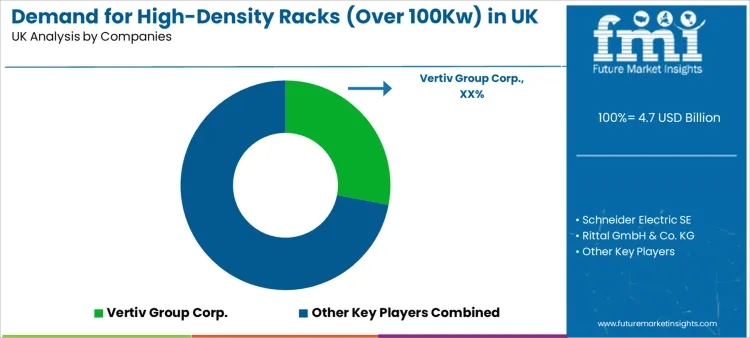
Competition is shaped by platform reliability, cooling readiness, installation speed, and service ecosystem strength. Buyers assess vendors based on rack structural integrity under heavy loads, cable management efficiency, compatibility with containment strategies, and how well the product supports high-density service operations. Cooling integration capability is a key differentiator, since racks above 100 kW must work as part of a broader thermal design system.
Vertiv Group Corp. competes through mission-critical infrastructure positioning and strong integration across rack and cooling solutions. Schneider Electric SE competes through facility infrastructure portfolios and data center power and cooling integration. Rittal GmbH & Co. KG competes through industrial-grade enclosures and system engineering approaches designed for high-availability environments. Eaton Corporation competes through power infrastructure strength and adjacent facility enablement. Hewlett Packard Enterprise (HPE) competes through data center ecosystem positioning and infrastructure-aligned enterprise deployment models.
Programs that move from planning to execution often align their architecture decisions with adjacent build categories such as data center construction programs and edge deployment trends such as colocation edge data centers, especially when rack density planning is linked to broader site expansion schedules.
Key Industry Participants
- Vertiv Group Corp.
- Schneider Electric SE
- Rittal GmbH & Co. KG
- Eaton Corporation
- Hewlett Packard Enterprise (HPE)
Scope of Report
| Items | Values |
|---|---|
| Quantitative Units | USD Billion |
| Type | Drive-in Rack; Drive-through Rack; Vacuums; Air Flow |
| Cooling | Refrigerant; Water; Direct Expansion |
| End Use | Data Center; Distribution Centers; Warehouses; Big-box Retail Outlets; Food Processing Plants |
| Regions Covered | England; Scotland; Wales; Northern Ireland |
| Key Companies Profiled | Vertiv Group Corp.; Schneider Electric SE; Rittal GmbH & Co. KG; Eaton Corporation; Hewlett Packard Enterprise (HPE) |
High-Density Racks (>100 kW) Demand in the UK by Segments
By Type
- Drive-in Rack
- Drive-through Rack
- Vacuums
- Air Flow
By Cooling
- Refrigerant
- Water
- Direct Expansion
By End Use
- Data Center
- Distribution Centers
- Warehouses
- Big-box Retail Outlets
- Food Processing Plants
By Region
- England
- Scotland
- Wales
- Northern Ireland
Bibliography
- British Parliament. (2025). Data centres: planning policy, sustainability, and resilience. House of Commons Library.
- European Commission, Joint Research Centre. (2024). 2024 Best practice guidelines for the EU Code of Conduct on Data Centre Energy Efficiency.
- International Organization for Standardization. (2024). ISO/IEC 22237-2: Information technology: Data centre facilities and infrastructures: Building construction. ISO.
- ASHRAE. (2021). Equipment thermal guidelines for data processing environments (5th edition reference card). ASHRAE.
- TÜV NORD. (2025). EN 50600 European standard for data centres: Planning, construction, and operation requirements.
Frequently Asked Questions
How big is the demand for high-density racks (over 100kw) in uk in 2026?
The demand for high-density racks (over 100kw) in uk is estimated to be valued at USD 4.7 billion in 2026.
What will be the size of high-density racks (over 100kw) in uk in 2036?
The market size for the high-density racks (over 100kw) in uk is projected to reach USD 6.7 billion by 2036.
How much will be the demand for high-density racks (over 100kw) in uk growth between 2026 and 2036?
The demand for high-density racks (over 100kw) in uk is expected to grow at a 3.7% CAGR between 2026 and 2036.
What are the key product types in the high-density racks (over 100kw) in uk?
The key product types in high-density racks (over 100kw) in uk are drive-in rack, drive-through rack and vacuums.
Which cooling segment is expected to contribute significant share in the high-density racks (over 100kw) in uk in 2026?
In terms of cooling, refrigerant segment is expected to command 34.5% share in the high-density racks (over 100kw) in uk in 2026.
Preview the report firsthand - request a free sample
Get SampleGet the brochure for pricing and purchase details.
Get PDFTable of Content
- Executive Summary
- UK Market Outlook
- Demand-side Trends
- Supply-side Trends
- Technology Roadmap Analysis
- Analysis and Recommendations
- Market Overview
- Market Coverage / Taxonomy
- Market Definition / Scope / Limitations
- Market Background
- Market Dynamics
- Drivers
- Restraints
- Opportunity
- Trends
- Scenario Forecast
- Demand in Optimistic Scenario
- Demand in Likely Scenario
- Demand in Conservative Scenario
- Opportunity Map Analysis
- Product Life Cycle Analysis
- Supply Chain Analysis
- Investment Feasibility Matrix
- Value Chain Analysis
- PESTLE and Porter’s Analysis
- Regulatory Landscape
- Regional Parent Market Outlook
- Production and Consumption Statistics
- Import and Export Statistics
- Market Dynamics
- UK Market Analysis 2021 to 2025 and Forecast, 2026 to 2036
- Historical Market Size Value (USD Million) Analysis, 2021 to 2025
- Current and Future Market Size Value (USD Million) Projections, 2026 to 2036
- Y-o-Y Growth Trend Analysis
- Absolute $ Opportunity Analysis
- UK Market Pricing Analysis 2021 to 2025 and Forecast 2026 to 2036
- UK Market Analysis 2021 to 2025 and Forecast 2026 to 2036, By Type
- Introduction / Key Findings
- Historical Market Size Value (USD Million) Analysis By Type , 2021 to 2025
- Current and Future Market Size Value (USD Million) Analysis and Forecast By Type , 2026 to 2036
- Drive-in Rack
- Drive-through Rack
- Vacuums
- Drive-in Rack
- Y-o-Y Growth Trend Analysis By Type , 2021 to 2025
- Absolute $ Opportunity Analysis By Type , 2026 to 2036
- UK Market Analysis 2021 to 2025 and Forecast 2026 to 2036, By Cooling
- Introduction / Key Findings
- Historical Market Size Value (USD Million) Analysis By Cooling, 2021 to 2025
- Current and Future Market Size Value (USD Million) Analysis and Forecast By Cooling, 2026 to 2036
- Refrigerant
- Water
- Direct Expansion
- Air Flow
- Refrigerant
- Y-o-Y Growth Trend Analysis By Cooling, 2021 to 2025
- Absolute $ Opportunity Analysis By Cooling, 2026 to 2036
- UK Market Analysis 2021 to 2025 and Forecast 2026 to 2036, By End Use
- Introduction / Key Findings
- Historical Market Size Value (USD Million) Analysis By End Use, 2021 to 2025
- Current and Future Market Size Value (USD Million) Analysis and Forecast By End Use, 2026 to 2036
- Data Center
- Distribution Centers
- Warehouses
- Big-box Retail Outlets
- Food Processing Plants
- Data Center
- Y-o-Y Growth Trend Analysis By End Use, 2021 to 2025
- Absolute $ Opportunity Analysis By End Use, 2026 to 2036
- Market Structure Analysis
- Competition Dashboard
- Competition Benchmarking
- Market Share Analysis of Top Players
- By Regional
- By Type
- By Cooling
- By End Use
- Competition Analysis
- Competition Deep Dive
- Vertiv Group Corp.
- Overview
- Product Portfolio
- Profitability by Market Segments (Product/Age /Sales Channel/Region)
- Sales Footprint
- Strategy Overview
- Marketing Strategy
- Product Strategy
- Channel Strategy
- Schneider Electric SE
- Rittal GmbH & Co. KG
- Eaton Corporation
- Hewlett Packard Enterprise (HPE)
- Vertiv Group Corp.
- Competition Deep Dive
- Assumptions & Acronyms Used
- Research Methodology


