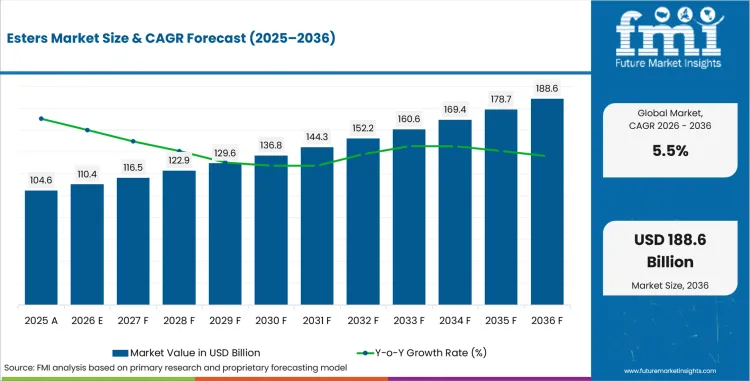
Esters sales will expand through 2036, with fatty acid esters holding a 24.0% share as the leading product segment. The market value stood at USD 104.6 billion in 2025 and is forecast to reach USD 188.6 billion by 2036 across key growth regions including China, India, and the USA.
USD 110.4 billion in 2026, reaching USD 188.6 billion by 2036 at a 5.5% CAGR
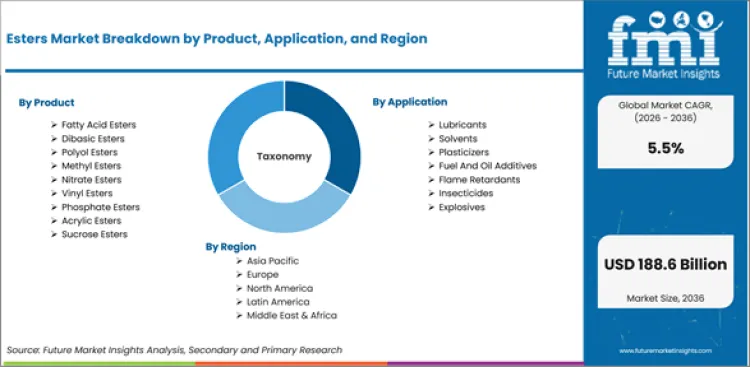
The esters market was valued at USD 104.6 billion in 2025. The market is set to reach USD 110.4 billion by 2026-end and grow at a CAGR of 5.5% between 2026-2036 to reach USD 188.6 billion by 2036. Fatty Acid Esters will dominate with a 24.0% share, while Lubricants will lead with a 22.0% share.
Esters Market Value Analysis
Key Takeaways, Market Size, and Forecast
Esters Market Value (2025): USD 104.6 Bn
Esters Market Forecast Value (2036): USD 188.6 Bn
Esters Market Forecast CAGR (2026 TO 2036): 5.5%
Esters Market Leading Product Segment: Fatty Acid Esters (24.0%)
Esters Market Key Growth Regions: China, India, USA, European Union, South Korea, UK
Esters Market Key Players: BASF SE, Evonik Industries AG, Lanxess AG, ExxonMobil Corporation, Croda International Plc, INEOS Group, Solvay S.A.
Parameter
Details
Market Size in 2026 (Value)
USD 110.4 Bn
Market Forecast in 2036 (Value)
USD 188.6 Bn
CAGR (2026 to 2036)
5.5%
Years Considered
2021 to 2036
Base Year
2025
Forecast Period
2026 to 2036
Units Considered
Value (USD Bn)
Leading Sub-Region
China
Summary of the Esters Market
Demand and Growth Drivers
Demand for esters is shaped by expanding applications in lubricants, plasticizers, and solvents, where performance requirements and environmental compliance are increasing specification complexity.
Sustainability-driven reformulation in coatings, detergents, and polymer processing is accelerating the shift toward bio-based and natural ester feedstocks that reduce carbon intensity.
Capacity expansion in Asia-Pacific petrochemical complexes is increasing supply of synthetic esters for industrial chemical and polymer applications at competitive cost positions.
Product and Segment View
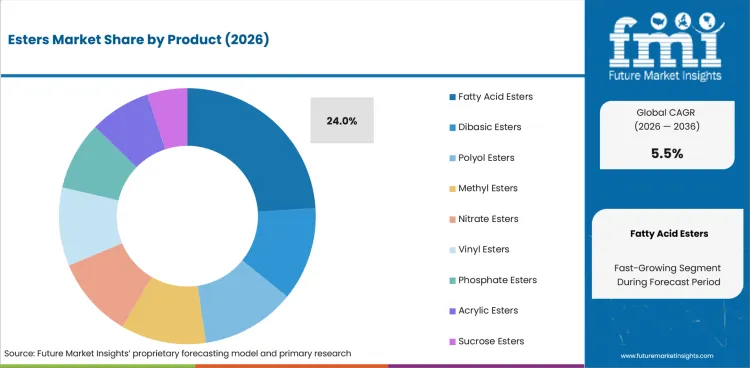
Fatty acid esters lead product demand at 24.0%, supported by versatile applications across lubricants, personal care, and food-grade processing where bio-derived feedstocks are preferred.
Lubricant applications hold 22.0% of application share, reflecting demand for high-performance ester-based synthetic lubricants in automotive, industrial machinery, and aerospace sectors.
Liquid esters account for 72.0% of form share, as liquid delivery formats dominate industrial processing, solvent applications, and lubricant blending operations.
Geography and Competitive Outlook
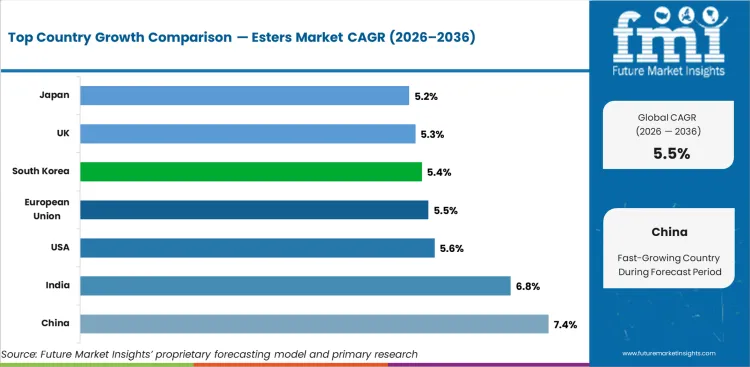
China leads growth at 7.4% CAGR, supported by expansion of downstream chemical processing capacity and rising demand for ester-based plasticizers and lubricants.
North America and Europe maintain significant demand anchored in specialty ester applications for automotive lubricants, pharmaceutical intermediates, and high-performance coatings.
Companies with integrated feedstock sourcing and global production footprints are positioned to serve diversified end-use demand across industrial chemicals, polymers, and specialty applications.
Analyst Opinion
Nikhil Kaitwade, Principal Consultant at FMI says, 'Producers that can secure diversified feedstock supply while scaling bio-based ester production capacity are likely to strengthen their competitive position across industrial and specialty segments over the forecast period.'
The esters market is transitioning from commodity-grade production toward higher-specification formulations that meet environmental and performance standards.
Adoption of bio-based esters is increasing due to regulatory pressure on volatile organic compound emissions and circular economy mandates in European and North American markets.
Demand is further supported by expansion of polymer and coating applications that require ester-based plasticizers, solvents, and processing aids.
Growth is attributable to capacity expansion in Asia-Pacific and diversification of ester applications across automotive, pharmaceutical, and personal care sectors.
What are esters and what does the market cover?
Organic compounds formed from carboxylic acids and alcohols for industrial, commercial and specialty applications
The esters market encompasses organic compounds formed by the reaction of carboxylic acids with alcohols, used across industrial, commercial, and specialty applications. Products include fatty acid esters, dibasic esters, polyol esters, methyl esters, nitrate esters, and vinyl esters supplied in liquid, powder, and gel forms for lubricant, solvent, plasticizer, and chemical processing applications.
What is included in the esters market scope?
Fatty acid esters, dibasic esters, polyol esters, methyl esters, nitrate esters and vinyl esters, 2026 to 2036.
Market scope covers all commercially traded esters categorized by product (fatty acid esters, dibasic esters, polyol esters, methyl esters, nitrate esters, vinyl esters), application (lubricants, solvents, plasticizers, fuel and oil additives, flame retardants, insecticides), end use industry (chemicals, plastic and polymers, soaps and detergents, paints and coatings, pharmaceuticals, industrial chemicals), source (natural esters, synthetic esters, bio-based esters), and form (liquid esters, powder esters, gel esters). Revenue is tracked from 2026 to 2036.
What is excluded from the esters market scope?
Finished ester-based products, raw carboxylic acids and alcohols, and captively consumed ester intermediates
The scope does not include ester-based finished products such as completed lubricant formulations or consumer cleaning products, raw carboxylic acids and alcohols sold prior to esterification, or ester intermediates consumed captively within integrated chemical manufacturing operations.
How was the esters market research conducted?
Primary interviews, desk research, bottom-up sizing, and quarterly validation
Primary Research: FMI analysts conducted interviews with chemical manufacturers, lubricant formulators, polymer processors, and feedstock suppliers across key production and consumption markets.
Desk Research: Combined data from chemical trade statistics, industrial production databases, and manufacturer revenue disclosures.
Market sizing & forecasting: Bottom-up aggregation of volumes produced by product types, applications and geographic markets with end-use demand forecasting
Data Validation: Quarterly cross-check with trade flow data, production capacity reports and downstream industry consumption estimates.
Why is the esters market growing?
Rising lubricant, plasticizer and specialty-chemical demand and bio-based ester adoption
Growing applications in lubricants, plasticizers and specialty chemicals are driving the demand for higher specification ester products satisfying performance and environmental compliance requirements.
Bio-based esters are being adopted at an increased rate driven by regulatory regimes in Europe and North America requiring lower volatile organic compound emissions and encouraging circular economy feedstock sourcing.
China leads with a CAGR of 7.4% indicative of the capacity expansion in petrochemical and oleochemical processing complexes catering to growing downstream demand for plasticizers and industrial solvents.
Their versatile role as intermediate chemicals and functional additives across multiple industrial sectors drives the demand for esters. Fatty acid esters represent 24.0% of product share and are used in a variety of applications including lubricant base stocks, metalworking fluids, food-grade emulsifiers, and personal care ingredients. Ester chemistry ranges from simple methyl ester to complex polyol ester which allows product customization for specific viscosity, thermal stability and biodegradability requirements for end use applications.
Lubricant application segment accounts for 22.0% demand, where ester-based synthetics perform better than mineral oil alternatives in high-temperature and high-load environments. Ester based formulations are increasingly being specified in automotive, aerospace and industrial machinery applications for improved oxidative stability and reduced environmental impact. Plasticizer applications are another major demand center, as dibasic esters and phthalate-free alternatives gain share as regulations restrict legacy plasticizer chemistries in consumer products.
Differences in petrochemical infrastructure, downstream industrial demand and regulatory environments shape regional production and consumption patterns. The largest production volumes are in the Asia-Pacific region, led by China and India, where esters are produced by integrated chemical complexes at competitive cost positions. The markets in Europe and North America are characterized by demand for higher specifications, for example automotive lubricant standards, pharmaceutical-grade requirements, and environmental regulations that favor bio-based and low-VOC ester formulations.
How is the esters market segmented?
By product, application, end use industry, source and form
Fatty acid esters are the leaders with 24.0% of products, used in lubricants, surfactants and food-grade applications where natural-source feedstocks provide performance and regulatory compliance advantages.
Natural esters account for 28.0% of the source segment share, as the preference for bio-derived feedstocks grows in applications where biodegradability and low toxicity are appreciated.
The plastic and polymer end-use industries and chemicals combined make up the largest slice of demand. They use esters as plasticizers, processing aids and chemical intermediates.
Why do fatty acid esters lead the esters market?
They hold 24.0% share, led by palm-, coconut- and tallow-derived bio-based grades
Esters Market Analysis By Product
Fatty acid esters accounted for 24.0% product share in 2026. These products are synthesized from natural fatty acids obtained from palm, coconut and tallow feedstocks, offering bio-based alternatives for lubricant, surfactant and emulsifier applications.
Demand is focused on lubricant base stock formulations where fatty acid esters offer high lubricity, low toxicity and biodegradability. A significant consumption is also found in personal care and food-grade applications, with the natural-source origin of fatty acid esters helping to satisfy clean-label and regulatory compliance requirements.
How big is the lubricants segment in the esters market?
About 22.0% share, led by synthetic ester lubricants with superior thermal stability
Lubricant applications accounted for 22.0% of application segment share in 2026. Synthetic esters have better thermal and oxidative stability and biodegradability than mineral oils and are therefore preferred formulations for automotive, aerospace and high performance industrial machinery applications.
Polyol esters are the leading lubricants in the premium segment, especially in aviation turbine oils and in industrial high temperature applications. Dibasic esters are used as co-base stocks for automotive and refrigeration lubricants. The move to longer oil change intervals and stricter fuel economy standards is leading to reformulation to ester-based synthetic blends in both transportation and industry.
What drives and restrains the esters market?
Driven by industrial reformulation and sustainability demand; restrained by feedstock price volatility
Developments in industrial applications and reformulation for sustainability are driving continuing demand for higher specification ester products in lubricants, plasticizers and coatings.
Margin uncertainty for ester manufacturers with a spectrum of bio-based and synthetic product lines is created by feedstock price volatility, especially for natural oils and petrochemical derivatives.
The regulatory restriction of legacy plasticizer chemistries is creating significant substitution opportunities for ester-based phthalate-free substitutes in flexible polymer applications.
The esters market is growing with the increasing industrial applications, reformulation to sustainability, and capacity expansion in Asia-Pacific. Margin pressures faced by ester producers due to feedstock volatility and competitive intensity are offset by structural growth opportunities from regulatory trends favoring bio-based and low-emission chemistries.
What drives industrial ester demand?
Rising use in lubricants, plasticizers, fuel additives and specialty chemicals
Demand is influenced by rising utilization of esters in lubricants, plasticizers, fuel additives and specialty chemicals. Automotive and aerospace lubricants are moving toward polyol and dibasic ester formulations to meet increasing specification complexity, especially with regard to thermal and oxidative stability.
What constrains ester production economics?
Fluctuating natural-oil and petrochemical feedstock prices
The implementation is limited by the fluctuation of prices of natural oil and petrochemical feedstocks, which directly influence the economics of ester production. Commodity price cycles, trade policy changes and weather-related supply disruptions all create margin uncertainty for producers of palm oil, coconut oil and petroleum-derived raw materials.
What regulatory tailwinds support growth?
European and North American rules restricting VOCs and favoring bio-based esters
Growth is driven by regulatory frameworks in Europe and North America restricting volatile organic compound emissions and promoting bio-based chemical feedstocks. Ester-based alternatives are leading reformulation in coatings, adhesives and cleaning product applications in response to EU REACH regulations and US EPA guidelines.
What opportunity does plasticizer substitution offer?
Expanding phthalate restrictions boosting demand for ester-based alternatives
Phthalate restrictions are expanding across consumer product categories, boosting demand for ester-based plasticizers. Phthalate-free plasticizer alternatives such as dibasic esters and adipate esters are gaining share in flexible PVC, wire and cable insulation and food contact packaging.
Which countries are growing fastest in the esters market?
China 7.4%, India 6.8%, USA 5.6%, European Union 5.5%, South Korea 5.4% through 2036
Top Country Growth Comparison Esters Market Cagr (2026 2036)
Country
CAGR
China
7.4%
India
6.8%
USA
5.6%
European Union
5.5%
South Korea
5.4%
UK
5.3%
Japan
5.2%
China leads with 7.4% CAGR as strong healthcare and industrial investment drive demand for ester products.
Next is India at 6.8%, boosted by infrastructure expansion and increasing market penetration.
The USA (5.6%) and European Union (5.5%) still show solid growth from established demand and regulatory support.
The global esters market is estimated to grow at 5.5% CAGR from 2026 to 2036. The study covers more than 30 countries, and the key markets are listed below.
Esters Market Cagr Analysis By Country
What is the esters market outlook in the United States?
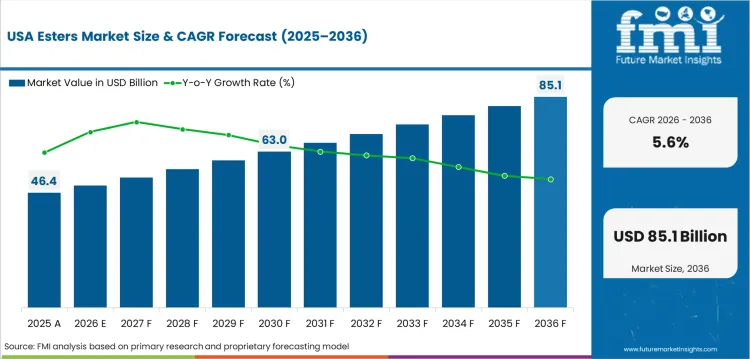
5.6% CAGR, driven by automotive lubricant reformulation, pharmaceutical intermediate production, and regulatory-driven substitution toward bio-based ester chemistries
Esters Market Country Value Analysis
The United States is projected to register 5.6% CAGR through 2036. Demand is concentrated in automotive lubricant reformulation, pharmaceutical intermediate production, and regulatory-driven substitution toward bio-based ester chemistries.
Automotive OEMs’ requirements for fuel efficiency are driving reformulation to synthetic ester-based lubricants that enable longer drain intervals and lower friction coefficients.
EPA volatile organic compound regulations are driving the adoption of low-VOC ester solvents in coatings, adhesives and industrial cleaning applications.
CHIPS and IRA provisions are supporting reshoring of specialty chemical production, which is supporting domestic ester manufacturing capacity investment.
How fast is the esters market growing in China?
7.4% CAGR through 2036, the fastest country-level market in the study
China leads global growth at 7.4% CAGR through 2036. Expansion of petrochemical and oleochemical processing capacity is increasing domestic ester production volumes that serve growing downstream demand from plasticizer, lubricant, and coating industries.
Integrated petrochemical complexes along the eastern seaboard are scaling ester production capacity to serve domestic polymer and plasticizer demand at globally competitive cost positions.
Government emissions standards for industrial solvents and coatings are creating demand for low-VOC ester formulations as substitutes for conventional hydrocarbon solvents.
Export-oriented ester production is expanding as Chinese manufacturers gain qualification with international lubricant and chemical buyers for specification-grade products.
What is driving esters growth in India?
6.8% CAGR, driven by Increasing national infrastructure development, growth of automotive sector
India is expected to register 6.8% CAGR until 2036. Increasing national infrastructure development, growth of automotive sector and expanding chemical processing capacity is driving the demand for esters in plasticizer, lubricant and industrial solvent applications.
There is a strong demand for ester-based plasticizers for PVC products in construction, water supply & electrical infrastructure, supported by National Infrastructure Pipeline investments.
Automotive sector expansion under PLI schemes is increasing consumption of synthetic ester-based lubricants and metalworking fluids in manufacturing operations.
Domestic oleochemical capacity development is reducing import dependency for fatty acid esters used in personal care and food processing applications.
How is the esters market performing in the European Union?
5.5% CAGR, driven by Reformulation to bio-based and low-emission ester products for industrial applications
The European Union is projected to register 5.5% CAGR through 2036. Reformulation to bio-based and low-emission ester products for industrial applications is being driven by REACH chemical regulations and circular economy mandates.
REACH compliance requirements are accelerating substitution of legacy solvent and plasticizer chemistries to ester-based alternatives that meet emission and toxicity thresholds.
Circular economy mandates are driving demand for bio-based ester feedstocks from waste oils and sustainable agricultural sources.
In Germany and France, the specification standards for automotive and industrial lubricants favor high-performance ester formulations with improved biodegradability profiles.
What is the esters market forecast for South Korea?
5.4% CAGR, driven by Advanced petrochemical infrastructure and high-technology manufacturing sectors
South Korea is predicted to register a CAGR of 5.4% through 2036. Advanced petrochemical infrastructure and high-technology manufacturing sectors support specification-grade ester products.
The semiconductor and display production facilities use high purity ester based solvents and cleaning agents compatible with cleanrooms.
Growing automotive and EV battery manufacturing is increasing demand for synthetic ester lubricants and electrolyte processing intermediates.
A competitive cost supply of feedstock for domestic ester production is available from existing petrochemical production clusters.
What is the growth outlook for the esters market in Japan?
5.2% CAGR, driven by High specification ester products
Japan is projected to grow at a CAGR of 5.2% during the review period. High specification ester products continue to be in demand for precision manufacturing industries and high quality standards throughout the lubricant, pharmaceutical and electronics industries.
JIS quality standards for industrial lubricants and pharmaceutical intermediates drive demand for high purity ester products with documented traceability.
As industrial equipment ages, lubricant reformulation is trending towards synthetic ester blends that extend service intervals.
Japan’s strict regulatory standards are conducive to established, quality-certified suppliers, which is favorable for pharmaceutical and food-grade ester applications.
Who are the leading companies in the esters market?
BASF SE, Evonik Industries AG, Lanxess AG, ExxonMobil Corporation, and Croda International Plc
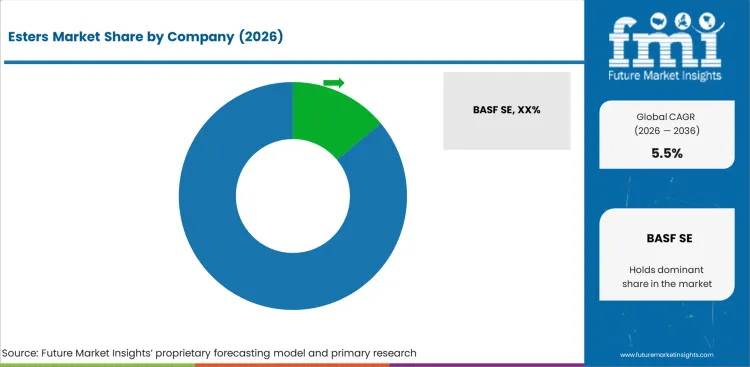
Esters Market Analysis By Company
BASF SE is a leader in integrated chemical production with a wide product portfolio in fatty acids, polyols and specialty esters and a global distribution infrastructure.
Evonik Industries and Lanxess are competitors with specialty ester production capabilities for high-performance lubricant and polymer applications.
Croda International and ExxonMobil are positioned in the synthetic and natural ester segments, respectively, through their petrochemical and oleochemical feedstock positions.
KLK OLEO, Emery Oleochemicals and other Asia-Pacific regional players are increasing export-grade production to compete in global markets.
Who are the key players in the esters market?
BASF SE, Evonik Industries AG, Lanxess AG, ExxonMobil Corporation and Croda International Plc, plus regional players
Key global companies leading the esters market include:
Key global players in the ester market include BASF SE (Germany), Evonik Industries AG (Germany), ExxonMobil Corporation (USA), and DuPont de Nemours, Inc. (USA). Major players are emphasizing integrated production infrastructure, diversified product portfolios and established customer relationships in lubricant, plasticizer and specialty chemical applications.
Companies such as Croda International Plc (UK), KLK OLEO (Malaysia) and Emery Oleochemicals (Malaysia) have a strong regional presence through oleochemical feedstock integration and natural ester production capabilities for personal care, food-grade and bio-based lubricant applications.
Corbion N.V. (Netherlands), Esters and Solvents LLP (India) and Oxea GmbH (Germany) are growing by producing specialty esters for niche applications like pharmaceutical intermediates, bio-based plasticizers and high purity solvent grades.
How do top esters companies compare?
BASF SE and Evonik Industries AG lead globally; Lanxess AG, ExxonMobil Corporation and Croda International Plc are regional specialists
In 2025, BASF continued implementing its Ludwigshafen site transformation strategy, directing investments toward higher-value specialty chemical value chains, infrastructure modernization, and advanced manufacturing capabilities while optimizing selected commodity chemical operations to enhance competitiveness and supply reliability for European customers.
In 2025, specialty ester manufacturers expanded synthetic polyol ester (POE) portfolios and production capabilities to address growing demand for high-performance, thermally stable, and biodegradable lubricant base stocks used in applications such as electric vehicle thermal management, industrial systems, and data center cooling technologies.
Key Players in the Esters Market
Major Global Players
BASF SE
Evonik Industries AG
Lanxess AG
ExxonMobil Corporation
Croda International Plc
INEOS Group
Solvay S.A.
KLK OLEO
Emerging Players/Startups
Esters and Solvents LLP
Ecogreen Oleochemicals
Oleon NV
Cailà & Parés
A&A Fratelli Parodi S.p.A.
Mosselman S.A.
Esters Market - Research Methodology
Esters Market Breakdown By Product, Application, And Region
Method
Description
Primary Research
FMI analysts conducted interviews with manufacturers, distributors, procurement specialists, and end-use operators across China, India, and USA to validate demand patterns and pricing structures for Fatty Acid Esters, and Dibasic Esters and related product categories.
Desk Research
Combined trade statistics, regulatory filings, industry association data, and manufacturer disclosures to establish baseline parameters for Esters across product, application, end use industry, source, and form segments.
Market Sizing & Forecasting
Bottom-up aggregation across Fatty Acid Esters, Dibasic Esters, and Polyol Esters product categories and Lubricants, Solvents, and Plasticizers application segments, triangulated with top-down macro indicators and regional adoption curves.
Data Validation
Cross-checked quarterly against production statistics, trade flow data, and manufacturer revenue disclosures for Esters products.
What does the esters market report cover?
2016 to 2025 history and 2026 to 2036 forecasts across all segments and 30+ countries
Parameter
Details
Market size by 2036
USD 188.6 Bn
Growth rate
5.5% CAGR (2026 to 2036)
Forecast period
2026 to 2036
Base year value (2025)
USD 104.6 Bn
Key Segment Covered
Product, Application, End Use Industry, Source, Form
Regions covered
North America, Latin America, Eastern Europe, Western Europe, East Asia, South Asia and Pacific, Middle East and Africa
Countries covered
USA, China, India, European Union, South Korea, UK, Japan, 30 plus countries
Key companies profiled
BASF SE, Evonik Industries AG, Lanxess AG, ExxonMobil Corporation, Croda International Plc, INEOS Group, Solvay S.A., KLK OLEO, DuPont de Nemours, Inc., Esters and Solvents LLP, Corbion N.V., Stepan Company, Emery Oleochemicals, Oxea GmbH, Sasol Limited
Approach
Hybrid bottom-up and top-down methodology starting with verified transaction data, projecting adoption velocity across segments and regions.
Market Segmentation Analysis
Esters Market Segmented by Product:
Fatty Acid Esters
Biodegradable Esters
Lubricant Base Stocks
Eco Friendly Applications
Surfactant Intermediate Esters
Soap And Detergent Production
Cleaning Product Formulations
Dibasic Esters
Solvent Grade Esters
Industrial Cleaning Applications
Low VOC Performance
High Purity Dibasic Esters
Coating Formulation Support
Enhanced Chemical Stability
Polyol Esters
Synthetic Lubricant Esters
High Temperature Stability
Aviation Lubrication Applications
Biodegradable Polyol Esters
Eco Friendly Lubricants
Industrial Machinery Use
Methyl Esters
Biodiesel Feedstock Esters
Fatty Acid Methyl Esters
Nitrate Esters
Energetic Nitrate Compounds
Pharmaceutical Nitrate Esters
Vinyl Esters
Vinyl Ester Resins
High Performance Vinyl Compounds
Phosphate Esters
Flame Retardant Esters
Lubricating Phosphate Esters
Acrylic Esters
Water Based Acrylic Esters
Specialty Acrylic Esters
Sucrose Esters
Food Grade Emulsifiers
Cosmetic Grade Sucrose Esters
Esters Market Segmented by Application:
Lubricants
Industrial Lubricants
Machinery Wear Protection
High Temperature Stability
Automotive Lubricants
Engine Performance Enhancement
Fuel Efficiency Support
Solvents
Industrial Cleaning Solvents
Surface Cleaning Applications
Low Toxicity Formulations
Paint And Coating Solvents
Improved Coating Performance
Fast Drying Properties
Plasticizers
Flexible PVC Applications
Improved Material Flexibility
Durability Enhancement
Specialty Plasticizers
Cable And Flooring Applications
Heat Resistance Improvement
Fuel And Oil Additives
Fuel Performance Additives
Combustion Efficiency Improvement
Emission Reduction Support
Lubricity Enhancers
Engine Component Protection
Fuel Stability Improvement
Flame Retardants
Phosphate Ester Retardants
Fire Safety Applications
Electrical Equipment Protection
Polymer Flame Resistance
Insecticides
Agricultural Formulations
Household Insecticides
Explosives
Industrial Explosive Compounds
Propellant Formulations
Esters Market Segmented by End Use Industry:
Chemicals
Specialty Chemical Manufacturing
Intermediate Chemical Production
Industrial Processing Applications
Basic Chemical Processing
Large Scale Ester Consumption
Reaction Solvent Applications
Plastic And Polymers
PVC Manufacturing
Plasticizer Applications
Flexible Polymer Production
Engineering Plastics
High Performance Material Production
Durability Enhancement
Soaps And Detergents
Household Cleaning Products
Surfactant Based Formulations
Foaming Agent Applications
Industrial Detergents
Heavy Duty Cleaning Solutions
Commercial Hygiene Products
Paints And Coatings
Architectural Coatings
Industrial Coatings
Pharmaceuticals
Drug Formulation Applications
Medical Chemical Production
Industrial Chemicals
Process Chemicals
Specialty Industrial Fluids
Food
Food Additive Applications
Beverage Industry Applications
Textiles
Textile Processing Chemicals
Synthetic Fiber Production
Cosmetics And Personal Care Products
Skin Care Formulations
Hair Care Products
Esters Market Segmented by Source:
Natural Esters
Vegetable Oil Based Esters
Biodegradable Formulations
Renewable Raw Material Usage
Animal Fat Derived Esters
Industrial Lubrication Applications
Cost Effective Production
Synthetic Esters
Chemically Synthesized Esters
High Performance Stability
Extreme Temperature Resistance
Specialty Synthetic Esters
Customized Molecular Structure
Advanced Industrial Applications
Bio Based Esters
Plant Derived Bio Esters
Eco Friendly Lubricants
Low Carbon Footprint
Green Solvent Esters
Sustainable Chemical Processing
Environmental Compliance Support
Esters Market Segmented by Form:
Liquid Esters
Low Viscosity Esters
Easy Industrial Handling
Efficient Mixing Properties
High Purity Liquid Esters
Pharmaceutical And Food Applications
Enhanced Product Stability
Powder Esters
Fine Powder Formulations
Food Additive Applications
Improved Shelf Stability
Encapsulated Ester Powders
Controlled Release Functions
Nutritional Product Applications
Gel Esters
Viscous Ester Gels
Cosmetic And Personal Care Usage
Smooth Texture Enhancement
Industrial Gel Formulations
Lubrication Support Applications
Specialty Manufacturing Use
Esters Market by Region:
North America
USA
Canada
Mexico
Latin America
Brazil
Chile
Rest of Latin America
Western Europe
Germany
UK
Italy
Spain
France
Nordic
BENELUX
Rest of Western Europe
Eastern Europe
Russia
Poland
Hungary
Balkan & Baltic
Rest of Eastern Europe
East Asia
China
Japan
South Korea
South Asia and Pacific
India
ASEAN
Australia & New Zealand
Rest of South Asia and Pacific
Middle East & Africa
Kingdom of Saudi Arabia
Other GCC Countries
Türkiye
South Africa
Other African Union
Rest of Middle East & Africa
Research Sources and Bibliography
European Chemicals Agency. (2025). ECHA REACH Registration Data: Esters and Derivatives. ECHA.
USA Environmental Protection Agency. (2025). EPA Chemical Safety Data: Industrial Esters. EPA.
International Union of Pure and Applied Chemistry. (2025). IUPAC Nomenclature of Esters and Carboxylic Acid Derivatives. IUPAC.
American Chemistry Council. (2025). ACC Chemical Industry Production Statistics. ACC.
Organisation for Economic Co-operation and Development. (2025). OECD Chemical Safety Assessment: Ester Compounds. OECD.
This bibliography is provided for reader reference.
This Report Answers
Estimating the size of the esters market and projected revenue from 2026 to 2036.
Segmentation by product, application, end use industry, source, form.
Insights about more than 30 regional markets.
Analysis of key market dynamics including demand drivers, restraints, and emerging opportunities.
Assessment of the competitive landscape and strategic positioning of leading companies.
Identifying investment opportunities across key product segments and geographic markets.
Supply chain and distribution channel analysis.
Delivery of data in PDF and Excel formats.
Frequently Asked Questions
How big is the esters market in 2026?
The global esters market is estimated to be valued at USD 110.4 billion in 2026.
What will be the size of the esters market in 2036?
The market size for the esters market is projected to reach USD 188.6 billion by 2036.
How much will the esters market growth be between 2026 and 2036?
The esters market is expected to grow at a 5.5% CAGR between 2026 and 2036.
What are the key products in the esters market?
The key products in the esters market are Fatty Acid Esters, Dibasic Esters, Polyol Esters, Methyl Esters, Nitrate Esters, Vinyl Esters, Phosphate Esters, Acrylic Esters and Sucrose Esters.
Which application segment is expected to contribute a significant share in the esters market in 2026?
In terms of application, the lubricants segment is expected to command 22.0% share in the esters market in 2026.
Preview the report firsthand - request a free sample


.webp "Top Country Growth Comparison Esters Market Cagr (2026 2036)")