

- Market Size (2026)
- USD 174.0 Mn
- Forecast (2036)
- USD 314.6 Mn
- CAGR (2026 to 2036)
- 6.1%
How big is Ethylene Absorber Sachets Market in 2026?
USD 174.0 million in 2026 and USD 314.6 million by 2036 at a 6.1% CAGR.
Demand for ethylene absorber sachets is projected to expand at 6.1% CAGR between 2026 and 2036, increasing valuation from USD 174.0 million in 2026 to USD 314.6 million by 2036. Commercial use depends on reducing ethylene exposure during product handling without disrupting package integrity or food-contact requirements.
Fresh produce creates a direct use case because ethylene can accelerate ripening and quality loss after harvest. FAO guidance states that ethylene absorber sachets placed with ethylene-sensitive produce can slow fruit ripening, vegetable de-greening or floral wilting. This gives packers a simple insert format for transport and storage where ethylene exposure must be controlled.
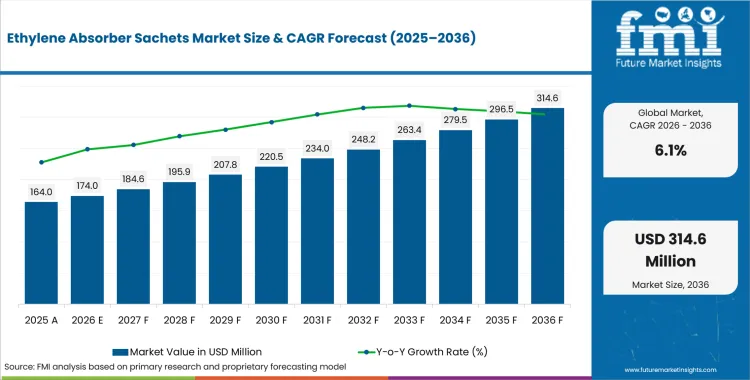
Key Takeaways of Ethylene Absorber Sachets Market
- Ethylene management supports fresh-produce quality during storage and transport, while package safety and recyclability shape format selection.
- Standard formats are projected at 41.0% of format type demand in 2026 because premeasured inserts can be introduced without redesigning the primary package.
- Oxygen control is estimated at 32.0% of function demand in 2026 within the assessed multifunctional atmosphere-management category.
- Sachets & inserts are projected at 40.0% of format demand in 2026, supported by compact placement inside cartons and packaged produce.
- Fresh food & produce is forecast at 31.0% by end use in 2026, while direct brand contracts account for 52.0% by sales channel.
- BIOCONSERVACION S.A.U., Ethylene Control, Inc., GreenKeeper Iberia S.L., SPM Biosciences (Beijing) Inc., ECP Ltd., Keep It Fresh LLP, Coppice Alupack Ltd T/A Sirane, Stream Peak International Pte Ltd, OM MAS CO., LTD. and CSY PRO Co., Ltd. serve direct sachet, integrated active-packaging or postharvest ethylene-control applications.
Analyst Perspective
"A sachet is commercially useful only when the active medium is matched to the produce load and package conditions. Packaging teams should evaluate ethylene removal together with sachet integrity and food-contact requirements before standardizing a format across routes."
- Nandini Roy Choudhury, Principal Consultant, Future Market Insights
How is the Ethylene Absorber Sachets Market segmented?
The ethylene absorber sachets market is segmented by format type, function, format, end use, sales channel and region.
Format Type covers Standard formats, Recyclable-optimized formats, Premium & branded formats and Custom-engineered formats. Function includes Oxygen control, Moisture control, Freshness & ripening control and Thermal & susceptor. Format includes Sachets & inserts, Integrated films & pads and Canisters & closures. End Use covers Fresh food & produce, Processed food, Pharma & nutraceutical and Electronics & industrial. Sales Channel covers Direct brand contracts, Specialty distributors and Online B2B.
Why do direct brand contracts lead the sales channel category?
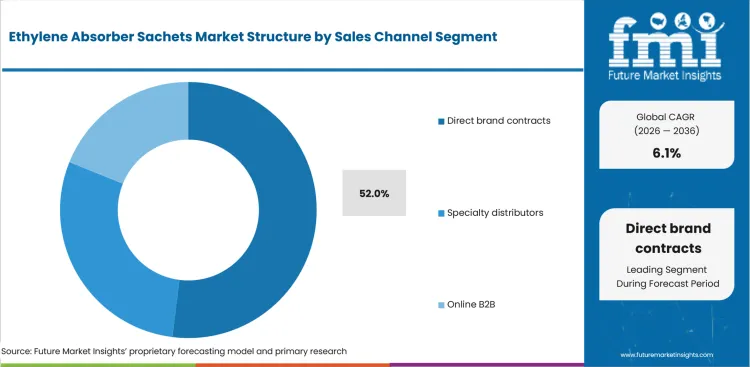
Direct brand contracts support specification work when sachet loading must be matched to commodity type, box size and route conditions. Supplier product ranges show several gram sizes and complementary filter systems, which makes direct technical coordination useful before a format is standardized for recurring pack-out.
- Direct brand contracts are projected to account for 52.0% of sales-channel demand in 2026 as commercial users align sachet format with the intended package and shipment conditions.
- Direct supplier engagement can also support custom formats. Sirane states that its ethylene-absorbent labels can be integrated with pads, bags, films or cartons and customized for customer requirements.
Why do standard formats lead the format type category?
Standard formats use predefined sachet constructions and loadings that can be placed into produce boxes or sealed packs with limited changes to the primary package. FAO guidance describes ethylene absorber sachets as a direct postharvest option for ethylene-sensitive produce, which supports a familiar pack-out route for commercial users.
- Based on format type, Standard formats are projected to account for 41.0% in 2026 because premeasured sachets can be introduced at packing without a custom package redesign.
- Commercial suppliers already provide standardized loading options. Ethylene Control lists 5 g, 9 g and 20 g sachets, while Stream Peak lists sizes from 0.25 g through 38 g for different transit and storage conditions.
Why does oxygen control lead the function category?
Oxygen control represents multifunctional atmosphere-management formats that manage oxygen exposure alongside ethylene. This matters when packaged perishables face both oxidation and ethylene-driven ripening within the same sealed environment, creating a use case for combined scavenger formats rather than a single-gas insert.
- The Oxygen control segment is estimated at 32.0% of function demand in 2026 within the assessed function taxonomy.
- Keep It Fresh LLP published KIF O2 Zorb-30 in March 2025 as a sachet that removes oxygen and ethylene from packaged perishables, showing how one insert can combine the two atmosphere-management functions.
Why do sachets & inserts lead the format category?
Sachets & inserts isolate active media inside a gas-permeable enclosure that can be placed directly into a carton or pack. "BIOCONSERVACION describes ETHYL STOPPER sachets made from food-contact Tyvek and filled with carbon and potassium permanganate alumina while SPM Biosciences offers minisachets and sachets across several gram sizes.
- In 2026, Sachets & inserts are projected to account for 40.0% of format demand because the active medium remains contained inside a discrete insert.
- Multiple sachet weights let packers adjust loading to package volume or transit conditions without changing the primary container. Stream Peak lists small, medium and larger sachet sizes for packaged produce.
Why does fresh food & produce lead the end-use category?
Fresh food & produce has a direct biological link to ethylene control because many fruits generate ethylene during ripening and sensitive products can respond to exposure during storage. FAO postharvest guidance identifies ethylene absorbers as a method for reducing ripening, de-greening or floral wilting in sensitive commodities.
- Fresh food & produce is forecast to represent 31.0% of end-use demand in 2026 owing to the role of ethylene management during storage and transport.
- Supplier portfolios reflect this use case across bananas, avocados, citrus, tomatoes and flowers, with sachet formats designed for wholesale cartons or retail packs.
What are the drivers, restraints and opportunities in the Ethylene Absorber Sachets Market?
Fresh-produce shelf-life requirements support ethylene-control formats, while food-contact safety constrains active-media use as recyclable packaging rules create scope for redesigned sachets and integrated materials.
- Driver: Ethylene management helps slow ripening and quality loss during storage and transport of sensitive fresh produce.
- Restraint: Active-media containment and food-contact requirements can limit adoption when sachet integrity or material compatibility is uncertain.
- Opportunity: Recyclable-optimized formats and integrated active materials can reduce accessory use as packaging rules tighten.
Ethylene absorber sachets address a defined postharvest problem. FAO guidance states that sachets placed with ethylene-sensitive produce can reduce the rate of fruit ripening, vegetable de-greening or floral wilting. The commercial driver is therefore strongest in routes where produce remains enclosed for enough time that accumulated ethylene can affect arrival condition.
The active medium must remain controlled within the package. Japan maintains specifications and standards for utensils, containers and packaging, while South Korea publishes standards for the same food-contact category. These controls raise the importance of sachet integrity, material selection and evidence that the insert is suitable for the intended food-packaging configuration.
Packaging policy is also shifting material choices. The EU Packaging and Packaging Waste Regulation applies generally from 12 August 2026 and strengthens circularity requirements. That creates room for recyclable-optimized sachets and integrated pads or labels where designers can preserve ethylene-control performance while reducing material complexity.
Which country CAGRs are profiled in the Ethylene Absorber Sachets Market?
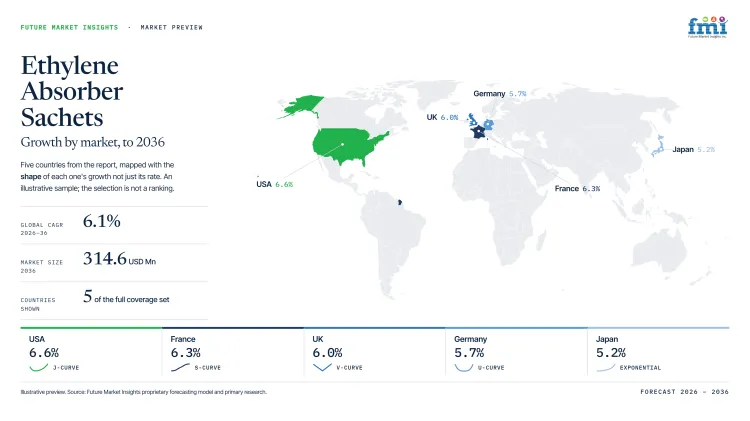
| Country | CAGR |
|---|---|
| USA | 6.6% |
| Germany | 5.7% |
| France | 6.3% |
| UK | 6.0% |
| Japan | 5.2% |
| South Korea | 6.9% |
| Saudi Arabia | 7.2% |
| UAE | 7.5% |
How do country-level CAGRs compare in the Ethylene Absorber Sachets Market?
The eight profiled CAGRs span 2.3 percentage points across produce logistics and packaging-control environments. The spacing measures expected expansion rather than current market size or installed usage within each country.
- USA combines a large fresh-produce supply chain with active postharvest research, while food-contact qualification remains specific to the package construction and intended use.
- Germany operates under the EU packaging framework, so recyclability requirements increasingly shape how active inserts are designed alongside the primary package.
- France combines the EU framework with a national policy path that targets the phase-out of single-use plastic packaging by 2040.
- UK demand is shaped by perishable produce flows that require timely transport, creating a practical role for packaging that protects arrival quality during distribution.
- Japan pairs food-loss reduction initiatives with positive-list controls for food-contact materials, which increases the importance of material qualification.
- South Korea applies national standards for utensils, containers and packages, giving suppliers a defined compliance environment for food-contact formats.
- Saudi Arabia requires imported foods and their packaging to meet SFDA rules, placing packaging conformity inside the commercial entry process.
- UAE packaging suppliers face Dubai Municipality food-contact-material guidance, making documentation and registration part of route-to-market planning.
Comparable CAGRs can produce different market entry conditions. The full report provides country-level CAGR analysis across North America, Latin America, Europe, East Asia, South Asia and Pacific, and the Middle East and Africa.
Country-wise Analysis
- Postharvest research in the USA continues to treat ethylene management as an important quality-control issue for climacteric produce. USDA Agricultural Research Service work on postharvest management emphasizes managing rapid ripening and ethylene production across fruits including apples, pears and mangoes. USA is estimated to post 6.6% CAGR over the forecast period, supported by fresh-produce logistics although food-contact suitability and package-specific performance remain necessary before broad commercial use.
- Germany is covered by the EU Packaging and Packaging Waste Regulation, which applies generally from 12 August 2026 and strengthens the policy focus on waste prevention plus circular packaging. Active inserts therefore need to fit a package architecture that can meet evolving recyclability requirements without losing atmosphere-control performance. Germany is anticipated to register 5.7% CAGR through 2036 as produce protection remains relevant while packaging redesign increases specification work.
- France combines EU packaging rules with national anti-waste policy. The French ecological ministry states that the anti-waste law schedules the end of placing single-use plastic packaging on the market by 2040, with interim reduction and reuse measures. France is forecast to expand at 6.3% CAGR during the assessment period, with ethylene-control suppliers facing demand for material-efficient formats that can fit the country's packaging transition.
- The UK depends on rapid movement for a meaningful share of perishable food imports. The United Kingdom Food Security Report 2024 notes that vegetables and fruit have higher exposure to Short Straits flows than the overall food import average and require faster transit. UK demand is projected to advance at 6.0% CAGR through 2036, supported by the need to protect perishable produce during distribution while packaging users balance cost and waste reduction.
- Japan links food-loss reduction with tightly managed food-contact materials. The Ministry of Health, Labour and Welfare maintains specifications for utensils, containers and packaging, and its updated positive-list framework entered enforcement on 1 June 2025. Japan is predicted to record 5.2% CAGR over the assessment period as active-packaging use develops within a compliance environment that places close attention on material composition and manufacturing controls.
- South Korea maintains national Standards and Specifications for Utensils, Containers and Packages, with an English version of Notification No. 2024-29 revised in June 2025. This gives food-packaging suppliers a defined technical reference for materials used around packaged products. South Korea is projected to post 6.9% CAGR through 2036, with commercial expansion depending on fit between active-media performance and local packaging requirements.
- Saudi Arabia places packaging requirements inside its imported-food control framework. The Saudi Food and Drug Authority states that imported food must meet applicable regulations and identifies food-contact packaging requirements, while its packaging FAQ references general requirements for food packages and plastic packages. Saudi Arabia is expected to advance at 7.2% CAGR during the forecast period as food import activity supports demand for shelf-life tools that can meet conformity requirements.
- Dubai Municipality lists Technical Guidelines 132 for Food Contact Materials as part of its consumer-product guidance framework. This creates a visible compliance reference for suppliers placing active food-packaging components into the UAE market. UAE demand is forecast to rise at 7.5% CAGR through 2036, with growth supported by imported perishables and distribution activity while documentation requirements shape commercial approval.
Who are the notable companies in the Ethylene Absorber Sachets Market?
BIOCONSERVACION S.A.U., Ethylene Control, Inc., GreenKeeper Iberia S.L., SPM Biosciences (Beijing) Inc., ECP Ltd., Keep It Fresh LLP, Coppice Alupack Ltd T/A Sirane, Stream Peak International Pte Ltd, OM MAS CO., LTD. and CSY PRO Co., Ltd. are notable companies serving the ethylene absorber sachets market.
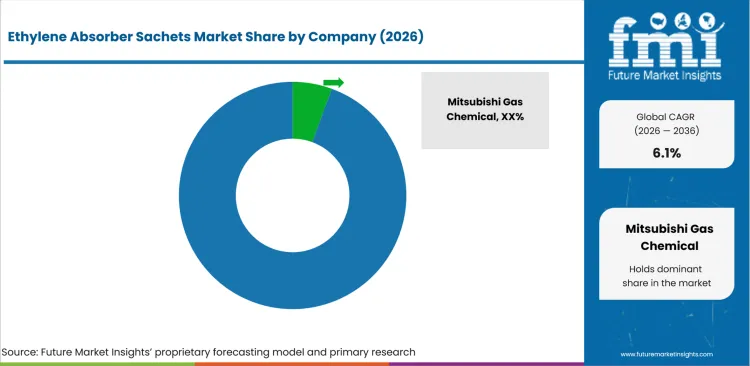
Competition includes dedicated ethylene-control specialists and active-packaging suppliers. Product differentiation centers on active media and sachet size. Humidity tolerance plus compatibility with filters or pads provide additional separation. New suppliers need food-contact evidence and repeatable performance in one defined pack or transport route.
- BIOCONSERVACION S.A.U., Ethylene Control, Inc., GreenKeeper Iberia S.L. and SPM Biosciences (Beijing) Inc. offer direct ethylene absorber sachets together with broader ethylene-control systems.
- ECP Ltd., Keep It Fresh LLP, Stream Peak International Pte Ltd, OM MAS CO., LTD. and CSY PRO Co., Ltd. provide sachet-based active packaging through regional commercial routes.
- Coppice Alupack Ltd T/A Sirane supplies ethylene-absorbent pads and labels that fit the Integrated films & pads format.
Competitive Benchmarking: Ethylene Absorber Sachets Market
| Company | Ethylene-control format | System range | Packaging integration | Operating footprint |
|---|---|---|---|---|
| BIOCONSERVACION S.A.U. | ETHYL STOPPER sachets | Sachets, filters and room equipment | MAP and polyethylene-bag use | Spain and international distribution |
| Ethylene Control, Inc. | Super Fresh Media sachets | Sachets plus filter and media systems | Carton and box placement | USA |
| GreenKeeper Iberia S.L. | GKI sachets | Sachets, blankets, filters and modules | Active packaging for produce boxes | Spain and international distribution |
| SPM Biosciences (Beijing) Inc. | ANGEL FRESH sachets | Minisachets, sachets, filters and modules | Wholesale and retail produce packs | China and export markets |
| ECP Ltd. | Everfresh scavenger sachets | Sachets and automatic inserters | Packaged and bulk produce | New Zealand |
| Keep It Fresh LLP | KIF ethylene absorber sachets | Sachets, filters and cassettes | Produce and packaged perishables | India with international operations |
| Coppice Alupack Ltd T/A Sirane | Dri-Fresh Fresh-Hold EA | Pads and labels | Pads, bags, films and cartons | UK |
| Stream Peak International Pte Ltd | Ethylene absorber sachets | Multiple sachet sizes and filters | Export cartons and boxes | Singapore |
| OM MAS CO., LTD. | Ethylene absorber sachets | Sachets, rods and machines | Food-packaging applications | Thailand |
| CSY PRO Co., Ltd. | Ethylene absorber sachets | Sachets and related absorbers | Fresh-fruit export packs | Vietnam with regional exports |
Key Developments in the Ethylene Absorber Sachets Market
- In March 2025, Keep It Fresh LLP published KIF O2 Zorb-30, an oxygen and ethylene absorber sachet for packaged perishables.
- In January 2025, USA Patent 12,208,355 was issued to GreenKeeper Iberia S.L. for an ethylene-absorbing sachet and a method for producing the granulate contained inside it.
- In January 2024, CSY PRO Co., Ltd. reported export of 5 g ethylene absorber sachets for fresh banana applications to India.
Key Players in the Ethylene Absorber Sachets Market
Dedicated Ethylene-Control Specialists
- BIOCONSERVACION S.A.U.
- Ethylene Control, Inc.
- GreenKeeper Iberia S.L.
- SPM Biosciences (Beijing) Inc.
Active Packaging and Postharvest Suppliers
- ECP Ltd.
- Keep It Fresh LLP
- Stream Peak International Pte Ltd
- OM MAS CO., LTD.
- CSY PRO Co., Ltd.
Integrated Ethylene-Absorbent Packaging
- Coppice Alupack Ltd T/A Sirane
Ethylene Absorber Sachets Market - Report Scope
| Coverage field | Report scope |
|---|---|
| Market breakdown | By format type, function, format, end use, sales channel and region. |
| Quantitative Units | Revenue in USD million and CAGR in %. |
| Market Definition | Sachets, inserts and related active packaging formats used to absorb ethylene or manage complementary package-atmosphere conditions during product storage and transport. |
| Regions Covered | North America, Latin America, Europe, East Asia, South Asia and Pacific, and Middle East and Africa. |
| Countries Covered | USA, Germany, France, UK, Japan, South Korea, Saudi Arabia, UAE, and 20+ countries included in the full report. |
| Key Companies Profiled | BIOCONSERVACION S.A.U., Ethylene Control, Inc., GreenKeeper Iberia S.L., SPM Biosciences (Beijing) Inc., ECP Ltd., Keep It Fresh LLP, Coppice Alupack Ltd T/A Sirane, Stream Peak International Pte Ltd, OM MAS CO., LTD. and CSY PRO Co., Ltd. |
| Forecast Period | 2026 to 2036. |
| Approach | Primary and secondary research with market triangulation. |
Ethylene Absorber Sachets Market - Research Methodology
| Method | Approach |
|---|---|
| Primary Research | FMI analysts gathered input from manufacturers, service providers, technology developers, distributors, end users, procurement teams, and subject-matter experts. Interviews examined purchasing decisions, product or service evaluation, adoption barriers, approval requirements, pricing considerations, and expectations for technical or commercial support. Respondents were also asked what evidence is required before a trial, pilot, or initial order develops into regular purchasing. |
| Desk Research | Desk research covered government statistics, regulatory publications, trade data, industry associations, technical literature, standards, company filings, product information, and official corporate announcements. Sources were reviewed for relevance, publication date, geographic coverage, and consistency with the defined market scope. Claims relating to performance, applications, approvals, capacity, investment, and commercial activity were retained only when supported by credible public evidence. |
| Market Sizing and Forecasting | The market model combined the baseline value with historical performance, segment structure, pricing and volume indicators, adoption levels, company participation, and country-level demand conditions. Forecast assumptions considered economic activity, investment trends, regulatory developments, technology adoption, purchasing cycles, supply availability, and barriers to wider market use. Segment and regional estimates were reconciled before the final market total was calculated. |
| Data Validation | Estimates were checked against multiple independent indicators, including public data, company activity, trade patterns, industry developments, and findings from primary interviews. Validation also tested whether products, services, applications, and company revenues fell within the defined market boundaries. Adjacent categories, unsupported claims, overlapping revenues, and activities without direct market relevance were excluded to reduce double counting and maintain consistency across segments and countries. |
Ethylene Absorber Sachets Market by Segments
Ethylene Absorber Sachets Market segmented by Format Type:
- Standard formats
- Recyclable-optimized formats
- Premium & branded formats
- Custom-engineered formats
Ethylene Absorber Sachets Market segmented by Function:
- Oxygen control
- Moisture control
- Freshness & ripening control
- Thermal & susceptor
Ethylene Absorber Sachets Market segmented by Format:
- Sachets & inserts
- Integrated films & pads
- Canisters & closures
Ethylene Absorber Sachets Market segmented by End Use:
- Fresh food & produce
- Processed food
- Pharma & nutraceutical
- Electronics & industrial
Ethylene Absorber Sachets Market segmented by Sales Channel:
- Direct brand contracts
- Specialty distributors
- Online B2B
Ethylene Absorber Sachets Market by Region:
- North America
- United States
- Canada
- Latin America
- Brazil
- Chile
- Mexico
- Rest of Latin America
- Western Europe
- Germany
- United Kingdom
- Italy
- Spain
- France
- Nordics
- Benelux
- Rest of Western Europe
- Eastern Europe
- Russia
- Poland
- Hungary
- Balkan and Baltic States
- Rest of Eastern Europe
- East Asia
- China
- Japan
- South Korea
- South Asia and Pacific
- India
- ASEAN
- Australia and New Zealand
- Rest of South Asia and Pacific
- Middle East and Africa
- Kingdom of Saudi Arabia
- Other GCC Countries
- Türkiye
- South Africa
- Other African Union Countries
- Rest of Middle East and Africa
Research Sources and Bibliography
- Food and Agriculture Organization of the United Nations. Small-Scale Postharvest Handling Practices: Packing and Packaging Materials.
- Food and Agriculture Organization of the United Nations. Recent and emerging food packaging alternatives: Chemical migration and food safety considerations.
- USA Department of Agriculture, Agricultural Research Service. Postharvest management of fruits and vegetables series II.
- USA Food and Drug Administration. Guidance for Industry: Preparation of Premarket Submissions for Food Contact Substances, Chemistry Recommendations.
- European Commission. (2026, August 11). New EU rules on packaging enter into application.
- European Commission. Packaging waste.
- French Ministry for Ecological Transition. Lutte contre la pollution plastique.
- UK Government. (2024, December 11). United Kingdom Food Security Report 2024: Theme 3 - Food supply chain resilience.
- Japan Ministry of Health, Labour and Welfare. Utensils, Containers, and Packaging.
- Japan Ministry of Health, Labour and Welfare. The draft of the Positive List dated May 31, 2023.
- Republic of Korea Ministry of Food and Drug Safety. (2025, June 27). Standards and Specifications for Utensils, Containers and Packages (No. 2024-29).
- Saudi Food and Drug Authority. Executive Management of Food Import Control.
- Saudi Food and Drug Authority. What are the requirements of food product packaging?
- Dubai Municipality. Technical Guidelines List, including Technical Guidelines 132 for Food Contact Materials.
- BIOCONSERVACION S.A.U. ETHYL STOPPER Sachets.
- Ethylene Control, Inc. Super Fresh Media Sachets.
- GreenKeeper Iberia S.L. Ethylene removal products and formats.
- SPM Biosciences (Beijing) Inc. ANGEL FRESH Ethylene Absorber Sachet.
- ECP Ltd. Everfresh Ethylene Scavenger Sachets.
- Keep It Fresh LLP. KIF Ethylene Absorber Sachets.
- Coppice Alupack Ltd T/A Sirane. Dri-Fresh Fresh-Hold EA labels.
- Stream Peak International Pte Ltd. Ethylene Absorber Sachets.
- OM MAS CO., LTD. Ethylene Absorbers.
- Keep It Fresh LLP. (2025, March 12). The Future of Food Packaging: Smart Oxygen Absorbers.
- Google Patents. (2025, January 28). US12208355B2, Ethylene-absorbing sachet and method for producing the granulate contained inside same.
- CSY PRO Co., Ltd. (2024, January 8). Exported to India: Ethylene absorber sachet for banana applications.
This bibliography is provided for reader reference and is not exhaustive. The full report contains the complete reference list and detailed citations
This Report Answers
- How large is the Ethylene Absorber Sachets Market in 2026 and 2036?
- Which operating conditions support ethylene-control demand in fresh-produce packaging?
- Which format type has the approved 2026 share?
- How do function and physical format shape product selection?
- Which end use and sales channel hold the approved 2026 shares?
- How do profiled country growth rates affect packaging qualification conditions?
- Which companies offer sachets or integrated ethylene-control formats?
Frequently Asked Questions
How big is the Ethylene Absorber Sachets Market in 2026?
USD 174.0 million represents the ethylene absorber sachets market value in 2026, with the market projected to reach USD 314.6 million by 2036. Demand is tied to postharvest ethylene management in packaged perishables and to active-packaging formats that can fit food-contact requirements.
What is the CAGR of the Ethylene Absorber Sachets Market from 2026 to 2036?
A 6.1% CAGR is projected for the ethylene absorber sachets market between 2026 and 2036. Expansion depends on recurring fresh-produce use, compliant active-media containment and package formats that can fit changing recyclability requirements.
Which format type segment is projected to account for 41.0% of the Ethylene Absorber Sachets Market?
Standard formats are projected to account for 41.0% of format type demand within the ethylene absorber sachets market in 2026. Their use fits commercial pack-out where predefined sachet constructions can be inserted without a custom redesign of the primary package.
How much will the Ethylene Absorber Sachets Market add between 2026 and 2036?
USD 140.6 million is expected to be added to the ethylene absorber sachets market between 2026 and 2036. The increase reflects broader use of ethylene-control inserts and related active-packaging formats across fresh-produce storage and transport.
Preview the report firsthand - request a free sample
Get SampleGet the brochure for pricing and purchase details.
Get PDFTable of Content
- Key Takeaways
- Market Size and CAGR
- Top Growth Driver
- Fastest Growing Segment
- Leading Region
- Key Companies
- Emerging Opportunities
- Executive Summary
- Global Market Outlook
- Demand-side Trends
- Supply-side Trends
- Technology Roadmap Analysis
- Analysis and Recommendations
- Analyst Perspective (What is happening? Why now? What should investors know?)
- Key Questions Answered
- How large is the market?
- What is the CAGR?
- What are key trends?
- Which region dominates?
- Who are the leaders?
- Market Overview
- Market Coverage / Taxonomy
- Market Definition / Scope / Limitations
- Research Methodology
- Chapter Orientation
- Analytical Lens and Working Hypotheses
- Market Structure, Signals, and Trend Drivers
- Benchmarking and Cross-market Comparability
- Market Sizing, Forecasting, and Opportunity Mapping
- Research Design and Evidence Framework
- Desk Research Programme (Secondary Evidence)
- Expert Input and Fieldwork (Primary Evidence)
- Tooling, Models, and Reference Databases
- Data Engineering and Model Build
- Quality Assurance and Audit Trail
- Market Background
- Market Dynamics (Drivers, Restraints, Opportunity, Trends)
- Scenario Forecast (Optimistic, Likely, Conservative)
- Impact Analysis
- AI Impact
- Sustainability Impact
- Regulatory Impact
- Technology Impact
- Consumer / Buyer Analysis
- Purchase Drivers
- Adoption Barriers
- Buyer Journey
- Opportunity Map Analysis
- Product Life Cycle Analysis
- Supply Chain Analysis
- Investment Feasibility Matrix
- Value Chain Analysis
- PESTLE and Porter's Analysis
- Regulatory Landscape
- Regional Parent Market Outlook
- Production and Consumption Statistics
- Import and Export Statistics
- Global Market Analysis and Forecast, 2021 to 2036
- Historical Market Size Value (USD Million) Analysis, 2021 to 2025
- Current and Future Market Size Value (USD Million) Projections, 2026 to 2036
- Y-o-Y Growth Trend Analysis
- Absolute $ Opportunity Analysis
- Global Market Pricing Analysis, 2021 to 2036
- Global Market Analysis and Forecast, By Format Type, 2021 to 2036
- Introduction / Key Findings
- Historical Market Size Value (USD Million) Analysis By Format Type, 2021 to 2025
- Current and Future Market Size Value (USD Million) Analysis and Forecast By Format Type, 2026 to 2036
- Standard formats
- Recyclable-optimized formats
- Premium & branded formats
- Custom-engineered formats
- Standard formats
- Y-o-Y Growth Trend Analysis By Format Type, 2021 to 2025
- Absolute $ Opportunity Analysis By Format Type, 2026 to 2036
- Global Market Analysis and Forecast, By Function, 2021 to 2036
- Introduction / Key Findings
- Historical Market Size Value (USD Million) Analysis By Function, 2021 to 2025
- Current and Future Market Size Value (USD Million) Analysis and Forecast By Function, 2026 to 2036
- Oxygen control
- Moisture control
- Freshness & ripening control
- Thermal & susceptor
- Oxygen control
- Y-o-Y Growth Trend Analysis By Function, 2021 to 2025
- Absolute $ Opportunity Analysis By Function, 2026 to 2036
- Global Market Analysis and Forecast, By Format, 2021 to 2036
- Introduction / Key Findings
- Historical Market Size Value (USD Million) Analysis By Format, 2021 to 2025
- Current and Future Market Size Value (USD Million) Analysis and Forecast By Format, 2026 to 2036
- Sachets & inserts
- Integrated films & pads
- Canisters & closures
- Sachets & inserts
- Y-o-Y Growth Trend Analysis By Format, 2021 to 2025
- Absolute $ Opportunity Analysis By Format, 2026 to 2036
- Global Market Analysis and Forecast, By End Use, 2021 to 2036
- Introduction / Key Findings
- Historical Market Size Value (USD Million) Analysis By End Use, 2021 to 2025
- Current and Future Market Size Value (USD Million) Analysis and Forecast By End Use, 2026 to 2036
- Fresh food & produce
- Processed food
- Pharma & nutraceutical
- Electronics & industrial
- Fresh food & produce
- Y-o-Y Growth Trend Analysis By End Use, 2021 to 2025
- Absolute $ Opportunity Analysis By End Use, 2026 to 2036
- Global Market Analysis and Forecast, By Sales Channel, 2021 to 2036
- Introduction / Key Findings
- Historical Market Size Value (USD Million) Analysis By Sales Channel, 2021 to 2025
- Current and Future Market Size Value (USD Million) Analysis and Forecast By Sales Channel, 2026 to 2036
- Direct brand contracts
- Specialty distributors
- Online B2B
- Direct brand contracts
- Y-o-Y Growth Trend Analysis By Sales Channel, 2021 to 2025
- Absolute $ Opportunity Analysis By Sales Channel, 2026 to 2036
- Global Market Analysis and Forecast, By Region, 2021 to 2036
- Introduction
- Historical Market Size Value (USD Million) Analysis By Region, 2021 to 2025
- Current Market Size Value (USD Million) Analysis and Forecast By Region, 2026 to 2036
- North America
- Latin America
- Western Europe
- Eastern Europe
- East Asia
- South Asia and Pacific
- Middle East & Africa
- Market Attractiveness Analysis By Region
- North America Market Analysis and Forecast, By Country, 2021 to 2036
- Historical Market Size Value (USD Million) Trend Analysis By Market Taxonomy, 2021 to 2025
- Market Size Value (USD Million) Forecast By Market Taxonomy, 2026 to 2036
- By Country
- USA
- Canada
- By Format Type
- By Function
- By Format
- By End Use
- By Sales Channel
- By Country
- Market Attractiveness Analysis
- By Country
- By Format Type
- By Function
- By Format
- By End Use
- By Sales Channel
- Key Takeaways
- Latin America Market Analysis and Forecast, By Country
- Historical Market Size Value (USD Million) Trend Analysis By Market Taxonomy, 2021 to 2025
- Market Size Value (USD Million) Forecast By Market Taxonomy, 2026 to 2036
- By Country
- Brazil
- Mexico
- Chile
- Rest of Latin America
- By Format Type
- By Function
- By Format
- By End Use
- By Sales Channel
- By Country
- Market Attractiveness Analysis
- By Country
- By Format Type
- By Function
- By Format
- By End Use
- By Sales Channel
- Key Takeaways
- Western Europe Market Analysis and Forecast, By Country
- Historical Market Size Value (USD Million) Trend Analysis By Market Taxonomy, 2021 to 2025
- Market Size Value (USD Million) Forecast By Market Taxonomy, 2026 to 2036
- By Country
- Germany
- UK
- Italy
- Spain
- France
- Nordic
- BENELUX
- Rest of Western Europe
- By Format Type
- By Function
- By Format
- By End Use
- By Sales Channel
- By Country
- Market Attractiveness Analysis
- By Country
- By Format Type
- By Function
- By Format
- By End Use
- By Sales Channel
- Key Takeaways
- Eastern Europe Market Analysis and Forecast, By Country
- Historical Market Size Value (USD Million) Trend Analysis By Market Taxonomy, 2021 to 2025
- Market Size Value (USD Million) Forecast By Market Taxonomy, 2026 to 2036
- By Country
- Russia
- Poland
- Hungary
- Balkan & Baltic
- Rest of Eastern Europe
- By Format Type
- By Function
- By Format
- By End Use
- By Sales Channel
- By Country
- Market Attractiveness Analysis
- By Country
- By Format Type
- By Function
- By Format
- By End Use
- By Sales Channel
- Key Takeaways
- East Asia Market Analysis and Forecast, By Country
- Historical Market Size Value (USD Million) Trend Analysis By Market Taxonomy, 2021 to 2025
- Market Size Value (USD Million) Forecast By Market Taxonomy, 2026 to 2036
- By Country
- China
- Japan
- South Korea
- By Format Type
- By Function
- By Format
- By End Use
- By Sales Channel
- By Country
- Market Attractiveness Analysis
- By Country
- By Format Type
- By Function
- By Format
- By End Use
- By Sales Channel
- Key Takeaways
- South Asia and Pacific Market Analysis and Forecast, By Country
- Historical Market Size Value (USD Million) Trend Analysis By Market Taxonomy, 2021 to 2025
- Market Size Value (USD Million) Forecast By Market Taxonomy, 2026 to 2036
- By Country
- India
- ASEAN
- Australia & New Zealand
- Rest of South Asia and Pacific
- By Format Type
- By Function
- By Format
- By End Use
- By Sales Channel
- By Country
- Market Attractiveness Analysis
- By Country
- By Format Type
- By Function
- By Format
- By End Use
- By Sales Channel
- Key Takeaways
- Middle East & Africa Market Analysis and Forecast, By Country
- Historical Market Size Value (USD Million) Trend Analysis By Market Taxonomy, 2021 to 2025
- Market Size Value (USD Million) Forecast By Market Taxonomy, 2026 to 2036
- By Country
- Kingdom of Saudi Arabia
- Other GCC Countries
- Türkiye
- South Africa
- Other African Union
- Rest of Middle East & Africa
- By Format Type
- By Function
- By Format
- By End Use
- By Sales Channel
- By Country
- Market Attractiveness Analysis
- By Country
- By Format Type
- By Function
- By Format
- By End Use
- By Sales Channel
- Key Takeaways
- Key Countries Market Analysis
- USA
- Pricing Analysis
- Market Share Analysis, 2025
- By Format Type
- By Function
- By Format
- By End Use
- By Sales Channel
- Canada
- Pricing Analysis
- Market Share Analysis, 2025
- By Format Type
- By Function
- By Format
- By End Use
- By Sales Channel
- Mexico
- Pricing Analysis
- Market Share Analysis, 2025
- By Format Type
- By Function
- By Format
- By End Use
- By Sales Channel
- Brazil
- Pricing Analysis
- Market Share Analysis, 2025
- By Format Type
- By Function
- By Format
- By End Use
- By Sales Channel
- Chile
- Pricing Analysis
- Market Share Analysis, 2025
- By Format Type
- By Function
- By Format
- By End Use
- By Sales Channel
- Germany
- Pricing Analysis
- Market Share Analysis, 2025
- By Format Type
- By Function
- By Format
- By End Use
- By Sales Channel
- UK
- Pricing Analysis
- Market Share Analysis, 2025
- By Format Type
- By Function
- By Format
- By End Use
- By Sales Channel
- Italy
- Pricing Analysis
- Market Share Analysis, 2025
- By Format Type
- By Function
- By Format
- By End Use
- By Sales Channel
- Spain
- Pricing Analysis
- Market Share Analysis, 2025
- By Format Type
- By Function
- By Format
- By End Use
- By Sales Channel
- France
- Pricing Analysis
- Market Share Analysis, 2025
- By Format Type
- By Function
- By Format
- By End Use
- By Sales Channel
- India
- Pricing Analysis
- Market Share Analysis, 2025
- By Format Type
- By Function
- By Format
- By End Use
- By Sales Channel
- ASEAN
- Pricing Analysis
- Market Share Analysis, 2025
- By Format Type
- By Function
- By Format
- By End Use
- By Sales Channel
- Australia & New Zealand
- Pricing Analysis
- Market Share Analysis, 2025
- By Format Type
- By Function
- By Format
- By End Use
- By Sales Channel
- China
- Pricing Analysis
- Market Share Analysis, 2025
- By Format Type
- By Function
- By Format
- By End Use
- By Sales Channel
- Japan
- Pricing Analysis
- Market Share Analysis, 2025
- By Format Type
- By Function
- By Format
- By End Use
- By Sales Channel
- South Korea
- Pricing Analysis
- Market Share Analysis, 2025
- By Format Type
- By Function
- By Format
- By End Use
- By Sales Channel
- Russia
- Pricing Analysis
- Market Share Analysis, 2025
- By Format Type
- By Function
- By Format
- By End Use
- By Sales Channel
- Poland
- Pricing Analysis
- Market Share Analysis, 2025
- By Format Type
- By Function
- By Format
- By End Use
- By Sales Channel
- Hungary
- Pricing Analysis
- Market Share Analysis, 2025
- By Format Type
- By Function
- By Format
- By End Use
- By Sales Channel
- Kingdom of Saudi Arabia
- Pricing Analysis
- Market Share Analysis, 2025
- By Format Type
- By Function
- By Format
- By End Use
- By Sales Channel
- Türkiye
- Pricing Analysis
- Market Share Analysis, 2025
- By Format Type
- By Function
- By Format
- By End Use
- By Sales Channel
- South Africa
- Pricing Analysis
- Market Share Analysis, 2025
- By Format Type
- By Function
- By Format
- By End Use
- By Sales Channel
- USA
- Market Structure Analysis
- Competition Dashboard
- Competition Benchmarking
- Market Share Analysis of Top Players
- By Regional
- By Format Type
- By Function
- By Format
- By End Use
- By Sales Channel
- Emerging Startups
- Innovation Benchmarking
- Competition Analysis
- Competition Deep Dive
- Mitsubishi Gas Chemical
- Overview
- Product Portfolio
- Profitability by Market Segments
- Sales Footprint
- Strategy Overview
- Marketing Strategy
- Product Strategy
- Channel Strategy
- Amcor
- AptarGroup
- McAirlaid's
- Clariant
- Sealed Air
- Multisorb
- Novipax
- Sirane
- Berry Global
- Mitsubishi Gas Chemical
- Case Studies
- Success Stories
- Recent Developments
- Competition Deep Dive
- Assumptions & Acronyms Used


