

- Market Size (2026)
- USD 161.0 Mn
- Forecast (2036)
- USD 374.2 Mn
- CAGR (2026 to 2036)
- 8.8%
How big is Ethylene-Control Produce Liners Market in 2026?
USD 161.0 million in 2026 and USD 374.2 million by 2036 at an 8.8% CAGR.
Demand for ethylene-control produce liners is projected to expand at an 8.8% CAGR between 2026 and 2036. Market value is forecast to rise from USD 161.0 million to USD 374.2 million as exporters seek passive protection inside produce packaging. WRAP reported in March 2025 that United Kingdom households discard more than 2.5 million tonnes of fresh fruit and vegetables annually. That volume strengthens the commercial case for liners that preserve saleable condition during routine distribution.
The United Kingdom is projected at 8.7% CAGR compared with Japan at 7.4% CAGR during the assessment period. United Kingdom retailers face a combined freshness and material-reduction test that can favor qualified active packaging formats. WRAP reported in December 2025 that 81% of United Kingdom fresh produce was sold in plastic packaging compared with about 50% across the European Union. Suppliers therefore need verified loss reduction and a defensible disposal profile to secure wider retail approval.
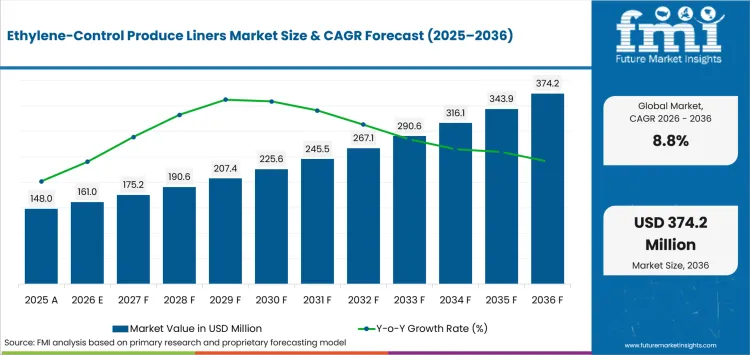
Key Takeaways of Ethylene-Control Produce Liners Market
- Long produce routes support liner demand as uncontrolled ethylene can shorten destination selling windows and increase quality deductions.
- KMnO4-Based Absorber Liners are projected to account for 30.0% share in 2026 due to established oxidation media.
- Paper-Fiber is estimated to capture 36.0% by substrate in 2026 owing to familiar converting routes and active-media compatibility.
- Ethylene Adsorption is anticipated to represent 44.0% share in 2026 owing to one clearly testable ripening-control objective.
- Crop respiration and active-media saturation delay qualification by making laboratory removal rates insufficient for approval across commercial routes.
- Ethylene Control Inc., Desiccare, Inc., TransFRESH Corporation, It's Fresh, AgroFresh, StePac, Sirane and McAirlaid's are some notable players.
Analyst Perspective
"Commercial trials earn repeat orders by connecting preserved arrival quality with fewer deductions per shipped unit. Manufacturers that define crop loading limits and disposal requirements reduce qualification risk for seasonal export programs."
- Nandini Roy Choudhury, Principal Consultant, Future Market Insights
How is the Ethylene-Control Produce Liners Market segmented?
The ethylene-control produce liners market is segmented by product type, substrate, function, produce type, end use, sales channel and region.
Product Type includes KMnO4-based absorbers, zeolite-mineral-infused liners, activated carbon liners, combination freshness liners, and other commercial formats. Substrate includes paper-fiber, airlaid cellulose, nonwoven materials, film structures, and other active-media carriers used in converted packs. Function distinguishes ethylene adsorption from combined moisture or antimicrobial control across qualified commercial freshness designs. Produce Type, End Use, and Sales Channel classify crop exposure, specification ownership, and purchasing route across commercial programs.
What makes KMnO4-Based absorber liners central to the product type category?
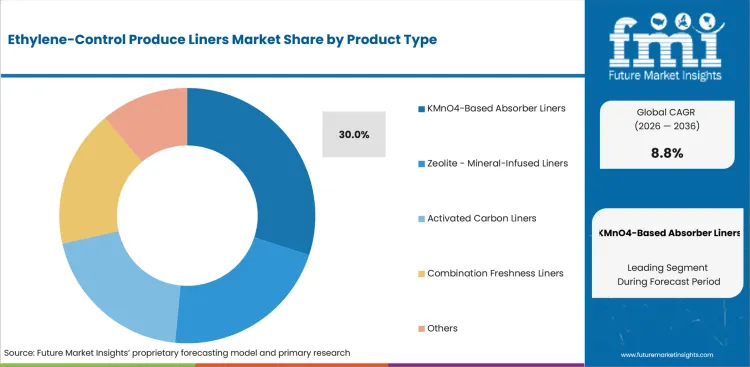
Potassium permanganate oxidizes ethylene as porous carriers bring the gas into contact with the active medium. This familiar food-grade packaging architecture lets manufacturers adjust media loading for cartons and transport units without installing powered equipment. The format also fits distributors that need passive control inside standard produce packs during storage and extended transit.
- By product type, KMnO4-Based Absorber Liners are estimated to hold 30.0% in 2026 owing to established oxidation chemistry and flexible loading options.
- Commercial approval depends on secure containment plus a media quantity matched to crop respiration and the expected enclosed-air volume throughout shipment.
Why does paper-fiber lead the substrate category?
Paper-fiber substrates accept printing and die cutting across established converting lines used for produce packs. Their internal structure can hold absorbent layers and preserve airflow around the active medium during commercial conversion. This operating fit connects ethylene control with familiar paper packaging processes at high-volume converting sites. Fiber structures also allow several absorption zones without adding a rigid device to the finished produce pack.
- The paper-fiber segment is likely to capture 36.0% share in 2026 attributable to converter familiarity and compatibility with absorbent media.
- Manufacturers must balance particle containment with gas access as excessive barriers reduce contact between ethylene and the active layer during use.
How does ethylene adsorption lead the function category?
Ethylene adsorption gives produce exporters one measurable control objective within a qualified commercial produce pack design. Container readings and arrival-condition checks connect the liner with a defined result during commercial route trials. The focused claim suits intelligent packaging programs that require clear validation criteria across packing operations.
- In 2026, ethylene adsorption is expected to lead the Function category with 44.0% share owing to a measurable primary control objective.
- In April 2026, It's Fresh held an Italian table-grape event covering ethylene dynamics plus pallet covers and cold storage. The technical program connected function selection with route-level handling decisions across commercial packing and storage programs.
Why are exporters-sea freight central to the end use category?
Ocean shipments expose produce to long transit windows and port delays that extend contact with accumulated ethylene. Exporters absorb the financial losses from downgraded or rejected loads during seasonal programs in destination markets. Documented lower shrink during commercial voyages earns repeat use for a liner or produce bag format without reducing packing speed.
- Exporters-sea freight is set to lead end use with 34.0% share in 2026 due to extended ocean-transit exposure.
- Commercial route approval requires destination comparisons covering firmness, weight loss and visible defects under the intended temperature plus ventilation settings.
What are the drivers, restraints and opportunities in the Ethylene-Control Produce Liners Market?
Long produce routes support demand, crop-specific validation slows approval, and multifunction fiber formats provide the clearest expansion route.
- Driver: Produce exporters require passive ripening control that protects destination quality across long storage and transport cycles.
- Restraint: Performance varies with crop respiration plus temperature and airflow conditions across each commercial route.
- Opportunity: Multifunction liners can combine ethylene control with moisture management inside one qualified pack component.
Year-round import dependence exposes fresh produce to more border crossings and longer distribution paths during movement toward retail outlets. USDA Economic Research Service reported in January 2025 that imports supplied 59% of fresh fruit availability and 35% of fresh vegetable availability during 2023. Those flows give fresh food packaging systems a measurable role whenever preserved grade reduces deductions or rejected loads.
Qualification remains difficult as ethylene load changes with crop maturity and enclosed air volume during each route. Media loading that succeeds in laboratory conditions can saturate early under warmer handling or restricted ventilation. Manufacturers therefore need commercial trials within food packaging systems that reflect the intended temperature and shipment duration for seasonal approval.
Multifunction formats provide the clearest expansion route for companies with active-media and absorbency knowledge serving commercial produce customers. A combined liner must preserve gas contact while adding liquid control without slowing existing packing equipment. That requirement connects sustainable packaging goals with fewer separate components inside one qualified produce format.
Which country CAGRs are profiled in the Ethylene-Control Produce Liners Market?
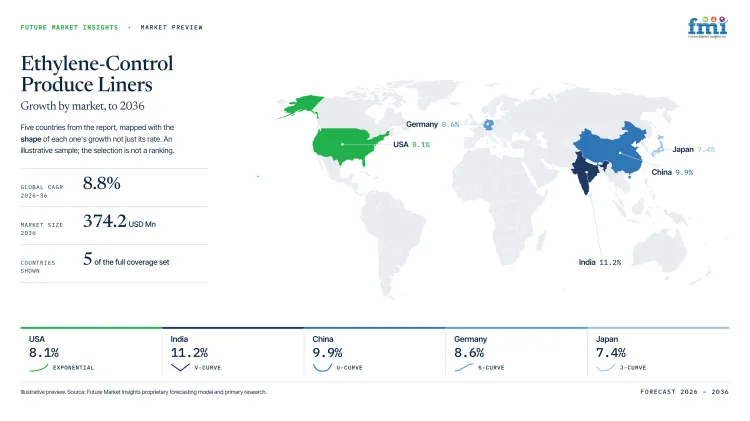
| Country | CAGR |
|---|---|
| USA | 8.1% |
| Germany | 8.6% |
| Japan | 7.4% |
| UK | 8.7% |
| Brazil | 9.2% |
How do country-level CAGRs compare in the Ethylene-Control Produce Liners Market?
The five profiled forecasts span 7.4% to 9.2% CAGR across the complete ten-year assessment period. The 1.8 percentage-point range reflects different export exposure and qualification thresholds across the five profiled country markets.
- Brazil's outlook is influenced by export-oriented fruit supply chains where long transit times increase the value of ethylene management during shipment.
- In the UK, retailers continue to balance produce waste reduction objectives with packaging recyclability and material reduction commitments.
- Germany places greater emphasis on documented performance benefits and verification of active materials used in fresh produce packaging.
- The USA market benefits from large domestic and imported produce volumes that create opportunities for liner adoption across diverse distribution networks.
- Japan's qualification process remains closely tied to established cold-chain practices, with packaging changes typically requiring extensive validation before rollout.
Comparable growth rates can conceal large differences in addressable packhouses and seasonal exposure during commercial planning. Country selection should combine forecast pace with route length and the cost of local qualification.
The full report covers more than thirty countries across the fixed regional taxonomy for detailed country-level assessment. Growth rate does not establish current market size or supplier accessibility during market entry planning.
Country-wise Analysis
- United States produce programs combine large domestic volumes with imports that travel across extended distribution networks and expose fruit or vegetables to several handling environments during the final retail or food-service sale. USDA Economic Research Service reported in May 2026 that imports represented about one-third of national vegetable availability during 2025 and Mexico supplied 77% of fresh vegetable imports. Demand for Ethylene-Control Produce Liners in the USA is forecast to rise at 8.1% CAGR over the forecast period, supported by addressable route volume although variable crop exposure requires evidence that preserved grade produces fewer deductions across each distributor program and seasonal crop mix.
- German retailers evaluate freshness formats against food-waste targets and strict documentation covering active materials plus disposal claims across national grocery programs that compare prevented spoilage with added packaging cost. The federal agriculture ministry reported in May 2025 that Germany generated about 10.8 million tonnes of food waste during 2022 and revised national governance during early 2025 across production and retail dialogues nationally. The Germany Ethylene-Control Produce Liners sector is projected to record 8.6% CAGR during the assessment period, supported by measurable waste pressure although manufacturers must prove containment and credible end-of-life instructions to secure recurring approval across retailer produce categories.
- Japanese produce distributors operate disciplined cold chains and require precise commercial evidence for changes to established pack specifications across premium fruit programs and long-distance import routes that already use controlled storage. Japan's agriculture ministry reported in June 2026 that business food loss reached 2.37 million tonnes during fiscal 2024 and stood 57% below the 2000 level under continuing reduction measures. Adoption of Ethylene-Control Produce Liners in Japan is estimated to expand at 7.4% CAGR through 2036, aided by measurable loss targets although manufacturers must quantify incremental gains under temperature and handling protocols that already perform consistently across established distribution programs.
- United Kingdom grocery programs connect fresh-produce performance with public waste measurement and packaging reduction commitments across retailer specifications and household-facing material policies that increasingly compare product protection with pack reduction. WRAP reported in March 2026 that self-reported waste across four monitored foods declined from 21.0% to 18.8% within a national survey covering 5,509 interviews and several demographic groups nationally. Ethylene-Control Produce Liners sales in the UK are forecast to expand at 8.7% CAGR by 2036, influenced by waste scrutiny although manufacturers must prove that prevented product loss exceeds the material burden under recycling and packaging-fee assessments across retailer programs.
- Brazilian fruit exporters require passive protection across warm precooling conditions and long ocean routes that expose tropical produce to variable port dwell times ahead of destination-market inspection across several seasonal programs. Brazil's agriculture ministry reported in July 2025 that fresh and prepared fruit exports exceeded USD 1.38 billion and one million tonnes during 2024 across diversified international destinations. Brazil is projected to grow at 9.2% CAGR by 2036 owing to export exposure, but manufacturers need mango and grape trials that account for temperature variation plus service support on European and North American routes during routine peak shipment windows and port delays.
Who are the notable companies in the Ethylene-Control Produce Liners Market?
Ethylene Control Inc., Desiccare, Inc., TransFRESH Corporation, It's Fresh, AgroFresh, StePac, Sirane and McAirlaid's are notable companies serving this market.
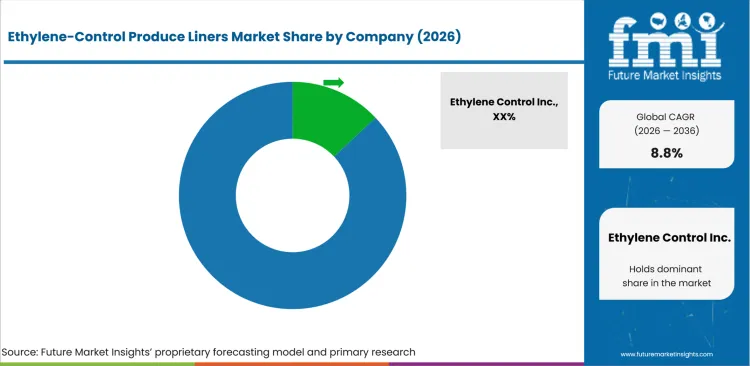
The competitive field remains fragmented across direct ethylene-control specialists, integrated postharvest groups and converted absorbent-packaging manufacturers. Produce programs compare crop evidence and route support before they compare the number of formats in a portfolio. Integrated groups can combine liners with modified atmosphere packaging, coatings or storage treatments. Entry barriers arise from active-media containment and repeatable commercial route results instead of company size alone.
- Ethylene-control specialists include Ethylene Control Inc., Desiccare, Inc. and It's Fresh whose positions reflect active-media knowledge plus documented crop applications.
- Integrated postharvest platforms include TransFRESH Corporation plus AgroFresh and StePac. These companies combine atmosphere control, treatments or long-haul packaging with broader technical support.
- Converted-liner specialists include Sirane and McAirlaid's whose absorbent structures can support multifunction produce formats across established converting operations.
Competitive Benchmarking: Ethylene-Control Produce Liners Market
| Company | Liner-Integrated Ethylene Control | Multi-Function Freshness Control | Route-Level Produce Application Support | Geographic Reach |
|---|---|---|---|---|
| Ethylene Control Inc. | High | High | Medium | United States with international distribution |
| Desiccare, Inc. | High | High | High | Europe with international postharvest programs |
| TransFRESH Corporation | Medium | High | High | North America with international produce routes |
| It's Fresh | High | Medium | High | Europe plus South Africa and Latin America |
| AgroFresh | Medium | High | High | Global operations across major produce regions |
| StePac | Medium | High | High | International long-haul produce programs |
| Sirane | High | High | Medium | United Kingdom with international converting reach |
| McAirlaid's | Unscored | Medium | Medium | Germany and United States manufacturing |
Key Developments in the Ethylene-Control Produce Liners Market
- In May 2026, It's Fresh joined the IFPA Packaging Innovation Program to integrate RYPEN into recyclable film for cardboard punnets and prepared salad packs. The work connected ethylene management with packaging reduction and required compatibility with established converting and filling processes.
- In June 2025, AgroFresh entered an exclusive global distribution agreement with Nabaco for NatuWrap. The agreement added a food-grade fruit barrier to AgroFresh channels and widened the alternatives considered beside liners, storage treatments and modified-atmosphere formats.
- In June 2025, AgroFresh entered an exclusive global distribution agreement with Nabaco for NatuWrap. The agreement added a food-grade fruit barrier to AgroFresh channels and widened the alternatives considered beside liners, storage treatments and modified-atmosphere formats
Key Players in the Ethylene-Control Produce Liners Market
Ethylene-Control Specialists
- Ethylene Control Inc.
- Desiccare, Inc.
- It's Fresh
Integrated Postharvest Platforms
- TransFRESH Corporation
- AgroFresh
- StePac
Absorbent and Converted-Liner Specialists
- Sirane
- McAirlaid's
Ethylene-Control Produce Liners Market - Report Scope
| Coverage field | Report scope |
|---|---|
| Market breakdown | By product type, substrate, function, produce type, end use, sales channel and region. |
| Quantitative Units | Revenue in USD million and CAGR in %. |
| Market Definition | Commercial liners and closely related inserts that adsorb or oxidize ethylene inside fresh-produce packs and transport units. |
| Regions Covered | North America, Latin America, Western Europe, Eastern Europe, East Asia, South Asia and Pacific, and Middle East and Africa. |
| Countries Covered | USA, Germany, Japan, UK, Brazil, and 30+ countries included in the full report. |
| Key Companies Profiled | Ethylene Control Inc., Desiccare, Inc., TransFRESH Corporation, It's Fresh, AgroFresh, StePac, Sirane and McAirlaid's. |
| Forecast Period | 2026 to 2036. |
| Approach | Primary and secondary research with market triangulation. |
Ethylene-Control Produce Liners Market - Research Methodology
| Method | Approach |
|---|---|
| Primary Research | FMI analysts gathered input from manufacturers, service providers, technology developers, distributors, end users, procurement teams, and subject-matter experts. Interviews examined purchasing decisions, product or service evaluation, adoption barriers, approval requirements, pricing considerations, and expectations for technical or commercial support. Respondents were also asked what evidence is required before a trial, pilot, or initial order develops into regular purchasing. |
| Desk Research | Desk research covered government statistics, regulatory publications, trade data, industry associations, technical literature, standards, company filings, product information, and official corporate announcements. Sources were reviewed for relevance, publication date, geographic coverage, and consistency with the defined market scope. Claims relating to performance, applications, approvals, capacity, investment, and commercial activity were retained only when supported by credible public evidence. |
| Market Sizing and Forecasting | The market model combined the baseline value with historical performance, segment structure, pricing and volume indicators, adoption levels, company participation, and country-level demand conditions. Forecast assumptions considered economic activity, investment trends, regulatory developments, technology adoption, purchasing cycles, supply availability, and barriers to wider market use. Segment and regional estimates were reconciled before the final market total was calculated. |
| Data Validation | Estimates were checked against multiple independent indicators, including public data, company activity, trade patterns, industry developments, and findings from primary interviews. Validation also tested whether products, services, applications, and company revenues fell within the defined market boundaries. Adjacent categories, unsupported claims, overlapping revenues, and activities without direct market relevance were excluded to reduce double counting and maintain consistency across segments and countries. |
Ethylene-Control Produce Liners Market by Segments
Ethylene-Control Produce Liners Market segmented by Product Type:
- KMnO4-Based Absorber Liners
- Zeolite-Mineral-Infused Liners
- Activated Carbon Liners
- Combination Freshness Liners
- Others
Ethylene-Control Produce Liners Market segmented by Substrate:
- Paper-Fiber
- Airlaid Cellulose
- Nonwoven
- Film
- Others
Ethylene-Control Produce Liners Market segmented by Function:
- Ethylene Adsorption
- Ethylene + Moisture Control
- Ethylene + Antimicrobial
- Others
Ethylene-Control Produce Liners Market segmented by Produce Type:
- Bananas & Tropicals
- Avocados
- Apples & Pears
- Stone Fruit
- Tomatoes
- Others
Ethylene-Control Produce Liners Market segmented by End Use:
- Exporters-Sea Freight
- Growers & Packers
- Grocery Retail
- Others
Ethylene-Control Produce Liners Market segmented by Sales Channel:
- Direct-OEM Supply
- Packaging Distributors
- Online-E-commerce
- Others
Ethylene-Control Produce Liners Market by Region:
- North America
- United States
- Canada
- Latin America
- Brazil
- Mexico
- Argentina
- Chile
- Western Europe
- Germany
- France
- United Kingdom
- Italy
- Spain
- Benelux
- Nordics
- Eastern Europe
- Poland
- Czech Republic
- Romania
- Hungary
- East Asia
- China
- Japan
- South Korea
- South Asia and Pacific
- India
- ASEAN
- Australia and New Zealand
- Middle East and Africa
- GCC Countries
- South Africa
- Türkiye
- Israel
Research Sources and Bibliography
- WRAP. (2025, March 19). UK bins thrive on a five-a-day diet of fruit & veg.
- WRAP. (2025, December 2). Removing packaging from uncut fresh produce: a financial case for action.
- It's Fresh. (2026, April 20). Our RYPEN team hosts table grape post-harvest event in Italy.
- Zahniser, S. (2025, January 16). USA fresh fruit and vegetable supplies continue to rely on imports.
- USA Department of Agriculture Economic Research Service. (2026, May 5). Vegetables and Pulses - Market Outlook.
- Federal Ministry of Food and Agriculture. (2025, May 16). Nationale Strategie zur Reduzierung der Lebensmittelverschwendung.
- Ministry of Agriculture, Forestry and Fisheries of Japan. (2026, June 30). 事業系食品ロス量(2024年度推計値)を公表.
- WRAP. (2026, March 9). Understanding household food waste in the UK: the Household Food Management Survey 2025.
- Ministry of Agriculture and Livestock of Brazil. (2025, July 1). A fruta mais exportada pelo Brasil é a manga.
- It's Fresh. (2026, May 1). Where shelf life, quality & recyclable packaging all meet.
- AgroFresh. (2025, June 18). AgroFresh Expands Global Post-Harvest Solutions Portfolio with NatuWrap® in Exclusive Distribution Agreement with Nabaco®.
- Hazel Technologies. (2025, February 3). Modified Atmosphere Packaging solution helps improve melon quality.
- TransFRESH Corporation. (2026, May 27). TransFRESH Corporation Acquires Hazel Technologies to Advance Industry-Leading Freshness Solutions for the Berry Sector.
- AgroFresh. (2026, April 28). AgroFresh Opens New Asia Pacific R&D Center in Yangling, China.
- It's Fresh. (2025, January 17). RYPEN is a finalist for the Fruit Logistica Innovation award.
This bibliography supports reader review without claiming exhaustiveness and the full report contains the complete reference list with detailed citations.
This Report Answers
- What are the Ethylene-Control Produce Liners Market values in 2026 and 2036?
- Which shipping conditions increase commercial use of ethylene-control liner formats?
- Why do KMnO4-Based Absorber Liners hold the leading Product Type position?
- How does Paper-Fiber affect converting options and active-media containment?
- Why does Ethylene Adsorption hold the leading Function position?
- How do growth rates differ across the five profiled country markets?
- Which companies provide direct ethylene control or broader postharvest platforms?
- How do crop-specific qualification and route conditions limit recurring adoption?
- What should produce exporters assess during approval of a liner system?
Frequently Asked Questions
How big is the Ethylene-Control Produce Liners Market in 2026?
In 2026, the ethylene-control produce liners market reaches a global value of USD 161.0 million. Commercial use concentrates on produce routes that need passive ripening control inside cartons or transport units without powered equipment at each packing point or distribution transfer.
What is the CAGR of the Ethylene-Control Produce Liners Market from 2026 to 2036?
The ethylene-control produce liners market is projected to expand at 8.8% CAGR from 2026 to 2036. Forecast growth depends on wider route qualification and evidence that each liner reduces shrink or quality deductions at an acceptable cost per shipped unit.
Which Function segment is projected to account for 44.0% of the Ethylene-Control Produce Liners Market?
Ethylene adsorption is projected to account for 44.0% of the ethylene-control produce liners market in 2026. The function remains central as exporters can test ethylene concentration and arrival condition without mixing the initial evaluation with moisture or antimicrobial requirements inside the same commercial pack.
Which End Use segment is projected to account for 34.0% of the Ethylene-Control Produce Liners Market?
Exporters-sea freight are projected to account for 34.0% of the Ethylene-Control Produce Liners Market in 2026. Long ocean journeys increase exposure to ripening signals and make destination grade plus rejected-load risk visible during commercial purchasing decisions for recurring seasonal export programs.
Which companies are active in the Ethylene-Control Produce Liners Market?
Ethylene Control Inc., Bioconservacion, TransFRESH Corporation and It's Fresh are active in the Ethylene-Control Produce Liners Market. AgroFresh plus StePac and Sirane join McAirlaid's across broader postharvest or converted-liner capabilities serving commercial produce programs in several regions.
Preview the report firsthand - request a free sample
Get SampleGet the brochure for pricing and purchase details.
Get PDFTable of Content
- Key Takeaways
- Market Size and CAGR
- Top Growth Driver
- Fastest Growing Segment
- Leading Region
- Key Companies
- Emerging Opportunities
- Executive Summary
- Global Market Outlook
- Demand-side Trends
- Supply-side Trends
- Technology Roadmap Analysis
- Analysis and Recommendations
- Analyst Perspective (What is happening? Why now? What should investors know?)
- Key Questions Answered
- How large is the market?
- What is the CAGR?
- What are key trends?
- Which region dominates?
- Who are the leaders?
- Market Overview
- Market Coverage / Taxonomy
- Market Definition / Scope / Limitations
- Research Methodology
- Chapter Orientation
- Analytical Lens and Working Hypotheses
- Market Structure, Signals, and Trend Drivers
- Benchmarking and Cross-market Comparability
- Market Sizing, Forecasting, and Opportunity Mapping
- Research Design and Evidence Framework
- Desk Research Programme (Secondary Evidence)
- Expert Input and Fieldwork (Primary Evidence)
- Tooling, Models, and Reference Databases
- Data Engineering and Model Build
- Quality Assurance and Audit Trail
- Market Background
- Market Dynamics (Drivers, Restraints, Opportunity, Trends)
- Scenario Forecast (Optimistic, Likely, Conservative)
- Impact Analysis
- AI Impact
- Sustainability Impact
- Regulatory Impact
- Technology Impact
- Consumer / Buyer Analysis
- Purchase Drivers
- Adoption Barriers
- Buyer Journey
- Opportunity Map Analysis
- Product Life Cycle Analysis
- Supply Chain Analysis
- Investment Feasibility Matrix
- Value Chain Analysis
- PESTLE and Porter's Analysis
- Regulatory Landscape
- Regional Parent Market Outlook
- Production and Consumption Statistics
- Import and Export Statistics
- Global Market Analysis and Forecast, 2021 to 2036
- Historical Market Size Value (USD Million) Analysis, 2021 to 2025
- Current and Future Market Size Value (USD Million) Projections, 2026 to 2036
- Y-o-Y Growth Trend Analysis
- Absolute $ Opportunity Analysis
- Global Market Pricing Analysis, 2021 to 2036
- Global Market Analysis and Forecast, By Product Type, 2021 to 2036
- Introduction / Key Findings
- Historical Market Size Value (USD Million) Analysis By Product Type, 2021 to 2025
- Current and Future Market Size Value (USD Million) Analysis and Forecast By Product Type, 2026 to 2036
- KMnO4-Based Absorber Liners
- Zeolite - Mineral-Infused Liners
- Activated Carbon Liners
- Combination Freshness Liners
- Others
- KMnO4-Based Absorber Liners
- Y-o-Y Growth Trend Analysis By Product Type, 2021 to 2025
- Absolute $ Opportunity Analysis By Product Type, 2026 to 2036
- Global Market Analysis and Forecast, By Substrate, 2021 to 2036
- Introduction / Key Findings
- Historical Market Size Value (USD Million) Analysis By Substrate, 2021 to 2025
- Current and Future Market Size Value (USD Million) Analysis and Forecast By Substrate, 2026 to 2036
- Paper - Fiber
- Airlaid Cellulose
- Nonwoven
- Film
- Others
- Paper - Fiber
- Y-o-Y Growth Trend Analysis By Substrate, 2021 to 2025
- Absolute $ Opportunity Analysis By Substrate, 2026 to 2036
- Global Market Analysis and Forecast, By Function, 2021 to 2036
- Introduction / Key Findings
- Historical Market Size Value (USD Million) Analysis By Function, 2021 to 2025
- Current and Future Market Size Value (USD Million) Analysis and Forecast By Function, 2026 to 2036
- Ethylene Adsorption
- Ethylene + Moisture Control
- Ethylene + Antimicrobial
- Others
- Ethylene Adsorption
- Y-o-Y Growth Trend Analysis By Function, 2021 to 2025
- Absolute $ Opportunity Analysis By Function, 2026 to 2036
- Global Market Analysis and Forecast, By Produce Type, 2021 to 2036
- Introduction / Key Findings
- Historical Market Size Value (USD Million) Analysis By Produce Type, 2021 to 2025
- Current and Future Market Size Value (USD Million) Analysis and Forecast By Produce Type, 2026 to 2036
- Bananas & Tropicals
- Avocados
- Apples & Pears
- Others
- Stone Fruit
- Tomatoes
- Bananas & Tropicals
- Y-o-Y Growth Trend Analysis By Produce Type, 2021 to 2025
- Absolute $ Opportunity Analysis By Produce Type, 2026 to 2036
- Global Market Analysis and Forecast, By End Use, 2021 to 2036
- Introduction / Key Findings
- Historical Market Size Value (USD Million) Analysis By End Use, 2021 to 2025
- Current and Future Market Size Value (USD Million) Analysis and Forecast By End Use, 2026 to 2036
- Exporters - Sea Freight
- Growers & Packers
- Grocery Retail
- Others
- Exporters - Sea Freight
- Y-o-Y Growth Trend Analysis By End Use, 2021 to 2025
- Absolute $ Opportunity Analysis By End Use, 2026 to 2036
- Global Market Analysis and Forecast, By Sales Channel
- Introduction / Key Findings
- Historical Market Size Value (USD Million) Analysis By Sales Channel, 2021 to 2025
- Current and Future Market Size Value (USD Million) Analysis and Forecast By Sales Channel, 2026 to 2036
- Direct - OEM Supply
- Packaging Distributors
- Online - E-commerce
- Others
- Direct - OEM Supply
- Y-o-Y Growth Trend Analysis By Sales Channel, 2021 to 2025
- Absolute $ Opportunity Analysis By Sales Channel, 2026 to 2036
- Global Market Analysis and Forecast, By Region, 2021 to 2036
- Introduction
- Historical Market Size Value (USD Million) Analysis By Region, 2021 to 2025
- Current Market Size Value (USD Million) Analysis and Forecast By Region, 2026 to 2036
- North America
- Latin America
- Western Europe
- Eastern Europe
- East Asia
- South Asia and Pacific
- Middle East & Africa
- Market Attractiveness Analysis By Region
- North America Market Analysis and Forecast, By Country, 2021 to 2036
- Historical Market Size Value (USD Million) Trend Analysis By Market Taxonomy, 2021 to 2025
- Market Size Value (USD Million) Forecast By Market Taxonomy, 2026 to 2036
- By Country
- USA
- Canada
- By Product Type
- By Substrate
- By Function
- By Produce Type
- By End Use
- By Sales Channel
- By Country
- Market Attractiveness Analysis
- By Country
- By Product Type
- By Substrate
- By Function
- By Produce Type
- By End Use
- By Sales Channel
- Key Takeaways
- Latin America Market Analysis and Forecast, By Country
- Historical Market Size Value (USD Million) Trend Analysis By Market Taxonomy, 2021 to 2025
- Market Size Value (USD Million) Forecast By Market Taxonomy, 2026 to 2036
- By Country
- Brazil
- Mexico
- Chile
- Rest of Latin America
- By Product Type
- By Substrate
- By Function
- By Produce Type
- By End Use
- By Sales Channel
- By Country
- Market Attractiveness Analysis
- By Country
- By Product Type
- By Substrate
- By Function
- By Produce Type
- By End Use
- By Sales Channel
- Key Takeaways
- Western Europe Market Analysis and Forecast, By Country
- Historical Market Size Value (USD Million) Trend Analysis By Market Taxonomy, 2021 to 2025
- Market Size Value (USD Million) Forecast By Market Taxonomy, 2026 to 2036
- By Country
- Germany
- UK
- Italy
- Spain
- France
- Nordic
- BENELUX
- Rest of Western Europe
- By Product Type
- By Substrate
- By Function
- By Produce Type
- By End Use
- By Sales Channel
- By Country
- Market Attractiveness Analysis
- By Country
- By Product Type
- By Substrate
- By Function
- By Produce Type
- By End Use
- By Sales Channel
- Key Takeaways
- Eastern Europe Market Analysis and Forecast, By Country
- Historical Market Size Value (USD Million) Trend Analysis By Market Taxonomy, 2021 to 2025
- Market Size Value (USD Million) Forecast By Market Taxonomy, 2026 to 2036
- By Country
- Russia
- Poland
- Hungary
- Balkan & Baltic
- Rest of Eastern Europe
- By Product Type
- By Substrate
- By Function
- By Produce Type
- By End Use
- By Sales Channel
- By Country
- Market Attractiveness Analysis
- By Country
- By Product Type
- By Substrate
- By Function
- By Produce Type
- By End Use
- By Sales Channel
- Key Takeaways
- East Asia Market Analysis and Forecast, By Country
- Historical Market Size Value (USD Million) Trend Analysis By Market Taxonomy, 2021 to 2025
- Market Size Value (USD Million) Forecast By Market Taxonomy, 2026 to 2036
- By Country
- China
- Japan
- South Korea
- By Product Type
- By Substrate
- By Function
- By Produce Type
- By End Use
- By Sales Channel
- By Country
- Market Attractiveness Analysis
- By Country
- By Product Type
- By Substrate
- By Function
- By Produce Type
- By End Use
- By Sales Channel
- Key Takeaways
- South Asia and Pacific Market Analysis and Forecast, By Country
- Historical Market Size Value (USD Million) Trend Analysis By Market Taxonomy, 2021 to 2025
- Market Size Value (USD Million) Forecast By Market Taxonomy, 2026 to 2036
- By Country
- India
- ASEAN
- Australia & New Zealand
- Rest of South Asia and Pacific
- By Product Type
- By Substrate
- By Function
- By Produce Type
- By End Use
- By Sales Channel
- By Country
- Market Attractiveness Analysis
- By Country
- By Product Type
- By Substrate
- By Function
- By Produce Type
- By End Use
- By Sales Channel
- Key Takeaways
- Middle East & Africa Market Analysis and Forecast, By Country
- Historical Market Size Value (USD Million) Trend Analysis By Market Taxonomy, 2021 to 2025
- Market Size Value (USD Million) Forecast By Market Taxonomy, 2026 to 2036
- By Country
- Kingdom of Saudi Arabia
- Other GCC Countries
- Türkiye
- South Africa
- Other African Union
- Rest of Middle East & Africa
- By Product Type
- By Substrate
- By Function
- By Produce Type
- By End Use
- By Sales Channel
- By Country
- Market Attractiveness Analysis
- By Country
- By Product Type
- By Substrate
- By Function
- By Produce Type
- By End Use
- By Sales Channel
- Key Takeaways
- Key Countries Market Analysis
- USA
- Pricing Analysis
- Market Share Analysis, 2025
- By Product Type
- By Substrate
- By Function
- By Produce Type
- By End Use
- By Sales Channel
- Canada
- Pricing Analysis
- Market Share Analysis, 2025
- By Product Type
- By Substrate
- By Function
- By Produce Type
- By End Use
- By Sales Channel
- Mexico
- Pricing Analysis
- Market Share Analysis, 2025
- By Product Type
- By Substrate
- By Function
- By Produce Type
- By End Use
- By Sales Channel
- Brazil
- Pricing Analysis
- Market Share Analysis, 2025
- By Product Type
- By Substrate
- By Function
- By Produce Type
- By End Use
- By Sales Channel
- Chile
- Pricing Analysis
- Market Share Analysis, 2025
- By Product Type
- By Substrate
- By Function
- By Produce Type
- By End Use
- By Sales Channel
- Germany
- Pricing Analysis
- Market Share Analysis, 2025
- By Product Type
- By Substrate
- By Function
- By Produce Type
- By End Use
- By Sales Channel
- UK
- Pricing Analysis
- Market Share Analysis, 2025
- By Product Type
- By Substrate
- By Function
- By Produce Type
- By End Use
- By Sales Channel
- Italy
- Pricing Analysis
- Market Share Analysis, 2025
- By Product Type
- By Substrate
- By Function
- By Produce Type
- By End Use
- By Sales Channel
- Spain
- Pricing Analysis
- Market Share Analysis, 2025
- By Product Type
- By Substrate
- By Function
- By Produce Type
- By End Use
- By Sales Channel
- France
- Pricing Analysis
- Market Share Analysis, 2025
- By Product Type
- By Substrate
- By Function
- By Produce Type
- By End Use
- By Sales Channel
- India
- Pricing Analysis
- Market Share Analysis, 2025
- By Product Type
- By Substrate
- By Function
- By Produce Type
- By End Use
- By Sales Channel
- ASEAN
- Pricing Analysis
- Market Share Analysis, 2025
- By Product Type
- By Substrate
- By Function
- By Produce Type
- By End Use
- By Sales Channel
- Australia & New Zealand
- Pricing Analysis
- Market Share Analysis, 2025
- By Product Type
- By Substrate
- By Function
- By Produce Type
- By End Use
- By Sales Channel
- China
- Pricing Analysis
- Market Share Analysis, 2025
- By Product Type
- By Substrate
- By Function
- By Produce Type
- By End Use
- By Sales Channel
- Japan
- Pricing Analysis
- Market Share Analysis, 2025
- By Product Type
- By Substrate
- By Function
- By Produce Type
- By End Use
- By Sales Channel
- South Korea
- Pricing Analysis
- Market Share Analysis, 2025
- By Product Type
- By Substrate
- By Function
- By Produce Type
- By End Use
- By Sales Channel
- Russia
- Pricing Analysis
- Market Share Analysis, 2025
- By Product Type
- By Substrate
- By Function
- By Produce Type
- By End Use
- By Sales Channel
- Poland
- Pricing Analysis
- Market Share Analysis, 2025
- By Product Type
- By Substrate
- By Function
- By Produce Type
- By End Use
- By Sales Channel
- Hungary
- Pricing Analysis
- Market Share Analysis, 2025
- By Product Type
- By Substrate
- By Function
- By Produce Type
- By End Use
- By Sales Channel
- Kingdom of Saudi Arabia
- Pricing Analysis
- Market Share Analysis, 2025
- By Product Type
- By Substrate
- By Function
- By Produce Type
- By End Use
- By Sales Channel
- Türkiye
- Pricing Analysis
- Market Share Analysis, 2025
- By Product Type
- By Substrate
- By Function
- By Produce Type
- By End Use
- By Sales Channel
- South Africa
- Pricing Analysis
- Market Share Analysis, 2025
- By Product Type
- By Substrate
- By Function
- By Produce Type
- By End Use
- By Sales Channel
- USA
- Market Structure Analysis
- Competition Dashboard
- Competition Benchmarking
- Market Share Analysis of Top Players
- By Regional
- By Product Type
- By Substrate
- By Function
- By Produce Type
- By End Use
- By Sales Channel
- Emerging Startups
- Innovation Benchmarking
- Competition Analysis
- Competition Deep Dive
- Ethylene Control Inc.
- Overview
- Product Portfolio
- Profitability by Market Segments
- Sales Footprint
- Strategy Overview
- Marketing Strategy
- Product Strategy
- Channel Strategy
- Desiccare, Inc.
- Hazel Technologies
- It's Fresh
- AgroFresh
- Purfresh
- Sirane
- StePac
- McAirlaid's
- Maxwell Chase Technologies
- Ethylene Control Inc.
- Case Studies
- Success Stories
- Recent Developments
- Competition Deep Dive
- Assumptions & Acronyms Used


