

- Market Size (2026)
- USD 17.5 Mn
- Forecast (2036)
- USD 20.1 Mn
- CAGR (2026 to 2036)
- 1.4%
How big is the etoricoxib market in 2026?
USD 17.5 million in 2026 and USD 20.1 million by 2036 at a 1.4% CAGR.
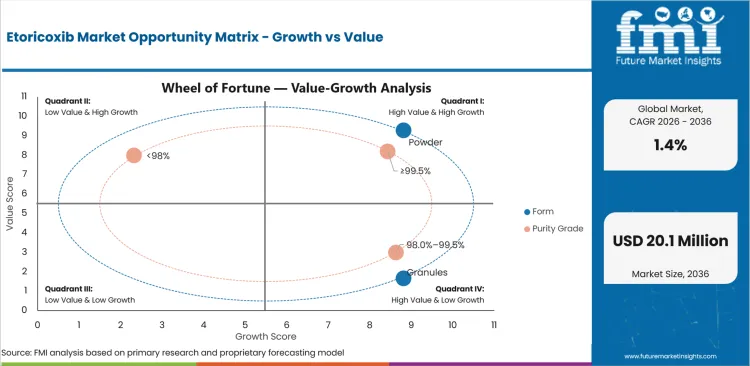
The etoricoxib market is expected to grow from USD 16.9 million in 2025 to USD 20.1 million by 2036 through narrow prescription use. Powder is forecast to hold 74.6% share in 2026 due to flexible API handling needs. The ≥99.5% purity grade is projected to represent 61.4% share due to buyer focus on impurity control.
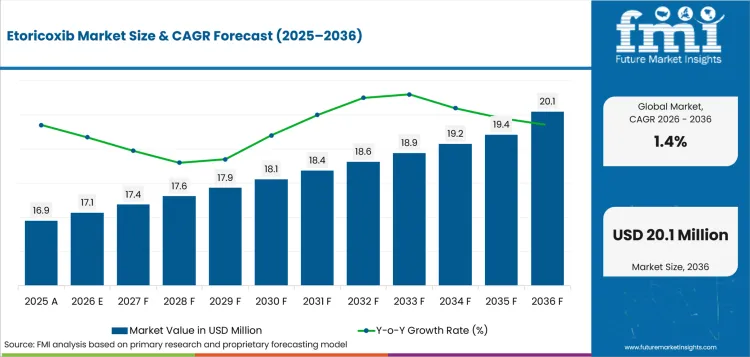
| 2026 Market Size | USD 17.5 million |
|---|---|
| 2036 Market Size | USD 20.1 million |
| Forecast CAGR (2026-2036) | 1.4% |
| Leading Form | Powder |
| Powder Share (2026) | 74.6% |
| Leading Purity Grade | ≥99.5% |
| ≥99.5% Purity Grade Share (2026) | 61.4% |
| Fastest-growing Country | India |
| India CAGR by 2036 | 2.4% |
| Market Signal | Commercial Impact |
|---|---|
| Demand and Growth Drivers | Chronic pain management and established COX-2 therapy continue to support demand for etoricoxib.
|
| Product and Segment View | Powder formulations, high-purity APIs, and direct supplier relationships remain the preferred commercial choices.
|
| Geography and Growth Outlook | South Asia & Pacific remains the leading production hub, while Europe continues to emphasize regulatory quality standards.
|
| Competitive Landscape | Competition increasingly depends on regulatory documentation and manufacturing consistency.
|
| Analyst Perspective | Etoricoxib remains a mature API market where compliance and product quality outweigh aggressive pricing strategies.
- Anurag Sharma, Principal Consultant at Future Market Insights (Healthcare) |
Etoricoxib industry expansion is driven by prescription-led arthritis treatment. CDC reported that 21.3% of U.S. adults had diagnosed arthritis in 2024. It also recorded 9.9 million office-based physician visits with osteoarthritis as the primary diagnosis. This supports a defined treatment pool where API demand follows clinician-managed arthritis care. Safety evidence keeps buyer planning selective because the April 2026 UK SmPC cites pooled cardiovascular safety data from 17,412 patients treated with etoricoxib. It also reports discontinuation rates of up to 2.6% for hypertension in MEDAL Programme studies.
Which factors support expansion in the etoricoxib market?
Licensed prescription demand and qualified API supply are expected to support market value across regulated and semi-regulated channels.
- Market value is supported by repeat API demand before finished-dose brands and dispensing revenue are counted.
- Supplier pricing reflects assay control and impurity documentation before distributors add transactional volume.
- Revenue improves when formulation customers keep validated API sources active across repeat tablet batches.
- Small-molecule sourcing behavior aligns with small molecule API purchasing due to similar qualification rules.
Why is the etoricoxib market growing?
Adult pain and inflammatory disorder treatment creates a stable API base in markets where etoricoxib remains licensed for selected indications.
The etoricoxib market is expected to maintain a measured outlook because use remains tied to prescription-led arthritis care and approved indication fit. EMA identifies etoricoxib for osteoarthritis, rheumatoid arthritis, and short-term arthritis due to gout. This keeps product planning focused on clinician use cases instead of broad consumer pain-relief demand. Qualified API supply is the second separator because buyers check impurity control and release documentation before routine orders begin. EDQM stated in December 2024 that its CEP inspection program verified GMP compliance at API manufacturing sites through 26 on-site inspections and two remote inspections in 2023. This matters because etoricoxib API suppliers with audit readiness and certificate delivery can move faster from buyer qualification to repeat procurement.
How is the etoricoxib market segmented?
The etoricoxib industry is segmented by segmented by form, purity grade, application, sales channel
- Powder is projected to secure 74.6% share in 2026 due to tablet-maker demand for flexible blending material.
- The ≥99.5% purity grade is anticipated to hold 61.4% share in 2026 owing to impurity-limit scrutiny.
- Osteoarthritis is expected to capture 46.0% application share in 2026 supported by chronic symptom treatment.
- Direct sales are forecast to represent 58.0% share in 2026 with regulated customers preferring auditable contracts.
- South Asia & Pacific is estimated to account for 32.0% regional share in 2026 through Indian API supply.
Why does powder dominate the etoricoxib market?
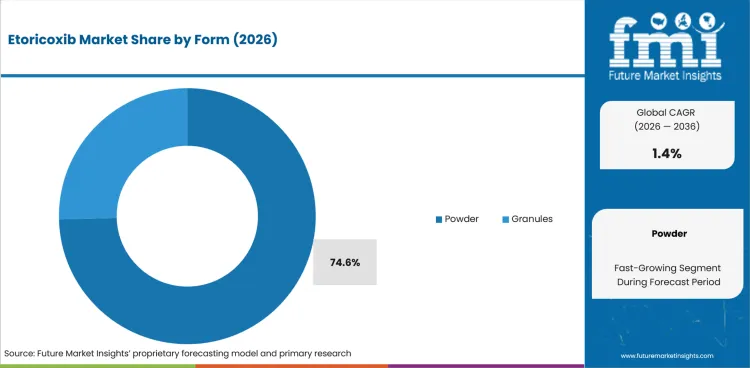
- Powder is projected to account for 74.6% share in 2026 owing to wet granulation and compression workflows.
- Granules serve buyers that prioritize flow and dust control during smaller commercial batches.
Which purity grade leads the etoricoxib market?
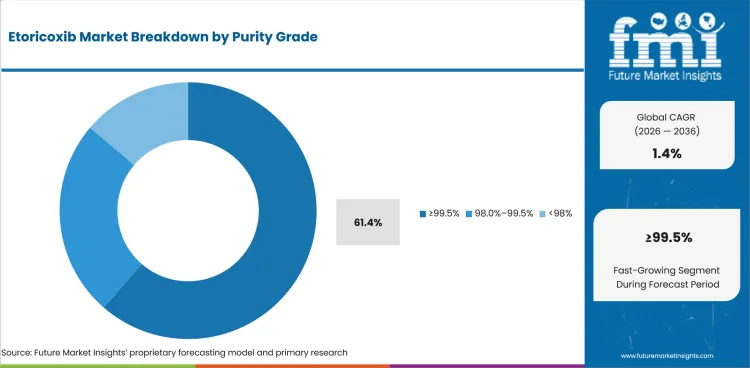
- The ≥99.5% grade is expected to hold 61.4% share in 2026 due to stronger impurity control.
- Lower purity grades are expected to stay limited where extra testing raises release burden.
Which application leads etoricoxib API use?
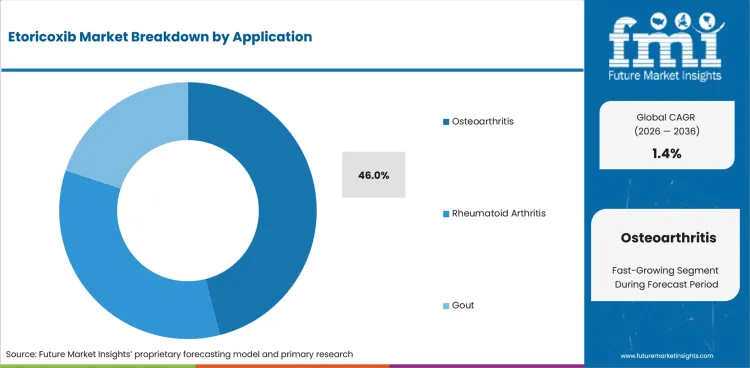
- Osteoarthritis is forecast to account for 46.0% share in 2026 due to repeat chronic joint-pain management.
- Acute gout creates short-duration batch needs where labels permit higher-dose treatment windows.
Which sales channel leads etoricoxib API purchases?
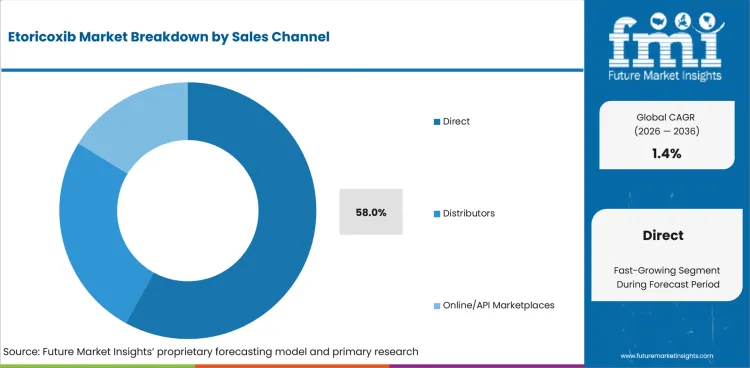
- Direct sales are expected to represent 58.0% share in 2026 due to supplier audit access.
- Distributors stay useful for smaller customers that need lower order quantities.
What are the drivers and restraints in the etoricoxib market?
Prescription discipline supports repeat demand. Cardiovascular risk language limits broad patient conversion.
- Driver: Arthritis-related prescribing is expected to support repeat API demand in licensed etoricoxib markets.
- Restraint: Cardiovascular warning language is expected to restrict dose escalation and long-duration use.
- Opportunity: Higher-purity supply is expected to help qualified suppliers reduce release risk for formulation customers.
- Opportunity: API process planning supports solvent-control reviews for formulation customers.
Prescription-Controlled Demand Outlook
Approved-use arthritis treatment keeps etoricoxib API demand small but repeatable. CDC’s February 2024 data brief found diagnosed arthritis in 18.9% of U.S. adults in 2022. The statistic supports the size of the pain-treatment pool but not broad etoricoxib conversion. Suppliers therefore plan around licensed-market orders and careful dosing language.
Qualified Supplier and Export-Capacity Signal
Supplier opportunity is expected to be driven by export-ready formulation depth. PIB reported in December 2025 that India’s pharmaceutical exports reached USD 30.47 billion in 2024–25. The same release reported 9.4% export growth over the previous year. This gives Indian API suppliers a stronger base for regulated customer outreach.
Quality-Control and Dose-Risk Restraint
Quality pressure is expected to remain central to repeat API approval. FDA reported in December 2025 that CDER’s FY2024 site catalog covered 4,619 manufacturing sites globally. FDA also recorded 972 drug-quality assurance inspections in FY2024. Buyers are therefore expected to favor suppliers that can answer audit and impurity questions quickly.
Which countries are growing fastest in the etoricoxib market?
India leads at 2.4% CAGR through 2036. China follows at 1.7% CAGR and South Korea records 1.5% CAGR. Germany is forecast at 1.3% CAGR. France and the United Kingdom follow at 1.2% and 1.1%. Japan reaches 0.9% CAGR and the United States records 0.8% CAGR.
.webp "Top Country Growth Comparison Etoricoxib Market Cagr (2026 2036)")
| Country | CAGR |
|---|---|
| India | 2.4% |
| China | 1.7% |
| South Korea | 1.5% |
| Germany | 1.3% |
| France | 1.2% |
| United Kingdom | 1.1% |
| Japan | 0.9% |
| United States | 0.8% |
Source: Future Market Insights, 2026.
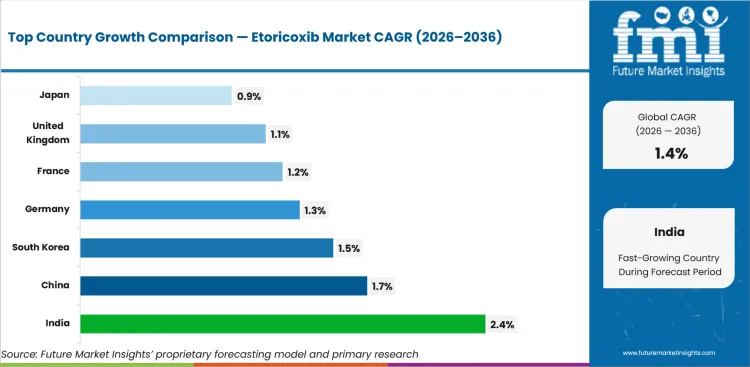
How do country-level CAGRs compare in the etoricoxib market?
India leads country growth while the United States records the most cautious expansion outlook among profiled markets.
- India is forecast to record 2.4% CAGR by 2036 due to domestic API capacity and formulation demand.
- China is expected to expand at 1.7% CAGR during the forecast period due to local finished-dose availability.
- South Korea is projected to grow at 1.5% CAGR by 2036 with regulated distribution shaping supplier choice.
- Germany is estimated to rise at 1.3% CAGR by the end of 2036 due to quality-sensitive demand.
- France is projected to grow at 1.2% CAGR over the assessment period, with safety review keeping expansion measured.
- The United Kingdom is forecast to record 1.1% CAGR by 2036 due to cautious product guidance.
- Japan is expected to advance at 0.9% CAGR during the forecast decade due to narrow commercial availability.
- The United States is projected to post 0.8% CAGR by 2036 due to limited routine finished-dose demand.
How fast is the etoricoxib market growing in India?
A 2.4% CAGR through 2036 reflects local medicine availability and qualified API sourcing behavior.
Country Market Snapshot Table
| Parameter | Value |
|---|---|
| Market Size in 2025 (Value) | USD 3.20 million |
| Market Size in 2026 (Value) | USD 3.28 million |
| Market Forecast in 2036 (Value) | USD 4.15 million |
| CAGR (2026 to 2036) | 2.4% |
| Years Considered | 2021 to 2036 |
| Base Year | 2025 |
| Forecast Period | 2026 to 2036 |
| Units Considered | Value (USD million) |
| Leading Sub-Region | Hyderabad and Gujarat pharmaceutical corridors |
India Etoricoxib Market Outlook
India demand is shaped by domestic formulation production and export-focused API supply. Buyers favor suppliers that can support recurring quality checks.
Aging demographics add a treatment pool for chronic pain medicines. Local quality alerts keep batch testing central to supplier selection.
Key Growth Drivers
- India’s aging base supports chronic pain planning. PIB projected the senior citizen population at around 230 million by 2036.
- National treatment programs add screening discipline around pain medicines. PIB reported 42.01 million people treated for hypertension by March 2025.
- Domestic API manufacturing depth supports repeat sourcing for etoricoxib formulation customers.
- Export-focused formulation plants keep direct API relationships active with qualified suppliers.
Key Restraints
- Quality alerts can slow supplier approval. CDSCO listed 2 etoricoxib tablet batches in its June 2025 state NSQ alert.
- Price competition from adjacent NSAID formulations can limit premium API pricing in domestic tenders.
- Regulated customers may delay source switching when impurity records are incomplete.
What makes India unique
India is unique due to API production depth close to domestic prescription demand.
Key Companies
- MSN Laboratories
- Hetero Drugs
- Aurobindo Pharma
- Alivus Life Sciences
- Orex Pharma
- Kekule Pharma
- Prudence Pharma
Sales & Marketing Channels
- Direct manufacturer contracts
- API distributors
- Export formulation customers
- Hospital formulation tenders
- Online/API marketplaces
Country Segment Breakdown Table
| Segment | Sub-Segments |
|---|---|
| By Form | Powder · Granules |
| By Purity Grade | ≥99.5% · 98.0%–99.5% · <98% |
| By Application | Osteoarthritis · Rheumatoid Arthritis · Acute Pain · Gout |
| By Sales Channel | Direct · Distributors · Online/API Marketplaces |
| Key Use Context | Licensed prescription products · Research supply · Export formulation support |
Frequently Asked Questions
How fast is India etoricoxib market growing?
Demand in India is expected to rise at 2.4% CAGR from 2026 to 2036.
Who leads India etoricoxib market?
Qualified formulation suppliers and API distributors lead through regulated sourcing channels.
What is driving adoption in India etoricoxib market?
Approved-use pain treatment and documentation needs are driving selective API demand.
How fast is the etoricoxib market growing in China?
A 1.7% CAGR through 2036 reflects local medicine availability and qualified API sourcing behavior.
Country Market Snapshot Table
| Parameter | Value |
|---|---|
| Market Size in 2025 (Value) | USD 2.70 million |
| Market Size in 2026 (Value) | USD 2.75 million |
| Market Forecast in 2036 (Value) | USD 3.25 million |
| CAGR (2026 to 2036) | 1.7% |
| Years Considered | 2021 to 2036 |
| Base Year | 2025 |
| Forecast Period | 2026 to 2036 |
| Units Considered | Value (USD million) |
| Leading Sub-Region | Jiangsu and Zhejiang pharmaceutical clusters |
China Etoricoxib Market Outlook
China demand is expected to move with local finished-dose availability and hospital prescribing controls. Supplier choice depends on regulatory documentation.
Population aging supports pain management demand. Cardiovascular screening language limits broad expansion.
Key Growth Drivers
- China’s older population supports chronic pain planning. NBS reported 220.23 million people aged 65 and above at the end of 2024.
- A second aging source supports chronic pain planning. World Bank data placed China’s age-65-plus share at 14.67% in 2024.
- Local finished-dose activity is expected to create structured API qualification needs.
- Coastal pharmaceutical clusters are expected to support sourcing options for qualified customers.
Key Restraints
- Cardiovascular screening limits broad use. The UK SmPC says blood pressure should be monitored within 2 weeks after treatment starts.
- Hospital procurement reviews can slow supplier conversion when batch history is limited.
- Public English evidence for some local company-specific approval claims remains limited.
What makes China unique
China is unique due to large patient scale and tight hospital procurement review.
Key Companies
- Jiangsu Hengrui Medicine
- Qualified finished-dose manufacturers
- Provincial distributors
Sales & Marketing Channels
- Hospital procurement channels
- Direct API supply
- Provincial distributors
- Finished-dose manufacturers
- Digital sourcing platforms
Country Segment Breakdown Table
| Segment | Sub-Segments |
|---|---|
| By Form | Powder · Granules |
| By Purity Grade | ≥99.5% · 98.0%-99.5% · <98% |
| By Application | Osteoarthritis · Rheumatoid Arthritis · Acute Pain · Gout |
| By Sales Channel | Direct · Distributors · Online/API Marketplaces |
| Key Use Context | Licensed prescription products · Research supply · Export formulation support |
Frequently Asked Questions
How fast is China etoricoxib market growing?
Demand in China is expected to rise at 1.7% CAGR from 2026 to 2036.
Who leads China etoricoxib market?
Qualified formulation suppliers and API distributors lead through regulated sourcing channels.
What is driving adoption in China etoricoxib market?
Approved-use pain treatment and documentation needs are driving selective API demand.
How fast is the etoricoxib market growing in South Korea?
A 1.5% CAGR through 2036 reflects local medicine availability and qualified API sourcing behavior.
Country Market Snapshot Table
| Parameter | Value |
|---|---|
| Market Size in 2025 (Value) | USD 1.25 million |
| Market Size in 2026 (Value) | USD 1.27 million |
| Market Forecast in 2036 (Value) | USD 1.48 million |
| CAGR (2026 to 2036) | 1.5% |
| Years Considered | 2021 to 2036 |
| Base Year | 2025 |
| Forecast Period | 2026 to 2036 |
| Units Considered | Value (USD million) |
| Leading Sub-Region | Seoul and Gyeonggi pharmaceutical corridors |
South Korea Etoricoxib Market Outlook
South Korea demand is expected to remain controlled through regulated prescribing and quality-focused sourcing. Local buyers prefer clear import records.
Demographic aging supports chronic pain management demand. Regulatory discipline keeps supplier qualification measured.
Key Growth Drivers
- Aging supports arthritis treatment relevance. World Bank data placed South Korea’s age-65-plus share at 19.27% in 2024.
- Older-person growth adds a long-term care base. KOSTAT projected the elderly population at 10.00 million persons in 2025.
- MFDS quality expectations are expected to favor suppliers with stable certificates.
- Urban hospital networks are expected to support controlled prescription demand for approved pain therapies.
Key Restraints
- Blood-pressure review adds repeat screening work. The UK SmPC says blood pressure should be monitored within 2 weeks after treatment starts.
- Small absolute API volumes can make distributor economics difficult outside repeat accounts.
- Physician caution around coxib risk can limit long-duration prescription expansion.
What makes South Korea unique
South Korea is unique due to fast population aging and tightly regulated pharmaceutical distribution.
Key Companies
- Hanmi Pharmaceutical
- Yuhan Corporation
- Chong Kun Dang
- Celltrion Pharm
- Local pharmaceutical distributors
Sales & Marketing Channels
- Direct import supply
- Hospital distributors
- Domestic formulation customers
- Regulated wholesalers
- Specialty sourcing agents
Country Segment Breakdown Table
| Segment | Sub-Segments |
|---|---|
| By Form | Powder · Granules |
| By Purity Grade | ≥99.5% · 98.0%-99.5% · <98% |
| By Application | Osteoarthritis · Rheumatoid Arthritis · Acute Pain · Gout |
| By Sales Channel | Direct · Distributors · Online/API Marketplaces |
| Key Use Context | Licensed prescription products · Research supply · Export formulation support |
Frequently Asked Questions
How fast is South Korea etoricoxib market growing?
Demand in South Korea is expected to rise at 1.5% CAGR from 2026 to 2036.
Who leads South Korea etoricoxib market?
Qualified formulation suppliers and API distributors lead through regulated sourcing channels.
What is driving adoption in South Korea etoricoxib market?
Approved-use pain treatment and documentation needs are driving selective API demand.
How fast is the etoricoxib market growing in Germany?
A 1.3% CAGR through 2036 reflects local medicine availability and qualified API sourcing behavior.
Country Market Snapshot Table
| Parameter | Value |
|---|---|
| Market Size in 2025 (Value) | USD 1.70 million |
| Market Size in 2026 (Value) | USD 1.72 million |
| Market Forecast in 2036 (Value) | USD 1.96 million |
| CAGR (2026 to 2036) | 1.3% |
| Years Considered | 2021 to 2036 |
| Base Year | 2025 |
| Forecast Period | 2026 to 2036 |
| Units Considered | Value (USD million) |
| Leading Sub-Region | North Rhine-Westphalia and Bavaria healthcare corridors |
Germany Etoricoxib Market Outlook
Germany demand is expected to stay quality-sensitive due to EU medicine expectations. Buyers prioritize traceable certificates over low price.
An older population supports chronic inflammatory disorder treatment. Safety language around dose and blood pressure keeps expansion restrained.
Key Growth Drivers
- Germany has a large chronic-care pool. Destatis reported 7.2% of the population aged 80 to 100 in 2024.
- Long-term aging supports pain therapy demand. Destatis projected one person in 4 will be aged 67 or over in 2035.
- German buyers are expected to favor suppliers with pharmacopoeial alignment and consistent impurity records.
- Direct sourcing is expected to remain preferred where customers need audit-ready documentation.
Key Restraints
- Hypertension risk narrows prescribing. A WHO 2025 hypertension profile reported Germany at 36% prevalence among adults aged 30 to 79.
- Payer and prescriber caution can slow conversion from established NSAID choices.
- Long qualification cycles can limit new API supplier entry into regulated accounts.
What makes Germany unique
Germany is unique due to EU risk language and documentation expectations in supplier selection.
Key Companies
- Stada Arzneimittel
- Phoenix Pharmahandel
- Ratiopharm legacy channels
- German API distributors
- EU-qualified formulation suppliers
Sales & Marketing Channels
- Direct API contracts
- Hospital procurement channels
- Pharmaceutical wholesalers
- EU distributors
- Qualified formulation customers
Country Segment Breakdown Table
| Segment | Sub-Segments |
|---|---|
| By Form | Powder · Granules |
| By Purity Grade | ≥99.5% · 98.0%–99.5% · <98% |
| By Application | Osteoarthritis · Rheumatoid Arthritis · Acute Pain · Gout |
| By Sales Channel | Direct · Distributors · Online/API Marketplaces |
| Key Use Context | Licensed prescription products · Research supply · Export formulation support |
Frequently Asked Questions
How fast is Germany etoricoxib market growing?
Demand in Germany is expected to rise at 1.3% CAGR from 2026 to 2036.
Who leads Germany etoricoxib market?
Qualified formulation suppliers and API distributors lead through regulated sourcing channels.
What is driving adoption in Germany etoricoxib market?
Approved-use pain treatment and documentation needs are driving selective API demand.
How fast is the etoricoxib market growing in France?
A 1.2% CAGR through 2036 reflects local medicine availability and qualified API sourcing behavior.
Country Market Snapshot Table
| Parameter | Value |
|---|---|
| Market Size in 2025 (Value) | USD 1.45 million |
| Market Size in 2026 (Value) | USD 1.47 million |
| Market Forecast in 2036 (Value) | USD 1.65 million |
| CAGR (2026 to 2036) | 1.2% |
| Years Considered | 2021 to 2036 |
| Base Year | 2025 |
| Forecast Period | 2026 to 2036 |
| Units Considered | Value (USD million) |
| Leading Sub-Region | Ile-de-France and Auvergne-Rhone-Alpes corridors |
France Etoricoxib Market Outlook
France demand is expected to stay conservative due to EU safety framing. Supplier choice depends on documentation strength.
Older population structure supports pain therapy needs. Reimbursement and safety review keep API demand incremental.
Key Growth Drivers
- France has a large older treatment pool. INSEE reported that 22% of the population was aged 65 or over in 2025.
- Population scale supports chronic medicine planning. INSEE estimated France at 69.1 million inhabitants on 1 January 2026.
- Quality-sensitive procurement is expected to favor suppliers with repeat certificate consistency.
- Distributor relationships are expected to serve smaller accounts that do not qualify for direct API supply.
Key Restraints
- Dose caution limits broad prescribing. The UK SmPC says cardiovascular risk may increase with dose and exposure duration.
- Reimbursement discipline can narrow incentives for aggressive finished-dose expansion.
- Generic NSAID alternatives can limit etoricoxib API pricing power.
What makes France unique
France is unique due to EU clinical caution and national reimbursement discipline.
Key Companies
- Servier supply channels
- Sanofi supplier networks
- EU API distributors
- Qualified formulation suppliers
Sales & Marketing Channels
- Direct API contracts
- Pharmaceutical wholesalers
- EU distribution networks
- Hospital formulary supply
- Regulated formulation customers
Country Segment Breakdown Table
| Segment | Sub-Segments |
|---|---|
| By Form | Powder · Granules |
| By Purity Grade | ≥99.5% · 98.0%-99.5% · <98% |
| By Application | Osteoarthritis · Rheumatoid Arthritis · Acute Pain · Gout |
| By Sales Channel | Direct · Distributors · Online/API Marketplaces |
| Key Use Context | Licensed prescription products · Research supply · Export formulation support |
Frequently Asked Questions
How fast is France etoricoxib market growing?
Demand in France is expected to rise at 1.2% CAGR from 2026 to 2036.
Who leads France etoricoxib market?
Qualified formulation suppliers and API distributors lead through regulated sourcing channels.
What is driving adoption in France etoricoxib market?
Approved-use pain treatment and documentation needs are driving selective API demand.
How fast is the etoricoxib market growing in United Kingdom?
A 1.1% CAGR through 2036 reflects local medicine availability and qualified API sourcing behavior.
Country Market Snapshot Table
| Parameter | Value |
|---|---|
| Market Size in 2025 (Value) | USD 1.25 million |
| Market Size in 2026 (Value) | USD 1.26 million |
| Market Forecast in 2036 (Value) | USD 1.41 million |
| CAGR (2026 to 2036) | 1.1% |
| Years Considered | 2021 to 2036 |
| Base Year | 2025 |
| Forecast Period | 2026 to 2036 |
| Units Considered | Value (USD million) |
| Leading Sub-Region | England hospital and community prescribing corridors |
United Kingdom Etoricoxib Market Outlook
The United Kingdom market is expected to stay cautious due to SmPC dose-control language. Buyers keep API commitments driven by measured finished-dose demand.
Older population growth supports chronic pain treatment needs. National product information keeps cardiovascular review central to prescribing.
Key Growth Drivers
- The UK medicine base is broad. ONS estimated the UK population at 69.3 million in mid-2024.
- Older adults support arthritis-related planning. ONS reported age-65-plus growth of 1.8% in England in the year to mid-2024.
- NHS prescribing data infrastructure is expected to support traceable medicine-use planning.
- Direct supply is expected to matter where UK customers need clean documentation.
Key Restraints
- Blood pressure screening restricts wider use. MHRA advice uses 140/90 mmHg for contraindicated uncontrolled hypertension.
- The UK SmPC requires the lowest effective daily dose for the shortest possible duration.
- Supplier switching can be slow where finished-dose customers maintain validated API sources.
What makes United Kingdom unique
The United Kingdom is unique due to detailed product information shaping prescriber and buyer caution.
Key Companies
- Accord Healthcare UK
- Teva UK
- Aurobindo Pharma UK
- Phoenix Healthcare Distribution
- Alliance Healthcare UK
Sales & Marketing Channels
- Direct API contracts
- NHS related wholesalers
- Specialty distributors
- Generic formulation customers
- Online/API marketplaces
Country Segment Breakdown Table
| Segment | Sub-Segments |
|---|---|
| By Form | Powder · Granules |
| By Purity Grade | ≥99.5% · 98.0%-99.5% · <98% |
| By Application | Osteoarthritis · Rheumatoid Arthritis · Acute Pain · Gout |
| By Sales Channel | Direct · Distributors · Online/API Marketplaces |
| Key Use Context | Licensed prescription products · Research supply · Export formulation support |
Frequently Asked Questions
How fast is United Kingdom etoricoxib market growing?
Demand in United Kingdom is expected to rise at 1.1% CAGR from 2026 to 2036.
Who leads United Kingdom etoricoxib market?
Qualified formulation suppliers and API distributors lead through regulated sourcing channels.
What is driving adoption in United Kingdom etoricoxib market?
Approved-use pain treatment and documentation needs are driving selective API demand.
How fast is the etoricoxib market growing in Japan?
A 0.9% CAGR through 2036 reflects local medicine availability and qualified API sourcing behavior.
Country Market Snapshot Table
| Parameter | Value |
|---|---|
| Market Size in 2025 (Value) | USD 1.15 million |
| Market Size in 2026 (Value) | USD 1.16 million |
| Market Forecast in 2036 (Value) | USD 1.27 million |
| CAGR (2026 to 2036) | 0.9% |
| Years Considered | 2021 to 2036 |
| Base Year | 2025 |
| Forecast Period | 2026 to 2036 |
| Units Considered | Value (USD million) |
| Leading Sub-Region | Kanto and Kansai pharmaceutical corridors |
Japan Etoricoxib Market Outlook
Japan demand is expected to remain modest due to reimbursement discipline. Suppliers serve narrow finished-dose needs.
Age structure supports pain management relevance. Buyer adoption depends on local regulatory fit and stable technical documentation.
Key Growth Drivers
- Japan has a large older treatment pool. The Statistics Bureau reported 36.243 million people aged 65 and over in October 2024.
- Older workers keep pain-care access relevant beyond retirement. MHLW reported 54.5% employment among people aged 65 to 69 in 2025.
- Hospitals and wholesalers are expected to favor suppliers with stable quality packages.
- Formulation customers are expected to keep demand focused on licensed and documented use cases.
Key Restraints
- Cost review limits broad expansion. OECD reported Japan health spending at 10.6% of GDP in Health at a Glance 2025.
- Small commercial API volume can limit the economics of dedicated supply programs.
- Strict local dossier expectations can slow new supplier entry.
What makes Japan unique
Japan is unique due to very old age structure and careful reimbursement review.
Key Companies
- Sawai Pharmaceutical
- Towa Pharmaceutical
- Daiichi Sankyo distribution channels
- Japanese API distributors
- Regulated wholesalers
Sales & Marketing Channels
- Direct pharmaceutical contracts
- Domestic wholesalers
- Hospital procurement channels
- Import distributors
- Regulated formulation customers
Country Segment Breakdown Table
| Segment | Sub-Segments |
|---|---|
| By Form | Powder · Granules |
| By Purity Grade | ≥99.5% · 98.0%-99.5% · <98% |
| By Application | Osteoarthritis · Rheumatoid Arthritis · Acute Pain · Gout |
| By Sales Channel | Direct · Distributors · Online/API Marketplaces |
| Key Use Context | Licensed prescription products · Research supply · Export formulation support |
Frequently Asked Questions
How fast is Japan etoricoxib market growing?
Demand in Japan is expected to rise at 0.9% CAGR from 2026 to 2036.
Who leads Japan etoricoxib market?
Qualified formulation suppliers and API distributors lead through regulated sourcing channels.
What is driving adoption in Japan etoricoxib market?
Approved-use pain treatment and documentation needs are driving selective API demand.
How fast is the etoricoxib market growing in United States?
A 0.8% CAGR through 2036 reflects local medicine availability and qualified API sourcing behavior.
Country Market Snapshot Table
| Parameter | Value |
|---|---|
| Market Size in 2025 (Value) | USD 0.75 million |
| Market Size in 2026 (Value) | USD 0.75 million |
| Market Forecast in 2036 (Value) | USD 0.77 million |
| CAGR (2026 to 2036) | 0.8% |
| Years Considered | 2021 to 2036 |
| Base Year | 2025 |
| Forecast Period | 2026 to 2036 |
| Units Considered | Value (USD million) |
| Leading Sub-Region | Research and reference-standard sourcing channels |
United States Etoricoxib Market Outlook
The United States records the smallest profiled growth case due to limited commercial prescription availability. Demand comes from research supply and specialized sourcing.
Demographic need exists but routine prescribing does not create large etoricoxib API demand. Safety and availability limits keep growth close to flat.
Key Growth Drivers
- Underlying pain-care need is large. The U.S. Census Bureau reported 61.2 million residents aged 65 and over in 2024.
- Screening relevance is high. CDC reported that 48.1% of U.S. adults had high blood pressure in its 2026 facts update.
- Research and reference-material demand is expected to sustain limited API ordering.
- Specialty import and analytical channels are expected to support small-volume procurement.
Key Restraints
- Cardiovascular caution is material. CDC reported that high blood pressure contributed to 680,179 deaths in 2024.
- Limited finished-dose commercial availability reduces routine API demand.
- Generic NSAID availability keeps etoricoxib outside mainstream sourcing priorities.
What makes United States unique
The United States is unique due to demographic need without broad commercial finished-dose availability.
Key Companies
- Compendial material vendors
- Contract analytical labs
Sales & Marketing Channels
- Research supply channels
- Reference-standard distributors
- Contract analytical customers
- Online/API marketplaces
Country Segment Breakdown Table
| Segment | Sub-Segments |
|---|---|
| By Form | Powder · Granules |
| By Purity Grade | ≥99.5% · 98.0%-99.5% · <98% |
| By Application | Osteoarthritis · Rheumatoid Arthritis · Acute Pain · Gout |
| By Sales Channel | Direct · Distributors · Online/API Marketplaces |
| Key Use Context | Licensed prescription products · Research supply · Export formulation support |
Frequently Asked Questions
How fast is United States etoricoxib market growing?
Demand in United States is expected to rise at 0.8% CAGR from 2026 to 2036.
Who leads United States etoricoxib market?
Qualified formulation suppliers and API distributors lead through regulated sourcing channels.
What is driving adoption in United States etoricoxib market?
Approved-use pain treatment and documentation needs are driving selective API demand.
Who are the leading companies in the etoricoxib market?
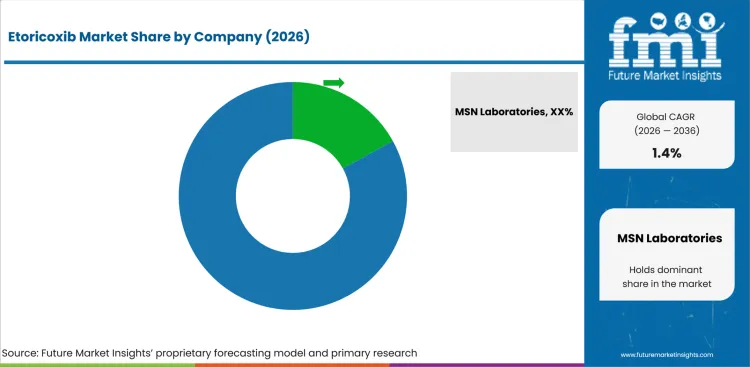
Broad Indian API groups lead on scale. Specialist suppliers compete through etoricoxib availability and document readiness.
- MSN Laboratories and Hetero are expected to lead the broad API group through manufacturing depth and export experience.
- Aurobindo Pharma and Alivus Life Sciences add wider formulation and API credibility for regulated customers.
- Orex Pharma and Kekule Pharma support molecule-specific visibility for inquiry-stage buyers.
- Prudence Pharma and SKJ Pharma compete through smaller-supplier access and documentation response.
Competition centers on qualified API supply and not broad brand promotion. Large Indian API groups benefit from scale and customer audit systems. Their advantage improves when they keep impurity records stable across repeat orders.
Specialist suppliers serve buyers that need etoricoxib availability and quicker inquiry handling. These suppliers still need clear certificates before moving into repeat contracts. Buyers compare supplier history and release support before price.
How do top etoricoxib companies compare?
Large API manufacturers score higher on manufacturing depth. Specialist suppliers score higher on molecule-specific visibility.
| Company | Relevance to Market Title | API Manufacturing Depth | Documentation Fit | Channel Reach | Geographic Footprint |
|---|---|---|---|---|---|
| MSN Laboratories | High | Very Strong | Strong | Strong | Global |
| Hetero Drugs | High | Very Strong | Strong | Strong | Global |
| Aurobindo Pharma | High | Strong | Strong | Strong | Global |
| Alivus Life Sciences | Moderate to High | Strong | Strong | Moderate | India and export markets |
| Orex Pharma | Moderate | Moderate | Moderate | Moderate | Export inquiry markets |
| Kekule Pharma | Moderate | Moderate | Moderate | Moderate | India and export markets |
| Prudence Pharma | Moderate | Moderate | Moderate | Moderate | India and export markets |
Source: Future Market Insights competitive analysis, 2026.
Who are the key players in the etoricoxib market?
Key companies in the etoricoxib market include broad API manufacturers and specialist sourcing suppliers.
- MSN Laboratories
- Hetero Drugs
- Aurobindo Pharma
- Alivus Life Sciences
- Orex Pharma
- Kekule Pharma
- Prudence Pharma
- SKJ Pharma
- MedicaPharma
- Themis Medicare
Key Developments in Etoricoxib Market
- In April 2026, Laurus Labs received CDSCO written confirmation for Unit IV covering Etoricoxib IH manufacturing and packing.
- In April 2026, Aurobindo Pharma and Milpharm’s UK etoricoxib product record was updated on eMC for 30 mg, 60 mg, 90 mg, and 120 mg tablets.
Key Players in the Etoricoxib Market
Broad API Manufacturers
- MSN Laboratories
- Hetero Drugs
- Aurobindo Pharma
- Alivus Life Sciences
Specialist Etoricoxib Suppliers
- Orex Pharma
- Kekule Pharma
- Prudence Pharma
- SKJ Pharma
Formulation and Distribution Participants
- Themis Medicare
- MedicaPharma
- Qualified API distributors
- Research-supply vendors
Etoricoxib Market - Report Scope
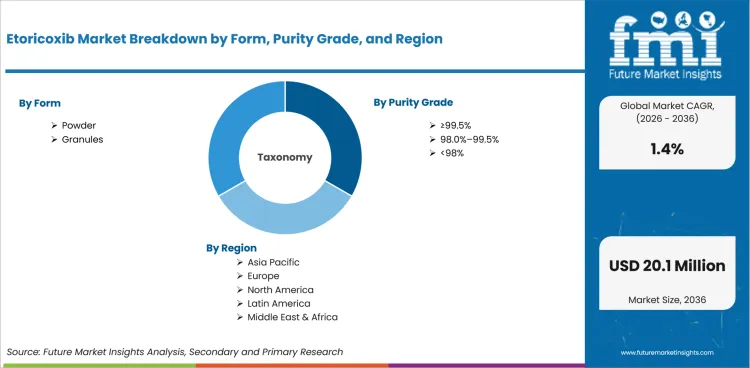
| Parameter | Details |
|---|---|
| Forecast period | 2026 to 2036 |
| Historical period | 2021 to 2025 |
| Quantitative unit | Revenue in USD million |
| By form | Powder, granules |
| By purity grade | ≥99.5%, 98.0%-99.5%, <98% |
| By application | Osteoarthritis, rheumatoid arthritis, acute pain, gout |
| By sales channel | Direct, distributors, online/API marketplaces |
| Regions covered | North America, Latin America, Europe, East Asia, South Asia & Pacific, Middle East & Africa |
| Countries covered | India, China, South Korea, Germany, France, United Kingdom, Japan, United States |
| Key companies profiled | MSN Laboratories, Hetero, Aurobindo Pharma, Alivus Life Sciences, Orex Pharma, Kekule Pharma, Prudence Pharma |
| Approach | Bottom-up API revenue approach using approved-use demand, country availability, supplier evidence, and locked FMI anchors |
Source: Future Market Insights, 2026.
Etoricoxib Market - Scope & Definition
| Attribute | Detail |
|---|---|
| Market Definition | Commercially traded etoricoxib active pharmaceutical ingredient used in regulated finished-dose manufacturing. |
| Functions Covered | Pain and inflammation therapy support through approved oral-dose formulations. |
| Applications Covered | Osteoarthritis, rheumatoid arthritis, acute pain, and gout. |
| End-Use Industries | Pharmaceutical manufacturing, generic formulation supply, and regulated API distribution. |
| Grades Covered | ≥99.5%, 98.0%-99.5%, and <98% purity grades. |
| Inclusions | Commercial API supply across form, purity grade, application, sales channel, and country demand. |
| Exclusions | Finished-dose brand sales, hospital dispensing revenue, other NSAID APIs, research-only quantities, and clinical-trial supply. |
Etoricoxib Market - Research Methodology
| Method | Description |
|---|---|
| Primary Research | FMI analyst interviews with API sourcing managers, formulation manufacturers, distributors, and regulatory consultants across key markets. |
| Desk Research | Review of EMA, CDSCO, ONS, NBS, Destatis, INSEE, CDC, company disclosures, and national population sources. |
| Market Sizing & Forecasting | Bottom-up API revenue approach using approved-use demand, price bands, purity-grade mix, country availability, and supplier evidence. |
| Data Validation | Cross-checks using safety language, country demographics, NSQ alerts, supplier evidence, and locked FMI market anchors. |
Etoricoxib Market Breakdown by Form, Purity Grade, Application, Sales Channel
Etoricoxib Market Segmented by Form:
- Powder
- Granules
Etoricoxib Market Segmented by Purity Grade:
- ≥99.5%
- 98.0%-99.5%
- <98%
Etoricoxib Market Segmented by Application:
- Osteoarthritis
- Rheumatoid Arthritis
- Acute Pain
- Gout
Etoricoxib Market Segmented by Sales Channel:
- Direct
- Distributors
- Online/API Marketplaces
Etoricoxib Market by Region:
- North America
- Latin America
- Europe
- East Asia
- South Asia and Pacific
- Middle East and Africa
Research Sources and Bibliography
- European Medicines Agency. (2008, June 26). Etoricoxib - referral. European Medicines Agency.
- Datapharm. (2026). Etoricoxib 30mg film-coated tablets - summary of product characteristics. Electronic Medicines Compendium.
- Central Drugs Standard Control Organization. (2025, June). State NSQ June 2025. CDSCO.
- Press Information Bureau. (2025, October 28). Elderly in India. Government of India.
- Press Information Bureau. (2025, March 11). Update on 75/25 initiative. Government of India.
- National Bureau of Statistics of China. (2025, January 17). National economy witnessed steady progress amidst stable growth in 2024. NBS.
- National Bureau of Statistics of China. (2025, February 28). Statistical communique of the People’s Republic of China on the 2024 national economic and social development. NBS.
- World Bank. (2026). Population ages 65 and above (% of total population) - China. World Development Indicators.
- World Bank. (2026). Population ages 65 and above (% of total population) - Korea, Rep. World Development Indicators.
- Statistics Korea. (2023, December 13). Population projection for Korea 2022 to 2072. KOSTAT.
- Federal Statistical Office of Germany. (2025, December 11). By 2035, one quarter of Germany’s population will be aged 67 or over. Destatis.
- Central Drugs Standard Control Organisation. April 10, 2026. Written Confirmation for Laurus Labs Limited Unit-IV for active substances imported into the European Union. Government of India.
- Aurobindo Pharma - Milpharm Ltd. April 24, 2026. Etoricoxib 60mg film-coated tablets - Patient Information Leaflet. Electronic Medicines Compendium.
- Federal Statistical Office of Germany. (2025). Population by age groups 2011 to 2024 in percent. Destatis.
- INSEE. (2026, January 13). Demographic report 2025. INSEE Première.
- Office for National Statistics. (2025, September 26). Population estimates for the UK, England, Wales, Scotland and Northern Ireland: mid-2024. ONS.
- Office for National Statistics. (2025, July 30). Population estimates for England and Wales: mid-2024. ONS.
- Statistics Bureau of Japan. (2025). Current population estimates: October 1, 2024. Ministry of Internal Affairs and Communications.
- Ministry of Health, Labour and Welfare. (2025). Employment of older persons. MHLW.
- Organisation for Economic Co-operation and Development. (2025, November 13). Health at a Glance 2025: Japan. OECD.
- U.S. Census Bureau. (2025, June 26). Older adults outnumber children in 11 states and nearly half of U.S. counties. U.S. Census Bureau.
- Centers for Disease Control and Prevention. (2026, June 2). High blood pressure facts. CDC.
- World Health Organization. (2025, September 23). Uncontrolled high blood pressure puts over a billion people at risk. WHO.
- MSN Laboratories. (2026). Active pharmaceutical ingredients. MSN Laboratories.
- Hetero. (2026). Active pharmaceutical ingredients. Hetero.
- Alivus Life Sciences. (2025). Integrated annual report 2024-25. Alivus Life Sciences.
- National Center for Health Statistics. (2024, February). Arthritis in adults age 18 and older: United States, 2022. Centers for Disease Control and Prevention.
- Press Information Bureau. (2025, December 17). Indian pharmaceutical products are globally recognized, exports jumped over 9% this year: Commerce Secretary. Government of India.
- U.S. Food and Drug Administration. (2025, December 12). Report on the state of pharmaceutical quality. FDA.
This bibliography is provided for reader reference and is not exhaustive. The full report contains the complete reference list and detailed citations.
This Report Answers
- Market size estimates for 2026 and forecasts through 2036 for the etoricoxib market.
- Insights across regional and country-level etoricoxib API demand.
- Analysis of demand drivers and prescribing limits. The report also reviews quality requirements and supplier selection.
- Evaluation of form and purity grade dynamics. Application and sales channel patterns are reviewed separately.
- Assessment of regulatory framing and cardiovascular caution in market development.
- Identification of growth opportunities across qualified API supply and finished-dose production.
- Evaluation of supply dynamics and product quality trends. Distribution channel structures are reviewed separately.
- France and the United Kingdom are also covered. Japan and the United States complete the country view.
- Assessment of the competitive landscape including broad API producers and specialist suppliers.
- Regional outlooks across North America and Europe. East Asia and South Asia & Pacific are also reviewed.
- Delivery of market data and forecasts. Supporting analysis is provided in PDF and Excel formats.
Frequently Asked Questions
What is the growth prospect for etoricoxib?
Demand for etoricoxib API is expected to rise slowly as approved prescription use supports repeat orders.
Which companies are expected to shape the etoricoxib market?
Orex Pharma and Kekule Pharma support specialist visibility. Prudence Pharma adds another inquiry-stage supplier.
Why are API suppliers investing in etoricoxib quality documentation?
Suppliers invest in documentation due to regulated formulation customer needs for impurity records before repeat supply approval.
Why is direct sourcing important in the etoricoxib market?
Direct sourcing supports faster audit review and cleaner certificate flow between API producers and formulation customers.
Which form leads the etoricoxib market?
Powder leads the market due to tablet-plant demand for flexible material before blending and compression.
How do safety rules influence etoricoxib API demand?
Safety rules keep demand measured by linking use to blood pressure review and treatment-duration caution.
Why does India lead country growth?
India leads country growth due to API capacity and formulation demand supporting repeat qualified sourcing.
How is the etoricoxib forecast prepared?
The forecast checks API demand and purity-grade mix. Price bands and country availability are checked with supplier evidence against FMI anchors.
Preview the report firsthand - request a free sample
Get SampleGet the brochure for pricing and purchase details.
Get PDFTable of Content
- Key Takeaways
- Market Size and CAGR
- Top Growth Driver
- Fastest Growing Segment
- Leading Region
- Key Companies
- Emerging Opportunities
- Executive Summary
- Global Market Outlook
- Demand-side Trends
- Supply-side Trends
- Technology Roadmap Analysis
- Analysis and Recommendations
- Analyst Perspective (What is happening? Why now? What should investors know?)
- Key Questions Answered
- How large is the market?
- What is the CAGR?
- What are key trends?
- Which region dominates?
- Who are the leaders?
- Market Overview
- Market Coverage / Taxonomy
- Market Definition / Scope / Limitations
- Research Methodology
- Chapter Orientation
- Analytical Lens and Working Hypotheses
- Market Structure, Signals, and Trend Drivers
- Benchmarking and Cross-market Comparability
- Market Sizing, Forecasting, and Opportunity Mapping
- Research Design and Evidence Framework
- Desk Research Programme (Secondary Evidence)
- Expert Input and Fieldwork (Primary Evidence)
- Tooling, Models, and Reference Databases
- Data Engineering and Model Build
- Quality Assurance and Audit Trail
- Market Background
- Market Dynamics (Drivers, Restraints, Opportunity, Trends)
- Scenario Forecast (Optimistic, Likely, Conservative)
- Impact Analysis
- AI Impact
- Sustainability Impact
- Regulatory Impact
- Technology Impact
- Consumer / Buyer Analysis
- Purchase Drivers
- Adoption Barriers
- Buyer Journey
- Opportunity Map Analysis
- Product Life Cycle Analysis
- Supply Chain Analysis
- Investment Feasibility Matrix
- Value Chain Analysis
- PESTLE and Porter's Analysis
- Regulatory Landscape
- Regional Parent Market Outlook
- Production and Consumption Statistics
- Import and Export Statistics
- Global Market Analysis and Forecast, 2021 to 2036
- Historical Market Size Value (USD Million) Analysis, 2021 to 2025
- Current and Future Market Size Value (USD Million) Projections, 2026 to 2036
- Y-o-Y Growth Trend Analysis
- Absolute $ Opportunity Analysis
- Global Market Pricing Analysis, 2021 to 2036
- Global Market Analysis and Forecast, By Form, 2021 to 2036
- Introduction / Key Findings
- Historical Market Size Value (USD Million) Analysis By Form, 2021 to 2025
- Current and Future Market Size Value (USD Million) Analysis and Forecast By Form, 2026 to 2036
- Powder
- Granules
- Powder
- Y-o-Y Growth Trend Analysis By Form, 2021 to 2025
- Absolute $ Opportunity Analysis By Form, 2026 to 2036
- Global Market Analysis and Forecast, By Purity Grade, 2021 to 2036
- Introduction / Key Findings
- Historical Market Size Value (USD Million) Analysis By Purity Grade, 2021 to 2025
- Current and Future Market Size Value (USD Million) Analysis and Forecast By Purity Grade, 2026 to 2036
- ≥99.5%
- 98.0%–99.5%
- <98%
- ≥99.5%
- Y-o-Y Growth Trend Analysis By Purity Grade, 2021 to 2025
- Absolute $ Opportunity Analysis By Purity Grade, 2026 to 2036
- Global Market Analysis and Forecast, By Application, 2021 to 2036
- Introduction / Key Findings
- Historical Market Size Value (USD Million) Analysis By Application, 2021 to 2025
- Current and Future Market Size Value (USD Million) Analysis and Forecast By Application, 2026 to 2036
- Osteoarthritis
- Rheumatoid Arthritis
- Gout
- Osteoarthritis
- Y-o-Y Growth Trend Analysis By Application, 2021 to 2025
- Absolute $ Opportunity Analysis By Application, 2026 to 2036
- Global Market Analysis and Forecast, By Sales Channel, 2021 to 2036
- Introduction / Key Findings
- Historical Market Size Value (USD Million) Analysis By Sales Channel, 2021 to 2025
- Current and Future Market Size Value (USD Million) Analysis and Forecast By Sales Channel, 2026 to 2036
- Direct
- Distributors
- Online/API Marketplaces
- Direct
- Y-o-Y Growth Trend Analysis By Sales Channel, 2021 to 2025
- Absolute $ Opportunity Analysis By Sales Channel, 2026 to 2036
- Global Market Analysis and Forecast, By Region, 2021 to 2036
- Introduction
- Historical Market Size Value (USD Million) Analysis By Region, 2021 to 2025
- Current Market Size Value (USD Million) Analysis and Forecast By Region, 2026 to 2036
- North America
- Latin America
- Western Europe
- Eastern Europe
- East Asia
- South Asia and Pacific
- Middle East & Africa
- Market Attractiveness Analysis By Region
- North America Market Analysis and Forecast, By Country, 2021 to 2036
- Historical Market Size Value (USD Million) Trend Analysis By Market Taxonomy, 2021 to 2025
- Market Size Value (USD Million) Forecast By Market Taxonomy, 2026 to 2036
- By Country
- USA
- Canada
- Mexico
- By Form
- By Purity Grade
- By Application
- By Sales Channel
- By Country
- Market Attractiveness Analysis
- By Country
- By Form
- By Purity Grade
- By Application
- By Sales Channel
- Key Takeaways
- Latin America Market Analysis and Forecast, By Country
- Historical Market Size Value (USD Million) Trend Analysis By Market Taxonomy, 2021 to 2025
- Market Size Value (USD Million) Forecast By Market Taxonomy, 2026 to 2036
- By Country
- Brazil
- Chile
- Rest of Latin America
- By Form
- By Purity Grade
- By Application
- By Sales Channel
- By Country
- Market Attractiveness Analysis
- By Country
- By Form
- By Purity Grade
- By Application
- By Sales Channel
- Key Takeaways
- Western Europe Market Analysis and Forecast, By Country
- Historical Market Size Value (USD Million) Trend Analysis By Market Taxonomy, 2021 to 2025
- Market Size Value (USD Million) Forecast By Market Taxonomy, 2026 to 2036
- By Country
- Germany
- UK
- Italy
- Spain
- France
- Nordic
- BENELUX
- Rest of Western Europe
- By Form
- By Purity Grade
- By Application
- By Sales Channel
- By Country
- Market Attractiveness Analysis
- By Country
- By Form
- By Purity Grade
- By Application
- By Sales Channel
- Key Takeaways
- Eastern Europe Market Analysis and Forecast, By Country
- Historical Market Size Value (USD Million) Trend Analysis By Market Taxonomy, 2021 to 2025
- Market Size Value (USD Million) Forecast By Market Taxonomy, 2026 to 2036
- By Country
- Russia
- Poland
- Hungary
- Balkan & Baltic
- Rest of Eastern Europe
- By Form
- By Purity Grade
- By Application
- By Sales Channel
- By Country
- Market Attractiveness Analysis
- By Country
- By Form
- By Purity Grade
- By Application
- By Sales Channel
- Key Takeaways
- East Asia Market Analysis and Forecast, By Country
- Historical Market Size Value (USD Million) Trend Analysis By Market Taxonomy, 2021 to 2025
- Market Size Value (USD Million) Forecast By Market Taxonomy, 2026 to 2036
- By Country
- China
- Japan
- South Korea
- By Form
- By Purity Grade
- By Application
- By Sales Channel
- By Country
- Market Attractiveness Analysis
- By Country
- By Form
- By Purity Grade
- By Application
- By Sales Channel
- Key Takeaways
- South Asia and Pacific Market Analysis and Forecast, By Country
- Historical Market Size Value (USD Million) Trend Analysis By Market Taxonomy, 2021 to 2025
- Market Size Value (USD Million) Forecast By Market Taxonomy, 2026 to 2036
- By Country
- India
- ASEAN
- Australia & New Zealand
- Rest of South Asia and Pacific
- By Form
- By Purity Grade
- By Application
- By Sales Channel
- By Country
- Market Attractiveness Analysis
- By Country
- By Form
- By Purity Grade
- By Application
- By Sales Channel
- Key Takeaways
- Middle East & Africa Market Analysis and Forecast, By Country
- Historical Market Size Value (USD Million) Trend Analysis By Market Taxonomy, 2021 to 2025
- Market Size Value (USD Million) Forecast By Market Taxonomy, 2026 to 2036
- By Country
- Kingdom of Saudi Arabia
- Other GCC Countries
- Türkiye
- South Africa
- Other African Union
- Rest of Middle East & Africa
- By Form
- By Purity Grade
- By Application
- By Sales Channel
- By Country
- Market Attractiveness Analysis
- By Country
- By Form
- By Purity Grade
- By Application
- By Sales Channel
- Key Takeaways
- Key Countries Market Analysis
- USA
- Pricing Analysis
- Market Share Analysis, 2025
- By Form
- By Purity Grade
- By Application
- By Sales Channel
- Canada
- Pricing Analysis
- Market Share Analysis, 2025
- By Form
- By Purity Grade
- By Application
- By Sales Channel
- Mexico
- Pricing Analysis
- Market Share Analysis, 2025
- By Form
- By Purity Grade
- By Application
- By Sales Channel
- Brazil
- Pricing Analysis
- Market Share Analysis, 2025
- By Form
- By Purity Grade
- By Application
- By Sales Channel
- Chile
- Pricing Analysis
- Market Share Analysis, 2025
- By Form
- By Purity Grade
- By Application
- By Sales Channel
- Germany
- Pricing Analysis
- Market Share Analysis, 2025
- By Form
- By Purity Grade
- By Application
- By Sales Channel
- UK
- Pricing Analysis
- Market Share Analysis, 2025
- By Form
- By Purity Grade
- By Application
- By Sales Channel
- Italy
- Pricing Analysis
- Market Share Analysis, 2025
- By Form
- By Purity Grade
- By Application
- By Sales Channel
- Spain
- Pricing Analysis
- Market Share Analysis, 2025
- By Form
- By Purity Grade
- By Application
- By Sales Channel
- France
- Pricing Analysis
- Market Share Analysis, 2025
- By Form
- By Purity Grade
- By Application
- By Sales Channel
- India
- Pricing Analysis
- Market Share Analysis, 2025
- By Form
- By Purity Grade
- By Application
- By Sales Channel
- ASEAN
- Pricing Analysis
- Market Share Analysis, 2025
- By Form
- By Purity Grade
- By Application
- By Sales Channel
- Australia & New Zealand
- Pricing Analysis
- Market Share Analysis, 2025
- By Form
- By Purity Grade
- By Application
- By Sales Channel
- China
- Pricing Analysis
- Market Share Analysis, 2025
- By Form
- By Purity Grade
- By Application
- By Sales Channel
- Japan
- Pricing Analysis
- Market Share Analysis, 2025
- By Form
- By Purity Grade
- By Application
- By Sales Channel
- South Korea
- Pricing Analysis
- Market Share Analysis, 2025
- By Form
- By Purity Grade
- By Application
- By Sales Channel
- Russia
- Pricing Analysis
- Market Share Analysis, 2025
- By Form
- By Purity Grade
- By Application
- By Sales Channel
- Poland
- Pricing Analysis
- Market Share Analysis, 2025
- By Form
- By Purity Grade
- By Application
- By Sales Channel
- Hungary
- Pricing Analysis
- Market Share Analysis, 2025
- By Form
- By Purity Grade
- By Application
- By Sales Channel
- Kingdom of Saudi Arabia
- Pricing Analysis
- Market Share Analysis, 2025
- By Form
- By Purity Grade
- By Application
- By Sales Channel
- Türkiye
- Pricing Analysis
- Market Share Analysis, 2025
- By Form
- By Purity Grade
- By Application
- By Sales Channel
- South Africa
- Pricing Analysis
- Market Share Analysis, 2025
- By Form
- By Purity Grade
- By Application
- By Sales Channel
- USA
- Market Structure Analysis
- Competition Dashboard
- Competition Benchmarking
- Market Share Analysis of Top Players
- By Regional
- By Form
- By Purity Grade
- By Application
- By Sales Channel
- Emerging Startups
- Innovation Benchmarking
- Competition Analysis
- Competition Deep Dive
- MSN Laboratories
- Overview
- Product Portfolio
- Profitability by Market Segments (Product/Region/Sales Channel)
- Sales Footprint
- Strategy Overview
- Marketing Strategy
- Product Strategy
- Channel Strategy
- Hetero Drugs
- Aurobindo Pharma
- Alivus Life Sciences
- Orex Pharma
- Kekule Pharma
- Prudence Pharma
- MSN Laboratories
- Case Studies
- Success Stories
- Recent Developments
- Competition Deep Dive
- Assumptions & Acronyms Used


