

- Market Size (2026)
- USD 7.8 Bn
- Forecast (2036)
- USD 13.8 Bn
- CAGR (2026 to 2036)
- 5.9%
How big is Iron Deficiency Anemia Therapy Market in 2026?
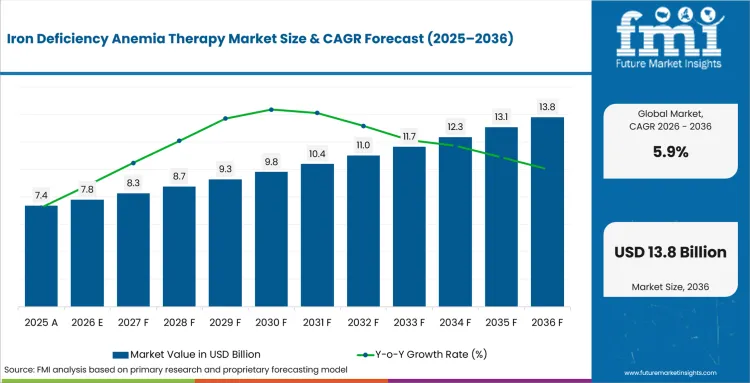
USD 7.8 billion in 2026 and USD 13.8 billion by 2036 at a 5.9% CAGR.
Demand for iron deficiency anemia therapy is projected to expand at 5.9% CAGR between 2026 and 2036, increasing valuation from USD 7.8 billion in 2026 to USD 13.8 billion by 2036. Growing recognition of iron deficiency as a common nutritional and clinical concern is supporting the utilization of iron replacement therapies. The Centers for Disease Control and Prevention reported in April 2025 that about one in four pregnant women in the United States had iron deficiency. This figure does not directly indicate prescription volumes or completed treatment courses. It highlights a significant patient population that may require diagnosis and monitoring along with iron replacement therapy, supporting long-term demand.
Care pathways separate patients suited to gradual oral replacement from patients needing supervised intravenous correction or faster replenishment. The Centers for Medicare and Medicaid Services confirmed in November 2025 that its 2026 dialysis bundle includes renal dialysis drugs and biological products. This gives intravenous iron drugs a defined funding route within maintenance dialysis while other settings use different coverage and administration models. Revenue requires medicine availability and completion of the planned dose through an appropriate service in routine care. Market planning should separate oral persistence from infusion throughput across national care settings because each route faces different reimbursement and capacity constraints.
Key Takeaways of Iron Deficiency Anemia Therapy Market
- Laboratory-confirmed deficiency becomes treatment demand through a suitable route that produces measurable recovery within available clinical capacity.
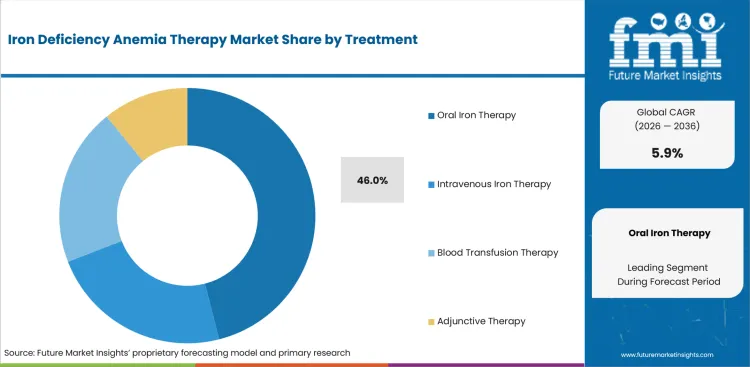
- Based on treatment, oral iron therapy is projected to account for 46.0% share in 2026 due to established prescribing and broad pharmacy access.
- The chronic kidney disease-associated anemia segment is likely to capture 34.0% share in 2026 attributable to recurring laboratory review across renal care.
- Oral administration is set to lead the route of administration category with 59.0% share in 2026 due to decentralized treatment for clinically suitable patients.
- Gastrointestinal intolerance and limited infusion staffing can interrupt treatment completion despite an appropriate prescription and confirmed clinical need.
- CSL Vifor, Pharmacosmos A/S, American Regent, Inc., Shield Therapeutics plc, Viatris Inc., Sandoz Inc., Teva Santé, and Kye Pharmaceuticals Inc. focus on integrated iron portfolios with generic injectables and licensed oral treatment routes.
Analyst Perspective
“Iron deficiency anemia therapy succeeds through completed correction rather than prescription counts across each care setting. Oral products expand access for stable patients but tolerance and follow-up decide whether repeated dosing restores iron effectively. Intravenous products support faster replacement, yet medicine supply and staffed appointments control delivery across hospital and outpatient services. Companies that link route selection with laboratory response and completion data can build more dependable demand.”
- Anurag Sharma, Principal Analyst, Future Market Insights
How is the Iron Deficiency Anemia Therapy Market segmented?
The iron deficiency anemia therapy industry is segmented by treatment, indication, route of administration, end user, distribution channel, and region.
The analysis separates treatment choice, clinical cause, delivery route, care setting, and dispensing channel because each category follows a different commercial pathway. Treatment categories distinguish oral iron, intravenous iron, transfusion support, and adjunctive care across separate clinical pathways. Indication categories separate renal disease, pregnancy, cancer care, and other causes that require different testing and treatment decisions. Route of administration measures practical delivery burden across community, clinic, and hospital settings for each treatment choice. End user and distribution channel identify the organizations that control prescribing, inventory, monitoring, and treatment completion.
How does oral iron therapy shape demand within the treatment category?
Oral iron therapy suits patients who can absorb medicine and complete repeated dosing without an infusion visit. Shield Therapeutics reported in September 2025 that the FDA granted priority review to its pediatric Accrufer application. The action advanced a regulated pediatric prescription route without proving routine use or completed therapy. Nonprescription plant-based iron supplements remain outside this segment because they follow different labeling and clinical follow-up requirements.
- Based on treatment, oral iron therapy is projected to account for 46.0% in 2026 due to established prescribing and broad pharmacy access. Community initiation preserves infusion appointments for patients needing rapid correction or supervised administration within hospital and clinic settings. The segment maintains its position through tolerable dosing and follow-up tests that confirm a satisfactory hemoglobin response.
- Primary care practices use oral therapy for stable patients who can complete repeated dosing without supervised administration. Gastrointestinal effects and poor absorption can interrupt treatment before iron stores recover enough to improve symptoms and laboratory results. Clear retesting and referral rules help clinicians identify inadequate response early and prevent prolonged undertreatment across routine outpatient care.
What keeps chronic kidney disease-associated anemia central within the indication category?
Chronic kidney disease creates repeated iron assessment because renal dysfunction can reduce red-cell production and alter iron use. Nephrology services review ferritin and hemoglobin to separate iron deficiency from other causes of anemia.
- The chronic kidney disease-associated anemia segment is likely to capture 34.0% share in 2026 attributable to recurring clinical review across renal care. KDIGO published its updated anemia guideline in January 2026 for adults and children across several disease stages. The guidance supports individualized oral or intravenous iron decisions while national coverage and local infusion capacity determine practical treatment access.
- Dialysis centers and outpatient nephrology practices follow different treatment routes despite serving related patient populations. Dialysis units can integrate intravenous iron with scheduled sessions while non-dialysis clinics often depend on separate appointments or continued oral dosing. Commercial planning must distinguish testing frequency from administration ownership and reimbursement so diagnosis volume does not overstate completed treatment.
Which operating conditions support oral administration within the route of administration category?
Oral administration extends treatment beyond infusion rooms and places adherence inside a patient’s daily routine. Prescription products remain distinct from vitamin and mineral supplements through diagnostic requirements, labeled dosing and clinical follow-up. Route selection reflects absorption and treatment urgency along with prior intolerance and the ability to complete repeated dosing. Oral access broadens care but does not remove the need for measured response and timely escalation.
- Oral administration is set to lead the route of administration category with 59.0% share in 2026 due to decentralized treatment for clinically suitable patients. The route avoids infusion scheduling and trained administration staff across routine outpatient care for clinically stable patients. Its position depends on absorption and tolerability with sustained dosing that produces a documented response without unnecessary escalation.
- The European Medicines Agency updated its Feraccru record in June 2026 and retained oral prescription use for adults and adolescents aged twelve years or older. The current record confirms a regulated oral route without proving the segment share or treatment completion. Community clinicians can use oral therapy, although weak recovery or poor tolerance requires timely escalation to supervised treatment.
How do hospitals influence treatment delivery within the end user category?
Hospitals concentrate supervised intravenous treatment for patients who need rapid correction, complex review, or emergency readiness. The USA Food and Drug Administration recorded two Mylan ferric carboxymaltose vial approvals in June 2026 through its competitive generic therapy program. The approvals widen regulated purchasing options without removing the need for infusion staffing and patient monitoring. Hospital use of injectable drugs depends on staffed capacity and protocol compliance.
- By end user, hospitals are estimated to hold 41.0% in 2026 owing to coordinated care for clinically complex patients. Hospital systems combine laboratory review and pharmacy control with infusion protocols and emergency support within one treatment pathway. Revenue remains constrained by appointment capacity and trained staffing across renal and obstetric services as well as gastrointestinal and oncology services.
- Hospital teams coordinate complex cases through shared pharmacy controls and infusion protocols across several clinical departments. Integrated care supports rapid escalation and consistent monitoring for patients requiring timely correction across several hospital departments. Capacity weakens when staffing shortages or delayed appointments divide responsibility between prescribing teams and administration services.
Why do hospital pharmacies retain a strong position within the distribution channel category?
Hospital pharmacies connect institutional inventory with dose preparation and formulary rules for scheduled administration of infused iron products. Their position reflects control over stock visibility and medicine handling rather than a simple dispensing transaction. Renal units and infusion centers depend on pharmacy coordination to match available vials with patient-specific doses while online pharmacy channels serve a different route because infused products require institutional handling and supervised delivery.
- In 2026, hospital pharmacies are expected to lead distribution channel with 44.0% share because institutional teams control inventory and supervised dispensing. American Regent reported in July 2026 that several Venofer presentations were in stock and shipping weekly. The update supports current supply continuity, while appointment capacity and local formularies determine whether available medicine reaches scheduled patients.
- Hospital pharmacies support adoption through stock visibility and dose preparation with adverse-event documentation across renal and infusion services. Coordinated treatment calendars reduce cancellations and avoidable medicine wastage during planned administration across busy clinical services. Commercial use weakens through tender delays and restricted formularies as well as medicine shortages or poor communication between prescribers and administration teams.
What are the drivers, restraints, and opportunities in the Iron Deficiency Anemia Therapy Market?
Laboratory-confirmed iron deficiency creates recurring treatment demand. Oral intolerance and limited infusion capacity restrict completion while route-matched care expands access across community and supervised settings.
- Driver: Laboratory confirmation places appropriate patients inside a defined treatment pathway with measurable response and completion requirements.
- Restraint: Oral intolerance and supervised-infusion requirements can interrupt treatment completion across otherwise suitable clinical pathways.
- Opportunity: Route-matched care can extend treatment across community and outpatient services while preserving hospital capacity for complex cases.
Confirmed iron deficiency creates recurring treatment demand across women’s health and chronic disease care pathways. Health Canada reported in August 2025 that one in four women aged 14 to 50 had low iron status. The figure identifies a population requiring clinical assessment without forecasting medicine sales or completed therapy. Commercial value develops through accurate diagnosis and suitable route selection followed by completed treatment and measurable laboratory recovery.
Treatment burden creates a material restraint across oral and intravenous routes through failures that occur during treatment completion. Oral medicines can cause gastrointestinal effects that interrupt repeated dosing, while infusion services require appointments and trained observation. DailyMed updated the Ferrlecit label in October 2025 with hemodialysis dosing and supervised intravenous requirements. Hospitals need adequate staffing and clear monitoring protocols so a suitable medicine progresses from prescription to completed administration without avoidable delay.
Route-matched care creates a practical opening across community prescribing and qualified home infusion therapy services for suitable patients. The World Health Organization published consolidated postpartum haemorrhage guidelines in October 2025 that recommend intravenous iron over oral treatment for selected women needing rapid correction or unable to use oral iron. The recommendation supports a defined postpartum pathway but requires trained staff to manage infusion reactions. Commercial expansion depends on diagnosis and referral as well as medicine supply and safe administration within the chosen setting.
Which country CAGRs are profiled in the Iron Deficiency Anemia Therapy Market?
| Country | CAGR |
|---|---|
| UK | 7.6% |
| Canada | 7.3% |
| Japan | 6.4% |
| Germany | 6.0% |
| USA | 5.5% |
| France | 5.2% |
| Italy | 4.5% |
How do country-level CAGRs compare in the Iron Deficiency Anemia Therapy Market?
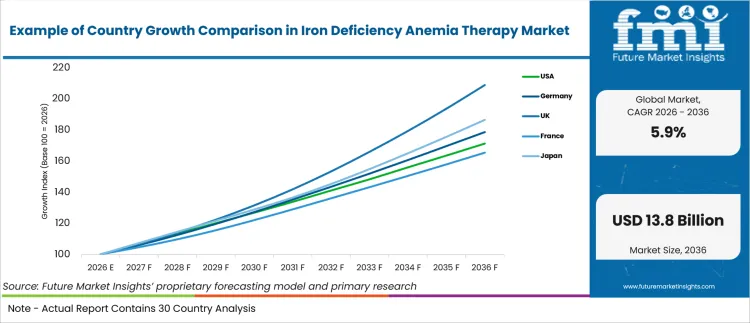
The profiled rates span 3.1 percentage points between the UK and Italy across the ten-year forecast. The UK and Canada form a narrow upper band with a difference of 0.3 points. Japan and Germany form a middle band with closely aligned growth conditions and a measured 0.4-point separation. The USA and France form a lower group with Italy across their national treatment systems. The pattern reflects different reimbursement routes and legal access along with medicine supply and treatment capacity rather than one transferable demand model.
- UK renal services benefit from a defined haemodialysis funding route, while treatment outside dialysis follows separate reimbursement and capacity arrangements.
- Canada combines regulated oral access with province-level coverage, yet long travel distances can limit supervised infusion outside major population centers.
- Japan pairs regulated oral and intravenous options with concentrated specialist follow-up, although hospital administration remains necessary for infused treatment.
- Germany emphasizes cause-based diagnosis and specialist referral, which supports targeted iron use but can lengthen the transition from testing to treatment.
- United States medicine availability spans several care settings, while payer rules and infusion economics create uneven commercial access across providers.
- France links reimbursement to laboratory confirmation and defined clinical need, giving prepared hospitals a clear pathway but limiting use outside approved criteria.
- Italy uses shortage import controls to protect continuity, while regional tenders and pharmacy logistics create uneven availability across hospital systems.
Comparable growth rates can produce different commercial entry conditions across national reimbursement and treatment-delivery systems. The full report provides country-level CAGR analysis across North America and Latin America as well as Europe, East Asia, South Asia, Oceania and the Middle East and Africa.
Country-wise Analysis
- England’s dialysis payment system includes intravenous iron within haemodialysis pricing and uses separate unit prices for other administration routes. NHS England confirmed this funding structure in April 2025 for iron deficiency anemia associated with chronic kidney disease. The UK iron deficiency anemia therapy sector is projected to record 7.6% CAGR during the assessment period, supported by bundled renal payment and concentrated dialysis services. The bundle gives renal units a predictable purchasing route for scheduled intravenous treatment during maintenance dialysis. Outpatient services outside dialysis follow different payment rules and can face limited infusion capacity beyond specialist renal centers. Commercial plans should pair formulary access with dependable administration support and laboratory follow-up that confirms each route fits the funded pathway.
- Canada combines community prescribing with province-level coverage and long travel distances for patients needing supervised infusion. In Canada, iron deficiency anemia therapy demand is predicted to advance at 7.3% CAGR through 2036, influenced by regulated oral access and distributed outpatient care. Community pharmacies can support oral treatment without requiring a specialist infusion visit for each administered dose. Health Canada recorded Accrufer as marketed from February 2025 as a prescription oral ferric maltol capsule. The current status gives clinicians a regulated oral option for appropriate adults with iron deficiency. Provincial reimbursement and pharmacy stocking can limit practical reach outside major population centers and remote communities. Commercial plans should separate oral distribution from infusion networks and support laboratory follow-up for patients living far from specialist services.
- Japan maintains formal product labeling for community oral treatment and hospital-administered ferric carboxymaltose within a tightly regulated medicine system. The Pharmaceuticals and Medical Devices Agency revised the Ferinject product information in June 2026 and retained current manufacturer details. Adoption of iron deficiency anemia therapy in Japan is estimated to expand at 6.4% CAGR through 2036, supported by current labels and concentrated specialist follow-up. The active regulatory record supports intravenous availability within established hospitals that maintain trained administration and monitoring procedures. Limited capacity outside prepared facilities can restrict infused treatment despite national product access across the healthcare system. Commercial strategy should emphasize regulatory maintenance, dependable distribution, and referral pathways that preserve follow-up across oral and intravenous routes.
- Germany’s ambulatory system requires clinicians to identify the cause of anemia before selecting iron replacement or specialist referral. Cause-based testing protects patients from unnecessary iron use and directs complex cases toward appropriate follow-up. Iron deficiency anemia therapy sales in Germany are forecast to expand at 6.0% CAGR by 2036, shaped by outpatient diagnosis and separate infusion routes. AWMF registered a national primary-care anemia guideline project in January 2026 to improve diagnostic stratification and clarify specialist interfaces. Community prescribing supports oral access, while infusion patients may depend on hospital appointments and regional specialist capacity. Commercial entry requires practical diagnostic support and referral pathways that connect laboratory findings with timely treatment without oversimplifying anemia as one condition.
- United States access combines broad medicine availability with payer variation across physician offices, hospitals, and dialysis organizations. By 2036, the USA iron deficiency anemia therapy market is projected to grow at 5.5% CAGR, influenced by broad label coverage and payer-specific treatment economics. DailyMed updated the Injectafer label in January 2025 and retained indications covering oral-treatment failure and selected chronic disease groups. The label enables use across several treatment settings, but patient costs and infusion economics differ across benefit designs. Commercial plans require dependable distribution, payer-specific access, and monitoring capacity rather than relying on national approval alone. Providers also need route-specific completion measures because prescription volume cannot show whether patients received the planned dose.
- France reimburses intravenous ferric carboxymaltose for defined patients who cannot use oral treatment or need rapid iron administration. Haute Autorité de Santé published this position in March 2025 and required laboratory confirmation of iron deficiency. France’s iron deficiency anemia therapy outlook is anticipated to advance at 5.2% CAGR over the assessment period, linked to evidence-based reimbursement and public hospital purchasing. The defined indication gives prepared hospitals a direct access route for eligible patients requiring intravenous correction. Administrative review and infusion capacity can delay treatment outside centers that maintain established pharmacy and monitoring protocols. Commercial positioning must remain inside the reimbursed indication and support formulary review, medicine supply, and safe administration across participating hospitals.
- Italy uses regional hospital purchasing and national shortage controls to manage infused iron access across uneven care capacity. Iron deficiency anemia therapy demand in Italy is forecast to rise at 4.5% CAGR over the forecast period, shaped by regional tenders and supply-continuity requirements. Established infusion centers support supervised care, while fragmented purchasing creates different inventory conditions across regions. The Italian Medicines Agency reported in June 2026 that ferric carboxymaltose Sandoz was unavailable nationally and authorized importation from abroad. The import route protects continuity but adds logistical work for hospital pharmacies and treatment teams. Commercial entry requires resilient inventory planning, distributor coordination, and contingency routes for hospitals that depend on imported supply during national shortages.
Who are the notable companies in the Iron Deficiency Anemia Therapy Market?
CSL Vifor; Pharmacosmos A/S; American Regent, Inc.; Shield Therapeutics plc; Viatris Inc.; Sandoz Inc.; Teva Santé; and Kye Pharmaceuticals Inc. are notable companies shaping this market.
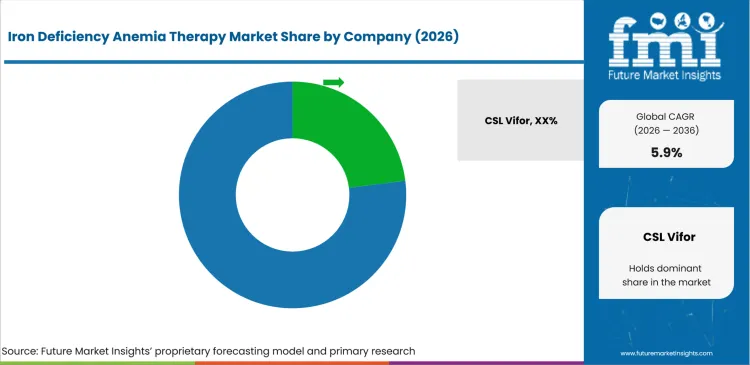
Competition includes integrated iron franchises and hospital injectables alongside generic medicines and licensed oral products across several care settings. CSL’s 2025 Annual Report describes a global CSL Vifor portfolio built around intravenous Ferinject and related iron products. Adjacent dialysis anemia treatment activity provides renal context but the competitive boundary here includes verified iron replacement therapies rather than every anemia medicine. American Regent manages United States hospital supply while Shield Therapeutics and Kye use direct and licensed oral routes. Viatris and Sandoz widen access with Teva Santé through approved generic or national products across defined markets. Company position therefore depends on exact product coverage and regulatory access as well as supply reliability and route-specific commercialization.
- CSL Vifor and Pharmacosmos focus on specialist relationships and regulatory coverage along with hospital access and dependable supply. Their commercial position depends on keeping high-dose intravenous products available across funded treatment pathways and care settings.
- American Regent supports United States hospital channels through branded intravenous iron supply and current distributor inventory. Viatris and Sandoz broaden purchasing choice with Teva Santé through regulator-approved generic or national products within hospital channels. Their role depends on continuous medicine supply and pharmacy access within each approved national market.
- Shield Therapeutics and Kye Pharmaceuticals commercialize prescription oral ferric maltol through direct operations and country licensing. Their route avoids infusion capacity and supervised administration, which supports community treatment for suitable patients. Repeat prescribing still depends on reimbursement and pharmacy availability as well as patient tolerance and documented response across community care settings.
Competitive Benchmarking: Iron Deficiency Anemia Therapy Market
| Company | Product Portfolio Breadth | Indication Coverage | Commercial Route Control | Geographic Reach |
|---|---|---|---|---|
| CSL Vifor | High | High | High | Global |
| Pharmacosmos A/S | Low | Low | High | Multi-region |
| American Regent, Inc. | High | High | Medium | United States |
| Shield Therapeutics plc | Low | Medium | Medium | United States and partner markets |
| Viatris Inc. | High | Medium | High | Global |
| Sandoz Inc. | High | Medium | High | Global |
| Teva Santé | Low | Low | Medium | France and European markets |
| Kye Pharmaceuticals Inc. | Low | Low | Medium | Canada |
Key Developments in the Iron Deficiency Anemia Therapy Market
- In March 2025, Kye Pharmaceuticals made Accrufer available by prescription across Canada for adults with iron deficiency anemia who did not respond to other oral preparations or could not tolerate them. The launch created a national prescription route between traditional oral salts and supervised intravenous treatment. Commercial uptake depends on provincial reimbursement, pharmacy availability, prescriber education, and sustained patient use across Canadian provinces.
- In August 2025, Viatris received United States approval for the first generic iron sucrose injection used in adults and children with iron deficiency anemia associated with chronic kidney disease. The company prepared three single-dose vial presentations for commercial availability across hospital and dialysis channels. The approval widens purchasing competition for institutional pharmacies, although intravenous administration, monitoring, and reliable supply remain necessary for completed treatment.
- In October 2025, Pharmacosmos began a headquarters expansion that adds laboratories, offices, warehouse space, and selected production-equipment upgrades at its Danish site. The project is scheduled for completion during mid-2027 and extends development and supply infrastructure around established research and manufacturing operations. Commercial value depends on product-specific approvals, validated manufacturing processes, and sustained iron therapy demand rather than construction capacity alone.
- In December 2025, Shield Therapeutics received FDA approval of Accrufer for patients aged ten years or older with iron deficiency. The decision extended prescription oral treatment beyond adults and followed pediatric evidence showing a meaningful hemoglobin increase. The expanded label broadens the addressable population, although dosing, monitoring, reimbursement, prescriber education, and sustained patient use remain necessary for routine commercial adoption.
Iron Deficiency Anemia Therapy Market - Report Scope
| Coverage field | Report scope |
|---|---|
| Market breakdown | Treatment, indication, route of administration, end user, distribution channel, and region. |
| Quantitative Units | Revenue in USD Billion and CAGR in %. |
| Market Definition | Prescription and clinically managed therapies used to correct confirmed iron deficiency anemia through oral, intravenous, intramuscular, transfusion, or adjunctive treatment pathways. |
| Regions Covered | North America, Latin America, Western Europe, Eastern Europe, East Asia, South Asia and Pacific, and Middle East and Africa. |
| Countries Covered | UK, Canada, Japan, Germany, USA, France, and Italy. |
| Key Companies Profiled | CSL Vifor, Pharmacosmos A/S, American Regent, Inc., Shield Therapeutics plc, Viatris Inc., Sandoz Inc., Teva Santé, and Kye Pharmaceuticals Inc. |
| Forecast Period | 2026 to 2036. |
| Approach | Hybrid bottom-up and top-down market sizing supported by primary interviews and official desk research. |
Iron Deficiency Anemia Therapy Market - Research Methodology
| Method | Approach |
|---|---|
| Primary Research | FMI analysts gathered input from manufacturers, service providers, technology developers, distributors, end users, procurement teams, and subject-matter experts. Interviews examined purchasing decisions, product or service evaluation, adoption barriers, approval requirements, pricing considerations, and expectations for technical or commercial support. Respondents were also asked what evidence is required before a trial, pilot, or initial order develops into regular purchasing. |
| Desk Research | Desk research covered government statistics, regulatory publications, trade data, industry associations, technical literature, standards, company filings, product information, and official corporate announcements. Sources were reviewed for relevance, publication date, geographic coverage, and consistency with the defined market scope. Claims relating to performance, applications, approvals, capacity, investment, and commercial activity were retained only when supported by credible public evidence. |
| Market Sizing and Forecasting | The market model combined the baseline value with historical performance, segment structure, pricing and volume indicators, adoption levels, company participation, and country-level demand conditions. Forecast assumptions considered economic activity, investment trends, regulatory developments, technology adoption, purchasing cycles, supply availability, and barriers to wider market use. Segment and regional estimates were reconciled before the final market total was calculated. |
| Data Validation | Estimates were checked against multiple independent indicators, including public data, company activity, trade patterns, industry developments, and findings from primary interviews. Validation also tested whether products, services, applications, and company revenues fell within the defined market boundaries. Adjacent categories, unsupported claims, overlapping revenues, and activities without direct market relevance were excluded to reduce double counting and maintain consistency across segments and countries. |
Iron Deficiency Anemia Therapy Market by Segments
Iron Deficiency Anemia Therapy Market segmented by Treatment:
- Oral Iron Therapy
- Ferrous Sulfate
- Ferrous Fumarate
- Ferrous Gluconate
- Intravenous Iron Therapy
- Ferric Carboxymaltose
- Iron Sucrose
- Ferumoxytol
- Blood Transfusion Therapy
- Packed Red Blood Cells
- Emergency Transfusion
- Perioperative Transfusion
- Adjunctive Therapy
- Erythropoiesis-stimulating Agents
- Folic Acid Supplements
- Vitamin B12 Supplements
Iron Deficiency Anemia Therapy Market segmented by Indication:
- Chronic Kidney Disease-associated Anemia
- Dialysis Patients
- Non-dialysis CKD
- Post-transplant Patients
- Pregnancy-related Anemia
- Antenatal Anemia
- Postpartum Anemia
- High-risk Pregnancy
- Cancer-related Anemia
- Chemotherapy-induced Anemia
- Radiotherapy-associated Anemia
- Supportive Oncology Care
- Other Iron Deficiency Anemia
- Gastrointestinal Blood Loss
- Malnutrition-related Anemia
- Pediatric Iron Deficiency
Iron Deficiency Anemia Therapy Market segmented by Route of Administration:
- Oral
- Tablets
- Capsules
- Liquid Formulations
- Intravenous
- Bolus Injection
- Infusion Therapy
- Hospital Administration
- Intramuscular
- Depot Injection
- Clinic Administration
- Long-acting Formulations
Iron Deficiency Anemia Therapy Market segmented by End User:
- Hospitals
- Public Hospitals
- Private Hospitals
- Specialty Hospitals
- Specialty Clinics
- Hematology Clinics
- Nephrology Clinics
- Oncology Clinics
- Home Healthcare
- Home Infusion Services
- Self-administration
- Community Nursing
- Ambulatory Care Centers
- Day Care Centers
- Outpatient Infusion Centers
- Diagnostic Centers
Iron Deficiency Anemia Therapy Market segmented by Distribution Channel:
- Hospital Pharmacies
- Inpatient Pharmacies
- Outpatient Pharmacies
- Specialty Hospital Pharmacies
- Retail Pharmacies
- Chain Pharmacies
- Independent Pharmacies
- Drug Stores
- Online Pharmacies
- E-commerce Pharmacies
- Mail-order Pharmacies
- Digital Health Platforms
Iron Deficiency Anemia Therapy Market by Region:
- North America
- United States
- Canada
- Latin America
- Brazil
- Mexico
- Argentina
- Chile
- Western Europe
- Germany
- France
- United Kingdom
- Italy
- Spain
- Benelux
- Nordics
- Eastern Europe
- Poland
- Czech Republic
- Romania
- Hungary
- East Asia
- China
- Japan
- South Korea
- South Asia and Pacific
- India
- ASEAN
- Australia and New Zealand
- Middle East and Africa
- GCC Countries
- South Africa
- Türkiye
- Israel
Research Sources and Bibliography
- Centers for Disease Control and Prevention. (2025, April 3). About Micronutrients.
- Centers for Medicare & Medicaid Services. (2025, November 20). Calendar Year (CY) 2026 End-Stage Renal Disease (ESRD) Prospective Payment System Final Rule.
- Shield Therapeutics plc. (2025, September 4). ACCRUFeR® assigned Priority Review in the US by FDA in children with iron deficiency anemia (IDA).
- Kidney Disease: Improving Global Outcomes. (2026, January 2). KDIGO Announces Publication of Anemia in CKD Guideline.
- European Medicines Agency. (2026, June 25). Feraccru.
- USA Food and Drug Administration. (2026, June 25). Competitive Generic Therapy Approvals.
- American Regent, Inc. (2026, July 26). Product Availability Update.
- Health Canada. (2025, August). Iron: A Powerhouse Nutrient for Your Health.
- USA National Library of Medicine. (2025, October 7). DailyMed - FERRLECIT- sodium ferric gluconate complex injection.
- World Health Organization. (2025, October 5). Consolidated guidelines for the prevention, diagnosis and treatment of postpartum haemorrhage.
- NHS England. (2025, April 4). 2025/26 NHS Payment Scheme - Annex C: Guidance on best practice tariffs.
- Health Canada. (2025, February 28). Product information: ACCRUFER.
- Pharmaceuticals and Medical Devices Agency. (2026, June 16). Ferinject intravenous injection 500 mg: Prescription drug information.
- Arbeitsgemeinschaft der Wissenschaftlichen Medizinischen Fachgesellschaften. (2026, January 7). Anämie - Diagnose und Management in der Primärversorgung.
- USA National Library of Medicine. (2025, January 1). INJECTAFER- ferric carboxymaltose injection, solution.
- Haute Autorité de Santé. (2025, March 6). CARBOXYMALTOSE FERRIQUE VIATRIS (carboxymaltose ferrique) - Carence martiale.
- Agenzia Italiana del Farmaco. (2026, June 8). Carenza CARBOSSIMALTOSIO FERRICO SANDOZ - modalità di richiesta d’importazione dall’estero.
- CSL Limited. (2025, August 19). CSL 2025 Annual Report.
- Pharmacosmos A/S. (2025, June 30). Pharmacosmos Continues Its Growth - Revenue Surpasses DKK 3 Billion.
- Haute Autorité de Santé. (2025, March 6). CARBOXYMALTOSE FERRIQUE TEVA (carboxymaltose ferrique) - Carence martiale.
- USA Food and Drug Administration. (2025, August 8). 2025 First Generic Drug Approvals.
- Kye Pharmaceuticals Inc. (2025, March 11). Accrufer® (ferric maltol) is now available in Canada as a prescription oral treatment for iron deficiency anemia.
- Viatris Inc. (2025, August 11). Viatris Announces Approval of First Generic Iron Sucrose Injection in the USA
- Pharmacosmos A/S. (2025, October 6). Pharmacosmos breaks ground on major expansion.
- USA Food and Drug Administration. (2025, December 22). FDA approves first prescription oral medicine for iron deficiency in pediatric patients ages 10 and older.
This bibliography is provided for reader reference and is not exhaustive. The full report contains the complete reference list and detailed citations
This Report Answers
- How large is the iron deficiency anemia therapy market in 2026 and 2036?
- Which clinical and operating conditions convert iron deficiency diagnosis into treatment revenue?
- Why does oral iron therapy hold dominant treatment revenue during 2026?
- How does Chronic Kidney Disease-associated Anemia shape recurrent therapy demand?
- Why does oral administration hold leading share in 2026?
- How do country growth rates differ across the UK, Canada, Japan, Germany, USA, France, and Italy?
- Which companies provide integrated iron portfolios, generic injectables, or specialized oral therapies?
- Which treatment burdens can reduce completion and commercial performance across oral and intravenous care?
- How can route-matched care models expand access without overloading hospital infusion capacity?
Frequently Asked Questions
How big is the Iron Deficiency Anemia Therapy Market in 2026?
The iron deficiency anemia therapy market is valued at USD 7.8 billion in 2026 and is forecast to reach USD 13.8 billion by 2036. Demand is supported by continued diagnosis of iron deficiency across pregnancy, chronic kidney disease, and other clinical conditions requiring oral or intravenous iron replacement therapies.
What is the CAGR of the Iron Deficiency Anemia Therapy Market from 2026 to 2036?
The iron deficiency anemia therapy market grows at a CAGR of 5.9% between 2026 and 2036, supported by recurring treatment requirements, established oral therapy access, and increasing use of intravenous iron for patients requiring faster correction or supervised treatment across healthcare settings.
Which treatment leads the Iron Deficiency Anemia Therapy Market?
Oral iron therapy accounts for 46.0% of the iron deficiency anemia therapy market by treatment in 2026, supported by established prescribing practices, broad pharmacy access, and its suitability for clinically stable patients who can complete repeated dosing without supervised administration.
How much will the Iron Deficiency Anemia Therapy Market add between 2026 and 2036?
The iron deficiency anemia therapy market is set to add USD 6.0 billion between 2026 and 2036, increasing from USD 7.8 billion to USD 13.8 billion as iron replacement therapies expand across renal care, pregnancy, oncology, and other clinical pathways requiring confirmed deficiency management.
Who are the leading companies in the Iron Deficiency Anemia Therapy Market?
Eight companies lead the iron deficiency anemia therapy market, including CSL Vifor, Pharmacosmos A/S, American Regent, Inc., Shield Therapeutics plc, Viatris Inc., Sandoz Inc., Teva Santé, and Kye Pharmaceuticals Inc., competing through intravenous iron portfolios, generic injectables, prescription oral therapies, hospital channels, and specialized treatment routes across major healthcare markets.
Preview the report firsthand - request a free sample
Get SampleGet the brochure for pricing and purchase details.
Get PDFTable of Content
- Key Takeaways
- Market Size and CAGR
- Top Growth Driver
- Fastest Growing Segment
- Leading Region
- Key Companies
- Emerging Opportunities
- Executive Summary
- Global Market Outlook
- Demand-side Trends
- Supply-side Trends
- Technology Roadmap Analysis
- Analysis and Recommendations
- Analyst Perspective (What is happening? Why now? What should investors know?)
- Key Questions Answered
- How large is the market?
- What is the CAGR?
- What are key trends?
- Which region dominates?
- Who are the leaders?
- Market Overview
- Market Coverage / Taxonomy
- Market Definition / Scope / Limitations
- Research Methodology
- Chapter Orientation
- Analytical Lens and Working Hypotheses
- Market Structure, Signals, and Trend Drivers
- Benchmarking and Cross-market Comparability
- Market Sizing, Forecasting, and Opportunity Mapping
- Research Design and Evidence Framework
- Desk Research Programme (Secondary Evidence)
- Expert Input and Fieldwork (Primary Evidence)
- Tooling, Models, and Reference Databases
- Data Engineering and Model Build
- Quality Assurance and Audit Trail
- Market Background
- Market Dynamics (Drivers, Restraints, Opportunity, Trends)
- Scenario Forecast (Optimistic, Likely, Conservative)
- Impact Analysis
- AI Impact
- Sustainability Impact
- Regulatory Impact
- Technology Impact
- Consumer / Buyer Analysis
- Purchase Drivers
- Adoption Barriers
- Buyer Journey
- Opportunity Map Analysis
- Product Life Cycle Analysis
- Supply Chain Analysis
- Investment Feasibility Matrix
- Value Chain Analysis
- PESTLE and Porter's Analysis
- Regulatory Landscape
- Regional Parent Market Outlook
- Production and Consumption Statistics
- Import and Export Statistics
- Global Market Analysis and Forecast, 2021 to 2036
- Historical Market Size Value (USD Billion) Analysis, 2021 to 2025
- Current and Future Market Size Value (USD Billion) Projections, 2026 to 2036
- Y-o-Y Growth Trend Analysis
- Absolute $ Opportunity Analysis
- Global Market Pricing Analysis, 2021 to 2036
- Global Market Analysis and Forecast, By Treatment, 2021 to 2036
- Introduction / Key Findings
- Historical Market Size Value (USD Billion) Analysis By Treatment, 2021 to 2025
- Current and Future Market Size Value (USD Billion) Analysis and Forecast By Treatment, 2026 to 2036
- Oral Iron Therapy
- Ferrous Sulfate
- Ferrous Fumarate
- Ferrous Gluconate
- Intravenous Iron Therapy
- Ferric Carboxymaltose
- Iron Sucrose
- Ferumoxytol
- Blood Transfusion Therapy
- Packed Red Blood Cells
- Emergency Transfusion
- Perioperative Transfusion
- Adjunctive Therapy
- Erythropoiesis-stimulating Agents
- Folic Acid Supplements
- Vitamin B12 Supplements
- Oral Iron Therapy
- Y-o-Y Growth Trend Analysis By Treatment, 2021 to 2025
- Absolute $ Opportunity Analysis By Treatment, 2026 to 2036
- Global Market Analysis and Forecast, By Indication, 2021 to 2036
- Introduction / Key Findings
- Historical Market Size Value (USD Billion) Analysis By Indication, 2021 to 2025
- Current and Future Market Size Value (USD Billion) Analysis and Forecast By Indication, 2026 to 2036
- Chronic Kidney Disease-associated Anemia
- Dialysis Patients
- Non-dialysis CKD
- Post-transplant Patients
- Pregnancy-related Anemia
- Antenatal Anemia
- Postpartum Anemia
- High-risk Pregnancy
- Cancer-related Anemia
- Chemotherapy-induced Anemia
- Radiotherapy-associated Anemia
- Supportive Oncology Care
- Other Iron Deficiency Anemia
- Gastrointestinal Blood Loss
- Malnutrition-related Anemia
- Pediatric Iron Deficiency
- Chronic Kidney Disease-associated Anemia
- Y-o-Y Growth Trend Analysis By Indication, 2021 to 2025
- Absolute $ Opportunity Analysis By Indication, 2026 to 2036
- Global Market Analysis and Forecast, By Route of Administration, 2021 to 2036
- Introduction / Key Findings
- Historical Market Size Value (USD Billion) Analysis By Route of Administration, 2021 to 2025
- Current and Future Market Size Value (USD Billion) Analysis and Forecast By Route of Administration, 2026 to 2036
- Oral
- Tablets
- Capsules
- Liquid Formulations
- Intravenous
- Bolus Injection
- Infusion Therapy
- Hospital Administration
- Intramuscular
- Depot Injection
- Clinic Administration
- Long-acting Formulations
- Oral
- Y-o-Y Growth Trend Analysis By Route of Administration, 2021 to 2025
- Absolute $ Opportunity Analysis By Route of Administration, 2026 to 2036
- Global Market Analysis and Forecast, By End User, 2021 to 2036
- Introduction / Key Findings
- Historical Market Size Value (USD Billion) Analysis By End User, 2021 to 2025
- Current and Future Market Size Value (USD Billion) Analysis and Forecast By End User, 2026 to 2036
- Hospitals
- Public Hospitals
- Private Hospitals
- Specialty Hospitals
- Specialty Clinics
- Hematology Clinics
- Nephrology Clinics
- Oncology Clinics
- Home Healthcare
- Home Infusion Services
- Self-administration
- Community Nursing
- Ambulatory Care Centers
- Day Care Centers
- Outpatient Infusion Centers
- Diagnostic Centers
- Hospitals
- Y-o-Y Growth Trend Analysis By End User, 2021 to 2025
- Absolute $ Opportunity Analysis By End User, 2026 to 2036
- Global Market Analysis and Forecast, By Distribution Channel, 2021 to 2036
- Introduction / Key Findings
- Historical Market Size Value (USD Billion) Analysis By Distribution Channel, 2021 to 2025
- Current and Future Market Size Value (USD Billion) Analysis and Forecast By Distribution Channel, 2026 to 2036
- Hospital Pharmacies
- Inpatient Pharmacies
- Outpatient Pharmacies
- Specialty Hospital Pharmacies
- Retail Pharmacies
- Chain Pharmacies
- Independent Pharmacies
- Drug Stores
- Online Pharmacies
- E-commerce Pharmacies
- Mail-order Pharmacies
- Digital Health Platforms
- Hospital Pharmacies
- Y-o-Y Growth Trend Analysis By Distribution Channel, 2021 to 2025
- Absolute $ Opportunity Analysis By Distribution Channel, 2026 to 2036
- Global Market Analysis and Forecast, By Region, 2021 to 2036
- Introduction
- Historical Market Size Value (USD Billion) Analysis By Region, 2021 to 2025
- Current Market Size Value (USD Billion) Analysis and Forecast By Region, 2026 to 2036
- North America
- Latin America
- Western Europe
- Eastern Europe
- East Asia
- South Asia and Pacific
- Middle East & Africa
- Market Attractiveness Analysis By Region
- North America Market Analysis and Forecast, By Country, 2021 to 2036
- Historical Market Size Value (USD Billion) Trend Analysis By Market Taxonomy, 2021 to 2025
- Market Size Value (USD Billion) Forecast By Market Taxonomy, 2026 to 2036
- By Country
- USA
- Canada
- By Treatment
- By Indication
- By Route of Administration
- By End User
- By Distribution Channel
- By Country
- Market Attractiveness Analysis
- By Country
- By Treatment
- By Indication
- By Route of Administration
- By End User
- By Distribution Channel
- Key Takeaways
- Latin America Market Analysis and Forecast, By Country
- Historical Market Size Value (USD Billion) Trend Analysis By Market Taxonomy, 2021 to 2025
- Market Size Value (USD Billion) Forecast By Market Taxonomy, 2026 to 2036
- By Country
- Brazil
- Mexico
- Chile
- Rest of Latin America
- By Treatment
- By Indication
- By Route of Administration
- By End User
- By Distribution Channel
- By Country
- Market Attractiveness Analysis
- By Country
- By Treatment
- By Indication
- By Route of Administration
- By End User
- By Distribution Channel
- Key Takeaways
- Western Europe Market Analysis and Forecast, By Country
- Historical Market Size Value (USD Billion) Trend Analysis By Market Taxonomy, 2021 to 2025
- Market Size Value (USD Billion) Forecast By Market Taxonomy, 2026 to 2036
- By Country
- Germany
- UK
- Italy
- Spain
- France
- Nordic
- BENELUX
- Rest of Western Europe
- By Treatment
- By Indication
- By Route of Administration
- By End User
- By Distribution Channel
- By Country
- Market Attractiveness Analysis
- By Country
- By Treatment
- By Indication
- By Route of Administration
- By End User
- By Distribution Channel
- Key Takeaways
- Eastern Europe Market Analysis and Forecast, By Country
- Historical Market Size Value (USD Billion) Trend Analysis By Market Taxonomy, 2021 to 2025
- Market Size Value (USD Billion) Forecast By Market Taxonomy, 2026 to 2036
- By Country
- Russia
- Poland
- Hungary
- Balkan & Baltic
- Rest of Eastern Europe
- By Treatment
- By Indication
- By Route of Administration
- By End User
- By Distribution Channel
- By Country
- Market Attractiveness Analysis
- By Country
- By Treatment
- By Indication
- By Route of Administration
- By End User
- By Distribution Channel
- Key Takeaways
- East Asia Market Analysis and Forecast, By Country
- Historical Market Size Value (USD Billion) Trend Analysis By Market Taxonomy, 2021 to 2025
- Market Size Value (USD Billion) Forecast By Market Taxonomy, 2026 to 2036
- By Country
- China
- Japan
- South Korea
- By Treatment
- By Indication
- By Route of Administration
- By End User
- By Distribution Channel
- By Country
- Market Attractiveness Analysis
- By Country
- By Treatment
- By Indication
- By Route of Administration
- By End User
- By Distribution Channel
- Key Takeaways
- South Asia and Pacific Market Analysis and Forecast, By Country
- Historical Market Size Value (USD Billion) Trend Analysis By Market Taxonomy, 2021 to 2025
- Market Size Value (USD Billion) Forecast By Market Taxonomy, 2026 to 2036
- By Country
- India
- ASEAN
- Australia & New Zealand
- Rest of South Asia and Pacific
- By Treatment
- By Indication
- By Route of Administration
- By End User
- By Distribution Channel
- By Country
- Market Attractiveness Analysis
- By Country
- By Treatment
- By Indication
- By Route of Administration
- By End User
- By Distribution Channel
- Key Takeaways
- Middle East & Africa Market Analysis and Forecast, By Country
- Historical Market Size Value (USD Billion) Trend Analysis By Market Taxonomy, 2021 to 2025
- Market Size Value (USD Billion) Forecast By Market Taxonomy, 2026 to 2036
- By Country
- Kingdom of Saudi Arabia
- Other GCC Countries
- Türkiye
- South Africa
- Other African Union
- Rest of Middle East & Africa
- By Treatment
- By Indication
- By Route of Administration
- By End User
- By Distribution Channel
- By Country
- Market Attractiveness Analysis
- By Country
- By Treatment
- By Indication
- By Route of Administration
- By End User
- By Distribution Channel
- Key Takeaways
- Key Countries Market Analysis
- USA
- Pricing Analysis
- Market Share Analysis, 2025
- By Treatment
- By Indication
- By Route of Administration
- By End User
- By Distribution Channel
- Canada
- Pricing Analysis
- Market Share Analysis, 2025
- By Treatment
- By Indication
- By Route of Administration
- By End User
- By Distribution Channel
- Mexico
- Pricing Analysis
- Market Share Analysis, 2025
- By Treatment
- By Indication
- By Route of Administration
- By End User
- By Distribution Channel
- Brazil
- Pricing Analysis
- Market Share Analysis, 2025
- By Treatment
- By Indication
- By Route of Administration
- By End User
- By Distribution Channel
- Chile
- Pricing Analysis
- Market Share Analysis, 2025
- By Treatment
- By Indication
- By Route of Administration
- By End User
- By Distribution Channel
- Germany
- Pricing Analysis
- Market Share Analysis, 2025
- By Treatment
- By Indication
- By Route of Administration
- By End User
- By Distribution Channel
- UK
- Pricing Analysis
- Market Share Analysis, 2025
- By Treatment
- By Indication
- By Route of Administration
- By End User
- By Distribution Channel
- Italy
- Pricing Analysis
- Market Share Analysis, 2025
- By Treatment
- By Indication
- By Route of Administration
- By End User
- By Distribution Channel
- Spain
- Pricing Analysis
- Market Share Analysis, 2025
- By Treatment
- By Indication
- By Route of Administration
- By End User
- By Distribution Channel
- France
- Pricing Analysis
- Market Share Analysis, 2025
- By Treatment
- By Indication
- By Route of Administration
- By End User
- By Distribution Channel
- India
- Pricing Analysis
- Market Share Analysis, 2025
- By Treatment
- By Indication
- By Route of Administration
- By End User
- By Distribution Channel
- ASEAN
- Pricing Analysis
- Market Share Analysis, 2025
- By Treatment
- By Indication
- By Route of Administration
- By End User
- By Distribution Channel
- Australia & New Zealand
- Pricing Analysis
- Market Share Analysis, 2025
- By Treatment
- By Indication
- By Route of Administration
- By End User
- By Distribution Channel
- China
- Pricing Analysis
- Market Share Analysis, 2025
- By Treatment
- By Indication
- By Route of Administration
- By End User
- By Distribution Channel
- Japan
- Pricing Analysis
- Market Share Analysis, 2025
- By Treatment
- By Indication
- By Route of Administration
- By End User
- By Distribution Channel
- South Korea
- Pricing Analysis
- Market Share Analysis, 2025
- By Treatment
- By Indication
- By Route of Administration
- By End User
- By Distribution Channel
- Russia
- Pricing Analysis
- Market Share Analysis, 2025
- By Treatment
- By Indication
- By Route of Administration
- By End User
- By Distribution Channel
- Poland
- Pricing Analysis
- Market Share Analysis, 2025
- By Treatment
- By Indication
- By Route of Administration
- By End User
- By Distribution Channel
- Hungary
- Pricing Analysis
- Market Share Analysis, 2025
- By Treatment
- By Indication
- By Route of Administration
- By End User
- By Distribution Channel
- Kingdom of Saudi Arabia
- Pricing Analysis
- Market Share Analysis, 2025
- By Treatment
- By Indication
- By Route of Administration
- By End User
- By Distribution Channel
- Türkiye
- Pricing Analysis
- Market Share Analysis, 2025
- By Treatment
- By Indication
- By Route of Administration
- By End User
- By Distribution Channel
- South Africa
- Pricing Analysis
- Market Share Analysis, 2025
- By Treatment
- By Indication
- By Route of Administration
- By End User
- By Distribution Channel
- USA
- Market Structure Analysis
- Competition Dashboard
- Competition Benchmarking
- Market Share Analysis of Top Players
- By Regional
- By Treatment
- By Indication
- By Route of Administration
- By End User
- By Distribution Channel
- Emerging Startups
- Innovation Benchmarking
- Competition Analysis
- Competition Deep Dive
- CSL Vifor
- Overview
- Product Portfolio
- Profitability by Market Segments
- Sales Footprint
- Strategy Overview
- Marketing Strategy
- Product Strategy
- Channel Strategy
- Daiichi Sankyo Company, Limited
- Pharmacosmos A/S
- American Regent, Inc.
- Sanofi
- Abbott Laboratories
- Shield Therapeutics plc
- Akebia Therapeutics
- Zydus Lifesciences
- Sun Pharmaceutical Industries Ltd.
- CSL Vifor
- Case Studies
- Success Stories
- Recent Developments
- Competition Deep Dive
- Assumptions & Acronyms Used


