

- Industry Size (2026)
- USD 2321.9 Mn
- Forecast (2036)
- USD 4525.0 Mn
- CAGR (2026 to 2036)
- 6.90%
Familial Hypercholesterolemia Treatment Market Forecast and Outlook 2026 to 2036
The familial hypercholesterolemia treatment market is projected to grow from USD 2,321.9 million in 2026 to USD 4,525.0 million by 2036, with a forecasted CAGR of 6.90%. Regulatory scrutiny plays a significant role in the adoption of new treatments, particularly as more advanced therapies enter the market. Navigating complex compliance frameworks is costly, especially when dealing with novel technologies like gene therapy or high-cost biologics. Vendors must manage both the time and expense associated with regulatory approvals, which impacts their market positioning.
As the industry expands, companies that excel in regulatory compliance and streamline the certification process will secure competitive advantages. Failure to meet evolving standards, or delays in obtaining approvals, can create barriers to entry, increasing the challenge for smaller or emerging vendors. Hence, regulatory and compliance factors are pivotal in shaping product offerings, pricing strategies, and the broader adoption of familial hypercholesterolemia treatments.
Quick Stats for Familial Hypercholesterolemia Treatment Market
- Familial Hypercholesterolemia Treatment Market Value (2026): USD 2,321.9 Million
- Familial Hypercholesterolemia Treatment Market Forecast Value (2036): USD 4,525.0 Million
- Familial Hypercholesterolemia Treatment Market Forecast CAGR 2026 to 2036: 6.90%
- Leading Product Type in Familial Hypercholesterolemia Treatment Market: Genetic Sequencing Tests (34% share)
- Leading Application in Familial Hypercholesterolemia Treatment Market: Initial Diagnosis (42% share)
- Key Growth Regions in Familial Hypercholesterolemia Treatment Market: North America, Europe, Asia Pacific
- Top Key Players in Familial Hypercholesterolemia Treatment Market: Invitae, Roche Diagnostics, Thermo Fisher Scientific, Qiagen, Abbott
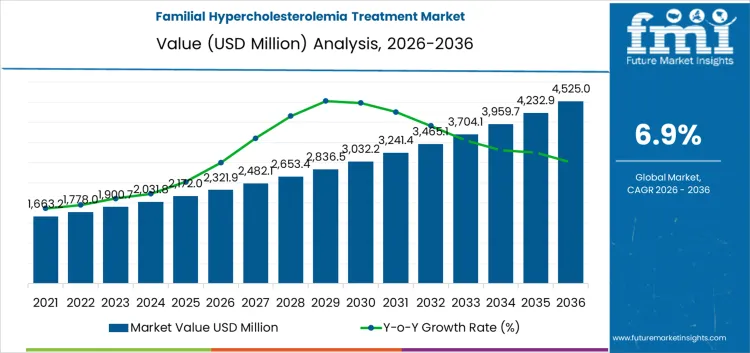
Familial Hypercholesterolemia Treatment Market Key Takeaways
| Metric | Value |
|---|---|
| Familial Hypercholesterolemia Treatment Market Value (2026) | USD 2,321.9 Million |
| Familial Hypercholesterolemia Treatment Market Forecast Value (2036) | USD 4,525.0 Million |
| Familial Hypercholesterolemia Treatment Market Forecast CAGR 2026 to 2036 | 6.90% |
Why is the Familial Hypercholesterolemia Treatment Market Growing?
The familial hypercholesterolemia treatment market is experiencing steady growth due to the increasing recognition of familial hypercholesterolemia (FH) as a prevalent genetic disorder that significantly contributes to cardiovascular diseases. As awareness about the importance of early detection and treatment grows, more patients are being diagnosed and seeking treatment options. FH leads to high cholesterol levels and a higher risk of heart disease, and as such, the demand for effective therapeutic solutions is on the rise.
Advancements in drug development and personalized medicine are driving growth in the familial hypercholesterolemia treatment market. The development of targeted therapies, such as PCSK9 inhibitors and gene therapies, has revolutionized the treatment approach for FH, providing patients with more effective and personalized treatment options. The increasing availability of these therapies, combined with improving diagnostic methods, is contributing to the growing adoption of treatments and thereby expanding the market.
The rising prevalence of cardiovascular diseases, improved healthcare access, and ongoing investments in genetic research are reinforcing growth in the familial hypercholesterolemia treatment market. As more healthcare professionals recognize FH as a key contributor to cardiovascular risk, the adoption of FH-specific treatments is expected to increase, further fueling market expansion over the forecast period.
What Does The Segment Overview Indicate About The Familial Hypercholesterolemia Treatment Market?
The familial hypercholesterolemia (FH) treatment market is segmented by product type and application, reflecting the diagnostic and therapeutic assessment needs of this genetic disorder. Genetic sequencing tests lead the product segment with 34% share, as they provide accurate identification of genetic mutations associated with FH. PCR-based mutation tests, lipid profile assays, and cascade screening kits address specific diagnostic and screening needs. On the application side, initial diagnosis accounts for 42% share, as early detection is crucial for managing FH and preventing cardiovascular complications. Family cascade screening, therapy eligibility assessment, and monitoring applications also contribute significant demand within clinical settings.
Why Do Genetic Sequencing Tests Hold The Leading Product Share In The Familial Hypercholesterolemia Treatment Market?
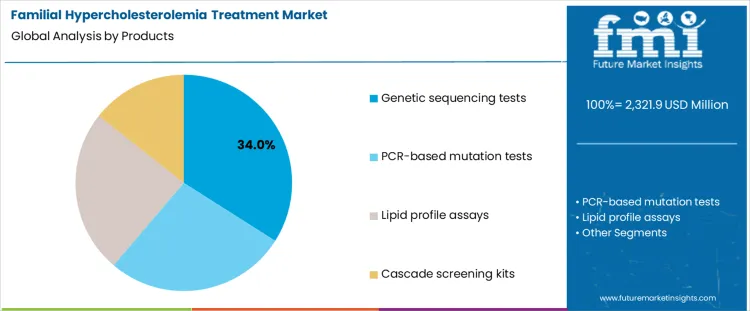
Genetic sequencing tests hold the largest 34% share in the familial hypercholesterolemia treatment market due to their ability to precisely identify mutations in the LDL receptor gene, which are responsible for FH. These tests provide definitive diagnosis and are essential for confirming FH in patients with high cholesterol levels and a family history of cardiovascular disease. The rising prevalence of genetic disorders, along with advancements in genomic technologies, has led to increased adoption of genetic testing as a gold standard for diagnosis. The ability of genetic sequencing tests to detect a wide range of mutations continues to drive their dominance in FH treatment.
How Does Initial Diagnosis Drive Application Demand In The Familial Hypercholesterolemia Treatment Market?
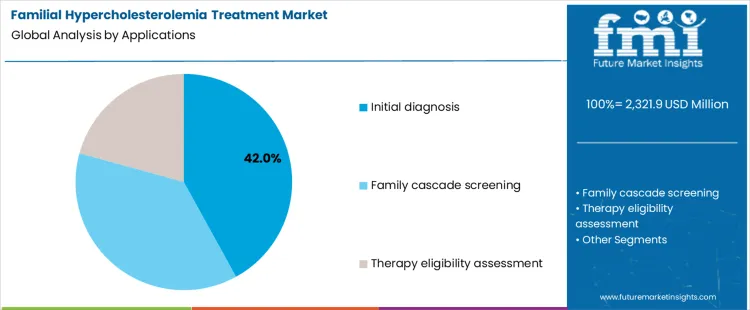
Initial diagnosis drives the largest 42% share in the familial hypercholesterolemia treatment market, as early identification of FH is critical for managing cholesterol levels and preventing cardiovascular diseases. Biomarkers such as lipid profiles and genetic tests are essential for confirming FH in individuals, especially when they exhibit high cholesterol levels. Early diagnosis leads to timely treatment interventions, including cholesterol-lowering medications and lifestyle changes, which can significantly reduce the risk of heart attacks and strokes. The increasing awareness of genetic screening and early detection strategies in high-risk populations further contributes to the demand for diagnostic tools focused on initial diagnosis.
What Are the Key Dynamics for the Familial Hypercholesterolemia Treatment Market?
The familial hypercholesterolemia treatment market is driven by increasing awareness, advances in genetic testing, and the development of novel therapies that offer targeted and personalized treatment options. Genetic testing has become a cornerstone of early diagnosis, leading to more people being identified and treated early, which reduces long-term cardiovascular risk. The market is also benefiting from the introduction of highly effective lipid-lowering therapies, such as PCSK9 inhibitors, which are improving patient outcomes. However, challenges such as high treatment costs, underdiagnosis, and limited access to advanced therapies remain. As awareness grows and access improves, the market is expected to experience sustained growth.
What Are the Key Challenges in the Familial Hypercholesterolemia Treatment Market?
The familial hypercholesterolemia treatment market faces several challenges, including high treatment costs, limited access to advanced therapies, and underdiagnosis. PCSK9 inhibitors, while effective, are expensive and not universally covered by insurance, limiting access for many patients. Genetic testing, while improving, is still not universally implemented in many healthcare systems, leading to delayed or missed diagnoses. Awareness of FH among healthcare providers remains low in some regions, particularly in developing countries, which further contributes to underdiagnosis and undertreatment. Furthermore, the long-term safety and efficacy of emerging gene therapies remain under investigation, presenting another challenge to their widespread adoption.
How Are Technological Advancements Enhancing the Familial Hypercholesterolemia Treatment Market?
Technological advancements are reshaping the familial hypercholesterolemia treatment market by improving diagnosis, treatment efficacy, and patient outcomes. Advances in genetic testing technologies, such as next-generation sequencing (NGS), have made it easier and more affordable to diagnose FH at an earlier stage. Innovations in lipid-lowering treatments, including the development of new biologics, gene therapies, and combination therapies, are enhancing treatment outcomes, especially in patients who are resistant to traditional therapies. Digital health technologies, including mobile apps and telemedicine platforms, are improving patient monitoring and adherence to treatment plans, offering more personalized care and improving overall disease management.
What Is the Country-Wise Growth Outlook for the Familial Hypercholesterolemia Treatment Market?
The familial hypercholesterolemia (FH) treatment market is experiencing steady growth, driven by increasing awareness of FH, improved diagnostic tools, and the rising demand for effective cholesterol-lowering therapies. India leads with a CAGR of 9.9%, supported by growing healthcare infrastructure, increasing prevalence of cardiovascular diseases, and enhanced screening programs for genetic disorders. China follows closely with a CAGR of 9.7%, fueled by its large population, rising awareness of FH, and healthcare policy support for genetic testing and treatment. Brazil shows a CAGR of 9.3%, as the country strengthens its healthcare system and focuses on improving access to cholesterol-lowering treatments. The USA records an 8.1% CAGR, driven by the advanced healthcare system, the introduction of novel therapies, and strong research and clinical trials. France grows at an 8.0% CAGR, benefiting from healthcare advancements, the widespread use of screening programs, and increasing focus on heart disease prevention.
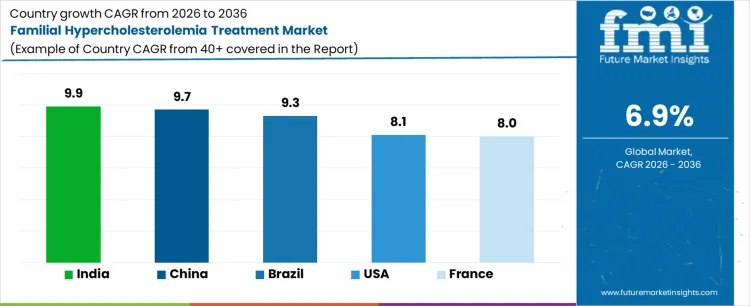
| Country | CAGR |
|---|---|
| India | 9.9% |
| China | 9.7% |
| Brazil | 9.3% |
| USA | 8.1% |
| France | 8.0% |
Why Is India Leading in the Familial Hypercholesterolemia Treatment Market?
Demand for familial hypercholesterolemia (FH) treatment in India is growing at a CAGR of 9.9%, driven by increasing healthcare awareness, improvements in diagnostic capabilities, and a growing focus on cardiovascular health. The prevalence of FH is rising due to better recognition and screening of genetic disorders, which is increasing the demand for effective treatments. The expansion of healthcare infrastructure in India, combined with government initiatives to improve access to healthcare, is enabling more patients to receive diagnosis and treatment for FH. With the growing burden of cardiovascular diseases, there is an increasing focus on preventive measures, including the management of cholesterol levels through treatment options. The development of novel cholesterol-lowering therapies and the rising availability of genetic screening for FH are also contributing to market growth. India’s rapidly expanding pharmaceutical sector and increasing healthcare expenditure further support the demand for FH treatments, ensuring continued growth in the market.
What Is Driving Growth in China’s Familial Hypercholesterolemia Treatment Market?
Sales for familial hypercholesterolemia treatment in China are increasing at a CAGR of 9.7%, driven by rising awareness of genetic disorders, government initiatives to improve healthcare access, and a growing focus on heart disease prevention. As China’s healthcare system continues to expand, access to screening programs and genetic testing for FH has improved, leading to earlier diagnosis and more targeted treatments. The growing prevalence of cardiovascular diseases, especially among the aging population, has prompted increased attention to cholesterol management, including treatment for FH. Furthermore, the Chinese government has been actively supporting the development of novel therapies for genetic conditions and encouraging the use of cholesterol-lowering treatments for high-risk populations. With the expansion of private and public healthcare services, the market for FH treatments in China is growing rapidly. Increased collaborations with global pharmaceutical companies and advancements in biotechnology are further contributing to the growth of this market, making China a key player in the global FH treatment landscape.
What Is Contributing to the Growth of the Familial Hypercholesterolemia Treatment Market in Brazil?
Demand for familial hypercholesterolemia treatment in Brazil is growing at a CAGR of 9.3%, supported by the country’s improving healthcare infrastructure, better diagnostic tools, and the growing awareness of cholesterol-related disorders. Brazil’s expanding healthcare sector is focusing on addressing the high prevalence of cardiovascular diseases, with increased emphasis on genetic testing and early detection of FH. The Brazilian government’s healthcare initiatives, combined with international partnerships, have improved access to FH treatments and screenings, which are essential for managing cholesterol levels in affected individuals. The rising demand for cholesterol-lowering drugs and therapies in Brazil’s large urban centers is fueling market growth. The increasing presence of global pharmaceutical companies offering novel FH treatments, alongside local research initiatives, ensures that Brazil remains a major market for FH therapies. As more Brazilians are diagnosed with FH and cardiovascular risk factors, the demand for effective, affordable treatments continues to rise, positioning Brazil as a rapidly growing market for FH therapies in Latin America.
What Is Supporting the Growth of the FH Treatment Market in the USA?
Sales for familial hypercholesterolemia treatment in the USA are growing at a CAGR of 8.1%, driven by the country’s well-established healthcare infrastructure, high awareness of genetic disorders, and growing demand for advanced cholesterol-lowering therapies. The USA has made significant strides in early detection and diagnosis of FH through genetic screening programs and advanced diagnostic tools. With an increasing focus on personalized medicine and targeted therapies, FH treatments are becoming more accessible to patients, particularly with the introduction of new biologic drugs and gene therapy options. The demand for FH treatments is also supported by the growing prevalence of cardiovascular diseases, which has led to greater attention on managing cholesterol levels and preventing heart disease. Furthermore, the FDA’s approval of new cholesterol-lowering medications is enhancing treatment options and increasing the market for FH therapies. The robust clinical research environment and increasing pharmaceutical investments ensure continued growth in the FH treatment market in the USA.
What Is Driving Growth in France’s Familial Hypercholesterolemia Treatment Market?
Demand for familial hypercholesterolemia treatment in France is increasing at a CAGR of 8.0%, supported by advancements in medical research, widespread use of screening programs, and a growing focus on cardiovascular health. France has a strong emphasis on early diagnosis and treatment of genetic disorders, with national healthcare programs facilitating the screening of high-risk populations for FH. As one of the leaders in European medical research, France is actively involved in developing and testing new treatment options for FH, including novel lipid-lowering therapies. The rising prevalence of cardiovascular diseases and the aging population are also contributing to the demand for effective treatments for FH. The French healthcare system’s commitment to providing access to the latest diagnostic tools and therapies ensures that patients with FH receive timely interventions. With the increasing adoption of personalized medicine, France is positioning itself as a key player in the global FH treatment market, ensuring continued growth in the sector.
How Are Leading Companies Competing And Differentiating In The Familial Hypercholesterolemia Treatment Market?
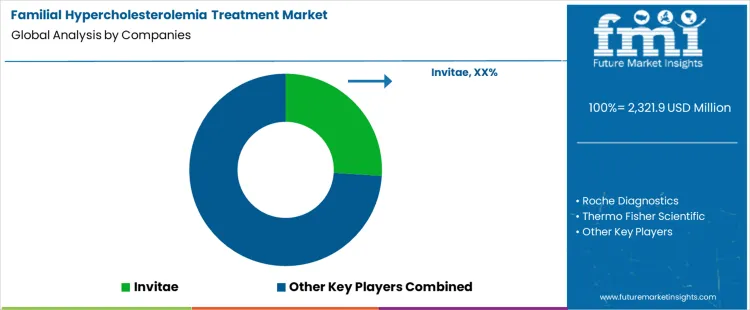
Competition in the familial hypercholesterolemia (FH) treatment market is driven by the development of genetic testing, diagnostics, and therapeutic interventions that offer personalized treatment options. Invitae is positioned as a leader in genetic testing for FH, offering comprehensive diagnostic services that help identify genetic mutations associated with the condition. Their product brochures emphasize the accuracy, speed, and scalability of their testing solutions, which support early detection and personalized care. Roche Diagnostics differentiates itself through its advanced diagnostic tools and assays for FH, focusing on precision in cholesterol measurement and early risk identification, enabling tailored treatment plans for patients.
Thermo Fisher Scientific and Qiagen focus on providing high-performance diagnostic platforms and reagents for genetic testing and biomarker identification. Thermo Fisher leverages its integrated systems for gene sequencing and clinical applications, promoting its solutions for both research and clinical settings. Their platforms are known for their reliability and sensitivity, offering detailed genetic and biomarker analysis that supports the diagnosis and treatment of FH. Qiagen is focusing on offering molecular diagnostic solutions with a focus on high-throughput testing, efficient workflows, and enhanced accuracy in genetic analysis, appealing to both clinical labs and research institutions.
Abbott, known for its expertise in diagnostics, is enhancing its position in the FH treatment market by offering diagnostic tools that enable comprehensive cholesterol profiling. Abbott’s solutions help in identifying individuals at risk of FH and guide treatment decisions, with a strong emphasis on ease of use and integration into clinical settings. Across the market, differentiation is driven by the integration of advanced genetic testing, high-sensitivity biomarkers, and personalized treatment solutions that enhance early diagnosis and improve patient outcomes.
Key Players in Familial Hypercholesterolemia Treatment Market
- Invitae
- Roche Diagnostics
- Thermo Fisher Scientific
- Qiagen
- Abbott
- Others
Scope of Report
| Attributes | Description |
|---|---|
| Quantitative Unit | USD Million |
| Products | Genetic sequencing tests, PCR-based mutation tests, Lipid profile assays, Cascade screening kits |
| Applications | Initial diagnosis, Family cascade screening, Therapy eligibility assessment |
| Regions Covered | Asia Pacific, Europe, North America, Latin America, Middle East & Africa |
| Countries Covered | China, Japan, South Korea, India, Australia & New Zealand, ASEAN, Rest of Asia Pacific, Germany, United Kingdom, France, Italy, Spain, Nordic, BENELUX, Rest of Europe, United States, Canada, Mexico, Brazil, Chile, Rest of Latin America, Kingdom of Saudi Arabia, Other GCC Countries, Turkey, South Africa, Other African Union, Rest of Middle East & Africa |
| Key Companies Profiled | Invitae, Roche Diagnostics, Thermo Fisher Scientific, Qiagen, Abbott, Others |
| Additional Attributes | Market revenue by product and application; adoption trends in genetic testing and cascade screening; regional growth analysis for North America, Europe, and Asia Pacific; projected market size and CAGR for 2026-2036; technological advancements in genetic sequencing for familial hypercholesterolemia; competitive landscape with market share analysis of key players; challenges and opportunities in screening and therapy eligibility assessment for FH. |
Familial Hypercholesterolemia Treatment Market by Key Segments
Products
- Genetic sequencing tests
- PCR-based mutation tests
- Lipid profile assays
- Cascade screening kits
Applications
- Initial diagnosis
- Family cascade screening
- Therapy eligibility assessment
Region:
- Asia Pacific
- China
- Japan
- South Korea
- India
- Australia & New Zealand
- ASEAN
- Rest of Asia Pacific
- Europe
- Germany
- United Kingdom
- France
- Italy
- Spain
- Nordic
- BENELUX
- Rest of Europe
- North America
- United States
- Canada
- Mexico
- Latin America
- Brazil
- Chile
- Rest of Latin America
- Middle East & Africa
- Kingdom of Saudi Arabia
- Other GCC Countries
- Turkey
- South Africa
- Other African Union
- Rest of Middle East & Africa
Institute for Quality and Efficiency in Health Care. (2025). High cholesterol: Learn more - Familial hypercholesterolemia (FH). In InformedHealth.org (NCBI Bookshelf).
- World Heart Federation. (2024). World Heart Report: Cardiovascular disease prevention strategies and global health impact
- USA Food and Drug Administration. (2024). Biomarker Qualification Program (BQP) -Context of use: Genetic and clinical biomarkers in disease detection and therapeutic development.
- National Institutes of Health. (2024). Familial hypercholesterolemia & lipoprotein metabolism, clinical diagnostic and therapeutic background.
- European Medicines Agency. (2024). Guideline on clinical development of medicinal products for familial hypercholesterolemia and related lipid disorders.
Frequently Asked Questions
How big is the familial hypercholesterolemia treatment market in 2026?
The global familial hypercholesterolemia treatment market is estimated to be valued at USD 2,321.9 million in 2026.
What will be the size of familial hypercholesterolemia treatment market in 2036?
The market size for the familial hypercholesterolemia treatment market is projected to reach USD 4,525.0 million by 2036.
How much will be the familial hypercholesterolemia treatment market growth between 2026 and 2036?
The familial hypercholesterolemia treatment market is expected to grow at a 6.9% CAGR between 2026 and 2036.
What are the key product types in the familial hypercholesterolemia treatment market?
The key product types in familial hypercholesterolemia treatment market are genetic sequencing tests, pcr-based mutation tests, lipid profile assays and cascade screening kits.
Which applications segment to contribute significant share in the familial hypercholesterolemia treatment market in 2026?
In terms of applications, initial diagnosis segment to command 42.0% share in the familial hypercholesterolemia treatment market in 2026.
Preview the report firsthand - request a free sample
Get SampleGet the brochure for pricing and purchase details.
Get PDFTable of Content
- Executive Summary
- Global Market Outlook
- Demand-side Trends
- Supply-side Trends
- Technology Roadmap Analysis
- Analysis and Recommendations
- Market Overview
- Market Coverage / Taxonomy
- Market Definition / Scope / Limitations
- Market Background
- Market Dynamics
- Drivers
- Restraints
- Opportunity
- Trends
- Scenario Forecast
- Demand in Optimistic Scenario
- Demand in Likely Scenario
- Demand in Conservative Scenario
- Opportunity Map Analysis
- Product Life Cycle Analysis
- Supply Chain Analysis
- Investment Feasibility Matrix
- Value Chain Analysis
- PESTLE and Porter’s Analysis
- Regulatory Landscape
- Regional Parent Market Outlook
- Production and Consumption Statistics
- Import and Export Statistics
- Market Dynamics
- Global Market Analysis 2021 to 2025 and Forecast, 2026 to 2036
- Historical Market Size Value (USD Million) Analysis, 2021 to 2025
- Current and Future Market Size Value (USD Million) Projections, 2026 to 2036
- Y-o-Y Growth Trend Analysis
- Absolute $ Opportunity Analysis
- Global Market Pricing Analysis 2021 to 2025 and Forecast 2026 to 2036
- Global Market Analysis 2021 to 2025 and Forecast 2026 to 2036, By Products
- Introduction / Key Findings
- Historical Market Size Value (USD Million) Analysis By Products, 2021 to 2025
- Current and Future Market Size Value (USD Million) Analysis and Forecast By Products, 2026 to 2036
- Genetic sequencing tests
- PCR-based mutation tests
- Lipid profile assays
- Cascade screening kits
- Genetic sequencing tests
- Y-o-Y Growth Trend Analysis By Products, 2021 to 2025
- Absolute $ Opportunity Analysis By Products, 2026 to 2036
- Global Market Analysis 2021 to 2025 and Forecast 2026 to 2036, By Applications
- Introduction / Key Findings
- Historical Market Size Value (USD Million) Analysis By Applications, 2021 to 2025
- Current and Future Market Size Value (USD Million) Analysis and Forecast By Applications, 2026 to 2036
- Initial diagnosis
- Family cascade screening
- Therapy eligibility assessment
- Initial diagnosis
- Y-o-Y Growth Trend Analysis By Applications, 2021 to 2025
- Absolute $ Opportunity Analysis By Applications, 2026 to 2036
- Global Market Analysis 2021 to 2025 and Forecast 2026 to 2036, By Region
- Introduction
- Historical Market Size Value (USD Million) Analysis By Region, 2021 to 2025
- Current Market Size Value (USD Million) Analysis and Forecast By Region, 2026 to 2036
- North America
- Latin America
- Western Europe
- Eastern Europe
- East Asia
- South Asia and Pacific
- Middle East & Africa
- Market Attractiveness Analysis By Region
- North America Market Analysis 2021 to 2025 and Forecast 2026 to 2036, By Country
- Historical Market Size Value (USD Million) Trend Analysis By Market Taxonomy, 2021 to 2025
- Market Size Value (USD Million) Forecast By Market Taxonomy, 2026 to 2036
- By Country
- USA
- Canada
- Mexico
- By Products
- By Applications
- By Country
- Market Attractiveness Analysis
- By Country
- By Products
- By Applications
- Key Takeaways
- Latin America Market Analysis 2021 to 2025 and Forecast 2026 to 2036, By Country
- Historical Market Size Value (USD Million) Trend Analysis By Market Taxonomy, 2021 to 2025
- Market Size Value (USD Million) Forecast By Market Taxonomy, 2026 to 2036
- By Country
- Brazil
- Chile
- Rest of Latin America
- By Products
- By Applications
- By Country
- Market Attractiveness Analysis
- By Country
- By Products
- By Applications
- Key Takeaways
- Western Europe Market Analysis 2021 to 2025 and Forecast 2026 to 2036, By Country
- Historical Market Size Value (USD Million) Trend Analysis By Market Taxonomy, 2021 to 2025
- Market Size Value (USD Million) Forecast By Market Taxonomy, 2026 to 2036
- By Country
- Germany
- UK
- Italy
- Spain
- France
- Nordic
- BENELUX
- Rest of Western Europe
- By Products
- By Applications
- By Country
- Market Attractiveness Analysis
- By Country
- By Products
- By Applications
- Key Takeaways
- Eastern Europe Market Analysis 2021 to 2025 and Forecast 2026 to 2036, By Country
- Historical Market Size Value (USD Million) Trend Analysis By Market Taxonomy, 2021 to 2025
- Market Size Value (USD Million) Forecast By Market Taxonomy, 2026 to 2036
- By Country
- Russia
- Poland
- Hungary
- Balkan & Baltic
- Rest of Eastern Europe
- By Products
- By Applications
- By Country
- Market Attractiveness Analysis
- By Country
- By Products
- By Applications
- Key Takeaways
- East Asia Market Analysis 2021 to 2025 and Forecast 2026 to 2036, By Country
- Historical Market Size Value (USD Million) Trend Analysis By Market Taxonomy, 2021 to 2025
- Market Size Value (USD Million) Forecast By Market Taxonomy, 2026 to 2036
- By Country
- China
- Japan
- South Korea
- By Products
- By Applications
- By Country
- Market Attractiveness Analysis
- By Country
- By Products
- By Applications
- Key Takeaways
- South Asia and Pacific Market Analysis 2021 to 2025 and Forecast 2026 to 2036, By Country
- Historical Market Size Value (USD Million) Trend Analysis By Market Taxonomy, 2021 to 2025
- Market Size Value (USD Million) Forecast By Market Taxonomy, 2026 to 2036
- By Country
- India
- ASEAN
- Australia & New Zealand
- Rest of South Asia and Pacific
- By Products
- By Applications
- By Country
- Market Attractiveness Analysis
- By Country
- By Products
- By Applications
- Key Takeaways
- Middle East & Africa Market Analysis 2021 to 2025 and Forecast 2026 to 2036, By Country
- Historical Market Size Value (USD Million) Trend Analysis By Market Taxonomy, 2021 to 2025
- Market Size Value (USD Million) Forecast By Market Taxonomy, 2026 to 2036
- By Country
- Kingdom of Saudi Arabia
- Other GCC Countries
- Turkiye
- South Africa
- Other African Union
- Rest of Middle East & Africa
- By Products
- By Applications
- By Country
- Market Attractiveness Analysis
- By Country
- By Products
- By Applications
- Key Takeaways
- Key Countries Market Analysis
- USA
- Pricing Analysis
- Market Share Analysis, 2025
- By Products
- By Applications
- Canada
- Pricing Analysis
- Market Share Analysis, 2025
- By Products
- By Applications
- Mexico
- Pricing Analysis
- Market Share Analysis, 2025
- By Products
- By Applications
- Brazil
- Pricing Analysis
- Market Share Analysis, 2025
- By Products
- By Applications
- Chile
- Pricing Analysis
- Market Share Analysis, 2025
- By Products
- By Applications
- Germany
- Pricing Analysis
- Market Share Analysis, 2025
- By Products
- By Applications
- UK
- Pricing Analysis
- Market Share Analysis, 2025
- By Products
- By Applications
- Italy
- Pricing Analysis
- Market Share Analysis, 2025
- By Products
- By Applications
- Spain
- Pricing Analysis
- Market Share Analysis, 2025
- By Products
- By Applications
- France
- Pricing Analysis
- Market Share Analysis, 2025
- By Products
- By Applications
- India
- Pricing Analysis
- Market Share Analysis, 2025
- By Products
- By Applications
- ASEAN
- Pricing Analysis
- Market Share Analysis, 2025
- By Products
- By Applications
- Australia & New Zealand
- Pricing Analysis
- Market Share Analysis, 2025
- By Products
- By Applications
- China
- Pricing Analysis
- Market Share Analysis, 2025
- By Products
- By Applications
- Japan
- Pricing Analysis
- Market Share Analysis, 2025
- By Products
- By Applications
- South Korea
- Pricing Analysis
- Market Share Analysis, 2025
- By Products
- By Applications
- Russia
- Pricing Analysis
- Market Share Analysis, 2025
- By Products
- By Applications
- Poland
- Pricing Analysis
- Market Share Analysis, 2025
- By Products
- By Applications
- Hungary
- Pricing Analysis
- Market Share Analysis, 2025
- By Products
- By Applications
- Kingdom of Saudi Arabia
- Pricing Analysis
- Market Share Analysis, 2025
- By Products
- By Applications
- Turkiye
- Pricing Analysis
- Market Share Analysis, 2025
- By Products
- By Applications
- South Africa
- Pricing Analysis
- Market Share Analysis, 2025
- By Products
- By Applications
- USA
- Market Structure Analysis
- Competition Dashboard
- Competition Benchmarking
- Market Share Analysis of Top Players
- By Regional
- By Products
- By Applications
- Competition Analysis
- Competition Deep Dive
- Invitae
- Overview
- Product Portfolio
- Profitability by Market Segments (Product/Age /Sales Channel/Region)
- Sales Footprint
- Strategy Overview
- Marketing Strategy
- Product Strategy
- Channel Strategy
- Roche Diagnostics
- Thermo Fisher Scientific
- Qiagen
- Abbott
- Others
- Invitae
- Competition Deep Dive
- Assumptions & Acronyms Used
- Research Methodology


