

- Market Size (2026)
- USD 17.6 Bn
- Forecast (2036)
- USD 42.8 Bn
- CAGR (2026 to 2036)
- 9.3%
How big is Novel Hypercholesterolemia Drugs Market in 2026?
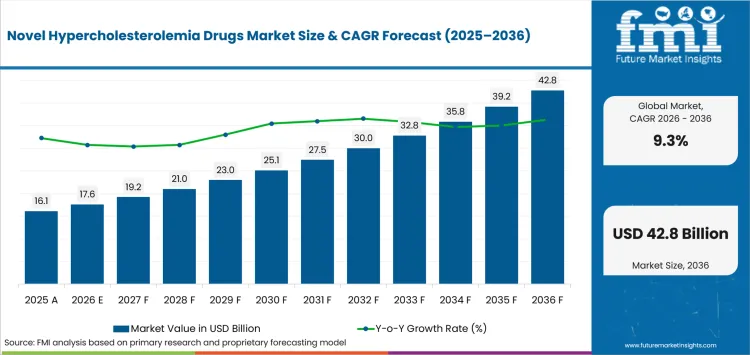
USD 17.6 billion in 2026 and USD 42.8 billion by 2036 at a 9.3% CAGR.
Demand for novel hypercholesterolemia drugs is projected to expand at 9.3% CAGR between 2026 and 2036, increasing valuation from USD 17.6 billion in 2026 to USD 42.8 billion by 2036. Commercial growth is moving across injectable antibodies, long-acting RNA therapies, oral nonstatin drugs and clinical-stage gene-editing programs that address patients who remain above LDL-C goals.
Treatment choice is widening as guidance and regulatory decisions recognize more routes to LDL-C reduction. The 2026 ACC/AHA Guideline on the Management of Dyslipidemia sets risk-based LDL-C goals, while the July 2026 FDA approval of Lipfendra adds the first once-daily oral PCSK9 inhibitor. These changes increase the value of evidence that links efficacy, route and access requirements to a defined patient group.
Key Takeaways of Novel Hypercholesterolemia Drugs Market
- LDL-C lowering is moving across injectable, oral and gene-silencing routes as prescribers seek additional options for patients who remain above risk-based goals.
- PCSK9 inhibitors are projected at 42.0% share in 2026 because marketed antibodies, inclisiran and oral enlicitide connect one validated pathway with several dosing models.
- Primary hypercholesterolemia is estimated at 46.0% of indication demand in 2026 due to the broad treatment need across non-familial disease and heterozygous familial hypercholesterolemia.
- Injectable therapies are forecast at 57.0% by route of administration in 2026, supported by established antibody and siRNA products administered subcutaneously or by infusion.
- Clinical outcome evidence, safety monitoring and reimbursement criteria limit adoption when a new modality adds cost or specialist administration without a clear care pathway.
- Amgen Inc., Novartis AG, Regeneron Pharmaceuticals, Inc., Esperion Therapeutics, Inc., Arrowhead Pharmaceuticals, Inc., Merck & Co., Inc., Eli Lilly and Company, Verve Therapeutics, Inc., CRISPR Therapeutics AG and Silence Therapeutics plc are active across marketed and clinical-stage lipid-lowering routes.
Analyst Perspective
"Novel hypercholesterolemia drugs are creating a choice between dosing frequency, route and durability. Commercial adoption will depend on whether each therapy reaches the intended LDL-C goal with evidence that payers and care teams can use in routine practice."
- Anurag Sharma, Principal Consultant, Future Market Insights
How is the Novel Hypercholesterolemia Drugs Market segmented?
The novel hypercholesterolemia drugs market is segmented by drug class, indication, route of administration, end user, distribution channel and region.
Drug class separates PCSK9 inhibition, siRNA, ATP citrate lyase inhibition, ANGPTL3 targeting and gene editing. Indication covers primary and familial hypercholesterolemia, mixed dyslipidemia and cardiovascular risk reduction. Route of administration distinguishes injectable and oral formats. End user and distribution channel show where prescribing, administration and dispensing occur across hospitals, clinics and pharmacy networks.
Why do PCSK9 Inhibitors lead the Drug Class category?
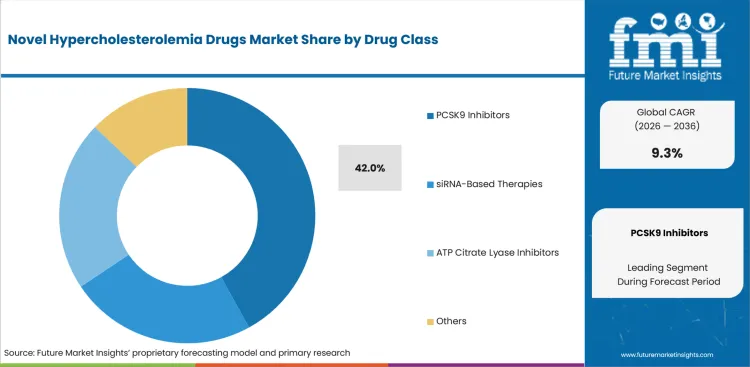
PCSK9 inhibition increases LDL-receptor recycling and supports several delivery models. Repatha prescribing information describes a subcutaneous monoclonal antibody, while Leqvio prescribing information identifies inclisiran as an siRNA directed to PCSK9 mRNA. Lipfendra extends the same pathway to a daily oral tablet.
- Based on drug class, PCSK9 inhibitors are projected to account for 42.0% in 2026 because the pathway is represented by marketed antibody, siRNA and oral therapies.
- Monoclonal antibodies provide established LDL-C reduction, while inclisiran supports twice-yearly maintenance dosing after the initial and three-month injections. Oral enlicitide reduces the administration barrier for patients who prefer a tablet, although adherence and reimbursement remain important.
Why does Primary Hypercholesterolemia lead the Indication category?
Primary hypercholesterolemia includes non-familial disease and heterozygous familial hypercholesterolemia across a broad adult population. The European Medicines Agency overview for Leqvio covers adults with primary hypercholesterolaemia or mixed dyslipidaemia, showing how one therapy can serve several common lipid-management pathways.
- In 2026, primary hypercholesterolemia is expected to lead the indication category with 46.0% share because it covers a wider treatment population than rare homozygous disease.
- Heterozygous familial hypercholesterolemia requires earlier and sustained LDL-C control, while non-familial disease creates larger treatment volumes across cardiology, internal medicine and primary care. Mixed dyslipidemia and secondary prevention add adjacent demand.
Why do Injectable therapies lead the Route of Administration category?
The leading marketed modalities entered practice as subcutaneous or intravenous therapies. Repatha is administered subcutaneously, Leqvio uses healthcare-professional subcutaneous dosing and Evkeeza prescribing information specifies a monthly intravenous infusion for homozygous familial hypercholesterolemia.
- The injectable category is likely to capture 57.0% share in 2026 due to established antibody and siRNA products with defined administration schedules.
- Long-acting injections can reduce dosing frequency but require appointment capacity and follow-up. Oral bempedoic acid and enlicitide widen at-home treatment, while gene-editing programs remain dependent on clinical evidence and specialized delivery.
Why do Hospitals lead the End User category?
Hospitals bring lipid specialists, cardiology services and infusion capacity into one setting for patients with severe LDL-C elevation or complex cardiovascular risk. This matters for intravenous treatment, treatment initiation and the monitoring required when therapy is added to an existing regimen.
- Hospitals are projected to lead the end user category with 38.0% share in 2026 because they coordinate specialist assessment, administration and follow-up for high-risk patients.
- Cardiology departments and lipid clinics manage treatment escalation, while internal medicine departments support patients with diabetes, hypertension or other risk factors. Ambulatory centers and specialty clinics extend administration outside large hospitals.
Why do Hospital Pharmacies lead the Distribution Channel category?
Hospital pharmacies support prescription review, cold-chain handling and provider-administered therapy within the same care pathway. They are positioned to coordinate high-cost injectables and infusion products where payer authorization or specialist confirmation is required before treatment.
- Hospital pharmacies are forecast to lead the distribution channel category with 41.0% share in 2026 owing to their role in specialist prescribing and controlled administration.
- Retail and specialty pharmacies are more relevant for oral therapies and self-administered injections. Specialty distribution remains important for biologics, while online channels depend on national dispensing rules and the route of administration.
What are the drivers, restraints and opportunities in the Novel Hypercholesterolemia Drugs Market?
Risk-based LDL-C goals support treatment escalation while evidence, reimbursement and administration requirements determine whether new modalities enter routine care.
- Driver: Updated lipid guidance and broader regulatory labels expand the population considered for additional nonstatin LDL-C lowering.
- Restraint: High treatment cost, specialist administration and incomplete long-term outcome evidence can slow payer approval or physician adoption.
- Opportunity: Oral PCSK9 inhibition, hepatic RNA interference and one-time gene editing can create new treatment paths if clinical benefit and access are established.
The main demand driver is the gap between measured LDL-C and the goal set for a patient's cardiovascular risk. The 2026 ACC/AHA dyslipidemia guideline restores explicit LDL-C and non-HDL-C goals and supports earlier treatment discussion for people at elevated risk. Broader labels for Repatha and Leqvio also allow use before a cardiovascular event in selected patients.
The main restraint is implementation. Injectable and infusion therapies require reliable administration, while high-cost drugs can involve prior authorization or step-therapy rules. New genetic medicines add uncertainty around durability, off-target effects and long-term follow-up, which can keep adoption within specialist centers during early commercialization.
The main opportunity is a wider modality mix. Lipfendra introduces oral PCSK9 inhibition, zodasiran advances ANGPTL3 RNA interference in Phase 3 for homozygous familial hypercholesterolemia and CTX310 tests one-time in vivo gene editing. Each route can address a different barrier involving frequency, adherence or biological target.
Which country CAGRs are included in the Novel Hypercholesterolemia Drugs Market?
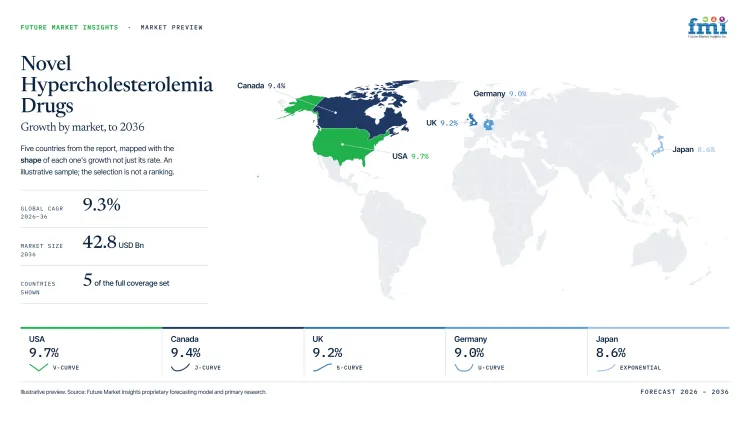
| Country | CAGR |
|---|---|
| South Korea | 10.1% |
| USA | 9.7% |
| Canada | 9.4% |
| UK | 9.2% |
| Germany | 9.0% |
| Australia | 9.0% |
| Japan | 8.6% |
How do country-level CAGRs compare in the Novel Hypercholesterolemia Drugs Market?
The seven country CAGRs span 1.5 percentage points, from South Korea at 10.1% to Japan at 8.6%. The range is narrow enough that access conditions, treatment guidelines and reimbursement design can matter more than the headline difference between two neighboring rates.
- South Korea records the highest CAGR at 10.1%, supported by specialist lipid care and clinical interest in PCSK9, siRNA and gene-targeted approaches.
- The USA is forecast at 9.7%, 0.4 percentage points below South Korea, with growth supported by updated dyslipidemia guidance and the first oral PCSK9 approval.
- Canada is projected at 9.4%, 0.3 percentage points below the USA, as national authorization and provincial access decisions shape uptake.
- The UK is estimated at 9.2%, 0.2 percentage points below Canada, with NICE criteria linking inclisiran use to defined cardiovascular and LDL-C thresholds.
- Germany is forecast at 9.0%, 0.2 percentage points below the UK, as benefit assessment keeps comparative evidence central to reimbursement.
- Australia also records 9.0%, matching Germany, with PBS listings supporting access to evolocumab and inclisiran under authority restrictions.
- Japan is projected at 8.6%, 0.4 percentage points below Germany and Australia, while the 2025 approval of bempedoic acid adds an oral nonstatin option.
Similar growth rates can produce different commercial entry conditions. The full report evaluates regulatory status, reimbursement, prescribing pathways and product availability across North America, Western Europe, East Asia, South Asia and Pacific, Latin America, Eastern Europe, and the Middle East and Africa.
Country-wise Analysis
- South Korea combines specialist cardiovascular care with an active national clinical community focused on dyslipidemia. The Korean Guidelines for the Management of Dyslipidemia, 5th edition include PCSK9 inhibitors for selected patients who remain above LDL-C targets, while the Dyslipidemia Fact Sheet 2024 continues national tracking of diagnosis and control. South Korea is forecast to expand at 10.1% CAGR through 2036 as treatment escalation and interest in long-acting or gene-targeted modalities broaden the addressable specialist population.
- The USA has the broadest recent change in treatment choice. The 2026 ACC/AHA guideline sets explicit LDL-C goals across risk groups, and the FDA approval of Lipfendra in July 2026 adds a once-daily oral PCSK9 inhibitor for adults with hypercholesterolemia, including heterozygous familial disease. The USA is estimated to grow at 9.7% CAGR as earlier risk-based treatment and more route options expand prescribing beyond established injectable pathways.
- Canada has national regulatory access to PCSK9 antibodies and inclisiran, while public reimbursement remains organized through federal, provincial and territorial processes. Health Canada's 2021 product highlights identify Leqvio for additional LDL-C reduction in adults with heterozygous familial or non-familial hypercholesterolemia under specified treatment conditions. Canada is projected to advance at 9.4% CAGR through 2036, although plan-level criteria and price review will continue to influence the pace of adoption.
- The UK links new lipid-lowering treatment to explicit health-technology assessment criteria. NICE technology appraisal TA733 recommends inclisiran as an option for adults with primary hypercholesterolaemia or mixed dyslipidaemia when the defined cardiovascular and LDL-C conditions are met. The UK is forecast to record 9.2% CAGR as structured NHS access supports eligible patients, while treatment thresholds limit use outside the recommended population.
- Germany provides access within a reimbursement system that gives strong weight to comparative benefit. The Federal Joint Committee assessment of inclisiran concluded that additional benefit was not proven for the assessed groups because suitable comparative data were not presented. Germany is expected to grow at 9.0% CAGR, with demand supported by cardiovascular prevention but constrained by the need to demonstrate value against established alternatives.
- Australia combines specialist prescribing with national subsidy rules. The PBS listing for inclisiran covers heterozygous familial and non-familial hypercholesterolaemia under streamlined authority, while evolocumab remains listed for familial and non-familial indications under defined restrictions. Australia is forecast at 9.0% CAGR as subsidized access supports eligible patients, although authority requirements keep treatment focused on higher-risk groups.
- Japan has an established specialist market for familial hypercholesterolemia and continues to add nonstatin options. The PMDA list of approved drugs records the September 2025 approval of Nexletol, containing bempedoic acid, for hypercholesterolemia and familial hypercholesterolemia. Japan is projected to expand at 8.6% CAGR through 2036 as oral therapy broadens choice, while local evidence and reimbursement decisions shape uptake across older and high-risk patients.
Who are the notable companies in the Novel Hypercholesterolemia Drugs Market?
Amgen Inc., Novartis AG, Regeneron Pharmaceuticals, Inc., Esperion Therapeutics, Inc., Arrowhead Pharmaceuticals, Inc., Merck & Co., Inc., Eli Lilly and Company, Verve Therapeutics, Inc., CRISPR Therapeutics AG and Silence Therapeutics plc are the notable companies serving the novel hypercholesterolemia drugs market.
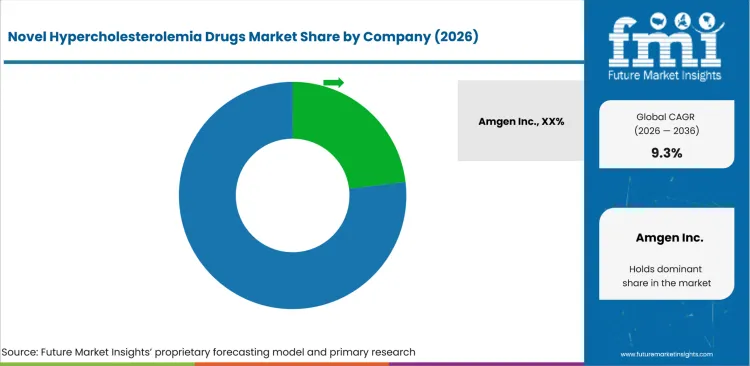
Competition extends from marketed LDL-C therapies to late-stage RNA interference and early gene-editing programs. Commercial suppliers compete on LDL-C reduction, cardiovascular evidence, dosing frequency and payer access. Clinical-stage companies compete on durability, target selection and the safety evidence needed to move genetic medicines into broader cardiovascular care.
- Amgen, Novartis, Regeneron, Esperion and Merck supply marketed products across PCSK9 inhibition, ANGPTL3 inhibition and ATP citrate lyase inhibition.
- Arrowhead and Silence Therapeutics develop RNA interference programs for inherited or residual lipid risk.
- Eli Lilly, Verve Therapeutics and CRISPR Therapeutics are advancing one-time gene-editing strategies directed at PCSK9, ANGPTL3 or related cardiovascular targets.
Competitive Benchmarking: Novel Hypercholesterolemia Drugs Market
| Company | Commercial presence | Novel modality depth | Verified market role | Geographic reach |
|---|---|---|---|---|
| Amgen Inc. | High | Medium | Repatha, a subcutaneous PCSK9 monoclonal antibody with cardiovascular and hypercholesterolemia indications | Global major markets |
| Novartis AG | High | High | Leqvio inclisiran siRNA with twice-yearly maintenance dosing after initial administration | More than 80 countries |
| Regeneron Pharmaceuticals, Inc. | High | High | Evkeeza intravenous ANGPTL3 antibody for homozygous familial hypercholesterolemia | USA, EU and selected markets |
| Esperion Therapeutics, Inc. | High | Medium | Nexletol and Nexlizet oral bempedoic acid products for LDL-C reduction and cardiovascular risk | USA and partner-led international markets |
| Merck & Co., Inc. | High | High | Lipfendra enlicitide, the first FDA-approved once-daily oral PCSK9 inhibitor | USA |
| Arrowhead Pharmaceuticals, Inc. | Medium | High | Zodasiran RNA interference targeting ANGPTL3 in Phase 3 for homozygous familial hypercholesterolemia | Multinational clinical development |
| Eli Lilly and Company | Medium | High | Owns the Verve cardiovascular gene-editing platform and supports one-time treatment development | Global |
| Verve Therapeutics, Inc. | Medium | High | Clinical-stage in vivo PCSK9 base-editing programs operating within Eli Lilly | Multinational clinical development |
| CRISPR Therapeutics AG | Medium | High | CTX310 one-time in vivo CRISPR-Cas9 program targeting ANGPTL3 | Multinational clinical development |
| Silence Therapeutics plc | Medium | Medium | Zerlasiran siRNA targets lipoprotein(a), an adjacent inherited cardiovascular lipid risk factor | Multinational clinical development |
Scoring basis: Commercial presence is High when a company has a marketed therapy directly used for hypercholesterolemia or familial hypercholesterolemia. Medium marks clinical-stage or adjacent cardiovascular lipid activity. Novel modality depth is High for siRNA, oral PCSK9, ANGPTL3 or gene-editing programs with direct development evidence. Medium covers an established modality or an adjacent lipid target without the same breadth. Geographic reach reflects documented product markets or multinational clinical activity rather than corporate scale.
Key Developments in the Novel Hypercholesterolemia Drugs Market
- In July 2026, Merck & Co., Inc. announced FDA approval of Lipfendra, the first once-daily oral PCSK9 inhibitor for adults with hypercholesterolemia, including heterozygous familial hypercholesterolemia.
- In August 2025, Amgen Inc. announced an expanded US label for Repatha covering adults at increased risk of major adverse cardiovascular events because of uncontrolled LDL-C.
- In July 2025, Novartis AG announced a US label update allowing Leqvio to be used without a statin requirement as an adjunct to diet and exercise for LDL-C reduction in adults with hypercholesterolemia.
Key Players in the Novel Hypercholesterolemia Drugs Market
Commercial LDL-C Lowering Platforms
- Amgen Inc.
- Novartis AG
- Regeneron Pharmaceuticals, Inc.
- Esperion Therapeutics, Inc.
- Merck & Co., Inc.
RNAi and Hepatic Gene-Silencing Platforms
- Arrowhead Pharmaceuticals, Inc.
- Silence Therapeutics plc
Gene-Editing and Strategic Cardiovascular Platforms
- Eli Lilly and Company
- Verve Therapeutics, Inc.
- CRISPR Therapeutics AG
Novel Hypercholesterolemia Drugs Market - Report Scope
| Coverage field | Report scope |
|---|---|
| Market breakdown | By drug class, indication, route of administration, end user, distribution channel and region. |
| Quantitative Units | USD billion. |
| Market Definition | Novel therapies used to reduce LDL-C or address inherited and high-risk hypercholesterolemia across the drug classes and care pathways included in this assessment. |
| Regions Covered | North America, Latin America, Western Europe, Eastern Europe, East Asia, South Asia and Pacific, and Middle East and Africa. |
| Countries Covered | South Korea, USA, Canada, UK, Germany, Australia, Japan, and additional countries included in the full report. |
| Key Companies | Amgen Inc., Novartis AG, Regeneron Pharmaceuticals, Inc., Esperion Therapeutics, Inc., Arrowhead Pharmaceuticals, Inc., Merck & Co., Inc., Eli Lilly and Company, Verve Therapeutics, Inc., CRISPR Therapeutics AG and Silence Therapeutics plc. |
| Forecast Period | 2026 to 2036. |
| Approach | Primary and secondary research with market triangulation. |
Novel Hypercholesterolemia Drugs Market - Research Methodology
| Method | Approach |
|---|---|
| Primary Research | FMI analysts gathered input from pharmaceutical manufacturers, biotechnology developers, cardiologists, lipid specialists, pharmacists, payers, specialty distributors and procurement teams. Interviews examined treatment escalation, dosing preferences, administration capacity, evidence requirements, reimbursement and barriers to sustained use. |
| Desk Research | Desk research covered regulatory labels, clinical guidelines, health-technology assessments, reimbursement schedules, trial registries, company filings, product information and official corporate announcements. Claims were retained when they had direct relevance to LDL-C lowering, hypercholesterolemia or the included treatment pathways. |
| Market Sizing and Forecasting | The model combined the 2026 baseline with the 2036 value, segment shares, country CAGRs, treatment adoption, route mix and company activity. Forecast assumptions considered label expansion, payer access, specialist capacity, dosing frequency and the probability that clinical-stage modalities progress toward commercialization. |
| Data Validation | Values and growth rates were reconciled across segments and countries before the market total was finalized. Product roles, indications and developments were checked against official regulatory or company sources to limit overlap and exclude activity without direct market relevance. |
Novel Hypercholesterolemia Drugs Market by Segments
Novel Hypercholesterolemia Drugs Market segmented by Drug Class:
- PCSK9 Inhibitors
- Monoclonal Antibodies
- Next-Generation PCSK9 Therapies
- siRNA-Based Therapies
- Inclisiran-Based Therapies
- Hepatic RNA Silencing Agents
- ATP Citrate Lyase Inhibitors
- Bempedoic Acid-Based Drugs
- Combination Therapies
- Others
- ANGPTL3 Inhibitors
- Gene Editing Therapies
Novel Hypercholesterolemia Drugs Market segmented by Indication:
- Primary Hypercholesterolemia
- Heterozygous Familial Hypercholesterolemia
- Non-Familial Hypercholesterolemia
- Mixed Dyslipidemia
- Combined Hyperlipidemia
- Atherogenic Dyslipidemia
- Homozygous Familial Hypercholesterolemia
- Genetic Lipid Disorders
- Severe LDL-C Elevation
- Others
- Cardiovascular Risk Reduction
- Secondary Prevention
Novel Hypercholesterolemia Drugs Market segmented by Route of Administration:
- Injectable
- Subcutaneous Injection
- Long-Acting Injectable
- Oral
- Tablets
- Fixed-Dose Combination
- Others
- Implantable Delivery Systems
- Emerging Gene Therapy Delivery
Novel Hypercholesterolemia Drugs Market segmented by End User:
- Hospitals
- Cardiology Departments
- Internal Medicine Departments
- Specialty Clinics
- Lipid Clinics
- Cardiovascular Centers
- Retail & Specialty Pharmacies
- Retail Pharmacy Chains
- Specialty Pharmacy Providers
- Others
- Academic Research Institutes
- Ambulatory Care Centers
Novel Hypercholesterolemia Drugs Market segmented by Distribution Channel:
- Hospital Pharmacies
- Inpatient Pharmacies
- Outpatient Pharmacies
- Retail Pharmacies
- Chain Pharmacies
- Independent Pharmacies
- Specialty Pharmacies
- Biologics Distribution
- Cold Chain Providers
- Others
- Online Pharmacies
- Government Procurement
Novel Hypercholesterolemia Drugs Market by Region:
- North America
- United States
- Canada
- Mexico
- Latin America
- Brazil
- Chile
- Rest of Latin America
- Western Europe
- Germany
- United Kingdom
- Italy
- Spain
- France
- Nordics
- Benelux
- Rest of Western Europe
- Eastern Europe
- Russia
- Poland
- Hungary
- Balkan and Baltic States
- Rest of Eastern Europe
- East Asia
- China
- Japan
- South Korea
- South Asia and Pacific
- India
- ASEAN
- Australia and New Zealand
- Rest of South Asia and Pacific
- Middle East and Africa
- Kingdom of Saudi Arabia
- Other GCC Countries
- Türkiye
- South Africa
- Other African Union Countries
- Rest of Middle East and Africa
Research Sources and Bibliography
- USA Food and Drug Administration. (2026, July 16). FDA approves first oral PCSK9 inhibitor to lower LDL-C in adults with high cholesterol.
- American College of Cardiology and American Heart Association. (2026). Guideline on the Management of Dyslipidemia.
- USA Food and Drug Administration. (2025). Repatha prescribing information.
- USA Food and Drug Administration. (2025). Leqvio prescribing information.
- European Medicines Agency. Leqvio: EPAR.
- USA Food and Drug Administration. (2024). Nexletol prescribing information.
- Regeneron Pharmaceuticals. Evkeeza prescribing information.
- National Institute for Health and Care Excellence. (2021). Inclisiran for treating primary hypercholesterolaemia or mixed dyslipidaemia.
- Health Canada. (2021). Health Product Highlights: Leqvio.
- Federal Joint Committee, Germany. (2021). Benefit assessment resolution for inclisiran.
- Pharmaceutical Benefits Scheme, Australia. Inclisiran item 14101E.
- Pharmaceutical Benefits Scheme, Australia. Evolocumab item 10958R.
- Pharmaceuticals and Medical Devices Agency, Japan. (2026). List of approved drugs from April 2004 to February 2026.
- Korean Society of Lipid and Atherosclerosis. (2025). Dyslipidemia Fact Sheet 2024.
- Korean Society of Lipid and Atherosclerosis. Korean Guidelines for the Management of Dyslipidemia, 5th edition.
- Merck & Co., Inc. (2026, July 16). Lipfendra FDA approval announcement.
- Novartis. (2025, July 31). Leqvio FDA approval for first-line use.
- Amgen. (2025, August 25). Repatha label expansion for adults at increased cardiovascular risk.
- Arrowhead Pharmaceuticals. (2025, July 8). Phase 3 YOSEMITE study initiation for zodasiran.
- Eli Lilly and Company. (2025, July 25). Completion of the acquisition of Verve Therapeutics.
- CRISPR Therapeutics. (2025). Phase 1 data for CTX310 targeting ANGPTL3.
- Silence Therapeutics. Zerlasiran development program.
- Esperion Therapeutics. (2024, March 22). FDA label expansion for Nexletol and Nexlizet.
- Regeneron Pharmaceuticals. (2025, September 26). Evkeeza indication expansion for younger children with HoFH.
This bibliography is provided for reader reference and is not exhaustive. The full report contains the complete reference list and detailed citations
This Report Answers
- How large is the Novel Hypercholesterolemia Drugs Market in 2026 and 2036?
- Which drug class accounts for the leading 2026 share?
- Why does primary hypercholesterolemia lead the indication mix?
- How does route of administration shape adoption?
- Which end user and distribution channel lead in 2026?
- How do country growth rates affect market entry conditions?
- Which companies supply marketed therapies or develop new modalities?
- What restraints could slow reimbursement and routine use?
Frequently Asked Questions
How big is the novel hypercholesterolemia drugs market in 2026?
USD 17.6 billion represents the market value in 2026 across marketed and clinical-stage lipid-lowering routes included in this assessment. The market is projected to reach USD 42.8 billion by 2036 as oral, injectable and gene-silencing options expand treatment choice.
What is the CAGR of the novel hypercholesterolemia drugs market from 2026 to 2036?
A 9.3% CAGR is forecast between 2026 and 2036. Growth depends on treatment escalation for patients above LDL-C goals, broader labels for nonstatin therapies and the ability of new modalities to secure reimbursement and fit routine care.
Which drug class is projected to account for 42.0% of the market in 2026?
PCSK9 inhibitors are projected to account for 42.0% of drug class demand in 2026. The category includes established monoclonal antibodies, inclisiran-based gene silencing and the new oral PCSK9 inhibitor enlicitide.
How much value will the market add between 2026 and 2036?
USD 25.2 billion is expected to be added between 2026 and 2036. The increase reflects a broader patient pool for additional LDL-C reduction and the commercialization of therapies with different dosing frequencies or biological targets.
Which companies are active in the novel hypercholesterolemia drugs market?
Ten notable companies include Amgen Inc., Novartis AG, Regeneron Pharmaceuticals, Inc., Esperion Therapeutics, Inc., Arrowhead Pharmaceuticals, Inc., Merck & Co., Inc., Eli Lilly and Company, Verve Therapeutics, Inc., CRISPR Therapeutics AG and Silence Therapeutics plc. Their activity spans marketed antibodies, oral drugs, RNA interference and gene editing.
Preview the report firsthand - request a free sample
Get SampleGet the brochure for pricing and purchase details.
Get PDFTable of Content
- Key Takeaways
- Market Size and CAGR
- Top Growth Driver
- Fastest Growing Segment
- Leading Region
- Key Companies
- Emerging Opportunities
- Executive Summary
- Global Market Outlook
- Demand-side Trends
- Supply-side Trends
- Technology Roadmap Analysis
- Analysis and Recommendations
- Analyst Perspective (What is happening? Why now? What should investors know?)
- Key Questions Answered
- How large is the market?
- What is the CAGR?
- What are key trends?
- Which region dominates?
- Who are the leaders?
- Market Overview
- Market Coverage / Taxonomy
- Market Definition / Scope / Limitations
- Research Methodology
- Chapter Orientation
- Analytical Lens and Working Hypotheses
- Market Structure, Signals, and Trend Drivers
- Benchmarking and Cross-market Comparability
- Market Sizing, Forecasting, and Opportunity Mapping
- Research Design and Evidence Framework
- Desk Research Programme (Secondary Evidence)
- Expert Input and Fieldwork (Primary Evidence)
- Tooling, Models, and Reference Databases
- Data Engineering and Model Build
- Quality Assurance and Audit Trail
- Market Background
- Market Dynamics (Drivers, Restraints, Opportunity, Trends)
- Scenario Forecast (Optimistic, Likely, Conservative)
- Impact Analysis
- AI Impact
- Sustainability Impact
- Regulatory Impact
- Technology Impact
- Consumer / Buyer Analysis
- Purchase Drivers
- Adoption Barriers
- Buyer Journey
- Opportunity Map Analysis
- Product Life Cycle Analysis
- Supply Chain Analysis
- Investment Feasibility Matrix
- Value Chain Analysis
- PESTLE and Porter's Analysis
- Regulatory Landscape
- Regional Parent Market Outlook
- Production and Consumption Statistics
- Import and Export Statistics
- Global Market Analysis and Forecast, 2021 to 2036
- Historical Market Size Value (USD Billion) Analysis, 2021 to 2025
- Current and Future Market Size Value (USD Billion) Projections, 2026 to 2036
- Y-o-Y Growth Trend Analysis
- Absolute $ Opportunity Analysis
- Global Market Pricing Analysis, 2021 to 2036
- Global Market Analysis and Forecast, By Drug Class, 2021 to 2036
- Introduction / Key Findings
- Historical Market Size Value (USD Billion) Analysis By Drug Class, 2021 to 2025
- Current and Future Market Size Value (USD Billion) Analysis and Forecast By Drug Class, 2026 to 2036
- PCSK9 Inhibitors
- Monoclonal Antibodies
- Next-Generation PCSK9 Therapies
- siRNA-Based Therapies
- Inclisiran-Based Therapies
- Hepatic RNA Silencing Agents
- ATP Citrate Lyase Inhibitors
- Bempedoic Acid-Based Drugs
- Combination Therapies
- Others
- ANGPTL3 Inhibitors
- Gene Editing Therapies
- PCSK9 Inhibitors
- Y-o-Y Growth Trend Analysis By Drug Class, 2021 to 2025
- Absolute $ Opportunity Analysis By Drug Class, 2026 to 2036
- Global Market Analysis and Forecast, By Indication, 2021 to 2036
- Introduction / Key Findings
- Historical Market Size Value (USD Billion) Analysis By Indication, 2021 to 2025
- Current and Future Market Size Value (USD Billion) Analysis and Forecast By Indication, 2026 to 2036
- Primary Hypercholesterolemia
- Heterozygous Familial Hypercholesterolemia
- Non-Familial Hypercholesterolemia
- Mixed Dyslipidemia
- Combined Hyperlipidemia
- Atherogenic Dyslipidemia
- Homozygous Familial Hypercholesterolemia
- Genetic Lipid Disorders
- Severe LDL-C Elevation
- Others
- Cardiovascular Risk Reduction
- Secondary Prevention
- Primary Hypercholesterolemia
- Y-o-Y Growth Trend Analysis By Indication, 2021 to 2025
- Absolute $ Opportunity Analysis By Indication, 2026 to 2036
- Global Market Analysis and Forecast, By Route of Administration, 2021 to 2036
- Introduction / Key Findings
- Historical Market Size Value (USD Billion) Analysis By Route of Administration, 2021 to 2025
- Current and Future Market Size Value (USD Billion) Analysis and Forecast By Route of Administration, 2026 to 2036
- Injectable
- Subcutaneous Injection
- Long-Acting Injectable
- Oral
- Tablets
- Fixed-Dose Combination
- Others
- Implantable Delivery Systems
- Emerging Gene Therapy Delivery
- Injectable
- Y-o-Y Growth Trend Analysis By Route of Administration, 2021 to 2025
- Absolute $ Opportunity Analysis By Route of Administration, 2026 to 2036
- Global Market Analysis and Forecast, By End User, 2021 to 2036
- Introduction / Key Findings
- Historical Market Size Value (USD Billion) Analysis By End User, 2021 to 2025
- Current and Future Market Size Value (USD Billion) Analysis and Forecast By End User, 2026 to 2036
- Hospitals
- Cardiology Departments
- Internal Medicine Departments
- Specialty Clinics
- Lipid Clinics
- Cardiovascular Centers
- Retail & Specialty Pharmacies
- Retail Pharmacy Chains
- Specialty Pharmacy Providers
- Others
- Academic Research Institutes
- Ambulatory Care Centers
- Hospitals
- Y-o-Y Growth Trend Analysis By End User, 2021 to 2025
- Absolute $ Opportunity Analysis By End User, 2026 to 2036
- Global Market Analysis and Forecast, By Distribution Channel, 2021 to 2036
- Introduction / Key Findings
- Historical Market Size Value (USD Billion) Analysis By Distribution Channel, 2021 to 2025
- Current and Future Market Size Value (USD Billion) Analysis and Forecast By Distribution Channel, 2026 to 2036
- Hospital Pharmacies
- Inpatient Pharmacies
- Outpatient Pharmacies
- Retail Pharmacies
- Chain Pharmacies
- Independent Pharmacies
- Specialty Pharmacies
- Biologics Distribution
- Cold Chain Providers
- Others
- Online Pharmacies
- Government Procurement
- Hospital Pharmacies
- Y-o-Y Growth Trend Analysis By Distribution Channel, 2021 to 2025
- Absolute $ Opportunity Analysis By Distribution Channel, 2026 to 2036
- Global Market Analysis and Forecast, By Region, 2021 to 2036
- Introduction
- Historical Market Size Value (USD Billion) Analysis By Region, 2021 to 2025
- Current Market Size Value (USD Billion) Analysis and Forecast By Region, 2026 to 2036
- North America
- Latin America
- Western Europe
- Eastern Europe
- East Asia
- South Asia and Pacific
- Middle East & Africa
- Market Attractiveness Analysis By Region
- North America Market Analysis and Forecast, By Country, 2021 to 2036
- Historical Market Size Value (USD Billion) Trend Analysis By Market Taxonomy, 2021 to 2025
- Market Size Value (USD Billion) Forecast By Market Taxonomy, 2026 to 2036
- By Country
- USA
- Canada
- By Drug Class
- By Indication
- By Route of Administration
- By End User
- By Distribution Channel
- By Country
- Market Attractiveness Analysis
- By Country
- By Drug Class
- By Indication
- By Route of Administration
- By End User
- By Distribution Channel
- Key Takeaways
- Latin America Market Analysis and Forecast, By Country
- Historical Market Size Value (USD Billion) Trend Analysis By Market Taxonomy, 2021 to 2025
- Market Size Value (USD Billion) Forecast By Market Taxonomy, 2026 to 2036
- By Country
- Brazil
- Mexico
- Chile
- Rest of Latin America
- By Drug Class
- By Indication
- By Route of Administration
- By End User
- By Distribution Channel
- By Country
- Market Attractiveness Analysis
- By Country
- By Drug Class
- By Indication
- By Route of Administration
- By End User
- By Distribution Channel
- Key Takeaways
- Western Europe Market Analysis and Forecast, By Country
- Historical Market Size Value (USD Billion) Trend Analysis By Market Taxonomy, 2021 to 2025
- Market Size Value (USD Billion) Forecast By Market Taxonomy, 2026 to 2036
- By Country
- Germany
- UK
- Italy
- Spain
- France
- Nordic
- BENELUX
- Rest of Western Europe
- By Drug Class
- By Indication
- By Route of Administration
- By End User
- By Distribution Channel
- By Country
- Market Attractiveness Analysis
- By Country
- By Drug Class
- By Indication
- By Route of Administration
- By End User
- By Distribution Channel
- Key Takeaways
- Eastern Europe Market Analysis and Forecast, By Country
- Historical Market Size Value (USD Billion) Trend Analysis By Market Taxonomy, 2021 to 2025
- Market Size Value (USD Billion) Forecast By Market Taxonomy, 2026 to 2036
- By Country
- Russia
- Poland
- Hungary
- Balkan & Baltic
- Rest of Eastern Europe
- By Drug Class
- By Indication
- By Route of Administration
- By End User
- By Distribution Channel
- By Country
- Market Attractiveness Analysis
- By Country
- By Drug Class
- By Indication
- By Route of Administration
- By End User
- By Distribution Channel
- Key Takeaways
- East Asia Market Analysis and Forecast, By Country
- Historical Market Size Value (USD Billion) Trend Analysis By Market Taxonomy, 2021 to 2025
- Market Size Value (USD Billion) Forecast By Market Taxonomy, 2026 to 2036
- By Country
- China
- Japan
- South Korea
- By Drug Class
- By Indication
- By Route of Administration
- By End User
- By Distribution Channel
- By Country
- Market Attractiveness Analysis
- By Country
- By Drug Class
- By Indication
- By Route of Administration
- By End User
- By Distribution Channel
- Key Takeaways
- South Asia and Pacific Market Analysis and Forecast, By Country
- Historical Market Size Value (USD Billion) Trend Analysis By Market Taxonomy, 2021 to 2025
- Market Size Value (USD Billion) Forecast By Market Taxonomy, 2026 to 2036
- By Country
- India
- ASEAN
- Australia & New Zealand
- Rest of South Asia and Pacific
- By Drug Class
- By Indication
- By Route of Administration
- By End User
- By Distribution Channel
- By Country
- Market Attractiveness Analysis
- By Country
- By Drug Class
- By Indication
- By Route of Administration
- By End User
- By Distribution Channel
- Key Takeaways
- Middle East & Africa Market Analysis and Forecast, By Country
- Historical Market Size Value (USD Billion) Trend Analysis By Market Taxonomy, 2021 to 2025
- Market Size Value (USD Billion) Forecast By Market Taxonomy, 2026 to 2036
- By Country
- Kingdom of Saudi Arabia
- Other GCC Countries
- Türkiye
- South Africa
- Other African Union
- Rest of Middle East & Africa
- By Drug Class
- By Indication
- By Route of Administration
- By End User
- By Distribution Channel
- By Country
- Market Attractiveness Analysis
- By Country
- By Drug Class
- By Indication
- By Route of Administration
- By End User
- By Distribution Channel
- Key Takeaways
- Key Countries Market Analysis
- USA
- Pricing Analysis
- Market Share Analysis, 2025
- By Drug Class
- By Indication
- By Route of Administration
- By End User
- By Distribution Channel
- Canada
- Pricing Analysis
- Market Share Analysis, 2025
- By Drug Class
- By Indication
- By Route of Administration
- By End User
- By Distribution Channel
- Mexico
- Pricing Analysis
- Market Share Analysis, 2025
- By Drug Class
- By Indication
- By Route of Administration
- By End User
- By Distribution Channel
- Brazil
- Pricing Analysis
- Market Share Analysis, 2025
- By Drug Class
- By Indication
- By Route of Administration
- By End User
- By Distribution Channel
- Chile
- Pricing Analysis
- Market Share Analysis, 2025
- By Drug Class
- By Indication
- By Route of Administration
- By End User
- By Distribution Channel
- Germany
- Pricing Analysis
- Market Share Analysis, 2025
- By Drug Class
- By Indication
- By Route of Administration
- By End User
- By Distribution Channel
- UK
- Pricing Analysis
- Market Share Analysis, 2025
- By Drug Class
- By Indication
- By Route of Administration
- By End User
- By Distribution Channel
- Italy
- Pricing Analysis
- Market Share Analysis, 2025
- By Drug Class
- By Indication
- By Route of Administration
- By End User
- By Distribution Channel
- Spain
- Pricing Analysis
- Market Share Analysis, 2025
- By Drug Class
- By Indication
- By Route of Administration
- By End User
- By Distribution Channel
- France
- Pricing Analysis
- Market Share Analysis, 2025
- By Drug Class
- By Indication
- By Route of Administration
- By End User
- By Distribution Channel
- India
- Pricing Analysis
- Market Share Analysis, 2025
- By Drug Class
- By Indication
- By Route of Administration
- By End User
- By Distribution Channel
- ASEAN
- Pricing Analysis
- Market Share Analysis, 2025
- By Drug Class
- By Indication
- By Route of Administration
- By End User
- By Distribution Channel
- Australia & New Zealand
- Pricing Analysis
- Market Share Analysis, 2025
- By Drug Class
- By Indication
- By Route of Administration
- By End User
- By Distribution Channel
- China
- Pricing Analysis
- Market Share Analysis, 2025
- By Drug Class
- By Indication
- By Route of Administration
- By End User
- By Distribution Channel
- Japan
- Pricing Analysis
- Market Share Analysis, 2025
- By Drug Class
- By Indication
- By Route of Administration
- By End User
- By Distribution Channel
- South Korea
- Pricing Analysis
- Market Share Analysis, 2025
- By Drug Class
- By Indication
- By Route of Administration
- By End User
- By Distribution Channel
- Russia
- Pricing Analysis
- Market Share Analysis, 2025
- By Drug Class
- By Indication
- By Route of Administration
- By End User
- By Distribution Channel
- Poland
- Pricing Analysis
- Market Share Analysis, 2025
- By Drug Class
- By Indication
- By Route of Administration
- By End User
- By Distribution Channel
- Hungary
- Pricing Analysis
- Market Share Analysis, 2025
- By Drug Class
- By Indication
- By Route of Administration
- By End User
- By Distribution Channel
- Kingdom of Saudi Arabia
- Pricing Analysis
- Market Share Analysis, 2025
- By Drug Class
- By Indication
- By Route of Administration
- By End User
- By Distribution Channel
- Türkiye
- Pricing Analysis
- Market Share Analysis, 2025
- By Drug Class
- By Indication
- By Route of Administration
- By End User
- By Distribution Channel
- South Africa
- Pricing Analysis
- Market Share Analysis, 2025
- By Drug Class
- By Indication
- By Route of Administration
- By End User
- By Distribution Channel
- USA
- Market Structure Analysis
- Competition Dashboard
- Competition Benchmarking
- Market Share Analysis of Top Players
- By Regional
- By Drug Class
- By Indication
- By Route of Administration
- By End User
- By Distribution Channel
- Emerging Startups
- Innovation Benchmarking
- Competition Analysis
- Competition Deep Dive
- Amgen Inc.
- Overview
- Product Portfolio
- Profitability by Market Segments
- Sales Footprint
- Strategy Overview
- Marketing Strategy
- Product Strategy
- Channel Strategy
- Novartis AG
- Regeneron Pharmaceuticals, Inc.
- Esperion Therapeutics, Inc.
- Arrowhead Pharmaceuticals, Inc.
- Merck & Co., Inc.
- Eli Lilly and Company
- Verve Therapeutics, Inc.
- CRISPR Therapeutics AG
- Silence Therapeutics plc
- Others
- Amgen Inc.
- Case Studies
- Success Stories
- Recent Developments
- Competition Deep Dive
- Assumptions & Acronyms Used


