

- Market Size (2026)
- USD 45.4 Mn
- Forecast (2036)
- USD 70.0 Mn
- CAGR (2026 to 2036)
- 4.4%
How big is the fexofenadine market in 2026?
USD 45.4 million in 2026 and USD 70.0 million by 2036 at a 4.4% CAGR.
The fexofenadine market is expected to grow from USD 44.1 million in 2025 to USD 70.0 million by 2036. Industry is expected to be driven by allergy tablet production and regulated generic filings. Allergic Rhinitis, which is forecast to represent 72.8% application share in 2026.
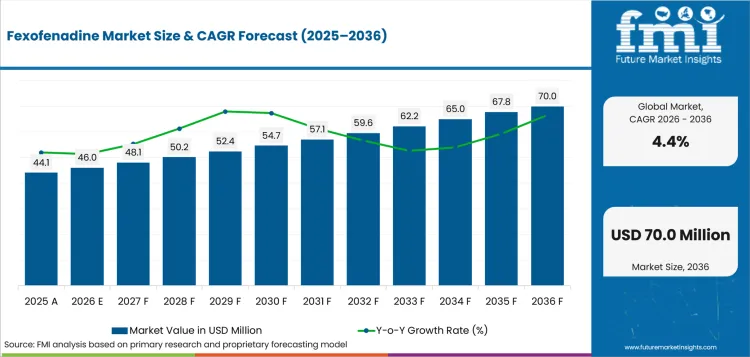
| Metric | Value |
|---|---|
| 2026 Market Size | USD 45.4 million |
| 2036 Market Size | USD 70.0 million |
| Forecast CAGR (2026-2036) | 4.4% |
| Leading Form | Powder |
| Powder Share (2026) | 63.4% |
| Leading Purity Grade | ≥99.5% |
| ≥99.5% Purity Grade Share (2026) | 68.8% |
| Fastest-growing Country | India |
| India CAGR by 2036 | 5.8% |
| Market Signal | Commercial Impact |
|---|---|
| Demand and Growth Drivers | Ongoing allergic rhinitis and chronic urticaria treatment continue to support the fexofenadine market through repeat seasonal and long-term therapy.
|
| Product and Segment View | Powder form, ≥99.5% purity, and direct sales channels lead their respective market segments.
|
| Geography and Growth Outlook | India and China remain key API manufacturing hubs, while the United States continues to support steady OTC demand.
|
| Competitive Landscape | Competition increasingly centers on regulatory documentation, API quality, and manufacturing reliability.
|
| Analyst Perspective | Fexofenadine remains a documentation-driven API market where regulatory readiness and consistent manufacturing are more valuable than aggressive pricing.
- Anurag Sharma, Principal Consultant at Future Market Insights |
Fexofenadine hydrochloride is an active pharmaceutical ingredient used in oral allergy medicines. Demand is expected to be driven by repeat allergy management and OTC shelf visibility. CDC reported in January 2026 that about 3 in 10 U.S. adults and children had a seasonal allergy or food allergy in 2024. This gives non-sedating antihistamines a broad use base across seasonal and recurring symptom periods. Sanofi’s April 2025 closing of the Opella transaction created an independent consumer healthcare company with EUR 5 billion in 2024 revenue. This means fexofenadine suppliers and finished-dose marketers must compete on brand access and clean quality documentation before buyers expand seasonal orders.
Which factors support expansion in the fexofenadine market?
Regulated tablet production and seasonal allergy use support value across fexofenadine API supply.
- Market value is supported by finished oral tablet production that needs repeat API orders across allergy seasons.
- Supplier pricing reflects purity grade and quality-file strength before simple ingredient availability affects buying.
- Revenue improves when suppliers support bioequivalence filings and reduce buyer qualification work.
- Buyer trust rises when release data and impurity control make supplier comparison easier.
Why is the fexofenadine market growing?
Oral allergy tablets keep fexofenadine commercially relevant due to familiarity among prescribers and consumers.
Regulated generic filings add a stronger buying filter. FDA’s October 2024 draft guidance names fexofenadine hydrochloride tablets and gives strength-specific bioequivalence expectations. The practical effect is clear for API suppliers. Buyers prefer sources that can support filings with stable impurity profiles and repeatable tablet behavior. Patient care pathways around allergy treatment can influence tablet demand. The pediatric allergy care category shows how age-group management can affect medicine planning.
How is the fexofenadine market segmented?
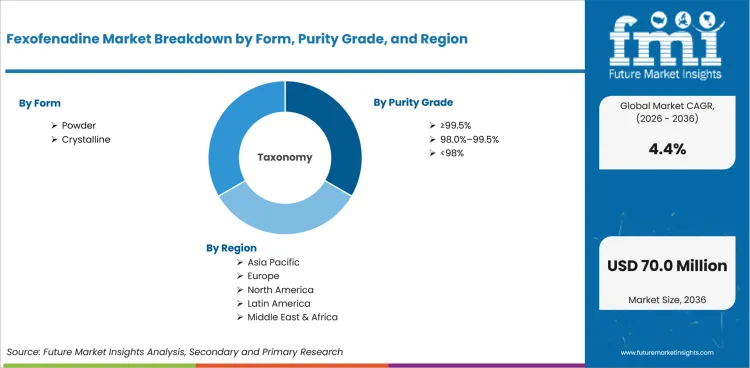
The fexofenadine industry is segmented by form, purity grade, application, sales channel.
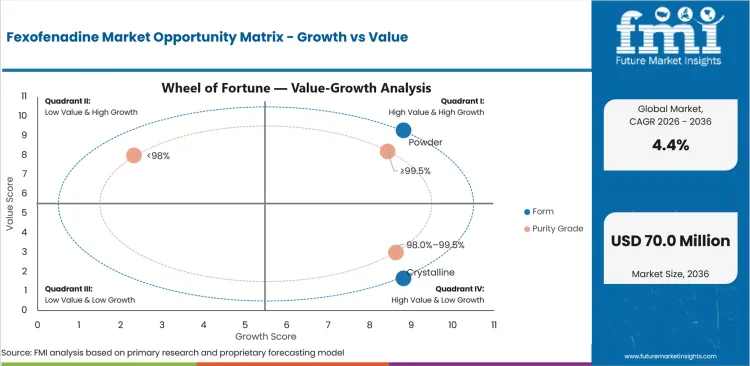
- Powder leads Form demand with an estimated 63.4% share in 2026 due to easier blending in oral solid-dose plants.
- By Purity Grade, ≥99.5% material is forecast to represent 68.8% share in 2026 due to early impurity screening.
- Allergic Rhinitis is projected to account for 72.8% application demand in 2026, led by seasonal tablet volume.
- Direct channels are forecast to hold 55.6% share in 2026 due to audited supplier qualification.
- North America is expected to account for 31.5% regional share in 2026, supported by established OTC allergy products.
Why does powder lead the fexofenadine market?
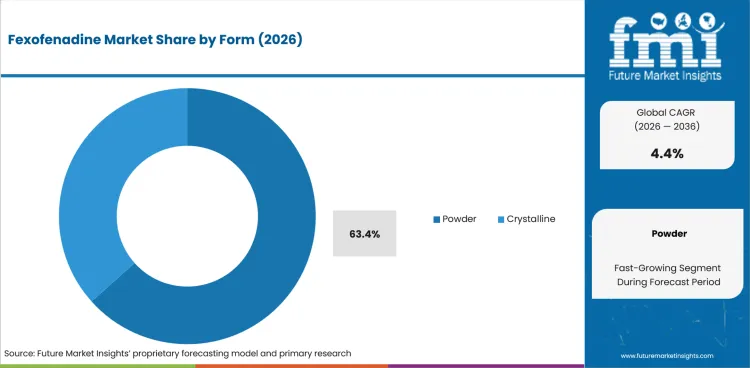
- Powder is projected to account for 63.4% share in 2026 through easier handling in oral solid-dose lines.
- Crystalline material remains useful when buyers specify tighter solid-state control for tablet performance.
Which purity grade leads the fexofenadine market?
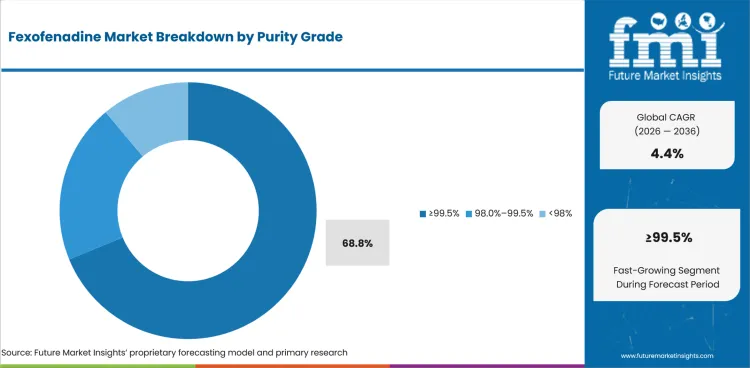
- The ≥99.5% grade is expected to represent 68.8% share in 2026 due to impurity-control needs in regulated filings.
- Lower purity grades remain available for less demanding uses but face weaker acceptance in regulated tablet programs.
Which application leads the fexofenadine market?
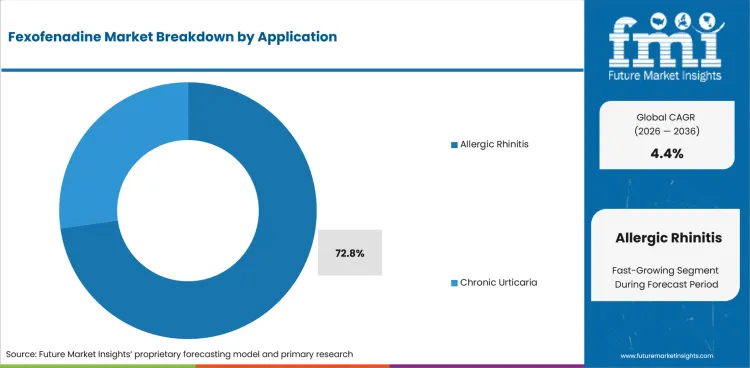
- Allergic Rhinitis is forecast to secure 72.8% share in 2026, driven by once-daily tablet demand.
- Chronic Urticaria keeps a second application pool active when patients need non-sedating antihistamine options.
Which sales channel leads the fexofenadine market?
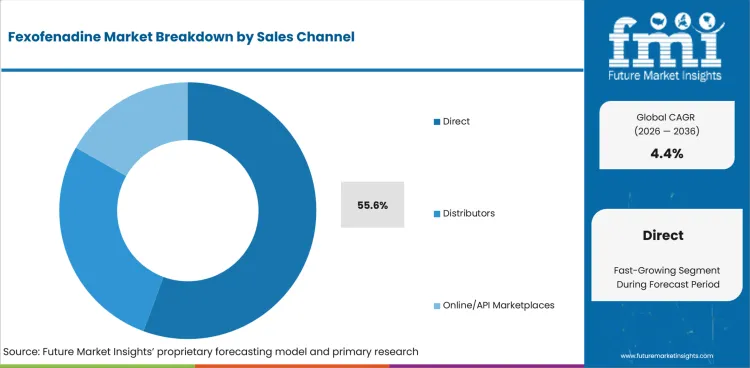
- Direct sales are estimated to hold 55.6% share in 2026 due to quality-audit requirements.
- Online/API marketplaces help supplier discovery but large buyers move to direct document review before purchase.
Which region leads the fexofenadine market?
- North America is anticipated to account for 31.5% share in 2026, supported by stable OTC allergy product demand.
- East Asia and South Asia gain share with local approvals and API capacity adding supplier depth.
What supports growth and what limits the fexofenadine market?
Bioequivalence filing needs support growth. Price competition limits premium room for standard API grades.
- Driver: Regulated-market buyers need API suppliers with quality files that support repeat tablet performance.
- Restraint: Qualified generic API suppliers can pressure prices when several sources meet basic tablet needs.
- Opportunity: Higher-purity material can win better account access when buyers reduce impurity risk before filing.
Fexofenadine Market Demand Outlook for Regulated API Supply
Allergy tablet demand is expected to stay steady across OTC and generic programs. CDC reported in January 2026 that 25.2% of U.S. adults had a diagnosed seasonal allergy in 2024. This gives fexofenadine suppliers a clearer demand anchor for oral tablet customers.
Quality-file pressure is expected to shape supplier selection before price talks begin. FDA stated in October 2025 that only 9% of API manufacturers were in the United States. This makes audit readiness and file response speed more important for offshore suppliers. Testing pathways can explain how patients enter allergy care without expanding the API scope.
Fexofenadine Buyer Segmentation and Purchase Behavior Analysis
Formulation firms and generic manufacturers make the purchase decision for fexofenadine API. These buyers review impurity control and release data before supplier approval. Batch behavior is checked during validation work and then used for purchase planning. Large buyers usually close commercial orders through direct contracts. Marketplaces help discovery but do not replace quality audits for regulated finished-dose products.
Fexofenadine Voice of Customer and Decision-driver Analysis
Quality teams want fewer file changes and fewer release surprises. FDA’s FY 2025 generic drug activity report listed 689 approvals across the year. That review volume keeps buyers focused on suppliers that can answer technical questions quickly. Procurement teams compare purity grade and delivery reliability before they approve repeat orders. Audit responsiveness can decide which supplier moves ahead when prices are close.
Which countries are growing fastest in the fexofenadine market?
India 5.8% CAGR, China 5.2% CAGR, South Korea 4.6% CAGR, United States 3.9% CAGR, Germany 3.8% CAGR, United Kingdom 3.6% CAGR, France 3.5% CAGR, and Japan 3.1% CAGR by 2036.
.webp "Top Country Growth Comparison Fexofenadine Market Cagr (2026 2036)")
| Country | CAGR |
|---|---|
| United States | 3.9% |
| United Kingdom | 3.6% |
| Germany | 3.8% |
| France | 3.5% |
| Japan | 3.1% |
| China | 5.2% |
| South Korea | 4.6% |
| India | 5.8% |
Source: Future Market Insights, 2026.
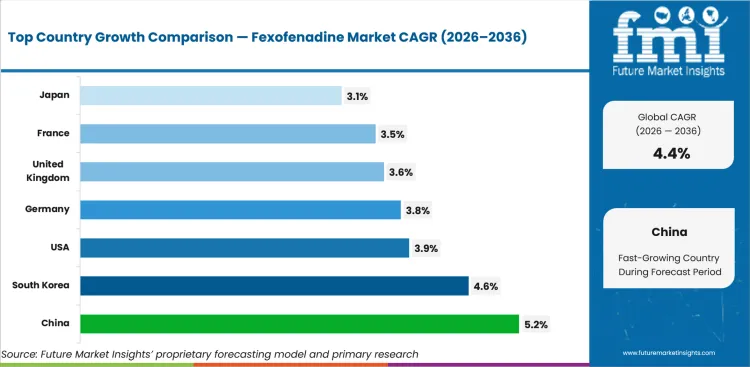
How do country-level CAGRs compare in the fexofenadine market?
India records the fastest profiled growth while Japan shows the most cautious outlook among selected countries.
- United States is projected to record 3.9% CAGR by 2036, supported by OTC allergy tablets and regulated generic filings.
- United Kingdom is projected to record 3.6% CAGR by 2036, supported by pharmacy access and public medicine guidance.
- Germany is projected to record 3.8% CAGR by 2036, led by EU-quality expectations and pharmacy substitution discipline.
- France is projected to record 3.5% CAGR by 2036, supported by pharmacy access and ANSM authorization discipline.
- Japan is projected to record 3.1% CAGR by 2036 due to cedar pollen allergy burden and high-specification buyer behavior.
- China is projected to record 5.2% CAGR by 2036, supported by domestic approvals and formulation scale.
- South Korea is projected to record 4.6% CAGR by 2036 due to regulated product review and imported API qualification.
- India is projected to record 5.8% CAGR by 2036 due to API scale and export-oriented filing depth.
What is the fexofenadine market outlook in United States?
A 3.9% CAGR by 2036 reflects OTC allergy tablets and regulated generic filings.
Country Market Snapshot Table
| Parameter | Value |
|---|---|
| Market Size in 2025 (Value) | USD 12.0 million |
| Market Size in 2026 (Value) | USD 12.5 million |
| Market Forecast in 2036 (Value) | USD 18.3 million |
| CAGR (2026 to 2036) | 3.9% |
| Years Considered | 2021 to 2036 |
| Base Year | 2025 |
| Forecast Period | 2026 to 2036 |
| Units Considered | Value (USD million) |
| Leading Sub-Region | New Jersey and national generic medicine corridors |
United States Fexofenadine Market Outlook
United States fexofenadine demand is shaped by OTC allergy tablets and regulated generic filings. Mature allergy medicine channels keep API volumes steady across tablet programs.
API suppliers gain preference when they provide stable quality files and reliable release data. Buyer caution stays high when a supplier change can affect an approved product.
Key Growth Drivers
- Seasonal allergy prevalence supports repeat tablet demand. CDC reported in January 2026 that women had 29.5% diagnosed seasonal allergy prevalence in 2024.
- Once-daily OTC dosing keeps 180 mg tablet planning simple. DailyMed lists one 180 mg tablet in 24 hours for adults and children aged 12 years and older.
- FDA issued fexofenadine hydrochloride tablet guidance in October 2024. This makes bioequivalence evidence central to regulated generic filings.
- Private-label allergy programs keep API buying close to seasonal inventory planning before spring retail demand.
Key Restraints
- Generic retail competition limits price room for standard API grades. Buyers often compare approved 180 mg tablet supply on cost and quality files.
- Supplier changes remain slow when approved dossiers and quality agreements must be updated before commercial batches move.
- Urban demand is broad but mature. CDC reported 24.8% diagnosed seasonal allergy prevalence among adults in metropolitan areas in 2024.
What makes United States unique
The United States is the main compliance benchmark due to FDA guidance affecting dossiers used by export-focused API suppliers.
Key Companies
- Aurobindo Pharma
- Sun Pharmaceutical Industries
- Dr. Reddy’s Laboratories
- Alembic Pharmaceuticals
- Lupin
Sales & Marketing Channels
- Direct API contracts with generic manufacturers
- Drug master file backed technical qualification
- Finished-dose private-label programs
- Distributor support for smaller formulation buyers
- Online API discovery before supplier audits
Country Segment Breakdown Table
| Segment | Sub-Segments |
|---|---|
| By Form | Powder · Crystalline |
| By Purity Grade | ≥99.5% · 98.0%–99.5% · <98% |
| By Application | Allergic Rhinitis · Chronic Urticaria |
| By Sales Channel | Direct · Distributors · Online/API Marketplaces |
| Key Buyer Groups | Generic drug makers · Formulation firms · API distributors |
| Key Sub-Regions Covered | Large urban medicine markets · API manufacturing corridors · Pharmacy demand clusters |
Frequently Asked Questions
How fast is United States fexofenadine market growing?
Demand in United States is projected to grow at 3.9% CAGR from 2026 to 2036.
Who leads United States fexofenadine market?
Aurobindo Pharma and Sun Pharmaceutical Industries compete through finished-dose reach. Dr. Reddy’s Laboratories adds supplier qualification support.
What is driving adoption in United States fexofenadine market?
Otc allergy tablets and regulated generic filings is moving buyers toward qualified API sources.
What is the fexofenadine market outlook in United Kingdom?
A 3.6% CAGR by 2036 reflects pharmacy access and public medicine guidance.
Country Market Snapshot Table
| Parameter | Value |
|---|---|
| Market Size in 2025 (Value) | USD 2.3 million |
| Market Size in 2026 (Value) | USD 2.4 million |
| Market Forecast in 2036 (Value) | USD 3.4 million |
| CAGR (2026 to 2036) | 3.6% |
| Years Considered | 2021 to 2036 |
| Base Year | 2025 |
| Forecast Period | 2026 to 2036 |
| Units Considered | Value (USD million) |
| Leading Sub-Region | England and national pharmacy wholesale corridors |
United Kingdom Fexofenadine Market Outlook
United Kingdom fexofenadine demand is shaped by pharmacy access and public medicine guidance. Pharmacy systems keep tablet demand visible for suppliers that serve licensed products.
Supplier selection depends on clear quality files and reliable supply history. Smaller suppliers need stronger evidence before buyers accept them into product files.
Key Growth Drivers
- Hay fever creates a broad treatment pool. GOV.UK reported in August 2025 that hay fever affects 26% of adults in the United Kingdom.
- NHS medicine guidance keeps fexofenadine visible in allergy care. NHS lists 180 mg once daily for hives in adults and children aged 12 years and older.
- MHRA product records support licensed medicine comparison for finished-dose buyers. This helps API suppliers present cleaner documentation to UK customers.
- Pharmacy substitution keeps generic antihistamine tablets relevant for distributors that serve community pharmacy channels.
Key Restraints
- Pharmacy reimbursement pressure restricts API margin room for standard tablet supply. Buyers therefore look for lower cost without weaker quality files.
- Smaller suppliers face longer acceptance cycles when UK buyers rely on licensed product information and quality review.
- Pediatric demand is more constrained. GOV.UK reported in August 2025 that hay fever affects 10% to 15% of children in the United Kingdom.
What makes United Kingdom unique
The United Kingdom combines pharmacy reach with public medicine information systems that make product equivalence easy to compare.
Key Companies
- Teva UK
- Viatris UK
- Zentiva UK
- Crescent Pharma
- Milpharm
Sales & Marketing Channels
- Pharmacy wholesale channels
- Direct API supply to UK-focused generics firms
- Licensed product documentation routes
- Distributor-backed API sourcing
- Online supplier screening before formal audits
Country Segment Breakdown Table
| Segment | Sub-Segments |
|---|---|
| By Form | Powder · Crystalline |
| By Purity Grade | ≥99.5% · 98.0%-99.5% · <98% |
| By Application | Allergic Rhinitis · Chronic Urticaria |
| By Sales Channel | Direct · Distributors · Online/API Marketplaces |
| Key Buyer Groups | Generic drug makers · Formulation firms · API distributors |
| Key Sub-Regions Covered | Large urban medicine markets · API manufacturing corridors · Pharmacy demand clusters |
Frequently Asked Questions
How fast is United Kingdom fexofenadine market growing?
Demand in United Kingdom is projected to grow at 3.6% CAGR from 2026 to 2036.
Who leads United Kingdom fexofenadine market?
Teva UK and Viatris UK compete through finished-dose reach. Zentiva UK adds supplier qualification support.
What is driving adoption in United Kingdom fexofenadine market?
Pharmacy access and public medicine guidance is moving buyers toward qualified API sources.
What is the fexofenadine market outlook in Germany?
A 3.8% CAGR by 2036 reflects EU-quality expectations and pharmacy substitution discipline.
Country Market Snapshot Table
| Parameter | Value |
|---|---|
| Market Size in 2025 (Value) | USD 2.6 million |
| Market Size in 2026 (Value) | USD 2.7 million |
| Market Forecast in 2036 (Value) | USD 3.9 million |
| CAGR (2026 to 2036) | 3.8% |
| Years Considered | 2021 to 2036 |
| Base Year | 2025 |
| Forecast Period | 2026 to 2036 |
| Units Considered | Value (USD million) |
| Leading Sub-Region | North Rhine-Westphalia and southern pharmacy clusters |
Germany Fexofenadine Market Outlook
Germany fexofenadine demand is shaped by EU-quality expectations and pharmacy substitution discipline. Buyers give more weight to documentation than spot-price availability.
API suppliers can gain account access through quality evidence and release consistency. Entry is slower for firms without a European file record.
Key Growth Drivers
- Allergy treatment needs keep antihistamine demand active. Germany’s public health portal states that allergies affect about one third of the population.
- Hay fever creates a large repeat-treatment pool. Germany’s health portal reported in May 2024 that about one quarter of the population has hay fever.
- EU quality comparison supports high-purity sourcing. EDQM made revised CEP guidance available in April 2026 for certification users.
- Pharmacy substitution systems sustain demand for approved generic allergy tablets sold through regulated retail channels.
Key Restraints
- Reimbursement and tender pressure narrow premium pricing for standard API grades. This makes suppliers defend price with better quality files.
- Documentation-heavy switching slows entry for unfamiliar suppliers. EU buyers avoid changes that disrupt dossiers.
- Pollen exposure is broad but established. Germany’s health portal reported in May 2024 that about one quarter of the population has hay fever.
What makes Germany unique
Germany is a documentation-led market where public medicine data and pharmacy substitution reinforce qualified API sourcing.
Key Companies
- Hexal
- Ratiopharm
- 1A Pharma
- Aristo Pharma
- ALIUD Pharma
Sales & Marketing Channels
- Direct supply to EU generic manufacturers
- Distributor networks serving formulation firms
- Pharmacy wholesaler demand
- Audit-based supplier qualification
- Online API discovery before technical review
Country Segment Breakdown Table
| Segment | Sub-Segments |
|---|---|
| By Form | Powder · Crystalline |
| By Purity Grade | ≥99.5% · 98.0%-99.5% · <98% |
| By Application | Allergic Rhinitis · Chronic Urticaria |
| By Sales Channel | Direct · Distributors · Online/API Marketplaces |
| Key Buyer Groups | Generic drug makers · Formulation firms · API distributors |
| Key Sub-Regions Covered | Large urban medicine markets · API manufacturing corridors · Pharmacy demand clusters |
Frequently Asked Questions
How fast is Germany fexofenadine market growing?
Demand in Germany is projected to grow at 3.8% CAGR from 2026 to 2036.
Who leads Germany fexofenadine market?
Hexal and Ratiopharm compete through finished-dose reach. 1A Pharma adds supplier qualification support.
What is driving adoption in Germany fexofenadine market?
Eu-quality expectations and pharmacy substitution discipline is moving buyers toward qualified API sources.
What is the fexofenadine market outlook in France?
A 3.5% CAGR by 2036 reflects pharmacy access and ANSM authorization discipline.
Country Market Snapshot Table
| Parameter | Value |
|---|---|
| Market Size in 2025 (Value) | USD 2.1 million |
| Market Size in 2026 (Value) | USD 2.2 million |
| Market Forecast in 2036 (Value) | USD 3.1 million |
| CAGR (2026 to 2036) | 3.5% |
| Years Considered | 2021 to 2036 |
| Base Year | 2025 |
| Forecast Period | 2026 to 2036 |
| Units Considered | Value (USD million) |
| Leading Sub-Region | Ile-de-France and national pharmacy corridors |
France Fexofenadine Market Outlook
France fexofenadine demand is shaped by pharmacy access and ANSM authorization discipline. Generic tablet demand depends on clear product records and substitution confidence.
API suppliers need clean release documents and stable quality history. Buyers can reject suppliers that create more work for approved product files.
Key Growth Drivers
- ANSM generic records keep fexofenadine visible in pharmacy substitution. The October 2024 generic repertoire lists a fexofenadine 180 mg tablet group.
- HAS reviewed fexofenadine products in 2024 across 120 mg and 180 mg tablet strengths. This supports continued public assessment of the product class.
- French public medicine records list fexofenadine tablet products with updates in June 2026. This keeps product information current for pharmacy users.
- EU-aligned authorization routes support suppliers that can provide stable quality files and release data.
Key Restraints
- Reimbursed medicine price controls reduce API margin room for standard grades. Buyers therefore focus on quality files and cost discipline.
- Local buyer qualification can be slow when new suppliers must support French product files and batch-release expectations.
- ANSM generic grouping around 180 mg tablets limits differentiation. Several products are compared within the same substitution frame.
What makes France unique
France is commercially useful for API suppliers due to national authorization discipline and documentation-led buyer confidence.
Key Companies
- Viatris Sante
- Biogaran
- Sandoz France
- Teva Sante
- Arrow Generiques
Sales & Marketing Channels
- Pharmacy dispensing channels
- Direct supply to EU-focused generics firms
- Distributor networks for formulation buyers
- Regulatory file support routes
- Online API sourcing for preliminary screening
Country Segment Breakdown Table
| Segment | Sub-Segments |
|---|---|
| By Form | Powder · Crystalline |
| By Purity Grade | ≥99.5% · 98.0%–99.5% · <98% |
| By Application | Allergic Rhinitis · Chronic Urticaria |
| By Sales Channel | Direct · Distributors · Online/API Marketplaces |
| Key Buyer Groups | Generic drug makers · Formulation firms · API distributors |
| Key Sub-Regions Covered | Large urban medicine markets · API manufacturing corridors · Pharmacy demand clusters |
Frequently Asked Questions
How fast is France fexofenadine market growing?
Demand in France is projected to grow at 3.5% CAGR from 2026 to 2036.
Who leads France fexofenadine market?
Viatris Sante and Biogaran compete through finished-dose reach. Sandoz France adds supplier qualification support.
What is driving adoption in France fexofenadine market?
Pharmacy access and ansm authorization discipline is moving buyers toward qualified API sources.
What is the fexofenadine market outlook in Japan?
A 3.1% CAGR by 2036 reflects cedar pollen allergy burden and high-specification buyer behavior.
Country Market Snapshot Table
| Parameter | Value |
|---|---|
| Market Size in 2025 (Value) | USD 3.5 million |
| Market Size in 2026 (Value) | USD 3.6 million |
| Market Forecast in 2036 (Value) | USD 4.9 million |
| CAGR (2026 to 2036) | 3.1% |
| Years Considered | 2021 to 2036 |
| Base Year | 2025 |
| Forecast Period | 2026 to 2036 |
| Units Considered | Value (USD million) |
| Leading Sub-Region | Tokyo and Kansai medicine demand clusters |
Japan Fexofenadine Market Outlook
Japan fexofenadine demand is shaped by cedar pollen allergy burden and high-specification buyer behavior. Spring pollen exposure keeps antihistamine use commercially relevant.
Supplier acceptance depends on stable release data and long quality history. Overseas suppliers need a clean local support path before buyers shift orders.
Key Growth Drivers
- Cedar pollen exposure keeps allergy medicine use relevant. MAFF reported in 2025 that cedar pollen allergy affects about 40% of Japan’s population every spring.
- Government pollen policy keeps the allergy burden visible. MAFF reported 573 specified mother-tree varieties for low-pollen cedar by March 2025.
- High-specification buyers prefer API suppliers with repeatable particle behavior and strong release documentation for oral tablets.
- Generic medicine channels support API demand when fexofenadine remains a familiar second-generation antihistamine.
Key Restraints
- Slow switching protects incumbent suppliers when Japanese buyers avoid disruption around approved quality files.
- Local supply validation raises entry cost for overseas API firms without proven documentation and audit history.
- Pollen-control policy can soften long-term exposure pressure. MAFF targeted 20% cedar-pollen output reduction over ten years.
What makes Japan unique
Japan is quality-intensive due to pollen-related allergy demand and strict buyer expectations for stable medicine supply.
Key Companies
- Sanwa Kagaku Kenkyusho
- Towa Pharmaceutical
- Nichi-Iko Pharmaceutical
- Sawai Pharmaceutical
- Nippon Chemiphar
Sales & Marketing Channels
- Direct supply to Japanese generics firms
- Trading-house buying routes
- Regulatory dossier support for approved products
- Wholesaler-backed finished-dose demand
- Supplier discovery before formal quality screening
Country Segment Breakdown Table
| Segment | Sub-Segments |
|---|---|
| By Form | Powder · Crystalline |
| By Purity Grade | ≥99.5% · 98.0%–99.5% · <98% |
| By Application | Allergic Rhinitis · Chronic Urticaria |
| By Sales Channel | Direct · Distributors · Online/API Marketplaces |
| Key Buyer Groups | Generic drug makers · Formulation firms · API distributors |
| Key Sub-Regions Covered | Large urban medicine markets · API manufacturing corridors · Pharmacy demand clusters |
Frequently Asked Questions
How fast is Japan fexofenadine market growing?
Demand in Japan is projected to grow at 3.1% CAGR from 2026 to 2036.
Who leads Japan fexofenadine market?
Sanwa Kagaku Kenkyusho and Towa Pharmaceutical compete through finished-dose reach. Nichi-Iko Pharmaceutical adds supplier qualification support.
What is driving adoption in Japan fexofenadine market?
Cedar pollen allergy burden and high-specification buyer behavior is moving buyers toward qualified API sources.
What is the fexofenadine market outlook in China?
A 5.2% CAGR by 2036 reflects domestic approvals and formulation scale.
Country Market Snapshot Table
| Parameter | Value |
|---|---|
| Market Size in 2025 (Value) | USD 5.1 million |
| Market Size in 2026 (Value) | USD 5.4 million |
| Market Forecast in 2036 (Value) | USD 9.0 million |
| CAGR (2026 to 2036) | 5.2% |
| Years Considered | 2021 to 2036 |
| Base Year | 2025 |
| Forecast Period | 2026 to 2036 |
| Units Considered | Value (USD million) |
| Leading Sub-Region | Jiangsu and Zhejiang formulation corridors |
China Fexofenadine Market Outlook
China fexofenadine demand is shaped by domestic approvals and formulation scale. Local formulation activity gives qualified API suppliers a wider addressable pool.
Supplier success depends on product registration fit and price control readiness. Buyers favor sources that support local files without adding review delays.
Key Growth Drivers
- Local dosage-form registration supports API pull. Jichuan reported in June 2024 that its subsidiary received registration certificates for 15 mg and 30 mg fexofenadine dry suspension.
- Public reimbursement review gives pricing evidence for finished products. NHSA materials listed 0.93 yuan for 15 mg and 1.58 yuan for 30 mg dry suspension bags.
- Large formulation capacity lets qualified suppliers convert local approvals into recurring ingredient demand for allergy medicines.
- Export-oriented API producers can use fexofenadine to build regulated buyer relationships through dossier-sensitive products.
Key Restraints
- Domestic formulation buyers compare local and imported API sources closely. This limits price room for suppliers without clear documentation advantages.
- Regulatory file translation and site evidence can slow overseas supplier acceptance in China.
- Reimbursement price discipline is visible in product filings. NHSA materials listed a 2025 to 2026 agreement term for fexofenadine dry suspension.
What makes China unique
China matters due to local approval activity and large-scale formulation widening finished-dose output for antihistamine products.
Key Companies
- Jichuan Pharmaceutical Group
- Zhejiang Wansheng Pharmaceutical
- Beijing Sihuan Kebao Pharmaceutical
- Zhejiang Conba Pharmaceutical
- CSPC Pharmaceutical Group
Sales & Marketing Channels
- Direct API supply to domestic formulation firms
- Provincial distributor networks
- Hospital and retail pharmacy channels
- Online supplier discovery for initial screening
- Export dossier support
Country Segment Breakdown Table
| Segment | Sub-Segments |
|---|---|
| By Form | Powder · Crystalline |
| By Purity Grade | ≥99.5% · 98.0%-99.5% · <98% |
| By Application | Allergic Rhinitis · Chronic Urticaria |
| By Sales Channel | Direct · Distributors · Online/API Marketplaces |
| Key Buyer Groups | Generic drug makers · Formulation firms · API distributors |
| Key Sub-Regions Covered | Large urban medicine markets · API manufacturing corridors · Pharmacy demand clusters |
Frequently Asked Questions
How fast is China fexofenadine market growing?
Demand in China is projected to grow at 5.2% CAGR from 2026 to 2036.
Who leads China fexofenadine market?
Jichuan Pharmaceutical Group and Zhejiang Wansheng Pharmaceutical compete through finished-dose reach. Beijing Sihuan Kebao Pharmaceutical adds supplier qualification support.
What is driving adoption in China fexofenadine market?
Domestic approvals and formulation scale is moving buyers toward qualified API sources.
What is the fexofenadine market outlook in South Korea?
A 4.6% CAGR by 2036 reflects regulated product review and imported API qualification.
Country Market Snapshot Table
| Parameter | Value |
|---|---|
| Market Size in 2025 (Value) | USD 1.5 million |
| Market Size in 2026 (Value) | USD 1.6 million |
| Market Forecast in 2036 (Value) | USD 2.5 million |
| CAGR (2026 to 2036) | 4.6% |
| Years Considered | 2021 to 2036 |
| Base Year | 2025 |
| Forecast Period | 2026 to 2036 |
| Units Considered | Value (USD million) |
| Leading Sub-Region | Seoul and Gyeonggi medicine manufacturing corridors |
South Korea Fexofenadine Market Outlook
South Korea fexofenadine demand is shaped by regulated product review and imported API qualification. Domestic finished-dose firms screen suppliers through formal files.
API suppliers need Korean-language support and audit-ready batch records. This keeps the market open to qualified sources but slows weak entrants.
Key Growth Drivers
- Regulatory documentation remains active. MFDS posted the 2024 Drug Approval Report on April 28 2025 for drug approval and notification trends.
- MFDS states that pharmaceutical approval covers products with identified safety and quality. This includes pharmaceutical ingredients under the Pharmaceutical Affairs Act.
- Imported API buyers value suppliers with files that support Korea and other regulated markets.
- Domestic generic manufacturers keep antihistamine tablets relevant across retail and hospital channels.
Key Restraints
- Smaller overseas suppliers face longer screening when local partners need Korean-language files and audit support.
- API price competition limits premium room unless suppliers show documentation speed and batch consistency.
- MFDS approval review covers safety and quality for pharmaceutical ingredients. This raises entry work for suppliers without complete source files.
What makes South Korea unique
South Korea is a quality-screening market where domestic finished-dose firms expect imported API suppliers to support detailed files.
Key Companies
- Hanmi Pharmaceutical
- Yuhan Corporation
- Chong Kun Dang
- Korea United Pharm
- Dong-A ST
Sales & Marketing Channels
- Direct supply to finished-dose manufacturers
- Distributor-backed imported API sourcing
- Regulatory dossier support routes
- Hospital and retail pharmacy demand
- Online discovery before buyer audits
Country Segment Breakdown Table
| Segment | Sub-Segments |
|---|---|
| By Form | Powder · Crystalline |
| By Purity Grade | ≥99.5% · 98.0%-99.5% · <98% |
| By Application | Allergic Rhinitis · Chronic Urticaria |
| By Sales Channel | Direct · Distributors · Online/API Marketplaces |
| Key Buyer Groups | Generic drug makers · Formulation firms · API distributors |
| Key Sub-Regions Covered | Large urban medicine markets · API manufacturing corridors · Pharmacy demand clusters |
Frequently Asked Questions
How fast is South Korea fexofenadine market growing?
Demand in South Korea is projected to grow at 4.6% CAGR from 2026 to 2036.
Who leads South Korea fexofenadine market?
Hanmi Pharmaceutical and Yuhan Corporation compete through finished-dose reach. Chong Kun Dang adds supplier qualification support.
What is driving adoption in South Korea fexofenadine market?
Regulated product review and imported api qualification is moving buyers toward qualified API sources.
What is the fexofenadine market outlook in India?
A 5.8% CAGR by 2036 reflects API scale and export-oriented filing depth.
Country Market Snapshot Table
| Parameter | Value |
|---|---|
| Market Size in 2025 (Value) | USD 2.9 million |
| Market Size in 2026 (Value) | USD 3.1 million |
| Market Forecast in 2036 (Value) | USD 5.4 million |
| CAGR (2026 to 2036) | 5.8% |
| Years Considered | 2021 to 2036 |
| Base Year | 2025 |
| Forecast Period | 2026 to 2036 |
| Units Considered | Value (USD million) |
| Leading Sub-Region | Maharashtra and Gujarat API corridors |
India Fexofenadine Market Outlook
India fexofenadine demand is shaped by API scale and export-oriented filing depth. Domestic manufacturing gives buyers more options for dossier-backed sourcing.
The fastest profiled growth comes from the mix of local supplier depth and export-market qualification. Buyers still screen files closely before shifting supply.
Key Growth Drivers
- Indian standards attention supports combination-product control. IPC issued a draft proposal for fexofenadine and montelukast tablets in November 2024.
- Finished-dose approval evidence supports regulated demand. Aurobindo reported final U.S. FDA approval for fexofenadine and pseudoephedrine tablets in August 2025.
- Morepen Laboratories lists fexofenadine in its API portfolio. This gives buyers direct public evidence of Indian supply participation.
- Export-oriented manufacturers use fexofenadine to support regulated customer relationships across allergy medicine supply.
Key Restraints
- Domestic price competition keeps margins tight for standard API grades when buyers can compare multiple Indian suppliers.
- Export buyers may need extra site and batch files before accepting a new source into a regulated finished-dose file.
- USP changed fexofenadine tablet impurity criteria in April 2024. This creates extra review work for suppliers updating quality files.
What makes India unique
India is both a manufacturing and demand country due to public evidence for fexofenadine API suppliers and export-market products.
Key Companies
- Morepen Laboratories
- Dr. Reddy’s Laboratories
- Hetero Drugs
- Aurobindo Pharma
- Sun Pharmaceutical Industries
Sales & Marketing Channels
- Direct API contracts with formulation manufacturers
- Export customer qualification
- Domestic distributor networks
- Institutional and pharmacy product channels
- Online API marketplace lead generation
Country Segment Breakdown Table
| Segment | Sub-Segments |
|---|---|
| By Form | Powder · Crystalline |
| By Purity Grade | ≥99.5% · 98.0%-99.5% · <98% |
| By Application | Allergic Rhinitis · Chronic Urticaria |
| By Sales Channel | Direct · Distributors · Online/API Marketplaces |
| Key Buyer Groups | Generic drug makers · Formulation firms · API distributors |
| Key Sub-Regions Covered | Large urban medicine markets · API manufacturing corridors · Pharmacy demand clusters |
Frequently Asked Questions
How fast is India fexofenadine market growing?
Demand in India is projected to grow at 5.8% CAGR from 2026 to 2036.
Who leads India fexofenadine market?
Morepen Laboratories, Dr. Reddy’s Laboratories, Hetero Drugs compete through finished-dose reach and supplier qualification support.
What is driving adoption in India fexofenadine market?
API scale and export-oriented filing depth are moving buyers toward qualified API sources.
Who are the leading companies in the fexofenadine market?
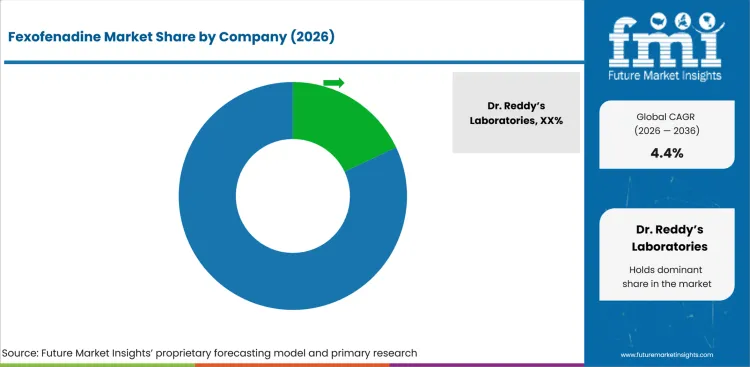
Dr. Reddy’s Laboratories and Morepen Laboratories lead API evidence. Aurobindo Pharma, Sun Pharmaceutical Industries and Hetero Drugs add integrated supply depth.
- API specialists compete through public fexofenadine API evidence and clear release documents.
- Integrated generic companies gain account access through regulated finished-dose activity.
- Regional formulation firms stay relevant when local medicine records support supplier screening.
- Buyers assess impurity control and documentation speed before awarding repeat API orders.
Competition is concentrated around evidence that buyers can verify before qualification. Dr. Reddy’s Laboratories and Morepen Laboratories provide direct public API listings for fexofenadine hydrochloride. This gives procurement teams a clearer starting point for supplier screening.
Integrated generic manufacturers add another competitive layer through finished-dose portfolios. Aurobindo Pharma reported final U.S. FDA approval for fexofenadine and pseudoephedrine extended-release tablets in August 2025. That activity can reinforce internal demand and partner sourcing needs.
Supplier selection is expected to favor companies that reduce review work for buyers. Release data and impurity control matter alongside price. Firms with fast documentation support should hold account access more easily.
How do top fexofenadine companies compare?
| Company | Regulatory Filing Depth | Fexofenadine Evidence | Oral Dose-Form Portfolio | Channel Reach | Geographic Footprint |
|---|---|---|---|---|---|
| Dr. Reddy’s Laboratories | Very Strong | Very Strong | Strong | Very Strong | Global |
| Morepen Laboratories | Strong | Very Strong | Moderate | Strong | India and export markets |
| Aurobindo Pharma | Very Strong | Strong | Very Strong | Very Strong | Global |
| Sun Pharmaceutical Industries | Strong | Moderate | Very Strong | Very Strong | Global |
| Hetero Drugs | Strong | Moderate | Strong | Strong | India and export markets |
| Lupin | Strong | Moderate | Strong | Strong | Global |
| Alembic Pharmaceuticals | Strong | Moderate | Strong | Strong | India and regulated export markets |
| Jichuan Pharmaceutical Group | Moderate | Strong | Strong | Strong | China |
| Hanmi Pharmaceutical | Strong | Moderate | Strong | Strong | South Korea |
| Viatris | Strong | Moderate | Strong | Very Strong | Global |
Source: Future Market Insights competitive analysis, 2026.
Who are the main companies in the fexofenadine market?
Dr. Reddy’s Laboratories and Morepen Laboratories are listed with Aurobindo Pharma. Sun Pharmaceutical Industries and Hetero add integrated supply depth.
Key global companies active in the fexofenadine market include:
- Dr. Reddy’s Laboratories
- Morepen Laboratories
- Aurobindo Pharma
- Sun Pharmaceutical Industries
- Hetero Drugs
- Lupin
- Alembic Pharmaceuticals
- Jichuan Pharmaceutical Group
- Hanmi Pharmaceutical
- Viatris
Key Developments in Fexofenadine Market
- In November 2024, Indian Pharmacopoeia Commission issued a draft proposal for fexofenadine and montelukast tablets. The proposal showed standards attention around fexofenadine combinations.
- In August 2025, Aurobindo Pharma reported final U.S. FDA approval for fexofenadine hydrochloride and pseudoephedrine hydrochloride extended-release tablets during Q1 FY26.
Key Players in the Fexofenadine Market
API-Focused Suppliers
- Dr. Reddy’s Laboratories
- Morepen Laboratories
- Valence Labs
- Manus Aktteva Biopharma
- Hetero Drugs
Integrated Generic Companies
- Aurobindo Pharma
- Sun Pharmaceutical Industries
- Lupin
- Alembic Pharmaceuticals
- Viatris
Regional Finished-Dose Companies
- Jichuan Pharmaceutical Group
- Hanmi Pharmaceutical
- Biogaran
- Hexal
- Towa Pharmaceutical
Fexofenadine Market - Report Scope
| Parameter | Details |
|---|---|
| Forecast period | 2026 to 2036 |
| Historical period | 2021 to 2025 |
| Quantitative unit | Revenue in USD million |
| By form | Powder, crystalline |
| By purity grade | ≥99.5%, 98.0%-99.5%, <98% |
| By application | Allergic Rhinitis, Chronic Urticaria |
| By sales channel | Direct, distributors, online/API marketplaces |
| Regions covered | North America, Latin America, Europe, East Asia, South Asia and Pacific, Middle East and Africa |
| Countries covered | United States, United Kingdom, Germany, France, Japan, China, South Korea, India |
| Key companies profiled | Dr. Reddy’s Laboratories, Morepen Laboratories, Aurobindo Pharma, Sun Pharmaceutical Industries, Hetero Drugs |
| Approach | Bottom-up API consumption approach using dosage-form demand, quality-file review, country readiness, and supplier evidence |
Source: Future Market Insights, 2026.
Fexofenadine Market - Scope & Definition
| Attribute | Detail |
|---|---|
| Market Definition | Commercially traded fexofenadine hydrochloride API used in oral antihistamine products for allergic rhinitis and chronic urticaria. |
| Functions Covered | Active ingredient supply, tablet formulation support, impurity control, dissolution performance, regulated dossier support |
| Applications Covered | Allergic Rhinitis, Chronic Urticaria |
| End-Use Industries | Generic drug manufacturing, pharmaceutical formulation, API distribution, regulated medicine supply |
| Grades Covered | ≥99.5%, 98.0%-99.5%, <98% purity grades |
| Inclusions | Powder and crystalline fexofenadine hydrochloride API sold through direct channels, distributors, and online/API marketplaces |
| Exclusions | Finished retail tablets, pseudoephedrine API sold separately, non-fexofenadine antihistamines, excipients, packaging, diagnostics |
Fexofenadine Market - Research Methodology
| Method | Description |
|---|---|
| Primary Research | FMI analyst interviews with API suppliers, formulation firms, distributors, and quality teams across selected markets. |
| Desk Research | Review of FDA guidance, DailyMed labels, national regulator records, pharmacopoeial references, company portfolios, and approval data. |
| Market Sizing & Forecasting | Bottom-up API consumption approach using oral dosage demand, application mix, supplier qualification, and country-level manufacturing signals. |
| Data Validation | Cross-verification using regulator evidence, buyer qualification patterns, public company records, and regional demand checks. |
Fexofenadine Market Breakdown by Core Segments and Region
Fexofenadine Market Segmented by Form:
- Powder
- Crystalline
Fexofenadine Market Segmented by Purity Grade:
- ≥99.5%
- 98.0%-99.5%
- <98%
Fexofenadine Market Segmented by Application:
- Allergic Rhinitis
- Chronic Urticaria
Fexofenadine Market Segmented by Sales Channel:
- Direct
- Distributors
- Online/API Marketplaces
Fexofenadine Market by Region:
- North America
- Latin America
- Europe
- East Asia
- South Asia and Pacific
- Middle East and Africa
Research Sources and Bibliography
- Centers for Disease Control and Prevention. (2026, January 8). Diagnosed allergic conditions in adults: United States, 2024. National Center for Health Statistics.
- U.S. Food and Drug Administration. (2024, October). Draft guidance on fexofenadine hydrochloride tablets. U.S. Food and Drug Administration.
- National Library of Medicine. (2026, May 5). DailyMed: Fexofenadine hydrochloride tablet, film coated. DailyMed.
- United Kingdom Health Security Agency. (2025, August 7). Hay fever and airborne allergens. GOV.UK.
- National Health Service. (2025). How and when to take fexofenadine. NHS.
- Medicines and Healthcare products Regulatory Agency. (2026). Products: Fexofenadine hydrochloride 180 mg film-coated tablets. MHRA.
- Bundesministerium für Gesundheit. (2024, October 17). Allergies: Prevention and treatment. gesund.bund.de.
- Bundesministerium für Gesundheit. (2024, May 27). Hay fever: Diagnosis, treatment, and therapy. gesund.bund.de.
- European Directorate for the Quality of Medicines & HealthCare. (2026, April 24). Certification of suitability to the monographs of the European Pharmacopoeia. EDQM.
- Agence nationale de sécurité du médicament et des produits de santé. (2024, October 21). Répertoire des médicaments génériques. ANSM.
- Haute Autorité de Santé. (2024, October 23). Fexofenadine Viatris Santé: Rhinite allergique saisonnière et urticaire idiopathique chronique. HAS.
- Base de données publique des médicaments. (2026, June 1). FEXOFENADINE BIOGARAN 180 mg, comprimé pelliculé. Ministère de la Santé.
- Ministry of Agriculture, Forestry and Fisheries. (2025). Annual Report on Forest and Forestry in Japan. Government of Japan.
- Pharmaceuticals and Medical Devices Agency. (2026, April). List of approved products. PMDA.
- Jichuan Pharmaceutical Group. (2024, June 20). Announcement on a subsidiary obtaining drug registration certificates. Shanghai Stock Exchange.
- National Healthcare Security Administration. (2024, July 12). 2024 National Medical Insurance Drug Catalogue adjustment application materials. Government of China.
- Ministry of Food and Drug Safety. (2025, April 28). 2024 Drug Approval Report. MFDS.
- Ministry of Food and Drug Safety. (2026). About pharmaceutical approvals and ingredients. MFDS.
- Indian Pharmacopoeia Commission. (2024, November 8). Draft proposal for fexofenadine and montelukast tablets. Indian Pharmacopoeia Commission.
- Aurobindo Pharma. (2025, August 4). Q1 FY26 results press release. Aurobindo Pharma.
- United States Pharmacopeia. (2024, April 26). Fexofenadine hydrochloride tablets revision bulletin. USP.
- Morepen Laboratories. (2026). Active pharmaceutical ingredients. Morepen Laboratories.
- Dr. Reddy’s Laboratories. (2026). Fexofenadine hydrochloride API manufacturer and supplier. Dr. Reddy’s Laboratories.
- U.S. Food and Drug Administration. (2025, November 24). Generic Drugs Program Activities Report: FY 2025 Monthly Performance. U.S. Food and Drug Administration.
- U.S. Food and Drug Administration. (2025, October 3). FDA announces new ANDA prioritization pilot to support U.S. generic drug manufacturing and testing. U.S. Food and Drug Administration.
This bibliography is provided for reader reference and is not exhaustive. The full report contains the complete reference list and detailed citations.
This Report Answers
- Market size estimates for 2026 and forecasts through 2036 for the fexofenadine market.
- Insights across regional and country-level markets for fexofenadine API demand.
- Analysis of demand drivers, buyer qualification patterns, purity-grade needs, and sourcing behavior.
- Evaluation of form and purity-grade preferences across regulated tablet manufacturing.
- Assessment of source verification, bioequivalence guidance, and pharmacopoeial expectations.
- Identification of growth opportunities across API grades, sales channels, and country supply corridors.
- Evaluation of competitive positioning across API suppliers and integrated generic companies.
- Country-level growth analysis covering the United States, United Kingdom, Germany, France, Japan, China, South Korea, and India.
- Assessment of company evidence and market participation across fexofenadine API and finished-dose products.
- Delivery of market data, forecasts, and supporting analysis in report format.
Frequently Asked Questions
What is the growth prospect for fexofenadine?
Demand for fexofenadine API is expected to rise steadily with allergy tablets and regulated generic filings keeping repeat sourcing active.
Which companies are expected to shape the fexofenadine market?
Dr. Reddy’s Laboratories, Morepen Laboratories, Aurobindo Pharma, Sun Pharmaceutical Industries, and Hetero Drugs are expected to shape supplier competition.
Why do pharmaceutical companies buy higher-purity fexofenadine API?
Pharmaceutical companies buy higher-purity API to reduce impurity risk and make regulated tablet filings easier to support.
Why are direct channels important in the fexofenadine market?
Direct channels support audits and quality-file review before regulated commercial supply begins.
Which product formats are gaining attention in fexofenadine API sourcing?
Powder API gains attention due to oral solid-dose plants needing predictable blending and release behavior.
How do regulations influence fexofenadine API launches?
Regulations influence launches through bioequivalence expectations and product-file review in regulated markets.
Why is documentation important for fexofenadine suppliers?
Documentation is important due to buyer need for release data and batch history before supplier acceptance.
What role does India play in the fexofenadine market?
India plays a supply role through API manufacturing depth and export-market regulated product activity.
How do online/API marketplaces support fexofenadine sourcing?
Online/API marketplaces support initial supplier discovery before buyers move to direct audits and file review.
Preview the report firsthand - request a free sample
Get SampleGet the brochure for pricing and purchase details.
Get PDFTable of Content
- Key Takeaways
- Market Size and CAGR
- Top Growth Driver
- Fastest Growing Segment
- Leading Region
- Key Companies
- Emerging Opportunities
- Executive Summary
- Global Market Outlook
- Demand-side Trends
- Supply-side Trends
- Technology Roadmap Analysis
- Analysis and Recommendations
- Analyst Perspective (What is happening? Why now? What should investors know?)
- Key Questions Answered
- How large is the market?
- What is the CAGR?
- What are key trends?
- Which region dominates?
- Who are the leaders?
- Market Overview
- Market Coverage / Taxonomy
- Market Definition / Scope / Limitations
- Research Methodology
- Chapter Orientation
- Analytical Lens and Working Hypotheses
- Market Structure, Signals, and Trend Drivers
- Benchmarking and Cross-market Comparability
- Market Sizing, Forecasting, and Opportunity Mapping
- Research Design and Evidence Framework
- Desk Research Programme (Secondary Evidence)
- Expert Input and Fieldwork (Primary Evidence)
- Tooling, Models, and Reference Databases
- Data Engineering and Model Build
- Quality Assurance and Audit Trail
- Market Background
- Market Dynamics (Drivers, Restraints, Opportunity, Trends)
- Scenario Forecast (Optimistic, Likely, Conservative)
- Impact Analysis
- AI Impact
- Sustainability Impact
- Regulatory Impact
- Technology Impact
- Consumer / Buyer Analysis
- Purchase Drivers
- Adoption Barriers
- Buyer Journey
- Opportunity Map Analysis
- Product Life Cycle Analysis
- Supply Chain Analysis
- Investment Feasibility Matrix
- Value Chain Analysis
- PESTLE and Porter's Analysis
- Regulatory Landscape
- Regional Parent Market Outlook
- Production and Consumption Statistics
- Import and Export Statistics
- Global Market Analysis and Forecast, 2021 to 2036
- Historical Market Size Value (USD Million) Analysis, 2021 to 2025
- Current and Future Market Size Value (USD Million) Projections, 2026 to 2036
- Y-o-Y Growth Trend Analysis
- Absolute $ Opportunity Analysis
- Global Market Pricing Analysis, 2021 to 2036
- Global Market Analysis and Forecast, By Form, 2021 to 2036
- Introduction / Key Findings
- Historical Market Size Value (USD Million) Analysis By Form, 2021 to 2025
- Current and Future Market Size Value (USD Million) Analysis and Forecast By Form, 2026 to 2036
- Powder
- Crystalline
- Powder
- Y-o-Y Growth Trend Analysis By Form, 2021 to 2025
- Absolute $ Opportunity Analysis By Form, 2026 to 2036
- Global Market Analysis and Forecast, By Purity Grade, 2021 to 2036
- Introduction / Key Findings
- Historical Market Size Value (USD Million) Analysis By Purity Grade, 2021 to 2025
- Current and Future Market Size Value (USD Million) Analysis and Forecast By Purity Grade, 2026 to 2036
- ≥99.5%
- 98.0%–99.5%
- <98%
- ≥99.5%
- Y-o-Y Growth Trend Analysis By Purity Grade, 2021 to 2025
- Absolute $ Opportunity Analysis By Purity Grade, 2026 to 2036
- Global Market Analysis and Forecast, By Application, 2021 to 2036
- Introduction / Key Findings
- Historical Market Size Value (USD Million) Analysis By Application, 2021 to 2025
- Current and Future Market Size Value (USD Million) Analysis and Forecast By Application, 2026 to 2036
- Allergic Rhinitis
- Chronic Urticaria
- Allergic Rhinitis
- Y-o-Y Growth Trend Analysis By Application, 2021 to 2025
- Absolute $ Opportunity Analysis By Application, 2026 to 2036
- Global Market Analysis and Forecast, By Sales Channel, 2021 to 2036
- Introduction / Key Findings
- Historical Market Size Value (USD Million) Analysis By Sales Channel, 2021 to 2025
- Current and Future Market Size Value (USD Million) Analysis and Forecast By Sales Channel, 2026 to 2036
- Direct
- Distributors
- Online/API Marketplaces
- Direct
- Y-o-Y Growth Trend Analysis By Sales Channel, 2021 to 2025
- Absolute $ Opportunity Analysis By Sales Channel, 2026 to 2036
- Global Market Analysis and Forecast, By Region, 2021 to 2036
- Introduction
- Historical Market Size Value (USD Million) Analysis By Region, 2021 to 2025
- Current Market Size Value (USD Million) Analysis and Forecast By Region, 2026 to 2036
- North America
- Latin America
- Western Europe
- Eastern Europe
- East Asia
- South Asia and Pacific
- Middle East & Africa
- Market Attractiveness Analysis By Region
- North America Market Analysis and Forecast, By Country, 2021 to 2036
- Historical Market Size Value (USD Million) Trend Analysis By Market Taxonomy, 2021 to 2025
- Market Size Value (USD Million) Forecast By Market Taxonomy, 2026 to 2036
- By Country
- USA
- Canada
- Mexico
- By Form
- By Purity Grade
- By Application
- By Sales Channel
- By Country
- Market Attractiveness Analysis
- By Country
- By Form
- By Purity Grade
- By Application
- By Sales Channel
- Key Takeaways
- Latin America Market Analysis and Forecast, By Country
- Historical Market Size Value (USD Million) Trend Analysis By Market Taxonomy, 2021 to 2025
- Market Size Value (USD Million) Forecast By Market Taxonomy, 2026 to 2036
- By Country
- Brazil
- Chile
- Rest of Latin America
- By Form
- By Purity Grade
- By Application
- By Sales Channel
- By Country
- Market Attractiveness Analysis
- By Country
- By Form
- By Purity Grade
- By Application
- By Sales Channel
- Key Takeaways
- Western Europe Market Analysis and Forecast, By Country
- Historical Market Size Value (USD Million) Trend Analysis By Market Taxonomy, 2021 to 2025
- Market Size Value (USD Million) Forecast By Market Taxonomy, 2026 to 2036
- By Country
- Germany
- UK
- Italy
- Spain
- France
- Nordic
- BENELUX
- Rest of Western Europe
- By Form
- By Purity Grade
- By Application
- By Sales Channel
- By Country
- Market Attractiveness Analysis
- By Country
- By Form
- By Purity Grade
- By Application
- By Sales Channel
- Key Takeaways
- Eastern Europe Market Analysis and Forecast, By Country
- Historical Market Size Value (USD Million) Trend Analysis By Market Taxonomy, 2021 to 2025
- Market Size Value (USD Million) Forecast By Market Taxonomy, 2026 to 2036
- By Country
- Russia
- Poland
- Hungary
- Balkan & Baltic
- Rest of Eastern Europe
- By Form
- By Purity Grade
- By Application
- By Sales Channel
- By Country
- Market Attractiveness Analysis
- By Country
- By Form
- By Purity Grade
- By Application
- By Sales Channel
- Key Takeaways
- East Asia Market Analysis and Forecast, By Country
- Historical Market Size Value (USD Million) Trend Analysis By Market Taxonomy, 2021 to 2025
- Market Size Value (USD Million) Forecast By Market Taxonomy, 2026 to 2036
- By Country
- China
- Japan
- South Korea
- By Form
- By Purity Grade
- By Application
- By Sales Channel
- By Country
- Market Attractiveness Analysis
- By Country
- By Form
- By Purity Grade
- By Application
- By Sales Channel
- Key Takeaways
- South Asia and Pacific Market Analysis and Forecast, By Country
- Historical Market Size Value (USD Million) Trend Analysis By Market Taxonomy, 2021 to 2025
- Market Size Value (USD Million) Forecast By Market Taxonomy, 2026 to 2036
- By Country
- India
- ASEAN
- Australia & New Zealand
- Rest of South Asia and Pacific
- By Form
- By Purity Grade
- By Application
- By Sales Channel
- By Country
- Market Attractiveness Analysis
- By Country
- By Form
- By Purity Grade
- By Application
- By Sales Channel
- Key Takeaways
- Middle East & Africa Market Analysis and Forecast, By Country
- Historical Market Size Value (USD Million) Trend Analysis By Market Taxonomy, 2021 to 2025
- Market Size Value (USD Million) Forecast By Market Taxonomy, 2026 to 2036
- By Country
- Kingdom of Saudi Arabia
- Other GCC Countries
- Türkiye
- South Africa
- Other African Union
- Rest of Middle East & Africa
- By Form
- By Purity Grade
- By Application
- By Sales Channel
- By Country
- Market Attractiveness Analysis
- By Country
- By Form
- By Purity Grade
- By Application
- By Sales Channel
- Key Takeaways
- Key Countries Market Analysis
- USA
- Pricing Analysis
- Market Share Analysis, 2025
- By Form
- By Purity Grade
- By Application
- By Sales Channel
- Canada
- Pricing Analysis
- Market Share Analysis, 2025
- By Form
- By Purity Grade
- By Application
- By Sales Channel
- Mexico
- Pricing Analysis
- Market Share Analysis, 2025
- By Form
- By Purity Grade
- By Application
- By Sales Channel
- Brazil
- Pricing Analysis
- Market Share Analysis, 2025
- By Form
- By Purity Grade
- By Application
- By Sales Channel
- Chile
- Pricing Analysis
- Market Share Analysis, 2025
- By Form
- By Purity Grade
- By Application
- By Sales Channel
- Germany
- Pricing Analysis
- Market Share Analysis, 2025
- By Form
- By Purity Grade
- By Application
- By Sales Channel
- UK
- Pricing Analysis
- Market Share Analysis, 2025
- By Form
- By Purity Grade
- By Application
- By Sales Channel
- Italy
- Pricing Analysis
- Market Share Analysis, 2025
- By Form
- By Purity Grade
- By Application
- By Sales Channel
- Spain
- Pricing Analysis
- Market Share Analysis, 2025
- By Form
- By Purity Grade
- By Application
- By Sales Channel
- France
- Pricing Analysis
- Market Share Analysis, 2025
- By Form
- By Purity Grade
- By Application
- By Sales Channel
- India
- Pricing Analysis
- Market Share Analysis, 2025
- By Form
- By Purity Grade
- By Application
- By Sales Channel
- ASEAN
- Pricing Analysis
- Market Share Analysis, 2025
- By Form
- By Purity Grade
- By Application
- By Sales Channel
- Australia & New Zealand
- Pricing Analysis
- Market Share Analysis, 2025
- By Form
- By Purity Grade
- By Application
- By Sales Channel
- China
- Pricing Analysis
- Market Share Analysis, 2025
- By Form
- By Purity Grade
- By Application
- By Sales Channel
- Japan
- Pricing Analysis
- Market Share Analysis, 2025
- By Form
- By Purity Grade
- By Application
- By Sales Channel
- South Korea
- Pricing Analysis
- Market Share Analysis, 2025
- By Form
- By Purity Grade
- By Application
- By Sales Channel
- Russia
- Pricing Analysis
- Market Share Analysis, 2025
- By Form
- By Purity Grade
- By Application
- By Sales Channel
- Poland
- Pricing Analysis
- Market Share Analysis, 2025
- By Form
- By Purity Grade
- By Application
- By Sales Channel
- Hungary
- Pricing Analysis
- Market Share Analysis, 2025
- By Form
- By Purity Grade
- By Application
- By Sales Channel
- Kingdom of Saudi Arabia
- Pricing Analysis
- Market Share Analysis, 2025
- By Form
- By Purity Grade
- By Application
- By Sales Channel
- Türkiye
- Pricing Analysis
- Market Share Analysis, 2025
- By Form
- By Purity Grade
- By Application
- By Sales Channel
- South Africa
- Pricing Analysis
- Market Share Analysis, 2025
- By Form
- By Purity Grade
- By Application
- By Sales Channel
- USA
- Market Structure Analysis
- Competition Dashboard
- Competition Benchmarking
- Market Share Analysis of Top Players
- By Regional
- By Form
- By Purity Grade
- By Application
- By Sales Channel
- Emerging Startups
- Innovation Benchmarking
- Competition Analysis
- Competition Deep Dive
- Dr. Reddy’s Laboratories
- Overview
- Product Portfolio
- Profitability by Market Segments (Product/Region/Sales Channel)
- Sales Footprint
- Strategy Overview
- Marketing Strategy
- Product Strategy
- Channel Strategy
- Morepen Laboratories
- Aurobindo Pharma
- Sun Pharmaceutical Industries
- Hetero Drugs
- Lupin
- Alembic Pharmaceuticals
- Dr. Reddy’s Laboratories
- Case Studies
- Success Stories
- Recent Developments
- Competition Deep Dive
- Assumptions & Acronyms Used


