

- Market Size (2026)
- USD 8.6 Bn
- Forecast (2036)
- USD 28.9 Bn
- CAGR (2026 to 2036)
- 12.9%
How big is the BCMA Targeted Therapies Market in 2026?
USD 8.6 billion in 2026 and USD 28.9 billion by 2036 at a 12.9% CAGR.
Demand for BCMA targeted therapies is projected to expand at 12.9% CAGR between 2026 and 2036, increasing valuation from USD 8.6 billion in 2026 to USD 28.9 billion by 2036. Earlier-line approvals and additional targeted oncology biologics widen treatment choices across relapsed or refractory multiple myeloma.
Relapse generates recurring treatment decisions across successive lines, so eligible demand depends on continuing patient flow rather than one approval cycle. The National Cancer Institute estimated 36,110 new United States multiple myeloma cases during 2025. Each diagnosis can progress through several blood cancer treatment regimens that require different specialist infrastructure.
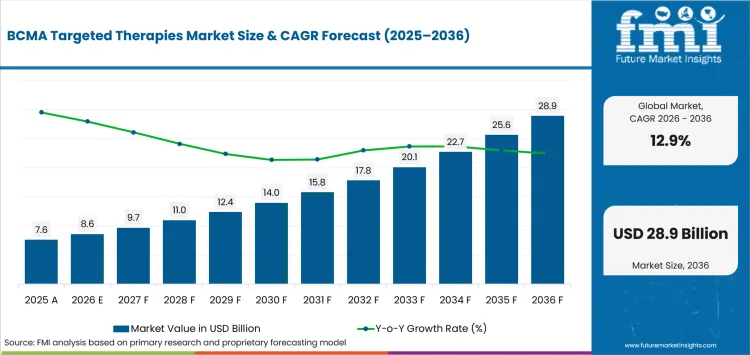
Key Takeaways of BCMA Targeted Therapies Market
- Earlier-line approvals and additional BCMA modalities widen treatment pathways for patients with relapsed or refractory multiple myeloma.
- BCMA CAR-T cell therapies are projected to hold 47.0% of product revenue in 2026 owing to established autologous pathways.
- Multiple myeloma is estimated to represent 82.0% by application in 2026 due to concentrated approved indications.
- Hospitals are forecast to capture 49.0% of end-user revenue in 2026 attributable to integrated administration and specialist toxicity management.
- Manufacturing delays and intensive monitoring restrict treatment access outside experienced hematology centers with adequate specialist capacity.
- Johnson & Johnson, Bristol Myers Squibb, GSK plc, Pfizer Inc., AbbVie Inc., Regeneron Pharmaceuticals, Inc., Legend Biotech Corporation and Gilead Sciences, Inc. are some notable companies.
Analyst Perspective
"BCMA portfolio value depends on matching treatment urgency with delivery mechanics across patient-specific CAR-T products and stocked antibodies. Companies that shorten referral-to-dose time without shifting monitoring risk onto underprepared hospitals are better positioned to earn repeat formulary use."
- Anurag Sharma, Principal Consultant, Future Market Insights
How is the BCMA Targeted Therapies Market segmented?
The BCMA targeted therapies industry is segmented by product, application, end user, distribution channel, therapy type and region.
The BCMA therapies market is segmented by product, application, end user, distribution channel, therapy type and region. Product covers CAR-T cell therapies, monoclonal antibodies, bispecific antibodies and antibody drug conjugates while application includes multiple myeloma, plasma-cell disorders, B-cell malignancies and clinical research. End users include hospitals, cancer centers, cell therapy centers and research institutes while distribution channels cover hospital pharmacies, specialty pharmacies, direct supply and specialty distribution networks. Therapy types include cell therapy, antibody therapy, antibody drug conjugate therapy and combination therapy across treatment mechanisms.
How does BCMA CAR-T cell therapy shape demand within the product category?
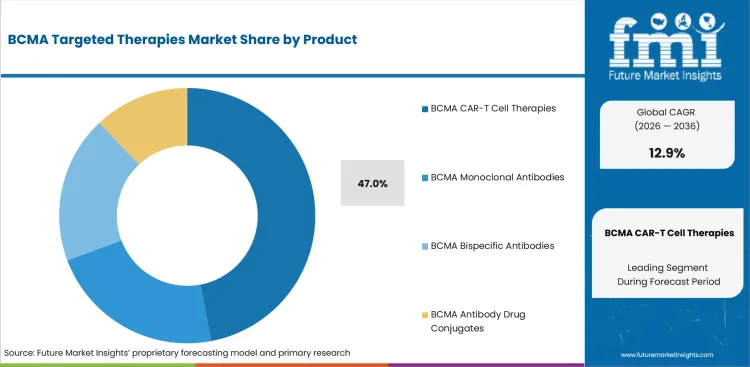
BCMA CAR-T cell therapy links patient collection with one-time infusion through centers that manage manufacturing release and acute toxicity. Referral must start early enough for lymphodepletion while the patient remains clinically fit for cellular treatment.
- BCMA CAR-T cell therapies are set to lead the product category with 47.0% share in 2026 due to established one-infusion treatment pathways.
- Autologous programs can deliver deep responses but individualized production extends scheduling and bridging requirements across specialist referral pathways. Allogeneic programs offer planned supply but need stronger evidence on durability and immune control before hospitals broaden routine clinical use.
What makes multiple myeloma central to the application category?
Multiple myeloma anchors commercial use as current BCMA approvals concentrate on relapsed or refractory plasma-cell disease. Stocked bispecific antibody regimens widen selection but require documented treatment history and planned step-up dosing.
- By application, multiple myeloma is estimated to hold 82.0% in 2026 owing to concentrated approved indications across relapsed disease.
- Stocked modalities suit patients whose treatment history supports antibody drug conjugate treatment within supervised hospital programs that manage scheduled infusions. FDA approved belantamab mafodotin combinations in October 2025 following two prior treatment lines, but ocular monitoring and REMS procedures require trained teams within experienced hospitals.
What role do hospitals play within the end-user category?
Hospitals combine hematology oversight with pharmacy preparation and emergency support inside one coordinated treatment pathway. FDA's July 2025 linvoseltamab snapshot requires twenty-four-hour hospitalization during initial step-up dosing in facilities prepared for toxicity management and advanced therapy medicinal products handling.
- Hospitals are likely to capture 49.0% share in 2026 attributable to integrated administration and specialist management of acute adverse events.
- Regional referral networks widen access but travel distance and limited beds can delay treatment for eligible patients outside metropolitan centers. Hospital scheduling determines whether step-up dosing begins during a clinically suitable treatment window for each patient.
How do hospital pharmacies influence the distribution channel category?
Hospital pharmacies coordinate ordering and supportive medicines through institutional protocols instead of routine retail dispensing. Modern cell therapy manufacturing requires pharmacy teams to align treatment schedules with chain-of-identity records and controlled product handoffs.
- The distribution channel is forecast to be led by hospital pharmacies at 48.0% share in 2026 due to centralized ordering and preparation requirements.
- Inpatient pharmacists manage inventory and preparation for repeat antibody dosing across scheduled treatment cycles within controlled oncology protocols. Cellular products add patient-matched custody controls that extend pharmacy responsibility from receipt through documented administration and final reconciliation across hospital systems.
What are the drivers, restraints and opportunities in the BCMA Targeted Therapies Market?
Earlier-line approvals widen eligible pathways despite manufacturing constraints, while stocked modalities support additional treatment sequences.
- Driver: Earlier-line approvals shift referral toward first relapse and preserve options for clinically fit patients.
- Restraint: Manufacturing lead times and intensive toxicity management reduce feasibility across qualified specialist referral networks.
- Opportunity: Stocked antibodies and faster cellular production serve patients unable to wait through individualized manufacturing.
Earlier-line eligibility changes referral timing as repeated regimens can reduce patient fitness for intensive treatment. Community oncologists need access to next-generation immunotherapies and qualified centers once specialists confirm disease progression.
CAR-T delivery depends on specific patient condition throughout manufacturing and release across individualized treatment pathways. Bispecific antibodies require step-up dosing and surveillance through teams familiar with hematopoietic stem cell transplantation.
Stocked antibodies shorten treatment delays for patients unable to wait through personalized cellular production schedules. Clinical trials test earlier sequencing and retreatment following prior BCMA exposure under defined monitoring protocols.
Which country CAGRs are profiled in the BCMA Targeted Therapies Market?
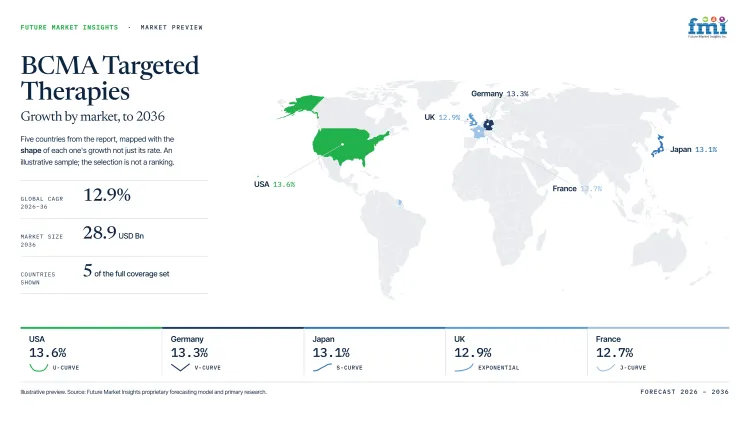
| Country | CAGR |
|---|---|
| USA | 13.6% |
| Germany | 13.3% |
| Japan | 13.1% |
| United Kingdom | 12.9% |
| France | 12.7% |
How do country-level CAGRs compare in the BCMA Targeted Therapies Market?
The displayed country CAGRs span 0.9 percentage point across five distinct national regulatory access systems. The spacing describes forecast pace and does not directly measure current market size or treatment availability.
- The USA combines broad modality choice with uneven payer authorization and treatment-center capacity across regional networks.
- Germany pairs advanced hematology centers with formal benefit assessment shaping reimbursement timing for each therapy.
- Japan relies on national approval and post-marketing controls that concentrate treatment within experienced tertiary hospitals.
- The United Kingdom connects regulator authorization with NICE assessment and NHS implementation through hematology services.
- France uses reimbursement opinions and hospital funding decisions to convert regulatory access into treatment availability.
Comparable CAGRs can produce different market entry conditions. The full report provides country-level CAGR analysis across North America, Latin America, Europe, East Asia, South Asia and Pacific, and the Middle East and Africa.
Country-wise Analysis
- United States treatment networks combine approved CAR-T products with stocked antibodies across hospitals coordinating apheresis and step-up dosing through academic and community referral systems with emergency support for distant patients across broad regions. The United States is estimated to post 13.6% CAGR over the forecast period, supported by broad modality choice and hematology infrastructure that can manage cellular manufacturing alongside repeated antibody dosing across established pathways. FDA eliminated REMS certification and onsite tocilizumab requirements for approved autologous CAR-T products in June 2025, although payer authorization and uneven center capacity continue delaying timely treatment outside major metropolitan networks across the country.
- Germany's Federal Joint Committee expanded ciltacabtagene autoleucel eligibility following one prior therapy in May 2025 through statutory insurance pathways that retain formal benefit review and qualified-center requirements across regional hematology networks throughout the country. The German BCMA targeted therapies sector is projected to record 13.3% CAGR during the assessment period, reinforced by experienced university hospitals and reimbursement routes that can support cellular and stocked antibody treatment pathways. Separate evidence review and negotiated funding can delay availability beyond qualified centers for patients who depend on regional referrals, scheduled manufacturing capacity and travel to major urban hematology programs across Germany's national network.
- Japanese BCMA treatment routes rely on tertiary hospitals coordinating national approvals with imported biologics and ophthalmology support through post-marketing controls and specialist referrals across metropolitan networks serving relapsed multiple myeloma patients throughout the country. BCMA targeted therapies demand in Japan is forecast to rise at 13.1% CAGR over the forecast period, shaped by experienced centers and additional antibody choices within nationally regulated hospital pathways for eligible patients. Japan's health ministry approved belantamab mafodotin in May 2025 with emergency-capable facility and specialist eye-examination requirements, limiting practical access for patients who live beyond established urban treatment centers and regional referral corridors nationwide.
- NICE recommended elranatamab through managed access in December 2024 following three prior treatments and linked NHS use with formal evidence collection through specialist hematology centers across England within commissioned regional referral systems nationwide. The United Kingdom's BCMA targeted therapies outlook is anticipated to advance at 12.9% CAGR over the assessment period, influenced by centralized assessment and nationally commissioned funding for complex specialist hospital treatment pathways nationwide. Limited specialist capacity and continuing evidence duties can slow implementation as repeated dosing requires trained teams, coordinated scheduling and reliable travel access for patients outside established treatment hubs across regional NHS services and communities.
- French BCMA treatment access combines national reimbursement assessment with hospital funding through hematology centers that manage cellular products, monitored antibody regimens and regional referrals for patients with relapsed multiple myeloma across the national system. BCMA targeted therapy sales in France are forecast to expand at 12.7% CAGR by 2036, driven by favorable assessment and earlier-line eligibility across established regional cellular therapy centers within the national hospital system. Haute Autorité de Santé issued a favorable reimbursement opinion for ciltacabtagene autoleucel in August 2025, but hospital budgets and qualified-center capacity continue shaping availability beyond major urban treatment hubs and regional referral routes.
Who are the notable companies in the BCMA Targeted Therapies Market?
Johnson & Johnson, Bristol Myers Squibb, GSK plc, Pfizer Inc., AbbVie Inc., Regeneron Pharmaceuticals, Inc., Legend Biotech Corporation and Gilead Sciences, Inc. are the notable companies serving this market.
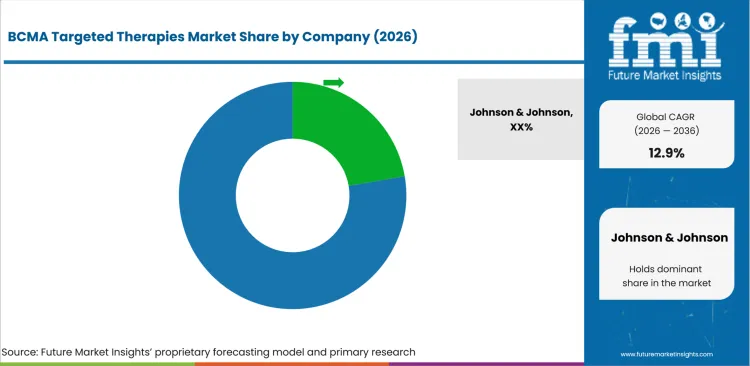
Competition is concentrated among companies controlling cellular and antibody therapy platforms for relapsed multiple myeloma. Rivalry centers on treatment-line access and reliable delivery across therapies with different dosing and monitoring demands.
- Johnson & Johnson and Legend Biotech commercialize CARVYKTI across earlier-line cellular pathways, while Johnson & Johnson supplies TECVAYLI through approved bispecific programs.
- Bristol Myers Squibb supplies ABECMA through one-time autologous pathways, while GSK manages BLENREP through ocular monitoring requirements. Pfizer and Regeneron provide stocked bispecific antibodies through recurring dosing schedules for patients with relapsed disease.
- AbbVie advances etentamig through Phase III development, while Gilead controls anito-cel through Kite cell-therapy operations.
Competitive Benchmarking: BCMA Targeted Therapies Market
| Company | Approved BCMA Portfolio | Clinical Maturity | Modality Breadth | Geographic Reach |
|---|---|---|---|---|
| Johnson & Johnson | High | High | High | USA, Europe and Japan |
| Bristol Myers Squibb | Medium | High | Low | USA, Europe and Japan |
| GSK plc | Medium | High | Low | USA and Japan |
| Pfizer Inc. | Medium | High | Low | Global |
| AbbVie Inc. | Low | Medium | Low | Global Phase III study |
| Regeneron Pharmaceuticals, Inc. | Medium | High | Low | USA and Europe |
| Legend Biotech Corporation | Medium | High | Low | USA, Europe and Japan |
| Gilead Sciences, Inc. | Low | Medium | Low | United States filing and global development |
Key Developments in the BCMA Targeted Therapies Market
- In June 2026, AbbVie Inc. presented etentamig data from BCMA-exposed patients with relapsed or refractory multiple myeloma during the EHA congress.
- In April 2026, Pfizer Inc. reported positive Phase III progression-free survival results for ELREXFIO among double-class exposed relapsed or refractory multiple myeloma patients.
- In March 2026, Johnson & Johnson received FDA approval for TECVAYLI plus DARZALEX FASPRO following at least one prior treatment line.
Key Players in the BCMA Targeted Therapies Market
Commercial Cell and Antibody Platforms
- Johnson & Johnson
- Legend Biotech Corporation
- Bristol Myers Squibb
- GSK plc
Commercial Bispecific Antibody Platforms
- Pfizer Inc.
- Regeneron Pharmaceuticals, Inc.
Late-Stage BCMA Developers
- AbbVie Inc.
- Gilead Sciences, Inc.
BCMA Targeted Therapies Market - Report Scope
| Coverage field | Report scope |
|---|---|
| Market breakdown | Product, application, end user, distribution channel, therapy type and region. |
| Quantitative Units | Revenue in USD billion and CAGR in %. |
| Market Definition | The market covers BCMA-directed cell therapies and antibody formats used or developed across commercial and clinical treatment pathways. |
| Regions Covered | North America, Latin America, Europe, East Asia, South Asia and Pacific, and Middle East and Africa. |
| Countries Covered | USA, Germany, Japan, United Kingdom, France, and 20+ countries included in the full report. |
| Key Companies Profiled | Johnson & Johnson, Bristol Myers Squibb, GSK plc, Pfizer Inc., AbbVie Inc., Regeneron Pharmaceuticals, Inc., Legend Biotech Corporation and Gilead Sciences, Inc. |
| Forecast Period | 2026 to 2036. |
| Approach | Primary and secondary research with market triangulation. |
BCMA Targeted Therapies Market - Research Methodology
| Method | Approach |
|---|---|
| Primary Research | FMI analysts gathered input from manufacturers, service providers, technology developers, distributors, end users, procurement teams, and subject-matter experts. Interviews examined purchasing decisions, product or service evaluation, adoption barriers, approval requirements, pricing considerations, and expectations for technical or commercial support. Respondents were also asked what evidence is required before a trial, pilot, or initial order develops into regular purchasing. |
| Desk Research | Desk research covered government statistics, regulatory publications, trade data, industry associations, technical literature, standards, company filings, product information, and official corporate announcements. Sources were reviewed for relevance, publication date, geographic coverage, and consistency with the defined market scope. Claims relating to performance, applications, approvals, capacity, investment, and commercial activity were retained only when supported by credible public evidence. |
| Market Sizing and Forecasting | The market model combined the baseline value with historical performance, segment structure, pricing and volume indicators, adoption levels, company participation, and country-level demand conditions. Forecast assumptions considered economic activity, investment trends, regulatory developments, technology adoption, purchasing cycles, supply availability, and barriers to wider market use. Segment and regional estimates were reconciled before the final market total was calculated. |
| Data Validation | Estimates were checked against multiple independent indicators, including public data, company activity, trade patterns, industry developments, and findings from primary interviews. Validation also tested whether products, services, applications, and company revenues fell within the defined market boundaries. Adjacent categories, unsupported claims, overlapping revenues, and activities without direct market relevance were excluded to reduce double counting and maintain consistency across segments and countries. |
BCMA Targeted Therapies Market by Segments
BCMA Targeted Therapies Market segmented by Product:
- BCMA CAR-T Cell Therapies
- Autologous CAR-T Cell Therapy
- Allogeneic CAR-T Cell Therapy
- BCMA Monoclonal Antibodies
- Naked Monoclonal Antibodies
- Engineered Monoclonal Antibodies
- BCMA Bispecific Antibodies
- T Cell Engagers
- Natural Killer Cell Engagers
- BCMA Antibody Drug Conjugates
- Monomethyl Auristatin Conjugates
- Topoisomerase Inhibitor Conjugates
BCMA Targeted Therapies Market segmented by Application:
- Multiple Myeloma
- Relapsed Multiple Myeloma
- Refractory Multiple Myeloma
- Plasma Cell Disorders
- Smoldering Multiple Myeloma
- Plasma Cell Leukemia
- B-Cell Malignancies
- Diffuse Large B Cell Lymphoma
- B Cell Acute Lymphoblastic Leukemia
- Clinical Research
- Phase II Clinical Trials
- Phase III Clinical Trials
BCMA Targeted Therapies Market segmented by End User:
- Hospitals
- Comprehensive Cancer Hospitals
- Tertiary Care Hospitals
- Cancer Treatment Centers
- Academic Cancer Centers
- Specialty Oncology Centers
- Cell Therapy Centers
- Certified CAR-T Centers
- Advanced Immunotherapy Clinics
- Research Institutes
- Cancer Research Institutes
- University Medical Centers
BCMA Targeted Therapies Market segmented by Distribution Channel:
- Hospital Pharmacies
- Inpatient Hospital Pharmacies
- Oncology Hospital Pharmacies
- Specialty Pharmacies
- Cellular Therapy Pharmacies
- Biologic Therapy Pharmacies
- Direct Institutional Supply
- Hospital Procurement Contracts
- Group Purchasing Organizations
- Specialty Distribution Networks
- Cold Chain Logistics
- Cell Therapy Distribution Services
BCMA Targeted Therapies Market segmented by Therapy Type:
- Cell Therapy
- CAR-T Cell Therapy
- Gene Modified T Cell Therapy
- Antibody Therapy
- Bispecific Antibody Therapy
- Monoclonal Antibody Therapy
- Antibody Drug Conjugate Therapy
- Targeted Cytotoxic Therapy
- Payload Conjugate Therapy
- Combination Therapy
- Immunotherapy Combination
- Proteasome Inhibitor Combination
BCMA Targeted Therapies Market by Region:
- North America
- United States
- Canada
- Mexico
- Latin America
- Brazil
- Chile
- Rest of Latin America
- Western Europe
- Germany
- United Kingdom
- Italy
- Spain
- France
- Nordics
- Benelux
- Rest of Western Europe
- Eastern Europe
- Russia
- Poland
- Hungary
- Balkan and Baltic States
- Rest of Eastern Europe
- East Asia
- China
- Japan
- South Korea
- South Asia and Pacific
- India
- ASEAN
- Australia and New Zealand
- Rest of South Asia and Pacific
- Middle East and Africa
- Kingdom of Saudi Arabia
- Other GCC Countries
- Türkiye
- South Africa
- Other African Union Countries
- Rest of Middle East and Africa
Research Sources and Bibliography
- National Cancer Institute. (2025, April 25). Plasma Cell Neoplasms (Including Multiple Myeloma) Treatment (PDQ®)-Health Professional Version.
- USA Food and Drug Administration. (2025, October 23). FDA approves belantamab mafodotin-blmf for relapsed or refractory multiple myeloma.
- USA Food and Drug Administration. (2025, July 2). Drug Trials Snapshot: LYNOZYFIC.
- Johnson & Johnson. (2026, March 5). Johnson & Johnson Announces USA FDA Approval of TECVAYLI® plus DARZALEX FASPRO® for Relapsed/Refractory Multiple Myeloma, Offering a Potential New Standard of Care as Early as Second Line.
- USA Food and Drug Administration. (2025, June 27). FDA Eliminates Risk Evaluation and Mitigation Strategies (REMS) for Autologous Chimeric Antigen Receptor CAR T cell Immunotherapies.
- Gemeinsamer Bundesausschuss. (2025, May 15). Arzneimittel-Richtlinie/Anlage XII: Ciltacabtagen autoleucel (Neues Anwendungsgebiet / Neubewertung eines Orphan Drugs nach Überschreitung der 30 Millionen Euro-Grenze: Multiples Myelom, nach mind. 1 Vortherapie, refraktär gegenüber Lenalidomid).
- Ministry of Health, Labour and Welfare. (2025, May 19).
- National Institute for Health and Care Excellence. (2024, December 11). Elranatamab for treating relapsed and refractory multiple myeloma after 3 or more treatments.
- Haute Autorité de Santé. (2025, August 7). CARVYKTI (ciltacabtagene autoleucel) - Multiple myeloma.
- Legend Biotech Corporation. (2026, January 12). Legend Biotech Highlights Recent Business Updates at 44th Annual J.P. Morgan Healthcare Conference.
- Bristol Myers Squibb. (2025, June 26). USA Food and Drug Administration Approves Streamlined Patient Monitoring Requirements and Removal of REMS Programs within Bristol Myers Squibb’s Cell Therapy Labels.
- Pfizer Inc. (2026, April 29). Pfizer’s ELREXFIO Significantly Improves Progression-Free Survival for Double-Class Exposed Patients with Relapsed or Refractory Multiple Myeloma.
- ClinicalTrials.gov. (2026, June 16). Study Assessing Activity of Intravenous (IV) Etentamig Monotherapy Versus Standard Available Therapies in Adult Participants With Relapsed or Refractory Multiple Myeloma.
- AbbVie Inc. (2026, June 8). AbbVie Presents New Data Across Its Blood Cancer Portfolio at EHA 2026.
- GSK plc. (2026, July 1). Blenrep assigned permanent billing code, supporting timely access for patients with relapsed/refractory multiple myeloma.
- Gilead Sciences, Inc. (2026, April 28). Gilead Sciences Completes Acquisition of Arcellx Ahead of Potential Commercial Launch of Anito-cel.
- Regeneron Pharmaceuticals, Inc. (2025, July 2). Lynozyfic™ (linvoseltamab-gcpt) Receives FDA Accelerated Approval for Treatment of Relapsed or Refractory Multiple Myeloma.
This bibliography is provided for reader reference and is not exhaustive. The full report contains the complete reference list and detailed citations.
This Report Answers
- How large is the BCMA targeted therapies market in 2026 and 2036?
- Which operating conditions support demand for BCMA targeted therapies?
- Which product category accounts for the leading 2026 share?
- Why does multiple myeloma dominate application demand?
- How do hospitals and hospital pharmacies shape treatment access?
- How do country growth rates differ across the profiled markets?
- Which companies serve approved and late-stage BCMA platforms?
- What limits BCMA targeted therapy adoption across treatment pathways?
Frequently Asked Questions
How big is the BCMA targeted therapies market in 2026?
In 2026, the BCMA targeted therapies market is valued at USD 8.6 billion across cellular and antibody-based treatment routes. Earlier-line eligibility and approved modalities support the projected increase to USD 28.9 billion by 2036 through specialist centers that can manage manufacturing and monitoring requirements.
What is the CAGR of the BCMA targeted therapies market from 2026 to 2036?
The BCMA targeted therapies market is projected to expand at 12.9% CAGR from 2026 to 2036 across approved and investigational modalities. Commercial growth depends on treatment-center capacity and reliable manufacturing as each therapy requires dosing infrastructure and reimbursement approval across national access systems.
Which product is projected to account for 47.0% of the BCMA targeted therapies market?
BCMA CAR-T cell therapies are estimated to account for 47.0% of the BCMA targeted therapies market by product in 2026. Established autologous programs combine deep-response potential with one infusion but require coordinated collection and manufacturing through qualified treatment centers serving suitable patients.
Which application is projected to account for 82.0% of the BCMA targeted therapies market?
Multiple myeloma is projected to represent 82.0% of the BCMA targeted therapies market by application in 2026. Approved BCMA indications remain concentrated in relapsed or refractory plasma-cell disease and shape commercial use through documented treatment history and specialist sequencing decisions.
Which companies are active in the BCMA targeted therapies market?
Companies participating in the BCMA targeted therapies market across approved products and advanced clinical programs. Johnson & Johnson and Bristol Myers Squibb join GSK plc and Pfizer Inc. alongside AbbVie Inc. and Regeneron Pharmaceuticals plus Legend Biotech Corporation and Gilead Sciences, Inc.
Preview the report firsthand - request a free sample
Get SampleGet the brochure for pricing and purchase details.
Get PDFTable of Content
- Key Takeaways
- Market Size and CAGR
- Top Growth Driver
- Fastest Growing Segment
- Leading Region
- Key Companies
- Emerging Opportunities
- Executive Summary
- Global Market Outlook
- Demand-side Trends
- Supply-side Trends
- Technology Roadmap Analysis
- Analysis and Recommendations
- Analyst Perspective (What is happening? Why now? What should investors know?)
- Key Questions Answered
- How large is the market?
- What is the CAGR?
- What are key trends?
- Which region dominates?
- Who are the leaders?
- Market Overview
- Market Coverage / Taxonomy
- Market Definition / Scope / Limitations
- Research Methodology
- Chapter Orientation
- Analytical Lens and Working Hypotheses
- Market Structure, Signals, and Trend Drivers
- Benchmarking and Cross-market Comparability
- Market Sizing, Forecasting, and Opportunity Mapping
- Research Design and Evidence Framework
- Desk Research Programme (Secondary Evidence)
- Expert Input and Fieldwork (Primary Evidence)
- Tooling, Models, and Reference Databases
- Data Engineering and Model Build
- Quality Assurance and Audit Trail
- Market Background
- Market Dynamics (Drivers, Restraints, Opportunity, Trends)
- Scenario Forecast (Optimistic, Likely, Conservative)
- Impact Analysis
- AI Impact
- Sustainability Impact
- Regulatory Impact
- Technology Impact
- Consumer / Buyer Analysis
- Purchase Drivers
- Adoption Barriers
- Buyer Journey
- Opportunity Map Analysis
- Product Life Cycle Analysis
- Supply Chain Analysis
- Investment Feasibility Matrix
- Value Chain Analysis
- PESTLE and Porter's Analysis
- Regulatory Landscape
- Regional Parent Market Outlook
- Production and Consumption Statistics
- Import and Export Statistics
- Global Market Analysis and Forecast, 2021 to 2036
- Historical Market Size Value (USD Billion) Analysis, 2021 to 2025
- Current and Future Market Size Value (USD Billion) Projections, 2026 to 2036
- Y-o-Y Growth Trend Analysis
- Absolute $ Opportunity Analysis
- Global Market Pricing Analysis, 2021 to 2036
- Global Market Analysis and Forecast, By Product, 2021 to 2036
- Introduction / Key Findings
- Historical Market Size Value (USD Billion) Analysis By Product, 2021 to 2025
- Current and Future Market Size Value (USD Billion) Analysis and Forecast By Product, 2026 to 2036
- BCMA CAR-T Cell Therapies
- Autologous CAR-T Cell Therapy
- Allogeneic CAR-T Cell Therapy
- BCMA Monoclonal Antibodies
- Naked Monoclonal Antibodies
- Engineered Monoclonal Antibodies
- BCMA Bispecific Antibodies
- T Cell Engagers
- Natural Killer Cell Engagers
- BCMA Antibody Drug Conjugates
- Monomethyl Auristatin Conjugates
- Topoisomerase Inhibitor Conjugates
- BCMA CAR-T Cell Therapies
- Y-o-Y Growth Trend Analysis By Product, 2021 to 2025
- Absolute $ Opportunity Analysis By Product, 2026 to 2036
- Global Market Analysis and Forecast, By Application, 2021 to 2036
- Introduction / Key Findings
- Historical Market Size Value (USD Billion) Analysis By Application, 2021 to 2025
- Current and Future Market Size Value (USD Billion) Analysis and Forecast By Application, 2026 to 2036
- Multiple Myeloma
- Relapsed Multiple Myeloma
- Refractory Multiple Myeloma
- Plasma Cell Disorders
- Smoldering Multiple Myeloma
- Plasma Cell Leukemia
- B-Cell Malignancies
- Diffuse Large B Cell Lymphoma
- B Cell Acute Lymphoblastic Leukemia
- Clinical Research
- Phase II Clinical Trials
- Phase III Clinical Trials
- Multiple Myeloma
- Y-o-Y Growth Trend Analysis By Application, 2021 to 2025
- Absolute $ Opportunity Analysis By Application, 2026 to 2036
- Global Market Analysis and Forecast, By End User, 2021 to 2036
- Introduction / Key Findings
- Historical Market Size Value (USD Billion) Analysis By End User, 2021 to 2025
- Current and Future Market Size Value (USD Billion) Analysis and Forecast By End User, 2026 to 2036
- Hospitals
- Comprehensive Cancer Hospitals
- Tertiary Care Hospitals
- Cancer Treatment Centers
- Academic Cancer Centers
- Specialty Oncology Centers
- Cell Therapy Centers
- CERTIFIED CAR-T Centers
- Advanced Immunotherapy Clinics
- Research Institutes
- Cancer Research Institutes
- University Medical Centers
- Hospitals
- Y-o-Y Growth Trend Analysis By End User, 2021 to 2025
- Absolute $ Opportunity Analysis By End User, 2026 to 2036
- Global Market Analysis and Forecast, By Distribution Channel, 2021 to 2036
- Introduction / Key Findings
- Historical Market Size Value (USD Billion) Analysis By Distribution Channel, 2021 to 2025
- Current and Future Market Size Value (USD Billion) Analysis and Forecast By Distribution Channel, 2026 to 2036
- Hospital Pharmacies
- Inpatient Hospital Pharmacies
- Oncology Hospital Pharmacies
- Specialty Pharmacies
- Cellular Therapy Pharmacies
- Biologic Therapy Pharmacies
- Direct Institutional Supply
- Hospital Procurement Contracts
- Group Purchasing Organizations
- Specialty Distribution Networks
- Cold Chain Logistics
- Cell Therapy Distribution Services
- Hospital Pharmacies
- Y-o-Y Growth Trend Analysis By Distribution Channel, 2021 to 2025
- Absolute $ Opportunity Analysis By Distribution Channel, 2026 to 2036
- Global Market Analysis and Forecast, By Therapy Type, 2021 to 2036
- Introduction / Key Findings
- Historical Market Size Value (USD Billion) Analysis By Therapy Type, 2021 to 2025
- Current and Future Market Size Value (USD Billion) Analysis and Forecast By Therapy Type, 2026 to 2036
- Cell Therapy
- CAR-T Cell Therapy
- Gene Modified T Cell Therapy
- Antibody Therapy
- Bispecific Antibody Therapy
- Monoclonal Antibody Therapy
- Antibody Drug Conjugate Therapy
- Targeted Cytotoxic Therapy
- Payload Conjugate Therapy
- Combination Therapy
- Immunotherapy Combination
- Proteasome Inhibitor Combination
- Cell Therapy
- Y-o-Y Growth Trend Analysis By Therapy Type, 2021 to 2025
- Absolute $ Opportunity Analysis By Therapy Type, 2026 to 2036
- Global Market Analysis and Forecast, By Region, 2021 to 2036
- Introduction
- Historical Market Size Value (USD Billion) Analysis By Region, 2021 to 2025
- Current Market Size Value (USD Billion) Analysis and Forecast By Region, 2026 to 2036
- North America
- Latin America
- Western Europe
- Eastern Europe
- East Asia
- South Asia and Pacific
- Middle East & Africa
- Market Attractiveness Analysis By Region
- North America Market Analysis and Forecast, By Country, 2021 to 2036
- Historical Market Size Value (USD Billion) Trend Analysis By Market Taxonomy, 2021 to 2025
- Market Size Value (USD Billion) Forecast By Market Taxonomy, 2026 to 2036
- By Country
- USA
- Canada
- By Product
- By Application
- By End User
- By Distribution Channel
- By Therapy Type
- By Country
- Market Attractiveness Analysis
- By Country
- By Product
- By Application
- By End User
- By Distribution Channel
- By Therapy Type
- Key Takeaways
- Latin America Market Analysis and Forecast, By Country
- Historical Market Size Value (USD Billion) Trend Analysis By Market Taxonomy, 2021 to 2025
- Market Size Value (USD Billion) Forecast By Market Taxonomy, 2026 to 2036
- By Country
- Brazil
- Mexico
- Chile
- Rest of Latin America
- By Product
- By Application
- By End User
- By Distribution Channel
- By Therapy Type
- By Country
- Market Attractiveness Analysis
- By Country
- By Product
- By Application
- By End User
- By Distribution Channel
- By Therapy Type
- Key Takeaways
- Western Europe Market Analysis and Forecast, By Country
- Historical Market Size Value (USD Billion) Trend Analysis By Market Taxonomy, 2021 to 2025
- Market Size Value (USD Billion) Forecast By Market Taxonomy, 2026 to 2036
- By Country
- Germany
- UK
- Italy
- Spain
- France
- Nordic
- BENELUX
- Rest of Western Europe
- By Product
- By Application
- By End User
- By Distribution Channel
- By Therapy Type
- By Country
- Market Attractiveness Analysis
- By Country
- By Product
- By Application
- By End User
- By Distribution Channel
- By Therapy Type
- Key Takeaways
- Eastern Europe Market Analysis and Forecast, By Country
- Historical Market Size Value (USD Billion) Trend Analysis By Market Taxonomy, 2021 to 2025
- Market Size Value (USD Billion) Forecast By Market Taxonomy, 2026 to 2036
- By Country
- Russia
- Poland
- Hungary
- Balkan & Baltic
- Rest of Eastern Europe
- By Product
- By Application
- By End User
- By Distribution Channel
- By Therapy Type
- By Country
- Market Attractiveness Analysis
- By Country
- By Product
- By Application
- By End User
- By Distribution Channel
- By Therapy Type
- Key Takeaways
- East Asia Market Analysis and Forecast, By Country
- Historical Market Size Value (USD Billion) Trend Analysis By Market Taxonomy, 2021 to 2025
- Market Size Value (USD Billion) Forecast By Market Taxonomy, 2026 to 2036
- By Country
- China
- Japan
- South Korea
- By Product
- By Application
- By End User
- By Distribution Channel
- By Therapy Type
- By Country
- Market Attractiveness Analysis
- By Country
- By Product
- By Application
- By End User
- By Distribution Channel
- By Therapy Type
- Key Takeaways
- South Asia and Pacific Market Analysis and Forecast, By Country
- Historical Market Size Value (USD Billion) Trend Analysis By Market Taxonomy, 2021 to 2025
- Market Size Value (USD Billion) Forecast By Market Taxonomy, 2026 to 2036
- By Country
- India
- ASEAN
- Australia & New Zealand
- Rest of South Asia and Pacific
- By Product
- By Application
- By End User
- By Distribution Channel
- By Therapy Type
- By Country
- Market Attractiveness Analysis
- By Country
- By Product
- By Application
- By End User
- By Distribution Channel
- By Therapy Type
- Key Takeaways
- Middle East & Africa Market Analysis and Forecast, By Country
- Historical Market Size Value (USD Billion) Trend Analysis By Market Taxonomy, 2021 to 2025
- Market Size Value (USD Billion) Forecast By Market Taxonomy, 2026 to 2036
- By Country
- Kingdom of Saudi Arabia
- Other GCC Countries
- Türkiye
- South Africa
- Other African Union
- Rest of Middle East & Africa
- By Product
- By Application
- By End User
- By Distribution Channel
- By Therapy Type
- By Country
- Market Attractiveness Analysis
- By Country
- By Product
- By Application
- By End User
- By Distribution Channel
- By Therapy Type
- Key Takeaways
- Key Countries Market Analysis
- USA
- Pricing Analysis
- Market Share Analysis, 2025
- By Product
- By Application
- By End User
- By Distribution Channel
- By Therapy Type
- Canada
- Pricing Analysis
- Market Share Analysis, 2025
- By Product
- By Application
- By End User
- By Distribution Channel
- By Therapy Type
- Mexico
- Pricing Analysis
- Market Share Analysis, 2025
- By Product
- By Application
- By End User
- By Distribution Channel
- By Therapy Type
- Brazil
- Pricing Analysis
- Market Share Analysis, 2025
- By Product
- By Application
- By End User
- By Distribution Channel
- By Therapy Type
- Chile
- Pricing Analysis
- Market Share Analysis, 2025
- By Product
- By Application
- By End User
- By Distribution Channel
- By Therapy Type
- Germany
- Pricing Analysis
- Market Share Analysis, 2025
- By Product
- By Application
- By End User
- By Distribution Channel
- By Therapy Type
- UK
- Pricing Analysis
- Market Share Analysis, 2025
- By Product
- By Application
- By End User
- By Distribution Channel
- By Therapy Type
- Italy
- Pricing Analysis
- Market Share Analysis, 2025
- By Product
- By Application
- By End User
- By Distribution Channel
- By Therapy Type
- Spain
- Pricing Analysis
- Market Share Analysis, 2025
- By Product
- By Application
- By End User
- By Distribution Channel
- By Therapy Type
- France
- Pricing Analysis
- Market Share Analysis, 2025
- By Product
- By Application
- By End User
- By Distribution Channel
- By Therapy Type
- India
- Pricing Analysis
- Market Share Analysis, 2025
- By Product
- By Application
- By End User
- By Distribution Channel
- By Therapy Type
- ASEAN
- Pricing Analysis
- Market Share Analysis, 2025
- By Product
- By Application
- By End User
- By Distribution Channel
- By Therapy Type
- Australia & New Zealand
- Pricing Analysis
- Market Share Analysis, 2025
- By Product
- By Application
- By End User
- By Distribution Channel
- By Therapy Type
- China
- Pricing Analysis
- Market Share Analysis, 2025
- By Product
- By Application
- By End User
- By Distribution Channel
- By Therapy Type
- Japan
- Pricing Analysis
- Market Share Analysis, 2025
- By Product
- By Application
- By End User
- By Distribution Channel
- By Therapy Type
- South Korea
- Pricing Analysis
- Market Share Analysis, 2025
- By Product
- By Application
- By End User
- By Distribution Channel
- By Therapy Type
- Russia
- Pricing Analysis
- Market Share Analysis, 2025
- By Product
- By Application
- By End User
- By Distribution Channel
- By Therapy Type
- Poland
- Pricing Analysis
- Market Share Analysis, 2025
- By Product
- By Application
- By End User
- By Distribution Channel
- By Therapy Type
- Hungary
- Pricing Analysis
- Market Share Analysis, 2025
- By Product
- By Application
- By End User
- By Distribution Channel
- By Therapy Type
- Kingdom of Saudi Arabia
- Pricing Analysis
- Market Share Analysis, 2025
- By Product
- By Application
- By End User
- By Distribution Channel
- By Therapy Type
- Türkiye
- Pricing Analysis
- Market Share Analysis, 2025
- By Product
- By Application
- By End User
- By Distribution Channel
- By Therapy Type
- South Africa
- Pricing Analysis
- Market Share Analysis, 2025
- By Product
- By Application
- By End User
- By Distribution Channel
- By Therapy Type
- USA
- Market Structure Analysis
- Competition Dashboard
- Competition Benchmarking
- Market Share Analysis of Top Players
- By Regional
- By Product
- By Application
- By End User
- By Distribution Channel
- By Therapy Type
- Emerging Startups
- Innovation Benchmarking
- Competition Analysis
- Competition Deep Dive
- Johnson & Johnson
- Overview
- Product Portfolio
- Profitability by Market Segments
- Sales Footprint
- Strategy Overview
- Marketing Strategy
- Product Strategy
- Channel Strategy
- Bristol Myers Squibb
- GSK plc
- Pfizer Inc.
- AbbVie Inc.
- Regeneron Pharmaceuticals, Inc.
- Legend Biotech Corporation
- Arcellx, Inc.
- Cellectis S.A.
- Cartesian Therapeutics, Inc.
- Johnson & Johnson
- Case Studies
- Success Stories
- Recent Developments
- Competition Deep Dive
- Assumptions & Acronyms Used


