
- Market Size (2026)
- USD 347.6 Mn
- Forecast (2036)
- USD 495.1 Mn
- CAGR (2026 to 2036)
- 3.6%
How big is the Fipronil Pyrazole Market in 2026?
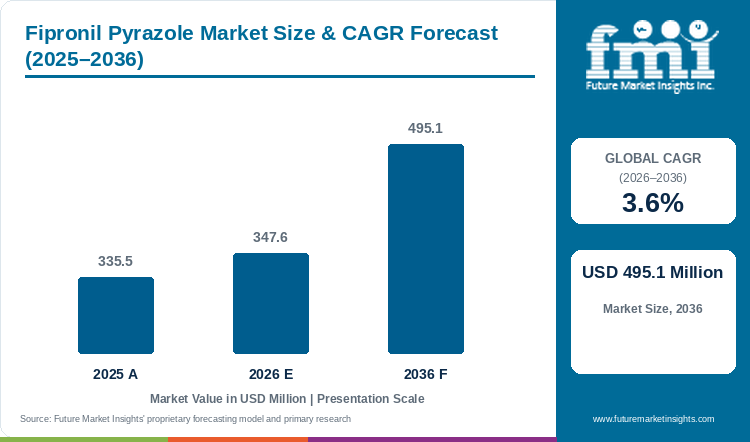
The Fipronil Pyrazole Market stands at USD 347.6 million in 2026. It is projected to reach USD 495.1 million by 2036, a 3.6% CAGR from 2026 to 2036. The market was valued at USD 335.5 million in 2025. The nearest demand signal is registrations, not volumes. At its 69th meeting in January 2026, India's Central Insecticides Board and Registration Committee approved further fipronil mixtures [5]. Ibama's communique of 12 January 2026 resumed registration requests in Brazil, while most agricultural uses stay under review [15].
Demand depends less on price than on which uses a regulator still permits. Fipronil is a phenylpyrazole that kills insects by contact or ingestion, disrupting the central nervous system [24]. HPM describes the action as a block of GABA-regulated chloride channels [6]. China prohibits fipronil on all crops except seed coating of maize and some other dryland crops [14]. The European Union approval for plant protection use expired on 30 September 2017 [17], and Brazil keeps foliar spraying suspended [15]. Baits face fewer limits, since Ibama did not suspend ant and termite baits after finding a low likelihood of bee exposure [15]. Crop protection volumes were soft in the latest quarter: BASF reported on 28 October 2026 that Agricultural Solutions sales fell 19.7% in the third quarter, with volumes down 17.3%, mainly because of adverse weather in Europe and, for herbicides, El Nino in Asia Pacific [1].
Key Market Trends & Insights
- On 12 January 2026 Ibama published a communique on its risk assessment of fipronil. The first phase found indications of risk to bees and other pollinators in most agricultural uses [15]. Uses that registrants did not defend stay suspended as a precaution [15]. Company studies are due by December 2027, and the reanalysis is expected to conclude by 27 July 2029 [15].
- India's Registration Committee approved fipronil-containing formulations at each of ten Central Insecticides Board meetings from May 2021 to January 2026 [5]. That made more than 20 entries in all [5]. They included a Gharda pyraclostrobin and fipronil suspension concentrate at the March 2023 meeting [5].
- On 16 September 2026 California's Department of Pesticide Regulation opened public comment on mitigation options for fipronil spot-on and spray products for dogs and cats [22]. Comment runs to 15 January 2027, after a final aquatic risk memo issued on 31 July 2026 [22].
Regional Highlights
- Asia Pacific: India keeps approving new fipronil mixtures for field crops [5]. China limits crop use to seed coating of maize and some other dryland crops [14].
- Latin America: Brazil suspended foliar spraying of fipronil on 21 December 2023 [16]. In January 2026 it set out which seed treatment and soil uses remain under review [15].
- North America: the US Environmental Protection Agency still lists a proposed interim decision and an interim decision for fipronil as upcoming [23]. California is consulting on limits for pet products [22].
Fipronil Pyrazole Market Size and Forecast
Table 1: Fipronil Pyrazole Market Size and Forecast
| Market size and forecast | Value |
|---|---|
| Market size in 2025 | USD 335.5 million |
| Market size in 2026 | USD 347.6 million |
| Projected market size by 2036 | USD 495.1 million |
| CAGR from 2026 to 2036 | 3.6% |
Source: Future Market Insights analysis of the fipronil pyrazole market, 2026.
Analyst Perspective
“Fipronil is no longer a single market. Crop uses are being cut back by regulators in Brazil, China and the European Union, while baits, termite treatments and technical-grade supply keep room to grow. Buyers who treat fipronil as one commodity will misread both price and availability. The useful signals are Ibama's study deadlines, the next Indian mixture approvals and the outcome of the US federal review. Supply agreements that name the use class and the technical source will hold up better than spot purchases.”
- Nikhil Kaitwade, Principal Consultant, FMI
How is the Fipronil Pyrazole Market segmented?
- By form: Gel, Particle and Liquid
- By end-use: Urban and Public Health Pest Control, Agriculture, and Veterinary and Other Uses
- By region: North America, Latin America, Europe and Asia Pacific
Why does Gel lead by Form in the Fipronil Pyrazole Market in 2026?
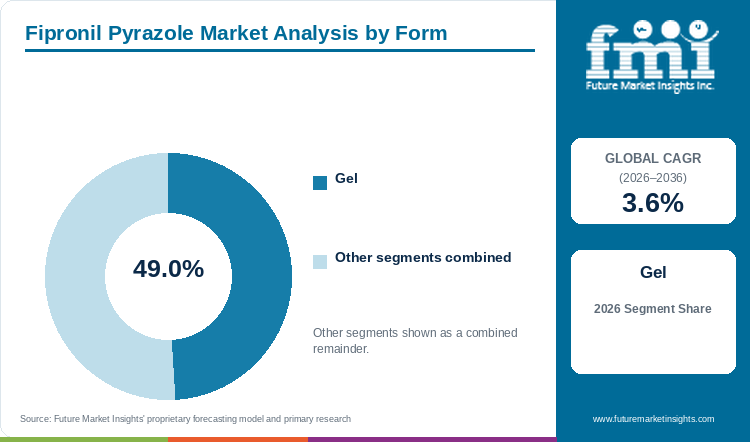
Gel accounts for 49.0% of the Fipronil Pyrazole Market by form in 2026. Gel is the form in which fipronil reaches pests inside buildings, outside most of the crop-use restrictions now spreading. The National Pesticide Information Center lists gel baits among the main fipronil product types, next to granules for turf, spot-on pet products, liquid termite products and agricultural formulations [24]. Ibama left ant and termite baits unsuspended in January 2026, because its first-phase assessment found a low likelihood of bee exposure [15]. Envu's Maxforce FC Select roach bait gel shows how little active ingredient the format needs. Its label under EPA Reg. No. 101563-49 states 0.01 percent fipronil and includes outdoor use adjacent to a home or structure [12]. A product built on one hundredth of one percent active ingredient sells on formulation and bait performance, which keeps gel value high even as crop volumes shrink. BASF says Termidor SC has treated more than 4 million structures since its introduction in 2000 [3]. The same low-dose, transfer-based logic applies to termite bait products.
Table 2: Form, 2026 Share
| Leading Share | 2026 market share |
|---|---|
| Gel | 49.0% |
| All Other Segments Combined Share | 51.0% |
Source: Future Market Insights analysis of the fipronil pyrazole market, 2026.
Why does Urban and Public Health Pest Control lead by End-use in the Fipronil Pyrazole Market in 2026?
Urban and Public Health Pest Control accounts for 49.0% of the Fipronil Pyrazole Market by end-use in 2026. The segment covers gel baits, ant and termite products and other structural treatments. Each sale is counted once, at the formulated or finished product. Technical material sold to formulators is not counted again. Regulators have left this use largely in place. Ibama did not suspend ant and termite baits, because its first-phase assessment found a low likelihood of bee exposure [15]. BASF promotes Termidor SC for termites, perimeter ant control and general pests [3]. Envu's Maxforce FC Select roach bait gel contains 0.01 percent fipronil [12]. Its label allows outdoor use next to a home or structure [12]. Crop uses face tighter limits. China permits fipronil only for seed coating of maize and some other dryland crops [14]. The EU approval for plant protection use expired on 30 September 2017 [17]. That gap explains why structural and bait uses hold the largest share.
Table 3: End-use, 2026 Share
| Leading Share | 2026 market share |
|---|---|
| Urban and Public Health Pest Control | 49.0% |
| All Other Segments Combined Share | 51.0% |
Source: Future Market Insights analysis of the fipronil pyrazole market, 2026.
What are the key drivers, restraints and opportunities?
Driver
Bait and structural pest control. Baits are the form least touched by pollinator concerns. Ibama did not suspend ant and termite baits [15]. Envu sells a roach bait gel at 0.01 percent fipronil for indoor and outdoor placement [12]. BASF promotes Termidor SC for termites, perimeter ant control and general pests, claiming colony elimination through transfer between insects [3]. Fipronil sits inside a wider anti-termite chemicals category.
Mixtures for field crops in India. Indian companies keep combining fipronil with other actives. The Registration Committee approved Rallis India's chlorantraniliprole and fipronil granule and Coromandel International's nitenpyram and fipronil wettable powder in January 2026 [5]. At the same meeting it approved Tropical Agrosystem's diafenthiuron, fipronil and dinotefuran suspension concentrate and Parijat Industries' pymetrozine, fipronil and dinotefuran suspension concentrate [5]. Meghmani offers fipronil with chlorantraniliprole and with flonicamid [11].
Restraint
Pollinator-driven restrictions. Ibama's first-phase assessment found indications of risk to bees in most agricultural uses [15]. Seed treatment and soil application are suspended for crops where registrants did not defend them [15]. Foliar spraying has been suspended since the communique of 21 December 2023, and cotton is the only crop where a defence was filed [15][16]. The European Commission restricted fipronil seed treatments in 2013 [18][19]. The approval for plant protection use lapsed on 30 September 2017 [17].
Residue and exposure scrutiny. Fipronil residues reached the food chain in 2017. More than 5,000 egg and chicken samples collected between 1 September and 30 November 2017 were reported to EFSA [20]. Of these, 742 exceeded legal limits, almost all linked to fipronil [20]. California is weighing limits on pet products because of aquatic and human health risks identified in its 2023 risk characterisation [22]. These risks include those for groomers, owners and children in close contact with treated pets [22]. For an older insecticide class, see the organophosphate insecticides market.
Opportunity
Registered technical supply. Formulators in restricted markets need technical material that carries a registration package. Meghmani states that GLP dossier data is available for its technical and formulated products [11]. Gharda Chemicals holds a technical registration in Brazil that supports the Gharda do Brasil formulations [13]. Suppliers that can document purity and origin are better placed as agencies reopen registration queues, as Ibama did in January 2026 [15].
Reformulation toward lower-exposure uses. Brazil's January 2026 communique keeps open the defended seed treatment and soil uses at lower doses [15]. For seedling immersion, only doses below currently authorised levels are kept [15]. Companies that redesign labels around these narrower uses can keep a place in crops. Those that already sell bait products have an alternative. For another insecticide class, see the neonicotinoid market.
Fipronil Pyrazole Market by Country (2026 to 2036)
Table 4: Fipronil Pyrazole Market Country Growth Forecast
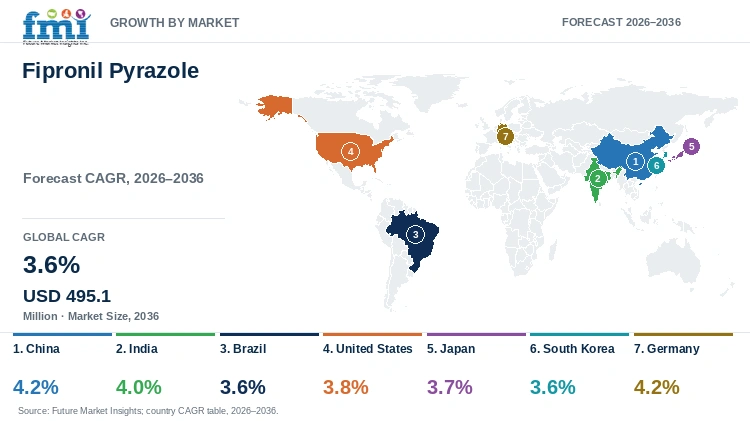
| Country | CAGR, 2026 to 2036 |
|---|---|
| China | 4.2% |
| India | 4.0% |
| Brazil | 3.6% |
| United States | 3.8% |
| Japan | 3.7% |
| South Korea | 3.6% |
| Germany | 4.2% |
Source: Future Market Insights analysis of the fipronil pyrazole market, 2026.
China
The Ministry of Agriculture and Rural Affairs lists fipronil among pesticides banned for part of their range [14]. It may not be used on any crop, except seed coating of maize and some other dryland crops [14]. The list was published on the ministry's planting industry site on 29 November 2019 [14].
That rule makes China more a manufacturing and non-crop market than a crop market. The Maxforce FC Select roach bait gel, registered in the United States, is marked as a product of China on its carton [12]. Finished goods made for pest control can be produced in China even where field use is barred.
BASF reported on 28 October 2026 that Asia Pacific sales in its Agricultural Solutions segment fell considerably in the third quarter, with El Nino weighing on herbicide volumes and lower prices adding pressure [1]. Chinese seed-coating buyers and exporters should expect little relief from crop demand. The commercial case rests on technical sales and bait products.
India
India's Registration Committee has approved fipronil-containing formulations at every Central Insecticides Board meeting from the 60th, in May 2021, to the 69th, in January 2026 [5]. That is more than 20 entries in total [5]. Approved lines include Gharda's pyraclostrobin 10% and fipronil 5% suspension concentrate in March 2023 [5]. In January 2026, four mixtures came from Rallis India, Coromandel International, Tropical Agrosystem and Parijat Industries [5].
Domestic companies sell straight products as well. HPM Chemicals and Fertilizers markets Aashirwaad as a 0.3% granule and a 5% suspension concentrate [6][7]. The suspension is also labelled for cabbage and chillies, and carries a 32-day waiting period on rice [6][7]. Albaugh India sells Ixus as a fipronil 5% suspension concentrate for rice, chilli, cabbage, cauliflower, sugarcane and cotton [8]. GSP Crop Science lists fipronil 5% suspension concentrate and 0.3% granule [10].
Input suppliers also work from India. Meghmani sells fipronil technical at 97% minimum and exports to several regions [11]. BASF noted in its third-quarter 2026 statement that a weaker Indian rupee and lower prices weighed on Asia Pacific sales [1]. Indian formulators that mix fipronil with newer actives compete on label novelty. Buyers should check which approvals have reached full registration.
Brazil
Ibama began an environmental reevaluation of fipronil products on 12 September 2022 [16]. In a communique dated 21 December 2023, it suspended use through foliar spraying over the whole area [16]. The agency had already restricted aerial spraying of imidacloprid, thiamethoxam, clothianidin and fipronil as a precaution, in a notice published on 19 July 2012 [16].
The communique of 12 January 2026 set the next steps. The first-phase assessment found indications of risk to bees and other pollinators in most agricultural uses. Uses that registrants chose not to defend stay suspended [15]. Seed treatment and soil application remain under review where companies defend them, while foliar spraying stays suspended with only cotton defended [15]. Ant and termite baits are not suspended [15]. Studies are due by December 2027, and the reanalysis is expected to conclude by 27 July 2029 [15].
Gharda do Brasil's Fipronil 80 WG label, registered under MAPA number 11417, lists cotton, potato, sugarcane, maize and soybean [13]. The label bars aerial and total-area foliar spraying and warns that the product is toxic to bees [13]. Registration requests have resumed under Law 14,785 of 2023, but Ibama states this does not mean automatic approval of new uses [15]. Brazilian buyers should plan around the 2029 conclusion date and not assume a quick reopening.
United States
Fipronil was first registered in the United States in 1996 [24]. More than 50 registered products contain it, from gel baits and turf granules to spot-on pet products, liquid termite treatments and agricultural formulations [24]. BASF's Regent 4 SC stays authorised for potatoes with an unconditional registration [2]. The conditional registration for in-furrow corn expired on 15 November 2009 [2].
Federal review is still open. EPA's registration review docket for fipronil is EPA-HQ-OPP-2011-0448 [23]. The agency's schedule still lists a proposed interim decision (fiscal year 2025) and an interim decision (fiscal year 2026) as upcoming, both with the quarter to be determined [23]. Albaugh says its Ixus is registered in the United States for more than 250 pest species across 60 crops [9].
California is moving first on pet products. DPR's announcement of 16 September 2026 covers spot-on and spray products for dogs and cats [22]. It lists mitigation options such as annual application limits, lower rates, bathing waiting periods and designation as a restricted material [22]. It counts 89 alternative spot-on products [22]. Comment runs to 15 January 2027 [22]. Pet-product sellers should expect label changes in one large state before any federal decision.
Japan
The Food Safety Commission of Japan completed its risk assessment of fipronil in January 2014, covering pesticide and veterinary medicinal uses [26]. It set an acceptable daily intake of 0.00019 mg per kg of body weight per day [26]. The intake divides the lowest no-observed-adverse-effect level of 0.019 mg per kg per day, from a two-year rat study, by a safety factor of 100 [26].
The commission recorded effects on the central nervous system, liver and thyroid [26]. It found no teratogenicity and no genotoxicity relevant to human health [26]. Thyroid follicular cell tumours in rats at 300 ppm were attributed to a chain of events starting with faster biliary clearance of thyroid hormone [26]. The commission concluded that a threshold could be set [26]. For residues, it defined fipronil alone for agricultural products [26]. For livestock products it defined fipronil with its metabolite F [26].
A tight intake limit leaves little room for impurities or residues in imported goods. Suppliers selling into Japan benefit from technical material backed by full data. Meghmani lists Asia among its markets and offers GLP dossier data on request [11]. Buyers there should ask for the residue definition and the technical source before approving a formulator.
South Korea
Korea's Ministry of Food and Drug Safety announced on 13 April 2018 that a positive list system for pesticide residues would apply to all agricultural products from 1 January 2019, following a WTO notification of 18 August 2017 [25].
Fipronil entered the Korean food safety debate in August 2017. The Netherlands issued an egg notice on 2 August 2017 [21]. Authorities in South Korea and Taiwan then reported fipronil in locally produced eggs [21]. Hong Kong's Centre for Food Safety noted that the pesticide is not allowed on food-producing animals in the European Union, where the incident began [21]. The incident was attributed to illegal use on egg farms [21].
The 2017 episode shows that scrutiny of fipronil reaches the food chain through non-crop uses as well as crop uses. Bait gels such as Maxforce FC Select, marked as made in China, are designed for indoor and structural placement [12]. Importers and pest control operators in Korea should confirm the residue rules in force for any new fipronil product before it is put on sale.
Germany
Commission Implementing Regulation (EU) No 781/2013 of 14 August 2013 changed the conditions of approval of fipronil and prohibited the use and sale of seeds treated with fipronil products [18]. Reporting in July 2013 said 23 member states voted in favour, two against and three abstained [19]. The restriction was to take effect on 1 January 2014, with treated seed allowed to be sown until 28 February [19].
Regulation (EU) 2016/2035, adopted on 21 November 2016, set the end date. Renewal applications had been lodged, but no supplementary dossiers were submitted. The approval of fipronil expired on 30 September 2017, not on 31 July 2018 [17]. Germany was among the eight member states whose products exceeded residue limits after the 2017 egg incident [20]. The EU recorded 742 samples over limits [20].
Plant protection demand in Germany is closed, so the remaining relevance is as a manufacturing and corporate base. The 2003 purchase of fipronil by BASF from Bayer CropScience, announced from Ludwigshafen, put the active in a German group's hands [4]. BASF said on 28 October 2026 that Agricultural Solutions sales in Europe fell substantially, driven by adverse weather [1].
Who are the notable companies in the Fipronil Pyrazole Market?
Notable companies in the Fipronil Pyrazole Market include BASF SE, Gharda Chemicals Limited, Albaugh LLC, HPM Chemicals and Fertilizers, GSP Crop Science Limited, Meghmani Organics Limited, Envu and Coromandel International Limited.
The sharpest difference between suppliers is how much of their fipronil business sits in crops. HPM, Albaugh India and GSP Crop Science sell fipronil as 5% suspension concentrates and 0.3% granules for rice and other field crops [6][7][8][10]. Gharda do Brasil's 80 WG is registered for cotton, potato, sugarcane, maize and soybean [13]. These lines carry the weight of the Ibama reanalysis [15] and of China's crop ban [14]. Envu's bait gel at 0.01 percent and BASF's Termidor SC for structures sit on the other side of that line [3][12].
A second split runs between makers of technical material and owners of brands. Meghmani sells fipronil technical at 97% minimum [11], HPM states 95.0% minimum for its technical [6], and Gharda Chemicals is named as the maker of the technical behind its Brazilian registrations [13]. BASF has held the fipronil business since it completed the purchase from Bayer CropScience. The purchase was announced on 24 March 2003 at an adjusted price of EUR 1.2 billion [4]. Back-licences for selected non-agricultural uses were granted to Bayer CropScience [4]. BASF still sells Regent 4 SC for potatoes [2].
Mixtures are how Indian companies differentiate. The January 2026 approvals pair fipronil with chlorantraniliprole, nitenpyram, diafenthiuron, dinotefuran and pymetrozine [5]. Meghmani offers fipronil with chlorantraniliprole and flonicamid [11]. Buyers choose between a straight, well-known active in a registered niche and a newer mixture whose label may not yet be accepted across states or export markets.
Key Developments in the Fipronil Pyrazole Market
- On 12 January 2026, Ibama published a communique that resumed registration requests for fipronil products in Brazil, kept foliar spraying suspended, left ant and termite baits unsuspended and set December 2027 for company studies [15].
- At its 69th meeting in January 2026, India's Registration Committee approved fipronil mixtures for Rallis India, Coromandel International, Tropical Agrosystem and Parijat Industries [5].
- On 31 July 2026, California's Department of Pesticide Regulation issued its final aquatic risk memo on fipronil pet products [22]. On 16 September 2026 it opened comment on mitigation options, with comment closing on 15 January 2027 [22].
- On 28 October 2026, BASF reported that Agricultural Solutions sales fell 19.7% in the third quarter of 2026, with EBITDA before special items at a loss of EUR 48 million against a profit of EUR 80 million a year earlier [1].
Key Players in the Fipronil Pyrazole Market
- BASF SE
- Gharda Chemicals Limited
- Albaugh LLC
- HPM Chemicals and Fertilizers Ltd
- GSP Crop Science Limited
- Meghmani Organics Limited
- Envu
- Coromandel International Limited
Fipronil Pyrazole Market Report Scope
Table 5: Fipronil Pyrazole Market Report Scope
| Coverage field | Report scope |
|---|---|
| Market definition | Fipronil, a phenylpyrazole insecticide, measured by value of sales at the formulated or finished product stage, with technical material counted once within that value |
| Form | Gel, Particle, Liquid |
| End-use | Urban and Public Health Pest Control, Agriculture, Veterinary and Other Uses |
| Regions and profiled countries | North America, Latin America, Europe and Asia Pacific. Profiled countries: China, India, Brazil, United States, Japan, South Korea, Germany |
| Companies covered | BASF SE, Gharda Chemicals Limited, Albaugh LLC, HPM Chemicals and Fertilizers Ltd, GSP Crop Science Limited, Meghmani Organics Limited, Envu, Coromandel International Limited |
| Forecast period | 2026 to 2036, with 2025 as the historical base year |
| Quantitative Units | USD million |
Source: Future Market Insights analysis of the fipronil pyrazole market, 2026.
Fipronil Pyrazole Market by Segments
Fipronil Pyrazole Market segmented by Form:
- Gel
- Particle
- Liquid
Fipronil Pyrazole Market segmented by End-use:
- Urban and Public Health Pest Control
- Agriculture
- Veterinary and Other Uses
Fipronil Pyrazole Market by Region
- North America
- Latin America
- Europe
- Asia Pacific
- China
- India
- Brazil
- United States
- Japan
- South Korea
- Germany
Research Sources and Bibliography
- [1] BASF SE. (2026, October 28). Quarterly Statement Q3 2026. https://www.basf.com/dam/jcr:9d4392ff-1402-43f6-be6e-8055826f4f0a/basf/www/global/documents/en/investor-relations/calendar-and-publications/reports/2026/BASF_Quarterly-Statement_03-2026.pdf
- [2] BASF Agricultural Solutions US. (n.d.). Regent 4 SC Insecticide. https://agriculture.basf.us/crop-protection/products/insecticides/regent.html
- [3] BASF Pest Control US. (n.d.). Termidor SC Termiticide/Insecticide. https://pestcontrol.basf.us/products/termidor--sc-termiticide-insecticide.html
- [4] BASF AG. (2003, March 24). Release on the acquisition of selected insecticides and fungicides from Bayer CropScience, carried by SeedQuest. https://www.seedquest.com/News/releases/2003/march/5529.htm
- [5] Plant Protection, Quarantine and Storage, Government of India. (2026, June). List of Pesticides and New Formulations Approved by the Registration Committee under Section 9(3) of the Insecticides Act, 1968, 60th to 69th CIB meetings. https://ppqs.gov.in/sites/default/files/2026-06/New%20molecules%20formulations%20registered%2060-69%20CIB%20meeting.pdf
- [6] HPM Chemicals and Fertilizers Ltd. (n.d.). Aashirwaad GR (Fipronil 0.3% GR). https://www.hpmindia.com/product-insecticides13.php
- [7] HPM Chemicals and Fertilizers Ltd. (n.d.). Aashirwaad SC (Fipronil 5% SC). https://www.hpmindia.com/product-insecticides14.php
- [8] Albaugh, LLC. (n.d.). IXUS: Fipronil 5% SC (India). https://www.albaugh.com/in/products/crop-protection/insecticides/listings/ixus-fipronil-5--sc
- [9] Albaugh, LLC. (2026, September 29). Ixus (Peru, English). https://www.albaugh.com/pe/en/products/crop-protection/insecticides/listings/ixus
- [10] GSP Crop Science Limited. (n.d.). Formulation products. https://www.gspcrop.in/crop-solutions/formulation
- [11] Meghmani Organics Limited. (n.d.). Fipronil Technical. https://meghmani.com/product/fipronil-technical/
- [12] Environmental Science U.S., LLC (Envu). (n.d.). Maxforce FC Select Roach Killer Bait Gel, product label, EPA Reg. No. 101563-49. https://bynder.envu.com/m/120037b635f0b4fd/original/Digital_PPM_Maxforce-FC-Select-Roach-Killer-Bait-Gel_Label_NA_US_EN.pdf
- [13] Revista Cultivar. (n.d.). Fipronil 80 WG Gharda, label data (MAPA registration 11417). https://revistacultivar.com.br/pesticida/fipronil-80-wg-gharda
- [14] Ministry of Agriculture and Rural Affairs of China, Planting Industry Management Department. (2019, November 29). Directory of banned and restricted pesticides. https://zzys.moa.gov.cn/gzdt/201911/t20191129_6332604.htm
- [15] Ibama. (2026, February 3). Ibama publica Comunicado que da continuidade a reanalise ambiental de agrotoxicos a base de fipronil. https://www.gov.br/ibama/pt-br/assuntos/notas/2026/ibama-publicacomunicadoque-da-continuidade-a-reanalise-ambiental-de-agrotoxicos-a-base-de-fipronil
- [16] Ibama. (2022, November 29). Reavaliacao ambiental. https://www.gov.br/ibama/pt-br/assuntos/quimicos-e-biologicos/agrotoxicos/reavaliacao-ambiental
- [17] European Commission. (2016, November 21). Commission Implementing Regulation (EU) 2016/2035 as regards the approval periods of the active substances fipronil and maneb. https://eurlexa.com/act/en/32016R2035/present/text
- [18] European Commission. (2013, August 14). Commission Implementing Regulation (EU) No 781/2013 on the conditions of approval of fipronil and the prohibition of treated seeds. https://www.legislation.gov.uk/eur/2013/781/contents
- [19] Erickson, B. E. (2013, July 22). Europe To Ban Fipronil Pesticide To Protect Bees. Chemical & Engineering News. https://cen.acs.org/articles/91/i29/Europe-Ban-Fipronil-Pesticide-Protect.html
- [20] European Food Safety Authority. (2018, May 3). Fipronil: results of follow-up monitoring published. https://www.efsa.europa.eu/en/press/news/180503
- [21] Centre for Food Safety, Hong Kong. (2017, November 3). Pesticide Fipronil Detected in Eggs, Food Safety Focus, 134th issue. https://www.cfs.gov.hk/english/multimedia/multimedia_pub/multimedia_pub_fsf_134_01.html
- [22] California Department of Pesticide Regulation. (2026, September 16). DPR Seeks Public Input on Options to Reduce Risks from Fipronil Flea and Tick Products. https://www.cdpr.ca.gov/2026/09/16/dpr-seeks-public-input-on-options-to-reduce-risks-from-fipronil-flea-and-tick-products/
- [23] US Environmental Protection Agency. (2026, August 19). Upcoming Registration Review Actions. https://www.epa.gov/pesticide-reevaluation/upcoming-registration-review-actions
- [24] National Pesticide Information Center. (2009, July). Fipronil General Fact Sheet. https://npic.orst.edu/factsheets/fipronil.html
- [25] Ministry of Food and Drug Safety, Republic of Korea. (2018, April 13). Leaflet for PLS (Positive List System). https://www.mfds.go.kr/eng/brd/m_15/view.do?seq=72423
- [26] Food Safety Commission of Japan. (2014, January). Risk Assessment Report: Fipronil (FS/77/2014). https://www.fsc.go.jp/english/evaluationreports/pesticide/fipronil_fs77.pdf
Table of Content
Table of Content
- Key Takeaways
- Market Size and CAGR
- Top Growth Driver
- Fastest Growing Segment
- Leading Region
- Key Companies
- Emerging Opportunities
- Executive Summary
- Global Market Outlook
- Demand-side Trends
- Supply-side Trends
- Technology Roadmap Analysis
- Analysis and Recommendations
- Analyst Perspective (What is happening? Why now? What should investors know?)
- Key Questions Answered
- How large is the market?
- What is the CAGR?
- What are key trends?
- Which region dominates?
- Who are the leaders?
Read More...
- Market Overview
- Market Coverage / Taxonomy
- Market Definition / Scope / Limitations
- Research Methodology
- Chapter Orientation
- Analytical Lens and Working Hypotheses
- Market Structure, Signals, and Trend Drivers
- Benchmarking and Cross-market Comparability
- Market Sizing, Forecasting, and Opportunity Mapping
- Research Design and Evidence Framework
- Desk Research Programme (Secondary Evidence)
- Expert Input and Fieldwork (Primary Evidence)
- Tooling, Models, and Reference Databases
- Data Engineering and Model Build
- Quality Assurance and Audit Trail
- Market Background
- Market Dynamics (Drivers, Restraints, Opportunity, Trends)
- Scenario Forecast (Optimistic, Likely, Conservative)
- Impact Analysis
- AI Impact
- Sustainability Impact
- Regulatory Impact
- Technology Impact
- Consumer / Buyer Analysis
- Purchase Drivers
- Adoption Barriers
- Buyer Journey
- Opportunity Map Analysis
- Product Life Cycle Analysis
- Supply Chain Analysis
- Investment Feasibility Matrix
- Value Chain Analysis
- PESTLE and Porter's Analysis
- Regulatory Landscape
- Regional Parent Market Outlook
- Production and Consumption Statistics
- Import and Export Statistics
- Global Market Analysis and Forecast, 2021 to 2036
- Historical Market Size Value (USD Million) Analysis, 2021 to 2025
- Current and Future Market Size Value (USD Million) Projections, 2026 to 2036
- Y-o-Y Growth Trend Analysis
- Absolute $ Opportunity Analysis
- Global Market Pricing Analysis, 2021 to 2036
- Global Market Analysis and Forecast, By Form, 2021 to 2036
- Introduction / Key Findings
- Historical Market Size Value (USD Million) Analysis By Form, 2021 to 2025
- Current and Future Market Size Value (USD Million) Analysis and Forecast By Form, 2026 to 2036
- Gel
- Particle
- Liquid
- Y-o-Y Growth Trend Analysis By Form, 2021 to 2025
- Absolute $ Opportunity Analysis By Form, 2026 to 2036
- Global Market Analysis and Forecast, By End-use, 2021 to 2036
- Introduction / Key Findings
- Historical Market Size Value (USD Million) Analysis By End-use, 2021 to 2025
- Current and Future Market Size Value (USD Million) Analysis and Forecast By End-use, 2026 to 2036
- Urban and Public Health Pest Control
- Agriculture
- Veterinary and Other Uses
- Y-o-Y Growth Trend Analysis By End-use, 2021 to 2025
- Absolute $ Opportunity Analysis By End-use, 2026 to 2036
- Global Market Analysis and Forecast, By Region, 2021 to 2036
- Introduction
- Historical Market Size Value (USD Million) Analysis By Region, 2021 to 2025
- Current Market Size Value (USD Million) Analysis and Forecast By Region, 2026 to 2036
- North America
- Latin America
- Europe
- Asia Pacific
- Market Attractiveness Analysis By Region
- North America Market Analysis and Forecast, By Country, 2021 to 2036
- Historical Market Size Value (USD Million) Trend Analysis By Market Taxonomy, 2021 to 2025
- Market Size Value (USD Million) Forecast By Market Taxonomy, 2026 to 2036
- By Country
- By Form
- By End-use
- Market Attractiveness Analysis
- By Country
- By Form
- By End-use
- Key Takeaways
- Latin America Market Analysis and Forecast, By Country
- Historical Market Size Value (USD Million) Trend Analysis By Market Taxonomy, 2021 to 2025
- Market Size Value (USD Million) Forecast By Market Taxonomy, 2026 to 2036
- By Country
- By Form
- By End-use
- Market Attractiveness Analysis
- By Country
- By Form
- By End-use
- Key Takeaways
- Europe Market Analysis and Forecast, By Country
- Historical Market Size Value (USD Million) Trend Analysis By Market Taxonomy, 2021 to 2025
- Market Size Value (USD Million) Forecast By Market Taxonomy, 2026 to 2036
- By Country
- By Form
- By End-use
- Market Attractiveness Analysis
- By Country
- By Form
- By End-use
- Key Takeaways
- Asia Pacific Market Analysis and Forecast, By Country
- Historical Market Size Value (USD Million) Trend Analysis By Market Taxonomy, 2021 to 2025
- Market Size Value (USD Million) Forecast By Market Taxonomy, 2026 to 2036
- By Country
- China
- India
- Brazil
- United States
- Japan
- South Korea
- Germany
- By Form
- By End-use
- By Country
- Market Attractiveness Analysis
- By Country
- By Form
- By End-use
- Key Takeaways
- Key Countries Market Analysis
- United States
- Pricing Analysis
- Market Share Analysis, 2025
- By Form
- By End-use
- Brazil
- Pricing Analysis
- Market Share Analysis, 2025
- By Form
- By End-use
- Germany
- Pricing Analysis
- Market Share Analysis, 2025
- By Form
- By End-use
- India
- Pricing Analysis
- Market Share Analysis, 2025
- By Form
- By End-use
- China
- Pricing Analysis
- Market Share Analysis, 2025
- By Form
- By End-use
- Japan
- Pricing Analysis
- Market Share Analysis, 2025
- By Form
- By End-use
- South Korea
- Pricing Analysis
- Market Share Analysis, 2025
- By Form
- By End-use
- United States
- Market Structure Analysis
- Competition Dashboard
- Competition Benchmarking
- Market Share Analysis of Top Players
- By Regional
- By Form
- By End-use
- Emerging Startups
- Innovation Benchmarking
- Competition Analysis
- Competition Deep Dive
- BASF SE
- Overview
- Product Portfolio
- Profitability by Market Segments
- Sales Footprint
- Strategy Overview
- Marketing Strategy
- Product Strategy
- Channel Strategy
- Gharda Chemicals Limited
- Albaugh LLC
- HPM Chemicals and Fertilizers Ltd
- GSP Crop Science Limited
- Meghmani Organics Limited
- Envu
- Coromandel International Limited
- BASF SE
- Case Studies
- Success Stories
- Recent Developments
- Competition Deep Dive
- Assumptions & Acronyms Used
List of Tables
- Table 1: Global Market Value (USD Million) Forecast by Region, 2021 to 2036
- Table 2: Global Market Value (USD Million) Forecast by Form, 2021 to 2036
- Table 3: Global Market Value (USD Million) Forecast by End-use, 2021 to 2036
- Table 4: North America Market Value (USD Million) Forecast by Country, 2021 to 2036
- Table 5: North America Market Value (USD Million) Forecast by Form, 2021 to 2036
- Table 6: North America Market Value (USD Million) Forecast by End-use, 2021 to 2036
- Table 7: Latin America Market Value (USD Million) Forecast by Country, 2021 to 2036
- Table 8: Latin America Market Value (USD Million) Forecast by Form, 2021 to 2036
- Table 9: Latin America Market Value (USD Million) Forecast by End-use, 2021 to 2036
- Table 10: Europe Market Value (USD Million) Forecast by Country, 2021 to 2036
- Table 11: Europe Market Value (USD Million) Forecast by Form, 2021 to 2036
- Table 12: Europe Market Value (USD Million) Forecast by End-use, 2021 to 2036
- Table 13: Asia Pacific Market Value (USD Million) Forecast by Country, 2021 to 2036
- Table 14: Asia Pacific Market Value (USD Million) Forecast by Form, 2021 to 2036
- Table 15: Asia Pacific Market Value (USD Million) Forecast by End-use, 2021 to 2036
List of Figures
- Figure 1: Global Market Pricing Analysis
- Figure 2: Global Market Value (USD Million) Forecast 2021-2036
- Figure 3: Global Market Value Share and BPS Analysis by Form, 2026 and 2036
- Figure 4: Global Market Y-o-Y Growth Comparison by Form, 2026-2036
- Figure 5: Global Market Attractiveness Analysis by Form
- Figure 6: Global Market Value Share and BPS Analysis by End-use, 2026 and 2036
- Figure 7: Global Market Y-o-Y Growth Comparison by End-use, 2026-2036
- Figure 8: Global Market Attractiveness Analysis by End-use
- Figure 9: Global Market Value (USD Million) Share and BPS Analysis by Region, 2026 and 2036
- Figure 10: Global Market Y-o-Y Growth Comparison by Region, 2026-2036
- Figure 11: Global Market Attractiveness Analysis by Region
- Figure 12: North America Market Incremental Dollar Opportunity, 2026-2036
- Figure 13: Latin America Market Incremental Dollar Opportunity, 2026-2036
- Figure 14: Europe Market Incremental Dollar Opportunity, 2026-2036
- Figure 15: Asia Pacific Market Incremental Dollar Opportunity, 2026-2036
- Figure 16: North America Market Value Share and BPS Analysis by Country, 2026 and 2036
- Figure 17: North America Market Value Share and BPS Analysis by Form, 2026 and 2036
- Figure 18: North America Market Y-o-Y Growth Comparison by Form, 2026-2036
- Figure 19: North America Market Attractiveness Analysis by Form
- Figure 20: North America Market Value Share and BPS Analysis by End-use, 2026 and 2036
- Figure 21: North America Market Y-o-Y Growth Comparison by End-use, 2026-2036
- Figure 22: North America Market Attractiveness Analysis by End-use
- Figure 23: Latin America Market Value Share and BPS Analysis by Country, 2026 and 2036
- Figure 24: Latin America Market Value Share and BPS Analysis by Form, 2026 and 2036
- Figure 25: Latin America Market Y-o-Y Growth Comparison by Form, 2026-2036
- Figure 26: Latin America Market Attractiveness Analysis by Form
- Figure 27: Latin America Market Value Share and BPS Analysis by End-use, 2026 and 2036
- Figure 28: Latin America Market Y-o-Y Growth Comparison by End-use, 2026-2036
- Figure 29: Latin America Market Attractiveness Analysis by End-use
- Figure 30: Europe Market Value Share and BPS Analysis by Country, 2026 and 2036
- Figure 31: Europe Market Value Share and BPS Analysis by Form, 2026 and 2036
- Figure 32: Europe Market Y-o-Y Growth Comparison by Form, 2026-2036
- Figure 33: Europe Market Attractiveness Analysis by Form
- Figure 34: Europe Market Value Share and BPS Analysis by End-use, 2026 and 2036
- Figure 35: Europe Market Y-o-Y Growth Comparison by End-use, 2026-2036
- Figure 36: Europe Market Attractiveness Analysis by End-use
- Figure 37: Asia Pacific Market Value Share and BPS Analysis by Country, 2026 and 2036
- Figure 38: Asia Pacific Market Value Share and BPS Analysis by Form, 2026 and 2036
- Figure 39: Asia Pacific Market Y-o-Y Growth Comparison by Form, 2026-2036
- Figure 40: Asia Pacific Market Attractiveness Analysis by Form
- Figure 41: Asia Pacific Market Value Share and BPS Analysis by End-use, 2026 and 2036
- Figure 42: Asia Pacific Market Y-o-Y Growth Comparison by End-use, 2026-2036
- Figure 43: Asia Pacific Market Attractiveness Analysis by End-use
- Figure 44: Global Market - Tier Structure Analysis
- Figure 45: Global Market - Company Share Analysis
Frequently Asked Questions
How big is the fipronil pyrazole market in 2026?
The Fipronil Pyrazole Market stands at USD 347.6 million in 2026, up from USD 335.5 million in 2025. It is projected to reach USD 495.1 million by 2036, a 3.6% CAGR from 2026 to 2036.
Which form leads the fipronil pyrazole market?
Gel leads with 49.0% of the market in 2026. The National Pesticide Information Center lists gel baits among the main fipronil product types [24]. Ibama left ant and termite baits unsuspended in January 2026 [15]. Envu's Maxforce FC Select gel carries 0.01 percent fipronil under EPA Reg. No. 101563-49 [12].
Which other forms and end-uses matter?
Particle holds 29.0% and Liquid 22.0% by form. By end-use, Agriculture holds 29.0% and Veterinary and Other Uses 22.0% behind Urban and Public Health Pest Control at 49.0%. HPM sells a 0.3% granule and a 5% suspension concentrate. Albaugh India sells a 5% suspension concentrate [6][7][8].
Which profiled country is forecast to grow fastest?
China and Germany have the highest forecast CAGR of the seven profiled countries, at 4.2% each from 2026 to 2036. India follows at 4.0%. China allows fipronil only for seed coating of maize and some other dryland crops [14]. The EU approval for plant protection use expired on 30 September 2017 [17].
Which rules and reviews are changing demand?
In Brazil, Ibama's communique of 12 January 2026 keeps foliar spraying suspended and sets the end of the reanalysis for 27 July 2029 [15]. In the United States, EPA lists a proposed interim decision for fipronil as upcoming [23]. California's comment period on pet product mitigation runs to 15 January 2027 [22].
What should a buyer check when choosing a fipronil supplier?
Check the use class first, because crop, bait and pet uses face different rules. Then check purity and source. Meghmani lists 97% minimum for its technical, and HPM 95.0% minimum [11][6]. Finally, confirm the registration status in the destination country, such as Gharda do Brasil's MAPA registration 11417 [13].
Preview the report firsthand - request a free sample
Get SampleGet the brochure for pricing and purchase details.
Get PDF
