

- Market Size (2026)
- USD 1.9 Bn
- Forecast (2036)
- USD 3.2 Bn
- CAGR (2026 to 2036)
- 5.7%
How big is Anti Termite Chemicals Market in 2026?
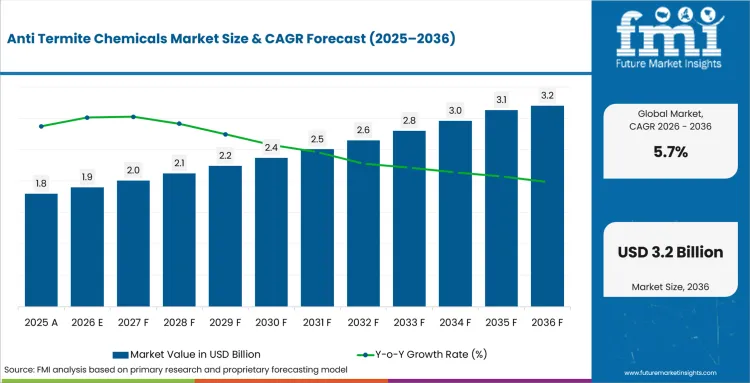
USD 1.9 billion in 2026 and USD 3.2 billion by 2036 at a 5.7% CAGR.
Sales in the anti termite chemicals market are projected to grow at 5.7% CAGR through 2036, driving valuation to USD 3.2 billion by 2036 from USD 1.9 billion in 2026. Structural protection depends on labels that define termite uses and application rates across professional treatment programs. EPA updated its termite guidance in October 2025 and confirmed that registered termiticides must demonstrate structural protection. The requirement connects professional pest control services with label compliance and documented treatment continuity around accessible foundation zones. Construction chemicals specifications shape treatment timing during excavation and slab work across every active building stage.
National registration systems and building rules assign responsibility through distinct legal routes and construction practices across countries. United States contractors work under federal labels; German products instead require authorization for each professional use. Australia adds building-code requirements that connect registered chemicals with installation standards and durable treatment notices. Current National Construction Code provisions require systems and notices that identify later inspection needs across protected structures nationwide. Japan relies on documented building practice; Brazil depends on regional applicator coverage and service capacity. Wood preservative chemicals provide a related route for exposed components that do not justify broad soil treatment across buildings.
Key Takeaways of Anti Termite Chemicals Market
- Construction activity and recurring inspections support registered structural treatments through trained pest management services nationwide.
- Fipronil is expected to account for 24.0% share in 2026 through established non-repellent programs across structural properties.
- Liquid concentrates are projected to represent 42.0% share in 2026 through measured dilution across varied foundation conditions.
- Pre-construction soil treatment is anticipated to capture 34.0% share in 2026 through unobstructed foundation access.
- Registration expense and uneven installation quality constrain structural protection across national service channels and recurring contracts.
- BASF and Envu compete through liquid termiticides; Syngenta adds foam and wood-treatment routes across professional programs.
Analyst Perspective
"Registered active ingredients have limited commercial value without complete foundation coverage and accountable field execution. Treatment programs protect buildings through documented repairs and reliable follow-up whenever later construction disturbs treated zones. Strong commercial models pair proven chemistry with local crews and durable records that support inspection coverage across each property."
- Nikhil Kaitwade, Principal Analyst, Future Market Insights
How is the Anti Termite Chemicals Market segmented?
Anti Termite Chemicals Market is segmented by chemical type, formulation, application, end use, sales channel, and region.
The market is segmented by chemical type, formulation, application, end use, sales channel, and region. Chemical type covers fipronil, imidacloprid, bifenthrin, chlorpyrifos alternatives, boric acid, and bio-based termiticides across professional programs. Formulation includes liquid concentrates, ready-to-use liquids, foams, powders, and bait systems for varied site conditions. Application covers pre-construction soil treatment, post-construction treatment, wood treatment, and barrier or baiting programs across structures. End use includes residential buildings, commercial buildings, infrastructure properties, industrial sites, and pest control operators. Sales channels comprise service providers, agrochemical distributors, retail outlets, hardware outlets, and direct project supply; regional analysis compares registration and service coverage nationwide.
What makes fipronil central to the chemical type category?
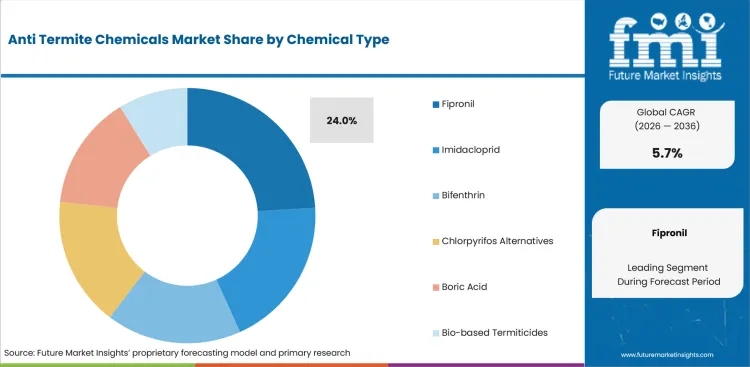
Fipronil supports non-repellent soil programs requiring continuous coverage around foundations and service penetrations across properties. Treatment design depends on label concentration and access to soil interfaces that termites can cross. BASF lists fipronil termiticides for pre-construction and post-construction structural work across licensed professional programs internationally. Service companies compare application depth with retreatment terms to quote long-term protection for each property.
- The chemical type category is forecast to be led by fipronil at 24.0% share in 2026 due to established non-repellent treatment practice. Non-repellent transfer supports consistent plans across comparable structures with established technician routines and inspection schedules. Registration differences remain decisive because identical chemistry cannot enter every structural use under equivalent labels.
- Pest management firms select fipronil for structures requiring continuous treated zones and documented follow-up responsibility. Adoption depends on calibrated equipment and clear access around foundation penetrations throughout each treatment route. Bait systems suit soil-restricted properties, whereas wood-directed products address localized components beyond efficient liquid-barrier reach across interiors and service routes.
Why do liquid concentrates shape the formulation category?
Liquid concentrates reduce packaged volume and let technicians prepare labeled dilutions for different foundation conditions. Control Solutions documents Taurus SC for pre-construction and post-construction termite work across structural properties nationwide. Accurate preparation requires calibrated equipment and secure transport throughout each operating day with complete records. Neonicotinoid pesticides provide another chemistry route under different registrations and treatment requirements across service programs.
- In 2026, liquid concentrates are expected to lead formulation with 42.0% share because measured dilution fits varied foundation conditions. One registered stock item can serve several treatment zones through labeled preparation and calibrated equipment. Lower transport volume improves service economics for firms covering multiple properties during one operating day.
- Professional applicators purchase concentrates to support several structural conditions through labeled rates and calibrated mixing equipment. Smaller contractors need dependable water access and secure storage throughout each service route with complete treatment logs. Preparation errors and spill duties can outweigh savings across low-volume territories with irregular schedules and limited supervision.
How does pre-construction soil treatment influence the application category?
Pre-construction soil treatment aligns application with foundation work until slabs or service penetrations close access. Project timing determines whether technicians can form continuous treated zones without drilling finished surfaces later. Control Solutions explained in February 2025 that open soil access supports barrier placement during construction. Builders use chemical testing services and records as trades conceal foundation edges during project completion.
- Pre-construction soil treatment is set to lead the application with 34.0% share in 2026 due to unobstructed foundation access. Early placement reduces drilling across completed floors and occupied interiors during later protection work nationwide. Builders document coverage before trades obscure foundation edges or disturb treated zones around slab joints.
- Builders coordinate pre-construction programs with excavation and concrete schedules so treatment remains continuous through each foundation stage. Later trades can breach treated zones without recorded repairs or assigned responsibility across completed projects. Detailed project controls support warranty administration and future inspection across corrected foundation areas throughout the protection period nationally.
What supports residential demand within the end use category?
Residential demand depends on perimeter access and a company able to return for corrective work. Construction volume establishes project flow across residential contracts and renovation sites for pest management firms. The Census Bureau reported in July 2026 that annualized June housing starts reached 1.427 million nationally. Installer availability determines whether registered treatments outperform home and garden pesticides across occupied residential properties.
- By end use, residential is forecast to represent 42.0% share in 2026 driven by recurring protection needs across occupied housing. Treatment records support resale discussions and structural inspections across completed residential properties during sales transactions. Defined retreatment responsibility gives households clear accountability around finished living areas and concealed termite entry points.
- Residential service companies favor clear preparation steps and predictable return visits that limit disruption across occupied properties. Treatment plans must explain drilling routes and follow-up duties at project start across completed living areas. Weak preparation guidance increases callbacks and reduces household confidence during later corrective service across finished homes nationally.
Why do pest control service providers shape the sales channel category?
Licensed service companies convert chemical products into measured programs through inspection records and follow-up obligations. Technician capability determines whether label instructions become consistent field performance across varied structural conditions nationally. Envu Malaysia scheduled three days of termite training in May 2025 for professional pest managers. Formal instruction connects product knowledge with application practice and local responsibility for later scheduled inspections.
- By sales channel, pest control service providers are estimated to hold 46.0% share in 2026 owing to accountable application and follow-up obligations. Their role combines diagnosis and treatment with records supporting warranty administration throughout each protection period. Property owners purchase a managed structural outcome rather than chemical volume from an unqualified outlet.
- Property managers use service companies to coordinate inspections without maintaining internal pesticide expertise across occupied sites. Channel expansion depends on route density and qualified technicians able to meet callback obligations across protected properties. Long travel distances weaken regional service economics despite national wholesale access and dependable replacement stock during contracts.
What are the drivers, restraints, and opportunities in the Anti Termite Chemicals Market?
Registered structural protection and recurring inspections support professional demand. Regulatory reassessment and uneven installation constrain adoption. Targeted bait systems and wood treatments support lower-exposure routes.
- Driver: Construction activity and recurring inspections support registered treatments that protect structures under defined professional use conditions.
- Restraint: Regulatory reassessment and uneven installation raise compliance expense and weaken confidence across country-specific treatment programs.
- Opportunity: Targeted bait and wood-treatment routes reduce broad soil coverage and support recurring inspection programs across sensitive properties.
National authorization requirements favor biocide formulations with complete structural-use directions and application controls across each approved territory. European Commission rules require each biocidal product to receive authorization before sale throughout the European Union. That legal route turns formulation evidence into country-specific labels and technician instructions for every permitted structural use. Manufacturers with complete dossiers can support distributors through consistent treatment logic and practical instructions that licensed firms can execute reliably.
Active-ingredient reassessment raises data costs and leaves future label conditions uncertain across established termite portfolios. The APVMA listed its fipronil chemical review as active in July 2026 with technical assessment continuing. Portfolio owners must fund stewardship work without assuming the final decision will preserve every structural use. Distributors delay stock and training commitments until approved conditions become clear, slowing investment in replacement chemistry and uninterrupted service programs across national contracts.
Localized termite bait products provide a practical route for properties that cannot accept soil treatment around every foundation. Ibama reported in February 2026 that localized fipronil termite bait uses remained unsuspended due to low expected bee exposure. The distinction supports inspection-led programs that rely on monitoring and scheduled replenishment instead of broad chemical coverage. Service firms gain recurring revenue through documented colony management and dependable follow-up across sensitive structural settings.
Which country CAGRs are profiled in the Anti Termite Chemicals Market?
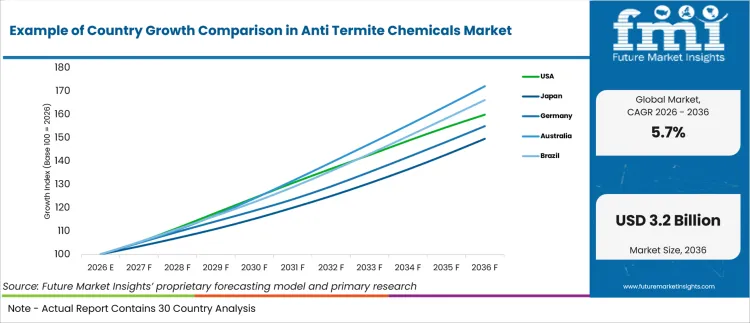
| Country | CAGR |
|---|---|
| United States | 4.8% |
| Japan | 4.1% |
| Germany | 4.5% |
| Australia | 5.6% |
| Brazil | 5.2% |
How do country-level CAGRs compare in the Anti Termite Chemicals Market?
The country forecasts remain relatively close across the anti-termite chemicals market, with a 1.5 percentage point gap between Australia and Japan. Australia and Brazil form an upper group, reflecting strong demand for termite prevention in regions with higher infestation risks and active construction sectors. The United States remains closely aligned with these markets and benefits from an established pest control industry. Germany and Japan create a lower pair with limited separation, where demand is supported more by building preservation and preventive treatments than by severe termite pressure.
- Australia benefits from widespread termite activity and extensive use of preventive treatment systems.
- Brazil continues to expand through rising construction activity and growing awareness of structural protection.
- The United States supports steady demand through professional pest management services and routine termite control programs.
- Germany reflects consistent adoption of wood protection and building maintenance solutions.
- Japan maintains demand through ongoing efforts to safeguard residential and commercial structures from termite damage.
The full report provides country-level CAGR analysis across North America, Latin America, Europe, East Asia, South Asia, Oceania and the Middle East and Africa.
Country-wise Analysis
- United States structural treatments operate through EPA-registered labels and state certification requirements governing professional application across properties. By 2036, the United States is projected to grow at 4.8% CAGR, supported by mature service networks. National distribution gives contractors access to liquid termiticides and monitored bait systems across major service territories. The EPA explained in March 2026 that restricted-use pesticide applicators need certification in each state or territory. State certification gives property owners an accountable service route with documented retreatment responsibility across each protected structure. Separate renewal rules raise training expense and complicate expansion across jurisdictions with different professional requirements.
- Japanese practice emphasizes documented treatment methods and qualified contractors across housing projects and renovation work. Japan's Ministry of Land reported in January 2026 that housing starts declined 1.3% during December 2025. Anti termite chemical demand in Japan is forecast to rise at 4.1% CAGR over the forecast period, influenced by renovation demand. Lower new-build volume increases dependence on repeat residential work and established regional service channels nationally. Entrants need Japanese-language instructions and compact equipment suited to dispersed renovation sites across established urban districts. Travel time and dealer stock remain material frictions outside major metropolitan service areas and corridors.
- German products require biocidal authorization and clear professional-use conditions across every structural treatment setting nationally. The German anti termite chemicals sector is projected to record 4.5% CAGR during the assessment period, reinforced by renovation work and contractor documentation. Qualified contractors turn authorization files into defensible application plans during renovation and later inspection work. Destatis reported 238,500 dwelling permits during 2025 in its February 2026 release on construction activity. The project pipeline supports accessible work without proving termiticide purchasing across every approved residential property. Authorization expense and German-language documentation constrain smaller portfolios entering professional distribution across regional service territories.
- Australian projects integrate termite management with building design and certified installation under national practice standards. Installer accreditation gives registered chemical systems a direct route into covered construction and later inspections. Anti termite chemical sales in Australia are forecast to expand at 5.6% CAGR by 2036, supported by pre-construction programs. Approved construction activity sustains installation demand, but long service distances constrain inspections across remote territories. The Australian Bureau of Statistics reported 15,542 dwelling approvals in February 2026 for the December 2025 period. Regional stock and durable treatment notices support continuity across projects and later corrective work throughout active contracts.
- Brazil combines an occupied housing stock with environmental controls affecting fipronil use across structural service programs. Brazil's anti termite chemicals outlook is anticipated to advance at 5.2% CAGR over the assessment period, shaped by residential service demand. IBGE recorded 79.3 million permanent private housing units during 2025 in its April 2026 release. The housing base supports service potential without proving uniform treatment adoption across distant regional markets. Uneven access to trained applicators raises travel expense across properties using varied construction materials nationally. Portuguese-language guidance and corrective capacity give professional service networks a practical operating route across national territories.
Who are the notable companies in the Anti Termite Chemicals Market?
BASF, Envu, Syngenta, Control Solutions Inc., Ensystex, Nisus Corporation, Corteva Agriscience, and UPL are the notable companies profiled in this market.
The anti termite chemicals field is moderately fragmented across liquid chemistry and bait systems alongside wood-treatment specialists. Entry remains possible through one registered treatment route, although national approvals and installer support limit geographic expansion. Competition centers on label breadth and treatment flexibility across active professional programs and structural settings. Technician training and follow-up responsibility determine whether registered products deliver repeatable protection across varied properties. Portfolio scale matters less than current authorizations and dependable service partners across each active national market.
- BASF and Envu combine registered liquid termiticides with professional support across several international regions and service markets. Their specialty chemical portfolios rely on trained installer networks that translate product breadth into defensible treatment programs and recurring inspections across protected buildings.
- Syngenta and Control Solutions provide liquid structural chemistry across active professional channels and service territories. Ensystex adds liquid and bait routes for properties with different access requirements, making technician guidance more decisive than broad brand visibility during local treatment selection.
- Nisus Corporation competes through low-leaching preservatives across wood-treatment formats, whereas Corteva Agriscience concentrates on monitored bait systems. UPL serves regional liquid programs requiring local registration and dependable partners for inspections and corrective service across active territories and varied building types.
Competitive Benchmarking: Anti Termite Chemicals Market
| Company | Registered Chemical Breadth | Non-soil Treatment Routes | Installer Support | Geographic Reach |
|---|---|---|---|---|
| BASF | High | High | High | Global or multi-region |
| Envu | High | Medium | High | Global or multi-region |
| Syngenta | High | High | Medium | North America |
| Control Solutions Inc. | High | High | Medium | United States |
| Ensystex | High | High | Medium | Global or multi-region |
| Nisus Corporation | Medium | High | Medium | United States and Canada |
| Corteva Agriscience | Low | High | High | Global or multi-region |
| UPL | High | Medium | Medium | India |
Key Developments in the Anti Termite Chemicals Market
- In April 2025, Envu launched a certified ten-year Premise warranty for eligible Indian pre-construction projects completed by approved applicators. The program linked product assurance with IS 6313 application standards and Envu Pest Expert Alliance membership.
- In June 2026, UPL Australia Pty Ltd submitted an APVMA application for BISECT Duo 100 EC containing bifenthrin. The proposed registration covers structural protection from subterranean termite damage beside other urban pest uses.
- In March 2026, Exterminex (Australia) Pty Ltd submitted an APVMA application for Exterminex 3 Termite Bait containing chlorfluazuron. The proposed registration covers a termite interception and baiting system for managing subterranean infestations under defined label conditions.
- In November 2025, TERMSEAL Australia Pty Ltd submitted an APVMA application for Assassin Liquid Termite Bait containing fipronil gel. The proposed use covers subterranean termite control under defined professional directions and application conditions across eligible sites.
Anti Termite Chemicals Market - Report Scope
| Coverage field | Report scope |
|---|---|
| Market breakdown | Chemical type, formulation, application, end use, sales channel, and region. |
| Market Definition | Chemical formulations, bait systems, wood treatments, and integrated products used to prevent or control termite damage across structures and related applications. |
| Regions Covered | North America, Latin America, Western Europe, Eastern Europe, East Asia, South Asia and Pacific, and Middle East and Africa. |
| Countries Covered | United States, Japan, Germany, Australia, and Brazil, with 20+ countries included in the full regional model. |
| Key Companies Profiled | BASF, Envu, Syngenta, Control Solutions Inc., Ensystex, Nisus Corporation, Corteva Agriscience, and UPL. |
| Forecast Period | 2026 to 2036. |
| Approach | Hybrid bottom-up and top-down market sizing supported by primary interviews and official desk research. |
Anti Termite Chemicals Market - Research Methodology
| Method | Approach |
|---|---|
| Primary Research | FMI analysts gathered input from manufacturers, service providers, technology developers, distributors, end users, procurement teams, and subject-matter experts. Interviews examined purchasing decisions, product or service evaluation, adoption barriers, approval requirements, pricing considerations, and expectations for technical or commercial support. Respondents were also asked what evidence is required before a trial, pilot, or initial order develops into regular purchasing. |
| Desk Research | Desk research covered government statistics, regulatory publications, trade data, industry associations, technical literature, standards, company filings, product information, and official corporate announcements. Sources were reviewed for relevance, publication date, geographic coverage, and consistency with the defined market scope. Claims relating to performance, applications, approvals, capacity, investment, and commercial activity were retained only when supported by credible public evidence. |
| Market Sizing and Forecasting | The market model combined the baseline value with historical performance, segment structure, pricing and volume indicators, adoption levels, company participation, and country-level demand conditions. Forecast assumptions considered economic activity, investment trends, regulatory developments, technology adoption, purchasing cycles, supply availability, and barriers to wider market use. Segment and regional estimates were reconciled before the final market total was calculated. |
| Data Validation | Estimates were checked against multiple independent indicators, including public data, company activity, trade patterns, industry developments, and findings from primary interviews. Validation also tested whether products, services, applications, and company revenues fell within the defined market boundaries. Adjacent categories, unsupported claims, overlapping revenues, and activities without direct market relevance were excluded to reduce double counting and maintain consistency across segments and countries. |
Anti Termite Chemicals Market by Segments
Anti Termite Chemicals Market segmented by Chemical Type:
- Fipronil
- Imidacloprid
- Bifenthrin
- Chlorpyrifos Alternatives
- Boric Acid
- Bio-based Termiticides
Anti Termite Chemicals Market segmented by Formulation:
- Liquid Concentrates
- Ready-to-use Liquids
- Foams
- Powders
- Bait Systems
Anti Termite Chemicals Market segmented by Application:
- Pre-construction Soil Treatment
- Post-construction Treatment
- Wood Treatment
- Barrier / Baiting Programs
Anti Termite Chemicals Market segmented by End Use:
- Residential
- Commercial Buildings
- Infrastructure / Industrial
- Pest Control Operators
Anti Termite Chemicals Market segmented by Sales Channel:
- Pest Control Service Providers
- Agrochemical Distributors
- Retail / Hardware
- Direct Project Supply
Anti Termite Chemicals Market by Region:
- North America
- United States
- Canada
- Latin America
- Brazil
- Mexico
- Argentina
- Chile
- Western Europe
- Germany
- France
- United Kingdom
- Italy
- Spain
- Benelux
- Nordics
- Eastern Europe
- Poland
- Czech Republic
- Romania
- Hungary
- East Asia
- China
- Japan
- South Korea
- South Asia and Pacific
- India
- ASEAN
- Australia and New Zealand
- Middle East and Africa
- GCC Countries
- South Africa
- Türkiye
- Israel
Research Sources and Bibliography
- USA Environmental Protection Agency. (2025, October 21). Termites: How to Identify and Control Them.
- Australian Building Codes Board. (n.d.). Part 3.4 Termite risk management.
- BASF. (n.d.). Termiticides.
- BASF. (n.d.). Termidor® Foam Termiticide/Insecticide.
- Control Solutions Inc. (n.d.). TAURUS® SC.
- Johnson, J. (2025, February 25). Proactive Termite Prevention: A Must for Every Pest Pro. Control Solutions Inc.
- USA Census Bureau. (2026, July 17). Monthly New Residential Construction, June 2026.
- Envu Malaysia. (2025, May 13). Termite Training Registration.
- European Commission. (n.d.). Biocidal products.
- Australian Pesticides and Veterinary Medicines Authority. (2026, July 10). Fipronil chemical review.
- Brazilian Institute of the Environment and Renewable Natural Resources. (2026, February 3). Ibama publica Comunicado que dá continuidade à reanálise ambiental de agrotóxicos à base de fipronil.
- USA Environmental Protection Agency. (2026, March 11). How to Get Certified as a Pesticide Applicator.
- Ministry of Land, Infrastructure, Transport and Tourism. (2026, January 30).
- Statistisches Bundesamt (Destatis). (2026, February 18). 10,8 % mehr Baugenehmigungen für Wohnungen im Jahr 2025.
- Australian Bureau of Statistics. (2026, February 3). Building Approvals, Australia, December 2025.
- Brazilian Institute of Geography and Statistics. (2026, April 17). Rented housing units grew more than 50% since 2016.
- Envu India. (2025, April 15). Envu Introduces India’s First Certified 10-Year Termite Warranty with Premise.
- Australian Pesticides and Veterinary Medicines Authority. (2026, June 26). Application summaries.
- Australian Pesticides and Veterinary Medicines Authority. (2026, March 5). Application summaries.
- Australian Pesticides and Veterinary Medicines Authority. (2025, November 19). Application summaries.
This bibliography is provided for reader reference and is not exhaustive. The full report contains the complete reference list and detailed citations
This Report Answers
- How large is the anti termite chemicals market in 2026 and 2036?
- Which construction and service conditions support demand for registered structural termiticides?
- Why does fipronil hold the largest chemical type share during 2026?
- How do liquid concentrates influence treatment planning across foundation applications?
- Why does pre-construction soil treatment account for the largest application share?
- How do country growth rates differ across the United States, Japan, Germany, Australia, and Brazil?
- Which companies provide liquid, bait, wood-treatment, or regional structural solutions?
- What regulatory and installation factors limit market adoption?
- What should decision-makers evaluate before selecting an anti termite chemical program?
Frequently Asked Questions
How big is the Anti Termite Chemicals Market in 2026?
The anti termite chemicals market is valued at USD 1.9 billion in 2026 and is forecast to reach USD 3.2 billion by 2036. Growth is supported by construction activity and recurring structural inspections that sustain registered termiticide demand across professional pest management services and documented treatment programs worldwide.
What is the CAGR of the Anti Termite Chemicals Market from 2026 to 2036?
The anti termite chemicals market grows at a CAGR of 5.7% between 2026 and 2036, supported by construction pipelines and recurring inspection obligations that drive professional demand for registered liquid termiticides, bait systems, and wood treatments across residential, commercial, and infrastructure properties globally.
Which chemical type leads the Anti Termite Chemicals Market?
Fipronil accounts for 24.0% of the anti termite chemicals market by chemical type in 2026, driven by established non-repellent soil treatment programs that support continuous coverage around foundations and service penetrations across licensed professional pest management operations and recurring structural protection contracts.
How much will the Anti Termite Chemicals Market add between 2026 and 2036?
The anti termite chemicals market is set to add USD 1.3 billion between 2026 and 2036, growing from USD 1.9 billion to USD 3.2 billion as construction activity and regulated professional pest management services expand registered structural treatment programs across residential, commercial, and infrastructure properties worldwide.
Who are the leading companies in the Anti Termite Chemicals Market?
Eight companies lead the anti termite chemicals market, including BASF, Envu, Syngenta, Control Solutions Inc., Ensystex, Nisus Corporation, Corteva Agriscience, and UPL, competing through registered liquid termiticides, monitored bait systems, low-leaching wood preservatives, and professional installer support across structural protection programs globally.
Preview the report firsthand - request a free sample
Get SampleGet the brochure for pricing and purchase details.
Get PDFTable of Content
- Key Takeaways
- Market Size and CAGR
- Top Growth Driver
- Fastest Growing Segment
- Leading Region
- Key Companies
- Emerging Opportunities
- Executive Summary
- Global Market Outlook
- Demand-side Trends
- Supply-side Trends
- Technology Roadmap Analysis
- Analysis and Recommendations
- Analyst Perspective (What is happening? Why now? What should investors know?)
- Key Questions Answered
- How large is the market?
- What is the CAGR?
- What are key trends?
- Which region dominates?
- Who are the leaders?
- Market Overview
- Market Coverage / Taxonomy
- Market Definition / Scope / Limitations
- Research Methodology
- Chapter Orientation
- Analytical Lens and Working Hypotheses
- Market Structure, Signals, and Trend Drivers
- Benchmarking and Cross-market Comparability
- Market Sizing, Forecasting, and Opportunity Mapping
- Research Design and Evidence Framework
- Desk Research Programme (Secondary Evidence)
- Expert Input and Fieldwork (Primary Evidence)
- Tooling, Models, and Reference Databases
- Data Engineering and Model Build
- Quality Assurance and Audit Trail
- Market Background
- Market Dynamics (Drivers, Restraints, Opportunity, Trends)
- Scenario Forecast (Optimistic, Likely, Conservative)
- Impact Analysis
- AI Impact
- Sustainability Impact
- Regulatory Impact
- Technology Impact
- Consumer / Buyer Analysis
- Purchase Drivers
- Adoption Barriers
- Buyer Journey
- Opportunity Map Analysis
- Product Life Cycle Analysis
- Supply Chain Analysis
- Investment Feasibility Matrix
- Value Chain Analysis
- PESTLE and Porter's Analysis
- Regulatory Landscape
- Regional Parent Market Outlook
- Production and Consumption Statistics
- Import and Export Statistics
- Global Market Analysis and Forecast, 2021 to 2036
- Historical Market Size Value (USD Billion) Analysis, 2021 to 2025
- Current and Future Market Size Value (USD Billion) Projections, 2026 to 2036
- Y-o-Y Growth Trend Analysis
- Absolute $ Opportunity Analysis
- Global Market Pricing Analysis, 2021 to 2036
- Global Market Analysis and Forecast, By Chemical Type, 2021 to 2036
- Introduction / Key Findings
- Historical Market Size Value (USD Billion) Analysis By Chemical Type, 2021 to 2025
- Current and Future Market Size Value (USD Billion) Analysis and Forecast By Chemical Type, 2026 to 2036
- Fipronil
- Imidacloprid
- Bifenthrin
- Chlorpyrifos Alternatives
- Boric Acid
- Bio-based Termiticides
- Fipronil
- Y-o-Y Growth Trend Analysis By Chemical Type, 2021 to 2025
- Absolute $ Opportunity Analysis By Chemical Type, 2026 to 2036
- Global Market Analysis and Forecast, By Formulation, 2021 to 2036
- Introduction / Key Findings
- Historical Market Size Value (USD Billion) Analysis By Formulation, 2021 to 2025
- Current and Future Market Size Value (USD Billion) Analysis and Forecast By Formulation, 2026 to 2036
- Liquid Concentrates
- Ready-to-use Liquids
- Foams
- Powders
- Bait Systems
- Liquid Concentrates
- Y-o-Y Growth Trend Analysis By Formulation, 2021 to 2025
- Absolute $ Opportunity Analysis By Formulation, 2026 to 2036
- Global Market Analysis and Forecast, By Application, 2021 to 2036
- Introduction / Key Findings
- Historical Market Size Value (USD Billion) Analysis By Application, 2021 to 2025
- Current and Future Market Size Value (USD Billion) Analysis and Forecast By Application, 2026 to 2036
- Pre-construction Soil Treatment
- Post-construction Treatment
- Wood Treatment
- Barrier / Baiting Programs
- Pre-construction Soil Treatment
- Y-o-Y Growth Trend Analysis By Application, 2021 to 2025
- Absolute $ Opportunity Analysis By Application, 2026 to 2036
- Global Market Analysis and Forecast, By End Use, 2021 to 2036
- Introduction / Key Findings
- Historical Market Size Value (USD Billion) Analysis By End Use, 2021 to 2025
- Current and Future Market Size Value (USD Billion) Analysis and Forecast By End Use, 2026 to 2036
- Residential
- Commercial Buildings
- Infrastructure / Industrial
- Pest Control Operators
- Residential
- Y-o-Y Growth Trend Analysis By End Use, 2021 to 2025
- Absolute $ Opportunity Analysis By End Use, 2026 to 2036
- Global Market Analysis and Forecast, By Sales Channel, 2021 to 2036
- Introduction / Key Findings
- Historical Market Size Value (USD Billion) Analysis By Sales Channel, 2021 to 2025
- Current and Future Market Size Value (USD Billion) Analysis and Forecast By Sales Channel, 2026 to 2036
- Pest Control Service Providers
- Agrochemical Distributors
- Retail / Hardware
- Direct Project Supply
- Pest Control Service Providers
- Y-o-Y Growth Trend Analysis By Sales Channel, 2021 to 2025
- Absolute $ Opportunity Analysis By Sales Channel, 2026 to 2036
- Global Market Analysis and Forecast, By Region, 2021 to 2036
- Introduction
- Historical Market Size Value (USD Billion) Analysis By Region, 2021 to 2025
- Current Market Size Value (USD Billion) Analysis and Forecast By Region, 2026 to 2036
- North America
- Latin America
- Western Europe
- Eastern Europe
- East Asia
- South Asia and Pacific
- Middle East & Africa
- Market Attractiveness Analysis By Region
- North America Market Analysis and Forecast, By Country, 2021 to 2036
- Historical Market Size Value (USD Billion) Trend Analysis By Market Taxonomy, 2021 to 2025
- Market Size Value (USD Billion) Forecast By Market Taxonomy, 2026 to 2036
- By Country
- USA
- Canada
- By Chemical Type
- By Formulation
- By Application
- By End Use
- By Sales Channel
- By Country
- Market Attractiveness Analysis
- By Country
- By Chemical Type
- By Formulation
- By Application
- By End Use
- By Sales Channel
- Key Takeaways
- Latin America Market Analysis and Forecast, By Country
- Historical Market Size Value (USD Billion) Trend Analysis By Market Taxonomy, 2021 to 2025
- Market Size Value (USD Billion) Forecast By Market Taxonomy, 2026 to 2036
- By Country
- Brazil
- Mexico
- Chile
- Rest of Latin America
- By Chemical Type
- By Formulation
- By Application
- By End Use
- By Sales Channel
- By Country
- Market Attractiveness Analysis
- By Country
- By Chemical Type
- By Formulation
- By Application
- By End Use
- By Sales Channel
- Key Takeaways
- Western Europe Market Analysis and Forecast, By Country
- Historical Market Size Value (USD Billion) Trend Analysis By Market Taxonomy, 2021 to 2025
- Market Size Value (USD Billion) Forecast By Market Taxonomy, 2026 to 2036
- By Country
- Germany
- UK
- Italy
- Spain
- France
- Nordic
- BENELUX
- Rest of Western Europe
- By Chemical Type
- By Formulation
- By Application
- By End Use
- By Sales Channel
- By Country
- Market Attractiveness Analysis
- By Country
- By Chemical Type
- By Formulation
- By Application
- By End Use
- By Sales Channel
- Key Takeaways
- Eastern Europe Market Analysis and Forecast, By Country
- Historical Market Size Value (USD Billion) Trend Analysis By Market Taxonomy, 2021 to 2025
- Market Size Value (USD Billion) Forecast By Market Taxonomy, 2026 to 2036
- By Country
- Russia
- Poland
- Hungary
- Balkan & Baltic
- Rest of Eastern Europe
- By Chemical Type
- By Formulation
- By Application
- By End Use
- By Sales Channel
- By Country
- Market Attractiveness Analysis
- By Country
- By Chemical Type
- By Formulation
- By Application
- By End Use
- By Sales Channel
- Key Takeaways
- East Asia Market Analysis and Forecast, By Country
- Historical Market Size Value (USD Billion) Trend Analysis By Market Taxonomy, 2021 to 2025
- Market Size Value (USD Billion) Forecast By Market Taxonomy, 2026 to 2036
- By Country
- China
- Japan
- South Korea
- By Chemical Type
- By Formulation
- By Application
- By End Use
- By Sales Channel
- By Country
- Market Attractiveness Analysis
- By Country
- By Chemical Type
- By Formulation
- By Application
- By End Use
- By Sales Channel
- Key Takeaways
- South Asia and Pacific Market Analysis and Forecast, By Country
- Historical Market Size Value (USD Billion) Trend Analysis By Market Taxonomy, 2021 to 2025
- Market Size Value (USD Billion) Forecast By Market Taxonomy, 2026 to 2036
- By Country
- India
- ASEAN
- Australia & New Zealand
- Rest of South Asia and Pacific
- By Chemical Type
- By Formulation
- By Application
- By End Use
- By Sales Channel
- By Country
- Market Attractiveness Analysis
- By Country
- By Chemical Type
- By Formulation
- By Application
- By End Use
- By Sales Channel
- Key Takeaways
- Middle East & Africa Market Analysis and Forecast, By Country
- Historical Market Size Value (USD Billion) Trend Analysis By Market Taxonomy, 2021 to 2025
- Market Size Value (USD Billion) Forecast By Market Taxonomy, 2026 to 2036
- By Country
- Kingdom of Saudi Arabia
- Other GCC Countries
- Türkiye
- South Africa
- Other African Union
- Rest of Middle East & Africa
- By Chemical Type
- By Formulation
- By Application
- By End Use
- By Sales Channel
- By Country
- Market Attractiveness Analysis
- By Country
- By Chemical Type
- By Formulation
- By Application
- By End Use
- By Sales Channel
- Key Takeaways
- Key Countries Market Analysis
- USA
- Pricing Analysis
- Market Share Analysis, 2025
- By Chemical Type
- By Formulation
- By Application
- By End Use
- By Sales Channel
- Canada
- Pricing Analysis
- Market Share Analysis, 2025
- By Chemical Type
- By Formulation
- By Application
- By End Use
- By Sales Channel
- Mexico
- Pricing Analysis
- Market Share Analysis, 2025
- By Chemical Type
- By Formulation
- By Application
- By End Use
- By Sales Channel
- Brazil
- Pricing Analysis
- Market Share Analysis, 2025
- By Chemical Type
- By Formulation
- By Application
- By End Use
- By Sales Channel
- Chile
- Pricing Analysis
- Market Share Analysis, 2025
- By Chemical Type
- By Formulation
- By Application
- By End Use
- By Sales Channel
- Germany
- Pricing Analysis
- Market Share Analysis, 2025
- By Chemical Type
- By Formulation
- By Application
- By End Use
- By Sales Channel
- UK
- Pricing Analysis
- Market Share Analysis, 2025
- By Chemical Type
- By Formulation
- By Application
- By End Use
- By Sales Channel
- Italy
- Pricing Analysis
- Market Share Analysis, 2025
- By Chemical Type
- By Formulation
- By Application
- By End Use
- By Sales Channel
- Spain
- Pricing Analysis
- Market Share Analysis, 2025
- By Chemical Type
- By Formulation
- By Application
- By End Use
- By Sales Channel
- France
- Pricing Analysis
- Market Share Analysis, 2025
- By Chemical Type
- By Formulation
- By Application
- By End Use
- By Sales Channel
- India
- Pricing Analysis
- Market Share Analysis, 2025
- By Chemical Type
- By Formulation
- By Application
- By End Use
- By Sales Channel
- ASEAN
- Pricing Analysis
- Market Share Analysis, 2025
- By Chemical Type
- By Formulation
- By Application
- By End Use
- By Sales Channel
- Australia & New Zealand
- Pricing Analysis
- Market Share Analysis, 2025
- By Chemical Type
- By Formulation
- By Application
- By End Use
- By Sales Channel
- China
- Pricing Analysis
- Market Share Analysis, 2025
- By Chemical Type
- By Formulation
- By Application
- By End Use
- By Sales Channel
- Japan
- Pricing Analysis
- Market Share Analysis, 2025
- By Chemical Type
- By Formulation
- By Application
- By End Use
- By Sales Channel
- South Korea
- Pricing Analysis
- Market Share Analysis, 2025
- By Chemical Type
- By Formulation
- By Application
- By End Use
- By Sales Channel
- Russia
- Pricing Analysis
- Market Share Analysis, 2025
- By Chemical Type
- By Formulation
- By Application
- By End Use
- By Sales Channel
- Poland
- Pricing Analysis
- Market Share Analysis, 2025
- By Chemical Type
- By Formulation
- By Application
- By End Use
- By Sales Channel
- Hungary
- Pricing Analysis
- Market Share Analysis, 2025
- By Chemical Type
- By Formulation
- By Application
- By End Use
- By Sales Channel
- Kingdom of Saudi Arabia
- Pricing Analysis
- Market Share Analysis, 2025
- By Chemical Type
- By Formulation
- By Application
- By End Use
- By Sales Channel
- Türkiye
- Pricing Analysis
- Market Share Analysis, 2025
- By Chemical Type
- By Formulation
- By Application
- By End Use
- By Sales Channel
- South Africa
- Pricing Analysis
- Market Share Analysis, 2025
- By Chemical Type
- By Formulation
- By Application
- By End Use
- By Sales Channel
- USA
- Market Structure Analysis
- Competition Dashboard
- Competition Benchmarking
- Market Share Analysis of Top Players
- By Regional
- By Chemical Type
- By Formulation
- By Application
- By End Use
- By Sales Channel
- Emerging Startups
- Innovation Benchmarking
- Competition Analysis
- Competition Deep Dive
- Bayer
- Overview
- Product Portfolio
- Profitability by Market Segments
- Sales Footprint
- Strategy Overview
- Marketing Strategy
- Product Strategy
- Channel Strategy
- BASF
- Syngenta
- FMC
- Sumitomo Chemical
- UPL
- Ensystex
- Control Solutions
- Nufarm
- Nisus Corporation
- Bayer
- Case Studies
- Success Stories
- Recent Developments
- Competition Deep Dive
- Assumptions & Acronyms Used


